

A Different Way to Well: Reimagining Wellness Without the Rules
What if wellness wasn’t about doing more, but about doing what feels good?
We’re overwhelmed with advice about how to live well.
Drink less. Eat more fibre. Get better sleep. Lift heavy. Walk outside. Meditate. Journal. Cold plunge. Biohack.
If you’ve ever felt like wellness has become a never-ending to-do list, you’re not alone.
That’s exactly where we began in the latest episode of A Thought I Kept — in a conversation with the journalist, author, and Substack writer Rosamund Dean. And what unfolded was a candid, open reframe on how we might give ourselves permission to do wellbeing differently?

Wellness Without the Pressure
Rosamund and I both come from backgrounds where “wellness” was something we didn’t feel part of. The green juice crowd. The sanctimonious language. The quiet implication that if you weren’t waking at 5am to train and sip mushroom coffee, you were failing.
But what stood out in our conversation — and what I’ve been thinking about ever since — was this idea of choice.
For Rosamund, that shift began not with a life overhaul, but a single comment overheard at a sobriety conference:
““The only thing I’ve given up is hangovers.””
That offhand remark reframed everything. It wasn’t about giving something up. It was about getting something back — joy, clarity, energy, connection.
And that opened the door to a very different kind of wellbeing. One that asks:
What makes me feel like me?
What am I ready to reclaim?
What am I tired of pretending to enjoy?
The Wellness Fatigue Is Real
We talked about that too — how the shoulds are so loud right now.
We should sleep better.
We should go alcohol-free.
We should wild swim, eat kale, and somehow find joy in weighted lunges.
And the truth is: many of us want to live better, but we’re also exhausted by the sameness of it all.
Rosamund put it beautifully: that it’s not the what anymore — it’s the how that we need.
So What Is a Different Way to Well?
Here’s what emerged from our chat — and what I hope will land with you today:
1. Start with Joy, Not Judgment
Let go of the wellness rules you don’t connect with. If you hate mushrooms, don’t eat them. If wild swimming fills you with dread, skip it. There are other ways.
2. See Wellbeing as a Practice, Not a Fix
You don’t have to become a non-drinker or a 5am person overnight. Ask instead: “What would it be like if I tried this today?”
3. Make It Social
Walking with friends. Cooking with kids. Chatting over kombucha. These are valid, vibrant acts of wellness.
4. Expand the Definition
Wellbeing isn’t just nutrition and movement. It’s awe. Laughter. Rest. Boundaries. It’s knowing yourself enough to ask what you actually need today.
This Isn’t About Perfection. It’s About Permission.
It’s about remembering that your version of “well” can look very different from anyone else’s. That taking care of yourself doesn’t have to mean subscribing to a whole new identity.
Maybe it means:
Drinking less because you want to feel sharper in the morning.
Strength training because you’re curious about feeling strong.
Going to bed earlier — not to optimise yourself — but because you’re tired.
Or maybe it means going out with friends, eating pizza, and laughing for hours. That counts too.
Want More?
This conversation with Rosamund Dean was full of honest insights, hard-earned learnings, and laugh-out-loud moments about mushroom coffee and kale guilt.
Listen to the full episode of A Thought I Kept here or search for it wherever you get your podcasts.
If wellness has felt a bit meh lately — this one’s for you.
Some questions to leave you with:
What part of wellness feels most alive for you right now?
What are you tired of pretending to like?
What’s your different way to well?

When Change Feels Like Too Much (or Not Enough)
A note for anyone feeling a little lost, a little tired, or quietly done with being told to “just push through.”
Change has become a bit of a cultural obsession. We’re told to embrace it, manifest it, optimize it, and if nothing else, get ahead of it. But what if you’re not ready for change?
What if you don’t even know where to begin — or worse, you’re so tired that even thinking about beginning feels like too much?
What if your to-do list is buried under feelings you can’t quite name, and change feels like another thing you're supposed to “achieve”?
Change can be powerful, but a lot of the time, it just feels hard.
It can feel like you’re supposed to reinvent your life, quit your job, start journaling, meditate, heal your nervous system, launch something meaningful, and find inner peace… all before breakfast.

In this week’s episode of A Thought I Kept, I spoke with Eleanor Tweddell — author of Another Door Opens and someone who has spent years thinking about how we navigate the murky middle of change.
Not the TED Talk version. The real version. The one where you feel uncertain, messy, and nothing is falling neatly into place.
And we kept circling back to one idea that feels worth offering here:
You don’t have to make change happen.
Sometimes, the most powerful thing you can do is make space for it.
So what do you do when you feel…lost?
When you’re feeling lost, it’s tempting to look for a map. A mentor. A checklist.
But when you’ve lost your sense of direction, what you often need most is stillness, not movement.
Try this:
Sit with the question: “What do I know to be true about me today?” Even if the answer is small. Even if it’s “I’m tired,” or “I love my morning coffee.”
Take the pressure off needing big answers. Instead, track what gives you a spark of energy or a softening in your body. These are breadcrumbs that you can tentatively start to follow.
We don’t often start with clarity. Sometimes we arrive with better questions — and that’s enough.
What to do when you feel…burned out
When you’re burned out, everything feels like another task — even things that are meant to help you.
But change doesn’t have to be action. Sometimes, the bravest, most radical thing you can do is nothing.
Instead of asking: “What should I do next?”
Try asking: “What would it look like to stop trying so hard today?”
Then let yourself off the hook — completely.
Ideas to try:
Take a tech-free walk with no goal.
Cancel something that doesn’t matter as much as your wellbeing.
Let your brain idle — yes, even with a box set or a nap.
As Eleanor shared, the most productive thing she did on the launch day of her book was make coffee and sit in the sun. That was enough.
What to do when you feel…overwhelmed
Overwhelm is often less about how much we have to do, and more about how much we’re holding in our heads and hearts without release.
Your nervous system doesn’t need another productivity hack.
It needs a moment of exhale.
Try this 3-step reset:
Name it: “I feel overwhelmed because…”
List it: Brain-dump everything that’s buzzing in your mind. No filtering.
Choose ONE: What’s one thing you could do today that would make you feel 5% more in control?
And if even that’s too much?
You’re allowed to press pause. You’re allowed to say “not today” to change.
Sometimes, the most generous act is letting go of urgency.
What to do when you feel… disconnected
When we’re disconnected, it can feel like we’re moving through life on autopilot.
We say yes when we want to say no. We scroll instead of feeling. We forget what brings us joy.
This is where a values check-in can bring you back to yourself.
Ask: What actually matters to me right now — not what used to, not what “should”? Where in my life am I living out of alignment with that?
You don’t need to overhaul everything. Just start by noticing.
If you’re a Wellery Member, you’ll find our full Values Check-In exercise here
And if that’s too much today?
Do one small thing that feels like you — not your “best” self, not your productive self, just your real self.
Maybe that’s:
Cooking a meal you love, just for you
Putting on music and dancing in the kitchen
Saying no to something you don’t want to do
The first step doesn’t have to bring clarity. Sometimes it’s more about connection. And that often starts with listening inward again.
You’re not doing it wrong. You’re just in it.
Navigating change isn’t about always knowing the next step.
Sometimes, it’s about standing still long enough to hear yourself think.
And in this week’s episode, Eleanor Tweddell makes the case for something both radical and restorative:
“Always hold space for magic. ”
Even when you’re tired. Even when you’re uncertain. Even when you don’t believe in it yet.
Because sometimes, what’s next arrives when you stop trying so hard to find it.
Listen to the full episode:
If you’ve ever felt like the idea of change is just too much, you’re not alone.
In our 1:1 sessions and The Wellery community, we see this again and again:
Some people are stuck in jobs that no longer feel right, but can’t imagine where else to go.
Some are depleted from caring for others and don’t know how to care for themselves.
Others are done with self-development and just want to feel like themselves again.
So instead of forcing clarity or making a five-year plan, here’s a better question:
What if you’re not utterly lost — just in a moment of in-between?
And what if that space could be a beginning, not a failure?
Want more thoughtful support that fits with your real-life?
Join The Wellery for deeper reflections, journaling prompts, and tools to help you stay connected to yourself while navigating change.
Feeling Disconnected? Here’s a Gentle Way to Reconnect With Yourself
Feeling overwhelmed, untethered or emotionally stuck? Today we’re sharing one simple, powerful way to reconnect with yourself — and why slowing down might be the best next step.
What if you didn’t need fixing?
It’s easy to believe we’re supposed to have ourselves sorted by now — that we should already know what we need, how to feel better, and how to move through our days without faltering. But what if the real work wasn’t in fixing or figuring it all out? What if it was something quieter?
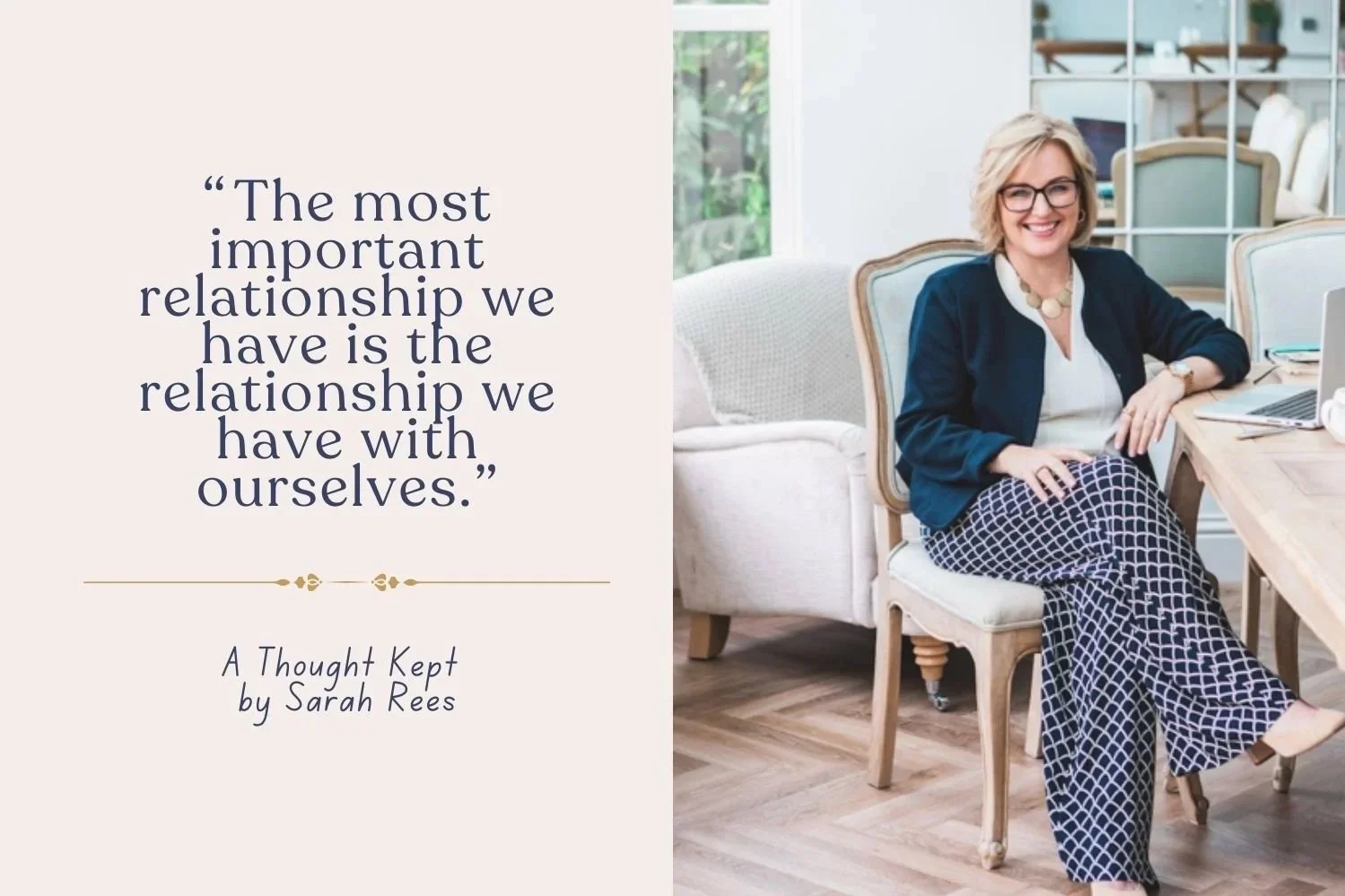
In this week’s episode of A Thought I Kept, I spoke with therapist Sarah Rees about the idea that’s stayed with her over the years:
““The most important relationship we have is the one we have with ourselves.””
The Tools We Think We Need
It’s tempting to rush to tools, techniques, productivity hacks, or another podcast episode that promises to fix whatever feels off. Sarah shared how, early in her training, she felt the same pull: to reach outside of herself for answers — to search for the next solution, the next strategy.
But the turning point came when she learned that compassion isn’t about quick fixes. It begins with turning toward ourselves. It’s about recognising that we’re already carrying a lot — and that maybe, just maybe, we don’t need to add more.
Why It’s Hard to Slow Down
So many of us are doing our best in lives that are full to the brim. Slowing down sounds lovely in theory — but in reality, it can feel uncomfortable. Almost unfamiliar.
We might not even realise we’re bypassing our own needs until something forces us to stop. Sarah put it beautifully:
““I work with lots of people who’ve lost the cues of hunger and thirst — they even forget to go to the toilet because they’re so out of touch with themselves.””
We’re living at a pace that often disconnects us from the simplest things — not just our feelings, but our bodies too.
A Small, Everyday Shift
So what do we do instead?
We slow things down.
We check in.
Not in a capital-S Self-Care way, but in the quiet way you might check in on a friend. Gently. Without judgement.
It might look like:
Setting a tiny reminder on your phone to pause.
Noticing how your body feels while waiting for the kettle to boil.
Asking: “What do I need right now?” — and really listening to the answer.
Journaling just one line a day to notice what’s going on beneath the surface.
These moments — these white spaces — become places where we reconnect with ourselves. Where we don’t have to be productive or polished or perfect. We just have to be.
It’s Not About Doing More
Here’s the thing: the goal isn’t to get better at wellbeing. It’s not another thing to add to your list.
It’s about making space to meet yourself again, in a world that constantly pulls your attention elsewhere.
Maybe that starts with checking in. Maybe it means resting when you thought you should be pushing. Maybe it’s reminding yourself that your emotional life doesn’t need to be neat and tidy.
If You’re Feeling a Bit Lost
This episode is for you if you’re feeling overwhelmed, unsure, or just… a little out of sync with yourself.
And if you want to explore this more — in a grounded, everyday way — we offer 1:1 coaching sessions designed to help you get back in touch with yourself.
Explore how our coaching sessions can support you
(Or get in touch if you’re not quite sure what you need yet — we’ll figure it out together.)
When was the last time you asked yourself, “What do I really need right now?”

What Happens When You Stop Optimising and Start Moving Gently?
A wellbeing experiment in mind-body connection, Qigong, and the search for energy that stays.
Have you ever felt like your energy disappears the moment you need it most?
Maybe you’ve hit a season of life (midlife, motherhood, burnout, the unnameable fog) where your mind and body no longer feel like they’re on speaking terms. You’ve tried the morning routines, the wellness hacks, the meditation apps. But somehow, you still feel off — unanchored, disconnected, lost.
Today I wanted to share one small experiment that helped me find a way back.

Living Wellishly, Not Perfectly
Back in May, I started A Year of Living Wellish-ly, a set of micro wellbeing experiments designed not to improve me, but to reconnect back in with myself, others and the world around me.
I wasn’t looking to become a better version of myself. I just wanted to feel more like myself again — to restore the link between my mind, body, and what makes life feel good. This wasn’t about glowing skin or green juice. It was about remembering who I was when I wasn’t rushing, striving, or performing.
And it worked. For a while.
Then life did what it always does: got full. Work deadlines stacked up, school year chaos kicked in, and work on my podcast began with ten interviews recorded in one month. Slowly, my wellbeing practices drifted to the edge. What returned was fatigue, self-doubt, and a sort of body-fog where energy used to be.
How the Mind-Body Connection Works (and Why It’s Easy to Forget)
Our culture tends to separate the body and the mind, even though research tells a very different story. In fact, studies show that our mental wellbeing is inextricably linked to physical movement, breath, posture, and even how we stand in space.
The research tells us this:
Moving your body in gentle, intentional ways reduces anxiety by lowering cortisol and regulating the nervous system.
Practices like Qigong, yoga, and Tai Chi stimulate the vagus nerve, improving your heart rate variability — a key marker of emotional resilience.
A 2022 systematic review and meta-analysis published in Frontiers in Psychology titled "Effects of Qigong Exercise on the Physical and Mental Health of College Students" found that Qigong exercise significantly reduced symptoms of depression and anxiety in college students.
And here’s something else science confirms: You don’t need high-intensity workouts or perfect form to feel better. Just starting—even slowly, even awkwardly—can be enough to begin rewiring your nervous system for calm, presence, and energy that lasts.
The Experiment: Qigong in a Sprint-lit Hall with Strangers
So when spring had rolled in with that fresh-start energy, I didn’t go back to the gym. I went to Qigong.
The class was held in a community hall. I was the youngest by at least ten years. Someone offered me a chair.
Our teacher, a calm and commanding German woman, opened the session with Mary Oliver’s Wild Geese — a poem that felt like permission.
Then we moved. Slowly. Deliberately. Breathing with intention. Stroking our arms. Holding our hands out as if to welcome something. And for a few minutes, I didn’t feel lost. I felt here.
I didn’t optimise. I didn’t hustle. I just allowed myself to feel. And what I felt was… present, even radiant. Like a little bit of my light had come back.
What I Learned About Reconnecting Through Movement
This class felt like a quiet homecoming.
Qigong invited me to meet myself where I was — tired, a little cynical, hopeful despite everything. And that soft meeting helped me realise:
I don’t need to “get fit” to start.
I don’t need to understand it fully to feel the benefits.
Movement isn’t about discipline — it’s about relationship.
And when I treat my body kindly, my mind follows.
What To Do If You’re Feeling Lost, Disconnected or Overwhelmed
If you’re reading this and thinking, “That sounds nice, but I could never…” — let me offer this:
You don’t need a fancy studio, or matching leggings, or a full hour.
You could try:
A 10-minute walk without your phone
Standing barefoot in your garden and taking five slow breaths
A YouTube Qigong video
Dancing to one song in your kitchen
Stretching your arms as you make tea, and simply noticing how it feels
These are not fixes. They are invitations. And if you follow them gently, they might just lead you back to the body you call home.
From Crashed to Connected (and What’s Next)
Though I’ve moved on to the next phase of Living Wellish-ly — creativity, more on that soon — I’m carrying a few things with me:
A community sauna I want to return to
A Nordic walking group I’m curious about
A commitment to listen to what my energy needs, not just what my to-do list says
A quieter conversation between my body and mind
If you’re curious about the mind-body connection, or wondering what your version of wellbeing might look like — here’s your invitation:
Create your own mini month of movement experiments.
Let it be playful, soft, silly even.
Try Qigong or something else that surprises you.
Don’t worry about doing it right. Just do it gently.
And if you want a companion for the path, you can find my collection of mind-body reflections here.
Because you don’t have to be good.
You just have to begin.

When You Think You Need to Know More… But Really Just Need to Begin
When you're feeling lost or stuck, it's tempting to keep learning more. But what if all that knowledge is just a very clever way to avoid starting? Here's how to notice—and gently shift.
We get it. When you're feeling lost, the world starts to look like one big advice column.
Buy this book.
Sign up for that course.
Follow this expert.
Click here, scroll there.
And you? You’re trying to find your way. So you do what you’ve always done: you gather. You research. You prepare.
You stack up ideas like blankets to keep out the cold.
It feels useful. Smart, even. You're learning, right?
But here’s the thing: sometimes the impulse to “know more” isn’t clarity-seeking. Sometimes it’s a very well-disguised form of procrastination.

When Ideas Keep Us Safe (But Still Stuck)
We recently spoke to Emma Lightfoot on our podcast A Thought I Kept, and she shared something that stopped us in our tracks. A friend had gently pointed out that when Emma gets a new idea, she doesn’t immediately start it—she starts learning about it. Endlessly. Widely. Sideways.
Sound familiar?
It’s a common habit, especially for people who care deeply. Who want to get it right. Who fear failure (or being seen as someone who hasn’t got it all together).
Emma called it “learning sideways.” It gave her the comfort of movement, without the risk of failure. And we’ve all done it. Bought the book instead of opening the journal. Signed up for the challenge instead of going for the walk. Listened to another podcast on boundaries instead of actually saying no.
Awareness, Not Shame
Let’s be clear though: we love ideas. Everyday we explore what learning, growth and guidance can look like. We create courses, coach clients, share resources. But we design them with this reality in mind. That people like you might already be overwhelmed. That you don’t need another guru. That you might just need a little spark that helps you begin—right where you are.
So this isn’t a post about stopping learning.
It’s a post about noticing when you’re gathering as a form of safety… and gently asking yourself:
Am I preparing? Or am I avoiding?
What might happen if I just began?
What do I already know that I can trust?
What If You Trusted Yourself?
Emma made a pledge for 2025: no more buying books or courses on self-help. Instead, she wrote herself a list of 25 small things to do this year. She made a mini-zine as a daily reminder. And she started moving forwards—not perfectly, but consistently.
Not because she doesn’t believe in learning. But because she believes in herself now, too.
That’s something we wish more of us were taught.
That wellbeing isn’t something you acquire—it’s something you tend to.
That starting imperfectly is often more powerful than preparing forever.
That sometimes the next best step isn’t another social media scroll, course or quote—it’s a cup of tea, a deep breath, and the first 10 minutes of actually doing the thing.

A Thought to Keep
If you’re waiting to feel ready… maybe ready is a myth.
Start where you are. Begin anyway.
Write the first line. Go for the walk. Cook the simple meal.
Be in motion—imperfectly, bravely, beautifully.
You can always return to the resources later (we’ve got some good ones for when you’re ready).
But maybe the knowing you need isn’t out there.
Maybe it’s already inside you.
You can listen to this episode on Substack or wherever you get your episodes.

Feeling All the Feelings: Your Emotional Reset for September
This season can bring pressure, excitement and reflection — all at once. Discover five emotional “buckets” to help you name what you're feeling, and three ideas to help you move forward with care.
This time of year brings a lot.
Let’s be honest: September can feel like a second January — but with more admin, more emotional weight, and more packed lunches.
There’s the back-to-school energy, even if school was decades ago. There’s the quiet ache of summer’s end and the creeping sense of time speeding up again. There’s planning. There’s pressure. And then there’s everything else happening in the world that doesn’t pause just because the new school year has started.
It can be a lot. And in our experience — it’s not just you. If you’re feeling a bit wobbly, untethered, wired, hopeful, or uncertain, you’re in good company.

The 5 “emotional buckets” of September
Sometimes it helps to name what we’re feeling. So here’s how we’ve been sorting ours:
The Back-to-School Feelings
New shoes, sharpened pencils, and… unexpected anxiety. Even if you’re not the one in the classroom, the energy of this time is palpable.
Will I make new friends?
Did I get it all that preparation “right”?
Is it OK to be excited for a quiet coffee alone?
The End-of-Summer Feelings
That soft sadness of saying goodbye to sandals and sunlight. The curiosity about jumper season. The unspoken dread of tights. The wistfulness that comes when leaves start to turn and you’re not quite ready to let go.
The New-Energy-of-September Feelings
This moment has its own kind of spark. There’s something quietly energising about fresh notebooks, new planners and the idea of small resets. We’re flirting with new classes. Reconnecting with good habits. Getting gently curious about what’s next.
The Almost-the-End-of-the-Year Feelings
Wait — how is it nearly the end of the year?
Are we where we thought we’d be?
Is there still time for something more?
What happens to the dreams from January that are still waiting patiently?
The Being-in-This-World Feelings
The beauty and the burn of just life. The memes that save us and the headlines that break us. The reality that even as we plan our week, we’re still holding grief, uncertainty, frustration, hope — often all at once.
So what can we do with all these feelings?
The goal isn’t to tidy them away. (You don’t need to get all your emotions “sorted” by Monday.)
But you can offer yourself a little more space, and a little more care, in how you hold them.
Here are three gentle ways to work with whatever’s coming up:
1. Name what’s here
Try writing your own version of these emotional buckets. (Or draw them. Or voice-note them.) Naming your emotions helps your nervous system regulate and allows you to meet yourself with compassion.
2. Pick one area to reset
You don’t have to overhaul your life — but is there one small thing you’d like to come back to? A walk before work? Five minutes of journaling? Saying no to one thing that drains you? September loves a small, thoughtful something.
3. Talk it through
You don’t have to carry it all alone. Whether that’s a friend, a walk-and-talk, a therapist or a coach — speaking things aloud can help you feel less tangled and more clear.
However you feel — it’s valid.
You’re allowed to feel uncertain.
You’re allowed to feel hopeful.
You’re allowed to feel all of it — even if it doesn’t make sense.
And if this moment feels like a bit too much, we want you to know this: it’s OK. You don’t need to be ready, or productive, or totally “back.” You just need to be here. Start where you are.
Need a space to explore your next step?
Our coaching sessions are designed to meet you right in the middle of it all — whether you’re feeling stuck, curious, hopeful, or a mix of everything.
If you’re ready to feel a little clearer or more anchored this season, have a look at our coaching options. We’d love to meet you there.

On Shopfronts, Stories and Small Joys: Why Your Town Needs You to Wander It
From blue moon ice cream to poetry prescriptions, Explorer Days connect us to what’s quietly slipping away.
While 11,341 independent shops closed their doors in the UK last year, I opened a few dozen.
Not mine—but the doors that held others’ dreams behind them.
Each time I stepped into a refill shop, an artist-run gallery, or a corner café with toast and conversation, I reminded myself: the high street is still alive.
It just needs us to notice it again.

I’ve come to see this not as nostalgia for what once was but rather as attention to what’s still here.
When I was little, my Saturdays weren’t for team sports or shopping centres. They were for going somewhere. My dad, a wholesaler delivering to small businesses, would bring me along. I’d carry a box or two and be ushered behind the counter, past the curtain, to a back room full of cardboard crates. A stool would be found. A mug of tea would be poured. And I’d sit amongst the apples and pears, offered toast, while my dad made deliveries and traded stories.
Back then, it didn’t occur to me that I was learning something. That these places—these independents—were the scaffolding of community.
But when my mum died, it became heartbreakingly clear. The same shopkeepers she’d spoken to every week for decades came to the funeral. One closed for the day. One wept on the doorstep as the hearse passed. Others filled the church pews. And in the months after, they were the ones who kept calling my dad—not for orders, but to ask how he was.
I think about that a lot now.
We talk so much about “community,” but we forget how often it begins in these small transactions. The ones where someone remembers your name. Where you don’t need an app. Where you're seen.
I’ve been annotating Explorer Days for years now—curiousity-driven visits to nearby towns with a loose plan, a bit of research, and a lot of openness. But more and more, those lists aren’t just growing. They’re shrinking too.
Places I’ve visited, loved, written down… are now gone. A paper shop here. A gallery there. A café I meant to return to.
The Centre for Retail Research found that in 2024, 45.5% more independents closed than the year before. We’re not just losing businesses. We’re losing the people-shaped worlds they create. The social glue. The soft edges of our worlds. The stories.
But here’s what I’ve also noticed: something else is emerging.
Where one thing disappears, something unexpected might take its place. A community sauna. A poetry pharmacy. A therapy room above a florist. In one town I found a shop that sold monster supplies by day and ran a children’s literacy programme by night. In another, a magazine store that felt like a museum. In another still, a bookshop that stocked only poems
You don’t stumble upon these in the same way while shopping online.
Explorer Days aren’t about escape. They’re about attention
They're how I practice wellbeing when I don’t know where else to start.
When I’ve been indoors too long, when I’ve felt out of step or out of touch, when my inner restlessness needs something gentle and grounding… I take a train. I wander a high street. I go somewhere I haven’t been before.
There’s often a pattern: An independent café. A bakery. A creative space. A bookshop
Something small yet still wonderful
I write down the name of the shop in the book I buy, so when I finally pull it from the shelf months later, I remember where I was before the story started.
These small wanderings help me reconnect. To where I live. To what matters. To what I might have missed.
And they’ve reminded me that our towns aren’t static. They’re waiting. Like Victorian debutantes, hoping someone might notice them and ask them to dance.
Maybe that someone is you.
What’s the last independent place that surprised you?
The bookshop you didn’t know you needed. The café you found when you got a bit lost. The artist-run space hidden behind the pharmacy.
Let’s help each other find more of those.
Download the Scavenger Hunt for Curious Locals
This is designed to help you rediscover what’s already around you. Take it out this weekend. Let it guide your steps.
And while you’re at it…
Nominate a Place for Our Guide to Life
We’re building a lovingly curated directory of places that make you feel more human—from refilleries and bakeries to museums, bookshops and creative sanctuaries.
Know somewhere that deserves a wider spotlight? Nominate it here
Own a place yourself? Apply to be featured
Because the world doesn’t need more noise. It needs more noticing.

When You're Caught Between Seasons and Burnout
How to let yourself slow down, even when everything says speed up. This conversation with Lyndsay Kaldor will help if you’re feeling burnout or disconnected from yourself right now.
It’s the last stretch of August. The air feels heavier. There’s a nudge toward routine, productivity, “back to it” energy — even if your soul’s not quite ready.
There’s that quiet panic that says I’m not ready to go again.
That creeping guilt because you’re not full of plans or energy or goals for the season ahead.
That lingering hold of summer you don’t yet want to shake off.
If you feel this way right now, this week's episode of A Thought I Kept where I interview Lyndsay Kaldor is for you.
Lyndsay is a writer, mother and creative whose life changed when her yoga teacher shared something simple but radical:
““Flowers don’t bloom all year round.””
It landed at a time in her twenties when she was living what she calls a “summer existence” — always outwards, productive, performing, never pausing. That line became a turning point — an invitation into rest, seasonality, and a whole new way of living.

In this week’s episode, Lyndsay and I talk about:
Why burnout often looks like numbness, sameness, or disconnection
How to tell when it’s time to stop pushing and start tending
What seasonal living actually means (no picture-perfect routines required)
How to mother, work, create or just exist without being always “on”
The quiet power of letting growth be unseen, slow, and small
Maybe your life doesn't look seasonal.
Maybe you’re in a job that doesn’t change pace, or a home that feels full of noise and needs.
Maybe you're tired of trying to change things — and just need to know you're not doing it wrong.
This conversation won't tell you to quit it all and start over.
But it will remind you that it’s OK to rest. To reset slowly. To resist the pressure of the algorithm, the to-do list, the inner critic who tells you to keep up.
This episode is for the part of you that needs permission.
To be quiet. To not know. To not be blooming right now.
We are not machines. We are living things. We shift. We fade. We return.
And just like the natural world, we’re allowed to move in cycles.
Burnout isn’t always dramatic. Sometimes it’s just the weariness of being endlessly outward when what you need is inward.
So if you’re in that messy, in-between moment — not quite summer, not quite autumn, not quite ready — this is for you.
Are you feeling a shift right now?
What season are you in — internally — even if the world’s moving on?
Listen to this episode of A Thought I Kept on Substack or wherever you get your podcasts.
“The Quiet Rebellion of Honouring Your Inner Seasons” with Lyndsay Kaldor.
Subscribe on your favourite podcast app so you don’t miss future episodes.

The Five-Mile Holiday: How to Travel Where You Live This Summer
Not going away this summer? Discover how to turn your everyday surroundings into a five-mile holiday — with summer tips for slow adventures, creativity, and wellbeing.
So many summer guides assume one thing: you’re going somewhere.
But what if you're not?
No flight. No beach. No real time off. Just… regular life, stretched across warmer days.
Maybe the budget’s tight.
Maybe the schedule’s full.
Maybe you just don’t want the faff.
But that doesn’t mean summer is cancelled.
It might just mean it’s time for a five-mile holiday.

Why Closeness Counts
You don’t need a plane ticket to access awe.
You don’t need a passport to feel wonder.
You can begin exactly where you are.
So many of us miss what’s right in front of us because we’re trained to look for what’s further away.
We assume meaning lives elsewhere — on a coastline, in a city break, under a Tuscan sun.
But what if it’s within five miles of your front door?
We call it the five-mile holiday: an experiment in staying local, but seeing differently.
It’s travel… but turned toward the overlooked, the ordinary, the surprisingly beautiful.
How to Take a Five-Mile Holiday
Here are a few ways to begin your five-mile adventure:
1. Pretend You’re Visiting Your Town for the First Time
Visit the museum you always walk past
Take photos like a tourist
Ask someone for a recommendation
Walk a new route (even if it’s just to the shop)
Read the historical plaques you usually ignore
2. Eat Like You’re Somewhere Else
Find a food truck, bakery, or stall you’ve never tried
Try a picnic in a park you haven’t been to since last summer
Cook a dish from a country you’ve always wanted to visit
Sit and people-watch with a coffee as if you’re in a foreign square
3. Give Your Day a Theme
“Botanical day": find every green space in your area
"Creative day": visit a gallery, journal in a café, buy a new pen
"Childhood day": eat an ice lolly, watch a kids’ film, cook your favourite foods from your childhood
"Quiet day": no plans, no pressure, just wandering and noticing
4. Create Your Own Guidebook
Keep notes of where you went and what you loved
Take a disposable camera or Polaroid
Record how places made you feel, not just what you did
Invite a friend to do the same and swap guides
You Don’t Have to Go Far to Feel Far Away
The five-mile holiday isn’t about settling.
It’s about noticing what’s already here.
It reminds us that we don’t need constant stimulation to feel alive — we need presence. Curiosity. A shift in the lens.
It’s a kind of emotional travel.
A reminder that movement doesn’t always have to be physical.
Sometimes, it’s perceptual. And that’s powerful, too.
What Could Your Five-Mile Holiday Look Like?
If you were to stay local and stay open this summer — what would you find?
Try it for a day. Or a weekend.
And if you want to explore this idea more deeply, our Summer Wellcation is a lovely way to do that.
It’s your gentle invitation to explore what feels good — wherever you are.
No suitcase required.

Why Good Coaching Starts with Space — and the Thinking That Happens There
In this wellbeing podcast conversation, educational psychologist and coach Sarah Philp explores the link between thinking, action, and the spaces that make transformation possible. Perfect for anyone curious about coaching or feeling lost, burned out, or disconnected from themselves.
What if you can’t rush a thought into something useful.
That’s one of the learnings that emerged in my recent short-form podcast conversation with Sarah Philp, an educational psychologist and coach who’s built her work on the belief that:
“The quality of everything human beings do depends on the quality of the thinking that we do first.” — Nancy Klein
It sounds simple. But think about your week so far — how often have you given yourself, or someone else, uninterrupted space to follow a thought to its end?
For many of us, the answer is almost never.

On why coaching isn’t advice — it’s space
If you’ve ever wondered what coaching really is, just know that it’s not someone telling you what to do.
Good coaching is the art of creating space — a physical, mental, and emotional container where you can think more deeply than you might on your own. It’s presence without pressure. It’s being witnessed in your thinking, without being hurried toward a solution before you’re ready.
In Sarah’s words, it’s “following the thread” of a thought. And in our busy, interrupted lives, that’s a rare thing.
Why thinking and action need each other
Coaching is often misunderstood as being only about action — setting goals, hitting targets, ticking boxes. But action without clear thinking can be reactive, scattered, even counterproductive.
On the other hand, thinking without movement can keep us stuck in loops of over-analysis.
The power is in the relationship between the two. The right kind of thinking — spacious, supported, fully explored — naturally leads to clearer, more aligned action. And action, in turn, gives thinking something to respond to.
The role of space in wellbeing
Space isn’t just about coaching sessions. It’s also about the environments and practices that help you reset — whether that’s a walk in nature, a few minutes of stillness before starting your day, or, in Sarah’s case, cold water swimming and time on the Isle of Skye.
These moments aren’t indulgences; they’re essential to wellbeing. They give you a vantage point outside the noise, where you can reconnect to yourself and what matters most.
If you’re feeling lost, burned out, or disconnected
You don’t have to fix everything at once. Sometimes, the first step is simply to create a little more space — in your day, in your conversations, in your head.
That’s where coaching can help. It’s not about having all the answers. It’s about having the time, attention, and support to find the ones that fit you.
If that sounds like something you need, we think you’ll love this latest episode of A Thought I Kept. It’s thoughtful and full of insights that might just shift the way you think — and act.
Listen now to on Substack, Spotify or wherever you get your podcasts.

It’s Summer… So Why Do I Still Feel Low?
Feeling flat even though the sun’s out? You’re not alone. Here’s why summertime sadness happens, what it means, and how to care for yourself through the summer blues.
You wake up to sunshine.
Your friends are away on holiday.
Your social feed is full of Aperol spritzes, sea swims, and sun-kissed skin.
But inside? You feel flat. A little off. Maybe even anxious.
And you can’t help but wonder: why doesn’t summer fix me?
Shouldn’t this be the season where everything feels lighter?
Why does it sometimes feel heavier instead?
If you’ve been feeling the pressure to be “living your best life” right now and can’t quite match that vibe — this post is for you.

We tend to associate sadness with winter — dark nights, long months, heaviness.
But there’s actually a summer-pattern Seasonal Affective Disorder:
Instead of low energy, this one shows up as
restlessness
irritability
trouble sleeping
a kind of persistent unease, even with blue skies above you
As the Mayo Clinic explains: Summer-pattern seasonal affective disorder affects about 10% of people who experience SAD. It often includes anxiety, poor sleep, and a sense of emotional disconnection.
3 Ways to Care for Yourself Through Summer Sadness
Summer-pattern SAD brings with it a unique kind of disorientation. Unlike the winter version that has us reaching for more light, this one asks us to manage too much of it. Too much brightness, heat, stimulation, and expectation.
So if you're feeling off right now, here are three expert-backed, compassion-led ways to care for yourself:
1. Cool the Light, Not Just the Room
Longer days and hotter nights can disturb our sleep — and when sleep is off, everything else follows.
Try this:
Blackout blinds or a soft sleep mask to help your body clock recalibrate
Fans, AC or whatever you need to to regulate the temperature of your room and your body.
Keep your sleep and wake times steady, even at weekends — your nervous system loves consistency
2. Say No to Overstimulation (and Over-Expectation)
Between heatwaves, social invitations, school holidays and the “go out and enjoy it!” pressure — summer can feel emotionally loud.
Instead:
Choose cooler, quieter places: libraries, art galleries, shaded walks
Hydrate. (Truly. Even slight dehydration affects your mood.)
Give yourself permission to opt out. Not every invitation is a requirement. It’s okay to not feel like BBQs and festivals. You’re allowed slower scenes.
You don’t owe the season anything.
3. Build a Gentle Structure That Holds You
One of the hidden challenges of summer is the loss of structure. Schools close. Routines dissolve. Life loosens. For some, that’s freeing. For others, it's destabilising.
Try:
Light anchors: regular mealtimes, morning stretches, a bedtime wind-down
Bookending your day with small, grounding rituals
Seeking support if the sadness sticks — therapy, especially approaches like CBT, can be a powerful guide back to steadiness
And if needed: medication and professional support are valid summer tools, too. You don't have to wait for it to pass.
That’s one layer…
Then there’s this: the emotional dissonance that comes from the pressure to feel good.
Happiness is expected in summer.
So when we don’t feel it, we add shame to the sadness.
This hedonic mismatch — the gap between what we think we should feel, and what’s really going on inside — can make us feel even more alone..
You might find yourself asking:
Is something wrong with me?
Am I wasting the season?
Why can’t I just feel better?
Even sunshine can’t override what you’re feeling.
What if we stopped treating summer like a performance?
What if instead of chasing happiness, we let ourselves be curious about what’s really here?
Your emotions don’t operate on a school calendar.
Your nervous system doesn’t care what month it is.
And while we love a good swim or iced coffee moment, they might not break familiar thoughts or feelings.
Which is where something powerful comes in: self-compassion.
According to Dr Kristen Neff, self-compassion involves treating yourself with the same kindness and care you’d offer a friend. It helps us hold pain and joy together..
Instead of asking “how do I fix this?”, ask:
What do I need more of right now?
What have I been carrying through every season?
What’s a gentle step I can take today?
A Different Kind of Summer Is Possible
When we drop the myth that summer should save us, we make space for something more nourishing:
A season of possibility, not pressure
A slower rhythm that matches our inner world
A deeper emotional honesty, rather than forced joy
You can feel more anchored in yourself this summer — not by doing more, but by being more honest about where you are.
This might be the season where you don’t reinvent yourself, glow up, or hustle through.
It might be the one where you rest, reset, and listen
That counts too. Maybe even more.
What’s summer bringing up for you this year?
Are there emotions lingering beneath the surface — even when everything looks “fine”?
If you want support to move through summer with more care, creativity, and calm — our Summer Wellcation was made just for this.
It’s a self-paced, self-supporting guide to feeling better in everyday life.
Image created with Freepik

Are Your Strengths Helping You… or Draining You?
Discover how to identify strengths that truly energise you, why being good at something isn’t the same as loving it, and how this connects to your sense of purpose.
If you’ve ever been told you’re really good at something but secretly wished you never had to do it again, you’re not alone. Many of us mistake competence for calling — and that can leave us stuck in roles that don’t energise us or move us closer to the life we want.
Being good at something doesn’t always mean it’s a strength worth building your career or purpose around.
This is exactly what we explore in the latest episode of our podcast, A Thought I Kept, where I speak with my friend Irena Meštrović Štajduhar about rethinking strengths and finding joy in the things that truly light you up.

Rethinking What “Strength” Means
Traditionally, strengths are defined as the skills and qualities you excel at — often reflected back to you by teachers, managers, and peers. This sounds straightforward, but it’s flawed:
It prioritises what’s visible to others over what’s valuable to you.
It can trap you in roles or habits that no longer fit.
Research by Marcus Buckingham, a leading strengths researcher, flips this definition on its head. He defines a strength as:
“Any activity that strengthens you. Before you do it, you look forward to it. While you do it, time flies. After you do it, you feel energised and you’ve learned something new — even if you’re not yet good at it.”
This shift matters. It means a true strength isn’t just about performance — it’s about energy, engagement, and personal fulfilment.
Why We Get Stuck in the Wrong Strengths
Irena describes this as a byproduct of internalised capitalism: the belief that our value comes from producing measurable outcomes. If a skill can be easily quantified — spreadsheets balanced, deadlines met, reports delivered — it’s more likely to be praised, promoted, and prioritised, regardless of how it makes us feel.
Over time, we start identifying with these externally recognised strengths, even when they leave us flat or burnt out.
This isn’t just anecdotal. Gallup’s State of the Global Workplace 2024 report found that only 21% of employees worldwide are engaged in their work — and one key driver of engagement is the opportunity to “do what you do best” regularly. But if “what you do best” isn’t aligned with what you love, engagement and purpose both suffer.
How to Identify Your Energising Strengths
If you’re wondering whether your strengths are the right ones to build your next career step around, start here:
1. Notice your “energy spikes.”
Over the next two weeks, jot down activities you look forward to, lose track of time doing, or feel energised by afterwards.
2. Separate skill from joy.
List the things you’re good at — then circle only the ones that also make you feel alive. (The others may be “competencies,” but they aren’t necessarily strengths to nurture.)
3. Test your curiosity.
If you weren’t paid for it, would you still choose to do it? If the answer’s yes, you’ve found a clue to your real strengths.
4. Look for patterns.
Are your energising strengths about creating, connecting, problem-solving, teaching, organising, or something else? These patterns can point toward your purpose.
5. Connect them to your future.
Ask: “How could I bring more of these strengths into my current role — or into the next chapter of my career?”
Strengths, Purpose, and Career Next Steps
Finding your strengths isn’t just about self-knowledge — it’s about creating a more purposeful direction in your work and life. According to Harvard Business Review, people who use their strengths daily report higher job satisfaction, resilience, and overall well-being.
That doesn’t mean quitting your job tomorrow to chase a passion project. It might mean redesigning parts of your role, volunteering for projects that energise you, or exploring side ventures that let you lean into these strengths.
Over time, the more you align what you’re good at with what you love, the closer you get to a career and life that feel both meaningful and sustainable.
Listen to the Full Conversation
In our latest podcast episode, Irena and I go deeper into:
Why personality tests can limit rather than liberate you
How to spot the difference between learned skills and true strengths
The role of internalised capitalism in shaping our self-worth
Practical ways to reconnect with joy in your work
Listen to The Strengths Paradox: What We Love Vs. What We’re Good At on Substack, Spotify or wherever you get your podcasts.

The Anti-Bucket List: A Summer To-Don’t List for a Gentler Season
What if this summer didn’t need a glow-up, but a lie-down? Tired of the pressure to do more this summer? Discover a slow, mindful approach with our Anti-Bucket List — a gentler way to feel better, not busier
It’s that time of year when everything tells you to do more.
Summer is framed as a season of upgrades:
Get the glow. Book the trip. Make the memories. Maximise the daylight.
But what if your body, your heart, your nervous system… don’t want more?
What if what you actually crave is less?
Less planning.
Less pressure.
Less pretending.
There’s another way to do summer — and it doesn’t need a passport or a productivity plan.

The Myth of the Summer Glow-Up
Scroll any feed this time of year and you’ll find it: the subtle pressure to transform into summer mode.
We call it “hot girl summer,” or talk about seizing the season, ticking off experiences, and finally becoming that more radiant, organised, tanned and toned version of ourselves.
But what if your version of summer doesn’t look like that?
What if you’ve been quietly exhausted since April?
What if you’re healing something no one can see?
What if your greatest summer wish is… space?
This is your permission slip.
Not to do more, but to let go.
Enter: The Summer To-Don’t List.
Because wellbeing doesn’t start with optimisation.
It starts with honesty.
A Different Way to Do Summer
Instead of asking:
What can I fit in?
Where should I go?
What should I achieve?
Try asking:
What could I remove?
What would I decline?
What no longer serves me in this season?
The anti-bucket list isn’t about deprivation — it’s about freedom.
About clearing enough space that you can breathe again.
Here’s what a Summer To-Don’t List might include:
Don’t say yes to every invitation
Don’t pretend you’re fine when you’re not
Don’t feel guilty for not making memories every day
Don’t follow someone else’s summer routine
Don’t overbook your weekends
Don’t believe productivity equals worth
Don’t aim for “perfect” — aim for present
There’s no medal for squeezing the most out of your summer.
But there is relief — and reward — in choosing what matters.
A slow summer can still be a meaningful one.
You might find joy in smaller, quieter moments:
A shady bench with your book
An early bedtime
A swim without counting laps
A walk without a destination
The gentler path is still a valid one.
In fact, it might be the one that allows you to come home to yourself again.
What’s Going on Your To-Don’t List?
What are you releasing this summer?
Where are you creating more space to just be?
If your heart is craving something softer, simpler, and more spacious — our Summer Wellcation is made for you.
It’s a low-pressure, self-guided programme designed to support your wellbeing in small, creative, and caring ways. So you can create the summer that you need.

Finding My Way Back to My Body: Sauna for Wellbeing in Somerset
Curious about the benefits of sauna for your wellbeing? Discover the rise of Finnish-style saunas in the UK, the mental and physical health benefits of heat and cold therapy, and how one Somerset sauna changed everything.
Why would anyone step into a hot sauna on one of the warmest days of the year?
That was my exact thought as I stood outside a bright orange door on a sun-baked industrial estate in Somerset. But beneath the surface of that contradiction was a deeper search for something. A reset. A moment of connection with my body. A pause in the chaos of modern life.
And I found it — not in a spa, but in a converted graffitied truck with steam billowing from its seams.
The idea of seeking out a sauna for better everyday wellbeing first took root while reading How to Winter by Kari Leibowitz. Her writing on Scandinavian winter rituals — particularly the reverence for sauna — felt oddly timely, even as I read it in the full bloom of British summer.
Did you know that in Finland, there are over 3 million saunas for a population of just 5.5 million? That’s one sauna for every two people. It’s not just a wellness trend there — it’s part of everyday life, deeply embedded in the culture. Saunas are where people slow down, open up, and sweat out more than just toxins. As Leibowitz writes:
“The sauna is an escape, both physical and mental. It’s a time to slow down, pause, and connect: with ourselves, with our bodies, with each other.”
In the UK, we’re catching up. According to the British Sauna Society, there were only 45 Finnish-style saunas across the country in 2023. By the end of 2025, that number had leapt to over 200. And in Somerset alone, new community saunas are popping up in forest clearings, rewilded farms, and, in my case, just behind the local bakery.
My first visit to Wildcat Sauna was part nervous curiosity, part midlife experiment.
The etiquette was unclear — was this a silent retreat? Were my unpainted toes allowed? But what I found instead was kindness, community, and a warm welcome. A mix of regulars and holiday-makers shared tips about 15-minute sauna cycles followed by cold plunges, and somehow, without ceremony, we all eased into it together.
I chose the hottest sauna first — a bold but not-for-me move — before relocating to the cosier wooden barrel. I found my rhythm slowly: heat, breathe, plunge. Repeat. In the cold plunge, I didn’t last long, but I lasted longer than I thought I could. There was pride in that. Progress.
And more than that — I found a kind of presence I hadn’t realised I was missing.
This small, steamy ritual has now become one of the most grounding practices in my week. I can reconnect with myself in a way that’s both physical and emotional. And I’m not alone.
Sauna offers proven health benefits:
Lowers blood pressure
Reduces stress and improves mood
Enhances circulation and immune function
But perhaps just as importantly, it offers a pause. A way to step outside the noise of everyday life and listen to yourself again.
And there’s something special about the communal nature of it too. Unlike a spa, this is a space for locals, regulars, conversations. As the Swedish Sauna Academy puts it: “In saunas, there is truth.”
There are now public or wild saunas nearby at Vallis Farm, The Glove Factory, Campwell, and more arriving each season. The trend is rising, yes — but so is the call to reconnect with ourselves.
So here’s my gentle nudge:
Have you tried a sauna for your wellbeing? Would you?
Whether you’re curious about the heat, the cold, the community, or just curious in general — this might be the warm, unfamiliar, lovely reset you didn’t know you needed.
Let me know if you sauna (and where!). I’d love to know which places are helping you feel more at home in your own body.
Sending you warmth and curiosity,

5 Places to Try Sauna in Somerset and Beyond
4. Campwell, Winsley, near Bath
5. Somerwhere Sauna, Dartington Estate
Where would you add? Let us know so we can add more saunas to our guide to life.

How to Reignite Creative Joy When You're Burnt Out
Feeling burnt out or disconnected from your creativity? Discover how reconnecting with joy and creating for love—not likes—can restore your sense of purpose, peace, and play. Featuring insights from our podcast conversation with Emily Charlotte Powell on new wellbeing podcast A Thought I Kept.
If you’re feeling creatively numb, worn down by algorithms, or like you’ve lost your way with the work you used to love — you're not alone. So many of us are asking how to keep going when creativity feels like just another demand, another item on the to-do list, another thing to optimise.
Recently, I had a conversation with artist and illustrator Emily Charlotte Powell on the A Thought I Kept podcast that helped me remember something essential — something I didn’t even realise I’d let slip:
“I will create what I love. I will love what I create. And that will be enough.”
What would shift if that were your starting point too?

Why Burnout Can Sneak Up on Creative People
Creative burnout doesn’t always look like collapse. Sometimes it shows up quietly — a reluctance to return to the page, a growing resentment of the posting schedule, a dullness where there used to be a spark.
We start out making something because we feel something. But over time, it’s easy to swap that inner compass for external cues:
What performs well
What grows fastest
What’s currently trending
In the episode, Emily and I unpack how this shift slowly disconnects us from our original why. We move from making things we love, to making things we think we should.
And that’s when joy leaves the room.
Joy Isn’t Frivolous — It’s Can Be Fuel
This conversation reminded me that joy isn’t a luxury or a frivolous extra — it’s part of the glue that holds our creative selves together.
It’s what makes us want to sit down again tomorrow.
It’s what helps us navigate the rejection, the unread work, the projects that didn’t quite land.
It’s what keeps us tethered to the core of why we started.
Emily speaks about making things she genuinely enjoys and how reconnecting with this playful spirit helped her fall back in love with her practice.
She didn’t wait for permission. She didn’t check what the market wanted first. She just let herself love what she was making.
Creating for Your Wellbeing — Not Just Your Feed
There’s so much content telling us how to create for growth. But what if your creativity was a tool for wellbeing?
What if:
Writing a paragraph you love is its own reward
Drawing something softens your day
Re-reading an old blog post and smiling at your own words is reason enough
Creating what you love and loving what you create can be an act of care — not just for the audience, but for you
It’s okay to pause. It’s okay to make what delights you, even if no one ever sees it. And it’s more than okay to step away from “relevance” to reconnect with resonance — that feeling that this matters to me and that’s enough.
What If Joy Was the Point?
After this episode, I’ve been asking myself:
What would I make if no one else ever saw it?
What would I love to return to?
What kind of work makes me want to begin again?
If you’re burnt out, blocked, or just quietly bored, maybe don’t start with a productivity tip. Start with a feeling. Start with joy. That could be your way back in.

Want More?
This journal post was inspired by my conversation with the wonderful Emily Charlotte Powell on the latest episode of A Thought I Kept.
Listen in for more on:
How to navigate creative pressure without losing your spark
Why feeling something while you create matters
How to protect joy as part of your process
The emotional reality of being a creative person in a content-driven world
Listen now on Substack with bonus video content or find us wherever you get your podcasts.
Let this episode be the quiet nudge that helps you find your way back to what you love.
Sign up for my Substack More Good Days, where I share gentle thoughts on creativity, emotions, and everyday wellbeing — always with the aim of helping you feel better, not more pressure.
Or check out our wellbeing courses designed to help you reconnect with what matters to you.

A Curiosity-Fuelled Summer Bucket List
Looking for an easier way to enjoy summer? This curiosity-fuelled bucket list offers 20 low-pressure, wellbeing-inspired ideas to help you slow down, reconnect, and find joy in the everyday.
You might love the idea of summer—the long days, the looser schedules, the promise of some sunnier days.
And yet, somewhere between school holidays, the laundry pile, and the pressure to “make the most of it,” it’s easy to feel like you’re falling behind on even the fun stuff.
Enter the summer bucket list.
What starts with good intentions—picnics, beaches, fire pits—can quickly turn into another list of things you should be doing.
For years, I made summer lists like they were contracts with joy. But by the end of July, I’d be half-ticked-off and half worn-out.
Somewhere in the middle of trying to have a good time, I forgot to notice whether I actually was.
Here’s what changed everything:
I stopped treating summer like something I had to conquer… and started following my curiosity instead.
Curiosity doesn’t ask you to rush. It doesn’t compare. It doesn’t have a checklist or a destination.
It simply asks, what if I noticed this? or what happens if I try that?
And in doing so, it gently pulls us out of overwhelm and back into presence.
Because when you feel stretched thin, curiosity doesn’t demand energy—it offers it.
It’s the gentle restart your nervous system might need when you feel like you have to be and do all the things just because “it’s summer”..
Try not to see this as a list of goals. Rather reframe it as a list glimmers—small, no-pressure invitations to help you reconnect with yourself, your surroundings, and even your sense of play.
You don’t need to do them all. Or do them “right.”
Just follow your interest. Let yourself wonder again.

The Curiosity-Fuelled Summer Bucket List
Pick one today. Come back tomorrow—or don’t. This is yours to shape.
Walk a route you’ve never taken
Lie on the grass and look at the sky for 5 minutes
Text someone just to say you’re thinking of them
Buy yourself a magazine you used to love
Eat something slowly, outside if you can
Leave your phone behind for a short walk
Watch the sunset or sunrise, on purpose
Rearrange one corner of your home
Draw something badly (no erasing allowed)
Take a 5-minute ‘holiday’—window open, feet up
Write a one-line diary entry for 3 days in a row
Make a playlist that sounds like sunshine
Sit on your front step with a cold drink
Do something with your hands (paint, knead, cut, fold)
Say no to something that doesn’t feel like a yes
Visit a local place you’ve never set foot in
Gift something to someone for no reason
Stand still in nature and count 3 things you can hear
Wear your favourite clothes for no occasion at all
Try one thing from our Summer Scavenger Hunt
This is how summer gets to feel now:
A little less effort. A little more ease. A little more *you.
When we let curiosity lead, we find joy in unexpected places: on front steps, in ordinary walks, in the sound of birds.
We don't have to make it epic—we can find some joy in the smaller, more thrown together things.
If this list gave you ideas, here are 2 ways to follow the feeling:
1. Download our free Summer Scavenger Hunt – 28 curiosity-fuelled prompts to keep you exploring all that summer can be for you
2. Join the Summer Wellcation – A self-guided, 4-week invitation to feel better in the season you love
If you’re craving a slower, more intentional season, that’s exactly what Summer Wellcation is created for.
When the Garden Teaches You How to Grow
How I learned that tending a garden is like attending to my emotional wellbeing. Discover why gardening might just be the gentlest teacher of all and the life lessons it might hold for you.
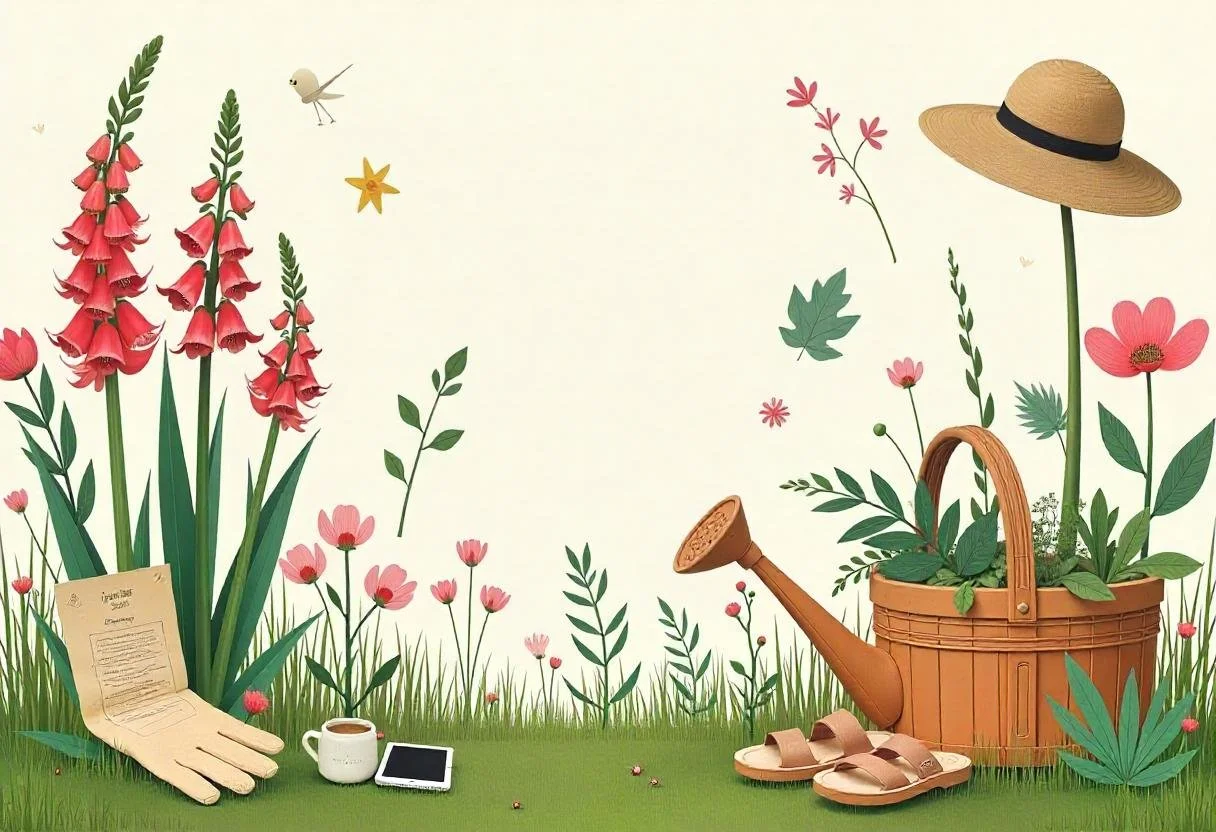
We often talk about personal growth like it’s something we can hack or schedule: an efficient morning routine here, a life-affirming listicle there. But growth—real, emotional, soul-deep growth—doesn’t always work like that.
What if the better metaphor isn’t a staircase going ever upwards… but a garden?
Because while we search for clarity, balance, or simply a day that feels like “enough,” we forget that the slow, subtle tending we do matters too. And nowhere has that been more apparent to me than in my garden.
When I first began gardening, I thought I was there to grow flowers. I didn’t realise I’d be unearthing something else entirely.
The spinach bolting too soon mirrored parts of myself I’d neglected. The alliums blooming after months of dark reminded me that beauty often requires quiet persistence. And the mess? That was its own kind of magic.
My garden began teaching me the lessons more often held in books on self-improvement
That manifesting without doing is like planting without watering.
That completion is hard—not because we can’t finish things, but because we forget to savour when we do.
That wildness isn’t chaos—it’s aliveness.
That rhythms matter, and sometimes staying still is part of tending too.
Most surprisingly, I learned that I didn’t have to get everything right. Not in the garden. And not in myself.
Sue Stuart-Smith wrote, “The mind needs to be gardened too.” And once I read it, I couldn’t stop thinking about how true that is.
Gardening asks us to:
Observe without rushing.
Accept mistakes without shame.
Work with the seasons, not against them.
Let go of perfect outcomes.
And return, again and again, to the same patch of ground.
In other words—it’s the same practice that wellbeing demands of us.
You don’t need to own a garden to live this way. But you do need to notice what’s already growing.
If the garden has taught me anything, it’s this:
There will always be weeds. You are not failing because things still need clearing.
Rest counts. Sitting in your garden is still tending to it.
Growth doesn’t announce itself. Often it’s quiet, a cucumber hidden behind a leaf, a shift in mindset you barely notice.
You don’t need to be the expert. Just the one who shows up.
This is the version of wellbeing I believe in: imperfect, seasonal, and rooted in presence rather than performance.
So tell me—what’s growing for you right now?
What do you notice when you look at your days not as tasks to complete but as something to tend?
Let’s start a new kind of growth together: slower, kinder, and more alive.
If this resonated with you, sign up for the newsletter for our take on personal growth (hint: we never call it personal growth outside of a gardening metaphor). Or explore our wellbeing courses where we start, not with goals, but with grounding.
We can cultivate a different kind of wellbeing together: one that feels messy, but real, and offers its own kind of beauty..
Image: made with Freepik

Postcards from a Happy Place
A day at The Happy Place wellbeing festival — and the ideas I brought home with the tote bag
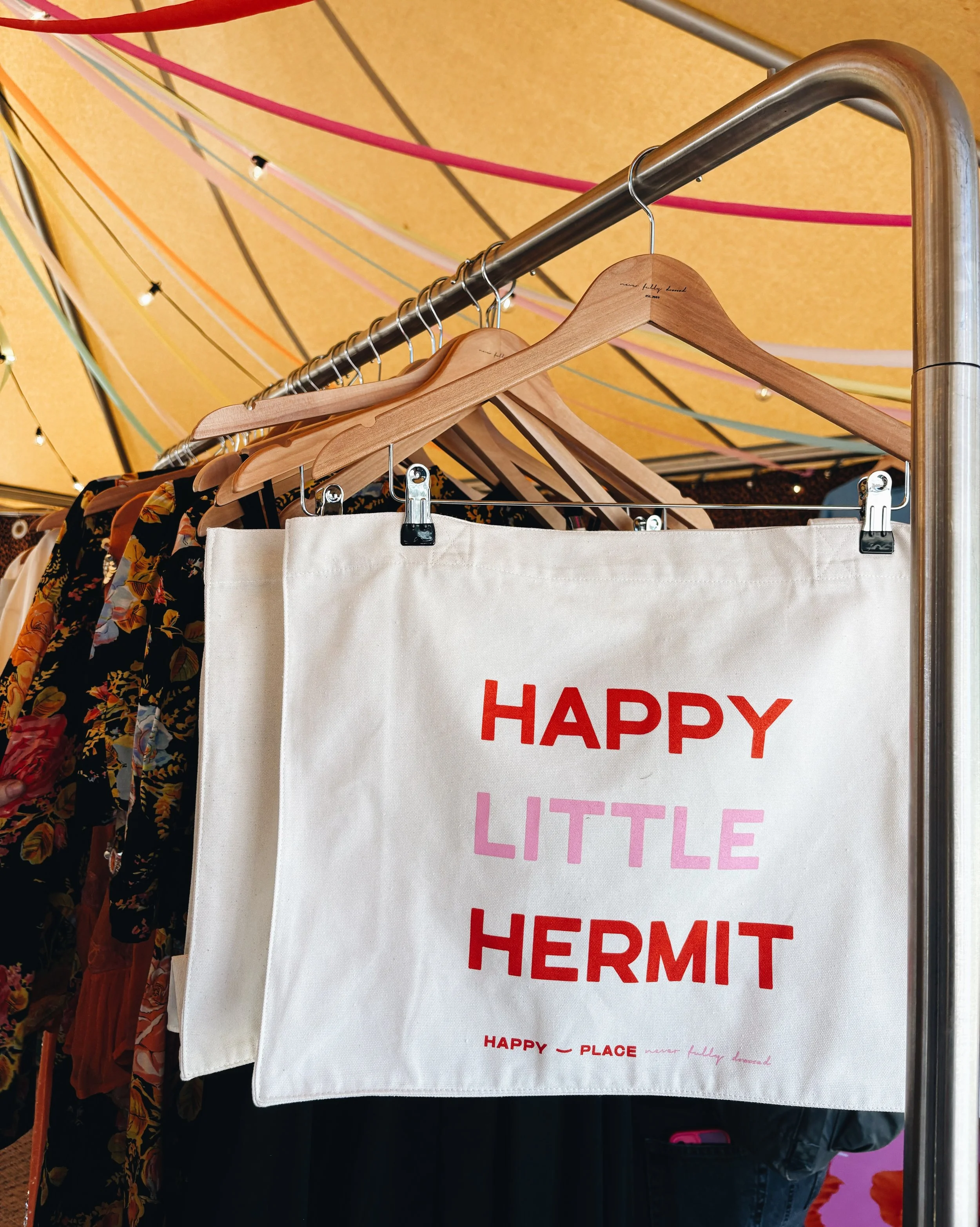
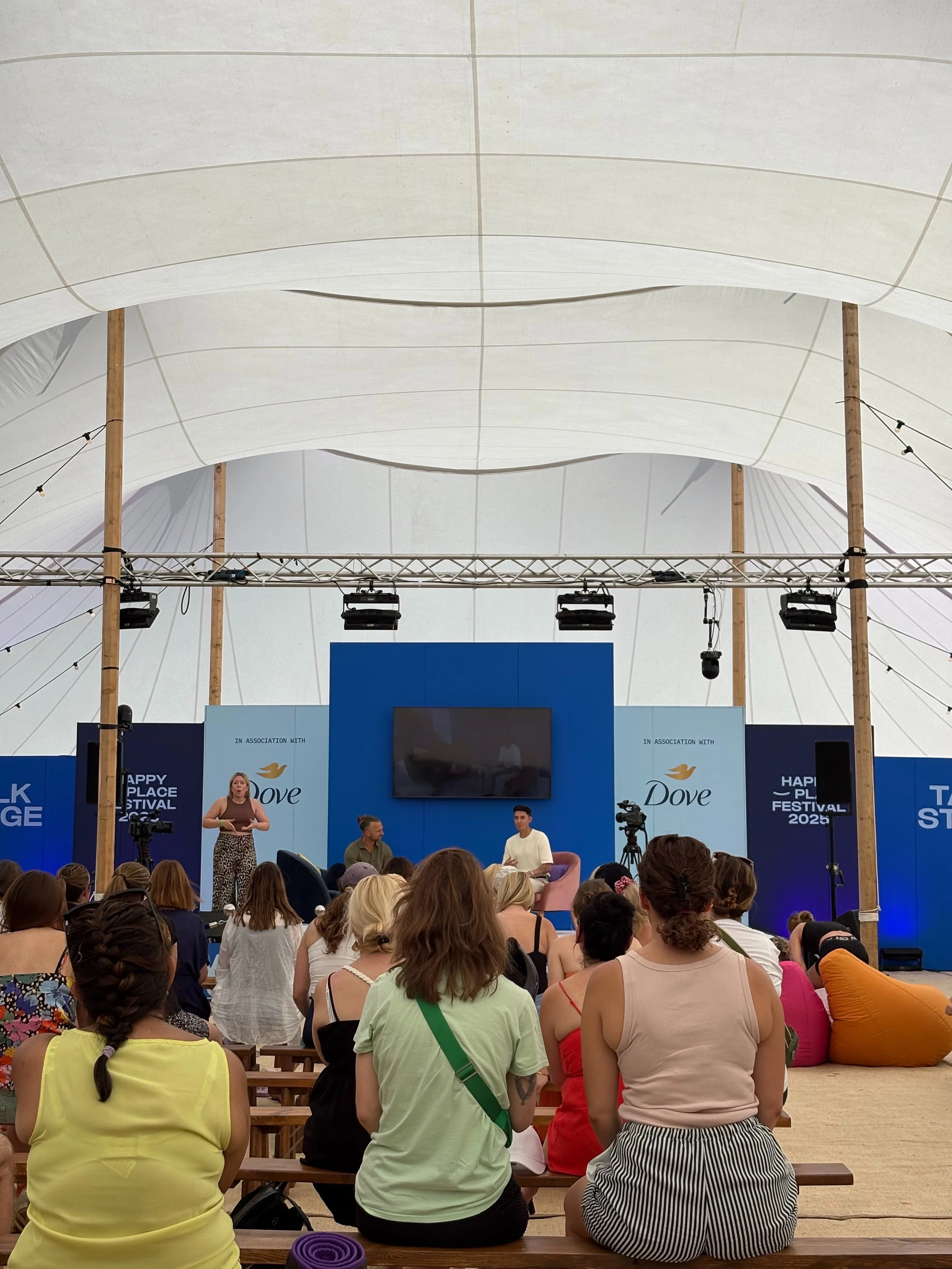
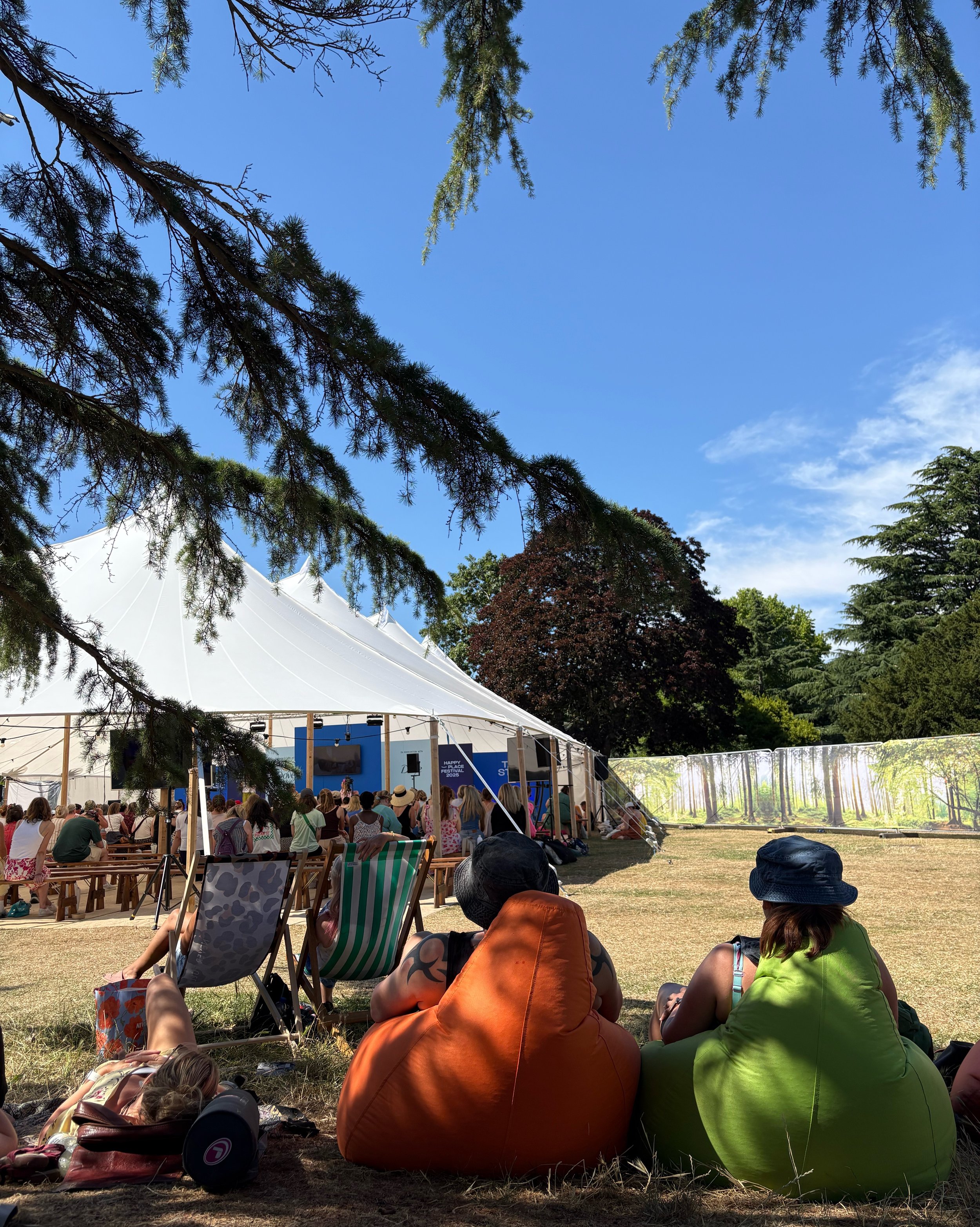
I’m sitting under the shade of a 100-year-old tree in a west London park, the kind with branches that creak when the breeze moves through them. I’ve claimed one of the bright bean bags scattered across the lawn and wedged it against the bark. It’s quieter here than in the big open-sided marquee where the talks are held. I almost left earlier — the heat was stifling — but this patch of dappled light invited me to stay.
This is the Happy Place Festival, Fearne Cotton’s annual celebration of all things wellbeing. Held in Gunnersbury Park, the event feels relaxed despite the crowds. There’s a sound bath tent, hormone talks, yoga happening under awnings, iced lattes for a quick pick-me-up, and a hum of voices talking about nutrition, breathwork, sleep, and happiness.
I wander a little, swap my trainers for sandals, browse the book tent, and eventually drift towards the Talk Tent — where the ideas start to land.
What Wellbeing Looks Like When You Do It at Your Own Pace
There’s a clawfoot bathtub painted bright yellow on the lawn. Giant HAPPY PLACE letters. Pink phone booths for Instagram moments.
People move slowly, or not at all. Some stretch into yoga poses. Others lounge with notebooks. I’m surrounded mostly by women. An older woman in a navy wrap dress stands near a mother and daughter in yoga pants. And I start to wonder: What are we all here for?
A day of self-care? A search for clarity? A break from decision fatigue?
For me, it became about gathering small, meaningful insights or the big ideas that I hope might stick. Here's what I took home from a single day of getting away from it all (so I could get back to it all).
5 Takeaways from The Happy Place Festival
1. Midlife Is for Beginning Again
“Everyone has something.” — Donna Ashworth
Poet Donna Ashworth shared that she didn’t begin writing until her mid-40s. “It was either me… or it,” she said. There was something inside her that needed to be expressed — even if it emerged messily.
Holly Tucker, founder of Holly & Co, echoed this. She shared that 75% of the small businesses they support were started by people aged 40–60. Midlife isn’t an ending. It’s the start of something else.
2. Listen to the Whispers of the Soul
The idea of tuning inward came up again and again. Katy Hill spoke of following the “whispers of the soul.” Kelly Holmes said she’s living not in the “if onlys” but the “maybes.”
What if we don’t need to have the whole plan — just enough of a nudge to start?
3. Time Is Measured in Moments, That Become Years
“Life is 80 summer holidays.” — Julia Bradbury
Oliver Burkeman’s 4000 Weeks was cited more than once. It’s a reminder that life is not endless. Julia Bradbury put it plainly: "You only get about 80 summers." She advocates for nature snacks as the way to reset her days — stepping outside every couple of hours to widen your gaze, regulate your nervous system, and remember you’re alive. The evidence backs her up. A University of Exeter study found that if 1.2 million people took part in a green prescribing project that would save the NHS £635.6 million.
4. Start Imperfectly, Stay Imperfect
“Just begin.” — Donna Ashworth
Donna’s talk — and the reading of her poem “Just Begin” — was a balm for the overthinkers. “Someone here needs this,” she said before reading. She was right. That someone was me. And maybe it’s you too.
Start before you’re ready. Begin without knowing the outcome. Let the thing live in the world. That’s where the magic happens — not in the editing, but in the doing.
5. Small Impacts Matter
“What’s my impact?” — Holly Tucker
Holly said she grounds herself daily in one question: What will my impact be today? Not in a pressure-filled way, but as an invitation. She believes we all have the potential to lift others — to support their dreams in small, significant ways.
And if you don’t know your answer yet? Ask yourself: What lit you up when you were 10?




Wellbeing That Feels Possible
There’s a lot out there right now about how to live better. Some of it’s helpful. A lot of it is loud. What this day reminded me is that you can be curious without committing to a complete reinvention.
Wellbeing isn’t a fixed destination or a 12-step plan. It’s something you get to define. Something you can build, imperfectly. Slowly. Softly. On your own terms.
Your happy place might not be mine. And that’s more than okay.
So, what’s your Version of a Happy Place?
Maybe it’s not a festival. Maybe it’s a book, or a walk, or a quiet cup of tea. The point is not to do more. It’s to tune in.
Here’s a gentle question to leave you with:
What whispers have you been ignoring?
And what might shift if you started to listen?
Want to explore this further?
We’re creating spaces for the wellbeing curious — people who want better days, not busier ones.
Announcing A Thought I Kept: A Podcast About the Ideas That Shape How We Live
Looking for a wellbeing podcast that can fit your everyday life? A Thought I Kept explores the single ideas that stay with us — and how they continue to shape us, long after we’ve forgotten the rest. Listen now.
If you're looking for a wellbeing podcast that feels like a conversation around a kitchen table, this is for you.
A Thought I Kept is a short-form podcast about the single ideas that stay with us — the ones that shape how we live, long after we’ve forgotten the rest.
Each week, I speak with a different guest about the one thought they’ve carried with them through life. Sometimes it’s a quote that landed at just the right moment. Other times it’s something said by a loved one that needed to be heard.
These are the ideas we live. Or try to. We return to them again and again. We test them, challenge them, adapt them. These are the ideas that stick, stay, and sometimes even shift everything.
A Wellbeing Podcast That Meets You Where You Are
In a world full of self-help lists, must-try methods and wellbeing how-tos, A Thought I Kept is about how we notice (and hold onto) the ideas that resonate, that mean something, and that — in their own way — shape who we’re becoming.
This is a podcast for people who are curious about what makes life feel better — more connected, more livable, more of what you need. Whether you're deep into self-improvement or simply looking for a new idea to carry through your week, you'll find something here that’s worth remembering.
What You’ll Hear
Every episode features a single guest — creatives, coaches, therapists, or just thoughtful humans — sharing the one idea they couldn’t let go of. We explore:
A moment that shifted their perspective
How the thought has shown up again and again
What it’s taught them — or is still teaching them
How they’ve made it their own
These aren’t polished life lessons. They’re lived ideas. Carried from books and stages, podcasts and conversations, into real days. The ones we try to live up to — or sometimes fall short of — but keep returning to anyway.
Why These Conversations Matter
We’re not short on inspiration these days. But we are short on meaningful, reflective spaces where we can explore how we actually integrate the ideas we hear into our daily lives.
A Thought I Kept is one of those spaces. It honours aha moments and imperfections both, small moments of clarity and the kind of emotional intelligence that grows slowly, over time.
These conversations are for anyone navigating change, searching for clarity, or wanting to feel more grounded in how they move through the world.
Where to Listen
A Thought I Kept is available wherever you get your podcasts, with bonus videos and content found over on Substack.
New episodes drop every Monday — perfect for starting your week with a fresh perspective.
If you’re looking for ideas that stay with you, you love wellbeing podcasts and you often choose meaningful conversations over monologues — this podcast is for you.
Subscribe to A Thought I Kept and join a community of people collecting the kind of ideas that make everyday life feel a little more livable.

How to Move Through Creative Self-Doubt and Reconnect With Your Purpose
Feeling stuck or creatively disconnected? Here's how to rebuild your confidence, find meaning in the uncertainty, and return to the creative work that matters.
Have you ever felt like you’ve lost your spark?
Like the ideas that once lit you up have dimmed, or that the thing that used to matter doesn’t quite land the same way anymore?
Maybe you’ve asked yourself: What am I doing this for?
If you're here, chances are you’re navigating your own season of doubt. And if that’s true, then let me offer you this:
You’re not doing it wrong. This is part of it.
The creative process isn’t linear. It’s a stretch and a return. A leap, and then a grounding. A brave “yes” to something new, followed (often quietly) by the decision to come back home to what really matters.

What’s for you won’t go by you.
That phrase—shared by brand designer and creative mentor Sarah Robertson on a recent episode of A Thought I Kept—has been looping in my head since we spoke. It was something her Scottish grandmother used to say, sometimes just in passing. But it landed.
It became an anchor for Sarah in all kinds of moments:
When her business changed direction
When launching a new product stirred up old fears
And when self-doubt made her question whether she was going in the right direction
In each of those moments, that phrase whispered back to her: If it’s for you, it won’t pass you by.
What happens when creativity starts to feel fragile?
Sarah spoke about the delicate emotions that come up when we make something new—especially something that asks a lot of us. When she launched her Brand Seasons card deck (a beautiful, soul-filled strategy tool), it wasn’t just a product launch. It was a creative stretch.
She worried about whether she still had it. She worried whether it was worth it. And in all of that, she still trusted enough to try.
Because sometimes, the bravery is just in showing up for what might be possible.
If you're in a stretch season...
...it might look like saying yes to something that scares you. A project you’re not sure will land. A conversation you don’t feel ready for.
But then there’s the other half of the rhythm—the return.
Sarah shared how, after all the brave leaping, she’s now back in her creative comfort zone: working one-on-one with clients, doing deep brand work, mentoring creatives who are trying something new.
And she’s realised:
It’s okay to let go of the things that aren’t for you too.
Even the things you poured your heart into.
This is permission to release the pressure to make every project the thing.
It can just be a thing. A moment. A stretch.
Then you come back to what fills you up.
If you're in a return season...
...let it be enough.
You don’t have to reinvent everything. You don’t have to push.
Returning to what feels good—what feels like you—can be the most creative act of all.
As Sarah put it:
““There’s definitely been something about learning that the creativity is always there. I can access it, I can tap into it.””
So how do you find your way back to creativity?
Here’s what this conversation reminded me of (and maybe it will help you too):
Self-doubt doesn’t mean you’re not creative. It means you care.
You don’t have to push all the time. Sometimes the letting go is the power move.
A creative pause doesn’t erase your purpose. Your creativity is still there.
The process matters as much as the outcome. Trust what you're learning in the doing.
Not everything is yours to carry. What’s truly for you will stay. What isn’t, can go.
Want to feel more connected to your creativity again?
Take a breath. Come back to yourself.
And ask: What feels like mine to hold right now?
Not what’s trending. Not what’s shiny. Just… what’s true?
If it’s for you, it won’t go by you.
Let that be the anchor.
Want more like this?
Listen to Sarah’s full episode on A Thought I Kept on Substack, Spotify or wherever you get your podcasts