

Summer Self-Care Checklist for Overwhelmed Days
Feeling stretched thin this summer? Here’s a gentle, practical self-care checklist to help you pause, reset and feel better—without adding on any more pressure.
You love the idea of summer—the long evenings, the slower mornings, the breezy dresses and flip-flops and maybe even a road trip or two.
But here you are, somewhere between the second heatwave and the eighth load of washing, feeling low-key exhausted and wondering: Isn’t this supposed to be the relaxing season?
Summer can be a swirl of too-muchness: too much expectation, too many people to keep happy, too little time to yourself.
That’s why we created a short checklist to help on overwhelming days—not to add more, but to gently guide you back to what you need today.
Because here’s what I’ve learned (the hard way): self-care in summer doesn’t always look like bubble baths or beach escapes.
Sometimes it looks like sitting on the garden step for five minutes with your phone inside the house.
Or letting the kids watch one more episode so you can be alone in silence and remember what your own voice sounds like.
I’ve coached women through every kind of season, and summer—while beautiful—has a sneaky way of stealing our energy.
We keep trying to "make the most of it," but no one talks about how much it can take out of us, especially when we’re already carrying so much.
This checklist isn’t about self-improvement. It’s about self-preservation. And maybe even a little more joy.

Summer Self-Care Checklist for Overwhelmed Days
For when you feeling wobbly, weary or just a bit lost in the swirl of summer...
Try one or two. You don’t need to do them all.
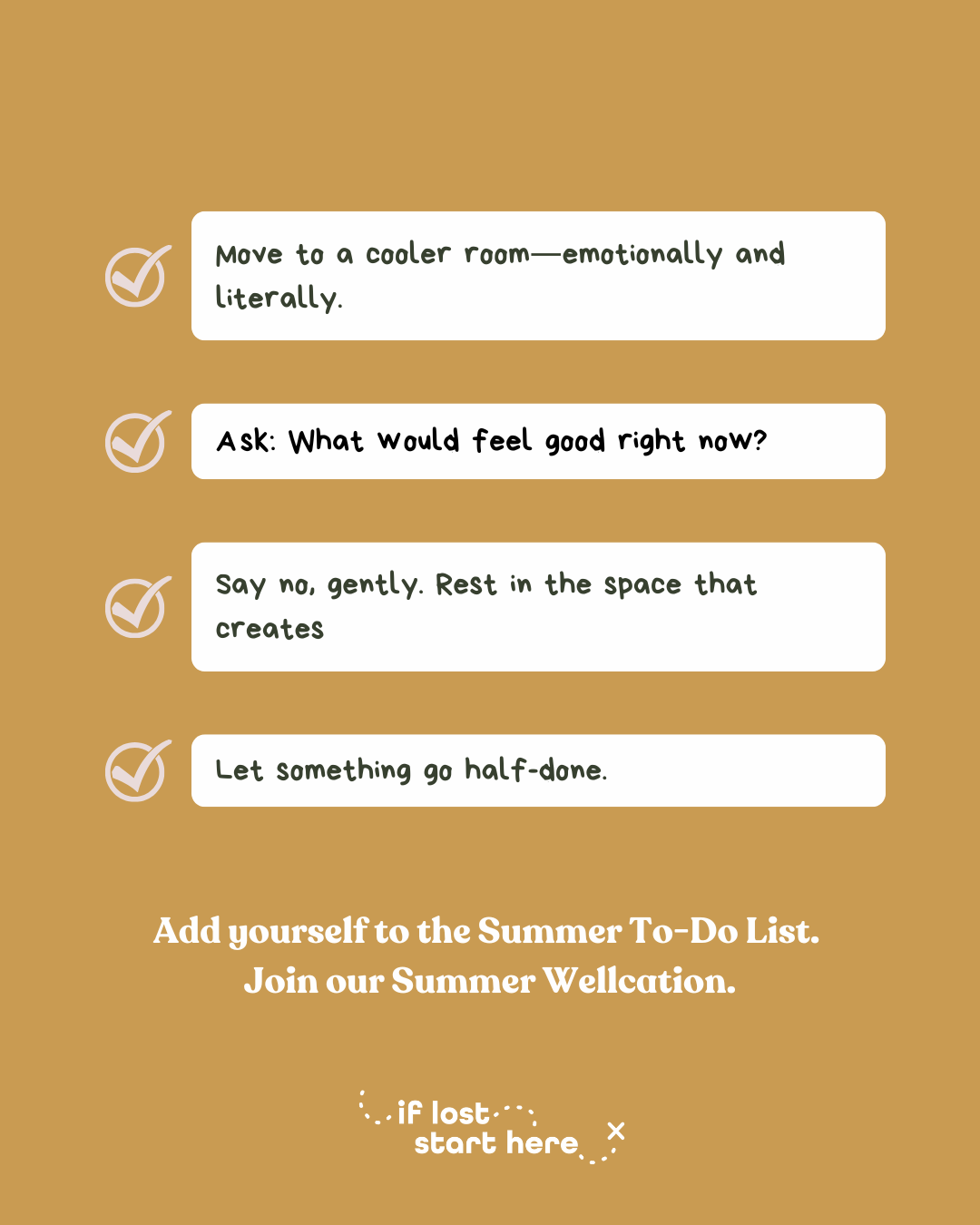
1. Move to a cooler room—emotionally and literally.
If you’re overheating, physically or mentally, step into shade. It can be a room, a car, a headspace. Give yourself that pause.
2. Have a "bare minimum" day.
Pick 3 things: eat something, drink water, send one message. That’s enough.
3. Use your senses to re-centre.
Run your hands under cold water. Notice the texture of grass under your feet. Inhale something fresh—lavender, mint, citrus. Let your senses bring you back to the present.
4. Draw a boundary shaped like a hammock.
Say no to something, kindly. Then rest in the space it creates.
5. Write a tiny list of what’s working.
Even in the mess: the good coffee this morning, your kid’s laugh, the breeze through the window.
6. Reach for real connection.
One message to someone who sees you. Not for advice. Just for being seen.
7. Put your phone in a different room for 20 minutes.
Not forever. Just long enough to change the rhythm.
8. Move your body to move the moment.
Step outside. Stretch your arms overhead. Walk to the end of the street and back. A shift in motion can soften the stuckness.
9. Let something go half-done.
It can still be there tomorrow. And there’s something ok about that. Let it wait.
10. Ask yourself one kind question.
What would feel good right now? Then honour the first answer that comes.

Even one of these actions can shift your day, your breath, your summer.
What’s on your personal self-care checklist right now?
Which one of these would feel best today?
If this resonated with you, here are 3 ways to go deeper:
Join our Summer Wellcation – a 4-week self-guided online reset to reclaim your season.
Subscribe to our newsletter – for more ideas, inspiration and emotional support.
Browse our guide to overwhelm — for more ways to navigate the days when it all feels too much.
Let’s create a summer that feels like yours.
Made image by Freepik

Vallis Farm
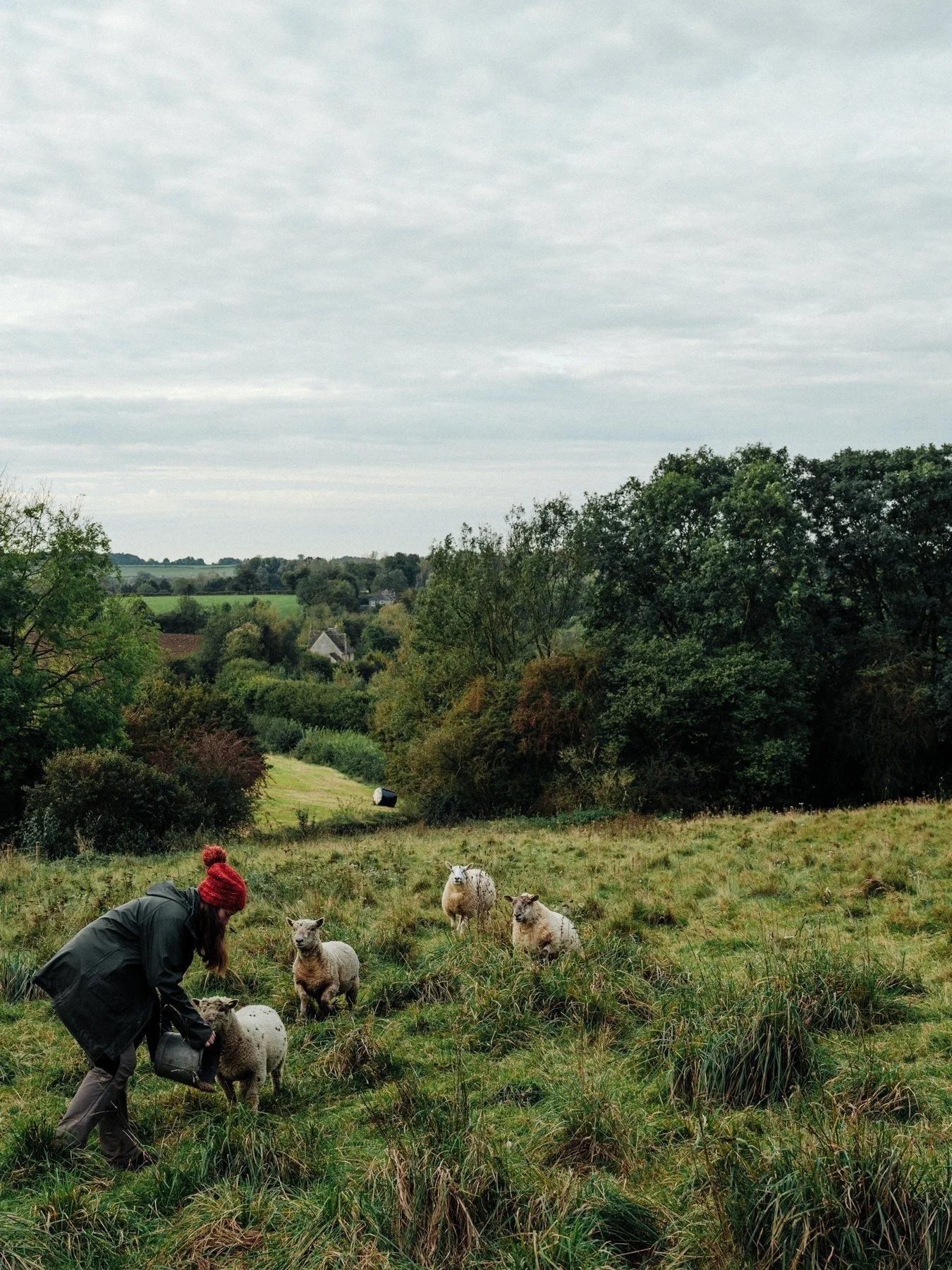
Seek out this farm in Somerset centered on learning and creativity, exchanging skills and ideas, while connecting you with the healing properties of nature. It’s truly a place to grow.
Go here if
You are looking for a beautiful space to share and swap skills, learn, grow and be in nature.
What is it?
Vallis Farm is a home for learning and creativity, for exchanging skills and ideas, a place to grow.
Why you need it
Nature has healing properties and this farm offers something special. Not only is the landscape stunning, the house warm and inviting but the people are welcoming and friendly.


What they offer
A range of workshops, supper clubs, weekly events such as yoga and pilates. They also encourage people to volunteer on the land to learn about their approach to sustainable gardening while being in the most healing of environments - the great outdoors!
What makes it different
Vallis Farm is a rather special place. The old Georgian farmhouse is warm and beautifully decorated with lots of spaces available to use depending on your needs.
The outside is even more stunning, just under 10 acres of rolling hills and woodland, a market garden using no-dig methods to grow local produce, a beautiful kitchen garden and roundhouse as well as shepherd’s huts that you can stay in. It's a truly restorative place to spend time.
What else do you need to know
You can book a range of spaces — whether that’s rooms in the house or the whole farm site — by the hour, for a half day or a full day, depending on your needs and budget.
Vallis Farm also welcomes people to pop up to have a look around. There is always someone there to say hello and show you this amazing place.

In their own words
Vallis Farm is led by an evolving collective of highly experienced craftspeople, compassionate educators and committed stewards of the land.
“We started Vallis Farm as a place to provide affordable spaces to local people. We have areas that have permanent tenants who are artisan craftspeople in their own right. We want people to know they will always be welcome to come and share their skills and knowledge with others. We truly are a place to grow and learn.”
Where inspires them
“It's proven time and again that nature has huge restorative effects. Not just on our mood but also on our memory, cognition and executive functions. We believe that being outside repairs the soul. If the weather is not our friend, our beautiful house has green views from every window which are also proven to help repair and restore our mental health. Having a place to just "be" is the most inspiring thing for us.”

A Thought I Kept: A New Wellbeing Podcast About the One Idea That Stayed
Introducing A Thought I Kept — a new wellbeing podcast about the ideas that last. Listen for real conversations, gentle insight, and the life advice we actually remember.
I’ve always loved a good idea.
A reframe.
A quiet insight that makes me pause mid-scroll, or scribble something in the notes app at 11:37 p.m. so I don’t forget it.
I love podcasts too. The kind that hold space. That shift something. That say the thing I didn’t know I needed to hear.
But lately I’ve been wondering:
Out of all the life advice, wellbeing strategies, and “you-have-to-listen-to-this” podcast moments… what actually stays with us?
What do we carry into our everyday lives, long after the episode ends or the book gets returned to the library?
We’re surrounded by incredible knowledge — how to be calmer, healthier, more grounded, more curious.
The science is smart. The frameworks are helpful. The tips are endless.
But when life happens — the real, messy, school-pick-up, half-asleep-on-the-couch life — what idea do we remember?
What thought do we keep?

A podcast about the ideas that last
So I made a podcast. It’s called A Thought I Kept.
Each short episode takes the form of a conversation with someone about the one thought they couldn’t forget.
Not because it was the most profound, or went viral, or solved everything.
But because it stuck. It mattered. It shaped something in how they moved through the world.
It might have come from a book.
Or a late-night conversation.
Or a stranger on a train.
Or a friend’s voice note, recorded mid-walk and slightly out of breath.
These are stories about the ideas that landed. The ones that felt personal. Sometimes private. Always real.
This podcast is for you if:
You collect ideas, but want to know which ones are worth keeping
You love good conversation but feel tired of overproduced advice
You’re a fan of wellbeing podcasts that center women’s voices, and the magic of “me too” moments
You’re curious, but craving softness
You’ve underlined a sentence and wondered why it hit so hard
You love wellbeing podcasts but crave something more human.
This isn’t a podcast about how to fix your life.
It’s about how we live with the ideas that gently shape it.
The trailer will be out next week with episodes going out on Mondays after that.
Subscribe to Substack to follow and listen.
I hope this podcast offers you something that stays.
x Claire

Goodwood Art Foundation
Discover the Goodwood Art Foundation, a feel-good creative destination blending contemporary art, nature and wellbeing on the Goodwood Estate in West Sussex. Explore a stunning landscape of thoughtfully curated artworks that encourage a sense of curiosity.
Perfect for
Art lovers, nature wanderers, the creatively curious and the quietly overstimulated.
For anyone craving inspiration with less noise and a way to feel more connected—to the world around you, to ideas and to yourself.
Why you’ll love it
The Goodwood Art Foundation isn’t just a gallery in the traditional sense — though you’ll find two stand-out exhibition spaces here — but also an invitation to experience art in a natural setting.
Set across the rolling chalk hills of the Goodwood Estate, it’s a space where sculpture and landscape meet in quiet conversation. Here, you get to wander at your own pace, following one of the three sign-posted trails. As you seek out the next sculpture, you’ll walk through ancient forests or wildflower meadows, coming across a natural amphitheater, chalk quarry and cherry grove as you do so. Pause a while and sit with something unexpected — an enchanting soundscape hidden in the trees perhaps or a view to the sea in the distance.
For the opening, Ann Gallagher, the former director of collections of British Art at Tate, has sensitively installed works by major contemporary artists — including Veronica Ryan, Rose Wylie and Isamu Noguchi — within the natural setting. There’s also a stunning solo exhibition of Rachel Whiteread, the first woman to win the Turner Prize.
What makes it special
Leading landscape designer Dan Pearson has created a 70-acre landscape that shifts according to 24 2-week botanical seasons. You’ll get a sense of how the land, the weather, the seasons and light all interact as you visit at different times of the year.
It’s the kind of place where you leave feeling lighter—and perhaps even a little rewilded, inside and out.
The story behind it
The Goodwood Art Foundation, newly opened in May 2025, is a non-profit on a mission to “foster wellbeing, creativity and lifelong learning for people of all backgrounds and abilities, through engagement with art and connectedness to nature.”
Founded by the Duke of Richmond and Gordon, the Goodwood Art Foundation is gounded in three pillars: art, environment and education, and explores how these can better support our physical and mental wellbeing, creativity and capacity to learn.
The If Lost take
We believe creativity is a form of self-care. There’s a palpable sense of permission here: to explore, to wonder, to allow ourselves to just be.
It’s also one of those rare spaces that nourishes your nervous system and your imagination at the same time.
Everything about it moves slowly, intentionally. There’s no rush. And that’s very much the point.
It’s a full-body exhale kind of place.


Practical details
Location: Situated within the Goodwood Estate near Chichester, West Sussex (also home to world-class motor and horse racing.)
Top tips: Wear comfortable shoes and dress according the weather forecast. There are indoor spaces but you’ll be spending a lot of time outdoors.
Check out Cafe24 for a full-menu with ingredients sourced from Goodwood’s regenerative farm. It’s located in a stunning steel-clad building designed by Studio Downie Architect.

Know somewhere that helps people feel better?
Nominate your favourite creative or feel-good place—or apply to be featured in the guidebook. Complete this form.

Walking for Wellness: How Daily Walks Brought Me Back to Myself
Discover the emotional and mental health benefits of walking with five mindful ways to walk, inspired by personal experience and wellbeing research.
It wasn’t until the pandemic that I discovered walking — not as a way to get from A to B, but as a way to come back to myself. Like many people, I found myself locked down, overwhelmed, and restless. My only escape was a daily walk.
It became essential. A bowl of milk to the day’s dry cereal. The thing that made everything else make sense.
Each morning, after waking to another repeat of the same uncertain day, I’d lace up my trainers and head out. Sometimes I went uphill, breath catching as I climbed towards the high view that held the San Francisco Bay and Mount Diablo in the distance. Other times, I turned down the trail, earbuds in, passing neighbours who had become companions in this strange shared stillness.
My walks weren’t about fitness. They were about sanity. A way to breathe again before returning to home-schooling, back-to-back video calls, and the quiet chaos of a household running on edge.

The benefits of walking for mental health
I wasn’t alone. According to the Mental Health Foundation, 59% of UK adults said that taking a walk helped them cope with the stress of the pandemic. In the UK, where I spent round three of lockdown, walking was considered so essential that the government protected it — up there with grocery shopping and filling your car with petrol.
These daily walks weren’t just good for our bodies. They were medicine for our minds. For many of us, walking helped re-establish a link between physical movement and emotional stability. And for some, it was the beginning of a new relationship with wellbeing altogether.
Why I kept walking (even when I didn’t have to)
I’ve kept walking. Not out of obligation, but because I now understand what it gives me.
I take a short walk before I collect my daughter from school — a simple mental reset after a day of coaching, writing, and running a business. I walk after dinner, letting the last of the day’s light touch my skin. I park further away than I need to when heading into Bath, giving myself that extra stroll in silence before a meeting.
It’s not always about the steps or the stats. I’ve let walking become part of how I design my day — like eating lunch, brushing my teeth, or drinking coffee. It gives me time to think. Time to feel. Time to stop being just a brain at a screen.
And the dog walkers I pass seem baffled that I walk alone — no dog, no Fitbit, no real purpose.
But here’s the thing: walking is the purpose.
5 mindful ways to walk when the world feels heavy
When I feel unmotivated, overwhelmed, or too busy to walk — I remind myself it doesn’t have to look a certain way. These are five gentle ways to walk that have helped me stay connected, curious, and calm.
1. Take a Colour Walk
This morning, I followed the colour pink.
It was a choice that made me look. Brash pinks and soft blushes showed up in unexpected places — roses in front gardens, foxgloves leaning into the road, a pair of pyjamas flapping on a washing line, and even the warm tone of a village pub sign. The pinks softened the streets I thought I knew.
Try this: Choose a colour before you leave the house. Follow it with your eyes. Notice the tones, textures, placements. Photograph them, sketch them, or just observe. You’re not documenting your walk — you’re getting more into it.
2. Walk Without an Agenda
“Take a walk without an agenda,” said Margaret Heffernan in her TEDx talk on thinking like an artist.
Leave your phone at home. Head out with no destination, no task list. Let the walk shape itself.
Can you hear the difference after the rain? Have the leaves turned? What’s blooming this week? Let your attention wander, gently.
The only cost is your attention. The gift is being where you are.
3. Try an Awe Walk
An awe walk invites you to look at the world with child-like eyes.
Research from the University of California found that regular awe walks can reduce stress, increase joy, and expand our sense of connection to something bigger than ourselves. Participants even began taking smaller selfies — a literal shrinking of the ego.
This week, I walked a slightly different route and was caught by wildflowers pushing through tarmac, a castle glowing yellow under a blue sky, and a pile of painted stones stacked on a gravestone by a child’s hand. Nothing grand, but all quietly wonderful.
Try this: Look for something vast or something tiny. Either way, let it move you.
4. Take a 12-Minute Brisk Walk
If time is the thing getting in your way, keep it short and purposeful.
In 52 Ways to Walk, Annabel Streets encourages a simple 12-minute brisk walk. That’s all it takes to shift your mood, alter your blood chemistry, and reconnect with your body.
Try this: Set a timer for 12 minutes. Walk like you mean it. Breathe deeply. Notice the shift.
5. Bring Company (Human or Otherwise)
Sometimes I take a friend. A quick lunchtime loop before school pickup. Sometimes I take a podcast — lately I’ve been walking with themes like overwhelm or emotional fatigue, choosing episodes that help me think differently.
There’s evidence that some of the emotional benefits of walking come not just from movement, but from connection. The nod of a neighbour. A chat with a friend. The quiet rhythm of shared silence.
Try this: Invite someone to walk with you. Or pick a podcast that feeds your mind as your feet move. Make it feel like a companion.
Let walking be whatever you need it to be
You don’t need to count steps or measure your worth in minutes. Walking is a practice — and like all good practices, it adapts to you. It can be fast or slow, quiet or sociable, structured or loose.
Let it meet you where you are.
If you need to ground yourself: walk.
If you feel cloudy-headed: walk.
If you want to think, or not think at all: walk.
You don’t need a goal. You just need to begin.
So…
What kind of walk are you craving today?
Which of these walking practices might you try?
Or do you have your own that sustains you?
We’d love to hear your stories of why you walk — and what you’ve found along the way.
Your next steps
If something here resonated, here are three gentle ways to keep exploring with us:
Subscribe to our Newsletter
Get weekly wellbeing notes — full of small, real-life ways to feel better, think differently, and live with a little more ease and curiosity. Sign up here.Explore Our Wellbeing Remedies
Discover our bespoke prescriptions for everyday life. Whether you're feeling lost, overwhelmed or just want to explore more of what matters to you — we’ve designed gentle tools to support you. Browse our remedies here.Visit Our Mind–Body Library
Practical, non-performative ways to reconnect with your body — whether you're walking, resting, stretching or simply breathing. It’s about being in your body in a way that feels good, not forced. Explore your mind-body connection here.

What If Overwhelm Isn’t the Emotion? Why We Sometimes Feel Too Much, Yet Not Enough—and How the Body Can Help
Feeling overwhelmed but not sure why? You might not be feeling “too much”—you might be disconnected from what your emotions are actually trying to say. Here’s how to make sense of overwhelm through the body.
You feel overwhelmed.
But if someone asked you why, or what exactly you’re feeling… you might not know. You just feel off. Foggy. Wound up. Flooded. Blank. Wired and tired at the same time.
It can feel like too much is happening inside you, without a clear signal or message to follow.
But what if overwhelm isn’t the emotion you really need to deal with?
What if it’s what shows up when you haven’t been able to feel what’s beneath it at all?

The Moment I Realised Overwhelm Was a Cover Story
For a long time, I treated overwhelm as a standalone state. A sign that life was “too busy,” my nervous system was overloaded, or I needed a break. Sometimes that was true.
But what I’ve come to realise—through training, through coaching, and through my own lived experience—is this:
> Overwhelm can also be a symptom of emotional disconnection, not emotional excess.
It’s what happens when we intellectualise our feelings, or try to manage them from a distance—without ever letting them land.
We might think:
“I know I’m feeling something, but I can’t get to it.”
“I can name the emotion, but it doesn’t feel real.”
“I should be able to cope with this, but I feel flooded anyway.”
Sound familiar?
This is a pattern that many people (especially high-functioning, thoughtful people) fall into: you process emotions with words, not with your body. You understand emotions cognitively, but don’t always experience them somatically.
And over time, all the un-felt, un-integrated emotion starts to pile up. It doesn’t go away—it just gets noisier. Messier. Louder.
Eventually, it spills over—not as anger, grief, fear, or sadness—but as overwhelm.
When the Body Tries to Speak and We Stay in Our Heads
From a neuroscience perspective, this makes perfect sense.
Emotions aren’t just thoughts. They’re bodily experiences—changes in breath, tension, heat, posture, heart rate.
When we ignore those signals—or lose access to them—we lose our in-built self-regulation system.
If you don’t feel the emotion as it comes, your body doesn’t know how to process or release it. It just keeps holding it.
Without that physical experience, your brain can’t fully complete the emotional loop. So it stays half-finished. Repeating. Piling on top of the next.
Eventually, all those unfelt emotions swirl together into a kind of emotional static—a sensory overload without clarity.
We call that overwhelm.
But maybe we’re naming the storm, not the weather patterns underneath it.
What to Do When You Don’t Know What You’re Feeling
So if overwhelm isn’t the emotion—what is?
It might be grief. Or fear. Or anger. Or a layered, messy mix of all three. But if you’re disconnected from your body’s signals, you can’t access them clearly.
Here’s how you can begin to shift that:
1. Start with the body, not the story
Don’t ask, “Why do I feel overwhelmed?”
Instead ask, “Where do I feel something in my body right now?”
You might notice:
A tightness in your chest
A fluttering in your stomach
A pressure behind your eyes
Let that be your starting point.
2. Give the emotion a safe place to land
The goal isn’t to solve or fix the feeling. It’s to feel it enough that your body recognises it, processes it, and releases what it can.
This might look like:
Breathing into the part of the body where you feel sensation
Moving (gently, freely, without agenda)
Letting sound, tears, or stillness come through
3. Use overwhelm as a cue, not a verdict
When overwhelm shows up, treat it as a signal, not an endpoint.
It might be saying:
“You’ve ignored this too long.”
“There’s something here that needs feeling.”
“You’re carrying more than you realise.”
What if overwhelm wasn’t the problem?
What if it was your body’s last attempt to get your attention?
So the next time you feel overwhelmed, pause.
Ask yourself: “What might I be feeling beneath this? What hasn’t had space yet?”
And instead of trying to “cope” better or “think” your way out—what if you tried simply feeling your way in?
You might find that you’re not feeling too much…
You’re just not yet feeling what’s really there.
Want more support like this—gentle, science-backed, and full of things you can try?
Join our newsletter to better understand all life’s emotions.

Distil Coworking Somerset
Discover Distil Coworking Somerset—an inspiring rural coworking space set in a restored mill with gardens, café and community. Ideal for creatives, freelancers and small business owners looking to feel more connected and work well in beautiful surroundings.
Perfect For
Creatives, freelancers, small business owners, remote workers — or anyone craving a more inspiring alternative to working from home.
Why You’ll Love It
Housed in a beautifully restored former mill, Distil Coworking Somerset offers a calm and inspiring place to work with beautifully restored wooden floors, abundant natural light and views out to a landscaped courtyard. It’s the kind of place that makes you exhale as soon as you walk through the door.
Whether you're a small business owner looking for an inspiring workspace for your team, a parent looking to be super productive around the school run or you want a change from the commute to the city — Distil Coworking Somerset is designed to make your working day better.
With plenty of free parking, choose the scenic route and work from a beautiful location in the heart of the Somerset countryside.
What Makes It Special
Set within the wider Kilver Court development, Distil offers more than just a desk. Booking a coworking space here includes access to the lush 3.5-acre gardens — perfect for stretching your legs between meetings, taking a walking call or a giving yourself a moment of pause under the trees.
You’ll also find fashion and homeware outlets like Toast and Mulberry and a newly renovated café with a wellbeing-focused menu. It’s all part of what founder Sam Cunningham envisioned when he transformed this site: “a thriving creative business ecosystem that drives growth, sparks innovation, and encourages collaboration.”
Whether you're looking for a quiet corner to enjoy a warm cup of tea, to scribble ideas in a notebook or simply to close your eyes and let the gentle rustle of leaves spark fresh inspiration, this is garden coworking.
The If Lost Take
We often think of coworking spaces as urban hubs — but Distil is part of a growing movement to bring creative, connected workspaces to rural settings. While countryside living has its charms, working from home in remote areas can sometimes deepen feelings of isolation and disconnection. Spaces like Distil shift that story — offering a place to come together, connect and work alongside fellow creatives, freelancers and entrepreneurs who also call Somerset home.
Founder’s Go-To Wellbeing Advice:
“You spend a third of your life at work — choose environments that nurture your wellbeing and people who help you thrive. The right environment can do more than just support productivity; it can restore calm, spark creativity, and invite genuine connection.”


Some Practical Details
Book a desk, meeting room or the podcasting studio. Facilities include free parking, superfast WIFI, private call booth, shower and kitchen with coffee and tea.
During every booking, receive 10% off at the café and access to the stunning Kilver Court Gardens — the perfect place to recharge during the working day.
Distil Coworking will soon have an events programme up and running, including the option of remote attendance at some events. For anyone visiting the area, they also offer day passes as well as the option of booking by the hour.
Kilver Court, Kilver Street, Shepton Mallet, BA4 5NF, United Kingdom
hello@distilcoworkingsomerset.co.uk
If Lost Reader Benefits: Use code 'InnerCircle' for 10% off your first month when signing up to a monthly membership.
If you prefer to book on a pay-as-you-go basis, use code InnerCircleHotDesk for 20% off your first day pass.

You’re Not Anti-Social. You’re Burnt Out
Struggling with connection? You’re not anti-social — you might just be overwhelmed. Here’s how burnout impacts relationships, and what to do about it.
You might be wondering why connection feels harder than it used to.
Why even replying to a message takes energy you don’t seem to have.
Why the idea of making plans — or keeping them — feels less like joy and more like effort.
Maybe you’ve told yourself you’re becoming anti-social. Or that something’s wrong with you.
But have you thought that you might just be burnt out?
And when we're burnt out, overwhelmed, or overstimulated, it's not that we don’t want connection — it’s that we don’t have the capacity for it in the ways we used to.
Let’s take a gentler look at what’s really going on — and how you can find your way back to the people in your world, slowly and on your terms.

1. It’s Not You. It’s Your Nervous System.
When you’re overwhelmed, your body isn't just stressed; it enters a primal survival mode. From a neuroscience perspective, this triggers your sympathetic nervous system, flooding your system with stress hormones like cortisol and adrenaline, preparing you for 'fight, flight, or freeze.'
In this state, your brain shifts activity away from the logical prefrontal cortex towards more reactive areas like the amygdala. This deprioritises connection because it perceives it as 'extra' or even a vulnerability.
Even if your conscious self longs for company, your autonomic nervous system might be screaming: 'too much!' – interpreting social interaction as additional cognitive load or sensory input when resources are already depleted.
Ultimately, this isn't a rejection of other people; it's a powerful, often unconscious, form of self-protection, as your system attempts to conserve vital energy and reduce stimulation until it can recalibrate.
2. We’ve Normalised Overstimulation
Constant scrolling. The news cycle. Notifications. Everyone needing something from you.
It’s no wonder that community starts to feel like another demand.
You’re not avoiding people because you don’t care. You’re avoiding people because you haven’t had a moment to care for yourself.
We’ve got so used to being “on” all the time, that we can start to judge ourselves when we want to, or need to, switch off.
3. Social Exhaustion Looks Like Disinterest
Here’s the trick: burnout mimics disconnection.
You cancel plans.
You ghost the group chat.
You forget to reply.
You assume it means you’re withdrawing.
But what if it’s just that your tank is empty?
You still love your friends and value your community, but there’s so little left in you to attest to this.
4. Connection Heals Burnout — But It Has to Feel Safe
Meaningful connection can help regulate your nervous system.
But forced connection — with people who drain you or settings that overstimulate you — only adds to the fatigue.
Start where it feels safe:
Someone who gets you, no performance needed
A place that feels calm and familiar
Time limits: 15-minute walk, one cup of tea, one reply
Slow, steady, in the relationships you value most.
5. Choose Micro-Connection, Not Big Energy
You don’t need a group. You don’t need to “make new friends.”
Try one of these instead:
Chat to your barista
Smile at the person on your usual dog walk
Send a funny reel to someone you love
Sit near others in a shared space (library, coworking space, café)
These “small things” are not small to your brain.
They restore trust. They regulate stress. They count.
You are in the world connecting in a way that fits your capacity right now. You’re restoring a sense of self-confidence, even self-trust.
6. Community Doesn’t Have to Be Loud
You’re allowed to build a quiet community. One that fits your energy and rhythm.
Your version of community might be:
An email thread with one friend
A book club where you just listen
A garden you share with neighbours
A quiet nod from someone who recognises you in the queue
Going to the same cafe each week
Showing up to an exercise class where you know the name of one other person
If it feels good and welcoming to you, that might be enough right now.
7. Connection Isn’t a Fix. It’s a Practice.
The point isn’t to solve your overwhelm with people.
The point is to slowly remind your system that you’re supported.
That people can be kind.
That you don’t always have to do it alone.
That you’re still part of something — even if you’ve been quiet for a while.
Find ways to remind yourself of how good, even restorative, connection can feel.
You're Still Social. You're Just Tired.
Let that idea shift something in you.
Let it lower the pressure.
Let it be the reason you reach out — even just a little.
Not to prove you’re okay.
But because connection might be part of what helps you feel more okay again.

If you’re looking for something that fits your pace:
Join our email community for soft encouragement, kind reminders, and gentle guidance
Book a wellbeing coaching session if you’re not sure where to begin. We cover all aspects of life including social connection and we’ll help you explore what this needs to look like for you to feel happier.
Join our community The Wellery on Substack where we figure out how to do life together.

Understanding Midlife Emotions: A Toolkit for Women in Perimenopause and Menopause
Explore why midlife feels so emotional — and learn science-backed, compassionate tools for navigating perimenopause, menopause, and the mental load of midlife.
Midlife is emotional. So emotional.
Not in the dramatic, dismissive way we’re told.
But in the quietly profound, messy, layered, deeply human way no one warned us about.
For some of us, midlife emotions feel like an ambush.
For others, like a fog that won’t lift.
You cry at the school newsletter. Snap over the dishwasher. Feel nostalgic, flat, elated, invisible, and uncertain — sometimes in a single afternoon.
Here’s the thing:
You’re not going mad.
You’re not failing at life.
You’re not the only one.
The emotional shifts in midlife are real, and they are biological, cultural, social, and psychological. And once you understand what’s happening beneath the surface, it all starts to make a little more sense.

Why Midlife Feels So Emotional
Here’s what the research shows:
Hormones are real players. During perimenopause and menopause, estrogen — a key mood-regulating hormone — fluctuates wildly. This can destabilise serotonin and trigger mood swings, irritability, anxiety, and even depression.
Sleep suffers. Hot flashes and night sweats disrupt sleep, which worsens emotional resilience. It's not just tiredness — it’s emotional sensitivity fuelled by exhaustion.
Life doesn’t pause. Career shifts, aging parents, empty nests, grief, relationship changes — all pile on at once. It’s not just one thing; it’s everything, all at once.
We’ve been socially trained to ignore ourselves. We’ve been told to stay upbeat, productive, and agreeable — so when emotions hit, they feel foreign, shameful, or ‘too much’.
And the world doesn’t always see us. Many women report feeling invisible, devalued, or dismissed — especially in work and public spaces.
This is biology + life + culture colliding in one highly stressful moment.
But here’s where it also gets hopeful:
An Emotional Toolkit for Midlife Women
You don’t need to ‘get over’ your emotions.
You need tools, space, and information. Here are five small but powerful shifts you can start today:
1. Name what’s happening — without judgement
Mood swings, anxiety, flatness, brain fog… they’re not weakness. They’re signals. Naming what you’re feeling reduces shame and increases clarity.
Try: “Today I feel... because... and that’s okay.”
2. Sleep is sacred
If you’re not sleeping, you’re not thriving. Manage sleep disruptions (hot flashes, anxiety) with gentle bedtime routines, calming rituals, and support if needed.
Consider: Magnesium glycinate, low evening light, and no emotional emails after 8pm.
3. Move — gently, often
Movement isn’t just about physical health. It’s emotional regulation in disguise. A walk. A stretch. A playlist you can dance to. Move your body to move your mood.
Try: Even five minutes counts for shifting your emotional energy.
4. Talk to people who get it
Because right now you probably also need validation. Your feelings aren’t ‘too much’. You’re not broken. Talk to someone who has walked this path — or is walking it too.
To do: This is your sign to call or text that friend you’ve been thinking about.
5. Challenge the crisis narrative
What if midlife wasn’t a crisis — but a moment to reevaluate? Research shows women who see midlife as a time for growth fare better emotionally. You can rewrite the script.
Ask: What part of me might be growing right now — even if I can’t see it yet?
Something’s Coming...
This is why we created So Emotional
A retreat for your emotional life.
We’re not opening enrolment just yet, but the waitlist is open.
If you're craving real tools and real talk,
If you want to understand yourself better — and feel less alone in the process…
join the waitlist for So Emotional
Be the first to know when we open our doors.
Let’s make space for your emotions — in a way that feels good to you.

If you’re struggling with all the feelings in midlife, download our free guide for five ways to better manage your emotions right now.

Feeling Like You’re Not Coping in Midlife? You May Just Be Burnt Out
If you feel like you're losing control of your emotions in midlife, you might be experiencing emotional burnout. Here's what it looks like — and what can help.
You used to be able to handle everything. Deadlines. Family logistics. The never-ending inbox. The emotional temperature of the people around you.
But lately?
It’s taking more energy just to get through the day. You lose your temper at things that never used to bother you. You forget words mid-sentence. You wake up already tired. The tears are always closer to the surface than you’d like.
You keep thinking: “What is wrong with me?”
Here’s what we may need to acknowledge — “this isn’t just the usual stress. This could be emotional burnout.”

When You’re Doing It All — and Still Feel Like You’re Falling Apart
For many women, midlife arrives not as a calm plateau, but as a crash of emotional noise.
You’re managing more than ever — ageing parents, growing children, workplace pressures, your own changing body. All while still holding up the emotional scaffolding for others.
And somewhere in all that care and competence, your emotions started to feel less like signals and more like symptoms.
Emotional burnout doesn’t always look like falling apart. Sometimes it looks like holding it all together — until one day, you just can’t
What Emotional Burnout Looks Like (Even If You’re Still “Functioning”)
Emotional burnout in midlife often shows up as:
Feeling numb or detached from things you used to enjoy
Mood swings that feel sudden, sharp, and disproportionate
Overwhelm that hits out of nowhere
Irritability and guilt in equal measure
A loss of confidence in your emotional responses
And yes — hormonal changes can absolutely cause and intensify these experiences. Once you’ve checked this out with a medical professional and you’re still feeling burned out, years of emotional labour, invisible caregiving, and the pressure to keep being “fine”, might also be contributing.
When we’re always trying to fine, we lose contact with what’s real. And emotional steadiness starts with giving yourself the space to see what’s really going on.
There’s a Way Back to Yourself — One Feeling at a Time
Your emotions don’t need to be your enemy — even when they feel messy and out of control. They can also be information. And with the right tools, you can begin to steady them again.
That’s why we created a free resource designed just for women navigating this exact moment.

Download the Free Guide: Feel Better in the Middle of Everything..
This contains five practical tools to help you:
Understand why your emotions feel so intense right now
Reclaim your energy and focus, one moment at a time
Shift the emotional stories you’ve been carrying
Feel less alone, more steady, and more like yourself again
Sometimes you don’t need to overhaul your life — just start with a clearer understanding of what’s really going on.
Download the free guide now and start feeling more like yourself again.

Navigate summer with ease | Your guide to a joyful, stress-free season
Feeling overwhelmed by summer pressures? Discover our (Stay-at-home) Wellcation program: a 4-week guide to creating a meaningful and stress-free summer with self-care, connection, and exploration - all from the comfort of your own home.
Ah, summer. The very idea of it can conjure up visions of sun-kissed beaches, lazy afternoons with a good book, and get-togethers in pub gardens.
We picture carefree days spent reconnecting with loved ones and making memories that last a lifetime. But for many of us, summer brings a different kind of pressure.
The Summer Juggle: Balancing Work, Family, and Expectations
As we transition from the dark days of winter to hopefully a sun-filled summer, we can often find ourselves caught in so many expectations. From planning family vacations to managing work commitments, the pressure to make every moment count can feel overwhelming. For many, summer isn't just a time of relaxation; it's a high-stakes game of juggling various aspects of life.
Each year both of us eagerly anticipate how we’ll create magical summer memories for our kids. Yet, as the summer progresses, we often find ourselves exhausted and financially stretched, feeling like we’re the only ones who haven't had a break.
Feel familiar? The pressure to have the "perfect" summer can transform this joyful season into a stressful one, making it hard to maintain our well-being amidst the chaos.
Introducing Our Summer Wellcation
But what if we told you that this summer could be different? At If Lost Start Here, we've designed something to help you navigate these pressures with ease and create the summer you’ve been longing for.
Introducing our first-ever Summer (Stay-at-Home) Wellcation — a unique 4-week online course that brings the vacation to you, wherever you are.
Over the course of four weeks, we'll deliver short, inspiring postcard lessons straight to our app and/or online platform. These lessons are designed to help you create a summer that's both meaningful and manageable, allowing you to connect deeply with yourself, your loved ones, and the world around you.
Embrace a Balanced Summer: Inner and Outer Adventures Await
So, how does the Summer (Stay-at-Home) Wellcation work?
1. Inward Journeying
Each week, we'll provide you with tools to connect with yourself on a deeper level. Whether it's through a journaling prompt, a self-coaching exercise, or an audio note, these activities will help you stay grounded and attuned to your own needs. You'll learn to prioritize self-care and cultivate a sense of self-connection, making it easier to handle the external pressures of summer.
2. Outward Exploring:
Alongside your inward exploration, we'll encourage you to step outside your comfort zone with fun and engaging activities. From local scavenger hunts to mini-adventures in your neighborhood, these tasks will help you see your surroundings with fresh eyes and rediscover the joy of simple pleasures. It's about creating moments of joy and connection, no matter where you are.
3. Balanced Days:
By balancing these inward and outward approaches, you'll find some equilibrium this summer. You'll learn to manage your time and energy more effectively, reducing stress and increasing your overall sense of well-being. This balanced approach ensures that you can enjoy the season without feeling overwhelmed or stretched too thin.
Make This Summer Different: Join Our Wellcation Now
How will your summer be different this year? Come choose your own summer adventure with us and connect with what truly matters while the sun is hopefully shining.
Ready to start your Wellcation? Visit here to learn more and register now!

Losing Control of Your Emotions at 48? Here's What's Really Going On (and What You Can Do About It)
Feeling like you’re losing control of your emotions at 48? Here’s why midlife hits hard emotionally, what it means, and how to steady yourself again.
You’ve always been the one who kept it together.
At home. At work. In the moments when other people fall apart, you’ve been the calm one. The capable one. The one who handles things.
But lately, something’s changed. You find yourself snapping over small things. Crying in the car. Waking up with dread or feeling foggy-headed in meetings. You’re asking yourself:
“Why can’t I control my emotions anymore?”
And maybe even, “Am I going crazy?”
You’re not. You’re in midlife — and what you’re feeling is incredibly common. But that doesn’t mean it isn’t deeply disorienting. And it definitely doesn’t mean you have to keep silently pushing through.

“I’ve Always Held It Together — Until Now”
Midlife is often described as a "second puberty" for good reason. For many women in their mid-to-late 40s, it’s the first time that emotional stability — something we’ve prided ourselves on — starts to feel elusive. You may feel like you’ve become a different person almost overnight.
The truth is, this shift isn’t just in your head — and it isn’t a sign of weakness. It’s a combination of biological, emotional, and psychological factors that hit at once:
Changing hormone levels can affect mood regulation and cognitive function.
Long-held emotional patterns (like bottling things up to stay professional or strong) begin to break down under pressure.
The stress of managing work, relationships, and caregiving responsibilities compounds everything.
It’s no wonder you feel like you’re holding on by a thread. And it’s no wonder you're asking: When will I feel like myself again?
What’s Really Going On with Your Emotions in Midlife
The good news is: there are ways to make sense of all this.
Understanding why your emotions feel so intense or unpredictable right now is the first step to feeling more steady.
You don’t need to meditate for hours or do a total life reset. You just need the right kind of support — practical, grounded, and designed for your life stage. Not one-size-fits-all advice. Not something that makes you feel broken or too much.
You need:
Language to understand what’s going on internally
Tools to respond to your emotions with clarity, not panic
Support that respects your intelligence, your capacity, and your lived experience
How to Feel Like Yourself Again (Even If You’re Not There Yet)
Imagine having a framework that explains what’s happening beneath the surface — so your emotions feel less scary and more manageable.
Imagine learning how to respond to your feelings without judging yourself, spiralling into shame, or snapping at the people you love.
Imagine feeling like yourself again — but with a deeper understanding of who that is now.
That’s exactly why I created So Emotional — a midlife course and community that helps women like you stop feeling out of control and start feeling informed, equipped, and understood.
So Emotional: A Course + Community for Women in Midlife
This is a four-week, expertly guided course to help you:
Understand why your emotions feel different in midlife
Learn tools for emotional regulation that actually make sense
Build emotional resilience without pretending nothing’s wrong
Reconnect to the steady, capable self you know is still in there
Join the waitlist now to get first access to enrolment and early bird bonuses.

Why You Feel Emotions in Your Body—And What to Do About It
Emotions aren’t just in your head—they live in your body too. Here’s what science and experience say about embodied emotions, and how reconnecting with your physical self can help you understand and manage your feelings better.
Your Emotions Live in Your Body Too
You probably know what anxiety feels like—not just the thoughts. The racing heart. The clenched jaw. The fluttery stomach.
Or how sadness can settle like a heaviness in your chest.
That’s not coincidence. That’s embodied emotion—and understanding it can completely change how you relate to your emotional life.
I didn’t always know this.
For years, I thought of myself as someone who was “good with emotions.” I could explain them, write about them, coach others through them. But it wasn’t until I started training in emotions coaching that I realised: I was living almost entirely in my head.
I could name a feeling. I could even quote research on it. But I wasn’t feeling it. Not really. Not in my chest, or my belly, or my breath. It was a cognitive experience. One that left me overwhelmed by emotions I wasn’t actually letting myself process.
That’s when I discovered what embodied emotion really means—and why it matters.

So… What Does ‘Embodied Emotion’ Actually Mean?
It means this:
You don’t just think emotions. You feel them.
Literally. Physically. In your body.
This isn’t just poetic—it’s backed by science:
Embodied cognition
Your brain and body work together to create emotional experiences. Your brain reads signals from your body (called interoception)—like muscle tension, heart rate, posture—and uses those to help you feel an emotion.
"I feel sad" = Your brain integrating body signals (slumped posture, shallow breath, heaviness) + memory/context.
Emotions as energy
Emotions are energetic experiences. Crying, laughing, shaking, sighing—these are physical discharges of emotional energy. If you don’t let it move through, it stays stuck in your system.
Why This Matters (Especially If You're Often in Your Head)
When we don’t allow emotions into the body—when we only talk about or think them—we disconnect from key tools of self-regulation and emotional clarity.
That disconnection might show up like this:
You overanalyse emotions instead of feeling them.
You get overwhelmed by “too many” emotions at once.
You struggle to explain how you feel, or can’t connect to the physical experience of it.
You feel exhausted, tense, or foggy without knowing why.
10 Ways to Reconnect with Your Emotions Through the Body
You don’t need to master this. You just need to start noticing. Try a few of these to begin:
1. Ask your body where the emotion is
Try:
“Where do I feel this in my body?”
“What’s the sensation—tightness, warmth, tension, fluttering?”
2. Breathe into it
Gently breathe into the area where you feel something. Let yourself stay with it for a few slow breaths, without judging it or needing it to change.
3. Name it—but stay curious
Instead of “I am anxious,” try “I’m feeling some anxiety in my chest right now.”
Let it be a process, not an identity.
4. Try movement as a release
Shake out your arms. Stretch. Walk. Sometimes the body needs to move emotion through before your mind makes sense of it.
5. Be aware of what you avoid
Ask: “Which emotions do I avoid because of how they feel in my body?”
Sometimes it’s not the thought—it’s the sensation we resist.
6. Don’t force clarity
Emotions don’t always show up with neat labels. Stay present to the feeling—even if it’s messy.
7. Use temperature and touch
Try a warm drink, a weighted blanket, a gentle hand on your chest. These can anchor you in your body when emotions feel too big.
8. Connect the dots
When you’re tense or tired, ask: “Is there an emotion I haven’t allowed myself to feel today?”
9. Use memory
Think of a time you felt confident, joyful, at peace. Remember how that felt in your body. Let that memory guide you back to that state.
10. Know this is a skill, not a flaw
If this feels unfamiliar, that’s not failure. It’s a sign you’re learning something new.
Three Things We Hope You’ll Take Away
Emotions are physiological, not just psychological.
When you feel cut off from your emotions, reconnecting with your body can help.
Small practices—like breath, movement, curiosity—can build emotional connection over time.
Join the Emotions Newsletter
Want more support as you explore your emotional world—both mind and body?
Sign up for our newsletter for practical prompts, gentle reflections and real ways to feel better in your everyday life.
You don’t need to think your way through everything.
Sometimes the answer is already in your body.

Is This Anxiety or Just a Lack of Magnesium? (And Other Mind-Body Mysteries)
From nervous system signals to gut health and breathwork, this playful, science-backed post explores how emotional and physical wellbeing are deeply connected — and how to listen when your body is trying to tell you something.
Ever feel off and have no idea why?
In this Q&A, we explore the messy space where your mind and body talk to each other — often in whispers, occasionally in yells. From gut feelings to breathwork to mystery symptoms, here’s what your body might be trying to say.

Q: Why do I feel weird today?
A: That’s the eternal question, isn’t it?
It might be:
Hormones
A fight with your sister
A missed meal
Perimenopause
Not enough sunlight
Too much coffee
Something someone said in passing that burrowed into your heart like a tick
Or… it could be magnesium. (We’re only half-joking.)
Q: How do I know what’s a mental health thing and what’s a physical thing?
A: The honest answer? You probably don’t — and neither do most of us.
That’s because your mind and body aren’t separate departments. They’re in constant conversation. That anxious feeling in your chest might be your nervous system gearing up. That foggy brain could be dehydration. That random wave of sadness might be emotional, hormonal, or both.
Here’s what science tells us:
The gut-brain axis means what you eat can affect your mood (yes, even that kombucha matters)
The nervous system can be soothed by breath, warmth, and gentle movement
Inflammation is increasingly linked to depression and fatigue
Sleep is your brain’s emotional housekeeping service
The more curious you are about your whole self — not just your thoughts — the more empowered you become.
Q: Is it just me, or does anxiety show up in the body first?
A: Not just you.
Many of us feel anxiety in our bodies before we ever identify it mentally. Your jaw tightens. Your breath shortens. Your stomach flips. Your hands fidget. Then — if you pause long enough to ask — you realise: oh, I’m anxious.
Learning to read those signals can help you intervene earlier and more kindly.
Q: So what helps?
A: Here are a few research-backed ways to support the mind-body connection — and your emotional state:
Movement (the kind you don’t dread)
Even gentle walks boost serotonin and dopamine. Pick movement that matches your mood.
Breathwork
A few long, slow exhales can activate the parasympathetic nervous system and calm stress.
Gut Health
Emerging science suggests your microbiome is deeply linked to your mood. Fermented foods, fibre, and reducing ultra-processed food might help.
Nervous System Regulation
Touch something warm. Take a shower. Rock gently. Even humming helps. All these stimulate the vagus nerve.
Being Seen
Talk to someone — a therapist, a coach, a trusted friend. Co-regulation (the sciencey term for calming down in the presence of another) is real.
Q: What if I still feel unsure about what’s going on?
A: That’s okay.
Sometimes the kindest thing you can do is notice, without needing to diagnose. Treat your body like a friend you’re just getting to know again. Ask it questions. Listen. Try something small. Then listen again.
This isn’t about mastering your biology. It’s about living in it .
Your body isn’t the enemy. It’s the messenger.
So when things feel a bit off — don’t rush to fix. Get curious.
Could it be anxiety? Yes.
Could it be magnesium? Maybe.
Could it be both? Absolutely.
Let’s keep figuring it out — gently, curiously, together. Have you ever had a mind-body mystery? What helped you understand it better?

Need more ways to well? Subscribe to our newsletter for a weekly dose of inspiration.

Dancing Into Emotional Wellbeing: A Year of Living Well-ishly Begins
Discover the science-backed emotional benefits of dance and join Claire’s “Year of Living Well-ishly” — a playful, accessible journey into movement, connection, and micro-adventures in wellbeing.
When was the last time you truly moved — not just walked or exercised, but swayed, spun, or laughed your way across a room?
For me, it was at a Friday morning disco class. I showed up, a little nervous, wearing all black but with bright turquoise trainers — a quiet nod to that day’s theme. My body, after a couple of midlife years of feeling rigid and cautious, was ready (though uncertain) to wake up again.
That class, led by the radiant Cheryl Sprinkler, became more than just a workout. It became a micro-adventure into reconnecting with my body, my emotions, and my life — and a surprising beginning to the year-long experiment I’m calling A Year of Living Well-ishly.
This month, we’re focusing on how our bodies might be speaking to us — and how we can learn to listen. One powerful way to start? Dance.

Why Dance? The Science Behind the Joy
Dance isn’t just fun; it offers a range of benefits for our emotional wellbeing. Here’s why moving to music can transform not only your body but also your mood and mind:
Emotional Regulation & Mood
Mood Lift & Stress Relief
Dancing to your favourite tunes releases endorphins, dopamine, and serotonin — the “feel good” chemicals that lift your spirits. Research shows that even a short dance session reduces stress, lowers cortisol, and boosts mood.
Processing Difficult Emotions
Sometimes, words just aren’t enough. Dance gives us a non-verbal way to express feelings like grief, frustration, or joy, helping us process what’s been sitting unspoken in our bodies.
Combating Depression & Anxiety
Structured dance programmes (even as short as six weeks) have been shown to significantly reduce symptoms of depression and anxiety — sometimes even outperforming other forms of exercise in emotional benefits.
Embracing Yourself: Confidence, Growth & Body Positivity
Boosting Self-Esteem
Learning a new move or simply letting go in a dance class offers a real sense of achievement, building confidence and emotional resilience.
Body Acceptance
Dance encourages us to notice what our bodies can do, rather than focusing on how they look. Moving freely fosters self-compassion and a healthier body image — especially important for those in midlife navigating shifts and changes.
Resilience Through Movement
By reconnecting with your body, reducing stress, and staying present, dance helps you better manage life’s challenges and bounce back from emotional setbacks.
The Power of Connection: Dancing Together
While dance can be deeply personal, it’s also beautifully communal.
Belonging & Community
Dancing in a group — whether in a church hall, at a party, or even a Zoom class — creates a shared rhythm, a sense of togetherness that fights isolation and fosters connection.
Shared Joy & Laughter
In that Friday disco class, it wasn’t just the music or the moves; it was the glances between women, the laughter when someone went right instead of left, the quiet understanding that we were all there for something bigger.
Your Invitation: Join Me on This Well-ish Journey
This year, I’ll be sharing weekly (or so) micro-adventures — small but powerful experiments in feeling better, reconnecting with ourselves, and making wellbeing more playful and accessible.
This month’s theme: How are you listening to your body?
This week’s invitation: Try dancing — wherever and however you like. Take a class, dance in your kitchen, or just put on a song that makes your shoulders shimmy. To read more about how why I’m starting out with dancing click here.
Let’s do this together. Share your stories on Substack or socials, tell me what music moves you, and let’s build a community of women exploring what wellbeing means for each of us — imperfectly, joyfully, together.
Want extra support? Join The Wellery and join one of our two Co-Wells where we explore these themes in community.

How to Deal with Emotional Burnout in Midlife
Feeling emotionally burned out in midlife? Learn why you feel this way, how hormones play a role, and get practical tools to move forward with more clarity.
Have you ever caught yourself thinking, Why am I so tired, so emotional, so unlike myself lately?
You’re not just “moody.”
You’re not just “failing to cope.”
You may be experiencing emotional burnout — and if you’re a woman in midlife, you’re far from alone.
Emotional burnout happens when your emotional reserves have been stretched thin for too long. You’ve been holding space for everyone else — your kids, your partner, your parents, your workplace — and slowly, silently, your own needs have slipped off the radar.
What makes this even more intense in midlife are the hormonal shifts happening under the surface. Perimenopause and menopause bring changes in estrogen, progesterone, and testosterone, which directly impact your body and brain — affecting mood, energy, focus, and resilience.
You’re not imagining this. You’re not weak. You’re human, and your body is asking you to pay attention.

Why You’re Feeling So Emotionally Burnt Out Right Now
For years, you’ve been the glue:
Keeping the family running.
Holding the emotional weight of relationships.
Being the one everyone relies on.
But now? You’re snapping or withdrawing. You feel guilt and shame after emotional outbursts. You can’t figure out why you’re so exhausted or why small things set you off.
This is emotional burnout.
It shows up as:
Constant tiredness, even after rest.
Feeling numb, flat, or disconnected.
Increased irritability or sadness over small triggers.
A sense of “losing yourself” or wondering if you’ll ever feel balanced again.
And here’s the thing: hormonal shifts amplify all of this. Fluctuating hormones can disrupt serotonin and dopamine levels, making you more vulnerable to mood swings, anxiety, and emotional overload.
Getting the right support — including exploring options like HRT (hormone replacement therapy) where appropriate — can be part of the picture, alongside emotional tools and understanding.
How to Start Moving Through Emotional Burnout
So, how do you begin to navigate emotional burnout in midlife? Here’s what we know from emotions coaching and recent research:
Understand the narratives you hold about your emotions.
Many women have been raised to believe that anger, frustration, or sadness are “bad” or “selfish.” But these emotions are signals — not flaws. Learning to recognise, name, and work with them (rather than push them down) is the first step toward healing.
Bring the body into the process
Emotions aren’t just in the mind; they live in the body. Gentle body scans, breathing exercises, or even mindful movement can help you reconnect with what you’re feeling — and release some of the emotional tension you’ve been carrying.
Separate yourself from your emotions
You are not your anger. You are not your exhaustion. These are experiences you are having, not identities you are becoming. This small shift can help you move from drowning in feelings to navigating them with more clarity.
Get the right support
Whether it’s therapy, HRT, emotions coaching, or a guided programme, you don’t have to figure this out alone. There is nothing to be gained for pushing through solo — and finding the right help can bring immense relief.
When you start to untangle what you’re feeling, why you’re feeling it, and how your body is playing a role, you begin to see:
You are not broken.
You are not failing.
You are in a transition — one that’s asking for more understanding, more care, and better support.
With the right tools, you can move through emotional burnout toward a steadier, more resourced version of yourself.

Join the Waitlist: So Emotional — A Midlife Feelings Reset
We’ve designed this 4-week online course and community for women in midlife who want to better understand their emotions, reconnect with themselves, and gently shift how they carry their emotional weight. You’ll get to explore your emotional patterns and learn practical tools to manage overwhelm with other women going through it too and expert guidance from a Certified Emotions Coach.
Join the waitlist now to be first in line for early access, exclusive bonuses, and the support you deserve.
You don’t have to stay stuck in emotional burnout. Let’s find a way forward — together.

What Counts as Movement? (Hint: It’s More Than the Gym)
Tired of fitness that feels like punishment? Discover 10 joyful, everyday ways to move your body that support your emotional and mental health — no gym required. For anyone seeking realistic, meaningful ways to feel better in their bodies.
If the word exercise makes you feel instantly tired or judged, this post is for you.
Maybe you’re not a “gym person.” Maybe your yoga mat is gathering dust. Maybe you’re in a season where even walking around the block feels like a big deal. That’s okay. You’re not doing it wrong.
Movement doesn’t have to be about performance. It doesn’t even have to be about fitness.
Movement can be about feeling better. About reconnecting with yourself. About shifting your mood, easing your stress, or making space for something new to emerge.
Here are 10 kinds of movement that count — for your mental health, your emotional wellbeing, and your connection to your body.

1. Walking (Without a Step Goal)
Whether it’s a loop around the block or a lap of your living room, walking helps us process thoughts, reset nervous systems, and regulate emotions. You don’t need a Fitbit to feel the benefits.
2. Dancing in the Kitchen
Spontaneous dancing — even just a microbop while waiting for the kettle — releases endorphins and activates joy. Bonus points for music you loved as a teen.
3. Stretching Like a Cat
You know how cats stretch without guilt or agenda? Try that. No fancy sequence needed — just listen to where your body wants length, space, or breath.
4. Housework as Movement
Yes, vacuuming counts. So does gardening, scrubbing, rearranging. These everyday movements often offer rhythm and release, especially when paired with a good playlist.
5. Breathwork or Intentional Breathing
Not all movement is big. Breathing deeply and consciously moves the diaphragm, signals safety to your nervous system, and can dramatically change how you feel — in just a few minutes.
6. Playing With Kids (or Pets)
Chasing a toddler. Running with a dog. Even just sitting on the floor and reaching for toys or rolling a ball. This kind of unstructured play can be more effective for wellbeing than any structured workout.
7. Cold Showers or Warm Baths
Both are sensory experiences that stimulate the vagus nerve — a key player in nervous system regulation. (And yes, standing in a cold shower does count as movement.)
8. Embodied Practices Like Qigong or Yoga
These practices help us slow down and actually feel what’s happening in our bodies. They're less about performance and more about presence.
9. Micro-Adventures
A walk in a new neighbourhood. Climbing a hill you’ve never noticed. Paddleboarding on a Sunday morning. These small shifts in scenery and sensation can wake up body and spirit alike.
10. Rest as Resistance
Sometimes, what your body needs is stillness. Choosing rest — intentional, spacious, nourishing — is itself a radical act of embodiment.
Movement doesn’t need to feel like punishment. It isn’t penance. Or even another box to tick.
It’s a way back to yourself.
The next time you feel overwhelmed, stuck, low or just a little disconnected, try moving in a way that feels good. Let your body take the lead.
Try This Today: What’s one form of movement that brings you joy or ease?
Can you make space for it — even just 5 minutes — today?

Need more ways to well? Subscribe to our newsletter for a weekly dose of inspiration.

HowTheLightGetsIn Festival
Discover HowTheLightGetsIn Festival in Hay-on-Wye — the world’s largest philosophy and music festival. Join Nobel Prize winners, Grammy artists, thinkers, and dreamers for a long weekend of ideas, talks, live music, comedy, and connection.
Perfect For
Anyone who feels most alive when they’re learning something new. For the curious, the restless, the thinkers and the dreamers—the ones who want their minds moved as much as their bodies.
Why You’ll Love it
Ideas sit so close to wonder here. New thinking propels your imagination forward, with academics out of the universities and into fairground fields, dancing late into the night.
You’ll spend your days soaking up mind-expanding discussions on subjects like black holes, AI, anxiety, and epidemiology, and your evenings beneath glitter balls at riverside discos or swaying to live music.
It’s a rare space where Nobel Prize winners and Grammy award-winners share the same billing—and where you leave feeling stretched in the best way.
What Makes It Special
HowTheLightGetsIn is the world’s largest philosophy and music festival (that these go together says it all). It’s not just about intellectual sparring or abstract debate—it’s about weaving ideas into real life, combining heavyweight talks with laughter, connection, and dance.
The magic comes from the mix: sitting under a tent roof in the afternoon listening to leading thinkers, then catching comedy sets or live bands as the sun goes down.
The Story Behind It
It all starts with the name.
“There is a crack in everything… that’s how the light gets in.”
These Leonard Cohen lyrics trace the festival’s origin story and tone. The “light” here is unarguably ideas—but also a reminder that light comes through imperfections, through play, through music, and through gathering. Held bi-annually, the festival takes over Hay-on-Wye each spring for one long, invigorating weekend, and Greenwich in the autumn for a shorter city edition.
The If Lost Take
HowTheLightGetsIn isn’t just about absorbing knowledge—it’s about feeling the spark of aliveness that comes when we expand. This festival offers intellectual adventure and playful escape all at once: a space to be both serious and silly, thoughtful and joyful, stretched and soothed. For anyone seeking a festival that feeds both brain and soul, this is your place.

Practical details
Location: Hay-on-Wye, Wales
Tickets: A range of options available, including day and Flexi passes. Under-25s and students receive a 40% discount; children under 12 attend free.
Accommodation: Choose from self-pitch camping, pre-pitched tents, or glamping.
Accessibility: The festival is committed to inclusivity, with accessible facilities and support.
More info & booking here

Why We Created a Wellbeing Guidebook (and What It Might Unlock for You)
Discover why feel-good places matter for your happiness. This wellbeing guidebook explores how everyday spaces—from creative studios to independent bookshops—can support your emotional wellbeing and inner world.
What do we really need when we’re feeling stuck, overwhelmed, or unsure of our next step? Not more noise. Not more sitting with our ever spiraling thoughts. Not pressure to fix or upgrade or optimise.
Often, we just need a place to pause.
A space that makes us feel something again.
Somewhere that helps us remember who we are.
That’s why we created our wellbeing guidebook—an ever-growing collection of feel-good, real-world places that support emotional wellbeing, gentle exploration, and the kind of connection that genuinely helps.
Because sometimes it’s the right place that can help us find our way back to ourselves.

Why Place Matters for Our Mental Wellbeing
Wellbeing isn’t just something we do in private with a journal, or during a one-hour class. It’s also shaped by the spaces we move through every day.
Whether it’s a forest walk, a quiet café, a workshop, a cold-water swim, or a tiny bookshop full of soul—the right space can ground us, support us, or simply give us a new perspective.
Science backs this too: studies show that spending time in certain environments—especially nature-connected or creativity-rich spaces—can lower anxiety, boost mood and regulate the nervous system.
Connection Is Part of the Cure
The modern world is increasingly isolating. We’re online, overstimulated, and often emotionally undernourished.
But when we step into the right places—places that welcome, hold, inspire or comfort us—we’re reminded that we don’t have to do everything alone.
That might be a shared table at a local supper club. A movement class where no one cares what you look like. A gallery that sparks something long dormant. These places reconnect us: to others, to our bodies, to our creativity, and to the wider world.
Why Exploring Out There Helps Us Explore In Here
You don’t have to travel far to feel a shift. Sometimes going just a few streets away can spark something powerful.
This guidebook isn’t about bucket lists or big-budget retreats—it’s about discovering destinations for wellbeing that feel human, thoughtful, and accessible. It’s about using the outer world to support your inner one.
Because when you change your environment, even briefly, you often change your story. And that’s where something new can begin.
The If Lost Start Here Guidebook: What It Is
It’s not just a list. It’s a lovingly curated collection of spaces that help people feel better in real life. Every entry is chosen with care—not because it’s trendy, but because it offers something meaningful.
The guide features places that support:
Mind–body wellbeing through movement or stillness.
Creativity and self-expression
Experiences of awe, presence and joy
Know a Place That Deserves to Be Seen?
If you run, own, or simply love a place that helps people feel better, we’d love to hear about it.
Because sharing these spaces matters—and someone out there might be looking for exactly what you offer and what you’ve found.

Want more like this?
Our newsletter offers small, thoughtful ideas for navigating everyday life—especially when things feel uncertain, busy or a bit off-track.
Think of it as your life companion: one part inspiration, one part practical support, always written with care.
Sign up here to receive occasional, meaningful emails from If Lost Start Here.

Daybreakers
Daybreaker is a global community hosting early-morning dance parties and wellness experiences focused on joy, connection, and conscious movement. With events in iconic spaces—from museums to rooftops—it offers a fresh, fun way to connect mind and body.
Perfect For
Anyone who wants to move their body, feel amazing, and start their day with a serious spark of joy. Ideal for people craving connection, ritual, and something different before 9am.
Why You’ll Love It
What if your morning started with a DJ set, a dance floor, and a room full of strangers moving like no one’s watching—completely sober?
Welcome to Daybreaker: a global movement that turns wellness on its head.
Equal parts early-morning rave, mindful movement practice, and joy experiment, Daybreaker events are designed to wake up your body, uplift your spirit, and reconnect you with fun.
What Makes It Special
Sober, high-vibe dance parties – No alcohol, no late nights—just sunrise dancing in iconic locations, from rooftops to museums.
Movement: Without the pressure to get it right or look good while doing so.
Community without dressing up– No velvet ropes, no staying awake beyond 9pm—just people who are there to feel good and connect.
The Story Behind It
Founded by Radha Agrawal in 2013, Daybreaker was born out of a desire for joyful connection and conscious community.
Radha, frustrated with traditional nightlife and craving something deeper, imagined a new way to gather: one rooted in wellness, intention, and playfulness.
What began as a 6am rooftop party in NYC has now grown into a global movement across 30+ cities—and counting.
Something Else We Love
We love how Daybreaker’s heart-led energy doesn’t stop at the dance floor—through its sister platform, the Belong Center, it’s creating deeper spaces for connection.
With courses, community gatherings, and creative initiatives like Belong Circles and Belong Benches, it’s all about helping people feel seen, supported, and part of something bigger.
The If Lost Take
We love Daybreaker because it reminds us that joy is a wellbeing practice. That dance floors can be about more than sticky surfaces. That community can be felt in a great song to dance to.
This is movement as a medium for joy, self-care as something done together and mornings reimagined as about more play rather than more productivity.
