

Daybreakers
Daybreaker is a global community hosting early-morning dance parties and wellness experiences focused on joy, connection, and conscious movement. With events in iconic spaces—from museums to rooftops—it offers a fresh, fun way to connect mind and body.
Perfect For
Anyone who wants to move their body, feel amazing, and start their day with a serious spark of joy. Ideal for people craving connection, ritual, and something different before 9am.
Why You’ll Love It
What if your morning started with a DJ set, a dance floor, and a room full of strangers moving like no one’s watching—completely sober?
Welcome to Daybreaker: a global movement that turns wellness on its head.
Equal parts early-morning rave, mindful movement practice, and joy experiment, Daybreaker events are designed to wake up your body, uplift your spirit, and reconnect you with fun.
What Makes It Special
Sober, high-vibe dance parties – No alcohol, no late nights—just sunrise dancing in iconic locations, from rooftops to museums.
Movement: Without the pressure to get it right or look good while doing so.
Community without dressing up– No velvet ropes, no staying awake beyond 9pm—just people who are there to feel good and connect.
The Story Behind It
Founded by Radha Agrawal in 2013, Daybreaker was born out of a desire for joyful connection and conscious community.
Radha, frustrated with traditional nightlife and craving something deeper, imagined a new way to gather: one rooted in wellness, intention, and playfulness.
What began as a 6am rooftop party in NYC has now grown into a global movement across 30+ cities—and counting.
Something Else We Love
We love how Daybreaker’s heart-led energy doesn’t stop at the dance floor—through its sister platform, the Belong Center, it’s creating deeper spaces for connection.
With courses, community gatherings, and creative initiatives like Belong Circles and Belong Benches, it’s all about helping people feel seen, supported, and part of something bigger.
The If Lost Take
We love Daybreaker because it reminds us that joy is a wellbeing practice. That dance floors can be about more than sticky surfaces. That community can be felt in a great song to dance to.
This is movement as a medium for joy, self-care as something done together and mornings reimagined as about more play rather than more productivity.


Ways to Give Back
How can you access the well-being benefits of giving back?
You might already be acquainted with the feeling that you get when you’ve helped someone, done right by the planet, and contributed to your community. Or you might never look up from your life to realize there are ways that you could participate in the world around you that might help others as well as yourself.
Being of service, living a values-driven life, and working to end systemic inequalities might sound like things other people do, or these could be the core of your very being right now.
Wherever you are in relation to the idea of giving back, here we’ll be discovering more of the science behind it and its impact on our well-being, some ideas that might spark something in you and initiatives you might be drawn to support, as well as some questions to ask yourself to get started.
To ask:
How can you see yourself as part of the bigger picture – planet, society, neighborhood? This might be the corrective you need to work on bettering something in our world – environment, homelessness, food waste —, or your answer could help you deepen a life already dedicated to the practice of doing good.
Wherever you are on this, know that even small gestures are meaningful and that there are no comparisons to be had (you do not need to be Greta Thurnberg, Jameela Jamil, or Meghan Markle to be of value to our worlds). There is space for all of our actions, however big or small.
To read:
How to motivate people to do more good (hint: make observable, remove excuses)
How to be a Changemaker wherever you are and at whatever stage in life
To Do:
Become a new kind of philanthropist / participate in a Giving Circle
Lend your eyes, use your sight to help someone who is blind or has low vision
Support FoodCycle, working to end food poverty, loneliness and food waste through community dinners
Support (or start) an Honesty Box
Join a Good Gymn
Become a Book Fairy
To Discover:
One Love Community Fridge: working to end food insecurity and the stigma of hunger in Brooklyn (US)
Farming Hope: a San Francisco-based garden-to-table job training non-profit (US)
The London Community Kitchen: working towards zero-waste and zero-hunger in London (UK)
World Central Kitchen: providing meals in humanitarian, climate and community crises (worldwide)
The Bridge: a new kind of food market fighting hunger in Wigan (UK)
Change Please Foundation: changing the world one cup of coffee at a time (UK)
Give Your Best: providing clothes for refugees (UK)
How will you rethink what giving back means to you? How might the idea of the collective shift your own approach to mental well-being? What’s something you believe in, where you could be of service?
Let us know how you navigate this pathway. What’s something you’re discovering about yourself?
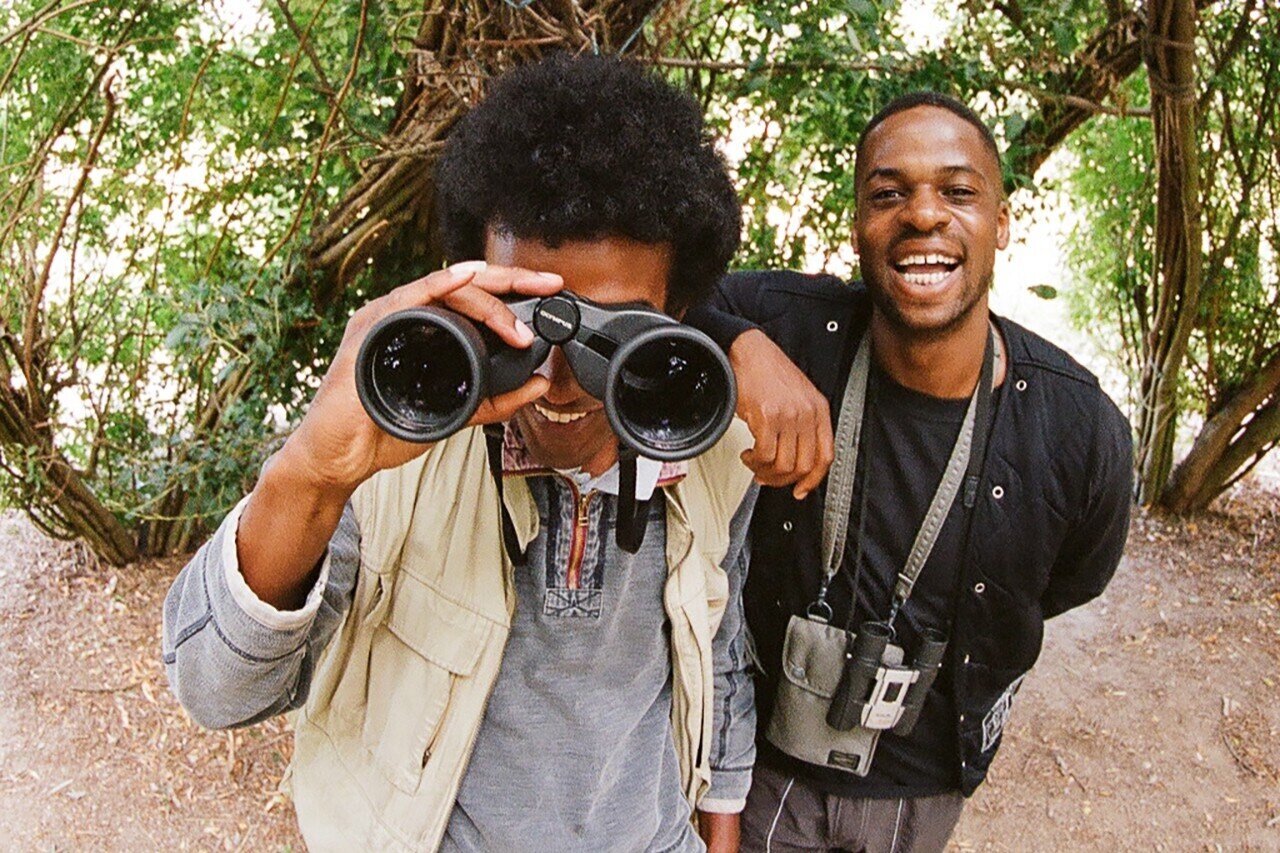
Flock Together
A birdwatching collective founded by and for people of colour that’s as much about mental health, creativity, ecology and community as ornithology.
What is it: A birdwatching collective for people of colour started in London by Ollie Olanipekun and Nadeem Perera (who met each other on Instagram over their shared love of birdwatching). From its first walk on Walthamstow Wetlands last year, Flock Together now has chapters worldwide, including in Toronto, New York, Milan and Paris.
Why you’ll love it: Join one of the monthly birdwatching walks — don’t worry, no experience is needed and beginners, as well as experienced birdwatchers, are very much welcome. So that no one is left out, Flock Together has developed brand partnerships, with binoculars and equipment donated. Although the walks are built around how to spot birds and what they are when you do — is that a jay, a wood pigeon, a robin? — they also build a supportive community, that understands the circumstances that might have brought you here.
What you need to know: New initiative Flock Together Academy makes sure kids get into nature, start to see the birds around them, and begin to understand ecological issues. Nature has been shown to have huge benefits to our kids — a year of being glued to Zoom classrooms and disconnected from the outdoors has been a desperately sad indicator of this. These classes in green spaces make nature visible, accessible, and vital again to young minds ready to learn outside the classroom what’s really important.
How to bring this into your life: Interested in the mission of Flock Together? Reach out to them to open a chapter wherever you are.
Why it matters: Think birdwatching and what’s the image that comes to mind? Maybe the media painted picture of a middle-aged khaki-wearing white man sat with their triangle sandwiches in a bird hide deep in the English countryside. That’s the history and that’s the misrepresentation problem, right there. Flock Together began during both lockdown – when the connection between nature and mental health became clearer — and the Black Lives Matter movement when who had access and who didn’t to this form of support also became more apparent. Similarly, birdwatching hasn’t been equitable, or diverse. This became acutely known when a white dog walker called the police on a black birdwatcher Chris Cooper in Central Park. Also, birdwatching hasn’t exactly been cool, but Flock Together is shifting that too. And those mental health benefits, Olanipekun and Perera are building this into their mission developing therapeutic sessions for participants.
In their own words: “Nature is a universal resource. For too long black, brown and POC have felt unwelcome and marginalised in spaces that should be for everyone. Together we are reclaiming green spaces and rebuilding our relationship with nature — one walk at a time.”
Something to do: We’re very new to noticing the birds around us. During the lockdown, we learned to identify the birds in our garden for the first time. And though we learned their rhythms, their colours and their songs, we also learned that we play a role in looking after them. Read this post from Flock Together, which shows us all how to take care of our feathered friends: by feeding them, cultivating wildflowers, putting out water, and looking after the insects — the birds need them too.
Lead photo credit: Zaineb Abelque

How creativity can improve your wellbeing during uncertain times and beyond
The many ways that creativity can make you feel better wherever you are, and whatever your creative practice.
“Unused creativity is not benign. It metastasizes. It turns into grief, rage, judgment, sorrow, shame. We are creative beings. We are by nature creative.”
Creativity is an important aspect of life, but many people are currently struggling to feel creative. Months of isolation have left many of us feeling lonely and uninspired.
However, some people in the past and present have found that uncertainty and crisis can actually spark creativity and innovation. From trying new crafts like knitting to renovating your home, undertaking creative projects can help boost your mood, bring some joy during these difficult days, and also help you cope during periods of isolation, especially if you live alone.
What is creativity?
Creativity can be channeled, honed, and expressed in tonnes of different ways, not just on canvas or through arts and crafts. It could be through a board game, party planning, or even coming up with solutions to a business problem.
Everyone is creative, but many of us choose to not explore, express or appreciate it, for a variety of reasons, so it goes down the pecking order of priorities and/or the benefits aren’t felt.
Sam had the perception for years that being creative involved painting a masterpiece, like Van Gogh, or writing and performing a song. Both of which he felt he couldn’t do; his creativity was locked in a box or didn't even exist. He’s now come to realise that creativity just needs an outlet that works for you, like many things in our lives.
Similarly, when we think of creativity, many of us still think of painters and musicians, rather than architects, interior designers, warehouse managers, founders, accountants, and all the other people who need to be creative regularly and may not realise they are.
We’ve found that being more creative, however, you choose to access it, is a superpower that can positively impact your life and business. Don't forget - you are creative, it is in you just waiting to come out.

Being more creative boosts your mental health
Here are seven ways that creativity can help us negotiate uncertain times and get through periods of isolation.
1. Creativity reduces stress, anxiety, and mood disturbance
The pandemic has created a lot of doubt and uncertainty, and for many people, this can create feelings of negativity — but you can help mitigate this negativity by doing something creative. Whether you make something beautiful for yourself (such as a pair of earrings) or use your creativity to help someone else (for instance, you could help a small local business with advertising), this focus on doing something and bringing an idea to life will give you a sense of purpose and productivity — giving more meaning to your days in isolation.
The Connection Between Art, Healing, And Public Health — a Review of Current Literature (2010) concluded that “creative engagement can decrease anxiety, stress and mood disturbances.” Another study Everyday Creative Activity as a Path to Flourishing similarly concluded that engaging in a creative activity just once a day can lead to a more positive state of mind.
[A creative activity can be simple, don’t worry. You may be doing it regularly already. It could be doodling in a journal, crafting, playing the guitar, redesigning your kitchen, or business planning. These are things everyone can do and just acknowledging it can give you a boost.]
Back to the study. The results surprised the researcher Tamlin Conner, who didn’t think the findings would be so definitive. Conner said...“Research often yields complex, murky, or weak findings…But, these patterns were strong and straightforward: Doing creative things today predicts improvements in well-being tomorrow. Full stop.”
During the pandemic, your local council might offer creative workshops. For example, the creative sector in Bradford has come up with a host of creative ways for locals to improve their mental health; they are providing virtual classes for both adults and children, including drawing classes, yoga classes and writing classes.
2. Creativity Can Improve Your Personal Space
Lockdown created a whole host of DIY clichés and for good reason! Being stuck inside your house for months isn’t much fun, especially if you don’t find your home relaxing or pleasant — but up-cycling is an easy way to improve your surroundings.
From up-cycling old chairs to give them some personality, repainting some cupboards to breathe new life into them, or turning old cups and bowls into planters for flowers and shrubs this is a simple way to stay occupied (and it is also great for the environment!).
If you are looking for some upcycling inspiration, we can recommend these Instagram Accounts:
@maiseshouse for beautiful upcycle furniture inspiration
@restoringlansdowne for moody interiors and Victorian home renovations
@linsdrabwell for some budget-friendly upcycle hacks
You can start small on something like a plant pot or a mirror and work your way up to something bigger.
This leads to another benefit of creativity; it gives us a feeling of pride, that "I did that, yeah, me”. It’s really nice spending an hour or more creating something, and then et voila. It’s done, it’s there, something that reflects your inner creativity and personality. An expression of you. It feels very empowering and never gets old.

3. Creativity Allows You To Connect With Other People – Close to Home & Around The Globe
Creativity allows you to connect with other people. One of the hardest things about isolation is limited socializing, but you don’t have to be creative alone.
When lockdown first started, and we were on furlough when our studio M.Y.O had to close, we launched #createsolation. This was a series of almost daily challenges trying a new craft from macramé to string art and even fork calligraphy! This helped bring some structure to our days especially and keep us connecting with our audience and regular studio guests virtually. It was so great to see many guests try out the challenges we were doing and share their tips and creations with us.
There are now a whole range of classes that you can take online with friends, as well as hundreds of forums for specific creative interests (such as designing jewelry or knitting) that meet virtually. This allows you to connect with new people who have the same passion as you so that you can collaborate and have fun together. It also opens up borders enabling you to connect with people around the world, who you may not normally meet!
Closer to home, Sam has been sending his mum a range of creative kits from calligraphy to watercolours and even candlemaking for them to do together and to bring back her creative spark. She has been cocooning for a few months as a vulnerable person and having retired was looking for projects to keep her busy. It’s been amazing to see how much it has helped brighten her mood and give her a sense of achievement — from lino printing 50 Christmas cards to decorating her lampshade and upcycling her furniture, her creations have definitely inspired us!
Humans are social creatures, we crave company, connections, and being around other people. Social interactions are still a vital part of who we are — but it is possible to build connections virtually.

4. Creativity increases our sense of self-awareness and opens up expression
Dabbling in being creative produces an output, which is basically an expression of you — even if you don’t think it is! Over time and with a little practice, you can feel a lot more able to express yourself as you become more comfortable in yourself and the different techniques that you are drawn to.
5. Creativity can slow you down (in a good way) and give you an expanded sense of time
Time slows a little in the sense that your thoughts slow and it’s easier to stay focused on the task at hand and feel a little more present. This can be referred to as being in the flow.
Ever feel like your weeks are just absolutely flying by and you don’t know how and what you’ve done? Slowing that right down can really help, and arts and crafts can make that happen. Having such easy access to technology means our brains are constantly whirring, but not necessarily about the right things.
6. Creativity can help you think better
Experiments have shown that being creative, which can trigger mindfulness, boosts your general creativity as it can enhance your ability for divergent thinking — a thought process or method used to generate creative ideas by exploring many possible solutions. But, many of the qualities associated with convergent thinking are also enhanced by mindfulness. Convergent thinking is basically the opposite of divergent thinking. It generally means the ability to give the “correct” answer to standard questions that do not require significant creativity. Creativity helps with both.
7. Become a better problem solver
Short and sweet here. You can become a little more resourceful and creative with figuring things out, much like you need to be when creating something. Part of this comes from having more confidence to think creatively, as you will naturally think harder and come up with more possible solutions to problems, rather than latching onto the first two you think of.
There are so many times when very quick decisions are made on big challenges, without really looking for all possible solutions. When we can come up with more options, we can assess each one and decide on the one that increases our chance of success.

But how can I be creative?
We know that starting any creative practice can be intimidating, even when the benefits to us are increasingly evident. Here are a few ideas for getting you started on your creative adventure.
Start small
If you feel you are never creative, that’s fine. Maybe try it once this month and make a mental note of how you feel after. Try something you can quickly do like an adult colouring book, doodling, or painting by numbers. Do that a couple of times in the next few months, then maybe try more often… you may end up doing it daily — but don’t put pressure on yourself to do that from the outset. Small, incremental changes can become habits.
From a creative thinking perspective, think back to times where you were creative. This will give you a confidence boost to do it more often when you are looking at challenges in life and business. There is always option a, b and c but what about option z?
Next time you have a challenge you need to overcome, write down ten possible solutions to it. You'll be surprised with what you come up with.
Start with someone else
We always find a bit of peer pressure helps and keeps you in check. Get a friend or colleague who you think would equally benefit from having a creative practice, explain the reasoning and get them on board — they don’t have to do it with you, it’s fine to do it solo, but at the least, they can check-in to see how it went, increasing the chances of you doing it! Try making something for each other or teasing out a life or business problem together.
Check out resources for creativity and find the ones that appeal
Our creative space for grown-ups has many classes (both online and off), you can check out our kits (and podcast!) on Creative Jungle and of course If Lost, Start Here has advice on where to go to seek out creativity. However, you start, make it something that works for you, whether that's pottery or welding... the options are huge. Go play.
So, stay creative, stay inspired, and make sure to regularly reach out to your loved ones for a chat whatever your creative life looks like.


Positive Wellbeing Zine for Mums
A magazine that supports mums that’s also a community for motherhood, wellbeing, and self-care.
What is it?: An independent magazine for mums, that’s all about motherhood, wellbeing, and self-care. Though it's not just a 'magazine' — it’s also about bringing together a community of like-minded people to share their stories, their words of wisdom about topics related to motherhood, wellbeing, and self-care, and their support for other mums on their journey. Through its pages, this magazine shares the values of community, collaboration, and a sense of cheering each other on.
Why You'll Love It: The magazine came from my own experiences of motherhood and not being able to find a place where my needs as a mum were being addressed and so I created the space that I needed for other mums.
What It Offers: Isabella and Us has an online community, a Facebook group (Positivity Hub for Mums), a Podcast (Positive Wellbeing Podcast for Mums), and the magazine (Positive Wellbeing Zine for Mums).
What Makes It Different: The magazine is the only one of its kind currently being published with a community around it that supports mums.
What You Need to Know: Mums need the magazine right now to support them through this tough time and to support and encourage them to take time for themselves.
In Their Words: “Being a mum is tough and often so much of what we do, read and buy is for our little ones. A mum’s needs can often get put to the bottom of the pile but it’s so important that as a mum we take time for ourselves, time to recharge, and time to just be us. This is why the Positive Wellbeing Zine for Mums is so important."

Sidewalk Talk
Sidewalk Talk takes the psychotherapist’s couch outdoors, creating the space for anyone to be heard.
Seek this out if: you want to refine your listening skills or just feel listened to.
What is it: A community-listening project, Sidewalk Talk offers a place of belonging within everyday surroundings. Just pull up a chair for the chance to be heard or volunteer to be the one listening. Connection doesn’t have to be complicated. It can happen right here in the streets around us by people who want to be there for us.
What you need to know: When San Francisco-based psychotherapist Traci Ruble noticed a surge in gun violence in her neighborhood, as well as increasing disengagement from each other due to tech and politics, she wondered whether she could place her therapist’s chair on the sidewalk and just listen. Curious about what was happening to society, Traci invited 28 psychotherapists to set up “listening chairs’ around the city, giving people an opportunity to just talk, to share their stories, to feel heard, and to find a connection. That was in 2015. Sidewalk Talk has since grown into a global movement and is now a non-profit operating in over 50 cities and in 15 countries, with over 8000 volunteers.
What they offer online and off: Sidewalk Talk is driven by its volunteers, 50% of whom have a background in therapy, though that’s not essential. Find out how to be trained as a listener or how to start your own chapter. Traci also hosts a podcast, Sidewalk Talk with invited guests discussing the breadth of issues creating loneliness and impacting our emotional wellbeing today.
New for 2021: The consequences of the pandemic – the stay-at-home orders, the focus on home at the expense of everything else, the pressures piling on – have strained some of our relationships like never before. Traci is also now offering a 12-week couples listening skills community, which is science-based, three-year tested, and heart-centered.
Why we think it’s special: In a moment when face-to-face contact has us feeling like we’re breaking rules or under threat, we’re looking forward to the time when that in-person piece is restored in our worlds. Sidewalk Talk recognizes the power of connection, how human it is just being together and how important it is just to feel heard. The organization also offers a much-needed counterpoint to the narrative that we need to do everything alone, including wellness, that being with each other, helping each other through, offers ways forward that going more and more inwards doesn’t. We need more kindness, more support, more togetherness; Sidewalk Talk steps into the “empathy deserts” we’re now living in and creates space for belonging and connection.
In their own words. “The world loves to talk - but words aren't enough. Listening helps people open up, share more, and reconnect in an increasingly lonely world. At Sidewalk Talk, our mission is to create communities of listeners who return to the same public spaces to practice heart-centered listening all over the world.”
More of a reflection: Learn to listen, not to fix, or give advice, or make sure someone knows absolutely what’s on your mind too. Learn to hear what someone is saying, reflect back to them the ways in which you understand, and be with them without judgment or preconceived direction. We’ve almost forgotten how to allow space for someone else and to show up to relationships with kindness. A language of listening can be learned, just as much as social media algorithms or cultural trends. Start with being aware of how you can listen better today. Then keep going, actively building positive relationships of trust and support.

Silent Book Club | In Conversation with Laura Gluhanich
We talked to Silent Book Club co-founder Laura Gluhanich about how a simple night of reading with a friend became a global phenomenon.
We recently discussed with co-founder Laura Gluhanich all the ways that Silent Book Club offers community and a space to unplug, both vital to our mental health and emotional wellbeing as we negotiate these uncertain times.
What compelled you to start reading together, silently?
One night out to dinner at a favorite local spot in San Francisco my friend Guinevere de la Mare and I shared our frustration with traditional book clubs, and our joy of reading at restaurant bars. The next time we met for dinner, we planned to sit at the bar and read together. We continued meeting up, and as friends heard about our “silent book club” they asked to join. Everything today comes from that.
How do you get over that initial need to chat, to make noise, to fill the silence? We’re so unaccustomed now to filling the spaces between us.
Our format includes some planned conversation at the start. Typically a silent book club meeting starts off with everyone saying hello and sharing what they are reading. It creates a shared space and connects folks over shared books or genres. I think our members appreciate that when they start reading they know they don’t have to worry about anything else at that moment. We set an alarm and wrap up the session, so they can just dive into whatever they are reading.

Book club selections can be very particular to a group or the situation of coming together to talk about one. Are there certain books that lend themselves to Silent Book Club? Like, don’t read conversation-inducing books such as anything by Glennon Doyle or Three Women?
What surprises me more is that at every in-person meet-up, I’d venture we have a minimum of five genres represented in a group of ten. It is a very welcoming group, and if someone isn’t into what you happen to be reading, it’s not taken personally. And in our Facebook group, just about everything goes, though we choose to not offer a platform to white supremacists, misogynists, and the like.
Have you ever thought of Silent Book Club as an anti-tech space?
Yes! My co-founder and I both work full time in tech, so providing a time to ignore notifications is a benefit we recognize.
Or maybe even an anti-loneliness initiative?
Yes! I love that Silent Book Club can provide community in a really low-key way. Beyond the minimal conversation, it is super low stakes, so especially if people are less extroverted it’s a great opportunity to connect. And while there are lots of book lovers in the community, particularly the Facebook group regularly gets posts from folks who are getting into reading for the first time or rediscovering their love.
You have chapters globally now. Have you noticed differences between how these book clubs meet or how they are received locally?
Not really! Shout-out to our Genoa chapter for being super photogenic and fun. There’s a ton of variety throughout our chapters but I don’t see a difference based on location.
What kind of setting is conducive to a Silent Book Club?
As you can see from that Genoa link, lots of places work to meet up and read. We recommend cafes and bars (hotel lobby bars can be chic and have the perfect level of background noise). Bookstores, ice cream shops, community centers, parks, beaches, and backyards have all been successful. We’ve even seen them at conferences — a great option for introvert attendees to chill out.
Do you have any favorite meetup anecdotes?
We’ve had a couple of chapters see people meet at their events (ready for that meet-cute to happen in a movie). We definitely hear more about books getting discovered than soulmates.
One fun thing that has happened with the virtualization of Silent Book Clubs is the ability for anyone to join any virtual meetup. Our Denver chapter has had guests from Mexico City, Guinevere has said hi to Italian chapters, and I sat in on a meetup based in South Korea. It’s a fun way to explore!
How are Silent Book Clubs adapting to the shifting situation of the pandemic?
We’ve seen dozens of chapters shift to an online format. A number have hosted outdoor meetups globally. Of course, plenty of countries have had competent pandemic leadership, so they have been able to meet far ahead of us here in the US.

Why do you think the idea of Silent Book Club has taken off so much?
I think there are two primary reasons people have responded to Silent Book Club. The first is broadly the mental wellbeing aspects that I’ve already mentioned. And in conjunction, we are all so over-productive, Silent Book Club is an antidote to that.
What is your vision for Silent Book Club going forwards?
We’d love to see its continued growth, supported by brands or organizations that share our mission of encouraging reading. We plan to continue our author series in 2021, and have an idea of a global Silent Book Club week, promoting literacy in public.
Any places out in the world or books that you seek out to support you in uncertain times?
We’re big fans of independent bookstores and libraries, and while there is broad uncertainty, we encourage folks who have the resources to support their local cultural institutions in an ongoing way. The mutual aid movement reflected in Little Free Libraries and the Community Fridge network gives me hope.
What should people do if they are curious about Silent Book Club?
Find a local chapter on our website or a virtual meetup. We welcome you whether you are looking for the time to get through a few chapters for another book club, or just for fun.
“If you are finding it hard to find space for reading, joining Silent Book Club gives you that time back. It prioritizes reading in your life again. It gives books back to you. ”
Discover more ways to connect
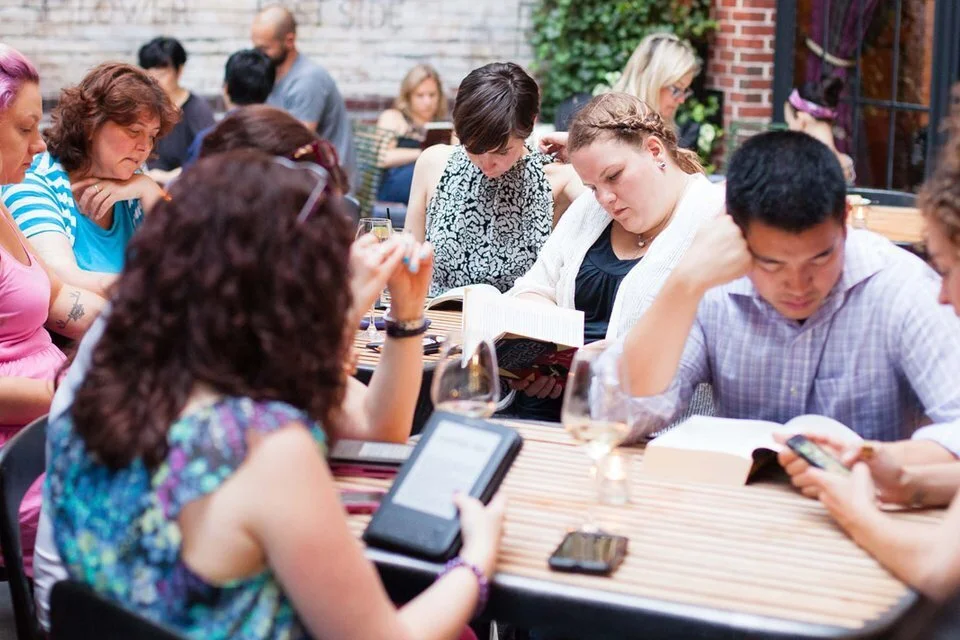
Silent Book Club
For the introverts, a book club that doesn’t get you talking.
“Welcome to introvert happy hour.”
What is it: An opportunity to read. The twist, there are others reading with you too. You’ll be in a café, a bar, a public library; in COVID times maybe you’ll be on Zoom or outdoors. The people with you will have their own books, you’ll have yours. And though there’s a social moment built in — a hello and sharing of what you are reading — the focus is simply on you and your book. Enjoyed now in ways which we have learnt to understand, together but apart.
Why you’ll love it: This is one for the introverts among us (of which we count ourselves). Yes, book clubs are great – we’ve hosted and attended many – but sharing just the love of reading that’s something magical. The Silent Book Club started in 2012 when two friends Guinevere de la Mare (a UX writer at Google) and Laura Gluhanich (director of programs at Him for Her) began reading together in a neighborhood bar in San Francisco. Gone was the pressure of typical book clubs, having to read the same books, having smart things to say, hiding the fact that you haven’t read the book. Here was just enjoying the moment of reading together – no mobile phones, no commitments pressing in, no pressure to select the right thing to share or carry out a conversation in the right way. Just a book, a friend, and a nice location somewhere. And from this, this now Silent Book Club grew to friends and acquaintances, and grew to a handful of cities, and grew to now 285 chapters in 37 countries.
What you need to know: If books are your happy place, you can now seek out a Chapter probably wherever you are, though if there isn’t you can start one (friends there isn’t one in Bath or the Marin area where we’re both based if someone’s inclined to host…). During stay-at-home times, many of these Chapters offer virtual read-ins.
Why we think we need it to exist: We’re noticed something odd going on in our lives. Though we love books, we’re no longer reading them in quite the same way that we used to. We seek out recommendations, we subscribe to book boxes, we haul heavy bags from independent stores, we ship boxes upon boxes when we move, but the reading part is not as high up our agenda as it once was. You may be finding the same in your life. Life pressing in, doomscrolling replacing narrative and character development, anxiety blocking any possibility of retreat or escape. Time has gone, and we’re trying to find it again. For many purposes, but also so that we can return to the books that we love and the ones we might love in our future. If you are finding it hard to find space for reading, joining a Silent Book Club gives you that time back. It prioritizes reading in your life again. It gives books back to you.
It also gives you other people. As many of us spiral in our loneliness, that companionable silence actually gives us connection, it fosters relationships. As co-founder Gluhanich says, “For people who want to do something on their own but at the same time are seeking connections and a community with other people, SBC’s can offer them both of these. People all around the world are forming emotional bonds with one another while reading in silence.”
In their own words: “Silent Book Club is about community. Everyone is welcome, and anyone can join or launch a chapter. We encourage people all over the world to start their own Silent Book Clubs. All you need is a friend, a café, and a book. We have more than 240 active chapters around the world in cities of all sizes, and new chapters are being launched by volunteers every week.”
Something to do from anywhere: Wake up, doom scrolling. Before bedtime, doom scrolling. These have traditionally been times for reading books. So for a non-binding, after the New Year’s, non-resolution, ban the phone from the bedroom, buy a book light, and read books again. Paper pages. Like us, you may find your brain working just that little bit better, your life feeling slightly less heavy, and the world just that little bit bigger. You’ll be reading books again.
To find out more: Website / Instagram / Twitter / Facebook
Love this? Try also Shelf Help, or podcast Celebrity Book Club

Men's Shed Movement
As men have traditionally struggled to find outlets to talk about their feelings and challenges, the men’s shed movement is starting to fulfill this need for connection.
What is it: A network of DIY-enthusiast communities that bring men (and now women) together to fix things, collaborate on projects, and share stories.
What you need to know: The men’s shed movement began life in Australia in the 1990s as a way to give older men a social hub. Working shoulder to shoulder (rather than face to face) offered participants a chance to share skills, learn techniques, and make friends. The men’s shed movement has since spread across the world; there are now 2000 sheds across 12 countries, including Finland, Ireland, the USA, and the UK, where there are more than 600 nationwide.
What they offer (online and off): Depending on the particular shed, there could be tools for woodworking, electricals, and metalwork, while members frequently pass on their own skills — coding, welding, machine tools, or car repair. Although most sheds are run by and for older men, there’s no barrier to entry; many sheds feature both female members and younger men. If there’s no shed in your area, British shedder Chris Lee has a TEDx talk on YouTube that’s a useful introduction to what sheds mean to him and how they’ve helped him. And if you’re inspired, get some tips from the guys who’ve “made one earlier” and start your own shed!
Why we think it matters: While individual sheds offer a creative, communal, and inclusive environment, the growth in the men’s shed movement illustrates the deep need for male companionship.
After major life changes such as retirement or the death of a partner, some men can become isolated. Often the loss of status or purpose can impact men’s mental health, as they keep their anxieties to themselves without finding outlets to talk about their feelings or their challenges. “As men we seem to be conditioned into letting go of things but not replacing them,” says Chris Lee, a former marketing professional who’s now a trustee of the men’s shed movement in the UK. Sheds — gathering points that feature activities from coffee to carpentry — provide a sense of community and purpose.
Whether sheds are literally wooden huts or shared community spaces, they are places where men can feel useful, comfortable, and purposeful.
In their own words: “When I heard about the Men’s Sheds movement, I immediately thought it was a brilliant way of bringing people together around something creative and fun. Men aren’t always the best at making new friends or talking to one another, but get them around a piece of wood or a DIY task and it’s amazing how they open up.” — Mike Magnay, retired electrical engineer and co-founder of a shed in Blewbury, Oxfordshire
One piece of advice for where you are: Start online and see if there’s a men’s shed in your area. Check out the website and learn more about weekly events or special sessions. Email the team. Show up. You don’t have to own a toolbelt — some guys just come along for the company and the conversation. Drink coffee, ask questions, learn wood-turning, repair an appliance, smell the smoke of a soldering iron, make a connection . . . whatever you’re looking for, the shed is what you make it.
To find out more: Website / Instagram / Facebook / Twitter
If you’ve visited a men’s shed, or you have other organizations with a purpose that you’d recommend, tell us about it at hello@ifloststarthere.com.

Content Care Package: Edition 3
Now we’re in the Holiday Season, we’ve pulled together a Content Care Package to keep us all together.
As we’re now in the Holiday season, we have to admit to finding this Content Care Package an odd one to write. Uncertainty is swirling around us again as we continue to live with the pandemic, forcing us apart from those we love and filling our days with anxiety and fatigue. Over the past couple of weeks, we’ve definitely been displacing with some Netflix watching as you’ll see below, but we’ve also been finding some gems to keep us feeling good and even just that little bit grateful in spite of it all. We’ve pulled together the places, the prompts, and the cultural events that are helping us and which we hope will help you too.


Mental Wellbeing:
We’re obsessed with The Queen’s Gambit on Netflix, Matt Haig’s The Midnight Library, Charlie Mackesy’s The Boy, the Mole, the Fox, and the Horse, and podcasts Goodnight Stories for Rebel Girls, Decoder Ring (particularly this episode on the Cabbage Patch Kids) and Reply All (see Happiness Calculator and the Case of the Missing Hit).
For a guide that’s all about getting to ok, we’d recommend these wellbeing focused magazines: Rising Issue – 01 // Mental Health Matters; What Do People Do? – Issue 2; Anxiety Empire – Issue 1, Positive Wellbeing — A Zine for Mums, Seed, and perennial favorite Flow. Even better, buy them from an independent magazine store.
Is it safe to see your therapist in-person anymore?
“Over the past decade, resilience has become a buzzword – touted as a protective talisman against the effects of trauma, which individuals, communities, and whole economies are told to cultivate.”
Open Door is a new initiative by Making Space in Stockport, which opens up free mental health support to those living in the Stockport area.
We’re huge fans of Meghan Markle for finding her own way through one of the trickiest family’s in the world (have you see The Crown), not least for her heartbreaking recent piece on her miscarriage in The NYT
Connection & Community:
How a small town in England is teaching us the value of community.
An introvert Happy Hour that we can get behind. Find a chapter of The Silent Book Club
Nature:
All the wisdom for living a nature-centered lifestyle at home is captured in ”Fforest: Being, Doing, and Making in Nature.” Create a tiny bit of the magic at home with star walks, wild swims, and den building. Planning something for 2021? Head to the book’s source material, Fforest.
New Zealand gets a new butterfly sanctuary courtesy of The Hobbit.
Forest Bathe Wales is finding a way to deepen our connection with nature.


Mind/Body Connection:
We’re on board with the millions of people who discovered yoga with Adriene Mishler during lockdown. No judgment about bad downward dogs or falling over trees, or even working out in our PJ’s.
As the seasons change, we’re looking to Red January to keep us motivated.
Follow Loom as it launches its campaign to #protectblackbirth and develops resources for women’s health from periods to menopause.
Modern Life:
In Culture Therapy, we’ve been thinking about How to Stay Sane in an Age of Division and how to navigate The Social Dilemma.
Pair with digital detox resources from It’s Time to Log Off
Culture and Creativity:
Inspired by Outlet PDX, consider which words you’d want to disseminate into the world. Which messages of support would you want to create for those within your community? Learn the skill of printing and give form to these words. You don’t need to be an artist, just a thoughtful person in the world hoping to counter messages of hate, division, and isolation that we’re now bombarded with. Or if that makes you tired, learn to draw your coffee mug.
One of our favorite Studio Ghibli movies Kiki’s Delivery Service gets the museum treatment in Tokyo.
‘Art, architecture and music have proven health benefits from alleviating pain, improving wellbeing and shortening recovery periods."‘ New online platform AORA by up-and-coming architecture studio EBBA, aims to instill a sense of calm and wellbeing through art, architecture, and food.
Is sitting in a ball pit allowed anymore? Why The Color Factory is making the argument that it is.


Doing Good:
How I Built This Host Guy Raz interviews Varshini Prakash co-founder of the Sunshine Movement on how to build an idea into a movement for change in the climate space.
You can still virtually attend KindFest even though it’s past. Standard tickets will give you access to the recordings into the next month.
We’re inspired by Counterpart Chef Almitra “Mimi” Williams who brings fresh food from her vegan restaurant to the homeless camps in Echo Park. From where you are, and if you are able to, volunteer or donate to Feeding America this Holiday Season.
Spirituality & Meaning:
We know that saying meditate is like saying eat your kale, but San Francisco’s Within has ways of making it seem doable with its classes now going online.
Awe & Wonder:
Discover Scarfolk: “a town you’re not permitted to visit, with sights you’re not allowed to see.”
Take a masterclass with Another Place artist Antony Gormley: choose between Zabludowicz Collection talk, BBC’s quarantine drawing class or National Saturday Club’s body sculpting exercise.
New podcast Ask Biq Questions has Bill Gates and Rashida Jones asking the things that are on our minds like wil be the COVID vaccines be safe or what’s the answer to widening social inequalty?
Purpose:
We’ve been pouring over Riposte magazine which is full of smart interviews with women who are figuring things out in ways we can relate to.
Do send us your recommendations for our next Content Care Package so that we can feature them in our next edition. Together we can build a better world to hold us.
Btw we wanted to let you know that we’ve changed all the links to the books we mention to Bookshop, which supports both our own work and that of independent bookstores, which is particularly crucial as many of them are struggling to survive.
Until next time, x Amanda & Claire

Content Care Package: Edition 2
As everything shifts, yet again, we’ve pulled together our second Content Care Package with all the places we’re turning to, the resouces getting us through, and just the fascinating things we just learned and had to share.
With much of Europe back in Lockdown and the US both celebrating and resisting the outcome of the recent election, we’ve pulled together our second Content Care Package. We’ve searched for the podcasts that make us run a little further just to keep listening, the online and offline initiatives that give us ways to feel better, the neuroscience that’s making us think differently about ourselves, the sources of support that have our backs through uncertain times, the books that capture all the things we’d want to say, and the big and small ways to feel more curious and less anxious. Let’s get lost together.

Connection & Community:
One of our favorite reads of recent times Together makes the argument that being with one another matters, though it was launched ironically at the beginning of a pandemic that found us locked in our homes and crossing streets to avoid one another. Now we’re excited that its author, Dr. Vivek Murthy has been appointed to President-Elect Joe Biden’s Coronovirus Task Force.
Already looking for something for post-lockdown life? Birch is the staycation you may be looking for (along with every creative in London)
Pop-up Magazine is hosting virtual suppers with recipes and chat. We sat down for the one with Cord Jefferson of The Good Place and the writer Jia Tolentino hosted by chef Priya Krishna.
Live in Bath and ready to enter The Dream Space. It’s an experimental project for sharing people’s stories around racism, the climate and ecological crises, and the social inequalities revealed through Covid-19.
Solitude: we all end up there eventually. Some willingly, some not.
“In these times of social distancing, business closures, and the constant questioning of why we live in this city at all, this is my weekly reminder that San Francisco is still somewhere special.” A Pop-Up Market in our beloved city taking us back to SF’s recent olden times.
Nature:
If you need a starting point to get back into nature, or if you are looking to deepen your knowledge of the greenery around you, we recommend Bloom Magazine.
Bringing greenery into our home is an act of conscious self-care. Having houseplants around us has been connected to a better sense of calm and well-being, reduced anxiety, and a happier mood. Our go-to houseplant shop is Frome’s Pilea.
Living Streets is finding ways to get us walking.
A Veteran’s Healing Farm opens in North Carolina.
Mind/Body Connection:
“I often say, the psyche as well as the body can, you know, stretch and come back into shape…But sometimes it doesn’t.”
The world’s first Vagina Museum is more than a display of gynecological anatomy. It’s dedicated to a serious discussion of women’s health, feminism, and sexuality
“We can use this medicine to start closing the health disparity gaps that exist because melanated humans in the United States live unnaturally stressed lives.”

Modern Life:
Esther Perel on The Sway Podcast brings her wisdom from relationships to the post-election world, the interpersonal costs of the pandemic, and finding freedom in confinement.
Are we allowed to plan ahead yet? If so, booking a slot at The Good Life Experience is high on our list of things to do for making 2021 nothing like 2020. In the meantime, you can participate in the new project Lockdown Radio and an All Day Communion, a partnership with writer Mark Shayler.
Watched The Social Dilemma? We did, with our kids, utterly terrifying. Sign up for the Center for Humane Technology to use technology more humanely.
Purpose:
This is all too familiar: “Many scholars, such as the psychologist Barbara Killinger, have shown that people willingly sacrifice their own well-being through overwork to keep getting hits of success.”
Work doesn’t have to mean competition. Creativity can play nice. Both your practice and your life may better from it.
Spirituality & Meaning:
The host of our new podcast find Unholier Than Thou, Philip Picardi is like a good friend holding your hand and bringing you along. He’s curious and open to all as he explores how faith can “fit into our lives today when the secular doesn’t feel like enough and the spiritual doesn’t always feel like a home”.
Looking to slow down and find new stories in these uncertain times, Emergence Magazine is a long-read for this moment that follows threads that link ecology, culture, and spirituality (the same interests of its publisher The Kalliopeia Foundation).

Mental wellbeing:
When a mid-life crisis doesn’t shape up to be the thing you believe it will be.
Having gone through this, we applaud this again and again and again. Make Birth Better
Preparing for the Holidays. Book Virtual Christmas Carols that support mental health charity Charlie Waller
Listening to the podcast Ten Things That Scare Me always reminds us that we’re not alone and that we all have fears, some of which we share. There are the tiny, seeming inconsequential concerns that stymie people, and the monumental, overarching themes of our lives that cause someone to catch their breath.
Recent advice from Headspace: Start your day with something positive (not the news). It will transform the rest of your day.
Awe & Wonder:
Our brains have two-distinct centers for beauty. Amazing.
Need more of Glennon Doyle. Or maybe Caitlin Moran. Or Deborah Frances-White. The How-to-Academy can bring them (or rather their insights) into your home.
When doomscrolling becomes too much, and the world becomes an even heavier burden than usual to carry, escape into stories, into time spent curled up with a good read, into the simple pleasures of holding something in your hands that doesn’t send push notifications.
Creativity & Culture
Seek out London’s Institute of the Imagination to let your imagination run free (even during a stay-at-home order)
Lionheart is a little gem of a magazine, something to sink into with a cuppa in hand (and a roar in that heart of yours). It’s been designed specifically to make you feel good, though it's more handmade than self-help.
Looking for creativity at home: workshops and kits from Stitch School (also loving their Supper Cloth for when the world starts back up again).
Ready to play in the analog world? Head to Berlin’s Clayground or purchase one of their clay kits to do at home, with all the tools and materials you need to get your hands muddy.
Doing Good:
Whether it’s for shopping small, shopping ethically, shopping cruelty-free, or simply for supporting some amazing people who work every day fighting the good fight, choosing Herbivore is a choice that makes us feel good.
Reading the magazine Positive News is reassuring: that the world isn’t entirely falling apart, that people aren’t demons in disguise running amok, that humanity isn’t doomed to endlessly flail (all thoughts that may have crossed our minds in the past curiosity of a year).
And leaving you with Obama and his enduring belief that America can become a place that aligns with the best of us.
We also wanted to let you know that our thoughtful guide to life is now back. Since March, we’ve hesitated on writing about places in the world as they close and open then close and open again, but we’ve come to believe strongly that in times of need we all need somewhere to go — even if it’s saved for later, or engaged with online, even as it can be bookmarked in the imaginary or supported from afar. The hope of bookstores, departments of make-believe, festivals, bakeries, cafes, museums, independent stores, maker studios, pop-up markets, school of emotions, sculpture parks, all existing still keeps us going. As our collective mental health is spiraling, the world out there, the collective world of our making, still has something to offer: ideas, nature, people, comfort, meaning, purpose, and wonder. We hope you enjoy our recent guide entries. We’re working on posting one a day and building out our guide, so we can truly make the mental health map that we believe we need.
One note: This platform is built by us but made by and for you. Let us know which sources of joy, wisdom, and connection you are looking to wherever you are by writing with us. Head here to know how to do this.
And also Schitt’s Creek is making the world a better place, still.

Solitude
Solitude is the latest place to be, whether we choose to go there or not.
As seekers of places in the world that contain us, there is nowhere that captures our imagination as much as that of Solitude. As commonplace as Costa (or Target for American readers), and as divisive as Goop, that state of being alone is one that we all may experience, but only some of us willingly seek out.
As Lockdown 2.0 is with us in much of Europe, we’re having to confront once again how Solitude can show up in our lives and how it stakes territory around us. This time though, from where I’m sitting alone at my kitchen table, it doesn’t feel like we’re all starting our frantic self-improvement projects again, but rather, as the color drains out of our newly returned worlds, we’re just trying to make stays against depression, loneliness, and loss.
When Solitude works, when it asserts itself as the Scandinavian design of our self-care worlds, it offers clarity, an opportunity to hear our inner voices, it gives us a chance to reconnect with ourselves. Silent meditations, forest bathing, wild swims, epic walks, even sitting reading in a favorite chair and lying a little longer in bed in the morning, whatever form Solitude can take, can capture that sense of being alone, but in a resoundingly positive way. Solitude holds the world back so that we may come in again. It’s a wall we can build around ourselves or the boundary that can set us apart for a while — even if you use it to connect with something bigger than yourself and to untether your mind to get to that universal ‘om’.
For some of us, Solitude is a place of comfort we deliberately seek out in our days. As with many introverts, for me, it’s the place I find to recharge. It was in a group lesson with a meditation teacher on how to get out of our minds, that I realized that wasn’t where I wanted to go. Getting into my mind, being able to play inside, that’s a place of comfort and retreat, a way to lose myself. In the first lockdown, my struggle was that I carried everywhere with me this potential for solace and comfort, but I couldn’t access it because I was never alone. With two children to homeschool, a business to run, and a husband no longer commuting, my life became crowded, my days full, and Solitude a place that I dreamt of.
I recognize that it’s a beast though, Solitude, if we allow it to grow, to take over, to become the only place we ever get to. Solitude can sit on us, it can hold us down, it can make us struggle for ways out that we can never find. When imposed and not chosen, Solitude does something very different to us. It calls in loneliness, it shines a light on our failings, it cultivates our anxiety, it can even bring on madness. Alone in our homes (even as the husband puts the kettle on beside us), separated from those we love by a pandemic and maybe also politics now (the post-election US is very much the context here), with our purpose confined to laptops and zoom calls, we can feel like we’re in a place no longer of our choosing. And with ever-shifting regulations and news bulletins, we’re told it’s one that we can’t easily leave.
Solitude as the storefront of our emotional lives starts to present differently, too. It can be a covetable indie café or an anonymous dollar store. Our Solitude over here can start to look much worse than your Solitude over there. Your neighbor, friends, or Insta-acquaintances can seem to be giving Solitude a Lockdown makeover. They’ve gone heavily into Hygge — their candles are burning, and sheepskins are carelessly draped on artisan benches beside outside firepits. Or they’ve become the creatives we envy and aspire to be, developing new but highly successful practices in screen-printing or photographic still lives. Or they are filling their days with awe and wonder, taunting us with complicated dance routines and planetariums built in the backyard.
We’re looking over Insta shoulders and neighbors’ walls wondering why Solitude looks so good for them, but so suffocating for us. How are they living in the better version? How are they shaping it rather than it them? But we know by now that styling a life, is not the same as living a life, or indeed telling the truth about a life (even though we forget that we know that all the time). Our coping strategies take all forms — and, indeed, have to, for we are all different, and so Solitude too is a shape-shifter.
However, you feel about Solitude — whether it’s a place you run towards or from — know this: Solitude has closing hours, too. It’s a temporary destination with a month-by-month (maybe even minute to minute) lease. There are ways out if that is what we are looking for (see Connection) and if it’s not, there are ways to nestle deeper into it (and extend its run). I know people who avoid Solitude with the passion of someone on a restrictive diet: they busy themselves, reach out to people widely and carelessly, fill days with things to do, spend time always with all the people, avoid its dark spaces.
I know others who crave it like new love, get itchy to spend time with it, fall into its comforts, and neglect the open arms of their human companions. Either approach works until it falls out of balance and then doesn’t. There is no judgment that Solitude should show up a certain way, but rather a recognition that we are in relationship to Solitude because we are in relationship to ourselves. After all, isn’t that the reality of Solitude, it’s the one place we can never avoid, because we are always there.
When our world shifts again, which we know now that it must, you can choose to stay in Solitude a bit longer. You may have found, like some the first time around, that they rather liked it. Or you may leave it behind, car tires screeching as you drive to new sunsets. Because by then hopefully, the destination of Solitude will be a choice and not an imposition. No one should be forced to go anywhere, especially here. Solitude can be life’s respite but also our greatest torture. It contains multitudes. There are very few places like it.

Content Care Package: Edition 1
As everything shifts, yet again, we’ve pulled together our first Content Care Package full of link love, inspiration, and we hope support.
We’ve pulled together our first Content Care Package full of link love, inspiration, and we hope support. These are all the things that we’ve been turning to over the past week(s). We’re realizing that in all our idiosyncrasies and wonderfully imperfect ways we’re finding different things to help us wherever and however we find ourselves. These are ours; we know you have yours. Let us know which sources of joy, wisdom, and connection you are looking to in your worlds.
Connection & Community:
Stacey Abrams talking to Brittany Packnett Cunningham as part of the Aspen Ideas Festival about the potential for transformation in our current moment.
“The science of friendship gives you permission to hang out with your friends and call it healthy.” Lydia Denworth on her new book, Friendship.
If you are interested in making an actual, physical send-it-in-the-mail care package, here’s how Ann Friedman makes them.
Nature:
The drive-in movie theater takes to the water in Paris this summer.
“Travel is a powerful antidote to the growing distance many feel from the natural world. But I’m just now learning that travel does not have to mean flying to the other side of the planet. A walk around the block will do. It’s not how far we go in miles that counts, but how deeply we allow the world to enter us.” Paying attention to our daily routes.
Many of us are looking to nature as a way of finding our balance right now, a connection many beloved writers have made before.

Mind/Body Connection:
We’re maybe slightly enamored by this voice, Jeff Warren telling us How to Meditate on the Calm app.
Interested in dancing but don’t want to leave your house? Try new Virtual Studio Imaginative Movement by our friend Lauren Duchene (Amanda designed the logo): “My dream was to create a space that inspires children and adults to use their imaginations and gain new strength in a way that is accessible.”
As a true Brit (well, one of us), we’re turning to tea in times of crisis.
Untethering:
Do you count yourself in the 84% of Smartphone users who can’t go a day without their device? If so, check out these resources for rebalancing tech in your life.
If you need five-minutes of untethering, we recommend listening to poetry on The Slowdown (see recent episode Frequently Asked Questions: #7)
Need a Phone Detox?
Purpose:
“Museums must practice empathy and close the gap between themselves and their communities; they must provide space for conversations on the issues that matter to the lives of their audiences, neighbors, and employees. Museums must be sites of advocacy, not just for the artistic and art-historical traditions that they hold so dear, but for basic rights to life, safety, shelter, well-being, and economic and intellectual sustenance. Museums must dismantle regimes of power even when that power emanates from within.” Rethinking our cultural institutions in terms of care and knowledge is vital to how they function in society.
We’re just a little in love with Jameela Jamil’s podcast particularly the episodes with Reese Witherspoon, Scarlet Curtis and Vivek Murphy (also see his new book Together which we’re currently listening to on Audible)
Spirituality & Meaning:
What does your Enneagram number mean?
“Finding answers from above for whatever the hell is going on down here.’ New podcast discovery, Phillip Picardi’s Unholier Than Thou.

Mental wellbeing:
“At some point, you’ve paid your dues. Months without sugar or caffeine or alcohol of cauliflower, months of meditation and books and creams, and you’ve finally suffered enough. You’ve sacrificed with just the right mix of humility and hope. Your value remains.” Amanda’s new piece at Harness Magazine.
Our brains are not cut-out for navigating how best to behave in a pandemic
“I’ve got these conditions—anxiety, depression, addiction—and they almost killed me. But they are also my superpowers. The sensitivity that led me to addiction is the same sensitivity that makes me a really good artist. The anxiety that makes it difficult to exist in a world where so many people are in so much pain—and that makes me a relentless activist. The fire that burned me up for the first half of my life is the exact same fire I’m using now to light up the world.” This quote alone tells you why we’re still in love with Glennon Doyle’s Untamed.
We’re discovering the benefits of teletherapy and they might outlast the pandemic.
Scented candles getting tired and In need of new inspiration for self-care? Chalkboard has some new ideas for you.
If like many of us you have been thinking about your mental and emotional wellbeing, we would be so so thankful if you took our survey! It will take you less than 5 minutes but will be hugely impactful for us!
Awe & Wonder:
How bookstores have stepped up as we’re allowed to step back into them again.
Our new favorite building.
Creativity & Culture
We’ve just discovered “illustration therapy” with Aww Magazine
Journal prompts to unleash your creativity
Hamilton. On Disney+. Nothing more to say on this one.
We’re planning to attend the Literary Death Match at the Hammer this Tuesday night
“You have the Rite”. Marc Bamuthi Joseph’s breathtaking spoken-word performance for TED
Doing Good:
Votes matter now more than ever. Join Fair Fight 2020
If you are not too exhausted with everything, this month is Plastic-Free July.
Support All Together Collective’s latest fundraising bundle (which includes our Filled With Feelings Tote Bag). This time 50% of profits will go directly to @play.marin - a local nonprofit already doing the work to increase diversity and inclusion in Marin through play.

If you have ideas for our next Content Care Package going out at the end of July, you can submit them here. Let us know what’s catching your attention and helping you through.
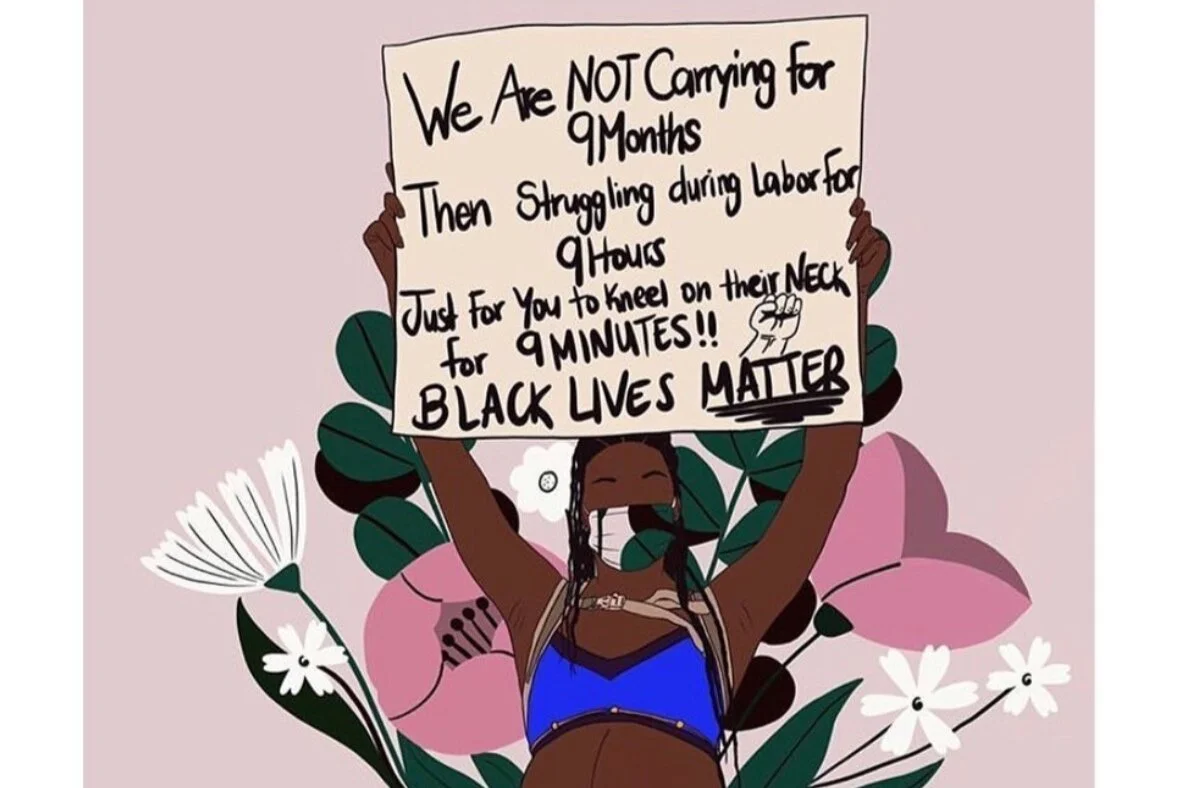
Keeping Up the Momentum
We’ve been thinking a lot about how to sustain momentum after this news cycle has passed, what role we’ll play in a massive fight against systemic racism...a long overdue fight for equality.
Because If Lost, Start Here exists to bring people closer to impactful mental health initiatives and independently-owned spaces, it makes sense that our energy stays here, but this time, with an added focus on the spaces founded by and for the Black community. .
In the world of mental health, with all of the stigma and misconceptions that surround it, the Black community has been particularly impacted. Today, we are taking a moment to highlight some of the spaces and projects that have been founded in response, some of which we’ve featured in the past, some that are totally new to us. From therapy directories and podcasts to yoga studios and books, there is a wealth of resources available from the Black community. Our focus will stretch across the US and the UK so please feel free to share any relevant projects. (We will continue to update this list.)
Approximately 15% percent of the US population identifies as Black. That means AT LEAST 15% of our content should be featuring spaces and initiatives founded by Black individuals. We are pledging to hold ourselves to this standard by ensuring that at least 1 of every 5 features in our guide (20%) is of a Black-owned business.
We are kicking off this initiative by donating to The Loveland Foundation (a therapy fund for Black womxn and girls). We will continue to donate 10% of any proceeds to this foundation moving forward.
BLACK LIVES MATTER
BLACK MENTAL HEALTH MATTERS
Illustration of @uluvmylovefaces by @jcgmisul ✨
This has been a difficult week for so many. If you’re struggling (or simply looking to take care of yourself more deeply) please check out these amazing projects and organizations.


We Will Never Go Back #blacklivesmatter
We are back on Instagram and back working on our guide and fulfilling this dream, but we are never going back to the world as we left it. On May 25th, George Floyd was murdered when a Minneapolis police officer pressed a knee to his neck for 8 minutes and 46 seconds. This act in itself was barbaric and reprehensible, but, almost as frightening, was the fact that so many of us were so shocked…so many of us who believed ourselves to be allies and friends had never truly grasped the severity of systemic racism and all of the brutality that exists within that oppressive system.
We launched If Lost, Start Here almost 2 years ago and committed ourselves, from Day 1 to making this space inclusive, representative and safe. We bought Rachel Cargle’s “Unpacking White Feminism”, we read articles, we consulted friends, we featured some amazing black-owned businesses and spaces. We tried. We are here to tell you that WE HAVE NOT DONE ENOUGH. Not even close. We are also here to tell you that THIS CHANGES NOW. We are not perfect, and never will be, but we are committed, and we will not let the momentum of this movement stop. Not here. If you are a white woman, we hope you’ll join us in our ongoing effort to be forcefully anti-racist.
Here are a few steps we’re taking now:
We are protesting (even when our social anxiety says to stay home)
We are donating to bailfunds (in Minneapolis and Louisville) and @thelovelandfoundation (a therapy fund for black women and girls)
Amanda is reading Ibram X. Kendi’s “How to Be An Anti-Racist” and Mikki Kendall’s “Hood Feminism”. Claire is reading Robin DiAngelo’s “White Fragility” (We are sharing/discussing as we go.)
We are listening to Layla F. Saad’s “Good Ancestor” Podcast
We are having uncomfortable conversations with friends and family (because nothing is as uncomfortable as being persecuted for over 400 years)
We are educating our children, laying the foundation with a real look at American History. (Check out the Oh Freedom! curriculum we’re using here.) We are incorporating stories of powerful and pivotal black men and women throughout history. (The books we purchased this week are from Bay Area bookseller @ashaybythebay)
We are buying from black-owned businesses and paying content creators for their knowledge/time/emotional energy (we should have been doing this consistently much earlier. We are committing to making up for that now.)
We are following lovely people like Kat Vellos who are helping us to navigate our relationships with our black friends.
We are reveling in the joy that is twitter. (We are KPOP fans now.)
We are committing to KEEP UP THE FIGHT by making If Lost a resource that is truly representative of the world we live in.
We are committed to using this platform to highlight black-owned small businesses, particularly community spaces founded by Black womxn. (As always, we will approach from the angle of mental health and community impact.)
We will accept responsibility for the role we’ve played in perpetuating a system that has benefited us.
We will not process our feelings or air our grievances in the comments sections of the black women we admire. We will not expect anyone to educate us.
We will vote.
We will center black voices without our analysis.
We will not wait for more educated people to impart their knowledge. We will seek it out, and we will compensate the creators.
We will sign petitions and send emails and apply unyielding pressure.
We will be active in dismantling a system that has been broken since its inception.
We will make mistakes.
We will keep fighting.
We hope you’ll join us.

Imaginary Places
This week we decided to pull together some of our favorite imaginary places (from TV shows, plays, movies and books.) We found that it was quite fun to imagine where we’d love to spend our time, if reality weren’t a confine.
We’ve spent the last year and a half devoting ourselves to finding the places in the world that help to support us as people.
We’ve defined categories representing our most basic needs for happiness and connection and belonging. We’ve categorized and consolidated, gained traction and lost momentum, burnt out and forged on. Eventually, we found our stride and mapped out our plans. You might be able to imagine, then, our surprise (read: panic) when the world shut down and “going places” was, suddenly, no longer a thing.
Instead of wallowing in self pity or questioning our entire lives, or throwing in the towel, we’ve pivoted, temporarily resetting our path and redefining our focus. (You can head here to see all of our prompts for surviving while Lost At Home or here to check out the tote bags we created to support struggling small businesses.) If we’re being honest though, the thing we miss more than anything is finding the most magical places for people.
So this week, we decided, instead, to pull together some of our favorite imaginary places (from TV shows, plays, movies and books.) We found that it was quite fun to imagine where we’d love to spend our time, if reality weren’t a confine.
We hope this list inspires you! And if it does, we have a challenge for you. Your prompt this week is to dream up your own imaginary place, sketch it out, write a story. Maybe when we come out of this, you could aim to stretch that imagination into the actual, and make that place real.
In the mean time, here’s a look at the places we’re visiting via Netflix binges and late night read-a-thons.
Our Favorite Imaginary Places




Learning to Count to 100
This week we’re learning to count to 100, listing the things we value, we need, we’ve lost and gained. What would your list include?
As we’ve both been homeschooling our Kindergarten girls (one of us by choice, the other by necessity), we’ve also been learning to count to 100. You know, 100 Lego pieces, a hundred marbles, a hundred Fruity ‘O’s — anything we can find at home to make this very serious academic lesson a bit more concrete.
And it made us think about — stay with us here — what as adults we might want to count at this time. Less shiny plastic objects and tiny snacks, more the things we rely on and reach for. The things that we’re grateful for and that bring us joy or make us laugh or give us that warm feeling in our chests. The things that energize our minds, the things we are desperate to share because they are so good, the things that linger once they are over. And the things, maybe most importantly, that help displace our fears and anxieties, pause the endless loop of overthinking and help us manage our own mental wellbeing through this pandemic.
So it is with that in mind, that we’re bringing you a very adult list of counting to 100. Yes, it’s super idiosyncratic. Yes, it roams widely across subjects. Yes, you may have no idea why something is included or left out. And if you want to analyze this, yes, this is probably a way of us asserting some control in uncertain times, by grounding 100 things that do make sense to us.
It’s maybe an odd exercise, but in writing this list we found that it captured not just a need to organize but a way of marking where we are right now. Last week this list would have been very different. Next week it certainly will be. For now, right now, this is what the threads of our life and attention look like. Some of it may resonate or inspire; some of this may leave you wondering about the legitimacy of how we’re spending our time. But the key thing here is that we all do lockdown differently, and we all need to approach our mental health in ways that fit us.
We’ve arranged our list — because if you know us by now you know we love lists — into our four modern life conditions that we might all find ourselves in, particularly as life is being played out for many of us: Curiosity, Loneliness, Anxiety and that complex feeling of being Lost wherever we are. See it like a gratitude journal, but totally random and super reflecting the very personal choices that we’re all learning to make to survive life under lockdown.
As an extra gold star bonus (can you tell, homeschooling brain is taking over) you can make your own list of counting to 100.

1. Kitchen micro-discos
2. The Happiness Lab special episodes on approaching our wellbeing during the lockdown
3. Taking just a little too long to come out of the bathroom (we all need to take our pauses when we can)
4. Going to Holland when you could have been going to Italy
5. The Getahead Virtual Festival
7. Be Kind magazine making its issues free
8. Rediscovering jigsaw puzzles
9. Watching every rom-com we can find on Netflix and starting Parasite on Hulu thinking it was a comedy
10. Eating all the cookies, brownies, and cakes that we’re baking with our kids (ok, we try to bake with our kids until they lose interest and we do all the work) and then wondering why we’re piling on the pounds.
11. Every Mind Matters Campaign and William & Kate talking it up this month
12. Snack Cleanse (we only have so many options in our kitchens right now, don’t judge)
13. The calming voice of Andy from Headspace
14. Being ok with a messy house because no-one will be visiting soon
15. The game Bears vs. Babies
16. A toolbox for living with worry and uncertainty
17. Bike rides to nowhere
18. In contradiction to number 14, keeping our houses very clean for one day, even though no one else will see it.
19. Winged eyeliner. (Why now? Why ever? Who knows.)
20. Tele-therapy (I know you can see me crying in my car but I DON’T CARE)
21. Deciding now is the time to get super new-age and find a spirit guide
22. Making at-home music videos
23. Morning meetings with Glennon Doyle (helping us to feel less alone, and MUCH less shitty for our subpar parenting)
24. Focusing on the relationships that matter most.
25. Doing slow-deep breathing out of necessity, but taking the opportunity to explain the value to our children.

26. Listening to Ted Connects with Elizabeth Gilbert: on the gentler stakes of following a journey of curiosity rather than passion
27. Create a list of 100 dreams from the Before Breakfast podcast
28. Rob Walker’s book The Art of Noticing: 131 Ways to Spark Creativity, Find inspiration and Discover Joy in the Everyday
29. A new love of the theater: National Theater Live weekly plays, Andrew Lloyd Weber’s Friday night Musicals The Show Must Go On, and the original theater version of Fleabag now on Amazon Prime as a fundraiser
30. Taking the bins out in our ballgowns
31. All the animals: Going On Safari / Beluga Whales at Georgia Aquarium / Koala bears and chubby unicorns (read Rhinos) at San Diego Zoo
32. Discovering our libraries at home and finding books to read amongst our own shelves
33. Histfest Lockdown edition
34. Mo Willems’ drawing residency and lessons in pigeon drawing
35. Watching Rolly Pollies cross the road
36. The Sunday Read: The Woman Who Might Find Us Another Earth
37. Skill Share classes!
38. Picking wildflowers along the side of the road.
39. Online dog training courses for our whole family! (We’ll probably start a circus soon. YOLO!)
40. Khan Academy for teaching us how to do math the right way.
41. This collection of research assuring us that all the video games our kids (and, yeah, maybe we) are playing, might actually work to ease anxiety and depression.
42. This “make-up” tutorial that had us crying laughing!
43. This Spotify playlist we made.
44. Unexpected gifts from friends left on our front porch.
45. Jen Gotch’s book The Upside of Being Down (there really is an upside, guys).
46. Global Citizen’s Together at Home concert series.
47. Gary Vee
48. Tip Your Waitstaff (and everything Mike Birbiglia has ever done).
49. Taking the time to find all of the automatically renewing things we’ve signed up for over the years and CANCELING ALL OF THEM.
50. Realizing if it weren’t for societal pressure we would probably wear the same seven items on repeat.

51. Phone calls with friends 80s style.
52. A new research paper suggesting that however we fill our social tank — yes, even with non-traditional social strategies like listening to music or watching a favorite TV show — works just as well as the traditional ones like spending time with a friend.
53. Carissa Potter of People I’ve Loved sharing her essay On Love in Confinement
54. Paper Profanities from Erica Frances George
55. Making friends with the people who go out for daily exercise at the same time — even though all you do is exchange a wave at six-feet apart. These relationships however tentative make our mornings most days (also to the lady who walks her dog each day and witnesses our red-faced runs each morning thanks for the silent encouragement)
56. Hello (from the Inside) An Adele Parody by Chris Mann
57. The Rime of the Ancient Mariner Big Read
58. Female friendships getting us through
59. The High Low being back on podcasting air
60. Organizing a Zoom Scavenger hunt with our extended family - ‘go find an elephant / something important to you / favorite thing, etc’
61. This song which contains a certain amount of irony
62. Anything Hamilton but particularly The Zoom Where It Happens
64. Kat Vellos new book Connected from Afar
65. 8pm Daily Howl, 7pm weekly clap for carers, and however you are singing into the empty streets with your neighbors
66. Hearing piano playing on our daily walks, a guitar player in town, kids playing in their yards
67. Spike Jonze, Her
68. Esther Perel’s podcast on couples under lockdown
69. Wondering what we can send in a package and why our handwriting is so bad
70. The Social Distancing Festival
71. Knowing your neighbors for the first time
72. Connecting and falling in love with small businesses (local and otherwise)
73. Being endlessly thankful for social media for…maybe the first time?
74. Basking in the glow and glory of everything Serious Mom Fun says/does.
75. Reveling in the beauty of missing things and taking note of the things we don’t. [Though we’re currently longing to go grocery shopping (without a mask and gloves) so our judgments can hardly be trusted.]

76. Foldall in Bath
77. Indhi Rojas’ spreadsheet for organizations that need our donations now
78. Some Good News with John Krasinski
79. French Fry Burritos (a real thing that you need to put in your face immediately)
80. Learning to make a decent latte at home (and also teaching our kids to make them for us cause you know #homeschool)
81. Battersea Power Station Community Choir paying tribute to NHS carers by singing ‘Something Inside So Strong’
82. Reading The Salt Path by Raynor Winn
83. Living hyper-locally (and using that exact buzz word so that it sounds much more intentional/chic.)
84. Bookstores counting as essential services in Europe.
85. The concept of practice days (if there was a time to do it all over again tomorrow but a little bit better that’s now)
86. A visit to a Pet Food Store feeling like a bad sci-fi movie
87. Looking at photos from just two months ago feeling like they were another age
88. This Human Moment — looking forward to these Friday sessions
89. Making new routines / realizing we’re bad at routines / accepting a life free of routines!
90. Mentally dedicating ourselves to ‘vision boarding’ but then forgetting to actually make the thing.
91. Keeping all the cookie ingredients on the counter so we can easily bribe our children and/or convince them that we’re fun and crafty and/or consume only cookie dough between the hours of 11am and 6pm.
92. The vulnerability and honesty of some of our favorite creative women in the world, including Megan February of For Women Who Roar
93. Distraction Tactics with Dan Smith from Bastille
95. Playing charades with our kids.
96. Following creative prompts from places like Sketch Appeal
97. Daily walks without time constraints or destinations.
98. Slowly making our way through the Top 50 Teen Movies of All Time and understanding why we are the way we are. (Spoiler alert: even if you remembered them being good, they are almost always inconceivably horrible.)
99. Looking for the helpers and finding them everywhere.
100. This quote from Jane Eyre: “I see at intervals the glance of a curious sort of bird through the close set bars of a cage: a vivid, restless, resolute captive is there; were it but free, it would soar cloud-high.”
Now that you have a glimpse into our lockdown life, let us know what your ‘Learning to Count to 100’ list would look like. Even better, make one of your own, tag us on social media, and we’ll spread the joy of the unique ways we are all finding to negotiate this as we’re very much alone and very much together at the same time.

Collective Care // A Guide to Supporting Others While Supporting Ourselves
It’s with dual tensions in mind that we offer up our first shopping guide to supporting small during uncertain times.
We’re writing this — our first Shopping Small Guide — with competing interests. Like many of you now, we’re all too aware of what resources we have and how we can best use them. We’re hunkering down, saving where we can, managing our budgets in ways we might not have done previously. We’re acutely aware that many are struggling to pay rent, to cover food needs, and to sustain basic necessities, as they are being financially dragged under by this virus.
We also know that as we pull back and retreat, we’re creating more pain for independent businesses, creative spaces, and places in the world that rely on our support to make their own ends meet. We’re conscious of places closing now and shutting their doors, and though we are hopeful that they will reopen, we’re aware that they also might not be able to if they can’t sustain some aspect of their business during lockdown. And we’re worried that the vital businesses that made up our neighborhoods— that we might have overlooked as luxuries but which were sustaining the connections we all need in our lives unbeknownst to us — will disappear. That the texture and heart of human life, the places that baked the bread, pulled that shot of espresso and sold the books (insert your own list here), will cease to exist even if the conditions return to allow them to.
So it’s with those dual tensions in mind, that we offer up this guide. We’ve tried to identify products from places that we’ve supported and who we’d encourage you to continue to support if you can. Some offer self-care essentials, or new skills (clothes repairing). Some offer treats like really good coffee beans or magic (yes you don’t need unicorn horn polish, but does that idea make you smile?). Some offer support to get us through — conversation cards feel like a must now for those fading home relationships. Some just kindness like a simple thank you.
We hope that you can find something here that might help you and help others who created these as we negotiate these uncertain times in relation to one another. And as always let us know what we missed, what you love and what is bringing joy to you in who you support in your life right now.
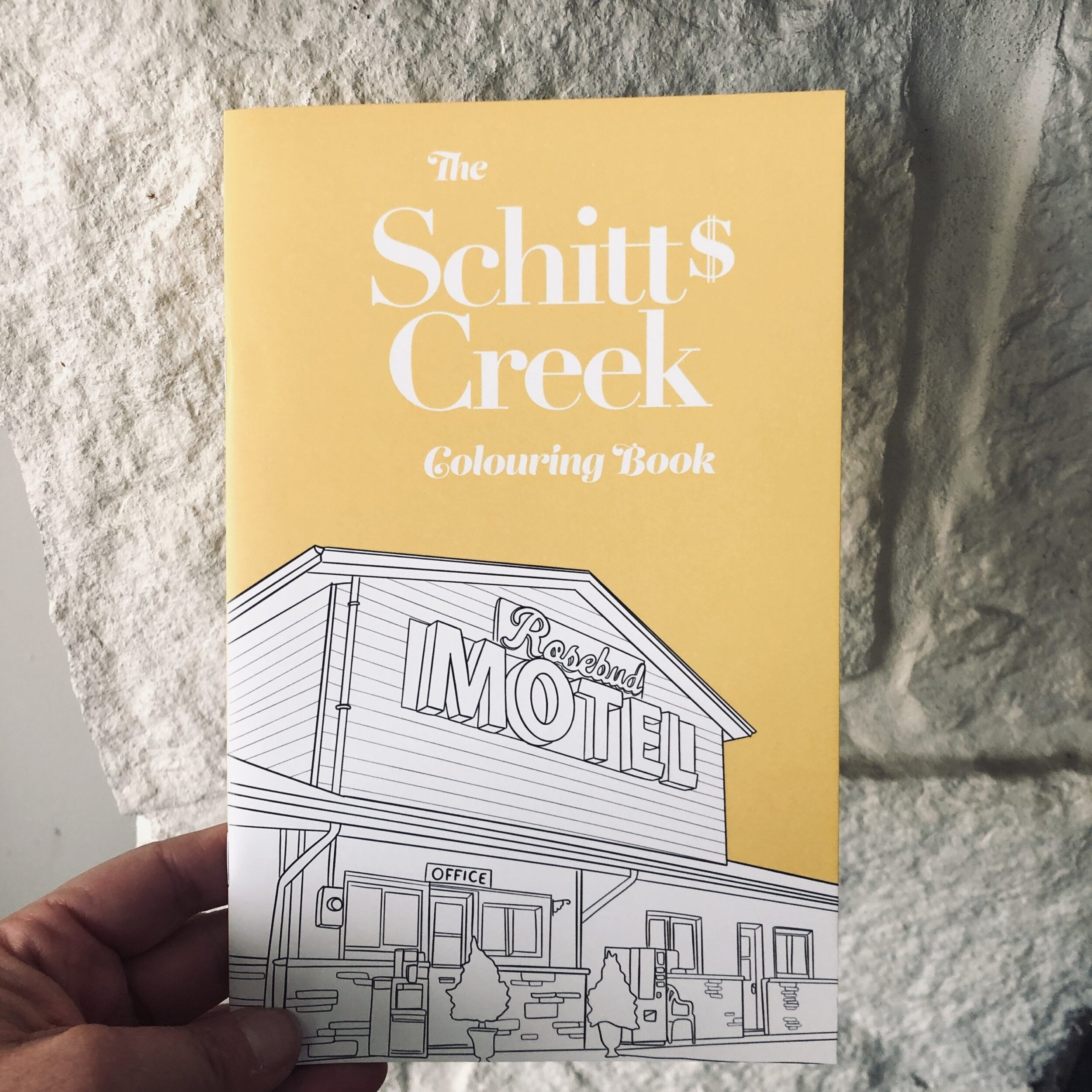


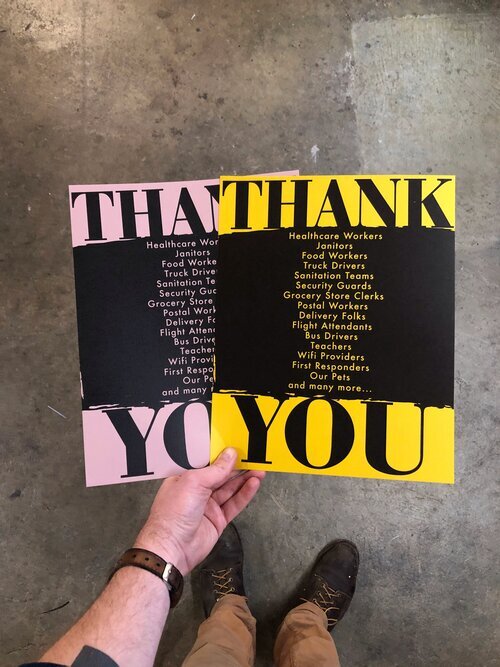
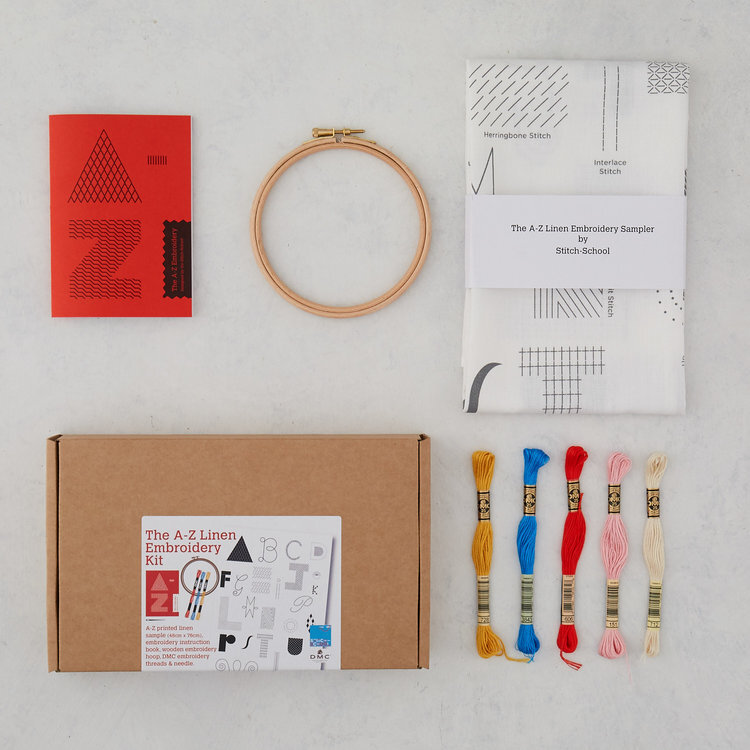
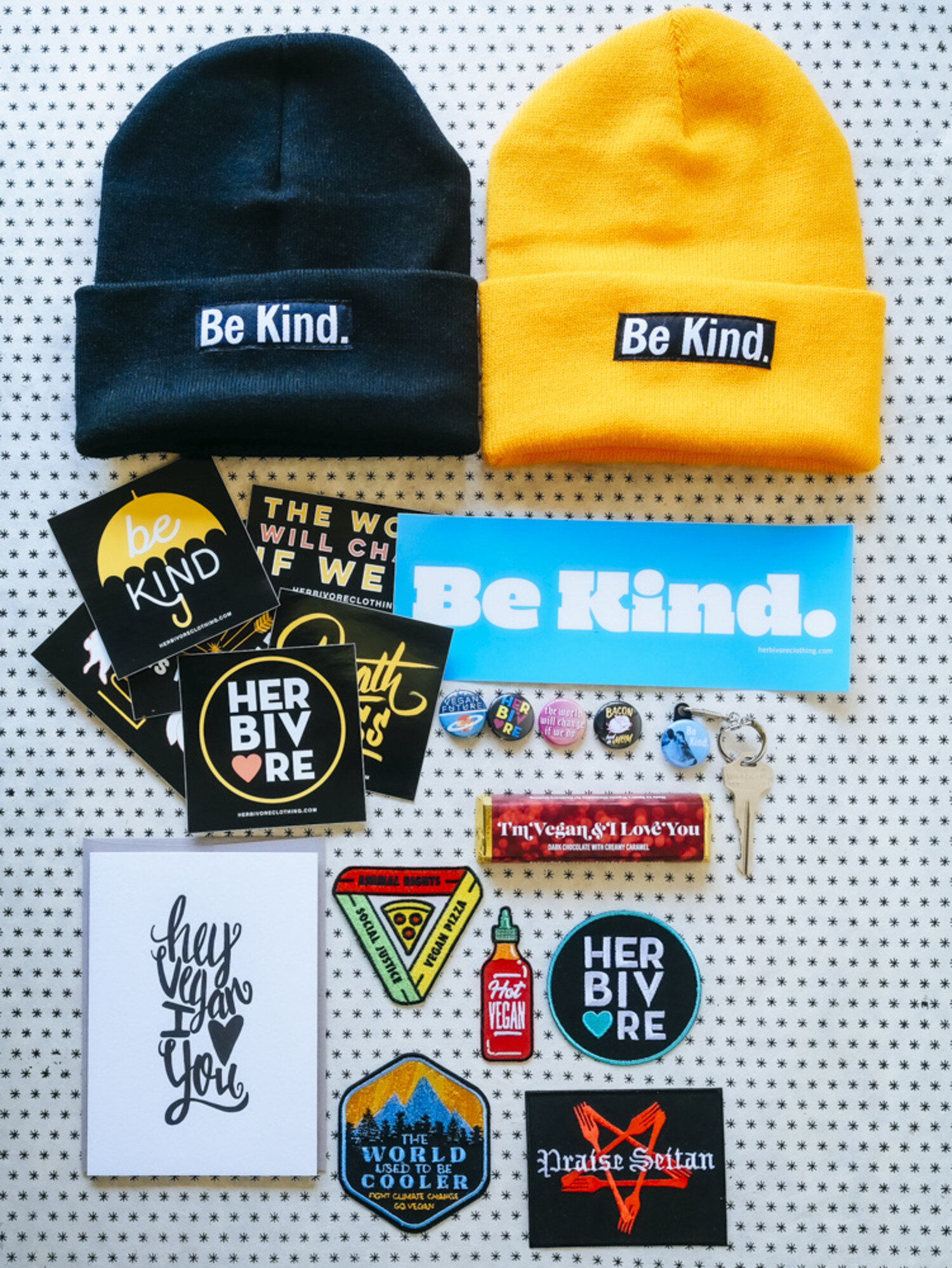
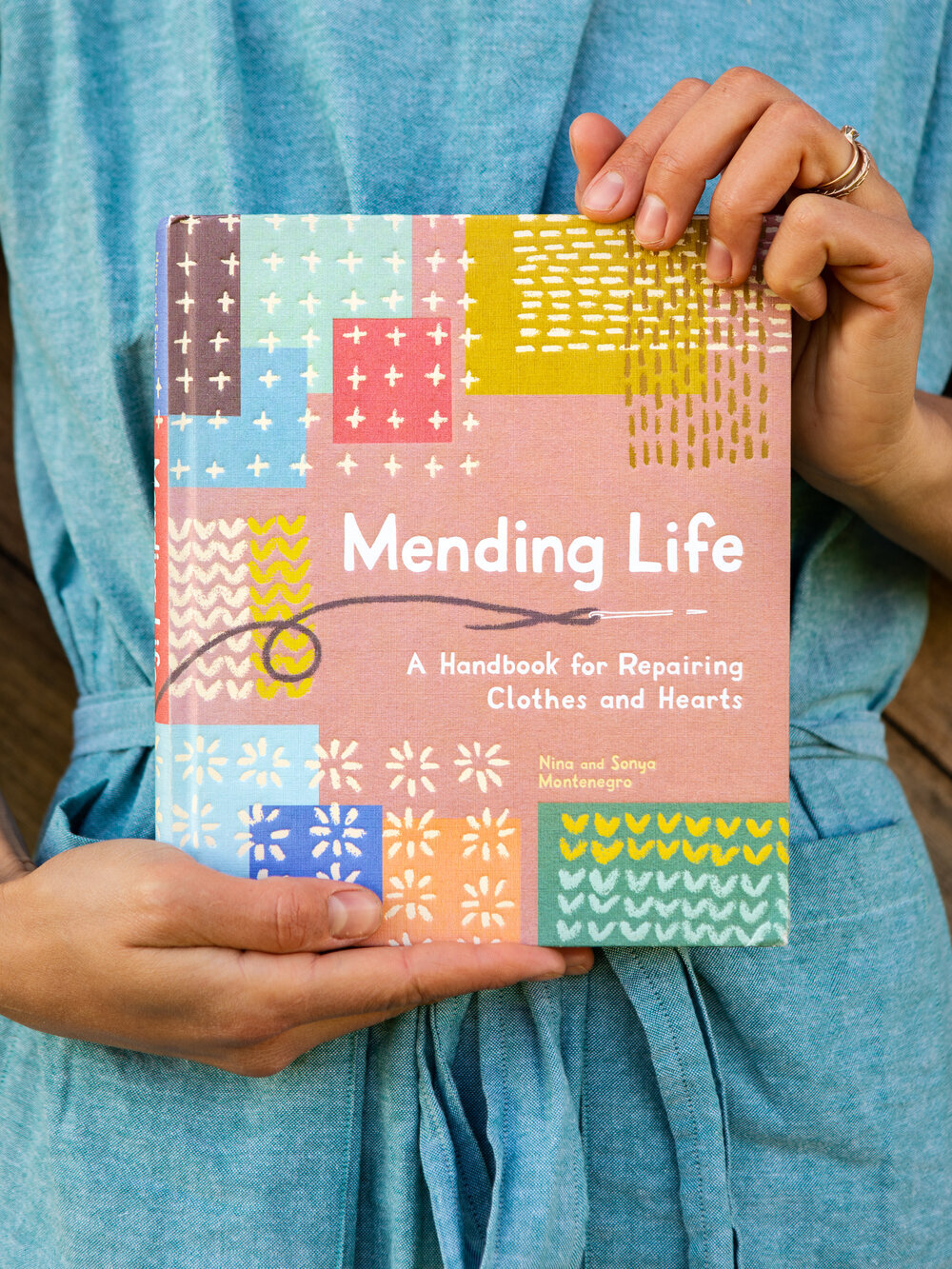
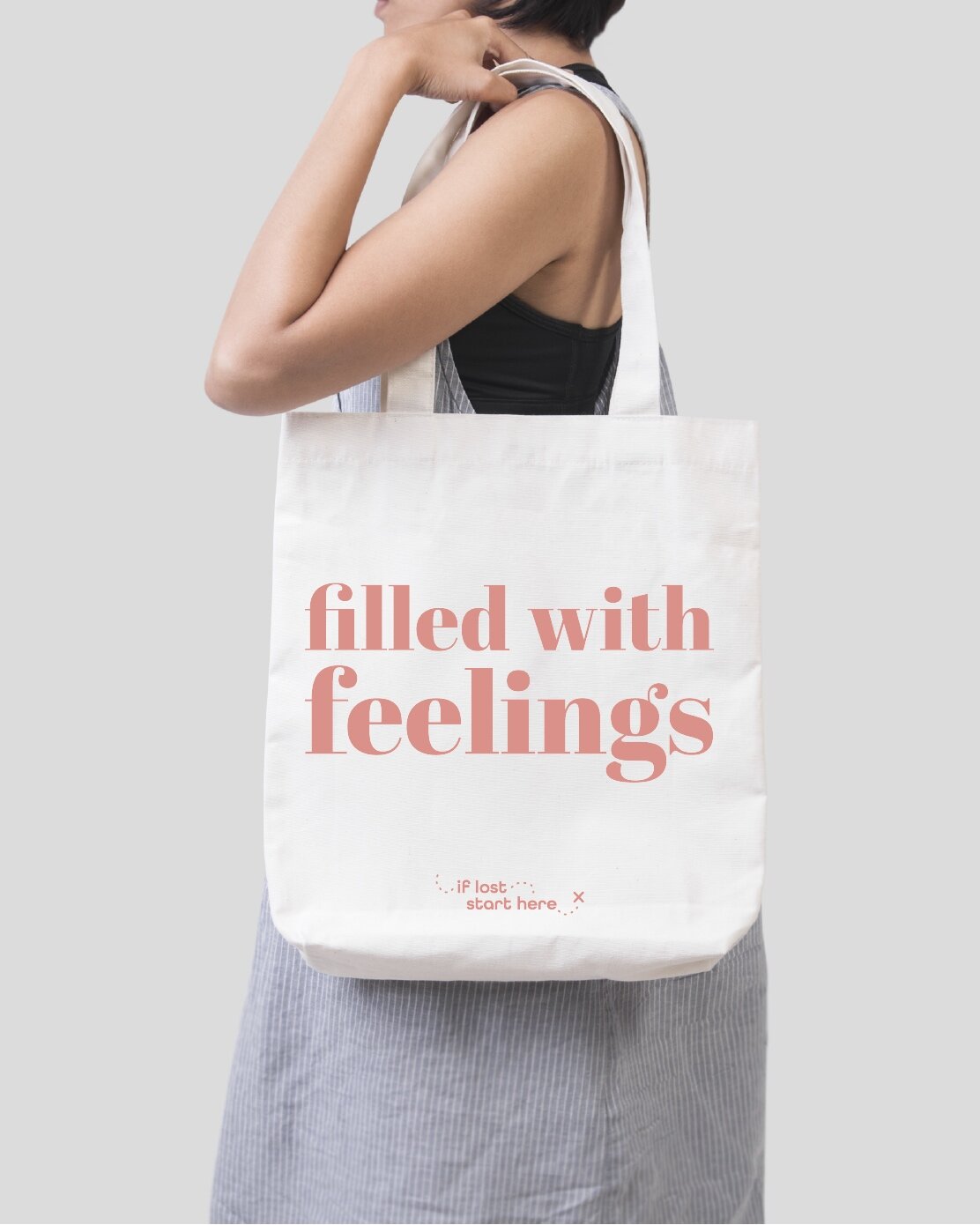
Local Spotlight
If you live in the SF Bay Area, we hope you’ll join us in supporting these women-owned brands and businesses. Each of them has impacted us and helped to lift us up through this time, and we want to do the same for them.


Why bother? // Self-care in a time of uncertainty with pioneering author Jennifer Louden
Before the impacts of the current pandemic began to be so keenly felt, we were lucky to talk to one of the original pioneers of the self-care movement, Jennifer Louden. Posting this now, we’re finding that Jen’s wisdom here and in her forthcoming book Why Bother can be a helpful guide for approaching our current situation.
“Why Bother? is a reclamation. With curiosity, wisdom, reverence, and grace, Jennifer Louden shows us how to transform two simple words from the ultimate expression of futility into a path back to desire and, eventually, meaning. Read it, then live it.”
In times of uncertainty — both personal and collective — it’s easy to struggle with the question Why Bother? Pioneering self-care author Jennifer Louden answers this complex call to both complacency and action in her new book, Why bother? Discover the Desire for What’s Next.
We had the opportunity to talk to Jennifer before the devastating impacts of the global Coronavirus pandemic started to be widely felt. But her wisdom on how to continue to feed our desires, create small moments of activism and live our lives in the gap gives us hope for how we might adapt to our current moment.
The following interview is an edited version of our original conversation. We hope you enjoy it, and benefit from it, as much as we have.

We sometimes talk about If Lost Start Here as a guidebook for people who don’t want to go anywhere. Let’s start by talking about the idea of that stuck place, where many of us have found ourselves and which is as real as any other location in the world.
I know that when I was in my why bother times — which started in my 20s and periodically showed up every decade except my 50s — I always imagined the stuck place as having glass walls, though the top was open. There was a way out but there was no way to get traction, or as my grandmother would say purchase, on those glass walls.
I think the thing that makes this location — this prison, this place, this swamp, however people describe their stuck place — so real is that we think we have already answered the question that we are asking. We think we’ve answered the question of why bother, or “What’s the point?”. We think that there’s not going to be anything new, or that “I’ve already tried that”, or whatever version that we’re asking and then answering in the negative.
This kind of thinking just creeps up on us and convinces us to remain where we are (though sometimes there are a lot of real reasons to believe something). A lot of the ways that our brain works keep reinforcing an idea. The thing that I look back on and realize is that I kept bouncing up against and trying to climb those slippery glass walls using the same outlook, the same tools, trying to get to the same place.
What makes stuck feel so real is what we believe about why we have to stay there, and why we can’t get out.
What did that concept of being lost mean to you? You write about being "in the land of the lost”, finding yourself there after your divorce, your father’s death, your mother’s Alzheimer’s, a close friend's suicide and a creatively insecure period.
Being lost to me means what I can say and see now, but which I couldn’t at the time: that I only could conceive of the same “found” that I had experienced before, the same kind of success, like writing a successful book and having a successful teaching business. Part of what kept me lost is that I kept going back and trying the same things over and over again. That not only kept me lost but it also meant that I didn’t have the energy or the imagination to find my way through.

I’m really interested in the moment that comes before going, before doing. How did you overcome your own sense of inertia and start to take steps forward?
God knows it took me long enough and there are stories in the book of people who figured it our much faster or had a lightbulb moment early on, or really listened to a sense of inner prompting. I’m very stubborn and I’m incredibly slow to learn so those moments had to come a lot!
One of the biggest things I did to overcome my own sense of inertia is really what became the thesis of the book: when I could stop repeating the same ineffectual things, I could then explore with openness and a lack of attachment an experience of desire, a desire that had nothing to do with figuring anything out or achieving something for me.
That’s what’s so important to know about these why bother / “What’s the point?” lost times. That there is desire bubbling up even if its super faint. I’ve noticed though that we deny it. We’re afraid of it. We stamp on it because it triggers fears in us, it doesn’t work well for our brain. That’s what keeps us in a sense of inertia. But if we can cultivate our sense of desire like we would embers in a campfire we can make space for it. Imagine that moment when you are about to get up on water-skis, that moment when you get pulled out of the water – it feels like that. It’s not perfect, and to get us going requires some efforts on our part.
Let’s linger for a moment on that concept of desire. You make a distinction between the outward kind — about things and status that we’ve been told to pursue — and a more inward, self-defining kind.
Desire, the flow of desire, a relationship with it, a curiosity about it, is how we open the door to life. The image that always comes to me is of a spring. If you’ve ever seen a spring bubbling up out of the ground, or the rocks, it’s amazing to see what feeds it. Where is it coming from? I think desire is that bumbling up spring. It feeds our curiosity. It feeds our ability to do hard things. It gives us resiliency. It gives us pleasure.
But that spring gets mucked up. It gets mucked up with culture and trauma and fear and images of what it is supposed to be to desire and what we’re supposed to desire and our needs to make money. We have to keep cleaning out that spring — not because it’s going to make us money, not because it’s going to get us someone’s love, not because it’s going to get us likes on social media, but because it’s a flow of life, it feeds everything. The movement created by desire helps us to be here, to be present, to show up and develop the gifts that we want to. When we stamp on that, when we judge it, when we twist it, eventually we fall into really, the worst kind of why bother.
A lot of things that happen in the world come back to some form of desire and what I see, especially in western women which is the population that I know, is that desire has gotten completely messed up and with it so much of our sense of what we want our life to look like and the permission we give ourselves to make decisions. There’s so much exhaustion and burn out. We revive desire once it's dormant by paying attention to what we want and even if we can’t have those things, we need to still allow that feeling of want and curiosity to flow and then trying to understand it in different ways.

Your new book finds its pivot point on the question of Why bother — which can be both a call for change and an admission of defeat. How did your interpretation of that question change in writing the book?
I didn’t know for so much of those different lost periods in my life, those different stuck periods including the longest and darkest one, that I was asking even why bother. What I really discovered when people started reading the book is that they didn’t even know that they were in a why bother phase either. A couple of people who endorse the book wrote back that reading it was so good for them because they didn’t realize that they were trapped in this why bother phase and reacting in all these unhelpful ways. One person was just hustling their way through it, working harder, which I think we can all relate to. The question in and of itself can be such a pivot point, but the first thing that we have to recognize is that we’re asking it.
Even though it has its dark side, its flawed side, its done side, we still need this question of why bother. If someone is asking why bother to date again after a partner has died, they also need to acknowledge that that relationship, that past, that love is gone. You can’t go back to it. In some ways even asking why bother to keep trying is really, really important. But if we can’t embrace what’s done, what’s not working, what’s been taken from us, we can’t start to ask the question of “What do I want to bother about now?” and “What’s possible about bothering about now?”
What I saw myself doing, what I saw the people I interviewed and who I work with doing, is trying to go back to what’s known or familiar. We keep replaying the past and complaining about it. We keep being sad about it. That’s what keeps us from asking the generative why bother? Because we can’t embrace it, we can’t come to terms with it, we can’t face what is no longer ours to bother about. There’s a lot of hanging on it.
You write about why bother as not just a response to personal life circumstances, but as a response to such overwhelming situations as climate change, political upheaval, and social injustice. We’ve certainly felt the pull-down of those issues and the weight of what to do has kept us stuck. How have you found ways to negotiate overwhelm and feelings of futility?
It is buying into overwhelm and futility where we lose our ability to take any action. It’s buying into cynicism.
I had a friend say to me that it’s too late to do anything about the climate crisis, that there’s nothing to do, that they are going to be dead before it gets really bad. I had a conversation with friends at a party a couple of weekends ago who said that, “Trump is going to win, it’s too late, it’s already over”.
It’s that kind of thinking that we have to stop in ourselves and, if we can and it’s appropriate, in conversations with people who we’re in community with. It drags all of us down. It stops our brains from being creative. It stops us from wondering what is possible. I love what some climate activists are saying now, that we have to stop the conversation that this is impossible, that this is overwhelming, and that we can’t do anything.
The first thing that we need to do is to find reasons to be optimistic and to reclaim our agency. Without agency, there is nothing that can happen. It’s just bullshit to believe in futility. It is not what history shows us. History shows us a lot of things, but it also shows us the possibility of change. It’s not always the change that we like or in the direction we want, but there’s nothing about history that shows us that things don’t change. And so why can’t we believe that our actions can be a force for change?
The flip side is that we have to negotiate our own lives, our own passions. We have to embrace our own human-scaled life. I have it on my list to take one action a day on the climate crisis. Sometimes that’s reading a couple of articles at lunch. Yesterday it was buying a book and sharing something on Facebook. Sometimes it's calling or tweeting something to my senator. It can be really small, but I refuse not to do anything. I want to keep learning where I can be a voice, where I can be useful.

One of your six ideas for getting your bother on is “become by doing”. We love the idea of “staying in the gap”.
Yes, this has been something I have been curious about, practicing and writing about forever. Given how our brains and our nervous system is built, we do not like to not know. We would rather have certainty that sucks then live in the question, the uncomfortableness of reaching forwards and exploring more. So, the key to living in the gap between what’s stirring in us and where we currently are is to recognize and find ways to be curious, awake and comfortable, even if it's only for moments at a time. But we need to stay in that curious, uncomfortable place, without freaking out because when we do that we make decisions, we numb out and we get busy with all kinds of things that ultimately obscure our discomfort.
How do you think the self-care landscape has shifted since you first wrote The Woman’s Comfort Book: A Self-Nurturing Guide for Restoring Balance in Your Life?
Its shifted as far as you can imagine. When I first wrote that book nobody talked about self-care. It was quite a foreign concept. I remember I taught a workshop early on and a woman looked at me and said, “I take care of myself. I get my nails done.” It’s now a multibillion-dollar industry.
What I discovered pretty early on in talking and teaching after The Woman’s Comfort Book was published is that self-care is how we recharge in order to do the hard things in life. It’s how we claim the courage and energy to have agency for ourselves to speak up for what we want. Self-care is intimately tied to creating a life we want. It’s not intimately tied to what we buy. It’s not intimately tied to some of the hoo-ha that I see out there. That stuff can be really fun, we don’t have to make it wrong, but I think it so often becomes an arms war of pashmina blankets and unicorn tear face cream. It can really trivialize the deeply feminist stance, that Audre Lorde first spoke about long before I did in the context of her work.

Something I love about your book is that you work against the narrative of self-care: that if you meditate enough, pray enough, have enough therapy, eat clean enough, become successful, you can create some happy ending for yourself and that's Life Done. But what you offer here is something more flexible, something foundational.
Yes, the narrative of self-care for me became an idea that if I just did everything right, I wouldn’t suffer anymore. It’s really ludicrous when you say it out loud, but I really, really believed it. And sometimes it still creeps in. I have some food allergies and the thought occurred to me that maybe this autoimmune response is my body reacting to what I still tell myself: if I’m a good person, I should eat these foods and I’ll feel great. It’s so much more foundational to realize that we fall into why bother, “what’s the point?”, and swamps of feeling lost, no matter what kind of self-care we practice because it’s part of being human.
How does it feel to be someone who writes about self-help concepts, facing your own life and struggles head-on? Did you feel pressure as "a self-help author" to be happy and to keep with narratives of promise and fulfillment?
I used to. It almost did me in and made me quit. I tried to run away from the self-help business numerous times. I felt like a fake so often because I couldn’t always take care of myself. I wasn’t getting better or “having my best life”. Can I just tell you how much I hate that phrase? I have no idea what my best life is! It feels like such a pressure. I don’t want my best life. I want real life.
If I was going to get a tattoo it would say, “Be here for it all.” I don’t feel the same pressure anymore. I feel the pressure to be here and to share ideas and stories and create community and spaces where we can be here for it all. I really do believe that once our basic needs are met — which for several billion people on the earth is not happening — the question really is how much can I be here for it. How awake can I be? And how compassionate can I be with myself and everyone else? There’s nothing to fix. When I realized that there’s nothing to fix, when I realized that fixing things is not my job in life, everything changed.

All quotes are taken from Why Bother? You can pre-order Jennifer’s book today (head to IndieBound if you can and support small bookstores).
About the author: Jennifer Louden is a personal growth pioneer who helped launch the concept of self-care with her 1992 bestselling debut book The Woman’s Comfort Book. She is the author of five additional books, including The Woman’s Retreat Book, The Life Organizer and Why Bother? With close to a million copies of her books in print in nine languages, Jennifer is a sought-after speaker, addressing audiences across the USA, Canada and Europe. She is a former columnist for Whole Living, a Martha Stewart magazine, and has appeared on a number of television and radio shows and podcasts—including The Oprah Winfrey Show. Her work has been featured in People, USA Today, CNN, and Brené Brown’s books Daring Greatly and Dare to Lead.

Isolation Inspiration: 5 Times The Internet Really Pulled Through This Week
Comedians are performing, children’s authors are reading their books, musicians are putting on concerts in their living rooms (!!) people are CONNECTING in any way that they can, all in the name of banding together to protect the most vulnerable members of our communities. (I know it’s the internet, and social media at that, but there is a real beauty here and I hope it is not lost on us.)
Ok, we know that this pandemic has been terrifying and overwhelming and inconvenient. Even under the best of conditions, we’ve been thrown from our regularly scheduled lives into some no-mans-land where no one knows what day it is or what is important or how they should be spending their time. I’m personally sticking with a 25-25-50 breakdown, toggling between (1) eating (2) trying to teach my kids literally anything and (3) re-watching every late-90s romantic movie I can remember. (While everyone else in the world is flipping out over Tiger King, I’m just over here like: Armageddon, Con Air, Titanic. Repeat). So yes, things are a bit wacky in our worlds, BUT, through all of this madness, something magical is happening, as well….
EVERYONE ELSE IS STUCK AT HOME, TOO!!
Yes, nearly everyone in the US and UK is sheltering in place at this point. Which, from one angle, might seem like a pretty bleak prospect…but with the existence of the internet, can actually be quite exciting. That’s because the people we love, the people we depend on for escape, the artists and writers and musicians, who so often feel so distant from us, now feel closer than ever. (The playing field has been leveled. All of us live in sweatpants now.)
Maybe you’ve noticed that every time you head to instagram you’re hit with a zillion notifications that people you are following are “going live”. (It is possible that I am technologically inept and need to adjust my settings, but I digress.) Under normal conditions, I wouldn’t really be apt to click on these live videos, assuming there might be some produced/commercial feel to whatever they were doing. This week, however, I started seeing new names pop up, creatives I admire, authors I live for, bands I’d never noticed on instagram…all suddenly “going live”. Hm. My interest was piqued. So I started clicking when they popped up…and you guys…hold onto your hats. (Or, your phones? Or whatever the modern day equivalent to that sentiment might be.) These people are putting on workshops and holding live readings and playing fucking concerts in their living rooms!!!
Please stop what you’re doing (YES STOP READING THIS) and go follow everyone you love on instagram! Comedians are performing, children’s authors are reading their books, people are CONNECTING in any way that they can—all in the name of banding together to protect the most vulnerable among us. (I know it’s the internet, and social media at that, but there is a real beauty here, and I hope it is not lost on us.)
I am sure you have all sorts of strange obsessions and specific tastes, but this is what we’ve loved this week, and we think you’d love it, too. (Also, we REALLY want to know how you pulled through this week and what helped you to get there? Was it a movie or a podcast or a book or a friend? Tell us about it!)
Here are a few of the things that made our life bearable this week.
5 Times The Internet Really Pulled Through

This acoustic set from Yoke Lore was like the coziest, sweetest performance ever. He was just sitting on the floor of his living room with all of his plants behind him. (We’re probably best friends now.) If you don’t know who this is, please go watch the video for his song “Beige” and fall in love. In his live performance he explains that the song is about finding a way to tell someone how you feel about them in a very specific way. (example: Let me go under your skin // Let me find the demon that drives those heavenly limbs). I’d tell you more but I’m sobbing just thinking about it. His next set will be in support of MusicCares (which provides a safety net of critical assistance for music people in times of need), so stay tuned!

We also loved Distraction Tactics with Dan Smith, lead singer of the band Bastille (who, interesting fact, would almost-definitely be my boyfriend if I weren’t married.) This new series is like a book club, but for films. (Wait, is a film club a thing?) Either way, here we come together to talk about movies from around the world. This week, we started in the UK with cult-classic Shaun of the Dead, complete with a pre-recorded interview with Simon Pegg (amazing) and a new jingle, written by Dan (equally as amazing). It was a bit like watching your best friend pull of a really great presentation at school. There’s something so sweet about the home-made authenticity in instagram live posts. (I say we get into it before the influencer destroy it.) Stay tuned for next week’s episode where we’ll head to a new country and breakdown another film! What film will it be? I can’t remember!

Glennon Doyle and Abby Wambach had an argument about “popcorn chewing volume” and cabinet doors remaining open for too long, in real time. (It was a very validating and cathartic experience for anyone who was able to catch a glimpse, I’m sure.) Glennon also stepped up as interim kindergarten teacher and read books to my six year old daughter while I lazed nearby. (This was via Instagram live…I don’t usually hang out with Glennon. I’m very busy.) She also prompted kids to ask dinnertime questions like: “How do you get your ickies out?” which is phrased so adorably that I’m maybe crying again. (She is officially raising my child now.)
**We also received our copies of Glennon’s new book Untamed! Who else is reading it?!

Lumineers singer Wesley Shultz performed a collection of original and cover songs from what looked like his kitchen? (But rich people have huge houses with tons of unnecessary rooms so it’s hard to say definitively.) In the performance he pleads with us to all take this virus seriously and do what we can to slow its spread. He also admits that some of his best lyrics were actually taken from things his wife has said to him over the years. So, you know, just typical stuff. #whoRunTheWorld?

BJ Novak read his hilarious children’s book, The Book With No Pictures and it was, again, like, do we even have to do anything? Can the internet just teach our kids?? (I, of course, am only joking. I am a homeschool mom and wrote allllll about our riveting days earlier this week.) If you watched this live reading we hope hearing BJ say “Boo Boo Butt” was the salve you needed to soothe whatever aches and pains this isolation may have conjured.
**And, as a bonus, we just wanted to mention #togetherAtHome, a virtual concert series and campaign of Global Citizen (a movement of engaged citizens who are using their collective voice to end extreme poverty) created in conjunction with the WHO. If you’ve got some time (and lets be real, you’ve got some time) scroll through the hashtag and see what’s coming up. This week, we’re excited to check out Jimmy Eat World and probably other people but we don’t know how to search upcoming events so we are simply welcoming whatever is meant to come to us, which might seem like something a highly enlightened person would say…or at least someone who possesses more crystals than we do…but for our purposes just means spending extra time on the internet, maniacally clicking on everything that pops up. 🤗
We know this time is full of so much uncertainty, but we hope you’re finding creative ways to move through and come together. Even in isolation, connection is possible. We want to hear how you’re connecting, or where you’re struggling. If you feel so inclined, please reach out.
And, if you are struggling, please consider heading to our guide to find more resources. Everyday, we’re adding and editing in the hopes that we’ll all come through this time with our mental well-being intact. To learn more about the mission of If Lost, Start Here and to stay connected, please sign up for our newsletter!