
What If Being Lost Is Part of Finding Your Way?
Feeling lost can feel uncomfortable, but it doesn’t mean you’re doing life wrong. Anne Ditmeyer explores uncertainty, detours, play and finding your own way.
When we feel lost often we want to get out of it as quickly as possible. We want the answer, the map, the five-step plan. We want to know where we’re going and preferably how long it will take us to get there.
I understand this. I have spent enough of my own life in uncertain moments to know how uncomfortable it can be not to know what comes next. And it’s something I see all the time in my coaching work too. We arrive at these moments in our careers, relationships, families and lives when the route we thought we were following suddenly stops making sense. We feel stuck, uncertain or overwhelmed and assume that somewhere, somehow, we’ve gone wrong.
But what if getting lost isn’t necessarily the problem?
That was one of the ideas I kept returning to during my conversation with Anne Ditmeyer on A Thought I Kept. Anne is a writer, creative coach and workshop facilitator living in Paris, and much of her work is about giving people the confidence to explore, experiment and, quite literally, get lost.
Anne’s thought kept is: “This should be fun.”
It was a mantra used by her grandfather, Charles Stark Draper, the scientist and engineer whose work on inertial guidance systems helped navigate the Apollo missions to the Moon and back. Anne was only six when he died and discovered the phrase much later, after the death of her mother prompted her to start finding out more about him.
Rather than simply following the official paper trail, she began talking to the people who had known him. It became, as she describes it, a scavenger hunt. And through their stories, she discovered not only the scientist she had grown up hearing about, but a man who danced, flew planes, built relationships and approached extraordinarily difficult problems with curiosity and enjoyment.
There was something else that struck Anne too. Her grandfather’s work had been about navigation and exploration. In a very different way, hers was too.
What if you don’t need the whole map?
We tend to talk about lives as if they should be linear. You work hard at school, choose the right university, find a job, progress, settle down, achieve the milestones and keep going. Even when we know intellectually that life rarely happens this neatly, it can still feel unsettling when ours doesn’t.
Anne describes how her grandfather didn’t begin with a perfectly formed plan to help get humans to the Moon. One thing led to another. There were people he met, things he learnt, questions he followed and opportunities he couldn’t possibly have predicted at the beginning.
Our lives can work like this too.
Anne talks about the “messy middle”: the part we often wish we could skip because it doesn’t yet make sense. But sometimes, she says, we need that mess to meet the right person, gain an insight, have an experience or build the skill that takes us somewhere else.
Perhaps feeling lost can be a little like this. It can be the space between the life that made sense before and whatever is emerging next.
That doesn’t necessarily make it comfortable. Anne talks beautifully about “dancing with discomfort”, rather than treating discomfort as evidence that we are doing something wrong. In one of her workshops, she asks people to draw lobsters partly because most of us have absolutely no idea how to draw one. The lobster also gives her a wonderful analogy: as they grow, lobsters have to leave one shell before a bigger one can form.
There is vulnerability in that in-between place. But there is growth too.
What if you followed the detour?
One of my favourite parts of our conversation was Anne’s invitation to think differently about detours.
We’re so accustomed to believing that the quickest, most direct route must be the best one. But Anne talks about rerouting, taking the scenic route and opening the door “just a teeny bit” to another possibility.
This is where being lost starts to feel less like something we have to solve and more like something we might explore.
What happens if, instead of immediately asking How do I get out of here?, we become curious about where we actually are? What assumptions have we been carrying about what our lives should look like? Which expectations still belong to us? What tiny nudges or ideas have we been overriding because they don’t fit the route we thought we were supposed to take?
Anne has a lovely way of describing this as our “internal guidance system”. Her grandfather worked with gyroscopes and inertial navigation systems, and she sees a parallel in our own ability to return to ourselves when the world shakes us around.
After Anne’s mother died, she found a letter her mother had written to her as a teenager. It was addressed to her daughter “born with her own special guidance system”.
I found that incredibly moving because perhaps the work isn’t always to find a completely new direction. Sometimes it’s to hear again what has become very quiet underneath all the noise.
What if being lost could contain possibility?
Of course, not every lost moment feels playful. Sometimes we are lost because somebody has died, a relationship has ended, work has become unbearable or a version of our life we depended upon is no longer available to us.
Anne is very clear that “this should be fun” isn’t about false positivity. Her own story contains profound grief. Instead, she talks about allowing multiple things to be true: that something can be hard and there can still be beauty; that we can grieve and connect; that we can be uncertain and occasionally delighted by what we discover.
Maybe we can be lost and finding our way at the same time.
I think that is what I took most from this conversation. We don’t always need to respond to feeling lost by gripping the map more tightly. We might need to wander. To take one small step before we understand where it leads. To notice what interests us. To follow an unlikely connection. To draw something badly. To go for a walk. To let ourselves admit, as Anne sometimes does, I’m not really sure right now, while trusting that something will come.
Because clarity, as Anne reminds us, doesn’t always come from thinking harder about our lives. Sometimes it comes from moving through them.
Listen to my full conversation with Anne Ditmeyer on A Thought I Kept: “This Should Be Fun”.
And if you’re feeling lost yourself, our book If Lost, Start Here: Wellbeing for the Anxious, Disconnected or Uncertain was created for exactly these moments. Rather than giving you another prescribed route to follow, it offers ten different pathways through wellbeing — including creativity, play, connection, nature, purpose and awe and wonder — so you can start with whatever feels possible or interesting to you right now.
You don’t have to know where it will lead. Sometimes you just need somewhere to start.
There Is No One Right Way to Be: Spirituality, Purpose & Feeling Lost
What can spirituality offer when you feel lost? Claire Fitzsimmons talks with Alice Thompson-Boyd about the Enneagram, purpose, self-understanding and finding your way back to yourself.
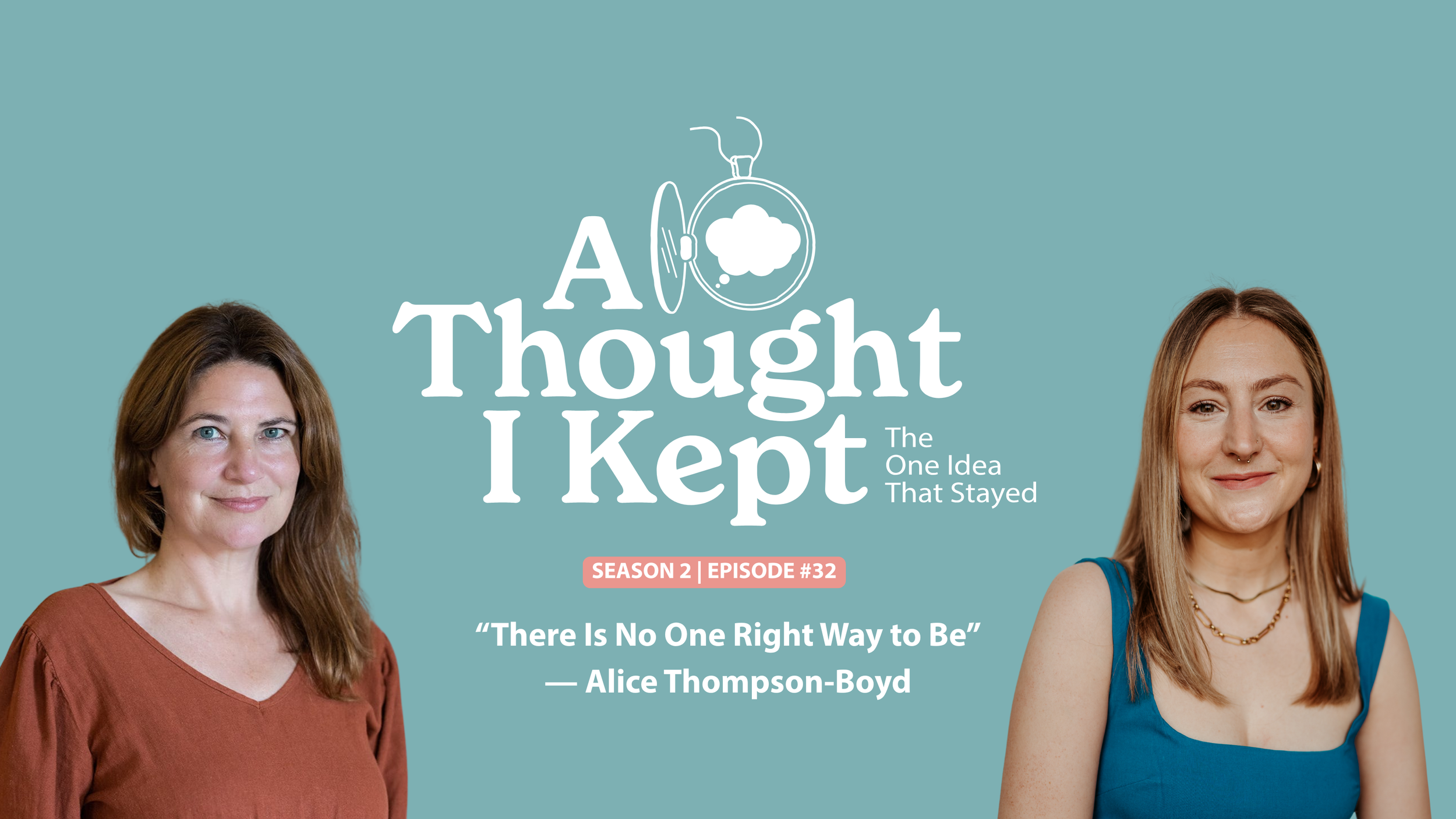
Have you ever arrived at a moment in your life when you thought that you’d feel ok, but you just didn’t?
We can build the career, achieve the goal, do work that genuinely matters, even create something successful, and still find ourselves asking difficult and confusing questions about who we are, what we need and where we’ve gone. Sometimes, as I discovered in my conversation with Alice Thompson-Boyd on A Thought I Kept, it can feel as though we have somehow disappeared out of our own lives.
Alice knows something about that experience. In her twenties, she co-founded Social Bite, the Edinburgh social enterprise supporting people experiencing homelessness. It grew into an organisation with more than 100 employees, celebrity supporters including George Clooney and Leonardo DiCaprio, awards, honorary doctorates and a level of impact that most of us would probably look at from the outside and call extraordinary.
And yet Alice was struggling. Alongside work that was changing other people’s lives, she experienced anxiety, burnout, panic attacks and a growing disconnection from herself. Eventually she stepped away from Social Bite and from the identity she had spent almost her entire adult life building.
What came next wasn’t another big mission. It was a much more internal question: who was she without all of that?
When we start looking for something deeper
It was after leaving Social Bite that Alice encountered the Enneagram, a system for understanding nine different patterns of human motivation and experience. She describes it as something that began almost accidentally and then became impossible to put down.
What interested me most in our conversation wasn’t really whether you believe in the Enneagram or whether you know your number. It was what Alice found through it: a different way of understanding herself.
For years, she had been trying to work out the right way to be. How should she show up to get the connection, approval and validation she longed for? How could she be one version of herself for one person and another for somebody else? What was she getting wrong?
The Enneagram offered her a surprisingly liberating answer: perhaps there wasn’t one right way to be at all.
It helped Alice see that the people around her weren’t necessarily looking at the same situation and reaching different conclusions. They might actually be experiencing that situation from a fundamentally different internal perspective. Their needs, fears, motivations and ways of making sense of the world could be different from hers.
There’s something very freeing in that. We don’t have to keep twisting ourselves into the person we imagine everyone else needs us to be. And other people don’t have to become more like us before we can understand them.
Spirituality doesn’t have to be about having the answers
This is where our conversation began to feel less like one about personality typing and more like one about spirituality.
Alice talked about how little time we seem to have now to sit around thinking about what it means to be human. We are behind screens, rushing between things, consuming information, producing, achieving, responding. There isn’t always much space left for the bigger questions.
And perhaps that helps explain our renewed interest in things like the Enneagram, astrology, Human Design and other systems for understanding ourselves. We are looking for depth. For connection. For something that helps us make sense of being here.
Of course, these systems can become another form of self-improvement. Another test to pass or way of deciding what is wrong with us. Alice makes an important distinction here. For her, the deeper she has gone into the Enneagram, the more she has realised that the point isn’t to fix herself. In fact, she suggests that our obsession with fixing ourselves can become part of the suffering itself.
Instead, she sees it as an invitation to become more aware of the patterns we inhabit and a little less confined by them. Not to put ourselves into a box, but to notice the box we may already be living inside and discover that there might be more room than we realised.
Remembering that we are part of something bigger
There was one moment in our conversation when Alice talked about zooming out far enough to see Earth as this small, vulnerable thing floating in space. From there, all the divisions and identities that can feel so convincing in everyday life begin to look rather different.
We are here for such a tiny amount of time. We are part of nature rather than separate from it. We are part of something much larger than the jobs we do, the things we achieve or the identities we work so hard to maintain.
I think that is one of the reasons spirituality is one of the ten pathways we explore in our book If Lost, Start Here. Not because Amanda and I believe there is one particular spiritual practice we should all follow, but because when we feel anxious, disconnected or uncertain, it can help to look beyond the immediate boundaries of our own lives.
Spirituality might mean religion. It might mean nature, ritual, meditation, philosophy or simply making space to wonder about the bigger questions. It might be standing under a huge night sky and remembering your scale within things. It can offer us somewhere to put the questions that don’t necessarily have neat answers.
And perhaps that matters particularly in a culture so interested in answers, solutions and fixing.
What happens when we stop trying so hard?
Alice told me that these days fulfilment increasingly looks like doing less. Walking the dog. Making dinner. Having nowhere she needs to be that evening. Stripping things away rather than continually adding more.
She also notices when she has forgotten the deeper lessons of the Enneagram because she gets fast. She starts rushing everywhere, trying to do everything. Remembering it asks her to slow down, become present and disentangle herself for a moment.
I keep thinking about that because it feels like such a useful measure. Not Have I found my purpose? or Have I finally become the right version of myself? But: am I here? Am I present in my own life? Do I feel connected to myself, other people and the world around me?
Perhaps spirituality can help us with that. Not by giving us another set of things to get right, but by reminding us that there was never only one right way to be in the first place.
Listen to my full conversation with Alice Thompson-Boyd on A Thought I Kept, where we explore the Enneagram, burnout, purpose, conviction, doing less and what happens when we stop looking outside ourselves for the answer to who we should be.
And if you’d like to explore spirituality in your own life, it’s one of the ten pathways in our book, If Lost, Start Here: Wellbeing for the Anxious, Disconnected or Uncertain — a place to explore what might help you feel more connected, grounded and part of something beyond yourself.
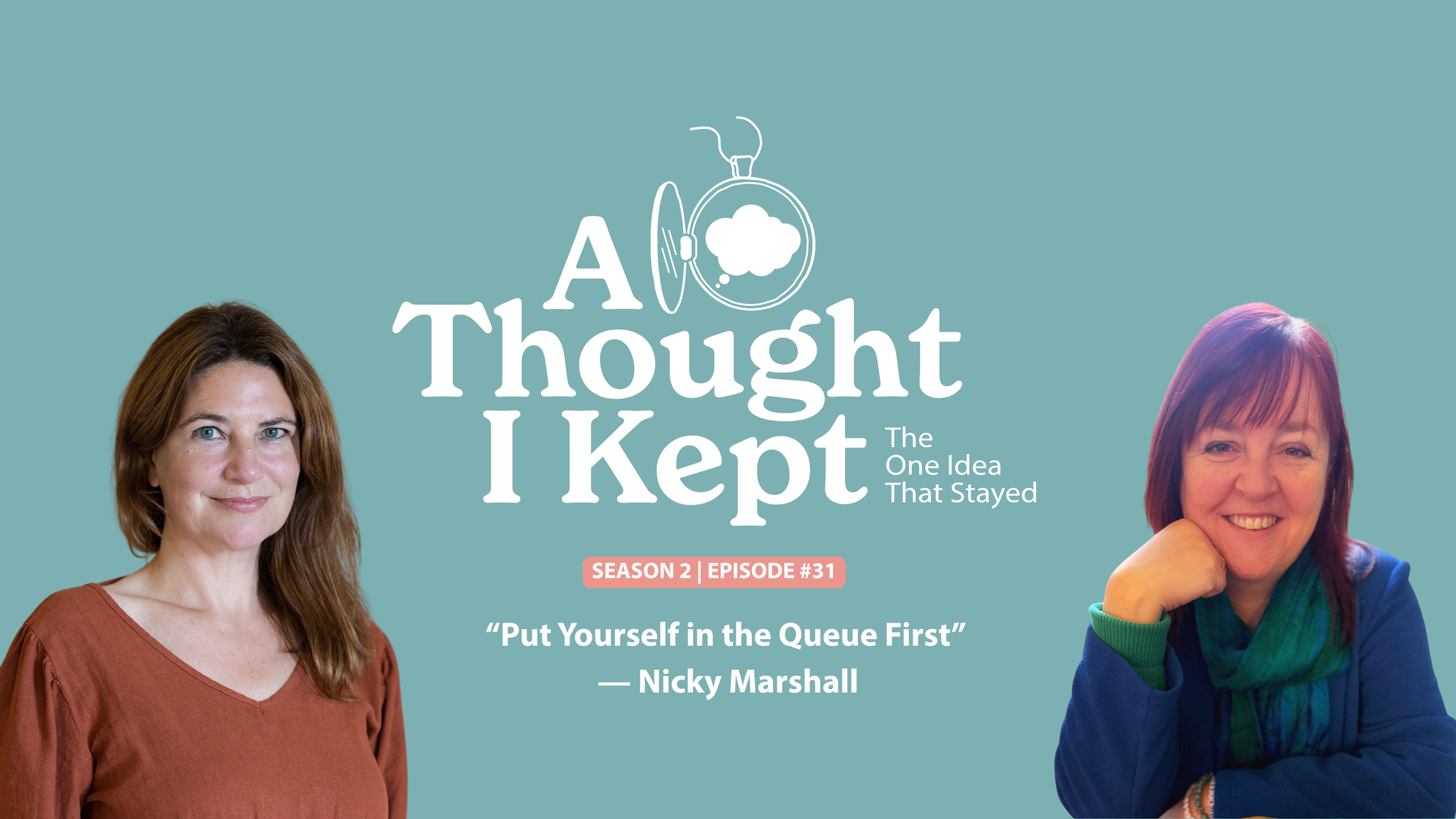
What If Kindness Included You Too?
Feeling burnt out from caring for everyone else? Discover why kindness needs to include you too, inspired by our podcast conversation with Nicky Marshall.
There are some people who are very good at knowing what everybody else needs.
They remember the message that needs replying to. They notice when someone is quieter than usual. They check in on their children, their parents, their friends, their colleagues. They make the lunches, hold the door open, listen to the problem, rearrange the diary, pick up the thing that everyone else seems to have forgotten. They care, often deeply, about making other people’s lives a little easier.
Kindness can be one of the most powerful ways we can create a better life. It’s why it’s one of our Pathways to Wellbeing at If Lost, Start Here. There is something profoundly wellbeing-giving about looking beyond ourselves, connecting with another person and knowing that something we did made a difference.
But what happens when our kindness includes everybody except ourselves?
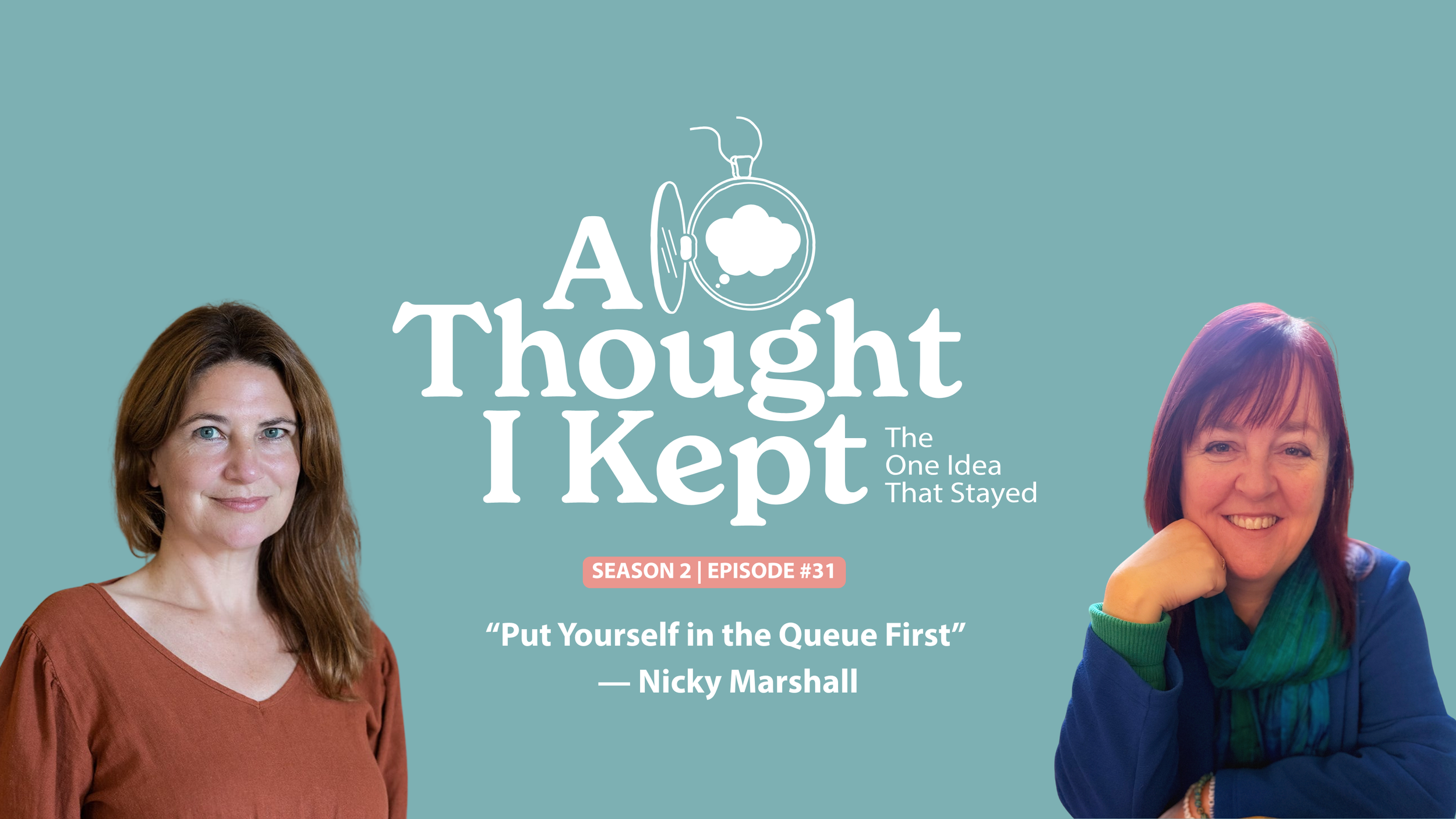
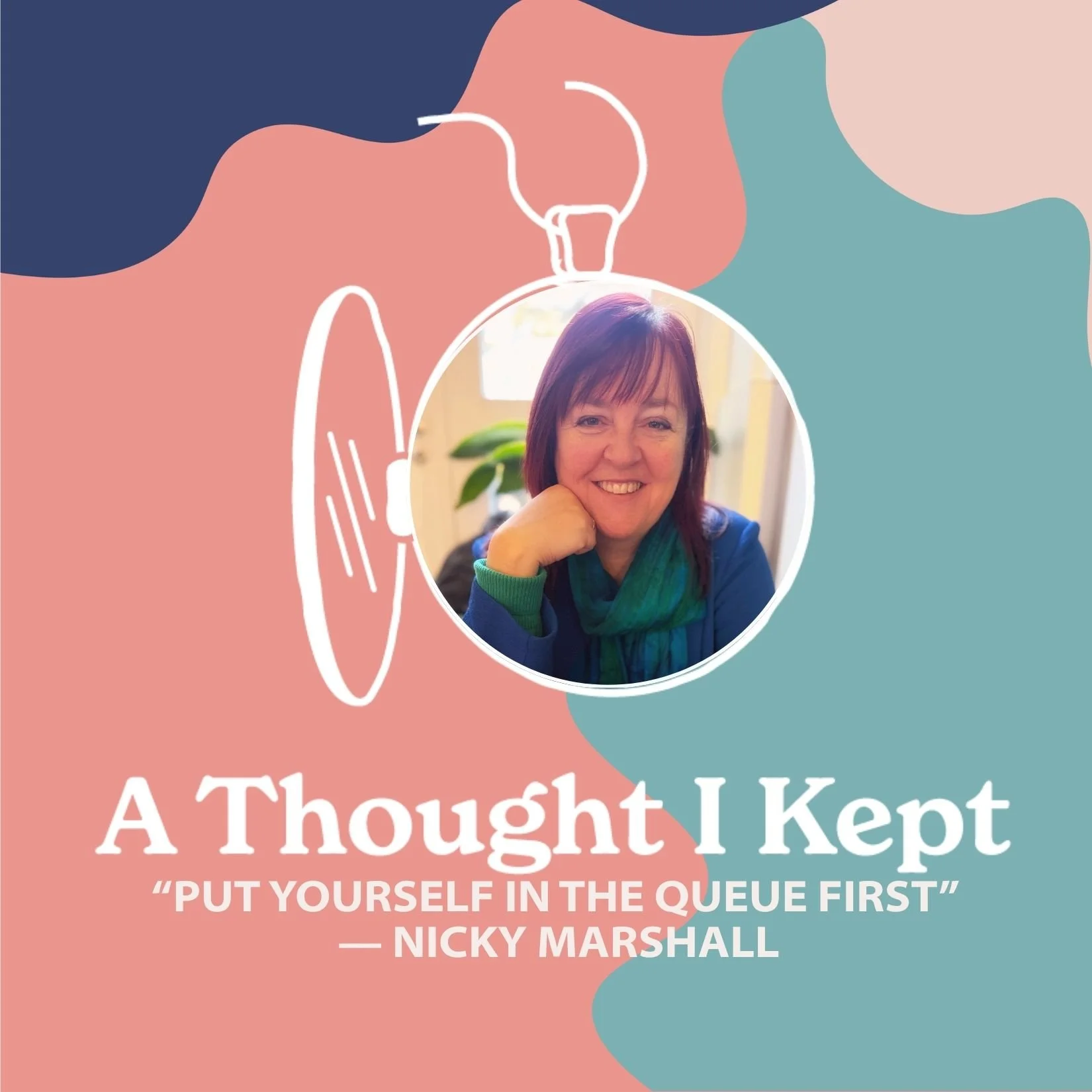
This came up in my recent conversation with Nicky Marshall for A Thought I Kept. Nicky is a speaker, mentor, publisher, wellbeing facilitator and author of No One Is Coming to Save You. She has spent much of her life wanting to help people and make a difference. But the thought she brought to the podcast came from realising that there was one person she had repeatedly left out of that mission:
“To make a difference in this life, I had to put myself in the queue first.”
When caring becomes too much
I recognise so much in this, not only in myself but in the women I work with. There can be so much invisible and emotional labour involved in caring for other people. We know what needs doing. We know who needs checking on. Even when we are supposedly concentrating on something else, part of our brain can still be carrying the people we love. And if you’re someone who believes strongly in kindness, putting yourself first can feel uncomfortable. Perhaps even selfish.
But if I don’t do it, who will?
So we keep going. We finish this and then we’ll rest. We get everyone else sorted and then we’ll look after ourselves. We make it through this week, this deadline, this difficult patch, this stage of the children’s lives, this period with our parents, and imagine that somewhere on the other side there will finally be enough time left over for us.
Nicky knows something about what can happen when we keep overriding the signals that tell us we have reached enough. At 40, after months of pushing herself, she suffered a disabling stroke following a scuba diving accident. Looking back, she can see the bargaining she had been doing with herself before it happened: I’ll do this and then I’ll relax. I’ll do this and then I’ll get some help.
That line stayed with me because I think many of us have our own version of it.
I’ll just get through this week.
I’ll rest when this is finished.
I’ll go for the swim tomorrow.
I don’t really have time for myself today.
Until sometimes we’ve been so busy caring, helping, achieving and getting through that we barely notice how far down our own queue we have slipped.
Kindness doesn’t have to mean self-sacrifice
What I particularly like about Nicky’s thought is that she doesn’t conclude that the answer is to stop helping other people. She still wants to make a difference. She talks in our conversation about making a difference to her husband, her children, her parents, her friends and her customers, right down to the stranger she holds a door open for. She believes those small acts ripple outwards.
The shift is that she now includes herself in that ripple.
As she puts it, she realised: “I need to make a difference to myself.” From there, she could continue making a difference to everyone else, but in a way that might actually be sustainable.
I think this matters because self-care is sometimes presented as the opposite of caring for others. As though we have to choose between being generous and having boundaries, between being available to the people we love and having needs of our own. Perhaps the more interesting question is whether kindness can remain genuinely kind when there is no kindness in it for us.
Because eventually something has to give. We become exhausted. Resentful. Irritable. We lose our sense of ourselves inside all the things we are doing for everybody else. The kindness might still be happening on the outside, but internally we are running increasingly close to empty.
Can you hear the nudges before they become a shout?
One of my favourite parts of my conversation with Nicky is when we talk about the smaller signals that tell us we are reaching capacity. After what happened to her, Nicky says she doesn’t want her body to have to give her another really big message. She wants to listen to the nudges.
For her, those nudges might begin with feeling grumpy when her phone pings, becoming more negative or noticing herself thinking, I’ve got so much to do. If she doesn’t respond, the message moves into her body: tense shoulders, a headache, pain in her hips.
“I like listening to the nudges,” she tells me.
I love this as a way of thinking about caring for ourselves because it doesn’t require a complete life overhaul. It asks us to become a little more curious about ourselves.
What are your nudges?
Perhaps you start resenting people you usually love spending time with. Maybe every request feels like an imposition. You find yourself endlessly scrolling because you have no capacity left to decide what you actually need. You’re tired but keep saying yes. You stop doing the small things that make you feel more like yourself because there simply doesn’t seem to be room for them.
These aren’t necessarily signs that you need to become better at coping. They might be information.
What would putting yourself in the queue actually look like?
This is where I think Nicky’s approach becomes particularly useful, because putting yourself first doesn’t have to mean putting yourself first in every situation, all day, every day. Her version can be surprisingly small. She takes ten minutes in the morning with a coffee, looking outside and checking in with herself. She puts ballet and Zumba into her week because they bring her back to herself. If her energy is lower, she tries to halve her diary for the following week. If she has 20 minutes and feels exhausted, she might get under the duvet.
There’s an acceptance in this that I find really refreshing: we are not machines with a consistent amount of energy to distribute every day. “We are organic beings,” Nicky says. Sometimes we have more energy than at other times. Sometimes life has asked more of us and we need to recuperate. Nature rests in winter, she points out, while somehow we imagine we should be able to keep going indefinitely.
It made me think about my own swimming. I sometimes swim in the morning, and on the day I spoke to Nicky I had caught myself considering cutting my swim short because I had so much to do afterwards. I had to actively remind myself: I am allowed to take this time.
Not because swimming makes me more productive. Not because I have earned it by doing enough for everybody else. But because I get to occupy some space in my own life too. And perhaps that is where putting yourself in the queue begins.
A different way to think about kindness
At If Lost, Start Here, we think about kindness as a pathway into wellbeing because turning towards other people can connect us to meaning, purpose and something beyond our own immediate worries. But pathways are invitations to explore, not another set of rules to get right.
So perhaps there is another direction we can travel along this one too: allowing some of that kindness to find its way back to us.
Not me instead of you.
Not caring less.
Not becoming someone who never helps, gives, supports or shows up.
Just recognising that you are one of the people whose wellbeing matters too.
Maybe today that means noticing the first signs that you’re depleted rather than waiting until you can’t keep going. Maybe it means saying no to something. Leaving something undone. Taking the full swim rather than cutting it short. Sitting with your coffee for ten minutes. Asking yourself what you need before automatically responding to what everybody else needs from you.
Nicky talks in the episode about moving away from the idea of balance and towards something she calls bounce. I like that distinction. Balance can suggest that there is some perfect state we should eventually achieve and then somehow maintain. Bounce makes room for movement. Our energy goes down and comes back. We lose ourselves and find ourselves again. We have weeks when we can hold more and weeks when we need to hold much less.
Maybe kindness can work like that too.
It can move outwards towards the people we love, our communities and even strangers. And it can move back towards us.
Because perhaps the most sustainable way to keep making a difference is not to keep placing ourselves at the very end of the queue.
It’s to remember that we were meant to be in it all along.
Listen to “Put Yourself in the Queue First” with Nicky Marshall on A Thought I Kept to hear our full conversation about burnout, resilience, people-pleasing, self-trust, spirituality, learning to listen to your body and what it might mean to put yourself back into your own life.
And if this idea of kindness as a pathway into feeling better resonates with you, explore this pathway at If Lost, Start Here for more ideas, reflections and small ways to experiment with kindness including, perhaps, extending a little more of it towards yourself.
What If Your Career Is Successful but It’s Burning You Out?
Feeling burnt out or questioning your career? Explore how to manage your energy, rethink success and find work and purpose that help you feel more alive.
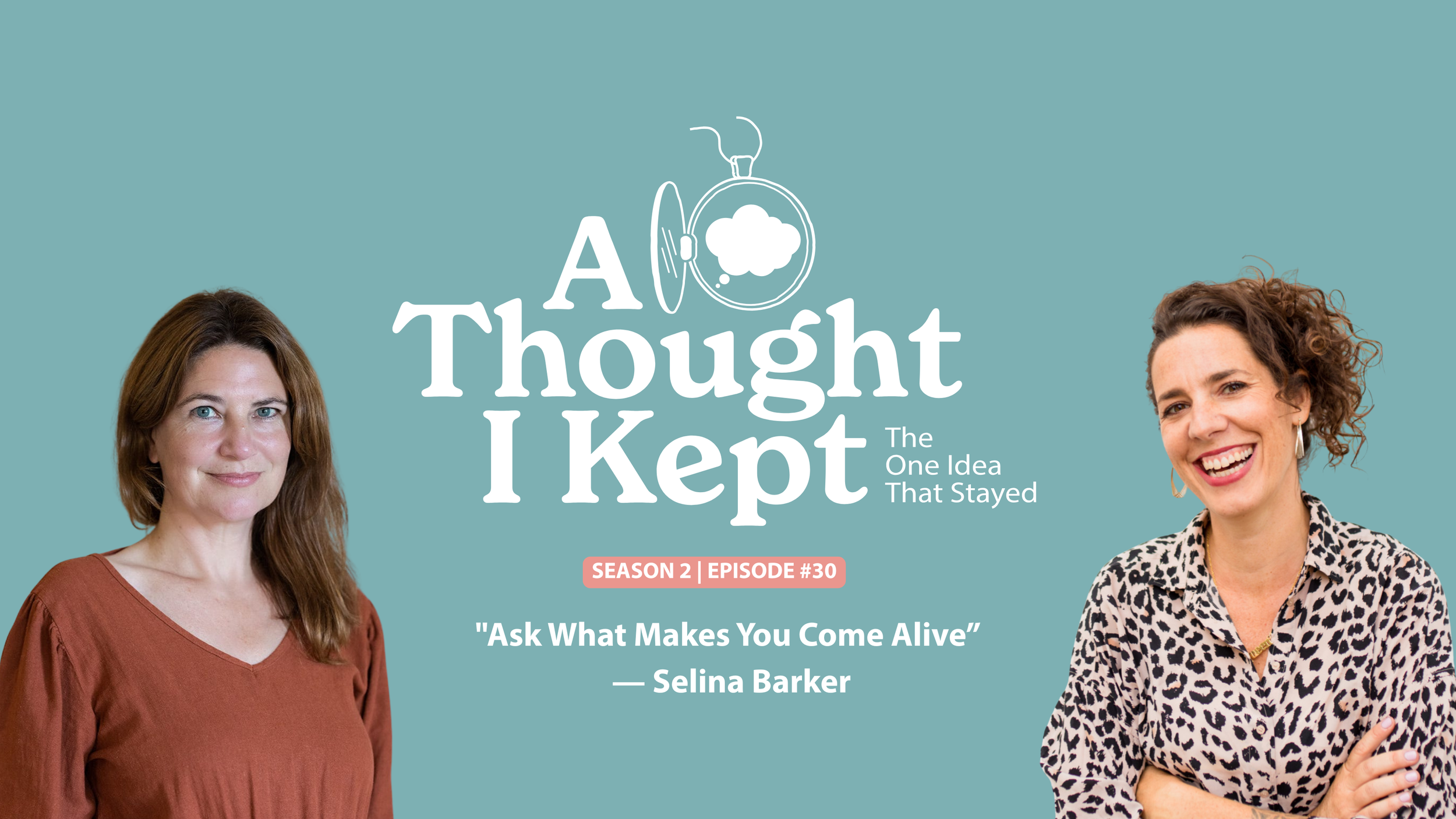
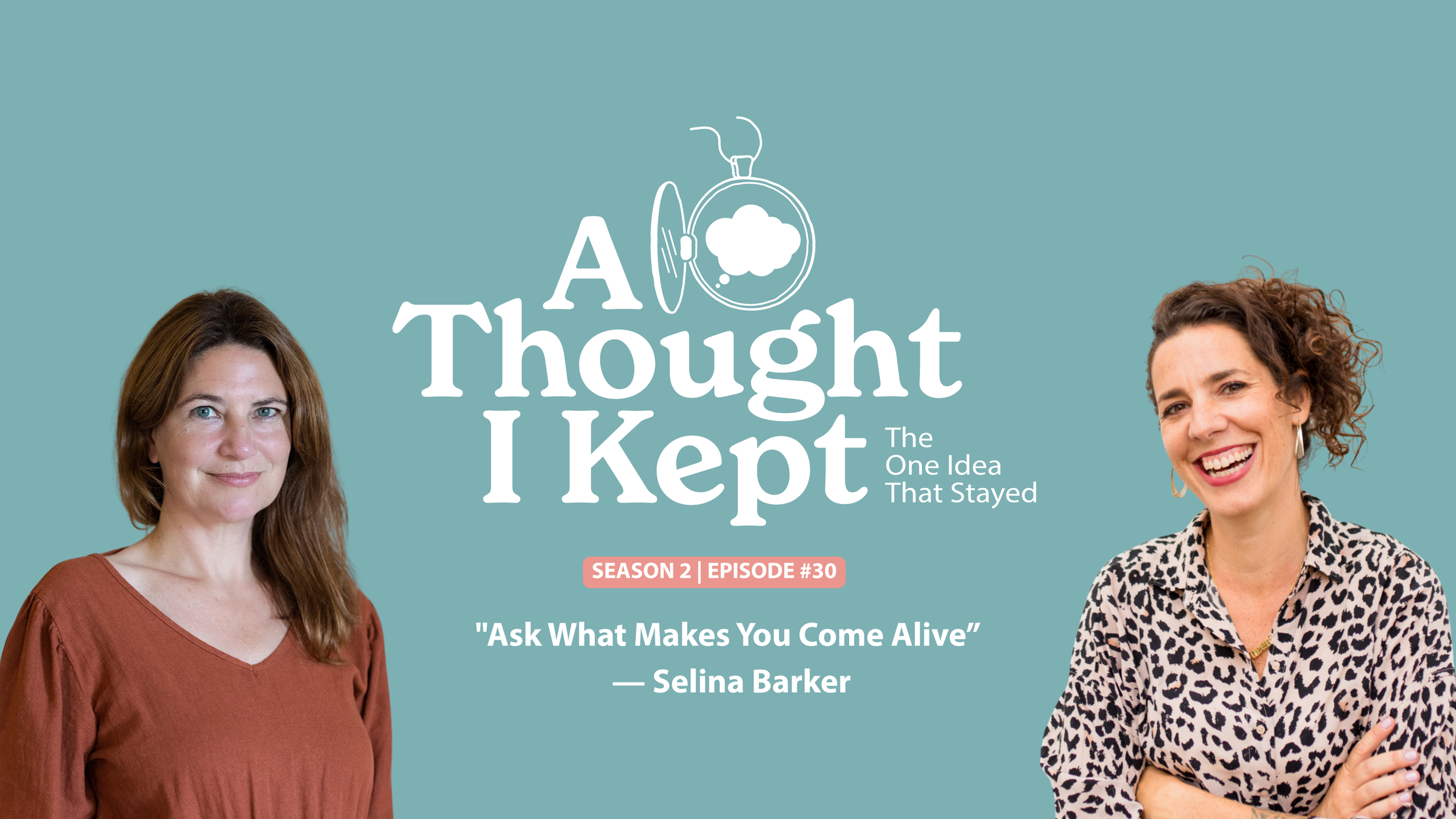
There is a moment in my conversation with career and life design coach Selina Barker when we find ourselves talking about pianos.
Selina is in the middle of a significant career and business transition. After 20 years of helping other people navigate career change, she has found herself questioning the way she has built her own working life. Some of that process has been frightening. At one point, she describes sitting in her garden panicking that her business might be over. But alongside the panic, something else has appeared: space.
She has more time to read. More time to draw. On the morning we recorded our conversation for A Thought I Kept, she had played the piano instead of sitting down immediately to work.
There was something about that detail that stayed with me. Because when we talk about career change, purpose and burnout, we can quickly turn them into another enormous life problem to solve. Should I leave my job? Retrain? Start a business? Find my purpose? Make more money? Make less money but be happier? What am I supposed to be doing with my life? But perhaps there is another question we can ask first.
Where is my energy going, and what is it creating in return?
When the life you created starts to deplete you
Selina’s career crisis didn’t begin because she suddenly stopped loving her work. In many ways, the opposite was true. She still loved coaching. She loved her journals, her membership and helping people flourish. What had become exhausting was everything she believed needed to surround that work.
She talks in our conversation about absorbing a particular story about what being a successful coach should look like: the six-figure business, the big programmes, the marketing, the recognition, perhaps eventually the bestselling book and a place on Oprah’s sofa.
Every industry probably has its own version of that sofa. There are the promotions we’re meant to want, the job titles that demonstrate we are progressing, the businesses that should keep growing, the salaries we should aspire to, the audiences we should build. We can become so accustomed to these measures of career success that we stop noticing whether we ever chose them.
That is where I think burnout and purpose become interesting companions. We often think about burnout as a problem of too much: too much work, too much responsibility, too many demands, too little rest. And of course, sometimes it is. But our conversation made me think about the exhaustion that can also come from spending enormous amounts of energy maintaining a version of success that no longer feels like our own.
You can be very good at something and still not want to keep doing it in the same way.
You can have worked hard to get somewhere and discover you don’t particularly want to stay.
You can even love the essential part of your work while being exhausted by the life you have had to construct around it.
None of those necessarily mean you have chosen the wrong career. But they might mean there is something worth listening to.
Purpose isn’t only about what you do
Purpose is one of the ten pathways to wellbeing we explore at If Lost Start Here and in our new book, and I think we can sometimes make it much grander than it needs to be.
We imagine that finding our purpose means identifying our one great calling. We search for the right job or the right contribution, hoping that once we find it everything will click into place.
Selina’s thought kept offers a slightly different way in. It comes from the writer, philosopher and civil rights leader Howard Thurman: “Don’t ask what the world needs. Ask what makes you come alive, and then go and do that because what the world needs is people who have come alive.”
Selina first encountered those words more than 20 years ago, when she was at the beginning of her career and deeply concerned with making a difference. She was involved in environmental campaigning and remembers being preoccupied with the question of how she could help save the world.
The problem was that the way she was approaching that purpose was exhausting her.
Thurman’s words gave her permission to turn the question around. What if her own needs, pleasure, joy and fun were allowed to matter too? What if making a difference didn’t require sacrificing herself in the process?
It became one of the guiding ideas of her career. And I think there is something particularly important in that for anyone experiencing burnout, considering a career change or wondering what their life’s work might be.
Purpose doesn’t have to ask only: What useful thing can I do?
It can also ask: What happens to me while I am doing it?
Burnout can become something we simply accept
One of the reasons I wanted to talk to Selina is that burnout comes up so often in the work I do. There is a point at which feeling exhausted and overwhelmed can start to seem almost unremarkable. We talk about dragging ourselves towards the weekend, desperately needing a holiday, being unable to switch off, feeling permanently behind or having nothing left by the end of the working day.
And somewhere along the way, we can start to believe this is simply what having a career, caring about our work and managing an adult life feels like.
Selina pushes against that assumption.
When she wrote Burnt Out, she was interested in the moment when someone reaches the point of thinking: I cannot keep going like this. I cannot cope like this anymore.
Her work also acknowledges that burnout doesn’t always look the same. For some people there is a strong emotional component, particularly when they are continually caring, helping or over-giving. For others, the depletion is mental: endless decisions, problem-solving, worry, household administration, work and the feeling that the brain simply never gets to switch off.
This is especially relevant to the way many women have been taught to think about purpose. Selina talks about the deep cultural programming that can equate being a good woman or a good person with looking after everybody else. Our value becomes attached to how useful we can be, how much we can hold and how little we appear to need ourselves.
Purpose without attention to our own wellbeing can very easily become self-sacrifice.
What if you managed your energy, not only your time?
This is where another of Selina’s ideas becomes useful. While researching Burnt Out, she encountered the idea of managing energy rather than simply managing time. It became a turning point in how she understood burnout: if burnout is an energy crisis, perhaps we need to become much more curious about where our energy comes from, what depletes it and what restores it.
Selina works with five different kinds of energy: physical, emotional, mental, motivational and spiritual.
Physical energy includes both movement and rest. Emotional energy asks us to look after our hearts: feeling our feelings, seeking support when we need it and making room for pleasure, creativity and play. Mental energy requires periods of focus but also genuine opportunities for our minds to switch gears and recover.
Motivational energy brings us particularly close to purpose. It asks bigger questions about our values and the life we are creating, but also what helps us keep moving through the difficult or boring parts of that life.
And spiritual energy is broader than religion or faith. Selina talks about nature, meditation, prayer, ritual and the things that connect us to something beyond our immediate thoughts and to-do lists.
Suddenly, “I don’t have enough energy” becomes a much more interesting statement.
Which energy is depleted? What has been drawing from it? What replenishes it? Is my working life asking too much from one part of me while giving very little back?
Those questions might tell us something that another productivity system cannot.
Career change doesn’t always mean changing everything
I also loved Selina’s honesty about what career change looks like from inside it. At first, she thought everything might need to go. But as she allowed herself to explore that possibility, she began to realise that she didn’t want to abandon the heart of her work at all. The coaching could stay. The journals could stay. The parts that made her feel useful, connected and alive could stay. What needed to change were some of the assumptions surrounding them.
That distinction matters because when we are burnt out or unhappy at work, it is easy to think we have only two options: keep going or blow everything up. Real career change can be much less linear. Sometimes we do need to leave. Sometimes we retrain, change industries, start businesses or close them. But sometimes the external life changes surprisingly little while our relationship with it changes enormously.
The useful question might not immediately be Should I quit my job?
It might be: What is the baby and what is the bathwater?
What is still meaningful here? What am I only doing because I think I should? Which parts of my work give me energy? Which parts continually require me to force myself through them? What version of success am I trying to maintain, and whose definition was it in the first place?
What does success look like when you include yourself?
This might be the question I have thought about most since recording the episode. Selina talks openly about her previous desire for recognition and the realisation that external recognition could become a “hungry ghost”: something she could keep feeding without ever reaching the point where it finally felt like enough.
Her emerging definition of success sounds much simpler. She wants to do work she knows she is good at and that helps other people. She wants to pay her bills and put some money aside. And she wants time to read, draw and play the piano.
When she described it, I remember thinking: Oh. That sounds really good. Not because it should become anybody else’s definition of success, but because it sounded like hers.
Perhaps that is part of our Purpose pathway too. Purpose is not only about discovering what we can contribute to the world. It is also about becoming more discerning about the life we want that contribution to create.
You might want the promotion and the responsibility that comes with it. You might want to build the enormous company. You might want to write the book, change careers, become brilliant at what you do or make a lot of money.
Or you might want enough work, enough money and enough time left over to play the piano.
The important part is noticing whether the definition you are working towards belongs to you.
Start with what makes you come alive
Towards the end of our conversation, I ask Selina what “aliveness” means to her now. Her answer isn't about permanently operating at maximum energy. In fact, it is almost the opposite.
Aliveness, for her, has become connected to presence. Sometimes that means being completely engaged in a conversation or absorbed in meaningful work. Afterwards, it might mean sitting in the garden, putting her feet on the grass, listening to the birds and allowing her energy to shift again. That feels like a much kinder way to think about purpose.
We don't have to find the one thing that will make us leap out of bed every morning for the rest of our lives. We can start by paying attention. Notice the work that absorbs you. Notice the people around whom you feel more yourself. Notice what you are curious about. Notice what leaves you depleted and what restores something in you. Notice where you are forcing and striving. Notice the small things you keep wishing you had more time for. And perhaps notice, too, where your life has slipped onto autopilot.
Because purpose isn't necessarily waiting somewhere outside us to be discovered. Sometimes we find our way towards it by paying closer attention to where our energy already wants to go.
Listen to Selina Barker on A Thought I Kept
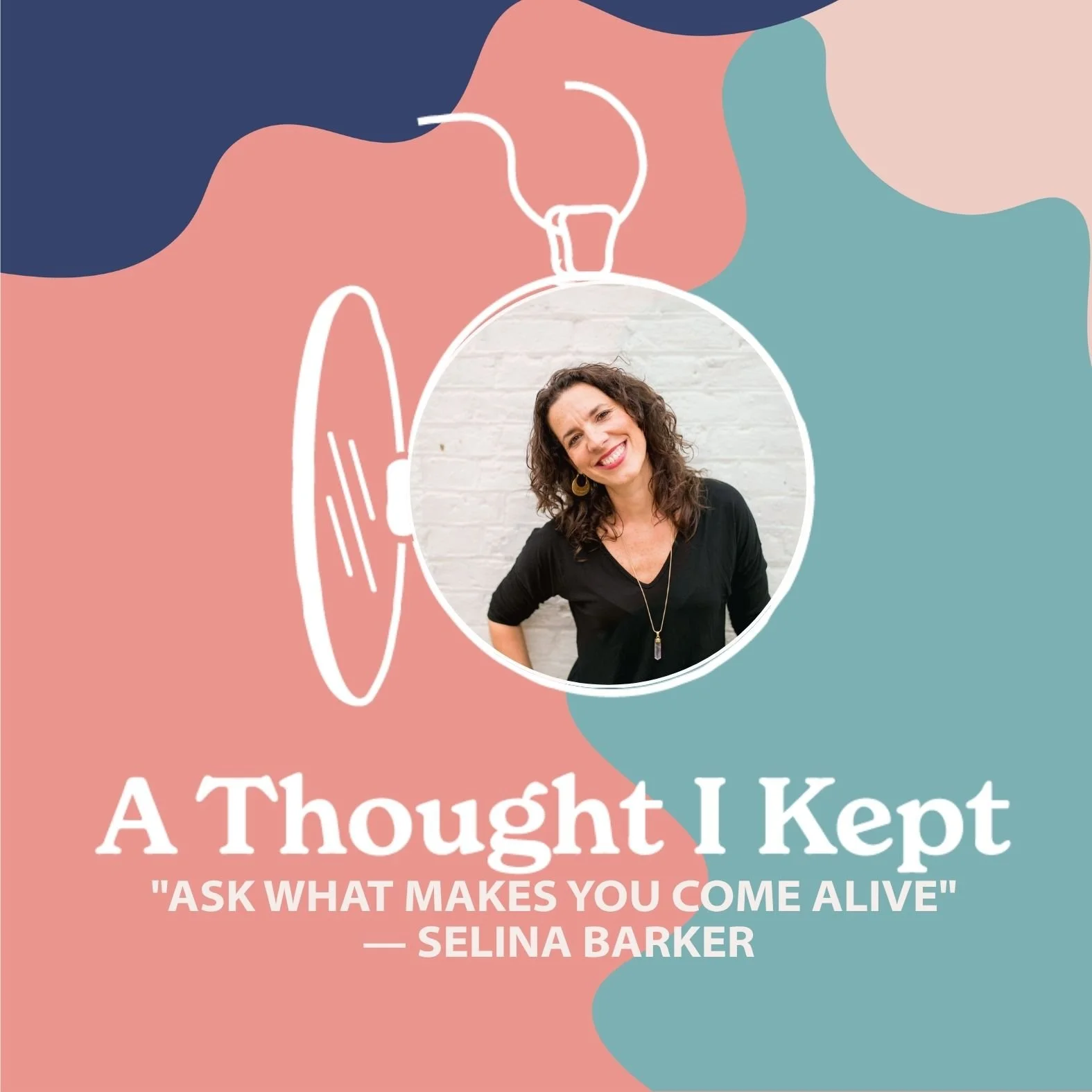
In my full conversation with Selina Barker on A Thought I Kept, we explore burnout, career change, energy management, external validation, redefining success and what it might mean to create a working life that supports rather than continually depletes us.
If you are feeling burnt out, questioning your career or simply wondering whether there might be another way to live and work, listen to the full episode: Ask What Makes You Come Alive with Selina Barker.
And if these questions feel particularly close to where you are right now, you don't have to work them out alone. Our coaching sessions can support you through burnout, career change, feeling stuck at work or the bigger question of what you want your life's work to be. Together, we can make space for what you're feeling, understand what is depleting you and begin exploring what you might want to move towards next.
What If Confidence Isn't What You Need?
Waiting until you feel confident? Women's leadership coach Sadia Ghazanfar shares why courage comes first, how to overcome perfectionism, imposter syndrome and self-doubt, and why being brave enough to start something new can change everything.
One of the questions I've found myself thinking about recently is this: what's something you're willing to be bad at? Not because you're naturally gifted at it. Not because you know you'll eventually master it. But because something about it feels interesting enough, hopeful enough, or alive enough that you're prepared to keep going anyway.
It's not a question we ask ourselves very often. Instead, many of us spend our energy trying not to look inexperienced, uncertain or unprepared. We polish. We perfect. We compare ourselves to people who seem effortlessly capable and quietly decide we'll begin when we feel more confident.
But what if confidence isn't actually where we begin?
That’s what I get into with this week's guest on A Thought I Kept, Sadia Ghazanfar, women's leadership and career development coach and founder of Slay Your Dragons. The thought she has carried with her for years is beautifully simple:
"Be brave enough to suck at something new."
At first it made me smile. Then it made me feel unexpectedly relieved. We live in a world that expects us not to suck. We see the outcomes of other people's efforts: the bestselling books, the polished speakers, the successful businesses, the perfect performances. What we rarely see are the years of uncertainty that came before them, the uncomfortable first attempts, the moments when someone wondered whether they should give up altogether. We're comparing our beginnings with somebody else's middle, and it's no wonder so many of us decide not to start at all.
One of my favourite moments in our conversation came when Sadia talked about confidence. So many women arrive in her coaching sessions believing confidence is what they need before they can apply for the promotion, change careers, launch the idea or finally speak up. But she sees it differently. Confidence isn't the starting point; it's the result. First comes courage. Then comes practice. Then comes competence. Confidence follows afterwards.
It's such a subtle shift, but it changes everything. Instead of waiting to feel different before we act, we allow ourselves to become different through the act of trying.
We also talked about perfectionism, another companion for so many of us. I loved Sadia's perspective that perfectionism isn't who we are; it's a behaviour that may once have protected us but perhaps no longer serves us. There's something deeply hopeful about that distinction. If perfectionism isn't our identity, then maybe we don't have to carry it forever. Maybe we can gently experiment with behaving differently instead.
As we spoke, I found myself thinking about how often uncertainty masquerades as failure. We assume that not knowing means we're on the wrong path. That feeling awkward means we shouldn't be there. That struggling is evidence we aren't capable. Yet every meaningful thing I've ever learned has begun with exactly those feelings. Coaching. Writing. Speaking. Hosting this podcast. None of them started with confidence. They all started with awkwardness, uncertainty and a willingness to keep going anyway.
Sadia also spoke openly about burnout and the pressure so many women feel to hold everything together. There was a time when she was navigating a demanding leadership role, retraining as a coach and renovating a house all at once. She kept pushing until eventually her body simply wouldn't let her anymore. It's a story that will feel familiar to many people because we often pride ourselves on coping. We tell ourselves we'll figure it out alone. We keep going because stopping feels impossible. Yet sometimes the bravest thing we can do is ask for help before our bodies ask for us.
Listening back to our conversation, I realised that "be brave enough to suck at something new" isn't really about being bad at something. It's about giving ourselves permission to be learners again. To remember that learning has always been messy. That curiosity is often more useful than certainty. That possibility only exists when we're willing to step into something we don't yet know how to do.
This podcast itself is an example of that. I started it because I'd always wanted to make a podcast. Those early episodes were wonderfully imperfect while I figured out the technology, the interviewing, the editing and the rhythm of the conversations. Perhaps they're still imperfect now. But every week I learn something. Every week I become a little more comfortable with not knowing everything. And every week I'm reminded that the joy was never in getting it right first time. It was in beginning.
So if you're arriving here today feeling unsure of yourself, wondering whether you're ready for whatever comes next, perhaps this week's thought is one to keep.
Be brave enough to suck at something new.
It may not feel elegant. It probably won't feel comfortable. But it just might be the beginning of something you couldn't have imagined yet.
Listen to the conversation
In this episode of A Thought I Kept, Sadia Ghazanfar and I explore perfectionism, confidence, courage, burnout, emotional capacity, leadership, asking for help and why learning something new can become one of the most freeing things we ever do.
Listen to "Be Brave Enough to Suck at Something New" — Sadia Ghazanfar wherever you get your podcasts.
Looking for support?
If this conversation resonated because you're feeling overwhelmed, stuck, burnt out or uncertain about your next step, you don't have to figure it out alone. Explore my one-to-one emotions coaching sessions and together we'll make sense of what's really going on beneath the surface, so you can move forward with greater clarity, self-compassion and courage.

Why Is It So Hard to Validate Ourselves?
If other people's approval never feels like enough, you're not alone. Discover why we seek external validation and how emotions coaching can help you trust yourself more.

A few years ago, I was talking to a coaching client about a project she had recently completed at work. It had gone well by every measure available. The feedback was positive, her colleagues were happy, and her manager had praised her contribution. As we talked about it, I asked a simple question: "So how do you feel about it?"
She paused for a moment before replying, "I don't know. No one's told me yet."
It was one of those answers that stayed with me because it captured something many of us experience but rarely say out loud. So often, we are waiting for someone else to tell us how to feel about ourselves. We wait for the compliment, the approval, the performance review, the invitation, the praise, the message that confirms we are doing a good job, making the right choice, or becoming the person we hope to be.
When those moments arrive, they can feel wonderful. There is relief in being recognised and comfort in being seen. Yet for many people, the feeling never lasts for long. The compliment fades. The praise is forgotten. The promotion becomes the new normal. Before long, we find ourselves searching for the next piece of evidence that we are okay.
If this sounds familiar, you are far from alone.
When Other People's Opinions Carry More Weight Than Our Own
Many of the people I work with in coaching are thoughtful, capable and deeply caring individuals. From the outside, they often appear confident and successful. Yet inside, they are carrying a constant question: Am I doing enough? Am I enough? They look to other people for the answer because trusting their own judgement feels surprisingly difficult.
What fascinates me is that this isn't usually a problem of confidence. More often, it is a problem of trust.
Somewhere along the way, many of us learned that other people's opinions carried more weight than our own. Perhaps praise was linked to achievement. Perhaps approval felt conditional. Perhaps there wasn't much room for our feelings, perspectives or needs growing up. Perhaps we discovered that being liked felt safer than being honest, or that getting things right earned connection and belonging.
Whatever the origin, the result can be the same. We begin to treat other people as the experts on our lives while becoming increasingly disconnected from our own authority.
The difficulty is that no amount of external validation can fully solve that problem. If you don't trust your own perspective, even the most generous praise struggles to land. It might make you feel better for an afternoon or a few days, but eventually the doubt returns and the search begins again.
What Are We Really Looking For?
One of the most helpful shifts I have seen in coaching comes when we stop focusing on validation itself and become curious about what sits underneath it.
Because validation is rarely the thing we are actually seeking.
When we long for reassurance from another person, what we are often looking for is something deeper. Sometimes it is safety. We want to know we haven't made a mistake. Sometimes it is belonging. We want to know we still have a place in the group. Sometimes it is certainty in an uncertain situation. Sometimes it is visibility. We want someone to notice how hard we have been trying. Sometimes it is worth. We want proof that we matter.
When we begin to understand the need beneath the validation, something softens. Instead of criticising ourselves for being needy, insecure or dependent on what other people think, we can approach ourselves with curiosity. We can ask what it is we are really hoping someone else's approval will give us.
That question often opens an entirely different conversation.
From Self-Validation to Self-Trust
I think this is why the language of self-validation can sometimes feel unhelpful. It can sound like another thing we should be doing better. Another wellbeing task to add to the list. Another reason to feel we are falling short.
What if the goal wasn't to become completely self-validating? What if the goal was simply to begin trusting ourselves a little more?
Not more than everyone else. Just enough that our own voice gets a seat at the table.
Letting Your Experience Count
Many people assume that self-trust means being certain all the time. In reality, it often looks much quieter than that. It is being willing to acknowledge your effort before someone else notices it. It is recognising when you have handled something well, even if there is no applause. It is allowing your experience to count as evidence. It is asking yourself what you think before immediately turning to someone else for an answer.
This isn't about becoming immune to feedback or pretending other people's perspectives don't matter. Relationships matter. Community matters. Being seen matters. We are human beings, not islands.
The invitation is simply to stop outsourcing your entire sense of worth and direction to people who can never fully know what it is like to be you.
The people who love you can offer encouragement. They can reflect your strengths back to you. They can remind you of things you have forgotten. What they cannot do is build the relationship you have with yourself.
Building a Different Relationship with Yourself
That work happens slowly, often through hundreds of small moments. Moments when you pause before seeking reassurance. Moments when you acknowledge your own effort. Moments when you choose to believe your experience rather than immediately questioning it. Moments when you allow yourself to be both uncertain and trustworthy at the same time.
If you are someone who constantly seeks validation from others, perhaps the question is not, "How do I stop needing reassurance?" Perhaps the question is, "What need am I hoping reassurance will meet, and how might I begin meeting some of that need myself?"
That feels like a gentler place to begin. It is certainly a more compassionate one.
And from that place, it becomes possible to build something far more sustainable than confidence. It becomes possible to build trust.
Explore Emotions Coaching
If you recognise yourself in this story, emotions coaching can help you understand why external validation feels so important, what needs sit beneath it, and how to build a steadier relationship with your own voice.
Together, we'll explore the emotional patterns that keep you second-guessing yourself, learn what your emotions are trying to tell you, and help you move forward with greater self-trust, clarity and confidence.
Because the goal isn't to stop caring what other people think. It's to make sure your opinion matters too.

What If You're Not Stuck?
If you feel stuck in a job, relationship or life transition, you may not be lacking motivation. Explore the emotional reasons we get stuck and how to find your next step with compassion and clarity.

A few years ago, I noticed that "stuck" was becoming one of the most common words people used in coaching sessions.
"I feel stuck in my job."
"I feel stuck in my relationship."
"I feel stuck where I live."
"I feel stuck in my life."
The details were always different, but the feeling underneath was remarkably similar. There was frustration, restlessness and often a fair amount of self-judgement. People would arrive convinced they should know what to do next. They should be making a decision. They should be taking action. They should have figured this out by now.
The assumption was always the same: if I'm stuck, something must be wrong. Yet the more I listened, the more I began to wonder whether stuckness was being misunderstood.
We tend to treat feeling stuck as a problem to solve. We assume it means we're procrastinating, lacking confidence or avoiding the obvious next step. We tell ourselves to be braver, more decisive, more motivated. We read the books, make the lists and search for clarity.
But what if feeling stuck isn't always a sign that you're failing to move forward? What if it's carrying information? What if, instead of asking how to get unstuck, we became curious about what stuckness might be trying to tell us?
Sometimes We're Not Stuck. We're Grieving.
One of the most overlooked forms of grief is grieving something that hasn't technically ended. You can grieve a workplace while still working there. You can grieve a relationship while still being in it. You can grieve a place you've outgrown while still calling it home. Often what we're grieving isn't the reality itself but the version we hoped it would become.
The manager who never recognised our contribution. The role that promised growth but delivered exhaustion. The relationship we believed would deepen. The future we imagined for ourselves that doesn’t feel like it will ever arrive.
When we're carrying that kind of grief, movement can feel surprisingly difficult. Part of us is still looking backwards, still hoping, still waiting for something to become what we needed it to be. We may find ourselves endlessly analysing what to do next when the real work is acknowledging what has already been lost.
Sometimes we're not stuck because we don't know the answer. Sometimes we're stuck because we're still mourning the fact that the answer isn't the one we wanted.
Sometimes We're Not Stuck. We're Protecting Ourselves.
One of the most compassionate questions I know is: what is this behaviour trying to protect?
Many of the things we criticise ourselves for are actually forms of self-protection. Staying quiet may protect us from rejection. Keeping ourselves small may protect us from visibility. Not applying for the job may protect us from disappointment. Not leaving may protect us from uncertainty.
Particularly when we've experienced setbacks, betrayals or repeated disappointments, our protective instincts can become incredibly sophisticated. We stop hoping. We lower expectations. We convince ourselves the grass isn't greener. We tell ourselves we're being realistic.
Yet underneath that realism there is often a quieter truth. We are trying not to get hurt.
The difficulty is that protective strategies have a habit of outliving their usefulness. What once helped us survive can eventually prevent us from growing. We become trapped not by our lack of courage but by the very strategies that once kept us safe.
Understanding that doesn't mean forcing ourselves to change overnight. It simply allows us to meet ourselves with curiosity rather than criticism.
Sometimes We're Not Stuck. We're Exhausted.
There is a version of stuckness that has nothing to do with clarity and everything to do with capacity. Many people are trying to make life-changing decisions while carrying far too much. They're burnt out at work, overwhelmed at home, supporting everyone else, navigating uncertainty and wondering why they can't summon the energy to reinvent their lives.
Everything feels harder when we're exhausted. The future feels smaller. Possibilities feel further away. Decisions that might have felt manageable a year ago now feel impossible.
In those moments, asking "What should I do?" may be the wrong question. A more useful question might be: "What do I need?"
Sometimes what looks like stuckness is simply a nervous system asking for rest, support and recovery before it can contemplate what comes next.
Sometimes We're Not Stuck. We're Waiting for Certainty.
If you've ever told yourself that you'll move once you're sure, you're in good company. Most of us are waiting for certainty. We want to know the next job will be better. We want reassurance that the move will be worth it. We want proof that we're making the right decision.
The problem is that certainty is rarely available in advance.
Most of the meaningful decisions in our lives are made without guarantees. We don't know how relationships will unfold. We don't know how jobs will turn out. We don't know how future versions of ourselves will feel about the choices we're making today.
What often keeps us stuck isn't uncertainty itself but the belief that we need certainty before we can move.
The people I admire most aren't necessarily the people who are most certain. They're the people who have learned to trust themselves in uncertain situations. They know disappointment is possible. They know things may not go to plan. But they also know they can respond, adapt and begin again if needed.
Sometimes We're Not Stuck. We're in Transition.
Some chapters of life have no obvious label. The old version of your life no longer fits, but the new version hasn't fully arrived. You can feel the shift happening, but you can't yet see what it's becoming.
These periods can be deeply uncomfortable because they don't offer the neat narrative arc we're looking for. We want a map. We want progress. We want to know we're heading somewhere. Instead, we find ourselves in a kind of hallway between two rooms.
Yet transition has its own purpose. Beneath the uncertainty, we are gathering information. We are discovering what matters. We are testing assumptions, developing resilience and becoming someone capable of inhabiting the next chapter.
The growth is real, even when it isn't visible.
Sometimes We're Not Stuck. We're Choosing.
This may be the most uncomfortable possibility of all. Sometimes we are making a choice. Not necessarily forever. Not necessarily consciously. But a choice nonetheless.
We may be choosing the known discomfort of today over the unknown discomfort of tomorrow. We may be choosing security over possibility, familiarity over uncertainty, stability over growth.
The challenge is that we often resist acknowledging the choice because we don't like the options available to us.
Yet there can be enormous relief in admitting it.
"I am choosing to stay in this job for now."
"I am choosing not to move yet."
"I am choosing to remain here while I work out what comes next."
The circumstances may not change immediately, but something important does. Agency returns. When we acknowledge our choices, we stop seeing ourselves as trapped and begin seeing ourselves as active participants in our own lives. We can then ask different questions. What is this choice giving me? What is it costing me? What need is it meeting? What would need to change for a different choice to become possible?
What If the Opposite of Stuck Isn't Movement?
We often imagine that the opposite of stuck is action. A resignation letter. A difficult conversation. A move across the country. A dramatic leap into the unknown. Sometimes it is. But increasingly, I wonder if the opposite of stuck is trust.
Trust that you can grieve what didn't happen. Trust that disappointment is not the end of the story. Trust that uncertainty is survivable. Trust that your instincts deserve a hearing. Trust that when the time comes, you'll know enough to take the next step.
Perhaps feeling stuck isn't always a sign that you're failing to move. Perhaps it's an invitation to understand what is really happening beneath the surface.
Because once we do that, movement often arrives naturally. Not because we've forced ourselves into action, but because we've stopped fighting the wisdom hidden inside the pause.
Explore Emotions Coaching
If you're feeling stuck in work, relationships, a life transition or simply in your own head, emotions coaching can help you understand what's really happening beneath the frustration.
Together we'll explore the emotions, needs, beliefs and protective patterns shaping your experience, helping you move from self-judgement towards greater clarity, self-trust and agency.
You don't need to know what comes next. You just need somewhere to start.
How We Learn to Matter Too
Always supporting everyone else can leave you exhausted and disconnected from yourself. Explore how to care for others without losing sight of your own needs.
One of the things I see come up most often in my work is what happens when someone has become the strong one.
They are the person everyone calls. The person who knows what needs to happen next. The person who organises the appointments, remembers the details, absorbs the worry, keeps the family going, manages the work, checks in on everyone else and says, when someone finally asks how they are, “I’m fine.”
Often, they are fine. Or fine enough. They are functioning. They are coping. They are doing what needs to be done, and perhaps doing it incredibly well. But somewhere in all that doing, they can begin to disappear.
This is particularly complicated when the people we love are going through something difficult themselves. If your partner is unwell, your parent needs care, your child is struggling, or someone close to you is living through grief, trauma or a major life change, it can feel almost impossible to say: What about me?
Their difficulty might seem bigger. Their needs might feel more urgent. You might look at what they are going through and decide that your exhaustion, sadness, anger, loneliness or uncertainty is somehow less important. You might tell yourself that this is simply what love looks like. You might believe that being strong means being the person who can handle it.
But what happens when you keep telling yourself that it isn’t about you?
When “it’s not about me” becomes a way of life
This is the question at the heart of my conversation with Lois Jackson on A Thought I Kept.
In 2017, Lois’s then-fiancé, former professional rugby player Ed Jackson, suffered a life-changing spinal cord injury. Their lives changed almost overnight, and Lois did what came naturally to her: she went into care mode. She booked appointments. She drove Ed where he needed to go. She spoke to doctors. She supported his recovery. When people asked how she was, her answer was simple: “It’s not about me. Ask Ed. I need to look after Ed.”
What struck me in talking to Lois was how little conscious decision there seemed to be in this. She didn’t sit down and decide to erase her own needs. She simply stepped into the role that needed filling, and perhaps the role she had always been good at filling.
I think many of us will recognise this. Losing ourselves rarely happens in one dramatic moment. It can happen gradually, through a thousand reasonable decisions. Someone else needs us more today. This isn’t the right time to bring that up. I can deal with it later. I don’t want to make things harder. I should be grateful. I should be able to cope. And then, one day, we might look at our lives and wonder where we have gone.
For Lois, that realisation came a couple of years after Ed’s accident. From the outside, life had in some ways returned to “normal”, but of course it wasn’t the old normal. Ed was living with the physical and psychological consequences of his injury. His rugby career had ended. Their relationship had changed. Their future had changed.
Lois realised that Ed had changed, their life had changed, but she was still, as she described it, “stuck in old Lois”. She had kept pushing her feelings to the back of her mind because it still felt as though they weren’t relevant.
Eventually, she knew she had to be honest.
The strong one has feelings too
This is often the difficult part. It can feel selfish to acknowledge that supporting someone has been hard when what they have experienced seems harder. We can turn suffering into a hierarchy in which only the person going through the most visible difficulty is allowed to have needs. But emotions don’t work particularly well in hierarchies.
You can love someone deeply and feel exhausted by caring for them. You can be grateful for your family and need time away from them. You can understand why someone is struggling and still be affected by the way their struggle changes your life. You can want to support someone and feel angry, lonely, scared or resentful. The presence of your feelings does not cancel out your love.
Lois had been afraid that being honest would hurt Ed. She was afraid of losing him. There was perhaps also something else underneath it: a fear that she might no longer be able to be the strong one who could handle everything.
But, as she told me, she came to understand strength differently. Sometimes the strong thing is not continuing to cope quietly. Sometimes strength looks like vulnerability. Sometimes it is saying the difficult thing carefully and honestly. Sometimes it is admitting that you are struggling too.
Lois began having those conversations with Ed. She also spoke to a relationship counsellor and started putting into words what she had been pushing away. Rather than destroying their relationship, that honesty became part of rebuilding it. She described it as though their relationship was “born again”.
There is something important here for those of us who have come to associate love with endurance. We can believe that protecting a relationship means protecting another person from our feelings. But what happens to a relationship when one person can no longer fully exist inside it?
What we suppress doesn’t simply disappear
When we repeatedly decide that our feelings are not relevant, they don’t usually go away. They can become exhaustion, disconnection, irritability or resentment. We might become increasingly frustrated with people we genuinely love, while also feeling guilty for that frustration. We might stop knowing what we want because we have spent so long asking what everyone else needs. Sometimes we end up in lives we never really chose.
This doesn’t necessarily happen because someone else chose them for us. It can happen because we made so many decisions around other people that we stopped including ourselves in the decision-making process.
This is why I think Lois’s thought is so important. After years of saying, “It’s not about me,” she realised something else:
It is about me.
Not only about me. Not me instead of you. Not my needs matter and yours don’t. Me as well as you.
There is a significant difference between putting yourself first all the time and remembering to put yourself somewhere in your own life.
Where are you in your own story?
One of the questions I found myself returning to during my conversation with Lois was: Where am I in my own story?
For those of us who are very good at looking outwards, this can be a surprisingly difficult question to answer. We might know what our children need, what our partner is worried about, what is happening at work, what our parents need help with and what is expected of us this week. But ask what we feel, what we need or what we want, and the answers can be much less clear.
Lois now does a lot of work around values, both for herself and with the people she supports. Values can sound like a very abstract idea until we think of them as an anchor: What actually matters to me? What makes me feel alive? What do I want more of? What am I no longer willing to lose?
When we have spent a long time responding to other people’s needs, reconnecting with ourselves may not begin with a dramatic life change. It might begin by noticing.
What am I feeling that I keep dismissing? What do I need that I keep telling myself is unreasonable? Where am I saying yes because I am afraid of what will happen if I say no? What parts of me have become smaller while I have been taking care of everyone else? What would it mean to include myself in the picture?
We may not immediately know the answers. Perhaps the important thing is to begin asking the questions.
You don’t have to wait until everyone else is okay
I think this is one of the hardest beliefs to loosen when you are caring for someone else: the idea that your turn will come later.
I will rest when things calm down. I will think about what I want when they are better. I will ask for help when this difficult period is over. I will return to myself eventually.
But sometimes things don’t calm down for a very long time. One difficult period becomes another. Children need us in different ways. Parents age. Work changes. Someone gets ill. Life continues to be life.
If our wellbeing is always conditional on everyone around us being okay, we may be waiting for a moment that never quite arrives.
Lois has learned to notice her boundaries, to lean on other people and to delegate. She has also learned that putting something back into herself does not have to be enormous. At the beginning of our conversation, after ten emotionally demanding days supporting people on a charity walk, she told me she had just had her hair done. It was a small thing, but it mattered. She had recognised that she needed something put back in.
I loved that because caring for ourselves can become another impossible standard. We imagine it requires a retreat, a perfect morning routine or hours of uninterrupted time we simply do not have. Sometimes it might be a walk. A book. Getting your hair done. Asking someone else to take over. An honest conversation. An hour in which nobody needs anything from you.
Lois also reminded me that rest does not have to look the same for everyone. For her, it might be walking slowly through the woods and paying attention to what she can see, smell and hear. Rest can still involve movement. Support can take different forms. The question is less whether we are doing self-care correctly and more whether there is anywhere in our lives where we are being replenished rather than continually depleted.
Small changes still count
There is another idea woven throughout Lois and Ed’s story: millimetres to mountains.
During Ed’s recovery, progress could be almost imperceptibly small. A finger moving a little more. A toe beginning to wiggle. Changes that were difficult to see from one day to the next, but became visible when they looked back. I think there is something useful in this for anyone trying to find themselves again.
You do not have to completely redesign your life tomorrow. If you have spent years being the person who copes, asking for help once might be a significant step. Saying what you actually feel might be a millimetre. Letting someone be disappointed in your boundary might be another. Doing something because you enjoy it, rather than because it is useful to somebody else, might be another still.
There may be steps backwards too. Lois is clear about that. Progress is not a neat journey in one direction. But once you have evidence that you can do something differently, you have something to return to.
Perhaps the question is not: How do I become someone who always puts myself first?
Perhaps it is: What would help me matter a little more in my own life today?
Maybe being strong was never meant to mean doing it alone
One of the great contradictions of being the strong one is that the more capable you appear, the less likely people may be to realise that you need support. You become the support system rather than someone within it.
But Lois’s work, both through her coaching and through the charity Millimetres 2 Mountains, is deeply rooted in connection. She has seen again and again how much it matters to be around people who understand, to have somewhere you can be honest, and to know that you do not have to carry everything alone.
The same should be true for the supporters. You are allowed to need somewhere to put your feelings. You are allowed to be affected by what is happening to someone you love. You are allowed to want things for your own life even while someone else is struggling. You are allowed to be tired of being strong.
And perhaps strength itself can become something different. Less about holding everything together without complaint, and more about knowing when to let yourself be held too.
Listen to my conversation with Lois Jackson
In this episode of A Thought I Kept, How We Learn to Matter Too with Lois Jackson, we talk about being the strong one, supporting someone through life-changing circumstances, honesty in relationships, identity, rest, hope, nature, joy and what happens when we finally realise that our own feelings and needs matter too.
Listen to the full episode and discover the thought Lois kept: “It is about me.”
Who supports the person who supports everyone else?
If you are used to being the capable one, the person who holds everything together, it can be difficult to know where to take your own emotions. You may not want to burden the people you love, particularly when they are struggling too, but that does not mean you have to keep carrying everything alone.
An emotions coaching session is a space for you. A place to talk honestly about what you are feeling, including the feelings that seem complicated, selfish or difficult to admit, and begin to understand what they might be asking for.
If you need somewhere to be supported while you support everyone else, you can book an emotions coaching session with me at If Lost Start Here.
When Wellbeing Becomes Another Thing to Get Right
Why is wellbeing so difficult to put into practice? Explore six common stories that keep us stuck, from overthinking to self-doubt, and discover a gentler way to start feeling better.
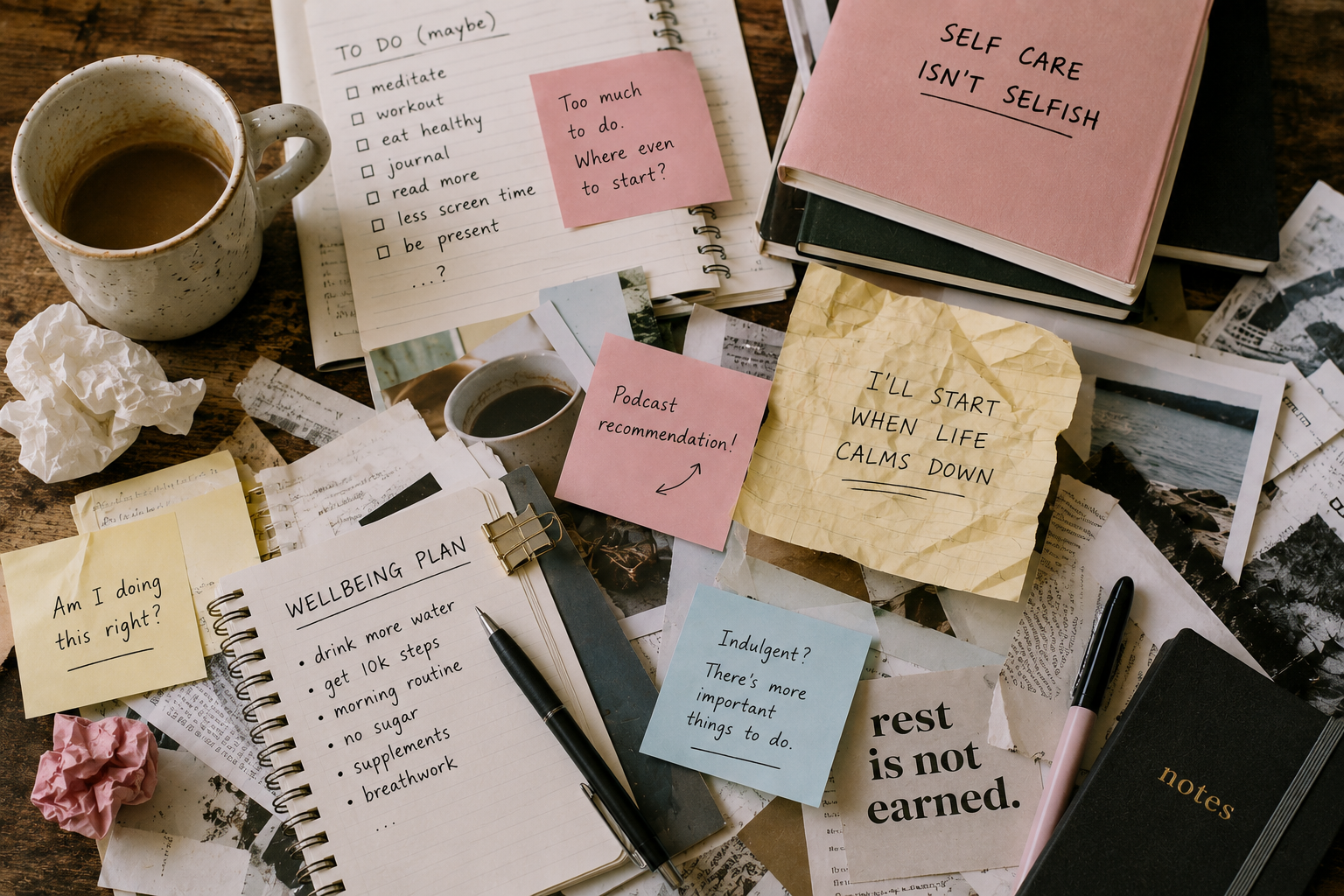
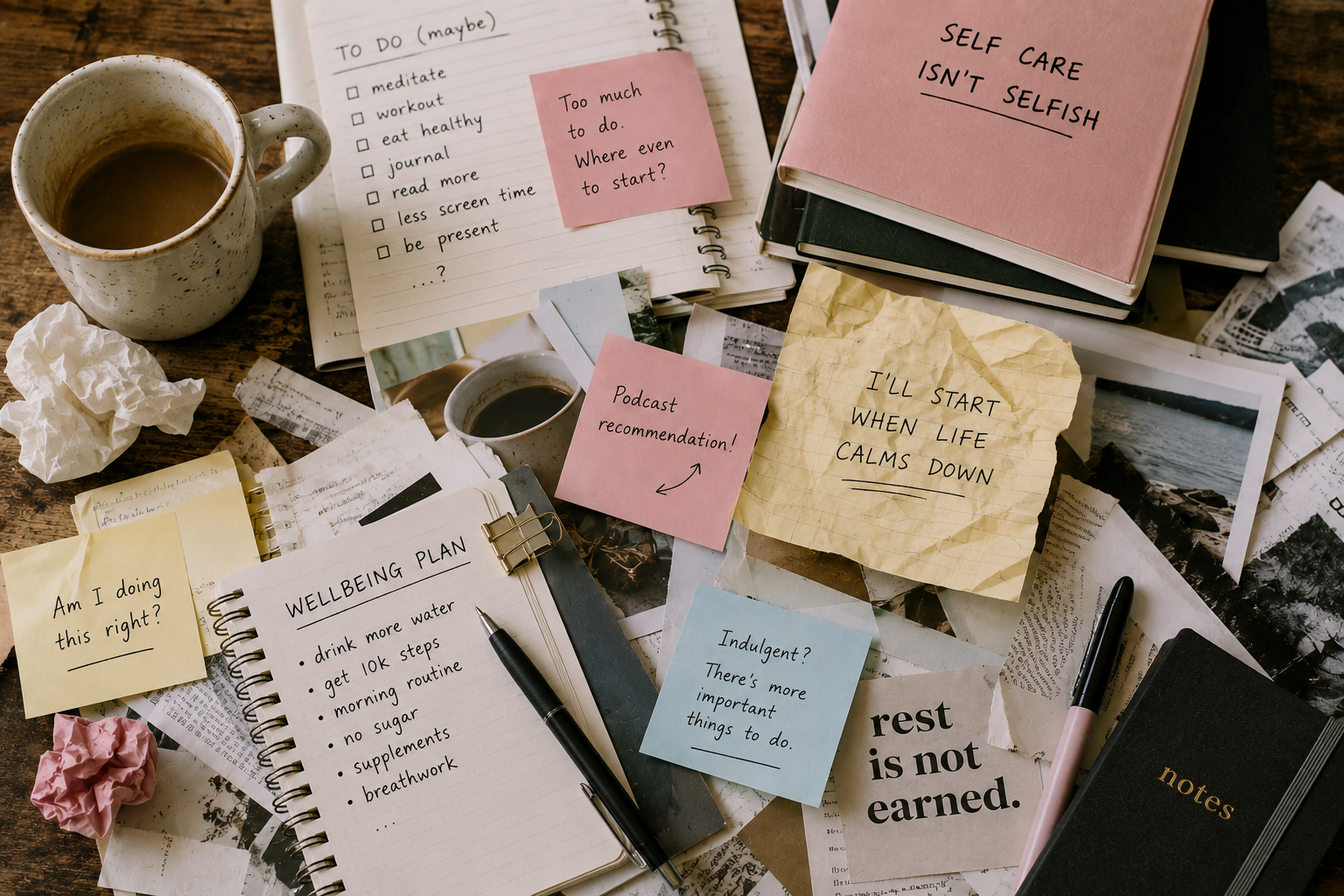
I saw a trend forecast this week that predicted that anti-optimization is the new direction wellbeing is taking. Which is an irony in itself: the not doing of the thing we're supposed to be doing becoming the thing we're now supposed to be doing.
I also feel like we're surrounded by countless maxxing articles right now: summermaxxing, productivitymaxxing, communitymaxxing, even joymaxxing. The drive towards more, more, more. But most of the women I talk to aren't looking to optimise their lives. They mostly just want to get to some state of being okay, a general sense of enoughness and a stronger belief that it will all work out, especially when it feels like it very much won't.
There's a real push and pull around wellbeing right now, so I became curious about what happens when we know all the things, yet it can still feel impossible to do the things, because we're not even sure if, or why, we'd want to.
Talking to clients and podcast guests, friends and workshop attendees, I've pulled together some of the most common narratives I'm hearing around wellbeing itself.
1. Starting: "I know I need something but have no idea where to start."
Okay, something is off. Something needs to change. We no longer want to feel, think or be like this. But now where do we start? Which of all those incoming messages is most relevant to us? Of all the possibilities available, which one works best? Which bits do we feel confident enough to take on, and which should we let fall away?
There is so much information, and some of it is contradictory. Are we falling for trends? Has the science shifted? What's the right thing to do with the information we have available to us right now? Before we've even begun, there's a whole wall of stuff to get through.
We go sideways into rabbit holes of research. We decide to go running, then spend the time we could have been running researching how to run. We consider a walk and wonder what speed, how long, which environment. We choose to nourish ourselves and suddenly there are question marks around fruit and Greek yogurt. We have three minutes while the kettle boils: should we stand on one leg or journal?
So we stay. Waiting to start. Hoping to start. Not starting.
2. Outsourcing ourselves: "Ahhh, I just want someone to tell me what to do."
When we're utterly lost, it makes sense that we turn to experts. We want them to make everything all right. We ask them, "Give me the list and I'll do that." We'll follow their ten-step plans. We'll learn all their hows for our whys.
This makes absolute sense because we have access to people who genuinely do know things, who have answers about overwhelm, burnout and productivity.
And they haven't travelled your life, the paths you've already taken or the ones you hope to take. They don't know the shape of your energy, your values or the systems you operate within. So there's some tempering here. I'll learn what you know, and I'll tailor it to what works within my very real, even messy, life over here.
3. Disconnecting from it all: "That version of magazine wellness doesn't represent my life right now."
We become desensitised to it all. We shrug. We become cynical. We roll our eyes at gratitude journaling and reject it outright. We push back against the very things that might help us. Wellbeing is a bit boring, no? It's just not fun. Or perhaps it doesn't feel serious enough. It becomes something for someone else, with a more photogenic life and a more abundant bank balance.
No one talked about wellbeing when I was growing up. No one talked about wellbeing in the toxic workplaces I found myself in. No one talked about wellbeing in the fast-paced city life that left me holding on and not much more. But it was there all along, in every moment when I longed to feel better, yearned for connection and hoped for purpose. It just looked different from what I imagined.
Maybe that's the same for you.
4. Procrastination: "When I'm in Majorca on that retreat in a few months' time, then I'll take care of myself."
That shiny life, the perfect practice, doesn't connect with the messy, imperfect lives we actually occupy. Washing piles don't sit well beside yoga mats. Bills to pay alongside affirmations to write. So wellbeing becomes something that happens over there, or not at all. If only we could get to that retreat, that calm space, that beach at sunset, then we'd finally have the capacity to do the thing that would make life better right now.
Our hope is that we'll get there while somehow holding onto here. But there are things we need here, in this life, as we wake up exhausted again, trying not to freeze when we look at our WhatsApp messages yet again, feeling so flooded that the only option is to sob in the car at school pick-up.
"Later." Later can become a mantra, when what we're really asking is, "Okay, now, what do I need?"
5. Distancing: "Oh, I totally understand. I'll send you a podcast."
We turn all those messages outwards. Maybe even as a shield against connection. We ask a friend whether they've listened to that podcast rather than offering a hug. We suggest a bestselling non-fiction book on the very subject they're struggling with.
I love a good recommendation. I see it as a love message when someone shares an episode they loved. And there's timing here.
Listen first. Connect first. Then share the thing.
6. Deciding it's not for us."But it's indulgent..."
This is where we turn it on ourselves. We believe wellbeing is indulgent, that we're not the kind of person who... We have more important things to think about than what we perceive as bubble baths and self-care. We may have learned somewhere along the way that taking time for ourselves, which often simply means time away from someone else, is selfish. We do a cost-benefit analysis, and our own column quietly disappears.
This often connects more deeply with self-worth than anything else. There's a pull towards what wellbeing might offer us, alongside a story that it's somehow not for us. There's guilt in considering our own needs when someone else has it worse. Shame when there are more important things to do. A belief that everyone else must come first.
Do any of these sound familiar? Is there a story here that gets in the way of your own wellbeing? What helps you move through it? And what do you hope wellbeing might become, so that it genuinely supports you in the ways you need?

Where to start
If any of these stories resonate, you're exactly who Amanda and I had in mind when we wrote If Lost, Start Here. We didn't want to create another wellbeing book full of things you should be doing. We wanted to create something more playful, more practical and more human. A guide to help you find your own way forward, one small step at a time.
If you're looking for a place to begin, you can find out more about the book and order your copy today.
Why Mothering Is a Radical Act
Historian Elinor Cleghorn explores the hidden history of motherhood, challenging myths about maternal instinct and revealing why mothering has always been a powerful, world-shaping act of care.
One of the things that surprised me when I first became a mum was how interested I suddenly became in my own maternal history.
I wanted to know everything. What had my mother's pregnancies been like? How had she felt holding me for the first time? What had motherhood given her, and what had it taken away? What had she loved about it? What had she struggled with? The boredom. The exhaustion. The joy. The parts she might never have said out loud. Questions that had barely crossed my mind before pregnancy suddenly felt deeply important.
Looking back, I think I was searching for reassurance, but also for connection. I wanted to know that other women had been here before me. That the confusion and intensity I felt were not signs that I was doing something wrong. That I belonged to something larger than my own experience.
It's one of the reasons I was so excited to talk to feminist cultural historian Elinor Cleghorn on my podcast recently. Her remarkable book, A Woman's Work: Reclaiming the Radical History of Mothering, traces motherhood across centuries, uncovering stories that have often been pushed to the edges of history or omitted from it entirely.
What stayed with me most was not simply what I learned about the past. It was how differently I began to think about motherhood itself.
The Stories We Inherit
For so long, motherhood has been presented as something natural. Instinctive. Automatic. As though women simply know how to do it because they are women. As though care arrives fully formed. As though mothering is somehow separate from intelligence, creativity, skill, knowledge or work. But what if that story is wrong?
Throughout our conversation, Elinor returns again and again to the idea that mothering is not simply an instinct. It is a practice. It is labour. It is ingenuity. It is resilience. It is thought. It is decision-making. It is adaptation. It is often extraordinary acts of love performed under less-than-ideal circumstances.
And perhaps most importantly, it is work that has helped shape human history.
That might sound obvious. Of course mothers matter. Of course children need care. Yet when we look at the stories we preserve and celebrate, motherhood has often been treated as background scenery rather than a force in its own right.
History tends to remember wars, political movements, scientific discoveries and powerful leaders. It is much less comfortable recording the work of feeding children, holding families together, passing on knowledge, sustaining communities and helping life continue. Yet without those things, none of the others would exist.
One of the things Elinor does so beautifully is reveal that motherhood itself is a thought kept. Not simply an experience, but a collection of beliefs and expectations, myths and fears, rituals and instructions that have been passed from generation to generation. Some of those stories have offered care and connection. Others have constrained women, diminished mothers' experiences, and reduced complex human beings to ideals that they could never fully inhabit.
The Hidden Expertise of Mothering
One of the ideas that stayed with me most from Elinor's book is how often motherhood has been framed as instinct rather than expertise.
We are surrounded by stories that suggest women simply know how to mother. That care emerges naturally. That nurturing is somehow built into our biology. Yet anyone who has spent time caring for a child knows that this version of motherhood bears very little resemblance to reality.
Mothering asks us to become observers, interpreters, negotiators, organisers, advocates and problem-solvers. It asks us to adapt constantly to a human being who is changing almost daily. It requires creativity, flexibility, emotional intelligence and endurance. It involves practical decisions, emotional labour, long-term thinking and often an extraordinary capacity to hold uncertainty.
As Elinor points out, one of the great tricks of patriarchy has been to dismiss this work as natural rather than skilled. To suggest that because women perform it, it somehow requires less thought, less knowledge or less expertise. Yet the reality is that mothering involves an enormous amount of wisdom, much of which has been passed from woman to woman, generation to generation, often outside the institutions that traditionally determine what counts as knowledge.
The result is that many mothers find themselves carrying immense responsibility while simultaneously living in cultures that struggle to recognise the value of what they do.
Mothering as Resistance
One of the reasons I found A Woman's Work so moving is that it refuses to tell a simplistic story. This is not a history of women as passive victims. Nor is it a story about inevitable progress. Instead, it is a story about women finding ways to mother, care, nurture and protect within the constraints of the worlds they inhabited.
Again and again, Elinor introduces us to women who insisted on their right to love and care for their children despite extraordinary obstacles. Women who documented their experiences when few believed those experiences mattered. Women who preserved family histories, maintained connections, fought for custody, challenged expectations and refused to disappear quietly into the background.
The story of Sojourner Truth particularly stayed with me. Born into slavery, denied ownership of her own children, she nevertheless insisted on her right to mother. She fought for her son. She preserved her family stories. She made visible experiences that powerful systems were determined to erase. In Elinor's telling, her story becomes something larger than a historical account. It becomes an example of what it means to understand mothering as an act of resistance.
There was another story that stayed with me too. Elizabeth Jocelyn, writing in the seventeenth century, became convinced she would die in childbirth. In response, she wrote a book for the child she feared she would never meet. It was a private act, hidden away in a desk drawer, and yet it survives centuries later as a testament to a mother's determination to remain present in her child's life, even in her absence.
What emerges throughout the book is a profound sense that motherhood has never simply happened in private. It has always been bound up with power, freedom, rights, visibility and whose lives are deemed worthy of attention.
The Conditions of Care
Towards the end of our conversation, Elinor reflects on her own experience of motherhood and the immense gratitude she feels for the conditions that allowed her to mother. Not simply her love for her children, but the wider circumstances around that love. Family and friendship. Economic security. Safe housing. Supportive relationships. Access to education. A community around her. The practical and social structures that make care possible.
Listening to her, I found myself thinking about how often conversations about motherhood become focused on individual women. Are we coping? Are we organised enough? Resilient enough? Present enough? Grateful enough?
Yet history repeatedly reminds us that motherhood has never been solely about individual effort. The conditions surrounding mothers matter. They always have.
The question is not only whether mothers love their children. The question is whether societies value mothers enough to create conditions in which care can flourish.
That feels particularly important right now. At a moment when public conversations often celebrate motherhood in the abstract while doing far less to support the people living it. At a moment when many mothers are carrying enormous emotional, financial and practical burdens while being told that motherhood itself should be enough.
Elinor's work offers a different perspective. It asks us to look beyond individual mothers and towards the structures around them. It asks us to recognise that care is not merely a private concern but a social one.
Mothering Makes History
Perhaps the most powerful shift this book offers is a simple one. It invites us to stop seeing motherhood as something that happens on the sidelines of history. Mothering is not a footnote to the story of human civilisation. It is one of the ways that story is written.
Every generation has been shaped by women who cared for children, sustained families, passed on knowledge, preserved stories and created the conditions for life to continue. Much of that work has been overlooked because it happened in kitchens rather than parliaments, in nurseries rather than boardrooms, in conversations rather than official records. Yet that does not make it less significant. If anything, Elinor's work reveals just how central mothering has always been. Not because motherhood is the only way a woman can live a meaningful life. Not because all women should become mothers. Not because mothering is always joyful or uncomplicated. But because whenever people choose to mother, the work deserves visibility. It deserves value. It deserves care.
And perhaps that is the truly radical idea running through this history. Mothering does not sit outside history. Mothering makes history.
If this conversation resonates with you, you can listen to my full episode with Elinor Cleghorn on A Thought I Kept.
And if you're navigating the complexities of motherhood - and with that identity, overwhelm or change — you can also explore our coaching sessions. Book now for space to just be, support to think more clearly, and hope for what’s ahead..

It Started With a Girl Who Learned Not to Feel
Many of us learn to ignore our emotions in order to cope. Explore how emotional numbing, anxiety and disconnection can be signs that something needs attention and how listening to your feelings can help you reconnect with yourself.

When I think about how I ended up doing this work, helping people understand their emotions, reconnect with themselves and navigate life's more uncertain moments, I could start with coaching qualifications, books, podcasts or businesses. But the truth is, it started much earlier than that. It started with a girl who learned not to feel.
Not consciously, of course. I don't remember making a decision one day that emotions were unwelcome. I simply learned, as many of us do, which feelings seemed acceptable and which ones were better kept hidden.
Growing up in Manchester in the 1980s, "I'm fine" was a useful phrase. It helped conversations move on. It prevented awkwardness. It stopped people worrying. It allowed me to carry on with whatever needed doing. Looking back, I can see that it became less of an answer and more of an identity. I wasn't someone who felt things deeply. I wasn't someone who needed help. I wasn't someone who made a fuss. At least, that was the story I told myself.
The problem with not feeling isn't that difficult emotions disappear. It's that everything else starts to disappear too. When we disconnect from sadness, we often disconnect from joy. When we stop listening to fear, we stop listening to excitement. When we avoid disappointment, we can lose touch with hope. The range of emotions available to us narrows, and with it our experience of being alive.
I remember sitting with a friend in sixth form and telling her that I felt numb most of the time. Neither of us really knew what that meant. We didn't have the language for emotional wellbeing, nervous system regulation or emotional avoidance. We just knew something wasn't quite right. So I did what many of us do. I carried on.
For years, carrying on looked quite successful. I built a career in the arts. I worked in museums and galleries. I travelled. I moved countries. I achieved things I was proud of. From the outside, there was very little evidence that anything was wrong. Yet underneath all of that was a growing sense of disconnection that I couldn't quite explain.
What I understand now is that emotions don't disappear when we ignore them. They simply find other ways to get our attention. Sometimes they arrive as anxiety. Sometimes they arrive as overwhelm. Sometimes they arrive as burnout. Sometimes they arrive as a persistent sense that life feels flatter than it should. Sometimes they arrive as the uncomfortable feeling that you've become very good at living your life without fully inhabiting it.
When I look back on the people I've worked with over the years, I don't think my story is unusual. The details differ, but the pattern is familiar. There's the woman who can't stop working because slowing down feels uncomfortable. The person who takes care of everyone else but struggles to identify their own needs. The high achiever who has ticked all the boxes but feels strangely disconnected from their life. The parent who is so busy meeting everyone else's needs that they've forgotten what they enjoy. The person who says "I'm fine" before they've even considered whether they are.
Many of us learned to relate to our emotions as problems to solve rather than experiences to understand. We were taught to calm down, cheer up, toughen up, get over it, move on, look on the bright side or be grateful for what we have. Often these messages were well-intentioned. The people around us were doing the best they could with what they knew. Yet somewhere along the way, many of us absorbed the idea that difficult feelings were signs that something was wrong.
What If Our Feelings Are Trying to Tell Us Something?
One of the biggest shifts in my life came when I began to wonder whether my emotions weren't obstacles after all. What if anxiety was trying to get my attention? What if anger was highlighting a boundary? What if sadness was asking me to acknowledge a loss? What if overwhelm was revealing that something needed to change? What if our emotions are not interruptions to life but part of the conversation?
That idea changed everything for me. Not overnight and not in a neat before-and-after way. More gradually than that. I stopped asking, "How do I get rid of this feeling?" and started asking, "What is this feeling trying to tell me?" I became curious. I listened. I paid attention. Slowly, I began to reconnect with parts of myself I hadn't realised I'd lost.
This is one of the reasons I care so much about emotions now. Not because I think we should spend every waking moment analysing ourselves, but because I know what it's like to live disconnected from what you're feeling. I know what it's like to confuse coping with living. I know what it's like to spend years trying to manage your emotions rather than understand them.
Finding Our Way Back
Perhaps that's what so many of us are searching for when we say we're lost. Not a new version of ourselves. Not a perfect plan. Not a life without difficult emotions.
Perhaps we're searching for a way back into relationship with ourselves.
A way back to our needs, our hopes, our fears, our boundaries and our desires. A way back to the emotions we've spent years avoiding. A way back to the parts of ourselves we've become disconnected from in the process of trying to cope, succeed, belong or simply get through the day.
The older I get, the more I believe that wellbeing is less about fixing ourselves and more about listening to ourselves. Less about becoming someone new and more about becoming more fully who we already are.
For me, it started with a girl who learned not to feel. The work since then has been learning how to again.
Explore Emotions Coaching
Perhaps you recognise something of yourself in it. Maybe you've become very good at carrying on. Maybe you're aware that anxiety, overwhelm, numbness or frustration keep showing up, but you're not quite sure what they're trying to tell you. Or perhaps you're simply tired of feeling disconnected from yourself. If so, my emotions coaching sessions offer a space to slow down and listen.
Together, we'll explore what you're feeling, what those emotions might be pointing towards, and how you can build a different relationship with them. Not so you can get rid of difficult feelings, but so you can better understand yourself through them.
Because our emotions are often carrying important information about our needs, values, boundaries, hopes and fears. When we learn how to listen, they can help us move forwards with greater self-trust, clarity and self-compassion.
If you'd like support in making sense of what you're feeling, I'd love to help.

What If Feeling Lost Isn't the Problem?
Feeling lost doesn't always mean something is wrong. Explore how the Enneagram, self-awareness and the lifelong process of becoming ourselves can help us reconnect with who we are and what matters most.

A few weeks ago, I found myself down an Enneagram rabbit hole.
If you've never come across it before, the Enneagram is a personality framework that describes nine different ways of moving through the world. Unlike many personality tools, it isn't particularly interested in what you do. It's more interested in why you do it. What motivates you. What you're trying to avoid. What you long for. The stories you've come to believe about yourself and the strategies you've developed to navigate life.
I'd encountered it before, but this time I found myself lingering. Was I a Three? A Six? A Nine? The more I read, the less certain I became. Part of me could see myself in the achiever, someone who likes creating things, working towards goals and making ideas happen. Another part recognised the (anxious) planner, always trying to anticipate what might happen next and looking for a way to feel more certain. Then there was the peacemaker, the person who wants harmony, dislikes conflict and can lose sight of themselves whilst attending to everyone else's needs.
The answer mattered less than I expected. What interested me was noticing what happened as I tried to answer the question. What was I hoping the Enneagram would tell me? Why was I so drawn to understanding myself through this particular lens? And what was I really searching for underneath it all?
Perhaps the same thing many of us are searching for when life feels uncertain. More clarity wherever we can find it. And often that does mean starting with ourselves.
When we're struggling, it's often tempting to believe that the answer lies somewhere outside us. A new habit. A better morning routine. A different job. A clearer plan. A version of ourselves that is somehow more confident, more productive or more certain. Sometimes those things help. Sometimes change is exactly what's needed. Yet so often what we're really searching for isn't a better system but a deeper understanding of ourselves.
We want to know why we keep ending up in the same place. Why we say yes when we mean no. Why we struggle to make decisions. Why we feel anxious when everything appears fine on paper. Why success doesn't feel the way we expected it to. Why we're exhausted. Why we're stuck. Why we've somehow become strangers to ourselves.
The older I get, the less interested I become in fixing myself and the more interested I become in understanding myself. Not because understanding alone changes everything, but because it's difficult to move forwards when we're constantly fighting who we are. Before we can choose a different path, we often need to understand the one we've been walking.
When the Map No Longer Works
One of the things I've noticed through coaching, writing and conversations on the podcast is how quickly we turn feeling lost into evidence that something is wrong. We treat uncertainty as a problem to solve. We assume that if we could just find the answer, make the decision or create the plan, everything would settle down.
Yet when I look back on the periods of my own life when I've felt most lost, they often weren't signs that I'd failed. They were signs that something important was changing.
The life that made sense before no longer fit. The identity I'd been carrying was becoming too small. The coping strategies that had once protected me were no longer serving me. I wasn't lost because I'd gone off course; I was lost because the map no longer worked.
I think this is one of the reasons people are drawn to frameworks like the Enneagram. Not because they provide all the answers, but because they offer language for things we haven't quite been able to articulate. They help us notice patterns. They invite us to become curious about ourselves. They shine a light on habits, fears and motivations that have often been running quietly in the background for years.
Whether or not the Enneagram is your thing, I think it points towards something useful. We all develop ways of being in the world. We find strategies for staying safe, being loved, belonging, succeeding or avoiding pain. We learn what earns approval. We discover what feels dangerous. We adapt.
The challenge is that over time these strategies can become so familiar that we mistake them for who we are.
The person who always takes care of everyone else may no longer know what they need. The person who always achieves may no longer know what they actually want. The person who keeps the peace may no longer know what they think. The person who prepares for every possibility may no longer trust themselves to handle uncertainty. What began as a way of navigating the world slowly hardens into an identity.
Then one day we find ourselves questioning things.
Perhaps we're burnt out. Perhaps a relationship changes. Perhaps the children leave home. Perhaps a career no longer feels meaningful. Perhaps we simply wake up one morning with the uncomfortable feeling that something isn't quite right.
Often what we're experiencing isn't failure. It's an invitation to become more fully ourselves.
The Lifelong Process of Becoming Ourselves
One of my favourite ideas comes from the writer Cathy Rentzenbrink and it’s the idea of selfing: the lifelong process of becoming more fully who we are.
I love it because it feels so different from the language of self-improvement that surrounds us. Selfing isn't about finding a perfect version of yourself hidden somewhere beneath the surface. It's not about optimisation, reinvention or becoming someone new. It's about developing a deeper relationship with yourself over time. It's about becoming more honest about what matters, more aware of your patterns and more compassionate towards the parts of yourself you've spent years trying to outrun.
Seen this way, there is no final version of you waiting to be discovered. There is only an ongoing conversation between who you have been, who you are and who you are becoming. To me that feels both more realistic and more hopeful.
If you're in a time of life where you're questioning things, feeling disconnected, uncertain or stuck, perhaps the invitation isn't to rush towards an answer. Perhaps it's to become curious.
What keeps repeating in your life? What feels out of alignment? What role are you playing that no longer fits? What are you longing for? What have you stopped listening to? What part of yourself have you lost touch with?
You don't need the Enneagram to ask those questions (though it’s always fascinating to explore). You don't need a personality framework, a diagnosis or a five-year plan (though for some of us they can offer something we are searching for). Sometimes the most important thing is simply creating enough space to hear your own answers.
Feeling lost can be frightening because we assume we're moving away from ourselves. Yet sometimes we're moving towards ourselves. Sometimes the confusion arrives because an old story is loosening its grip. Sometimes uncertainty is what it feels like before something truer emerges.
The challenge is not to solve yourself too quickly. The challenge is to stay curious long enough to discover who you're becoming.
If you're feeling anxious, disconnected or uncertain, explore the resources at If Lost Start Here. From our Guide to Life and wellbeing journal to one-to-one coaching and community, everything we create is designed to help you find your grounding when life feels a little off course.
Finding presence through tactility by Sarah Robertson
How sensory activities and physical objects can bring us home to ourselves.
All photos courtesy Sarah Robertson
We are increasingly living in a state of digital abstraction, consuming stories and making connections through the blue light of our screens.
Yet we often finish a session of scrolling feeling strangely detached, as if we’ve travelled miles without ever having moved. So how do we find our way back?
How do we ground ourselves when the digital world pulls us toward endless distraction or when the rhythms of our own lives feel chaotic and overwhelming?
For me, the answer lies in tactility.
“The hands are the instruments of man's intelligence.”
— Seneca
Sensory rituals
I recently took my daughter on a creative pilgrimage to Robert Smail’s Printing Works, one of the few remaining Victorian letterpress printers in the UK. It’s a quiet place, filled with the scent of ink and the rhythmic clunk and whirr of cast-iron machines.
Watching the type being laid one character at a time, I was struck by how much patience and presence are required in the physical act of making. As my daughter made her own bookmark, it struck me that there’s a profound magic in things that have weight, texture and even scent
The feel of paper, the impression of a letterpress print, the resistance of a pen as we write — these aren't just aesthetic preferences. They’re sensory signals, acting as anchors, pulling our attention away from the infinite expanse of the internet and back into the immediate, physical moment.
Objects as anchors
When we engage with a physical object — be it a beautifully bound book, a ceramic mug held in both hands or a wellbeing journal like those created by If Lost Start Here or Saorsa Psychology — we engage in ritual. We’re choosing a medium that requires us to slow down.
I’ve come to realise that these sensory moments aren’t about productivity; they’re about protection. They create a soft space for our thoughts and ideas to arrive. In a busy world that asks us for polish and perfection, the tactile world offers us permission to be messy. There’s a grace in imperfect action…the scribbles, the ink stains, the sketches. These moments signal to our nervous system that it is safe to land, to be.
This sense of ritual is something I used to enjoy exploring through the concept of the "Artist Date", a weekly practice of seeking out sensory, playful experiences to refill our creative wells, popularised by The Artist’s Way by Julia Cameron. Of course, it doesn't have to be an excursion to a printing works; it can be as simple as choosing a specific notebook for your morning reflections or finding joy in turning the pages of a new magazine.
Returning to self
The tools we use to care for ourselves matter. In seasons where our capacity feels limited, or life feels loud, these tactile anchors become even more vital.
For me, it’s a reminder that creativity and connection don't always require grandeur; they require mindfulness, maybe even playfulness. And I’ve learned that the value of these rituals isn't in the "finish line" or the end result. It’s in the returning; the decision to show up for ourselves and our curiosity, even when we feel uninspired.
By choosing the tactile, we choose the real. By choosing the moment, we choose to be here.
This love for the sensory is woven into the very fabric of my upcoming book, Shape Your Brand Story. This tactile companion for founders, makers and creatives is a beautifully crafted hardback — complete with gold foiling and accents — something to be held and enjoyed as you navigate the cycles of your branding and business journey.
Do you have a tactile ritual that helps you transition from the digital world into a more intentional space? Whether it’s the scratch of a fountain pen on paper or the ritual of opening a fresh journal, I’d love to know what helps you slow down enough to notice.
Sarah Robertson is the creator of the Brand Seasons® Method, a cyclical approach to branding and business that inspired the Brand Seasons® Playdeck and Playbook.
Through her storytelling studio, Fonn, she helps founders, makers and creatives define their vision, craft beautiful visuals and discover their voice. You can find more reflections on intentionality and creativity on her Substack publication, This Creative Life.
Sarah’s first book, Shape Your Brand Story, is being published with 91 Editions this autumn and is now available to pre-order.
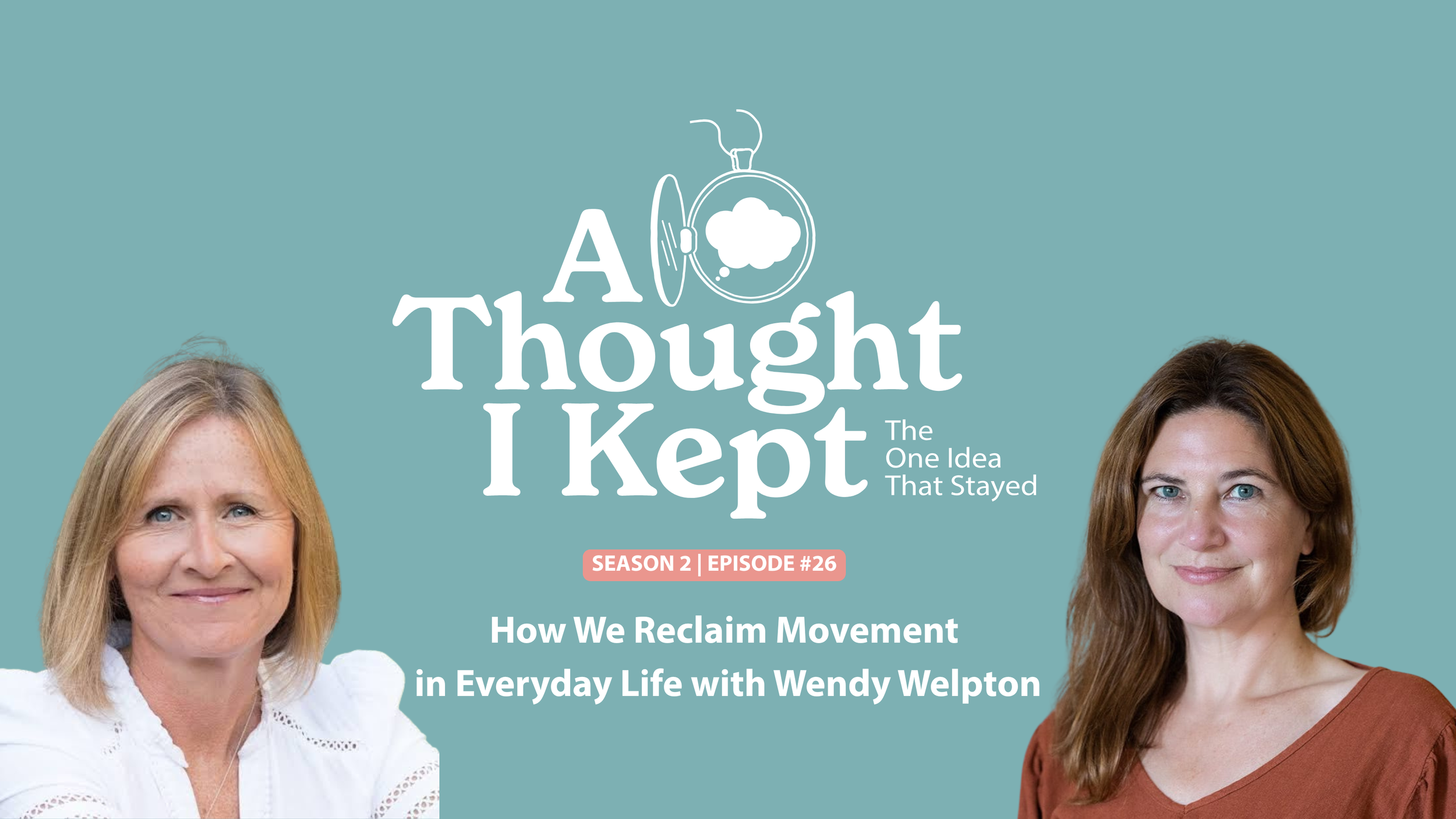
When Movement Starts Feeling Like Something You Have to Earn
If chronic pain, ageing or wellbeing overwhelm have left you disconnected from your body, discover how everyday movement can help you rebuild confidence, self-trust and wellbeing.
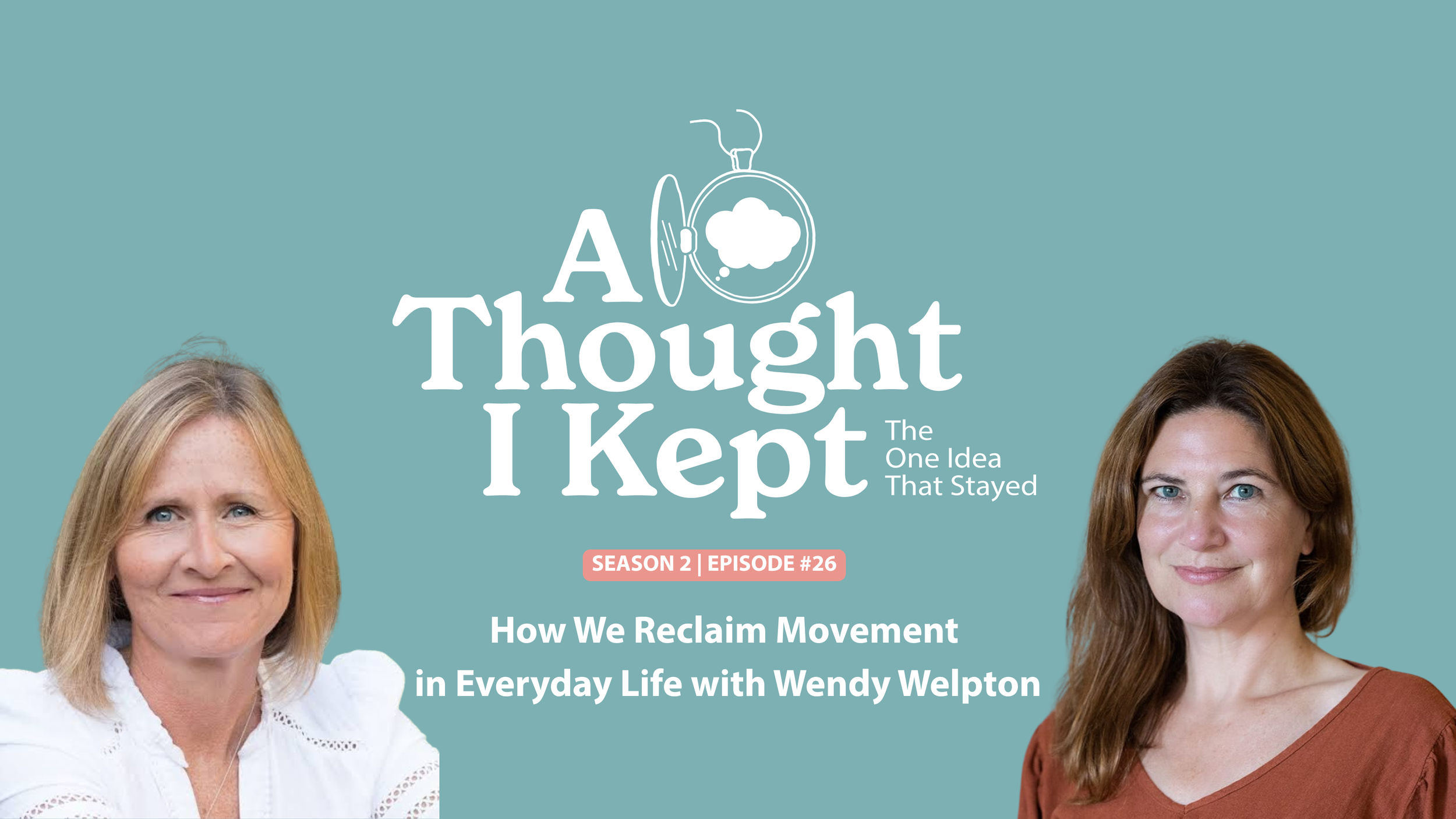
There was a point in my life when I no longer entirely trusted my body. It happened slowly, through a period of chronic pain and fatigue that changed the way I moved through the world. Without consciously deciding to, I found myself becoming more cautious. I was restricting what I did, avoiding certain movements and quietly absorbing some of the messages about ageing and decline that seem to surround us.
At the same time, I was consuming all the usual wellbeing advice. Walk more. Strength train. Improve your mobility. Increase your step count. Some of it was undoubtedly useful, but much of it left me feeling as though wellbeing had become another job, another set of expectations to meet, another area of life where I wasn't quite doing enough.
That's why I was so relieved when I came across Wendy Welpton's work. Wendy is the founder of Reclaim Movement and author of Move Well for Life. When she joined me on A Thought I Kept, she brought a simple idea that has stayed with her for more than a decade: everyday movement is just as important as exercise.
At first, that might not sound particularly radical. Yet the more we talked, the more I realised how much of our thinking about movement has become tied up with workouts, achievements, measurements and goals. We have become so accustomed to counting, tracking and optimising that we can easily forget movement exists outside of exercise altogether.
Many of us have come to believe that movement only counts if it looks a certain way. A walk becomes something to optimise rather than enjoy. Exercise becomes something to complete rather than experience. We start looking for the ideal routine, the perfect number of steps, the optimum pace, the right time of day. Somewhere along the way, movement stops being something we do naturally and becomes something we perform.
Wendy's story began there too. She was doing all the things she thought she should be doing. Running. Exercising. Ticking every box. Yet she found herself living with chronic pain for four years. It was only when she began paying attention to how she moved during the rest of her day that something started to shift.
That distinction feels important because when most of us say we want to move more, what we often mean is that we think we should be exercising more. Those are not necessarily the same thing. One of the things I loved most about this conversation was Wendy's invitation to widen the frame. Movement is not just a run, a gym session or a yoga class. It is getting up from the floor. It is reaching for something on a shelf. It is taking the stairs. It is changing position after sitting for too long. It is walking because you enjoy walking rather than because your watch tells you to. It is all the small interactions we have with our bodies throughout the day, many of which have become so automatic that we barely notice them anymore.
The more we talked, the more I found myself wondering whether the problem is not that we are moving too little, but that we have narrowed our definition of movement so dramatically. We celebrate the workout while ignoring the twenty-three hours around it. We count the walk but overlook the ways we have stopped bending, reaching, balancing, squatting and playing.
And perhaps most importantly, we forget that movement affects much more than our physical health. It influences our mood, our confidence, our sense of capability and our relationship with ourselves. For Wendy, the journey out of pain was not about forcing her body to do more. It was about rebuilding trust. It was about becoming curious again, playful again and gradually rediscovering a sense of confidence in what her body could do.
If this conversation resonated, you can listen to my full episode with Wendy Welpton on A Thought I Kept, where we explore chronic pain, ageing, body trust, self-compassion and why everyday movement might matter just as much as exercise.
And if you're feeling anxious, disconnected, uncertain or simply stuck in a pattern that no longer feels helpful, our wellbeing sessions and wellbeing prescriptions offer space to understand what's really going on beneath the surface. Together, we explore where you are, what you need and the small shifts that can help you move forward with more confidence, clarity and ease.
The Difference Between Kindness and People-Pleasing
People-pleasing isn't always a flaw to fix. Explore the difference between kindness and self-abandonment, why people-pleasing develops, and how to reconnect with your own needs.
There is a lot of advice out there about people-pleasing. We're told to stop doing it. To set firmer boundaries. To care less about what other people think. To say no more often. To put ourselves first.
While there is wisdom in some of that, it can also leave us feeling as though people-pleasing is simply another flaw to fix, another habit to break, another reason we're somehow getting life wrong.
Listening to my recent podcast conversation with psychotherapist Alice Bramhill reminded me that there might be a more helpful place to begin. Rather than asking how we stop people-pleasing, what if we got curious about why it exists in the first place? Because for many of us, people-pleasing didn't appear out of nowhere. It developed for reasons that made sense at the time.
Perhaps it helped us feel safe. Perhaps it helped us belong. Perhaps it helped us navigate difficult family dynamics, demanding workplaces, friendships we didn't want to lose, or relationships where conflict felt frightening. Perhaps we learned, consciously or unconsciously, that being easy-going, agreeable, capable, useful, accommodating, or endlessly understanding was the best way to move through the world.
Over time, those behaviours can become so familiar that we stop noticing them altogether. We become highly attuned to the needs, moods, preferences, and expectations of everyone around us, often without realising how little attention we're paying to our own.
This is where many people find themselves feeling lost. Not because they don't care enough about other people, but because somewhere along the way they stopped knowing what they themselves wanted.
When Kindness Becomes Self-Abandonment
One of the things I appreciated most about Alice's perspective is that she doesn't demonise people-pleasing.
There is a tendency in wellbeing spaces to treat it as something entirely negative, as though caring deeply about other people is automatically a problem. Yet most of us can think of countless examples where being thoughtful, considerate, generous, or compassionate enriches our relationships and our lives.
Many people-pleasers are genuinely kind people.
The challenge comes when kindness stops being a choice and starts feeling like an obligation.
When we say yes because the thought of disappointing someone feels unbearable.
When we agree because we don't know how to express what we really want.
When we take responsibility for everyone else's emotions while quietly carrying our own.
When we become so focused on keeping the peace that we lose touch with ourselves altogether.
The difference can be subtle, which is why so many of us miss it.
Making your grandmother happy because you love her and want to spend time with her is very different from feeling unable to say no to anyone, ever. Supporting a friend through a difficult time is different from believing you are responsible for fixing their life. Being considerate is different from constantly abandoning your own needs.
The question is rarely whether we're being kind. The question is whether we're choosing that kindness freely.
The Hidden Cost of Always Being Good
For many women especially, people-pleasing is tangled up with a much older story about being good.
A good daughter. A good mother. A good friend. A good employee. A good partner. A good person.
These ideas often arrive long before we have a chance to question them. They are handed to us through family, school, work, culture, religion, advertising, and countless everyday interactions. Some serve us well. Some help us become thoughtful, responsible, caring human beings.
Others can become surprisingly heavy. Because when being good becomes the primary goal, we sometimes start rejecting parts of ourselves that don't fit the picture.
Our anger. Our ambition. Our uncertainty. Our need for rest. Our desire for more space. Our wish to change our minds. Our longing for a different life.
The more energy we spend trying to maintain the image of being good, the harder it can become to hear what is actually true.
The Fawn Response and the Need to Feel Safe
In recent years, more people have become familiar with the idea of the fawn response, a survival strategy where we seek safety through pleasing, accommodating, or appeasing others.
For some people, this language offers an enormous sense of relief. What looked like weakness may have been adaptation. What felt like a personal failing may have been an intelligent response to circumstances. Seen through this lens, people-pleasing becomes less of a character flaw and more of a conversation.
What was this behaviour trying to protect?
What did it help me avoid?
What need was it meeting?
Those questions don't excuse every pattern or remove the challenges people-pleasing can create. They simply invite us to respond with curiosity rather than criticism. And curiosity tends to open doors that self-judgement keeps firmly closed.
Becoming Curious About Yourself Again
One of the hidden consequences of people-pleasing is that we often become experts in everybody else's needs.
We know who likes what.
We know who is upset.
We know who needs support.
We know who is disappointed.
We know who might be annoyed.
We know who requires reassurance.
What we often don't know is how we feel. Or what we need. Or what we want.
Many people arrive at coaching, therapy, or periods of personal reflection not because they are selfish, but because they realise they have spent years looking outward and very little time looking inward.
This is where the work begins. Not with becoming harder. Not with becoming less caring. Not with learning to stop being ourselves.
But with gradually extending some of the same curiosity, compassion, and attentiveness that we offer other people towards ourselves.
A Different Question
Perhaps the goal isn't to stop people-pleasing altogether. Perhaps the goal is to understand it well enough that we have a choice.
To recognise when kindness feels nourishing and aligned. To notice when accommodation becomes exhaustion. To understand when caring for others is an expression of who we are and when it has become a way of disappearing from our own lives.
Because there is a difference between kindness and self-abandonment. And sometimes finding our way back to ourselves begins with asking a gentler question than "How do I stop people-pleasing?"
Perhaps it begins with asking:
What has people-pleasing been trying to do for me all these years?
The answer might tell us far more than any boundary script ever could.
If you’re curious about where people-pleasing and ideas of being “good” show up in your own life, listen to my conversation with psychotherapist, writer, and podcast host Alice Bramhill on A Thought I Kept.
Together, we explore self-trust, boundaries, sensitivity, late-diagnosed neurodivergence, and the thought Alice has carried with her for decades: "I'd rather be whole than good."
If you've ever felt exhausted by trying to be good, struggled to know what you want, or wondered where people-pleasing ends and genuine kindness begins, I think you'll find this conversation really helpful.
Listen to When Being Good Is Exhausting with Alice Bramhill on A Thought I Kept.
If this piece resonated with you, it may be because you've spent a long time paying attention to everyone else.
Many of the people I work with arrive feeling exhausted, overwhelmed, resentful, or disconnected from themselves. They often know exactly what everybody around them needs but struggle to answer a much simpler question: "What do I need?"
Emotions coaching offers a space to slow down and get curious about those patterns with someone alongside you. Together, we can explore the habits, beliefs, emotions, and expectations that may have helped you navigate life so far, while gently uncovering what you need now.
You don't have to stop being kind. You don't have to become a different person. Sometimes the work is simply learning how to include yourself in the care and attention you've spent years offering everybody else.
If you'd like some support finding your way back to yourself, I'd love to help. Explore emotions coaching and book a free discovery call.

What Happens When We Stop Listening to Our Feelings?
Emotional avoidance can look like busyness, people-pleasing, anxiety, overwhelm, and burnout. Explore what happens when we disconnect from our feelings and how to start listening again.

For years, I thought not feeling was a skill. Being able to put difficult emotions to one side seemed practical, sensible, and even admirable. If something hurt, I carried on. If I felt anxious, I pushed through. If I was grieving, overwhelmed, uncertain, or angry, I told myself there would be time for that later.
Later, of course, rarely came.
It's only in recent years that I've realised how many of us are taught some version of the same lesson: that our feelings are a problem to solve rather than information to understand.
Sometimes the message is obvious.
"Toughen up."
"Don't be so sensitive."
"Stop overthinking."
"Just get on with it."
Other times it's much more subtle. We absorb it from workplaces that reward productivity over humanity. Families that don't talk about emotions. Social media feeds that celebrate resilience but rarely vulnerability. Cultures that tell us to stay positive no matter what.
Over time, many of us become experts at emotional avoidance. We stop listening to ourselves.
The Cost of Emotional Numbing
When people think about avoiding emotions, they often imagine dramatic denial or repression. But emotional numbing can look surprisingly ordinary.
It can look like staying busy.
It can look like always being the capable one.
It can look like endlessly researching solutions instead of sitting with uncertainty.
It can look like scrolling, working, tidying, planning, helping everyone else, or finding one more thing to cross off the list.
From the outside, life can appear completely fine. Inside, however, something starts to go quiet. The challenge with numbing difficult emotions is that we rarely get to choose which feelings disappear. When we turn down the volume on anxiety, grief, fear, disappointment, or anger, we often dampen joy, excitement, pride, connection, and hope too.
We don't just lose access to difficult emotions. We lose access to ourselves.
The Emotional Ailments That Often Follow
Many of the struggles people bring to coaching aren't caused by emotions themselves. They're caused by years of ignoring them.
Anxiety can become louder when we repeatedly dismiss what it might be trying to tell us.
Overwhelm can build when we override our limits for too long.
Burnout often follows prolonged periods of disconnecting from our needs.
People-pleasing can flourish when we become more attuned to everyone else's feelings than our own.
Indecision can emerge when we've lost touch with the internal signals that help us know what matters.
Even feeling lost can sometimes be a symptom of emotional disconnection.
After all, emotions are one of the ways we orient ourselves in the world. They tell us what feels safe, meaningful, threatening, exciting, important, unfair, or deeply wanted.
Without them, we can find ourselves moving through life with the map folded shut.
Why We Learn to Disconnect
Most of us don't disconnect from our feelings because we're broken. We disconnect because, at some point, it helped.
Perhaps feeling wasn't welcomed in your family.
Perhaps sensitivity was mocked.
Perhaps you learnt that achievement earned praise while vulnerability attracted criticism.
Perhaps you were carrying responsibilities that left little room for your own emotional life.
Perhaps you simply became very good at surviving.
Emotional avoidance is often an adaptation before it's a problem. The difficulty comes when a strategy that once protected us starts limiting us.
What If Feelings Aren't The Problem?
One of the biggest shifts in my own life has been moving from seeing emotions as obstacles to seeing them as information.
Not instructions. Not facts. Not something that must be acted upon immediately. But information.
Anxiety might be highlighting uncertainty.
Anger might be pointing towards a boundary.
Sadness might be asking us to acknowledge a loss.
Frustration might reveal a need that isn't being met.
Joy might show us what we want more of.
When we stop fighting our feelings, something surprising often happens. They become easier to understand. And when we understand them, we can respond rather than react.
Starting to Listen Again
You don't need to become someone who endlessly analyses every emotion. You don't need to share everything you feel. You don't need to become a different person altogether. But it can be worth becoming curious.
The next time you find yourself distracted, overwhelmed, anxious, stuck, exhausted, or disconnected, try asking:
What might I be feeling right now?
And what might that feeling be trying to tell me?
The answer may not solve everything. But it might reconnect you with the person who has been there all along, quietly trying to get your attention. And sometimes that's where finding your way starts.
Explore Emotions Coaching
If any part of this feels familiar, emotions coaching can offer a space to slow down and listen to what your feelings might be trying to tell you.
Many of us spend years pushing emotions aside, questioning them, fearing them, or simply trying to get through them. Together, we explore what's underneath anxiety, overwhelm, uncertainty, people-pleasing, burnout, and other everyday emotional struggles—not to get rid of your feelings, but to better understand them.
Because emotions aren't interruptions to life. They're part of how we find our way through it.
If you're ready to have a different relationship with what you're feeling, I'd love to help.
Find out more about emotions coaching today.
How Creativity Helps When You Feel Lost, Overwhelmed, or Disconnected
Creativity isn't just for artists. Discover how creative practices can support wellbeing, reduce overwhelm, and help you reconnect with yourself when life feels noisy or uncertain.
Sometimes the problem isn't that we don't know what to do. It's that we've heard so many voices telling us what we should do that we can no longer hear our own. The productivity experts. The wellbeing experts. The people on social media who seem to have figured it out. The friends with strong opinions. The endless stream of advice arriving through podcasts, newsletters, books, and algorithms. None of it is necessarily wrong. In fact, much of it may be thoughtful, useful, and well-intentioned. But there comes a point where all of that input can begin to drown something out.
Our own voice.
We stop noticing what we think because we're busy collecting what everyone else thinks. We stop paying attention to what we need because we're trying to keep up with what everyone else appears to need. We become disconnected. Not dramatically. Not all at once. Just gradually. A little further away from ourselves than we realise.
This was one of the themes that stayed with me from a recent conversation with Claire Venus, founder of Creatively Conscious. Although we talked about creativity, online life, burnout, visibility, trust, and self-expression, underneath all of it was a question that feels increasingly important:
How do we stay connected to ourselves in a world that is constantly competing for our attention?
The Cost of Overriding Ourselves
One of the most powerful ideas in the conversation was surprisingly simple. Claire talked about paying attention to what feels uplifting and what feels tightening. What expands us and what contracts us. What feels like ours and what feels like something we've absorbed from somewhere else.
It's easy to dismiss this as a small thing.
But many of us have become remarkably skilled at overriding those signals. We push through exhaustion. We say yes when we mean no. We follow advice that doesn't fit. We continue with projects that drain us because we've already invested so much time. We force ourselves to be consistent when what we really need is rest. Eventually, we stop asking ourselves a very important question:
How does this actually feel?
Not how it looks. Not whether it's impressive. Not whether someone else would approve.
How does it feel?
Because our bodies often know something long before our minds catch up.
Creativity Is Sometimes a Form of Reconnection
When people hear the word creativity, they often think of art: Painting. Writing. Music. Design. But creativity can be something much broader than that. It can be the act of making space for yourself again.
A notebook opened at the end of a difficult day.
A walk without headphones.
A garden.
A sketchbook.
A conversation.
A few quiet minutes spent wondering what you actually think about something.
Creativity creates room. And for people who feel overwhelmed, burnt out, anxious, or disconnected, room can be surprisingly healing. Not because it fixes everything. But because it allows us to hear ourselves again.
What If The Goal Isn't To Push Harder?
Many of us have absorbed the idea that if something isn't working, we simply need to try harder.
Be more disciplined. More productive. More consistent. More efficient.
Yet Claire challenges that idea in a way I found refreshing. She describes consistency as one of the biggest myths of modern creative life, arguing instead that what matters is understanding your own creative practice and your own rhythms.
That feels relevant far beyond creativity.
Because perhaps the question isn't:
"How do I make myself keep going?"
Perhaps the question is:
"What do I need in order to thrive?"
Those are very different questions.
One asks us to override ourselves. The other asks us to listen.
Finding Your Way Back
If you've been feeling disconnected lately, maybe the answer isn't another strategy. Maybe it isn't another expert. Maybe it isn't another thing to optimise. Maybe it's simply paying closer attention.
To what lifts you up.
To what drains you.
To what feels alive.
To what feels like yours.
Sometimes finding our way back to ourselves begins with noticing what we've stopped noticing. And perhaps that's what being creatively conscious really means. Not becoming a different person. Just becoming more aware of the one who's already here.
Listen to my full conversation with Claire Venus on A Thought I Kept: How We Stay Creatively Conscious.
And if you're feeling lost, overwhelmed, creatively stuck, or unsure what you need next, our wellbeing sessions offer space to explore what might help you reconnect with yourself. Creativity often becomes part of that conversation.
How to Rewild Your Summer (Without Adding Another Thing to Your To-Do List)
Feeling overwhelmed by summer? Discover a gentler approach to nature, wellbeing, and slowing down. Explore simple ways to reconnect with the outdoors without turning it into another project.
By June, summer can start to feel less like a season and more like a project.
There are holidays to organise, childcare puzzles to solve, gardens to tame, bbq invitations to accept or decline, and a growing awareness that these long evenings and warm days are somehow supposed to be enjoyed before they disappear again. If you have children, there can be the pressure to create memories. If you run a business, there can be the challenge of keeping things moving while everyone else appears to be on holiday. If you're already tired, summer can feel surprisingly demanding.
We're sold an image of summer as carefree and expansive. In reality, many of us arrive here carrying the same worries, responsibilities, and emotional baggage we had in February, only now we're expected to enjoy ourselves while carrying it.
Perhaps that's why I keep returning to nature at this time of year. Not because I believe it will fix everything. Not because I think everyone should be hiking mountains at dawn or plunging into cold rivers before breakfast. But because nature offers something that feels increasingly rare: a different pace.
Recently I came across a survey from the Wildlife Trusts that found almost 90% of UK adults have happy memories of spending time in nature as children. Reading it sent me back to my own childhood.
Growing up in suburban Manchester, nature wasn't wild swimming and forest bathing. It was annual trips to the Lake District, farm holidays in Devon, climbing shale hills in Yorkshire, and riding bikes across cul-de-sacs to fields that would soon become housing estates. It was picnics amongst gravestones because that was the nearest green space. It was drinking hot chocolate in garden centres with my mum while surrounded by tropical plants.
The details were different, but what struck me was how easily those memories returned.
The survey found something else too: people who remember positive experiences in nature are more likely to seek it out as adults. That feels important because many of us have drifted away from it.
Not necessarily because we don't care about nature, but because adult life has a way of shrinking our worlds. We spend more time indoors, more time looking at screens, more time moving from task to task. We become efficient. Practical. Busy.
Nature, meanwhile, waits patiently in the background.
But before we turn this into another wellbeing prescription, it's worth acknowledging that reconnecting with nature isn't equally easy for everyone.
One in five households in the UK cannot access green space within a fifteen-minute walk of home. Some people live with disabilities or identities that make outdoor spaces difficult to navigate. Some of us carry fears that make nature feel less restorative than wellbeing magazines suggest.
I still don't particularly enjoy walking through isolated country fields alone. Years after reading about attacks on women in rural places, I remain aware of my surroundings. Camping alone with a toddler and newborn didn't make me feel adventurous and free. Mostly it made me feel responsible for keeping everyone alive.
For some of us, nature is associated with discomfort, boredom, loneliness, danger, or exclusion as much as wonder.
Which is why I think rewilding our summer isn't really about becoming more outdoorsy.
It's about becoming more curious.
It's about asking what nature could look like for us.
Maybe it is wild swimming and mountain hikes.
Maybe it's moving your desk so you can see trees instead of a wall.
Maybe it's growing herbs in a window box.
Maybe it's reading a novel in the shade for twenty minutes while your children play nearby.
Maybe it's joining a community garden, visiting a flower farm, taking a slower route home, sitting in a park with a friend, or eating lunch outdoors whenever the weather allows.
Perhaps the goal isn't to become the kind of person who loves nature.
Perhaps it's simply to notice where nature is already waiting for you.
At If Lost Start Here, we often talk about wellbeing as a series of pathways rather than prescriptions. Nature is one of those pathways. Not because everyone needs the same relationship with it, but because so many of us feel better when we experience even small moments of connection with the wider world beyond our own concerns.
Summer offers us more opportunities for that connection than any other season.
Longer evenings.
Open windows.
Unexpected conversations on walks.
The scent of cut grass.
Strawberries that actually taste of strawberries.
A garden that changes week by week.
The first time you notice the swifts have arrived.
None of these moments require us to completely overhaul our lives.
They simply ask us to pay attention.
So rather than creating a summer bucket list or another set of expectations, what if we approached the next few months as an experiment?
What if we became curious about the role nature might play in helping us feel a little more grounded, a little less rushed, and a little more connected to ourselves?
Not because we should.
Not because it will solve everything.
But because there might be something there waiting for us.
A Question to Take With You
When you think about being outdoors as a child, what comes to mind first?
And is there a small piece of that feeling you'd like to bring back into your summer?
Ready to Explore What Helps You Feel Better?
Sometimes finding your footing isn't about doing more. It's about noticing what helps you feel more like yourself. If you're feeling overwhelmed, disconnected, or unsure where to start, our coaching sessions can help you explore what wellbeing looks like for your real life.
Burnout Isn't Just About Being Busy
Burnout is about more than being busy. Explore the emotional signs of burnout, why wellbeing isn't a destination, and how to find your way back to yourself.
A few years ago, if you'd asked me what burnout looked like, I probably would have described someone who couldn't get out of bed. Someone who was exhausted. Someone who had simply done too much for too long. And while all of those things can be true, I've started to realise that burnout can be much harder to spot than that.
Sometimes it looks like carrying on. You still show up to work. You still answer the emails. You still remember the PE kit, book the dentist appointment and reply to the WhatsApp messages. From the outside, everything appears to be functioning more or less as normal. But something has shifted.
The things that used to bring you pleasure don't quite land in the same way. The book sits unopened on the bedside table. The walk you've been looking forward to all week suddenly feels like another item on the list. Someone suggests meeting for coffee and, rather than feeling excited, you find yourself wondering whether you can get out of it.
Life starts to feel flatter somehow. Not terrible or dramatic. Just a little more grey than it used to. This was something that really stood out for me from my recent conversation with Dr Jillian Bybee on A Thought I Kept.
Jillian is a paediatric intensive care physician, coach, writer and mother who has experienced burnout twice herself. During our conversation she shared a thought that changed the way she understood wellbeing:
"Wellness is not a state of being, it's a state of action."
We kept returning to that sentence as we talked because it challenges one of the most common assumptions many of us carry around wellbeing. Namely, that it's somewhere we're trying to get to.
If we're honest, many of us live as though wellbeing is waiting for us on the other side of life. It's over there somewhere, beyond the busy period at work, beyond the caring responsibilities, beyond the financial worries, beyond the endless list of things that need our attention. We imagine there will come a moment when life finally settles down and we'll have enough space to focus on ourselves.
Only life has a habit of refusing to settle down. There's always another deadline, another transition, another worry, another season of life that requires something from us. And so wellbeing remains permanently postponed.
What I loved about Jillian's perspective was the reminder that wellbeing isn't something that exists outside our lives. It has to exist within them. Not when things calm down. Now. Not perfectly. Imperfectly. Not as a destination. As a practice.
One of the moments that particularly struck me was when Jillian spoke about how she now understands burnout. Rather than defining it purely through exhaustion or workload, she shared a definition from Duke University's wellbeing research that describes burnout as an inability to feel positive emotion. Which is such a powerful reframe. Because it explains something I've seen in myself at times and in so many people I've worked with.
Burnout isn't always a collapse. Sometimes it's a disappearance. A gradual loss of access to the things that make us feel alive. Joy becomes harder to find. Wonder feels distant. Connection requires effort. Even gratitude can feel strangely out of reach.
We often think of burnout as a productivity problem. We imagine the solution lies in better time management, fewer commitments or a more efficient morning routine. But what if burnout is also an emotional experience?
What if part of what we're grieving when we're burnt out isn't simply our energy, but our relationship with life itself? That idea feels particularly important because so many of us have become very good at pushing through.
We're good at functioning. Good at coping. Good at convincing everyone, including ourselves, that we're fine.
As Jillian pointed out during our conversation, many of us have learned to suppress difficult emotions because they feel inconvenient, uncomfortable or overwhelming. The problem is that emotions don't really work like that. We can't neatly push away grief, anger, sadness and frustration while keeping joy, connection and hope fully intact. Often when we numb one part of ourselves, we numb other parts too.
Which perhaps explains why burnout can feel so lonely. Not because nobody is around us, but because we've become disconnected from ourselves.
One of the stories Jillian shared was about a coaching client who felt completely overwhelmed by the demands of her life. When they began working together, the thing she felt able to offer herself wasn't a wellness retreat or a radical lifestyle overhaul. It was five minutes. Five minutes spent reading in a room where nobody could find her.
I loved that story because it feels so different from the way wellbeing is often presented to us. There was no perfect morning routine. No expensive solution. No dramatic life change. Just five minutes and a growing recognition that she mattered too.
Sometimes I think we underestimate how powerful these small acts can be. Not because they solve everything, but because they begin to challenge the story that everyone else's needs must come before our own.
Perhaps that's why I left this conversation feeling unexpectedly hopeful. Not because burnout is simple. It isn't. Not because five minutes fixes everything. It doesn't. But because Jillian's perspective offers something many of us desperately need right now: a kinder relationship with wellbeing itself.
One that isn't rooted in perfection, optimisation or achievement. One that allows us to ask a different question. Not, "How do I become the best version of myself?" But, "What would help me feel a little more like myself again?" If burnout is the gradual loss of connection to ourselves, perhaps recovery begins there too. Not in becoming someone new. But in finding our way back to the person who has been there all along.
If this resonates, I'd encourage you to listen to my full conversation with Dr Jillian Bybee on A Thought I Kept.
And if you're feeling stuck, overwhelmed or unsure what support might help, you can also explore our Wellbeing Check-Ins and coaching sessions. Sometimes we need another idea. And sometimes we need another person.

The Things We Avoid and the Things We Ache For
Avoidance isn't always laziness. Explore why we avoid difficult tasks, conversations and decisions, how emotions shape procrastination, and what our desires can teach us about what matters most.

We all have something we've been meaning to deal with.
The email we haven't opened. The text message we haven't replied to. The work project that has been sitting in the corner of our desktop for months. The difficult conversation. The bank statement. The decision.
Sometimes it can feel as though there's a monster under the bed. We suspect it's there. We can hear it scratching around in the dark. But as long as we don't look directly at it, perhaps it can't hurt us.
So we keep our heads down. We busy ourselves elsewhere. We tell ourselves we'll deal with it next week, next month, when things calm down.
But whatever it is hasn't disappeared simply because we haven't looked at it.
And often, that's where the exhaustion begins.
What Are We Really Avoiding?
The thing itself is not always the problem.
The unopened envelope might only take thirty seconds to open. The email could take five minutes to answer. The phone call might last less time than we've spent worrying about it.
What we're often avoiding is how we expect we'll feel.
Shame. Guilt. Disappointment. Regret. Anxiety. Self-doubt.
It's rarely just the task.
Many of us tell ourselves we're avoiding something because we're busy, and to be fair, that's often true. Life can feel relentless. There are school runs and deadlines, caring responsibilities and life admin, work demands and household logistics. We are trying to keep a lot of plates spinning at once.
The journalist Brigid Schulte describes modern life as being made up of "time confetti" — little scraps of time scattered throughout our days rather than long stretches of uninterrupted space. We might have five minutes here and ten minutes there, but not the emotional energy needed to climb the hill of something that feels difficult.
So we choose the easier path.
We check our phones. We reorganise the kitchen drawer. We watch another episode. We answer easier emails first.
For a moment, we feel relief.
But avoidance often comes with a hidden cost.
The thing remains. The emotional energy it requires remains. The quiet hum of guilt or dread remains.
And so we find ourselves carrying it around with us anyway.
When Avoidance Isn't About Time
Sometimes the issue isn't that something feels difficult.
Sometimes it's that it no longer matters.
We can spend months trying to motivate ourselves towards something that simply isn't aligned anymore. A commitment we've outgrown. A goal that belonged to a previous version of ourselves. A project that no longer reflects what we value.
In those moments, avoidance may not be a sign that we need more discipline. It may be information. A gentle indication that something needs revisiting, revising or perhaps even releasing.
Of course, the opposite can be true as well.
Sometimes we avoid something because it matters deeply.
The novel we want to write.
The business idea we can't stop thinking about.
The course we'd love to take.
The conversation we know we need to have.
The dream that feels so important that we become afraid to touch it.
If it stays in our imagination, it remains perfect. Once we engage with it, it becomes vulnerable to disappointment, rejection or failure.
Avoidance and fear tend to keep each other company.
What Helps When We're Stuck
One thing I've noticed is that the things I avoid often become enormous in my imagination.
The task expands. The conversation grows. The consequence becomes catastrophic.
Then I finally look at it and discover it was far smaller than I'd made it.
Not always easy. But smaller.
I've found it helpful to stop asking, "How do I finish this?" and instead ask, "What would fifteen minutes look like?"
The writer Maggie O'Farrell once spoke about writing one of the most painful scenes in Hamnet. Rather than forcing herself through it, she would write for ten minutes, walk around the garden, and then come back. Ten minutes at a time.
Sometimes courage looks less like a leap and more like a series of tiny returns.
I've also found self-compassion matters more than self-criticism. When we're already struggling with something, adding shame rarely helps. Instead, I try to remember that avoidance usually makes sense.
There is often a reason I'm hesitating. A fear. A wound. A protective instinct.
Sometimes I find it helpful to imagine speaking to myself the way I would speak to a friend:
"I know this feels difficult. I know why you're avoiding it. But we'll be okay. Let's take a look together."
Finally, I've learned to notice when avoidance moves beyond procrastination and becomes something else entirely.
There are times when avoidance can be connected to anxiety, depression, burnout or emotional overwhelm. The world becomes smaller. Opportunities narrow. Relationships drift. We stop participating in our own lives.
If that's where you find yourself, it's worth treating that experience with curiosity and care rather than judgment and getting the support that you need to help you move through this.
On the Other Side of Avoidance
On the other side of avoidance sits something else. Wanting.
Not wanting in the consumer sense. Not the endless message that we should always be striving for more.
A different kind of wanting.
The quiet question: What do I actually want?
It sounds simple, but many of us struggle to answer it.
We're often very clear on what needs doing. What is expected of us. What other people require from us.
But what do we desire? That's harder.
Perhaps because wanting can feel indulgent. We learn early that practicality is admirable. Responsibility is admirable. Self-sacrifice is admirable. Wanting can feel frivolous by comparison.
And yet some of the most meaningful parts of life begin there.
Because I want to learn a new instrument.
Because I want to travel somewhere I've never been.
Because I want to spend more time with friends.
Because I want to make things.
Because I want to.
The aviator Amelia Earhart famously answered the question of why she flew across oceans with this simple statement:
There is something wonderfully freeing about that. Not because every desire should be followed. But because sometimes wanting itself is enough..
Following the Threads of Aliveness
I've come to think of wanting as a signal. It points us towards what feels alive. Towards connection. Creativity. Curiosity. Joy. Meaning. Play.
Many of us spend so much time coping that we forget to ask what brings us pleasure.
What delights us.
What energises us.
What makes us feel more like ourselves.
And yet these questions matter. Not because they solve our problems. But because they remind us we're more than our responsibilities.
More than our productivity.
More than our to-do lists.
There is a life beyond coping.
And sometimes our longings help us find it.
What Are You Avoiding? What Are You Wanting?
Lately I've been wondering whether I'm spending more energy keeping things at bay or moving towards what matters.
Perhaps that's the question I'm leaving with you too.
What are you avoiding? And what are you wanting?
Sometimes the things we're avoiding contain important information. So do the things we're longing for.
One points towards what feels difficult, uncertain or unresolved.
The other points towards what feels meaningful, alive or true.
Neither needs to be fixed immediately. But both deserve our attention.
Explore Emotions Coaching
If you're finding yourself stuck in patterns of avoidance, overwhelmed by difficult emotions, or unsure what you want next, emotions coaching can help you slow down and make sense of what's happening beneath the surface.
Together we'll explore what you're feeling, what's driving your reactions, and how you can respond with more clarity, self-trust and choice.
Because sometimes the next step isn't about pushing harder. It's about understanding what's really going on.
Find out more about emotions coaching and book a discovery call.