
What If Kindness Included You Too?
There are some people who are very good at knowing what everybody else needs.
They remember the message that needs replying to. They notice when someone is quieter than usual. They check in on their children, their parents, their friends, their colleagues. They make the lunches, hold the door open, listen to the problem, rearrange the diary, pick up the thing that everyone else seems to have forgotten. They care, often deeply, about making other people’s lives a little easier.
Kindness can be one of the most powerful ways we can create a better life. It’s why it’s one of our Pathways to Wellbeing at If Lost, Start Here. There is something profoundly wellbeing-giving about looking beyond ourselves, connecting with another person and knowing that something we did made a difference.
But what happens when our kindness includes everybody except ourselves?
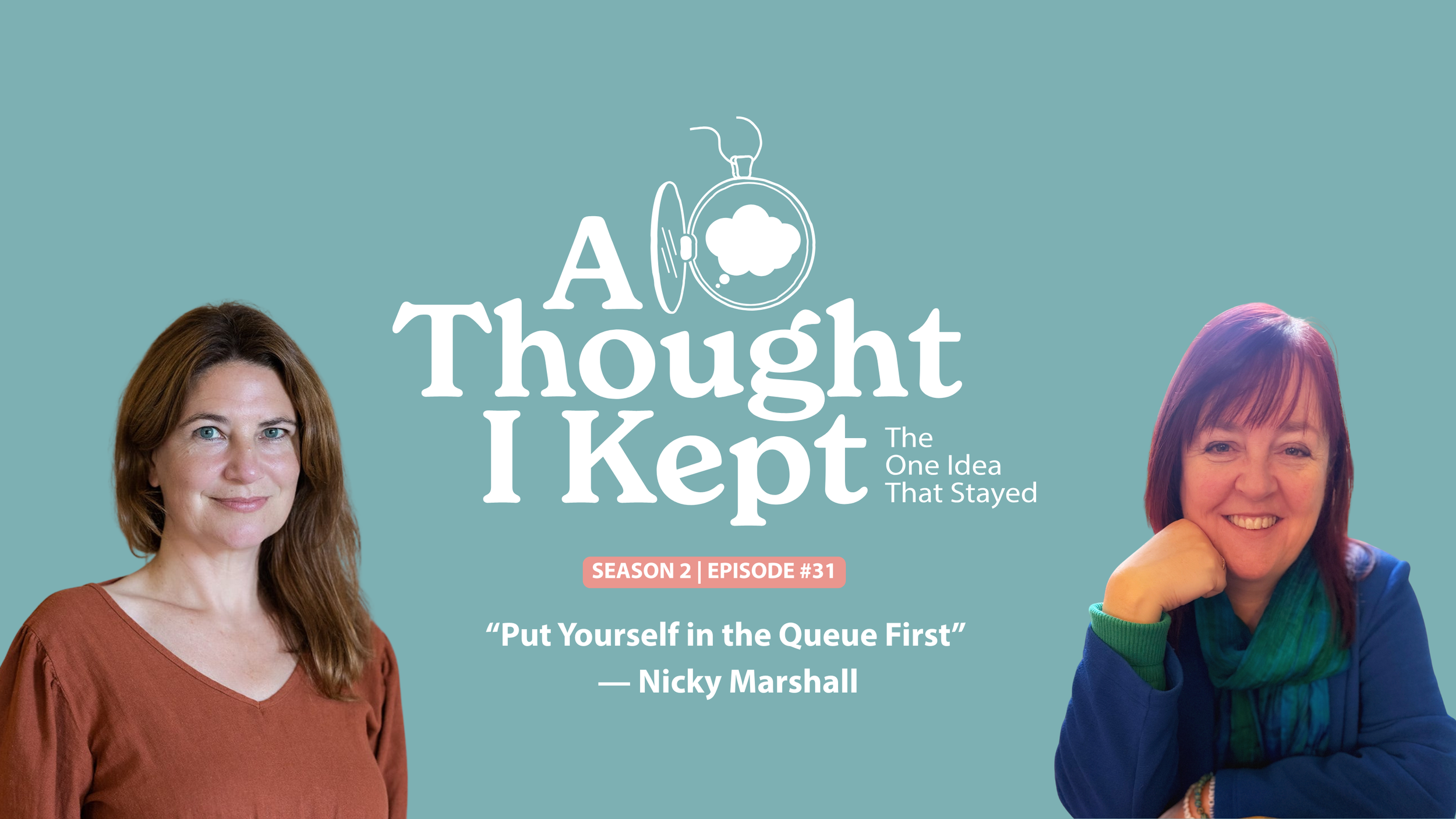
This came up in my recent conversation with Nicky Marshall for A Thought I Kept. Nicky is a speaker, mentor, publisher, wellbeing facilitator and author of No One Is Coming to Save You. She has spent much of her life wanting to help people and make a difference. But the thought she brought to the podcast came from realising that there was one person she had repeatedly left out of that mission:
“To make a difference in this life, I had to put myself in the queue first.”
When caring becomes too much
I recognise so much in this, not only in myself but in the women I work with. There can be so much invisible and emotional labour involved in caring for other people. We know what needs doing. We know who needs checking on. Even when we are supposedly concentrating on something else, part of our brain can still be carrying the people we love. And if you’re someone who believes strongly in kindness, putting yourself first can feel uncomfortable. Perhaps even selfish.
But if I don’t do it, who will?
So we keep going. We finish this and then we’ll rest. We get everyone else sorted and then we’ll look after ourselves. We make it through this week, this deadline, this difficult patch, this stage of the children’s lives, this period with our parents, and imagine that somewhere on the other side there will finally be enough time left over for us.
Nicky knows something about what can happen when we keep overriding the signals that tell us we have reached enough. At 40, after months of pushing herself, she suffered a disabling stroke following a scuba diving accident. Looking back, she can see the bargaining she had been doing with herself before it happened: I’ll do this and then I’ll relax. I’ll do this and then I’ll get some help.
That line stayed with me because I think many of us have our own version of it.
I’ll just get through this week.
I’ll rest when this is finished.
I’ll go for the swim tomorrow.
I don’t really have time for myself today.
Until sometimes we’ve been so busy caring, helping, achieving and getting through that we barely notice how far down our own queue we have slipped.
Kindness doesn’t have to mean self-sacrifice
What I particularly like about Nicky’s thought is that she doesn’t conclude that the answer is to stop helping other people. She still wants to make a difference. She talks in our conversation about making a difference to her husband, her children, her parents, her friends and her customers, right down to the stranger she holds a door open for. She believes those small acts ripple outwards.
The shift is that she now includes herself in that ripple.
As she puts it, she realised: “I need to make a difference to myself.” From there, she could continue making a difference to everyone else, but in a way that might actually be sustainable.
I think this matters because self-care is sometimes presented as the opposite of caring for others. As though we have to choose between being generous and having boundaries, between being available to the people we love and having needs of our own. Perhaps the more interesting question is whether kindness can remain genuinely kind when there is no kindness in it for us.
Because eventually something has to give. We become exhausted. Resentful. Irritable. We lose our sense of ourselves inside all the things we are doing for everybody else. The kindness might still be happening on the outside, but internally we are running increasingly close to empty.
Can you hear the nudges before they become a shout?
One of my favourite parts of my conversation with Nicky is when we talk about the smaller signals that tell us we are reaching capacity. After what happened to her, Nicky says she doesn’t want her body to have to give her another really big message. She wants to listen to the nudges.
For her, those nudges might begin with feeling grumpy when her phone pings, becoming more negative or noticing herself thinking, I’ve got so much to do. If she doesn’t respond, the message moves into her body: tense shoulders, a headache, pain in her hips.
“I like listening to the nudges,” she tells me.
I love this as a way of thinking about caring for ourselves because it doesn’t require a complete life overhaul. It asks us to become a little more curious about ourselves.
What are your nudges?
Perhaps you start resenting people you usually love spending time with. Maybe every request feels like an imposition. You find yourself endlessly scrolling because you have no capacity left to decide what you actually need. You’re tired but keep saying yes. You stop doing the small things that make you feel more like yourself because there simply doesn’t seem to be room for them.
These aren’t necessarily signs that you need to become better at coping. They might be information.
What would putting yourself in the queue actually look like?
This is where I think Nicky’s approach becomes particularly useful, because putting yourself first doesn’t have to mean putting yourself first in every situation, all day, every day. Her version can be surprisingly small. She takes ten minutes in the morning with a coffee, looking outside and checking in with herself. She puts ballet and Zumba into her week because they bring her back to herself. If her energy is lower, she tries to halve her diary for the following week. If she has 20 minutes and feels exhausted, she might get under the duvet.
There’s an acceptance in this that I find really refreshing: we are not machines with a consistent amount of energy to distribute every day. “We are organic beings,” Nicky says. Sometimes we have more energy than at other times. Sometimes life has asked more of us and we need to recuperate. Nature rests in winter, she points out, while somehow we imagine we should be able to keep going indefinitely.
It made me think about my own swimming. I sometimes swim in the morning, and on the day I spoke to Nicky I had caught myself considering cutting my swim short because I had so much to do afterwards. I had to actively remind myself: I am allowed to take this time.
Not because swimming makes me more productive. Not because I have earned it by doing enough for everybody else. But because I get to occupy some space in my own life too. And perhaps that is where putting yourself in the queue begins.
A different way to think about kindness
At If Lost, Start Here, we think about kindness as a pathway into wellbeing because turning towards other people can connect us to meaning, purpose and something beyond our own immediate worries. But pathways are invitations to explore, not another set of rules to get right.
So perhaps there is another direction we can travel along this one too: allowing some of that kindness to find its way back to us.
Not me instead of you.
Not caring less.
Not becoming someone who never helps, gives, supports or shows up.
Just recognising that you are one of the people whose wellbeing matters too.
Maybe today that means noticing the first signs that you’re depleted rather than waiting until you can’t keep going. Maybe it means saying no to something. Leaving something undone. Taking the full swim rather than cutting it short. Sitting with your coffee for ten minutes. Asking yourself what you need before automatically responding to what everybody else needs from you.
Nicky talks in the episode about moving away from the idea of balance and towards something she calls bounce. I like that distinction. Balance can suggest that there is some perfect state we should eventually achieve and then somehow maintain. Bounce makes room for movement. Our energy goes down and comes back. We lose ourselves and find ourselves again. We have weeks when we can hold more and weeks when we need to hold much less.
Maybe kindness can work like that too.
It can move outwards towards the people we love, our communities and even strangers. And it can move back towards us.
Because perhaps the most sustainable way to keep making a difference is not to keep placing ourselves at the very end of the queue.
It’s to remember that we were meant to be in it all along.
Listen to “Put Yourself in the Queue First” with Nicky Marshall on A Thought I Kept to hear our full conversation about burnout, resilience, people-pleasing, self-trust, spirituality, learning to listen to your body and what it might mean to put yourself back into your own life.
And if this idea of kindness as a pathway into feeling better resonates with you, explore this pathway at If Lost, Start Here for more ideas, reflections and small ways to experiment with kindness including, perhaps, extending a little more of it towards yourself.