
Confidence without self-rejection
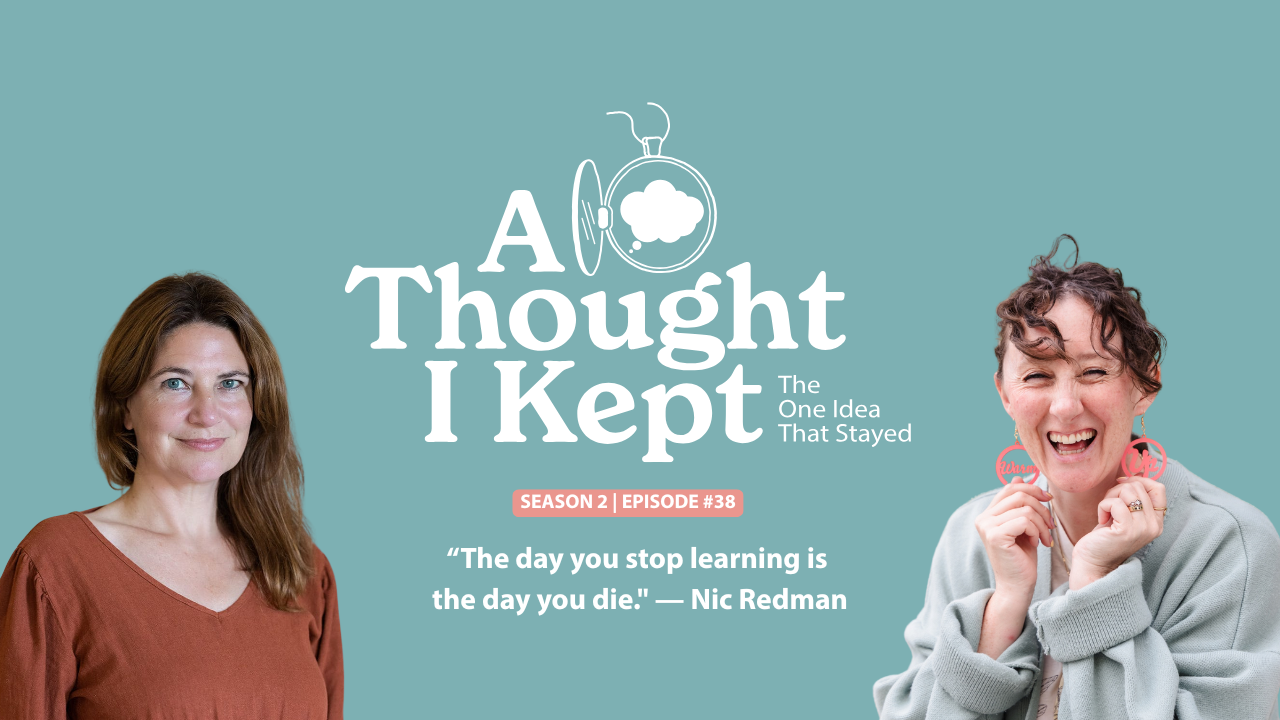
What if confidence doesn’t require changing who you are? A conversation with voice coach Nic Redman about finding your voice, becoming visible and growing without self-rejection.
I’ve spent quite a lot of my life thinking there was something slightly wrong with my voice. At various points it hasn’t been posh enough, then it’s been too posh, and now, after living in America for more than a decade, it can sound too American.
I grew up in Manchester. My dad is from Salford and sounds much more northern than I do. My mum grew up in Wythenshawe and had what we called her “posh voice” that appeared whenever she answered the phone. Then I went to a grammar school and absorbed all sorts of ideas about there being a right way to speak. I moved to California and my voice shifted again. And when I eventually moved back to the UK, I was surprised by how interested people were in placing me.
So I felt surprisingly vulnerable sitting down with voice coach Nic Redman for this week’s A Thought I Kept. There was a tiny part of me that wondered whether Nic would immediately hear everything that was wrong with my voice and just politely not mention it.
Which, as it turns out, says far more about my relationship with my voice than it does about Nic.
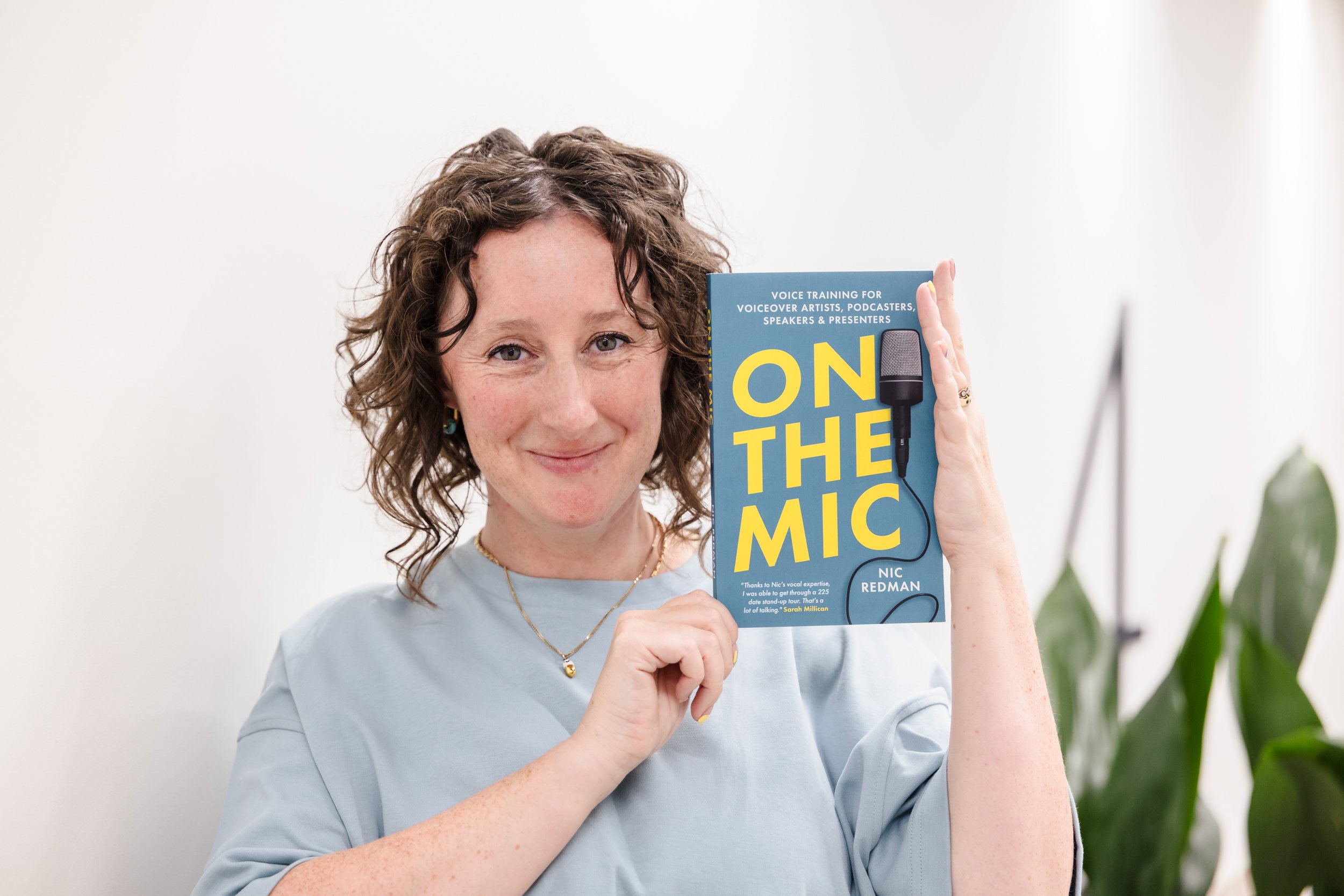
Nic is a voice coach and speaking director, author of On the Mic and host of The Voice Coach Podcast and The Voiceover Social. She works with everyone from performers to founders and senior leaders, but what I found most interesting about our conversation wasn’t how she could help us acquire a better voice. It was what happens when we become more curious about the one we already have.
Because our voices don’t exist separately from our lives. They carry geography and class, family and education, gender and culture. They are affected by who we grew up around, the places we’ve lived and all those messages we received — explicitly and otherwise — about who was allowed to speak, how loudly, with what accent and in what way.
They carry what is happening to us right now too. Nic talks about how anxiety, tiredness, stress, excitement and tension can all show up in our voices. As she puts it in our conversation, your voice is a product of everything you have experienced, as well as everything you are currently going through.
And all of that has made me think differently about confidence.
What does a confident voice sound like?
There has historically been a fairly narrow answer to this question. Nic talks about Samara Bay’s book Permission to Speak and the ways we have learned to associate power with particular kinds of voices. As Nic rather wonderfully puts it, “let’s be real, power has often nearly always sounded like a white guy.”
Which matters when we talk about becoming more visible.
There is so much encouragement, particularly for women, to speak up, take up space, share our ideas, make the presentation, start the business, go on camera, ask for what we want. I believe in so much of that. My word for this year is visibility, after all. But we aren’t doing any of these things in a vacuum. We’re doing them while carrying years of information about which voices belong in which rooms and what those voices are supposed to sound like when they get there.
Nic still works with people who have been told their regional accents might hold them back professionally. Others arrive wanting to sound more “professional”, “controlled”, “proper” or “intelligent”. But, as she points out, those words are incredibly subjective. What sounds professional to you might not sound professional to me because we are each bringing our own history with voice, class, accent, authority and belonging to what we hear.
We can work on articulation and clarity. We can understand our voices better and learn how to use them differently. But ultimately, Nic says, we only have so much control over how somebody else receives our voice.
I found that oddly freeing.
Confidence without self-rejection
Sometimes we might believe that becoming more confident requires us to reject something about who we are now.
I come across versions of this quite often in my coaching work. There can be an assumption that confidence exists somewhere on the other side of correcting ourselves. We’ll speak when we know enough. Put ourselves forward when we feel less anxious. Become visible when we’re more certain of what we’re doing. Use our voice when we’ve worked out how to make it sound right.
And of course we can learn and practise and change. This whole conversation with Nic is, in many ways, about learning. But I’m becoming increasingly interested in whether change has to begin from a position of this bit of me needs fixing.
I asked Nic whether she thought it was possible to love our voices, and I loved how realistic she was about her answer. Love is a big word, she said. Some people get there and some don’t. Perhaps what matters more is beginning to appreciate what our voices actually do for us: they allow us to connect with people, make somebody laugh, express an idea, order a coffee, talk to our children and say something that matters.
“I don’t think it’s necessary to love your voice,” Nic tells me. What matters is becoming comfortable enough with it that it can be free and expressive and do what you need it to do.
What if confidence isn’t about finally reaching the point where there is nothing left about ourselves that makes us uncomfortable? What if it can include the discomfort? What if we can want to grow without needing to dislike the person we are growing from?
Maybe there is a version of confidence that comes with more acceptance and less self-rejection?
Being visible while we’re still learning
Nic’s thought kept for this episode is “The day you stop learning is the day you die.” It’s deliberately dramatic, and we have some fun with that in the conversation, but I was interested in where it took us, particularly when we started talking about expertise.
Because being visible now can come with a strange pressure to know. We’re encouraged to find our thing and establish ourselves as the expert in it. To develop our methodology, our ideas, our manifesto. Then put those ideas online where, ideally, we will continue to confidently believe them forever.
Learning asks something quite different of us. It asks us to remain open to the possibility that there is something we don’t yet know.
Nic tells me about meeting one of her former teachers years after he first taught her and hearing him acknowledge that he would teach things differently now. She talks about her own book as a snapshot of her practice at a particular moment rather than the final word on how voice works. Research changes. Her practice changes. She learns something new from the people she works with and sometimes has to rethink what she previously believed.
I find that enormously reassuring, especially when I think about visibility. Because it offers another way of thinking about what it means to put ourselves and our ideas into the world.
We don’t have to be finished first. We can know something and still be learning. We can have something worth saying and still change our minds later. We can be good at what we do and remain curious about how we might do it differently. Perhaps confidence isn’t certainty at all. Perhaps sometimes it’s trusting ourselves enough to be seen while we’re still figuring things out.
This is my voice
Starting this podcast has made my own experiment with visibility very literal. Every week I hear myself. I watch myself. I put my voice out into the world. And slowly I’m having to come to terms with something very obvious: this is how I speak.
There’s Manchester in there. There’s school. There’s America. There’s moving home again. There are probably traces of every room in which I learned that certain ways of speaking were valued more than others. There’s also what’s happening in my life now because, as Nic reminded me, our voices carry that too.
Of course they do. And maybe I don’t have to get rid of all of that before I use mine.
Perhaps this is what I’m keeping from my conversation with Nic: the possibility that we can become more confident without first deciding there is something wrong with us. That we can become more visible without having to perfect what other people will see. That we can learn without turning our current selves into another improvement project.
And maybe we can even become a little more curious about the parts of ourselves — our voices included — that we’ve spent years thinking we needed to change.
Listen to my full conversation with Nic Redman on A Thought I Kept, where we talk about voice, confidence, cultural conditioning, learning, curiosity, play and what it might mean to find more power in the voice you already have.
And if this brings up something less about how your voice sounds and more about what makes it difficult to use it — whether that’s anxiety, overwhelm, uncertainty, self-consciousness or feeling that you need to get yourself “right” before you can be seen — explore our coaching sessions.
What if you could worry and still live your life?
Why accepting worry, rather than trying to eliminate it, might change our relationship with ourselves.
One of the things I hear most often in my coaching conversations is some version of this: "I just want to stop worrying."
Sometimes it's worry about the future. Sometimes it's about relationships, work, money or the people we love. Sometimes there's no obvious reason at all. Just a familiar feeling that something might go wrong and a mind that seems determined to consider every possible scenario in which that could happen.
When I ask people what they'd like to get out of our work together, the answer is often remarkably similar. They want the worry to go away. They want to feel more confident, less anxious, more in control. They want to be the sort of person who doesn't spend quite so much time worrying about everything.
I understand that desire. Worry can be exhausting. But I've become increasingly interested in what happens when we make eliminating a feeling the goal of our work. Because I’ve found that alongside the worry itself, there's often something else going on. We're frustrated that we're worrying. We feel guilty about the time we're spending worrying. We might even feel ashamed that we're somebody who worries quite so much.
And suddenly we have two problems: the thing we're worrying about and the fact that we're worrying in the first place.
A poem about not worrying
When I invited Sophie Olson onto A Thought I Kept, she brought something rather wonderful to our conversation. Not a famous quotation or an idea from a bestselling book, but a little handwritten poem tucked inside her grandmother's old recipe book.
Sophie inherited the book when her grandmother died. Alongside the family recipes, written in her grandmother's beautiful handwriting, was a poem about worry. Its author is unknown, but its message is wonderfully straightforward.
Essentially, there's no point worrying that something bad might happen if it never does. There's equally little point worrying that things might get worse if they don't. And even if the worst imaginable thing happens, worrying beforehand won't necessarily have changed anything.
Sophie discovered the poem around 2012 or 2013. She describes it as almost like receiving a message from her grandmother beyond the grave. It offered her comfort and the possibility of approaching life differently.
There was just one problem. Sophie couldn't stop worrying. And I think this is where our conversation becomes particularly interesting.
What happens when we can't stop worrying?
Sophie is a survivor of childhood sexual abuse, an author and the founder of The Flying Child, an organisation working to improve understanding and support for survivors. Her experiences are very different from those of many people who might recognise themselves in this article, and I wouldn't want to suggest that all worry has the same origins or requires the same support.
But something Sophie said felt relevant to so many of the conversations I have about anxiety and emotional wellbeing.
She loved her grandmother's poem. She understood its message. She could see the wisdom in it. But understanding that worrying might be pointless didn't mean she could simply decide to stop.
How often do we do something similar? We read a book about anxiety, listen to a podcast about managing stress or receive perfectly sensible advice from somebody who loves us. We understand what we're being told. We might even agree with it completely. Yet the next time we find ourselves worrying, there we are again. And because we think we should know better, we become even more frustrated with ourselves.
What if the problem isn't that we haven't yet discovered how to stop worrying? What if part of our difficulty is the expectation that we shouldn't worry at all?
What if we tried understanding ourselves instead?
One of the most moving parts of my conversation with Sophie concerns her relationship with her therapist, Patricia Walsh, whom she calls Pat.
Before meeting Pat, Sophie had spent years struggling with the effects of her experiences. She describes encounters with professionals that left her feeling ashamed and hopeless, including being told that she would never recover from severe and enduring mental illness.
When she began working with Pat, she struggled to find the words to communicate what had happened to her. One day, as Sophie was leaving a session feeling that therapy wasn't working, Pat suggested that she try writing her experiences as a fairy tale.
"Once upon a time, there was a girl..."
Sophie went home and began writing. It was the beginning of a process that eventually led to their co-authored book, The Flying Child: A Cautionary Fairy Tale for Adults.
But it wasn't simply the writing that changed things. It was also how Pat responded to what Sophie shared.
At one point, Pat helped Sophie understand that her responses made sense in the context of what she'd experienced. Rather than seeing herself as somebody who was fundamentally wrong, Sophie began to understand why she felt and behaved as she did.
I found this particularly affecting. Having spent years navigating mental health services with my own mum, I know how desperately we can search for the person, treatment or approach that might finally make everything better. Reading Sophie's book and hearing about Pat made me think about the difference between trying to change somebody's emotional experience and helping them understand it. And it made me wonder how often we could extend a little more of that understanding towards ourselves.
Perhaps worry doesn't have to disappear
Towards the end of our conversation, Sophie talks about her relationship with the word recovery. For her, recovery suggests an endpoint. A moment when she's supposed to have moved beyond her experiences and no longer be affected by them. She prefers to think about having learnt to live alongside her trauma rather than underneath it.
It's an important distinction, and one that Sophie makes specifically about her own experiences. Other people may find the idea of recovery meaningful and helpful. But there's something in that distinction that I think we can explore in our everyday emotional lives, too.
What if, instead of making the absence of worry our measure of progress, we became interested in how we respond when worry appears? Could we recognise it without immediately criticising ourselves? Could we become curious about what we're worried about and what we might need? Could we make room for the feeling without allowing it to make every decision for us?
This isn't about resigning ourselves to feeling terrible. Nor is it about suggesting that we shouldn't seek help when anxiety becomes overwhelming or interferes with our lives. There are effective treatments and forms of support, and accepting how we feel doesn't mean abandoning the possibility of change. It's about considering whether we might be able to approach ourselves with a little more kindness while that change is happening.
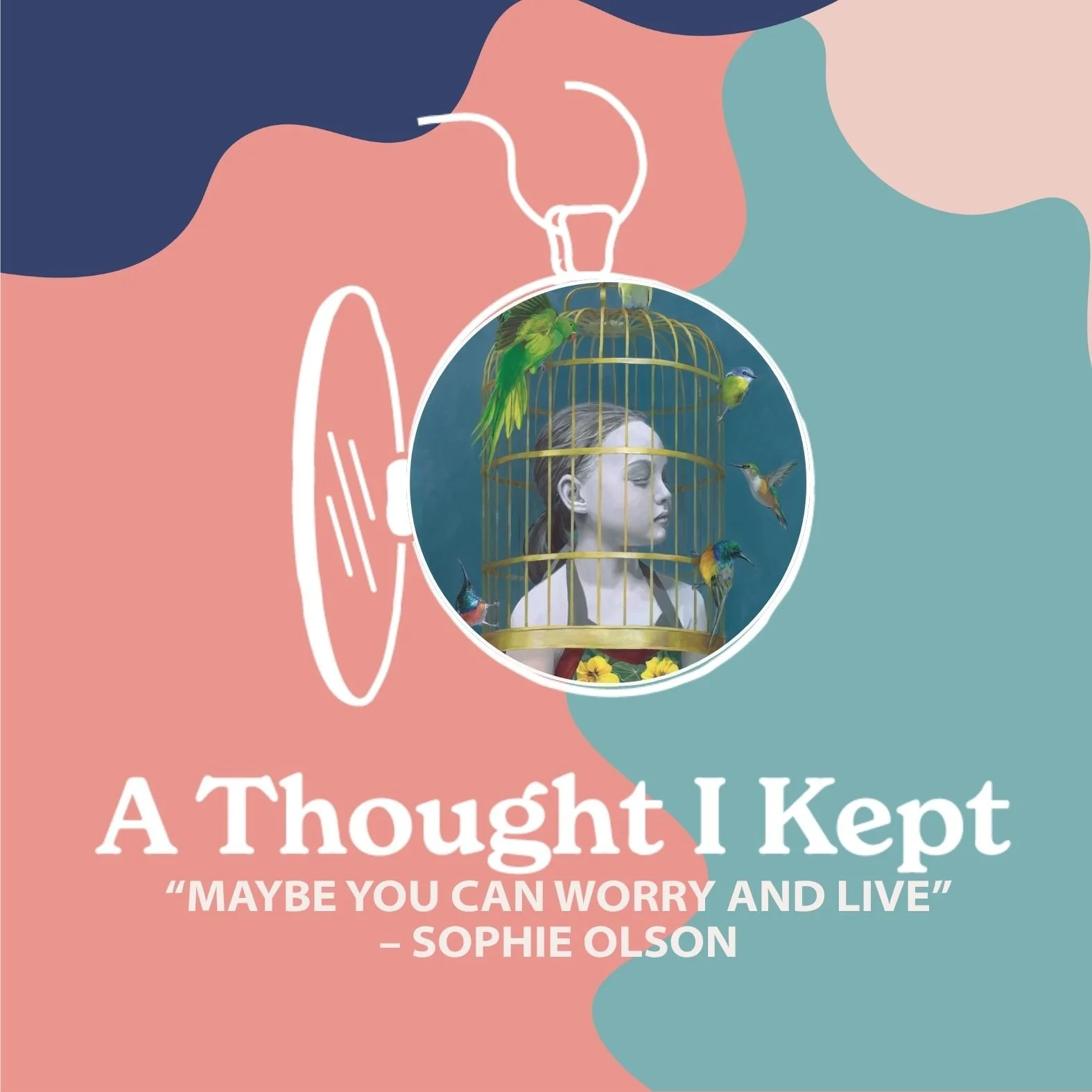
Maybe you can worry and live
At the end of every episode of A Thought I Kept, I return to the thought my guest brought and ask what it means to them now.
When Sophie and I returned to her grandmother's poem, something lovely happened. After almost an hour discussing her experiences, her relationship with Pat, writing, shame, anger and recovery, Sophie offered a different interpretation of the poem she'd carried with her for so many years.
"Maybe you can worry and live."
I love that she said maybe. There's no grand declaration that she's conquered worry. No promise that she'll never feel anxious again. Just the possibility that worrying and living aren't necessarily mutually exclusive. And perhaps that's something worth exploring in our own lives.
If worry has become something you're constantly fighting, you might start by asking yourself a slightly different question. Rather than “How do I make this feeling disappear?”, what would happen if you asked “How can I be a little kinder to myself when this feeling appears?”
You might discover that you need reassurance, rest, practical support or help addressing something genuinely difficult. You might decide to take action on a problem you've been avoiding. Or you might recognise that you're worrying about something you can't currently control and consider what you'd like to do with your day anyway.
None of these responses requires you to be delighted about feeling worried. And none requires you to stop wanting things to feel easier. But they might allow you to get on with living while you're figuring things out.
Perhaps the next time you find yourself worrying, you could try not adding the guilt, shame and frustration of being somebody who worries to everything you're already carrying. And perhaps that would be quite a good place to start.
Explore further
Listen to the episode: In Maybe You Can Worry and Live — Sophie Olson, we explore the intimate story behind Sophie’s grandmother's poem, her extraordinary relationship with her therapist, and how she's learnt to approach her experiences differently. Please note that our conversation includes discussions of childhood sexual abuse, self-harm and suicide.
Book a coaching conversation: If you're finding yourself caught between worrying and feeling frustrated that you worry, emotions coaching offers space to explore that relationship. We can look at what you're experiencing, what might be contributing to it and how you might approach yourself differently. Explore emotions coaching with me at If Lost, Start Here.
Please note that emotions coaching is not a substitute for therapy and is not suitable for working through trauma. If you're seeking support with trauma, I recommend working with a suitably qualified trauma-informed therapist.
Feeling Stuck and Don’t Know What to Do Next? 5 Ways to Start
Feeling lost, restless or stuck and unsure what to do next? Here are five ways to find direction, build confidence and start moving before you feel ready.
You know there’s something else. That might actually be the most frustrating part because if you were perfectly happy with your life as it is, perhaps you could settle into it. But instead you keep having ideas. You look at jobs you could do, courses you could take, places you could move to, things you could make or start or write. One day you think you’ve figured it out. By the next morning, you’re not so sure.
You talk yourself into something and then straight back out again. Underneath all those ideas is this restlessness, a feeling that you want more from your life, or perhaps simply something different from it, but you can’t work out what that something is. So you stay where you are.
This is the not particularly fun version of feeling lost. It doesn’t feel like freedom or possibility or a wide-open road. It feels constricting. Your world can start to feel smaller because you can’t work out how to make it bigger, and the longer you stay there, the more your confidence can disappear too.
Maybe you tell yourself you’ll make a decision when you’re more certain. You’ll start when you have more energy. You’ll apply when you feel more qualified. You’ll put the idea into the world when you believe in it — and yourself — a little more. Except the confidence doesn’t come, and without it, you don’t move.
I was thinking about all of this during my conversation with Victoria Phipps MBE on A Thought I Kept. Victoria describes emerging from COVID and the intense early years of motherhood feeling as though she had “fallen out of the world.” Before children, she had spent more than a decade running a charity with her father supporting Second World War veterans alongside a successful wedding photography business. Her life had felt big. She had felt capable. She had purpose and work she loved.
Then suddenly her life looked very different. She talks in our conversation about the “grief over my own capacity” — going from happily working a lot to finding that even sending an email could become a mission with two small children around her. But the ideas hadn’t disappeared. If anything, there were too many of them. Victoria estimates that she had over a thousand ideas about what she could do next.
This gets at something we don't always understand about feeling lost. You don't necessarily have no idea what you want. You can have far too many. So how do you start moving when you have all that restless energy but absolutely no idea where to put it?
1. Stop trying to find the thing
When you're lost, it's very easy to become obsessed with finding the answer. What should I do with my life? What's the right job? Which idea should I pursue? What am I meant to be doing? Victoria was asking versions of these questions too. She knew she couldn't simply return to the life she'd had before children, but she couldn't see what should replace it either.
Eventually, she stopped trying to recreate the thing and started thinking about the feelings underneath it. What had she loved about her old life? Connection. Community. Creativity. Conversation. Purpose. The feeling that how she was spending her time was making some kind of difference. She couldn't have her old life back, but perhaps those feelings could show up somewhere new.
I think that's such a useful place to start when you can't see a direction. Instead of asking yourself to name the job, business, project or life you want next, try asking what you want to feel more of. Perhaps you want to feel interested again. Useful. Connected. Creative. Free. Challenged. Calm. You still might not know what to do, but you've given yourself a direction to look in.
2. Follow the energy, even if you don't know what it means yet
There’s a moment in our conversation when Victoria describes having all this mental energy for the “adult world” while living almost entirely in the baby world. She was physically exhausted, but creatively restless. Those two things can exist together, and you might recognise that feeling too: you're tired of thinking about what comes next and simultaneously unable to stop thinking about it.
Maybe you keep returning to the same idea. Maybe there’s something you could happily talk about for an hour. Maybe you feel completely different after you've spent an afternoon writing, gardening, volunteering, making something or being around a certain group of people. Don't immediately ask any of these things to become your new career. Just notice them.
I think restlessness gets a bad reputation. We can treat it as something to calm down or get rid of, but sometimes restlessness contains information. Your energy might know something before the rest of you has caught up.
3. Don't wait to feel confident
Victoria eventually had an idea she really liked. She wanted to start a podcast. She told a trusted friend about it and her friend thought it was a great idea. And then Victoria did nothing with it for several months because she didn't feel ready.
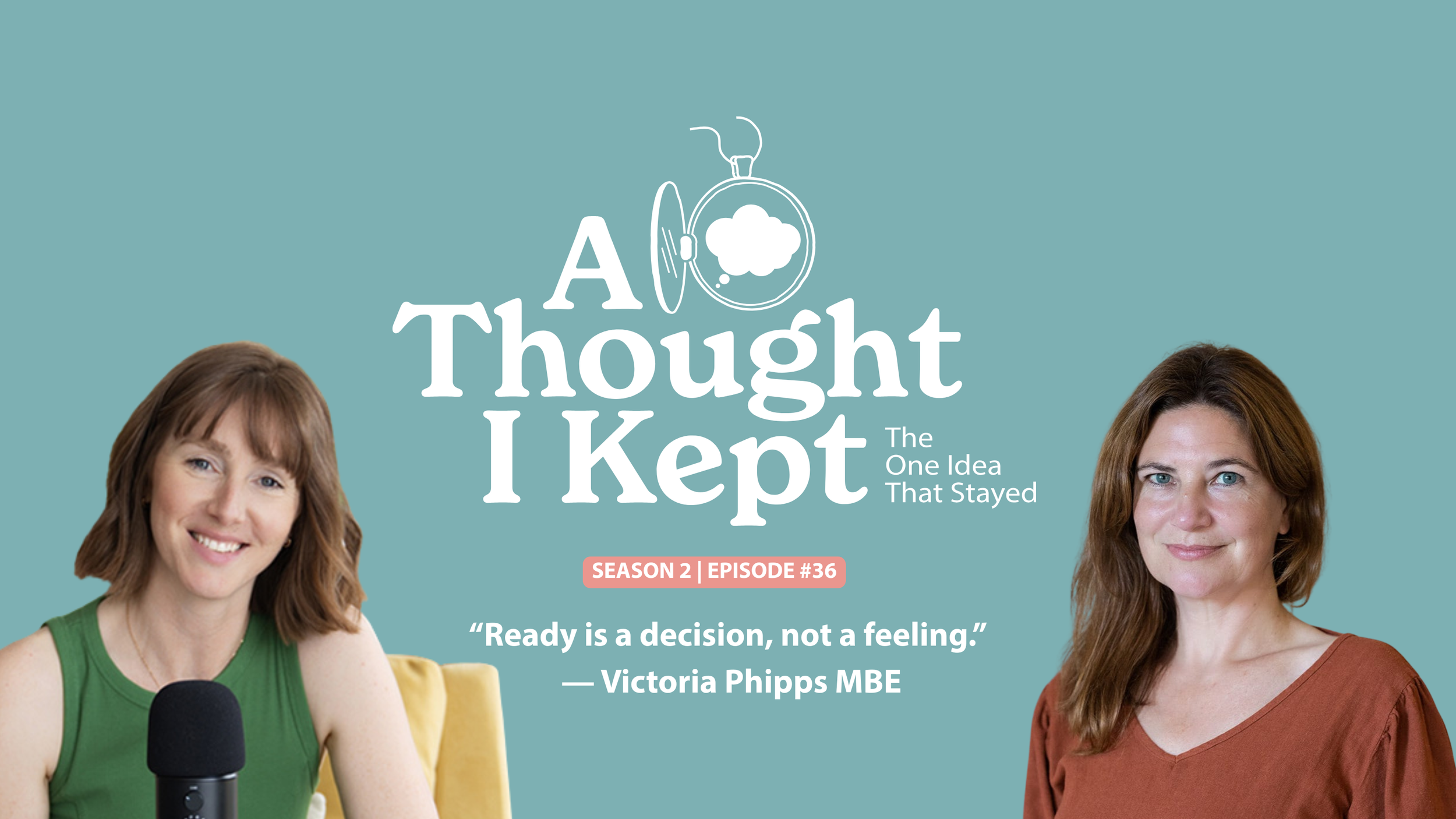
She wasn't a podcaster. She didn't know how to edit audio. She worried about what people would think. She'd spent several years feeling as though she'd fallen out of the world and her confidence had taken a knock. So she waited, and then this thought kept following her around: “Ready is a decision, not a feeling.”
Eventually she had to consider the possibility that perhaps the feeling of readiness wasn't coming. I think this is where we can get really stuck. We assume confidence comes first: When I feel confident, I'll apply. When I'm certain, I'll leave. When I know I'm good enough, I'll start.
But confidence often doesn't work like that. Sometimes we have to do something while feeling decidedly unconfident about it and allow the doing to change how we feel.
4. Make the decision that helps you find out more
Shortly after her 40th birthday, Victoria announced that she was starting a podcast. And then she had to learn how to make one. The decision didn't suddenly make Victoria certain. It gave her something to do.
She learned the technology. She found guests. She figured out what she wanted the podcast to be about. She made an episode and then another one. She learned what she liked, what she was good at and what she wanted to change. The first decision created the next one, and the next, until gradually there was something that looked a lot more like a direction.
When you're feeling lost, you can put enormous pressure on yourself to make the right decision. It's as though you should somehow be able to stand where you are now and accurately predict how every possible version of your future will turn out. Perhaps the decision doesn't need to do that. Perhaps it just needs to help you find out something you don't know yet.
5. Be willing to be a beginner
This might be especially difficult if you've spent years getting good at what you already do. Changing direction means becoming new at something again, and being new at something can be uncomfortable. You don't know the terminology. You don't know how everything works. Other people seem much further ahead. The first version of what you make might not be particularly good.
Victoria talks about discovering at 40 that she could be a beginner again. She could learn how to podcast. She could create her first online course. She could change the way she worked as a photographer. She could learn on the job and, importantly, she could do those things imperfectly.
When she first launched her podcast, she tried to have everything ready: the website, the branding, the social media, four episodes in the first week. She remembers editing until 3am when she had two small children and absolutely did not need to be sacrificing sleep. A year later, she launched a rebrand differently. Not everything was finished. She did it anyway.
Somewhere along the way, she'd stopped needing to know that she could do everything before allowing herself to begin. And maybe this is the kind of confidence that matters when you're lost. Not I know exactly what I'm doing, but I trust myself to find out.
By the end of our conversation, Victoria describes herself as feeling “expansive.” It's so different from where she began: small, stuck, frantic, looking at everyone else moving forward while feeling as though she'd fallen out of the world herself.
She didn't get from one place to the other because she finally figured out exactly what she should do with her life. She noticed what she missed. She followed some of her energy. She made one decision and learned from it. Then she made another.
So if you're feeling utterly stuck right now — restless, knowing there must be something else but unable to see it clearly — perhaps you don't need to answer What am I going to do with the rest of my life? That is a lot to ask of yourself on a Tuesday afternoon.
Maybe there are smaller questions: How do I want my life to feel? What gives me energy? What am I waiting to feel ready for? What could I do that would help me find out more? Where could I allow myself to be a beginner?
You don't need all five answers today. You don't even need to know where you're going yet. Perhaps you just need one of them to make your world feel a little bigger again and give you somewhere to start.
You can listen to my full conversation with Victoria Phipps MBE on A Thought I Kept, where we talk about feeling lost, motherhood and identity, ambition, creativity, perfectionism, visibility, becoming a beginner again and the thought that helped Victoria begin moving: “Ready is a decision, not a feeling.”
And if you're feeling lost yourself, our book If Lost, Start Here was made for exactly these kinds of moments: when you don't necessarily need someone to give you the answer, but you could do with somewhere to begin.
How Poetry Can Help When You’re Feeling Lost
Feeling lost or uncertain? Discover how poetry can help us live with uncertainty, find meaning, notice what matters and reconnect with possibility.
When we’re feeling lost, we tend to go looking for answers. We ask what we should do next, which direction we should take, what needs to change. We make lists. We ask other people what they think. We search online. Sometimes we search so hard for a way forward that being lost starts to feel like another problem we ought to be able to solve. But what if, sometimes, we didn’t need an answer? What if we needed a poem?
I’ve been thinking about this since my conversation with Deborah Alma, poet, editor and founder of The Poetry Pharmacy, for A Thought I Kept. Deborah has spent years prescribing poetry for the emotional ailments of everyday life, and the thought she brought to our conversation was beautifully simple:
“A poem can fundamentally change someone’s mood.”
Deb first understood the power of this while working with people living with profound dementia. Through a poem, she could take someone to the sea, fly a kite with them or go on an imaginary picnic. They might not remember afterwards where the poem had taken them, but Deborah saw that the feeling it created could remain for hours.
I love this idea of a poem as somewhere we can go. That we can seek them out to experience something different for a moment as well as to find answers. To step outside the moment we’re in. To remember the sea. To notice sunlight. To find ourselves somewhere else in our imagination when our actual lives feel particularly difficult to navigate. Perhaps that is also why poetry can help us when we feel lost.
Deborah told me that increasingly the people coming to her for poetry prescriptions are living with a more general anxiety about the world. They’re trying to work out how to live with uncertainty. And poetry, she believes, is particularly good at this because uncertainty is a place poets already know how to inhabit.
So much of feeling lost is about wanting to get out of where we are. We want certainty back. We want to know what happens next. We want the new job, the decision, the relationship to resolve itself, the grief to become more manageable, the sense of possibility to return. We want to find ourselves again. Poetry doesn’t necessarily give us any of those things. Instead, it can help us stay for a moment with what we don’t yet know.
There is something almost spiritual in that for me. Not spiritual in the sense that we have to believe anything in particular, but in the way poetry asks us to pay attention to what it means to be here.
Deborah talked about this beautifully. She believes we all have the poetic in us. We notice a bird landing in a tree while we’re grieving and wonder if, somehow, we’ve been visited by the person we’ve lost. We see that the sea is exactly the same colour as a flower in front of us. We notice strange coincidences, beauty, juxtapositions, things that seem to mean something even when we can’t quite explain what. For Deborah, those moments are already poems. We just haven’t written them down.
Maybe poetry is akin to a spiritual practice in this way: a practice of noticing. A way of interrupting the scrolling, doing and busyness long enough to see what is actually around us. A way of making contact with beauty, meaning, mystery and our own humanity without needing to pin any of it down.
I know that I have reached for poetry most instinctively when I haven’t had the words myself. When my mum died, I found myself looking through the Norton anthologies I had studied at university. I have a literature degree and a longstanding love of John Donne, so perhaps I thought I was supposed to find something suitably literary and profound. But my mum would never have chosen John Donne. She loved Pam Ayres.
So at her funeral I read Ayres’ poem These Hands, about all the often invisible things a mother’s hands have done throughout a life. It managed to hold something I couldn’t quite hold myself: what we had overlooked while Mum was here and what her absence now meant. The poem didn’t resolve my grief but it filled a space where my own words failed me.
Towards the end of our conversation, I asked Deborah to prescribe a poem for someone feeling lost. She thought about lostness as uncertainty and stuckness, but also as losing contact with possibility and hope.
The poems that came to her were about stillness, finding your own centre and noticing the small and beautiful things around you. One was Lost by David Wagoner, which imagines being lost in a forest and, rather than continuing to wander frantically in search of the way out, becoming still. She also suggested Denise Levertov’s Variation on a Theme by Rilke and Esther Morgan’s Grace, poems that offered her a sense of hope and possibility.
Perhaps this is what we so often miss about being lost. We assume our task is to find the path as quickly as possible. But perhaps there are moments when we need to become still enough to notice where we already are.
A poem can help us do that. You don’t need to understand all of it. You don’t need to analyse it as you once did at school. You don’t even need to become someone who “reads poetry.” Deborah’s invitation is much simpler: find a poem. Sit with it. Notice what happens.
Maybe it changes your mood. Maybe it gives you words for something you couldn’t name. Maybe it makes you notice the light coming through the window or remember somewhere you once felt more like yourself. Maybe it offers no answers at all, but makes the uncertainty a little easier to inhabit.
And when you’re lost, that might be somewhere to start.
Listen to my full conversation with Deborah Alma on A Thought I Kept: “A Poem Can Fundamentally Change Someone’s Mood.”
And if you are feeling lost, explore emotions coaching with me.
When You’re Told You’re Too Emotional at Work
Been told you’re too emotional at work? Discover Hannah Wilson’s approach to criticism, emotional intelligence and choosing which feedback you carry forward.
There are certain words that can follow us around at work long after the person who said them has moved on. Difficult. Sensitive. Intimidating. Emotional. They can be delivered as feedback, an observation or sometimes almost casually, but if they touch something we are already conscious of in ourselves, they can become much bigger than the original conversation.
I see this particularly with women who have been told that they are “too emotional” at work. Perhaps you cried in a meeting. Perhaps you showed frustration when something mattered to you. Perhaps you noticed the emotional temperature in a room when everyone else seemed determined to ignore it. Or perhaps, as my guest Hannah Wilson experienced, what somebody else called emotional was actually something rather different: emotional intelligence.
Hannah is a leadership development coach, trainer, former teacher and school leader, co-founder of #WomenEd and #DiverseEd, and author of Cultivating Belonging in Schools. When she joined me on A Thought I Kept, she brought with her a piece of advice she was given about 15 years ago, when she was the youngest and only woman on her senior leadership team. She had received criticism she thought was deeply unfair and went to see her line manager feeling, in her words, “really quite annoyed.”
His advice changed the way she thought about criticism. Becoming more senior and more visible, he told her, meant putting her “head above the parapet.” People were going to critique her. She couldn’t necessarily control that, but she did have a choice about what happened next: “You need to choose which bits you hear and which bits you leave or choose to reframe it, so it helps you.”
What if “too emotional” isn’t the whole story?
Hannah gives a brilliant example of what that reframing can look like. She was working within what she describes as quite an “alpha male leadership culture” and received criticism from male colleagues that she was emotional. Rather than simply absorbing that description as evidence of something she needed to change, she started questioning the premise.
“I don’t think I actually am emotional,” she remembers thinking. “I think I’m emotionally intelligent, and there’s a difference.”
That distinction matters. Because sometimes feedback can sound objective when it is actually tangled up with expectations about how we are supposed to behave at work, what leadership is supposed to look like, and which qualities we have collectively decided to value.
Hannah could see that the criticism she received was gendered. She could also see that some of her male colleagues who showed qualities perceived as more nurturing were criticised too. What was being presented as a weakness might actually have been a different way of leading.
As Hannah puts it, “We are emotional beings.” Being emotional isn’t automatically a weakness. Our emotions are part of our humanity, and centring that humanity can make us better leaders, colleagues and people.
You don’t have to accept every piece of feedback
I think this is where Hannah’s thought becomes particularly useful. “Choose which bits you hear” does not mean refusing criticism, surrounding yourself with people who agree with you or deciding that every uncomfortable piece of feedback is somebody else’s problem.
Hannah does almost the opposite. She talks about having a circle of supporters and “critical friends” who can hold a mirror up to her. She actively asks her team whether she has got something wrong. She describes herself as a work in progress and talks about responding to feedback and changing what she does when she needs to.
But she makes an important distinction between feedback offered within a relationship of trust and what she calls unsolicited critical feedback. Not every opinion deserves equal weight simply because somebody has decided to give it to us.
When criticism arrives, then, we might borrow Hannah’s approach and ask: Is there something useful here? Does this come from someone whose judgement I trust? Is this feedback about my behaviour, or an expectation of how someone like me should behave? What could I learn from it? And what might say more about the person giving it than it does about me?
The aim isn’t to become impervious. It’s to become more discerning.
What are you already doing well?
There is another side to this that I loved in my conversation with Hannah. If we are going to become more thoughtful about the criticism we accept, perhaps we also need to become better at accepting affirmation.
Hannah sees women brush compliments aside all the time. In her coaching, when someone immediately starts listing everything they’re getting wrong, she stops them. Before they talk about what needs work, she asks them to name three things they are doing well or three of their strengths.
There’s something wonderfully corrective about this. Many of us have become incredibly accomplished at noticing evidence for our supposed inadequacies while being strangely suspicious of evidence that suggests we might actually be doing rather well.
And perhaps that’s particularly important when someone has called you “too emotional.” Instead of immediately asking How do I become less emotional?, there are other questions available. What does my emotional awareness allow me to notice? How does it help me connect, communicate or lead? Is there something I need to work on here — or is there a strength that someone else has failed to see?
You can listen to my full conversation with Hannah Wilson on A Thought I Kept, where we talk about criticism, emotional intelligence, visibility, likability, belonging, courageous conversations and why Hannah would rather be “Marmite than vanilla.” Her thought — “Choose Which Bits You Hear” — feels like one worth keeping, particularly the next time someone else’s words threaten to become the story you tell yourself about who you are.
And if criticism at work has become tangled up with anxiety, overwhelm, confidence or how you feel about yourself, you don’t necessarily have to think your way through it on your own. In my 1:1 emotions coaching sessions, we can make some space for what you’re feeling, understand what it might be telling you, and work out what you want to carry forward — and, perhaps just as importantly, what you’re ready to leave behind.
What If Being Lost Is Part of Finding Your Way?
Feeling lost can feel uncomfortable, but it doesn’t mean you’re doing life wrong. Anne Ditmeyer explores uncertainty, detours, play and finding your own way.
When we feel lost often we want to get out of it as quickly as possible. We want the answer, the map, the five-step plan. We want to know where we’re going and preferably how long it will take us to get there.
I understand this. I have spent enough of my own life in uncertain moments to know how uncomfortable it can be not to know what comes next. And it’s something I see all the time in my coaching work too. We arrive at these moments in our careers, relationships, families and lives when the route we thought we were following suddenly stops making sense. We feel stuck, uncertain or overwhelmed and assume that somewhere, somehow, we’ve gone wrong.
But what if getting lost isn’t necessarily the problem?
That was one of the ideas I kept returning to during my conversation with Anne Ditmeyer on A Thought I Kept. Anne is a writer, creative coach and workshop facilitator living in Paris, and much of her work is about giving people the confidence to explore, experiment and, quite literally, get lost.
Anne’s thought kept is: “This should be fun.”
It was a mantra used by her grandfather, Charles Stark Draper, the scientist and engineer whose work on inertial guidance systems helped navigate the Apollo missions to the Moon and back. Anne was only six when he died and discovered the phrase much later, after the death of her mother prompted her to start finding out more about him.
Rather than simply following the official paper trail, she began talking to the people who had known him. It became, as she describes it, a scavenger hunt. And through their stories, she discovered not only the scientist she had grown up hearing about, but a man who danced, flew planes, built relationships and approached extraordinarily difficult problems with curiosity and enjoyment.
There was something else that struck Anne too. Her grandfather’s work had been about navigation and exploration. In a very different way, hers was too.
What if you don’t need the whole map?
We tend to talk about lives as if they should be linear. You work hard at school, choose the right university, find a job, progress, settle down, achieve the milestones and keep going. Even when we know intellectually that life rarely happens this neatly, it can still feel unsettling when ours doesn’t.
Anne describes how her grandfather didn’t begin with a perfectly formed plan to help get humans to the Moon. One thing led to another. There were people he met, things he learnt, questions he followed and opportunities he couldn’t possibly have predicted at the beginning.
Our lives can work like this too.
Anne talks about the “messy middle”: the part we often wish we could skip because it doesn’t yet make sense. But sometimes, she says, we need that mess to meet the right person, gain an insight, have an experience or build the skill that takes us somewhere else.
Perhaps feeling lost can be a little like this. It can be the space between the life that made sense before and whatever is emerging next.
That doesn’t necessarily make it comfortable. Anne talks beautifully about “dancing with discomfort”, rather than treating discomfort as evidence that we are doing something wrong. In one of her workshops, she asks people to draw lobsters partly because most of us have absolutely no idea how to draw one. The lobster also gives her a wonderful analogy: as they grow, lobsters have to leave one shell before a bigger one can form.
There is vulnerability in that in-between place. But there is growth too.
What if you followed the detour?
One of my favourite parts of our conversation was Anne’s invitation to think differently about detours.
We’re so accustomed to believing that the quickest, most direct route must be the best one. But Anne talks about rerouting, taking the scenic route and opening the door “just a teeny bit” to another possibility.
This is where being lost starts to feel less like something we have to solve and more like something we might explore.
What happens if, instead of immediately asking How do I get out of here?, we become curious about where we actually are? What assumptions have we been carrying about what our lives should look like? Which expectations still belong to us? What tiny nudges or ideas have we been overriding because they don’t fit the route we thought we were supposed to take?
Anne has a lovely way of describing this as our “internal guidance system”. Her grandfather worked with gyroscopes and inertial navigation systems, and she sees a parallel in our own ability to return to ourselves when the world shakes us around.
After Anne’s mother died, she found a letter her mother had written to her as a teenager. It was addressed to her daughter “born with her own special guidance system”.
I found that incredibly moving because perhaps the work isn’t always to find a completely new direction. Sometimes it’s to hear again what has become very quiet underneath all the noise.
What if being lost could contain possibility?
Of course, not every lost moment feels playful. Sometimes we are lost because somebody has died, a relationship has ended, work has become unbearable or a version of our life we depended upon is no longer available to us.
Anne is very clear that “this should be fun” isn’t about false positivity. Her own story contains profound grief. Instead, she talks about allowing multiple things to be true: that something can be hard and there can still be beauty; that we can grieve and connect; that we can be uncertain and occasionally delighted by what we discover.
Maybe we can be lost and finding our way at the same time.
I think that is what I took most from this conversation. We don’t always need to respond to feeling lost by gripping the map more tightly. We might need to wander. To take one small step before we understand where it leads. To notice what interests us. To follow an unlikely connection. To draw something badly. To go for a walk. To let ourselves admit, as Anne sometimes does, I’m not really sure right now, while trusting that something will come.
Because clarity, as Anne reminds us, doesn’t always come from thinking harder about our lives. Sometimes it comes from moving through them.
Listen to my full conversation with Anne Ditmeyer on A Thought I Kept: “This Should Be Fun”.
And if you’re feeling lost yourself, our book If Lost, Start Here: Wellbeing for the Anxious, Disconnected or Uncertain was created for exactly these moments. Rather than giving you another prescribed route to follow, it offers ten different pathways through wellbeing — including creativity, play, connection, nature, purpose and awe and wonder — so you can start with whatever feels possible or interesting to you right now.
You don’t have to know where it will lead. Sometimes you just need somewhere to start.
There Is No One Right Way to Be: Spirituality, Purpose & Feeling Lost
What can spirituality offer when you feel lost? Claire Fitzsimmons talks with Alice Thompson-Boyd about the Enneagram, purpose, self-understanding and finding your way back to yourself.
Have you ever arrived at a moment in your life when you thought that you’d feel ok, but you just didn’t?
We can build the career, achieve the goal, do work that genuinely matters, even create something successful, and still find ourselves asking difficult and confusing questions about who we are, what we need and where we’ve gone. Sometimes, as I discovered in my conversation with Alice Thompson-Boyd on A Thought I Kept, it can feel as though we have somehow disappeared out of our own lives.
Alice knows something about that experience. In her twenties, she co-founded Social Bite, the Edinburgh social enterprise supporting people experiencing homelessness. It grew into an organisation with more than 100 employees, celebrity supporters including George Clooney and Leonardo DiCaprio, awards, honorary doctorates and a level of impact that most of us would probably look at from the outside and call extraordinary.
And yet Alice was struggling. Alongside work that was changing other people’s lives, she experienced anxiety, burnout, panic attacks and a growing disconnection from herself. Eventually she stepped away from Social Bite and from the identity she had spent almost her entire adult life building.
What came next wasn’t another big mission. It was a much more internal question: who was she without all of that?
When we start looking for something deeper
It was after leaving Social Bite that Alice encountered the Enneagram, a system for understanding nine different patterns of human motivation and experience. She describes it as something that began almost accidentally and then became impossible to put down.
What interested me most in our conversation wasn’t really whether you believe in the Enneagram or whether you know your number. It was what Alice found through it: a different way of understanding herself.
For years, she had been trying to work out the right way to be. How should she show up to get the connection, approval and validation she longed for? How could she be one version of herself for one person and another for somebody else? What was she getting wrong?
The Enneagram offered her a surprisingly liberating answer: perhaps there wasn’t one right way to be at all.
It helped Alice see that the people around her weren’t necessarily looking at the same situation and reaching different conclusions. They might actually be experiencing that situation from a fundamentally different internal perspective. Their needs, fears, motivations and ways of making sense of the world could be different from hers.
There’s something very freeing in that. We don’t have to keep twisting ourselves into the person we imagine everyone else needs us to be. And other people don’t have to become more like us before we can understand them.
Spirituality doesn’t have to be about having the answers
This is where our conversation began to feel less like one about personality typing and more like one about spirituality.
Alice talked about how little time we seem to have now to sit around thinking about what it means to be human. We are behind screens, rushing between things, consuming information, producing, achieving, responding. There isn’t always much space left for the bigger questions.
And perhaps that helps explain our renewed interest in things like the Enneagram, astrology, Human Design and other systems for understanding ourselves. We are looking for depth. For connection. For something that helps us make sense of being here.
Of course, these systems can become another form of self-improvement. Another test to pass or way of deciding what is wrong with us. Alice makes an important distinction here. For her, the deeper she has gone into the Enneagram, the more she has realised that the point isn’t to fix herself. In fact, she suggests that our obsession with fixing ourselves can become part of the suffering itself.
Instead, she sees it as an invitation to become more aware of the patterns we inhabit and a little less confined by them. Not to put ourselves into a box, but to notice the box we may already be living inside and discover that there might be more room than we realised.
Remembering that we are part of something bigger
There was one moment in our conversation when Alice talked about zooming out far enough to see Earth as this small, vulnerable thing floating in space. From there, all the divisions and identities that can feel so convincing in everyday life begin to look rather different.
We are here for such a tiny amount of time. We are part of nature rather than separate from it. We are part of something much larger than the jobs we do, the things we achieve or the identities we work so hard to maintain.
I think that is one of the reasons spirituality is one of the ten pathways we explore in our book If Lost, Start Here. Not because Amanda and I believe there is one particular spiritual practice we should all follow, but because when we feel anxious, disconnected or uncertain, it can help to look beyond the immediate boundaries of our own lives.
Spirituality might mean religion. It might mean nature, ritual, meditation, philosophy or simply making space to wonder about the bigger questions. It might be standing under a huge night sky and remembering your scale within things. It can offer us somewhere to put the questions that don’t necessarily have neat answers.
And perhaps that matters particularly in a culture so interested in answers, solutions and fixing.
What happens when we stop trying so hard?
Alice told me that these days fulfilment increasingly looks like doing less. Walking the dog. Making dinner. Having nowhere she needs to be that evening. Stripping things away rather than continually adding more.
She also notices when she has forgotten the deeper lessons of the Enneagram because she gets fast. She starts rushing everywhere, trying to do everything. Remembering it asks her to slow down, become present and disentangle herself for a moment.
I keep thinking about that because it feels like such a useful measure. Not Have I found my purpose? or Have I finally become the right version of myself? But: am I here? Am I present in my own life? Do I feel connected to myself, other people and the world around me?
Perhaps spirituality can help us with that. Not by giving us another set of things to get right, but by reminding us that there was never only one right way to be in the first place.
Listen to my full conversation with Alice Thompson-Boyd on A Thought I Kept, where we explore the Enneagram, burnout, purpose, conviction, doing less and what happens when we stop looking outside ourselves for the answer to who we should be.
And if you’d like to explore spirituality in your own life, it’s one of the ten pathways in our book, If Lost, Start Here: Wellbeing for the Anxious, Disconnected or Uncertain — a place to explore what might help you feel more connected, grounded and part of something beyond yourself.
What If Kindness Included You Too?
Feeling burnt out from caring for everyone else? Discover why kindness needs to include you too, inspired by our podcast conversation with Nicky Marshall.
There are some people who are very good at knowing what everybody else needs.
They remember the message that needs replying to. They notice when someone is quieter than usual. They check in on their children, their parents, their friends, their colleagues. They make the lunches, hold the door open, listen to the problem, rearrange the diary, pick up the thing that everyone else seems to have forgotten. They care, often deeply, about making other people’s lives a little easier.
Kindness can be one of the most powerful ways we can create a better life. It’s why it’s one of our Pathways to Wellbeing at If Lost, Start Here. There is something profoundly wellbeing-giving about looking beyond ourselves, connecting with another person and knowing that something we did made a difference.
But what happens when our kindness includes everybody except ourselves?
This came up in my recent conversation with Nicky Marshall for A Thought I Kept. Nicky is a speaker, mentor, publisher, wellbeing facilitator and author of No One Is Coming to Save You. She has spent much of her life wanting to help people and make a difference. But the thought she brought to the podcast came from realising that there was one person she had repeatedly left out of that mission:
“To make a difference in this life, I had to put myself in the queue first.”
When caring becomes too much
I recognise so much in this, not only in myself but in the women I work with. There can be so much invisible and emotional labour involved in caring for other people. We know what needs doing. We know who needs checking on. Even when we are supposedly concentrating on something else, part of our brain can still be carrying the people we love. And if you’re someone who believes strongly in kindness, putting yourself first can feel uncomfortable. Perhaps even selfish.
But if I don’t do it, who will?
So we keep going. We finish this and then we’ll rest. We get everyone else sorted and then we’ll look after ourselves. We make it through this week, this deadline, this difficult patch, this stage of the children’s lives, this period with our parents, and imagine that somewhere on the other side there will finally be enough time left over for us.
Nicky knows something about what can happen when we keep overriding the signals that tell us we have reached enough. At 40, after months of pushing herself, she suffered a disabling stroke following a scuba diving accident. Looking back, she can see the bargaining she had been doing with herself before it happened: I’ll do this and then I’ll relax. I’ll do this and then I’ll get some help.
That line stayed with me because I think many of us have our own version of it.
I’ll just get through this week.
I’ll rest when this is finished.
I’ll go for the swim tomorrow.
I don’t really have time for myself today.
Until sometimes we’ve been so busy caring, helping, achieving and getting through that we barely notice how far down our own queue we have slipped.
Kindness doesn’t have to mean self-sacrifice
What I particularly like about Nicky’s thought is that she doesn’t conclude that the answer is to stop helping other people. She still wants to make a difference. She talks in our conversation about making a difference to her husband, her children, her parents, her friends and her customers, right down to the stranger she holds a door open for. She believes those small acts ripple outwards.
The shift is that she now includes herself in that ripple.
As she puts it, she realised: “I need to make a difference to myself.” From there, she could continue making a difference to everyone else, but in a way that might actually be sustainable.
I think this matters because self-care is sometimes presented as the opposite of caring for others. As though we have to choose between being generous and having boundaries, between being available to the people we love and having needs of our own. Perhaps the more interesting question is whether kindness can remain genuinely kind when there is no kindness in it for us.
Because eventually something has to give. We become exhausted. Resentful. Irritable. We lose our sense of ourselves inside all the things we are doing for everybody else. The kindness might still be happening on the outside, but internally we are running increasingly close to empty.
Can you hear the nudges before they become a shout?
One of my favourite parts of my conversation with Nicky is when we talk about the smaller signals that tell us we are reaching capacity. After what happened to her, Nicky says she doesn’t want her body to have to give her another really big message. She wants to listen to the nudges.
For her, those nudges might begin with feeling grumpy when her phone pings, becoming more negative or noticing herself thinking, I’ve got so much to do. If she doesn’t respond, the message moves into her body: tense shoulders, a headache, pain in her hips.
“I like listening to the nudges,” she tells me.
I love this as a way of thinking about caring for ourselves because it doesn’t require a complete life overhaul. It asks us to become a little more curious about ourselves.
What are your nudges?
Perhaps you start resenting people you usually love spending time with. Maybe every request feels like an imposition. You find yourself endlessly scrolling because you have no capacity left to decide what you actually need. You’re tired but keep saying yes. You stop doing the small things that make you feel more like yourself because there simply doesn’t seem to be room for them.
These aren’t necessarily signs that you need to become better at coping. They might be information.
What would putting yourself in the queue actually look like?
This is where I think Nicky’s approach becomes particularly useful, because putting yourself first doesn’t have to mean putting yourself first in every situation, all day, every day. Her version can be surprisingly small. She takes ten minutes in the morning with a coffee, looking outside and checking in with herself. She puts ballet and Zumba into her week because they bring her back to herself. If her energy is lower, she tries to halve her diary for the following week. If she has 20 minutes and feels exhausted, she might get under the duvet.
There’s an acceptance in this that I find really refreshing: we are not machines with a consistent amount of energy to distribute every day. “We are organic beings,” Nicky says. Sometimes we have more energy than at other times. Sometimes life has asked more of us and we need to recuperate. Nature rests in winter, she points out, while somehow we imagine we should be able to keep going indefinitely.
It made me think about my own swimming. I sometimes swim in the morning, and on the day I spoke to Nicky I had caught myself considering cutting my swim short because I had so much to do afterwards. I had to actively remind myself: I am allowed to take this time.
Not because swimming makes me more productive. Not because I have earned it by doing enough for everybody else. But because I get to occupy some space in my own life too. And perhaps that is where putting yourself in the queue begins.
A different way to think about kindness
At If Lost, Start Here, we think about kindness as a pathway into wellbeing because turning towards other people can connect us to meaning, purpose and something beyond our own immediate worries. But pathways are invitations to explore, not another set of rules to get right.
So perhaps there is another direction we can travel along this one too: allowing some of that kindness to find its way back to us.
Not me instead of you.
Not caring less.
Not becoming someone who never helps, gives, supports or shows up.
Just recognising that you are one of the people whose wellbeing matters too.
Maybe today that means noticing the first signs that you’re depleted rather than waiting until you can’t keep going. Maybe it means saying no to something. Leaving something undone. Taking the full swim rather than cutting it short. Sitting with your coffee for ten minutes. Asking yourself what you need before automatically responding to what everybody else needs from you.
Nicky talks in the episode about moving away from the idea of balance and towards something she calls bounce. I like that distinction. Balance can suggest that there is some perfect state we should eventually achieve and then somehow maintain. Bounce makes room for movement. Our energy goes down and comes back. We lose ourselves and find ourselves again. We have weeks when we can hold more and weeks when we need to hold much less.
Maybe kindness can work like that too.
It can move outwards towards the people we love, our communities and even strangers. And it can move back towards us.
Because perhaps the most sustainable way to keep making a difference is not to keep placing ourselves at the very end of the queue.
It’s to remember that we were meant to be in it all along.
Listen to “Put Yourself in the Queue First” with Nicky Marshall on A Thought I Kept to hear our full conversation about burnout, resilience, people-pleasing, self-trust, spirituality, learning to listen to your body and what it might mean to put yourself back into your own life.
And if this idea of kindness as a pathway into feeling better resonates with you, explore this pathway at If Lost, Start Here for more ideas, reflections and small ways to experiment with kindness including, perhaps, extending a little more of it towards yourself.
What If Your Career Is Successful but It’s Burning You Out?
Feeling burnt out or questioning your career? Explore how to manage your energy, rethink success and find work and purpose that help you feel more alive.
There is a moment in my conversation with career and life design coach Selina Barker when we find ourselves talking about pianos.
Selina is in the middle of a significant career and business transition. After 20 years of helping other people navigate career change, she has found herself questioning the way she has built her own working life. Some of that process has been frightening. At one point, she describes sitting in her garden panicking that her business might be over. But alongside the panic, something else has appeared: space.
She has more time to read. More time to draw. On the morning we recorded our conversation for A Thought I Kept, she had played the piano instead of sitting down immediately to work.
There was something about that detail that stayed with me. Because when we talk about career change, purpose and burnout, we can quickly turn them into another enormous life problem to solve. Should I leave my job? Retrain? Start a business? Find my purpose? Make more money? Make less money but be happier? What am I supposed to be doing with my life? But perhaps there is another question we can ask first.
Where is my energy going, and what is it creating in return?
When the life you created starts to deplete you
Selina’s career crisis didn’t begin because she suddenly stopped loving her work. In many ways, the opposite was true. She still loved coaching. She loved her journals, her membership and helping people flourish. What had become exhausting was everything she believed needed to surround that work.
She talks in our conversation about absorbing a particular story about what being a successful coach should look like: the six-figure business, the big programmes, the marketing, the recognition, perhaps eventually the bestselling book and a place on Oprah’s sofa.
Every industry probably has its own version of that sofa. There are the promotions we’re meant to want, the job titles that demonstrate we are progressing, the businesses that should keep growing, the salaries we should aspire to, the audiences we should build. We can become so accustomed to these measures of career success that we stop noticing whether we ever chose them.
That is where I think burnout and purpose become interesting companions. We often think about burnout as a problem of too much: too much work, too much responsibility, too many demands, too little rest. And of course, sometimes it is. But our conversation made me think about the exhaustion that can also come from spending enormous amounts of energy maintaining a version of success that no longer feels like our own.
You can be very good at something and still not want to keep doing it in the same way.
You can have worked hard to get somewhere and discover you don’t particularly want to stay.
You can even love the essential part of your work while being exhausted by the life you have had to construct around it.
None of those necessarily mean you have chosen the wrong career. But they might mean there is something worth listening to.
Purpose isn’t only about what you do
Purpose is one of the ten pathways to wellbeing we explore at If Lost Start Here and in our new book, and I think we can sometimes make it much grander than it needs to be.
We imagine that finding our purpose means identifying our one great calling. We search for the right job or the right contribution, hoping that once we find it everything will click into place.
Selina’s thought kept offers a slightly different way in. It comes from the writer, philosopher and civil rights leader Howard Thurman: “Don’t ask what the world needs. Ask what makes you come alive, and then go and do that because what the world needs is people who have come alive.”
Selina first encountered those words more than 20 years ago, when she was at the beginning of her career and deeply concerned with making a difference. She was involved in environmental campaigning and remembers being preoccupied with the question of how she could help save the world.
The problem was that the way she was approaching that purpose was exhausting her.
Thurman’s words gave her permission to turn the question around. What if her own needs, pleasure, joy and fun were allowed to matter too? What if making a difference didn’t require sacrificing herself in the process?
It became one of the guiding ideas of her career. And I think there is something particularly important in that for anyone experiencing burnout, considering a career change or wondering what their life’s work might be.
Purpose doesn’t have to ask only: What useful thing can I do?
It can also ask: What happens to me while I am doing it?
Burnout can become something we simply accept
One of the reasons I wanted to talk to Selina is that burnout comes up so often in the work I do. There is a point at which feeling exhausted and overwhelmed can start to seem almost unremarkable. We talk about dragging ourselves towards the weekend, desperately needing a holiday, being unable to switch off, feeling permanently behind or having nothing left by the end of the working day.
And somewhere along the way, we can start to believe this is simply what having a career, caring about our work and managing an adult life feels like.
Selina pushes against that assumption.
When she wrote Burnt Out, she was interested in the moment when someone reaches the point of thinking: I cannot keep going like this. I cannot cope like this anymore.
Her work also acknowledges that burnout doesn’t always look the same. For some people there is a strong emotional component, particularly when they are continually caring, helping or over-giving. For others, the depletion is mental: endless decisions, problem-solving, worry, household administration, work and the feeling that the brain simply never gets to switch off.
This is especially relevant to the way many women have been taught to think about purpose. Selina talks about the deep cultural programming that can equate being a good woman or a good person with looking after everybody else. Our value becomes attached to how useful we can be, how much we can hold and how little we appear to need ourselves.
Purpose without attention to our own wellbeing can very easily become self-sacrifice.
What if you managed your energy, not only your time?
This is where another of Selina’s ideas becomes useful. While researching Burnt Out, she encountered the idea of managing energy rather than simply managing time. It became a turning point in how she understood burnout: if burnout is an energy crisis, perhaps we need to become much more curious about where our energy comes from, what depletes it and what restores it.
Selina works with five different kinds of energy: physical, emotional, mental, motivational and spiritual.
Physical energy includes both movement and rest. Emotional energy asks us to look after our hearts: feeling our feelings, seeking support when we need it and making room for pleasure, creativity and play. Mental energy requires periods of focus but also genuine opportunities for our minds to switch gears and recover.
Motivational energy brings us particularly close to purpose. It asks bigger questions about our values and the life we are creating, but also what helps us keep moving through the difficult or boring parts of that life.
And spiritual energy is broader than religion or faith. Selina talks about nature, meditation, prayer, ritual and the things that connect us to something beyond our immediate thoughts and to-do lists.
Suddenly, “I don’t have enough energy” becomes a much more interesting statement.
Which energy is depleted? What has been drawing from it? What replenishes it? Is my working life asking too much from one part of me while giving very little back?
Those questions might tell us something that another productivity system cannot.
Career change doesn’t always mean changing everything
I also loved Selina’s honesty about what career change looks like from inside it. At first, she thought everything might need to go. But as she allowed herself to explore that possibility, she began to realise that she didn’t want to abandon the heart of her work at all. The coaching could stay. The journals could stay. The parts that made her feel useful, connected and alive could stay. What needed to change were some of the assumptions surrounding them.
That distinction matters because when we are burnt out or unhappy at work, it is easy to think we have only two options: keep going or blow everything up. Real career change can be much less linear. Sometimes we do need to leave. Sometimes we retrain, change industries, start businesses or close them. But sometimes the external life changes surprisingly little while our relationship with it changes enormously.
The useful question might not immediately be Should I quit my job?
It might be: What is the baby and what is the bathwater?
What is still meaningful here? What am I only doing because I think I should? Which parts of my work give me energy? Which parts continually require me to force myself through them? What version of success am I trying to maintain, and whose definition was it in the first place?
What does success look like when you include yourself?
This might be the question I have thought about most since recording the episode. Selina talks openly about her previous desire for recognition and the realisation that external recognition could become a “hungry ghost”: something she could keep feeding without ever reaching the point where it finally felt like enough.
Her emerging definition of success sounds much simpler. She wants to do work she knows she is good at and that helps other people. She wants to pay her bills and put some money aside. And she wants time to read, draw and play the piano.
When she described it, I remember thinking: Oh. That sounds really good. Not because it should become anybody else’s definition of success, but because it sounded like hers.
Perhaps that is part of our Purpose pathway too. Purpose is not only about discovering what we can contribute to the world. It is also about becoming more discerning about the life we want that contribution to create.
You might want the promotion and the responsibility that comes with it. You might want to build the enormous company. You might want to write the book, change careers, become brilliant at what you do or make a lot of money.
Or you might want enough work, enough money and enough time left over to play the piano.
The important part is noticing whether the definition you are working towards belongs to you.
Start with what makes you come alive
Towards the end of our conversation, I ask Selina what “aliveness” means to her now. Her answer isn't about permanently operating at maximum energy. In fact, it is almost the opposite.
Aliveness, for her, has become connected to presence. Sometimes that means being completely engaged in a conversation or absorbed in meaningful work. Afterwards, it might mean sitting in the garden, putting her feet on the grass, listening to the birds and allowing her energy to shift again. That feels like a much kinder way to think about purpose.
We don't have to find the one thing that will make us leap out of bed every morning for the rest of our lives. We can start by paying attention. Notice the work that absorbs you. Notice the people around whom you feel more yourself. Notice what you are curious about. Notice what leaves you depleted and what restores something in you. Notice where you are forcing and striving. Notice the small things you keep wishing you had more time for. And perhaps notice, too, where your life has slipped onto autopilot.
Because purpose isn't necessarily waiting somewhere outside us to be discovered. Sometimes we find our way towards it by paying closer attention to where our energy already wants to go.
Listen to Selina Barker on A Thought I Kept
In my full conversation with Selina Barker on A Thought I Kept, we explore burnout, career change, energy management, external validation, redefining success and what it might mean to create a working life that supports rather than continually depletes us.
If you are feeling burnt out, questioning your career or simply wondering whether there might be another way to live and work, listen to the full episode: Ask What Makes You Come Alive with Selina Barker.
And if these questions feel particularly close to where you are right now, you don't have to work them out alone. Our coaching sessions can support you through burnout, career change, feeling stuck at work or the bigger question of what you want your life's work to be. Together, we can make space for what you're feeling, understand what is depleting you and begin exploring what you might want to move towards next.
What If Confidence Isn't What You Need?
Waiting until you feel confident? Women's leadership coach Sadia Ghazanfar shares why courage comes first, how to overcome perfectionism, imposter syndrome and self-doubt, and why being brave enough to start something new can change everything.
One of the questions I've found myself thinking about recently is this: what's something you're willing to be bad at? Not because you're naturally gifted at it. Not because you know you'll eventually master it. But because something about it feels interesting enough, hopeful enough, or alive enough that you're prepared to keep going anyway.
It's not a question we ask ourselves very often. Instead, many of us spend our energy trying not to look inexperienced, uncertain or unprepared. We polish. We perfect. We compare ourselves to people who seem effortlessly capable and quietly decide we'll begin when we feel more confident.
But what if confidence isn't actually where we begin?
That’s what I get into with this week's guest on A Thought I Kept, Sadia Ghazanfar, women's leadership and career development coach and founder of Slay Your Dragons. The thought she has carried with her for years is beautifully simple:
"Be brave enough to suck at something new."
At first it made me smile. Then it made me feel unexpectedly relieved. We live in a world that expects us not to suck. We see the outcomes of other people's efforts: the bestselling books, the polished speakers, the successful businesses, the perfect performances. What we rarely see are the years of uncertainty that came before them, the uncomfortable first attempts, the moments when someone wondered whether they should give up altogether. We're comparing our beginnings with somebody else's middle, and it's no wonder so many of us decide not to start at all.
One of my favourite moments in our conversation came when Sadia talked about confidence. So many women arrive in her coaching sessions believing confidence is what they need before they can apply for the promotion, change careers, launch the idea or finally speak up. But she sees it differently. Confidence isn't the starting point; it's the result. First comes courage. Then comes practice. Then comes competence. Confidence follows afterwards.
It's such a subtle shift, but it changes everything. Instead of waiting to feel different before we act, we allow ourselves to become different through the act of trying.
We also talked about perfectionism, another companion for so many of us. I loved Sadia's perspective that perfectionism isn't who we are; it's a behaviour that may once have protected us but perhaps no longer serves us. There's something deeply hopeful about that distinction. If perfectionism isn't our identity, then maybe we don't have to carry it forever. Maybe we can gently experiment with behaving differently instead.
As we spoke, I found myself thinking about how often uncertainty masquerades as failure. We assume that not knowing means we're on the wrong path. That feeling awkward means we shouldn't be there. That struggling is evidence we aren't capable. Yet every meaningful thing I've ever learned has begun with exactly those feelings. Coaching. Writing. Speaking. Hosting this podcast. None of them started with confidence. They all started with awkwardness, uncertainty and a willingness to keep going anyway.
Sadia also spoke openly about burnout and the pressure so many women feel to hold everything together. There was a time when she was navigating a demanding leadership role, retraining as a coach and renovating a house all at once. She kept pushing until eventually her body simply wouldn't let her anymore. It's a story that will feel familiar to many people because we often pride ourselves on coping. We tell ourselves we'll figure it out alone. We keep going because stopping feels impossible. Yet sometimes the bravest thing we can do is ask for help before our bodies ask for us.
Listening back to our conversation, I realised that "be brave enough to suck at something new" isn't really about being bad at something. It's about giving ourselves permission to be learners again. To remember that learning has always been messy. That curiosity is often more useful than certainty. That possibility only exists when we're willing to step into something we don't yet know how to do.
This podcast itself is an example of that. I started it because I'd always wanted to make a podcast. Those early episodes were wonderfully imperfect while I figured out the technology, the interviewing, the editing and the rhythm of the conversations. Perhaps they're still imperfect now. But every week I learn something. Every week I become a little more comfortable with not knowing everything. And every week I'm reminded that the joy was never in getting it right first time. It was in beginning.
So if you're arriving here today feeling unsure of yourself, wondering whether you're ready for whatever comes next, perhaps this week's thought is one to keep.
Be brave enough to suck at something new.
It may not feel elegant. It probably won't feel comfortable. But it just might be the beginning of something you couldn't have imagined yet.
Listen to the conversation
In this episode of A Thought I Kept, Sadia Ghazanfar and I explore perfectionism, confidence, courage, burnout, emotional capacity, leadership, asking for help and why learning something new can become one of the most freeing things we ever do.
Listen to "Be Brave Enough to Suck at Something New" — Sadia Ghazanfar wherever you get your podcasts.
Looking for support?
If this conversation resonated because you're feeling overwhelmed, stuck, burnt out or uncertain about your next step, you don't have to figure it out alone. Explore my one-to-one emotions coaching sessions and together we'll make sense of what's really going on beneath the surface, so you can move forward with greater clarity, self-compassion and courage.
How We Learn to Matter Too
Always supporting everyone else can leave you exhausted and disconnected from yourself. Explore how to care for others without losing sight of your own needs.
One of the things I see come up most often in my work is what happens when someone has become the strong one.
They are the person everyone calls. The person who knows what needs to happen next. The person who organises the appointments, remembers the details, absorbs the worry, keeps the family going, manages the work, checks in on everyone else and says, when someone finally asks how they are, “I’m fine.”
Often, they are fine. Or fine enough. They are functioning. They are coping. They are doing what needs to be done, and perhaps doing it incredibly well. But somewhere in all that doing, they can begin to disappear.
This is particularly complicated when the people we love are going through something difficult themselves. If your partner is unwell, your parent needs care, your child is struggling, or someone close to you is living through grief, trauma or a major life change, it can feel almost impossible to say: What about me?
Their difficulty might seem bigger. Their needs might feel more urgent. You might look at what they are going through and decide that your exhaustion, sadness, anger, loneliness or uncertainty is somehow less important. You might tell yourself that this is simply what love looks like. You might believe that being strong means being the person who can handle it.
But what happens when you keep telling yourself that it isn’t about you?
When “it’s not about me” becomes a way of life
This is the question at the heart of my conversation with Lois Jackson on A Thought I Kept.
In 2017, Lois’s then-fiancé, former professional rugby player Ed Jackson, suffered a life-changing spinal cord injury. Their lives changed almost overnight, and Lois did what came naturally to her: she went into care mode. She booked appointments. She drove Ed where he needed to go. She spoke to doctors. She supported his recovery. When people asked how she was, her answer was simple: “It’s not about me. Ask Ed. I need to look after Ed.”
What struck me in talking to Lois was how little conscious decision there seemed to be in this. She didn’t sit down and decide to erase her own needs. She simply stepped into the role that needed filling, and perhaps the role she had always been good at filling.
I think many of us will recognise this. Losing ourselves rarely happens in one dramatic moment. It can happen gradually, through a thousand reasonable decisions. Someone else needs us more today. This isn’t the right time to bring that up. I can deal with it later. I don’t want to make things harder. I should be grateful. I should be able to cope. And then, one day, we might look at our lives and wonder where we have gone.
For Lois, that realisation came a couple of years after Ed’s accident. From the outside, life had in some ways returned to “normal”, but of course it wasn’t the old normal. Ed was living with the physical and psychological consequences of his injury. His rugby career had ended. Their relationship had changed. Their future had changed.
Lois realised that Ed had changed, their life had changed, but she was still, as she described it, “stuck in old Lois”. She had kept pushing her feelings to the back of her mind because it still felt as though they weren’t relevant.
Eventually, she knew she had to be honest.
The strong one has feelings too
This is often the difficult part. It can feel selfish to acknowledge that supporting someone has been hard when what they have experienced seems harder. We can turn suffering into a hierarchy in which only the person going through the most visible difficulty is allowed to have needs. But emotions don’t work particularly well in hierarchies.
You can love someone deeply and feel exhausted by caring for them. You can be grateful for your family and need time away from them. You can understand why someone is struggling and still be affected by the way their struggle changes your life. You can want to support someone and feel angry, lonely, scared or resentful. The presence of your feelings does not cancel out your love.
Lois had been afraid that being honest would hurt Ed. She was afraid of losing him. There was perhaps also something else underneath it: a fear that she might no longer be able to be the strong one who could handle everything.
But, as she told me, she came to understand strength differently. Sometimes the strong thing is not continuing to cope quietly. Sometimes strength looks like vulnerability. Sometimes it is saying the difficult thing carefully and honestly. Sometimes it is admitting that you are struggling too.
Lois began having those conversations with Ed. She also spoke to a relationship counsellor and started putting into words what she had been pushing away. Rather than destroying their relationship, that honesty became part of rebuilding it. She described it as though their relationship was “born again”.
There is something important here for those of us who have come to associate love with endurance. We can believe that protecting a relationship means protecting another person from our feelings. But what happens to a relationship when one person can no longer fully exist inside it?
What we suppress doesn’t simply disappear
When we repeatedly decide that our feelings are not relevant, they don’t usually go away. They can become exhaustion, disconnection, irritability or resentment. We might become increasingly frustrated with people we genuinely love, while also feeling guilty for that frustration. We might stop knowing what we want because we have spent so long asking what everyone else needs. Sometimes we end up in lives we never really chose.
This doesn’t necessarily happen because someone else chose them for us. It can happen because we made so many decisions around other people that we stopped including ourselves in the decision-making process.
This is why I think Lois’s thought is so important. After years of saying, “It’s not about me,” she realised something else:
It is about me.
Not only about me. Not me instead of you. Not my needs matter and yours don’t. Me as well as you.
There is a significant difference between putting yourself first all the time and remembering to put yourself somewhere in your own life.
Where are you in your own story?
One of the questions I found myself returning to during my conversation with Lois was: Where am I in my own story?
For those of us who are very good at looking outwards, this can be a surprisingly difficult question to answer. We might know what our children need, what our partner is worried about, what is happening at work, what our parents need help with and what is expected of us this week. But ask what we feel, what we need or what we want, and the answers can be much less clear.
Lois now does a lot of work around values, both for herself and with the people she supports. Values can sound like a very abstract idea until we think of them as an anchor: What actually matters to me? What makes me feel alive? What do I want more of? What am I no longer willing to lose?
When we have spent a long time responding to other people’s needs, reconnecting with ourselves may not begin with a dramatic life change. It might begin by noticing.
What am I feeling that I keep dismissing? What do I need that I keep telling myself is unreasonable? Where am I saying yes because I am afraid of what will happen if I say no? What parts of me have become smaller while I have been taking care of everyone else? What would it mean to include myself in the picture?
We may not immediately know the answers. Perhaps the important thing is to begin asking the questions.
You don’t have to wait until everyone else is okay
I think this is one of the hardest beliefs to loosen when you are caring for someone else: the idea that your turn will come later.
I will rest when things calm down. I will think about what I want when they are better. I will ask for help when this difficult period is over. I will return to myself eventually.
But sometimes things don’t calm down for a very long time. One difficult period becomes another. Children need us in different ways. Parents age. Work changes. Someone gets ill. Life continues to be life.
If our wellbeing is always conditional on everyone around us being okay, we may be waiting for a moment that never quite arrives.
Lois has learned to notice her boundaries, to lean on other people and to delegate. She has also learned that putting something back into herself does not have to be enormous. At the beginning of our conversation, after ten emotionally demanding days supporting people on a charity walk, she told me she had just had her hair done. It was a small thing, but it mattered. She had recognised that she needed something put back in.
I loved that because caring for ourselves can become another impossible standard. We imagine it requires a retreat, a perfect morning routine or hours of uninterrupted time we simply do not have. Sometimes it might be a walk. A book. Getting your hair done. Asking someone else to take over. An honest conversation. An hour in which nobody needs anything from you.
Lois also reminded me that rest does not have to look the same for everyone. For her, it might be walking slowly through the woods and paying attention to what she can see, smell and hear. Rest can still involve movement. Support can take different forms. The question is less whether we are doing self-care correctly and more whether there is anywhere in our lives where we are being replenished rather than continually depleted.
Small changes still count
There is another idea woven throughout Lois and Ed’s story: millimetres to mountains.
During Ed’s recovery, progress could be almost imperceptibly small. A finger moving a little more. A toe beginning to wiggle. Changes that were difficult to see from one day to the next, but became visible when they looked back. I think there is something useful in this for anyone trying to find themselves again.
You do not have to completely redesign your life tomorrow. If you have spent years being the person who copes, asking for help once might be a significant step. Saying what you actually feel might be a millimetre. Letting someone be disappointed in your boundary might be another. Doing something because you enjoy it, rather than because it is useful to somebody else, might be another still.
There may be steps backwards too. Lois is clear about that. Progress is not a neat journey in one direction. But once you have evidence that you can do something differently, you have something to return to.
Perhaps the question is not: How do I become someone who always puts myself first?
Perhaps it is: What would help me matter a little more in my own life today?
Maybe being strong was never meant to mean doing it alone
One of the great contradictions of being the strong one is that the more capable you appear, the less likely people may be to realise that you need support. You become the support system rather than someone within it.
But Lois’s work, both through her coaching and through the charity Millimetres 2 Mountains, is deeply rooted in connection. She has seen again and again how much it matters to be around people who understand, to have somewhere you can be honest, and to know that you do not have to carry everything alone.
The same should be true for the supporters. You are allowed to need somewhere to put your feelings. You are allowed to be affected by what is happening to someone you love. You are allowed to want things for your own life even while someone else is struggling. You are allowed to be tired of being strong.
And perhaps strength itself can become something different. Less about holding everything together without complaint, and more about knowing when to let yourself be held too.
Listen to my conversation with Lois Jackson
In this episode of A Thought I Kept, How We Learn to Matter Too with Lois Jackson, we talk about being the strong one, supporting someone through life-changing circumstances, honesty in relationships, identity, rest, hope, nature, joy and what happens when we finally realise that our own feelings and needs matter too.
Listen to the full episode and discover the thought Lois kept: “It is about me.”
Who supports the person who supports everyone else?
If you are used to being the capable one, the person who holds everything together, it can be difficult to know where to take your own emotions. You may not want to burden the people you love, particularly when they are struggling too, but that does not mean you have to keep carrying everything alone.
An emotions coaching session is a space for you. A place to talk honestly about what you are feeling, including the feelings that seem complicated, selfish or difficult to admit, and begin to understand what they might be asking for.
If you need somewhere to be supported while you support everyone else, you can book an emotions coaching session with me at If Lost Start Here.
Why Mothering Is a Radical Act
Historian Elinor Cleghorn explores the hidden history of motherhood, challenging myths about maternal instinct and revealing why mothering has always been a powerful, world-shaping act of care.
One of the things that surprised me when I first became a mum was how interested I suddenly became in my own maternal history.
I wanted to know everything. What had my mother's pregnancies been like? How had she felt holding me for the first time? What had motherhood given her, and what had it taken away? What had she loved about it? What had she struggled with? The boredom. The exhaustion. The joy. The parts she might never have said out loud. Questions that had barely crossed my mind before pregnancy suddenly felt deeply important.
Looking back, I think I was searching for reassurance, but also for connection. I wanted to know that other women had been here before me. That the confusion and intensity I felt were not signs that I was doing something wrong. That I belonged to something larger than my own experience.
It's one of the reasons I was so excited to talk to feminist cultural historian Elinor Cleghorn on my podcast recently. Her remarkable book, A Woman's Work: Reclaiming the Radical History of Mothering, traces motherhood across centuries, uncovering stories that have often been pushed to the edges of history or omitted from it entirely.
What stayed with me most was not simply what I learned about the past. It was how differently I began to think about motherhood itself.
The Stories We Inherit
For so long, motherhood has been presented as something natural. Instinctive. Automatic. As though women simply know how to do it because they are women. As though care arrives fully formed. As though mothering is somehow separate from intelligence, creativity, skill, knowledge or work. But what if that story is wrong?
Throughout our conversation, Elinor returns again and again to the idea that mothering is not simply an instinct. It is a practice. It is labour. It is ingenuity. It is resilience. It is thought. It is decision-making. It is adaptation. It is often extraordinary acts of love performed under less-than-ideal circumstances.
And perhaps most importantly, it is work that has helped shape human history.
That might sound obvious. Of course mothers matter. Of course children need care. Yet when we look at the stories we preserve and celebrate, motherhood has often been treated as background scenery rather than a force in its own right.
History tends to remember wars, political movements, scientific discoveries and powerful leaders. It is much less comfortable recording the work of feeding children, holding families together, passing on knowledge, sustaining communities and helping life continue. Yet without those things, none of the others would exist.
One of the things Elinor does so beautifully is reveal that motherhood itself is a thought kept. Not simply an experience, but a collection of beliefs and expectations, myths and fears, rituals and instructions that have been passed from generation to generation. Some of those stories have offered care and connection. Others have constrained women, diminished mothers' experiences, and reduced complex human beings to ideals that they could never fully inhabit.
The Hidden Expertise of Mothering
One of the ideas that stayed with me most from Elinor's book is how often motherhood has been framed as instinct rather than expertise.
We are surrounded by stories that suggest women simply know how to mother. That care emerges naturally. That nurturing is somehow built into our biology. Yet anyone who has spent time caring for a child knows that this version of motherhood bears very little resemblance to reality.
Mothering asks us to become observers, interpreters, negotiators, organisers, advocates and problem-solvers. It asks us to adapt constantly to a human being who is changing almost daily. It requires creativity, flexibility, emotional intelligence and endurance. It involves practical decisions, emotional labour, long-term thinking and often an extraordinary capacity to hold uncertainty.
As Elinor points out, one of the great tricks of patriarchy has been to dismiss this work as natural rather than skilled. To suggest that because women perform it, it somehow requires less thought, less knowledge or less expertise. Yet the reality is that mothering involves an enormous amount of wisdom, much of which has been passed from woman to woman, generation to generation, often outside the institutions that traditionally determine what counts as knowledge.
The result is that many mothers find themselves carrying immense responsibility while simultaneously living in cultures that struggle to recognise the value of what they do.
Mothering as Resistance
One of the reasons I found A Woman's Work so moving is that it refuses to tell a simplistic story. This is not a history of women as passive victims. Nor is it a story about inevitable progress. Instead, it is a story about women finding ways to mother, care, nurture and protect within the constraints of the worlds they inhabited.
Again and again, Elinor introduces us to women who insisted on their right to love and care for their children despite extraordinary obstacles. Women who documented their experiences when few believed those experiences mattered. Women who preserved family histories, maintained connections, fought for custody, challenged expectations and refused to disappear quietly into the background.
The story of Sojourner Truth particularly stayed with me. Born into slavery, denied ownership of her own children, she nevertheless insisted on her right to mother. She fought for her son. She preserved her family stories. She made visible experiences that powerful systems were determined to erase. In Elinor's telling, her story becomes something larger than a historical account. It becomes an example of what it means to understand mothering as an act of resistance.
There was another story that stayed with me too. Elizabeth Jocelyn, writing in the seventeenth century, became convinced she would die in childbirth. In response, she wrote a book for the child she feared she would never meet. It was a private act, hidden away in a desk drawer, and yet it survives centuries later as a testament to a mother's determination to remain present in her child's life, even in her absence.
What emerges throughout the book is a profound sense that motherhood has never simply happened in private. It has always been bound up with power, freedom, rights, visibility and whose lives are deemed worthy of attention.
The Conditions of Care
Towards the end of our conversation, Elinor reflects on her own experience of motherhood and the immense gratitude she feels for the conditions that allowed her to mother. Not simply her love for her children, but the wider circumstances around that love. Family and friendship. Economic security. Safe housing. Supportive relationships. Access to education. A community around her. The practical and social structures that make care possible.
Listening to her, I found myself thinking about how often conversations about motherhood become focused on individual women. Are we coping? Are we organised enough? Resilient enough? Present enough? Grateful enough?
Yet history repeatedly reminds us that motherhood has never been solely about individual effort. The conditions surrounding mothers matter. They always have.
The question is not only whether mothers love their children. The question is whether societies value mothers enough to create conditions in which care can flourish.
That feels particularly important right now. At a moment when public conversations often celebrate motherhood in the abstract while doing far less to support the people living it. At a moment when many mothers are carrying enormous emotional, financial and practical burdens while being told that motherhood itself should be enough.
Elinor's work offers a different perspective. It asks us to look beyond individual mothers and towards the structures around them. It asks us to recognise that care is not merely a private concern but a social one.
Mothering Makes History
Perhaps the most powerful shift this book offers is a simple one. It invites us to stop seeing motherhood as something that happens on the sidelines of history. Mothering is not a footnote to the story of human civilisation. It is one of the ways that story is written.
Every generation has been shaped by women who cared for children, sustained families, passed on knowledge, preserved stories and created the conditions for life to continue. Much of that work has been overlooked because it happened in kitchens rather than parliaments, in nurseries rather than boardrooms, in conversations rather than official records. Yet that does not make it less significant. If anything, Elinor's work reveals just how central mothering has always been. Not because motherhood is the only way a woman can live a meaningful life. Not because all women should become mothers. Not because mothering is always joyful or uncomplicated. But because whenever people choose to mother, the work deserves visibility. It deserves value. It deserves care.
And perhaps that is the truly radical idea running through this history. Mothering does not sit outside history. Mothering makes history.
If this conversation resonates with you, you can listen to my full episode with Elinor Cleghorn on A Thought I Kept.
And if you're navigating the complexities of motherhood - and with that identity, overwhelm or change — you can also explore our coaching sessions. Book now for space to just be, support to think more clearly, and hope for what’s ahead..
When Movement Starts Feeling Like Something You Have to Earn
If chronic pain, ageing or wellbeing overwhelm have left you disconnected from your body, discover how everyday movement can help you rebuild confidence, self-trust and wellbeing.
There was a point in my life when I no longer entirely trusted my body. It happened slowly, through a period of chronic pain and fatigue that changed the way I moved through the world. Without consciously deciding to, I found myself becoming more cautious. I was restricting what I did, avoiding certain movements and quietly absorbing some of the messages about ageing and decline that seem to surround us.
At the same time, I was consuming all the usual wellbeing advice. Walk more. Strength train. Improve your mobility. Increase your step count. Some of it was undoubtedly useful, but much of it left me feeling as though wellbeing had become another job, another set of expectations to meet, another area of life where I wasn't quite doing enough.
That's why I was so relieved when I came across Wendy Welpton's work. Wendy is the founder of Reclaim Movement and author of Move Well for Life. When she joined me on A Thought I Kept, she brought a simple idea that has stayed with her for more than a decade: everyday movement is just as important as exercise.
At first, that might not sound particularly radical. Yet the more we talked, the more I realised how much of our thinking about movement has become tied up with workouts, achievements, measurements and goals. We have become so accustomed to counting, tracking and optimising that we can easily forget movement exists outside of exercise altogether.
Many of us have come to believe that movement only counts if it looks a certain way. A walk becomes something to optimise rather than enjoy. Exercise becomes something to complete rather than experience. We start looking for the ideal routine, the perfect number of steps, the optimum pace, the right time of day. Somewhere along the way, movement stops being something we do naturally and becomes something we perform.
Wendy's story began there too. She was doing all the things she thought she should be doing. Running. Exercising. Ticking every box. Yet she found herself living with chronic pain for four years. It was only when she began paying attention to how she moved during the rest of her day that something started to shift.
That distinction feels important because when most of us say we want to move more, what we often mean is that we think we should be exercising more. Those are not necessarily the same thing. One of the things I loved most about this conversation was Wendy's invitation to widen the frame. Movement is not just a run, a gym session or a yoga class. It is getting up from the floor. It is reaching for something on a shelf. It is taking the stairs. It is changing position after sitting for too long. It is walking because you enjoy walking rather than because your watch tells you to. It is all the small interactions we have with our bodies throughout the day, many of which have become so automatic that we barely notice them anymore.
The more we talked, the more I found myself wondering whether the problem is not that we are moving too little, but that we have narrowed our definition of movement so dramatically. We celebrate the workout while ignoring the twenty-three hours around it. We count the walk but overlook the ways we have stopped bending, reaching, balancing, squatting and playing.
And perhaps most importantly, we forget that movement affects much more than our physical health. It influences our mood, our confidence, our sense of capability and our relationship with ourselves. For Wendy, the journey out of pain was not about forcing her body to do more. It was about rebuilding trust. It was about becoming curious again, playful again and gradually rediscovering a sense of confidence in what her body could do.
If this conversation resonated, you can listen to my full episode with Wendy Welpton on A Thought I Kept, where we explore chronic pain, ageing, body trust, self-compassion and why everyday movement might matter just as much as exercise.
And if you're feeling anxious, disconnected, uncertain or simply stuck in a pattern that no longer feels helpful, our wellbeing sessions and wellbeing prescriptions offer space to understand what's really going on beneath the surface. Together, we explore where you are, what you need and the small shifts that can help you move forward with more confidence, clarity and ease.
The Difference Between Kindness and People-Pleasing
People-pleasing isn't always a flaw to fix. Explore the difference between kindness and self-abandonment, why people-pleasing develops, and how to reconnect with your own needs.
There is a lot of advice out there about people-pleasing. We're told to stop doing it. To set firmer boundaries. To care less about what other people think. To say no more often. To put ourselves first.
While there is wisdom in some of that, it can also leave us feeling as though people-pleasing is simply another flaw to fix, another habit to break, another reason we're somehow getting life wrong.
Listening to my recent podcast conversation with psychotherapist Alice Bramhill reminded me that there might be a more helpful place to begin. Rather than asking how we stop people-pleasing, what if we got curious about why it exists in the first place? Because for many of us, people-pleasing didn't appear out of nowhere. It developed for reasons that made sense at the time.
Perhaps it helped us feel safe. Perhaps it helped us belong. Perhaps it helped us navigate difficult family dynamics, demanding workplaces, friendships we didn't want to lose, or relationships where conflict felt frightening. Perhaps we learned, consciously or unconsciously, that being easy-going, agreeable, capable, useful, accommodating, or endlessly understanding was the best way to move through the world.
Over time, those behaviours can become so familiar that we stop noticing them altogether. We become highly attuned to the needs, moods, preferences, and expectations of everyone around us, often without realising how little attention we're paying to our own.
This is where many people find themselves feeling lost. Not because they don't care enough about other people, but because somewhere along the way they stopped knowing what they themselves wanted.
When Kindness Becomes Self-Abandonment
One of the things I appreciated most about Alice's perspective is that she doesn't demonise people-pleasing.
There is a tendency in wellbeing spaces to treat it as something entirely negative, as though caring deeply about other people is automatically a problem. Yet most of us can think of countless examples where being thoughtful, considerate, generous, or compassionate enriches our relationships and our lives.
Many people-pleasers are genuinely kind people.
The challenge comes when kindness stops being a choice and starts feeling like an obligation.
When we say yes because the thought of disappointing someone feels unbearable.
When we agree because we don't know how to express what we really want.
When we take responsibility for everyone else's emotions while quietly carrying our own.
When we become so focused on keeping the peace that we lose touch with ourselves altogether.
The difference can be subtle, which is why so many of us miss it.
Making your grandmother happy because you love her and want to spend time with her is very different from feeling unable to say no to anyone, ever. Supporting a friend through a difficult time is different from believing you are responsible for fixing their life. Being considerate is different from constantly abandoning your own needs.
The question is rarely whether we're being kind. The question is whether we're choosing that kindness freely.
The Hidden Cost of Always Being Good
For many women especially, people-pleasing is tangled up with a much older story about being good.
A good daughter. A good mother. A good friend. A good employee. A good partner. A good person.
These ideas often arrive long before we have a chance to question them. They are handed to us through family, school, work, culture, religion, advertising, and countless everyday interactions. Some serve us well. Some help us become thoughtful, responsible, caring human beings.
Others can become surprisingly heavy. Because when being good becomes the primary goal, we sometimes start rejecting parts of ourselves that don't fit the picture.
Our anger. Our ambition. Our uncertainty. Our need for rest. Our desire for more space. Our wish to change our minds. Our longing for a different life.
The more energy we spend trying to maintain the image of being good, the harder it can become to hear what is actually true.
The Fawn Response and the Need to Feel Safe
In recent years, more people have become familiar with the idea of the fawn response, a survival strategy where we seek safety through pleasing, accommodating, or appeasing others.
For some people, this language offers an enormous sense of relief. What looked like weakness may have been adaptation. What felt like a personal failing may have been an intelligent response to circumstances. Seen through this lens, people-pleasing becomes less of a character flaw and more of a conversation.
What was this behaviour trying to protect?
What did it help me avoid?
What need was it meeting?
Those questions don't excuse every pattern or remove the challenges people-pleasing can create. They simply invite us to respond with curiosity rather than criticism. And curiosity tends to open doors that self-judgement keeps firmly closed.
Becoming Curious About Yourself Again
One of the hidden consequences of people-pleasing is that we often become experts in everybody else's needs.
We know who likes what.
We know who is upset.
We know who needs support.
We know who is disappointed.
We know who might be annoyed.
We know who requires reassurance.
What we often don't know is how we feel. Or what we need. Or what we want.
Many people arrive at coaching, therapy, or periods of personal reflection not because they are selfish, but because they realise they have spent years looking outward and very little time looking inward.
This is where the work begins. Not with becoming harder. Not with becoming less caring. Not with learning to stop being ourselves.
But with gradually extending some of the same curiosity, compassion, and attentiveness that we offer other people towards ourselves.
A Different Question
Perhaps the goal isn't to stop people-pleasing altogether. Perhaps the goal is to understand it well enough that we have a choice.
To recognise when kindness feels nourishing and aligned. To notice when accommodation becomes exhaustion. To understand when caring for others is an expression of who we are and when it has become a way of disappearing from our own lives.
Because there is a difference between kindness and self-abandonment. And sometimes finding our way back to ourselves begins with asking a gentler question than "How do I stop people-pleasing?"
Perhaps it begins with asking:
What has people-pleasing been trying to do for me all these years?
The answer might tell us far more than any boundary script ever could.
If you’re curious about where people-pleasing and ideas of being “good” show up in your own life, listen to my conversation with psychotherapist, writer, and podcast host Alice Bramhill on A Thought I Kept.
Together, we explore self-trust, boundaries, sensitivity, late-diagnosed neurodivergence, and the thought Alice has carried with her for decades: "I'd rather be whole than good."
If you've ever felt exhausted by trying to be good, struggled to know what you want, or wondered where people-pleasing ends and genuine kindness begins, I think you'll find this conversation really helpful.
Listen to When Being Good Is Exhausting with Alice Bramhill on A Thought I Kept.
If this piece resonated with you, it may be because you've spent a long time paying attention to everyone else.
Many of the people I work with arrive feeling exhausted, overwhelmed, resentful, or disconnected from themselves. They often know exactly what everybody around them needs but struggle to answer a much simpler question: "What do I need?"
Emotions coaching offers a space to slow down and get curious about those patterns with someone alongside you. Together, we can explore the habits, beliefs, emotions, and expectations that may have helped you navigate life so far, while gently uncovering what you need now.
You don't have to stop being kind. You don't have to become a different person. Sometimes the work is simply learning how to include yourself in the care and attention you've spent years offering everybody else.
If you'd like some support finding your way back to yourself, I'd love to help. Explore emotions coaching and book a free discovery call.
How Creativity Helps When You Feel Lost, Overwhelmed, or Disconnected
Creativity isn't just for artists. Discover how creative practices can support wellbeing, reduce overwhelm, and help you reconnect with yourself when life feels noisy or uncertain.
Sometimes the problem isn't that we don't know what to do. It's that we've heard so many voices telling us what we should do that we can no longer hear our own. The productivity experts. The wellbeing experts. The people on social media who seem to have figured it out. The friends with strong opinions. The endless stream of advice arriving through podcasts, newsletters, books, and algorithms. None of it is necessarily wrong. In fact, much of it may be thoughtful, useful, and well-intentioned. But there comes a point where all of that input can begin to drown something out.
Our own voice.
We stop noticing what we think because we're busy collecting what everyone else thinks. We stop paying attention to what we need because we're trying to keep up with what everyone else appears to need. We become disconnected. Not dramatically. Not all at once. Just gradually. A little further away from ourselves than we realise.
This was one of the themes that stayed with me from a recent conversation with Claire Venus, founder of Creatively Conscious. Although we talked about creativity, online life, burnout, visibility, trust, and self-expression, underneath all of it was a question that feels increasingly important:
How do we stay connected to ourselves in a world that is constantly competing for our attention?
The Cost of Overriding Ourselves
One of the most powerful ideas in the conversation was surprisingly simple. Claire talked about paying attention to what feels uplifting and what feels tightening. What expands us and what contracts us. What feels like ours and what feels like something we've absorbed from somewhere else.
It's easy to dismiss this as a small thing.
But many of us have become remarkably skilled at overriding those signals. We push through exhaustion. We say yes when we mean no. We follow advice that doesn't fit. We continue with projects that drain us because we've already invested so much time. We force ourselves to be consistent when what we really need is rest. Eventually, we stop asking ourselves a very important question:
How does this actually feel?
Not how it looks. Not whether it's impressive. Not whether someone else would approve.
How does it feel?
Because our bodies often know something long before our minds catch up.
Creativity Is Sometimes a Form of Reconnection
When people hear the word creativity, they often think of art: Painting. Writing. Music. Design. But creativity can be something much broader than that. It can be the act of making space for yourself again.
A notebook opened at the end of a difficult day.
A walk without headphones.
A garden.
A sketchbook.
A conversation.
A few quiet minutes spent wondering what you actually think about something.
Creativity creates room. And for people who feel overwhelmed, burnt out, anxious, or disconnected, room can be surprisingly healing. Not because it fixes everything. But because it allows us to hear ourselves again.
What If The Goal Isn't To Push Harder?
Many of us have absorbed the idea that if something isn't working, we simply need to try harder.
Be more disciplined. More productive. More consistent. More efficient.
Yet Claire challenges that idea in a way I found refreshing. She describes consistency as one of the biggest myths of modern creative life, arguing instead that what matters is understanding your own creative practice and your own rhythms.
That feels relevant far beyond creativity.
Because perhaps the question isn't:
"How do I make myself keep going?"
Perhaps the question is:
"What do I need in order to thrive?"
Those are very different questions.
One asks us to override ourselves. The other asks us to listen.
Finding Your Way Back
If you've been feeling disconnected lately, maybe the answer isn't another strategy. Maybe it isn't another expert. Maybe it isn't another thing to optimise. Maybe it's simply paying closer attention.
To what lifts you up.
To what drains you.
To what feels alive.
To what feels like yours.
Sometimes finding our way back to ourselves begins with noticing what we've stopped noticing. And perhaps that's what being creatively conscious really means. Not becoming a different person. Just becoming more aware of the one who's already here.
Listen to my full conversation with Claire Venus on A Thought I Kept: How We Stay Creatively Conscious.
And if you're feeling lost, overwhelmed, creatively stuck, or unsure what you need next, our wellbeing sessions offer space to explore what might help you reconnect with yourself. Creativity often becomes part of that conversation.
Finding the Work You Were Intended to Do
Feeling lost, stuck, or unsure what comes next? Inspired by a conversation with Natalie Lue, this piece explores purpose, people pleasing, creativity, self-trust, and how to recognise the work you may already know you’re meant to do.
You can spend years building a life that looks successful from the outside while quietly wondering why it no longer quite fits on the inside.
Not in a dramatic, burn-it-all-down kind of way. More subtle than that. More like noticing you feel strangely flat after doing work you once loved. Or finding yourself restless in moments that should feel satisfying. Or realising that the thing you keep thinking about — the thing you dismiss as impractical, indulgent, impossible, too late, too risky — keeps returning anyway.
Maybe it arrives while you’re washing dishes. Or driving home from work. Or lying awake at 3am trying to mentally organise your entire future. Maybe it appears as envy when you see somebody else making the kind of work they were clearly meant to make. Maybe it shows up as grief. Maybe it simply sounds like a very quiet voice saying: “There must be something more true than this.”
This week on A Thought I Kept, I spoke to Natalie Lue about people pleasing, creativity, identity, perfectionism, and what it means to finally stop fighting the thing calling for your attention.
The thought Natalie brought to the conversation was this:
“Do the work that you were intended to do, and your money worries will cease.”
What fascinated me about our conversation wasn’t really the money part. It was the word intended.
Because I think many of us secretly wonder this, especially in midlife or moments of change: What am I actually meant to be doing with my life?
And beneath that question often sits another one we rarely say out loud: What if I already know?
Natalie spoke beautifully about spending years trying to make a version of work continue because she had already invested so much into it. The effort. The loyalty. The identity. The expectation. She talked about how easy it is to become attached not just to a career or role, but to being the kind of person who keeps going, who makes things work, who doesn’t let people down.
I recognised so much of that.
Particularly the idea that if we are competent, thoughtful, caring people, we often mistake endurance for alignment. We think the discomfort means we should simply try harder. Be more disciplined. More grateful. More resilient. We tighten our grip instead of asking whether the thing itself still fits who we are becoming.
And because many of us have been rewarded our entire lives for achievement, reliability, or self-sacrifice, changing direction can feel almost morally wrong. Like we are abandoning something. Wasting potential. Failing.
But what if changing is not failure?
What if a version of your life can be deeply meaningful and still not be yours forever?
One of the most moving parts of the conversation was hearing Natalie speak about creativity. About art. About the thing that had quietly kept calling to her for years while she continued showing up for everything and everyone else first. She described the strange habit many of us have of postponing the thing we most long for until we’ve finally “sorted everything else out.”
The problem is, there is always something else to sort out.
Another responsibility. Another deadline. Another financial worry. Another person to care for. Another reason why now is not the right time.
And yet the longing remains.
I think this is partly why conversations about calling can feel so emotionally loaded. Because they are rarely just about work. They are about permission. About self-trust. About whether we believe our desires matter. About whether we are allowed to evolve beyond the version of ourselves that once kept us safe.
For many people — particularly women — there is also a deep fear that choosing ourselves will disappoint other people. That if we stop being useful in the ways we always have been, we might lose love, approval, belonging, identity.
So we stay in roles, routines, relationships, or versions of ourselves that no longer fully fit because at least they are familiar.
We tell ourselves we are being practical.
Sometimes we are simply frightened.
And to be clear, this isn’t really an argument for dramatic reinvention. I don’t think most people need to quit their jobs, move countries, or become entirely different people to feel more alive. Often the shifts begin much more quietly than that.
Taking the class.
Starting the project.
Making space for rest.
Writing the thing.
Applying for the role.
Letting yourself want what you want without immediately dismissing it.
Allowing the possibility that the thing you keep returning to might matter for a reason.
I also think there is something deeply reassuring in realising that we do not have to become entirely new people to move forward. So much of modern wellbeing culture still quietly suggests that confidence, healing, or success require a total transformation of the self. But what if the goal is not to become somebody else at all?
What if it is simply to become more honest about who you already are?
Throughout our conversation, Natalie returned again and again to the idea that we are allowed to change. Allowed to evolve. Allowed to outgrow old identities without those identities becoming mistakes.
That feels important to me.
Because I meet so many people through coaching and through this work who are exhausted from trying to force certainty before they allow themselves movement. They want guarantees before they begin. They want to know the outcome before they trust the instinct.
But perhaps self-trust is not certainty.
Perhaps self-trust is simply being willing to listen when something inside you keeps whispering: this matters.
Even if you don’t yet know exactly why.
If this resonates, you might enjoy listening to my full conversation with Natalie Lue on A Thought I Kept, where we explore people pleasing, creativity, identity, self-trust, and what it means to let yourself change.

And if you are sitting with questions about direction, confidence, emotional overwhelm, or the sense that something in your life no longer fits, you can also explore our coaching sessions. Sometimes it helps simply to have space to hear yourself think again.
Thoughts Kept… About Burnout
What does burnout really feel like? Drawing on conversations from A Thought I Kept, this piece explores the signs of burnout, emotional exhaustion, perfectionism, grief, people pleasing, and what sustainable burnout recovery can actually look like.
The first sign was probably the resentment. Just a low, constant irritation that seemed to follow me everywhere. The email arriving five minutes before the end of the day that made my shoulders tense instantly. The friend asking for a favour and my internal reaction feeling disproportionate to the request. Sitting at my laptop already tired before I’d even really begun. Feeling strangely annoyed at tiny inconveniences, while also somehow too exhausted to explain why.
At the time, I wouldn’t have called it burnout. I think I imagined burnout as something more obvious than that, something involving collapse or crisis or the inability to get out of bed. But one of the things I’ve learned from the guests on A Thought I Kept is that burnout often arrives much more quietly than we expect. It can look like functioning. Achievement. Keeping going. Being capable. It can look like replying to emails, meeting deadlines, hosting meetings, making dinner, posting on Instagram, smiling at people in supermarkets, all while feeling increasingly disconnected from yourself underneath it all.
Over the past year of recording conversations for the podcast, burnout has surfaced again and again, sometimes explicitly and sometimes hiding beneath conversations about perfectionism, people pleasing, creativity, ambition, neurodiversity, work, identity, caregiving, or the pressure many of us feel to keep performing wellness while privately struggling to cope with ordinary life.
And the thing that has surprised me most is that very few people describe burnout as simply “working too hard.” Instead, they describe years of overriding themselves. Years of separating achievement from joy. Years of confusing resilience with endurance. Years of not noticing what they needed until their body eventually forced the conversation.
Listening back to these episodes, there are five lessons about burnout that I keep returning to, especially because they say something much bigger about how many of us are living right now.
1. Burnout often begins long before we recognise it
One of the most powerful things I’ve learned from these conversations is that burnout is not always obvious while you’re inside it.
Matthew Bellringer described how many neurodivergent people become so used to masking distress and unmet needs that they can function at levels of overwhelm that would feel completely unsustainable for somebody else, until eventually “the system cannot continue doing this.” This explains why burnout can be so difficult to recognise early on. Many people experiencing burnout are still functioning. They are still showing up to work, replying to emails, caring for children, making dinners, meeting deadlines, laughing in meetings, organising birthdays, and keeping everything moving while privately feeling increasingly exhausted, emotionally numb, or disconnected from themselves.
Liana Fricker spoke about realising, after a major burnout in her forties, that she could no longer ignore what her body had been trying to tell her for years. “You can’t fight this anymore,” she said. “You’re going to have to learn new ways.” There was something in that conversation that felt deeply relevant to the moment we’re all living through now, because so many people are trying to cope with a world that feels relentlessly demanding. The cost of living crisis, constant bad news, workplace pressure, caregiving, uncertainty about the future, digital overload, the sense that there is always more to respond to, improve, optimise, manage.
It means burnout symptoms often become normalised. Which is perhaps why so many people only recognise burnout once their body, mind, or emotions become impossible to ignore.
2. Burnout is often connected to grief, loss, and emotional overwhelm, not just overwork
One thing I’ve found myself thinking about while making the podcast is how often burnout conversations are really conversations about loss. Not only the loss of energy, but the loss of identity, meaning, connection, certainty, or the version of yourself you thought you were supposed to be.
In Hiroko Yoda’s episode, she described the period after the death of her mother as feeling as though “the flames of my soul had been snuffed” and “the world had drained of color.” Listening to her speak about grief, spirituality, and slowly finding her way back to herself through nature and ritual made me realise how many forms emotional burnout can take, particularly when we are carrying loss that hasn’t fully been acknowledged.
Similarly, Toni Jones spoke movingly about how much of her life had been spent avoiding her feelings entirely, pushing through burnout during a high-pressure media career before eventually turning toward books, reflection, and self-development as a way of reconnecting with herself.
I think this matters because burnout is often discussed in incredibly practical terms, as though it can be solved purely through time management or better routines. But many guests described something much more emotional underneath their exhaustion. Grief. Loneliness. Emotional suppression. A life lived too long in survival mode.
And when people search for how to cope with burnout, I think part of what they are often really asking is: how do I come back to myself after a long period of disappearing from my own life?
3. Perfectionism and people pleasing are often hiding underneath burnout
Again and again, conversations about burnout on the podcast eventually circled back to approval.
Approval at school. Approval at work. Approval in relationships. Approval online. Approval through achievement.
Matthew described learning early in life to separate what felt intrinsically rewarding from what earned praise and validation from other people.
Liana talked about slowly untangling intuition from perfectionism and people pleasing, laughing as she realised they were “three distinct balls of wool.”
What struck me listening back was how often burnout seems connected not simply to doing too much, but to becoming trapped inside identities built around usefulness, capability, achievement, or being easy for other people to rely on.
For many people, burnout recovery is difficult because the behaviours that created the burnout were also the behaviours that earned love, praise, security, or success.
And that’s why simply telling people to “rest more” often doesn’t touch the deeper issue. If slowing down makes you feel guilty, anxious, purposeless, or unsafe, then burnout management is not just about changing your schedule. It’s also about understanding the emotional engine underneath the overworking in the first place.
Liana put it beautifully when she reflected on her repeated burnout cycles and asked herself: “What is this internal engine that keeps making me run at full speed, ultimately off a cliff?” I suspect many of us are carrying versions of that same question.
4. Burnout recovery is less about becoming productive again and more about rebuilding your relationship with yourself
Something else that comes through strongly in these conversations is that burnout recovery rarely looks like bouncing back quickly into the old version of your life. Instead, many guests described it as a slower rebuilding process that required them to pay attention to themselves in entirely new ways.
Liana spoke about recognising patterns she now calls “burn downs,” smaller recurring cycles of depletion that eventually accumulate into something much larger if ignored. She described reorganising her calendar around her actual energy levels rather than the version of productivity she thought she should be capable of sustaining, deliberately creating more spaciousness during certain periods because she knew her nervous system needed it.
There was something profoundly compassionate in that conversation because it wasn’t about becoming perfect at wellbeing. It was about becoming more honest. And honesty appears repeatedly across these episodes as one of the real turning points in burnout recovery. Honest recognition of limits. Honest recognition of exhaustion. Honest recognition of what no longer works.
Matthew described burnout recovery not simply as reducing stress, but as “getting something back” again. Joy. Playfulness. Meaning. Intrinsic reward. Time spent doing things that actually feel alive rather than merely productive.
That feels important because many people experiencing burnout are not simply tired. They are disconnected from pleasure, creativity, curiosity, and spaciousness, the very things that make life feel sustainable over time.
5. People recovering from burnout are often becoming more curious, not more perfect
Perhaps my biggest takeaway from these conversations is that sustainable burnout recovery seems to involve curiosity much more than self-optimisation.
Not becoming a “better” person.
Not becoming perfectly balanced.
Not finally mastering wellness.
Just becoming more aware.
Aware of patterns.
Aware of emotional needs.
Aware of capacity.
Aware of what depletes you and what restores you.
Aware of the stories you’ve inherited about success, worth, ambition, rest, and productivity.
Liana talked about spending more time in her body rather than only in her rational mind, slowly learning the difference between intuition, perfectionism, and people pleasing.
Hiroko found herself reconnecting with the world again through tiny moments of attention to nature, ritual, and spirituality after profound grief.
Toni’s story explored what happens when we stop avoiding ourselves long enough to really ask how we are living and whether it’s sustainable.
None of these conversations offered a perfect formula for how to manage burnout, and honestly I think that’s part of why they’ve stayed with me. Because burnout recovery is rarely linear. It is often messy, cyclical, emotional, and deeply personal. But listening to these guests has reminded me that healing doesn’t always begin with dramatic transformation. Sometimes it begins with finally paying attention.
If this piece resonated, you might want to listen to our special playlist, The Thoughts I Kept… About Burnout, a collection of episodes from A Thought I Kept exploring burnout, emotional exhaustion, grief, perfectionism, people pleasing, identity, overwhelm, and the complicated process of finding your way back to yourself again.
And if you’re feeling emotionally exhausted, overwhelmed, disconnected, or unsure where to begin, you can also explore our coaching sessions through If Lost Start Here.
Our work is not about helping you become endlessly productive again. It’s about understanding what’s happening underneath the exhaustion, reconnecting with yourself more honestly, and building a version of wellbeing that actually fits your real life.
More ways to explore burnout

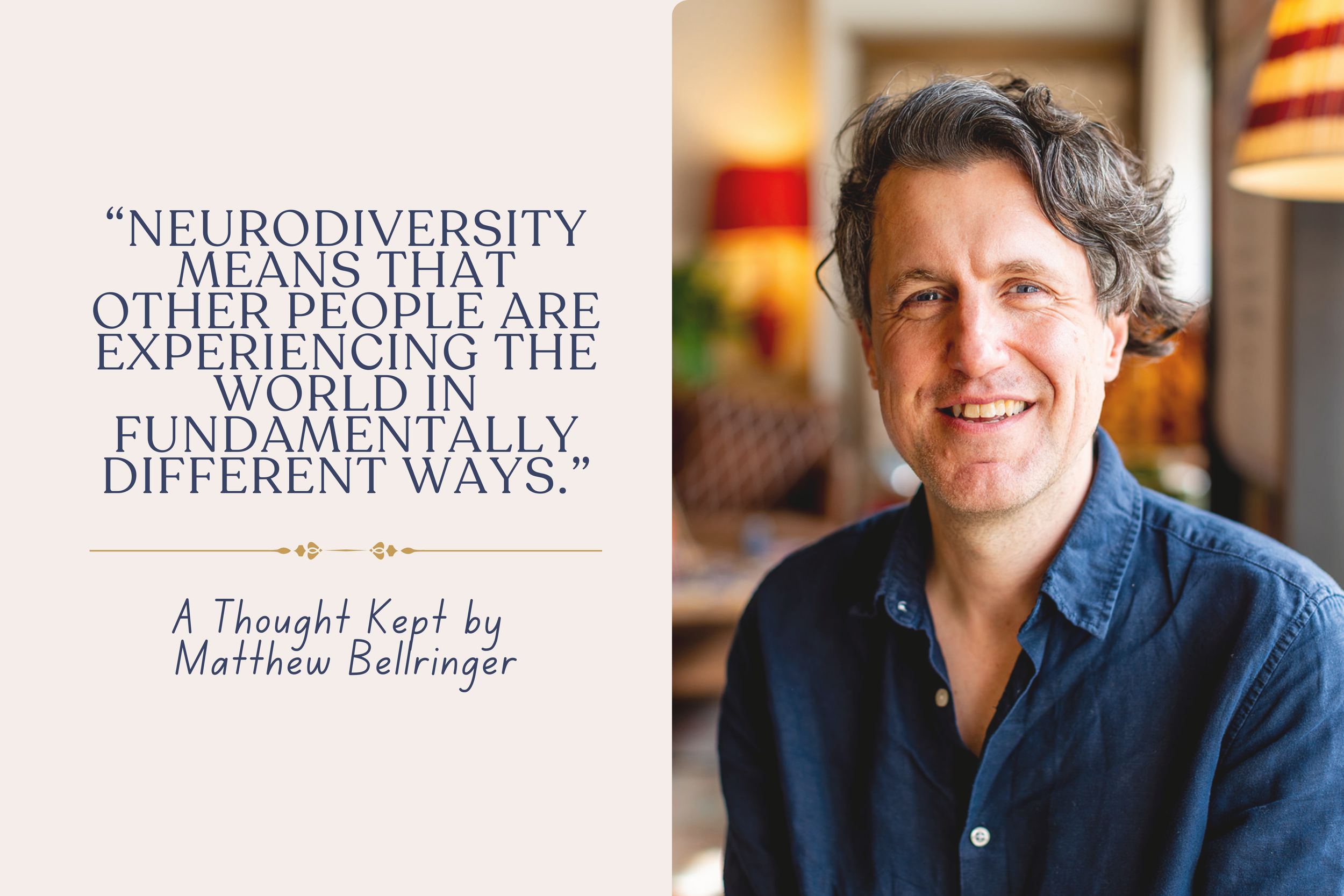


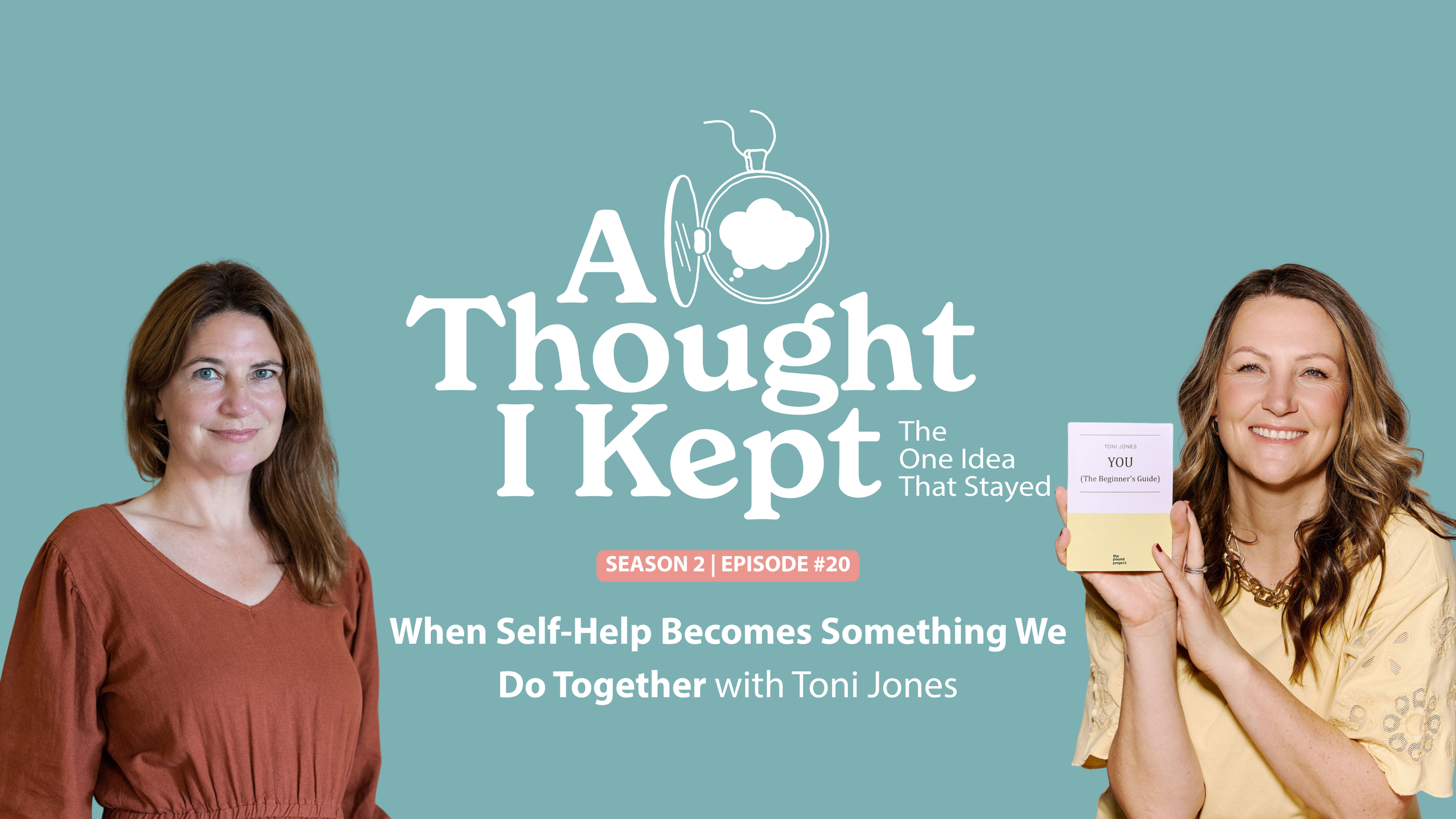
Finding a Better Way to Well Without Trying to Fix Yourself
Feeling overwhelmed by self-help and wellbeing advice? Explore how you can find a more human way to feel better with Toni Jones of Shelf Help.
I still remember standing in the wellbeing section of my local independent bookshop years ago, holding three different books in my hands and feeling completely overwhelmed by all of them.
One promised confidence. One promised calm. One promised a completely new life if I just followed the steps properly enough. Around me were shelves and shelves of answers. Morning routines. Better habits. Nervous systems. Boundaries. Purpose. Productivity. Healing. Manifestation. Rest. Reinvention.
And underneath all of it was this quiet but persistent feeling: if I could just find the right idea, the right practice, the right way of living, maybe I would finally feel okay.
I think a lot of us arrive at wellbeing from this place now. Not because we’re shallow or self-absorbed, but because life genuinely feels difficult. The world feels loud. Work is relentless. Relationships can be complicated. Many of us are carrying anxiety, grief, uncertainty, burnout or a low-level sense that we’ve somehow drifted away from ourselves. And when you feel like that, it makes sense to go looking for answers.
In my recent conversation on A Thought I Kept with Toni Jones, we talked about what happens when you spend a decade immersed in self-help culture. Toni has read more than 1,000 self-help books. She founded Shelf Help, the world’s first self-help book club, after burnout and a growing sense that something in her life needed to change.
What I loved most about our conversation wasn’t really the books though. It was the gentler, steadier framework underneath them.
Because Toni spoke so honestly about how messy change actually is. Not cinematic. Not linear. Not “new life in seven easy steps.” More experimental than transformational. More human than polished.
At one point we talked about the pressure that can sit underneath wellbeing culture now — the sense that we should always be improving ourselves. That wellness can become another arena where we fail, compare, strive or feel behind. And honestly, I think many people feel exhausted by that version of wellbeing, even if they can’t quite articulate why.
There’s something profoundly tiring about approaching yourself like a constant problem to solve.
What Toni kept returning to instead was curiosity.
Not: “How do I finally become perfect?”
But: “What happens if I try this?”
Not: “I must completely reinvent myself.”
But: “What if I treated this more like an experiment?”
That small shift feels important to me. Because experiments allow room for being human. They allow for bad days, contradictions, changing your mind, getting it wrong, trying again. They soften the harshness that so often creeps into conversations about growth.
And maybe that’s part of finding a better way to well.
Not turning wellbeing into another performance of goodness or discipline or achievement. But allowing it to become something more personal. More playful. More forgiving. Something shaped around your actual life rather than the life you think you should be living.
During the conversation, Toni described reading her first self-help book while completely burnt out and desperate for something to change. It was called Change Your Life in Seven Days. Looking back now, she laughs at the urgency of it. The idea that her exhausted nervous system was searching for a quick fix because she simply couldn’t carry on as she was.
I think many of us recognise that feeling.
The late-night googling. The saving of posts we never quite return to. The hopeful ordering of books. The quiet thought that maybe this next thing will finally help us feel calmer, happier, clearer, more confident, less overwhelmed.
And sometimes those things do help. Books can change us. Conversations can change us. Therapy can change us. Tiny rituals and practices can genuinely support us.
But what struck me listening to Toni was that the deeper shift seemed to come less from finding the perfect answer and more from slowly building a different relationship with herself.
One with more compassion in it.
More honesty.
More willingness to be seen.
More permission to need support.
That feels important too because I think a lot of us have absorbed the idea that wellbeing is something we should master privately. Quietly. Alone. We should hold everything together. Cope beautifully. Be low maintenance. Keep functioning.
And yet the thought Toni brought to the podcast — borrowed from Brené Brown — was this: “We don’t have to do all of it alone. We were never meant to.”
I kept thinking about that afterwards.
Because maybe a better way to well isn’t just about what we do for ourselves. Maybe it’s also about who we let sit beside us while we figure things out.
The friend who notices you’re not okay before you admit it yourself.
The conversation that helps you feel less strange.
The book club where people finally say the quiet parts out loud.
The person who reminds you that you’re allowed to need care too.
The older version of yourself who can look back and realise: things did change, slowly, even when it didn’t feel like they were changing at all.
One of the things I loved most from the episode was Toni talking about how, years ago, she felt desperate for something — anything — to change. Whereas now, after years of reflection and experimentation and self-discovery, she approaches life with more curiosity than panic. More openness than grasping.
Not because she became a completely different person.
But because she became more connected to herself.
I think that’s the part of wellbeing we don’t talk about enough. That perhaps the goal isn’t becoming somebody new entirely. Perhaps it’s becoming more honest about who we already are. Understanding what supports us. Learning what drains us. Allowing our version of wellbeing to look different from somebody else’s.
And maybe that’s why Amanda and I created the If Lost, Start Here wellbeing journal in the way we did. Not as a rigid plan or perfect prescription, but as an invitation into curiosity. Into experimentation. Into asking better questions about what actually helps you feel more alive, connected, grounded or held.
Not wellness as performance.
Not self-improvement as punishment.
Just a steadier, kinder relationship with yourself and your life.
If this conversation resonates, you can listen to my full episode of A Thought I Kept with Toni Jones, where we explore vulnerability, burnout, self-help, friendship, identity, emotional wellbeing and what it means to stop carrying everything alone.
And if you’re feeling a little lost in your own life right now — unsure what wellbeing even means for you anymore — you’re also very welcome to explore my coaching work or the If Lost, Start Here journal. Not as a way to become someone else. Just as a place to begin listening to yourself again.

A Thought I Kept… About Connection
Feeling disconnected, overwhelmed, or emotionally exhausted? Explore why human connection matters most in difficult times. Inspired by conversations from our podcast, A Thought I Kept.
There are moments when the world can feel too loud to properly hear yourself think. You wake up already behind. The news is unbearable again. Somebody somewhere is shouting online. The food shop costs more than you thought it would. Your phone keeps filling with reminders, requests, headlines, notifications. Work spills into evenings. Even rest starts to feel strangely performative. We scroll instead of pausing. We cancel plans because we’re tired. We tell ourselves we’ll reply properly tomorrow.
And slowly, often without noticing, many of us begin retreating from one another. Not dramatically. Quietly.
We stop reaching out first. We stay home more. We become suspicious of people who think differently to us. We compare ourselves. We convince ourselves everyone else is coping better. We move through life slightly armoured — overstimulated, emotionally exhausted, and unsure how to find our way back to each other again.
But one of the thoughts I’ve kept from making A Thought I Kept is this: human connection matters most precisely in the moments when we’re tempted to withdraw from it.
Not because connection fixes everything. Not because friendship erases grief or anxiety or burnout or uncertainty. But because being with other people — really being with them — can remind us that we are still here. Still human. Still part of something larger than our own spiralling thoughts.
As I pulled together conversations with Cathy Rentzenbrink, Tanya Lynch, Hiroko Yoda, Laurence McCahill, Suzy Reading, Liana Fricker and Lauren Barber, I realised that although these episodes explored very different corners of life — grief, spirituality, creativity, burnout, friendship, books, business, midlife, rest — they kept circling back to the same idea. Connection is not an optional extra to wellbeing. It might be the thing holding so much of it together.
1. We Retreat When Overwhelmed But Isolation Deepens the Feeling
One of the strange things about difficult periods is how quickly they can make us disappear from our own lives. You stop texting back properly. You feel too tired to explain how you are. Going out starts to feel like effort. You tell yourself you’ll reconnect when you feel calmer, less overwhelmed, more yourself again.
But listening back to these conversations, I kept noticing how often people found their way back through other people. Not through becoming shinier or more productive or more emotionally “together,” but through being alongside somebody else long enough to soften a little.
In my conversation with Laurence McCahill, we talked about how growth and change so rarely happen in isolation. We can read the books and underline the quotes and listen to the podcasts and still feel strangely stuck. Sometimes what’s missing isn’t another idea. It’s other people. Someone sitting opposite you saying, “Yes, I know exactly what you mean.” A room where you don’t have to explain yourself quite so much. A gathering that reminds you life can feel different to this.
I think modern wellbeing culture sometimes forgets this. So much advice is aimed at the individual: your morning routine, your mindset, your habits, your healing, your optimisation. And while solitude can absolutely be restorative, there is also something profoundly regulating about being witnessed by another human being. The friend you voice note while unloading the dishwasher. The person who notices you’ve gone quiet. The neighbour you always end up chatting to longer than intended. The group chat that suddenly becomes honest at 11pm. These moments can seem tiny from the outside, but emotionally they can be enormous.
2. Connection Doesn’t Have to Look Big or Impressive
What struck me listening back to these episodes was how often connection appeared in ordinary forms. Not grand gestures or perfectly curated social lives, but cups of tea, shared books, walks, retreats, conversations that drift unexpectedly from logistics into longing.
In my conversation with Tanya Lynch, we spoke about the feeling of being gathered — of spaces where people are allowed to arrive exactly as they are, whether that’s hopeful or grieving or emotionally threadbare. There was something in that conversation that stayed with me because I think so many of us are craving precisely that kind of space right now. Not networking. Not performance. Just moments where we can stop pretending to be fine for a minute.
I think many of us accidentally make connection feel harder than it needs to be. We imagine thriving social lives and elaborate dinner parties and huge friendship circles maintained through impeccable emotional availability and perfectly colour-coded calendars. But often connection is much quieter than that. It’s somebody saving you a seat. Somebody remembering what you said last week. Somebody sending you a photo because it made them think of you.
These tiny gestures matter because they remind us we exist in other people’s minds and lives. That we are held somewhere beyond our own stress and self-criticism.
3. Being Witnessed Changes Us
There’s a moment in my conversation with Cathy Rentzenbrink where we talk about books and grief and the relief of feeling recognised by somebody else’s words. I think that’s one of the deepest forms of connection there is: the feeling that someone else has inhabited something adjacent to your own experience and survived long enough to describe it.
Loneliness is not only physical isolation. It’s also the feeling that your inner world is somehow unshareable, too strange or messy or contradictory to be understood by anyone else. Which is why it can feel so unexpectedly emotional when somebody articulates the thing you haven’t been able to say yourself.
This is part of why art matters so much to me. Why conversations matter. Why podcasts matter. Why books matter. Not because they solve life, but because they make our inner worlds feel more shareable. Somebody else has also sat in the car park crying. Somebody else has also felt lost at a dinner party or uncertain in midlife or disconnected from themselves after years of coping. Somebody else has also stared at the ceiling at 3am wondering what on earth they’re doing with their life.
Being witnessed doesn’t remove pain, but it can make pain feel survivable. Sometimes another person’s honesty becomes a bridge back to our own.
4. Rituals and Shared Experiences Help Us Feel Human Again
I kept thinking about this during my conversation with Hiroko Yoda, where we explored Japanese spirituality and the way it can live quietly inside ordinary rituals and everyday life. Shared meals. Seasonal practices. Returning to certain places. Moments of pause and reverence that tether people back to each other and to the world around them.
It made me realise how many of us are quietly searching not only for connection with other people, but connection with meaning itself. Something beyond productivity and algorithms and constant consumption. Something that helps us feel part of a wider human experience again.
Maybe this is why small rituals can feel so unexpectedly important during difficult seasons. Cooking for somebody. Reading in bed beside another person. Returning to the same café every Saturday morning. Listening to a familiar voice on a podcast while commuting home in the dark. These things can seem insignificant until you realise they are helping hold you together.
There’s comfort in repetition. In familiarity. In tiny practices that remind us we belong somewhere — to a person, a community, a season, a place, a version of ourselves we’re trying not to lose.
5. Other People Help Us Remember Who We Are
Perhaps this is the thought I’ve kept most strongly from these conversations: we do not become ourselves entirely alone.
Other people reflect us back to ourselves all the time. A friend remembers the version of you that existed before burnout. Someone notices your excitement returning before you do. A conversation unlocks a part of yourself you thought had disappeared. A community helps you imagine a different future.
We are constantly shaped by what we share, what we witness, and what we allow ourselves to receive from one another. Which feels particularly important in a culture that simultaneously encourages hyper-independence while exhausting us emotionally.
Maybe wellbeing was never supposed to be something we carry entirely alone. Maybe part of feeling better is allowing ourselves to be held — by conversations, friendships, rituals, stories, books, communities, shared meals, and moments of recognition that arrive unexpectedly in ordinary life.
Putting together this playlist reminded me that connection rarely arrives looking cinematic. More often it appears quietly. A message sent at the right moment. A conversation that stays with you for weeks afterwards. Somebody making you laugh when everything has felt unbearably heavy. A voice in your headphones helping you feel a little less alone as you move through another complicated Tuesday.
And maybe, for now at least, that’s enough.
If you’d like to listen to the full A Thought I Kept… About Connection playlist, you can find it here:
How Japanese Spirituality Can Help Us Feel Less Lost
What Japanese spirituality can teach us about wellbeing, grief and uncertainty from everyday rituals and noticing beauty to finding comfort in living between belief and doubt.
The park was the same one Hiroko Yoda had walked through countless times before. Same paths. Same trees. Same shrine tucked quietly amongst the landscape. But after her mother died, she could barely see any of it. She describes walking with her head down, shuffling through the park and back home again, where she would cry. Then repeat it the next day. And the next. Until one day she looked up.
She noticed the birds first. Then the maple trees. The shifting light through the leaves. A shrine she must have passed hundreds of times before. And in that moment, something changed. Not because her grief disappeared or because she suddenly understood everything about life or death or spirituality, but because she no longer felt entirely alone inside the world.
I haven’t stopped thinking about that since we recorded our conversation for A Thought I Kept.
Partly because I think many of us know what it is to move through life with our heads down. To become so overwhelmed by grief, anxiety, burnout, uncertainty or simply the sheer weight of being human that the world narrows around us. Our lives become logistical. Functional. We focus on getting through the day, answering messages, making dinner, remembering appointments. We stop noticing what is around us because we are working so hard to hold ourselves together within it.
And yet so much of what Hiroko shared in our conversation was about exactly that: noticing.
Noticing what remains. Noticing what connects us. Noticing the things that quietly hold us when we feel lost.
Her book, Eight Million Ways to Happiness, explores Japanese spirituality not as a rigid belief system but as something lived alongside everyday life. Something woven into nature, rituals, food, language, grief, playfulness and community. In Japanese spirituality, kami — spiritual presences — exist not just in shrines or sacred spaces, but in trees, rivers, mountains, words, objects and everyday acts of care.
I think what struck me most was how different this felt from the way spirituality is often discussed in wellbeing spaces. So much modern wellbeing culture seems obsessed with certainty. Morning routines that promise transformation. Manifesting practices that suggest we can think ourselves into a better life. The pressure to optimise, improve, transcend.
But Hiroko kept returning to something much softer and more spacious than that.
The Japanese idea of hanshin hangi — half belief, half doubt. The permission to remain somewhere in the grey zone. To not fully know. To allow uncertainty to exist without rushing to resolve it.
Honestly, it felt like a relief.
Because I suspect many of us already live there, whether we admit it or not.
We carry objects that mean more to us than they logically should. We talk to people we’ve lost. We feel calmer by the sea. We light candles. We keep rituals we cannot entirely explain. We sense that some places hold energy. We wonder whether there might be more to life than what we can immediately see or prove.
And then, often, we dismiss ourselves. We tell ourselves we’re being silly. Irrational. Dramatic.
What I loved about Hiroko’s perspective was that it made space for both curiosity and scepticism. Both wonder and uncertainty. Both grief and joy.
At one point in the conversation she talks about eating a banana at breakfast and saying itadakimasu beforehand — “I humbly receive.” And suddenly the banana stops being just a banana. It becomes the people who grew it, transported it, stocked it, bought it. It becomes weather and soil and labour and unseen connection.
That stayed with me because I think many of us are searching for meaning whilst overlooking the small moments where meaning already exists.
Noticing can become a kind of spiritual practice.
Making coffee in the morning. Opening the curtains. Walking the dog. Watering plants. Speaking kindly. Taking the long route home. Sitting quietly before the rest of the house wakes up.
Not because these things solve our lives, but because they return us to relationship with them.
And perhaps that matters especially when we feel lost.
Often when we feel uncertain, we assume we need dramatic change. A new version of ourselves. A breakthrough. A complete reinvention. But sometimes what we actually need is a gentler way of relating to where we already are.
Hiroko spoke beautifully about how Japanese spirituality allows opposites to coexist. Joy and sadness. Gratitude and anger. Light and darkness. She talked about how grief changed shape over time, how writing about her mother softened certain memories and complicated others, how healing was not neat or linear but layered.
I think there’s comfort in that too.
Because many people arrive at wellbeing feeling as though they are failing at it. Failing at being positive enough, resilient enough, healed enough, grateful enough. But perhaps wellbeing is not about eliminating darkness or uncertainty. Perhaps it is about learning how to stay connected to ourselves and the world around us whilst those things exist.
To look up occasionally, even when life feels heavy.
To notice the shrine amongst the trees.
To let a cup of coffee become a moment of connection rather than simply fuel.
To allow for half belief and half doubt.
If this resonates with you, you might enjoy my conversation with Hiroko Yoda on A Thought I Kept. We talk about grief, spirituality, uncertainty, belonging, rituals and the unseen threads that connect us to each other and the world around us.
And if you’re navigating your own season of uncertainty or emotional overwhelm, you can also explore coaching and support through If Lost Start Here. Not to fix yourself or become someone new, but simply to have somewhere to think things through more honestly and openly.
Feeling burnt out or questioning your career? Explore how to manage your energy, rethink success and find work and purpose that help you feel more alive.