
Connecting While Human
You’re halfway through a conversation and realise you’re not really in it. You’re nodding, saying the right things, keeping the tone light enough, agreeable enough. You hear yourself laugh at something that isn’t quite funny. You offer an explanation you’ve offered before, one that lands just well enough to move things on. And at the same time, there’s something else happening underneath — a more insistent feeling that says: this isn’t quite it.
You might notice it later, when you’re walking home or making dinner, replaying the conversation in your head. The bit you didn’t say. The way you softened something. The way you tried, once again, to explain yourself into being understood. And then, almost reluctantly, the thought arrives: I don’t think this is about explaining anymore.
It’s a subtle shift, but once it’s there, it tends to stay.
This is the place Jacky Power and I found ourselves in during our conversation — not just the moment of clarity that so many wellbeing conversations promise, but in what comes just after it. The part where you realise something about yourself or your relationships, and then very messily try to do something about it.
Jacky described believing, for a long time, that if she could just say things the right way, people would meet her there. That the gap between her and others was something she could bridge with better words, more careful explanations, a little more effort. It’s such a human instinct — to assume that understanding is something we can earn if we try hard enough.
And sometimes that’s true. But not always.
Sometimes what we’re up against isn’t a lack of clarity, but a difference in direction. A difference in how we see things, what we value, what we’re willing to hold or not hold anymore. And that’s much harder to resolve, because it doesn’t bend as easily.
What follows that realisation isn’t a clean decision. It’s more like learning to walk again on uneven ground.
You say something you’ve been meaning to say, and it comes out slightly wrong. Or it lands in a way you didn’t expect. You question yourself almost immediately. Was that too much? Too blunt? Not quite right? You tell yourself you’ll try again next time, maybe in a softer way, a clearer way. You adjust, you retreat, you step forward again.
Jacky described it as “stumble, trip, stumble, trip.” And it’s exactly that. Not a confident stride into a new way of being, but a series of attempts, some of which don’t go to plan.
There’s a kind of vulnerability in this stage that doesn’t get talked about much. Because from the outside, it might look like growth — becoming more self-aware, more aligned, more boundaried. But from the inside, it can feel uncertain and exposing. You’re no longer fully comfortable in the old way of relating, but you’re not yet steady in the new one either.
And that can feel lonely.
Not necessarily in the obvious sense of being alone, but in the quieter sense of not quite being met. Of noticing that the ways you’re beginning to show up don’t always fit neatly into the relationships you’ve had before. Of realising that not everyone will come with you, or understand you in the way you hoped.
Jacky spoke about this without dressing it up. That there can be grief in it. That choosing your own direction — even gently, even kindly — can create a kind of separation. Not because you want it to, but because something has shifted, and you can’t quite go back to not knowing that.
And still, there was something else in what she said that felt just as important.
That the alternative — ignoring what you’ve noticed, continuing to override yourself for the sake of keeping things smooth — comes at a cost too. A quieter one, perhaps, but one that builds over time. A sense of being slightly out of step with yourself. Of saying yes when you mean maybe, or maybe when you mean no. Of slowly losing touch with what feels true.
This is where connection becomes more complicated than we often allow it to be.
Because it isn’t just about being close to other people. It’s also about how close you are to yourself within those relationships. Whether there is space, even in small ways, to be honest about what you feel, what you need, what you see differently now.
And that honesty doesn’t have to arrive all at once.
One of the things I took from this conversation is that connection doesn’t depend on getting it perfectly right. It might be something much smaller than that. A moment where you say a little more than you usually would. A conversation where you don’t immediately tidy up your feelings. A pause where you notice the urge to explain, and choose, just for a second, not to.
It might be noticing where you feel able to do that, and where you don’t.
Because not every space will hold it. And that, too, is information.
Jacky talks about “human tricky things” — the parts of being alive that don’t resolve easily. The feelings we don’t always have words for. The experiences that sit somewhere between connection and disconnection, between being seen and staying hidden. And what struck me is that learning to connect while human isn’t about smoothing those things out. It’s about finding ways to stay with them.
To stay with yourself when you’re unsure. To stay in relationship where you can, without forcing it where you can’t. To allow for the possibility that connection might look different now — less about being perfectly understood, and more about being real in the places that can hold it.
If you’re in that space at the moment — noticing something has shifted, but not yet sure how to live it — it might help to know that this part doesn’t need to be rushed.
You’re not behind. You’re not getting it wrong. You’re in the middle of learning something about yourself that takes time to settle.
And there is a kind of steadiness that can grow here, even if it doesn’t feel like it yet. Not from having all the answers, but from beginning to trust what you notice. From allowing that to matter, even when it complicates things.
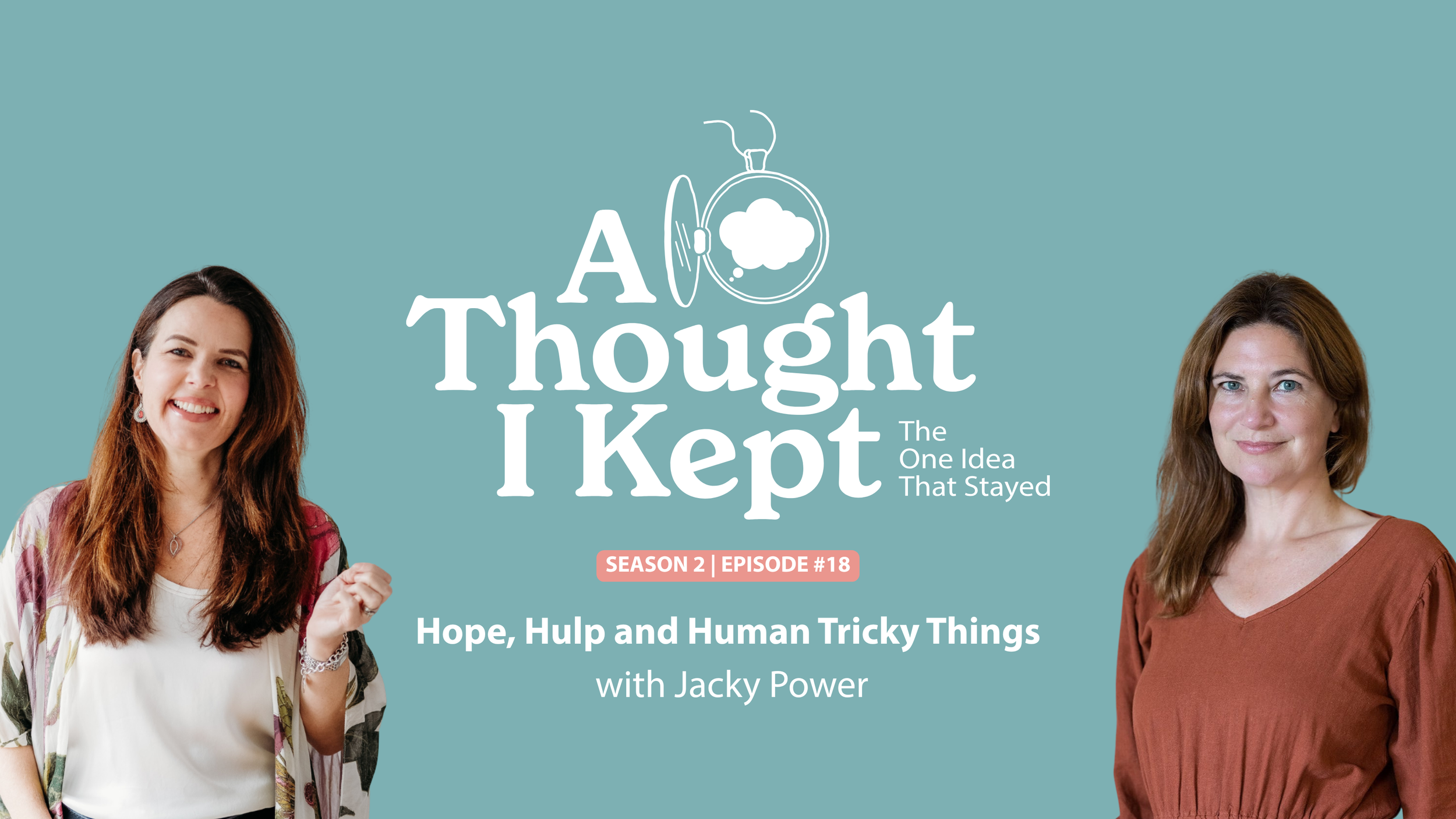
If you’d like to hear more of this conversation, you can listen to my episode with Jacky Power on A Thought I Kept, where we explore emotions, loneliness, and what it means to stay connected — to ourselves and to each other.
And if you’re looking for somewhere to think about your own relationships or feelings a little more gently, explore our coaching and resources here If Lost Start Here.