
How to Trust That Things Will Be OK (Even When You Feel Lost)
You arrive a little more tired than you expected: The train was delayed, the coffee wasn’t great, and there’s already a message waiting for you from home. You hold your bag a little tighter as you step off, aware of that familiar feeling underneath it all, the one that says you’re doing your best, and still wondering if it’s enough.
But then you’re welcomed in, properly welcomed in. There’s a cup of tea placed into your hands, a chair that feels like it was waiting for you, and a sense — rare, and difficult to create on demand — that you don’t have to perform or explain or improve anything about yourself in this moment.
You have arrived.
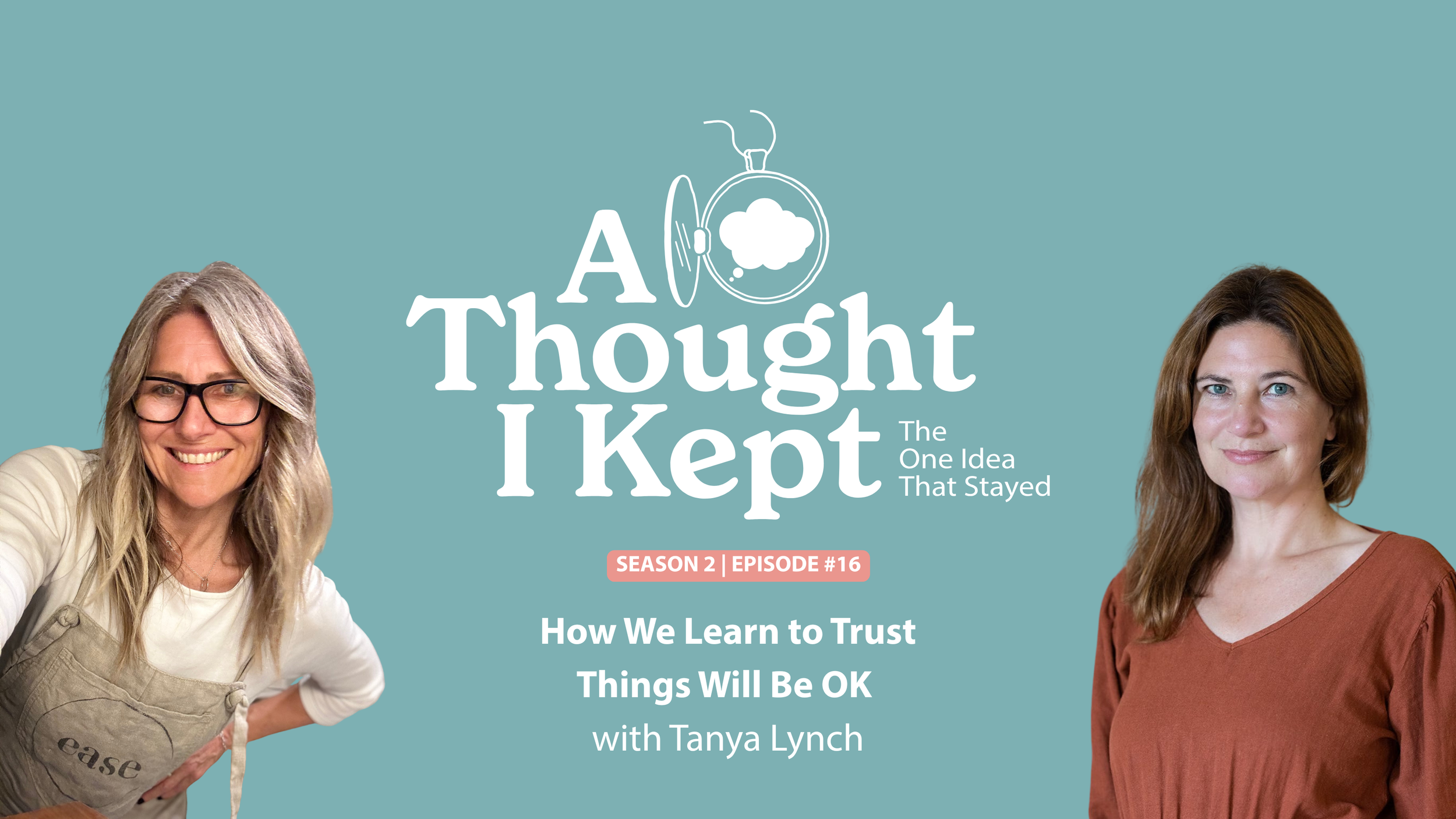
This is the kind of space described in my recent conversation with Tanya Lynch on A Thought I Kept, but more than that, it’s the kind of space many of us are quietly searching for in our everyday lives, especially when we find ourselves feeling lost without quite knowing how we got there. Because feeling lost doesn’t often look dramatic. It tends to look like carrying on, showing up, doing what needs to be done while holding a question in the background about whether this is how things are meant to feel.
When Life Doesn’t Look Like You Thought It Would
Tanya’s work, through journaling, retreats, and bibliotherapy, is rooted in something both simple and surprisingly hard to practice, which is the idea that everything is welcome.
Not just the parts of life that feel resolved or hopeful or easy to share, but also the uncertainty, the heartbreak, the restlessness, and the moments where you don’t know what comes next or how you’re meant to move through them. These are the parts we’re often encouraged to fix or move past, and yet they are also the parts that tend to shape us most.
There is a phrase she returns to, one that you may have heard so many times it risks losing its meaning:
Every cloud has a silver lining.
It can feel too neat for the complexity of real life, too polished for the moments when things are genuinely hard, but the origins of the phrase tell a different story. It dates back to the 17th century, from a line by John Milton in Comus, where he describes a dark cloud revealing a silver edge when caught by light.
It wasn’t written as advice or reassurance, but as an observation, a moment of noticing that even within something heavy, there might be something else present at the same time. And perhaps that is where this idea becomes more useful to us, not as a way of reframing everything into something positive, but as an invitation to look a little more closely at what is already there.
Learning to Stay With the Hard Parts
One of the things that stayed with me most from this conversation is the way Tanya speaks about challenge, not as something to avoid or move quickly beyond, but as something that is woven into the shape of a life. There isn’t a single moment where everything resolves or becomes easier, and there isn’t a version of life that is made up only of blue skies and straightforward narratives. Instead, there are multiple moments, some expansive, some difficult, some that ask more of us than we feel ready to give, and all of them becoming part of the story we are living.
Over time, something begins to build alongside that, and it is not certainty or control but a quieter kind of trust. Not the kind that insists everything will work out exactly as we hope, but the kind that recognises we have moved through difficult things before and found our way, even when it didn’t feel possible at the time.
What It Means to Feel Held
So much of what Tanya creates through her retreats is about this idea of being held, and it’s something that feels increasingly important in a world that often asks us to keep going without pausing to notice how we actually are. Being held doesn’t mean being fixed or guided towards a better version of yourself, and it doesn’t come with a list of things to do or ways to improve. It is something quieter than that, an experience of being seen without needing to justify yourself, of being able to arrive as you are without editing or softening the edges of what you’re feeling.
It’s the difference between being asked what you need to do next and being given the space to sit with where you already are. And while retreats can offer a more intentional version of that experience, the question it opens up feels relevant far beyond those spaces.
Where in your life do you feel held, and where might you need a little more of that than you currently have?
A Way to Begin Again, Gently
If you are in a moment that feels uncertain right now, this isn’t about finding a solution or creating a plan, and it doesn’t ask you to turn everything around or see things differently straight away.
It might begin somewhere much smaller.
The next time you find yourself caught in the noise of everything you’re holding, the questions, the pressure to figure things out, the sense that you should know what comes next, you might step outside if you can and allow yourself a moment to look up rather than down. Not in a symbolic or forced way, but simply to notice what is there.
Clouds moving, light catching edges, space opening up in ways you hadn’t registered before.
This is not about convincing yourself that things are better than they are, but about allowing for the possibility that more than one thing can be true at the same time, that alongside what feels difficult, there may also be something else present that you hadn’t yet seen.
A Thought to Keep
Every cloud has a silver lining may not be something you believe all of the time, and it may not be something you want to hold onto in every moment, but it can sit gently in the background as a question rather than a conclusion.
What else might be here that I haven’t noticed yet?
If you’d like to spend more time with this idea, you can listen to the full episode of A Thought I Kept with Tanya Lynch, where we explore what it means to trust that things will be OK without needing to force that belief.
And if you are finding that you need more support in understanding what you’re feeling or where you are, you can explore our private coaching at If Lost Start Here, where we make space for all of it, not just the parts that are easy to explain.
Sometimes, finding your way doesn’t begin with knowing what to do next, but with allowing yourself to arrive exactly where you are.