
How Japanese Spirituality Can Help Us Feel Less Lost
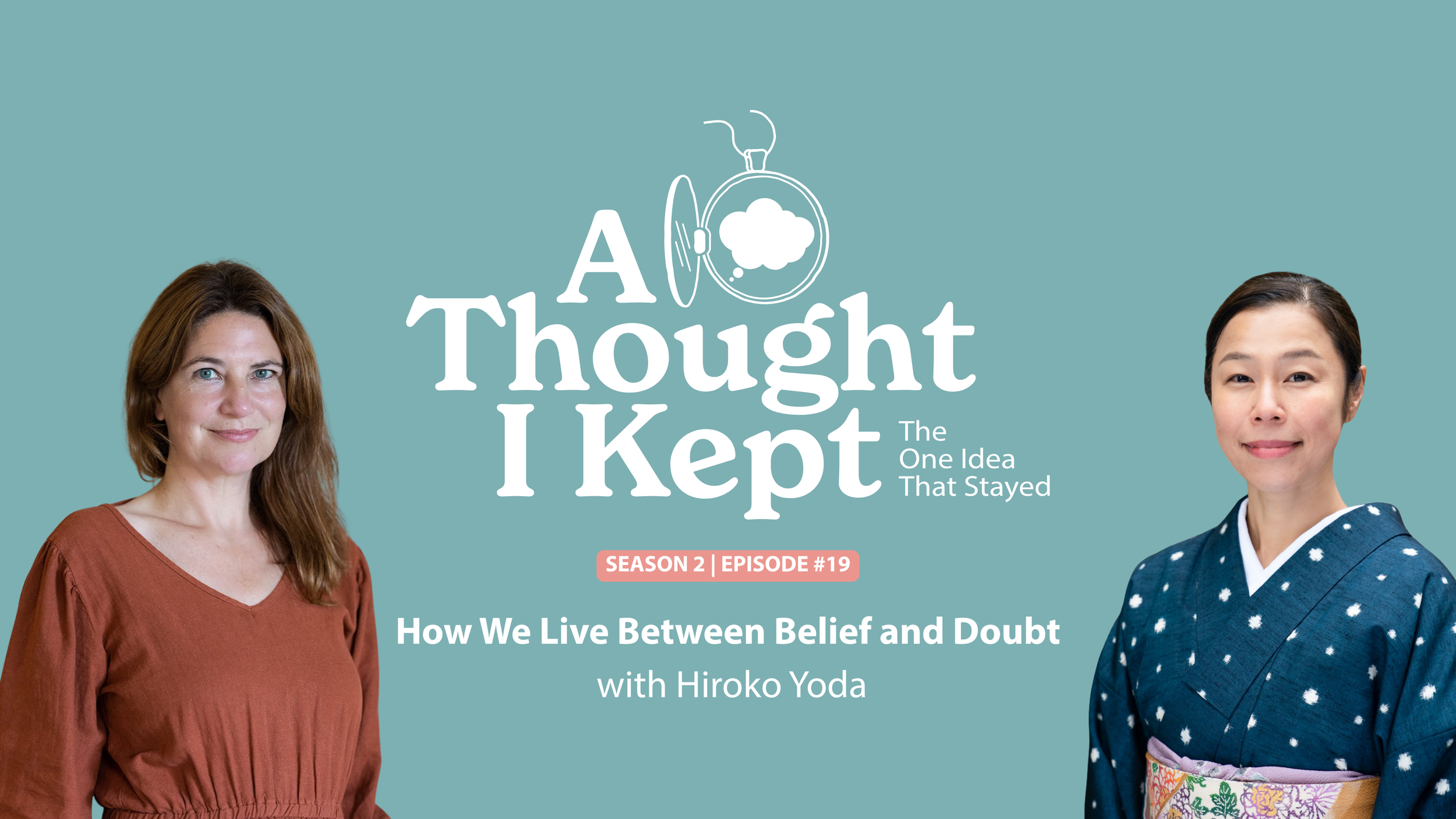
The park was the same one Hiroko Yoda had walked through countless times before. Same paths. Same trees. Same shrine tucked quietly amongst the landscape. But after her mother died, she could barely see any of it. She describes walking with her head down, shuffling through the park and back home again, where she would cry. Then repeat it the next day. And the next. Until one day she looked up.
She noticed the birds first. Then the maple trees. The shifting light through the leaves. A shrine she must have passed hundreds of times before. And in that moment, something changed. Not because her grief disappeared or because she suddenly understood everything about life or death or spirituality, but because she no longer felt entirely alone inside the world.
I haven’t stopped thinking about that since we recorded our conversation for A Thought I Kept.
Partly because I think many of us know what it is to move through life with our heads down. To become so overwhelmed by grief, anxiety, burnout, uncertainty or simply the sheer weight of being human that the world narrows around us. Our lives become logistical. Functional. We focus on getting through the day, answering messages, making dinner, remembering appointments. We stop noticing what is around us because we are working so hard to hold ourselves together within it.
And yet so much of what Hiroko shared in our conversation was about exactly that: noticing.
Noticing what remains. Noticing what connects us. Noticing the things that quietly hold us when we feel lost.
Her book, Eight Million Ways to Happiness, explores Japanese spirituality not as a rigid belief system but as something lived alongside everyday life. Something woven into nature, rituals, food, language, grief, playfulness and community. In Japanese spirituality, kami — spiritual presences — exist not just in shrines or sacred spaces, but in trees, rivers, mountains, words, objects and everyday acts of care.
I think what struck me most was how different this felt from the way spirituality is often discussed in wellbeing spaces. So much modern wellbeing culture seems obsessed with certainty. Morning routines that promise transformation. Manifesting practices that suggest we can think ourselves into a better life. The pressure to optimise, improve, transcend.
But Hiroko kept returning to something much softer and more spacious than that.
The Japanese idea of hanshin hangi — half belief, half doubt. The permission to remain somewhere in the grey zone. To not fully know. To allow uncertainty to exist without rushing to resolve it.
Honestly, it felt like a relief.
Because I suspect many of us already live there, whether we admit it or not.
We carry objects that mean more to us than they logically should. We talk to people we’ve lost. We feel calmer by the sea. We light candles. We keep rituals we cannot entirely explain. We sense that some places hold energy. We wonder whether there might be more to life than what we can immediately see or prove.
And then, often, we dismiss ourselves. We tell ourselves we’re being silly. Irrational. Dramatic.
What I loved about Hiroko’s perspective was that it made space for both curiosity and scepticism. Both wonder and uncertainty. Both grief and joy.
At one point in the conversation she talks about eating a banana at breakfast and saying itadakimasu beforehand — “I humbly receive.” And suddenly the banana stops being just a banana. It becomes the people who grew it, transported it, stocked it, bought it. It becomes weather and soil and labour and unseen connection.
That stayed with me because I think many of us are searching for meaning whilst overlooking the small moments where meaning already exists.
Noticing can become a kind of spiritual practice.
Making coffee in the morning. Opening the curtains. Walking the dog. Watering plants. Speaking kindly. Taking the long route home. Sitting quietly before the rest of the house wakes up.
Not because these things solve our lives, but because they return us to relationship with them.
And perhaps that matters especially when we feel lost.
Often when we feel uncertain, we assume we need dramatic change. A new version of ourselves. A breakthrough. A complete reinvention. But sometimes what we actually need is a gentler way of relating to where we already are.
Hiroko spoke beautifully about how Japanese spirituality allows opposites to coexist. Joy and sadness. Gratitude and anger. Light and darkness. She talked about how grief changed shape over time, how writing about her mother softened certain memories and complicated others, how healing was not neat or linear but layered.
I think there’s comfort in that too.
Because many people arrive at wellbeing feeling as though they are failing at it. Failing at being positive enough, resilient enough, healed enough, grateful enough. But perhaps wellbeing is not about eliminating darkness or uncertainty. Perhaps it is about learning how to stay connected to ourselves and the world around us whilst those things exist.
To look up occasionally, even when life feels heavy.
To notice the shrine amongst the trees.
To let a cup of coffee become a moment of connection rather than simply fuel.
To allow for half belief and half doubt.
If this resonates with you, you might enjoy my conversation with Hiroko Yoda on A Thought I Kept. We talk about grief, spirituality, uncertainty, belonging, rituals and the unseen threads that connect us to each other and the world around us.
And if you’re navigating your own season of uncertainty or emotional overwhelm, you can also explore coaching and support through If Lost Start Here. Not to fix yourself or become someone new, but simply to have somewhere to think things through more honestly and openly.