
What If Kindness Included You Too?
Feeling burnt out from caring for everyone else? Discover why kindness needs to include you too, inspired by our podcast conversation with Nicky Marshall.
There are some people who are very good at knowing what everybody else needs.
They remember the message that needs replying to. They notice when someone is quieter than usual. They check in on their children, their parents, their friends, their colleagues. They make the lunches, hold the door open, listen to the problem, rearrange the diary, pick up the thing that everyone else seems to have forgotten. They care, often deeply, about making other people’s lives a little easier.
Kindness can be one of the most powerful ways we can create a better life. It’s why it’s one of our Pathways to Wellbeing at If Lost, Start Here. There is something profoundly wellbeing-giving about looking beyond ourselves, connecting with another person and knowing that something we did made a difference.
But what happens when our kindness includes everybody except ourselves?
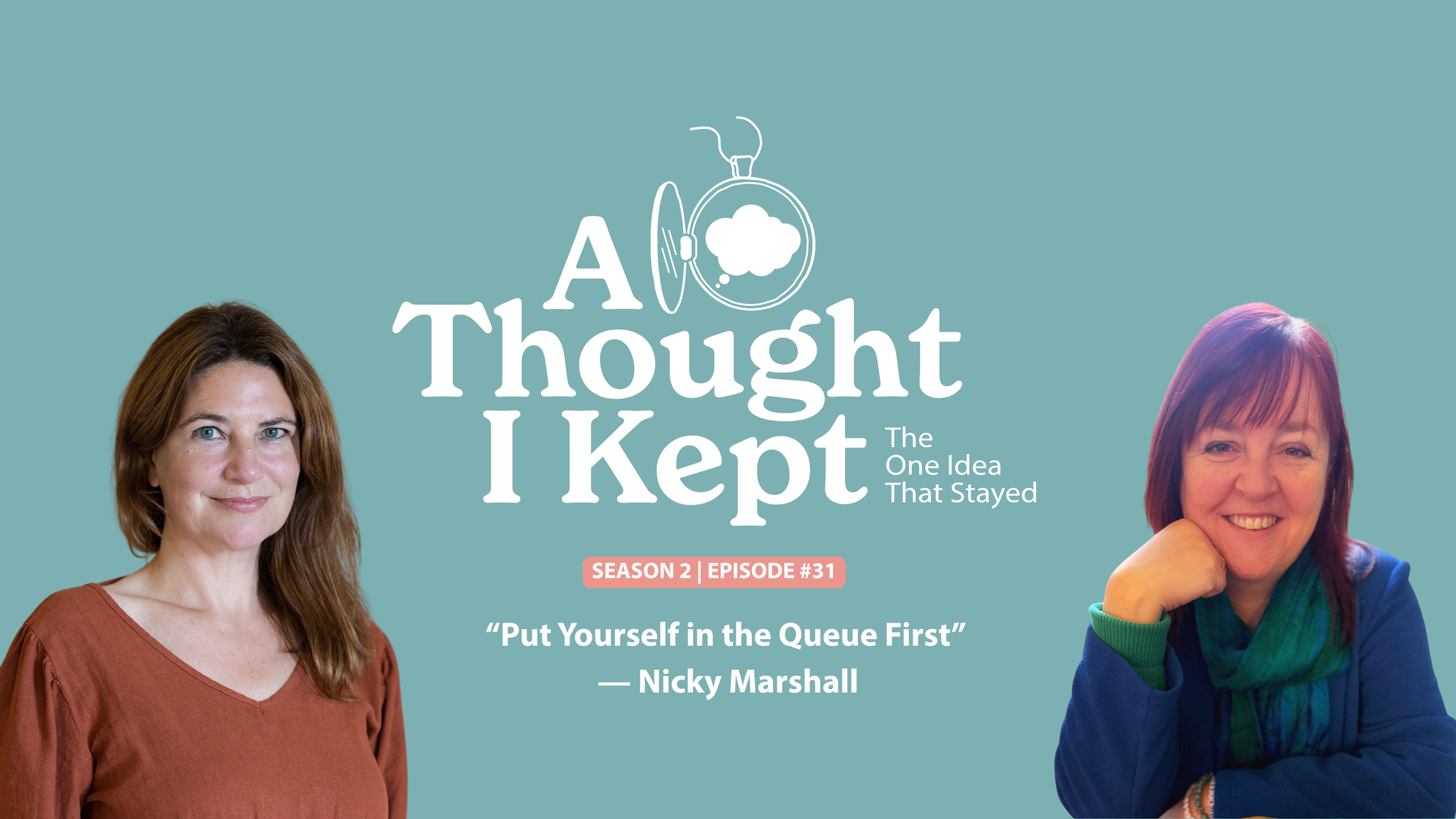
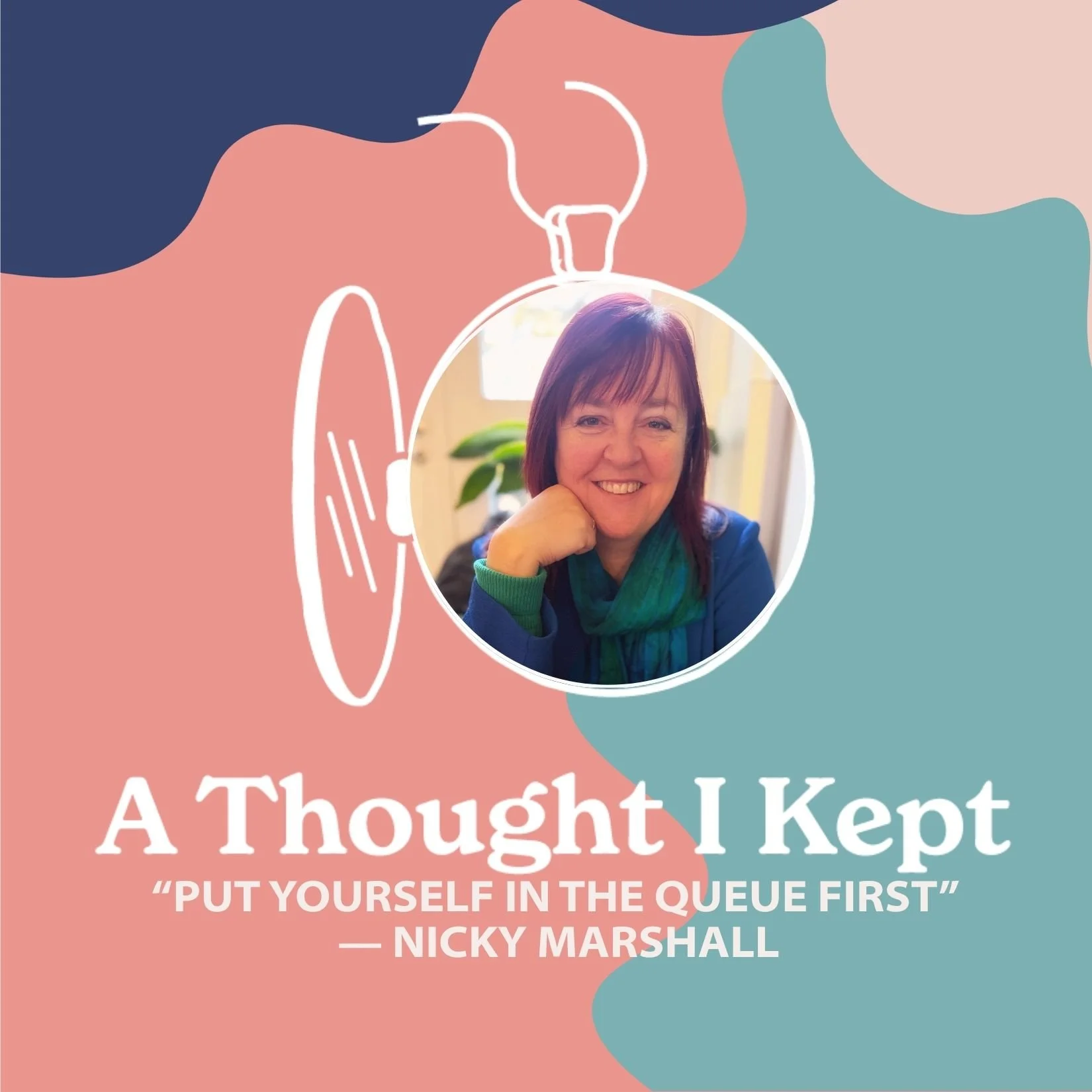
This came up in my recent conversation with Nicky Marshall for A Thought I Kept. Nicky is a speaker, mentor, publisher, wellbeing facilitator and author of No One Is Coming to Save You. She has spent much of her life wanting to help people and make a difference. But the thought she brought to the podcast came from realising that there was one person she had repeatedly left out of that mission:
“To make a difference in this life, I had to put myself in the queue first.”
When caring becomes too much
I recognise so much in this, not only in myself but in the women I work with. There can be so much invisible and emotional labour involved in caring for other people. We know what needs doing. We know who needs checking on. Even when we are supposedly concentrating on something else, part of our brain can still be carrying the people we love. And if you’re someone who believes strongly in kindness, putting yourself first can feel uncomfortable. Perhaps even selfish.
But if I don’t do it, who will?
So we keep going. We finish this and then we’ll rest. We get everyone else sorted and then we’ll look after ourselves. We make it through this week, this deadline, this difficult patch, this stage of the children’s lives, this period with our parents, and imagine that somewhere on the other side there will finally be enough time left over for us.
Nicky knows something about what can happen when we keep overriding the signals that tell us we have reached enough. At 40, after months of pushing herself, she suffered a disabling stroke following a scuba diving accident. Looking back, she can see the bargaining she had been doing with herself before it happened: I’ll do this and then I’ll relax. I’ll do this and then I’ll get some help.
That line stayed with me because I think many of us have our own version of it.
I’ll just get through this week.
I’ll rest when this is finished.
I’ll go for the swim tomorrow.
I don’t really have time for myself today.
Until sometimes we’ve been so busy caring, helping, achieving and getting through that we barely notice how far down our own queue we have slipped.
Kindness doesn’t have to mean self-sacrifice
What I particularly like about Nicky’s thought is that she doesn’t conclude that the answer is to stop helping other people. She still wants to make a difference. She talks in our conversation about making a difference to her husband, her children, her parents, her friends and her customers, right down to the stranger she holds a door open for. She believes those small acts ripple outwards.
The shift is that she now includes herself in that ripple.
As she puts it, she realised: “I need to make a difference to myself.” From there, she could continue making a difference to everyone else, but in a way that might actually be sustainable.
I think this matters because self-care is sometimes presented as the opposite of caring for others. As though we have to choose between being generous and having boundaries, between being available to the people we love and having needs of our own. Perhaps the more interesting question is whether kindness can remain genuinely kind when there is no kindness in it for us.
Because eventually something has to give. We become exhausted. Resentful. Irritable. We lose our sense of ourselves inside all the things we are doing for everybody else. The kindness might still be happening on the outside, but internally we are running increasingly close to empty.
Can you hear the nudges before they become a shout?
One of my favourite parts of my conversation with Nicky is when we talk about the smaller signals that tell us we are reaching capacity. After what happened to her, Nicky says she doesn’t want her body to have to give her another really big message. She wants to listen to the nudges.
For her, those nudges might begin with feeling grumpy when her phone pings, becoming more negative or noticing herself thinking, I’ve got so much to do. If she doesn’t respond, the message moves into her body: tense shoulders, a headache, pain in her hips.
“I like listening to the nudges,” she tells me.
I love this as a way of thinking about caring for ourselves because it doesn’t require a complete life overhaul. It asks us to become a little more curious about ourselves.
What are your nudges?
Perhaps you start resenting people you usually love spending time with. Maybe every request feels like an imposition. You find yourself endlessly scrolling because you have no capacity left to decide what you actually need. You’re tired but keep saying yes. You stop doing the small things that make you feel more like yourself because there simply doesn’t seem to be room for them.
These aren’t necessarily signs that you need to become better at coping. They might be information.
What would putting yourself in the queue actually look like?
This is where I think Nicky’s approach becomes particularly useful, because putting yourself first doesn’t have to mean putting yourself first in every situation, all day, every day. Her version can be surprisingly small. She takes ten minutes in the morning with a coffee, looking outside and checking in with herself. She puts ballet and Zumba into her week because they bring her back to herself. If her energy is lower, she tries to halve her diary for the following week. If she has 20 minutes and feels exhausted, she might get under the duvet.
There’s an acceptance in this that I find really refreshing: we are not machines with a consistent amount of energy to distribute every day. “We are organic beings,” Nicky says. Sometimes we have more energy than at other times. Sometimes life has asked more of us and we need to recuperate. Nature rests in winter, she points out, while somehow we imagine we should be able to keep going indefinitely.
It made me think about my own swimming. I sometimes swim in the morning, and on the day I spoke to Nicky I had caught myself considering cutting my swim short because I had so much to do afterwards. I had to actively remind myself: I am allowed to take this time.
Not because swimming makes me more productive. Not because I have earned it by doing enough for everybody else. But because I get to occupy some space in my own life too. And perhaps that is where putting yourself in the queue begins.
A different way to think about kindness
At If Lost, Start Here, we think about kindness as a pathway into wellbeing because turning towards other people can connect us to meaning, purpose and something beyond our own immediate worries. But pathways are invitations to explore, not another set of rules to get right.
So perhaps there is another direction we can travel along this one too: allowing some of that kindness to find its way back to us.
Not me instead of you.
Not caring less.
Not becoming someone who never helps, gives, supports or shows up.
Just recognising that you are one of the people whose wellbeing matters too.
Maybe today that means noticing the first signs that you’re depleted rather than waiting until you can’t keep going. Maybe it means saying no to something. Leaving something undone. Taking the full swim rather than cutting it short. Sitting with your coffee for ten minutes. Asking yourself what you need before automatically responding to what everybody else needs from you.
Nicky talks in the episode about moving away from the idea of balance and towards something she calls bounce. I like that distinction. Balance can suggest that there is some perfect state we should eventually achieve and then somehow maintain. Bounce makes room for movement. Our energy goes down and comes back. We lose ourselves and find ourselves again. We have weeks when we can hold more and weeks when we need to hold much less.
Maybe kindness can work like that too.
It can move outwards towards the people we love, our communities and even strangers. And it can move back towards us.
Because perhaps the most sustainable way to keep making a difference is not to keep placing ourselves at the very end of the queue.
It’s to remember that we were meant to be in it all along.
Listen to “Put Yourself in the Queue First” with Nicky Marshall on A Thought I Kept to hear our full conversation about burnout, resilience, people-pleasing, self-trust, spirituality, learning to listen to your body and what it might mean to put yourself back into your own life.
And if this idea of kindness as a pathway into feeling better resonates with you, explore this pathway at If Lost, Start Here for more ideas, reflections and small ways to experiment with kindness including, perhaps, extending a little more of it towards yourself.
Struggling With Comparison? Rethinking Confidence and Self-Trust
Comparison and competition can quietly shape how we see ourselves. In this conversation, we explore confidence, self-trust, and the beliefs we carry through life.
This is how it might go. You’re scrolling, or reading, or listening to a podcast, and you notice a flicker of feeling when someone else shares good news. A promotion. A book deal. A confident post about work they love. You’re pleased for them — genuinely — and yet something tightens. A question forms that you don’t quite want to look at too closely.
What does this mean about me?
Moments like this don’t usually come with drama. They’re small, everyday, easy to brush past. But they can linger. And over time, they shape how we see ourselves, how we show up at work, and how much space we allow ourselves to take.
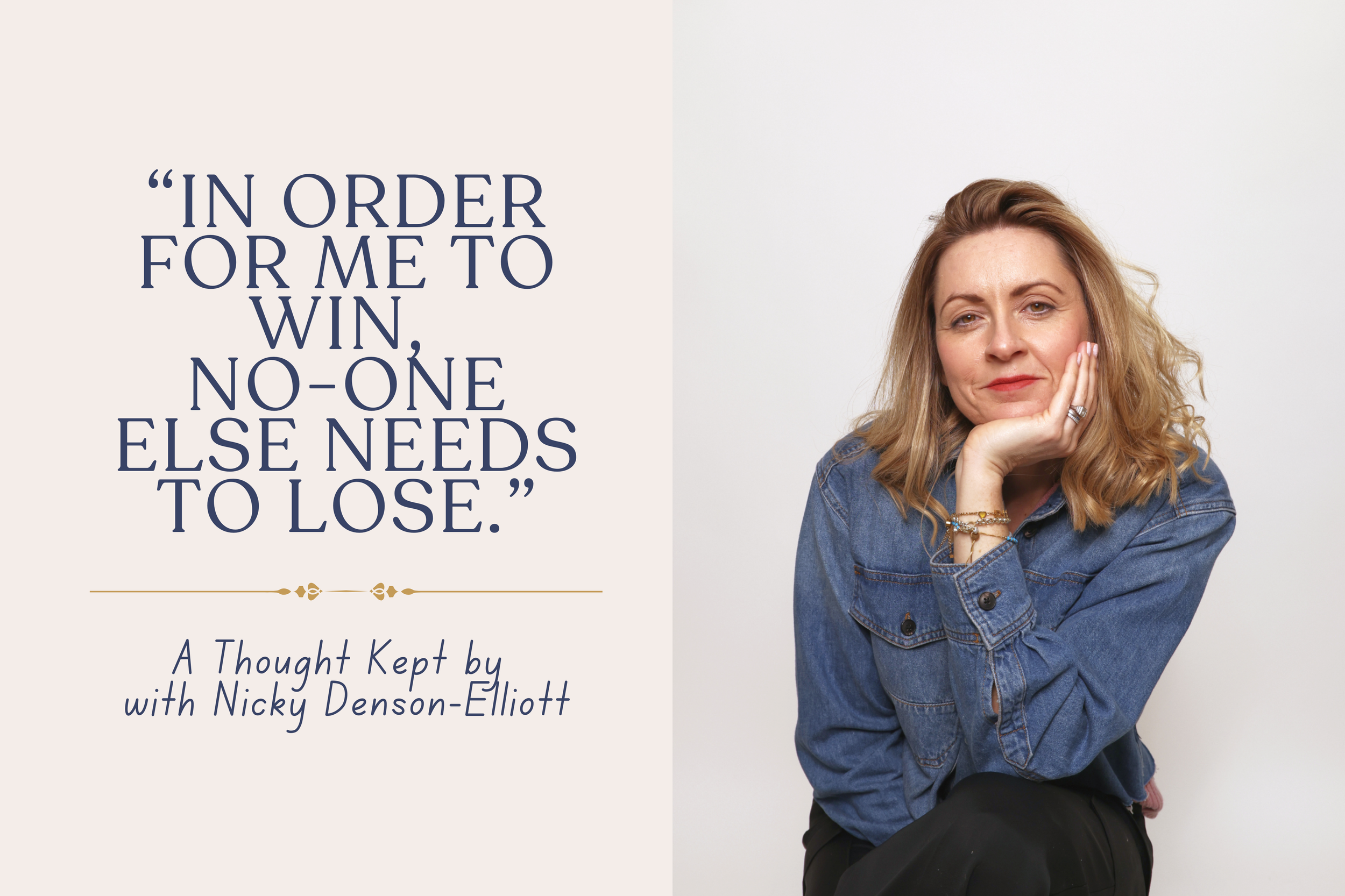
This week on A Thought I Kept, I spoke to Nicky Denson-Elliott, and she brought a thought that disrupted that familiar inner pattern:
In order for me to win, no one else has to lose.
It’s one of those ideas that seems obvious when you first hear it and then quietly radical the longer you sit with it.
Because so much of our inner landscape has been shaped by the opposite belief. That success is scarce. That confidence belongs to certain people, not others. That if someone else steps forward, there’s less room for us. These ideas don’t usually announce themselves as beliefs. They show up as feelings: comparison, jealousy, self-doubt, hesitation.
Nicky spoke about how deeply this conditioning runs, especially for women. How it can shape our relationship with money, confidence, and visibility. How it influences the way we price our work — often not based on its value, but on what feels safe. How it quietly sets women against one another, even when connection and solidarity are what we most want.
What’s important here is that none of this is a personal flaw. These are not thoughts we invented. They’re learned. Reinforced. Picked up over time in workplaces, families, schools, media, and culture. When they surface, they can feel intensely personal but they rarely originate there.
And when life already feels full or uncertain, carrying these inherited ideas can make everything heavier. You might notice it in how hard you are on yourself. In the way you second-guess decisions. In the tension you feel around confidence — wanting it, distrusting it, worrying what it might cost.
One of the most grounding parts of the conversation with Nicky was her refusal to replace one set of rules with another. There was no invitation to be bolder, louder, or more confident in a performative sense. Instead, she talked about noticing. About recognising when a familiar reaction appears and asking, with curiosity rather than judgment: Is this actually mine?
That question alone can create a shift.
Because when we start to see that some of our thoughts are inherited rather than chosen, we don’t have to wrestle with them in the same way. We don’t have to argue ourselves out of feeling jealous or small or unsure. We can simply recognise the pattern, and loosen our grip.
This matters not just for our inner world, but for how we move through everyday life. Especially work. Especially relationships with other women. Especially moments where confidence feels like something other people have access to, and we’re still figuring it out.
Letting go of the myth of competition doesn’t mean pretending everything is fair or easy. It doesn’t mean denying ambition or discomfort. But it does open up a different orientation — one where someone else’s success doesn’t automatically diminish our own, and where confidence can be something we grow into, rather than something we perform.
For many of us, this kind of rethinking doesn’t arrive as a neat turning point. It shows up gradually. In small pauses. In moments where we choose not to rush to judgment — of ourselves or others. In the realisation that uncertainty doesn’t mean we’re failing; it often means we’re paying attention.
If you’ve been questioning old ideas about success, money, confidence, or what it means to be doing “well” in life, you’re not behind. You may simply be noticing that the old maps don’t quite match the terrain anymore.
Nicky’s thought offers a steadier way of orienting. It reminds us that life isn’t a zero-sum game. That generosity — toward ourselves and others — isn’t naïve, but grounding. And that self-trust doesn’t come from fixing or perfecting ourselves, but from recognising which beliefs were never designed to support us in the first place.
You don’t need to know what comes next. You don’t need to replace every thought at once. Sometimes it’s enough to notice which ideas make life feel smaller, and to wonder — without urgency — what it might be like to set one of them down.
If this resonates, listen to the full conversation with Nicky on A Thought I Kept.
And if you need help exploring some of the feelings you have around comparison — jealousy, self-doubt, hesitation — or what confidence even means to you, explore our emotions coaching sessions.

When You Think You Need to Know More… But Really Just Need to Begin
When you're feeling lost or stuck, it's tempting to keep learning more. But what if all that knowledge is just a very clever way to avoid starting? Here's how to notice—and gently shift.
We get it. When you're feeling lost, the world starts to look like one big advice column.
Buy this book.
Sign up for that course.
Follow this expert.
Click here, scroll there.
And you? You’re trying to find your way. So you do what you’ve always done: you gather. You research. You prepare.
You stack up ideas like blankets to keep out the cold.
It feels useful. Smart, even. You're learning, right?
But here’s the thing: sometimes the impulse to “know more” isn’t clarity-seeking. Sometimes it’s a very well-disguised form of procrastination.

When Ideas Keep Us Safe (But Still Stuck)
We recently spoke to Emma Lightfoot on our podcast A Thought I Kept, and she shared something that stopped us in our tracks. A friend had gently pointed out that when Emma gets a new idea, she doesn’t immediately start it—she starts learning about it. Endlessly. Widely. Sideways.
Sound familiar?
It’s a common habit, especially for people who care deeply. Who want to get it right. Who fear failure (or being seen as someone who hasn’t got it all together).
Emma called it “learning sideways.” It gave her the comfort of movement, without the risk of failure. And we’ve all done it. Bought the book instead of opening the journal. Signed up for the challenge instead of going for the walk. Listened to another podcast on boundaries instead of actually saying no.
Awareness, Not Shame
Let’s be clear though: we love ideas. Everyday we explore what learning, growth and guidance can look like. We create courses, coach clients, share resources. But we design them with this reality in mind. That people like you might already be overwhelmed. That you don’t need another guru. That you might just need a little spark that helps you begin—right where you are.
So this isn’t a post about stopping learning.
It’s a post about noticing when you’re gathering as a form of safety… and gently asking yourself:
Am I preparing? Or am I avoiding?
What might happen if I just began?
What do I already know that I can trust?
What If You Trusted Yourself?
Emma made a pledge for 2025: no more buying books or courses on self-help. Instead, she wrote herself a list of 25 small things to do this year. She made a mini-zine as a daily reminder. And she started moving forwards—not perfectly, but consistently.
Not because she doesn’t believe in learning. But because she believes in herself now, too.
That’s something we wish more of us were taught.
That wellbeing isn’t something you acquire—it’s something you tend to.
That starting imperfectly is often more powerful than preparing forever.
That sometimes the next best step isn’t another social media scroll, course or quote—it’s a cup of tea, a deep breath, and the first 10 minutes of actually doing the thing.

A Thought to Keep
If you’re waiting to feel ready… maybe ready is a myth.
Start where you are. Begin anyway.
Write the first line. Go for the walk. Cook the simple meal.
Be in motion—imperfectly, bravely, beautifully.
You can always return to the resources later (we’ve got some good ones for when you’re ready).
But maybe the knowing you need isn’t out there.
Maybe it’s already inside you.
You can listen to this episode on Substack or wherever you get your episodes.