
How We Learn to Matter Too
One of the things I see come up most often in my work is what happens when someone has become the strong one.
They are the person everyone calls. The person who knows what needs to happen next. The person who organises the appointments, remembers the details, absorbs the worry, keeps the family going, manages the work, checks in on everyone else and says, when someone finally asks how they are, “I’m fine.”
Often, they are fine. Or fine enough. They are functioning. They are coping. They are doing what needs to be done, and perhaps doing it incredibly well. But somewhere in all that doing, they can begin to disappear.
This is particularly complicated when the people we love are going through something difficult themselves. If your partner is unwell, your parent needs care, your child is struggling, or someone close to you is living through grief, trauma or a major life change, it can feel almost impossible to say: What about me?
Their difficulty might seem bigger. Their needs might feel more urgent. You might look at what they are going through and decide that your exhaustion, sadness, anger, loneliness or uncertainty is somehow less important. You might tell yourself that this is simply what love looks like. You might believe that being strong means being the person who can handle it.
But what happens when you keep telling yourself that it isn’t about you?
When “it’s not about me” becomes a way of life
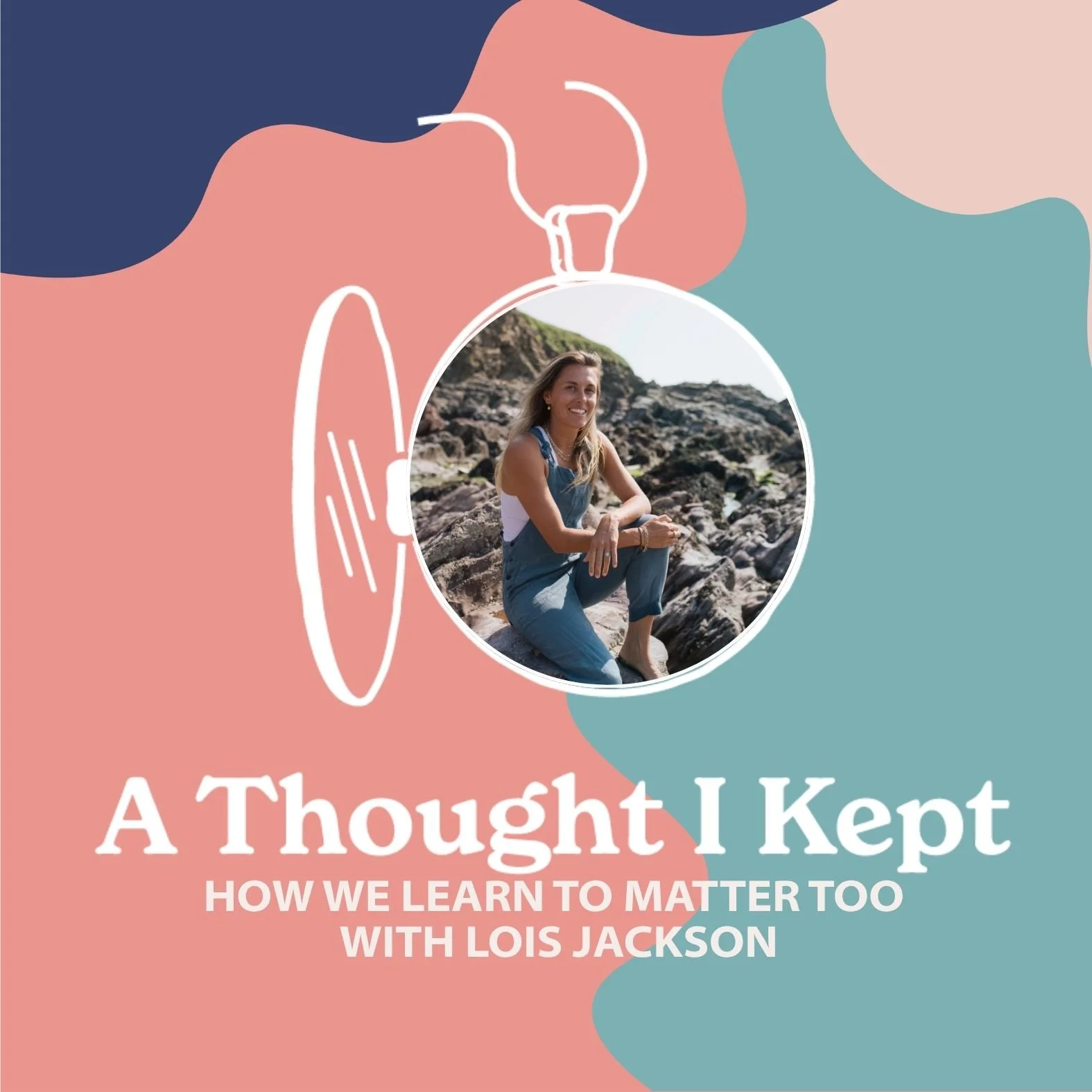
This is the question at the heart of my conversation with Lois Jackson on A Thought I Kept.
In 2017, Lois’s then-fiancé, former professional rugby player Ed Jackson, suffered a life-changing spinal cord injury. Their lives changed almost overnight, and Lois did what came naturally to her: she went into care mode. She booked appointments. She drove Ed where he needed to go. She spoke to doctors. She supported his recovery. When people asked how she was, her answer was simple: “It’s not about me. Ask Ed. I need to look after Ed.”
What struck me in talking to Lois was how little conscious decision there seemed to be in this. She didn’t sit down and decide to erase her own needs. She simply stepped into the role that needed filling, and perhaps the role she had always been good at filling.
I think many of us will recognise this. Losing ourselves rarely happens in one dramatic moment. It can happen gradually, through a thousand reasonable decisions. Someone else needs us more today. This isn’t the right time to bring that up. I can deal with it later. I don’t want to make things harder. I should be grateful. I should be able to cope. And then, one day, we might look at our lives and wonder where we have gone.
For Lois, that realisation came a couple of years after Ed’s accident. From the outside, life had in some ways returned to “normal”, but of course it wasn’t the old normal. Ed was living with the physical and psychological consequences of his injury. His rugby career had ended. Their relationship had changed. Their future had changed.
Lois realised that Ed had changed, their life had changed, but she was still, as she described it, “stuck in old Lois”. She had kept pushing her feelings to the back of her mind because it still felt as though they weren’t relevant.
Eventually, she knew she had to be honest.
The strong one has feelings too
This is often the difficult part. It can feel selfish to acknowledge that supporting someone has been hard when what they have experienced seems harder. We can turn suffering into a hierarchy in which only the person going through the most visible difficulty is allowed to have needs. But emotions don’t work particularly well in hierarchies.
You can love someone deeply and feel exhausted by caring for them. You can be grateful for your family and need time away from them. You can understand why someone is struggling and still be affected by the way their struggle changes your life. You can want to support someone and feel angry, lonely, scared or resentful. The presence of your feelings does not cancel out your love.
Lois had been afraid that being honest would hurt Ed. She was afraid of losing him. There was perhaps also something else underneath it: a fear that she might no longer be able to be the strong one who could handle everything.
But, as she told me, she came to understand strength differently. Sometimes the strong thing is not continuing to cope quietly. Sometimes strength looks like vulnerability. Sometimes it is saying the difficult thing carefully and honestly. Sometimes it is admitting that you are struggling too.
Lois began having those conversations with Ed. She also spoke to a relationship counsellor and started putting into words what she had been pushing away. Rather than destroying their relationship, that honesty became part of rebuilding it. She described it as though their relationship was “born again”.
There is something important here for those of us who have come to associate love with endurance. We can believe that protecting a relationship means protecting another person from our feelings. But what happens to a relationship when one person can no longer fully exist inside it?
What we suppress doesn’t simply disappear
When we repeatedly decide that our feelings are not relevant, they don’t usually go away. They can become exhaustion, disconnection, irritability or resentment. We might become increasingly frustrated with people we genuinely love, while also feeling guilty for that frustration. We might stop knowing what we want because we have spent so long asking what everyone else needs. Sometimes we end up in lives we never really chose.
This doesn’t necessarily happen because someone else chose them for us. It can happen because we made so many decisions around other people that we stopped including ourselves in the decision-making process.
This is why I think Lois’s thought is so important. After years of saying, “It’s not about me,” she realised something else:
It is about me.
Not only about me. Not me instead of you. Not my needs matter and yours don’t. Me as well as you.
There is a significant difference between putting yourself first all the time and remembering to put yourself somewhere in your own life.
Where are you in your own story?
One of the questions I found myself returning to during my conversation with Lois was: Where am I in my own story?
For those of us who are very good at looking outwards, this can be a surprisingly difficult question to answer. We might know what our children need, what our partner is worried about, what is happening at work, what our parents need help with and what is expected of us this week. But ask what we feel, what we need or what we want, and the answers can be much less clear.
Lois now does a lot of work around values, both for herself and with the people she supports. Values can sound like a very abstract idea until we think of them as an anchor: What actually matters to me? What makes me feel alive? What do I want more of? What am I no longer willing to lose?
When we have spent a long time responding to other people’s needs, reconnecting with ourselves may not begin with a dramatic life change. It might begin by noticing.
What am I feeling that I keep dismissing? What do I need that I keep telling myself is unreasonable? Where am I saying yes because I am afraid of what will happen if I say no? What parts of me have become smaller while I have been taking care of everyone else? What would it mean to include myself in the picture?
We may not immediately know the answers. Perhaps the important thing is to begin asking the questions.
You don’t have to wait until everyone else is okay
I think this is one of the hardest beliefs to loosen when you are caring for someone else: the idea that your turn will come later.
I will rest when things calm down. I will think about what I want when they are better. I will ask for help when this difficult period is over. I will return to myself eventually.
But sometimes things don’t calm down for a very long time. One difficult period becomes another. Children need us in different ways. Parents age. Work changes. Someone gets ill. Life continues to be life.
If our wellbeing is always conditional on everyone around us being okay, we may be waiting for a moment that never quite arrives.
Lois has learned to notice her boundaries, to lean on other people and to delegate. She has also learned that putting something back into herself does not have to be enormous. At the beginning of our conversation, after ten emotionally demanding days supporting people on a charity walk, she told me she had just had her hair done. It was a small thing, but it mattered. She had recognised that she needed something put back in.
I loved that because caring for ourselves can become another impossible standard. We imagine it requires a retreat, a perfect morning routine or hours of uninterrupted time we simply do not have. Sometimes it might be a walk. A book. Getting your hair done. Asking someone else to take over. An honest conversation. An hour in which nobody needs anything from you.
Lois also reminded me that rest does not have to look the same for everyone. For her, it might be walking slowly through the woods and paying attention to what she can see, smell and hear. Rest can still involve movement. Support can take different forms. The question is less whether we are doing self-care correctly and more whether there is anywhere in our lives where we are being replenished rather than continually depleted.
Small changes still count
There is another idea woven throughout Lois and Ed’s story: millimetres to mountains.
During Ed’s recovery, progress could be almost imperceptibly small. A finger moving a little more. A toe beginning to wiggle. Changes that were difficult to see from one day to the next, but became visible when they looked back. I think there is something useful in this for anyone trying to find themselves again.
You do not have to completely redesign your life tomorrow. If you have spent years being the person who copes, asking for help once might be a significant step. Saying what you actually feel might be a millimetre. Letting someone be disappointed in your boundary might be another. Doing something because you enjoy it, rather than because it is useful to somebody else, might be another still.
There may be steps backwards too. Lois is clear about that. Progress is not a neat journey in one direction. But once you have evidence that you can do something differently, you have something to return to.
Perhaps the question is not: How do I become someone who always puts myself first?
Perhaps it is: What would help me matter a little more in my own life today?
Maybe being strong was never meant to mean doing it alone
One of the great contradictions of being the strong one is that the more capable you appear, the less likely people may be to realise that you need support. You become the support system rather than someone within it.
But Lois’s work, both through her coaching and through the charity Millimetres 2 Mountains, is deeply rooted in connection. She has seen again and again how much it matters to be around people who understand, to have somewhere you can be honest, and to know that you do not have to carry everything alone.
The same should be true for the supporters. You are allowed to need somewhere to put your feelings. You are allowed to be affected by what is happening to someone you love. You are allowed to want things for your own life even while someone else is struggling. You are allowed to be tired of being strong.
And perhaps strength itself can become something different. Less about holding everything together without complaint, and more about knowing when to let yourself be held too.
Listen to my conversation with Lois Jackson
In this episode of A Thought I Kept, How We Learn to Matter Too with Lois Jackson, we talk about being the strong one, supporting someone through life-changing circumstances, honesty in relationships, identity, rest, hope, nature, joy and what happens when we finally realise that our own feelings and needs matter too.
Listen to the full episode and discover the thought Lois kept: “It is about me.”
Who supports the person who supports everyone else?
If you are used to being the capable one, the person who holds everything together, it can be difficult to know where to take your own emotions. You may not want to burden the people you love, particularly when they are struggling too, but that does not mean you have to keep carrying everything alone.
An emotions coaching session is a space for you. A place to talk honestly about what you are feeling, including the feelings that seem complicated, selfish or difficult to admit, and begin to understand what they might be asking for.
If you need somewhere to be supported while you support everyone else, you can book an emotions coaching session with me at If Lost Start Here.