
What If Being Lost Is Part of Finding Your Way?
When we feel lost often we want to get out of it as quickly as possible. We want the answer, the map, the five-step plan. We want to know where we’re going and preferably how long it will take us to get there.
I understand this. I have spent enough of my own life in uncertain moments to know how uncomfortable it can be not to know what comes next. And it’s something I see all the time in my coaching work too. We arrive at these moments in our careers, relationships, families and lives when the route we thought we were following suddenly stops making sense. We feel stuck, uncertain or overwhelmed and assume that somewhere, somehow, we’ve gone wrong.
But what if getting lost isn’t necessarily the problem?
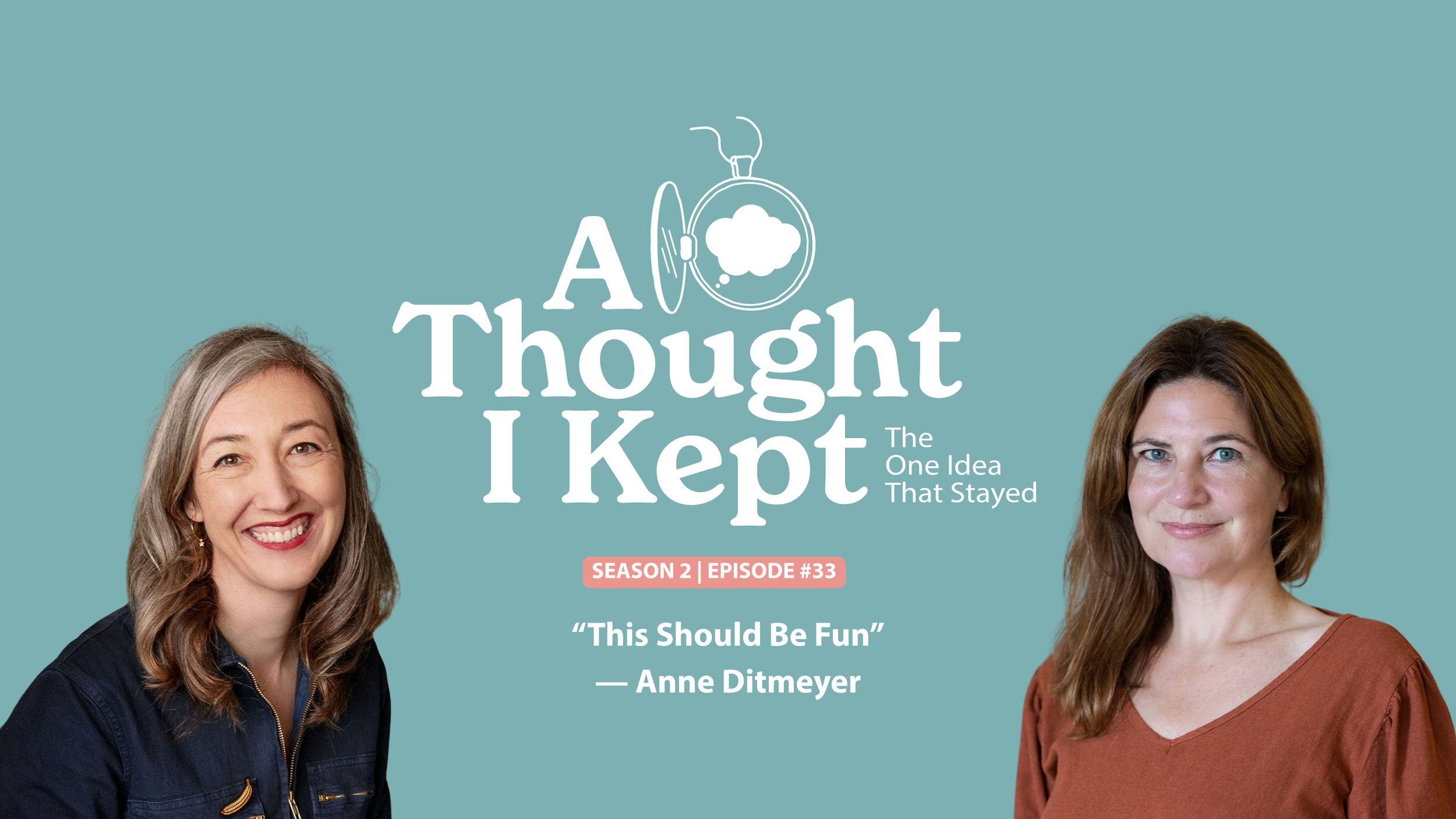
That was one of the ideas I kept returning to during my conversation with Anne Ditmeyer on A Thought I Kept. Anne is a writer, creative coach and workshop facilitator living in Paris, and much of her work is about giving people the confidence to explore, experiment and, quite literally, get lost.
Anne’s thought kept is: “This should be fun.”
It was a mantra used by her grandfather, Charles Stark Draper, the scientist and engineer whose work on inertial guidance systems helped navigate the Apollo missions to the Moon and back. Anne was only six when he died and discovered the phrase much later, after the death of her mother prompted her to start finding out more about him.
Rather than simply following the official paper trail, she began talking to the people who had known him. It became, as she describes it, a scavenger hunt. And through their stories, she discovered not only the scientist she had grown up hearing about, but a man who danced, flew planes, built relationships and approached extraordinarily difficult problems with curiosity and enjoyment.
There was something else that struck Anne too. Her grandfather’s work had been about navigation and exploration. In a very different way, hers was too.
What if you don’t need the whole map?
We tend to talk about lives as if they should be linear. You work hard at school, choose the right university, find a job, progress, settle down, achieve the milestones and keep going. Even when we know intellectually that life rarely happens this neatly, it can still feel unsettling when ours doesn’t.
Anne describes how her grandfather didn’t begin with a perfectly formed plan to help get humans to the Moon. One thing led to another. There were people he met, things he learnt, questions he followed and opportunities he couldn’t possibly have predicted at the beginning.
Our lives can work like this too.
Anne talks about the “messy middle”: the part we often wish we could skip because it doesn’t yet make sense. But sometimes, she says, we need that mess to meet the right person, gain an insight, have an experience or build the skill that takes us somewhere else.
Perhaps feeling lost can be a little like this. It can be the space between the life that made sense before and whatever is emerging next.
That doesn’t necessarily make it comfortable. Anne talks beautifully about “dancing with discomfort”, rather than treating discomfort as evidence that we are doing something wrong. In one of her workshops, she asks people to draw lobsters partly because most of us have absolutely no idea how to draw one. The lobster also gives her a wonderful analogy: as they grow, lobsters have to leave one shell before a bigger one can form.
There is vulnerability in that in-between place. But there is growth too.
What if you followed the detour?
One of my favourite parts of our conversation was Anne’s invitation to think differently about detours.
We’re so accustomed to believing that the quickest, most direct route must be the best one. But Anne talks about rerouting, taking the scenic route and opening the door “just a teeny bit” to another possibility.
This is where being lost starts to feel less like something we have to solve and more like something we might explore.
What happens if, instead of immediately asking How do I get out of here?, we become curious about where we actually are? What assumptions have we been carrying about what our lives should look like? Which expectations still belong to us? What tiny nudges or ideas have we been overriding because they don’t fit the route we thought we were supposed to take?
Anne has a lovely way of describing this as our “internal guidance system”. Her grandfather worked with gyroscopes and inertial navigation systems, and she sees a parallel in our own ability to return to ourselves when the world shakes us around.
After Anne’s mother died, she found a letter her mother had written to her as a teenager. It was addressed to her daughter “born with her own special guidance system”.
I found that incredibly moving because perhaps the work isn’t always to find a completely new direction. Sometimes it’s to hear again what has become very quiet underneath all the noise.
What if being lost could contain possibility?
Of course, not every lost moment feels playful. Sometimes we are lost because somebody has died, a relationship has ended, work has become unbearable or a version of our life we depended upon is no longer available to us.
Anne is very clear that “this should be fun” isn’t about false positivity. Her own story contains profound grief. Instead, she talks about allowing multiple things to be true: that something can be hard and there can still be beauty; that we can grieve and connect; that we can be uncertain and occasionally delighted by what we discover.
Maybe we can be lost and finding our way at the same time.
I think that is what I took most from this conversation. We don’t always need to respond to feeling lost by gripping the map more tightly. We might need to wander. To take one small step before we understand where it leads. To notice what interests us. To follow an unlikely connection. To draw something badly. To go for a walk. To let ourselves admit, as Anne sometimes does, I’m not really sure right now, while trusting that something will come.
Because clarity, as Anne reminds us, doesn’t always come from thinking harder about our lives. Sometimes it comes from moving through them.
Listen to my full conversation with Anne Ditmeyer on A Thought I Kept: “This Should Be Fun”.
And if you’re feeling lost yourself, our book If Lost, Start Here: Wellbeing for the Anxious, Disconnected or Uncertain was created for exactly these moments. Rather than giving you another prescribed route to follow, it offers ten different pathways through wellbeing — including creativity, play, connection, nature, purpose and awe and wonder — so you can start with whatever feels possible or interesting to you right now.
You don’t have to know where it will lead. Sometimes you just need somewhere to start.