
There Is No One Right Way to Be: Spirituality, Purpose & Feeling Lost
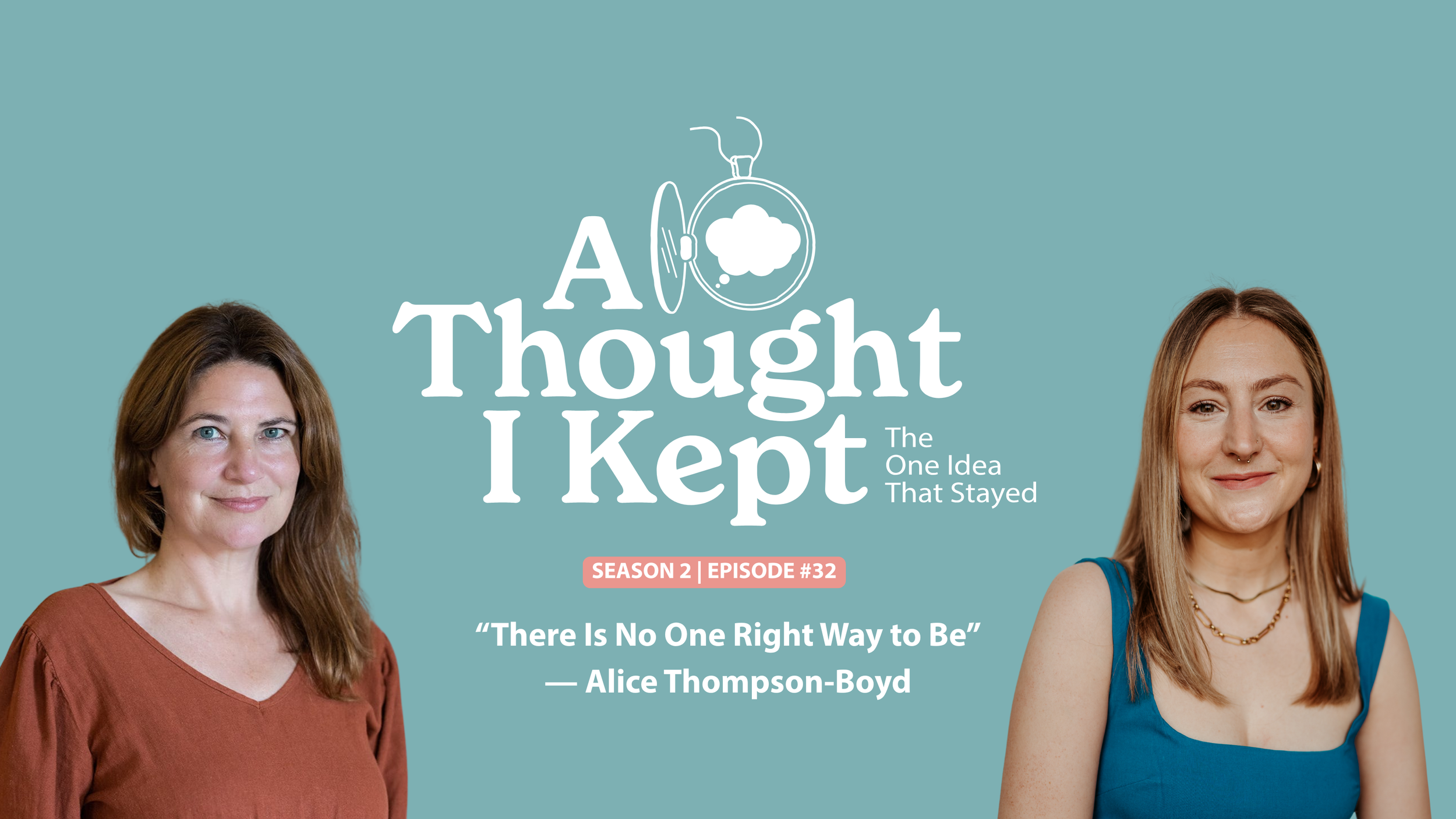
Have you ever arrived at a moment in your life when you thought that you’d feel ok, but you just didn’t?
We can build the career, achieve the goal, do work that genuinely matters, even create something successful, and still find ourselves asking difficult and confusing questions about who we are, what we need and where we’ve gone. Sometimes, as I discovered in my conversation with Alice Thompson-Boyd on A Thought I Kept, it can feel as though we have somehow disappeared out of our own lives.
Alice knows something about that experience. In her twenties, she co-founded Social Bite, the Edinburgh social enterprise supporting people experiencing homelessness. It grew into an organisation with more than 100 employees, celebrity supporters including George Clooney and Leonardo DiCaprio, awards, honorary doctorates and a level of impact that most of us would probably look at from the outside and call extraordinary.
And yet Alice was struggling. Alongside work that was changing other people’s lives, she experienced anxiety, burnout, panic attacks and a growing disconnection from herself. Eventually she stepped away from Social Bite and from the identity she had spent almost her entire adult life building.
What came next wasn’t another big mission. It was a much more internal question: who was she without all of that?
When we start looking for something deeper
It was after leaving Social Bite that Alice encountered the Enneagram, a system for understanding nine different patterns of human motivation and experience. She describes it as something that began almost accidentally and then became impossible to put down.
What interested me most in our conversation wasn’t really whether you believe in the Enneagram or whether you know your number. It was what Alice found through it: a different way of understanding herself.
For years, she had been trying to work out the right way to be. How should she show up to get the connection, approval and validation she longed for? How could she be one version of herself for one person and another for somebody else? What was she getting wrong?
The Enneagram offered her a surprisingly liberating answer: perhaps there wasn’t one right way to be at all.
It helped Alice see that the people around her weren’t necessarily looking at the same situation and reaching different conclusions. They might actually be experiencing that situation from a fundamentally different internal perspective. Their needs, fears, motivations and ways of making sense of the world could be different from hers.
There’s something very freeing in that. We don’t have to keep twisting ourselves into the person we imagine everyone else needs us to be. And other people don’t have to become more like us before we can understand them.
Spirituality doesn’t have to be about having the answers
This is where our conversation began to feel less like one about personality typing and more like one about spirituality.
Alice talked about how little time we seem to have now to sit around thinking about what it means to be human. We are behind screens, rushing between things, consuming information, producing, achieving, responding. There isn’t always much space left for the bigger questions.
And perhaps that helps explain our renewed interest in things like the Enneagram, astrology, Human Design and other systems for understanding ourselves. We are looking for depth. For connection. For something that helps us make sense of being here.
Of course, these systems can become another form of self-improvement. Another test to pass or way of deciding what is wrong with us. Alice makes an important distinction here. For her, the deeper she has gone into the Enneagram, the more she has realised that the point isn’t to fix herself. In fact, she suggests that our obsession with fixing ourselves can become part of the suffering itself.
Instead, she sees it as an invitation to become more aware of the patterns we inhabit and a little less confined by them. Not to put ourselves into a box, but to notice the box we may already be living inside and discover that there might be more room than we realised.
Remembering that we are part of something bigger
There was one moment in our conversation when Alice talked about zooming out far enough to see Earth as this small, vulnerable thing floating in space. From there, all the divisions and identities that can feel so convincing in everyday life begin to look rather different.
We are here for such a tiny amount of time. We are part of nature rather than separate from it. We are part of something much larger than the jobs we do, the things we achieve or the identities we work so hard to maintain.
I think that is one of the reasons spirituality is one of the ten pathways we explore in our book If Lost, Start Here. Not because Amanda and I believe there is one particular spiritual practice we should all follow, but because when we feel anxious, disconnected or uncertain, it can help to look beyond the immediate boundaries of our own lives.
Spirituality might mean religion. It might mean nature, ritual, meditation, philosophy or simply making space to wonder about the bigger questions. It might be standing under a huge night sky and remembering your scale within things. It can offer us somewhere to put the questions that don’t necessarily have neat answers.
And perhaps that matters particularly in a culture so interested in answers, solutions and fixing.
What happens when we stop trying so hard?
Alice told me that these days fulfilment increasingly looks like doing less. Walking the dog. Making dinner. Having nowhere she needs to be that evening. Stripping things away rather than continually adding more.
She also notices when she has forgotten the deeper lessons of the Enneagram because she gets fast. She starts rushing everywhere, trying to do everything. Remembering it asks her to slow down, become present and disentangle herself for a moment.
I keep thinking about that because it feels like such a useful measure. Not Have I found my purpose? or Have I finally become the right version of myself? But: am I here? Am I present in my own life? Do I feel connected to myself, other people and the world around me?
Perhaps spirituality can help us with that. Not by giving us another set of things to get right, but by reminding us that there was never only one right way to be in the first place.
Listen to my full conversation with Alice Thompson-Boyd on A Thought I Kept, where we explore the Enneagram, burnout, purpose, conviction, doing less and what happens when we stop looking outside ourselves for the answer to who we should be.
And if you’d like to explore spirituality in your own life, it’s one of the ten pathways in our book, If Lost, Start Here: Wellbeing for the Anxious, Disconnected or Uncertain — a place to explore what might help you feel more connected, grounded and part of something beyond yourself.