
When Everything Becomes Something You Should Be Doing
What happens when the things we're doing to make our lives better start making them feel harder instead?
I should go for a walk. I should be more present with my children. I should be doing more exercise. I should see my friends more often. I should be better at switching off. I should spend less time on my phone. I should really try meditating again.
And that's before we've even got to all the things we should be doing at work, in our relationships, with our money, or with the rest of our lives. All the things we should have achieved by now, the people we should be more like, the ways we should be spending our time. Even the things we do for pleasure can start to feel like another thing we're supposed to be getting right.
The strange thing is that many of these are perfectly lovely things to want. Some might make our lives better. But somewhere between wanting to do something and feeling that we should, something changes. What might have been enjoyable becomes another obligation, another expectation, another thing to add to a list that was already rather long.
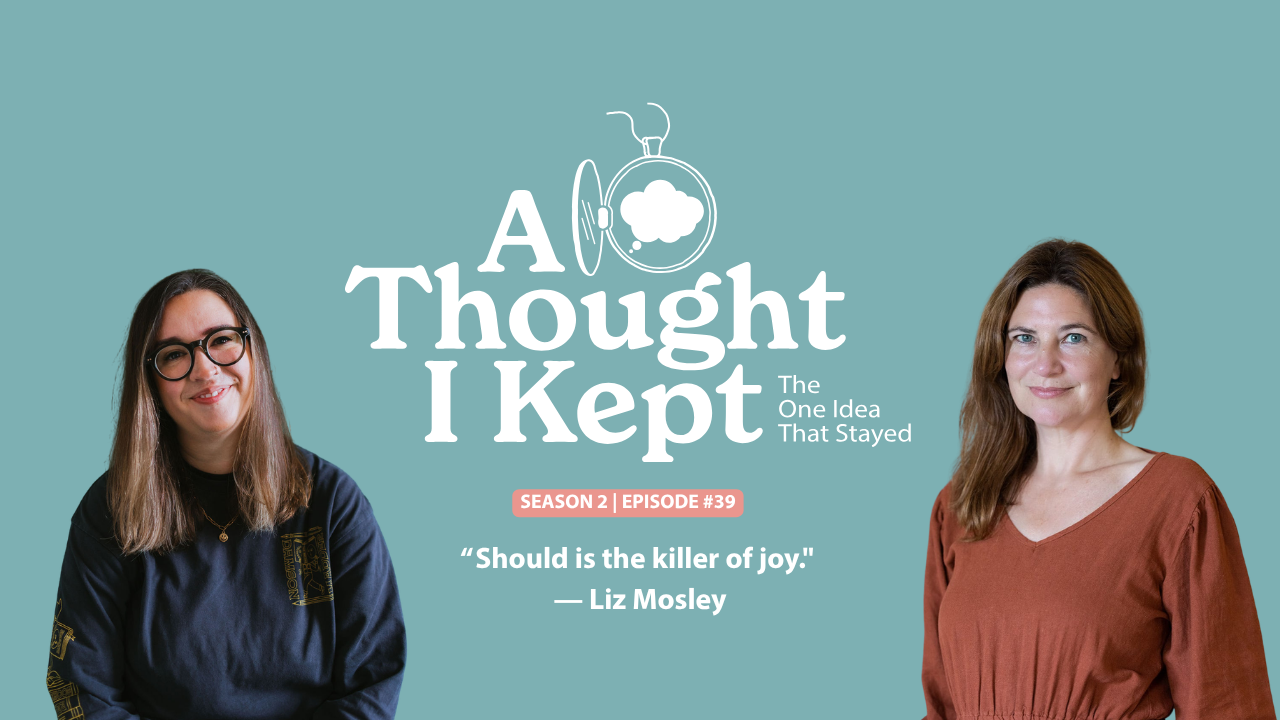
I've been thinking about this since my conversation with graphic designer, speaker and podcaster Liz Mosley on A Thought I Kept. Liz brought a thought she'd first heard from joy coach Sophie Cliff on her own podcast, Building Your Brand:
"Should is the killer of joy."
It's a thought that has stayed with her ever since, and one that has made her notice just how many shoulds are quietly shaping her own life.
Whose shoulds are we following?
When I started A Thought I Kept, there were all these shoulds I thought I had to follow. How I should introduce a podcast, how I should have a conversation with someone, even how I should introduce myself. I'd listen to advice, look at what other people were doing and try to work out what the right way was. But the more I followed these rules, the more I felt something quietly disappearing inside me. The creativity, the enjoyment, the very reasons I'd wanted to make a podcast in the first place.
I'd experienced something similar when I moved from working in museums and galleries into the wellbeing world. Suddenly there was a whole new language to learn and a seemingly endless number of ways I was supposed to be doing things. There were courses to take, marketing funnels to build, emails to send and strategies to follow. I remember opening emails about marketing and feeling slightly dead inside. This wasn't who I was, and yet there I was, following the breadcrumbs towards a version of success that I wasn't even sure I wanted.
Liz recognised this immediately. She talked about looking at successful men in her industry and assuming that she should be marketing herself, sharing her work and running her business in the same way. It took a conversation with a friend to make her realise that she didn't have to do any of those things. She could find her own way, even if she didn't yet know exactly what that looked like.
And I wonder how often we're doing something similar in other parts of our lives. Following ideas about what makes a good mother, a good partner, a successful woman, a healthy person, a happy person. There are so many versions of how we're supposed to be living, and so many places to find them, that it can become so difficult to hear what we might actually want underneath all the noise.
What happens when should becomes could?
One of the things I loved most about Liz's response to Sophie Cliff's thought is how simple it is. She's started replacing should with could. Not only in the things she tells herself, but in the advice she offers other people too.
She noticed that when she spoke to friends, she'd often say things like, "Oh, you should try this." It was coming from a good place. She'd found something interesting or useful and wanted to share it. But she began to realise that she might also be adding another thing to someone's already rather long to-do list, something that might not even be right for them. So now she tries saying, "You could try this" instead.
It's such a small change, but there's something quite extraordinary about how differently those two words feel. Should comes with an expectation. It suggests there's a right way, and perhaps we're not doing it. Could offers a possibility. There's room to consider it, to try it, to decide it isn't for us, or to discover something entirely different.
I think about this particularly in relation to wellbeing. We know so much more now about the things that can support us emotionally, mentally and physically, and I'm fascinated by all of it. But I also wonder whether, in trying to feel better, we sometimes end up creating more pressure for ourselves. We should be walking, sleeping, journaling, exercising, meditating, connecting, resting. And if we're not doing those things, perhaps we're getting wellbeing wrong too.
What if we could approach some of these things with a little more curiosity instead? We could go for a walk because we fancy being outside. We could try journaling because there's something on our mind. We could say no to something because we'd rather have an evening at home. Or we could decide that none of those things are what we need today.
What if joy isn't something we have to earn?
Another part of our conversation that stayed with me was Liz's relationship with joy. I asked her whether we sometimes treat joy as though it isn't quite enough. As though enjoyment isn't a sufficient reason to do something, particularly when it comes to work, where we're often encouraged to value productivity, achievement and consistency above almost everything else.
Liz talked about how important play and fun have been in building a business she can sustain. She's tried lots of different approaches to marketing, but the thing she's been most consistent with is her podcast. Not because she's particularly disciplined about it, but because she loves doing it. She loves the conversations, the people she meets and the things she learns along the way. There are parts of the process she doesn't enjoy, of course, but there's enough that she does to keep her coming back.
I recognised this immediately. For years, I'd been telling myself that I wasn't particularly consistent. I wasn't posting often enough, launching things in the right way or following the strategies that seemed to work for everyone else. And yet I've been making a weekly podcast for over a year and a half. I love these conversations. There's an aliveness in them, and they connect with my values and how I want to spend my time. As Liz put it, the joy brings the consistency rather than the should bringing the consistency.
And I wonder whether we've got something rather backwards. We so often imagine joy as something we'll get to eventually. When the work is finished, when the children are older, when we're less busy, when we've achieved whatever it is we're working towards. Perhaps we'll find it on holiday next year, or over a weekend when there's nothing else to do. But what if joy could be part of how we do things in the first place, rather than something waiting for us at the end?
Liz was careful to distinguish this from the idea that we should be happy all the time. She talked about joy as something foundational, something that comes from living and working in ways that reflect our values. That doesn't mean there won't be difficult days, mistakes, frustrations or things we really don't want to do. In fact, she spoke beautifully about how those experiences can be part of finding our way towards something that matters to us.
I think that's an important distinction, particularly when we're already feeling overwhelmed. Because the last thing any of us needs is to turn joy into another should. Another expectation to feel something we're not feeling, or to make every moment meaningful or enjoyable. Perhaps joy is less about how we feel all the time and more about whether there's room in our lives for the things that make us feel like ourselves.
Making a little more room for ourselves
Towards the end of our conversation, I asked Liz about saying no. She described herself as a recovering people-pleaser and talked about turning down opportunities that looked wonderful from the outside but weren't right for her or her family. The sort of things other people might think she was crazy to refuse. But rather than feeling she'd missed out, she found those decisions surprisingly empowering.
What I loved was how she described the experience. Saying no wasn't simply about protecting her time or setting a boundary. It was about making space for something else. Something that might be more interesting, more enjoyable or simply more right for her.
And perhaps that's what questioning our shoulds can offer us too. Not a completely different life or another self-improvement project, but a little more room to notice what we want, what matters to us and what we might be ready to let go of. Because if we're spending so much of our time trying to meet expectations that aren't really ours, I wonder how much space is left for the things that are.
Liz's thought has made me more aware of the shoulds that slip into my own thinking, often without me noticing. And I'm curious about what happens when I start to question them. Not because every should is wrong, or because we can simply abandon all the things we need to do, but because perhaps we have more choice than we sometimes realise.
So the next time you catch yourself thinking, "I should be doing that," perhaps you could wonder where that thought came from. Whether it's something you actually want. Whether it fits with the life you're living, rather than the one you think you're supposed to be living.
You might discover it's something you still want to do. But you might also find there's something else you'd much rather make room for. And perhaps that's where a little more joy begins.
Listen to the conversation
In this episode of A Thought I Kept, I talk to graphic designer, speaker and Building Your Brand podcast host Liz Mosley about the shoulds we inherit, finding our own definitions of success, creative confidence, rejection, people-pleasing and what happens when we begin doing things our own way.
Explore more with If Lost, Start Here
If you've been feeling overwhelmed, anxious or uncertain about where you are in life, our book If Lost, Start Here: Wellbeing for the anxious, disconnected or uncertain offers creative ways to explore what you need, what matters to you and where you might want to go next.