
How Creativity Helps When You Feel Lost, Overwhelmed, or Disconnected
Creativity isn't just for artists. Discover how creative practices can support wellbeing, reduce overwhelm, and help you reconnect with yourself when life feels noisy or uncertain.
Sometimes the problem isn't that we don't know what to do. It's that we've heard so many voices telling us what we should do that we can no longer hear our own. The productivity experts. The wellbeing experts. The people on social media who seem to have figured it out. The friends with strong opinions. The endless stream of advice arriving through podcasts, newsletters, books, and algorithms. None of it is necessarily wrong. In fact, much of it may be thoughtful, useful, and well-intentioned. But there comes a point where all of that input can begin to drown something out.
Our own voice.
We stop noticing what we think because we're busy collecting what everyone else thinks. We stop paying attention to what we need because we're trying to keep up with what everyone else appears to need. We become disconnected. Not dramatically. Not all at once. Just gradually. A little further away from ourselves than we realise.
This was one of the themes that stayed with me from a recent conversation with Claire Venus, founder of Creatively Conscious. Although we talked about creativity, online life, burnout, visibility, trust, and self-expression, underneath all of it was a question that feels increasingly important:
How do we stay connected to ourselves in a world that is constantly competing for our attention?
The Cost of Overriding Ourselves
One of the most powerful ideas in the conversation was surprisingly simple. Claire talked about paying attention to what feels uplifting and what feels tightening. What expands us and what contracts us. What feels like ours and what feels like something we've absorbed from somewhere else.
It's easy to dismiss this as a small thing.
But many of us have become remarkably skilled at overriding those signals. We push through exhaustion. We say yes when we mean no. We follow advice that doesn't fit. We continue with projects that drain us because we've already invested so much time. We force ourselves to be consistent when what we really need is rest. Eventually, we stop asking ourselves a very important question:
How does this actually feel?
Not how it looks. Not whether it's impressive. Not whether someone else would approve.
How does it feel?
Because our bodies often know something long before our minds catch up.
Creativity Is Sometimes a Form of Reconnection
When people hear the word creativity, they often think of art: Painting. Writing. Music. Design. But creativity can be something much broader than that. It can be the act of making space for yourself again.
A notebook opened at the end of a difficult day.
A walk without headphones.
A garden.
A sketchbook.
A conversation.
A few quiet minutes spent wondering what you actually think about something.
Creativity creates room. And for people who feel overwhelmed, burnt out, anxious, or disconnected, room can be surprisingly healing. Not because it fixes everything. But because it allows us to hear ourselves again.
What If The Goal Isn't To Push Harder?
Many of us have absorbed the idea that if something isn't working, we simply need to try harder.
Be more disciplined. More productive. More consistent. More efficient.
Yet Claire challenges that idea in a way I found refreshing. She describes consistency as one of the biggest myths of modern creative life, arguing instead that what matters is understanding your own creative practice and your own rhythms.
That feels relevant far beyond creativity.
Because perhaps the question isn't:
"How do I make myself keep going?"
Perhaps the question is:
"What do I need in order to thrive?"
Those are very different questions.
One asks us to override ourselves. The other asks us to listen.
Finding Your Way Back
If you've been feeling disconnected lately, maybe the answer isn't another strategy. Maybe it isn't another expert. Maybe it isn't another thing to optimise. Maybe it's simply paying closer attention.
To what lifts you up.
To what drains you.
To what feels alive.
To what feels like yours.
Sometimes finding our way back to ourselves begins with noticing what we've stopped noticing. And perhaps that's what being creatively conscious really means. Not becoming a different person. Just becoming more aware of the one who's already here.
Listen to my full conversation with Claire Venus on A Thought I Kept: How We Stay Creatively Conscious.
And if you're feeling lost, overwhelmed, creatively stuck, or unsure what you need next, our wellbeing sessions offer space to explore what might help you reconnect with yourself. Creativity often becomes part of that conversation.

Goodwood Art Foundation
Discover the Goodwood Art Foundation, a feel-good creative destination blending contemporary art, nature and wellbeing on the Goodwood Estate in West Sussex. Explore a stunning landscape of thoughtfully curated artworks that encourage a sense of curiosity.
Perfect for
Art lovers, nature wanderers, the creatively curious and the quietly overstimulated.
For anyone craving inspiration with less noise and a way to feel more connected—to the world around you, to ideas and to yourself.
Why you’ll love it
The Goodwood Art Foundation isn’t just a gallery in the traditional sense — though you’ll find two stand-out exhibition spaces here — but also an invitation to experience art in a natural setting.
Set across the rolling chalk hills of the Goodwood Estate, it’s a space where sculpture and landscape meet in quiet conversation. Here, you get to wander at your own pace, following one of the three sign-posted trails. As you seek out the next sculpture, you’ll walk through ancient forests or wildflower meadows, coming across a natural amphitheater, chalk quarry and cherry grove as you do so. Pause a while and sit with something unexpected — an enchanting soundscape hidden in the trees perhaps or a view to the sea in the distance.
For the opening, Ann Gallagher, the former director of collections of British Art at Tate, has sensitively installed works by major contemporary artists — including Veronica Ryan, Rose Wylie and Isamu Noguchi — within the natural setting. There’s also a stunning solo exhibition of Rachel Whiteread, the first woman to win the Turner Prize.
What makes it special
Leading landscape designer Dan Pearson has created a 70-acre landscape that shifts according to 24 2-week botanical seasons. You’ll get a sense of how the land, the weather, the seasons and light all interact as you visit at different times of the year.
It’s the kind of place where you leave feeling lighter—and perhaps even a little rewilded, inside and out.
The story behind it
The Goodwood Art Foundation, newly opened in May 2025, is a non-profit on a mission to “foster wellbeing, creativity and lifelong learning for people of all backgrounds and abilities, through engagement with art and connectedness to nature.”
Founded by the Duke of Richmond and Gordon, the Goodwood Art Foundation is gounded in three pillars: art, environment and education, and explores how these can better support our physical and mental wellbeing, creativity and capacity to learn.
The If Lost take
We believe creativity is a form of self-care. There’s a palpable sense of permission here: to explore, to wonder, to allow ourselves to just be.
It’s also one of those rare spaces that nourishes your nervous system and your imagination at the same time.
Everything about it moves slowly, intentionally. There’s no rush. And that’s very much the point.
It’s a full-body exhale kind of place.


Practical details
Location: Situated within the Goodwood Estate near Chichester, West Sussex (also home to world-class motor and horse racing.)
Top tips: Wear comfortable shoes and dress according the weather forecast. There are indoor spaces but you’ll be spending a lot of time outdoors.
Check out Cafe24 for a full-menu with ingredients sourced from Goodwood’s regenerative farm. It’s located in a stunning steel-clad building designed by Studio Downie Architect.

Know somewhere that helps people feel better?
Nominate your favourite creative or feel-good place—or apply to be featured in the guidebook. Complete this form.

Charleston
Step inside Charleston, the historic home of the Bloomsbury Group, where art, literature, and radical thinking shaped a new way of life. This beautifully preserved house and garden in East Sussex offers an immersive experience in creativity, from hand-painted walls to inspiring exhibitions.
Perfect For
Anyone who loves art, history, and a bit of creative rebellion. If you believe that life itself should be an artwork, you’ll feel right at home here
Why You’ll Love It
More than just a house, Charleston is a living, breathing piece of art history—once the home of the Bloomsbury Group, a radical collective of artists, writers, and thinkers who redefined creativity, relationships, and modern life. Every inch of the house, from painted walls to hand-decorated furniture, tells a story of rebellion, artistic freedom, and a refusal to follow convention. It’s a place that invites you to step inside a world where creativity had no limits—and to leave inspired to create your own.
What Makes It Special
An artist’s dream home – Charleston isn’t just decorated; it’s painted from floor to ceiling, inside and out.
The garden is a creative project in itself too – Designed by Vanessa Bell and Duncan Grant, it’s full of colour and sculptural beauty.
A hub for creative minds today – From literary festivals to exhibitions, Charleston is still very much alive, a gathering place for ideas and imagination. Check out their events for up-to-date information.
The Story Behind It
In 1916, artists Vanessa Bell and Duncan Grant left London behind and moved to Charleston with their unconventional household. What started as a rural retreat became the heart of the Bloomsbury Group, where Virginia Woolf, John Maynard Keynes, and E.M. Forster would visit, debate, and create. Unlike the rigid, buttoned-up world of their time, Charleston was a space of artistic and personal freedom, where boundaries were blurred, rules were broken, and the walls—quite literally—became the canvas. Today, it stands as a testament to the power of living creatively, without constraints.
Something Else We Love
The Charleston shop is a treasure trove for lovers of art, literature, and design, with prints, ceramics, and homewares inspired by the house itself. But our favourites? Their fabric collection. If you’ve ever wanted to wrap yourself in Bloomsbury-inspired patterns, this is your chance. Their notepads make sweet gifts and make you feel like you’ve borrowing a little of their creativity. And we couldn’t resist buying Deceived with Kindness by Vanessa Bell’s daughter Angelica Garnett when we stopped by to better understand what it was like to grow up here.
The If Lost Take
We love Charleston because it’s not just a museum—it’s a manifesto for a different way of living. The Bloomsbury Group believed in art as a way of life, in challenging convention, and in finding beauty in the everyday. Stepping into Charleston is stepping into a world where those ideas are still alive and waiting for you to take them home.
Some Practical Details
Firle, East Sussex, UK
P.S.
If you visit, check out some of our favourite local places in nearby Lewes:
For independent shopping: Nord, Leadbetter & Good, Closet and Botts and From Victoria
For coffee: Trading Post Coffee Roasters
For eco-conscious snacks: Seasons
For a little bit of nature: Bulb Florist
For children’s books: Bags of Books
For culture (and lunch): The Depot
For artisan breads and pastries: Flint Owl Bakery

The Barbara Hepworth Museum & Sculpture Garden
Step into the world of sculptor Barbara Hepworth at her preserved home and studio in St Ives. The Barbara Hepworth Museum & Sculpture Garden offers a rare glimpse into the artist’s life, with her untouched workshop, iconic sculptures, and a breathtaking garden space.
Perfect For
Anyone who wants to be immersed in the story of art, seek out The Barbara Hepworth Museum & Sculpture Garden in St Ives. If you’ve ever wondered what it’s like to create something truly lasting, this is your place.
Why You’ll Love It
Tucked away in the heart of St Ives, this isn’t just a museum—it’s an escape into the mind of one of the UK’s most celebrated sculptors. Barbara Hepworth lived and worked here for the last 26 years of her life, and stepping into her home and garden feels like stepping into her world. From the intimate, light-filled studio to the lush outdoor sculpture garden, every part of this space invites you to slow down, breathe deeply, and see the world as she did—through form, texture, and movement.
What Makes It Special
A sculptor’s world, frozen in time – Hepworth’s workshop remains untouched, complete with tools, unfinished pieces, and even her white work coat, as if she just stepped out for a moment.
The sculpture garden – A hidden oasis where her iconic stone and bronze works sit between tropical plants, perfectly framed by Cornish light.
Awe in the everyday – Hepworth’s work invites you to pay attention, whether that’s noticing the shadows, reframing space, and seeing shape in a whole new way.
The Story Behind It
After Hepworth’s sudden passing in 1975, her wish was clear—she wanted her home and studio to remain as she left it, a place where people could experience her work in the environment that shaped it. Honouring this, the Barbara Hepworth Museum was established later that year by her family, with Tate taking over its care in 1980. Today, it stands as one of the most personal and intimate artist museums in the world, a place where her legacy is preserved not just in her sculptures, but in the very air of the studio she worked in.
Something Else We Love
It’s not just about the art—it’s about stepping into Hepworth’s way of seeing the world. One of the most moving parts of the experience? Seeing her unfinished works, left exactly as they were when she passed, mid-creation. It’s a rare, raw glimpse into the mind of an artist, proof that the creative process is never truly finished.
The If Lost Take
We love the Barbara Hepworth Museum because it’s not just about seeing art—it’s about experiencing the world through an artist’s eyes. Hepworth believed in sculpture as something to be lived with, and this place brings that philosophy to life. Whether you’re an art lover or just someone seeking a moment of quiet awe, this is a space that lingers with you long after you leave.
Some Practical Details
St Ives, Cornwall, UK
P.S.
If you do visit, also check out our favourite local places:
For coffee: The Yellow Canary and Yallah Coffee.
For morning pastries, artisan loaves and of course Cornish pasties: St Ives Bakery
For browsing: independent book shop St Ives Bookseller.
And of course, another awe-inspiring cultural destination: Tate St Ives.

Mood & Moves Dance Co.
Explore your mood through dance at Mood & Moves, a creative studio in San Francisco. Founded in 2020 by Marcella Palazzo, the studio promotes creativity, self-expression, and well-being through empowering and fun dance experiences.
Go here if: You’re curious about exploring your mood through dance and having fun as you do so.
What is it: Mood & Moves is a dance studio and creative space in the heart of San Francisco founded in 2020 by Marcella Palazzo. They offer dance classes and host monthly workshops as well as pop-up classes in various styles of dance. They also provide 1:1 and group private lessons for a customized experience.
Why you need it: Mood & Moves inspires creativity and individuality. Classes are empowering and promote dancing as self-expression, passion, and self-enjoyment for better overall well-being
What else do they offer: Their studio is a blank canvas for creatives of all kinds to bring their vision to life. Whether you're a photographer, dancer, artist, or filmmaker, the studio is a big open space for you to turn your idea into reality. Studio rentals are available 7 days a week for all things creative! You can rent the space by the hour for rehearsals, photoshoots, video shoots, fitness, workshops, and more.


What makes it different: Whether you're renting the studio space or taking a class, you will feel like a star. The facilities are inviting, stylish, and clean. Need a costume change? Step into their Hollywood-themed dressing room. Hosting an event with refreshments? Take advantage of the kitchenette. Ready for your video? Take one in front of their marquee letters. Dancing for the first time ever? Their instructors are ready to take your hand!
How Mood and Moves Dance Co can inspire you, wherever you are: Founder Marcella Palazzo and her group of advanced dancers create concept videos in all styles of dance. The Mood & Moves signature style is featured in these videos, and can be enjoyed by people watching anywhere in the world! You’ll get to experience their passion for creating a performance that makes you feel something, and hopefully become inspired to dance/create as well wherever you may be!
Behind the space
We asked Founder Marcella Palazzo for the story behind Mood and Moves Dance Co.
“Before opening my studio, dance has always been my passion and form of self-expression. I always feel the most like myself when I'm dancing.

As I got older I developed an even greater passion for choreography and watching the ideas in my head come to life. It is my main goal to provide a space for other creatives to dance and bring their visions to life in a world that doesn't always prioritize the arts.
At the end of the day, I lead my art and business with my heart. Whether I'm creating choreography, teaching a class, or prepping for a rental, I give it my all.
If something doesn't feel authentic, I won't do it. I care about the quality of learning my students are receiving, choreography that reflects who I am, and a studio that is always ready to make other people's visions happen.
I hope that through my videos, classes, and studio people can feel my passion for the industry and the art!”
Where inspires you?
“When I'm not feeling like myself I take a break from creating and allow myself to just be.
I usually spend time in nature, read a fictional book, watch a new movie, or go see an artistic performance. I let my mind wander and become inspired by something I experienced doing these activities.”
Mood and Moves Dance Co.
264 Dore Street
San Francisco, CA 94103
USA
The monthly Heels/Burlesque Workshop takes place every second Sunday of the month.
Pop Up Classes with guest instructors are always updated/posted on the website, Instagram, & newsletter
The studio is available for rent 8 am-10 pm 7 days a week.

The Creativity Cure | How creativity can positively impact your well-being
Learn how to fold more creative activities into your everyday life, so that you can feel happier.
In the moments when we feel most stuck or disconnected, we can overlook how turning to creative practices could help us feel better.
Engaging in creative activities has been found to boost mental health, improve our mood, and help us feel more connected to ourselves and the world around us.
Sometimes though the routine of work, chores, and responsibilities can leave little room for creativity and self-expression. We can get caught in a cycle of endless tasks and relentless deadlines.
If we also have a natural interest in creative pursuits, we can find this lack of an outlet leads us to feel blocked and uninspired. We can start to miss the joy of creating for the sake of creating.
5 Ways to access the well-being benefits of creativity
If you’re curious about exploring your own creativity for well-being purposes, or you long to reconnect with your artistic side, here are some steps to get you started.
1. Try New Creative Outlets:
Experiment with different creative activities, such as painting, writing, dancing, or playing a musical instrument. Trying new things can spark your creativity and open up new possibilities.
2. Set Aside Creative Time:
Make time for creativity in your daily routine. Set aside a specific time each day or week for creative activities, and treat it as a non-negotiable part of your schedule.
3. Join Creative Communities:
Connect with others who share your creative interests. Join local art classes, writing groups, or online communities where you can share your work and get inspired by others.
4. Embrace Imperfection:
Don't worry about creating something perfect. Allow yourself to experiment, make mistakes, and have fun with the creative process. The goal is to enjoy the activity itself, not just what it produces.
5. Seek Inspiration:
Surround yourself with inspiration by visiting museums, attending concerts, reading books, or exploring nature. Inspiration can come from anywhere, and exposing yourself to new experiences can fuel your creativity.
Creativity offers numerous ways to reconnect with yourself, other people, and the world around you.
How could you fold more creative activities into your everyday life, so that you can feel happier?
Find your way to more creativity
Creativity is one of our company’s core values. It’s also one of the areas of our lives that we explore in our online well-being course Find Your Way.
Here’s just a glimpse into how we’ll help you explore more creativity in your everyday life so that you can feel good.
If you’re curious about how to bring more creativity into your life for better well-being, learn more about Find Your Way here.

How journaling can positively impact your well-being
Discover how expressive writing can boost mental health and creativity. Learn how this simple practice helps deepen awareness, process emotions, and unleash imagination. Explore key exercises for immediate well-being benefits.
I recently attended a Writing Workshop for Well-being at The Write Place in Frome led by Christina Sanders, an educator, poet, and fiction writer. During a Saturday morning session, both seasoned writers and complete beginners explored how the simple act of putting words on a page can help us connect with the wonder of life, slow down, deepen our awareness, and unleash our imagination.
James Pennebaker, a social psychologist, was one of the first to highlight the emotional benefits of expressing our thoughts and feelings through writing. His studies, along with those of others, have demonstrated that expressive writing can help us feel less isolated, identify our emotions, and connect with our needs. Moreover, it can assist in processing trauma and alleviating depression.
Writing is a powerful, generative practice. It helps us make sense of our thoughts and feelings, allowing us to write to understand, to get unstuck, and to be curious. Writing encourages us to pay attention to what’s happening inside us as well as in the world around us. And importantly, it can be a source of fun, enabling us to play with our imaginations and give our minds the freedom to roam—even into silliness!
One of the most remarkable insights from the workshop was how quickly writing could create a positive shift. Although the workshop lasted three hours, the actual exercises were just 5 to 10 minutes long. Even these brief exercises were enough to bring about a sense of well-being.
Below, I’ve included five short exercises adapted from Christina’s prompts. These combine freewriting—where you keep writing without stopping, letting whatever comes up flow onto the page—with journaling exercises.
Five Short Writing Exercises for Well-being
Five-Minute Freewrite:
Set a timer for five minutes
Start writing and don’t stop until the timer goes off.
Write whatever comes to mind without worrying about grammar or structure. Just let your thoughts flow.
Write a dialogue:
Take as your subjects the different parts of yourself (e.g., your anxious self and your calm self). This can help you explore inner conflicts and find resolutions. This can also support you in better understanding your inner dynamics and find balanced solutions.
Identify two aspects of yourself that are in conflict.
Write a conversation between these parts, allowing each to express its perspective.
Gratitude Journaling:
Spend five minutes writing about things you are grateful for.
Focus on the details and how these things make you feel.
Imaginary Journey:
Imagine a place where you feel completely at peace.
Spend ten minutes describing this place in as much detail as possible.
Allow your imagination to take over and enjoy the process of creating your peaceful haven.
Visual Prompts:
Using images as prompts can stimulate creativity and emotional expression. This exercise can help you explore emotions and uncover hidden thoughts.
Find a photograph or piece of artwork that resonates with you.
Spend 10-15 minutes writing about what you see, how it makes you feel, and any memories or thoughts it evokes.
Try these exercises and see how writing can enhance your well-being. Remember, the key is not to self-edit as you go along. No one else needs to read what you write—not even you. The goal is simply to get your thoughts and feelings down on the page, no matter how messy or meandering they may seem.
Try to write regularly, even if it’s just for a few minutes each day.
You might be surprised by what emerges from your scribbles. Give it a try, and you’ll see the benefits for yourself.
Happy writing!

Studio Pottery
Reconnect with the practice of making in this light-filled and spacious pottery workshop located in the heart of Belgravia.
Go here if: You are seeking a break from the noise of the city and are looking to connect with the practice of making.
What is it: Founded by Lucy Attwood and Gregory Tingay in 2019, Studio Pottery London is a light-filled and spacious workshop for all who are attracted to making with clay, from absolute beginners to more experienced potters.
Why you need it: Uniquely located in central London in the heart of Victoria as part of the Eccleston Yards development, the studio has been created as a place of calm and community. A carefully curated working studio and gallery space provides a perfect environment for city-dwellers to come together to learn and create.

Photo: Yiki Dong, Studio Pottery, London

What they offer: Intimate classes across the two teaching classrooms with six wheels in each as well as a dedicated area that has been carefully designed to give members premium space. The central area, with its library, kitchenette and facilities, gives opportunities for the community to socialize.
Members and students are also welcomed by a resident potter into their private studio for one-to-one throwing and mentoring sessions, while an evolving teaching team and an in-house technician — who monitor the studio kilns and glazing room — provide support for the studio community.
For inspiration, take a look at the curated windows and displays of historic and contemporary ceramics (some of which are also for sale to visitors).
We asked Directors and Co-Founders, Lucy Attwood and Gregory Tingay what makes Studio Pottery different:
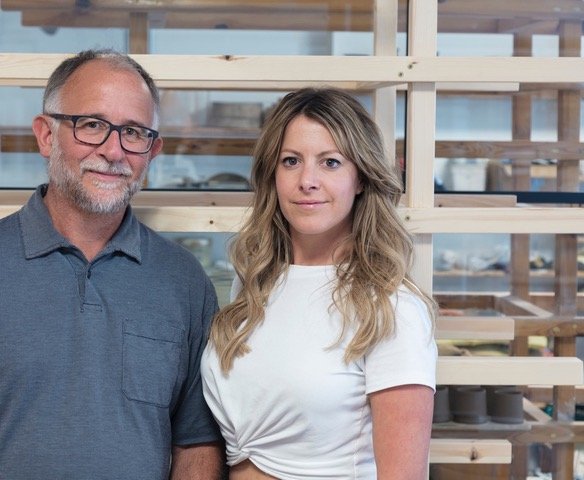
“Our focus is throwing – working with clay on the wheel. The studio also provides space for hand-building. This traditional craft provides a counterbalance to the hyperactive, mechanised, and technologically saturated metropolis.
The hands-on practice of throwing opens dormant creativity and encourages therapeutic transformation. Engaging with clay, the practitioner slows down, assimilating technique and mastering knowledge through careful repetition. It is a holistic, gradual and joyous experience, connecting the potter to a living history of human making.
Our lineage flows directly from Bernard Leach and the 20th Century revival of studio pottery – enshrined in our name. At the heart of Studio Pottery London is the desire to form a community around a shared ethos and love of pottery in all its forms.”
— Gregory Tingay, Co-founder
“Pottery can be a wonderfully social activity, as well as a solitary path of meditative practice. Our studio respects both.
We provide group taster introductions, 5 week foundation courses, and run a regular schedule of ongoing mixed ability classes that you can book according to your availability.
Our expert teachers not only lead our group sessions, they offer on-one-on tuition, which is an excellent way to learn and grow in confidence on the wheel. If you would like the flexibility of coming in your own time you can become a member, enjoying exclusive access to our members area, equipped with several wheels and workspaces.
Our studio is also available for private hire, and our team has a wealth of experience arranging workshops for private functions and one-off experiences.”
— Lucy Attwood, Co-founder

Turning Earth Ceramics
"Like a gym membership for potters", discover four pioneering London studios cultivating craft both as an accessible hobby and as a viable career.
Go here if: You want to learn a new skill, make work in ceramics, be part of a community, find new ways to relax and unwind, nurture your creativity, or even develop your career.
What is it: Turning Earth's pioneering ceramics studios are for everyone, from beginners to part-time professionals, and can now be found in four London locations: Hoxton, Leyton, Tottenham and Highgate. They offer classes and open-access membership, "like a gym membership for potters".

Turning Earth Hoxton

Turning Earth Highgate
Why you need it: Turning Earth's mission is to cultivate craft both as an accessible hobby and as a viable career (they offer a full-time professional studio, In Production, in Leyton). They want to contribute towards a broad adult curriculum that will improve the quality of life in the city.
What they offer: All the ways to try making and develop skills: Tasters, 8 or 12-week beginners courses, intermediate courses, week-long courses, weekend-long courses, private workshops, and monthly membership.
For members, they also organise improvement workshops, like their very popular raku parties, and they have exclusive access to their quarterly ceramics markets.

Turning Earth Leyton

Turning Earth Tottenham
What makes it different: The community and atmosphere are unique to each of their studios. Someone might join for the craft and end up staying for the friends and a 'second home' discovered.
What else do you need to know: They are open every day till late except on Mondays. If you’re not local you can see the wide diversity of skills and techniques on their Instagram which is often updated with pots made by their members in the studio.
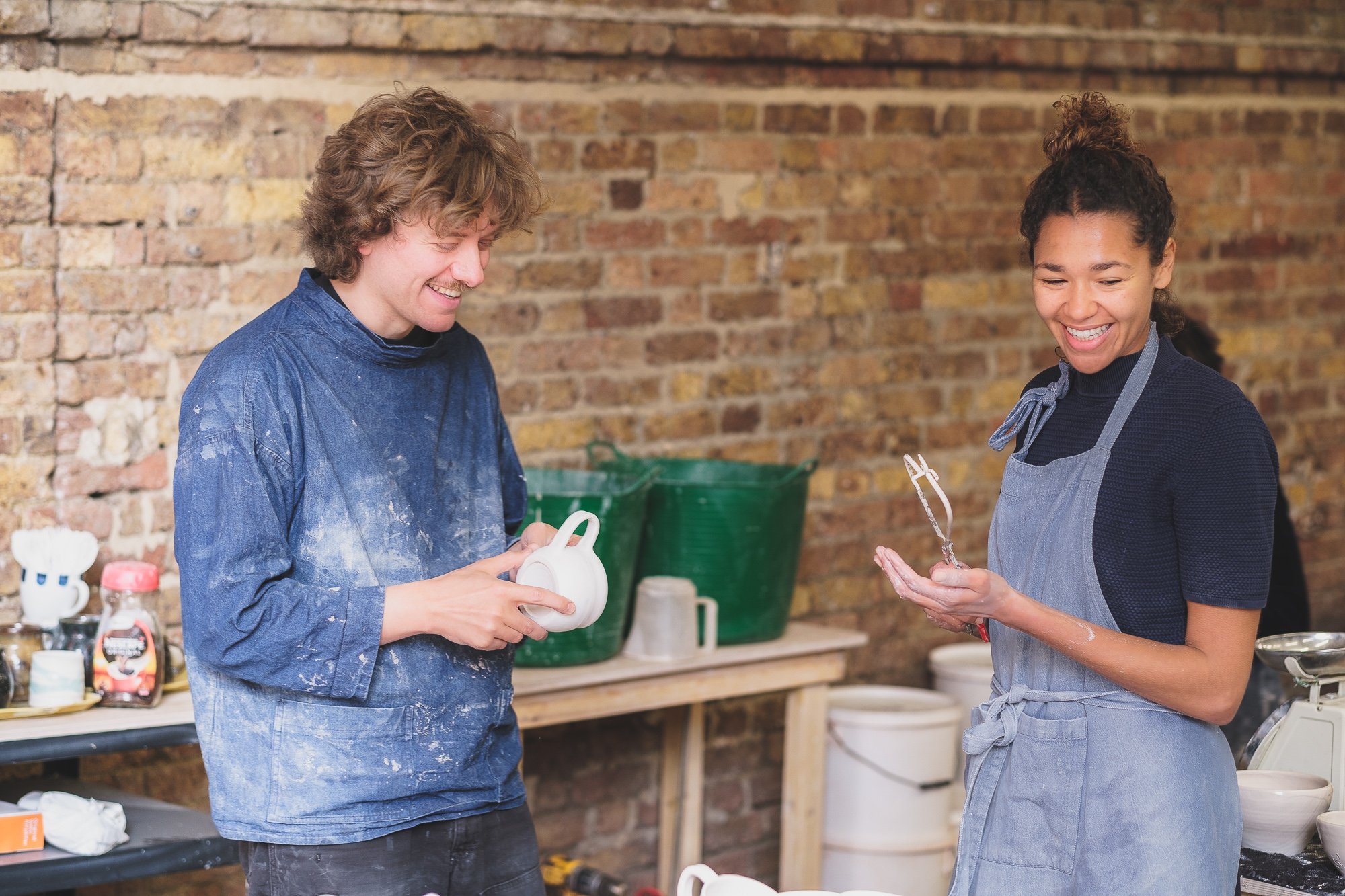

In their own words: Turning Earth was founded by Tallie Maughan. Their first studio, Turning Earth Hoxton, opened in December 2013. Following a model popular in the US, it was the first dedicated open-access ceramics studio in London.

“Turning Earth is indebted to the Arts and Crafts movement at the beginning of the 20th century, which suggested that there should be no separation between utility and art.
Our vision rests in the intuited feeling that we will naturally make life more beautiful when we take our aesthetic awareness, our right-brained feeling for things, as seriously as we take our rational understanding of the world.
We exist to enable people to make beautiful physical objects, and in so doing to make their lives more beautiful: more centred, more fulfilled, more present to what they truly care about.
We feel that in making this movement, we are encouraging a broader social shift towards living with care in our world.”


Shop Small Special: The Bristol Artisan
A home for local craftsmanship and creativity, The Bristol Artisan embodies the spirit of community and sustainability of the city.
Go here if: you love contemporary design and craft, supporting local makers and feeling like you are truly in Bristol.
What is it: A home for local craftsmanship and creativity, The Bristol Artisan in Clifton is a charming shop that stands as a testament to the city's vibrant community of artists, designers and makers.
Why you’ll love it: Showcasing a curated collection of handmade homewares and gifts from independent makers from Bristol and across the UK, you’re sure to find something to take home. From ceramics, jewelry and original prints, to vegan beauty, living plants and dried flower bouquets, each piece tells a story of skill, passion, and dedication.
The Bristol Artisan embodies the spirit of the city. It encapsulates Bristol's ethos of creativity, community, and sustainability.
How to bring this into your life: The online shop is extensive so you can shop from home. Check out the gift guides for all seasons and occasions (we have our eye on cozy hot water bottles and the perfect ceramic ramen bowls). If you do get to visit, stop at Burra next door for coffee (Bristol’s Cafe of the Year 2022).
In their own words: “The Bristol Artisan is a curated space for contemporary handmade design and craft with a focus on homewares and gifts, supporting over 60 independent makers from Bristol and beyond.”

Shop Small Special: The Department of Hope, Joy and Wonder
An uplifting place to browse and meet friends that spreads joy and wonder in Cheltenham and beyond
Go here: for an uplifting experience, you love colour and sweary cards, or you are looking for the perfect gift, stationery or homeware for yourself or someone else (also to secretly meet friends)
What is it: Cheltenham, a town known for its history and charm, holds a hidden gem — The Department of Hope, Joy and Wonder. Nestled within the heart of Tivoli, an easy walk from the centre, since spring 2021 Catherine Colebrook’s shop has been spreading joy and wonder through its selection of homeware, gifts, and sweary cards.
Why you’ll love it: When we heard the name we just had to visit. It’s a fun place to wander from the first room which is a riot of colour to the more calming monochrome spaces beyond, but we particularly loved discovering The Secret Coffee Shed at the back. Tucked away in a courtyard it feels like the perfect hideaway for locally roasted coffee (by Gloucester-based Rave) and cake by local bakers Creme De La Em and S Bakes.
How to bring this into your life: Visit if you can and attend one of the creative workshops from modern calligraphy to paper decorations (details for which you’ll find on their Instagram). If you can’t get there, play with colour in your own home by making a rainbow of your bookshelves.
In their own words: “Catherine's aim was to create an inspiring space where you can browse and catch up with friends over a coffee. A place where people can reconnect or just come in & have a good laugh at our selection of thoroughly rude & sweary cards.”


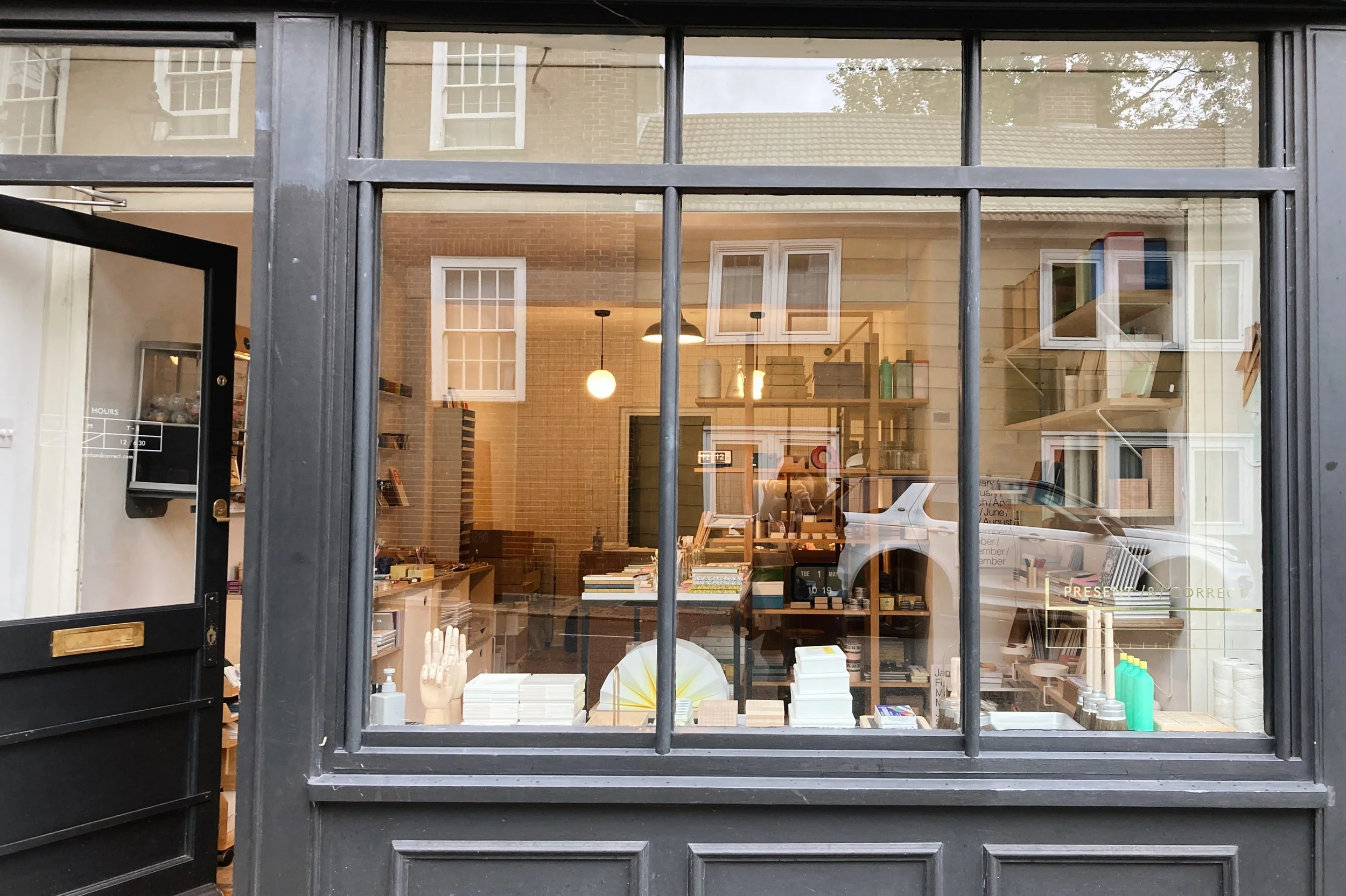
Present and Correct
A beloved stationary shop to quiet the mind and spark your creativity
Go here if: you still enjoy the tactile experience of writing, the thrill of organizing (also we see that looming project deadline that makes you want to tidy your desk), and hold the belief that self-care can come in the form of the perfect planner.
What is it: Present and Correct is a carefully curated stationary shop founded by Neal Whittington that’s currently tucked away in North London (though there’s a summer move to a larger space in Bloomsbury on the cards).
A popular destination for stationery enthusiasts and lovers of unique office supplies, this small shop offers a variety of paper goods and office conveniences from notebooks to desk accessories that combine contemporary design with a nostalgic touch. You’ll also find vintage items sourced from overseas markets. This is not your typical high-street office supply shop.
Why you’ll love it: Present and Correct is known for its emphasis on quality, craftsmanship, and attention to detail, but we also love the promises it holds. Of creativity: its notebooks and pens are the gateways to journaling, sketching, and writing that memoir in long form. Of calm: its clean and minimalist interior, and artfully arranged displays hint at some degree of control over our lives, a possible neatening of our edges. And maybe of a simpler moment: something of the analogue, of the openness of a new page, and even the joy of childhood and those new pencil cases on the first day of school.
How to bring this into your life: Although our true love is the physical store, the website offers the chance to browse and purchase from their collection of products (and they ship worldwide). We love the Finnish School chalk, Things to do Planners and Two Tone Ballpoints. And we’re huge fans – as are many – of Present and Correct’s Instagram.
In their own words: “It's a showcase for the things we have enjoyed since school….We want to spark a distant memory, make you smile or look at the most mundane in a new, and fonder, light.”


Present and Correct
At the time of writing 23 Arlington Way, London
From 20 June: see the new Bloomsbury address

Ways to discover your creativity for better emotional well-being
Bring more creativity into your everyday life. Discover how creativity can positively impact your emotional well-being and mental health.
Creativity can mean very different things to different people. You might consider it to be the moment you sit down with your Morning Pages before the day gets started. You might also consider it to be having a studio and being a ‘proper artist’. Whatever you consider your creativity to be, you are both right and not right.
Creativity weaves throughout our lives. It shows up in all places (in creative practice, but also our workplaces, our homes, our relationships) — if we allow it. And that’s the key. Your ideal of creativity might be the very thing that’s pushing away your ability to even make space for it in your life.
With the links below, there are ideas to get you thinking about that gap — between how you imagine creativity to be, and what you need it to be to feel good in your life. Particularly if you want to access its benefits for your emotional wellbeing and mental health.
Read through articles about the new science of neuroaesthetics, try a noticing workout, watch an inspiring talk on Imposter Syndrome (hint that’s often what’s in the gap) or get to a Sketchbook Skool. Just explore where creativity takes you, not where you think it should be taking you.
You’ll learn some of the ways creativity can positively impact your emotional well-being and mental health.
To read:
How improv can impact not just your creative expression but also your wellbeing
How music loops make me feel more present
Self-care knits and ‘reminders of how to care for oneself through challenging times’
What we actually make when we listen to ChatGPT
What if we could reframe regret as pretending
How Banksy’s work is bringing hope to Ukraine
To do:
6 ideas to fill your sketchbook
Put on an art night at home
Try an app that combines music therapy and neuroscience
Rediscover the well-being benefits of playing with Lego as an adult
To watch:
To discover:



What sparks your interest, your creativity? How do you see creativity as something that affects your emotional wellbeing and mental health?
Let us know how you navigate this aspect of your everyday life.

Gather Round
Discover a family of creative workspaces in Bristol built by creatives for creatives. Now we’ve experienced life without each other, Gather Round restores real-life interactions that no amount of Zoom can replace.
With its first location in Southville’s Cigar Factory and now a second location in Brunswick Square, Gather Round was created to make space for community and collaboration as much as for our everyday working lives. We asked the people at Fiasco, the design studio behind it, to tell us more about what makes their creative workspace different, how they bring ideas to life and how they have created a positive culture centered on people.
What is it: Gather Round is a growing family of unique creative workspaces, designed to foster a positive community of like-minded creative people through an open and supportive culture.
Why do people need It? Gather Round was set up in 2018 by us, Ben Steers and Jason Smith, Bristol-based business owners of Fiasco Design. We had struggled to find a workspace for our design studio that wasn’t an office, didn’t tie us into a long-term contract and crucially, didn’t charge obscene rates. After chatting to other creative business owners, we soon realised that we weren’t alone. It was time to shake things up. And so Gather Round was born. Built by creatives, for creatives.
What do you offer? Across two locations in Bristol, our considered workspaces are designed around the needs of those who work within the creative industries. Made up of flexible areas with fixed and casual desks, private studios, meeting rooms, production studios for hire, hang-out areas, communal kitchen tables, quiet rooms for headspace and event spaces. At Gather Round you can do your thing, your way.
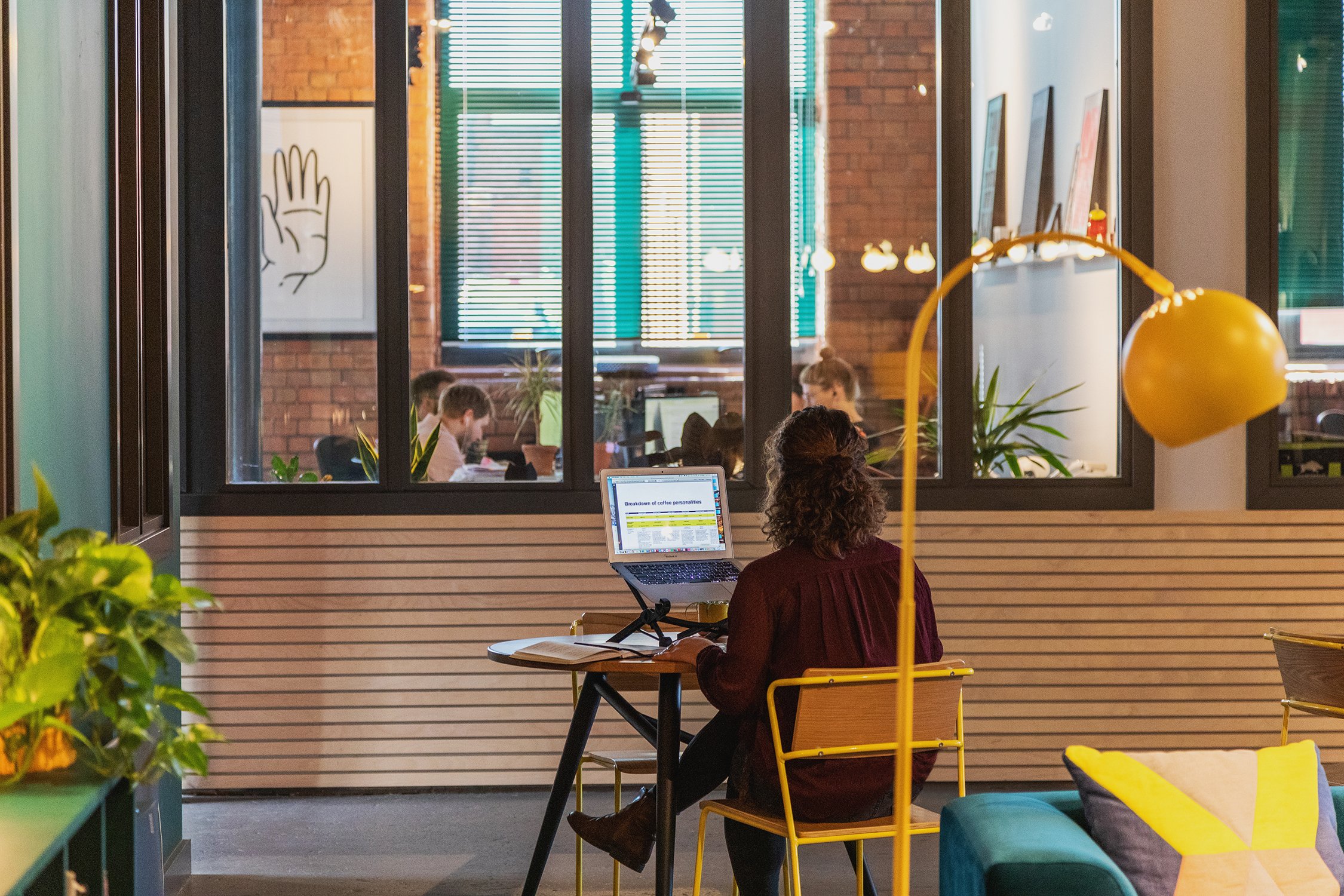
What makes Gather Round different? As creatives ourselves, we know what makes a great workspace. No indoor caravans, tardis-style meeting rooms or artificial grass in sight. Just thoughtfully designed spaces. We provide the right ingredients for creative professionals to flourish; we’ve had businesses born from Gather Round and creative collaboration between people is a natural part of everyday working. So whether you're musing over an idea, hashing out a project, or launching your plan for world-domination - we’ve got it covered.
Our beautiful coworking spaces are nothing without the community of creatives that call them home from home. Filmmakers, designers, writers, publishers, art consultants, brand strategists, photographers and more… Our members are an eclectic and talented bunch. They’re also excellent people that make our special workspaces unique.
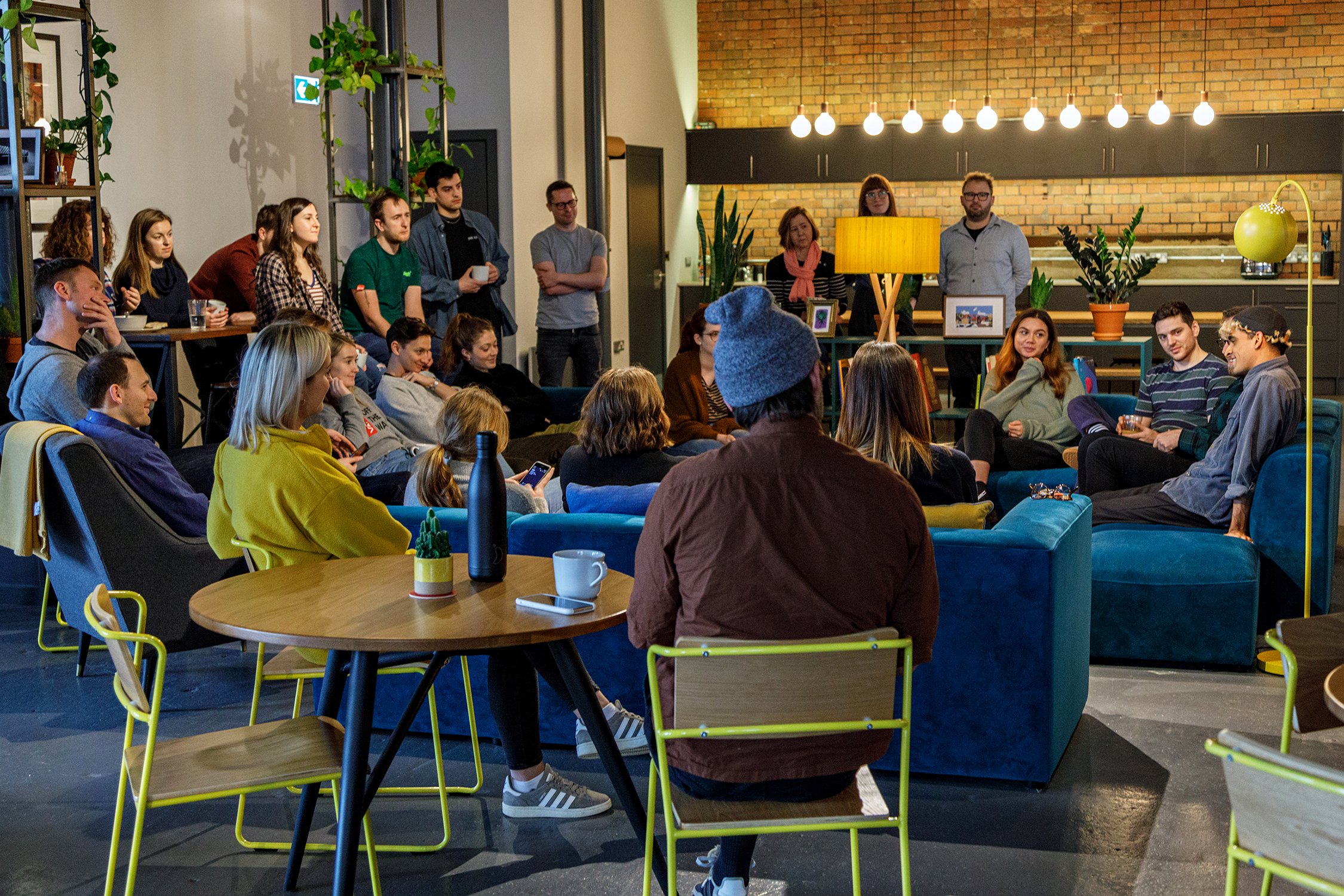
What do our readers need to know? Gather Round is fully open and accepting new memberships at both Bristol locations. As an independent business, we are able to be reactive to the changing landscape. We have adapted to new ways of working, putting our members and their needs first. Now more than ever, people appreciate the value of human connection. Zoom, Slack and the like, are fantastic but they don’t compensate for real-life interactions. We’re proud that our spaces help to bring people together, whether that’s via a project collaboration or enjoying one of our events with a post-work beer.
Tell us a little about your story: The pandemic was a really trying time for the creative industries. As agency owners of Fiasco Design, we were in the thick of it. Multiple projects fell through for us and we witnessed first-hand businesses fold, redundancies happen and talented creatives struggle to support their families. Throughout this, our members were there for one another; supporting each other through the tough times. Our community really pulled together. Many of us were thrust into working from home, often in less than ideal circumstances. Working from home for months on end can be lonely and particularly in the creative industries, it can lead to fatigue and burnout. It’s not surprising that since the end of restrictions we’ve seen an increase in people looking for somewhere to work away from home.
How can people be inspired by your space wherever they are? We are passionate about supporting creative endeavours and we have a blog on our site that is dedicated solely to this. Whether it’s learning how to bake sourdough bread, or reading about essential tools for freelancers, you can find it all on the Journal section of our site. You can also follow us on social channels to keep up to date with what our fantastic members are up to.

Gather Round
Cigar Factory
127-131 Raleigh Rd,
Southville, Bristol BS3 1QU
&
15-16 Brunswick Square
St Pauls, Bristol, BS2 8NX.
Gather Round now has a space in Bath. Check out their new location at Trinity Church here.
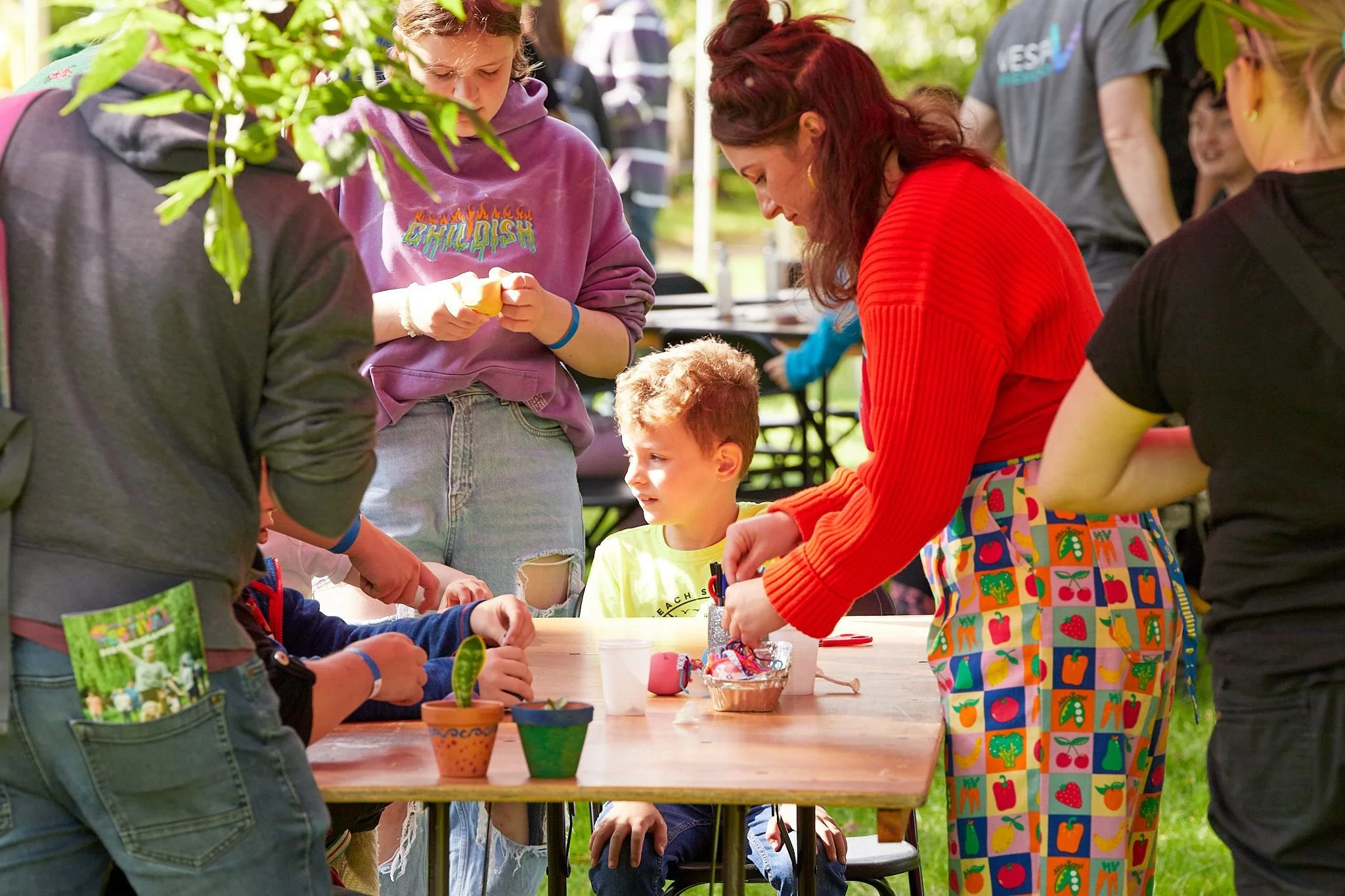
All in the Mind Festival
Discover an annual festival that uses creativity to explore mental well-being, and that’s finding ways to use performance to make happier brains.
“We use theatre to create happy brains.’”
After a couple of years that have seen our individual and collective mental health impacted and that has also forced us physically apart, the All in the Mind Festival comes at a crucial moment. Gathering people together to experience creative projects that explore our mental wellbeing, All in the Mind offers the conversations and connections we so badly need right now.
But though timely, it’s now into its 7th year. Founded in 2016 by the Fluid Motion Theatre Company, this festival has become an annual one-day event, bringing together actors, musicians, poets, comedians, and artists, for performances, workshops and interactive activities that harness the power of the arts toward better mental health for everyone. We found out more about the vision behind it and what makes it different.
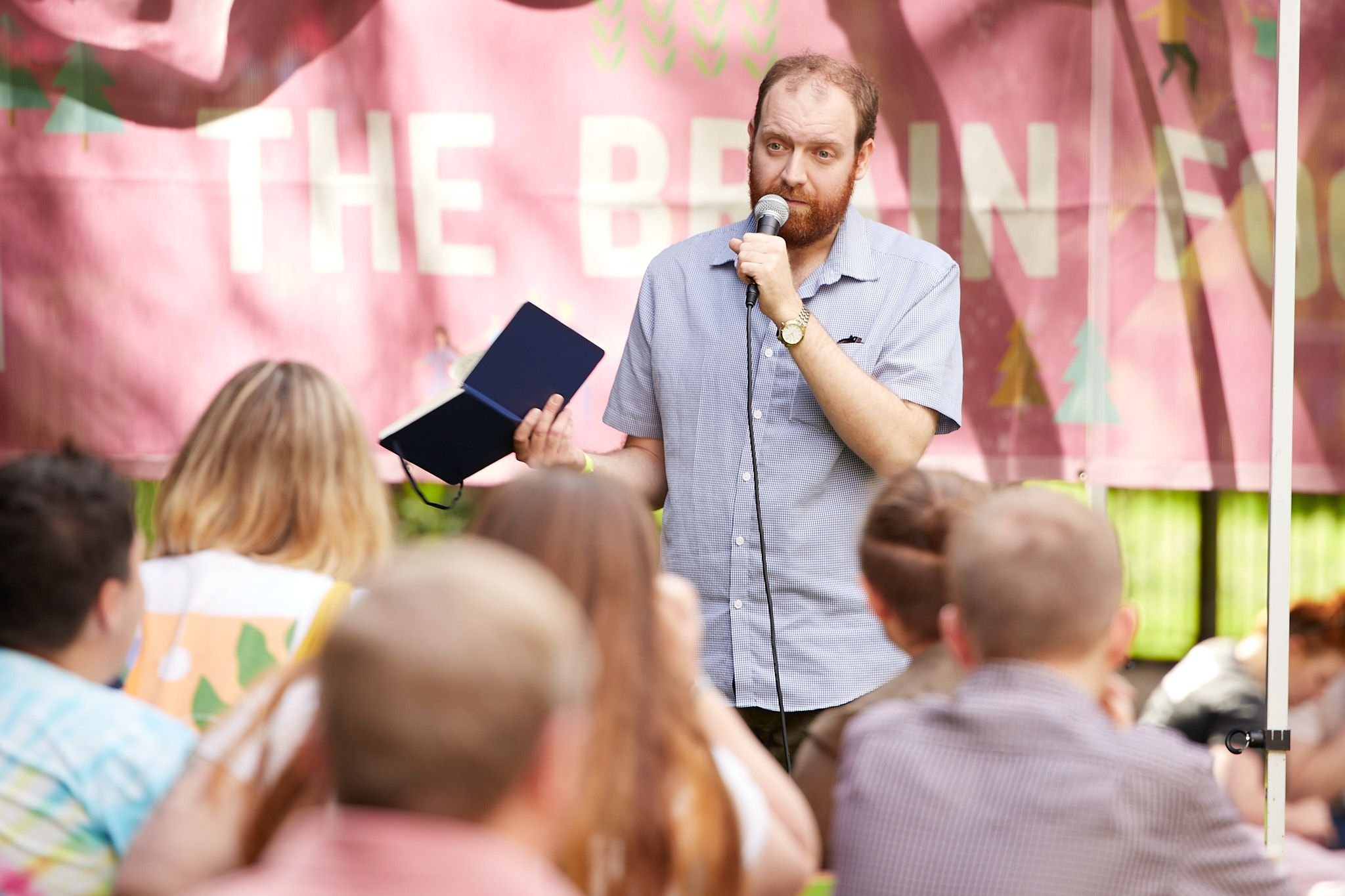
What is it? All in the Mind is the leading outdoor mental health arts festival in the UK, held in Glebe Gardens in Basingstoke’s town centre.
What do you offer? A day jam-packed with family-friendly shows and activities – from inspirational and quirky performances, to fun and interactive workshops, nature trails, a solar-powered carousel, delicious local food and drink and a community parade – there is something for everyone!
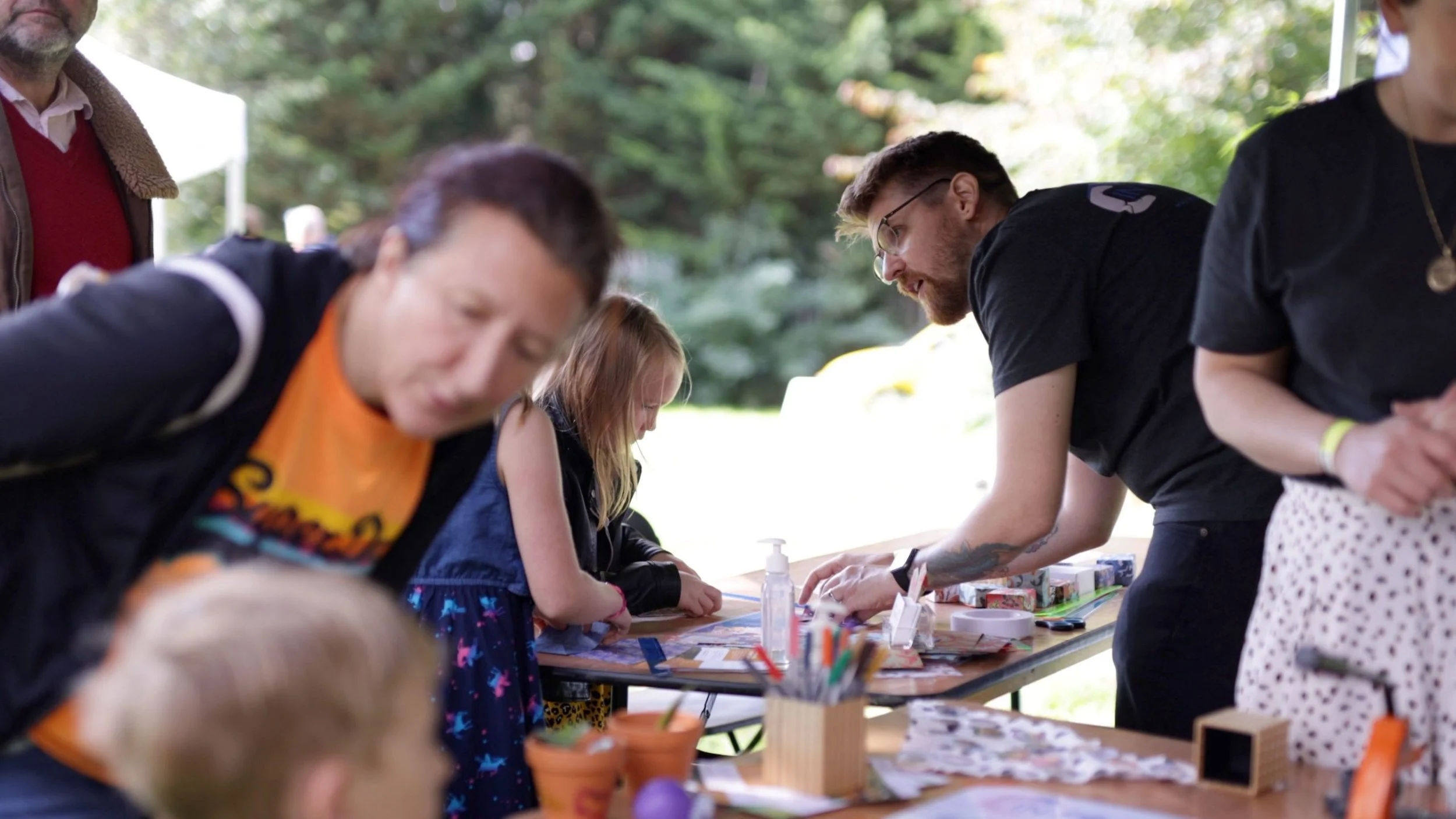
Tell us a little about your story: Our vision is to use the arts as a tool for helping open up the conversation around mental health, challenge the stigma and improve wellbeing
This year the festival will take place on Saturday 10 September 2022, is themed around nature, with tickets on sale here.

Pages of Hackney
A bright blue beacon on Lower Clapton Road, Pages of Hackney is one of our favourite bookstores for reading advice. Founder Eleonor Lowenthal talks to us about what makes Pages of Hackney so unique and why independent bookstores matter so much to our neighborhoods.
A bright blue beacon on Lower Clapton Road, Pages of Hackney is one of our favourite bookstores for reading advice. It’s welcoming not just in how customers are greeted and the bookstore arranged (no intimidating, fusty-ness here), but also in terms of which books get to sit on its shelves and whose stories get to be told. Founder Eleonor Lowenthal talks to us about what makes Pages of Hackney so unique and why independent bookstores matter so much to our neighborhoods.
What is it? Pages of Hackney is a small award-winning bookshop on the Lower Clapton Road selling an eclectic mix of books. Our priority is to be a friendly, community bookshop that is accessible and inclusive, supporting the issues we believe in and giving a platform to marginalised voices in publishing.
Why do people need it? Everyone should have the opportunity to have books in their lives. When I started the bookshop in 2008, there hadn't been one in the local area for 30 years and we had both children and adults coming in who weren't sure what a bookshop even was. We do our best to reflect the local community in our diverse stock choices and through our Pay it Forward scheme to also make it affordable for everyone.
What do you offer? We sell books in the areas of literary fiction, politics, feminism, essays and life writing as well as philosophy, psychology, nature writing, music and children’s books. Our priority is for each customer to feel that the bookshop is for them, and we do our best to give our customers individually as much time and thought as we can. We put on lots of events, both in-person and online, addressing issues including gender, sexuality, race and current events as well as platforming novels from established and debut authors.
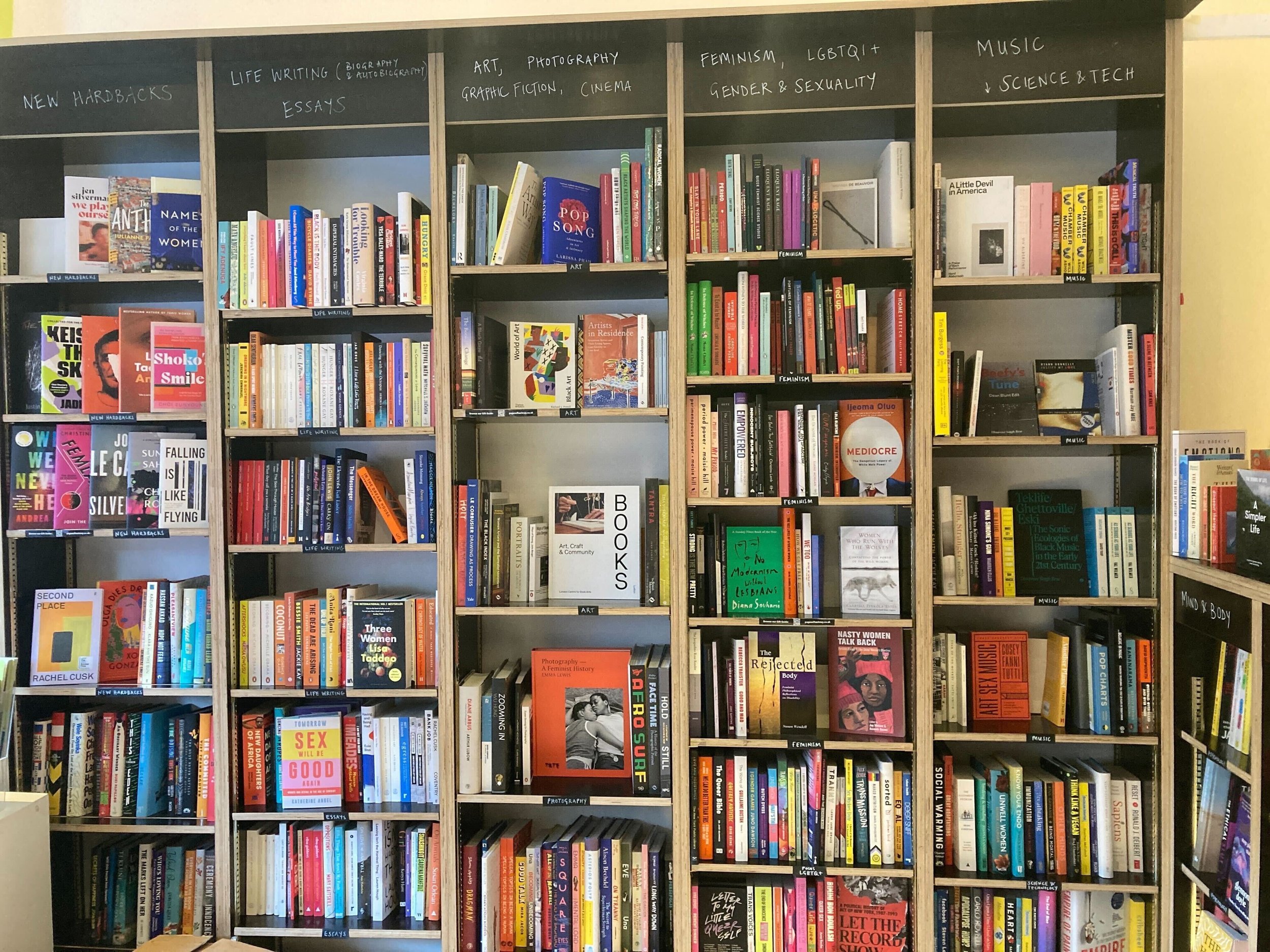
What makes it different? The space is designed to feel like a sanctuary from the busy life of the High Street. Once you step inside, you're free to browse in a quiet space, talk to us and ask for specific recommendations, or simply sit in our cosy basement. What makes us different is that we aren't simply invested in selling a book to every customer, but in making everyone feel welcome and as if the shop belongs to them and is a part of their community.
What do people need to know? We are open every day for in-person browsing, but you can also order all our books online, or request anything you don't see there. We can get most books we don't have in stock in 1-2 days and can also post books and gift wrap if required.
Tell us a little about your story: Books are an excellent way to unwind, escape into, and learn about how to cope with anything people might be struggling with. Our books reflect this and the bookshop itself is a safe space in which people can reconnect with themselves and consider what is important to them.
How can people be inspired by your space wherever they are? Simply browsing our shelves, online or in person, should be inspirational, connecting people to authors and ideas that they haven't heard of, or that they might want to explore more deeply. In addition to the usual categories, we have shelves dedicated to specific subjects that might be of interest (including the Black Britain series, both Japanese and Korean writing shelves, Afrofuturism) and authors we're currently inspired by (like Joan Didion and Toni Morrison).
Where inspires you? I get inspired by talking to new people every day in the shop and exchanging thoughts, ideas and feelings.


First Art Kit: A Conversation with author & illustrator Boo Paterson
On the publication of her new book First Art Kit, we caught up with Boo Paterson to talk about how therapy and paper crafting can come together, why using our hands can help our brains, and how sometimes peace can be found in a paper Gramophone sitting on our bedstand.
“Hope comes from working to overcome your problems, so they no longer have a detrimental effect on your life. The first step is in identifying what’s going on — which is where I think First Art Kit can help.”
Over the past year of uncertainty, many of us have been searching for that something that works for us. We’ve had to go looking for that thing that can ground us. We’ve had to develop new strategies to contend with our anxieties and our struggles. For many of us, what we’ve found to help ourselves is Creativity.
As our world shifts and shifts again, watercolor sets have been opened, easels purchased, and sketchpads taken on daily walks. Some of us have picked up a pencil for the first time, some have returned to a lost passion long abandoned in school art class. A few have even managed to nurture a hobby into a profession.
Creativity has now staked its place firmly within the realm of mental health. We’re becoming accustomed to it being something to reach for when we’re lost, lonely or anxious. For journalist, illustrator and book sculptor Boo Paterson art has long been a cure for her soul and with her soon-to-be-released book First Art Kit we all get to benefit from her learnings.
In this book of modern creative remedies, Boo brings together common emotional and psychological ailments, from anxiety to insomnia, with paper crafting projects that have helped her navigate her life and that might help each of us in our own. With each paper trace and fold, each twist and tear, Boo takes us step by step through possible antidotes, with projects that get us into a state of flow, signpost changes in our own behaviour and give hope for whatever our situation might be.
Recently awarded the prestigious American Illustration Awards 2021, we caught up with Boo to talk about how therapy and paper crafting can come together, why using our hands can help our brains, and how sometimes peace can be found in a paper Gramophone sitting on our bedstand.
In First Art Kit, you pull together a few strands that we’re often used to seeing separately, the craft of paper-cutting, the practice of therapy, your own story and mental wellness more widely. How did you come to bring them together in this way?
I had a traumatic upbringing and consequently suffer from severe depression. A few years ago, I was going through another black-dog episode and began to think ‘you’ve had loads of therapy — why don’t you make a first aid kit for your brain from the advice you’ve had?’
Then I thought I could make things out of paper that were connected to each psychological cure as reminders for me to do the work because therapy *is* hard work!
I’ve been making things out of paper since I was a very young child and this later became what I was known for as an adult. It’s my go-to material for expressing myself. I knew almost instantly that the idea would make a cool book that could potentially help other people, and this spark of ingenuity actually lifted me out of the depression. I came up with the title and the design within the first 5 minutes: I wanted it to look like a vintage first aid kit.
The crafts in First Art Kit aren’t just papercutting, they’re all different types of paper creations; collage, book sculpture, construction, and colouring. I chose paper because it’s easily accessible to all, inexpensive, and recyclable. Also, paper is unintimidating; many people who think of themselves as ‘bad at art’ are put off by paints and other media, feeling that they have no skills and that they’ll somehow embarrass themselves. But people handle paper every day. It’s seen as something that everyone can use.

Header image: Photo Alex Robson
I love how the book normalises everyday life — the moments we feel we have low self-esteem, or experience anger, or struggle with family members for instance. It universalises our emotional and mental wellbeing. How did you choose the 25 ailments covered in the book? What’s the balance between what you’ve experienced in your own life and how you understand the experiences of others?
I’ve had 23 years of different types of therapy — and every type I’ve tried has benefited me in some way. The last treatment I had was Schema Therapy plus EMDR for trauma, which I have found to be the most useful of all, as it rewires your brain so you no longer default to problem coping strategies. It does seem to have cured my depression and PTSD.
Each chapter tackles a different problem, such as insomnia or anxiety, for example. I’d say I’ve personally dealt with about 18 of the 25 problems and I started writing about those first because, remember, the book was initially created to cure me!
I then began to think of friends’ struggles — such as hoarding or eating disorders — which I’ve never had, but have been on the periphery of. So that’s what I researched next.
The crafts themselves are therapeutic, allowing people to get into a ‘flow state’ of deep concentration. It’s a state that children are frequently in through play, but that adults hardly ever experience. It’s incredibly relaxing and allows the chatter of your brain to be switched off. Making things with your hands also gives people a sense of mastery, which is very important for self-esteem.
As my shrinks never tired of telling me, it’s normal to have a range of emotions. No one is happy all the time, and it wouldn’t be ideal if you were. For those who don’t have problematic behaviours, there is still something here for you — if you’re on a downer, you can read the advice, and relax by doing the crafts.
For those rare people with no problems at all, it can just be used as a craft book!
What’s your hope when someone picks up this book?
I hope that people who’ve never been to therapy and who have little experience of psychology can get a little insight into what the real reason for their unhappiness might be and that it leads them on a journey to find out more and even seek treatment. I also hope that people can get some light relief from doing the crafts, relaxing into the flow state, picking up new skills and learning to incorporate these into their daily life.

Photo: Alex Robson
I like how some of the projects feel like talismen almost, as reminders of some learning, others as meditative exercises, and others as ways of processing something. Some of them are funny and whimsical, others heartbreaking, or heady/conceptual. How did you connect the ailments to the projects; what purpose are you hoping they’ll serve and did that shift as you developed this book?
I wanted them to be beautiful — that’s always a given for me. And I wanted them to be linked in some way to the psychological work that people would have to do. You have to practise therapeutic cures repeatedly to make them stick. I thought if they were unusual, in whatever manner, then that would make users have a connection with the objects.
I guess the reason they came out as they did — with this range of emotions associated with them — is just how my brain works. I reckoned that if I wanted a mini-gramophone made out of paper on my mantlepiece, then probably other people would too!
You mention your own experience with therapy in the preface and you’ve mentioned elsewhere that you’ve been in therapy for 23 years. I’m curious about your relationship with therapy now. This book feels very open to the practice and brings in advice from your own sessions, so you seem therapy-curious still?
My Schema Therapy and EMDR finished in January and its effect on me has been amazing, so I don’t actually need therapy anymore. I exhibit completely different behaviours now.
My parents were alcoholics, so were emotionally absent, and I couldn’t rely on them to meet my needs. As is typical of children who never had their needs met, I continued to put myself in situations where they would not be met as an adult, because that is what is comfortable.
I was face-palming myself all during Schema Therapy, at each realisation that I was inflicting these cruelties on myself.
A good example is this: I have Raynaud’s Syndrome, so I’m always cold unless it’s about 25 degrees. But I wouldn’t switch the heating on unless it was below about 5 degrees. I would sit in the house in my coat — or sometimes two coats — and a hat and scarf, saying it was because I couldn’t afford the heating.
But keeping myself poor was also one of my problem behaviours. I felt I didn’t deserve to have financial security or warmth, or enough food; just the bare minimum, as I’d grown up with emotional deprivation.
As I was undergoing the Schema Therapy, I suddenly noticed that I was starting to turn the heating on as soon as I felt even slightly cold — it made me laugh, actually, as it was so unusual. It became automatic and over-rode the original problem behaviour. So much so that I started meeting my needs all over the place! Now I not only turn the heating on, but buy nice food, and treat myself as I treat others.

Photo: Alex Robson
Why do you think so many people are now turning to creativity as a tool to think about and manage their relationship with themselves and their lives?
Well, it’s completely enjoyable for a start. But there are also numerous studies showing how it alleviates anxiety, depression and stress. I mean, art therapy isn’t a highly skilled profession for nothing.
How do you hope First Art Kit might help in our current moment, of increased loneliness and disconnection, and our collective need to heal from the past year (and keep hopeful in the coming months)?
I think that there’s an element of kismet in First Art Kit coming out at a time of worldwide collective trauma. Many people — who could distract themselves in normal times — were left for the first time to have a good hard look that their problems and their personal situations. People realised what they did and didn’t need. Emotional needs were actually talked about in public discourse, which rarely happened before.
People who have considered the subject of mental health to be embarrassing or un-macho are now verbalising their problems.
Hope comes from working to overcome your problems, so they no longer have a detrimental effect on your life. The first step is in identifying what’s going on — which is where I think First Art Kit can help. Most people have no idea why they act the way they do.
Could you tell me a little about the process of making this book over the 6 months of the first lockdown? I was sorry to learn that you lost loved ones.
I had started writing the words in December 2019 and started conceptualizing and creating the crafts by February 2020. My aunty died around the time of the first lockdown in March, my mum in May, my uncle in August, my friend of 30 years in October and another great friend the day after my birthday in January 2021.
It was like a grenade going off in my face every couple of months. I have actually had a year like this before though: I lost six loved ones in seven months in 2016. So that experience helped somewhat, in that I knew it was normal to feel absolutely abnormal most of the time. I knew that it would take years to process, because — for me anyway — after 3 deaths you don’t have the capacity to grieve for any more people. You kind of put them on a mental back-burner and the grief for them hits you later — sometimes years later.
As for doing the book at the same time, well this is where a dysfunctional childhood really comes into its own! If it doesn’t completely break you, it makes you highly resilient; to the extent where you can cope with almost any trauma and also hold down a full-time job. You’re so used to having no one to rely on that you just get on with it. So I did.
You’ve long used art as an escape. What did that look like for you as a child and how did it help you?
Well, the ‘artist as a tortured soul’ isn’t a cliche for nothing. In childhood, as in adulthood, art allows you to funnel emotional pain out of you and onto a page, where you can process it. Sometimes it’s beautiful, sometimes it’s ugly, but it’s always meaningful.
Personally, I like to create beauty out of suffering, then I feel I’ve converted pain into something worthwhile that others can enjoy.

Photo: Alex Robson
What drew you to paper cutting in particular as a child and why does it continue to be something that you do in your life?
One of my earliest memories was watching an episode of Me and You with my mum — I was probably 3 or 4. They showed you how to make a birdcage out of paper and so I followed along and was amazed that I could make something flat into something 3D.
I also had a ‘play box’, which was a big cardboard box filled with Fairy bottles, loo-roll tubes, and scrap paper; I think we’d now call it ‘the recycling’, but we made our own fun in the 70s. Luckily, there was a plentiful supply of scrap paper as my dad was an author, as well as being a fireman, so all his manuscript pages that didn’t make the cut went into the play box.
I suppose if there had been oil paints and canvas lying around, I would have been into that.
You’ve experienced first-hand the surge in popularity of paper cutting? What do you attribute this to?
I suppose I’m partly responsible for this, as I created Papercut This Book to allow people with no artistic experience to get really nice results papercutting using templates. But aside from that, it’s the case of paper being cheap and available to all — so paper cutting is really a democratic art and craft.
Departing from the book, can you tell me a little about your book holiday course and how this came about?
I’m a book sculptor and created a 15-day e-course to let people immerse themselves in the joy of books and related arts and crafts, and like First Art Kit, its main thrust was to improve overall wellbeing.
I came up with the idea when I was incredibly stressed, and a friend told me to take a week off and do nothing but read books. I loved that idea of taking a vacation from life to be creative with books, and so Book Holiday was born. And, of course, I didn’t take a week off to read books — I got stuck in creating the course instead!
Last question, where do you go when you are lost, lonely, anxious or curious?
Books for when I’m lost, lonely or curious; either reading them or making things out of them.
I’ve been doing Transcendental Meditation for several years now, so I no longer experience anxiety.

Boo Paterson is an artist, illustrator, and journalist whose papercuts and book sculptures have been exhibited at the prestigious Royal Scottish Academy and short-listed for the World Illustration Awards twice. She is a regular cultural commentator for the BBC, and extensive coverage of her artwork has appeared in publications across the world, including the Guardian, the Week, and the Sunday Times. Boo divides her time between New York and the UK.
To learn more about Boo, visit her online.
Boo Paterson, First Art Kit: 25 Creative Papercraft Remedies for What Ails You
Published by Simon & Schuster.

Hoxton Street Monster Supplies
Now allowing in humans, this store has everything the monster in you needs (and a not-so-secret cause behind it all).
For: monsters of every kind struggling to find the supplies they need to get through their ghoulish days and humans of all ages looking to restore make-believe in their lives.
What is it: One to enter at your own risk, this quirky store on an ordinary-looking street in Hackney is maybe the only one in the world (that we know of) that stocks “Bespoke and Everyday Items for the Living, Dead and Undead’.
What you need to know: Escape into your imagination with a store that is really one of its kind: since its murky start by newly exiled Igor the 1st in 1818 and its tentative steps into the human world in 2010, it has been serving everyone and everything with the kind of canned and boxed delights that any self-respecting creature needs, the fang floss, breath remedies, and dragon treats on our shopping list.

How to bring this into your undead life: Wherever you are, your way into this world is definitely via witty and fantastic products like their Salt Made from the Tears Shed while Home Schooling, Mummy’s Sewing Kit and packets of powdery pink brain food. If you live locally, volunteer to help brave visitors survive the store or become a writing mentor in the Ministry of Stories.
Why we think it’s different: Beyond its license to sell ‘items including, but not limited to: Malodulous Gases, Children’s Ears, Gore, Fear (tinned only)”, behind a secret password guarded door is The Ministry of Stories , a creative and mentoring charity for mini-humans aged 8 to 18.
The not-for-profit was started by About a Boy / Fever Pitch / High Fidelity writer Nick Hornby with Lucy Macnab and Ben Payne and was modeled on Dave Egger’s 826 Valencia. The aim of the classes here is to make writing fun and accessible across all genres from gaming to screenwriting, cookbook contributions, and graphic novels, and to build the confidence that comes with creative adventures on the page experienced in a supportive community.
It’s now been widely published that there’s a curse in the store – that makes all profits go to the Ministry of Stories. As Minister of Fluency, the beloved by us and many a monster, Colin Firth declares “you know your helping to support the business of the imagination with the next generation”, so maybe this is one hex that we humans won’t venture to break.

In their own words: “We pride ourselves on being London’s, and quite possibly the world’s, only purveyor of quality goods for monsters of every kind. Many of our customers have been coming to us for centuries. Indeed, some have been coming for considerably longer. Whether you’re a Vampire, Werewolf, Sasquatch or something else entirely, we have everything you need.”
Something to inspire: Short of attempting to rebrand everything in our homes – will our kids go with water if it’s the elixir of life – look to ways to bring in the make-believe. In a year, when we’re been abruptly pulled up by reality, there are ways of escape that might be nearer than the dream destinations we’re been longing for – retreats made in our minds, and played out in worlds of our own making. Even travel bans can't go there. But monsters can.

How creativity can improve your wellbeing during uncertain times and beyond
The many ways that creativity can make you feel better wherever you are, and whatever your creative practice.
“Unused creativity is not benign. It metastasizes. It turns into grief, rage, judgment, sorrow, shame. We are creative beings. We are by nature creative.”
Creativity is an important aspect of life, but many people are currently struggling to feel creative. Months of isolation have left many of us feeling lonely and uninspired.
However, some people in the past and present have found that uncertainty and crisis can actually spark creativity and innovation. From trying new crafts like knitting to renovating your home, undertaking creative projects can help boost your mood, bring some joy during these difficult days, and also help you cope during periods of isolation, especially if you live alone.
What is creativity?
Creativity can be channeled, honed, and expressed in tonnes of different ways, not just on canvas or through arts and crafts. It could be through a board game, party planning, or even coming up with solutions to a business problem.
Everyone is creative, but many of us choose to not explore, express or appreciate it, for a variety of reasons, so it goes down the pecking order of priorities and/or the benefits aren’t felt.
Sam had the perception for years that being creative involved painting a masterpiece, like Van Gogh, or writing and performing a song. Both of which he felt he couldn’t do; his creativity was locked in a box or didn't even exist. He’s now come to realise that creativity just needs an outlet that works for you, like many things in our lives.
Similarly, when we think of creativity, many of us still think of painters and musicians, rather than architects, interior designers, warehouse managers, founders, accountants, and all the other people who need to be creative regularly and may not realise they are.
We’ve found that being more creative, however, you choose to access it, is a superpower that can positively impact your life and business. Don't forget - you are creative, it is in you just waiting to come out.

Being more creative boosts your mental health
Here are seven ways that creativity can help us negotiate uncertain times and get through periods of isolation.
1. Creativity reduces stress, anxiety, and mood disturbance
The pandemic has created a lot of doubt and uncertainty, and for many people, this can create feelings of negativity — but you can help mitigate this negativity by doing something creative. Whether you make something beautiful for yourself (such as a pair of earrings) or use your creativity to help someone else (for instance, you could help a small local business with advertising), this focus on doing something and bringing an idea to life will give you a sense of purpose and productivity — giving more meaning to your days in isolation.
The Connection Between Art, Healing, And Public Health — a Review of Current Literature (2010) concluded that “creative engagement can decrease anxiety, stress and mood disturbances.” Another study Everyday Creative Activity as a Path to Flourishing similarly concluded that engaging in a creative activity just once a day can lead to a more positive state of mind.
[A creative activity can be simple, don’t worry. You may be doing it regularly already. It could be doodling in a journal, crafting, playing the guitar, redesigning your kitchen, or business planning. These are things everyone can do and just acknowledging it can give you a boost.]
Back to the study. The results surprised the researcher Tamlin Conner, who didn’t think the findings would be so definitive. Conner said...“Research often yields complex, murky, or weak findings…But, these patterns were strong and straightforward: Doing creative things today predicts improvements in well-being tomorrow. Full stop.”
During the pandemic, your local council might offer creative workshops. For example, the creative sector in Bradford has come up with a host of creative ways for locals to improve their mental health; they are providing virtual classes for both adults and children, including drawing classes, yoga classes and writing classes.
2. Creativity Can Improve Your Personal Space
Lockdown created a whole host of DIY clichés and for good reason! Being stuck inside your house for months isn’t much fun, especially if you don’t find your home relaxing or pleasant — but up-cycling is an easy way to improve your surroundings.
From up-cycling old chairs to give them some personality, repainting some cupboards to breathe new life into them, or turning old cups and bowls into planters for flowers and shrubs this is a simple way to stay occupied (and it is also great for the environment!).
If you are looking for some upcycling inspiration, we can recommend these Instagram Accounts:
@maiseshouse for beautiful upcycle furniture inspiration
@restoringlansdowne for moody interiors and Victorian home renovations
@linsdrabwell for some budget-friendly upcycle hacks
You can start small on something like a plant pot or a mirror and work your way up to something bigger.
This leads to another benefit of creativity; it gives us a feeling of pride, that "I did that, yeah, me”. It’s really nice spending an hour or more creating something, and then et voila. It’s done, it’s there, something that reflects your inner creativity and personality. An expression of you. It feels very empowering and never gets old.

3. Creativity Allows You To Connect With Other People – Close to Home & Around The Globe
Creativity allows you to connect with other people. One of the hardest things about isolation is limited socializing, but you don’t have to be creative alone.
When lockdown first started, and we were on furlough when our studio M.Y.O had to close, we launched #createsolation. This was a series of almost daily challenges trying a new craft from macramé to string art and even fork calligraphy! This helped bring some structure to our days especially and keep us connecting with our audience and regular studio guests virtually. It was so great to see many guests try out the challenges we were doing and share their tips and creations with us.
There are now a whole range of classes that you can take online with friends, as well as hundreds of forums for specific creative interests (such as designing jewelry or knitting) that meet virtually. This allows you to connect with new people who have the same passion as you so that you can collaborate and have fun together. It also opens up borders enabling you to connect with people around the world, who you may not normally meet!
Closer to home, Sam has been sending his mum a range of creative kits from calligraphy to watercolours and even candlemaking for them to do together and to bring back her creative spark. She has been cocooning for a few months as a vulnerable person and having retired was looking for projects to keep her busy. It’s been amazing to see how much it has helped brighten her mood and give her a sense of achievement — from lino printing 50 Christmas cards to decorating her lampshade and upcycling her furniture, her creations have definitely inspired us!
Humans are social creatures, we crave company, connections, and being around other people. Social interactions are still a vital part of who we are — but it is possible to build connections virtually.

4. Creativity increases our sense of self-awareness and opens up expression
Dabbling in being creative produces an output, which is basically an expression of you — even if you don’t think it is! Over time and with a little practice, you can feel a lot more able to express yourself as you become more comfortable in yourself and the different techniques that you are drawn to.
5. Creativity can slow you down (in a good way) and give you an expanded sense of time
Time slows a little in the sense that your thoughts slow and it’s easier to stay focused on the task at hand and feel a little more present. This can be referred to as being in the flow.
Ever feel like your weeks are just absolutely flying by and you don’t know how and what you’ve done? Slowing that right down can really help, and arts and crafts can make that happen. Having such easy access to technology means our brains are constantly whirring, but not necessarily about the right things.
6. Creativity can help you think better
Experiments have shown that being creative, which can trigger mindfulness, boosts your general creativity as it can enhance your ability for divergent thinking — a thought process or method used to generate creative ideas by exploring many possible solutions. But, many of the qualities associated with convergent thinking are also enhanced by mindfulness. Convergent thinking is basically the opposite of divergent thinking. It generally means the ability to give the “correct” answer to standard questions that do not require significant creativity. Creativity helps with both.
7. Become a better problem solver
Short and sweet here. You can become a little more resourceful and creative with figuring things out, much like you need to be when creating something. Part of this comes from having more confidence to think creatively, as you will naturally think harder and come up with more possible solutions to problems, rather than latching onto the first two you think of.
There are so many times when very quick decisions are made on big challenges, without really looking for all possible solutions. When we can come up with more options, we can assess each one and decide on the one that increases our chance of success.

But how can I be creative?
We know that starting any creative practice can be intimidating, even when the benefits to us are increasingly evident. Here are a few ideas for getting you started on your creative adventure.
Start small
If you feel you are never creative, that’s fine. Maybe try it once this month and make a mental note of how you feel after. Try something you can quickly do like an adult colouring book, doodling, or painting by numbers. Do that a couple of times in the next few months, then maybe try more often… you may end up doing it daily — but don’t put pressure on yourself to do that from the outset. Small, incremental changes can become habits.
From a creative thinking perspective, think back to times where you were creative. This will give you a confidence boost to do it more often when you are looking at challenges in life and business. There is always option a, b and c but what about option z?
Next time you have a challenge you need to overcome, write down ten possible solutions to it. You'll be surprised with what you come up with.
Start with someone else
We always find a bit of peer pressure helps and keeps you in check. Get a friend or colleague who you think would equally benefit from having a creative practice, explain the reasoning and get them on board — they don’t have to do it with you, it’s fine to do it solo, but at the least, they can check-in to see how it went, increasing the chances of you doing it! Try making something for each other or teasing out a life or business problem together.
Check out resources for creativity and find the ones that appeal
Our creative space for grown-ups has many classes (both online and off), you can check out our kits (and podcast!) on Creative Jungle and of course If Lost, Start Here has advice on where to go to seek out creativity. However, you start, make it something that works for you, whether that's pottery or welding... the options are huge. Go play.
So, stay creative, stay inspired, and make sure to regularly reach out to your loved ones for a chat whatever your creative life looks like.


M.Y.O (Make Your Own)
A London studio designed for grown-ups to discover their own creativity, with all the wellbeing benefits of making.
Go here if: you’re wondering how to bring more creativity into your life, you are feeling lonely and looking for more connection, or you need to find a strategy for destressing, learned here, then taken home with your creation.
What is it: M.Y.O. (Make Your Own) is a space where grown-ups can play around with materials and making. The creative studio was launched in 2017 by Sam Lehane and Diana Muendo, both chartered accountants who were coming into their own creativity but could not find the environment that they needed to support their new interests.
Why you’ll love it: M.Y.O. gives you permission to be creative because Sam and Diana believe that everyone is. There’s no worrying about outcomes, or getting it wrong, or that you’re not really ‘Arty’ or an ‘Artist’. Just the space to explore and find the medium or practice that works for you.
What you need to know: Small classes take place in a two-level studio in Borough that has all the materials you could possibly imagine to get you making things and a space where it feels ok to get messy. There’s a huge variety of classes (refreshed every few months) on everything from watercolor painting to macrame plant hangers. Adults get a break from it all and a chance to explore arts and crafts skills without judgment or prior experience.
How to bring this into your life wherever you are: In parallel to the bricks-and-mortar space, M.Y.O. hosts a similarly wide array of virtual class options hosted with sister company Creative Jungle Co (which also offers Virtual Team Building with teams across the world).
Why we think it matters: The well-being benefits of creativity are becoming ever clearer (anyone who has picked up a watercolor brush or taken up baking in a lockdown can probably now attest to this). M.Y.O. is increasingly thinking about creativity in terms of how it helps us function in the world, helping reduce stress and loneliness. The classes offered by the studio give you an easy way into figuring out if creativity can have a place in your life and what shape that might take for you.
In their own words: “An art gym for your creative muscles.”
Something to do: You don’t need to be good at art to do it. You don’t have to make perfect pots to mold clay. All you need is the willingness to try, and an openness to seeing where it takes you. What would you try creatively if no one was watching and it’s really just for you? Start there.