
What if you could worry and still live your life?
One of the things I hear most often in my coaching conversations is some version of this: "I just want to stop worrying."
Sometimes it's worry about the future. Sometimes it's about relationships, work, money or the people we love. Sometimes there's no obvious reason at all. Just a familiar feeling that something might go wrong and a mind that seems determined to consider every possible scenario in which that could happen.
When I ask people what they'd like to get out of our work together, the answer is often remarkably similar. They want the worry to go away. They want to feel more confident, less anxious, more in control. They want to be the sort of person who doesn't spend quite so much time worrying about everything.
I understand that desire. Worry can be exhausting. But I've become increasingly interested in what happens when we make eliminating a feeling the goal of our work. Because I’ve found that alongside the worry itself, there's often something else going on. We're frustrated that we're worrying. We feel guilty about the time we're spending worrying. We might even feel ashamed that we're somebody who worries quite so much.
And suddenly we have two problems: the thing we're worrying about and the fact that we're worrying in the first place.
A poem about not worrying
When I invited Sophie Olson onto A Thought I Kept, she brought something rather wonderful to our conversation. Not a famous quotation or an idea from a bestselling book, but a little handwritten poem tucked inside her grandmother's old recipe book.
Sophie inherited the book when her grandmother died. Alongside the family recipes, written in her grandmother's beautiful handwriting, was a poem about worry. Its author is unknown, but its message is wonderfully straightforward.
Essentially, there's no point worrying that something bad might happen if it never does. There's equally little point worrying that things might get worse if they don't. And even if the worst imaginable thing happens, worrying beforehand won't necessarily have changed anything.
Sophie discovered the poem around 2012 or 2013. She describes it as almost like receiving a message from her grandmother beyond the grave. It offered her comfort and the possibility of approaching life differently.
There was just one problem. Sophie couldn't stop worrying. And I think this is where our conversation becomes particularly interesting.
What happens when we can't stop worrying?
Sophie is a survivor of childhood sexual abuse, an author and the founder of The Flying Child, an organisation working to improve understanding and support for survivors. Her experiences are very different from those of many people who might recognise themselves in this article, and I wouldn't want to suggest that all worry has the same origins or requires the same support.
But something Sophie said felt relevant to so many of the conversations I have about anxiety and emotional wellbeing.
She loved her grandmother's poem. She understood its message. She could see the wisdom in it. But understanding that worrying might be pointless didn't mean she could simply decide to stop.
How often do we do something similar? We read a book about anxiety, listen to a podcast about managing stress or receive perfectly sensible advice from somebody who loves us. We understand what we're being told. We might even agree with it completely. Yet the next time we find ourselves worrying, there we are again. And because we think we should know better, we become even more frustrated with ourselves.
What if the problem isn't that we haven't yet discovered how to stop worrying? What if part of our difficulty is the expectation that we shouldn't worry at all?
What if we tried understanding ourselves instead?
One of the most moving parts of my conversation with Sophie concerns her relationship with her therapist, Patricia Walsh, whom she calls Pat.
Before meeting Pat, Sophie had spent years struggling with the effects of her experiences. She describes encounters with professionals that left her feeling ashamed and hopeless, including being told that she would never recover from severe and enduring mental illness.
When she began working with Pat, she struggled to find the words to communicate what had happened to her. One day, as Sophie was leaving a session feeling that therapy wasn't working, Pat suggested that she try writing her experiences as a fairy tale.
"Once upon a time, there was a girl..."
Sophie went home and began writing. It was the beginning of a process that eventually led to their co-authored book, The Flying Child: A Cautionary Fairy Tale for Adults.
But it wasn't simply the writing that changed things. It was also how Pat responded to what Sophie shared.
At one point, Pat helped Sophie understand that her responses made sense in the context of what she'd experienced. Rather than seeing herself as somebody who was fundamentally wrong, Sophie began to understand why she felt and behaved as she did.
I found this particularly affecting. Having spent years navigating mental health services with my own mum, I know how desperately we can search for the person, treatment or approach that might finally make everything better. Reading Sophie's book and hearing about Pat made me think about the difference between trying to change somebody's emotional experience and helping them understand it. And it made me wonder how often we could extend a little more of that understanding towards ourselves.
Perhaps worry doesn't have to disappear
Towards the end of our conversation, Sophie talks about her relationship with the word recovery. For her, recovery suggests an endpoint. A moment when she's supposed to have moved beyond her experiences and no longer be affected by them. She prefers to think about having learnt to live alongside her trauma rather than underneath it.
It's an important distinction, and one that Sophie makes specifically about her own experiences. Other people may find the idea of recovery meaningful and helpful. But there's something in that distinction that I think we can explore in our everyday emotional lives, too.
What if, instead of making the absence of worry our measure of progress, we became interested in how we respond when worry appears? Could we recognise it without immediately criticising ourselves? Could we become curious about what we're worried about and what we might need? Could we make room for the feeling without allowing it to make every decision for us?
This isn't about resigning ourselves to feeling terrible. Nor is it about suggesting that we shouldn't seek help when anxiety becomes overwhelming or interferes with our lives. There are effective treatments and forms of support, and accepting how we feel doesn't mean abandoning the possibility of change. It's about considering whether we might be able to approach ourselves with a little more kindness while that change is happening.
Maybe you can worry and live
At the end of every episode of A Thought I Kept, I return to the thought my guest brought and ask what it means to them now.
When Sophie and I returned to her grandmother's poem, something lovely happened. After almost an hour discussing her experiences, her relationship with Pat, writing, shame, anger and recovery, Sophie offered a different interpretation of the poem she'd carried with her for so many years.
"Maybe you can worry and live."
I love that she said maybe. There's no grand declaration that she's conquered worry. No promise that she'll never feel anxious again. Just the possibility that worrying and living aren't necessarily mutually exclusive. And perhaps that's something worth exploring in our own lives.
If worry has become something you're constantly fighting, you might start by asking yourself a slightly different question. Rather than “How do I make this feeling disappear?”, what would happen if you asked “How can I be a little kinder to myself when this feeling appears?”
You might discover that you need reassurance, rest, practical support or help addressing something genuinely difficult. You might decide to take action on a problem you've been avoiding. Or you might recognise that you're worrying about something you can't currently control and consider what you'd like to do with your day anyway.
None of these responses requires you to be delighted about feeling worried. And none requires you to stop wanting things to feel easier. But they might allow you to get on with living while you're figuring things out.
Perhaps the next time you find yourself worrying, you could try not adding the guilt, shame and frustration of being somebody who worries to everything you're already carrying. And perhaps that would be quite a good place to start.
Explore further
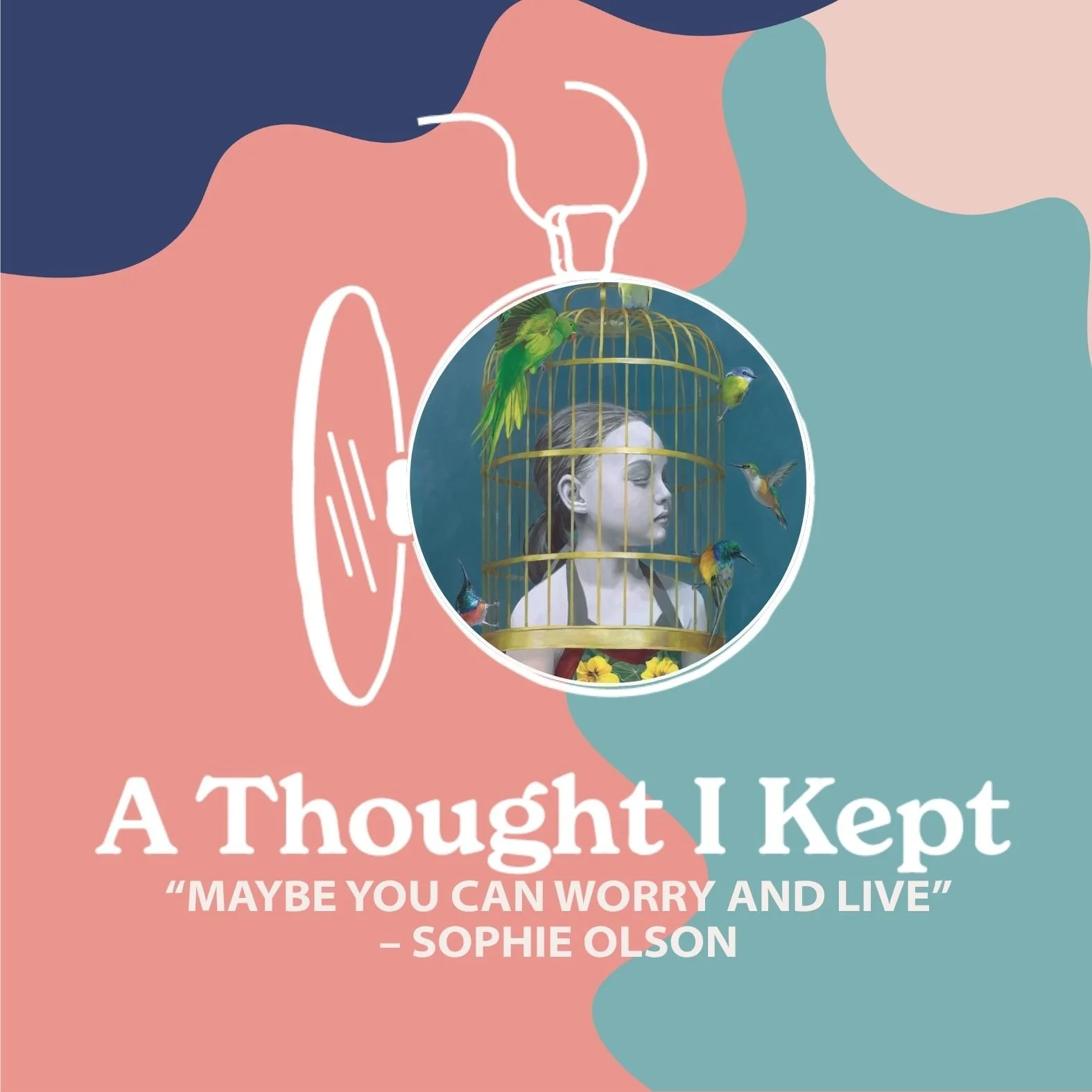
Listen to the episode: In Maybe You Can Worry and Live — Sophie Olson, we explore the intimate story behind Sophie’s grandmother's poem, her extraordinary relationship with her therapist, and how she's learnt to approach her experiences differently. Please note that our conversation includes discussions of childhood sexual abuse, self-harm and suicide.
Book a coaching conversation: If you're finding yourself caught between worrying and feeling frustrated that you worry, emotions coaching offers space to explore that relationship. We can look at what you're experiencing, what might be contributing to it and how you might approach yourself differently. Explore emotions coaching with me at If Lost, Start Here.
Please note that emotions coaching is not a substitute for therapy and is not suitable for working through trauma. If you're seeking support with trauma, I recommend working with a suitably qualified trauma-informed therapist.