
What if you could worry and still live your life?
Why accepting worry, rather than trying to eliminate it, might change our relationship with ourselves.
One of the things I hear most often in my coaching conversations is some version of this: "I just want to stop worrying."
Sometimes it's worry about the future. Sometimes it's about relationships, work, money or the people we love. Sometimes there's no obvious reason at all. Just a familiar feeling that something might go wrong and a mind that seems determined to consider every possible scenario in which that could happen.
When I ask people what they'd like to get out of our work together, the answer is often remarkably similar. They want the worry to go away. They want to feel more confident, less anxious, more in control. They want to be the sort of person who doesn't spend quite so much time worrying about everything.
I understand that desire. Worry can be exhausting. But I've become increasingly interested in what happens when we make eliminating a feeling the goal of our work. Because I’ve found that alongside the worry itself, there's often something else going on. We're frustrated that we're worrying. We feel guilty about the time we're spending worrying. We might even feel ashamed that we're somebody who worries quite so much.
And suddenly we have two problems: the thing we're worrying about and the fact that we're worrying in the first place.
A poem about not worrying
When I invited Sophie Olson onto A Thought I Kept, she brought something rather wonderful to our conversation. Not a famous quotation or an idea from a bestselling book, but a little handwritten poem tucked inside her grandmother's old recipe book.
Sophie inherited the book when her grandmother died. Alongside the family recipes, written in her grandmother's beautiful handwriting, was a poem about worry. Its author is unknown, but its message is wonderfully straightforward.
Essentially, there's no point worrying that something bad might happen if it never does. There's equally little point worrying that things might get worse if they don't. And even if the worst imaginable thing happens, worrying beforehand won't necessarily have changed anything.
Sophie discovered the poem around 2012 or 2013. She describes it as almost like receiving a message from her grandmother beyond the grave. It offered her comfort and the possibility of approaching life differently.
There was just one problem. Sophie couldn't stop worrying. And I think this is where our conversation becomes particularly interesting.
What happens when we can't stop worrying?
Sophie is a survivor of childhood sexual abuse, an author and the founder of The Flying Child, an organisation working to improve understanding and support for survivors. Her experiences are very different from those of many people who might recognise themselves in this article, and I wouldn't want to suggest that all worry has the same origins or requires the same support.
But something Sophie said felt relevant to so many of the conversations I have about anxiety and emotional wellbeing.
She loved her grandmother's poem. She understood its message. She could see the wisdom in it. But understanding that worrying might be pointless didn't mean she could simply decide to stop.
How often do we do something similar? We read a book about anxiety, listen to a podcast about managing stress or receive perfectly sensible advice from somebody who loves us. We understand what we're being told. We might even agree with it completely. Yet the next time we find ourselves worrying, there we are again. And because we think we should know better, we become even more frustrated with ourselves.
What if the problem isn't that we haven't yet discovered how to stop worrying? What if part of our difficulty is the expectation that we shouldn't worry at all?
What if we tried understanding ourselves instead?
One of the most moving parts of my conversation with Sophie concerns her relationship with her therapist, Patricia Walsh, whom she calls Pat.
Before meeting Pat, Sophie had spent years struggling with the effects of her experiences. She describes encounters with professionals that left her feeling ashamed and hopeless, including being told that she would never recover from severe and enduring mental illness.
When she began working with Pat, she struggled to find the words to communicate what had happened to her. One day, as Sophie was leaving a session feeling that therapy wasn't working, Pat suggested that she try writing her experiences as a fairy tale.
"Once upon a time, there was a girl..."
Sophie went home and began writing. It was the beginning of a process that eventually led to their co-authored book, The Flying Child: A Cautionary Fairy Tale for Adults.
But it wasn't simply the writing that changed things. It was also how Pat responded to what Sophie shared.
At one point, Pat helped Sophie understand that her responses made sense in the context of what she'd experienced. Rather than seeing herself as somebody who was fundamentally wrong, Sophie began to understand why she felt and behaved as she did.
I found this particularly affecting. Having spent years navigating mental health services with my own mum, I know how desperately we can search for the person, treatment or approach that might finally make everything better. Reading Sophie's book and hearing about Pat made me think about the difference between trying to change somebody's emotional experience and helping them understand it. And it made me wonder how often we could extend a little more of that understanding towards ourselves.
Perhaps worry doesn't have to disappear
Towards the end of our conversation, Sophie talks about her relationship with the word recovery. For her, recovery suggests an endpoint. A moment when she's supposed to have moved beyond her experiences and no longer be affected by them. She prefers to think about having learnt to live alongside her trauma rather than underneath it.
It's an important distinction, and one that Sophie makes specifically about her own experiences. Other people may find the idea of recovery meaningful and helpful. But there's something in that distinction that I think we can explore in our everyday emotional lives, too.
What if, instead of making the absence of worry our measure of progress, we became interested in how we respond when worry appears? Could we recognise it without immediately criticising ourselves? Could we become curious about what we're worried about and what we might need? Could we make room for the feeling without allowing it to make every decision for us?
This isn't about resigning ourselves to feeling terrible. Nor is it about suggesting that we shouldn't seek help when anxiety becomes overwhelming or interferes with our lives. There are effective treatments and forms of support, and accepting how we feel doesn't mean abandoning the possibility of change. It's about considering whether we might be able to approach ourselves with a little more kindness while that change is happening.
Maybe you can worry and live
At the end of every episode of A Thought I Kept, I return to the thought my guest brought and ask what it means to them now.
When Sophie and I returned to her grandmother's poem, something lovely happened. After almost an hour discussing her experiences, her relationship with Pat, writing, shame, anger and recovery, Sophie offered a different interpretation of the poem she'd carried with her for so many years.
"Maybe you can worry and live."
I love that she said maybe. There's no grand declaration that she's conquered worry. No promise that she'll never feel anxious again. Just the possibility that worrying and living aren't necessarily mutually exclusive. And perhaps that's something worth exploring in our own lives.
If worry has become something you're constantly fighting, you might start by asking yourself a slightly different question. Rather than “How do I make this feeling disappear?”, what would happen if you asked “How can I be a little kinder to myself when this feeling appears?”
You might discover that you need reassurance, rest, practical support or help addressing something genuinely difficult. You might decide to take action on a problem you've been avoiding. Or you might recognise that you're worrying about something you can't currently control and consider what you'd like to do with your day anyway.
None of these responses requires you to be delighted about feeling worried. And none requires you to stop wanting things to feel easier. But they might allow you to get on with living while you're figuring things out.
Perhaps the next time you find yourself worrying, you could try not adding the guilt, shame and frustration of being somebody who worries to everything you're already carrying. And perhaps that would be quite a good place to start.
Explore further
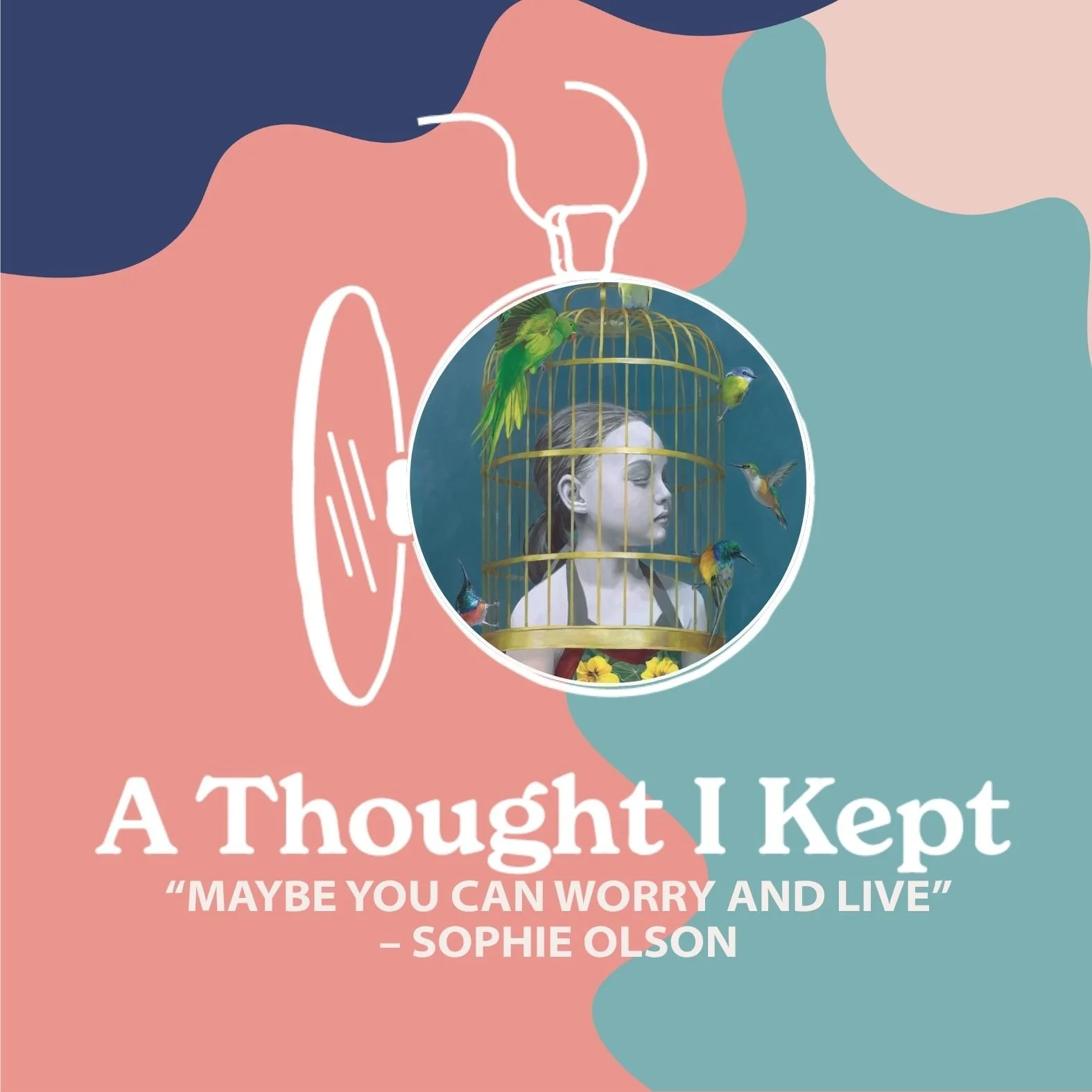
Listen to the episode: In Maybe You Can Worry and Live — Sophie Olson, we explore the intimate story behind Sophie’s grandmother's poem, her extraordinary relationship with her therapist, and how she's learnt to approach her experiences differently. Please note that our conversation includes discussions of childhood sexual abuse, self-harm and suicide.
Book a coaching conversation: If you're finding yourself caught between worrying and feeling frustrated that you worry, emotions coaching offers space to explore that relationship. We can look at what you're experiencing, what might be contributing to it and how you might approach yourself differently. Explore emotions coaching with me at If Lost, Start Here.
Please note that emotions coaching is not a substitute for therapy and is not suitable for working through trauma. If you're seeking support with trauma, I recommend working with a suitably qualified trauma-informed therapist.

It Started With a Girl Who Learned Not to Feel
Many of us learn to ignore our emotions in order to cope. Explore how emotional numbing, anxiety and disconnection can be signs that something needs attention and how listening to your feelings can help you reconnect with yourself.

When I think about how I ended up doing this work, helping people understand their emotions, reconnect with themselves and navigate life's more uncertain moments, I could start with coaching qualifications, books, podcasts or businesses. But the truth is, it started much earlier than that. It started with a girl who learned not to feel.
Not consciously, of course. I don't remember making a decision one day that emotions were unwelcome. I simply learned, as many of us do, which feelings seemed acceptable and which ones were better kept hidden.
Growing up in Manchester in the 1980s, "I'm fine" was a useful phrase. It helped conversations move on. It prevented awkwardness. It stopped people worrying. It allowed me to carry on with whatever needed doing. Looking back, I can see that it became less of an answer and more of an identity. I wasn't someone who felt things deeply. I wasn't someone who needed help. I wasn't someone who made a fuss. At least, that was the story I told myself.
The problem with not feeling isn't that difficult emotions disappear. It's that everything else starts to disappear too. When we disconnect from sadness, we often disconnect from joy. When we stop listening to fear, we stop listening to excitement. When we avoid disappointment, we can lose touch with hope. The range of emotions available to us narrows, and with it our experience of being alive.
I remember sitting with a friend in sixth form and telling her that I felt numb most of the time. Neither of us really knew what that meant. We didn't have the language for emotional wellbeing, nervous system regulation or emotional avoidance. We just knew something wasn't quite right. So I did what many of us do. I carried on.
For years, carrying on looked quite successful. I built a career in the arts. I worked in museums and galleries. I travelled. I moved countries. I achieved things I was proud of. From the outside, there was very little evidence that anything was wrong. Yet underneath all of that was a growing sense of disconnection that I couldn't quite explain.
What I understand now is that emotions don't disappear when we ignore them. They simply find other ways to get our attention. Sometimes they arrive as anxiety. Sometimes they arrive as overwhelm. Sometimes they arrive as burnout. Sometimes they arrive as a persistent sense that life feels flatter than it should. Sometimes they arrive as the uncomfortable feeling that you've become very good at living your life without fully inhabiting it.
When I look back on the people I've worked with over the years, I don't think my story is unusual. The details differ, but the pattern is familiar. There's the woman who can't stop working because slowing down feels uncomfortable. The person who takes care of everyone else but struggles to identify their own needs. The high achiever who has ticked all the boxes but feels strangely disconnected from their life. The parent who is so busy meeting everyone else's needs that they've forgotten what they enjoy. The person who says "I'm fine" before they've even considered whether they are.
Many of us learned to relate to our emotions as problems to solve rather than experiences to understand. We were taught to calm down, cheer up, toughen up, get over it, move on, look on the bright side or be grateful for what we have. Often these messages were well-intentioned. The people around us were doing the best they could with what they knew. Yet somewhere along the way, many of us absorbed the idea that difficult feelings were signs that something was wrong.
What If Our Feelings Are Trying to Tell Us Something?
One of the biggest shifts in my life came when I began to wonder whether my emotions weren't obstacles after all. What if anxiety was trying to get my attention? What if anger was highlighting a boundary? What if sadness was asking me to acknowledge a loss? What if overwhelm was revealing that something needed to change? What if our emotions are not interruptions to life but part of the conversation?
That idea changed everything for me. Not overnight and not in a neat before-and-after way. More gradually than that. I stopped asking, "How do I get rid of this feeling?" and started asking, "What is this feeling trying to tell me?" I became curious. I listened. I paid attention. Slowly, I began to reconnect with parts of myself I hadn't realised I'd lost.
This is one of the reasons I care so much about emotions now. Not because I think we should spend every waking moment analysing ourselves, but because I know what it's like to live disconnected from what you're feeling. I know what it's like to confuse coping with living. I know what it's like to spend years trying to manage your emotions rather than understand them.
Finding Our Way Back
Perhaps that's what so many of us are searching for when we say we're lost. Not a new version of ourselves. Not a perfect plan. Not a life without difficult emotions.
Perhaps we're searching for a way back into relationship with ourselves.
A way back to our needs, our hopes, our fears, our boundaries and our desires. A way back to the emotions we've spent years avoiding. A way back to the parts of ourselves we've become disconnected from in the process of trying to cope, succeed, belong or simply get through the day.
The older I get, the more I believe that wellbeing is less about fixing ourselves and more about listening to ourselves. Less about becoming someone new and more about becoming more fully who we already are.
For me, it started with a girl who learned not to feel. The work since then has been learning how to again.
Explore Emotions Coaching
Perhaps you recognise something of yourself in it. Maybe you've become very good at carrying on. Maybe you're aware that anxiety, overwhelm, numbness or frustration keep showing up, but you're not quite sure what they're trying to tell you. Or perhaps you're simply tired of feeling disconnected from yourself. If so, my emotions coaching sessions offer a space to slow down and listen.
Together, we'll explore what you're feeling, what those emotions might be pointing towards, and how you can build a different relationship with them. Not so you can get rid of difficult feelings, but so you can better understand yourself through them.
Because our emotions are often carrying important information about our needs, values, boundaries, hopes and fears. When we learn how to listen, they can help us move forwards with greater self-trust, clarity and self-compassion.
If you'd like support in making sense of what you're feeling, I'd love to help.

“I’m Fine” in Midlife
In midlife, “I’m fine” can mask burnout, hormonal shifts, and emotional overload. Explore why this response changes and how to reconnect with what you really need.

You wake before the alarm, not because you’re rested but because your mind has already started. There’s a list forming before your eyes are fully open — things to organise, respond to, remember, hold together. The day begins before you’ve even stepped into it.
By mid-morning you’ve answered messages, kept something running that might otherwise have stalled, smoothed over a moment that could have turned into conflict, and made sure everyone else is more or less where they need to be. When someone asks how you are — and they do, in passing, in between everything else — you say, “I’m fine,” and keep moving.
And in many ways, you are. You’re functioning. You’re managing. You’re doing what needs to be done. But somewhere underneath that, something feels different to how it once did.
The pace is the same, or even faster, but your capacity to keep absorbing it without cost has shifted. Sleep doesn’t restore you in quite the same way. Small things feel harder. Your body speaks more loudly, even if you’re not always sure how to listen. Emotions can feel closer to the surface — or, at times, more difficult to access altogether. And yet, the expectation — internal as much as external — is often that you should still be able to carry it all.
This is where “I’m fine” in midlife can take on a particular weight. It becomes the thing that holds together a life that has grown fuller and more complex over time — work, relationships, children, parents, friendships, the quiet accumulation of responsibility, the invisible labour that sits beneath it all.
It can also hold together an identity that has been built over years. If you’ve been the capable one, the one who gets things done, the one who can be relied on, then not being fine can feel like more than just a feeling — it can feel like a fracture in who you are. So “fine” keeps you inside something familiar, even if it’s starting to feel tight.
At the same time, midlife brings its own particular pressures.
Changes in the body — hormonal shifts, disrupted sleep, anxiety that arrives without clear reason, irritability that feels out of proportion.
Changes in relationships — renegotiations, distance, new dynamics that require different conversations.
Changes in perspective — a growing awareness of time, of what has been, of what might still be possible.
And alongside all of that, a question that can be hard to ignore:
Is this still working for me?
“Fine” often steps in right at that point.
Not because nothing is there, but because what’s there feels too big, too layered, or too disruptive to fully open. It protects you from the immensity of it — grief for versions of life that didn’t happen, anger at loads that feel uneven, fear of what change might bring, longing for something more spacious or more aligned. It also protects your nervous system when things have been too much for too long.
So instead of anxiety, you might feel a kind of flatness. A functional steadiness that keeps everything moving, but leaves little room for rest, pleasure, or connection.
You can cope, but you can’t receive.
You’re productive, but not nourished.
You’re calm on the outside, but internally braced.
And over time, that can begin to feel like the place you live.
But midlife also has a way of gently interrupting that pattern. Not necessarily with a dramatic breaking point, but with a steady accumulation of moments where “fine” no longer quite fits.
Where your body asks for something different.
Where your capacity reaches a limit.
Where your desires, long held at the edges, become harder to ignore.
And this is where something else becomes possible. Not a complete reinvention, and not a rejection of everything that has brought you here, but a gradual renegotiation.
Of what you carry.
Of what you expect of yourself.
Of what you allow yourself to need.
Questions begin to surface that cut through the automatic nature of “fine”:
What am I responsible for that I shouldn’t be?
What expectations am I meeting that no one has actually asked of me?
Where have I become the only one holding something together?
What would change if I believed my needs were legitimate?
These aren’t questions to answer all at once. They’re invitations. Because “fine” in this season of life isn’t something to get rid of. It’s something to listen to. A signal that something is asking for attention, for care, for adjustment. And alongside it, there can be another version of fine — one that feels different in the body. A steadier kind of okay.
Where your mood is mostly stable, even if life is full.
Where problems feel solvable, and support feels possible.
Where you have access, even in small ways, to rest, to pleasure, to connection.
Where your yes and your no feel real.
Midlife doesn’t remove the need for “fine.” But it does offer the chance to reshape it. To let it become less about holding everything together, and more about being in relationship with yourself as you actually are — changing, adjusting, becoming.
And from there, something opens. Not all at once. But enough to feel the difference between coping… and being here, in your life, with a little more space to breathe.
Identify the hidden emotion under “fine”
Common ones in midlife:
Grief (for time, body, dreams, parents, versions of self)
Anger (from unfair load, invisibility, broken agreements)
Fear (change, aging, being alone, being trapped)
Longing (for rest, intimacy, freedom, meaning)
Shame (for needing, for not coping “better”)
Prompt:
If ‘fine’ had a feeling, it would be?.
If ‘fine’ had a message, it would be?
Find the right kind of support
If it’s hormonal/body-based: track symptoms, consider talking to a clinician, consider sleep support and nutrition.
If it’s relational: practice direct asks, therapy/couples work, boundary setting.
If it’s nervous-system burnout: prioritize downshifting (rest, somatic work, less stimulation).
If it’s meaning/identity: coaching/therapy/journaling around values and your “next chapter.”
How to talk to people when you’re FINE
Scripts to try out:
“I’m a bit depleted. I don’t need fixing, just you to listen.”
“I’m not ready to talk details, but I’m not okay.”
“Can we do a low-energy hang? I need company.”
“I’m overwhelmed. Can you take one thing off my plate this week?”
“I’m not fine, but I’m ok.”
If “fine” has become the place you’re living from more often than you’d like, this might be a moment to have a different kind of conversation.
In coaching, we explore what’s shifting in this season of life — your needs, your energy, your direction — so you can move forward in a way that feels more sustainable and more yours.
Book a free discovery call and begin to find your way from here.

Moving Gently Beyond “Fine”
“I’m fine” can hide what we’re really feeling. Learn gentle, practical ways to understand your emotions, reconnect with your body, and express what’s true without overwhelm.

You’re replying to a message. “How are you?” they’ve asked, and your thumbs hover for a moment before typing, “I’m fine, how are you?” It’s already sent before you’ve really checked in. You notice it though, that slight pause afterwards, that sense that something more could have been said, but didn’t quite make it into words.
This is often how “fine” works. Not as a deliberate decision, but as a well-practised reflex. And once you start noticing it, it can be hard to unsee. Not because it’s wrong, but because you can feel both sides of it — what it’s doing for you, and what it might be costing you.
So the work isn’t to stop saying “fine.” It’s to start relating to it differently. Instead of treating it as something to correct, you can begin by treating it as information. A question, asked internally: what is “fine” doing for me right now?
Sometimes it’s protecting you from a conversation you don’t have the energy for. Sometimes it’s holding together a version of yourself that still feels important. Sometimes it’s simply buying you time — a way of saying, not now. And alongside that, another question can sit gently beside it:
What would become more complicated if I wasn’t fine?
Because that’s often where the truth lives — in the complication. The conversation you might have to have. The need you might have to express. The change you might have to consider.
You don’t have to go there all at once. Often, the smallest shift is enough. Instead of replacing “fine” entirely, you can add a little more specificity, a little more truth, while keeping the safety that “fine” was giving you.
It might sound like:
“I’m okay, but I’m carrying quite a lot.”
“I’m functioning, but I feel a bit tender.”
“I’m not in crisis, but I’m not feeling great.”
“I’m managing, but I could use some support.”
Or even more simply, noticing where “fine” is and isn’t true:
Fine at work, not fine at home.
Fine in the morning, not fine at night.
Fine physically, not fine emotionally.
These are small translations, but they begin to reconnect you with what’s actually there. And often, the quickest way into that isn’t through language, but through the body. A moment of pausing. A hand resting somewhere steady — your chest, your stomach. A question that doesn’t require explanation:
What’s here?
Tight. Heavy. Buzzing. Numb.
And alongside it, perhaps, a need:
Rest. Space. Reassurance. Warmth.
Even this — just naming a sensation and a need — can begin to shift “fine” into something more alive.
Because underneath “fine” there’s often a mix of feelings that don’t always separate themselves neatly. Grief that hasn’t had time. Anger that hasn’t had space. Fear about what might change. Longing for something more spacious, more connected, more yours.
You don’t have to untangle all of it. You can start with the smallest true thing.
And alongside that, you can begin to make small repairs — not dramatic changes, but deliberate acts that meet you where you are.
A short walk outside.
Water and something nourishing before the next coffee.
A message to someone safe saying I’m not great today.
A boundary you’ve been circling but haven’t yet set.
Because often “FINE” — the version that feels tight and effortful — comes from cumulative depletion.
You can cope, but you can’t receive.
You’re productive, but not nourished.
You’re calm on the outside, but internally braced.
A helpful shorthand can be:
Healthy fine = I’m okay, and I’m connected.
FINE = I’m okay, and I’m disconnected.
And the movement between those two states isn’t dramatic. It’s made up of small moments of noticing, naming, and meeting yourself a little more honestly. Not all at once. Just enough to feel the difference.
Healthy “fine” (when you’re genuinely okay)
Stable mood most days.
Problems feel solvable; you can ask for help.
You have access to pleasure, rest, and connection.
Your “yes” and “no” feel real.
You feel present in your life (even if tired).
Unhealthy “FINE” (a kind of functional numbness)
You can cope, but you can’t receive.
You’re productive, but not nourished.
You’re calm on the outside, but internally braced.
You’re “fine” because you’ve stopped expecting support.
Your life is organized around avoiding collapse.
If you’re ready to move beyond “fine,” even just a little, having someone alongside you can make that feel safer and more possible.
Coaching offers a space to find the words, reconnect with what’s going on beneath the surface, and take small, steady steps towards something that feels more like you.
You can start with a free call and see if it feels like the right kind of support.

Understanding Anxiety: 10 Things I’ve Learned About This Emotion
A thoughtful guide to understanding anxiety, drawing on research, coaching insights, and lived experience. Learn what anxiety really is and how to build a healthier relationship with it.
Anxiety is one of the emotions people most often want to get rid of. When it shows up — as racing thoughts, tightness in the chest, restlessness, or a constant hum of worry — the instinct is usually to quiet it as quickly as possible. But over the years, through emotions coaching, my own experience, research, and conversations with thoughtful guests on A Thought I Kept, I’ve come to see anxiety a little differently.
Not as an enemy. Not as a failure to cope. But as information about how our mind, body, and life circumstances are interacting in that moment.
Here are ten things I’ve come to understand about anxiety that may help you see it differently too.
1. Anxiety often appears in people who care deeply
Research on vulnerability and uncertainty — including the work of Brené Brown — suggests anxiety often shows up in people who care deeply and feel responsible for what happens next.
In other words, anxiety is often the emotional cost of trying very hard to do life well. It isn’t necessarily weakness. Sometimes it’s care that has nowhere to rest.
2. Anxiety is closely linked to uncertainty
Many researchers describe anxiety as our difficulty tolerating uncertainty. We don’t always feel anxious because something bad is happening. We feel anxious because we don’t know what will happen, and our mind begins trying to predict and prepare for every possible outcome. That prediction loop can quickly become exhausting.
A helpful question in anxious moments is simply: What uncertainty am I struggling to sit with right now?
Naming uncertainty often softens anxiety’s intensity.
3. Anxiety lives in the body before it reaches the mind
Emotion scientist Lisa Feldman Barrett has shown that emotions begin with bodily sensations.
Before the mind labels something “anxiety,” the body may already be experiencing:
a racing heart
tightness in the chest
restlessness
fatigue or agitation
Your brain then interprets these sensations and constructs the emotional experience. This is why logic alone rarely calms anxiety in the moment. Your nervous system needs signals of safety first.
4. “Anxiety” is often several emotions combined
In coaching conversations, many people use the word anxiety to describe a wide range of feelings. But when we look more closely, anxiety often includes:
fear
pressure
anticipation
responsibility
grief
uncertainty
Researchers call the ability to name emotions more precisely emotional granularity, and it’s linked to lower anxiety and greater emotional resilience. Because when we’re clear about what we’re feeling we can create better choices about what to do with that.
5. Anxiety is often trying to protect something
One of the most helpful coaching perspectives is to see anxiety as a protective response. It may be trying to prevent:
mistakes
rejection
disappointment
loss
uncertainty
Seen this way, anxiety isn’t random or irrational. It’s your system trying to help you navigate something that feels important. The work isn’t eliminating anxiety. It’s learning when protection is helpful and when it can soften.
6. Anxiety grows stronger in silence
Anxiety thrives in isolation. When it stays internal, it easily turns into self-criticism:
Why can’t I handle this?
Why am I like this?
But when anxiety is shared with the right people — trusted friends, supportive communities, or thoughtful conversations — its intensity often shifts. Connection doesn’t remove anxiety. But it changes how alone we feel with it.
7. Anxiety is deeply connected to the nervous system
Many experiences labelled “anxiety” are actually nervous system responses. When the body perceives pressure or threat, it may move into patterns such as:
fight
flight
freeze
flop or faun
These responses are not character flaws. They are biological (or learned) survival mechanisms. Understanding this can reduce the shame people often feel about anxiety.
8. Anxiety is often linked to responsibility and people-pleasing
Another pattern that shows up frequently is the connection between anxiety and over-responsibility. Many anxious people believe it’s their job to manage:
other people’s emotions
other people’s comfort
other people’s expectations
When you feel responsible for everyone around you, anxiety becomes inevitable. Learning to set boundaries — emotionally and practically — often changes the experience dramatically.
9. Anxiety often appears during life transitions
Periods of change frequently bring anxiety with them.
Career shifts
Relationship changes.
Parenting transitions.
Midlife questions about identity and purpose.
Anxiety in these moments doesn’t necessarily mean something is wrong. It can mean your life is asking new questions of you. Questions that don’t yet have clear answers.
10. Anxiety softens when trust grows
One of the most powerful shifts I see in coaching is this: moving from trying to control the future to trusting your ability to respond to it.
At first, anxiety tells us relief will come when we figure everything out. But life rarely offers that kind of certainty. What helps more is building trust:
trust in your resilience
trust in your ability to respond
trust in your capacity to ask for support
That trust doesn’t eliminate anxiety. But it stops anxiety from running the entire show.
Anxiety isn’t the whole story of you
If anxiety is part of your experience right now, it doesn’t mean something has gone wrong. More often it means something matters. Something feels uncertain. Something may be asking for attention or change.
Understanding anxiety isn’t a quick fix. But it can be the beginning of a steadier, kinder relationship with your emotional life.
Explore emotions coaching
If anxiety has been feeling overwhelming or confusing, emotions coaching offers a calm space to explore what’s happening underneath it.
Together we can look at how anxiety shows up in your life, what it might be protecting, and how you can move forward with more self-trust and steadiness.
Explore coaching options and book a free discovery call
This post is part of the If Lost Start Here Emotions Series — an exploration of the emotions that shape our lives and what they might be trying to tell us.

Understanding Anxiety: A Kinder Way to Live With It (Instead of Fighting It)
Anxiety often shows up quietly — as restlessness, pressure, or a constant hum of worry. Learn why anxiety happens, what it’s trying to signal, and how to respond to it with more understanding and self-trust.
Anxiety rarely arrives with a clear explanation. It tends to slip in sideways, disguising itself as restlessness, urgency, tightness in the chest, or a low-level sense that something isn’t quite right, even when life looks fine on the surface. You might be getting on with your days — working, caring, showing up — but underneath there’s a constant hum of worry or anticipation that never fully settles. If that feels familiar, it doesn’t mean you’re failing at coping. It often means something in you is paying very close attention.
Many people experience anxiety as though it appeared out of nowhere, an unwelcome guest that needs to be dealt with as quickly as possible. But when we slow down and look more closely, anxiety is rarely sudden. It often builds quietly over time, shaped by responsibility, change, uncertainty, loss, or long periods of holding things together without much space to pause.
Anxiety frequently belongs to people who care deeply, who think ahead, who want to do things well and not let others down. In that sense, it isn’t random or irrational. It’s connected to how you’ve learned to move through the world and what’s been asked of you along the way. The difficulty begins when anxiety becomes something you judge yourself for, rather than something you try to understand. When it shifts from an experience you’re having to an identity you feel stuck with.
One of the biggest myths about anxiety is that it means you’re not coping properly. Another is that if you could just calm down, think more positively, or gain more control over your thoughts, it would disappear. These ideas are everywhere, but they often make anxiety worse by adding pressure and self-criticism to something that already feels heavy.
Anxiety isn’t just about thoughts. It involves your whole system — your body, your nervous system, your past experiences, and your relationship with uncertainty. Often, anxiety is your system trying to prepare you for something it perceives as demanding or risky, even if that threat isn’t clear or immediate.
There’s also a common belief that anxiety is always about fear. Sometimes it is, but just as often it’s about pressure, responsibility, anticipation, or caring deeply about outcomes you can’t fully control. When everything gets bundled into the single label of “anxiety,” it can feel overwhelming and impossible to navigate. But when you start to understand the different layers underneath it, anxiety can feel less frightening and more workable.
Learning how to handle anxiety begins with understanding how it shows up for you, what tends to intensify it, and what helps it soften, even slightly. It also means recognising that anxiety lives in the body as much as the mind, which is why reasoning your way out of it rarely works when your system feels on high alert. Anxiety often grows in isolation and eases when it’s named, shared, and met with curiosity rather than judgement.
Handling anxiety better doesn’t mean getting rid of it altogether or becoming someone who never feels unsettled. It means changing your relationship with it so it no longer runs your life. That might start with noticing the early physical signs of anxiety, rather than only paying attention once it becomes overwhelming. It might involve questioning the stories you’ve absorbed about what anxiety says about you, and replacing them with something more accurate and compassionate.
It can also help to shift the focus away from certainty and towards trust. Anxiety often promises relief if you can just figure everything out in advance, but life rarely offers that kind of clarity. What tends to help more is building trust in your ability to respond, to ask for support, and to take things one step at a time without needing all the answers upfront.
Most importantly, learning to live better with anxiety means letting go of the idea that you have to manage it alone. Support doesn’t make anxiety vanish, but it can help you understand what it’s asking for and find steadier, kinder ways to move forward.
If anxiety has brought you here, it isn’t a sign that you’re lost beyond repair. It’s often a signal that something matters, that something is changing, or that you’ve been carrying more than your share for a while. Understanding anxiety isn’t a quick fix, but it can be the beginning of a more grounded way of living with yourself.
Explore emotions coaching
If you’re struggling with anxiety and want support that helps you understand your emotions rather than push them away, emotions coaching can offer a calm, thoughtful space to explore what’s going on. Together, we can look at how anxiety shows up in your everyday life, what it’s connected to, and how you can build trust in your ability to meet it with more ease and self-compassion.
Explore coaching options and book a free discovery call
Start better understanding your emotional life today and find a way through anxiety that feels supportive, human, and even realistic.

How to Feel Good Without Perfect: Simple Steps to a Kinder Holiday Season
Striving for a perfect holiday season can lead to burnout. Discover three gentle ways to embrace a “well-ish” approach instead, with tips for finding ease, balance, and genuine joy this holiday season.
With the holiday season approaching, many of us feel the pressure to make everything “just right.” Between the gatherings, gift-giving, and endless “to-do” lists, this time of year can bring both joy and stress. If the quest for perfection leaves you feeling more overwhelmed than content, it may be time to try a new approach.
Instead of aiming for a picture-perfect holiday, consider setting your sights on something kinder: simply feeling “well enough”. This shift is not about lowering standards; it’s about embracing what matters and letting go of what doesn’t.
Here, we’ll explore three simple ways to create a season that feels right for you, plus some journal prompts and gentle actions to help you connect to your own well-being.
1. Release the Holiday “Shoulds”
The holiday season is full of “shoulds”: we should send out perfectly coordinated holiday cards, bake all the desserts from scratch, and make sure every gift is wrapped with care. But who set these standards? Often, they’re a mix of societal expectations, family traditions, and our own internal pressures. Research suggests that releasing perfectionist tendencies, especially around the holidays, can reduce stress and lead to greater happiness
Try This:
- Journal Prompt: “What holiday traditions actually bring me joy? What expectations do I feel pressure to uphold, and why?”
- Gentle Action: Pick one “should” you feel attached to (like baking cookies from scratch or hosting a large gathering) and ask yourself if it truly brings you joy. If not, consider letting it go or simplifying it to suit your current needs.
When we question the holiday “shoulds” and focus on what feels genuine, we create space for a season that aligns with our real desires rather than external pressures. Remember, there’s no one right way to celebrate – only what feels right for you.
2. Permission to Pause
With all the activity and planning that comes with the holidays, it’s easy to lose sight of our own needs. But taking a small moment to pause can make all the difference. Research shows that small breaks throughout the day can significantly improve mood, focus, and overall well-being. Even a 5-minute pause can help reduce stress and reconnect you with yourself..
Try This:
- Journal Prompt: “How can I create moments of calm for myself this season? What would a short, meaningful pause look like for me?”
- Gentle Action: Practice a “holiday pause” by setting aside five minutes in your day to just breathe, enjoy a hot drink, or step outside. If a pause feels difficult to fit in, try integrating it into an existing activity, like focusing on your breath while waiting in line or slowing down during your evening routine.
These small pauses are powerful because they give us a chance to reconnect with ourselves amid the holiday bustle. Let this time be about you, free from any “shoulds” or “to-dos.”
3. Prioritise Feeling Over Doing
It’s tempting to overfill our calendars during the holidays, saying “yes” to every invitation, event, and tradition. But when we focus solely on “doing,” we can lose sight of how we actually want to feel. Do you want to feel relaxed, connected, or joyful this season? Let those feelings guide your choices.
Focusing on activities that support our desired emotions (rather than obligations) leads to greater life satisfaction. When we let our feelings, rather than activities, shape our holiday experience, we find a balance that aligns with our true well-being.
Try This:
- Journal Prompt: “How do I want to feel during the holiday season? What small choices or actions can support these feelings?”
- Gentle Action: Set an intention based on how you want to feel. For example, if you want to feel connected, consider inviting a friend for a casual coffee date. If relaxation is your priority, block off an afternoon to enjoy a quiet activity you love, like reading or crafting.
By prioritising feeling over doing, we can create a holiday season that resonates with who we truly are. This approach allows us to say “yes” to what matters and “no” to what doesn’t – without guilt.
Three Journal Prompts for a Kinder Holiday Season
Here are three journal prompts designed to help you dig deeper into what a “well enough” holiday could look like for you:
1. “What does a well holiday feel like to me?”
- Imagine your ideal holiday season. What stands out? What are you doing (or not doing) that makes it feel well? This prompt can help you identify specific actions or moments to bring into your season.
2. “What holiday expectations am I holding onto that I could release?”
- Often, we cling to traditions or expectations out of habit. Use this prompt to identify which of these serve you and which ones you might let go.
3. “What small moments can I add to my holiday routine to feel more balanced?”
- Small, daily rituals (like morning tea, evening journaling, or mindful walks) can help you stay grounded. Reflect on what these moments might look like for you.
Gentle Actions to Try
If you’re ready to make this season feel more balanced, here are three simple actions you can try:
1. Create a “Yes-No-Maybe” List:
Make a list of holiday activities and label them as “yes,” “no,” or “maybe.” Keep only the “yes” activities on your calendar and see if the “maybe” ones can become “no” if they feel too much.
2. Practice the “10-Minute Reset”:
Give yourself ten minutes each day to pause, reflect, and reset. This could be a quick walk, journaling, or simply sitting quietly. It’s a way to ground yourself in the midst of the holiday pace.
3. Set a “Feeling Intention” for Each Week:
Choose one feeling to focus on each week of the season, such as “peace,” “gratitude,” or “connection.” Make small choices that nurture this feeling in your life.
A Holiday Season That Feels Right for You
The holidays are a time for joy and connection, but they’re also an invitation to care for ourselves. By letting go of the “shoulds,” giving ourselves permission to pause, and focusing on how we want to feel, we can experience a season that’s kinder, calmer, and truly well.
If you’re ready for more ways to enjoy a well holiday season, sign up for our free Well-ish Guide to Feeling Better this Holiday Season. It’s packed with small, simple tips that help you focus on what really matters.

Less Stress, More Care: Tailor Self-Care to Your Real Life
Feeling overwhelmed by self-care advice? Discover five simple, personalized practices to help you redefine self-care, reconnect with your needs, and find balance in your daily life
Does it ever feel like self-care has become just another to-do list item?
Between “perfect morning routines,” endless lists of self-care must-dos, and the latest wellness trends, it’s easy to get overwhelmed. Instead of feeling better, you might find yourself feeling more exhausted.
But what if self-care could actually be about less? Less pressure, less perfection, and more about what genuinely supports you?
Why Self-Care Feels Like Another Task on Your To-Do List
Everywhere you look, there’s advice on how to meditate better, eat cleaner, or optimize your downtime. We’re bombarded by messages about self-care that often seem to suggest we need to add more things to our already busy lives. The result? Many of us feel like we’re failing at self-care. Instead of feeling relaxed and rejuvenated, we’re left stressed out and exhausted, wondering if we’re doing it all wrong.
But self-care isn’t supposed to be another area where you feel like you need to excel. It’s about supporting yourself in a way that feels right for you. It’s time to rethink self-care, moving beyond the latest trends and finding what truly helps you reconnect, recharge, and feel good.
How to Make Self-Care Yours—And Actually Enjoy It
How do we do that? By shifting from a one-size-fits-all approach to a personalized one. These five practices will help you make self-care yours, focusing on what genuinely fits your life and needs.
1. Identify Your “Non-Negotiables”
What are the small actions that make a big difference in your day? Maybe it’s your morning cup of coffee, a quiet walk, or five minutes of stretching. By figuring out the few things that you genuinely need to feel good, you can prioritize them no matter how busy your day gets. Your non-negotiables are the anchors that keep you steady, even when everything else is chaotic.
2. Create a ‘Done for Today’ Ritual
We’re often caught up in a cycle of constant productivity, but self-care can start with the simple act of letting go. Establish a small ritual to mark the end of your workday, whether it’s turning off your computer, lighting a candle, or putting on your favorite music. By creating a boundary between your work and personal time, you give yourself permission to relax and unwind without guilt.
3. Experiment with Micro-Moments of Self-Care
Self-care doesn’t have to be a grand gesture. It can be as simple as taking a deep breath, stepping outside for a minute, or savoring a piece of chocolate. Think of it as sprinkling little moments of care throughout your day rather than waiting for a big break. These micro-moments can be powerful ways to reset and recharge, especially when you don’t have time for a full routine.
4. Embrace the Power of Saying “No”
Sometimes the best self-care is knowing when to set boundaries. If you’re someone who often says yes to others, start practicing the power of a gentle “no.” Declining an extra project, skipping an event, or simply carving out time for yourself is not selfish—it’s essential. By saying no to what drains you, you’re saying yes to your well-being.
5. Revisit an Old Hobby or Passion
Self-care can also be about reconnecting with things you once loved but have set aside. Whether it’s painting, gardening, reading, or playing an instrument, revisiting an old hobby can bring a sense of joy and fulfillment. It’s a reminder that self-care is not just about maintaining your well-being but also about nourishing your passions and interests.
There’s No ‘Right’ Way to Self-Care—Only What Feels Right to You
Self-care shouldn’t be a source of stress. It could be a way to bring a little more joy, ease, and connection into your life. By identifying your non-negotiables, creating rituals, embracing micro-moments, learning to say no, and revisiting old passions, you can create a self-care practice that feels authentic, attainable, and genuinely helpful.
There’s no right or wrong way to do it—just your way. So, how will you make self-care yours today?
Ready to Make Self-Care Simple?
Sign up for our free guide, 5 Ways to a Better Well, and discover easy, practical tips to boost your well-being every day. Get started on your journey to feeling better, one step at a time.

Sometimes you just need to start (In memory of Carol)
On the many reasons why not If Lost Start Here, and the many (actually one) reason why, by co-founder Claire Fitzsimmons.
There are many reasons for not doing this project, for not starting If Lost Start Here. Want to hear a selection of them?
We are not ‘Experts’.
It makes us want to vomit.
Do projects like this pay?
Husband is doubtful.
Time to get a ‘proper’ job.
Don’t only perfectly-formed people start projects like this?
Someone, maybe many people, will laugh at us.
We are terrified of putting our ideas out there.
When? Like seriously when? And how? Maybe these are the same thing.
But there are many reasons why to work on If Lost Start Here:
We believe in it.
It wakes us up at 2am and gets us to the coffee shop to work on it by 5am.
More about mental wellbeing = matters hugely
It feels so good and right and necessary.
Good things might come of it, for us and others.
It might make people look differently at something, value their own thoughts, to notice who and what’s around them.
So many things in our lives led us to exactly this place.
We’d be moving forwards on one of our major life ambitions: mental health advocacy
Vomit can be cleaned and we’ll be ok even if we blush a little.
We get to decide what we do and where we put our attention, even if we have limited resources.
Not to, would be one of life’s big regrets
We love doing this together.
AND
This is the big one: because of my mum (this is a photo of her from sometime in the 70s—I love how she looks here). For many of us, it always comes back to our mums, doesn’t it?
There was a very clear ‘Before’ for me: I used to be a curator, in a former art world life, creating exhibitions in museums and galleries that I could have only dreamt of, like Tate Modern, the Serpentine and the ICA in London. It was an incredibly exciting career for a northern girl: I wore a lot of black.
Then something happened that forced me to reassess everything. My mum, who had been my best friend and constant in my life, started to lose her mind. Slowly, then completely. Now she struggles to function in the world. No, I don’t know her diagnosis. No-one does. We’re still trying to figure that out, after years and years of appointments, and ER visits, and specialists, and reading. Lots and lots of reading.
But the loss of my mum, even as she’s very much in this world, did this to me: it forced that question of the After, of what comes next. After I dropped my mum off at a psychiatric ward for the first time, as I drove to my childhood home, I made a promise to whatever entity we want to call it, that this would not all be for nothing, that I would work in any capacity I could to change whatever this situation was in which we were finding ourselves now lost. There is only After when you’ve been through something like this.
I’d quit the art world to train as a therapist. My experience with my mum’s mental health, and let’s add here my own, put the question of how we function as people front and center in my life, and it made me feel that this reified environment of conceptually-oriented art exhibitions didn’t connect with my life anymore. I would become the person in the room. I’d seek out a very clear role for myself.
My year at CCPE completing a Foundational Counseling & Psychotherapy course taught me that I was sincerely drawn to this world of therapeutic thinking. But I also wanted to bring that learning together with my curator brain—that roaming, search for thematics on which that profession is built. There’s always that tension in my mind between ideas and how they take their form in the world, in other words, the human piece. That’s the point of interaction that fascinates me the most. Could I make that into that something?
If Lost Start Here began to percolate when I realized that people were starting to do some fascinating things with that tension point. They were starting to build brick-and-mortar places around things like community and emotional intelligence, anxiety and depression, and even the end of relationships and end of life. They were starting to make places that hold our mental well-being in ways that the museums that I’d worked in held contemporary art.
I also realized that was nowhere to go to find all those different things. There were, and are, incredible platforms for great interior design, or travel off the beaten path, or well-being trends, but there’s nowhere to think about all the different places in the world that are now being kind to our minds and making for better lives. I realized that we needed a guide to this new sector, one that combines well-being with curiosity, travel and lifestyle, place-making and socially engaged art, independent cafes, and mom-and-pop stores—all approaches directed at making our lives better, and easier, and more fulfilling.
We’re hoping that If Lost Start Here will become the platform that curates the best places that support us as actual people in our worlds. It’s about that practical search for something else, for whatever it is that represents the gap in your life, for the thing that you need. My hope is that you’ll find what you are looking for and what you need. As I’m trying to do for my mum and me. Maybe we can do this together?
There are various ways for you to engage. By reading our online guide of those places that help with our sanity and our everyday lives, and supporting them as and when you need them in your life. By participating in our guide, contributing the places that you know prioritize our mental wellbeing in new and interesting ways. And of course, by sharing—help us get the word out that this platform exists, that there is help out there. Sometimes, we, you, and I just have to find it.
x Claire
My mum passed away unexpectedly last month. We’re reposting this piece now in her memory. This month, we’re supporting a place dear to mum’s heart, Sandbach Art Room. It helped my mum immensely over the last few years. You can also contribute to our Just Giving Page.

Getting High: The Power of Nature in Early Sobriety
Maybe the problem is less about who we are and how we escape and more about the walls we try to contain ourselves within.
A friend once told me that when life got hard, the secret was to get high...like, on a hill, or in a tree...maybe even in a small plane? (I’m not totally sure about the details.) While I never clarified how high, the sentiment behind this philosophy, I’ve come to understand, is that when life is feeling overwhelming, sometimes what we need is simply a shift in perspective.
1000 days ago, I set out on a journey to become sober. (Or, more aptly, 1000 days ago was the last time I set out on a journey to become sober.) For me, chasing a new and natural way to get high was a pursuit born less out of curiosity and more out of necessity.
I started questioning my relationship with alcohol when I realized how much I clung to my experiences of intoxication. How I pushed to keep those blurry nights going. How the evening wasn’t a success until I’d climbed to the top of a batting cage fence and balanced along the edge singing “Don’t Stop Believin” to whoever would listen; until I’d shut down the bar and become best friends with the bartender; until I’d climbed a tree and called to profess my love to every friend I’d ever made. And it was really not over until I stumbled through my door, passed out on my bed, and sunk fitfully into a familiar depression.
Maybe this persona, which only felt accessible when drunk, represented youth and freedom...maybe it represented recklessness and bravery. (Maybe those were the same thing to me?) Whatever it was, there were pieces of this version of myself that I cherished. And the truth was, I knew I would never grant myself this type of freedom in everyday life. I could never square who I was in sobriety with the freer version of myself I could conjure when drinking. Or maybe the problem was, I’d never stopped to try.
1000 days ago marked what I assumed was the beginning of some sort of infinite and unbearable tedium.
But, as it turned out…that’s not what happened at all.
Early Sobriety
So much of early sobriety was defined by not knowing what to do with my hands, or my thoughts, or myself — so afraid of judgment that I could hardly stand to exist in the same room as other people, let alone myself. Here I was, fully lucid, but unable to connect to my body or emotions or anyone around me in any real way.
A huge part of sobriety, for so many of us, is learning to live within the confines of our own minds, processing traumas and regrets, and fears, and finding a way to accept who we once were and redefine who we’re still becoming. We go to therapy and find support groups and lean on our most trusted friends. We take all the big steps, but we sometimes fail to know how to take the small ones, how to move through our daily lives.
When you’ve constructed a world around yourself that relies on your ability to escape it, removing the easiest exit can be terrifying.
Maybe though, the problem is less about who we are and how we escape and more about the walls we try to contain ourselves within.
So many of the things I was running from, so many of my fears, stemmed from this idea that I was not enough. That I had to shift and contort to fit into some preconceived mold, that who I was did not fit within the context of the walls I’d found myself trapped behind.
I wondered, then, what would happen if I removed the walls, and attempted to exist in a different setting? What would happen if I let go of control (of myself, my environment) and embraced something messier? Maybe the problem wasn’t mine to hold...maybe it was mine to set free.
Finding Nature
I can still remember the first time I stripped down to my underwear and plunged into the freezing Pacific. I was six months sober and desperate for something I couldn't name. My decision was made before I’d had time to second guess it (and before I’d seen the sign that said “Don’t go in here, you’ll die.”) This was the type of behavior that I’d assumed was relegated to my college years - the years of invincibility and low-stakes, when you could get drunk and jump in a fountain at midnight and it was mostly just funny; When your ideas were the only prompts needed to move you to action. In sobriety, I assumed that this spontaneity would die.
There is still something that calls me to live on the edge of recklessness, at times, some nearly-forgotten piece of myself that begs to be brought to life. I’ve found though, that at its root, this is not a calling to destroy myself, or even risk anything, it’s more of a call to move and live, to find joy and adventure. This is not a call to push myself to the brink of disaster, it’s simply a call to act.
The waters of Northern California answer the call. The cold hits like a punch to the face, but there is something about the way the shock is met with the lull of the waves. Something about the feeling of being alive, and not wanting to escape.
Being in nature offers us the chance to put our minds and bodies at ease by forcing them to adapt to new and changing conditions, by presenting us with opportunities to be present, without the fear that our minds will run away with us.
Today, plunging into violent waves, jumping into October rivers, and floating in lakes created from newly melted snow are the highlights of my life, a chance to feel alive and in awe. Today hiking and biking and exploring are regular practices and every time I climb a tree or attempt some made-up yoga position atop the highest boulder I can find, I feel a connection, not just to myself and within my body, but to something bigger...something I can’t explain.
When I first stopped drinking, the idea of connecting to some power greater than myself was touted as one of the many necessary stages to recovery. And while I don’t know that it is the same as believing in God or an afterlife or some other whimsical notion, nature is certainly bigger than I am, and full of as many mysteries as anything else. If there were ever a power I felt compelled to respect, this was it.
Rediscovering Ourselves
I can still recall the feelings of drunkenness. The weightless moments that lived somewhere between my anxieties and regrets. For a long time, I missed the feeling, longed for it. But it never occurred to me that there could be something in the world of sobriety to rival that feeling.
This ease of being in nature was enough to get me thinking: what is it that we get from drugs and alcohol that is mimicked here? Why do so many of us feel free and restored? Seen and accepted? Safe and held? I began to wonder if maybe everything we had deluded ourselves to believe we were running towards by drinking, was actually available to us in the natural world.
While there are so many paths to addiction and alcohol dependency, and no simple solutions or quick fixes, I can’t help but wonder if many of us, in addition to our deeper issues, are also starving for feelings of awe and wonder, for some presence of magic in our everyday lives.
For me, drinking had been largely about escape. Less from the problems in my life and more from the incessant hum of my brain, the voices in my head that ran the same narratives, filled with the same lies, over and over and over again, no matter how much I tried to drown them out. As anyone who has ever drunk alcohol knows, the voices can only be quieted for so long, and in the end, they always seemed to come back louder.
I remember being newly sober and in therapy (for anxiety that had shifted to panic attacks and near-constant paranoia). I remember speaking to my therapist about all the things I’d wished I could do but was too afraid to try. At the top of the list were always the same few things: hiking alone, surfing, camping with my kids. I couldn’t shake the feeling that who I was and who I wanted to be, would never coincide.
I’m not sure if it was something she said or some slow realization that progressed over months, but I began to push myself to spend time outside in ways that were uncomfortable. I had to face fears of murderous wildlife and even more murderous humans, fears of sharks and undertows, of snakes, and being alone with my thoughts. In time, the life I imagined for myself, the life I longed for and needed in sobriety, became the life I was leading. In some sort of magical gift of synchronicity, “who I wanted to be” suddenly became much closer to “who I actually am”.
Honesty and Acceptance
I feel like I should be holding a crystal and beating some sort of handmade drum as I expound on the purity and honesty of nature, but despite the painfully cliche trope, I can’t help but believe it is true. With nature, there is no facade. Sure from a distance it is pristine. A snowy mountain top. An alpine lake. The sun setting slowly into the sea...but get up close and you’ll find that it is an entirely different story.
One of my favorite settings is a grassy hillside dappled with cows. You’ve seen it before: The bright green hills set against a perfect blue sky, 7 wispy clouds peacefully poofing by. (It is possible that the Windows XP background, circa-2001, has brainwashed me.) But what happens when you get up close? What happens when you park your car and hop the fence and head up that perfect hill?
Here’s what happens: It’s literally covered in shit.
Truly, just shit. Everywhere.
Rocks. Thorns. Snakes. Shit. Not one square foot of grass that looks suitable for sitting on. Just the luckiest version of factory-farmed cows with their sweet big eyes and dangling little ear tags looking at you like: “Why the fuck are you here? This is our poop hill. Can we not find peace anywhere? Please go away.”
Because here’s the thing. Anything can look beautiful from far away, but pretty much everything is a mess if you look closely enough.
Take any natural wonder and I’ll show you the murky underside. This is the duality of life...the very nature of existence. There is no black and white, there is no perfection. Everything is all of it, all of the time.
1000 days ago I did not understand what it meant to be all of it, all of the time. I didn’t understand the complexity of the mountain that sat before me, could not grasp the nature of the climb or the difficulty of the landscape. 1000 days ago clouds were just beginning to part so that I could finally see the sun.
Today, I am somewhere on the mountain but with the understanding that I’ll never get to the top. I climb because I need the freedom to explore and the space to be myself and the air that is fresh and new. I climb because the alternative is to tumble off of the cliffside and plummet to the river and drown. I climb for the clarity and the perspective and the views. I climb because I can feel the earth beneath my feet and it reminds me of being a child, reminds me that I’m connected to something I cannot understand, reminds me that there is mystery and adventure waiting for me. I climb not because I am headed toward a destination, but because I’m learning to revel in the challenge of the never-ending journey, because there is joy here, and beauty. Because everything I’d ever longed for - freedom and escape, peace and chaos, honesty and connection - all reside here.
I used to think life was about shutting all of the bad parts of myself out so that the beauty could shine. Now I understand that it was that manner of thinking that led me to drink in the first place. The trick isn’t to suppress who you are to be something else, it’s to see the beauty in every piece of yourself, even when it’s a total disaster, to build a life free from the confines of our shallow judgments, to recognize our shortcomings, and love ourselves anyway.
In sobriety, we are forced to grapple with every version of ourselves, who we’ve been through every season, forced to sit with whatever shame or guilt or sadness we’ve spent our lives amassing and running from. Here, there is no running. We are the beautiful shit-covered hillside. We are the mud beneath the melting snow. We are the seagull choking on cigarette butts as the sun slips slowly into the sea. (Someone please find a way to put this on my headstone.)
There is an honesty in nature not because it’s perfect, but because despite its inherent chaos, it’s still beautiful... awe-inspiring...worthy of our love and admiration.
I’m beginning to wonder if maybe we love nature not because it represents something more pure than us, but because it is just like us: a total fucking mess—-and it’s beautiful.

Easing Into Adventure
Tips for overcoming anxiety, introversion and overwhelm so you can say “Yes!” to doing more of the things you (actually) want to do.
It might seem ironic that someone who struggles to leave the house is the co-founder of a project designed to get people out and into the world. But when you stop to think about it, maybe it’s actually less ironic, and more...necessary?
So often it is the confident extroverts of the world who are guiding us through our days, making recommendations for the must-see places of the world, filling us in on the latest go-to destinations, hashtagging their way into our hearts with their carefree wanderlust. While this is lovely and appreciated and a gift to so many...for some, it can make an already impossible-seeming task feel even more impossible. Like many people who live with anxiety and depression, I understand the value of getting out into the world (and long for the “good” days when I feel capable of doing so)...but I also understand that it isn’t always easy, or, in some cases, even possible.
I spent many years absolutely terrified to be in the world. Trapped in my home / my car / my mind.
If this project has taught me anything, it’s that healing can be gentle...gradual. We don’t have to power through and push beyond everything that makes us uncomfortable all at once, and we certainly don’t deserve to suffer the wrath of our own judgment when we can’t. If the goal of life is progress and forward momentum...I think it makes sense then to choose the paths that bring us the most comfort and joy, to hold ourselves accountable, sure, but more importantly to hold ourselves. I hope these tips help to ease you into doing more of the things you want to do. Please share with anyone who could use a boost.


Mindful Doing & Creative Space
Ellie Grout finds her community of introverts at Bristol’s Creative Space and her equilibrium through Mindful Doing.
Relaxing spaces took on a major importance in my life following the second—and hopefully last—of two very unexpected breakdowns. Although I’d previously needed a little time to settle in to new surroundings, I could still be content in most places. Once my mental health had been shattered there were very few places I could go without heavy consideration. This meant that I now spent a lot of time at home; I love my house and it is definitely an anchor for me, but too much of a good thing always has its downsides.
This deterioration in health pushed me into creative experimentation, along with my sister and best friend Lottie Suki, who in a spooky coincidence had experienced a similar breakdown that closely mirrored my own. Coming from a creative family and each with creative backgrounds, it was no surprise that we found our solace in making and crafting. The first smile of excitement on my face in months came from making a teeny, tiny 25mm badge. This unofficial course of discovery proved to be our tonic: we both began to recover and rediscover our authentic selves as we lost ourselves in creation.



Once my sister and I had regained our confidence and joie de vivre, we began to daydream about developing a community of introverts, who, like us, would rejoice in the opportunity to calmly and quietly experiment with crafts. A weekend stroll down North Street, Bedminster, Bristol, landed us with the perfect location to make our dream a reality. I was heading to Storysmith (an idyllic independent bookshop on the same street, where you can browse what feel like dream bookshelves) and from the corner of my eye I noticed a sign calling for creative professionals who wanted to rent space to lead workshops. The coincidence was too exciting for us to ignore.
Even on first impression, Creative Space seemed heavenly. Settled amongst the pleasant hustle and bustle of North Street, the entire shop front comprises of windows which let the light flood in. Inside, the space is spacious and yet still cosy. The studio is an inspiring place to be; like a gallery, the walls are white, and the artificial lighting is bright. The windows are filled with reupholstery projects that are still in progress, along with creations from the wide variety of teachers who also run workshops in the space.


Having come such a long way in our own lives, my sister and I decided to be brave. We knew how much our wellbeing had improved through doing things mindfully, and so we made the bold step to begin our own course: ‘Mindful Doing’. Whilst we both do rather different things with our days and careers, we both discovered that the act of creating was a major contributor to our improved wellbeing and we wanted to share this with others. We devised a short course which explored some of our favourite ways of making things through writing, drawing, paper making and bookbinding and we ran it for the first time last summer. That was when we discovered our own 'Community of Introverts'.
Even though anxiety has haunted us throughout, what has been most wonderful about this little venture, is that we have both felt the healing of these sessions at least as much as the people who have come along to them. We travel to the venue filled with nerves and the overhang of daytime stressors, but by the time we leave we are filled with positivity and calm. We both feel the benefit so much from supporting others to be mindful in their ‘doing’. The community within our sessions is wonderful, the space and what it stands for within the local area closely aligns with our values, and the area is itself is a magical little nook of a vibrant city.

Two Chairs | A Conversation about Thoughtful Therapy with Alex Maceda
Two Chairs is doing therapy differently. We spoke to its Director of Brand Strategy about why the model of delivery has been so broken but also why therapy itself isn’t.
I’ve sat in uncomfortable chairs in rooms with badly painted walls. I’ve awkwardly handed over a cheque or counted out cash at the end of a session. I’ve missed weeks of help because scheduling hadn’t worked out with the shape of my week. I’ve stumbled down stairs afterwards crying and fled to my car for solace. I’ve found people, then dropped them when it didn’t work, but made sure that I felt like I was the cause of the ending and not them. All of the above, all of it is wrong, but all of it is what can happen in our experience of therapy.
We are huge advocates of the practice of therapy and have been in and out of it (between us) for most of our adult lives. Sitting with a therapist has saved us again and again. We’re happy to spread the cause that #therapyiscool, and we’re in the business of making all our mental health tools, including talk therapy, more present in our lives.
But as we do this, we also need to acknowledge that the model of how therapy is given—not the content or the relationship parts—but all those things around it such as booking, payment, design, and fit, make it really, really hard to have a good experience at best and to get the help we need at worst. We pay more attention to how we go for a haircut, then how we go for therapy, and that makes no sense at all.
That’s why we were relieved to discover Two Chairs, a San Francisco start-up (hold the judgement) that’s making therapy all about you in all the ways that it hasn’t been so far and really needed to be. That means when you step into one of their seven therapy clinics across the Bay Area, you enter a setting that actually has your back as a person in the world.
Here the design of the spaces matters, not just in terms of beautiful furnishings with yellow (brand color) flourishes amongst the muted tones, or the LaCroix stocked in the fridge, and carefully chosen Phaidon art books on the coffee tables, but in psychologically impactful ways too. How the chairs are arranged affects how comfortable you might feel as a therapy go-er depending on your life situation. The art on the walls can subtly shift your mood. The presence of plants actually makes for a calmer environment.
Yes, therapy here is given the modern makeover it so, so badly needed, but it’s also been given one that takes into account what science is telling us about the environments and processes we need to best function as people. This is all Two Chairs Therapy’s Alex (Amac) Maceda’s domain. As the Director of Brand Strategy, Amac is responsible in her remit for interior design and client experience, working through all these details with not just operations and designers, but also clinicians and clients, who are folded into the process of what goes on before and after, as well as during a therapy session.
We had the opportunity to talk to Amac about why the model of delivery has been so broken but also why therapy in itself isn’t.


Claire: Let’s start with what Two Chairs is changing about the experience of therapy from the client’s side. Although we’re huge believers in therapy, we know that it’s really hard to just get the help that’s needed. How are you responding to this?
Amac: At Two Chairs, it’s all about access. We think of access as all the barriers that the system puts in front of you when you want to start care. The most classic example is that you are probably in crisis and you know that you want to go to therapy. You go online and Google. You maybe find 10 names. All of them are phone numbers only. Three of them call you back. Two of them don’t have availability. One of them can see you 30 minutes away at 2pm. Even when you’re opted-in, the system makes it so hard for you to get care. It’s such a disheartening experience, especially when you are engaging with it for the first time.
Claire: It’s hard to say,“I need to go to therapy,”and it’s even harder when you are trying to do this, and it’s still not coming together.
Amac: For a lot of people by the time they are asking for help, they have probably gone through quite a bit. Also, a lot of people are afraid to ask for help that first time. Whether they don’t know where to start or fear the stigma, there are so many things that you find yourself up against. Imagine that after taking so long to get to that realization, there’s still 20 barriers that they didn’t even know existed. When Two Chairs first started, that was the problem that we were trying to solve: How can we make engaging in high-quality care as easy as possible for those seeking it.
Claire: Can you talk me through how you are doing that in practice?
Amac: Some of the things we are doing are so simple, and take inspiration from different consumer brands, but are not typical in a health care setting. Things like online scheduling—it takes less than five minutes to schedule an appointment—and convenient locations—all of our clinics are located near major transit hubs. We want clients to be able to get in and out. We want clients to get on with their day and have the experience of therapy be as seamless as possible in daily routines.
Claire: You also have a unique offering in how the therapy journey starts way before clients are physically in a room with someone. Can you tell me about that intake piece?
Amac: We have a really dedicated care coordination team, and see them as a helping hand before clients even start care. They help clients think through questions like, “I don’t know if therapy is right for me, but someone recommended it,” to “how much can I expect to be covered with my insurance plan?”
What I think is really unique with Two Chairs compared to private practice or other group practices is our emphasis on matching. It’s clinically proven that the strength of the alliance between the therapist and the client is the biggest predictor of success, rather than the therapeutic approach taken by the therapist. However, the current system is not set up to match well.
Choosing a therapist can be really intimidating for anyone, and at Two Chairs, we try to make that as easy as possible. What that looks like from a client perspective is: you book an appointment online, receive a series of emails about what to expect in your appointment and then we send you a client profile to fill out.
The profile is a detailed intake form asking what some of your goals are for therapy, some demographic information, and questions that try to get at what modality might work for you, including,“How structured of a thinker are you?” from very structured to not structured, and,“How much do you want to be challenged in therapy?” from pushing back to I want a therapist who listens more. We’re not asking you to choose a modality, but rather we’re getting at some of the qualities that might move you towards one type of care or another.


Claire: That’s an interesting technology-driven part of your approach that hasn’t had a place previously in therapy. How important is the personalized data-driven piece to the Two Chairs model?
Amac: The self-reported data from the client goes into a matching algorithm that has been built in-house by our engineering team, and is founded on the latest data science. But our approach is not founded on data only. That information forms a hypothesis that a consult clinician (a position unique to Two Chairs) uses for a first consult. They prep with all the intake data, but they use their clinical expertise in that first in-person appointment to move the data around and to form a recommendation based on this human interaction. It is that person who then matches you with an ongoing clinician.
We match on so many different factors, from demographics, lived experience, and any specific preferences, like, “I can only come in at 8am in Oakland and I want to see a female who is middle aged.” We take this all into account when matching.
Claire: So, they take what they understand as you as this person on paper and you as this person in space, then put you in contact with the person who would be your therapist? If someone then goes to that therapist, and that’s not a good match, do you then rematch them? That’s one of those broken parts of classic therapy, that bad matches do happen and then someone drops out of therapy because of this even though they still need help.
Amac: Yes, that is where the consult clinician is so powerful—they become that point of contact throughout the process if anything is wrong. But we do have an over 90% success rate with the first match. Clients tend to be in therapy for quite a long time, though our goal is not to keep you in therapy forever. We’re now just over two years old, and at this stage, we’re seeing clients come back for new courses of care, and to work on new issues in more proactive ways versus more reactive ways.
Claire: I’m interested in this narrative of therapy positioned within life maintenance, like something you fit in on a regular basis. I’ve noticed that in the language of Two Chairs, that you are positioning therapy as a self-care tool rather than just as crisis management.
Amac: We have a good mix of clients who are brand new to therapy, and also those who are returning to therapy. On the new to therapy side, it’s been so powerful to see clients coming in for the first time who are telling us that they’ve been looking for a therapist, but that it had felt too intimidating, and that Two Chairs made it so easy. And on the flip side, we’ve had clients who have been in therapy for years who are coming more proactively, and treating therapy as a tool that is part of their life.
Claire: Do you approach those two needs differently in the intake process given that therapists have their own specialisms, such as trauma or situational issues, or work more generally, in a style that can be more holistic and generalized?
Amac: Yes, there’s all this self-reported data on the client side but I think what people don’t think about as much with Two Chairs is that we also have all this self-reported data on the clinician side too. Our matching tool includes their clinical expertise in session and the data we have about the clinicians about how they self-report their stylist preferences, their studies and research backgrounds.
Claire: How do you deal with the inclusivity piece? Therapy has been charged with being very narrow in its focus.
Amac: There’s a few different aspects to inclusivity, and certainly one of the hardest is financial. We’re still an Out-of-Network provider and we charge $180 for a session. That’s under market in San Francisco. But we aspire to be In-Network which we know will help a lot in terms of that financial piece. We know that the bigger we get the more power we have to be in network and then we can open access to more people.
On the other side, one of the narratives around therapy is that traditionally minority communities are less served within therapy and that gets back to our matching system. A big part of what we hear from clients is that we have a very diverse population of therapists across demographic and lived experience, qualities like gender, race, and sexual orientation. We consciously build for that. The feeling that someone understands your lived experience is very important, so we hire against that.


Claire: What happens after a therapy session? I always had this issue with therapy where I would sit in this non-descript room, see my therapist, and then come out with whatever raw feeling that I had, but then I have to go on the tube and get myself home. Can people hang out? Can they linger in the waiting room or sit with a cup of tea before heading back out into their non-therapy worlds?
Amac: I personally feel so passionately about this. Imagine that you cried during therapy and then you have to go to the bathroom to check your face and then sit in your car doing breathing exercises to collect yourself before going back to work. It doesn’t happen always, but for many of us, myself included, we’ve been there once or twice. For much of therapy, there’s no after. We think a lot about how you enter, but no one ever thinks about how you leave.
That’s something we’re addressing in all of our newest clinics and bringing that concept into the space. We’re introducing decompression areas to the extent that we can where you have separate exits and semi-private areas where you can sit and journal. We have essential oils and rocking chairs, so you can take a few moments if you need to. Each of our therapy rooms have a small mirror right before you exit so you can check how you look. These are all the little thoughtful details that we know from experience or from our clients speak to where they are at in that moment and we try to pull that into the design of the space.
Claire: Two Chairs didn’t go down the route of becoming an app but has invested in bricks and mortar and that in-person piece. Why is that aspect of just being in the room with someone so important. I know Two Chairs Founder Alex Katz has talked about Sherry Turkle’s Reclaiming Conversation: The Power of Talk in a Digital Age as a foundational text, and I wonder how this folds into your approach?
Amac: We know it’s clinically proven that in person is better. You lose so much when you are not in the room: like body language, tone, how a person is presenting, and how they seem to feel.
We also know that we are in a generation where we keep talking about how much digital is taking over our lives, and how much interaction is going through a screen. To be able to interact in person, especially around topics that are so deeply personal and that a lot of clients are talking about for the first time, allows us to bring a lot more empathy and understanding to the experience.
Claire: You have all the science backing up therapy, but you also have the science backing up the in-person piece. We’re at this moment that those two pieces are coming more and more together.
Amac: Yes, there’s so much care and attention paid understandably to the clinical setting. The hard part goes on in the therapy room. But there’s so much across the whole experience that matters—being able to be in person, to walk into a space and to feel a sense of calm, to have a cup of tea and to sit there for a moment, to take an hour out of your day in a beautifully designed setting that addresses our needs as a person.
Claire: Do you find that therapy is as stigmatized as when you started even a couple of year ago?
Amac: I certainly feel the stigma has decreased—but we have a long way to go. I find myself in a lot more open conversations about it, but know it’s a self-selecting group of people around me saying they go to therapy and that they love it. Even then, they are sharing in small conversations but not necessarily projecting it in public.
As someone who has worked in brand and marketing at different companies, I find it to be a very unique and specific reflection of where we’re at culturally with mental health. I used to work in fashion, and we had tons of user generated content on social media—people were posting pictures and tagging our brand, being advocates for our sustainability efforts, sharing our mission with friends—they wanted to be publicly associated with us. That’s not quite the same at Two Chairs—yet. We had our first tag from a client testimonial for Two Chairs only a couple of months ago, which was so powerful and exciting. Even two years ago, it would be hard to imagine someone posting about their experience with therapy on Instagram and thanking their mental health provider. It’s happening, but it’s still rare. Which makes sense—how many people do you know are going to therapy and taking a selfie and saying, “I had a great therapy session?”
There’s still a little bit of a ‘coming out’ that people do when they start to publicly associate themselves with mental health, mental illness, and therapy. Even people who are very mental health positive are not necessarily saying I’m going to therapy every week.
I was there six years ago, when I told a friend that I was in therapy and I remember feeling so scared. When they just said, “that’s great”, this relief washed over me. But even that makes such a big difference. It can be so powerful.
Everyone is on their own journey with telling their personal mental health story, but we hope that the work we’re doing at Two Chairs is making therapy a little more approachable, and creating more space so that you can talk to people about your experience with therapy when you’re ready. We want to humanize therapy more. In the past couple years there have been more and more mental health stories of famous people, often with this narrative of a grand fall from grace and then rise, which is inspiring, but not representative of most people’s experience. We’ve introduced an initiative called #TalkTherapy on our blog where we put more stories out there to show there’s a breadth of experience, that it’s positive or that it’s negative, sometimes life changing and sometimes it’s not, but we try to normalize the breadth of what happens to people in therapy.
Claire: How has Two Chairs been received on both sides, client and therapist, since launching?
Amac: We’ve seen over 2000 clients in the San Francisco Bay Area over the past two years. Last month we opened our fourth clinic in two years within San Francisco. We are one of the biggest group providers in the Bay Area at this point.
We are creating demand for therapy—we know this because a large percentage of our clients are coming to therapy for the first time, but there’s still a lot of latent demand for therapy. We’re the first consumer brand in a space that has existed for a long time and what we’re offering is a high-quality version of a something that is already there. We’re not trying to create something new that people don’t understand; we’re a better-quality version of what’s out there and we’re adding new aspects to it that make it more compelling for clients. In San Francisco there’s an emphasis on wellbeing, wellness, and self-improvement, and it’s really exciting to be in the generation that’s opening the conversation around mental health.
To learn more about Two Chairs visit their Website, Instagram, and Facebook

When Friendship Saves Us (Part 2) : Our Take On Modern Love
As our problems gain significance and gravity and weight, we are no longer confident that our friends can bear their burden, no longer confident that they’ll be able to see us through the wreckage of our flaws. Maybe that’s why, when we find someone who does see us and loves us still…maybe that’s why we hold so tight?
Believe me when I tell you that nothing sounds more terrifying to me than a posh British girl who has just transitioned out of her successful career as a modern art curator to focus more fully on our societal responsibility to address mental well-being. (For reference: I am insane, and 50% of the “art” in my house is from TJ Maxx.)
But a few months after our second babies were born, it was time for our firstborn children to start Kindergarten, and by some stroke of luck, or destiny (or the fact that there was actually only one school in our town) our children ended up being placed in class together.
I sometimes wonder what these days would have been like if I’d understood at that time who she was…who’d she’d be to me. If I’d have felt less lost? Less alone? If we both would have? But maybe that’s the beauty of friendship? There is simply no rush to force its unfolding, no timetable that stipulates where things ought to be; a freedom that allowed us to bumble through the initial unfolding in spit-up ridden fits and starts, baby slings flapping unceremoniously in the breeze as we realized: being together through all of this was just better than being apart.
There was a time when I thought of friendship as an immature pursuit, that all of these minor relationships were simply buying time until the real relationships began. Surely I’d outgrow the need to spill forth all of the pieces of my life in the hopes that my poor, unsuspecting friends would put them back together. Surely slumber parties and impromptu ice cream binges would lose their appeal? Surely I’d feel increasingly more inclined to hide who I was in the hopes that I’d remain protected, collected, secure. And maybe that’s true. Maybe we do start holding ourselves together more as we age. We smile and respond “I’m great!”, and we shift our conversations to inconsequential topics and we occasionally pop in to therapy when things get bad…but by and large, more often than not, we choose to suffer alone. As our problems gain significance and gravity and weight, we are no longer confident that our friends can bear their burden, no longer confident that they’ll be able to see us through the wreckage of our flaws. Maybe that’s why, when we find someone who does see us (really sees us) and loves us still…maybe that’s why we hold so tight?
Claire was the first person I opened up to fully (partially because she made me feel safe, and partially because I was breaking down before her very eyes and there was no longer a polite way to brush off her concerns).
“Yes I babysat your daughter today!” (You’re welcome!)
Yes, I also stayed at the park the whole time because I thought a murderer was hidden in my attic.“Yes, we rode our bikes to school pick-up today!” (What a fun and active mom!)
Yes, I also believe a bomb has been planted in my car and will explode at any moment in some sort of Speed-esque fashion (but minus the uniformly-sweaty-and-bronzed Keanu Reeves.)“Yes, my eyes are very puffy because I’m tired!” (#momLife amirite?)
Yes my eyes are also puffy because I’ve been crying constantly/hysterically/desperately wondering how to escape the confines of my body.
Due, in part, to a series of traumatic events and in part to a less-than-ideal genetic composition, I’d found myself locked in the jaws of anxiety and paranoia, once again — a constant gnawing that quickly escalated to a violent, thrashing attack. And when everyone else saw the smiles and the bikes and the requisite puffy-eyes…Claire saw the bite marks. When everyone else was happy to accept the ‘I’m fine!’s, happy to accept the facade I’d so expertly constructed (and who could blame them?) Claire was the type of friend who was brave enough to look beyond the poorly-bandaged wounds to the disaster that lay beyond. And when she saw me there (the real and broken me) the ‘me’ who had no jokes or quips or excuse left; when anyone would have been justified in their rapid fleeing ... She stayed.

Frazzled Cafes
With Frazzled Cafes, our mental wellbeing has hit the High Street. Comedian Ruby Wax has created safe spaces to talk at M&S locations across the UK.
“We live in a time where to have a life crammed to the hilt is considered a success story. But with all this pressure, so many of us have nowhere to go to meet and talk about it. Frazzled Cafe is about people coming together to share their stories, calmly sitting together, stating their case and feeling validated as a result. Feeling heard, to me, has always been half the cure.”
Modern life burn-out is as ubiquitous as M&S but we have this idea that we have to be all in with therapy or medication to deal with it. And we’re not knocking either (we have been and sometimes still are there), but sometimes we just need access to what we see as mental health maintenance, safe spaces to talk it out and talk it over. That’s where the network of Frazzled Cafes come in. They fill that gap between sitting alone with something, with the struggle and the frankly frazzled feelings that infiltrate our lives and our days, and pouring resources like money and time into talking cures, to committing to sessions and schedules. We need both. In fact we need all the different things, the different kinds of spaces and initiatives that might meet us where we are and hold us for the time that we’re there in whatever way we need, without judgment and with compassion.
Frazzled Cafes were launched a couple of years ago by the comedian Ruby Wax, who has recently become known as the popular author of books that include How to be Human, in which she discusses with a monk, and a neuroscientist the fundamentals of how we function as people, and A Mindfulness Guide for the Frazzled, an approachable and funny course in mindfulness. During the tour for her books, Wax had people again and again come up to her needing to talk and that was her lightbulb moment—that we all are running on empty and still finding our way through, and that we all need a way of expressing that feeling while connecting with others who are probably experiencing the same thing.
On why that word ‘Frazzled’, Wax explains: “A neurobiologist might say that someone is ‘stuck in a state of “frazzle”. They mean that, for this person, constant stress is overloading the nervous system, flooding it with cortisol and adrenaline; their attention is fixed on what’s worrying them and not the job in hand, which can lead to burn-out.”
The genius of the idea though is that Wax reached out to M&S, the widely beloved British High Street institution, to host these talk gatherings. And with that one call, you are in seriously stigma busting territory. If the venerable M&S is in that space of talking about our emotional and psychological lives, then surely that’s ok and allowed. Plus, who doesn’t want to spend time in an M&S after hours where the sessions are held?
Frazzled Cafes now take place in M&S locations across the UK, in their cafes and sometimes community rooms. Recently the idea was also tested at High Street Bakery Le Pain Quotidien. People are invited to RSVP beforehand and some weight is given to those who have attended before. Each session lasts 75-90 minutes and starts with a meditation to bring people into the room and ground their experience. The meetings are run according to the rules of therapeutic spaces, with a set of guidelines that promotes ideas of confidentiality, kindness and support.
If you interested in joining one of these meet-ups, sign-up for the newsletter which announces dates and venues and will link you to the RSVP for each cafe session. Just note that Frazzled Cafes are keen to point out that this is not designed to replace therapy but rather fills a need that most of us have just to be heard.
In our busy, often overwhelming lives, sometimes all we need is a safe space to talk. Frazzled Cafe is that space. And with that the issue of our mental wellbeing has now hit our high-street. Let’s keep it there.
To find out more: Website www.frazzledcafe.org / Twitter @frazzledcafe / Facebook @frazzledcafeuk / Instagram @frazzled_cafe

Culture Therapy | Mental Wellbeing
Here’s our Prescription for Mental Wellbeing: you will find in these pages and in these narratives, lives lived within, or touched by, consumed or imploded, maybe even adjacent to, issues around mental wellbeing. Our culture is now holding this space in a very different way than before for issues around depression, anxiety and mental health more widely. We recommend you check these out.
We went through a period of reading mental health memoirs: The Center Cannot Hold, Touched With Fire, Darkness Visible, My Age of Anxiety. We sought them out for information, for resources, for shared experiences. We held onto Andrew Solomon’s The Noonday Demon and Elizabeth Wurtzel’s Prozac Nation. We returned again and again to The Bell Jar. We looked to something outside ourselves that made sense of what was happening in our own minds, in our own lives, and with friends, colleagues and family also impacted by depression, anxiety, and other diagnosed and undiagnosable conditions. Through reading we found a way forward that wasn’t yet being spoken about; admittedly we sat alone with our books trying to locate ourselves and others we loved.
Thinking about this, our Prescription for Mental Wellbeing, we’ve realized that there’s been a huge shift in how we now get to talk about our mental health. There are now what seems to be an abundance of publications, podcasts, films and programs which to us collectively say no to that stigma that had previously left us alone with our experiences. There’s been a huge surge in positive media that has created a very real platform for our very real stories. Narratives that are now out there which take ownership of the conversation; that take someone’s experience and throw it out into the world so that we too can shift our relationship with what mental health means and how it shapes us and those around us.
These examples don’t glamorize mental health as bohemian or creative, rather they allow for truth and pain and joy and loss and connection, and for a deep, sometimes lifelong search for equilibrium and understanding. You will find in these pages and in these narratives, lives lived within, or touched by, consumed or imploded, maybe even adjacent to, issues around mental wellbeing. Our culture is now holding this space in a very different way than before for issues around depression, anxiety and mental health more widely. Messy, and unresolved sometimes. Hopeful and self-aware always. And for that we are very, very grateful.
Take up a book, head to Netflix, listen to something on your way to work. Support this shift and these very brave voices. Acknowledge that there are humans behind these stories putting themselves out there so that we may have a way to live our own situations outwardly. Make this openness last. Because we can not go back to not talking, to not reaching out, to being hidden and confused. To being alone with our books and our questions and our lives which didn’t have a place in the world and now very much do.








The Saviors We Never Knew We Needed
But the beauty in this moment, if there is any to be found, is that we’re beginning to accept that mental health isn’t just something to be addressed within the stark walls of our therapist’s office. We’re beginning to look to more than the typical health care provider to carry us through. We’re beginning to see that, maybe, there is healing to be found elsewhere? Maybe there are solutions and connections and answers in our everyday lives? Maybe music is here to save us, after all.
The sun is setting in San Francisco and I’m roaming the streets barefoot (again).
It’s the summer of 2004 and I’ve just lost my shoes for the fourth time. Seeing as I’ve spent the last hour fighting to stay alive amidst a sea of people, rioting and screaming, it feels like a relatively small casualty.
You might be imagining that I’d just witnessed a burgeoning political movement take shape, that I was standing (shoeless) at the precipice of some groundbreaking revolution (and, now that I think of it, maybe I was...but I certainly didn’t realize it at the time). You may *also* be thinking I was very drunk, tripping my way down the crowded streets of the Tenderloin (which is certainly a strong possibility, but I honestly can’t recall the details.) In reality, I was simply ambling back to my car after a night at The Fillmore...manically happy (albeit a bit bruised)...feeling more alive than I’d ever felt.
I often think back to this time, the early 2000s, coming of age just as the California music scene was coming alive with a new wave of emotionally-charged sounds. (Emo, Screamo, Pop-Punk, Hardcore ... whatever the distinction, there were lots of feelings, and everyone was yelling.)
While I’ve never fully fleshed out the true impact, this much, I know, is true: Packing into a small, hot venue, with all the focus and intensity funneling in one direction is a powerful, communal experience and arguably more cathartic than most other experiences we’re afforded as adults. (Truly, if you have never been allowed to push someone really hard and then sob next to that *same person* whilst swaying, let me tell you, friends: It does NOT disappoint!)
For someone lacking any sort of formal religion, rock shows became my church.
If you were to create a Venn-diagram outlining the commonalities between the two, there probably is a pretty sizable overlap.
(you should draw this)
It makes sense, then, that, in moments of struggle, we look to these idols for direction and guidance, that we take their words as gospel and apply them to our lives; that we pour over their lyrics in search of answers; that we try to align our experiences with their teachings; that we seek connection with other believers; that we stand and chant, screaming their words back to them hoping, this time, that we’ll finally hear them.
Because the truth of the matter is, the reason that we love music is that it offers us a safe place to process and feel—a necessity we’ve, historically, been completely starved for.
We’re a nation of young people being ravaged by mental health issues. Suicide rates and depression and anxiety are all on a steady rise.* But the beauty in this moment, if there is any to be found, is that we’re beginning to accept that mental health isn’t just something to be addressed within the stark walls of our therapist’s office. We’re beginning to look to more than the typical health care provider to carry us through. We’re beginning to see that, maybe, there is healing to be found elsewhere? Maybe there are solutions and connections and answers in our everyday lives? Maybe music is here to save us, after all.
For teens, specifically, there is a power in seeing the people we idolize, respect and trust bringing a vulnerability and openness around these difficult conversations.
Emerging at the same time as this early 2000s emo and punk scenes, To Write Love on Her Arms (TWLOHA) was established to reach this demographic of young people.
“TWLOHA is a non-profit movement dedicated to presenting hope and finding help for people struggling with depression, addiction, self-injury, and suicide. TWLOHA exists to encourage, inform, inspire, and also to invest directly into treatment and recovery.”
Traveling with The Warped Tour, TWLOHA brought mental health awareness to a massive audience and served as a springboard for other similarly impactful initiatives. “Wanting to support existing professional help organizations rather than replace them, TWLOHA has invested directly into causes such as Hopeline, InTheRooms.com, S.A.F.E. Alternatives, Minding Your Mind, and (in Australia) Kids Helpline."
The incredible thing about TWLOHA was seeing how it affected not just the fans, but the bands as well. It became clear that fame and success were no more protective against mental illness than anything else. The truth that we all struggle was brought fully, and literally, to center stage.
Working in the music industry over the last few years, I’ve noticed an uptick, not just in the vulnerability bands bring to their live shows, but in the intentional messaging that is expressed, both through their lyrics and through their on-stage admissions. There is a real drive to reach out and let listeners know that they are not alone.
This year alone:
We saw Lovely The Band frontman Mitchy Collins open up about losing friends to suicide , encouraging listeners to reach out, find help, and check in on one another.
We watched K.Flay release an entire album full of deeply personal stories from her childhood with topics ranging from her ever-present mental health struggles to her strained relationship with her father.
Blue October frontman Justin Furstenfeld’s Open Book tour exposed us to his addiction, how he found hope, accepted help and eventually saved himself.
Rainbow Kitten Surprise floored us with their groundbreaking video for “Hide” (please go watch it immediately) and their resolve to secure equal rights and protections for LGBTQ community members by donating a portion of ticket sales directly to Equality NC.
Billie Eilish took the world by storm by bringing an entirely new sound to the world of alternative and pop music, but she also brought stories of living with Tourette’s syndrome, normalizing the condition for sufferers across the world.
Whether they realize it or not, these bands are shifting the way we orient ourselves to mental health.
I remember the early days of attending shows, being lost in a sea of people, hoping, simply, to hold on to my shoes. I remember the days when “HOW THE FUCK ARE YOU GUYS?!” was the requisite level of interest a band was expected to pay you. I remember how, sometimes, I’d find myself being crushed against the barriers in front of the stage, how the band would stop playing to say something about loving and protecting each other before launching back in to their set. I remember, in that moment, however brief, after fighting for space and gasping for breath, the palpable feeling of relief.
Today’s bands are doing more than offering brief moments of reprieve from the pain... they’re creating a space where the pain can sit and live as we breathe our way through, creating a space where we can come together in recognition of our brokenness and in awe of our strength, creating a space where, yes, we might lose some shoes...but one where we might find some hope, as well.
* In the United States, the suicide rate has jumped 24 percent since 1999, to 13 per 100,000 people, with the steepest growth in the years since 2006, according to a new report from the Centers for Disease Control and Prevention.

Mind Food
As MindFood’s motto goes, “Gardening is cheaper than therapy and you get tomatoes.” The Ealing-based social enterprise has this idea at its core: it’s founded on nature and uses food as the framework for figuring out our mental health concerns.
“We support people to improve their wellbeing through growing and selling food.”
Did you know that as you grow your tomatoes or tend that cabbage patch, you are also doing something deeply therapeutic?
The Ealing-based social enterprise MindFood has this idea at its core: its founded on nature and uses food as the framework for figuring out our mental health concerns, whether we’re struggling with common conditions like depression, anxiety, and stress, including PTSD, or we’re just curious about plotting and planning our own psychological health and wellbeing. As their motto goes, “Gardening is cheaper than therapy and you get tomatoes.”
Chatting to co-founder and director, Ciaran Biggins, he points out that, “An environment of nature and growing food is a perfect way to practice the Five Ways to Wellbeing as identified by the New Economics Foundation”. So if we break that down, you get connection in the form of the community around you. You are able to take your time and pay attention whether that’s to changing seasons or to something you planted. You take on the role of an active learner, specifically here about horticulture. You get to give back through the systems of sharing and support that MindFood is grounded in. And lastly, you get to be physically active, getting those wellies on and hands dirty.
Drawing from the evidence base of nature’s calming effect and the restorative practice of planting, cultivating and selling food, Biggins created a program that involved “spending more time learning about food, building community, and being in nature in a supportive environment.”
Want to get involved? MindFood offers a starter program: a free six-week course, Growing Wellbeing, which covers the theoretical and practical relationship of nature and wellbeing. It’s all “action orientated to encourage behaviour change.”
And for those who want to continue their involvement, there’s Plot to Plate, 12 weeks of working to cultivate the produce in their allotment, then selling it from their Market Stall in Acton (which inscribes a whole other level of value and purpose for what you’ve just achieved).
To find out more: www.mindfood.org.uk / Twitter @MindFoodCIC / facebook.com/MindFoodCIC

Navigate from here.
Have you ever been lost? Totally stuck? Grasping for something? So much so that you’ve sat in front of your computer, not knowing what to type into Google, not knowing where to look, so you’ve simply typed ‘help’. You had no idea how to square that work situation that was escalating, you didn’t know how to get beyond the heartbreak of losing someone you love, you didn’t have a clue how to get your aging parents to listen to any of your well-thought out advice, your boss was driving you crazy, your kids equally so, and you were knackered beyond compare. So, you just typed ‘help’. And really what you were doing was looking for the answer to a really simple question: ‘What can I do?’ But the answer still didn’t come.
If Lost Start Here attempts to answer that question by exploring each week exactly what you can do. We’ll cover a café that deals with anxiety, a museum that can teach us about empathy, a group of blokes hanging out in their sheds. We’ll get to an organization that offers mental health walks, another that focuses on getting out of our heads and into nature. We’ll feature a festival that encourages creativity, a community allotment project that takes on aging, and a collaborative art project that invites participants to make connections, material and otherwise.
This platform will focus on what we believe is an emerging new sector that’s all about how to be a person in the world. This includes initiatives that range from inspired classes and smart idea sessions, to hands-on practice studios and maker sessions. Initiatives that have arisen across different sectors, away from just wellness to the domains of culture, science, and the humanities. Initiatives that are people-centered, have a deep appreciation of experience and design, are open and accessible to all, and are often playful. Initiatives that represent something that people can return back to, again and again, and offer a longer-term relationship to making something work better (so not the quick-fixes).
Other people, or maybe you, are building the frameworks and creating the structures to help people negotiate their lives, from multiple perspectives and in very different ways than what went before. There’s a sector developing that’s aims at helping our emotional and psychological well-being, but it hasn’t yet been pulled together as an effective and necessary response to all our life’s problems.
If Lost Starts Here attempts to do just that, to respond to the conundrum of tons of advice, shifting evidence and approaches, and the very real question of where and how you can actually do this. As you read through, your bit is to find the thing that appeals to you, to show up to something and see how it goes. To engage.
So, let’s get started…