
How We Learn to Cope Without Alcohol
Alcohol often becomes a way to manage anxiety, overwhelm, and difficult emotions. Explore how emotional regulation works and how to develop healthier ways of coping.
Rethinking emotional regulation, drinking, and the stories we inherit about coping
There are moments in life when something quietly stops working.
Not dramatically, not all at once, but gradually, almost imperceptibly. A glass of wine at the end of the day that once felt relaxing begins to feel necessary. A way to soften the edges of stress, to slow a racing mind, to take a brief step away from the feelings that have been gathering in the background.
For many people, alcohol becomes woven into the way we cope with everyday life. It sits comfortably in the rituals of the evening, the social rhythms of weekends, the celebrations and the commiserations. It promises relief, connection, relaxation — and often, at least for a while, it delivers.
But sometimes there comes a moment when the question begins to surface: Is this actually helping?
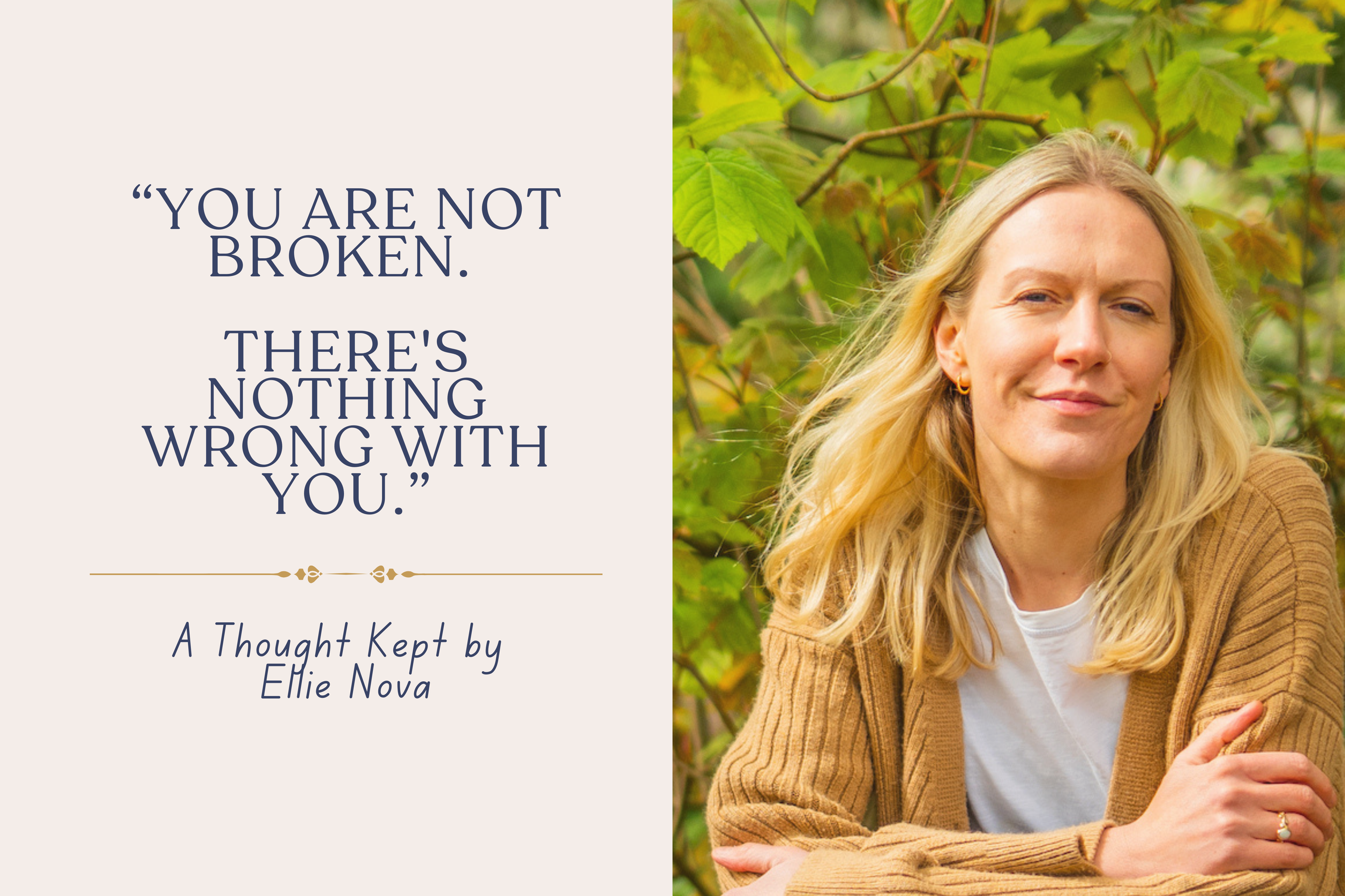
That question was at the heart of a recent conversation on my podcast A Thought I Kept with sober coach and writer Ellie Nova. Ellie spent more than a decade feeling trapped in a relationship with alcohol that was increasingly tangled up with shame and self-judgement. And the thought that ultimately helped her begin to step away from it was surprisingly simple:
There is nothing wrong with you.
At first glance, that might not sound like a thought powerful enough to change a life. But the more we talked, the clearer it became just how radical it can be.
Because when people begin to question their relationship with alcohol, the story they often tell themselves is one of personal failure. Why can everyone else seem to drink normally? Why does this feel so difficult for me? Why can’t I control myself?
But what if alcohol was never really the problem in the first place?
What if, instead, it had simply become a way of coping with emotions that felt too big to hold?
The quiet role alcohol plays in emotional regulation
One of the things Ellie and I explored together was the role alcohol can come to play in regulating our emotional lives. Not because we consciously choose it as a coping strategy, but because many of us grow up without ever being taught how to sit with difficult feelings.
Anxiety, loneliness, grief, pressure, shame — these emotions can be uncomfortable and confusing, especially if we’ve learned, consciously or unconsciously, that they are not entirely welcome. Perhaps we were told we were too sensitive, or that we needed to toughen up, or that certain feelings were inappropriate in certain situations.
Over time, many of us become quite skilled at pushing emotions aside. We distract ourselves, we stay busy, we find ways to numb what we’re feeling just enough to keep moving.
In that context, alcohol can begin to make a certain kind of sense. It offers a socially acceptable way to soften emotions that feel sharp, to quiet thoughts that won’t settle, to step briefly outside of the intensity of being human.
And because alcohol is so culturally embedded — in celebrations, socialising, relaxation, and even self-care — it can take a long time before we start to question the role it’s playing.
When drinking stops feeling like relief
For some people, that questioning begins when alcohol stops delivering the relief it once promised. The drink that once helped take the edge off anxiety begins to bring its own kind of discomfort. The sense of escape becomes tangled up with regret, exhaustion, or a quiet awareness that something isn’t quite right.
At that point, it can be tempting to interpret the problem as one of discipline or willpower. Perhaps I just need to be stronger. Perhaps I need more control.
But Ellie’s experience — and the experiences of many of the women she now supports — suggests something quite different.
If alcohol became a coping strategy, it likely did so because something inside needed support. Something needed soothing, or understanding, or simply space to be felt.
And when we begin to look at our relationship with alcohol through that lens, the conversation shifts.
Instead of asking What’s wrong with me?, we begin asking more curious questions.
What am I actually feeling?
What have I been trying not to feel?
And what might help me cope in a way that truly supports me?
Learning to cope without numbing
Letting go of alcohol can feel daunting not simply because it is a habit, but because it has often been doing important emotional work behind the scenes.
Without it, many people suddenly find themselves face to face with feelings that have been carefully managed for years — anxiety, grief, loneliness, stress, even the quieter emotions like disappointment or regret that are easy to push aside in a busy life.
Learning to cope without alcohol, then, is rarely just about stopping drinking. More often, it becomes a process of learning a new relationship with our emotional lives.
That might involve recognising emotions earlier, before they gather into overwhelm. It might involve paying attention to the physical sensations that accompany anxiety or stress in the body. It might mean finding other ways to regulate ourselves — movement, conversation, rest, time in nature, creative expression.
But perhaps most importantly, it involves replacing judgement with curiosity.
When we stop seeing emotions as problems to eliminate and begin to understand them as signals, something shifts. The very feelings we once tried to escape can begin to feel more manageable, even informative.
A different understanding of self-care
In our conversation, Ellie and I also reflected on the way self-care is often presented as a form of escape — a brief pause from the pressures of life, a small indulgence designed to help us get through the week.
But real emotional care often looks quieter and deeper than that. It might mean slowing down long enough to notice what is actually happening inside us. It might mean allowing feelings that are uncomfortable rather than immediately trying to distract ourselves from them.
Sometimes it means asking for support.
For many people, learning to cope without alcohol becomes part of a broader shift toward self-trust — a growing sense that our emotions are not something to suppress or manage away, but something to understand.
And that shift often begins with a simple but powerful idea.
There is nothing wrong with you.
Listen to the conversation
If this perspective resonates with you, you can listen to the full conversation with Ellie Nova on the podcast A Thought I Kept.
In the episode How We Break Free From Alcohol, Ellie shares her own experience of stepping away from alcohol and the thought that helped her begin to see her emotions, and herself, in a different way.
Looking for support with your emotions?
If you’re navigating emotional overwhelm, anxiety, or simply trying to understand your feelings more clearly, you might also find our emotions coaching sessions helpful.
These sessions offer a calm, thoughtful space to explore what you’re feeling and to develop ways of working with your emotions that feel supportive rather than overwhelming.
You can learn more about emotions coaching with Claire here.

Getting High: The Power of Nature in Early Sobriety
Maybe the problem is less about who we are and how we escape and more about the walls we try to contain ourselves within.
A friend once told me that when life got hard, the secret was to get high...like, on a hill, or in a tree...maybe even in a small plane? (I’m not totally sure about the details.) While I never clarified how high, the sentiment behind this philosophy, I’ve come to understand, is that when life is feeling overwhelming, sometimes what we need is simply a shift in perspective.
1000 days ago, I set out on a journey to become sober. (Or, more aptly, 1000 days ago was the last time I set out on a journey to become sober.) For me, chasing a new and natural way to get high was a pursuit born less out of curiosity and more out of necessity.
I started questioning my relationship with alcohol when I realized how much I clung to my experiences of intoxication. How I pushed to keep those blurry nights going. How the evening wasn’t a success until I’d climbed to the top of a batting cage fence and balanced along the edge singing “Don’t Stop Believin” to whoever would listen; until I’d shut down the bar and become best friends with the bartender; until I’d climbed a tree and called to profess my love to every friend I’d ever made. And it was really not over until I stumbled through my door, passed out on my bed, and sunk fitfully into a familiar depression.
Maybe this persona, which only felt accessible when drunk, represented youth and freedom...maybe it represented recklessness and bravery. (Maybe those were the same thing to me?) Whatever it was, there were pieces of this version of myself that I cherished. And the truth was, I knew I would never grant myself this type of freedom in everyday life. I could never square who I was in sobriety with the freer version of myself I could conjure when drinking. Or maybe the problem was, I’d never stopped to try.
1000 days ago marked what I assumed was the beginning of some sort of infinite and unbearable tedium.
But, as it turned out…that’s not what happened at all.
Early Sobriety
So much of early sobriety was defined by not knowing what to do with my hands, or my thoughts, or myself — so afraid of judgment that I could hardly stand to exist in the same room as other people, let alone myself. Here I was, fully lucid, but unable to connect to my body or emotions or anyone around me in any real way.
A huge part of sobriety, for so many of us, is learning to live within the confines of our own minds, processing traumas and regrets, and fears, and finding a way to accept who we once were and redefine who we’re still becoming. We go to therapy and find support groups and lean on our most trusted friends. We take all the big steps, but we sometimes fail to know how to take the small ones, how to move through our daily lives.
When you’ve constructed a world around yourself that relies on your ability to escape it, removing the easiest exit can be terrifying.
Maybe though, the problem is less about who we are and how we escape and more about the walls we try to contain ourselves within.
So many of the things I was running from, so many of my fears, stemmed from this idea that I was not enough. That I had to shift and contort to fit into some preconceived mold, that who I was did not fit within the context of the walls I’d found myself trapped behind.
I wondered, then, what would happen if I removed the walls, and attempted to exist in a different setting? What would happen if I let go of control (of myself, my environment) and embraced something messier? Maybe the problem wasn’t mine to hold...maybe it was mine to set free.
Finding Nature
I can still remember the first time I stripped down to my underwear and plunged into the freezing Pacific. I was six months sober and desperate for something I couldn't name. My decision was made before I’d had time to second guess it (and before I’d seen the sign that said “Don’t go in here, you’ll die.”) This was the type of behavior that I’d assumed was relegated to my college years - the years of invincibility and low-stakes, when you could get drunk and jump in a fountain at midnight and it was mostly just funny; When your ideas were the only prompts needed to move you to action. In sobriety, I assumed that this spontaneity would die.
There is still something that calls me to live on the edge of recklessness, at times, some nearly-forgotten piece of myself that begs to be brought to life. I’ve found though, that at its root, this is not a calling to destroy myself, or even risk anything, it’s more of a call to move and live, to find joy and adventure. This is not a call to push myself to the brink of disaster, it’s simply a call to act.
The waters of Northern California answer the call. The cold hits like a punch to the face, but there is something about the way the shock is met with the lull of the waves. Something about the feeling of being alive, and not wanting to escape.
Being in nature offers us the chance to put our minds and bodies at ease by forcing them to adapt to new and changing conditions, by presenting us with opportunities to be present, without the fear that our minds will run away with us.
Today, plunging into violent waves, jumping into October rivers, and floating in lakes created from newly melted snow are the highlights of my life, a chance to feel alive and in awe. Today hiking and biking and exploring are regular practices and every time I climb a tree or attempt some made-up yoga position atop the highest boulder I can find, I feel a connection, not just to myself and within my body, but to something bigger...something I can’t explain.
When I first stopped drinking, the idea of connecting to some power greater than myself was touted as one of the many necessary stages to recovery. And while I don’t know that it is the same as believing in God or an afterlife or some other whimsical notion, nature is certainly bigger than I am, and full of as many mysteries as anything else. If there were ever a power I felt compelled to respect, this was it.
Rediscovering Ourselves
I can still recall the feelings of drunkenness. The weightless moments that lived somewhere between my anxieties and regrets. For a long time, I missed the feeling, longed for it. But it never occurred to me that there could be something in the world of sobriety to rival that feeling.
This ease of being in nature was enough to get me thinking: what is it that we get from drugs and alcohol that is mimicked here? Why do so many of us feel free and restored? Seen and accepted? Safe and held? I began to wonder if maybe everything we had deluded ourselves to believe we were running towards by drinking, was actually available to us in the natural world.
While there are so many paths to addiction and alcohol dependency, and no simple solutions or quick fixes, I can’t help but wonder if many of us, in addition to our deeper issues, are also starving for feelings of awe and wonder, for some presence of magic in our everyday lives.
For me, drinking had been largely about escape. Less from the problems in my life and more from the incessant hum of my brain, the voices in my head that ran the same narratives, filled with the same lies, over and over and over again, no matter how much I tried to drown them out. As anyone who has ever drunk alcohol knows, the voices can only be quieted for so long, and in the end, they always seemed to come back louder.
I remember being newly sober and in therapy (for anxiety that had shifted to panic attacks and near-constant paranoia). I remember speaking to my therapist about all the things I’d wished I could do but was too afraid to try. At the top of the list were always the same few things: hiking alone, surfing, camping with my kids. I couldn’t shake the feeling that who I was and who I wanted to be, would never coincide.
I’m not sure if it was something she said or some slow realization that progressed over months, but I began to push myself to spend time outside in ways that were uncomfortable. I had to face fears of murderous wildlife and even more murderous humans, fears of sharks and undertows, of snakes, and being alone with my thoughts. In time, the life I imagined for myself, the life I longed for and needed in sobriety, became the life I was leading. In some sort of magical gift of synchronicity, “who I wanted to be” suddenly became much closer to “who I actually am”.
Honesty and Acceptance
I feel like I should be holding a crystal and beating some sort of handmade drum as I expound on the purity and honesty of nature, but despite the painfully cliche trope, I can’t help but believe it is true. With nature, there is no facade. Sure from a distance it is pristine. A snowy mountain top. An alpine lake. The sun setting slowly into the sea...but get up close and you’ll find that it is an entirely different story.
One of my favorite settings is a grassy hillside dappled with cows. You’ve seen it before: The bright green hills set against a perfect blue sky, 7 wispy clouds peacefully poofing by. (It is possible that the Windows XP background, circa-2001, has brainwashed me.) But what happens when you get up close? What happens when you park your car and hop the fence and head up that perfect hill?
Here’s what happens: It’s literally covered in shit.
Truly, just shit. Everywhere.
Rocks. Thorns. Snakes. Shit. Not one square foot of grass that looks suitable for sitting on. Just the luckiest version of factory-farmed cows with their sweet big eyes and dangling little ear tags looking at you like: “Why the fuck are you here? This is our poop hill. Can we not find peace anywhere? Please go away.”
Because here’s the thing. Anything can look beautiful from far away, but pretty much everything is a mess if you look closely enough.
Take any natural wonder and I’ll show you the murky underside. This is the duality of life...the very nature of existence. There is no black and white, there is no perfection. Everything is all of it, all of the time.
1000 days ago I did not understand what it meant to be all of it, all of the time. I didn’t understand the complexity of the mountain that sat before me, could not grasp the nature of the climb or the difficulty of the landscape. 1000 days ago clouds were just beginning to part so that I could finally see the sun.
Today, I am somewhere on the mountain but with the understanding that I’ll never get to the top. I climb because I need the freedom to explore and the space to be myself and the air that is fresh and new. I climb because the alternative is to tumble off of the cliffside and plummet to the river and drown. I climb for the clarity and the perspective and the views. I climb because I can feel the earth beneath my feet and it reminds me of being a child, reminds me that I’m connected to something I cannot understand, reminds me that there is mystery and adventure waiting for me. I climb not because I am headed toward a destination, but because I’m learning to revel in the challenge of the never-ending journey, because there is joy here, and beauty. Because everything I’d ever longed for - freedom and escape, peace and chaos, honesty and connection - all reside here.
I used to think life was about shutting all of the bad parts of myself out so that the beauty could shine. Now I understand that it was that manner of thinking that led me to drink in the first place. The trick isn’t to suppress who you are to be something else, it’s to see the beauty in every piece of yourself, even when it’s a total disaster, to build a life free from the confines of our shallow judgments, to recognize our shortcomings, and love ourselves anyway.
In sobriety, we are forced to grapple with every version of ourselves, who we’ve been through every season, forced to sit with whatever shame or guilt or sadness we’ve spent our lives amassing and running from. Here, there is no running. We are the beautiful shit-covered hillside. We are the mud beneath the melting snow. We are the seagull choking on cigarette butts as the sun slips slowly into the sea. (Someone please find a way to put this on my headstone.)
There is an honesty in nature not because it’s perfect, but because despite its inherent chaos, it’s still beautiful... awe-inspiring...worthy of our love and admiration.
I’m beginning to wonder if maybe we love nature not because it represents something more pure than us, but because it is just like us: a total fucking mess—-and it’s beautiful.

SoberIRL | In Conversation wtih Karla Carolina
In conversation with soberIRL founder Karla Carolina on the power of connection in sobriety.
We spoke with SoberIRL founder Karla Carolina about her journey to sobriety and her realization about the role connection can play in helping people to maintain their alcohol-free lifestyle (and overall mental well-being).
How long have you been sober? Can you tell us a bit about yourself and your journey?
I celebrated 2 years on 12/31/20. I started drinking at 19 when I was studying abroad in college and knew I was a problematic drinker from the get-go. Binge drinking was normal in my circle of friends so even though I was blacking out and acting in ways I didn't like, they were too so it was normal. I also was getting great grades, got into a master’s program, and started my career so it was easy to rationalize away my fears that I had a problem. After 13 years and seeing how much my life was changing for the worse because of drinking, I finally accepted sobriety was the right choice for me.
What is the most important component to maintaining your sobriety and overall well-being?
Community is everything to me, which feels so odd because I felt very strongly against socializing with other sober people in the beginning. I was 8 months in when I started feeling lonely and mourned the loss of my party buddies. I decided to go to a sober retreat and holy guacamole — I felt myself come alive! I made deep connections with people I still talk to regularly. Having a network of people who get me, who understand what I've gone through, and don't judge me for it, is incredibly healing. I have people I can count on when I need some encouragement, need to vent, or want to celebrate. Essentially my real, true, authentic friendships keep me going.
What was the catalyst behind starting soberIRL? Did you ever struggle to be social without alcohol? If so, how have you worked to move past that?
When I went to a sober retreat at 8 months, I became friends with so many amazing people but they lived all over the country. I also made great connections with people I met through Instagram but they didn't live near me either. I struggled to find where I could meet other women locally who were also sober/sober-curious in a casual setting. Since I couldn't find it I decided to create what I wanted. I was equally part scared shitless and excited about the possibilities!
Alcohol had always been part of the equation when I socialized and the idea of meeting new people without it terrified me. What I learned at the sober retreat is: the awkwardness lasts for a short time and as long as you push past it, everything will be ok. Each time I put myself in a situation to socialize without alcohol it has gotten easier, like any other skill.
How has COVID affected your mission?
After doing 2 meetups pre-pandemic, I was heartbroken when we couldn't meet up anymore especially when IRL is part of the name! The coolest thing happened though — I started getting DMs and messages from people asking if we could just do virtual meetings in the meantime. By keeping the virtual meetups for local people, we were still able to foster our connections so when we could do social-distanced hangouts outside. We were so excited to be in each other's company!
COVID has also made me think through what virtual offerings I'd like to make permanent for soberIRL, especially for people with accessibility concerns or those who don't live nearby. A virtual community is still important and can bring lots of value to someone's life. I think after being cooped up for a year, people will want to socialize more than ever but also want to be very intentional about who and what they spend their time on.
What is your dream for soberIRL? How has it been going starting new chapters?
I want to get lofty with this, I'd love for soberIRL to be as ubiquitous as AA! For a long time, it's been the main resource people know, even if they don't have issues with alcohol. I am doing my part to co-create a world where people understand there are multiple pathways to recovery and they have the opportunity to choose what feels right for them. And for those who want to explore what it’s like to socialize and participate in life without alcohol, soberIRL will be there.
After a year of hosting meetups in San Francisco and sharing it with people through Instagram, I decided to partner with women to bring soberIRL to their local community. Right now my biggest challenge is spreading awareness that soberIRL is no longer just a Bay Area thing. I almost feel like I'm getting people set up to start their own franchise! It's been great as a forcing function to be very clear about the mission, vision, and vibe of the community.
What are some of your favorite sobriety resources? Products?
The resources I am forever grateful to:
Podcasts: Recovery Happy Hour and Recovery Elevator
Books: This Naked Mind by Annie Grace and Quit Like A Woman by Holly Whittaker
NA Drinks: CLEAN Cause, Curious Elixirs, Siren Shrubs
Places: Ocean Beach Cafe
What would you say to someone who might be sober-curious but afraid to take the leap?
You know where alcohol leads you, why not see where cutting it out for a bit takes you? Part of what kept me stuck was feeling I had to quit forever and to make that decision on Day 1. Because I couldn't commit to forever I kept drinking. You don't have to worry about forever right now.
The other thing I would say is...get first-hand experience of what sober life is like. Just imagining it (like I did for years!) is not sufficient. Immerse yourself in it. Read some quit lit, listen to podcasts, check out some blogs, and/or scroll through sober IG for inspiration — it will help you see people who are empowered by their sobriety, not ashamed of it.
What are some of your favorite quotes?
“I understood myself only after I destroyed myself. And only in the process of fixing myself, did I know who I really was.” ― Sade Andria Zabala.
"I would rather go through life sober, believing I am an alcoholic, than go through life drunk, trying to convince myself that I am not" -unknown
You can learn more about SoberIRL, find a local chapter or sign-up for a virtual meet-up by reaching out on instagram or their website!

6 Benefits of Sobriety (That You Might Actually Care About)
The value I found in this version of myself shifted over time. She was, undoubtedly, more fun than everyday-me (free from the plagues of anxiety, depression, paranoia, self-doubt). But pulling her up, and keeping her there, seemed to become harder over time. The disparity between who she was and who I wanted to be, who I thought I was, seemed to grow further and further apart…the transition away from her, back to me, increasingly more chaotic.
How Sober-Curiosity Opened the Door to Self-Discovery
When I drank, I liked to imagine that I was unearthing some deeply repressed version of myself. The fun version. The loving one. The one who might jump in a fountain or run the wrong way up an escalator or (expertly) choreograph a dance to Paula Abdul’s Opposites Attract. (Yes, THAT ONE.) This version was also the one who knew the answer to all of your life’s problems, the one who would stay up til 4am crying with you while we redesigned our entire lives, the one who would drunk-dial you seventeen times in one night just to say hello. (Yep, hi, so sorry about that.)
The value I found in this version of myself shifted over time. She was, undoubtedly, more fun than everyday-me (free from the plagues of anxiety, depression, paranoia, self-doubt). But pulling her up, and keeping her there, seemed to become harder over time. The disparity between who she was and who I wanted to be, who I thought I was, seemed to grow further and further apart…the transition away from her, back to me, increasingly more chaotic.
When I decided to leave this version of myself behind, decided she wasn’t worth the heartache, I assumed I’d be leaving behind all of the best things in my life, as well…all of the freedom and the fun and excitement. Real me was safe, made good choices, followed the rules. (How would I ever bear being her, all the time?!) What I didn’t realize then was that everything I’d created in the land of drunkenness, was available to me in the land of sobriety, I just had to work for it.
In time, it became clear that, with a little intention, I was in complete control of every facet of my life, every experience I had. And when something didn’t feel right? There was no escape. I either had to feel it or fix it, a realization that sat somewhere between extremely overwhelming and incredibly empowering.
Having now made it through one entire year of sobriety, I can only assume that I am the authority on the advantages of such a lifestyle. The following are the Top 6 benefits I’ve managed to work out.
FRIENDSHIP
Ok, this may come as a shock to you, but you have preferences. Yes, your very real need to be loved by every person you come in contact with is still VERY intact. (Gotta work on that.) But now, NOW, you have a chance to curate your company in a more intentional manner. Better still? You’ll have to! Because, eek, you probably don’t like most of your friends! (Whoop whoop!) I will tell you this…there is one sure-fire way to realize who you like to be around and it is to endure the potentially mind-numbing monotony of their company without the aid of alcohol.
As you may have predicted, everyone seemed much funnier when I was drunk. (Myself included!) The result? One million surface-level relationships that I’d convinced myself were more than they were. (And an entire stand-up routine that would make you cringe very, very hard.) Sober, I’m able to decipher behaviors I appreciate from ones I was simply entertained by. Yes, those friends who entice you to dance on tables and take shots at 2 am are “fun” but have you ever sat with someone you genuinely like and laugh-wheezed your way through an entire season of Bachelor in Paradise without so much as a swig of mouthwash? It’s fucking amazing.
MONEY
You’re likely thinking that I’m referencing the money you’ll save by avoiding nights out, or the mass amounts of money you’ll save simply by not purchasing alcohol (and yes, all that money is yours too—hurrah!) but what I’m really talking about is the guilt-induced online shopping that happens in those wee hours before dawn, those hours when you’re wide awake and tired of googling “do I have a drinking problem?” (Yeah girl, buy that face mask that makes it look like your eyes are about to pop out of your head. You don’t have a problem, you just need a new juicer and fourteen bath bombs. This is the path to salvation. This is the jam.)
As it turns out, this sort of spending is not novel. As revealed in a recent survey, last year, American consumers were said to have spent a staggering 40 BILLION dollars while drunk. As expected, the bulk of this money (52%) was spent on snacks. (Feels safe to assume that most of that 20 billion went to fries, but that’s more based on personal experience than science.) While the idea that people are spending any money while drunk is entertaining, the more outrageous categories are truly a treat. The breakdown? Somehow, “10% of people surveyed said they bought a ... car while drunk.” (Please zoom straight into this hole in my heart.) “14% caught wanderlust and booked a whole vacation.” (If an escape isn’t the answer then WHAT IS?!) Then “there was the man who reportedly bought a pig, a peacock, and a giant salamander while drunk online shopping." (The three best friends that anyone could have.) And, naturally “the couple who got wasted and purchased the hotel they were honeymooning at in Sri Lanka." (YOLO!)
Whether it’s the relatively innocent, “guess I smoke cigarettes now” type purchase, or the more serious, “I just purchased an entire fucking resort” situation, the jury is no longer out: we cannot be trusted to spend money wisely whilst intoxicated.
THE MORNING
This is no fucking joke, guys. The morning is glorious. It’s like the world’s best kept secret! Beautiful lighting, industrious little birds, infinite possibilities lying ahead. Just wow.
The first morning that I set my alarm for 5am I literally woke up hissing. Who in their right mind would subject themselves to this frigid, inhospitable start to the day? I thought. Is this what it feels like to live in Alaska? Or one of those other places that is dark for like a billion hours a day? (I was not with it.) I struggled to understand why anyone would ever do this to themselves. Didn’t people know they could set their alarms for 15 minutes before they had to leave, put some make-up over last night’s make-up (a gorgeous layered effect) maybe throw on some new clothes and head out?!
It took some getting used to, but soon, being an early-riser transformed me into one of those people who cannot help but tell you about the benefits of being an early-riser, a compulsion so strong that I’d literally risk any friendship just to get the message out. (Please email me hello@ifloststarthere.com if you’d like to talk more about these benefits. I will probably have gotten more done in the infinite hours I’ve been awake than you’ve ever gotten done in your entire life, so should have ample time to talk.)
WORK CLARITY
I’d like to say that in sobriety my workflow has morphed into something admirable and machine-like, but I still fumble through my to-do list like I always have. The difference now is, I know who I am, I know what I want, I know how to get there. (Ok, full disclosure I don’t *totally* know how to get there, but the answers are feeling increasingly more clear as the days go on.)
There is truly nothing like alcohol to dampen and deaden all of the negative feelings you have about yourself/your life. (A real selling point when things feel shitty, but not so great if you’re actually wanting to make a change and live your best life.) When drinking, I found it easier to stay in undesirable circumstances, accept less-than-ideal arrangements and fall into the after-work drink culture that essentially perpetuates an entire industry. Sober, I’m forced to look critically at the way I spend my days because I know there isn’t going to be an escape later. This same principle seems to crop up over and over again as I work towards actively creating a life that feels good.
TIME
I’m not just talking about the time you spent drinking/drunk/recovering (which, ugh, huge “ew” to that last one which really seemed like it kept holding on longer and longer as I got older) but also:
the time you spent in the middle of the night googling “what is addiction?” or “yoga for beginners” or “Will a pig, peacock and giant salamander fight?”
the time saved from not having to explain bruises you don’t remember acquiring.
the time spent wondering what you said/did the night before.
the time spent wondering if you’ve got a problem.
the time spent knowing you’ve got a problem but convincing yourself that it’s not a problem.
the time wondering why you keep spending so much time having the same fucking conversation with yourself.
Lots of time to be saved!
SOBER SEX SOCIETY
Ok, Sober Sex Society isn’t real* but if it were, I would appoint myself president and create a flag and, while I was at it, an embroidered jean jacket and I’d throw them both at every person shopping for La Croix at Safeway on a Friday night. (Ay-o let’s be best friends!)
Truly though, I’m at a bit of a loss as to why the sober community has been holding out on us here. Consistently sober sex is, and I cannot stress this enough, THE BEST SEX! (fr)
Over are the days of half-hearted “ooooo uh-huh”s. Over are the days of inaccurate fumblings and clouded judgements. These are the days of knowing what you want and GETTING IT.
It isn’t as though I’ve never had sober sex (though plenty of people haven’t, and the fear that they feel entering such a vulnerable arena without the aid of alcohol is real and valid and not to be down-played) but when I say “consistently sober sex,” I’m implying that, in a version of your world where escape is not ever-present and readily-available, it is on you to find ways to create your own escapes, to mimic the sensations you were seeking in the first place (preferably in happy/healthy/well-adjusted ways). And in order to do this, you’ve got to know what you want. You’ve got to be able to say it, or hint at it, and, in some cases, articulate it via fast breathing or morse code or well-timed hair-pulling (??) so that you can be in control of your own pleasure and your own body.
There is an inherit complacency that comes along with drunkenness, this idea that simply being in an altered state is the joy. Sobriety, on the other hand, requires a level of intention. What am I actually looking for? And how can I find it? It makes sense then that we’d have a vested interest in figuring this shit out. There is literally no one else watching out for you and your joy and your pleasure. It’s all you, babe. And if we’re going to be left here, shackled to our own bodies, we might as well figure out what makes them feel good.
*Oh my god, but what if it IS real???