
The Things We Avoid and the Things We Ache For
Avoidance isn't always laziness. Explore why we avoid difficult tasks, conversations and decisions, how emotions shape procrastination, and what our desires can teach us about what matters most.
We all have something we've been meaning to deal with.
The email we haven't opened. The text message we haven't replied to. The work project that has been sitting in the corner of our desktop for months. The difficult conversation. The bank statement. The decision.
Sometimes it can feel as though there's a monster under the bed. We suspect it's there. We can hear it scratching around in the dark. But as long as we don't look directly at it, perhaps it can't hurt us.
So we keep our heads down. We busy ourselves elsewhere. We tell ourselves we'll deal with it next week, next month, when things calm down.
But whatever it is hasn't disappeared simply because we haven't looked at it.
And often, that's where the exhaustion begins.
What Are We Really Avoiding?
The thing itself is not always the problem.
The unopened envelope might only take thirty seconds to open. The email could take five minutes to answer. The phone call might last less time than we've spent worrying about it.
What we're often avoiding is how we expect we'll feel.
Shame. Guilt. Disappointment. Regret. Anxiety. Self-doubt.
It's rarely just the task.
Many of us tell ourselves we're avoiding something because we're busy, and to be fair, that's often true. Life can feel relentless. There are school runs and deadlines, caring responsibilities and life admin, work demands and household logistics. We are trying to keep a lot of plates spinning at once.
The journalist Brigid Schulte describes modern life as being made up of "time confetti" — little scraps of time scattered throughout our days rather than long stretches of uninterrupted space. We might have five minutes here and ten minutes there, but not the emotional energy needed to climb the hill of something that feels difficult.
So we choose the easier path.
We check our phones. We reorganise the kitchen drawer. We watch another episode. We answer easier emails first.
For a moment, we feel relief.
But avoidance often comes with a hidden cost.
The thing remains. The emotional energy it requires remains. The quiet hum of guilt or dread remains.
And so we find ourselves carrying it around with us anyway.
When Avoidance Isn't About Time
Sometimes the issue isn't that something feels difficult.
Sometimes it's that it no longer matters.
We can spend months trying to motivate ourselves towards something that simply isn't aligned anymore. A commitment we've outgrown. A goal that belonged to a previous version of ourselves. A project that no longer reflects what we value.
In those moments, avoidance may not be a sign that we need more discipline. It may be information. A gentle indication that something needs revisiting, revising or perhaps even releasing.
Of course, the opposite can be true as well.
Sometimes we avoid something because it matters deeply.
The novel we want to write.
The business idea we can't stop thinking about.
The course we'd love to take.
The conversation we know we need to have.
The dream that feels so important that we become afraid to touch it.
If it stays in our imagination, it remains perfect. Once we engage with it, it becomes vulnerable to disappointment, rejection or failure.
Avoidance and fear tend to keep each other company.
What Helps When We're Stuck
One thing I've noticed is that the things I avoid often become enormous in my imagination.
The task expands. The conversation grows. The consequence becomes catastrophic.
Then I finally look at it and discover it was far smaller than I'd made it.
Not always easy. But smaller.
I've found it helpful to stop asking, "How do I finish this?" and instead ask, "What would fifteen minutes look like?"
The writer Maggie O'Farrell once spoke about writing one of the most painful scenes in Hamnet. Rather than forcing herself through it, she would write for ten minutes, walk around the garden, and then come back. Ten minutes at a time.
Sometimes courage looks less like a leap and more like a series of tiny returns.
I've also found self-compassion matters more than self-criticism. When we're already struggling with something, adding shame rarely helps. Instead, I try to remember that avoidance usually makes sense.
There is often a reason I'm hesitating. A fear. A wound. A protective instinct.
Sometimes I find it helpful to imagine speaking to myself the way I would speak to a friend:
"I know this feels difficult. I know why you're avoiding it. But we'll be okay. Let's take a look together."
Finally, I've learned to notice when avoidance moves beyond procrastination and becomes something else entirely.
There are times when avoidance can be connected to anxiety, depression, burnout or emotional overwhelm. The world becomes smaller. Opportunities narrow. Relationships drift. We stop participating in our own lives.
If that's where you find yourself, it's worth treating that experience with curiosity and care rather than judgment and getting the support that you need to help you move through this.
On the Other Side of Avoidance
On the other side of avoidance sits something else. Wanting.
Not wanting in the consumer sense. Not the endless message that we should always be striving for more.
A different kind of wanting.
The quiet question: What do I actually want?
It sounds simple, but many of us struggle to answer it.
We're often very clear on what needs doing. What is expected of us. What other people require from us.
But what do we desire? That's harder.
Perhaps because wanting can feel indulgent. We learn early that practicality is admirable. Responsibility is admirable. Self-sacrifice is admirable. Wanting can feel frivolous by comparison.
And yet some of the most meaningful parts of life begin there.
Because I want to learn a new instrument.
Because I want to travel somewhere I've never been.
Because I want to spend more time with friends.
Because I want to make things.
Because I want to.
The aviator Amelia Earhart famously answered the question of why she flew across oceans with this simple statement:
There is something wonderfully freeing about that. Not because every desire should be followed. But because sometimes wanting itself is enough..
Following the Threads of Aliveness
I've come to think of wanting as a signal. It points us towards what feels alive. Towards connection. Creativity. Curiosity. Joy. Meaning. Play.
Many of us spend so much time coping that we forget to ask what brings us pleasure.
What delights us.
What energises us.
What makes us feel more like ourselves.
And yet these questions matter. Not because they solve our problems. But because they remind us we're more than our responsibilities.
More than our productivity.
More than our to-do lists.
There is a life beyond coping.
And sometimes our longings help us find it.
What Are You Avoiding? What Are You Wanting?
Lately I've been wondering whether I'm spending more energy keeping things at bay or moving towards what matters.
Perhaps that's the question I'm leaving with you too.
What are you avoiding? And what are you wanting?
Sometimes the things we're avoiding contain important information. So do the things we're longing for.
One points towards what feels difficult, uncertain or unresolved.
The other points towards what feels meaningful, alive or true.
Neither needs to be fixed immediately. But both deserve our attention.
Explore Emotions Coaching
If you're finding yourself stuck in patterns of avoidance, overwhelmed by difficult emotions, or unsure what you want next, emotions coaching can help you slow down and make sense of what's happening beneath the surface.
Together we'll explore what you're feeling, what's driving your reactions, and how you can respond with more clarity, self-trust and choice.
Because sometimes the next step isn't about pushing harder. It's about understanding what's really going on.
Find out more about emotions coaching and book a discovery call.

Red Rocks Ampitheatre
With sounds bouncing off the rocks in every direction, the venue, and surrounding 700 acres, offer an immersive and awe-inspiring setting for your favorite musical acts. On our trip, we photographed deer and birds (and one random feral cat) as we awaited entry to Phoebe Bridgers show. For lovers of nature and music, there simply could not be a more beautiful place to lose yourself. (Spoiler alert: I cried twice.)
We’re all familiar with the natural wonder that is Colorado. Pristine lakes and rivers, massive mountains and expansive skies. If you’re from California (like me) you’re familiar with Colorado because 15% of your friends have moved there and 100% of them are “really thinking about it”. Despite all of the fanfare and mental preparation, I was simply unprepared for the awe-inspiring beauty of Colorado’s Red Rocks Amphitheatre.
With sounds bouncing off the rocks in every direction, the venue, and surrounding 700 acres, offer an immersive and awe-inspiring setting for your favorite musical acts. On our trip, we photographed deer and birds (and one random feral cat) as we awaited entry to Phoebe Bridgers show. For lovers of nature and music, there simply could not be a more beautiful place to lose yourself. (Spoiler alert: I cried twice.)
What is it? A breathtaking open-air amphitheatre set 10 miles east of Denver, Colorado. The venue hosts more people each year than any amphitheatre in the country and has played host to some of the biggest acts in the world. (Think: The Beatles, Fleetwood Mac, Johnny Cash, Jimi Hendrix, Mumford and Sons, Diana Ross, The Grateful Dead, Radiohead, and the list goes on). Officially dedicated in 1941 and designated a National Landmark in 1973, Red Rocks has made a name for itself not just as a great place to see a show, but as a destination for music lovers and nature lovers alike.
What makes it different? For starters, basically everything. Situated at approximately 6,450 elevation (read: you might pass out if you ascend the stairs too quickly) the historic venue offers visitors a chance to attend concerts, view films and practice yoga (yes, really) perched perfectly above the city of Denver (and virtually everything east of it). Looking out beyond the stage the view feels more like a green screen than anything real life could possibly offer. (To be noted: we threw some rocks, as a test, and are pretty sure it is legit.) In addition to the incredible acoustics and jaw-dropping views, the venue is also dedicated to sustainability and in 2008 implemented a recycling and composting program which helped them to reduce their landfill waste by 85%, a number that, we’re sure, is greatly appreciated by the nature-revering concert-goers that are drawn to the place.
Why do people need it? Whether you’re there for the natural beauty or the musical offerings, or a combination of the two, Red Rocks offers something spectacular. A chance to connect (both personally, and spiritually) to something bigger.
We love music for the artistry and the escape, for the catharsis it offers, and the feeling we get that maybe someone out there understands us. The experience of being immersed in nature offers something similar. We are present and awe-struck, lucid but in a dreamlike reality. Red Rocks sits at the convergence of these two places. It pulls us in with it’s beauty and keeps us there with a once-in-a-lifetime musical experience.
What do people need to know? In addition to a concert series that runs from Spring into Fall, the venue also hosts Yoga on the Rocks, Film on The Rocks and Snowshape (a fitness series programmed for winter sports enthusiasts). Beyond the amphitheatre itself, Red Rocks is also home to The Colorado Music Hall of Fame, miles of hiking trails and the perfectly-situated Ship Rock Grille.
How can people be inspired by this place, wherever they are? While it may not be feasible to rush to Red Rocks from wherever you are, some of the biggest acts in the world have recorded live sessions from the venue. You can find a list of these sessions on their website, or stop by to check out their live cam and video gallery.
And, if you’re anything like us, you may want to go ahead and develop a full on obsession with Red Rocks Concert Posters. We have spent many many years going to concerts / working in the music industry / designing merch and can confirm, nothing is as a wondrous as a Red Rocks concert poster.
In their words: “Red Rocks is a geologically formed, open-air amphitheatre not duplicated anywhere in the world. With Mother Nature as the architect, the design of the Amphitheatre consists of two 300 foot monoliths (Ship Rock and Creation Rock) that provide a stunning setting for any performance. The dramatic sandstone monoliths serve as a history book of animal and plant life in the area for the past 250 million years. Red Rocks hosts some of the biggest names in music, which is why it’s also one of the most popular music venues in the country.”
The Center for Fiction
A space dedicated to bringing fiction into the world, that supports our real lives as it does so.
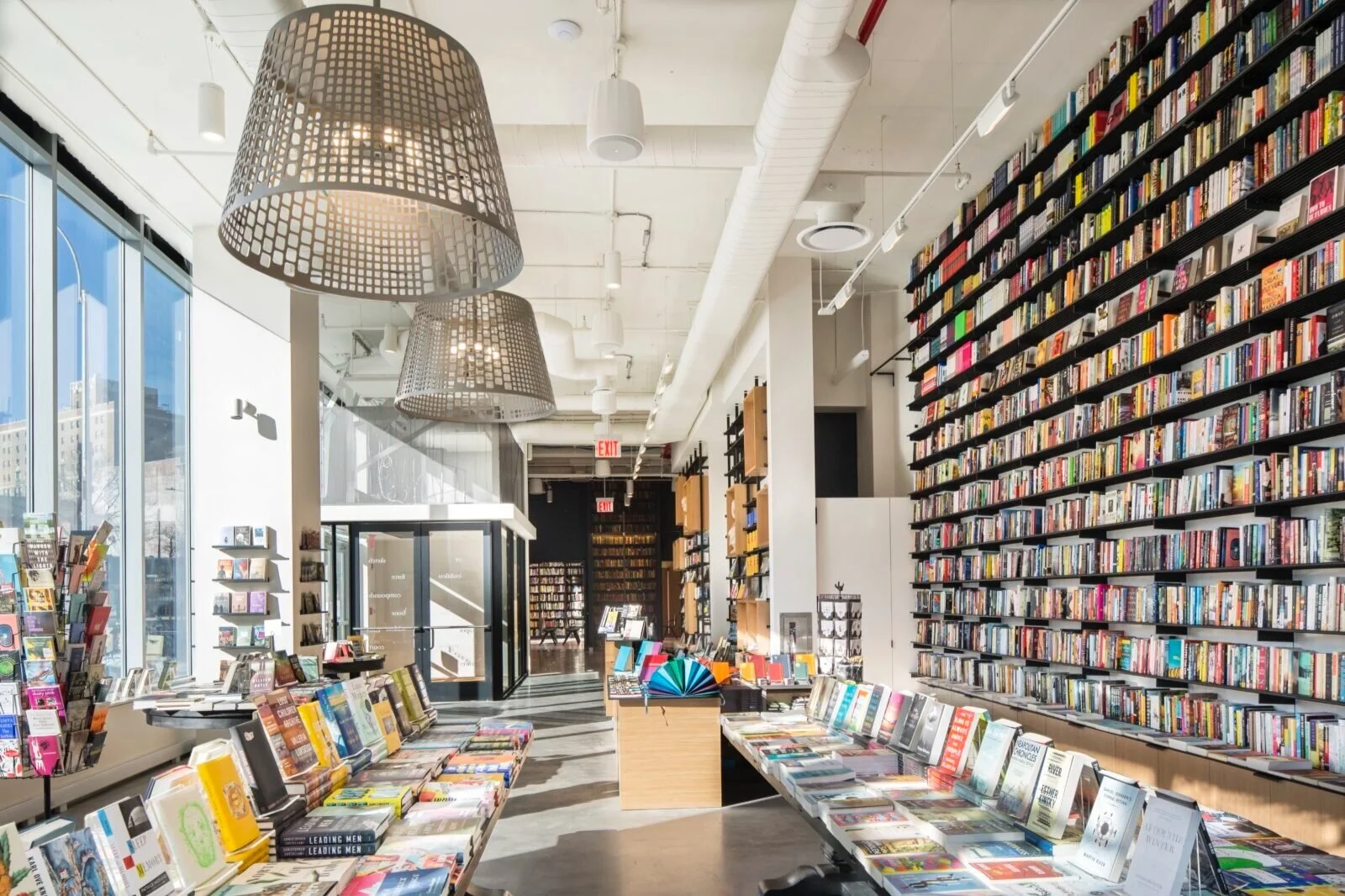
What is it: For book lovers of all ages, whether those who love to read or those who love to write, The Center for Fiction celebrates fiction in all its stages, from first imaginings to beloved reads. Over 200-years after it was founded — originally as the Mercantile Library — the non-profit moved into its public-facing home in Brooklyn’s Cultural District in February 2019. Over 18,000 square feet across three floors, architects BKSK have created the conditions to make words come alive and to enter our lives in a multitude of ways.
Why you’ll love it: Browse the independent bookstore (with a focus on fiction, works in translation, and independent publishers), chat books in the café and terrace bar, attend workshops, events, writing groups, and seminars, or sit at a writing station to get down to the actual work of crafting your own story.
The Center is a living organization that grows both readers, from the youngest kids exposed to its workshops (see its Kids Read and Kids Write programs), and writers, from the earliest stages of their careers, such as the Emerging Writers Fellowship and First Novel Prize. Within its quote-strewn walls, books can be experienced at every point in their realization.
What you need to know: The Center is also home to a circulating library of over 70,000 books focused entirely on fiction, including a prominent crime fiction collection that goes back to the early twentieth century.
How to bring this into your life: Recently retired Executive Director Noreen Tomassi started a bibliotherapy program, that is still going strong, called A Novel Approach, which prescribes a year’s worth of fiction reading depending on your situation, your interests, your longings.
Why we think it matters: Though books are read alone, often they come alive when experienced together. The Center pivots on this duality. It offers a place of solace and reflection, a retreat, or maybe just a pause, from the noise and encroachments of modern living. And it sets up the connections between readers, to not just enliven narratives through discussion but to offer an antidote to our loneliness, and a comfortable excursionon for introverts. Books can take us inwards while opening up our worlds. We can hold fiction in our minds, and those stories can have a life that exists in conversation. The Center for Fiction attests to the importance of making physical space in the world that supports our imaginary one, bringing people together over words that connect.
In their own words: “The Center for Fiction, founded in 1820 as the Mercantile Library, is the only organization in the United States devoted solely to the vital art of fiction. The mission of The Center for Fiction is to encourage people to read and value fiction and to support and celebrate its creation and enjoyment.”
Something to inspire: How can you lift words off the page and live them in company, wherever you are? Seek out a writing community, a book club, an author’s talk, a book festival, an independent book store, a library. The Center is a one-stop-shop for the craft of fiction, but parse out its functions and you’ve got a version of your own making, slightly spread out but highly tailored to your world.

Rochester Brainery
A community classroom space in Rochester teaching what really matters in life.
Go here if: you’re a seeker, of knowledge, skills, experiences, and connections.
What is it: A community classroom and event space in Rochester’s Neighborhood of the Arts founded by local Danielle Raymo.
Why you’ll love it: Rochester Brainery is a classroom driven by curiosity. Since it launched in 2013, it has hosted over 2500 classes. Before the pandemic, 70-80 classes were being held each month. Subjects are not limited but roam widely across interests from hand lettering to cocktail making, improvisation to mindfulness. Many of the lessons are co-created with local community partners, makers, artists, authors, and entrepreneurs reflecting everything and anything that someone would want to teach and someone would want to learn.
How to bring this into your life from wherever you are: At the time of writing the Rochester Brainery is open for in-person classes – a Shibori dye workshop, a History Happy Hour, and blacksmithing caught our eye. Outdoor classes have been added with popular geology field trips planned for the spring. If you are based outside the area, the Rochester Brainery is also offering its classes on zoom – a business development class for makers and creatives, and macaroon making looked particularly interesting and fun.
Why we think it matters: Learning sustains us, connecting to new subjects can expand our days, whether that is picking up a new skill or finding a life-long passion. Often as grown-ups, we forget this impulse for discovery; if we follow our curiosity it can be into the rabbit holes of scrolling, rather than meaningful searches in our analog lives. The Rochester Brainery makes it ok to learn again, to connect with subjects that just pique our interest, from history to cooking, and to make space for pursuing something just because we want to. It does so by bringing people together to share new experiences, enabling connections beyond the material and to those with one other. Within this classroom, new friendships have evolved, new business concepts tested (in events and pop-ups), and a community educated in what makes life most important, the people we get to share it with.
In their own words: “Learn from local authors, actors, artists, chefs, graphic designers, distillers, and more who share their smarts in single and multi-session classes.”
Something to try: Push your learning boundaries. We tend to sit within the subjects we feel comfortable with: maybe it's psychology for you, maybe it’s the arts. We may find it hard to wander into a different section of the bookstore, a different theme in podcasts, a different field to our own. Look outside of your world, try on another one. Even if just for a moment. The awe and wonder that can come with being somewhere else, might make it ok to be wherever you are again.
Photo: Rachel Liz Photography

Cafe Con Libros
A feminist bookstore making vital space for the stories of women and girls.
What is it: An intersectional feminist independent bookstore and coffee shop in Brooklyn’s Crown Heights neighborhood.
Why you’ll love it: Café Con Libros was founded by Kalima DeSuze in December 2017 when she made real the space that she wanted to see in the world, one that could hold the stories of womxn and girls – stories which have overwhelmingly been sidelined in favor of those of male voices – for those who want, need and are open to hearing them. Though intimate, the reach of the store is wide, bringing together on its physical and virtual shelves an abundance of books by female authors (99% of the selections are books by, for, or about womxn), including those beyond the continental US and by LGBTQAI+ writers.
Why we think it matters: During normal times, Café Con Libros is very much a community space for female-identifying folx; it's somewhere to hang out and be as much as it’s a bookstore. As Kalima says, the spaces that we create are political. Who holds physical space, what that space is used for, and even the stories these places are allowed to tell has meaning on a personal and collective level. Bookstores like Café Con Libros hold not just the stories within pages that we need to hear, but stories within a place that allow for all possible futures, for nurturing relationships, for community action, and for extending our learning together. As Kalima notes: “It’s time that womyn’s stories be prioritized and that a space exists explicitly for and about womyn. So many of our spaces are male-dominated; even the ones that are created solely to be for and about womyn. My womyn only spaces have served as a healing tonic and, a reminder of whose shoulders I stand on. It’s important that more of our girls and womyn have access to such warmth and mirroring.”
How to bring this into your life: As mothers of young daughters, we’re excited by the monthly subscription boxes, which include an option for baby feminist board books for the zero to fives and emerging feminist books for kids aged five to nine. There are also subscription boxes focusing on womxn of color and for the feminists among us. You can also join one of two book clubs that meet monthly (on zoom during shut-door times): either the Feminist Book Club which focuses on a book by, for, and about womxn, or The Womxn of Colour Book Club, a reading space and conversation for womxn of color. There are also virtual read-a-longs and a monthly podcast Black Feminist & Bookish, hosted by Kalima.
In their own words: “ We value: family. community. justice. art. transparency. accountability. equity. equality. authenticity. joy. solidarity. earth. the brilliance and possibility of imperfection. love.
We respect and value the contentious history womxn of color have with the word "feminist;" the tension hold us to account to live our Black Feminist and Womanist principles in real and measurable ways. We were born from and are guided by the lush cannon of Black Feminist thought producers and activists; the space endeavors to be intersectional, inclusive and welcoming of all who stand with and on behalf of the full human rights of womxn and girls. We seek to advance and uplift stories of womxn and girls around the globe who are redefining the word feminist and feminism with every day, ordinary culturally informed acts of resistance and love.
Something to inspire: Try a reading challenge: purchase, support, and read books only by womxn, or womxn of color, or by LGBTQIA+ writers for 3, 6, or 12 months. Change your knee-jerk choices in what you’d ordinarily see or consume. Extend this challenge even further to include podcasts, TV shows, films, and music that are by, for, and about womxn. This not only helps our own understanding of the ongoing pursuit for gender equality but the choices you make in where you put your attention and your money indicates to the industries behind them – the entertainment, publishing, and culture industries – what it is you really want to see.

Black Bird Bookstore
San Francisco’s Black Bird Books sits on the edge of the world while being resolutely of its place.
“a community bookstore for all”
What is it: Black Bird Bookstore is exactly how an independent bookstore located a couple of blocks from the Pacific Ocean should look. It brings the outdoors very much in. Hinting at Cali Cabin chic, Black Bird is wooded out (in reclaimed oak and cypress) coziness — perfect for a neighborhood that in San Francisco is known for its non-warming fog blanket. There’s even an indoor treehouse reading nook complete with a twisting oak branch that our kids love to spend time in.
Why you’ll love it: Opened by Kathryn Grantham, formerly the owner of feminist bookstore Bluestockings in New York, this is a place driven by curiosity: all titles face out, are regularly changed, and tightly curated from an inclusive selection of writers. It’s all about discovery with thought out selections made from the 1000 titles across just 900 square feet of space.
What they offer (online and off): Even during shifting times, this sense of discovery is still there, only its also happening online: chose from a monthly box of curated picks such as the Bay Area Box, Poetry Box, or Cooking Box. You can also currently book a 30-minute appointment to shop alone (from 6 pm to 8 pm), which sounds like a book lover's fantasy date.
Why we think it's special: Opening an independent bookstore feels counter to all the claims that both storefronts and books don't work anymore. But Black Bird makes the case that as our lives are pushed to be experienced more and more online, physical spaces for books and people matter. It’s a bookstore driven by both curiosity and community. Leading book lovers through its titles while supporting those who share this community.
Black Bird is so much an expression of its neighborhood (there’s a high-end garden shed by local artist Jesse Schlesinger and the shelving and counter space have been designed by Luke Bartels). Even the name was inspired by one of Kathryn’s kids who noted the awe-inspiring presence of Black Birds in the neighborhood. Books connect us to worlds on the page; the bookstores that contain them to the wider world outside their doors.
In their own words: We’re borrowing the words from Ocean Vuong that Kathryn has quoted: “The way I see it, whenever someone walks into a bookstore, they are walking into the future of their cultural and intellectual life… Amazon, with its algorithms, can only show you where you’ve been, can only give you a calcified mirror of your past. In a bookstore, you get a human being who is also a mapmaker of possibility. As booksellers, you are practicing, to my mind, one of our species’ oldest arts, the art of fostering, sharing and shepherding our most vital stories into the future.”
Something to do: Be driven by curiosity about where you live. Now is the moment to spend time in one place – the place where you are. Books can take you there in ways that go beyond your local commute, your working days, the school drop off. We recently sought out guidebooks to our county, and though it's hard for us to visit the places we’re learning about, we’re layering on history that we probably wouldn’t have connected with if we didn’t need to live hyper-locally. Our block is holding our world: our social connections, our daily outings, new discoveries and narratives that haven’t involved us. What’s really around you? Who has shaped your community and how is it evolving. Where are you really? Even when doors close, lives are still open.
While there: Black Bird Bookstore sits in the middle of our favorite SF block: Stop by Trouble next door for toast and coffee, the General Store, Case for Making, and Outerlands. Then head to the sand dunes for fast runs down to the ocean.

Little Free Diverse Libraries
A movement born on social media changing the narratives that make up our neighborhoods.
What is it: A movement born only six months ago on social media that is having real-world impacts, Little Free Diverse Libraries aim to amplify and share stories of Black, Indigenous, and People of Colour.
What you need to know: You may have seen Little Free Libraries in your community: those cute wooden boxes around since 2009 where you are invited to take a book and leave a book. But have you thought about the books that make-up those libraries? Do they represent the community, country, or context in which you live? Do they represent you, your voice, and your life? Do they include a breadth of voices, diverse backgrounds, and inclusive stories?
On a walk, through her home neighborhood of Arlington, Massachusetts where she was sitting out the pandemic, New York School Counsellor Sarah Kamya noticed that those in her own neighborhood didn’t do any of those things. As a daughter of a black father and a white mother, they didn’t reflect her. Neither did they speak to the Black Lives Matter Movement that was taking hold across the county.
With $150 donated from her family, Kamya brought books from black authors and began placing them in the Little Free Libraries in her neighborhood. This tiny gesture grew and grew: boxes of books by BIPOC authors began arriving at her home, as did donations from people to buy more books from diverse authors, all of which were to be distributed in other Free Libraries. Kamya bought directly from black-owned bookstores and opened her own Little Free Diverse Library.
Over 2,200 books have now been distributed to Little Free Libraries across 50 states, over 15 Little Free Diverse Libraries have been installed, $16,000 of books have purchased from Black-Owned bookstores, and the movement has inspired 20 LFDL Instagram accounts.
Why we think it matters: The stories that we are exposed to shape our understanding of the world and our place in it, not just in terms of whose lives we get to see represented but in terms of who gets to even tell those stories. Growing up, Kamya didn’t see herself in the characters or the narratives of the books she loved to read. Little Free Diverse Libraries aims to change that by widening the books that we are all exposed to so that we can increase our empathy, understanding, and kindness towards others, and think differently about issues such as social justice, systemic racism, and gender inequality.
As Kamya says: “I find books to be such an important place where one can build their self-confidence and self-worth, start conversations, and create change. I believe that Black and brown children deserve to see themselves represented in books and that if you cannot see it, you cannot be it. Some of my favorite books have been discovered in Little Free Libraries, and I am so excited for others to discover books they may have never seen, books they wish they had seen, and books that create conversations and change for years to come.”
The project has since expanded to include books about LGBT+ issues, people with disabilities, and who have different religious beliefs.
How to bring this into your life: Read widely, from diverse authors. Kamya is generous with her knowledge of books, and you can find recommendations for both adults and children on the Little Free Diverse Libraries Instagram. Among her recommendations are: Hair Love by Matthew A. Cherry, illustrated by Vashti Harrison; Of Thee I Sing by Barack Obama, illustrated by Loren Long; Talullah the Tooth Fairy CEO by Tamara Pizzoli, illustrated by Federico Fabiani; and Amazing Grace by Mary Hoffman, illustrated by Caroline Binch.
In her own words: “Having conversations regarding race with children and youth is extremely important to me. I truly believe that we have to teach about race and differences and a lot of that starts at home, and through books. I also find it important for books to represent diverse characters because if you can’t see it, you can’t be it. This project has allowed me to show Black and brown children that they deserve to have themselves represented, celebrated, and portrayed in literature. For Black authors, this project has allowed me to bring their work to the forefront. For so long Black authors have not had the recognition they deserve and this project has allowed me to highlight their work, as well as the Black-owned bookstores who have made it their mission to amplify Black voices.”
To find out more (or even start your own): Instagram

The Color Factory
Is sitting in a ball pit allowed anymore? Why The Color Factory is making the argument that it is.
What is it: Founded by Jordan Ferney of Oh Happy Day with fellow creatives and artists as a temporary participatory exhibition in San Francisco, The Color Factory now takes the form of two locations in NYC and Houston that capture each cities unique color stories.
Why you’ll love it: Yes, experiential museums have gotten some flack for their Insta-heavy ways, but we like how The Color Factory works with local artists, illustrators, designers, and makers to envisage its color-loving environments: like our favorite Christine Wong Yap, whose Complementary Compliments room invites visitors to sit across from one another, Emmanuelle Moureaux’s colorful paper ribbon ceilings and Carnovsky’s perspective-shifting NYC corridor. Also, note the jet black ice cream available to try.
What you need to know: Is sitting in a ball pit allowed anymore? Is it ok for rainbow confetti to sprinkle down on you? Can you really draw with giant markers on the wall or boogie on a giant light-up dance floor? Apparently yes you can. After months of being closed (and maybe even again), The Color Factory has brought in some serious cleaning techniques – just note how they clean those plastic balls. One reminder: wear a mask for those selfies.
How to bring this into your life wherever you are: You can extend your visit to The Colour Factory by following a neighborhood map to seek out more colors, and we’d suggest creating something similar where you are. Which colors can you see in your immediate environment? How often do they occur? Can you create the color palette of your home, your street, whatever your world geographically consists of? Photograph the different shades, sketch them, paint them out, even arrange them in a print. We’re inspired by the work of Leah Rosenberg, one of the founding Color Factory artists and eternal explorer of color.
Why we think it still matters: Anyone else longing for joy? For play, for escapism, for (can we whisper it here) fun? At a moment when many of us are fatigued or despondent or a little bit lost, that spirit of play that before felt frivolous in its Insta-centric approach now feels like a much-needed respite from the world. And maybe it's needed now in a not just a running-away-from-it-all-through-mirrored-ceiling-rooms way, but in a physiological sense: when we find the joy in our lives, we benefit from a release of happy hormones dopamine and serotonin. Though the impact of specific colors is changeable depending on culture (white = calm here, = mourning over there, for instance) and their specific mental health effects unproven, finding small gestures of joy in our days can contribute to an overall sense of happiness.
It may have felt like the color has drained out of our lives recently and we’re all existing in that sluggish brown that is created when kids mix all the colors together, but somewhere like The Colour Factory can remind us of the rainbow they were hoping to create when they did that.
In their own words: ‘Color Factory embraces child-like imagination, while expanding boundaries of perception and understanding.’

Utah Olympic Park
Between the setting and the breathtaking view, it’s difficult to leave here without a newfound sense of awe and wonder - a feeling we could all use, at the moment.
What is it? A state-of-the-art Olympic training facility, and home to the US Ski and Snowboard Teams, located in Park City, Utah. “The nearly 400 acre venue houses one of only four sliding tracks in North America, six Nordic ski jumps, a 2002 Winter Games museum, and a multitude of adventure activities.”
Why you’ll love it: Set in the picturesque mountainside of Park City Utah, Olympic Park offers year-round access to winter sports activities. In addition to their museum, extreme sports simulators and (absolutely terrifying) bobsled experience, Olympic park also allows you to sit in on the US Olympic Ski and Snowboard Team practices. For someone who is not an olympic sports enthusiast (which, how dare you) this may not seem exciting, but, we assure you, you WILL be impressed when you see the aerial skiers fly off a massive ramp, propelling them 20 meters into their air (!!!) where they land expertly in a (very deep) pool below. To see these athletes articulating every movement (in a setting where we would likely just be flailing to our deaths) is truly something to behold!

Aerial Skiers at Utah’s Olympic Park
What you need to know: While restrictions are ever-changing, because Olympic park boasts wide open outdoor viewing spaces across it’s 400 acres, it’s easy to remain distanced while watching aerial practice or checking out the freestyle ski and snowboard teams. (As a bonus, you’re nestled right up in one of the country’s most beautiful canyons) For the time being, the Alf Engen Ski Museum is open from 9am-6pm, daily. On weekends, for the low low price of $195 dollars, you are invited to risk your life (and possibly your dignity) as you scream your way down an actual bobsled track piloted by an actual bobsled professional. (Can you even fathom how much that guy loves his job?) For the slightly less death-inclined, the park also offers tubing, zip-lines, a ropes course and other season-and-covid-dependent activities.
Why we think it matters: At a time when it can be difficult to feel patriotic (re: our would-be dictator refusing to concede an election he clearly lost) Olympic Park brings us closer to a feeling of pride in our country than we’ve had in a long time. Seeing athletes whirl through the air at top speed while the flag flies high over the olympic rings is the like the reset we never knew we needed. Between the setting and the breathtaking view, it’s difficult to leave without a newfound sense of awe and wonder - a feeling we could all use, at the moment.
In their own words: Inspired by the success and momentum of the 2002 Salt Lake Olympic Winter Games, the (Utah Olympic Legacy) Foundation has turned its focus toward embracing, engaging and involving Utah’s youth in winter sport. From community-based recreational camps and progression-oriented development programs to its official designation as an official U.S. Olympic Training Site at the Utah Olympic Oval and Utah Olympic Park – the Foundation represents the future of winter sports in North America.
Mouse-Shaped Misery or Picture-Perfect Family Fun: Disneyland Observations
Our take on whether Disneyland is really “The Happiest Place on Earth”.
I spent the last week of my life in Disneyland trying to figure out if I was a sucker for loving it so much. (I think I’ve landed on “probably yes”.) Here are my observations.
Observation 1: Everyone is better at doing make-up than I am.
Is there, like, an onsite class available somewhere? (Can I come?!) Why is everyone so luminous and poised here? I must have seen 17 thousand women, with their rose-gold Mickey ears glinting in the warm afternoon sun, their customized Etsy t-shirts clinging perfectly to their (clearly) cross-fitted bodies and their winged eyeliner looking like it was applied 6 seconds ago. Meanwhile I take one glance in the direction of Splash Mountain and I turn around in full Jafar cosplay, shocking both my group and all of the low-key Jafar fanatics.
Maybe it’s that my youth has slipped away subtly in the night, or that I don’t actually know how to use all the things the nice girls at Sephora have suggested I buy. Or maybe it’s that everyone here is Mormon and, as such, blessed with abundant, inexplicable beauty. (Having lived in Salt Lake City, I can confirm that they are, I am all but certain, God’s chosen people). But I digress. Everyone is beautiful here. (Maybe it’s the magic?) Someone please come airbrush me before I leave the house again.
Observation 2: There is an abundance of children wearing shirts with phrases like “best day ever” and “happiest vacation on earth” who are being aggressively shamed by their parents.
Hello Parents, have you ever met a child? They have small legs, need ample sleep, and are easily overwhelmed by blinking lights. They go absolutely fucking nuts when exposed to sugar and food coloring. Why, then, would we expect them to exhibit perfect behavior at 11pm on a Tuesday night while sat on the ground picking hours-old cotton candy off of their sleepy faces as Mickey Mouse shoots fireworks from his eyeballs?
Please understand that I am, in no way, exempt from the Disney-induced lapse in parenting judgement and performance. I wanted to abandon my family and drown myself in the shallow waters of It’s A Small World just as many times as the next parent, but I internalized those resentments and whisper reprimanded my children through gritted teeth (like a grown-up).
Observation 3: I am infinitely grateful for my mobility and health and I remain ever-impressed by the people who push through theirs in the name of fun.
One of the greatest things I observed on this trip were people pushing through physical setbacks, getting out there in the name of fun. There were two women (had to be 100 years old) zipping around on rascal scooters like they owned the place. (Maybe they did?) One had brace on her ankle and the other had multiple tanks of oxygen (maybe jetpacks?) affixed to her chair. They laughed and zigged and zagged through the lines of the roller coasters and the teacups and almost-never ran into small children. They didn’t have young people pulling them along, or passes that granted them access to the front of the lines. They were just there, living their best lives, for themselves.
Observation 4: Vegan food is EVERYWHERE.
From plant-based sheppard’s pie and cauliflower street tacos to vegan gumbo and oat milk mochas, I was in near-constant awe at the food selection available in the Disneyland parks. More than being impressed, I was relieved, to see the world changing in ways that feel meaningful. I understand that veganism isn’t relevant to everyone, but I think it is fair to say that adding 400 vegan menu items to the parks is indicative of a greater shift in the world, a shift that means more mindfulness in regard to the way we’re consuming food, utilizing animals and protecting our planet. Sure, Disney is primarily interested in catering to their consumers and making more money…but the implications of this shift are far greater than that. And when a massive corporation brings a once-taboo lifestyle choice into the mainstream, it opens the doors for more people to enter that space. More plant-based options = less animals harmed, and that’s an equation I can get behind.
Observation 5: There is something that happens when you spend lots of money to be happy - you’re really fucking set on being happy.
There is a lot to be said about the downfalls of the positive psychology movement (we’re very-much over the days of faking it until we make it) but there is some mystical concoction that exists at Disneyland. Something about spending an obscene amount of money, the overly-friendly staff who are there to cater to your every need, endless access to sugar/salt/fat, your belief that you should be having fun and your awe-struck children whose expectations you’ve spent MONTHS bolstering. I don’t know exactly what it is, but I actually feel happier there. Sure this could be a recipe for the letdown of the century. Unrealistically high expectations are, in our experience, almost always ill-advised. But what about when all those expectations converge in a place that is actually pretty fun? What about when Disney releases interactive apps that allow your family to play games together in line (apps that help you to start conversations about things like gratitude, favorite memories and finding magic in the everyday.) What happens when you’re really expecting to have a good time and you put all of your energy into bringing that experience to fruition? Like any person with a conscience, I struggle to look past the rampant wealth disparity in Anaheim (the home to Disneyland Park), I struggle to accept the messaging of some of their films, struggle to accept that I’ve bought into a very well-branded consumer trap that thrives on manufactured-emotions and poor impulse control…but you’d be hard-pressed to visit this place, and not fall (at least a tiny bit) into the magic of it all. Concentrated time with family, activities that are fun for all-ages and messaging that screams “YOU ARE HERE TO HAVE FUN!” are really difficult points to deny. Yes, I know I’m a sucker…my back aches and I am desperate need of a post-vacation vacation, but every night, I cuddled with my kids while watching fireworks, and I laughed and ran with my 11-year-old (whose years of wanting to connect with me are feeling more fleeting by the day) and I watched my 6-year-old hug Minnie Mouse with tears rolling down her exhausted face. Yes I know it’s all a bit contrived. I know we could have gone to Yosemite, or the Museum of Modern Art, or, like, our great aunt martha’s house(?). But sometimes it feels good to turn your brain off and sink into the magic that’s unfolding around you.

Parnassus Books
In Nashville author Ann Patchett gives bookstores the happy ending that they deserve.
“An Independent Bookstore for Independent People.”
At the precise moment that it felt like the end of bookstores and the victory of Amazon, author Ann Patchett jumped into the void. In 2011 when the last bookstore in Nashville closed, together with business partner Karen Hayes, Patchett somewhat counterintuitively opened a bookstore. She couldn’t quite stomach the fact that there would no longer be a place in her hometown to buy books. She was also banking on the fact that others would feel the loss and feel the same. And there was that niggling memory from long ago of wandering around Mills bookstore and finding magic within its walls. There’s a happy ending here that runs counter to the narrative that we’ve been sold; her bookstore has since thrived. The business model that we thought was broken, maybe it isn’t.
Parnassus Books is all the things you’d hope for in an independent bookstore. Shelves (perversely from closed-down Borders) of books chosen not by algorithms but by people who know, love and can recommend them, the staff who work here. Author events (a massive 250 a year) to build the connections between people who read and those who write. Storytime for children to develop a lifelong love of the printed word. Chairs to lounge in, a store dog to pet. Such was its success, that there’s a spin-off, Parnassus Books on Wheels.
Parnassus Books attests to the fact that bookstores are more than books; they go beyond words on pages to other things like getting us off screens and getting us into space with other people whether we know them or not. They allow our minds and curiosity to wander, creating safe environments to emotionally sink into. They are also community centers and empathy makers. Bookstores give us other people; books give us compassion within their pages.
The question at the heart of Parnassus Books is this: Do you want to live in a city without an independent bookstore? It’s all about choice. We have the agency to shape the towns in which we live, to share in the co-creation of the spaces that we love to spend time in. As Patchett says: “Amazon doesn’t get to make all the decisions; the people can make them, by choosing how and where they spend their money. If what a bookstore offers matters to you, then shop at a bookstore. If you feel that the experience of reading a book is valuable, then read a book. This is how we change the world: We grab hold of it. We change ourselves.”
We get to write the ending.

Caveat
A smart speakeasy to get your curiosity peaked while having a laugh.
“Caveat makes smart entertainment for smart people.”
With New York’s Caveat, speakeasies just got smart. A non-descript black door with a ‘c’ logo leads down a staircase and a basement space that looks like the kind of nighttime-entertainment setting you are probably familiar with: an intimate theater with chairs and round café tables facing a stage and a bar backdrop. But there are hints of something else – a library and gallery also feature within the space, and a program that includes things like this: Chaos Theory: An Off-The-Rails TED Talk On The Underlying Chaos Of Our Lives and The Nerds & The Bees: Comedy And Data — What’s Really Happening In Modern Dating.
If you like anything produced by NPR, listen to podcasts and Audible on your commute, and get excited about deep heady dives into ideas, then Caveat, a performance venue in New York’s Lower East Side, might just be your spiritual home. Here you’ll always find the kind of material that gets your brain working, unashamedly so. There is nothing even slightly uncomfortable here about knowledge, maybe because its positioned in ways that are ‘fucking funny’ by co-founders Ben Lillie (a particle physicist and co-founder of science podcast, The Story Collider) and Kate Downe (who has directed opera and Shakespeare, and led renegade museum tours). Nerdy stuff is made cool, high concepts accessible, and the esoteric absurdly wonderful.
Caveat produces its own shows, a combination of storytelling, interactive games, music, comedy and performance that range across science, philosophy, literature and academia and are hosted by university professors, anthropologists, philosophers, academics, neuroscientists and other brainy types. Live podcasts are also recorded here, authored both in-house like Nevertheless she existed and out-of-house like Monica McCarthy’s The Happier Hour. If you are finding this is your thing, you can also become a Member.
And its all with booze. Drinking kills brain cells, but here it supports the making of new ones (kind of), through smart programs designed to get your mind working and your belly laughing. Like a night of college all over again, but this time around it really is about that learning part and not just the drinking.
The Interval
As humans we’re obsessed by time, with running through our days while also being in the moment. We’re a little confused about it. To get a more balanced, holistic view head to San Francisco’s The Interval.
“Fostering long-term responsibility.”
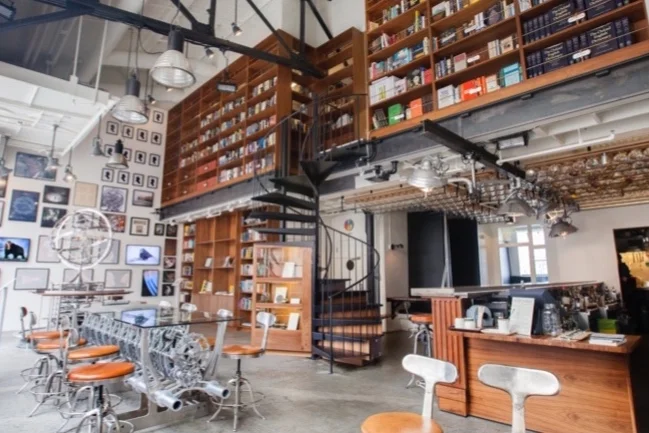
As humans we’re obsessed by time, with running through our days while also being in the moment. We’re a little confused about it. To get a more balanced, holistic view head to San Francisco’s The Interval, a unique blend of a café, salon, museum, and the home of The Long Now Foundation. Here time is very much slowed down and experienced for what it really is: infinite. Well that’s the hope anyway: Those books you’ll find on the floor-to-ceiling height shelves contain the wisdom to rebuild civilization.
The Interval is playing the longest of long games. Mechanical prototypes for a 10,000 year clock (yep, that blows our mind too) sit next to more contemporary, transient art exhibitions. Even the menu of bespoke drinks and food is time-inspired (see the perfectly named cocktail I’ve Grown to Love Life Too Much). But this is no gimmicky, temporal theme park. Rather this is a location that is thoughtfully (and maybe essentially) holding space for the idea that the long view matters.
This is made manifest most clearly in the program of conversations and lectures with scientists, technologists, creatives and entrepreneurs across subjects that take in climate, astronomy, psychology, the arts, any discipline really that intersects with an idea of the long-term (an approach that maybe encompasses everything, or should at least if we’re wise about it). Recent talks, available to watch online, have included primatologist Elizabeth Lonsdorf talking about how evolution and human behavior can be understood through studying primates, former NASA astronaut Ed Lu speaking to the importance of mapping our solar system, and historian Caroline Winterer on the idea of “deep time”, the billions of years we humans struggle to get our heads around.
You’ll find The Interval on one of our favourite sites in San Francisco, Fort Mason Center—which itself has evolved and shifted over its lifespan from military base to its latest iteration of culture center. Nab the coveted nook room for a coffee or drink, and you’ll also get a spectacular view of the city’s prized bay and the famous bridge that marks it entrance—testaments themselves to the natural and human forces that have shaped this region’s recent history. Then feel the awe of it all, the years past and those to come, while sipping on an in-the-moment latte and pulling one of those books, like Jorge Luis Borges’ Funes the Memorious or Angela Carter’s The Bloody Chamber, from the shelves. Then just be here right now.
To find out more: Website www.theinterval.org/ Twitter @interval / Facebook @longnowinterval / Instagram @theinterval

Lucky Penny Parlor & the World's Smallest Postal Service x Lea Redmond
Maria Popova, a similar collector of interesting (in ideas rather than things) encourages: “Be curious. Be constantly, consistently, indiscriminately curious.” We had that quote in mind talking to Lea and wandering through Lucky Penny Parlor.
“Lea’s storefront project is a place where matter and meaning meet through found object conversations and storytelling.”
At times of darkness, what do we reach for? What do we try to bring into our lives? Our go-to’s are probably around activism, around self-care, around community. But wonder? Curiosity? Sometimes we put them in the ‘superficial’ bucket, the one reserved for whimsy, for frivolity, for later. We leave them alone. They are coping strategies LITE.
Spending a morning with artist Lea Redmond at Lucky Penny Parlor in Oakland you realize you’ve got it all wrong. Finding wonder is deeply purposeful. To abandon it now is to abandon something of our humanity, of our possibility.
It’s ok to not feel entirely comfortable when you come into Lucky Penny Parlor. What is it really? How do you engage? Can you touch this? You’ll have these questions and others. And Lea is fine with this – she’ll lead you through it, spend time with you so you can reach for understanding, bring your experiences into hers. There’s a beauty in questioning, a kindness in the suggestion of clarity. Lea did this with my daughter and I – as we touched things on display, grasped for information as we tried to orientate ourselves, she provided the scaffolding for a connection. Over mint tea, in carefully chosen cups, we found our way in.
There’s a therapy of sorts to be found here in Tea Cup Consultations in which Lea choses a cup from her extensive collection and you bring something from your own life to discuss over tea, and the staged Tabletop Shows, dioramas that encapsulate narratives and even the universe (upcoming shows are about hummingbirds and a choose-your-own-adventure through the solar system). These intimate services provide the framework for poetic conversations, exploratory meanderings and immersive play.
Lea is interested in the material that’s in front of us of another kind though, of what’s available to us in the ordinary and every day that has a tangible quality, the concrete items that are all around us, all the time, and that we no longer see. Look through the hundreds of tiny drawers that make up Lea’s Wonder Cabinet and which contain the detritus of our everyday lives – tags, bottle tops, flea market finds, and household artifacts. Here you are taken right back into the space of seeing again, of living in the pause. Meaning here sneaks up on you, revealed by delight and humor and amusement.
Maria Popova, a similar collector of interesting (in ideas rather than things) encourages: “Be curious. Be constantly, consistently, indiscriminately curious.” We had that quote in mind talking to Lea and wandering through Lucky Penny Parlor which houses her personal collection of curios and from which she curates her own singular world.
Two doors up from Lucky Penny Parlor, is a work in process, the very soon to be first outpost of Lea’s World’s Smallest Post Service and the latest iteration of her 10-year tiny mail project. A space of serendipity – Lea happened upon the perfect-sized vintage post office front to pull it all together. From here Lea and her team will send out tiny – as in seriously tiny – packages into the world.
It’s a truly magical space that captures our love of the absurd and the cute, as well as our need for connection, our longing for the analogue. With this project, Lea is returning to something long lost – our wonder at receiving things in the mail that are not in the form of a bill or bulk entreaties. Can you imagine finding one of these tiny letters or parcels in your mailbox. Can you imagine that moment being in your day? Aren’t you smiling now just thinking about it? Or maybe you are thinking about who you can send something to?
For Lea the World’s Smallest Post Service is all about bringing not just ‘tiny mail magic’ but ‘more wonder into the world’: “We propose to create an enchanting, museum-like, open-to-the-public brick & mortar home for our World's Smallest Post Service. We want to make a place, a magical coordinate on the globe where people can count on wonder and kindness.”
Lea has constructed her world too so that we can reach for it wherever we are – with products by her design company Leafcutter Designs. Like Lively Matter a deck of prompt cards to encourage creativity and play through ‘a grand adventure of the ordinary’, and that provide a much-needed break from our screens, and the Letters to My Series, which we’ve handed to grandparents and friends, to capture the stories they may want to tell but have had no format to do so. Most recently, Lea created Everyday Offerings, which holds a way forward in our daily lives.
From the outside, all this, these storefronts and projects, Lea’s vision for crafting this magical way of living, look fun but it takes hard work, a serious and keen drive, to sustain this creative space. It looks easy because whimsy is a kind of sleight of hand, a magic of sorts that leads you out of the mundane and into belief. You don’t see the trickery (read commitment and focus) that makes it happen, that makes non-obviously functional spaces, exist in the world.
Yes, we need independent cafes and bakeries, coworking spaces and stores. But we need this other non-definable space on our high streets – of inspiration, wonder and play. Of something else. That’s a need that is not being fulfilled in our grown-up lives. We’re losing our joy, and we need to badly capture it again. We’re lucky in that we get to visit this world of Lea’s creation. For a short while. To walk within this vision of what light existing in darkness can actual be, the physical form it can take and its importance in sustaining our lives. There’s nothing superficial in that.
To find out more: website www.leafcutterdesigns.com / Instagram @lucky_penny_parlor / Facebook @LeafcutterDesigns

MOAB | Feeling Beloved
Moab is a place to discover yourself in the present, but with a deep sense of being cradled by the past. A place to feel beloved on the earth.
“And did you get what
you wanted from this life, even so?
I did.
And what did you want?
To call myself beloved, to feel myself
beloved on the earth.”
Moab, in Southern Utah, is an enchanting town full of contrasts. Nestled in the Southwest desert, it is an area of stark but ethereal beauty. Red cliffs rise dramatically out of the flattest of plains, as if sculpted by some other-worldly hand.
As a land where dinosaurs once roamed, where the Wild West played out, markers of the past are everywhere. Serene hikes among stunning, primitive, red rock formations compete with modern, high-octane adventures, tempting the senses. Moab is a place to discover yourself in the present, but with a deep sense of being cradled by the past. A place to feel beloved on the earth
The town is the gateway to two national parks, The Arches and Canyonlands. The former has over 2,000 Arches, with the iconic Delicate Arch drawing endless streams of visitors. The park is a mystical wonderland of gigantic sandstone structures, eroded monoliths, spires and colossal rocks, balancing precariously; somehow daring you to approach, to wander among them, but forever imprinting a deep awe and respect for this ancient ecosystem upon you. For indeed, over 65 million years of intense geological forces created this surreal, fragile land.
A visit to the Canyonlands is equally as mesmerising. The Colorado River and Green River combine here, dramatically carving out the land. Majestic canyons, mesas and buttes formed over millions of years invite the visitor deeper into the desert. It is a place of reflection, a place where solitude can be found among its vast, primitive deserts. Traces of the past hang in its atmosphere. Rock art from hunter-gatherers from the Late Archaic period (2,000-1,000 BC) is found alongside petroglyphs from the Ancestral Puebloans, and some images are dated to after 1540 AD, when the Spanish re-introduced horses into America; a veritable gallery of mankind’s visions unfolding over time.
Moab is a land of awe and wonder, where dinosaur tracks are as ubiquitous as Native American petroglyphs. Time transcends. As the desert sun burns intensely overhead, you can somehow feel the ground shake as a gigantic Brontosaurus tears trees from the land.
As the night sky falls, a curtain of black dramatically descending, you are drawn into the thundering hooves of the Wild West days, debauchery and gunfights escalating in the town squares. Ultimately though, it is a magical place where time loses relevance, a place to feel beloved on earth.
To find out more: website www.discovermoab.com / Instagram discovermoab / Facebook @discovermoab / Twitter @Visit_Moab_Utah

MARFA | Land of the Lost
The great irony of Marfa is that it isn’t really trying to be anything other than what it is: a tiny, dusty Texas town. The city of Marfa website pitches it as “more than just a place. . . . It’s a state of mind,” but my mom and I agreed that that gives the wrong idea.
“Don’t drop it!!” I yelled in mock alarm.
I’d just mentioned to the proprietor of Many Stones, the rock shop in Terlingua, Texas, that my mom and I had driven down from Marfa. Mostly in good fun, but also with a healthy dose of genuine mockery, he was holding up a work of contemporary art for our admiration and possible purchase—which was, of course, imaginary. He’d likely perfected the joke over many years: a rock shop owner, selling empty air! These rubes will believe anything!
Grizzled locals ribbing the art crowd who helicopters in, lingers just a while, and jet-sets out: Is it a cliché if that’s what they genuinely think? And who are art tourists to fling around words like “cliché,” hmm?
My mom and I spent three days in Marfa, and we saw most of what it has to offer the out-of-towners. Most tourists come to see the art—expansive installations by Donald Judd, Robert Irwin, Dan Flavin, and other confrères of 1960s minimalism, most of the works permanent and overseen by Judd’s Chinati Foundation. Almost everything is advance-ticketed in order to keep the crowds similarly minimalistic. Other tourists come to see the famous Marfa Lights, a ghostly atmospheric effect. Yet other tourists, for instance Anthony Bourdain, come for the food and continue on to Big Bend National Park, which is even deeper in, on the Mexico border. Bourdain would be dead before that episode aired. Judd died before his time, too.
The great irony of Marfa is that it isn’t really trying to be anything other than what it is: a tiny, dusty Texas town. The city of Marfa website pitches it as “more than just a place. . . . It’s a state of mind,” but my mom and I agreed that that gives the wrong idea. The folks who run the town and the art foundation really do want to keep Marfa a smallish, authentic (in the true-to-itself sense of the word, not the external-culture-police sense) place where tourism doesn’t make life insufferable for the locals. Donald Judd left New York for Marfa because he dug it as it was: small, remote, cheap. It’s the outsiders who insist on projecting onto it all sorts of loco imaginings.
My initial trip research turned up these two young ladies who sought it out as a backdrop for their fashion show:
http://livvyland.com/2017/02/02/texas-road-trip-marfa-big-bend-national-park/
Then there’s this, which makes me think “ugh”:
I have no words for this:
I mean, if you’ve spent many a summer in tiny midwestern towns, as both my mom and I have, there’s nothing . . . magical and transformative about being back in one. In fact, it’s familiar, comfortable. People wave at you when you’re out for a run. Shop owners have time to chat.
And now that we’re on the subject, I’m actually highly suspicious of art people who profess too much astonishment at experiencing a remote place. How many art hotshots in New York or L.A. or San Francisco actually grew up in the metropolis, hmm? And indeed, while waiting around for our tour of The Block, Judd’s former home/compound, I struck up a conversation with a guy, who turned out to be a Local Kid Made Good: grew up nearby, cut his teeth as a Chinati tour guide, now is employed at the Smithsonian in DC, and was back in town for the holidays to see his family. He was taking the tour as an excuse to jaw with old coworkers.
Of course now that I’ve debunked the place, it’s time to admit that I did have a transcendent moment in Marfa. As a lifelong James Dean acolyte (who even made the long, lonely drive to Cholame on one milestone death anniversary to linger at the fateful spot on the highway, at the exact time of day of the crash, with the similarly besotted), I’d known for years that his last film, the epic Giant, was filmed in Marfa. He died just days after principal photography wrapped. What I hadn’t realized was that the Hotel Paisano, where my mom and I stayed, was where the cast had lived for the month-plus of on-location filming. Massive production stills plastered the lobby, and the hallways were filled with little gems for the inquisitive guest with time on her hands, for instance a photo essay by some guy who’d visited the remains of the train station in Maryland where Elizabeth Taylor’s character was shown embarking for Texas with Rock Hudson, her new husband.
It was decrepit now, and that made him sad.
At least there was still something to see. Nothing at all remains of the Reata mansion, which was only ever a facade to begin with—time and tide, fires and looters have disappeared it all—but the spirits of those film legends, all gone now, hovered everywhere for me in Marfa.
As you leave town, for sure stop to take a photo at Elmgreen & Dragset’s Prada Marfa (I bet the rock shop guy secretly loves the idea of that place! so snarky!). But also linger a while in the desert just outside of town and commune with the ghosts of the big ones—and I’m talking about Judd and Bourdain here, too—who likewise stayed a moment or longer, and for some of whom it was more or less a last stop.

City Lights Books | behind the truth
City Lights Bookstore is a literary landmark and a magical meeting place for intellectual inquiry.
“City Lights is a landmark independent bookstore and publisher that specializes in world literature, the arts, and progressive politics.”
City Lights Bookstore is a literary landmark and a magical meeting place for intellectual inquiry. Open until midnight daily since 1953, City Lights is internationally known for its expert selection of books and for its impact on the history of free speech in America with the publication of Allen Ginsberg’s Howl and the subsequent trials. City Lights continues to publish avant-garde work, host regular events and readings, and be a beacon of inspiration for all writers and lovers of the written word.
Lawrence Ferlinghetti, the primary founder and caretaker of City Lights, turned 100 years old this year and San Francisco celebrated his incredible contribution to both this city and literary culture across the globe. Ferlinghetti is a widely read, published, and cherished poet and activist who continues to create and paint mystical worlds of the imagination.
Inspired by Ferlinghetti and City Lights, I wrote a poem to pay homage to this singular place of multi-faceted truth:
behind the truth
after ‘behind the cape’ by david larsen
behind the truth,
and growing numb,
fear floods
the misled head.
men of power
trick fear from
silence.
from
knowing
something
to
knowing
nothing.
now
the work of
untangling
knots of
misplaced, misused
lies
i start again.
To find out more about City Lights Books: Website www.citylights.com / Facebook @citylightsbooks / Instagram @citylightsbooks/ Twitter @citylightsbooks

Descanso Gardens
Most city gardens are well manicured and pretty to visit, but Descanso maintains a unique kind of messiness that instantly transports you into a magical world of plants, trees, and flowers.
“Descanso Gardens is an urban retreat of year-round natural beauty, internationally renowned botanical collections and spectacular seasonal horticultural displays. Visit for a stroll, a concert or a class — there are so many ways to explore.”
Nestled in the mountains just a short drive from the urban landscape of Los Angeles you’ll find Descanso Gardens. Walking among the winding paths and hidden trails, you can’t help but feel transported into a global nature experience spanning the world. One moment you’re in a Japanese garden, and the next you find yourself in the midst of California redwoods.
Most city gardens are well manicured and pretty to visit, but Descanso maintains a unique kind of messiness that instantly transports you into a magical world of plants, trees, and flowers. It’s unique design and layout organically encourage curiosity, and instill a felt sense of wild freedom. Descanso has a way of washing away worry while generating a new perspective on life.
We’re learning more and more how essential nature is to our mental health, and visits to places like Descanso Gardens offer a perfect prescription when difficult feelings like overwhelm and loneliness surface. Providing an opportunity to easily escape and connect at the same time, Descanso is a place to wander alone, or to generate a strong sense of belonging and community.
Your spirits will be lifted by the special beauty of Descanso Gardens, and you’ll immediately feel a sense of calm when you journey into these gardens. This is the perfect place to get the peace of mind you crave in the city of angels.
Website: www.descansogardens.org / Facebook @descansogardensLA / Twitter @descansogardens / Instagram @descansogardens

LA Central Library x Susan Orlean
It’s when Susan Orlean writes of the multipurpose function of libraries now to be the spaces that can reflect our public imagination that we feel like signing up to be a librarian right now.
“The publicness of the public library is an increasingly rare commodity. It becomes harder all the time to think of places that welcome everyone and don’t charge any money for that warm embrace.”
The Los Angeles Central Library? Wait, what, is this the right place for this? Its just a library afterall.
Yeah, we think so. We just finished reading Susan Orlean’s The Library Book and she wrote of this one library in all the terms that we consider fundamental to If Lost… places. She lyrically, and realistically, captures what this library in particular, and libraries more widely, mean to us. She knows in the heart and her own experience, how libraries hold a unique space in our lives, sometimes across generation, how they allow us spaces to just be, how they create a way into our communities that might not otherwise be there.
The Library Book captures the unique history of the LA Public Library itself - the fire that almost took it down, the women who first shaped its mission, and the current social conditions and expectations that it must now negotiate. Its also just a building. Albeit one that makes magic on a daily basis. On the LA Public Library itself, Orlean’s writes:
“The ground floor has the same traffic pattern as Grand Central Station in Manhattan. Both places are animated by a hurrying flow that surges in and out of the doors all day long. You can bob along in that flow, unnoticed. The library is an easy place to be when you have no place you need to go and a desire to be invisible.”
It’s when she writes of the multipurpose function of libraries now to be the spaces that can reflect our public imagination that we feel like signing up to be a librarian right now. Since their development in the 1800s libraries have acted as critical focal points for our communities, but The Library Book, also captures the shift in libraries from “a gigantic, groaning, fusty pile of books” to “a sleek ship of information and imagination.” Our libraries now contain not just text and voices, but services and programs that serve diverse populations, including the homeless, low income population and families. Today, libraries have a critical civic role, a pubic facing responsibility. They are sanctuaries, our town square, our community hub, our places of learning, or as Orlean’s writes “a place that is home when you aren't at home”.
We need libraries. We need these spaces to thrive, and they are.
“By most measures, this optimistic cohort seems to be right. According to a 2010 study, almost thee hundred million Americans used one of the country’s 17,078 public libraries and bookmobiles in the course of the year. In another study, over ninety percent of those surveyed said closing their local library would hurt their communities. Public libraries in the United States outnumber McDonald’s; they outnumber retail bookstores two to one. In many towns, the library is the only place you can browse through physical books.
Libraries are old-fashioned, but they are growing more popular with people under thirty. This younger generation uses libraries in greater numbers than older Americans do, and even though they grew up in a streaming, digital world, almost two thirds of them believe that there is important material in libraries that is not available on the Internet. Unlike older generations, people under thirty are less likely to have office jobs. Consequently, they are always looking for pleasant places to work outside their homes. Many end up in coffee shops and hotel lobbies or join the booming business of coworking spaces. Some of them are also discovering that libraries are society’s original coworking space and have the distinct advantage of being free.
Humankind persists in having the desire to create public places where books and ideas are shared.”
But libraries are also something else aren't they? They have this critical place in our communities, but they hold as equally a powerful place in our imaginations. When Orlean’s writes of the nostalgia around libraries, who cannot be taken back to that place of refuge or respite that they themselves experienced at some stage in their life? For her, it was like this:
“Decades had passed and I was three thousand miles away, but I felt like I had been lifted up and whisked back to that time and place, back to the scenario of walking into the library with my mother. Nothing had changed—there was the same soft tsk-tsk-tsk of pencil on paper, and the muffled murmuring from patrons at the tables in the center of the room, and the creak and groan of book carts, and the occasional papery clunk of a booked dropped on a desk. The scarred wooden checkout counters, and the librarians’ desks, as big as boats, and the bulletin board with its fluttering, raggedy notices were all the same. The sense of gentle, steady busyness, like water on a rolling boil, was just the same. The books on the shelves, with some subtractions and additions, were certainly the same.
It wasn’t that time stopped in the library. It was as if it were captured here, collected here, and in all libraries—and not only my time, life, but all human time as well. In the library, time is damned up—not just stopped but saved. The library is a gathering pool of narratives and of the people who come to find them. It is where we can glimpse immortality; in the library, we can live forever.”
When my son was born the first thing my husband did was get him a library card. He’s now 10, and has a sister in tow, and he has come to know very closely the capacity of libraries to enchant and educate. From the time his then stay-at-how dad bounced him on his knee during library story times to his amazement at experiencing Virtual Reality during a preteen takeover, the library has been a constant. Its one of the few places left where all of us with our different ages and needs finds something. We all find our way in their together, even if we spend our time separately when we’re in there.
If you don’t know your public library seek it out. And if its under threat like we know many are, campaign for its survival. These are places we need, so we don’t become untethered from our pasts or each other.