

Sometimes you just need to start (In memory of Carol)
On the many reasons why not If Lost Start Here, and the many (actually one) reason why, by co-founder Claire Fitzsimmons.
There are many reasons for not doing this project, for not starting If Lost Start Here. Want to hear a selection of them?
We are not ‘Experts’.
It makes us want to vomit.
Do projects like this pay?
Husband is doubtful.
Time to get a ‘proper’ job.
Don’t only perfectly-formed people start projects like this?
Someone, maybe many people, will laugh at us.
We are terrified of putting our ideas out there.
When? Like seriously when? And how? Maybe these are the same thing.
But there are many reasons why to work on If Lost Start Here:
We believe in it.
It wakes us up at 2am and gets us to the coffee shop to work on it by 5am.
More about mental wellbeing = matters hugely
It feels so good and right and necessary.
Good things might come of it, for us and others.
It might make people look differently at something, value their own thoughts, to notice who and what’s around them.
So many things in our lives led us to exactly this place.
We’d be moving forwards on one of our major life ambitions: mental health advocacy
Vomit can be cleaned and we’ll be ok even if we blush a little.
We get to decide what we do and where we put our attention, even if we have limited resources.
Not to, would be one of life’s big regrets
We love doing this together.
AND
This is the big one: because of my mum (this is a photo of her from sometime in the 70s—I love how she looks here). For many of us, it always comes back to our mums, doesn’t it?
There was a very clear ‘Before’ for me: I used to be a curator, in a former art world life, creating exhibitions in museums and galleries that I could have only dreamt of, like Tate Modern, the Serpentine and the ICA in London. It was an incredibly exciting career for a northern girl: I wore a lot of black.
Then something happened that forced me to reassess everything. My mum, who had been my best friend and constant in my life, started to lose her mind. Slowly, then completely. Now she struggles to function in the world. No, I don’t know her diagnosis. No-one does. We’re still trying to figure that out, after years and years of appointments, and ER visits, and specialists, and reading. Lots and lots of reading.
But the loss of my mum, even as she’s very much in this world, did this to me: it forced that question of the After, of what comes next. After I dropped my mum off at a psychiatric ward for the first time, as I drove to my childhood home, I made a promise to whatever entity we want to call it, that this would not all be for nothing, that I would work in any capacity I could to change whatever this situation was in which we were finding ourselves now lost. There is only After when you’ve been through something like this.
I’d quit the art world to train as a therapist. My experience with my mum’s mental health, and let’s add here my own, put the question of how we function as people front and center in my life, and it made me feel that this reified environment of conceptually-oriented art exhibitions didn’t connect with my life anymore. I would become the person in the room. I’d seek out a very clear role for myself.
My year at CCPE completing a Foundational Counseling & Psychotherapy course taught me that I was sincerely drawn to this world of therapeutic thinking. But I also wanted to bring that learning together with my curator brain—that roaming, search for thematics on which that profession is built. There’s always that tension in my mind between ideas and how they take their form in the world, in other words, the human piece. That’s the point of interaction that fascinates me the most. Could I make that into that something?
If Lost Start Here began to percolate when I realized that people were starting to do some fascinating things with that tension point. They were starting to build brick-and-mortar places around things like community and emotional intelligence, anxiety and depression, and even the end of relationships and end of life. They were starting to make places that hold our mental well-being in ways that the museums that I’d worked in held contemporary art.
I also realized that was nowhere to go to find all those different things. There were, and are, incredible platforms for great interior design, or travel off the beaten path, or well-being trends, but there’s nowhere to think about all the different places in the world that are now being kind to our minds and making for better lives. I realized that we needed a guide to this new sector, one that combines well-being with curiosity, travel and lifestyle, place-making and socially engaged art, independent cafes, and mom-and-pop stores—all approaches directed at making our lives better, and easier, and more fulfilling.
We’re hoping that If Lost Start Here will become the platform that curates the best places that support us as actual people in our worlds. It’s about that practical search for something else, for whatever it is that represents the gap in your life, for the thing that you need. My hope is that you’ll find what you are looking for and what you need. As I’m trying to do for my mum and me. Maybe we can do this together?
There are various ways for you to engage. By reading our online guide of those places that help with our sanity and our everyday lives, and supporting them as and when you need them in your life. By participating in our guide, contributing the places that you know prioritize our mental wellbeing in new and interesting ways. And of course, by sharing—help us get the word out that this platform exists, that there is help out there. Sometimes, we, you, and I just have to find it.
x Claire
My mum passed away unexpectedly last month. We’re reposting this piece now in her memory. This month, we’re supporting a place dear to mum’s heart, Sandbach Art Room. It helped my mum immensely over the last few years. You can also contribute to our Just Giving Page.
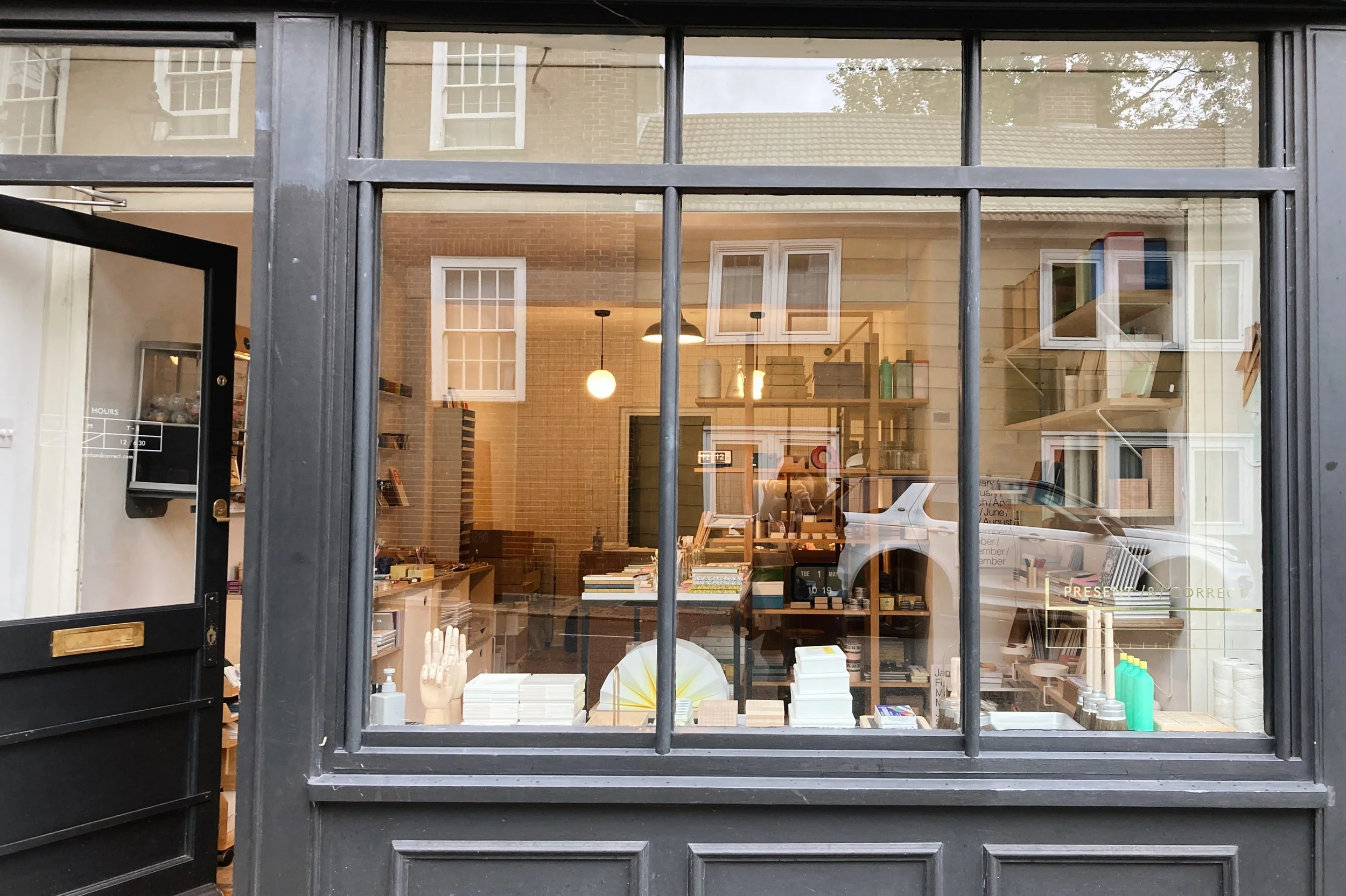
Present and Correct
A beloved stationary shop to quiet the mind and spark your creativity
Go here if: you still enjoy the tactile experience of writing, the thrill of organizing (also we see that looming project deadline that makes you want to tidy your desk), and hold the belief that self-care can come in the form of the perfect planner.
What is it: Present and Correct is a carefully curated stationary shop founded by Neal Whittington that’s currently tucked away in North London (though there’s a summer move to a larger space in Bloomsbury on the cards).
A popular destination for stationery enthusiasts and lovers of unique office supplies, this small shop offers a variety of paper goods and office conveniences from notebooks to desk accessories that combine contemporary design with a nostalgic touch. You’ll also find vintage items sourced from overseas markets. This is not your typical high-street office supply shop.
Why you’ll love it: Present and Correct is known for its emphasis on quality, craftsmanship, and attention to detail, but we also love the promises it holds. Of creativity: its notebooks and pens are the gateways to journaling, sketching, and writing that memoir in long form. Of calm: its clean and minimalist interior, and artfully arranged displays hint at some degree of control over our lives, a possible neatening of our edges. And maybe of a simpler moment: something of the analogue, of the openness of a new page, and even the joy of childhood and those new pencil cases on the first day of school.
How to bring this into your life: Although our true love is the physical store, the website offers the chance to browse and purchase from their collection of products (and they ship worldwide). We love the Finnish School chalk, Things to do Planners and Two Tone Ballpoints. And we’re huge fans – as are many – of Present and Correct’s Instagram.
In their own words: “It's a showcase for the things we have enjoyed since school….We want to spark a distant memory, make you smile or look at the most mundane in a new, and fonder, light.”


Present and Correct
At the time of writing 23 Arlington Way, London
From 20 June: see the new Bloomsbury address
Life advice for the spiritually-curious
Feeling like there's something else, but you don't know what? Some meaning out there that you've yet to locate? Hannah Carey, founder of Rewild the Empress, talks to us about being Spiritually-Curious and how that's helped her find herself.
Today we have a guest post from Hannah Carey, the founder of Rewild The Empress, a place and community in which there is infinite space for self-acceptance.
In Hannah’s practice, she supports the spiritually curious as they navigate, discover and recommit to living in an authentic and aligned way: “to be the me you were always meant to be”. Rewilders often come from a place of feeling destined for more and, at the same time, fear they may not be enough or that they are unfulfilled and failing. Something that Hannah has experienced first-hand as she writes here:

Spirituality for me has become about confronting the conscious unrest within us.
But it wasn’t always that way: I was brought up in an informally Christian household, was baptised and attended traditional schools in which formal religion, regular chapel attendance and hymns were woven throughout the school week. My weekends ended on Sundays at 6 pm with a Sunday Service or Hymn Practice, the school’s version of informality.
Internally I was already rejecting the patriarchal God our Father, the Almighty and the governor of us all. It wasn’t me and didn’t align with my values of Freedom, Authenticity and Personal Growth.
And yet my heart rejoiced when an entire congregation of people sang in unison and in troubled times I found the voice in my head speaking to a higher power – I assumed God.
And so commenced the constant narrative of right or wrong, god or no god, and the general black-and-white thinking that goes with this, which might also be familiar to you.
As a teenager (pre-google, damn and pre-mainstream internet access) I bought tarot cards and explored. I read about paganism, and astrology. I aligned with nature and the cycle of the year. But wasn’t this “Witchcraft”? I couldn’t call myself a witch and be taken seriously – at 15 I knew enough to know that it was safer to keep it quiet.
Years passed by and in the many times of existential crisis in my 20s I muddled through beating myself up with the shame stick (it’s one of my personal favourites – what’s yours?). I figured I was agnostic, got married in a church because I rationalised that there was ‘something there’ and it may as well be God and continued to aspire to success and fitting-in-ness so unaligned with my personal values I wound up deeply misshapen and lost. I viewed it as ‘just the way it is’ and carried on.
But that internal compass just wouldn’t let it go. The conscious unrest ebbed and flowed like a tide and every so often I allowed my inner self a small win… I closed a ‘successful business’ searching for more. I took a slight detour down ‘what the fuck were you thinking avenue’ and finally landed at a rest stop in which I dusted off my tarot cards, took a deep breath and shuffled.
Death, The Emperor, The Hanged Man and 10 coins stared back at me. Plain as day my ‘god’ was telling me – Change it girl. You are meant for more.

Hannah is one of our ‘People We Love’ - handpicked practitioners who can help us feel better in our lives. To work with Hannah reach out to her here (we may get affiliate fees which help support our work but in no way influences who we choose to feature).
Hannah offers coaching in all areas of life whilst exploring your personal version of spirituality.
By recognising where systems, structures and history may have led you astray, unpicking family dynamics, the messaging you took on from the big people around you as you grew up, and your beliefs and the “shoulds” that keep you small and unfulfilled, you’ll get to re-decide and choose to do life differently.
Whether it’s through modalities like Astrology, Human Design, or the lunar cycles, you will get to connect with yourself and deepen your self-awareness. Hopefully, from working with Hannah you’ll discover that there is a glorious permission and freedom that comes from knowing you are whole and OK just as you are.

Royal Botanic Gardens Edinburgh
Discover the well-being benefits of a world-class botanical garden beloved by locals and visitors alike
Go here if: you’re looking for a place of tranquility, an escape from the busyness of city life, and a way to be more mindful of nature
What is it: A renowned botanical garden, the Royal Botanic Garden Edinburgh (RBGE) is one of the world’s leading centers for plant research, conservation, and education. Founded in 1670 as a physic garden for medicinal plants, this world-class botanical institution now reaches across 70 acres and includes over 13,500 species in its living collection.
Why you’ll love it: While you wander through the Chinese Hillside, Rock Garden, or Alpine Houses, you’ll also be accessing the positive well-being benefits of such a stunning natural setting from reducing stress levels and improving mood and mental clarity, to increasing your sense of awe. To make the most of this soothing and meditative location, pay close attention to the different textures, smells, and sounds of the ever-evolving natural spaces around you.
And while here, access the other well-being Pathways: as you walk the grounds you’re body will be releasing endorphins, those feel-good hormones (mind-body connection); you can visit alone, or you could invite a friend, for the added benefits of social interaction; and follow your curiosity as you learn about the plant-life nurtured here.
We like how a place like the RBGE that could feel like just a tourist destination has woven itself into the lives of locals, who seek out moments of respite here. It’s very much become a part of the fabric of city life rather than only a momentary break from it.

How to bring this into your life: Beyond visiting the gardens, the RBGE offers a range of events like flower shows, art exhibitions in the stunning Inverleith House, and monthly behind the scenes.
It also hosts restorative programs designed to connect with well-being including Food Socials, dementia-friendly Garden socials, and skills share workshops.
For some seasonal joy, check out the winter illuminations and spring flower displays.
And if you can’t get there read The Fair Botanists by Sara Sheridan, the Waterstones Scottish Book of the Year set in the gardens.
In their own words: “When visiting Scotland, a trip to the world-famous Royal Botanic Garden Edinburgh is unmissable. Experience an extravaganza of plants from around the world, learn about the Garden's rich and diverse Living Collection and discover a history dating back to the 17th century.”
Royal Botanic Gardens Edinburgh
Edinburgh
EH3 5NZ
And did we mention the garden entry is free

How nature can help us feel better in our everyday lives
How can we broaden out what nature can be for us: the micro gestures that have us listening for bird songs to the bigger-ask ones that have us hiking up mountains? Discover more of nature’s wellbeing benefits.
You do not need to be ‘outdoorsy’ to access nature’s benefits for our mental health and emotional well-being.
We know that we needed to hear that. It can often feel like the entry point to the natural world can be so high, and involve trips to REI, extensive bush-crafting knowledge and an orienteering certificate.
We’re definitely not saying hike in flip-flops or wander into the wilderness without knowing what you’re really taking on. But we are saying there are many, many ways to find yourself in the natural world and to do so in some really simple ways.
We love National Parks, but we also love that field we walk through after dropping our kids off, and that lake we can wander around with a close friend while having a chat on a Sunday morning. We get so much from looking out the window and catching sunsets, or planting something in our garden and willing it to grow (this one is very mixed for us). We feel happy around trees (though slightly less happy in the middle of a forest), and take us to any beach at any time and our hearts will sing. There’s a way into nature for all of us.
Here are just some of the ways to explore where your curiosity might take you as you find ways to wander through the natural world (with not a blistered hiking boot in sight).
To read:
How to overcome eco-anxiety
The Norwegian love of friluftsliv and why being in the fresh air can help us all feel good
A secret sanctuary created with hope in Los Angeles
How a search for female gardeners combatted this writer’s loneliness
How bad air quality is connected to depression later in life
Inspiring books for going outside
A land art masterpiece in the Nevada desert
How to assess the benefits of nature and walking in nature
To do:
Become a community scientist and discover the animals in your neighborhood
Discover The Gardening Mind on Substack
Join 72 Seasons
Plant organic seeds
To watch:
To discover:



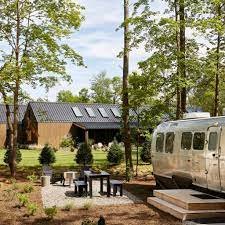
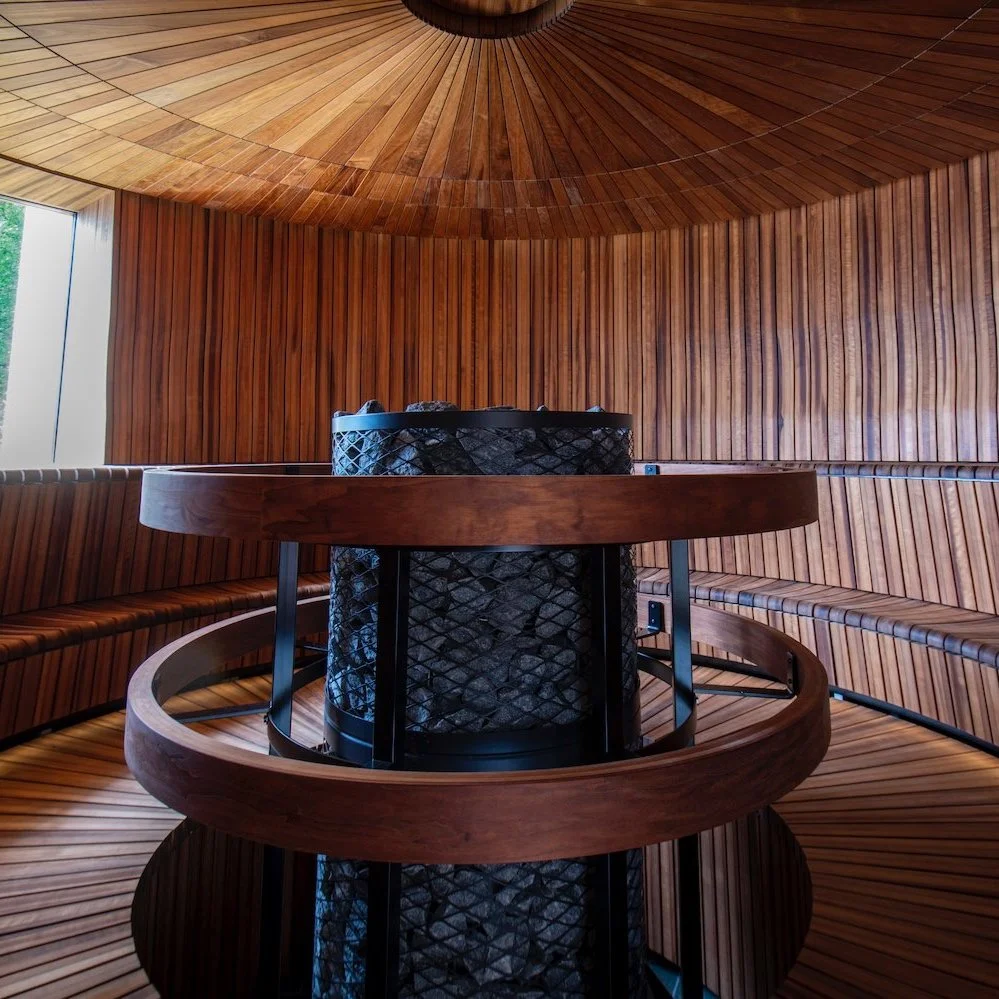
How can we broaden out what nature can be for us: the micro gestures that have us listening for bird songs to the bigger-ask ones that have us hiking up mountains?
How do you see nature as something that affects your emotional well-being and mental health?
Let us know how you navigate this aspect of your everyday life.

How to bring a sense of wonder back to your everyday life
Discover how a sense of wonder can bring more meaning, joy and connection into your life
“Let yourself go past those thoughts that tell you it’s silly or pointless or a waste of time, or you’re far too busy to possibly do this...Instead give yourself permission to want that in the first place — to crave that contact with the sacred, and that feeling of being able to commune with something that’s bigger than you are.”
We started to notice wonder in our everyday lives during the first pandemic when our worlds became small but our attention needed to roam. That sense woke up for us then. Birds we never noticed before held our attention for a moment longer than we ever thought they could. We noticed skies and stars and the movement in the trees. We focused on a single program (Normal People anyone) while not texting or a Ted talk which we might once have scanned while doing 100 other things, allowing it to endure in our minds and not dissipate as the next video played. We stayed in moments because we had nowhere to go.
Now we’re back to some kind of normal, the challenge here is to sustain that wonder-driven life so that we can keep our minds open and stretch our worlds. How to do that? Through new (or once lost) hobbies that connect us with nature, the visual arts or music, looking up from our phones and noticing the world around us (and maybe even the moon above us), and by allowing ourselves to be lost in big ideas and imaginary worlds that we wouldn’t ordinarily visit.
Below we share some recent reads on the science behind wonder, some things to try, and places to visit to access it in all our everyday lives.
Where will wonder take you?
Why wonder can be so beneficial to our emotional and mental well-being:
Finding awe amid everyday splendor
How to absorb wonder in small spaces and enchant your life
Discovering Pacha, a word that contains multitudes
This will make your head spin. What is life really?
Starting a bookstore to save a marriage (because bookstores = wonder for us)
A Wonder List: follow ours, make your own, chase your curiosity
The weighted blanket of the public library
The Webb Telescope and our stunning universe
More dark skies and night-welcoming lighting
Prehistoric Planet and just about anything David Attenborough
Vermeer. Maybe always.
Ai Weiwei again
The Poetry of Sarah Kay
How do you feel about wonder? And how could you connect with its benefits for your emotional and mental well-being?
If you’re curious about it and want to see how it can help you find more joy, meaning and connection in your life, sign up for Find Your Way. In this Well-being Reset that puts what you like first, we’ll explore how to find more wonder in your everyday life. Wonder is just one of the ten Pathways we’ll follow together as we explore all that life can offer us.

Find Your Way to a Better Place
Curious about how to create the life you want without losing your way? Explore what better emotional well-being means to you with this 25-Day Reset. Join now.
As we've navigated our anxieties and everyday life together, we've learned that returning to the basics, again and again, is what serves us best — reaching out to a friend, putting our phones away, going on a daily walk — but we still get distracted by the latest well-being trends and cute social media posts that sell us something different.
We've been supporting each other, and now our clients, to develop an everyday well-being practice that focuses on what matters and filters out all the noise so that we can feel more confident and connected throughout the ups and downs. We've found that when we're lost, we return back to this practice again and again and again. It brings us back to ourselves, creates space to move (in the direction we want, not one that we unheedingly follow), and reduces those familiar feelings of being unmoored, fearful, or full of self-doubt.
We want to share this practice with you too and have distilled this into our new Find Your Way Reset designed to reorientate your life to what really matters. To bring more of what you need into your everyday life. And to discover more of what makes you feel good.
Where will it take you?

Lost in May | A Podcast Playlist
Explore our latest podcast playlist. We curated some of our favourite recent listens to help you navigate your everyday life. Discover how these episodes can help your emotional well-being.
We’ve made a Podcast Playlist for you to take on your next walk, to accompany you on your drive, and to make tidying the house just a little less tedious.
This month, there are many new listens including Wiser Than Me, Letters from a Hopeful Creative and It’s Going to be OK. There’s season 2 of WILD, a Southeast LA Rom-Com. And some great stand-out episodes from long-time favourites The Ezra Klein Show, Unladylike, Truth be Told and Normal Gossip. Plus that Clueless episode from Articles of Interest is just Podcast Perfection.
Listening to this playlist lets you know where our interests currently go (it’s a little like reading our journal). From our emerging curiosity about plant medicine to how we think about self-care, you’ll find that we’re seeking voices that offer us more than traditional well-being and counter some long-held narratives about how we should exist in this world of ours.
Hopefully, some ideas and conversations here help you navigate your own life just that little bit better this month.

Discover some of the ways that human connection can help you feel better
We are hardwired to connect. Explore some of the benefits that simply being together can have for your emotional well-being and mental health.
Connection is complicated, isn’t it? Study after study tells us how central it is to human happiness and health, but in our everyday lives we often forget its importance.
Call a friend? But what if they don’t want to hear from us? Reach out to a family member? But what about that political view they seem to have that’s different than my own? Volunteer in the local community? But when? Who has the time?
But this is what we’ve found. When we do reach out, contribute to our community, or try to get to a place of understanding if not agreement, we tend to feel much better than we’d imagined. And we carry those benefits into the rest of our lives.
Curious about how to cultivate more connections in your own life? We’ve selected some things to read, do, watch and experience so that you can discover the benefits to your emotional well-being and mental health of relationships in all their various forms.
Read through an article about what the longest study on happiness tells us about the importance of relationships, try going to therapy with a friend, watch a talk on what empathy can do for us, and discover some cafes that are shaping the community for all.
Be open to the form that relationships can take in your life, and what they can offer you (and you, in turn, can offer them).
To read:
How human relationships fit into a lifetime of happiness
Alternatives to ‘How Are You?’
We are interwoven beings
What to do if you find yourself in the “friendship recession”
An experiment in connection across generations
How to ease your loneliness
Dating with an Expiration Date
When to end a toxic relationship
To do:
Take a quiz to learn how connected you are to humanity
Take a course in the Art of Gathering by bestselling author Priya Parker
Learn how to apologize
Go to friend therapy
Join a community like Peanut
Support the Campaign to End Loneliness
To watch:
To discover:


The Dot Cafe (Spain)

Fluid Coffee (San Francisco, US)

Milk Cafe (San Francisco Bay Area, US)

Kinfolx (Oakland, US)
What are you learning about how your connections impact your emotional well-being and mental health?
Let us know how you navigate this aspect of your everyday life.
Where to next?

How nature can benefit our emotional well-being
We’re learning more about nature’s positive impacts on our emotional well-being and mental health. But how do you access its benefits in your everyday life? We have some ideas for you.
Let’s think about nature for a moment. What comes to mind for you?
We’re learning more about nature’s positive impacts on our emotional well-being and mental health. But how do you access its benefits in your everyday life?
We’ve rounded up some things to read, do, watch and experience so that you can both learn about nature and live in alignment with it.
Read through articles about what happens to our bodies and brains when we walk in nature, try a ‘Going Outside Challenge’, watch an unexpectedly funny talk on foraging, or get to dinner on a beach with a hundred strangers. You’ll learn some of the ways nature can positively impact your emotional well-being and mental health.
Just explore where your curiosity takes you as you find ways to wander through the natural world.
To read:
Just two hours of nature a week offers benefits to our health and well-being
The unique benefits of walking in nature
Are you guilty of ‘plant blindness’? What plants are saying about us
How activism can help with climate anxiety
How buying that fleece could save our National Parks
A stunning new green lung in Hong Kong
What we’re learning from leafing through seed catalogues
Water… as a blueprint for health and well-being
To do:
Although we’re now in March, there’s value in starting this at any time: The Go Outside Challenge
How can you begin to notice the nature that is around you
We made it. Look for signs of spring
Try therapy outdoors
Discover a wild sauna
Develop carbon literacy
To watch:
To discover:


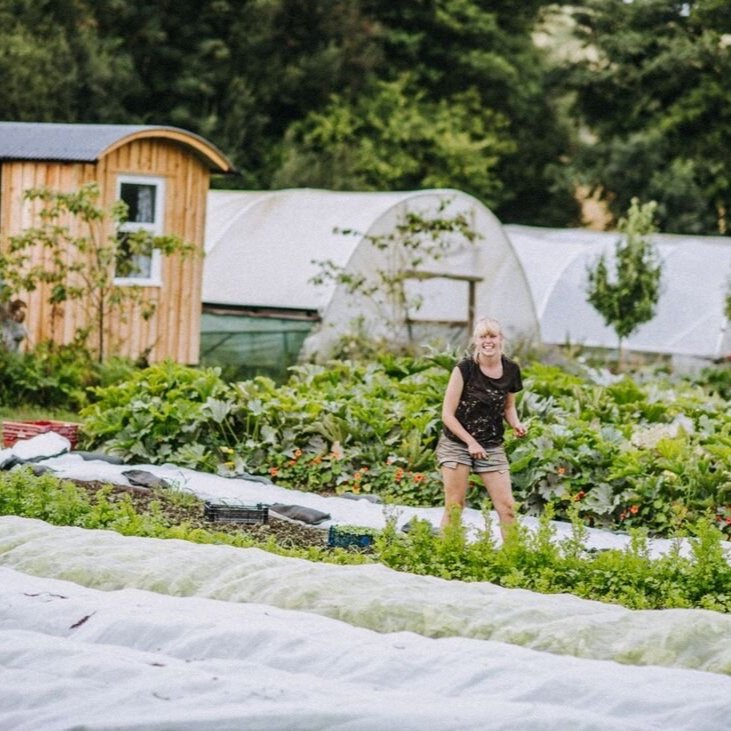


Bronx River Foodway (New York, US)

Oko Farms (New York, US)

Flora Grubb Gardens (San Francisco Bay Area, US)

How can we broaden out what nature can be for us: the micro gestures that have us listening for bird songs to the bigger-ask ones that have us hiking up mountains?
How do you see nature as something that affects your emotional well-being and mental health?
Let us know how you navigate this aspect of your everyday life.

Ways to discover your creativity for better emotional well-being
Bring more creativity into your everyday life. Discover how creativity can positively impact your emotional well-being and mental health.
Creativity can mean very different things to different people. You might consider it to be the moment you sit down with your Morning Pages before the day gets started. You might also consider it to be having a studio and being a ‘proper artist’. Whatever you consider your creativity to be, you are both right and not right.
Creativity weaves throughout our lives. It shows up in all places (in creative practice, but also our workplaces, our homes, our relationships) — if we allow it. And that’s the key. Your ideal of creativity might be the very thing that’s pushing away your ability to even make space for it in your life.
With the links below, there are ideas to get you thinking about that gap — between how you imagine creativity to be, and what you need it to be to feel good in your life. Particularly if you want to access its benefits for your emotional wellbeing and mental health.
Read through articles about the new science of neuroaesthetics, try a noticing workout, watch an inspiring talk on Imposter Syndrome (hint that’s often what’s in the gap) or get to a Sketchbook Skool. Just explore where creativity takes you, not where you think it should be taking you.
You’ll learn some of the ways creativity can positively impact your emotional well-being and mental health.
To read:
How improv can impact not just your creative expression but also your wellbeing
How music loops make me feel more present
Self-care knits and ‘reminders of how to care for oneself through challenging times’
What we actually make when we listen to ChatGPT
What if we could reframe regret as pretending
How Banksy’s work is bringing hope to Ukraine
To do:
6 ideas to fill your sketchbook
Put on an art night at home
Try an app that combines music therapy and neuroscience
Rediscover the well-being benefits of playing with Lego as an adult
To watch:
To discover:

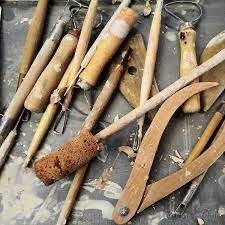
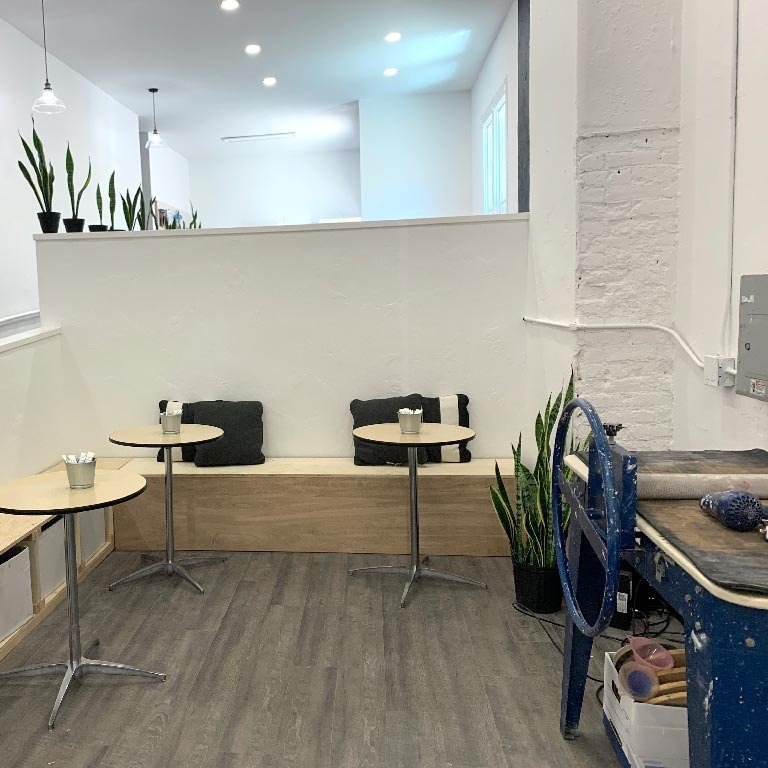
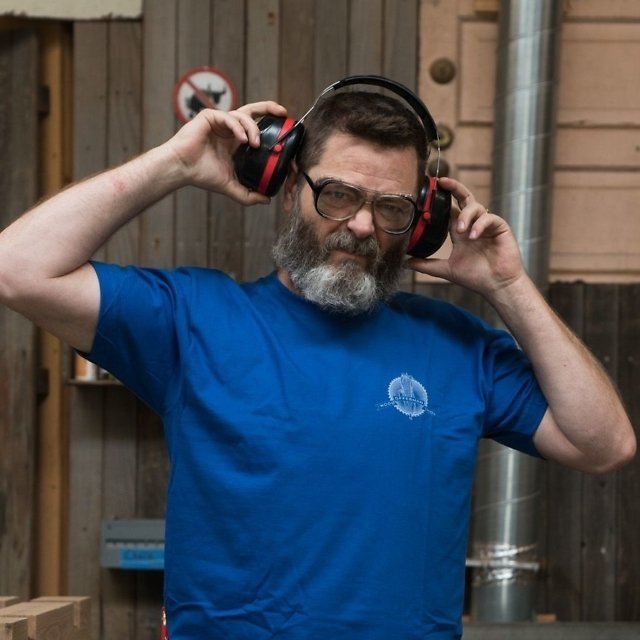
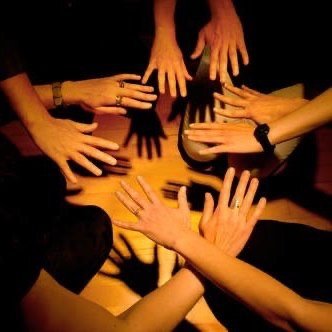


What sparks your interest, your creativity? How do you see creativity as something that affects your emotional wellbeing and mental health?
Let us know how you navigate this aspect of your everyday life.

A Culture Therapy Prescription | March Edition by Beth Nasce
This month’s Culture Therapy Prescription will help you feel good this season. Discover the podcasts, books, websites, apps, events, and places that can connect you with more of what you need for better emotional and mental well-being.
This month’s Culture Therapy Prescription is written by Beth Nasce, a creative celebrant, writer and primary school teacher, whose passions are seasonal living and celebrating all of life's milestones (the big and small). Beth is constantly experimenting with poetry, non-fiction and short stories and helps other people explore their own creativity too.
Connection & Community
Podcasts: The Real Question, and Harry Potter and the Sacred Text, both by Not Sorry Productions.
TRQ is a place for people to explore deeper questions about life and think about how different texts can help us with those answers. The current edition of the podcast is called Should I Quit and its guests come on with a question about whether they should quit something and Vanessa the host does a sort of chaplaincy service for them.
HPST is treating the HP stories like a bible study. Each episode goes chapter by chapter reading it through a theme e.g. love or jealousy and then they use old religious practices to deepen their questioning.
This is the second read of the books (I think book 5 right now?) and they do an amazing job of holding this tension of the ultimate question about whether HP should or shouldn't be given airtime anymore given the author’s recent statements. The podcast has a large LGBTQ+ fanbase so it has been really helpful in understanding the difficulties with it.

Modern Life / Untethering
Book: The Power of Ritual by Casper Ter Keuile is a fantastic book that looks at rituals and spirituality from a secular lens.
Casper is not a Christian but has grown up sort of culturally that way, and while traditional Christianity feels inaccessible to him as a gay man at times he also sees the power and beauty of many ancient practices.
In this book, he explores the ways different religions and civilisations access rituals and explores how we can see them being used in secular contexts too e.g. Soul Cycle or CrossFit.
In the book, he talks about doing a tech sabbath every Friday night for 24 hours where he turns off his phone and all tech. He says the mantra "the work isn't done but it's still time to stop" and it's something I TRY to do. It always feels very enriching and expansive when I do it!

Nature
Podcast: As The Season Turns by Ffern and Lia Leendertz.
Lia Leendertz who writes The Almanac releases an enhanced audio version of the monthly entries of her book on the first of every month. The podcast version also includes a soundscape meditation, a herbal musing by Zoe Gilbert and a Welsh folk song.
In my newsletter Spark and Fable, each month I follow a weekly pattern - of things to look forward to this month (a combination of seasonal events and celebration days) - a seasonal recipe - field notes (where I simply write what is going on at this moment in time outside) - and a monthly roundup of favourite things (including tree, plant and flower of the month!)

Mind & Body
Book: The Self Care Year by Alison Davies is a lovely book that has different ways to care for yourself both physically and mentally in line with the seasons. There are meditations to do, pamper products to make yourself, yoga positions to try, etc.

Purpose
Podcasts: Quiet The Hive is a podcast where host Jane Galloway mixes solo musings with interviews of people in all different industries. Her linking thread is well-being and often the people in the interviews have a clear vision for their project/mission which is always very inspiring. Most people in it have simple ideas and not many resources but just go for it. Her solo episodes are also very inspiring and give lots of ideas for getting to know yourself better.
Squiggly Careers podcast. Hosts Helen and Sarah send out a weekly podcast about careers that are never really linear.

Spirituality & Meaning
Book: Your Spiritual Almanac by Joey Hulin is an evergreen almanac that can be used every year. Each month has a theme e.g. abundance, rest, and alignment, with affirmations, meditations, journal prompts, ways of paying it forward, yoga poses, fables and creative ideas.
Podcast: The RobCast by Rob Bell. Rob Bell is a spiritual writer/speaker who used to lead a megachurch back in the 90s and early 2000s until he wrote a book called Love Wins which basically said "there is no heaven and hell" or words to that effect, and he was very much ousted by the church. He is a beloved friend of Elizabeth Gilbert and Glennon Doyle (I think) and while he uses the Bible and what he called "Jesus stories" in a lot of his podcasts I do feel he comes at it from a totally different way and isn't really seen as a "Christian" podcast. This podcast is great for everyone but perhaps, especially for people who used to be Christians or who struggle with calling themselves that.

Mental Wellbeing
App: Finch is kind of like a Tamagotchi on your phone, only you're not feeding and watering it with food, etc but you're feeding it by doing little reflections or mini well-being activities.
Website: 750Words. If you've ever attempted morning pages (from Julia Cameron's The Artist's Way) this is sort of a digital version of that (750 words is roughly 3 pages)
It's essentially a private place for you to write and store your words. The beauty of doing it on the website as opposed to handwriting is you get a sort of analysis afterward that details the themes you wrote about, and your predominant feelings and ways of writing (eg. introverted/extroverted). You also get badges for keeping streaks or doing certain things like writing early in the morning etc. (love a bit of gamification!)
It has become a daily practice for me in the same way handwriting them used to but I feel I access deeper thoughts and feelings, like lots of "gunk" coming out onto the screen. Perhaps it's because I find I type as fast as I think whereas my handwriting is always a little slower and I often trip over my own thoughts.
I'd recommend it to anyone who struggles with the handwriting element of morning pages but likes the idea of them! (oh and it's totally private too)
Awe & Wonder
Art: Nature Photographer of the Year Exhibition (starts in the Natural History Museum then tours the country). Just looking at how these photographers interpret a category but also the way they can capture nature in such awe-inspiring ways is enough to have you desperate to get outside!
Place: Cambo Gardens in Fife, Scotland is an absolutely stunning garden that has a "wow" moment at every turn! It's a walled garden that's lovingly looked after, which then turns into a woodland walk and before you know it you're on a beach. Oh, and it has a lovely cafe and shop.
Creativity & Culture
Book: Little Stories of Your Life by Laura Pashly is a fabulous book that looks at how we can use social media, storytelling and photography to tell more authentic and creative stories online. It feels like a perfect antidote to the showoffiness of social media (Instagram in particular) and gives a beautiful roadmap of how we could all show up online in a more positive, creative and authentic way.
Podcast: Sentimental Garbage by Caroline O'Donoghue, especially the latest season of this podcast. Caroline and a guest take a cultural phenomenon or work that society deems as "trashy" and looks at why it isn't and why it is in fact worthy of being treated like high culture. Particular highlights lately have been the movies, Chicago and Bring It On, and a discussion about weddings.
Doing Good
App: Seek (also nature really!) Seek by iNaturalist is a citizen science app that also helps you learn more about the flora and fauna around you. You begin by holding your phone on a plant/insect/bird/stone until the app identifies it, you then take a picture and save it to the app which then records where you spotted the thing you've just snapped. This then gives a clearer picture of what exists where and when. There are also monthly challenges like "butterflies" etc
In a similar vein: Joining in with RSPB's great garden birdwatch in January, and The Big Butterfly Count in the spring are great ways of helping scientists understand species numbers and placements, etc. I'm sure there are similar things with The Woodland Trust, The National Trust and there's a bluebell one too - all ways of helping people to track patterns, migrations, growth and decline etc
We’re currently reviewing submissions for April’s Culture Therapy Prescription.
Fill in yours here to be considered:

Ways to Connect Your Mind & Body
Discover how your physical health might be impacting your mental well-being, and/ or vice versa. They are talking to each other. Are you listening?
What comes to mind when you think about your mind-body connection?
What does that currently look like to you?
What would you like it to look like?
Wherever you are in relation to the idea of your mind and body being connected, we’re exploring below some of the impacts this has on our emotional and mental well-being.
We’ll run through more of the science behind it, some ideas that might spark something in you, and offer initiatives you might be drawn to try.
To read:
The “inner pharmacy” available to us when we move
Is Stutz right? Why we start with lifestyle when talking about mental well-being.
It’s not too late to exercise for brain health
How women are breaking fitness taboos
Body trust can support better mental health
Was body-positivity one big fat lie?
To do:
Add-in psychobiotics to help your emotional and mental health
We still love Yoga with Adriene. Have you also tried Kassandra Reinhardt (join her next 30-day yoga challenge), the Ritual challenge with Breathe and Flow, or Movement for Modern Life
To watch:
To discover:

We Are Fit Attitude (UK)
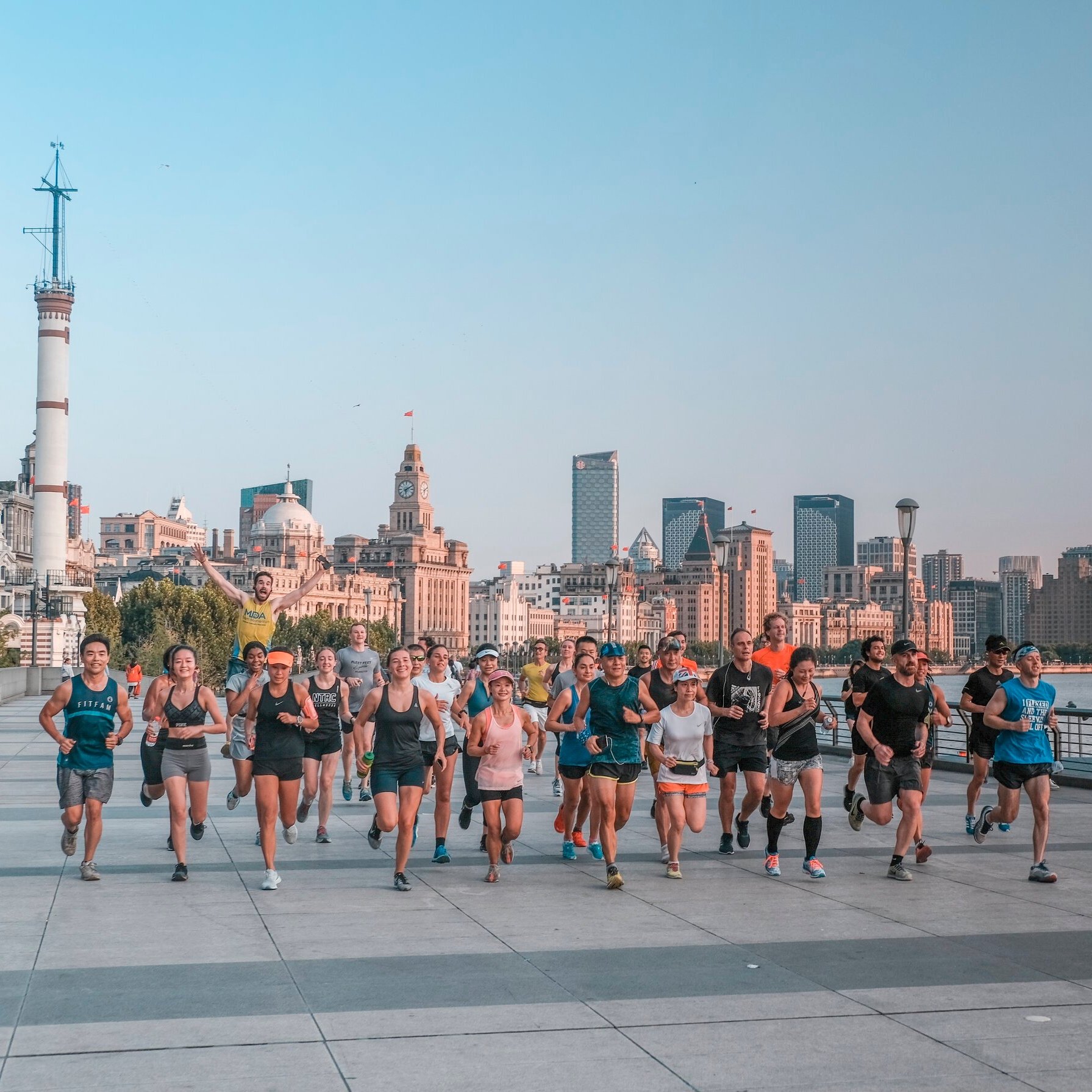
FitFam (Worldwide)

Soul Melanin Retreats (Worldwide)

Tennis for Free (UK)

Left Write Hook (Australia)
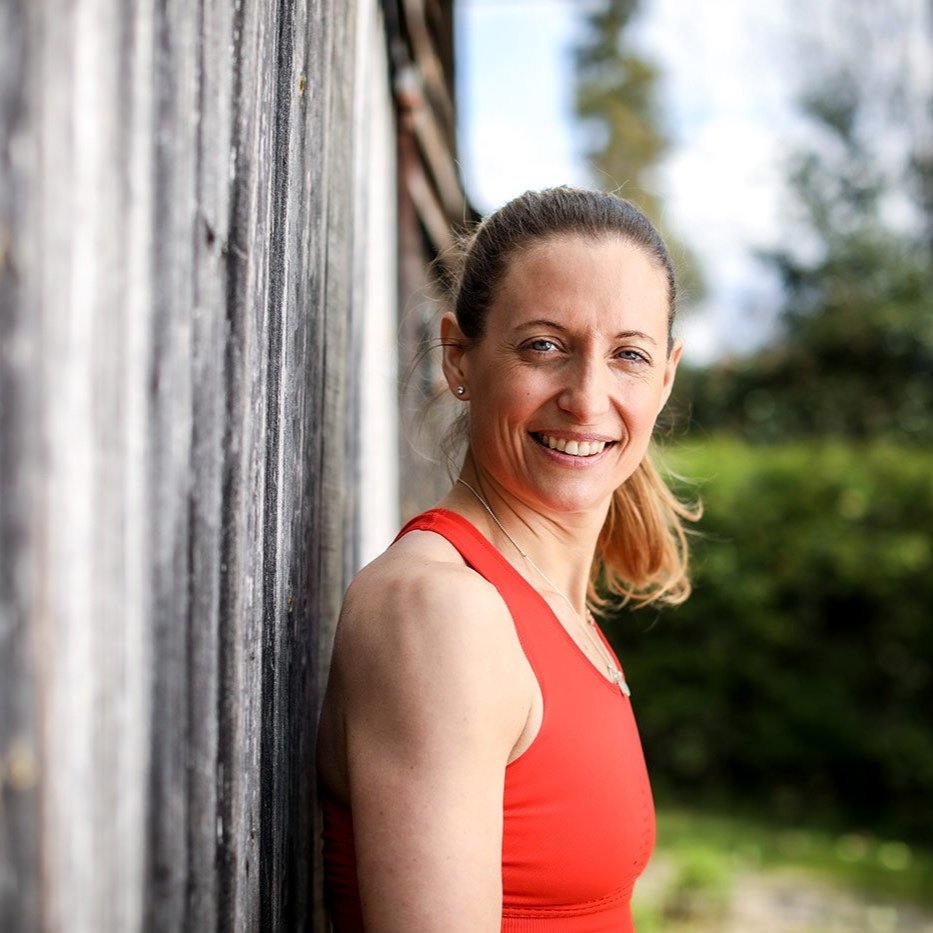
Owning Your Menopause (UK)

Sage + Sound (New York)

She Swims (UK)
How will you rethink what the mind and body connection means to you? How might you shift your ideas around physical wellness to incorporate your mental well-being?
Let us know how you navigate this pathway. What’s something you’re discovering about yourself as you go through this?

The Lost Together Book Club | Atlas of the Heart
We’re welcoming in all the emotions with this month’s pick by Brene Brown. Let’s discover together what our emotions are telling us.
““I want this book to be an atlas for all of us, because I believe that with an adventurous heart and the right maps, we can travel anywhere and never fear losing ourselves. Even when we don’t know where we are.””
This is the first month of our Lost Together Book Club where we figure out how to live the books we love — not in an imaginative daydreamy way but in a what-next kind of way. (Read this kick-off post if you missed it).
This book club is for anyone who believes that the right book at the right time can change lives, but also that there are so many books at all times to change our lives in so many ways, it’s all become a bit overwhelming.
In this group, we’ll experiment with the concepts we’ve read, try to apply them to our own lives, and share what we’ve learned. What worked, and what didn’t? What did we discover? What did we let go of? What do we want to take forwards?
So, choose one book. Start reading. And I’ll see you in the Zoom meet-ups to see what you learned, and what you’re curious to try. You just need to register below.
Our Emotions Pick this month is:
Atlas of the Heart, Brene Brown

This is the book that inspired my path to train as an Emotions Coach Practitioner. When Brene Brown turns her formidable attention to what it means to live a life full of all the emotions you know there’s something meaningful going on there.
This book will help you learn to recognize and name your emotions. Research is now showing that this leads to ‘greater emotional regulation and psychosocial wellbeing’. But when asked, many of us can name just 3 emotions – happy, sad, and angry.
Brene shows 87 emotions and experiences that include such things as bittersweetness, resignation, amusement, anguish, and wonder.
I added this one so we can broaden together our understanding of emotions, and what to do when we realize they are there, doing all their magical and confounding work.
To join this month’s Lost Together Book Club head to Substack.

The Frome Kindness Festival
How a small town in Somerset is trying to be kinder
“Frome is already full of kindness, but there’s always scope for more – particularly towards the people that we don’t feel close to.
The scientific evidence is that simply watching someone else doing something kind can set a ripple of positive change in motion. As Aesop said: No act of kindness, however small, is ever wasted.”
Go here if: you would like to be a kinder person, you would like to have more kindness in your life, or you would like to make where you live and work a better place
What is it: Brought to you by The Good Heart, a local non-profit, this week-long festival aims to make Frome, a market town in Somerset, the kindest place on earth
Why you’ll love it: When else do you get to put kindness front and center in your life, and the lives of others? And how often is kindness even the aim that we have for the communities in which we live and work?
What you need to know: Now in its second year, The Frome Kindness Festival takes place from 5th to 11 March, 2023.
Each day of the Festival has a kindness-related theme, and events range from a Caravan of Kindness to a West Country afternoon tea with Radio 4 presenter Claudia Hammond.
There will be a debate about Kindness in Social Media, a film extravaganza, and clothes swaps for children and adults, including a catwalk where eco-conscious shoppers can be photographed in their new outfits.
On the streets, there will be live music, pop-ups and a flash mob featuring a specially commissioned Kindness Dance. The Boyle Cross in the centre of the town will be decorated with a super-sized hat that encourages passers-by to “put your kindness hat on.”
At heart: “the Festival aims to bring together young and old to celebrate, practice and explore the power of kindness to improve mental and physical health, transform relationships and strengthen communities.”
Something to do: Join the Kindness Challenge, where local individuals, groups, businesses and organizations have the opportunity to give back. You’re invited to do something kind, imaginative, special and down-to-earth.
Even if you can’t sign up for the Kindness Challenge, you could bring in acts of kindness wherever you are. See some ideas for how to do that here.
Read The Compassionate Project, a great book about how Frome turned to human kindness to solve the problem of loneliness.

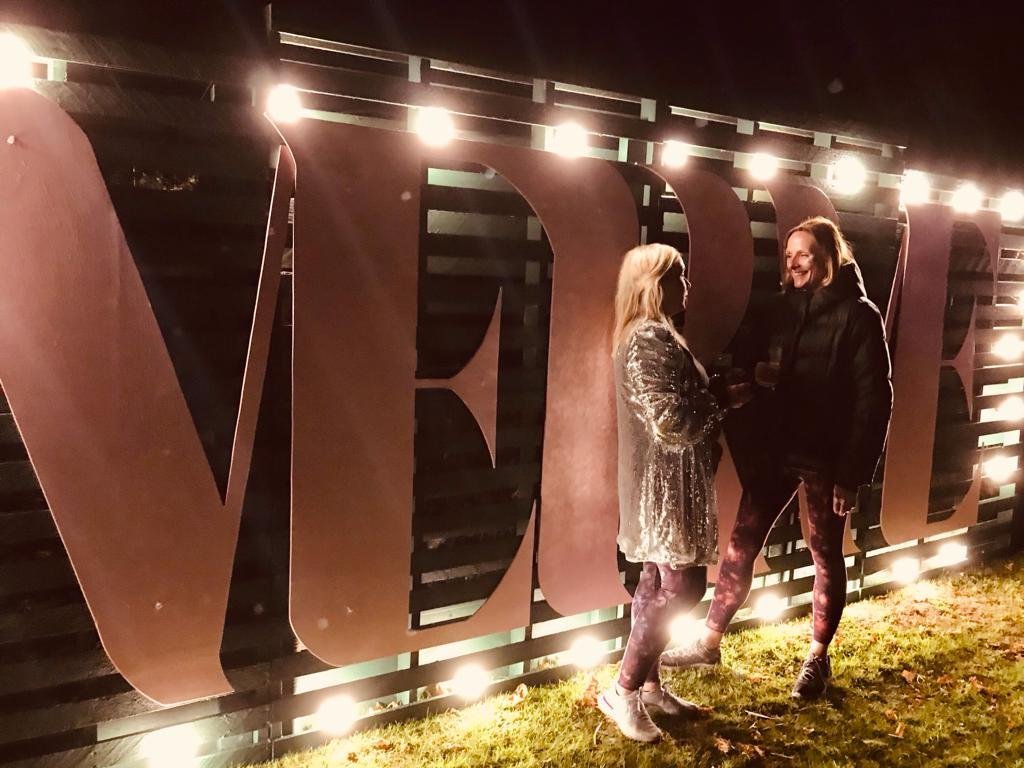
VERVE Festival | A conversation with co-founder Anna Hayward
One of Conde Nast Traveller’s “Woodstocks of Wellness”, we interviewed co-founder Anna Hayward about how doing what you love is at the heart of any well-being practice
“Wellness can be whatever makes you feel better.”
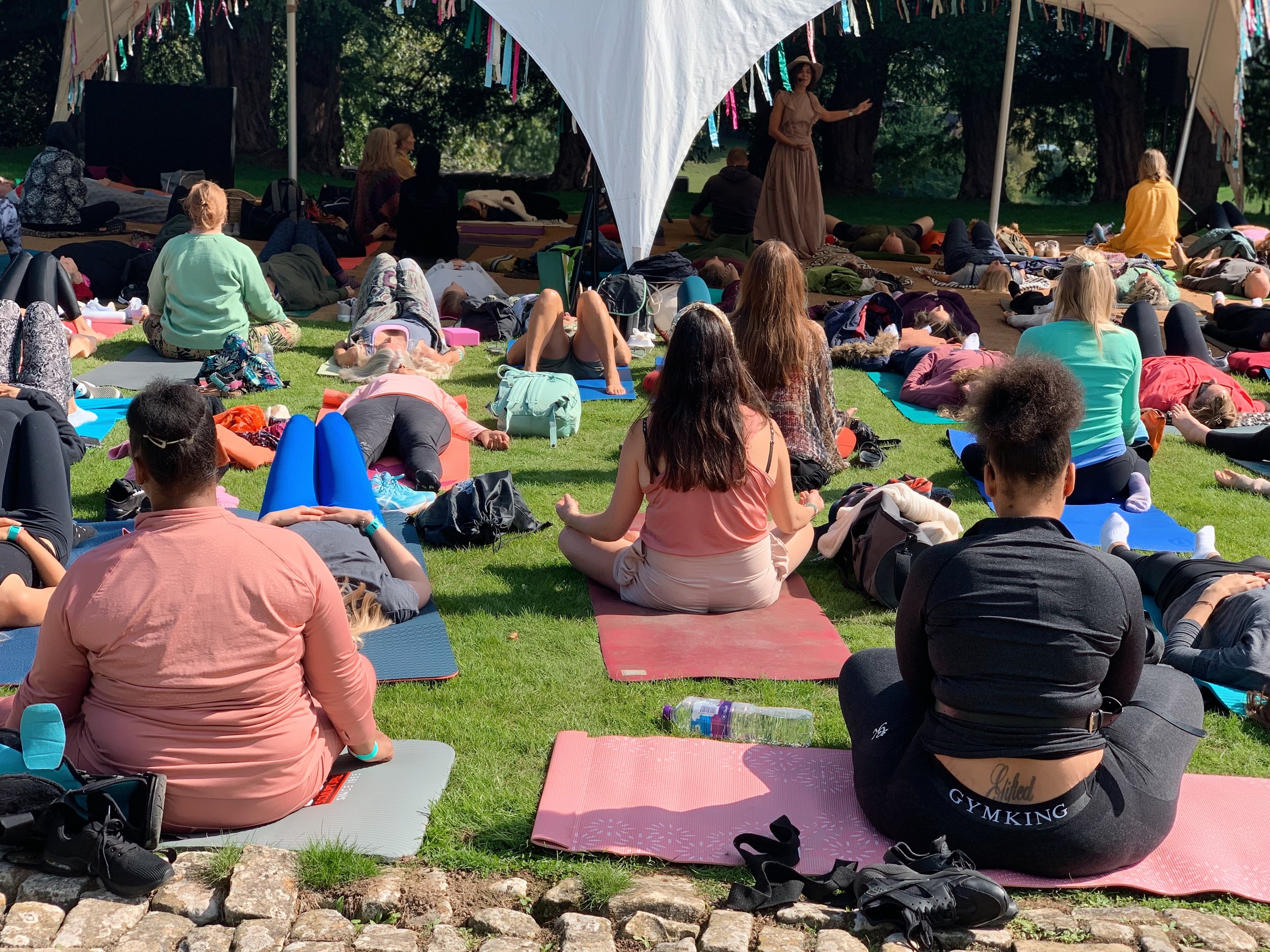
We talk to Anna Hayward, the co-founder of VERVE Festival— a weekend wellness reset located in the heart of the Wiltshire countryside — about why you don’t need to be a wellness warrior to attend and how we can all shape a practice that reflects who we are, rather than who we think we need to be.
Where once there were music festivals, literary festivals, and ideas festivals, it now feels like there’s a movement toward wellness festivals. Why do you think we are now drawn to them?
I think that’s true although there are still only a handful of wellness festivals.
It feeds into our current moment. I know from feedback how much people appreciate just having a real me-day and not everyone these days wants to go out to a festival and drink till 4 am. We’re all starting to care a bit more about our health and well-being.
We celebrate healthy hedonism; we still have a bar, we still have cocktails, and we’ve got DJs in the evening, but it’s more of a balance.

Do you think the perception of wellness has shifted? We’re noticing how wellness has become something of an unachievable goal, ironically given its intention.
I feel like the version of wellness that you offer is more accessible; that it’s ok to be messy about it (wellness doesn’t have to be this pristine thing anymore – it’s ok to fit it in when your kids are crawling on you).
I think so too. I think the idea of wellness is for everybody and it’s for all shapes and sizes and ages and it doesn’t matter. We get all kinds of people at VERVE Festival – we had a man in his seventies and older ladies with grey hair and bigger girls and skinny girls and everything in between and that’s what it should be. It shouldn’t have ego; it shouldn’t be about anything other than just trying to be better to yourself.
Wellness is different for everyone. It can just be about having a big burger and a glass of wine (that’s what makes me happy). That’s just as good for you, isn’t it? Wellness can be whatever makes you feel better.
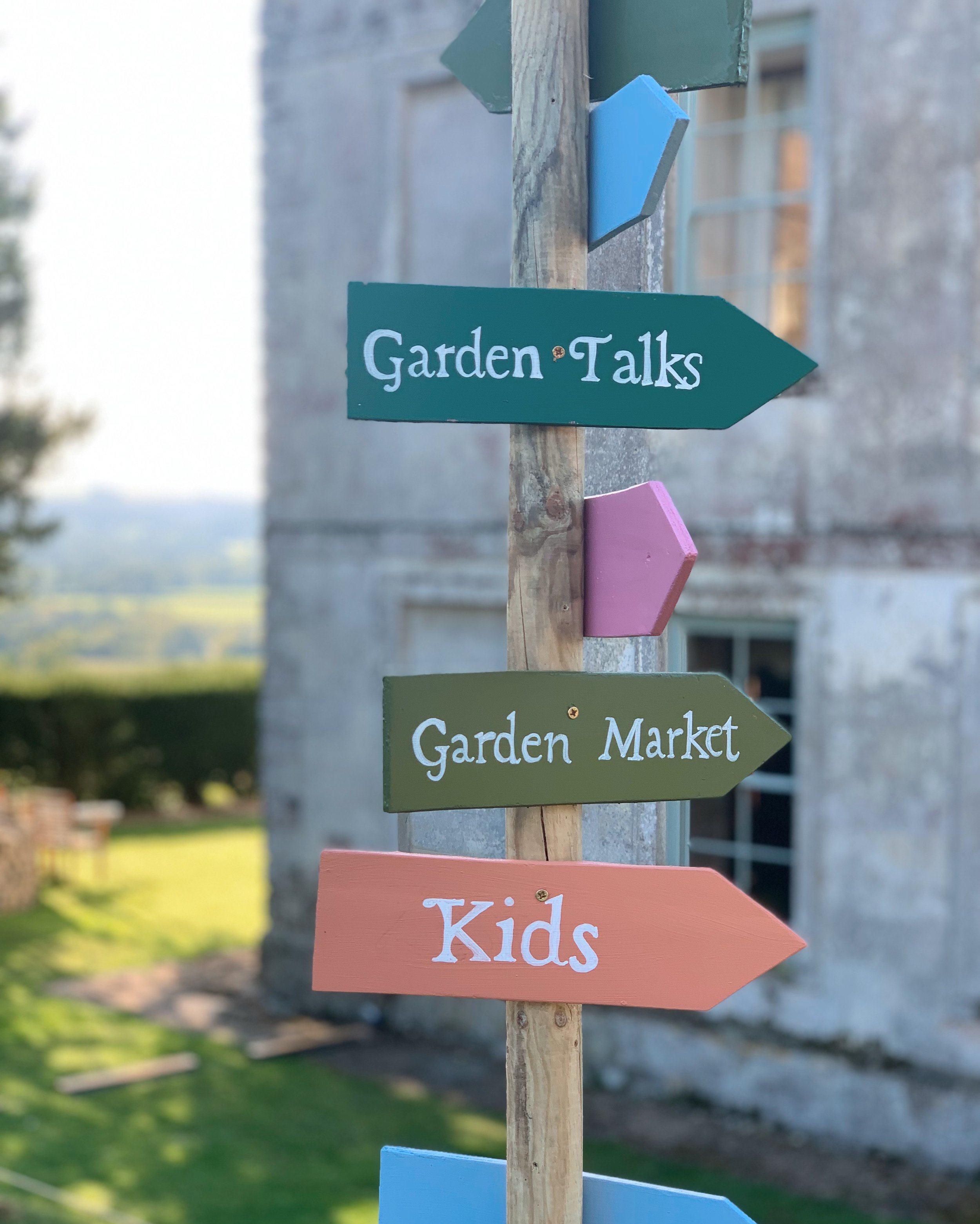

What do you hope people experience with the festival?
It’s different for everybody. People were coming up to me at the end of the last festival – complete strangers – hugging me and saying what an amazing time they’d had. Many people said: “I can’t believe I’ve never done this before. I’m going to go home and carry on with it.” And quite a lot of people said they were going to make changes. They’d listened to a talk, or something had happened during the day, and it was going to be a little catalyst for change in their lives.
The timetable allows people to do their own thing and most things are free once you are at the festival, so people just drift around and everyone has their own way of approaching the day.
We enable people to try some things that are different, that they may never have thought of doing in a million years. While some people literally want a day away from their children, or to sit with their friends and drink cocktails and listen to some music. That’s great too.
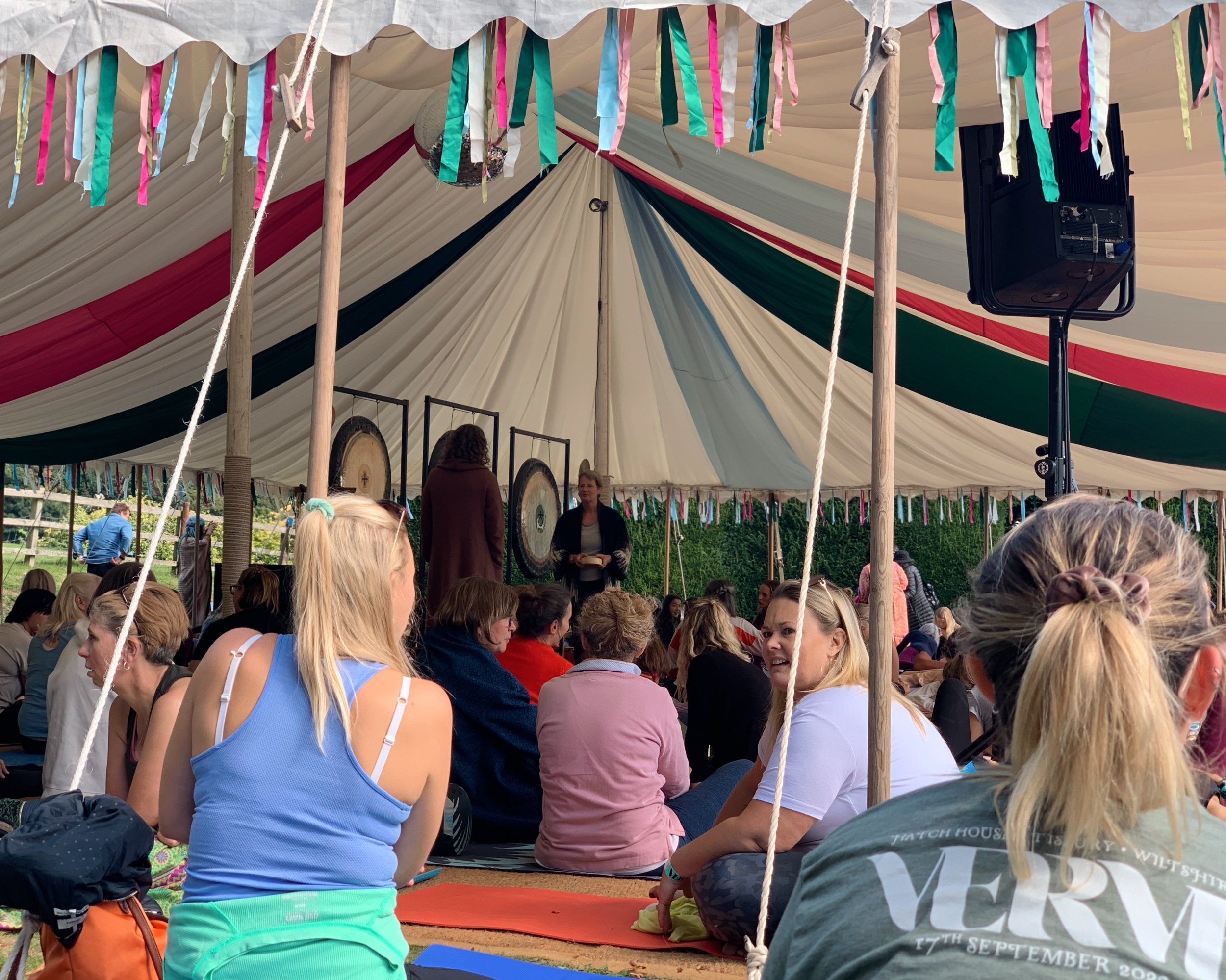
There’s been a huge surge of interest in nature since you started, but you built that in from the beginning.
Yes, the whole idea is health, wellness, and nature. We live in an area of natural beauty, a dark skies reserve, and the farm we hosted on the first year was so beautiful. We realized that’s our Unique Selling Point. There are other wellness festivals, but no one has got this natural space, this greenery and this beauty quite frankly. We’ve done star gazing, we once got the AONB to come along with their astronomers, we had runs along the farm, we offered forest bathing, and everything was just to celebrate being outside and being in nature.
Even a few years ago, when we held our first festival, no one really talked about nature but obviously, with the pandemic — when people were going out walking and that’s the only thing they could do in a way — people realized how important it is to their lives.
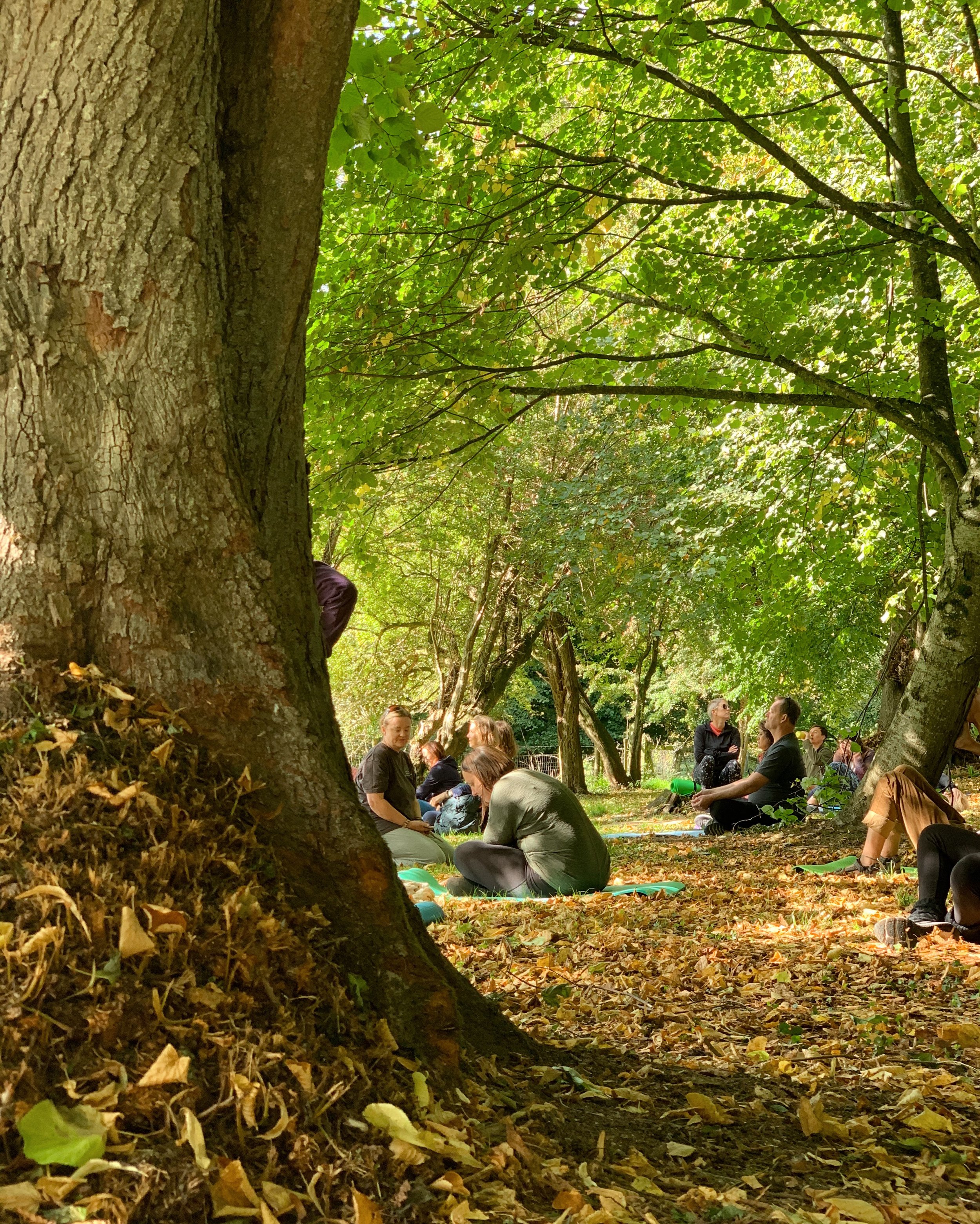
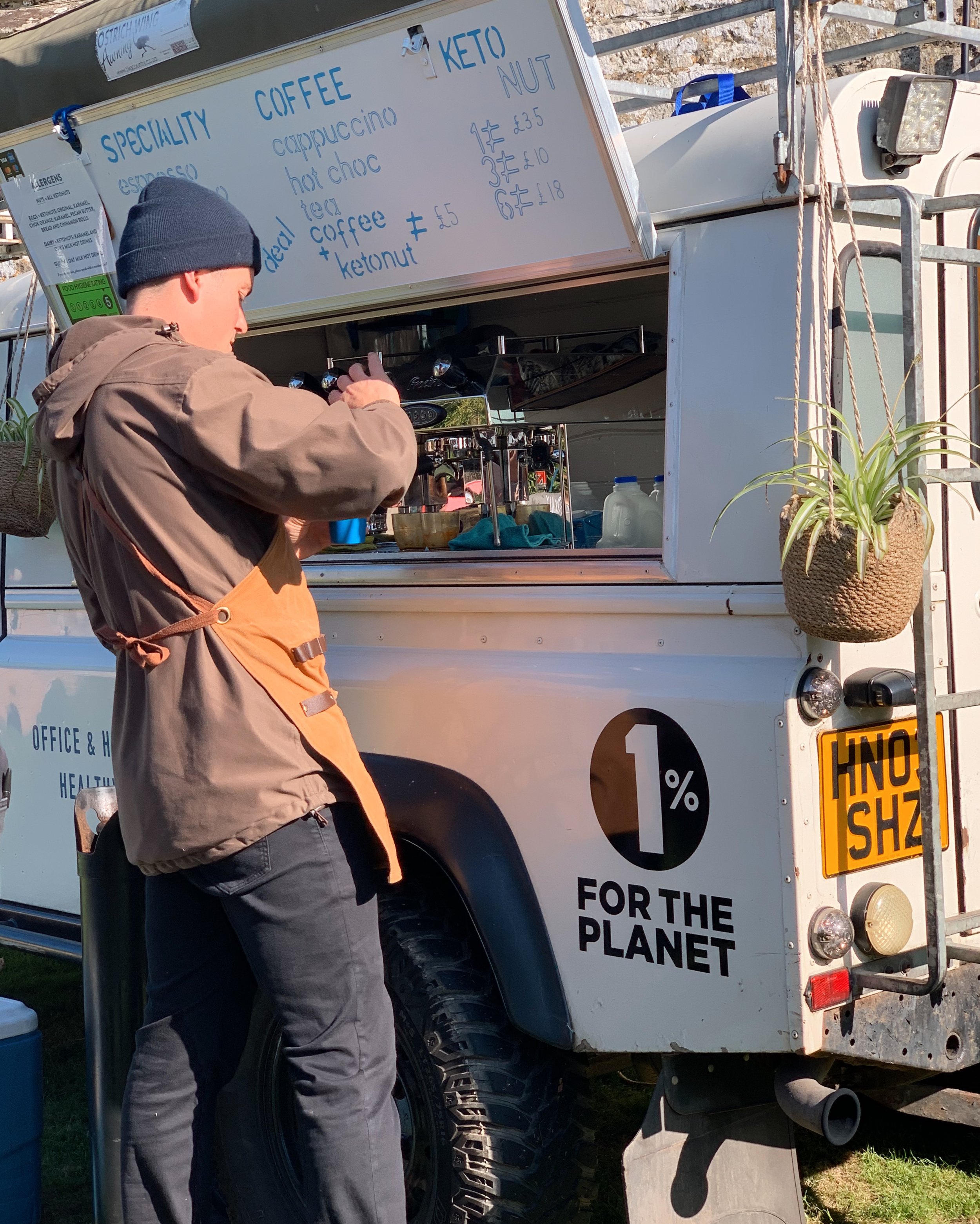
What advice do you have for someone starting a wellness practice wherever they are?
Do what makes you happy. I’m lucky I’m a glass-half-full person, but my advice would be don’t force yourself to do something if you are not going to enjoy it because whatever you do it’s got to make you happy.
Don’t do something because you think you should or someone else is doing it. Do something that is true to you. Which is what we’re doing with Verve.
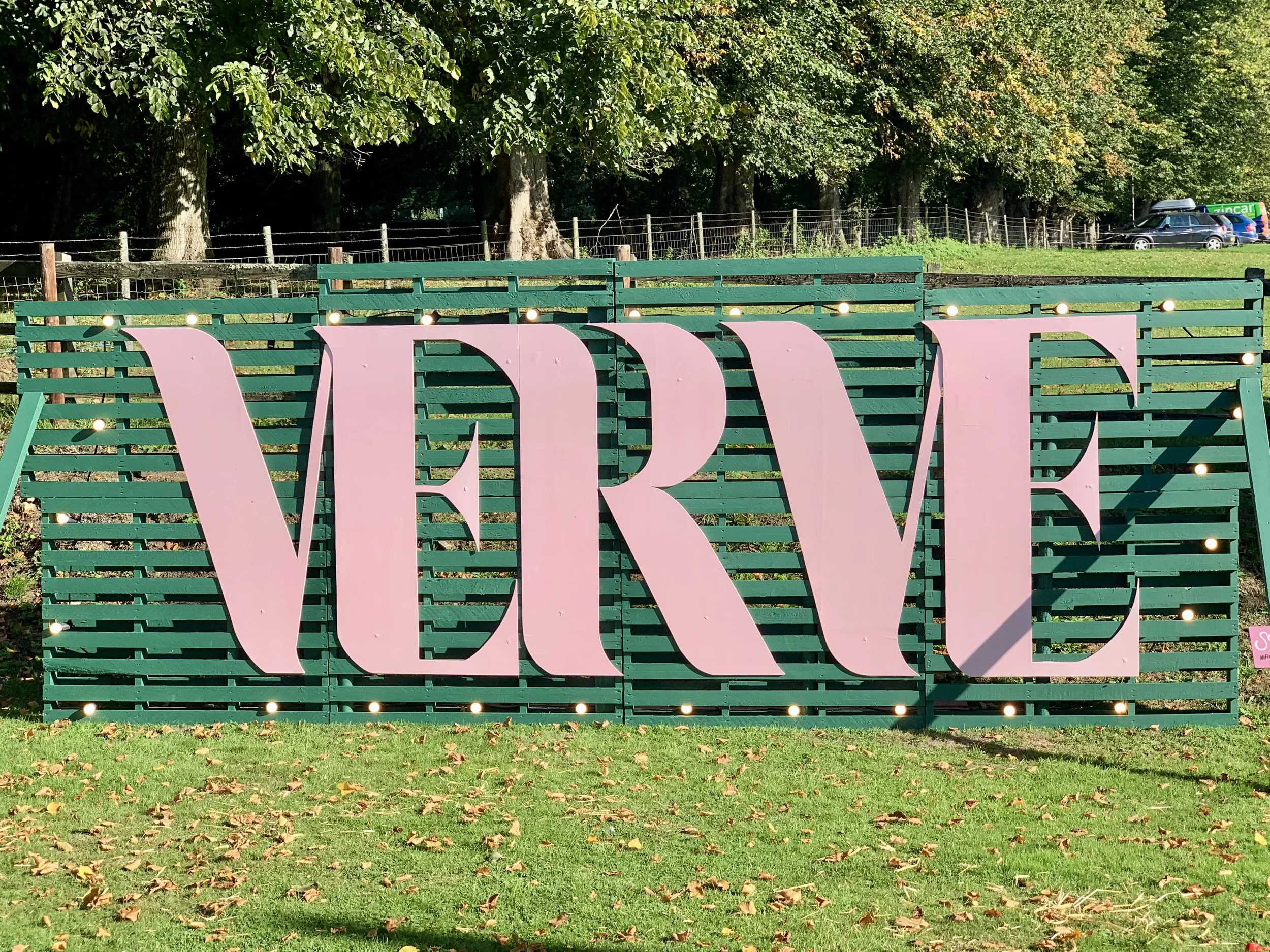
We’re excited be participating in VERVE Festival this year. Find out more here.
Beyond Happy: Finding Your Way To Better Emotional Well-Being at VERVE Festival
We’re bringing emotions coaching to one of our favourite wellness festivals.
“Language shows us that naming an experience doesn’t give the experience more power, it gives us the power of understanding and meaning.”
How many emotions can you name? Most people can name just three; some version of mad, glad or sad. But recent research indicates that having a wider emotional vocabulary can help people not just better express what they are feeling but cope better with everyday experiences, and live happier and healthier lives. When Brene Brown turns her formidable attention to what it means to live a life full of all the emotions you know there’s something meaningful going on there.
Just knowing the words can help better regulate our emotions and respond more helpfully in all of life’s situations. Is what you’re feeling sorrow or vulnerability? Is it anger or frustration? Is it happiness or pride? How we name something shapes our experience of it. Having access to a greater breadth of emotions means we’re able to better understand what those emotions are asking of us, and what they are pointing to, or guarding against.
I’m thrilled to be joining one of my favourite wellbeing festivals this year by offering coaching around emotions.
In my 1:1 sessions at VERVE Festival this September, I’ll start to explore your emotions. We’ll figure out which emotions you welcome and which ones you deny, which ones you think of as ‘good’ or ‘bad’, and which ones have something to tell you (and whether you’re ready to listen to them).
Over the 30-40 minutes of your session, we’ll get you to a place of being more familiar with all your emotions, build the confidence to explore what to do with them when they inevitably show up, and learn how they can help you find your way to what matters most in your life.
Curious about what better emotional wellbeing would look like to you? Find me near the VERVE Stage and book a session here (you’ll need to have your tickets for the Verve Festival to book a session as this is available to Verve attendees only). The cost is £25.
These sessions can help:
If you’re stuck in an emotion – like fear, stress, overwhelm, anxiety – and need to find a way through them to create more space for the things you want in your life
If you’re struggling with even the idea of bringing joy, love and happiness into your life, and want to learn how to welcome these in so you can access all they could bring
If you have an emotional blocker on something and it’s getting in your way, and you want to learn how to let go of it/ release that to get to a better place
If you are feeling lost, and need help finding your way again
If you’re feeling all the feelings – you are unsettled and unsure – and would like to get to a place of calm, peace and equilibrium
If you’re feeling none of the feelings – just numb and disconnected – and want to figure out what emotions could offer you and the significant role they could play in your life
If you’ve looked at life in all the ways, except this one, and you’re curious to learn how transformational emotions coaching can be.
Excited, optimistic, or even hopeful about what this might do for you? Join me in getting curious about your emotional life.
For more information, you can email me at claire@ifloststarthere.com or book your emotions coaching session at VERVE Festival here.
If you’re not able to get to VERVE Festival this year and you’re still interested in Emotions Coaching, don’t worry, we can still work together. Book a quick call out to see how I can support you to find your way to better emotional wellbeing in your life.
“You are what you feel, as long as you can describe it.”

The Lost Together Book Club | The Wellbeing Pick
Possibly what happens when you smoosh together Culture Therapy, a Book Club and Coaching.
““you have to get to work being your own coach instead of your own worst critic”
”
Have you ever read a non-fiction book and had an idea spark, but then die again because hours passed and you forgot it? Have you ever wanted to do the exercises, answer the questions, and take the wisdom offered in the latest bestseller, but then left that space behind when you closed its pages?
Or have you learned some new way to well-being only to be confused about how that sits with that other piece of advice you liked that said something equally as valid, but opposite? Have you felt just a little like you were flailing with all the things to do that feel contradictory rather than complimentary, or all-encompassing rather than life-enhancing?
Or. Or, have you ever felt alone with your emotions, your thoughts, and your life and you thought maybe others felt like this too? You were sneakily suspicious that they did. (Just think about all those readers of The New York Times or Sunday Times bestsellers which must mean we’re all thinking about this too?) You believe that other people have felt this way, experienced this as well, and felt just as lost. You just didn’t know where to find them.
All of this is a preamble for telling you why I’m starting a book club and why I’m doing it differently. At its heart is the question: what if we could shift the self in self-help to a kind of collective support? Could we learn all the things together, bring a sense of acceptance and curiosity back into our days, and integrate just the bits of science that resonate into our lives?
So this is how it’ll work:
I’ll take the Culture Therapy piece from If Lost. I’ll cover mostly books, but I may also bring in podcasts, TV series, magazines — really anything that can help navigate life and all that life now contains.
I’ll add in a coaching framework — taking what we’re reading and exploring and seeing how, and whether, to integrate it into our actual lives.
And we’ll add in the familiarity and community that comes with being part of a book club. Think slightly awkward, but kind of connecting, moments together.
At the beginning of each month, I’ll announce the selections: a mix of books you might already have on your shelves with new releases you’ve been looking forward to reading.
Mid-month, I’ll send some ideas/questions/exercises that stood out for me and invite you to practice them together.
And — here’s the fun bit — I’ll organize a get-together on Zoom focusing on each book, coaching around what came up for you, and seeing where the book took you.
For this kick-off month, the Wellbeing Pick is:

This book is designed as the complete toolkit – it’s filled with the lessons we could learn through years of therapy, but that should really be available to all of us before we even sit on that couch.
What’s the baseline for our emotional and mental well-being?
What are the foundational approaches to better navigate our everyday lives?
How can we build a practice when we feel good that serves us when we’re feeling bad?
We added this because it’s a book to live through and by, with concepts to integrate and exercises to complete.
We’re curious about what happens when books go beyond reading, and this one’s a case in point: how might we actively nurture our good mental health when we spend time with it?
To join this month’s Lost Together Book Club head to Substack.

Rediscover yourself: How identifying values can guide your life
Find your way to better emotional well-being by connecting with your values
““Your personal identity comes from your values.””
Values are decision-making magic. When you know what yours are, you can better navigate your life.
They are things like: Creativity. Freedom. Purpose. Kindness. Curiosity. Love.
We once heard the idea that values are something that you can't put in a wheelbarrow — like integrity, wonder and creativity — but not like money, which could be represented by words such as safety, security, status, and belonging instead.
Indicators of meaning, of what matters to you, values are powerful when we connect with them. Values point the way to how you want to live your life, what you’d like it to contain, and how you want to spend your time. Even on what and with whom.
When your values are being met you are more fulfilled and happier. But often in life when you are not achieving something that matters to you this can be because it conflicts with your values. Feelings of disconnection, emptiness, frustration, anger, or just the sense that something isn't quite right, suggest that those values you need do not yet have a place in your life.
But here’s the thing: although our values are deeply important and are threaded through our lives, often they can be maddeningly unconscious to us.
Discovering your values can be a one-off exercise (or a session with a coach like me) so that you can get to the small handful of values you want to live by (Brene Brown swears by having just 2).
So the first step is identifying them.
Something to Try
Here are a handful of words. Choose any that spark something in you:
Adventure Community Fairness Health Kindness Play
Authenticity Courage Friendship Honesty Laughter Respect
Beauty Empathy Growth Innovation Love Tranquility
What resonates? What’s missing?
Book a Values Assessment
Want to explore more? Book a 1:1 online coaching session to capture what your values might be, and learn how discovering them can help you find your way.
““Nobody has passion and perseverance unless what they do aligns with their values.” ”

Ways to Give Back
How can you access the well-being benefits of giving back?
You might already be acquainted with the feeling that you get when you’ve helped someone, done right by the planet, and contributed to your community. Or you might never look up from your life to realize there are ways that you could participate in the world around you that might help others as well as yourself.
Being of service, living a values-driven life, and working to end systemic inequalities might sound like things other people do, or these could be the core of your very being right now.
Wherever you are in relation to the idea of giving back, here we’ll be discovering more of the science behind it and its impact on our well-being, some ideas that might spark something in you and initiatives you might be drawn to support, as well as some questions to ask yourself to get started.
To ask:
How can you see yourself as part of the bigger picture – planet, society, neighborhood? This might be the corrective you need to work on bettering something in our world – environment, homelessness, food waste —, or your answer could help you deepen a life already dedicated to the practice of doing good.
Wherever you are on this, know that even small gestures are meaningful and that there are no comparisons to be had (you do not need to be Greta Thurnberg, Jameela Jamil, or Meghan Markle to be of value to our worlds). There is space for all of our actions, however big or small.
To read:
How to motivate people to do more good (hint: make observable, remove excuses)
How to be a Changemaker wherever you are and at whatever stage in life
To Do:
Become a new kind of philanthropist / participate in a Giving Circle
Lend your eyes, use your sight to help someone who is blind or has low vision
Support FoodCycle, working to end food poverty, loneliness and food waste through community dinners
Support (or start) an Honesty Box
Join a Good Gymn
Become a Book Fairy
To Discover:
One Love Community Fridge: working to end food insecurity and the stigma of hunger in Brooklyn (US)
Farming Hope: a San Francisco-based garden-to-table job training non-profit (US)
The London Community Kitchen: working towards zero-waste and zero-hunger in London (UK)
World Central Kitchen: providing meals in humanitarian, climate and community crises (worldwide)
The Bridge: a new kind of food market fighting hunger in Wigan (UK)
Change Please Foundation: changing the world one cup of coffee at a time (UK)
Give Your Best: providing clothes for refugees (UK)
How will you rethink what giving back means to you? How might the idea of the collective shift your own approach to mental well-being? What’s something you believe in, where you could be of service?
Let us know how you navigate this pathway. What’s something you’re discovering about yourself?