

The Wave
Discover a wave garden focused on bringing the benefits of blue spaces to everyone.
With The Wave, founder Nick Hounsfield has created a slice of California on the outskirts of Bristol, but this is no ordinary surfing destination. Beyond the blue waters, burrito trucks, and clubhouse, Nick and his team are rethinking issues of social health, mental well-being, and our mind-body connection.

Where do you want to begin?
Curious about coaching? Discover what it really is and how it might help you navigate your everyday life.
Before I became certified as a coach I had some ideas about what this profession was — big personalities, large audiences, lots of ‘motivational speaking’ — so much so that I hesitated to train for a very long time. Finding coaches who were nothing like this — who listened, created a safe space, and challenged yes, but supported also — led me to rethink some of my biases.
You may also have some thoughts about who coaches are and what they (or rather we now) do, so I thought I’d try and dispel some of your own myths.
Or maybe you haven’t come across this helping profession — you’re more familiar with its sister practitioners counseling, therapy, or mentoring. Maybe you are curious to just know more. Hopefully, this helps you gain an inkling of what it is and if you would benefit from coaching,
So what is coaching?
The ICF (the prestigious international accrediting body) defines coaching as “partnering with clients in a thought-provoking and creative process that inspires them to maximize their personal and professional potential.”
But what I love about coaching is that we (the coach and the client) co-create the experience together. See sessions as a structured conversation, where the coach walks by your side.
Coaching is client-driven – you set the focus of the session – and the coach partners with you to identify what you want to explore, facilitate new insight and learning, and find a way to create what you need in your life.
And it’s non-directional – which means that the coach won’t tell you what to do – but will hold the space for you to think and discover, clarify and align with what you want to achieve in your life. The coach’s role is to encourage reflection and self-discovery, help you reach strategies and solutions for your life, and to hold you accountable where you need this.
Sessions can be exploratory, giving space for you to think and reflect (maybe for the first time), and enabling you to take your thoughts in new directions.
Or sessions might be more goal focused, formulating the steps to take you from where you are to where you want to be while figuring out the resources, support, and skills you need to get you there.
You may end a session with something to work on or something to process, or a shift in how to show up in your world and how you think about it.
And what coaching isn’t.
This is key: It’s not consulting, therapy, counseling, or mentoring. In coaching sessions you can work in depth – you may touch on limiting beliefs, learning from earlier experiences, and even relational dynamics – but you’ll do this in a forward-focused way and in relation to a goal or a desired change.
If during sessions, you or your coach feel that you are better served by someone else (like a trauma-informed coach or a psychotherapist), or a resource outside of the coaching practice, these may be suggested to you.
How do I work?
In my training, I learned how to coach the whole person and work holistically across different coaching approaches and modalities, including Positive Psychology, Transactional Analysis, and Neuroscience, which help to understand what it means to be a person in this world, and how we can possibly do life with all that life can contain. As a Trainee Emotions Coach Practitioner, I'm learning how to help clients make contact with the full range of their emotions and use this awareness to bring insights and shifts to their lives.
In our sessions together, clients can be assured of a safe space, thoughtful inquiry, and openness to what they would like to bring. My approach is always shaped by courage and compassion (and challenge framed within both if needed).
5 expansive questions to ask yourself:
In coaching sessions, you’ll be asked some situationally-appropriate questions to bring more awareness into your life, like these:
Where are you now in your life?
Where would you like to be?
What sits in the gap between the two?
Where do you want the first steps to take you?
What’s most meaningful to you in your life? Is this showing up in ways you like?
Grab a pen and paper and take a moment to answer these. Is anything coming up for you? Any new learning?
If you had the opportunity to be coached, how would you like to use it?
If you’re interested in knowing more, finding out how coaching can specifically help you, and curious about how to move forwards in your life, let’s chat (sounds scary but really it’s just a conversation to get to know each other and find out how we can best work together). Or check out some options for 1:1 coaching here.

Dry January and The Path to Self-Acceptance
What I’ve found, that I am not sure would be obvious in a month of sobriety, is that the impact of this process, is exponential, that life can become not only tolerable, but legitimately joyful, and it just keeps getting better.
Five years ago I would have thought the idea of Dry January was insane. (Why torture yourself for a month when life itself could be torturous year-round???)
Now, at four-and-a-half-years sober, I feel a little thrill at the thought of Dry January; at the thought that maybe some collectively repressed hope has resurfaced, the thought that someone else might find themselves down a path with the power to shift their life in beautiful and unexpected ways. (This, I would imagine, must be how Mormon missionaries feel when they knock and you open the door.)
“What I’ve found, that I am not sure would be obvious in a month of sobriety, is that the impact of this process, is exponential, that life can become not only tolerable, but legitimately joyful - and it just keeps getting better.”
For me, sobriety was a process of learning to tolerate the discomfort of existence (of being me) then shifting my life (and myself) until it all felt a bit more tolerable. I was fortunate to already be in therapy at this time; to have already begun examining all the undiagnosed mental health conditions I’d amassed and subsequently mistaken as whimsical quirks and unique eccentricities.
(It should be noted here, that sober curiosity and the need for recovery are not one and the same. For anyone struggling to get sober and in need of medical intervention, please consult your doctors, therapists, trusted support system. Bryony Gordon wrote a great article for anyone who is in that boat and struggling to stay afloat. It might be a great place to start.)
What I’ve found, that I am not sure would be obvious in a month of sobriety, is that the impact of this process, is exponential, that life can become not only tolerable, but legitimately joyful, and it just keeps getting better.
Of course I’d found joy prior to sobriety. I had a built a life, a family, had great friends, was doing interesting work. I’d succeeded in so many of the ways we are taught to strive for, but the truth was, beneath the surface, I was still struggling. At some point, I knew there was more for me (more to sift through, more to feel, more to experience) and the dulling haze of alcohol simply wouldn’t allow me to arrive there.

Congrats on Your Sobriety postcard from Okay Yeah Design and Sans Bar
Few other choices have catapulted me towards well-being so forcefully as sobriety. And, like so many things that are good for us, few other choices have made me so uncomfortable. I will never forget the first days and weeks of sobriety, the first social gatherings and family get togethers, the first girls nights. I didn’t know what to do with my hands, my feet, my face, my words, the pulsing dread coursing through my veins. It wasn’t until I’d removed it, that I realized how much I’d depended on alcohol to manage my anxiety. There were many moments in early sobriety where I felt raw and exposed and absolutely terrified. The very facade I’d created around myself (the fun and funny and care-free one) was forced to crumble. This deconstruction, I realize now, was pivotal.
By removing alcohol, I was able to meet myself (like, my actual self…the one I spent so much time running from) and in doing so, granted myself the opportunity to grapple with all the nuance and complexity that comes along with being human.
Seeing ourselves, as we are, without any filter, can be an overwhelming experience. My guess is, for any of you who are exploring Dry January, there will be a moment where you’re forced to meet yourself, maybe for the first time in a long time. The decision to maintain your sobriety after this point, is the decision to welcome the challenge of accepting the person you’ve met (with all of their flaws and shortcomings). I am not sure how scientific this is, but I think many people who have been sober for a long time will agree: sobriety and self-acceptance go hand in hand. And while one can exist without the other, they really do pair well together.
There are so many ways we hide ourselves away, make ourselves small, abandon ourselves. I think the reason I feel so hopeful about movements like Dry January is that I see it as an opportunity to turn all of that around. Sure maybe this won’t be your last attempt at getting sober, maybe it will be the first of many, but that doesn’t mean the work you do this month won’t be a powerful start towards something more impactful in your life. If we can take this time to shift our perspective a bit, I think we can welcome it as an opportunity to show up for ourselves in a totally new way. Dry January really is less about abstaining from alcohol and more about welcoming everything that comes with the clarity of sobriety, including the opportunity to rediscover ourselves.
Whether this journey lasts for 31 days, or 90, or 365, I hope you’re able to be gentle with yourself as you navigate it, because it really is about so much more than avoiding alcohol.
And if, in the process of heading down this new path, you get the chance to meet some forgotten version of yourself, I hope you’re able to do so with the same kindness you reserve for the people you love the most in this world. Falling back into yourself can be hard. You deserve a gentle landing.
If you are participating in Dry January and need some solidarity and entertainment, here are a few fun lists to help pull you through the month. Please take them lightly and feel free to share them with any of your friends who might be participating in Dry January along with you! For more resources and ridiculousness, you can follow me at The Sober Illustrator on instagram!

Four Phases of Sobriety*
Phase 1: Look at me go!
Phase 2: Oh fuck, there are some feelings here.
Phase 3: Oh that part is forever? Right. Ok, let me figure out how to deal with that.
Phase 4: Basically just phases 1-3 on repeat forever.
*probably not science

Tips For Thriving in Early Sobriety
DISCOVER WAYS TO HAVE FUN AT HOME
(Read: eat all the sugar, watch all the shows)
FIND SOBER FRIENDS
(On the internet, obviously — I would never ask you to leave the house)
CUDDLE WITH A SMALL CREATURE
(Dog/cat/lizard/tamed squirrel…doesn’t matter)
READ BOOKS ABOUT SOBRIETY
(Or just buy them then tell other people you’ve read them)
SCHEDULE TIME TO CRY
(*tentatively penciling in Friday at 5pm to Sunday at 9pm*)
MOVE YOUR BODY
(But not like super fast or anything, just kind of stroll around…vibing)
REDISCOVER A FORGOTTEN HOBBY
(It’s ok if you’re bad at it, so long as your hands are busy)
WRITE DOWN 5 THINGS YOU LOVE ABOUT YOURSELF
(Tape this to your mirror, staple it to your face, tattoo it on your eyelids — DO NOT FORGET)

Sober People to Follow (on Instagram)









Shitty Life Advice
How a bespectacled Sam Lamott plans to resolve life’s most complicated issues.
“Have you ever considered that maybe God hates you?”
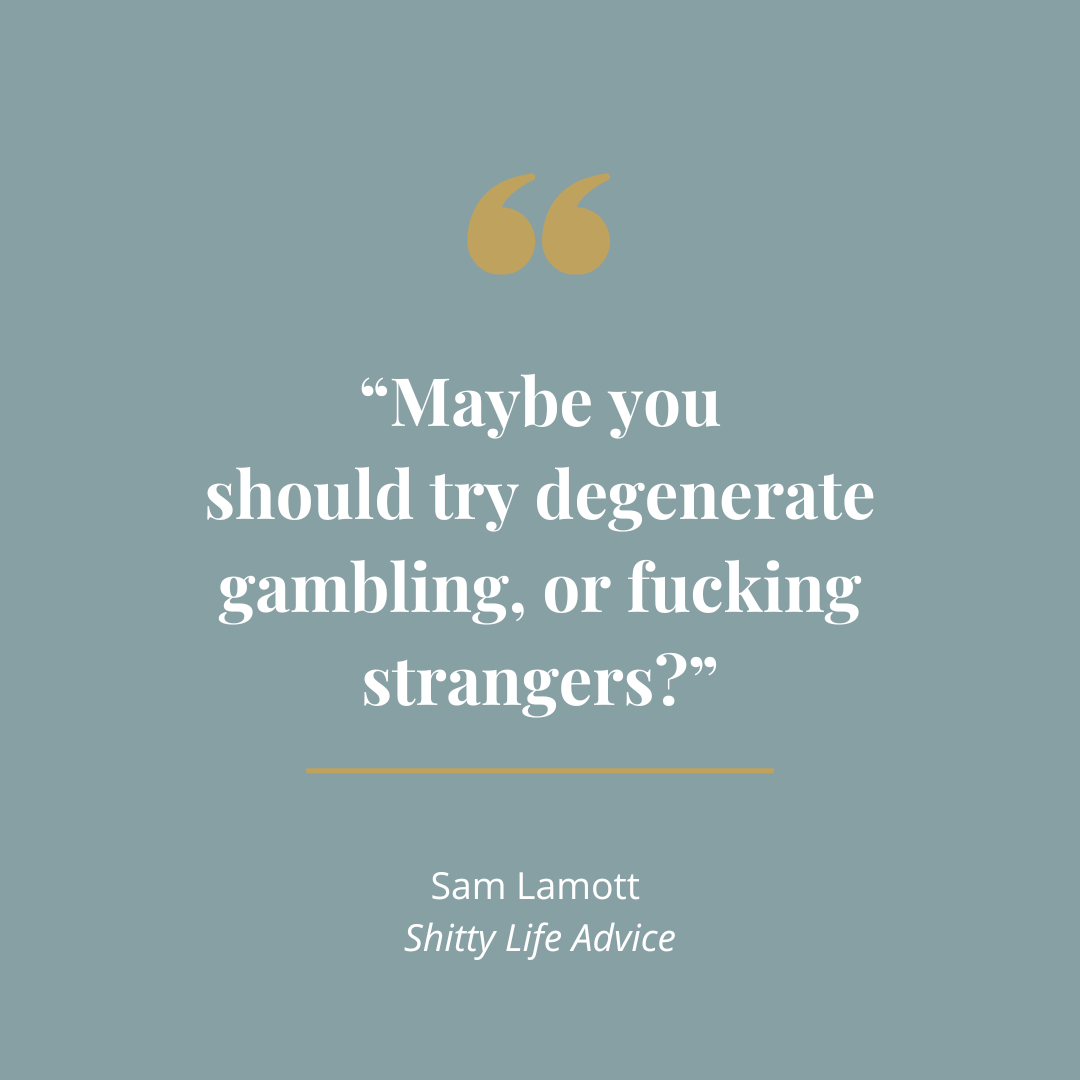
“You should try degenerate gambling, or fucking strangers!”
“What you need to do is gather all the pubic hair you can find and cover every surface of the bathroom with it.”
Is this a collection of quotes from famous drunk uncles, or random bits of wisdom spewed forth by a defunct AI text generator? No friends. These are all actual words spoken by writer, artist and How To Human podcast founder, Sam Lamott…and, if I’m being honest, I think he might be on to something.

Ok, now, for some context.
Sam Lamott, as himself, probably doesn’t think God hates you, and he likely doesn’t condone the random strewing of pubic hair in shared spaces (though I can’t be sure here). He is, however, a huge fan of giving Shitty Life Advice. So much so, that he’s created an entire show about it.
A few years ago Sam took to Instagram (a sacred space for social connection and the dispensing of sound wellness advice) urging his followers to submit question about their life’s greatest issues, which he would then attempt to solve in 15 seconds. The catch? He’d would be taking on an entirely new persona and providing people with the worst. advice. imaginable.
For many people, this venture might have ended in chaos, but, somehow (miraculously) Sam had struck a chord.
In his everyday life, Sam is a kind, generous and intelligent human, well-versed in the nuances and complexities of life. As described in his bio, Sam is “a single dad, college drop-out, ex-meth head who came out of a ten-year bender at the age of 22 with severe clinical depression, a two-year-old, and zero life skills. Simply put, there is no one more genuinely curious about how to be a human being.”
Over the last decade, Sam has managed to get the hang of it. Not only is he still human-ing, but some may argue that he’s done so to great success. On his podcasts, Sam has sat down with some of the greatest thought leaders of our time (everyone from Brene Brown to Byron Katie, Gay Hendricks to Gloria Allred, Reggie Watts to Marianne Williamson) in an attempt to glean some understanding of how to human. More recently, Sam has shifted towards bringing on “ordinary" people who inspire him; people who enrich their communities, find joy and meaning in the everyday, and share their creativity with the world.
Regardless of who he’s talking to, Sam has always managed to access people at a very human level.
“For whatever reason, people just want to tell me their secrets,” he once told me. The reason of course, is that people feel safe in his presence, like nothing they can say or do will render them “bad,” or damaged, or unworthy of love. (And, at our core, isn’t that really the basis for all of our insecurities?) When giving Shitty Life Advice, Sam manages to create this same secure container, giving viewers the sense that, even behind the glasses of his smug alter-ego (who I just realized should have some sort of devious name) there is a person there who gets it, and really does want them to succeed.

Last week, I was able to sit with Sam in his Marin County studio as he launched Shitty Life Advice (2.0). Here, 15 second instagram stories would move aside to make room for an hour-long live-streamed show, complete with live callers, exceedingly shitty advice, and a panel of highly-trained therapists to make sure Sam didn’t ruin anyone’s life. Imagine if Dr. Drew’s Loveline and Glennon Doyle’s “We Can Do Hard Things” Podcast had a baby. (And then someone dropped that baby.)
Opening with an “undergrounding” meditation, viewers were welcomed to the show and instructed to move systematically through their bodies, cursing every inch of it, all the way from their stupid hearts, (“which would probably be the thing that kills you”) to their stupid brains (“the same one responsible for every mistake you’ve ever made”).
Words cannot describe how hilarious and comforting this meditation was for me. I’ve been struggling to pinpoint it ever since, and the only thing I can land on is that while I, like many, have subjected my body to a fair amount of criticism and berating, it had never felt ridiculous or funny until this moment. Somehow, this exercise had taken the charge out of the worst of what I say to myself. Like hating yourself in this way surely must be a joke.
For me, this same perplexed feeling surrounds the whole concept of Shitty Life Advice. After all, aren’t we already good at being shitty to ourselves? Do we really need a show to give us more ideas about how to be shitty to ourselves?? If I wanted bad advice couldn’t I just ask my most unhinged friend or some guy at the gas station (like I normally do)?
While Shitty Life Advice appears to be the antithesis of the wellness movement, if we look closer, I think we’ll see that it may actually be the exact complement that the movement needs. In a world saturated with wellness resources (books / podcasts / planners) there is something incredibly refreshing that comes with receiving absolutely horrific advice, and, I’d argue, that it may help us to find clarity even more quickly, and profoundly, than if we’d been given “good” advice in the first place.
Because the truth is, at this point, most of us “know” what to do. Right?
Like, we have the basics down:
Have the hard conversations.
Feel the feelings.
Uphold the boundaries.
Extend grace (but, like, not too much)
Practice gratitude.
Go outside.
Breathe deeply.
Something to this effect?
It isn’t that these tips and tricks are new. It’s just that they’re not always easy to execute. Because just as strong as our knowledge of ourselves and what is in our best interest, is our absolutely incredible ability to fuck it all up. We postpone discomfort, ignore intuition, give in to our egos, all in an attempt to keep our lives (momentarily) harmonious, to harvest every bit of serotonin we can conjure, not realizing that in doing so, we are just delaying the inevitable, and sabotaging ourselves in the process.
That’s because knowing how to human and actively humaning are not one and the same. And while one of the secrets to life is probably in understanding and accepting this fact, this understanding does not necessarily lead to action.
Shitty Life Advice is genius to me because in it, Sam is essentially saying the worst of what we’re all thinking. And something about exposing the truth of our deepest fears, desires, tendencies, frees us from that weight, gives it all some levity, and allows us to see our issues through a whole new lens.
When given advice, it’s difficult not be defensive, because there is some perception that maybe we are clueless or helpless or inept. With Shitty Life Advice, we’re immediately off the defensive because we know the advice we’ll be getting is so outlandish that anything we do/think/believe, short of that, actually seems pretty acceptable. It’s also strangely comforting to hear what someone else’s brain can whip up as a worst-case-scenario response to a difficult problem. Getting Shitty Life Advice allows us to come to the “correct” conclusions on our own (a luxury we don’t often afford ourselves).
And the truth is, even that “good advice” can go bad.
Practice gratitude? Oh you mean list all the wonderful things in my life that will almost definitely fall away from me at some point because I probably never deserved them in the first place. Great.
Go outside? To the place where the bears and murderers live? Yeah. No thank you.
Feel the feelings? Fine. I will do nothing else for 8 months. *Dies*

Because here is the thing: we can’t just make blanket statements and TELL people what to do. Every scenario we are faced with is too complex. There are hardly ever “right” answers (though after hearing Sam’s responses it is clear there are many wrong answers) just endless opportunities to shift our lives and shape ourselves more fully into the people we want to be.
And, really, maybe what we need is a little less of an emphasis on what we “should” be doing in these scenarios, and a little of an emphasis on humility and humor. Life is, after all, laughably disastrous at times. And who knows, maybe dabbling in gambling and fucking strangers is exactly the shake-up we need! (Disclaimer: probably not.)
If you’re interested in getting some Shitty Life Advice, you can submit your questions for this weeks episode in Sam’s Instagram bio. And if you’d just like to revel in the misfortune of others and take part in a series of unsettling exercises, you can catch Shitty Life Advice live on YouTube every Tuesday at noon!

Finding Myself Lost
Why being lost is sometimes the thing that points the way.
Let me tell you a story.
There’s a very personal “why” for me in co-founding with Amanda If Lost, Start Here: While working at some of the most renowned spaces for contemporary art in the world, my mum’s mind began to slip away, slowly at first, then completely. She struggles now to manage everyday tasks and has a diagnosis somewhere around Dissociative Identity Disorder, the parts of herself fragmented, doctors still confused about how to treat her.
I have seen myself in my mum’s situation, enough to shift my life’s focus. I have struggled with panic attacks, general anxiety disorder, and depression, which in London meant not being able to get on the tube some days, and in San Francisco not being able to cross the Golden Gate Bridge. I’ve been to therapists and energy healers, attended workshops, and engaged in thought work, becoming an active seeker of strategies that work for me, both in the hope of managing my own mind and preventing the same slide as my mum’s. I think part of me believed I was helping her too - if I could just find the right thing, I could save her (and yes, I’ve had years of learning on that one).
That question of how we function as people, put front and center in my life, meant that the pristine environment of conceptually oriented art exhibitions in which I worked didn’t connect with my life anymore. So I worked on swapping gallery walls for something more intimate, two chairs and slightly worse decor.
A year at CCPE completing a foundational course in Counseling & Psychotherapy taught me many things:: that ideas can shape our understanding of who people are and why they do what they do, that Carl Rogers was as cool as Foucault, that I shouldn’t try to fix my role-playing clients (more rescuing).
But most importantly for this project, I also learned that it wasn’t about just the role for me, the job of a therapist, it was about the room, the therapist’s office, the safe container. That interest would lead to seeking out the very spaces that we curate in our guide.
If Lost, Start Here began to percolate when I realized that people were starting to build brick-and-mortar places and starting initiatives that went beyond therapy (though there are now some great contemporary reframes on that) around things like community and emotional intelligence, anxiety and depression, and even the end of relationships and the end of life. They were starting to make places that hold our mental well-being in ways that the museums that I had worked in held contemporary art and the way that a therapist could hold a room.
I also realized that there was nowhere to go to find all those different things. There were, and are, incredible platforms for great interior design, or travel off the beaten path, or well-being trends, but there is nowhere to think about all the different places in the world that are now being kind to our minds and making for better lives. I realised that we needed a guide to this new sector, one that combines well-being with culture, and includes curiosity, travel, lifestyle, place-making and socially engaged art, independent cafes, and mom-and-pop stores — all approaches directed at making our lives better, and easier, and more thoughtful.
If Lost, Start Here brings together the open inquiry I learned in my years in curatorial practice – creating narratives out of disparate subjects and working across different fields of interest — and the search for spaces that act therapeutically and offer different possibilities in which to contain and explore our lives. This project is founded on the belief that the spaces that we make in the world for ourselves matter in who we are and who we are able to become.
My hope for If Lost, Start Here is that it becomes the platform for finding the therapeutic, bringing together the best places that support us as actual people in our worlds. Here we bring together that practical search for something else, for whatever it is that fills the gap in all our lives, for the thing that we need most and are still seeking. As we build this guide, hopefully you’ll find more of what your looking for to help you navigate your days.
How you can help
Help us create a guide to all the places that can help our mental, emotional and physical well-being (they are all interconnected) and you’ll be helping others find more of what they need in their lives as well.

Twenty-Five Ways to Find Yourself In the Natural World
As the seasons start to change, this week we're looking at ways to bring the great outdoors into our everyday lives.
As the seasons start to change, this week we're looking at ways to bring the great outdoors into our everyday lives.
Here are some ways you might seek out nature this week. What would you like to try? Where would you like to go? What would you like to commit to?
Take action with a Climate Optimist (Anywhere)
#FindthatLizard (Los Angeles)
Discover the UK’s only surviving Georgian Lido at Cleveland Pools (Bath)
Spend time with an emotional support squid (Anywhere)
Seek out Allotme (Pair with this guide to allotments for beginners) (UK)
Explore a former Victorian Viaduct that has been transformed into a Public Park (Manchester)
Visit an actual Schleep Sanctuary (think glamping with real sheep to count before bedtime) (UK)
Support a seed library (US)
Help make surfing accessible to everyone (Cornwall)
Nurture your digital health plants: Play Kinder World (Anywhere)
Try a new walking App like GoJauntly or FreeTree or Trigbagging (Anywhere)
Take The High Road (Massachusetts)
Join a Garden Club (Anywhere)
Discover the English Fenlands, for Annie Proulx a story of a ‘tearing apart’ (To be experienced in the UK, to be read anywhere)
Support Planting Justice (Oakland)
Garden with Heidegger (Anywhere)
Improve your emotional and physical health with Hiking for Health (UK)
Escape to an airstream in Joshua Tree (California)
Discover Diversity Outdoors (featuring London Caribbean Trekkers, Muslim Hikers, Peaks of Colour, Black Girls Hike & The Wonderlust Women)
Learn why we should all be chasing acorns (Anywhere)
Make a bucket list of places to find nature anew: On ours (Anywhere, & Norway)
Stay in a Plant-friendly hotel (Kentucky)
Pursue Ecohappiness (Anywhere)
Discover how to rewild your organization (see Ted Talk below)
And even looking at nature helps, so shop our new prints! (US only right now)
How will you find your way back to (or even stay in) the natural world this week?
Let us know what you discover, what works for you, and what doesn’t.
You may have local finds that help you connect with nature’s remedy. Tell us about those too so we can fold them into future lists and help everyone benefit from a connection with our green and blue spaces.
“The more people I meet, the more individuals I come across who are crying out for a connection with the natural world. Today, society is in many ways dangerously disconnected – people are separate from both each other and their surroundings. Mental health problems and stress are on the rise for children and adults. We need nature; we are part of it and the sooner we embrace the natural elements in our lives, the sooner balance will be restored in our lives.”

Okay Humans
With Okay Humans, founder and LMFT Christy Desai is modernizing and destigmatizing therapy to help more people feel better, stronger, and more alive.
We are constantly on the lookout for modern therapy that holds great design with great practice. We’ve sat in one too many uncomfortable waiting rooms, following frustrating booking systems, that came after equally as frustrating searches for someone we actually wanted to work with.
When we discovered LA’s Okay Humans, we knew we’d found a way of offering therapy that made sense to us, and how we live our modern lives. Founder (and LMFT therapist herself) Christy Desai tells us how she has designed a new client experience and environment around therapeutic practice. (We now just need one on every High Street and in every neighborhood).
Tell us about Okay Humans:
Okay Humans is a modern therapy practice from the founders of Drybar. We have a group of qualified and diverse therapists with degrees from places like Pepperdine, USC, Smith College, and more.
We’re all about making it easier to get to therapy. Before you even visit Okay Humans, we've simplified the process for you. Finding your therapist, booking your session, and filling out "paperwork" is all done at your fingertips through our industry-leading app or on okayhumans.com.
It was important to us that Okay Humans be on a visible street so we opened our flagship location in the Brentwood neighborhood of Los Angeles on 11710 San Vicente Blvd.
When you arrive at our brick-and-mortar location, you'll notice we've designed a space that makes you start to feel okay the minute you walk through the door – beautiful architecture, a wellness shop, mentali-tea bar, and sound diminishing therapy suites to ensure a feel-good experience from start to finish. We also built an industry-leading app that makes scheduling, booking, and paying a seamless experience.

What inspired you to start this space and app?
After unsuccessfully trying to outrun the stress of life, I finally looked for a therapist in hopes of catching my breath. What started as “3-5 sessions” turned into years of deep inner work. I learned how to be okay with conflict, curveballs, and growth, just to name a few things. My own experience turned into a personal mission to help other people feel better, stronger, and more alive so I went back to school to get my master’s in clinical psychology and become a licensed marriage and family therapist.
From my experience on both sides of the couch, I realized how antiquated and prohibitive the entire experience around therapy was. I knew that changes needed to be made to remove the barriers of entry so therapy could be more readily available and accessible.
Prior to becoming an LMFT, I was the franchise owner of a kids’ indoor playspace where I learned the ins and outs of building and operating a small business. Coupling these two experiences together, the idea of Okay Humans was born.
What do you offer?
We have a brick-and-mortar location where we see teens, adults, and couples for in-person therapy sessions and have a virtual option available for California residents.
To take even more of the headache out of the experience, we’re now in-network with Aetna & Cigna to help guests save up to 100% of their session costs. Even if guests aren’t covered by our in-network partners, we’ll submit insurance claims on their behalf so they can still save up to 80% on session costs, without the hassle.


What makes Okay Humans different?
We know therapy works. It changes lives and helps people thrive. The magic that happens between you and your therapist in session and the relationship you build together is key in accomplishing that. Our therapists at Okay Humans will provide a framework and a safe space, but there is no right or wrong way for the session to go - the important part is showing up. We make it easier for people to do that, and that’s what I’m most proud of.
With insurance benefits, an app-based booking and payment platform, qualified therapists, and a beautiful, safe space - it's the best way to prioritize your emotional wellbeing.
Our long-term goal is to continue modernizing and destigmatizing therapy so more and more people can reap the benefits. We plan to expand across the country to reach even more people and make going to therapy feel okay in every way.
What keeps you motivated?
The impact that we’re making on people’s lives each and every day is what keeps me excited about building Okay Humans. Building a business is certainly not easy but if you can wake up every morning and know that you’re making a meaningful difference in the world, then it’s worth it. You don’t need to be the smartest, loudest, or most educated person in the room to build a successful business. But you do need to believe wholeheartedly in what you’re doing. If you’re doing something you love and something you’re passionate about, the triumphs supersede the trials.
Next (or first) steps?
To book an appointment, download the Okay Humans iphone app or go to okayhumans.com. To stay in the loop and access mental wellness tips, follow @okayhumans on social media.


Tribe Porty
Tribe Porty makes good things happen for its community and beyond. Find out how this Edinburgh coworking space thinks differently about how we gather together to work.
Located in a neighborhood known for its community, Portobello’s Tribe Porty is all about how we come together and what we can achieve when we do. An old warehouse has been converted into a hub for coworking, events and collaboration. We talk to community manager Alice Hudson about what sets Tribe Party apart from other coworking spaces.
What is Tribe Porty? We are a community coworking and creative events space based in Edinburgh's well-loved seaside town, Portobello.
Why did you open your space? Tribe Porty started because we know the power of connection and social capital. When we asked our community what they wanted, they told us a place to work, be creative, be active and connected. Tribe Porty provides more than just a desk for people to work at. We strive to make good things happen by connecting our network of members and helping people to reimagine their working life. Tribe Porty is more important now than ever; due to the circumstances of the pandemic many professionals work remotely and are seeking social human contact. That's what we're about, growing a community that enables us all to thrive.
What do you offer? Our coworking space is specifically designed to encourage creativity – the random collision of people and ideas that spur innovation, exchange and connectivity. Tribe Porty suits the evolving working styles of freelancers, start-ups and people who require a flexible workspace and opportunities to share, collaborate and develop our work.
We offer a whole range of social events for our lovely members such as coffee mornings, social lunches and Tribe Talks. Our Tribe Talks are a monthly series of events where we invite a Tribe member, or friend of the tribe, to host a talk all about a project they're working on, an interest or a hobby. These evenings have ranged from astrophysics to brand identity. Tribe Talks are a fantastic way for our members to not only network but even learn something new. They are always free and open to the general public as well as members.
In addition to our coworking members, Tribe Porty is home to an assortment of businesses such as The Pilates Studio Edinburgh, Portobello Natural Health, Glocast, Sodak and more. Velow Bikeworks rebuilds custom bikes to reduce bikes in landfills. Fellow social enterprises include The Edinburgh Tool Library, which promotes the circular economy by lending tools and providing workshops for woodworking skills, and Oi Musica, which works with young people through brass instruments. We often use our social media platforms to promote and share their projects. It’s important to us to support each other and coexist together.

What makes Tribe Porty different? The biggest thing that separates us from other coworking spaces is our true focus on community. We are committed to generosity and kindness and actions rooted in those qualities are contagious. We promote a culture of building community and believe that a nurturing environment that sparks creativity and collaboration is good for business, individuals and communities.
We want people to feel at home, or even better, feel Tribe is a more creative home away from home. We want our members to leave their egos at the door and form genuine and important connections. We also look out into the wider community and are always looking for ways to connect and support.
When people come into Tribe for a tour, a day pass or an event the general feedback is that they were pleasantly surprised and slightly taken back by how chatty and genuine people are. It's a beautiful thing to hear and always brings people back.
What do our readers need to know? We are open Monday-Friday, 8.30-17.30. You can book free tours on our website as well as day passes and monthly packages. You can keep up to date with what’s going on inside Tribe Porty by signing up for our newsletter and by following us on social media @tribeporty.

Tell us a little about your story: Founder, Dani Trudeau, believes that we want our work to contribute to our lives, not take away joy or valuable time from what we really want to do. Having started her first enterprise at the age of 14 and her first company at 25, Dani is infinitely curious about what makes a good business — and businesses for good. Dani’s working experience is in education, health and social care and she has worked throughout the UK and America in the field of behavioural science.
Dani founded Tribe Porty in 2015 and more recently in 2018, founded Tribe Women, now Keystone Women, a community for enterprising women who want to reimagine their working lives. More recent times have been challenging but the pandemic has really exemplified how strong our community really is. Members have supported Tribe and have also checked in on one another – a commitment that has genuinely demonstrated unconditional kindness by supporting the constant growth and improvement of ourselves, each other, and our wider environment. This level of showing up for one another is what it is all about and also drives the team and I to work hard for Tribe.
How can people be inspired by your space wherever they are? Our social media platforms open a window to our world and also offer an insight into Portobello living. You can follow our newsletter to keep up with our blog posts. Our Keystone Women programme is open to enterprising women from around the world.
Where inspires you? We’re always inspired by our Tribe members and the wider community. We love not only finding out what other members are up to but celebrating and supporting their accomplishments. We have had members start all kinds of communities — from men's groups to writing, sewing, art, walking, cycling groups and more. They are a continued lifeline for many. Outside of Tribe, the great outdoors; we’re spoiled for choice here in Scotland.
Anything we're missing? No matter where you are, it is important to feel connected and pursue something that feels meaningful to you. Take time to cultivate your connections and be thoughtful about who you spend time to invest in your future wellbeing. Read our full blog about Finding Purpose which Promotes Wellbeing.


Gather Round
Discover a family of creative workspaces in Bristol built by creatives for creatives. Now we’ve experienced life without each other, Gather Round restores real-life interactions that no amount of Zoom can replace.
With its first location in Southville’s Cigar Factory and now a second location in Brunswick Square, Gather Round was created to make space for community and collaboration as much as for our everyday working lives. We asked the people at Fiasco, the design studio behind it, to tell us more about what makes their creative workspace different, how they bring ideas to life and how they have created a positive culture centered on people.
What is it: Gather Round is a growing family of unique creative workspaces, designed to foster a positive community of like-minded creative people through an open and supportive culture.
Why do people need It? Gather Round was set up in 2018 by us, Ben Steers and Jason Smith, Bristol-based business owners of Fiasco Design. We had struggled to find a workspace for our design studio that wasn’t an office, didn’t tie us into a long-term contract and crucially, didn’t charge obscene rates. After chatting to other creative business owners, we soon realised that we weren’t alone. It was time to shake things up. And so Gather Round was born. Built by creatives, for creatives.
What do you offer? Across two locations in Bristol, our considered workspaces are designed around the needs of those who work within the creative industries. Made up of flexible areas with fixed and casual desks, private studios, meeting rooms, production studios for hire, hang-out areas, communal kitchen tables, quiet rooms for headspace and event spaces. At Gather Round you can do your thing, your way.
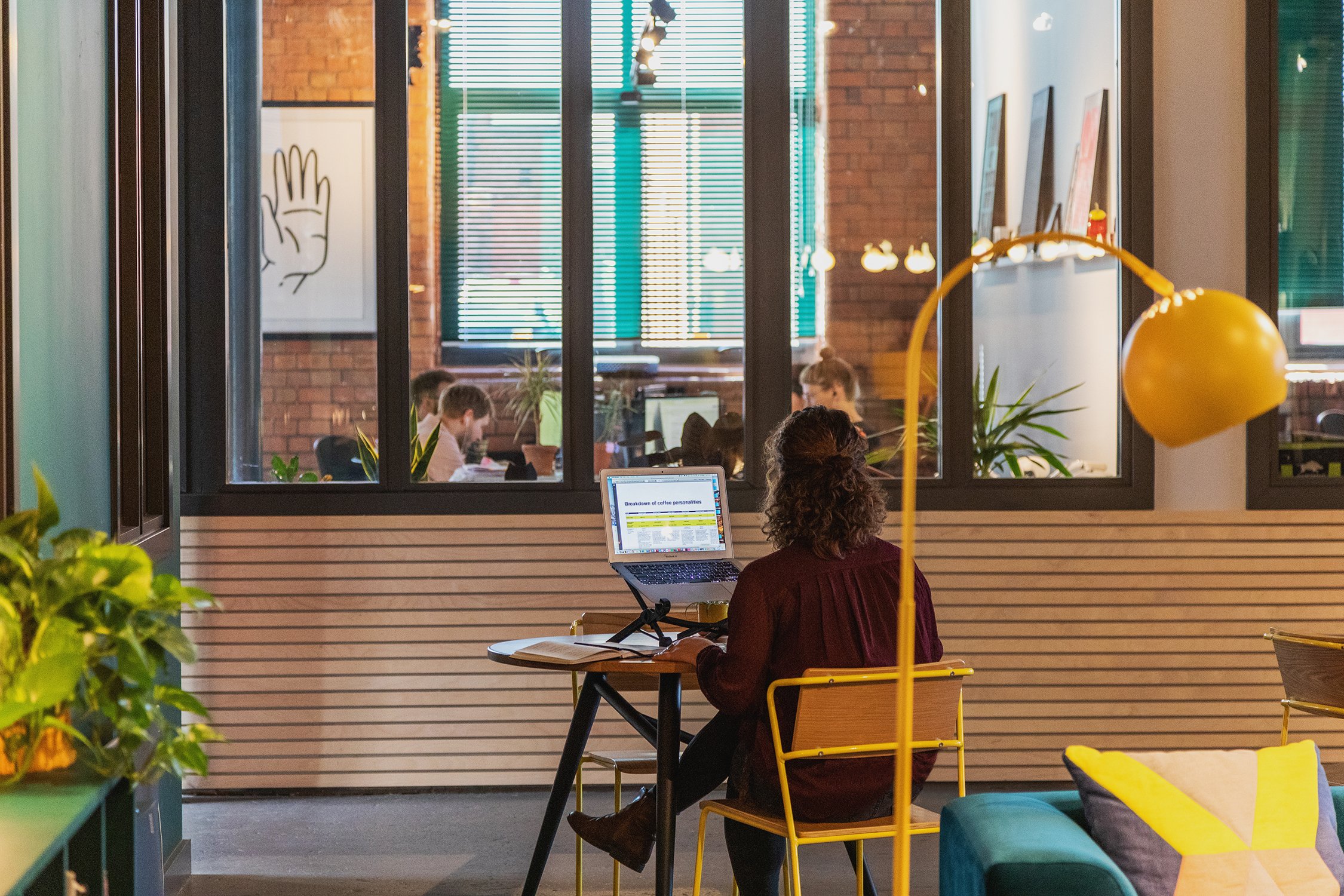
What makes Gather Round different? As creatives ourselves, we know what makes a great workspace. No indoor caravans, tardis-style meeting rooms or artificial grass in sight. Just thoughtfully designed spaces. We provide the right ingredients for creative professionals to flourish; we’ve had businesses born from Gather Round and creative collaboration between people is a natural part of everyday working. So whether you're musing over an idea, hashing out a project, or launching your plan for world-domination - we’ve got it covered.
Our beautiful coworking spaces are nothing without the community of creatives that call them home from home. Filmmakers, designers, writers, publishers, art consultants, brand strategists, photographers and more… Our members are an eclectic and talented bunch. They’re also excellent people that make our special workspaces unique.
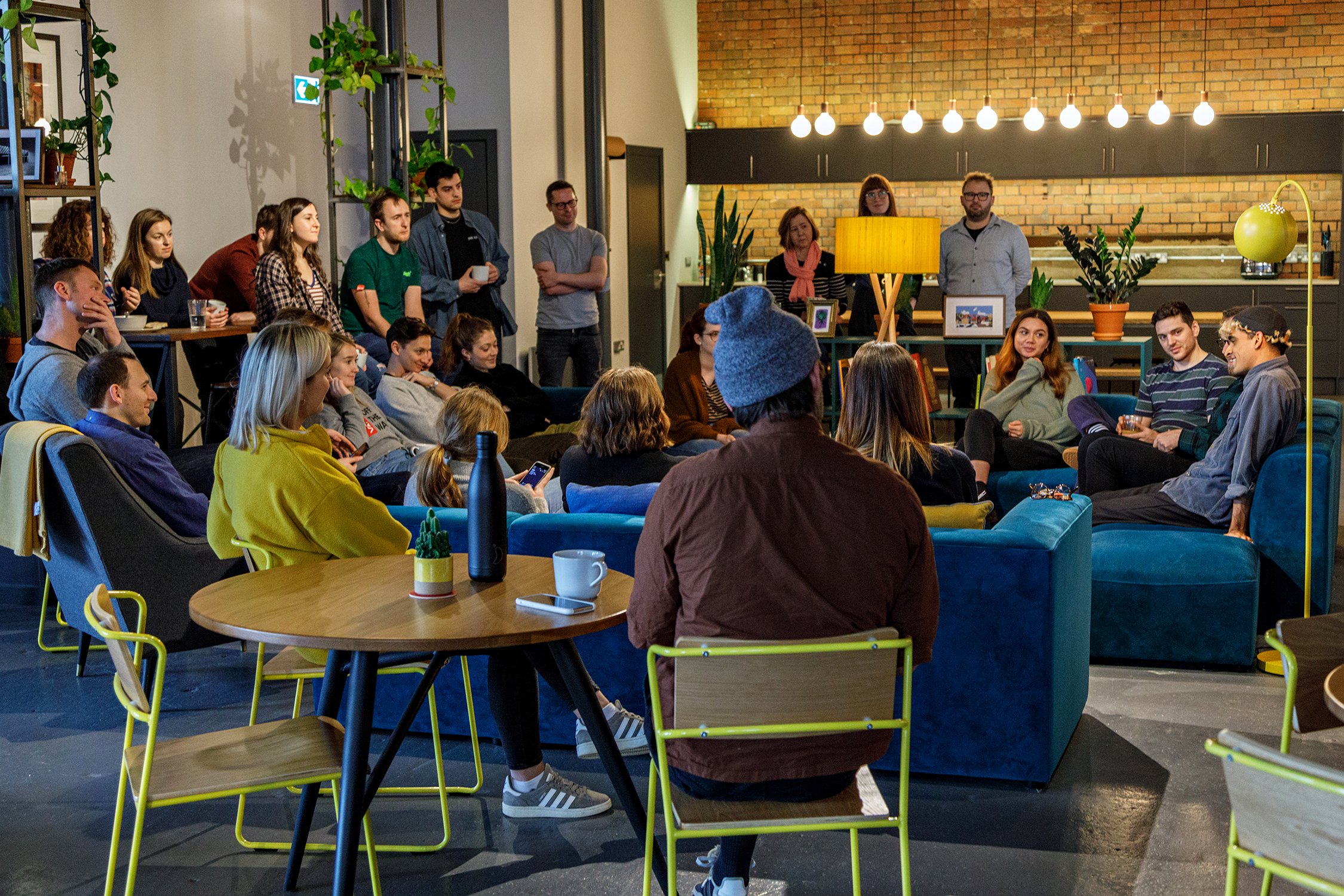
What do our readers need to know? Gather Round is fully open and accepting new memberships at both Bristol locations. As an independent business, we are able to be reactive to the changing landscape. We have adapted to new ways of working, putting our members and their needs first. Now more than ever, people appreciate the value of human connection. Zoom, Slack and the like, are fantastic but they don’t compensate for real-life interactions. We’re proud that our spaces help to bring people together, whether that’s via a project collaboration or enjoying one of our events with a post-work beer.
Tell us a little about your story: The pandemic was a really trying time for the creative industries. As agency owners of Fiasco Design, we were in the thick of it. Multiple projects fell through for us and we witnessed first-hand businesses fold, redundancies happen and talented creatives struggle to support their families. Throughout this, our members were there for one another; supporting each other through the tough times. Our community really pulled together. Many of us were thrust into working from home, often in less than ideal circumstances. Working from home for months on end can be lonely and particularly in the creative industries, it can lead to fatigue and burnout. It’s not surprising that since the end of restrictions we’ve seen an increase in people looking for somewhere to work away from home.
How can people be inspired by your space wherever they are? We are passionate about supporting creative endeavours and we have a blog on our site that is dedicated solely to this. Whether it’s learning how to bake sourdough bread, or reading about essential tools for freelancers, you can find it all on the Journal section of our site. You can also follow us on social channels to keep up to date with what our fantastic members are up to.

Gather Round
Cigar Factory
127-131 Raleigh Rd,
Southville, Bristol BS3 1QU
&
15-16 Brunswick Square
St Pauls, Bristol, BS2 8NX.
Gather Round now has a space in Bath. Check out their new location at Trinity Church here.

Beyond Books
This independent Bookshop Week, escape into the Imaginary with some of our favourite independent bookshops.
This Independent Bookshop Week (Saturday 18 June – Saturday 25 Jun), we’re celebrating some of our favourite indie bookshops. We often seek out bookstores when we’re feeling lost, even lonely, when we need a pick-me-up, when we need inspiration, and occasionally when we have that happy-just-to-be-in-the-world-feeling and want to connect with other people. Bookshops are pretty much there for us all the times of our lives.
So let’s return the favour this week and show up for them. Show them our support: Buy a book, attend an event, say hello to the booksellers and ask their advice on your next read, go on a bookshop crawl. Make a point of visiting your local bookshop, alone, with your friends, on a date, or with your kids (get them in the habit of bookstores early).
That way bookshops will get to stay around, making our lives and communities just that little bit better.
Here are our picks this week for Independent Bookshops we love and why we think they matter.
Bookbar, London

If we were a bookshop, we’d aspire to something like this: coffee on arrival, bottles of wine dotted amongst the bookshelves downstairs, spot-on curation from owner Chrissy Ryan (see the very covetable Booklists), and inspiring events that have included conversations with people like Emma Gannon and “read-dating”. To celebrate the book of the month: Akwaeke Emezi’s You Made a Fool of Death with Your Beauty, Bookbar even played host to a pop-up nail bar. Where “books are social”, this is a place to seek out all the things: connecting, learning, or most crucial of all belonging
With a cause: This one’s all about community: even their Loyalty Card supports books for the local school, Ambler Primary.
To do: Get some bibliotherapy with Shelf Medicate Prescription and Consultation. We’ve very much in need of the escapism offered by the G&T for the Soul Prescription. Consultations are also available for the kids in our life.
Max Minerva’s, Bristol

Every neighborhood needs its own bookstore, every community a hub for kids and grown-ups. When Jessica Paul and Sam Taylor moved into Bristol’s Westbury Park neighborhood they thought they’d found that in Durham Down Bookshop. But when the owner died in 2016, they realized that it was down to them to keep a bookstore in their community. In 2018, Max Minerva’s opened its welcoming yellow fronted space, with a built-in window seat and cozy armchair for lingering. For Jessica, “Bookshops are a comfort thing.” They also tell deeply personal stories: Named after Maxene Emily Minerva, Paul’s late 15-year-old cousin (and also the Goddess of Knowledge Minerva), the store celebrates her voracious love of reading. It’s a joyful celebration of how books are all about ‘emotion, imagination, and ways to making you think.”
With a cause: Bright orange lettering outlines a quote from Lemony Snicket: “All the secrets of the world are contained in books. Read at your own risk.” And it is the joy of reading for all, but particularly kids, that Max Minerva’s encourages by focusing on kids' literacy and creative classes that tell some of those secrets.
To do: Sign up for a children’s reading subscription, and choose between titles for Juniors aged 9 to 12 or aged 5 to 8.
The Book Hive, Norwich

Founded by Henry Layte who describes it as “someone’s home where you can buy a book. Always has, intentionally,’ The Book Hive is an irreverent indie bookstore, with a highly individualistic take on what to read. Located in a landmark building in Norwich Lanes, this is a bookstore for discovering the unexpected. Beloved by authors like Margaret Atwood (who completed her novel The Heart Goes Last in one of its upstairs rooms) and poet Simon Armitage (part of the shop’s award-winning imprint Propolis), the titles on offer are not your usual suspects, but an eclectic assortment that puts personal choice above algorithms. Similarly, the events push back on where we’re all falling down: like Page Against the Machine, a space dedicated to reading, which in itself feels radical now: coming together, detoxing from tech, and putting the world on hold by escaping into a good book.
With a cause: The Book Hive supports the work of the Norman Lamb Mental Health and Wellbeing Fund, which funds vital local, grassroots, community mental health initiatives
To do: Join the Short Short Story BookClub, which takes the much underrated short story and gives it its due with two collections mailed a month to be discussed for now on Zoom.


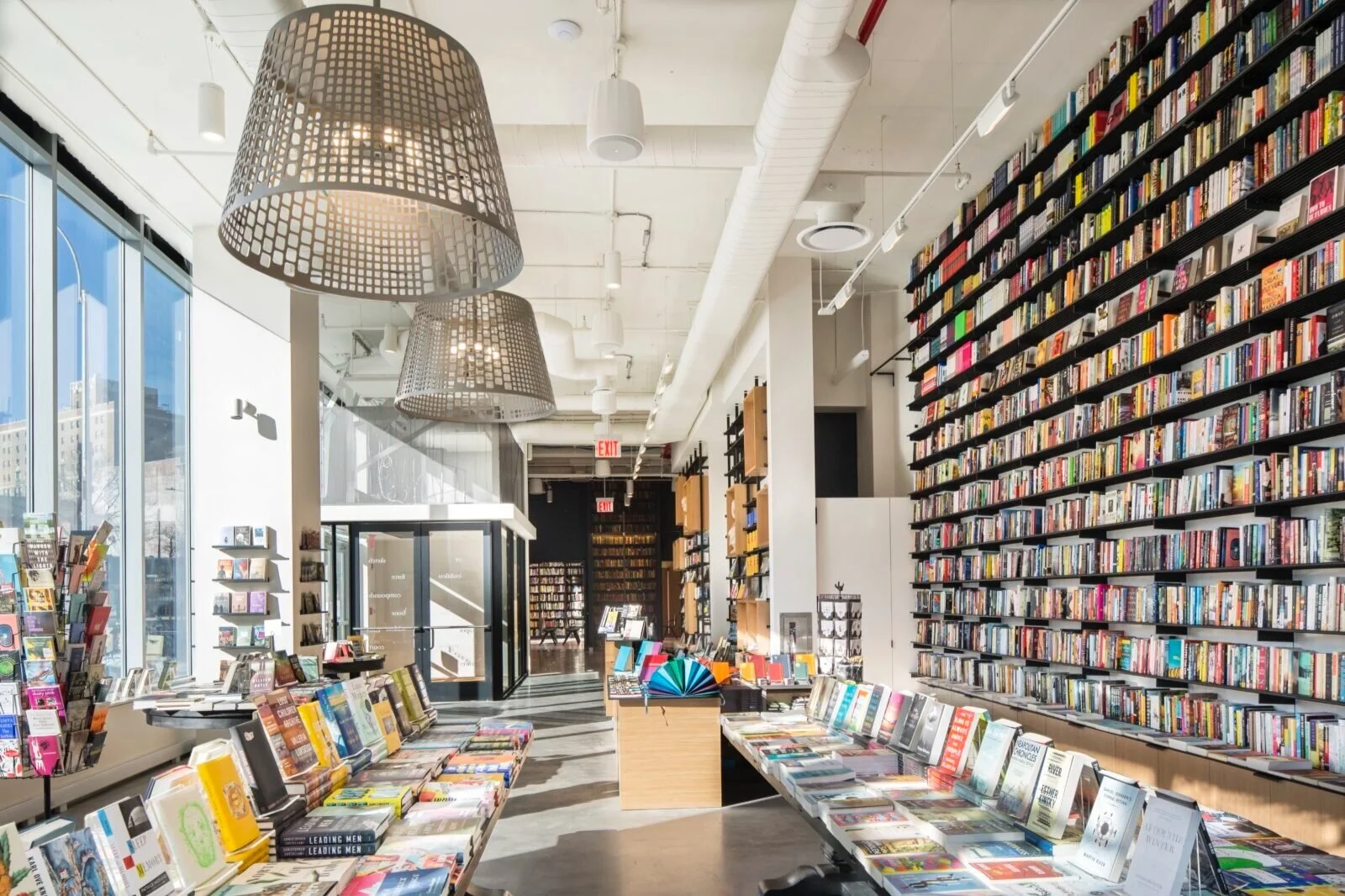


Support your small book store. Read something you love.
Let us know which local bookshops make your life better and which you’d recommend for our guide.
[Main photo: Photo by Pj Accetturo on Unsplash]

Work + Play - A New Local Coworking Concept
Looking for a new way to work? Co-founder of London’s Work + Play Freddie Scobey talks to us about how he’s creating a coworking space that’s reclaiming how we balance our lives.
If the pandemic taught us anything it was maybe how restrictive our working life can be. More of us are looking for a new way to work. And London’s Work + Play is responding to that need. Co-founder Freddie Scobey talks to us about how he’s creating a coworking space that’s reclaiming how we balance our lives.
What is it? Work + Play is the first coworking space geared towards the “work from home” crowd and will focus equally on Work + Play. With its first location having just opened in Finsbury Park, London. W+P offers a unique take on coworking.
Why do people need It? ‘Joy can be really simple’, says my co-founder, Tobias, ‘It can be as simple as coming to work with an amazing community of talented and like-minded people. It can be a comedy night, a morning workout, afternoon sound healing, evening drinks, or combining all the above. Work + Play prides itself on creating unique opportunities for great experiences.’ Finding an environment where you can get the most out of yourself and benefit from the knowledge and insights of others, can be invaluable.
W+P is looking to build these “third spaces” of the future. Not the home, not the office, but somewhere new where work + life is balanced, and which also has the vital goal of rejuvenating the high street to focus on community experiences rather than personal purchases.
Work + Play is a co-working space that responds to what we need. We need comfort, but also community. A place to feel inspired. A launchpad for new friendships. A focal point for family. A warm home, a fertile ground for unexpected hobbies, or budding business ideas.
What do you offer? Fully-Flex Coworking Warp Speed Wi-Fi All Desks Inc. Monitors Exercise + Wellness + Community Events Puppy Yoga Free Yoga + Pilates Free Tea + Coffee Meeting Room + Phone Booths Event Space For Hire.
What makes It different? At its core, Work and Play is about refusing to return to the unnatural work habits of previous eras. We take a local first approach which blends community, wellness and work into a single complete offering on your doorstep.
Tell us a little about your story: We exist because: • No space truly combines work & play • People waste too much of their lives commuting • High streets are the shared spaces of every local community
Our mission: Create unique, healthy, productive, and visually awesome spaces, that support individuals and local communities to define our work + play balance of the future.
Our take on wellness: To help us all cut through the “noise” and focus on what wellness means to us as individuals, we have woven the following seven ideas into the fabric of our spaces. See if you can spot them all!
How can people be inspired by your space wherever they are? The space has been meticulously designed by award-winning architects to be a perfect blend of work and home comfort. Including formal work desks, informal lounge, café-style seating and privacy booths; W+P offers everything required to work productively out of the office.
In addition, the space has its own studio ‘play-space’, which will host a range of classes and events from those more pointed to wellness (HIIT, Pilates, Yoga, TRX, Meditation) to those aimed at bringing fun into view (Puppy yoga, life drawing, speed networking). Work + Play will support people to blend well-being and enjoyment into their workdays.


New ways to think about your purpose
If like us you’re feeling befuddled by the world of work or need one too many cups of coffee to identify your core motivation, take a look at some recent reads, talks and listens that reframe our work lives and can help us show up in ways that matter.
Whether you’re trialing a four-day week, returning to the office after a very long time away, starting a business later in life, or taking part in the Great Resignation/ Great Sabattical (or whatever we’re now calling it), our relationship to work has dramatically changed over the past couple of years. And we’re finding that this is bringing all the things: anxiety and excitement, flexibility and burnout, possibility and loss.
We’re all adjusting, all shifting our relationship to how and where we find purpose. To help we’ve gathered some recent articles that offer tools to make our work lives easier and some perspectives on how to show up in ways that matter to us, though maybe not day after day after day.
100+ Tooks for an Easy Life. As always the people from Do deliver a stellar list to make life work.
An Anxiety Toolkit for returning to the office
“the new frontier for competition is quality of life”: a mass experiment of a four-day working week and here’s the reason why it works
66% of working parents meet the criteria for parental burnout and why it might be here to stay
The rise of the Anywhere Worker
The formula from Yale Researchers for getting into that state of flow
“love for the content of the work itself” - how to redesign work for lives that matter to us
Is anyone else diving deep into the Brene Brown Dare to Lead universe?
Follow these recommendations with our Podcast Playlist for Finding Purpose and/or our curated selection of places to seek out a better work-life.
Have an article, talk, podcast, place, or other suggestion that helps you find your life’s purpose let us know.

Queer LifeSpace
Discover San Francisco’s Queer LifeSpace which offers safe, affordable and accessible support for the queer community. We invited them to tell us about their approach and how people can access their services from wherever they are.
“Evidence-Based Training & Mental Health Services for the LGBTQ+ Community. For Queer People. By Queer People.”
What is it? We are a small, mental health non-profit based in the Castro neighborhood of San Francisco. We specifically focus on providing low-cost therapy to people in the queer community.
Why do people need it? There is a huge need for mental health support in the queer community. We also recognize that the cost of living in the Bay Area is challenging for many so we strive to create a safe, welcoming, and affordable place for our fellow queer people to find the help they need to navigate life's challenges.
What do you offer? We often participate in community events such as the Castro Street Fair. Our website has descriptions of our services, including individual, couples, and group therapy sessions. We just celebrated our 10-year anniversary with a fundraising daytime brunch and drag show Gala.
What makes it different? Our rates are sliding scale and start at $30 for an hour-long session, which, in the Bay Area, is very hard to find. Our organization is also a training site for emerging queer therapists. Because we are a small nonprofit, we have the freedom to create and run our own programming as we see fit. For example, we have a brand new program called EQUARTY, which supports up-and-coming queer artists in the Bay Area. We have another program called Rural Youth Outreach which offers free therapy to queer youth in remote and rural areas of California who may not have easy access to therapy due to their location. There are more plans to expand our programming beyond just therapy.
What do people need to know? We are now seeing clients on Zoom or in person, depending on client preference and therapist availability.
Tell us a little about your story: We understand how important it is to cultivate a space where people can be themselves. As a result, we make great efforts to pair our therapists with clients that share similar life paths. Because of the way we are structured, we aren't limited to a certain number of therapy sessions per client. Clients can attend sessions at QLS for as long as they need.
How can people be inspired by your space wherever they are? Queer mental health could always use more attention in mainstream society. We encourage anyone to talk about the need for mental health support, whether personally or as a culture.
Where inspires you? The strong queer community of the Bay Area is an incredible source of support. We draw upon the wisdom of the queer ancestors who have paved the way for us to do what we do today.
Main Image: Photo by Shingi Rice on Unsplash
All in the Mind Festival
Discover an annual festival that uses creativity to explore mental well-being, and that’s finding ways to use performance to make happier brains.
“We use theatre to create happy brains.’”
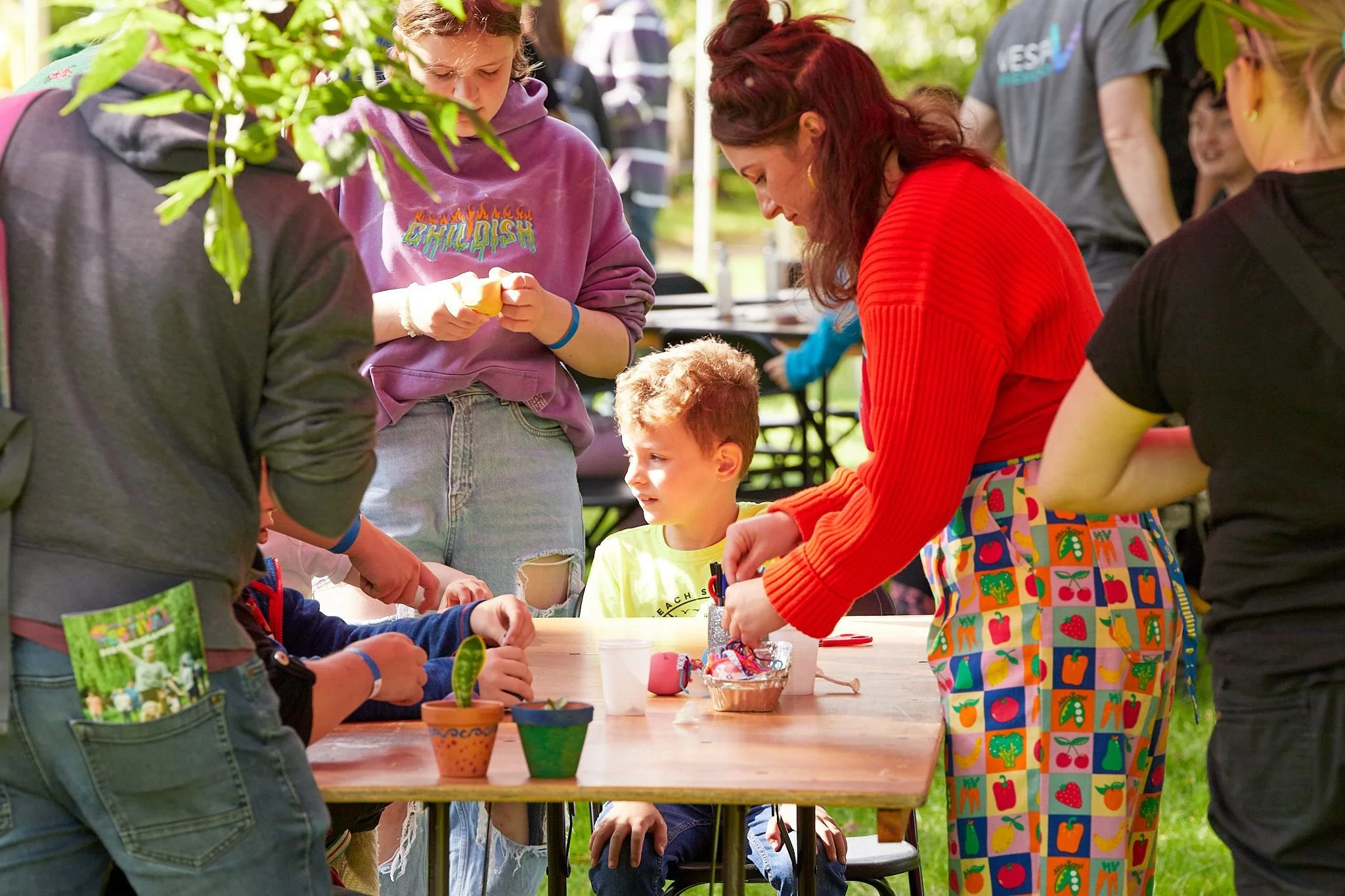
After a couple of years that have seen our individual and collective mental health impacted and that has also forced us physically apart, the All in the Mind Festival comes at a crucial moment. Gathering people together to experience creative projects that explore our mental wellbeing, All in the Mind offers the conversations and connections we so badly need right now.
But though timely, it’s now into its 7th year. Founded in 2016 by the Fluid Motion Theatre Company, this festival has become an annual one-day event, bringing together actors, musicians, poets, comedians, and artists, for performances, workshops and interactive activities that harness the power of the arts toward better mental health for everyone. We found out more about the vision behind it and what makes it different.
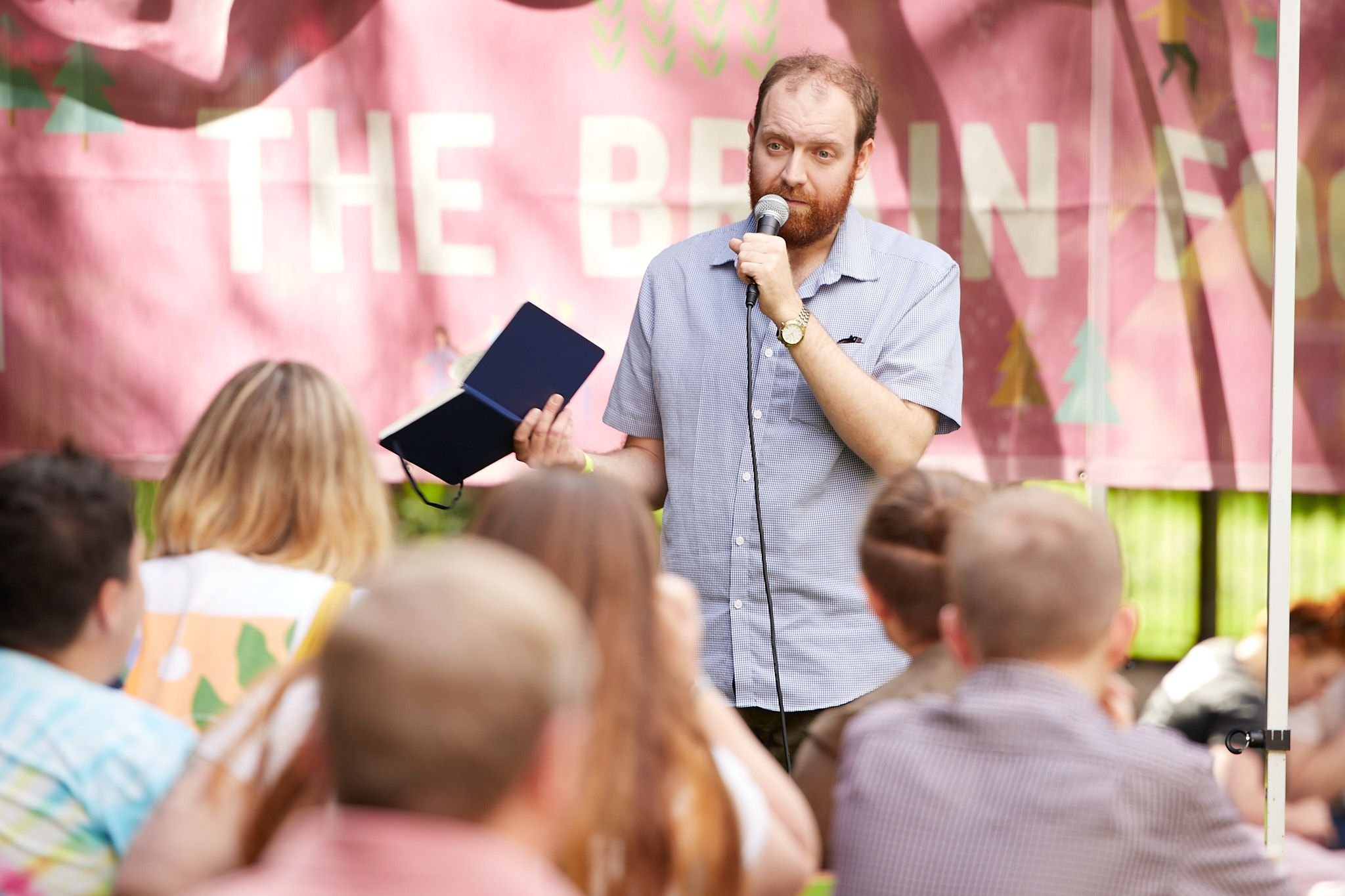
What is it? All in the Mind is the leading outdoor mental health arts festival in the UK, held in Glebe Gardens in Basingstoke’s town centre.
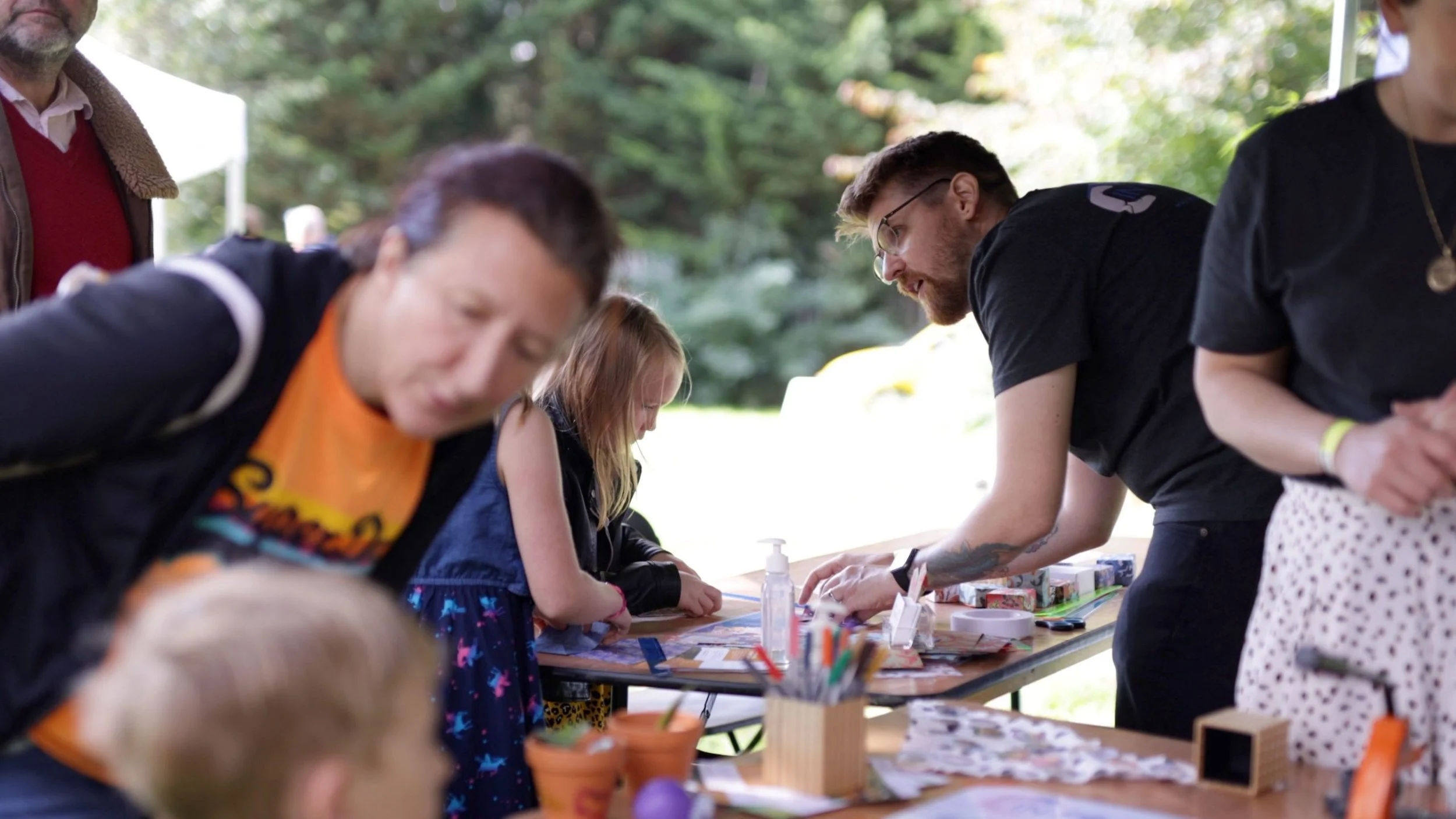
What do you offer? A day jam-packed with family-friendly shows and activities – from inspirational and quirky performances, to fun and interactive workshops, nature trails, a solar-powered carousel, delicious local food and drink and a community parade – there is something for everyone!
Tell us a little about your story: Our vision is to use the arts as a tool for helping open up the conversation around mental health, challenge the stigma and improve wellbeing
This year the festival will take place on Saturday 10 September 2022, is themed around nature, with tickets on sale here.

Knockout
We find out about London's Premier LGBTQ+ Boxing Club and the role that both the mind and community can play in physical wellbeing.
What is it? Knockout is a safe space for the LGBTQ+ community and their allies to gather together and pursue a healthier lifestyle through the sport of boxing. We are a fitness training group that recognises the health of the body comes through the security of the mind and community.
Why do people need it? This space was started as a secure and safe space for queer athletes who prefer non-team sports. Boxing is traditionally a sphere that is rife with difficulties for queer athletes, in regards to competitiveness and homo/transphobia. Knockout is a place where not only can these athletes find respite from these domineering structures, but also find individual and inner strength through a style of boxing not typically found in most other gyms. We focus on community and elevating the individual through the group.
What do you offer? A competitive boxing workout that challenges the body but is also tailored to the individual. We have some members who compete, but our core members are there to focus on their physical well-being.
In addition to this, we are a community that likes to deepen our bonds together by organising social events, karaoke nights, pub nights, and watching fights together.
We are also active in supporting other LGBTQ ventures, through charity drives and other forms of support. We organise 5k, 10k, and half marathon runs through our members, and help members find other sports and hobbies all with the mission statement of promoting LGBTQ+ rights and ideals.
What makes it different? Boxing is a hyper-aggressive individualistic sport that focuses on competitiveness and is typically taught in a harmful manner that isolates and can be damaging to the individual. Our trainers focus on combating these stereotypes to produce strong boxers that are developed through shared bonds and training together.
We emphasise positivity and connection, and work hard to welcome everyone to be a vital member of our community. Our training focuses on everyone who walks in the doors, leaving no one behind. For those who wish to, we encourage meeting strangers and learning something new from them. A Boxer steps into the ring alone, but we prove that the road to the ring can only be walked with friends and family.
What do people need to know? Boxing is a very intense sport and tends to attract introverted people. We are respectful of this and strive to provide a safe space for everyone, regardless of background. It is an intense workout, but highly rewarding, physically and mentally.
Currently, our trainings are held at the Sobell Center in North London, and are open to boxers of all levels. We have 2-3 coaches on hand in order to provide adequate attention to individual training, and thus are able to accommodate boxers of all skill levels.
For first-timers wishing to try out the sport, please come in comfortable trainers/running shoes, loose shorts, and a loose top. Freedom of movement is key. Please see our web page for more details.
Tell us a little about your story: Wanting to create a club run by queer people for queer people, to create a safe space and break down the barriers LGBTQ+ people feel when engaging in sport, Knockout London was born over a few drinks in the Duke of Wellington in Soho in January 2016. In the last six years, the club has expanded from a handful of people to a community of almost 200, with 2 classes available a week (and more coming soon), and supporting fighters participating in white-collar boxing events.
How can people be inspired by your space wherever they are? Our group focuses on community. We train strong individuals to become leaders but recognise that the individual is a construction of the community they are a part of. Competitive boxers are not created in gyms, but rather through the love, support and connection to the community around them. A strong Boxer gives back to their community and is active through charitable works and social events. It is not enough to carry these principles of Charity and Community only when one trains, but also throughout one’s everyday life.
Where inspires you? Any of the strong LGBTQ+ voices trying to bring positive changes to our community, whether they are activists (Munroe Bergdorf), actors (Elliot Page) or professional athletes (Jake Daniels). But also our members, all come to the club with their own stories, and our social events are a great opportunity to hear about their inspiring journeys.
Anything we're missing? We are a safe space for all members of the LGBTQ community and their allies, which means our members come first and foremost. Please be respectful of an individual’s right to privacy.

The Lost Gardens of Heligan
Seek wonder at The Lost Gardens of Heligan and discover a land once forgotten.
“Putting Heligan in aspic for posterity wasn’t what we wanted. Instead, we’d tell the story of those who worked here and re-discover their horticultural knowledge and skills.”
Go here if: you’re looking to find magic in nature, lose yourself in awe, or take a moment to pause.
What is it: Sometimes when you expect a tourist destination, what you find is a place of true wonder. From the founder of The Eden Project (and now Gillyflower Golf Course) Sir Tim Smit, The Lost Gardens of Heligan comprises 200 acres for nature lovers to explore, with breathtaking twists and turns through a lost landscape and a lost history.
Why you’ll love it: Like a story from a fairytale, a door found in the ruins of the Heligan estate led to the discovery of a garden lain long dormant. When World War I reaped its devastation, it took many of the gardeners who had once worked the estate and eventually all that they had created here: the Victorian glasshouses broke, the ferns and camellias grew over, the plant specimens brought from around the world, became hidden by time. Now Heligan has become the site of the largest garden restoration project in Europe; since the 1990s a team has worked to restore what once was, adopting the same principles of regenerative architecture, reviving the plants and species forgotten and revealing the original gardens.

Take the trail past the living sculptures embedded in the landscape (including the much-photographed Giant’s Head and reclining Mud Lady) through the jungle hidden in a valley (you can cross it by a rope bridge and it all feels like a dinosaur might emerge at any moment) up to the pineapple pit and the working gardens. But most of all just wander – the landscape shifts as you do, and the discoveries reveal themselves, sometimes slowly.
Heligan is still actively farmed with over 300 species of mostly heritage fruits, vegetables, salad, and herb plants, that are then used in the Heligan Kitchen, and heritage breeds (it was lambing season when we visited).
What you need to know: We sought out The Thunderbox, which was not what we thought it would be – once the gardener’s lavatory — but it contains the secret of past lives. The gardeners wrote their signatures on the wall beneath the statement “Don’t come here to sleep or slumber.”: the date August, 1914. In 2013, the Imperial War Museum recognized The Thunderbox as a “Living Memorial” to the gardeners of Heligan, a testament to the people who worked on the estate before World War 1 took them.

How to bring this into your life: Beyond visiting, you can attend a Lost Supper.
In their own words: “We were fired by a magnificent obsession to bring these once glorious gardens back to life in every sense and to tell, for the first time, not tales of lords and ladies but of those “ordinary” people who had made these gardens great, before departing for the Great War.”


Talk Club
Talk Club is creating the space for much-needed conversations about men’s mental health. Meet Ben Akers, its inspirational founder, who is leading the change in how men think about mental fitness and emotional strength.
There’s so much in that question. Maybe you haven’t thought to answer that for yourself. Maybe you haven’t thought to ask that of someone else. But for Ben Akers, it’s the question that can lead to everything else and the one on which his award-winning charity, Talk Club, is founded.
Talk Club provides a confidential forum for the conversations that men need to have and a safe space for men to explore their mental health and emotional wellbeing. The online and in-person meet-ups take the mental health awareness that Ben pioneered through his film Steve and turns it into mental health action: giving permission for men to look at their mental fitness and an understanding of how to get to a place of emotional strength.
We asked Ben to tell us more about his story, what motivated him to start Talk Club, and how vital it is that places like Talk Club exist. What we discovered was someone who is living his life, his own story, with the vulnerability, and courage, that he’s asking of those he’s helping.
What is it? Talk Club is a mental fitness movement for men. Founded in Bristol in 2019, the community now has over 2500 men in 64 clubs. All over the world. From Sydney to South London and all that's in between.
Why do men need it? Suicide is the biggest killer of men under 50 in the UK. A man takes his own life every 90 minutes. 76% of suicides are male. One of those men was my childhood best friend Steve Yates. He was a brother, a son, a father, a husband. A friend. My friend. So I made a film called Steve - a film for change. Here are links to both the trailer and the film.
From that film came the start of Talk Club, through which we promote Mental Fitness through the question/s "How are you? Out of 10?"
What do you offer? A safe community for men to be vulnerable. A network of talking groups as well as talk and move. If you are male and over 18 join us.
What makes it different? It's simplicity. We are about preventing mental ill-health. Promoting mental fitness through the Question/s "How are you? Out of 10?"
What do people need to know? This is TALK CLUB. Join us.
How can people be inspired by your space, wherever they are? Asking themselves or someone they care about: "How are you? Out of 10?" Start the conversation. Listen to the answer.
What inspires you? Human connection. Men who are vulnerable enough to help themselves. It has saved lives.
Talk Club
Also there for you:
Campaign Against Living Miserably | Movember | Andys Man Club | Men’s Sheds | Get The Boys A Lift | The Charlie Waller Trust and the advocacy work of Dick Moore
Main image | Photo by Donovan Grabowski on Unsplash

Red Rocks Ampitheatre
With sounds bouncing off the rocks in every direction, the venue, and surrounding 700 acres, offer an immersive and awe-inspiring setting for your favorite musical acts. On our trip, we photographed deer and birds (and one random feral cat) as we awaited entry to Phoebe Bridgers show. For lovers of nature and music, there simply could not be a more beautiful place to lose yourself. (Spoiler alert: I cried twice.)
We’re all familiar with the natural wonder that is Colorado. Pristine lakes and rivers, massive mountains and expansive skies. If you’re from California (like me) you’re familiar with Colorado because 15% of your friends have moved there and 100% of them are “really thinking about it”. Despite all of the fanfare and mental preparation, I was simply unprepared for the awe-inspiring beauty of Colorado’s Red Rocks Amphitheatre.
With sounds bouncing off the rocks in every direction, the venue, and surrounding 700 acres, offer an immersive and awe-inspiring setting for your favorite musical acts. On our trip, we photographed deer and birds (and one random feral cat) as we awaited entry to Phoebe Bridgers show. For lovers of nature and music, there simply could not be a more beautiful place to lose yourself. (Spoiler alert: I cried twice.)
What is it? A breathtaking open-air amphitheatre set 10 miles east of Denver, Colorado. The venue hosts more people each year than any amphitheatre in the country and has played host to some of the biggest acts in the world. (Think: The Beatles, Fleetwood Mac, Johnny Cash, Jimi Hendrix, Mumford and Sons, Diana Ross, The Grateful Dead, Radiohead, and the list goes on). Officially dedicated in 1941 and designated a National Landmark in 1973, Red Rocks has made a name for itself not just as a great place to see a show, but as a destination for music lovers and nature lovers alike.
What makes it different? For starters, basically everything. Situated at approximately 6,450 elevation (read: you might pass out if you ascend the stairs too quickly) the historic venue offers visitors a chance to attend concerts, view films and practice yoga (yes, really) perched perfectly above the city of Denver (and virtually everything east of it). Looking out beyond the stage the view feels more like a green screen than anything real life could possibly offer. (To be noted: we threw some rocks, as a test, and are pretty sure it is legit.) In addition to the incredible acoustics and jaw-dropping views, the venue is also dedicated to sustainability and in 2008 implemented a recycling and composting program which helped them to reduce their landfill waste by 85%, a number that, we’re sure, is greatly appreciated by the nature-revering concert-goers that are drawn to the place.
Why do people need it? Whether you’re there for the natural beauty or the musical offerings, or a combination of the two, Red Rocks offers something spectacular. A chance to connect (both personally, and spiritually) to something bigger.
We love music for the artistry and the escape, for the catharsis it offers, and the feeling we get that maybe someone out there understands us. The experience of being immersed in nature offers something similar. We are present and awe-struck, lucid but in a dreamlike reality. Red Rocks sits at the convergence of these two places. It pulls us in with it’s beauty and keeps us there with a once-in-a-lifetime musical experience.
What do people need to know? In addition to a concert series that runs from Spring into Fall, the venue also hosts Yoga on the Rocks, Film on The Rocks and Snowshape (a fitness series programmed for winter sports enthusiasts). Beyond the amphitheatre itself, Red Rocks is also home to The Colorado Music Hall of Fame, miles of hiking trails and the perfectly-situated Ship Rock Grille.
How can people be inspired by this place, wherever they are? While it may not be feasible to rush to Red Rocks from wherever you are, some of the biggest acts in the world have recorded live sessions from the venue. You can find a list of these sessions on their website, or stop by to check out their live cam and video gallery.
And, if you’re anything like us, you may want to go ahead and develop a full on obsession with Red Rocks Concert Posters. We have spent many many years going to concerts / working in the music industry / designing merch and can confirm, nothing is as a wondrous as a Red Rocks concert poster.
In their words: “Red Rocks is a geologically formed, open-air amphitheatre not duplicated anywhere in the world. With Mother Nature as the architect, the design of the Amphitheatre consists of two 300 foot monoliths (Ship Rock and Creation Rock) that provide a stunning setting for any performance. The dramatic sandstone monoliths serve as a history book of animal and plant life in the area for the past 250 million years. Red Rocks hosts some of the biggest names in music, which is why it’s also one of the most popular music venues in the country.”
Five of our Favourite Museums for Finding Awe and Wonder
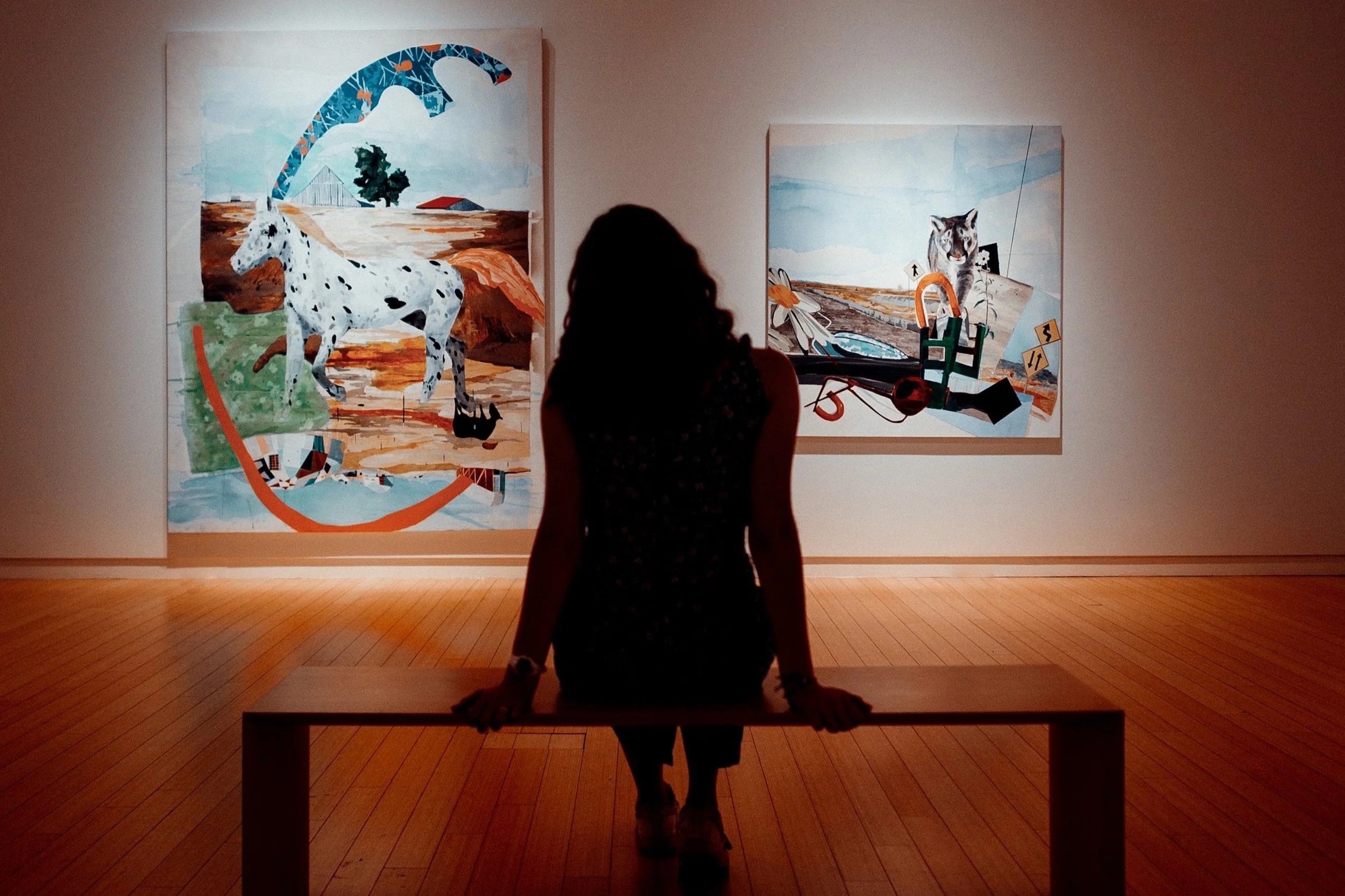
A visit to a museum can be one of those everyday adventures that helps inspire us in our daily lives, feeds our curiosity, and brings a sense of awe and wonder into our days. Here’s a round-up of five museums in London that recently offered the life pick-me-up that we needed.
Where do you go to locate awe and wonder? For us, it’s often a museum; that combination of the architecture of the space, the works in the galleries, the storytelling of the displays and exhibitions, and the people sharing the experience with us (plus the cafe and bookshop, of course).
A visit to a museum can be one of those everyday adventures that helps inspire us in our everyday lives and feeds our curiosity.
Here’s a round-up of five museums in London that we recently visited when we needed a life pick-me-up when all the things got a little too much.

Just the central atrium space on entering The Design Museum’s new home on Kensington High Street brings pause enough; but then the journey through approximately 1000 objects in Designer Maker User, the permanent collection display that contains everything from typewriters to roadsigns, is the experience we need to stimulate our (often neglected) creative minds.
For us, The Design Museum, one of the world’s leading museums on design and architecture, helps us to pay attention, to notice the details, the choices, that shape the things we use daily. The story of how we work, how we connect, and how we live our lives is told within these galleries (and sometimes it’s an odd sensation to look back on past iterations and realize that for a moment the promise they held was the future).
Look out for exhibitions that explore sensation in The World of ASMR, social and environmental issues in the work of Bethany Williams, and colour and play in the installations of Yinka Iloria.

A museum to break your heart and put it back together again: From the very first wall that reminds you that ‘Heathcliff was a foundling. Harry Potter was fostered… and Han Solo was adopted’, to the display of tokens that allowed a parent to reclaim a child, the Foundling Museum reveals the intimate stories behind the UK’s first children’s charity. Founded as a place for abandoned and neglected children by Thomas Coram, London’s first and only foundling hospital opened in 1939 (it took 17 years to raise the funds). Though the hospital has long closed, its purpose is still vital. As the current director, Caro Howell recently said, “This museum is unlike any other museum in the world, because for care-experienced young people, who have experienced such isolation and grown up without family, this museum gives them ancestry.”
But the museum also tells another story, one of artists and philanthropy; this was England’s first public art gallery (and a precursor to the Royal Academy) and artists (including William Hogarth, Charles Dickens and George Frideric Handel) created works to bring the public into its spaces. Today, The Foundling Museum celebrates the impact artists have had on children’s lives for over 270 years, from continuing to work with vulnerable young people to creating newly commissioned pieces that speak to the history of the museum itself (by artists such as Yinka Shonibare and Michael Craig-Martin).
Look out for the exhibition Superheroes, Orphans & Origins: 125 years in Comics.

We’ve often lost ourselves down the corridors of the V&A. For a time we were lucky enough to work close by and visit in our lunch hour – walking its many galleries, room by room, over years (though always finding ourselves back in the fashion galleries). The building in which the V&A is housed itself inspires awe, but it’s the vast collection spanning 5000 years of history and 1.2 million objects that inspires wonder. There’s Michelangelo’s David, Grayson Perry’s vases, Julia Margaret Cameron’s photographs, Alexander McQueen’s evening dresses and William Morris wallpaper, as well as ceramics from China, a theatre and performance collection and even a Glastonbury Festival Archive. And it’s all free to visit.
Now with a site in Dundee, a collection in Stoke on Trent, galleries in China, and future new London locations the Young V&A and the V&A East, this cultural behemoth continues to enthrall. For a taste of its magic wherever you are, watch the V&A film’s Creativity: It’s What Makes Us, or book a spot on one of their many online programs.
An exhibition to look out for Fashioning Masculinities: The Art of Menswear. An event to attend: Friday Late.

Tate Modern, always. Is there anywhere else like the Turbine Hall? Or the repurposed industrial tanks? Or the view from the iconic Lightbox on Level 6? Since it opened in May 2000, Tate Modern has dominated London’s cultural life and the South Bank. But though the building exists on a monumental scale, the artworks offer a more intimate experience: we recommended finding spaces away from the crowds (particularly in the permanent collection displays) and trying some techniques for Slow Looking.
Seek out Yayoi Kusama’s Obliteration Room and the artist’s Infinity Rooms, Lubaina Himid’s theatrical exhibition and Magdalena Abakanowicz’s woven sculptures. Participate in the Drawing Bar. And lose yourself in the wonder of modern and contemporary art (even if you don’t fully understand it).

What does home mean to you? This museum can help you reflect on that question.
Tracing how our homes have changed over a period of 400 years, this museum looks at how they are more than the spaces in which we play out our lives, but also hold emotional meanings around ideas of belonging, safety, and mental wellbeing. The Rooms Through Time Display traces a single room – the main living space – and how it evolved in middle-class households from 1630 to today offering a fascinating insight into how the way we organize our lives, our families, and our work, has changed dramatically in that period. Moving from a hall where all the household (including servants) ate together to a loft-style apartment in 1998, we get glimpses of lives once lived as well as some nostalgic moment’s along the way (like remembrances of our grandparent’s house).
Located in a row of former almshouses (whose architectural lines are traced in gold on the floor) in Hoxton, the Museum of Home reopened in 2021 (though it has existed in some form on the site since 1914) after a rebrand and refurbishment, so it’s definitely worth a visit even if you think you know it. Though on a domestic scale, there’s wonder to be hand exploring the spaces and witnessing just how much life has changed and continues to change, and how that’s impacting us – rightly or wrongly - on a daily basis.
Look out for the Museum’s Festival of Sleep and the Great Pajama Party.
Where would you add to this list? Which museums do you visit for bringing more awe and wonder to your everyday life? Let us know the places that you’d recommend we add to our guide for life.

The Generator Hub
Discover a coworking space in Exeter that has become a place where people can come and escape their own four walls, and meet other like-minded individuals (maybe even friends for life).
Located in a historic building in a stunning location on Exeter’s Quayside, the Generator Hub was the city’s first independent coworking space. Elizabeth Finnie, one of its three founders, takes us through how the Generator Hub has been helping its members shape both their businesses and their lives since 2012, and how it’s very much a coworking space with soul.
What is The Generator Hub? We are more than just bricks and mortar, we are a coworking space where people can work flexibly in a professional manner while being immersed in a diverse, interactive, and supportive community.
How did your space get started? When Neil Finnie (one of the founders) started a new business aimed at abolishing the status-quo of traditional and uninspiring internship schemes, he recognised that the participants attending his Corkscrew programs also needed to be immersed in real-time businesses to better grow their skills. At that time there were no co-working spaces in Exeter, so Neil launched not one, but two businesses simultaneously in order for them to complement each other. This is when The Generator Hub began, making Corkscrew one of its first members. Since then, The Generator has gone on to support hundreds of local businesses in many different capacities as well as the community where it is located.

How is your space different? Having grown organically we remain a very small team. Three out of four of the directors are based in the coworking space and play an active role in the community and day-to-day running of the space. We’ve also progressed approximately ten apprentices through business admin and event management roles, giving them the skills to move on to further employment. We also recognise that individuals and businesses are all unique and we will always take each situation on a case-by-case basis to give them a chance to grow and be successful.
We offer discounts for CICs, social enterprises, charities, and the NHS and adapt to people's ever-changing needs. We also like to get involved in the local community — attending local meet-up groups, supporting local networking groups by offering free space, and highlighting local events on our internal slides, newsletter and social posts.
Why is your space needed now? For many freelancers working alone, the Generator Hub has been a place where they can come and escape their own four walls, meeting other like-minded individuals and friends for life. Everyone is viewed as equal and, for many, it's a place to come and talk about issues both business-related and in their personal lives.
For small businesses, we are a great space to offer a more hybrid way of working — many companies now rotate larger teams so there is the flexibility to work from home some days and be part of the team others — again, this has really helped people’s health and wellbeing, This is particularly poignant after Covid and we feel with have maintained many people's mental well-being by just being here.

What do you offer people? We offer flexible working space options (hot desks, permanent desks, private offices), meeting rooms, registered addresses, a postal service, a reception service, and even showers on site. We organise Lunch & Learn events whereby we invite external speakers to promote their business/charity/initiatives, we hold internal talks to showcase our own members’ businesses and skills, and we arrange regular charity fundraising events. We have a meet-the-members wall and within the community, other events have grown, such as a curry club, a biscuit club, a running club, a CrossFit club, and 5-a-side football — the list is ever-growing.
How can people be inspired by your space wherever they are? We have regular social posts on Instagram and Facebook, alongside promotions of things going on in and around Exeter (on LinkedIn). We also have a monthly newsletter that highlights all the things that have been going on in the space and future things to come — as well as a community insider highlight to introduce our members to others.
What do people need to know? We are fully up and running again after Covid and we welcome any business to talk to us about their needs.
We also have a big emphasis on sustainability, people, and the planet. Having very recently started on the B-Corporation journey, we hope to make our business better for the people that work for us, the community and the environment. We are looking at trialing a 4-day work week for our employees, alongside ways to become net-zero.
Where inspires you? Nature — anything sea, river, stream, countryside.
