
What If Confidence Isn't What You Need?
Waiting until you feel confident? Women's leadership coach Sadia Ghazanfar shares why courage comes first, how to overcome perfectionism, imposter syndrome and self-doubt, and why being brave enough to start something new can change everything.
One of the questions I've found myself thinking about recently is this: what's something you're willing to be bad at? Not because you're naturally gifted at it. Not because you know you'll eventually master it. But because something about it feels interesting enough, hopeful enough, or alive enough that you're prepared to keep going anyway.
It's not a question we ask ourselves very often. Instead, many of us spend our energy trying not to look inexperienced, uncertain or unprepared. We polish. We perfect. We compare ourselves to people who seem effortlessly capable and quietly decide we'll begin when we feel more confident.
But what if confidence isn't actually where we begin?
That’s what I get into with this week's guest on A Thought I Kept, Sadia Ghazanfar, women's leadership and career development coach and founder of Slay Your Dragons. The thought she has carried with her for years is beautifully simple:
"Be brave enough to suck at something new."
At first it made me smile. Then it made me feel unexpectedly relieved. We live in a world that expects us not to suck. We see the outcomes of other people's efforts: the bestselling books, the polished speakers, the successful businesses, the perfect performances. What we rarely see are the years of uncertainty that came before them, the uncomfortable first attempts, the moments when someone wondered whether they should give up altogether. We're comparing our beginnings with somebody else's middle, and it's no wonder so many of us decide not to start at all.
One of my favourite moments in our conversation came when Sadia talked about confidence. So many women arrive in her coaching sessions believing confidence is what they need before they can apply for the promotion, change careers, launch the idea or finally speak up. But she sees it differently. Confidence isn't the starting point; it's the result. First comes courage. Then comes practice. Then comes competence. Confidence follows afterwards.
It's such a subtle shift, but it changes everything. Instead of waiting to feel different before we act, we allow ourselves to become different through the act of trying.
We also talked about perfectionism, another companion for so many of us. I loved Sadia's perspective that perfectionism isn't who we are; it's a behaviour that may once have protected us but perhaps no longer serves us. There's something deeply hopeful about that distinction. If perfectionism isn't our identity, then maybe we don't have to carry it forever. Maybe we can gently experiment with behaving differently instead.
As we spoke, I found myself thinking about how often uncertainty masquerades as failure. We assume that not knowing means we're on the wrong path. That feeling awkward means we shouldn't be there. That struggling is evidence we aren't capable. Yet every meaningful thing I've ever learned has begun with exactly those feelings. Coaching. Writing. Speaking. Hosting this podcast. None of them started with confidence. They all started with awkwardness, uncertainty and a willingness to keep going anyway.
Sadia also spoke openly about burnout and the pressure so many women feel to hold everything together. There was a time when she was navigating a demanding leadership role, retraining as a coach and renovating a house all at once. She kept pushing until eventually her body simply wouldn't let her anymore. It's a story that will feel familiar to many people because we often pride ourselves on coping. We tell ourselves we'll figure it out alone. We keep going because stopping feels impossible. Yet sometimes the bravest thing we can do is ask for help before our bodies ask for us.
Listening back to our conversation, I realised that "be brave enough to suck at something new" isn't really about being bad at something. It's about giving ourselves permission to be learners again. To remember that learning has always been messy. That curiosity is often more useful than certainty. That possibility only exists when we're willing to step into something we don't yet know how to do.
This podcast itself is an example of that. I started it because I'd always wanted to make a podcast. Those early episodes were wonderfully imperfect while I figured out the technology, the interviewing, the editing and the rhythm of the conversations. Perhaps they're still imperfect now. But every week I learn something. Every week I become a little more comfortable with not knowing everything. And every week I'm reminded that the joy was never in getting it right first time. It was in beginning.
So if you're arriving here today feeling unsure of yourself, wondering whether you're ready for whatever comes next, perhaps this week's thought is one to keep.
Be brave enough to suck at something new.
It may not feel elegant. It probably won't feel comfortable. But it just might be the beginning of something you couldn't have imagined yet.
Listen to the conversation
In this episode of A Thought I Kept, Sadia Ghazanfar and I explore perfectionism, confidence, courage, burnout, emotional capacity, leadership, asking for help and why learning something new can become one of the most freeing things we ever do.
Listen to "Be Brave Enough to Suck at Something New" — Sadia Ghazanfar wherever you get your podcasts.
Looking for support?
If this conversation resonated because you're feeling overwhelmed, stuck, burnt out or uncertain about your next step, you don't have to figure it out alone. Explore my one-to-one emotions coaching sessions and together we'll make sense of what's really going on beneath the surface, so you can move forward with greater clarity, self-compassion and courage.

What If You're Not Stuck?
If you feel stuck in a job, relationship or life transition, you may not be lacking motivation. Explore the emotional reasons we get stuck and how to find your next step with compassion and clarity.

A few years ago, I noticed that "stuck" was becoming one of the most common words people used in coaching sessions.
"I feel stuck in my job."
"I feel stuck in my relationship."
"I feel stuck where I live."
"I feel stuck in my life."
The details were always different, but the feeling underneath was remarkably similar. There was frustration, restlessness and often a fair amount of self-judgement. People would arrive convinced they should know what to do next. They should be making a decision. They should be taking action. They should have figured this out by now.
The assumption was always the same: if I'm stuck, something must be wrong. Yet the more I listened, the more I began to wonder whether stuckness was being misunderstood.
We tend to treat feeling stuck as a problem to solve. We assume it means we're procrastinating, lacking confidence or avoiding the obvious next step. We tell ourselves to be braver, more decisive, more motivated. We read the books, make the lists and search for clarity.
But what if feeling stuck isn't always a sign that you're failing to move forward? What if it's carrying information? What if, instead of asking how to get unstuck, we became curious about what stuckness might be trying to tell us?
Sometimes We're Not Stuck. We're Grieving.
One of the most overlooked forms of grief is grieving something that hasn't technically ended. You can grieve a workplace while still working there. You can grieve a relationship while still being in it. You can grieve a place you've outgrown while still calling it home. Often what we're grieving isn't the reality itself but the version we hoped it would become.
The manager who never recognised our contribution. The role that promised growth but delivered exhaustion. The relationship we believed would deepen. The future we imagined for ourselves that doesn’t feel like it will ever arrive.
When we're carrying that kind of grief, movement can feel surprisingly difficult. Part of us is still looking backwards, still hoping, still waiting for something to become what we needed it to be. We may find ourselves endlessly analysing what to do next when the real work is acknowledging what has already been lost.
Sometimes we're not stuck because we don't know the answer. Sometimes we're stuck because we're still mourning the fact that the answer isn't the one we wanted.
Sometimes We're Not Stuck. We're Protecting Ourselves.
One of the most compassionate questions I know is: what is this behaviour trying to protect?
Many of the things we criticise ourselves for are actually forms of self-protection. Staying quiet may protect us from rejection. Keeping ourselves small may protect us from visibility. Not applying for the job may protect us from disappointment. Not leaving may protect us from uncertainty.
Particularly when we've experienced setbacks, betrayals or repeated disappointments, our protective instincts can become incredibly sophisticated. We stop hoping. We lower expectations. We convince ourselves the grass isn't greener. We tell ourselves we're being realistic.
Yet underneath that realism there is often a quieter truth. We are trying not to get hurt.
The difficulty is that protective strategies have a habit of outliving their usefulness. What once helped us survive can eventually prevent us from growing. We become trapped not by our lack of courage but by the very strategies that once kept us safe.
Understanding that doesn't mean forcing ourselves to change overnight. It simply allows us to meet ourselves with curiosity rather than criticism.
Sometimes We're Not Stuck. We're Exhausted.
There is a version of stuckness that has nothing to do with clarity and everything to do with capacity. Many people are trying to make life-changing decisions while carrying far too much. They're burnt out at work, overwhelmed at home, supporting everyone else, navigating uncertainty and wondering why they can't summon the energy to reinvent their lives.
Everything feels harder when we're exhausted. The future feels smaller. Possibilities feel further away. Decisions that might have felt manageable a year ago now feel impossible.
In those moments, asking "What should I do?" may be the wrong question. A more useful question might be: "What do I need?"
Sometimes what looks like stuckness is simply a nervous system asking for rest, support and recovery before it can contemplate what comes next.
Sometimes We're Not Stuck. We're Waiting for Certainty.
If you've ever told yourself that you'll move once you're sure, you're in good company. Most of us are waiting for certainty. We want to know the next job will be better. We want reassurance that the move will be worth it. We want proof that we're making the right decision.
The problem is that certainty is rarely available in advance.
Most of the meaningful decisions in our lives are made without guarantees. We don't know how relationships will unfold. We don't know how jobs will turn out. We don't know how future versions of ourselves will feel about the choices we're making today.
What often keeps us stuck isn't uncertainty itself but the belief that we need certainty before we can move.
The people I admire most aren't necessarily the people who are most certain. They're the people who have learned to trust themselves in uncertain situations. They know disappointment is possible. They know things may not go to plan. But they also know they can respond, adapt and begin again if needed.
Sometimes We're Not Stuck. We're in Transition.
Some chapters of life have no obvious label. The old version of your life no longer fits, but the new version hasn't fully arrived. You can feel the shift happening, but you can't yet see what it's becoming.
These periods can be deeply uncomfortable because they don't offer the neat narrative arc we're looking for. We want a map. We want progress. We want to know we're heading somewhere. Instead, we find ourselves in a kind of hallway between two rooms.
Yet transition has its own purpose. Beneath the uncertainty, we are gathering information. We are discovering what matters. We are testing assumptions, developing resilience and becoming someone capable of inhabiting the next chapter.
The growth is real, even when it isn't visible.
Sometimes We're Not Stuck. We're Choosing.
This may be the most uncomfortable possibility of all. Sometimes we are making a choice. Not necessarily forever. Not necessarily consciously. But a choice nonetheless.
We may be choosing the known discomfort of today over the unknown discomfort of tomorrow. We may be choosing security over possibility, familiarity over uncertainty, stability over growth.
The challenge is that we often resist acknowledging the choice because we don't like the options available to us.
Yet there can be enormous relief in admitting it.
"I am choosing to stay in this job for now."
"I am choosing not to move yet."
"I am choosing to remain here while I work out what comes next."
The circumstances may not change immediately, but something important does. Agency returns. When we acknowledge our choices, we stop seeing ourselves as trapped and begin seeing ourselves as active participants in our own lives. We can then ask different questions. What is this choice giving me? What is it costing me? What need is it meeting? What would need to change for a different choice to become possible?
What If the Opposite of Stuck Isn't Movement?
We often imagine that the opposite of stuck is action. A resignation letter. A difficult conversation. A move across the country. A dramatic leap into the unknown. Sometimes it is. But increasingly, I wonder if the opposite of stuck is trust.
Trust that you can grieve what didn't happen. Trust that disappointment is not the end of the story. Trust that uncertainty is survivable. Trust that your instincts deserve a hearing. Trust that when the time comes, you'll know enough to take the next step.
Perhaps feeling stuck isn't always a sign that you're failing to move. Perhaps it's an invitation to understand what is really happening beneath the surface.
Because once we do that, movement often arrives naturally. Not because we've forced ourselves into action, but because we've stopped fighting the wisdom hidden inside the pause.
Explore Emotions Coaching
If you're feeling stuck in work, relationships, a life transition or simply in your own head, emotions coaching can help you understand what's really happening beneath the frustration.
Together we'll explore the emotions, needs, beliefs and protective patterns shaping your experience, helping you move from self-judgement towards greater clarity, self-trust and agency.
You don't need to know what comes next. You just need somewhere to start.

What If Feeling Lost Isn't the Problem?
Feeling lost doesn't always mean something is wrong. Explore how the Enneagram, self-awareness and the lifelong process of becoming ourselves can help us reconnect with who we are and what matters most.

A few weeks ago, I found myself down an Enneagram rabbit hole.
If you've never come across it before, the Enneagram is a personality framework that describes nine different ways of moving through the world. Unlike many personality tools, it isn't particularly interested in what you do. It's more interested in why you do it. What motivates you. What you're trying to avoid. What you long for. The stories you've come to believe about yourself and the strategies you've developed to navigate life.
I'd encountered it before, but this time I found myself lingering. Was I a Three? A Six? A Nine? The more I read, the less certain I became. Part of me could see myself in the achiever, someone who likes creating things, working towards goals and making ideas happen. Another part recognised the (anxious) planner, always trying to anticipate what might happen next and looking for a way to feel more certain. Then there was the peacemaker, the person who wants harmony, dislikes conflict and can lose sight of themselves whilst attending to everyone else's needs.
The answer mattered less than I expected. What interested me was noticing what happened as I tried to answer the question. What was I hoping the Enneagram would tell me? Why was I so drawn to understanding myself through this particular lens? And what was I really searching for underneath it all?
Perhaps the same thing many of us are searching for when life feels uncertain. More clarity wherever we can find it. And often that does mean starting with ourselves.
When we're struggling, it's often tempting to believe that the answer lies somewhere outside us. A new habit. A better morning routine. A different job. A clearer plan. A version of ourselves that is somehow more confident, more productive or more certain. Sometimes those things help. Sometimes change is exactly what's needed. Yet so often what we're really searching for isn't a better system but a deeper understanding of ourselves.
We want to know why we keep ending up in the same place. Why we say yes when we mean no. Why we struggle to make decisions. Why we feel anxious when everything appears fine on paper. Why success doesn't feel the way we expected it to. Why we're exhausted. Why we're stuck. Why we've somehow become strangers to ourselves.
The older I get, the less interested I become in fixing myself and the more interested I become in understanding myself. Not because understanding alone changes everything, but because it's difficult to move forwards when we're constantly fighting who we are. Before we can choose a different path, we often need to understand the one we've been walking.
When the Map No Longer Works
One of the things I've noticed through coaching, writing and conversations on the podcast is how quickly we turn feeling lost into evidence that something is wrong. We treat uncertainty as a problem to solve. We assume that if we could just find the answer, make the decision or create the plan, everything would settle down.
Yet when I look back on the periods of my own life when I've felt most lost, they often weren't signs that I'd failed. They were signs that something important was changing.
The life that made sense before no longer fit. The identity I'd been carrying was becoming too small. The coping strategies that had once protected me were no longer serving me. I wasn't lost because I'd gone off course; I was lost because the map no longer worked.
I think this is one of the reasons people are drawn to frameworks like the Enneagram. Not because they provide all the answers, but because they offer language for things we haven't quite been able to articulate. They help us notice patterns. They invite us to become curious about ourselves. They shine a light on habits, fears and motivations that have often been running quietly in the background for years.
Whether or not the Enneagram is your thing, I think it points towards something useful. We all develop ways of being in the world. We find strategies for staying safe, being loved, belonging, succeeding or avoiding pain. We learn what earns approval. We discover what feels dangerous. We adapt.
The challenge is that over time these strategies can become so familiar that we mistake them for who we are.
The person who always takes care of everyone else may no longer know what they need. The person who always achieves may no longer know what they actually want. The person who keeps the peace may no longer know what they think. The person who prepares for every possibility may no longer trust themselves to handle uncertainty. What began as a way of navigating the world slowly hardens into an identity.
Then one day we find ourselves questioning things.
Perhaps we're burnt out. Perhaps a relationship changes. Perhaps the children leave home. Perhaps a career no longer feels meaningful. Perhaps we simply wake up one morning with the uncomfortable feeling that something isn't quite right.
Often what we're experiencing isn't failure. It's an invitation to become more fully ourselves.
The Lifelong Process of Becoming Ourselves
One of my favourite ideas comes from the writer Cathy Rentzenbrink and it’s the idea of selfing: the lifelong process of becoming more fully who we are.
I love it because it feels so different from the language of self-improvement that surrounds us. Selfing isn't about finding a perfect version of yourself hidden somewhere beneath the surface. It's not about optimisation, reinvention or becoming someone new. It's about developing a deeper relationship with yourself over time. It's about becoming more honest about what matters, more aware of your patterns and more compassionate towards the parts of yourself you've spent years trying to outrun.
Seen this way, there is no final version of you waiting to be discovered. There is only an ongoing conversation between who you have been, who you are and who you are becoming. To me that feels both more realistic and more hopeful.
If you're in a time of life where you're questioning things, feeling disconnected, uncertain or stuck, perhaps the invitation isn't to rush towards an answer. Perhaps it's to become curious.
What keeps repeating in your life? What feels out of alignment? What role are you playing that no longer fits? What are you longing for? What have you stopped listening to? What part of yourself have you lost touch with?
You don't need the Enneagram to ask those questions (though it’s always fascinating to explore). You don't need a personality framework, a diagnosis or a five-year plan (though for some of us they can offer something we are searching for). Sometimes the most important thing is simply creating enough space to hear your own answers.
Feeling lost can be frightening because we assume we're moving away from ourselves. Yet sometimes we're moving towards ourselves. Sometimes the confusion arrives because an old story is loosening its grip. Sometimes uncertainty is what it feels like before something truer emerges.
The challenge is not to solve yourself too quickly. The challenge is to stay curious long enough to discover who you're becoming.
If you're feeling anxious, disconnected or uncertain, explore the resources at If Lost Start Here. From our Guide to Life and wellbeing journal to one-to-one coaching and community, everything we create is designed to help you find your grounding when life feels a little off course.
What to Do When Life Falls Apart and You Feel Lost
When a relationship ends, someone dies, or you lose your job, it can feel like you’ve been pushed out of the life you built. Read this guide to navigating unexpected change, uncertainty, and rebuilding self-trust without rushing to fix everything.
There are moments in life when the ground gives way without your consent.
You didn’t choose the ending. You didn’t plan the disruption. A relationship ends because someone else makes a decision. A parent dies. A health diagnosis lands. A job disappears. And suddenly you are standing outside the life you built, holding pieces that no longer fit together.
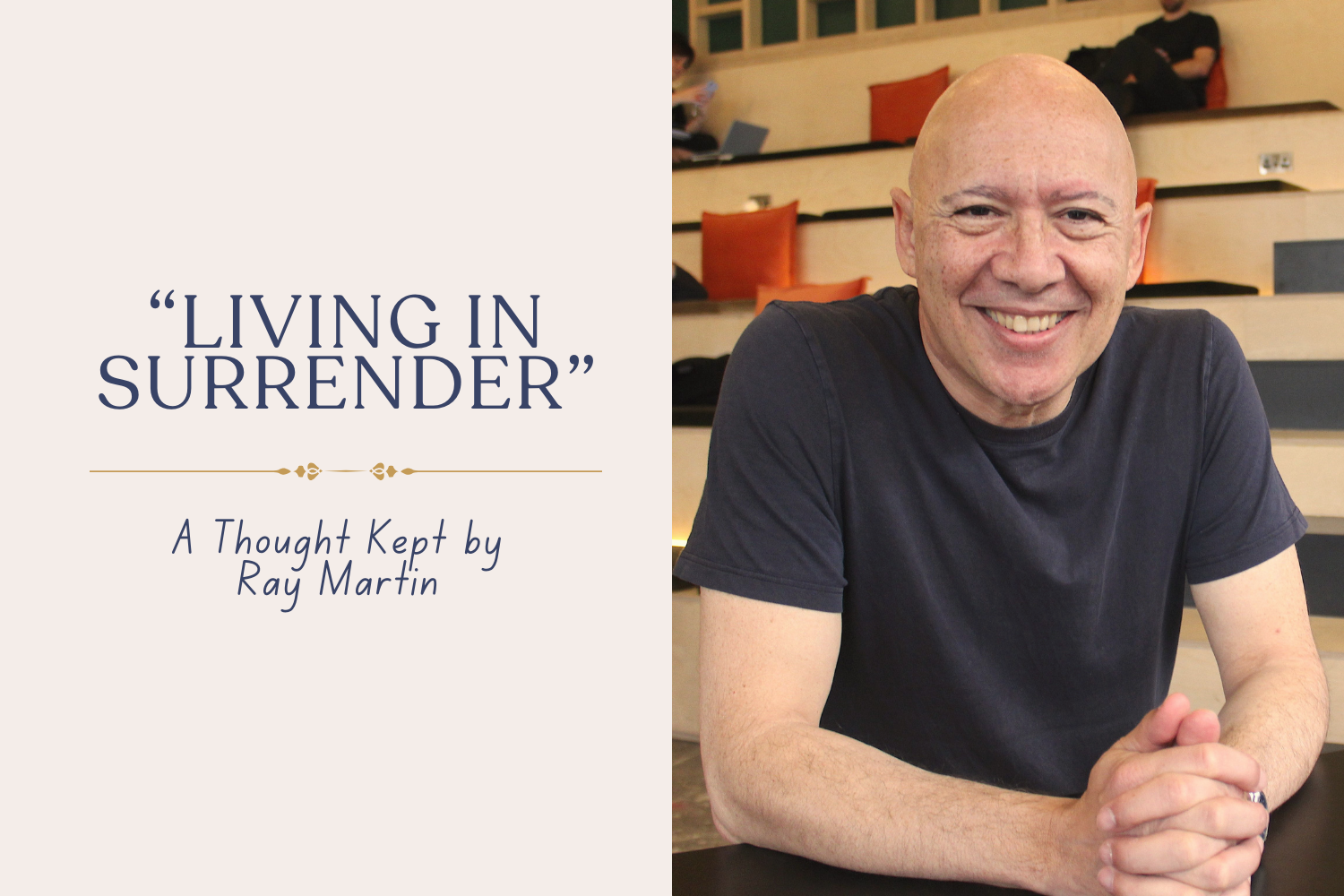
In my recent conversation with Ray Martin on A Thought I Kept, what struck me most wasn’t the romance of fourteen years of travel. It was the year that came before it. In a single stretch of time he lost his marriage, his business partnership, and his father The identity he had constructed — successful businessman, husband, son— fractured all at once.
He didn’t wake up one morning and decide to reinvent himself. Life pushed him out.
And that is often how it happens.
When something unexpected pulls the rug from under us, the first instinct is to restore what was. To fix. To replace. To rush toward a new beginning so we don’t have to sit in the in-between. Ray became fascinated by this middle space — what William Bridges calls the neutral zone The place where the old life has ended but the new one hasn’t fully formed. From the outside, nothing looks dramatic. Inside, everything is shifting.
If you are in that space, it can feel disorienting. You might not recognise yourself. The roles that once organised your days no longer apply. The confidence that came from knowing who you were can wobble. You may feel lost not because you are indecisive, but because the map you were using is no longer valid.
Ray’s core thought — the one he kept — is living in surrender
Not surrender as defeat. Not resignation. But surrender as a different way of orienting when control has already slipped from your hands.
He began to pay attention to where his energy went. After visiting an elephant sanctuary and an orphanage, he couldn’t stop thinking about them. Instead of dismissing that tug as sentimental, he followed it. That eventually led him to train for and run a marathon to raise money, something he had never imagined doing before
What I take from that is not “run a marathon.” It is this: when life has already dismantled your plans, perhaps you can afford to listen more closely to what quietly draws you.
Unexpected endings often strip us back to something more elemental. Ray speaks openly about how, earlier in life, he overrode his instincts in order to stay in character After everything fell apart, he found he could no longer ignore those nudges. He began treating life as a series of experiments rather than a fixed destination
There is something gentle in that framing. If you have been kicked out of the life you built, the pressure to “get it right” next time can be immense. An experiment carries less weight. It allows you to try, to notice, to adjust.
Another shift that came for him was around feeling. He moved from living primarily in his head to allowing himself to express emotion more freely. That matters when we are navigating grief, anxiety, or overwhelm. Emotional states are not permanent addresses. They are places we pass through. Letting yourself feel does not mean you will be swallowed by it. Often it means the feeling can move.
He also rethought the idea of “ties.” Work, relationships, community, home. The issue, he suggests, isn’t being tied to something. It’s being unconsciously tied When life tears away a tie without your permission, there can be freedom hidden inside the shock. Not the freedom you would have chosen, but the freedom to ask: what do I now choose, consciously?
Later in the conversation, Ray talks about calculating how many days he might have left — around 5,700 at this stage Not as a dramatic countdown, but as orientation. If time is finite, what is worth fighting? What can be softened? What is no longer necessary?
When the unexpected happens, we often look for certainty. For guarantees. For a clear five-step plan. What Ray’s story offers instead is steadier and perhaps more honest. You may not get certainty. But you can cultivate attention. You can notice what feels alive, even faintly. You can allow the neutral zone to do its quiet work inside you.
Being lost is not always a failure of planning. Sometimes it is the inevitable consequence of loving, committing, building — and then losing.
If you find yourself outside the life you built, perhaps the question is not immediately “What should I do next?” Perhaps it is “What is drawing me, even now?”
You can listen to the full conversation with Ray on A Thought I Kept:
And if you are in the middle of your own unexpected transition, our coaching sessions at If Lost Start Here offers a place to think, feel, and find your footing again without pressure to rush toward a new identity.
You are allowed to be in between. You are allowed to listen before you leap.
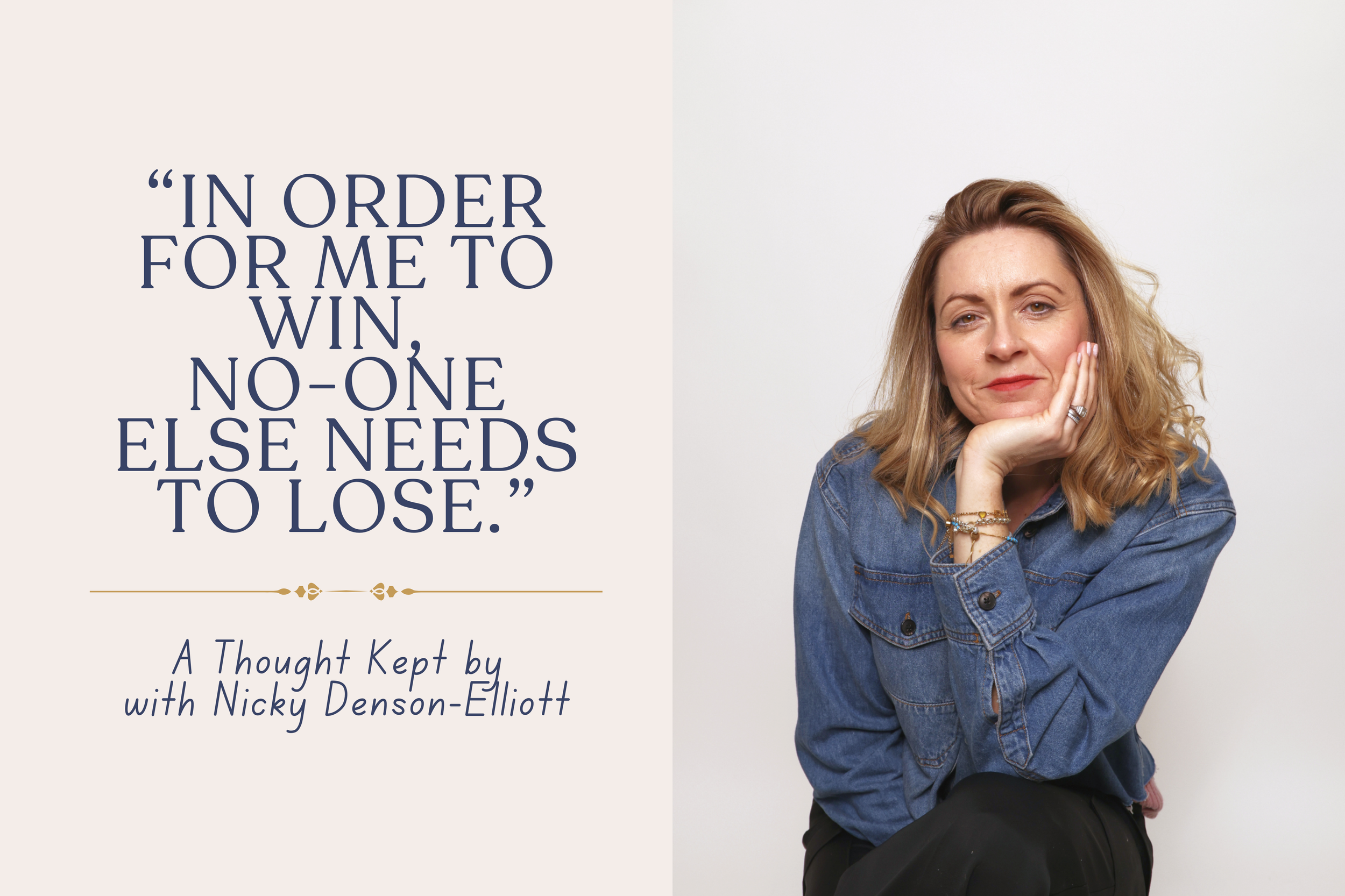
Struggling With Comparison? Rethinking Confidence and Self-Trust
Comparison and competition can quietly shape how we see ourselves. In this conversation, we explore confidence, self-trust, and the beliefs we carry through life.
This is how it might go. You’re scrolling, or reading, or listening to a podcast, and you notice a flicker of feeling when someone else shares good news. A promotion. A book deal. A confident post about work they love. You’re pleased for them — genuinely — and yet something tightens. A question forms that you don’t quite want to look at too closely.
What does this mean about me?
Moments like this don’t usually come with drama. They’re small, everyday, easy to brush past. But they can linger. And over time, they shape how we see ourselves, how we show up at work, and how much space we allow ourselves to take.
This week on A Thought I Kept, I spoke to Nicky Denson-Elliott, and she brought a thought that disrupted that familiar inner pattern:
In order for me to win, no one else has to lose.
It’s one of those ideas that seems obvious when you first hear it and then quietly radical the longer you sit with it.
Because so much of our inner landscape has been shaped by the opposite belief. That success is scarce. That confidence belongs to certain people, not others. That if someone else steps forward, there’s less room for us. These ideas don’t usually announce themselves as beliefs. They show up as feelings: comparison, jealousy, self-doubt, hesitation.
Nicky spoke about how deeply this conditioning runs, especially for women. How it can shape our relationship with money, confidence, and visibility. How it influences the way we price our work — often not based on its value, but on what feels safe. How it quietly sets women against one another, even when connection and solidarity are what we most want.
What’s important here is that none of this is a personal flaw. These are not thoughts we invented. They’re learned. Reinforced. Picked up over time in workplaces, families, schools, media, and culture. When they surface, they can feel intensely personal but they rarely originate there.
And when life already feels full or uncertain, carrying these inherited ideas can make everything heavier. You might notice it in how hard you are on yourself. In the way you second-guess decisions. In the tension you feel around confidence — wanting it, distrusting it, worrying what it might cost.
One of the most grounding parts of the conversation with Nicky was her refusal to replace one set of rules with another. There was no invitation to be bolder, louder, or more confident in a performative sense. Instead, she talked about noticing. About recognising when a familiar reaction appears and asking, with curiosity rather than judgment: Is this actually mine?
That question alone can create a shift.
Because when we start to see that some of our thoughts are inherited rather than chosen, we don’t have to wrestle with them in the same way. We don’t have to argue ourselves out of feeling jealous or small or unsure. We can simply recognise the pattern, and loosen our grip.
This matters not just for our inner world, but for how we move through everyday life. Especially work. Especially relationships with other women. Especially moments where confidence feels like something other people have access to, and we’re still figuring it out.
Letting go of the myth of competition doesn’t mean pretending everything is fair or easy. It doesn’t mean denying ambition or discomfort. But it does open up a different orientation — one where someone else’s success doesn’t automatically diminish our own, and where confidence can be something we grow into, rather than something we perform.
For many of us, this kind of rethinking doesn’t arrive as a neat turning point. It shows up gradually. In small pauses. In moments where we choose not to rush to judgment — of ourselves or others. In the realisation that uncertainty doesn’t mean we’re failing; it often means we’re paying attention.
If you’ve been questioning old ideas about success, money, confidence, or what it means to be doing “well” in life, you’re not behind. You may simply be noticing that the old maps don’t quite match the terrain anymore.
Nicky’s thought offers a steadier way of orienting. It reminds us that life isn’t a zero-sum game. That generosity — toward ourselves and others — isn’t naïve, but grounding. And that self-trust doesn’t come from fixing or perfecting ourselves, but from recognising which beliefs were never designed to support us in the first place.
You don’t need to know what comes next. You don’t need to replace every thought at once. Sometimes it’s enough to notice which ideas make life feel smaller, and to wonder — without urgency — what it might be like to set one of them down.
If this resonates, listen to the full conversation with Nicky on A Thought I Kept.
And if you need help exploring some of the feelings you have around comparison — jealousy, self-doubt, hesitation — or what confidence even means to you, explore our emotions coaching sessions.
Feeling Stuck Until You’re “More Confident”? Curiosity Might Be a Better Place to Start
If you’re waiting to feel confident before making a change, curiosity can help you move forward.
“I’ll do this when I feel more confident.”
We tell ourselves we’ll speak up, make the change, apply for the role, take ourselves seriously, or move forward once confidence arrives. Once we feel braver, clearer, more certain about who we are and what we want.
But confidence has a habit of staying just out of reach.
Not because there’s something wrong with us, but because confidence is rarely the starting point we imagine it to be. For most people, confidence grows through experience, not before it. The problem is that waiting to feel confident can keep us stuck, circling the same questions, postponing decisions, and quietly reinforcing the idea that we need to become someone else before we’re allowed to act.
This is where curiosity offers a different way in.
Curiosity doesn’t ask you to believe in yourself. It doesn’t require certainty or bravery. It simply invites you to explore. What would happen if you tried this? What might you notice if you took one small step, not to prove anything, but to learn?
When you approach change with curiosity, the stakes are lower. You’re not asking yourself to succeed; you’re allowing yourself to gather information. A conversation becomes an experiment rather than a test. A new direction becomes something you’re exploring rather than committing to forever.
This shift matters because it changes how we relate to ourselves. Instead of measuring every move against an imagined ideal, curiosity keeps us in contact with our actual experience. Each step, however small, offers insight rather than judgement. Over time, that insight builds self-trust — and confidence follows.
Many people who want to feel more confident are really looking for something deeper: a sense that they can trust themselves, that they’re allowed to make choices without constant second-guessing, that they don’t need to have it all worked out in advance. Curiosity supports that kind of confidence because it stays close to what’s real. It helps you learn what fits, what doesn’t, and what feels meaningful in your own life.
If you’re feeling stuck, unsure, or waiting for confidence before you move forward, curiosity can be a more accessible starting point. It allows movement without demanding certainty. It gives you permission to begin where you are, rather than where you think you should be.
If confidence, decision-making, or feeling stuck are recurring patterns for you, coaching can be a supportive space to explore them more deeply. Coaching isn’t about fixing you or telling you what to do; it’s about understanding what’s going on beneath the surface and finding ways to move forward that feel steady, realistic, and impactful.
You don’t need to wait until you feel confident. You can start by getting curious.

Recognizing the Moment Change Arrives
Feeling stuck? Learn how to recognize when it's time to change, what to do next, and how to take small steps forward with clarity and confidence.
You might not notice it at first.
The pivot point of life isn’t always dramatic. It doesn’t always come as a bolt of lightning or a cinematic moment of clarity. Often, it’s quieter—a realization whispered in the stillness, a feeling that won’t let go, a sentence you catch yourself saying under your breath:
"Something has to shift."
Maybe it’s exhaustion from a situation you can’t tolerate anymore. Maybe it’s a spark of curiosity about what else could be possible. Maybe it’s simply that tiny flicker of okay—the moment you stop resisting and start allowing yourself to see a different way forward.
The question is: How do you recognize it? And what do you do when you do?
How to Know When Change is Calling for Your Attention
If you’re standing at the edge of something different but unsure if it’s time, consider these signs:
You feel restless, even when everything looks fine on the surface.
Your current life doesn’t quite fit anymore, like a sweater that has shrunk in the wash.
You keep circling the same thoughts, sensing that what worked before isn’t working now.
You find yourself drawn to new ideas, places, or people who reflect a version of yourself you haven't fully stepped into yet.
You hear yourself saying “I can’t do this anymore” or “There has to be another way.”
If any of this resonates, change might already be in motion—even if you can’t see the full picture yet.
What to Do When You Know It’s Time
Start Small:
The biggest misconception about change is that it has to be sudden or drastic. It doesn’t. Sometimes, the most profound shifts begin with one small step—a conversation, a decision, a quiet commitment to yourself.
Embrace Discomfort:
Change is rarely easy. The moment right before transformation often feels the most uncertain. But discomfort doesn’t mean you’re on the wrong path; it means you’re cultivating something new.
Get Clear on Your “Why”:
What are you moving toward? If the answer is “I don’t know yet,” that’s okay. Sometimes, all you need to know is what no longer fits. The clarity about what comes next will follow.
Reframe Setbacks:
Feeling stuck or taking a step backward doesn’t mean you’re failing. It means you’re learning. Every moment of hesitation or doubt is part of the process—it’s data, not defeat.
Surround Yourself with Support:
You don’t have to navigate change alone. The people, spaces, and resources around you influence your ability to step forward. Find those who help you move in the direction you want to go.
You Don’t Have to Have It All Figured Out—You Just Have to Begin
Here’s what we know:
The best time to change isn’t when you feel completely ready—it’s when you recognize the need for change.
Every significant transformation begins with a single decision to explore what’s next.
If you’re at that pivot point—standing at the threshold but unsure how to step through—we’re here to help.
Explore our coaching sessions.
This isn’t about forcing a transformation. It’s about clearing just a little more space—so you can finally see what might be ahead.

How to Know It’s Time for a Change: Understanding Avoidance vs. Approach Motivation
Feeling stuck in life? Learn how to recognize if you're running away from something (avoidance motivation) or moving toward something better (approach motivation) and what to do next.
Something needs to change. But what?
Maybe you’ve been circling the same thoughts for weeks, months, years even. You know something isn’t working, but the specifics feel murky. Should you quit the job? End the relationship? Finally book the trip, sign up for the course, or move to that city you can’t stop thinking about?
Or maybe it’s more subtle. A feeling of restlessness. A quiet dissatisfaction. You keep going through the motions, but a part of you knows: this isn’t it.
So how do you know when it’s time to change?
One of the most powerful ways to understand your desire for change is through the lens of “avoidance motivation” and “approach motivation”— two psychological forces that shape every decision we make.
And once you understand which one is driving you, the next step becomes clearer.
Are You Running Away or Moving Towards?
Every decision we make is guided by either avoidance motivation or approach motivation.
Avoidance Motivation is about moving away from something that feels bad—pain, stress, burnout, dissatisfaction.
Approach Motivation is about moving towards something that feels good—fulfillment, excitement, joy, purpose.
Both are valid. Both are powerful. And both can be the spark for real change. The key is knowing which one is currently guiding you and whether it’s enough to propel you forward.
Avoidance Motivation: When You Just Can’t Anymore
Avoidance motivation kicks in when you hit your limit.
It’s when:
You can’t face another Sunday night dread before Monday.
The relationship is more draining than supportive.
Your body is exhausted from stress, but you keep pushing through.
You feel trapped, uninspired, disconnected from yourself.
It’s the feeling of enough is enough.
And yet, while avoidance motivation can push us to act, it doesn’t always lead to intentional change. It can be reactive: quitting impulsively, burning bridges, retreating without a plan.
If avoidance is your main driver, pause. Ask yourself: What do I actually want instead? Not just what you want to escape, but what you want to move toward.
Because that’s where approach motivation comes in.
Approach Motivation: When You Feel Pulled Towards Something More
Approach motivation feels different.
It’s when:
You get a spark of excitement thinking about what could be.
The idea of a new path feels energizing, not just like relief.
You’re drawn towards something, even if it’s uncertain.
You start imagining a version of your life that fits better.
Approach motivation is about expansion rather than escape.
When you make a change based on what excites and compels you, rather than just what you’re running from, you’re more likely to create something lasting and meaningful.
But here’s the challenge: many of us wait until avoidance motivation is unbearable before we take action.
We wait until we’re drowning in burnout before we rethink work. Until a relationship is completely broken before we acknowledge it’s not right. Until we hit rock bottom before we start listening to ourselves.
What if we didn’t wait? What if we started paying attention the moment we felt that first pull towards something better?
Where Are You Right Now?
If you’re standing at the edge of change but feeling unsure, ask yourself:
Am I more focused on what I want to leave behind, or what I want to move towards?
Is this decision based on desperation, or is there something I’m genuinely excited to create?
If I gave myself permission to change, what would I step into?
And if the answers feel unclear, that’s okay. This is the work we do.
Your Next Step: Let’s Find Your Direction
Change doesn’t have to be something you have to struggle with alone. Whether you’re running away from something that no longer fits, or being pulled towards something you can’t quite name yet, we can help you navigate this moment.
Our coaching sessions are designed for this exact stage of life. The one where you know something needs to shift, but you’re not sure what or how.
The first step isn’t about having all the answers. It’s about deciding that you’re ready to explore what’s next.

How to cultivate a creative mindset in your daily life for better well-being
Learn how to bring a creative mindset to your well-being practices.
What would happen if you cultivated a creative mindset in your everyday life? If you’re well-being practices came from a perspective of play, curiosity, and openness?
This mindset isn’t just limited to engaging in creative activities; it’s also about fostering an environment and attitude that encourages creative approaches to human flourishing.
How could you get creative with your life?
Key strategies to cultivate a creative mindset:
1. Embrace Curiosity:
Curiosity drives exploration and fuels the desire to learn, which are essential for creativity.
Make a habit of asking questions, seeking new experiences, and learning new skills. Studies show that curious individuals tend to be more creative because they are constantly seeking new knowledge and experiences.
When you bring a creative mindset to your well-being practices you’ll be more open to exploring ideas that can help you feel better. You’ll also remove some of the self-judgment that can accompany either not getting to or even believing you're failing at the self-care practices that you’ve chosen.
2. Practice Mindfulness:
Mindfulness enhances focus and awareness, allowing you to fully engage with the present moment and your creative process.
Incorporate mindfulness practices such as meditation, mindful walking, or mindful art-making into your routine. Mindfulness has been linked to increased creativity and problem-solving abilities.
When you apply this to your well-being practices, you can find ways to connect more with your needs in the present moment. Not who you’ll be when x happens or when you reach a certain goal, but who you are now, how you feel in this moment, how you experience life right now. You’ll find ways to feel better in the practice of your everyday life rather than in some distant future.
3. Create a Stimulating Environment:
Your physical and social environment can significantly influence your creativity.
Surround yourself with inspiring objects, art, and people who encourage and challenge your creative thinking. Design your workspace to reflect your creative aspirations and ensure it is conducive to creative activities.
Create an environment that supports your well-being; beautiful things that help you feel good, books that hold the epiphanies you need, reminders of happy moments and future goals. Define what living within a context of creative well-being looks like to you.
4. Adopt a Growth Mindset:
A growth mindset, the belief that abilities can be developed through dedication and hard work, fosters resilience and the willingness to take risks.
Embrace challenges, learn from criticism, and persist in the face of setbacks. Carol Dweck’s research shows that individuals with a growth mindset are more likely to pursue creative endeavors and persist through difficulties.
As you embark on new well-being practices hold onto the idea of ‘not yet’. You may not have reached the place you want to be, but that doesn’t mean you’ll never get there. It just hasn’t happened yet.
5. Engage in Regular Reflection:
Reflecting on your experiences helps you understand your creative process and identify areas for improvement.
Keep a creativity journal to document your ideas, inspirations, and reflections on your creative activities. Regular reflection can help you recognize patterns and develop new strategies for fostering creativity.
Take time out to connect with your thoughts and feelings, to have a regular dialogue with yourself, so that you can understand what you need that day from your well-being practices and what you’d like to most focus on in your everday life.
6. Balance Structure and Freedom:
A balance between structure and freedom provides a framework for creativity while allowing for flexibility and spontaneous ideas.
Set aside specific times for creative activities while also allowing for unstructured, free-flowing creative sessions. Studies suggest that having some structure can help in organizing thoughts and ideas, while freedom allows for exploration and innovation.
You’ll need both as you bring a creative mindset to your well-being. Define the framework in which you’ll be approaching your life, and then meander in all kinds of directions within it.
Approaching your well-being with a creative mindset might open up new possibilities for feeling better. You might also find that you start to enjoy all those practices you currently believe you have to do. Bring play and possibility to how you approach your everyday life.
By focusing on cultivating a creative mindset, you can integrate creativity into your daily life more effectively, enhancing both your well-being and your creative output.
Further Reading and Resources:
Books:
Mindset: Changing the Way You Think to Fulfil Your Potential by Carol Dweck
Big Magic: How to Live a Creative Life and Let Go of Fear by Elizabeth Gilbert
The Creative Habit: Learn It and Use It for Life by Twyla Tharp
Discover a Better Way to Well
Sign up to our newsletter to receive five ways to approach your well-being so that it works for you. Discover how to create your unique way to well.

The Creativity Cure | How creativity can positively impact your well-being
Learn how to fold more creative activities into your everyday life, so that you can feel happier.
In the moments when we feel most stuck or disconnected, we can overlook how turning to creative practices could help us feel better.
Engaging in creative activities has been found to boost mental health, improve our mood, and help us feel more connected to ourselves and the world around us.
Sometimes though the routine of work, chores, and responsibilities can leave little room for creativity and self-expression. We can get caught in a cycle of endless tasks and relentless deadlines.
If we also have a natural interest in creative pursuits, we can find this lack of an outlet leads us to feel blocked and uninspired. We can start to miss the joy of creating for the sake of creating.
5 Ways to access the well-being benefits of creativity
If you’re curious about exploring your own creativity for well-being purposes, or you long to reconnect with your artistic side, here are some steps to get you started.
1. Try New Creative Outlets:
Experiment with different creative activities, such as painting, writing, dancing, or playing a musical instrument. Trying new things can spark your creativity and open up new possibilities.
2. Set Aside Creative Time:
Make time for creativity in your daily routine. Set aside a specific time each day or week for creative activities, and treat it as a non-negotiable part of your schedule.
3. Join Creative Communities:
Connect with others who share your creative interests. Join local art classes, writing groups, or online communities where you can share your work and get inspired by others.
4. Embrace Imperfection:
Don't worry about creating something perfect. Allow yourself to experiment, make mistakes, and have fun with the creative process. The goal is to enjoy the activity itself, not just what it produces.
5. Seek Inspiration:
Surround yourself with inspiration by visiting museums, attending concerts, reading books, or exploring nature. Inspiration can come from anywhere, and exposing yourself to new experiences can fuel your creativity.
Creativity offers numerous ways to reconnect with yourself, other people, and the world around you.
How could you fold more creative activities into your everyday life, so that you can feel happier?
Find your way to more creativity
Creativity is one of our company’s core values. It’s also one of the areas of our lives that we explore in our online well-being course Find Your Way.
Here’s just a glimpse into how we’ll help you explore more creativity in your everyday life so that you can feel good.
If you’re curious about how to bring more creativity into your life for better well-being, learn more about Find Your Way here.

Discover your inner strengths: A guide to boosting confidence and fulfillment
Find out how to incorporate more of your strengths are into your everyday life.
What are your strengths?
How do you feel about me even asking that? Do you feel comfortable talking about all that is great about who you are and how you naturally function in the world? Even having this conversation can be difficult for people. We’re told so often not to boast, not to get too big for ourselves, even that there is something uncouth about singing our own praises. Maybe answering just this question will bring something up for you.
But research shows that identifying our strengths and folding them into our lives:
helps make decisions (we can assess if the options available to us align with our strengths and where they don’t)
makes us more energized and engaged as we learn where and how we want to put our focus;
and enhances our well-being, sense of life satisfaction, and overall feelings of happiness.
So right now, let’s get the resistance piece out of the way. This is the part where we celebrate who you are because discovering your strengths will help you find your way. And that my lovely is ok.
Below are some ideas to get you started. We’ve woven through some of the research of Jolanta Burke and Jonathan Passmore on how to think about your strengths. The key here is to figure out something they call a “Strengths tilt”: “an individual’s interests and preferences, as well as the ways in which strengths are uniquely applied in each person, in order for them to live their lives in alignment with their values.”
Let’s find out how you can uniquely understand your strengths and then apply them or tilt your life in their direction.
Step 1: Play a little & take a quiz:
There are a ton of quizzes out there to help you find your strengths. Here are some that we like (if you subscribe to our newsletter we talk about some more we like there):
Authentic Happiness: we recommend PERMA, Strengths Finder & The Authentic Happiness Inventory (from Martin Seligman)
The Four Tendencies (from Gretchen Rubin)
Introvert versus Extrovert (from Adam Grant at Ted)
Step 2: Get to know yourself & ask some questions:
Take whatever you like to write with, and whatever surface or device works for you, and jot down your responses to these questions:
Explain a situation where you were in flow. What were you doing? Who were you doing it with? What were you working on?
How did you get here? What does it tell you about yourself?
What do you like to teach others?
Keep in mind something that Passmore and Burke called “Strengths Blindness”: “individuals not appreciating their strengths and viewing them as something common and ordinary, rather than something that needs to be celebrated and developed further.”
Learn how your strengths talk to each other. Passmore and Burke call this: a “Strengths Constellation”: ”the interactions of strengths with each other. For example, an individual who frequently uses the strengths of fairness and bravery would be more likely to stand up for someone who is unfairly treated than those who score highly in fairness but low in bravery”. With this in mind, reflect on these questions:
How do your strengths speak to each other?
What consistently shows up for you that maybe doesn’t with others?
And if there’s some resistance here that might be “Strengths sensitivity”: which “may occur in clients who are being criticized around their strengths or when they discuss the negative aspects of their strengths.”
How could what others think about your strengths affect how you use yours?
What have you been told to hide, that you no longer want to?
What’s your secret strength that you are ready to make space for?
Step 3: Now bring your strengths into your life & learn how to integrate them
There’s the knowing piece, and there’s the doing piece. For you to get to the place you want to go, you need more than awareness. The next part is all about movement: In what ways can you now bring in your strengths to align with who you are? Take each of your strengths — the ones you want to invite in — and brainstorm what you can commit to doing in each area of your life that you’re looking to shift. Or take a look at this list for inspiration on how to use your strengths to boost happiness.
Keep in mind that the more you increase the number of positive strengths that you use, the greater the positive impact this has. Dr. Laurie Santos in her course on The Science of Wellbeing has identified 4-7 as the sweet spot (the number that tips a job to a calling for instance).
So what’s next for you? How can your strengths help you find your way?
If you’re interested in exploring more about who you are and how you best show up in the world, explore our coaching options. From exploring your strengths to identifying your values, you’ll find ways to reconnect with yourself when life feels uncertain or you feel like you have lost your way.

Embracing uncertainty: how to thrive when you feel lost
Feeling lost and overwhelmed by uncertainty? Discover how embracing uncertainty might help you find your way in life. Learn how to navigate life's unpredictability, take meaningful risks, and balance comfort with challenge.
In a world full of constant change and unpredictability, it's completely normal to feel a little adrift. You’re not alone if you feel this way. Many of us are now unsure of where we are and even where we’d like to be.
But what if we told you that being lost could actually be a good thing? Today, we’re going to explore how embracing uncertainty can help you feel better in your everyday life (it’s counter-intuitive we know but stay with us).
Finding beauty in the unexpected
Imagine you’re on a road trip. The GPS stops working, and you have no idea where you are. Panic sets in. You start to worry about what could go wrong. But then, as you take a deep breath, you notice the beautiful scenery around you — the kind you would’ve missed if you had been following the right path. A moment of being lost turns into an unexpected adventure, filled with new discoveries and experiences.
Life is much like this road trip. We often crave certainty and control, but the truth is, that uncertainty is a regular part of life. Embracing this can lead to profound both new learning and a more fulfilling life.
Locating balance: comfort and challenge
So, how do we shift our mindset from fearing the unknown to welcoming it? It starts with understanding that uncertainty is not only normal but also beneficial.
Here are three key areas to focus on:
Accepting Uncertainty
Uncertainty is a constant in our lives. Even when we make plans, there's always an element of unpredictability. Rather than fearing this, we can learn to accept it. Acknowledging that complete certainty is unattainable can be liberating. It allows us to release the weight of trying to control everything and instead, focus on what we can manage.
For example, think about the last time something unexpected happened in your life. Maybe it was a surprise visit from a friend or a sudden change in plans that led to a new opportunity. These moments, though initially unsettling, often bring unexpected joy and growth.
Brene Brown, in her research on vulnerability, calls uncertainty ‘the torture chamber’ but also emphasizes its link to vulnerability. By braving uncertainty, we open ourselves up to new possibilities and personal growth. The next time you feel unsure, remind yourself that it's an opportunity for something new and potentially wonderful.
Taking Risks
Avoiding risks means missing out on life's richness. It's not just about big life changes like switching careers or moving to a new city. It's also about the small, everyday risks—like trying a new hobby, joining a community group, or speaking up in a meeting.
Taking risks, even small ones, can enhance our resilience and confidence. It can improve our decision-making skills and help us develop new talents. More importantly, it builds self-trust. Each time we step out of our comfort zone and take a risk, we learn to rely on our abilities and judgment.
Consider the last time you took a small risk. Maybe you attended a social event alone or tried a new workout class. Reflect on how these experiences, despite their initial discomfort, contributed to your growing sense of self.
Balancing Ease with Discomfort
In our quest for a simpler, more comfortable life, we often eliminate challenges and frictions that are essential for our experiences. While ease is important, it’s the texture of life—the ups and downs, the unexpected twists—that makes it vibrant and meaningful.
We need to strike a balance between seeking comfort and embracing discomfort. Think of it like a well-balanced diet. Too much comfort can lead to stagnation, while too much discomfort can be overwhelming. Finding the right mix helps us live a fuller, more engaged life.
Reflect on the moments that brought unexpected joy. Maybe it was a spontaneous trip, an unplanned conversation, or a challenging project at work. These experiences, while initially uncomfortable, often become our most cherished memories.
Navigating life's beautiful uncertainty
Embracing uncertainty, taking risks, and balancing ease with discomfort can transform the feeling of being lost into an opportunity for growth and discovery. By shifting our mindset, we can replace fear and self-doubt with awe, curiosity, playfulness, and courage.
So, the next time you feel lost, remember that it's okay. In fact, it’s more than okay—it’s an opportunity to explore new paths, discover new strengths, and live a richer, more fulfilling life.
How will you navigate your journey of uncertainty and possibility?
How will you embrace being just a little bit lost?
Next steps
Feeling lost and uncertain? Discover clarity and confidence with our personalized coaching sessions designed to help you reconnect with your true self and navigate life's challenges. Take the first step towards a more fulfilling life today.
Book a free consultation and start your journey to finding your way. Embrace the unknown with expert guidance and transform your uncertainty into empowerment and joy.
Where do you want life to take you?

Create your path to clarity and calm by discovering your unique way to well
Discover how to create a self-guided wellbeing practice that can take you from overwhelm to calm. Where would you like to explore in your life?
Feeling overwhelmed by the demands of everyday life? Many women today are searching for ways to navigate their busy schedules with more ease and purpose. Discover how our self-guided wellbeing course can help you reclaim your well-being and move forward with confidence.
Your Journey Towards Self-Wellness
Imagine taking a moment to pause and reflect on your current state, identifying areas of your life that feel cluttered and distracting. This simple act of reflection can give you a clearer picture of where to focus your energy. This is the first step, Taking Stock, in our self-guided online course designed to help create a personalized well-being practice.
As you move through the course, you’ll learn to Embrace Change. Letting go of old habits and beliefs can be liberating, making space for new growth. You’ll begin to live more intentionally, aligning your daily actions with your core values and goals.
The concept of Frequent Resets will become your new mantra. Regular, small adjustments can keep you aligned with your aspirations and prevent you from getting stuck.
You’ll explore how to Integrate New Practices that support your well-being, such as creative pursuits and adventures in nature.
Refreshing your life in meaningful ways—whether it's reevaluating relationships or learning to have a healthier relationship with your emotions—can give you a renewed sense of energy and purpose.
Finally, by Investing in Yourself, you’ll discover the joy of dedicating time and resources to activities that enrich your life, resulting in increased happiness and fulfillment.
Create Your Own Well-Being Practice
Many women have found themselves on a similar journey, seeking ways to feel more connected and less overwhelmed. Our online self-guided course is designed to help you create a tailored well-being practice that fits seamlessly into your daily life. It’s about learning to live with intention and acceptance, making small, attainable changes that lead to a more fulfilling life.
What You’ll Learn in Our Course
Take Stock: Gain clarity on what needs your attention.
Embrace Change: Let go of what no longer serves you.
Live Consciously: Make mindful choices aligned with your values.
Reset Frequently: Keep your life dynamic and forward-moving.
Integrate New Practices: Support your health and happiness.
Refresh Your Life: Create a renewed sense of energy and purpose.
Invest in Yourself: Find joy and fulfillment in personal growth.
Join Our Course Today
Imagine waking up each day with a sense of clarity and calm, knowing that you’re investing in your well-being in ways that truly matter. Our course is your guide to creating a well-being practice that’s uniquely yours.
Start your journey today and discover how to navigate your life with more ease, purpose, and joy. Click here to enroll in our online self-guided wellbeing course now.

Embrace the Magic of Midlife
Don't let midlife be a time of uncertainty and confusion. Embrace the opportunity to rediscover yourself and create a future filled with purpose and joy.
Are you navigating the winding roads of midlife? You're not alone; in fact, one of us is right there with you, experiencing all the highs and lows of this transformative period.
The Midlife Awakening
Whether you're fully entrenched in midlife or supporting someone who is, understanding this phase can be a game-changer. Midlife brings a whirlwind of thoughts about aging, self-image, purpose, and relationships. The what-ifs and what's-to-comes might wake you up at 3 a.m., as frequently as those nighttime sweats do. Anxiety often feels like a constant companion, alongside that trusty retinol cream.
You look in the mirror and sometimes struggle to recognize the person staring back. The meticulously built life might not align with who you are today. Your career, relationships, and daily routines may no longer spark the joy they once did, leaving you wondering what's next.
Midlife challenges us to reassess our identities, paths, and future aspirations. Yet, within these challenges lie opportunities for rediscovery and new possibilities. It's a chance to get curious about life again, even amidst the brain fog and hot flushes.
From Lost to Found
So, how do you transition from feeling lost in midlife to reconnecting with yourself? Here are a few guiding principles to help you navigate this journey:
The Ebb and Flow:
Recognize that there will be good and bad days. Navigate these cycles with grace, adjusting your to-do lists and emotional awareness accordingly.
Adopting a Threshold Perspective:
Embrace this in-between stage as a chance for exploration. It's okay not to have all the answers yet.
Getting Quiet:
Create space for self-reflection through practices like journaling, meditation, or quiet walks. Listen to what you really think and feel to gain clarity.
Midlife can be both challenging and rewarding, but you are not alone. There are more resources available than ever to support you through this stage. From books and podcasts to organizations and apps, you can find the tools you need in ways our mothers never could.
Step into Your New Chapter
Inspired by our personal experiences, we've designed a range of 1:1 midlife coaching sessions to provide you with the support and tools you need to navigate midlife positively. We'll explore why you feel the way you do, address anxiety and self-doubt, and help you recognize how your values and goals are evolving.
We'll delve into well-being practices that can make you feel better, one step at a time. Midlife may sometimes feel like a confusing and disorienting rethinking of everything, but it doesn't have to be navigated alone.
Here are some of the benefits you'll experience:
Personalized Guidance: Tailored strategies that align with your values and goals.
Emotional Support: Navigate the emotional ups and downs of midlife with confidence.
New Perspectives: Discover new possibilities and reignite your passions.
Improved Well-being: Learn well-being practices that enhance your overall quality of life.
If you're ready to explore what's next and reconnect with yourself, come and talk to us. Our expert midlife coaches are here to support you through these middling moments, helping you rediscover the magic and potential of midlife.
Midlife is a time of change—let’s make it a time of possibility. Sign up for our mailing list to receive insights, tools, and guidance to help you navigate midlife with more clarity, confidence, and ease. Because this chapter is yours to shape. Join us here

How journaling can positively impact your well-being
Discover how expressive writing can boost mental health and creativity. Learn how this simple practice helps deepen awareness, process emotions, and unleash imagination. Explore key exercises for immediate well-being benefits.
I recently attended a Writing Workshop for Well-being at The Write Place in Frome led by Christina Sanders, an educator, poet, and fiction writer. During a Saturday morning session, both seasoned writers and complete beginners explored how the simple act of putting words on a page can help us connect with the wonder of life, slow down, deepen our awareness, and unleash our imagination.
James Pennebaker, a social psychologist, was one of the first to highlight the emotional benefits of expressing our thoughts and feelings through writing. His studies, along with those of others, have demonstrated that expressive writing can help us feel less isolated, identify our emotions, and connect with our needs. Moreover, it can assist in processing trauma and alleviating depression.
Writing is a powerful, generative practice. It helps us make sense of our thoughts and feelings, allowing us to write to understand, to get unstuck, and to be curious. Writing encourages us to pay attention to what’s happening inside us as well as in the world around us. And importantly, it can be a source of fun, enabling us to play with our imaginations and give our minds the freedom to roam—even into silliness!
One of the most remarkable insights from the workshop was how quickly writing could create a positive shift. Although the workshop lasted three hours, the actual exercises were just 5 to 10 minutes long. Even these brief exercises were enough to bring about a sense of well-being.
Below, I’ve included five short exercises adapted from Christina’s prompts. These combine freewriting—where you keep writing without stopping, letting whatever comes up flow onto the page—with journaling exercises.
Five Short Writing Exercises for Well-being
Five-Minute Freewrite:
Set a timer for five minutes
Start writing and don’t stop until the timer goes off.
Write whatever comes to mind without worrying about grammar or structure. Just let your thoughts flow.
Write a dialogue:
Take as your subjects the different parts of yourself (e.g., your anxious self and your calm self). This can help you explore inner conflicts and find resolutions. This can also support you in better understanding your inner dynamics and find balanced solutions.
Identify two aspects of yourself that are in conflict.
Write a conversation between these parts, allowing each to express its perspective.
Gratitude Journaling:
Spend five minutes writing about things you are grateful for.
Focus on the details and how these things make you feel.
Imaginary Journey:
Imagine a place where you feel completely at peace.
Spend ten minutes describing this place in as much detail as possible.
Allow your imagination to take over and enjoy the process of creating your peaceful haven.
Visual Prompts:
Using images as prompts can stimulate creativity and emotional expression. This exercise can help you explore emotions and uncover hidden thoughts.
Find a photograph or piece of artwork that resonates with you.
Spend 10-15 minutes writing about what you see, how it makes you feel, and any memories or thoughts it evokes.
Try these exercises and see how writing can enhance your well-being. Remember, the key is not to self-edit as you go along. No one else needs to read what you write—not even you. The goal is simply to get your thoughts and feelings down on the page, no matter how messy or meandering they may seem.
Try to write regularly, even if it’s just for a few minutes each day.
You might be surprised by what emerges from your scribbles. Give it a try, and you’ll see the benefits for yourself.
Happy writing!

From self-doubt to self-belief: Strategies to overcome Imposter Syndrome
Struggling with Imposter Syndrome and self-doubt? Discover expert strategies to step into self-belief.
Ever felt like a fraud, even when in reality you’ve got this? Hands up if you’ve ever experienced Imposter Syndrome!
At the recent Bath Festival, Dr. Jessamy Hibberd, the brilliant mind behind The Imposter Cure, asked a packed room if they’d ever felt this way. Spoiler alert: nearly everyone raised their hands! Turns out, about 70% of people have experienced Imposter Syndrome at some point. You're definitely not alone!
A Quick History Lesson on Imposter Syndrome
Imposter Syndrome was first identified by researchers in 1978 when they discovered that many high-achieving women, including those in academia, felt like frauds even though they were more than qualified. These women were fearful of being found out and believed that their success and accomplishments were based on external factors like luck or other people’s mistakes, rather than their abilities. The study concluded that Imposter Syndrome was widespread among high-achieving women and this led to wider recognition of the term. The concept would be expanded to apply to men — 50% of whom feel it too — as well as people from different backgrounds and professions.
So, What Is Imposter Syndrome?
In short, it’s the sneaky belief that we’re not worthy of our achievements. Even when we’re outwardly successful, we think we’re not good enough. Dr. Hibberd calls these “faulty beliefs.” Many of us are busy doubting ourselves. When we approach life from a place of anxiety — from fearing we’ll get found out — that can make it impossible to give ourselves the space to learn, grow, and experiment. Sound familiar?
We also think everyone else has it all together. We see others’ shiny success stories and hold ourselves to impossible standards, trying to be the best version of ourselves. It’s exhausting!
Meet the 5 Imposter Types—Which One Are You?
The Perfectionist: Believes there’s a right and wrong way to do everything.
The Soloist: Is hesitant to ask for help.
The Natural Genius: Thinks they need to get it right on the first try.
The Expert: Feels they need to know everything before starting.
The Superwoman/man: Strives to be perfect in all areas.
These can lead us down two not-so-fun paths: Avoidance (hello, procrastination!) and Overwork (burnout, anyone?). Which one’s your go-to?
Finding Your Grounding in Self-Belief
Dr. Hibberd suggests some impactful strategies to combat Imposter Syndrome:
Self-Compassion: Swap self-criticism for self-awareness. Talk to yourself like you would to a friend.
Challenge Your Beliefs: Keep a record of your daily successes and strengths. This helps shift how you see yourself.
Be Aware of Biases: We all have a 'negativity bias' (always on the lookout for threats) and a 'confirmation bias' (seeking proof of what we believe).
The Antidote in The Imposter Cure
In her book, Dr. Hibberd delves deep into practical, science-backed strategies to help you reframe your thoughts and silence your inner critic. Here are some gems from the book:
Visualization Techniques: Picture your success and visualize overcoming challenges.
Cognitive Behavioral Therapy (CBT) Exercises: Change negative thought patterns with simple yet effective CBT practices.
Daily Affirmations: Use positive affirmations to reinforce your worth and capabilities.
Sharing Is Caring
Sitting with a group of fellow doubters at the Guildhall, I realized the magic of saying, “That’s me too.” It’s a reminder that we’re not alone. We’re all in this together, and we’re all more ‘normal’ than we think. Let’s take a deep breath and let go of that weight because many of us are exhausted from carrying it around with us.
Ready to Move Beyond Imposter Syndrome?
Check out Dr. Hibberd’s The Imposter Cure. Or, let’s have a chat. Book a free 20-minute call to see how a 1:1 coaching session with one of our Certified Coaches can help you navigate and conquer Imposter Syndrome.

How to create your emotional and mental well-being plan for happier days
Learn how to create an emotional and mental well-being plan tailored to you. Discover how our new online well-being course can help you feel better in your everyday life.
In today's fast-paced world, just finding your way to feel better can be daunting. That’s why our online well-being course, "Find Your Way," offers a distinct approach to navigating through all the noise.
Our mission is to guide individuals toward enhanced emotional and mental well-being, acknowledging the uniqueness of each person's experience. "Find Your Way" provides inclusive and empathetic personalized support, while drowning out all the messages of what we should be doing with our time, bodies, life.
Here's how you can integrate "Find Your Way" into your daily routine and create an emotional and mental well-being plan that feels good to you.
How to incorporate our well-being course into your daily life
We've structured the course content into easily digestible segments — whether through video, audio, or workbook components. These daily lessons seamlessly blend into your schedule, each lasting approximately 10-20 minutes.
This manageable timeframe ensures you can seamlessly integrate our guidance into your daily rituals, be it during your morning coffee, a work break, or before bedtime. Consistency is key, so find a time that suits you best and make it a dedicated part of your day.
How to tailor our well-being course to your pace
One of the unique features of “Find Your Way” is its flexible duration. Whether it takes you 12 weeks or 12 months to move through the program, the important thing is to progress at your own pace. Set your own rhythm: there's no pressure to rush through the material. Instead, focus on fully absorbing the insights and applying them to your life. This flexibility allows for a truly personalized exploration of your well-being, one based on curiosity rather than anxiety.
How to cultivate a personal connection for support
As co-founders of If Lost, Claire and Amanda act not only as your guides but as companions on your wellness journey. Interact with the content as if engaging in a heartfelt conversation with a supportive friend.
This personal connection forms the cornerstone of the program, providing direct support and empathy. Remember, you're not alone in this; there's a real person, with genuine thought and expertise, guiding you every step of the way.
How to embrace the social purpose behind If Lost
At the core of our course lies a commitment to collective well-being. By participating in "Find Your Way," you contribute to a broader movement towards a more inclusive and supportive wellness culture.
Keep this purpose in mind as you progress through the program, allowing it to inspire and motivate your engagement.
Feeling lost, uncertain, overwhelmed, directionless, or something else? Discover how we can help you create an emotional and mental well-being plan that helps you find your way through life.
You can start this online well-being course anytime. Click on the link below to learn more.
A glimpse into “Find Your Way”
Discover where this course will take you. How can it help you create an emotional and mental well-being plan of your own making? One that will help you feel better in your everyday life?

Navigating Well-being Your Way
Discover a personalized, maybe even messier, path to well-being with our 12-week course, Find Your Way.
Ever feel like well-being is just this elusive concept that's supposed to magically fix everything? We get it. The struggle is real when it comes to navigating the overwhelming sea of advice, scientific jargon, and endless to-dos just to feel a little better.
Picture this: You're drowning in information, constantly questioning where to start. You know you need something, but exhaustion kicks in before you even begin. And let's not even talk about the time factor – it's like there's a conspiracy against finding a moment for self-care in our hectic lives. Cue the self-judgment.
Then there's the inevitable feeling of failure. That trendy meditation or journaling practice that's all the rage? Nope, doesn't work for everyone. And suddenly, what's meant to be a source of well-being becomes a guilt trip because you can't seem to fit the mold.
Oh, and don't get us started on the 'magazine wellness' fantasy. Breakfast bowls? Try a rushed piece of toast. Herb-infused waters? More like a constant drip of caffeine to survive the daily grind.
But here's the thing: Well-being isn't one-size-fits-all. There's no right way to do it. What works for you might not work for someone else. And that's perfectly okay.
Enter Find Your Way – our 12-week course designed to redefine well-being. No more unattainable perfection, just a messy, fun, and sustainable journey back to yourself. Whether you crave calm or excitement, or need to tackle overwhelm or burnout, we've got you covered.
We've put in the work to create a course that respects your values, beliefs, and the unique shape of your life. It's not about conforming to stereotypes; it's about finding what truly feels good for you.
Starting on January 29th, this course is your personal roadmap to more of what matters – without the pressure. Join at your own pace, with access to our course hub, weekly meet-ups (if you fancy some company), and insights from amazing guest speakers.
Excited to embark on this curiosity-led journey with us? Register now, and let's make well-being your own unique adventure.
Check out our new video for a sneak peek into the course – trust us, you won't want to miss it!
Can't wait to see your faces and connect on a deeper level. Let's make positive mental health a reality, together.

How to bring a sense of wonder back to your everyday life
Discover how a sense of wonder can bring more meaning, joy and connection into your life
“Let yourself go past those thoughts that tell you it’s silly or pointless or a waste of time, or you’re far too busy to possibly do this...Instead give yourself permission to want that in the first place — to crave that contact with the sacred, and that feeling of being able to commune with something that’s bigger than you are.”
We started to notice wonder in our everyday lives during the first pandemic when our worlds became small but our attention needed to roam. That sense woke up for us then. Birds we never noticed before held our attention for a moment longer than we ever thought they could. We noticed skies and stars and the movement in the trees. We focused on a single program (Normal People anyone) while not texting or a Ted talk which we might once have scanned while doing 100 other things, allowing it to endure in our minds and not dissipate as the next video played. We stayed in moments because we had nowhere to go.
Now we’re back to some kind of normal, the challenge here is to sustain that wonder-driven life so that we can keep our minds open and stretch our worlds. How to do that? Through new (or once lost) hobbies that connect us with nature, the visual arts or music, looking up from our phones and noticing the world around us (and maybe even the moon above us), and by allowing ourselves to be lost in big ideas and imaginary worlds that we wouldn’t ordinarily visit.
Below we share some recent reads on the science behind wonder, some things to try, and places to visit to access it in all our everyday lives.
Where will wonder take you?
Why wonder can be so beneficial to our emotional and mental well-being:
Finding awe amid everyday splendor
How to absorb wonder in small spaces and enchant your life
Discovering Pacha, a word that contains multitudes
This will make your head spin. What is life really?
Starting a bookstore to save a marriage (because bookstores = wonder for us)
A Wonder List: follow ours, make your own, chase your curiosity
The weighted blanket of the public library
The Webb Telescope and our stunning universe
More dark skies and night-welcoming lighting
Prehistoric Planet and just about anything David Attenborough
Vermeer. Maybe always.
Ai Weiwei again
The Poetry of Sarah Kay
How do you feel about wonder? And how could you connect with its benefits for your emotional and mental well-being?
If you’re curious about it and want to see how it can help you find more joy, meaning and connection in your life, sign up for Find Your Way. In this Well-being Reset that puts what you like first, we’ll explore how to find more wonder in your everyday life. Wonder is just one of the ten Pathways we’ll follow together as we explore all that life can offer us.

Rediscover yourself: How identifying values can guide your life
Find your way to better emotional well-being by connecting with your values
““Your personal identity comes from your values.””
Values are decision-making magic. When you know what yours are, you can better navigate your life.
They are things like: Creativity. Freedom. Purpose. Kindness. Curiosity. Love.
We once heard the idea that values are something that you can't put in a wheelbarrow — like integrity, wonder and creativity — but not like money, which could be represented by words such as safety, security, status, and belonging instead.
Indicators of meaning, of what matters to you, values are powerful when we connect with them. Values point the way to how you want to live your life, what you’d like it to contain, and how you want to spend your time. Even on what and with whom.
When your values are being met you are more fulfilled and happier. But often in life when you are not achieving something that matters to you this can be because it conflicts with your values. Feelings of disconnection, emptiness, frustration, anger, or just the sense that something isn't quite right, suggest that those values you need do not yet have a place in your life.
But here’s the thing: although our values are deeply important and are threaded through our lives, often they can be maddeningly unconscious to us.
Discovering your values can be a one-off exercise (or a session with a coach like me) so that you can get to the small handful of values you want to live by (Brene Brown swears by having just 2).
So the first step is identifying them.
Something to Try
Here are a handful of words. Choose any that spark something in you:
Adventure Community Fairness Health Kindness Play
Authenticity Courage Friendship Honesty Laughter Respect
Beauty Empathy Growth Innovation Love Tranquility
What resonates? What’s missing?
Book a Values Assessment
Want to explore more? Book a 1:1 online coaching session to capture what your values might be, and learn how discovering them can help you find your way.
““Nobody has passion and perseverance unless what they do aligns with their values.” ”