

Silent Book Club | In Conversation with Laura Gluhanich
We talked to Silent Book Club co-founder Laura Gluhanich about how a simple night of reading with a friend became a global phenomenon.
We recently discussed with co-founder Laura Gluhanich all the ways that Silent Book Club offers community and a space to unplug, both vital to our mental health and emotional wellbeing as we negotiate these uncertain times.
What compelled you to start reading together, silently?
One night out to dinner at a favorite local spot in San Francisco my friend Guinevere de la Mare and I shared our frustration with traditional book clubs, and our joy of reading at restaurant bars. The next time we met for dinner, we planned to sit at the bar and read together. We continued meeting up, and as friends heard about our “silent book club” they asked to join. Everything today comes from that.
How do you get over that initial need to chat, to make noise, to fill the silence? We’re so unaccustomed now to filling the spaces between us.
Our format includes some planned conversation at the start. Typically a silent book club meeting starts off with everyone saying hello and sharing what they are reading. It creates a shared space and connects folks over shared books or genres. I think our members appreciate that when they start reading they know they don’t have to worry about anything else at that moment. We set an alarm and wrap up the session, so they can just dive into whatever they are reading.

Book club selections can be very particular to a group or the situation of coming together to talk about one. Are there certain books that lend themselves to Silent Book Club? Like, don’t read conversation-inducing books such as anything by Glennon Doyle or Three Women?
What surprises me more is that at every in-person meet-up, I’d venture we have a minimum of five genres represented in a group of ten. It is a very welcoming group, and if someone isn’t into what you happen to be reading, it’s not taken personally. And in our Facebook group, just about everything goes, though we choose to not offer a platform to white supremacists, misogynists, and the like.
Have you ever thought of Silent Book Club as an anti-tech space?
Yes! My co-founder and I both work full time in tech, so providing a time to ignore notifications is a benefit we recognize.
Or maybe even an anti-loneliness initiative?
Yes! I love that Silent Book Club can provide community in a really low-key way. Beyond the minimal conversation, it is super low stakes, so especially if people are less extroverted it’s a great opportunity to connect. And while there are lots of book lovers in the community, particularly the Facebook group regularly gets posts from folks who are getting into reading for the first time or rediscovering their love.
You have chapters globally now. Have you noticed differences between how these book clubs meet or how they are received locally?
Not really! Shout-out to our Genoa chapter for being super photogenic and fun. There’s a ton of variety throughout our chapters but I don’t see a difference based on location.
What kind of setting is conducive to a Silent Book Club?
As you can see from that Genoa link, lots of places work to meet up and read. We recommend cafes and bars (hotel lobby bars can be chic and have the perfect level of background noise). Bookstores, ice cream shops, community centers, parks, beaches, and backyards have all been successful. We’ve even seen them at conferences — a great option for introvert attendees to chill out.
Do you have any favorite meetup anecdotes?
We’ve had a couple of chapters see people meet at their events (ready for that meet-cute to happen in a movie). We definitely hear more about books getting discovered than soulmates.
One fun thing that has happened with the virtualization of Silent Book Clubs is the ability for anyone to join any virtual meetup. Our Denver chapter has had guests from Mexico City, Guinevere has said hi to Italian chapters, and I sat in on a meetup based in South Korea. It’s a fun way to explore!
How are Silent Book Clubs adapting to the shifting situation of the pandemic?
We’ve seen dozens of chapters shift to an online format. A number have hosted outdoor meetups globally. Of course, plenty of countries have had competent pandemic leadership, so they have been able to meet far ahead of us here in the US.

Why do you think the idea of Silent Book Club has taken off so much?
I think there are two primary reasons people have responded to Silent Book Club. The first is broadly the mental wellbeing aspects that I’ve already mentioned. And in conjunction, we are all so over-productive, Silent Book Club is an antidote to that.
What is your vision for Silent Book Club going forwards?
We’d love to see its continued growth, supported by brands or organizations that share our mission of encouraging reading. We plan to continue our author series in 2021, and have an idea of a global Silent Book Club week, promoting literacy in public.
Any places out in the world or books that you seek out to support you in uncertain times?
We’re big fans of independent bookstores and libraries, and while there is broad uncertainty, we encourage folks who have the resources to support their local cultural institutions in an ongoing way. The mutual aid movement reflected in Little Free Libraries and the Community Fridge network gives me hope.
What should people do if they are curious about Silent Book Club?
Find a local chapter on our website or a virtual meetup. We welcome you whether you are looking for the time to get through a few chapters for another book club, or just for fun.
“If you are finding it hard to find space for reading, joining Silent Book Club gives you that time back. It prioritizes reading in your life again. It gives books back to you. ”
Discover more ways to connect

The Good Life | A conversation on sustainability with founder Shelley Brown
The Good Life is one of those stores we’d love to have in our neighborhood. We chatted to its founder on why local matters more than ever.
We lured Shelley Brown away from stock-taking to talk to us about The Good Life, the waste-free mini market that she founded in northern England just a year ago. We discussed why local still matters, what led her to start the space, and how to deal with the challenges of being a store owner. This conversation restored our faith in our High Streets to do good for our communities, our planet and ourselves. We hope you feel the same!
What inspired you to start The Good Life?
The Good Life had been brewing in my subconscious for some time. It was the sudden death of my sister which spurred me to start the project with my father. It became something positive to focus on during a very dark time.
How do you bring a sense of community and connection into your space?
The Good Life is very much a community enterprise. It has been unexpected quite how much! Customers constantly tell me what the shop means to them and what it has done for the area. It’s been so rewarding. I live down the road in Heaton Moor and my daughter goes to Didsbury Rd School, a four-minute walk away. I knew that when I opened a shop like this it would be vital that I was connected to its location. The Heatons is full of independent businesses and the residents are passionate about supporting them. It is an area where people tend to stay. The shop stock has been built around the customers; if they ask for something, if I can get it I will!
Do you ever think about wellbeing, your own or others, in what you do?
Wellbeing is very much connected to The Good Life. I have always embraced life, but even more so since losing my sister. It is not unusual for customers to bring us home-baked goods, cards, and flowers. The shop has become an open space for customers to come and have a coffee or sometimes a glass of wine, to have a chat or even a cry. I feel very connected to my customer base; some have become dear friends.


Are you finding that there's an increasing interest in sustainable lifestyles? Do you think that people are starting to change their shopping habits? We've noticed more people going on plastic fasts and bringing reusable cups, for instance.
Absolutely. A change is certainly happening and people know they have to make changes. We are also seeing big corporations responding to a demand for this because of the action of individuals.
What one thing could people do to live a more sustainable life?
Refill! The household/beauty refill side of the business has grown month on month since we opened. We look for new products all the time. As well as the obvious choices like laundry liquid we now do everything from micellar water to deodorant to baby oil. It's a very easy swap for people to make and massively reduces their personal waste.
Why was a physical space important to you (rather than online)?
This business is all about relationships. The internet has, of course, contributed to the death of the High Street, but also the death of communication. Our demographic is from 0-90 and I am very aware of the isolation that older generations must feel and how important shops like this are to them.
What’s the best thing you did to achieve this dream?
I just got on with it! Failure was never an option!
What’s been the toughest moment and how did you get through it?
It's a financial juggling act. Building the stock has been hard as it's vital to buy in large bulk to compete with the supermarkets.


Who or what did you draw inspiration from?
I drew inspiration from other zero waste shops to build my base stock. An old friend Pete helped me realise my shop vision through the design process and Charly Tudor (introduced through Pete) was vital in creating the brand identity.
The shop is named after the TV programme. My sister and I watched it growing up and I re-watched it all after her death. It's not an original name, but I couldn't call it anything else!
What would be on your ideal High Street?
I love living in the Heatons because we have what a traditional High Street looks like. Independent shops offering everything from glasses to gifts to clothes. We even have an independent cinema. I hate cheap shops selling crap. Budget supermarkets who rip off suppliers and farmers. Convenience stores that sell air-freighted food all year round! We have lost the value of good, local, seasonal produce. The high cost of living has forced people to demand cheaper and cheaper foodstuffs and it's been to the detriment of the planet and of the nation’s health.
We wanted to mention how much we love the apron 'We're Naked in Here!' and your design approach overall.
All down to our designer Charly Tudor! It was certainly a talking point!

The Poetry Pharmacy | A conversation with Founder Deborah Alma about why poetry still matters
We talked to the founder of the world’s first Poetry Pharmacy about why poetry still matters.
When we first heard about The Poetry Pharmacy, we thought it was a kind of dream. A shopfront dispensing poetry for modern day ailments. It’s something from a children’s book, or a gorgeous idea of a place developed over excited conversations. But just last month, in the town of Bishop’s Castle in Shropshire, poet Deborah Alma (with her partner Dr James Sheard) opened the world’s first Poetry Pharmacy. And she readily admits its dream-like quality even as it now exists as a reality for her, and the people it serves. In the first months of opening, we were lucky to grab some time with Deborah to talk about why real-life places and poetry matter more than ever.
Claire: We’re enthralled by The Poetry Pharmacy, as I think are many people who are reaching out to you. Can you talk us through the space?
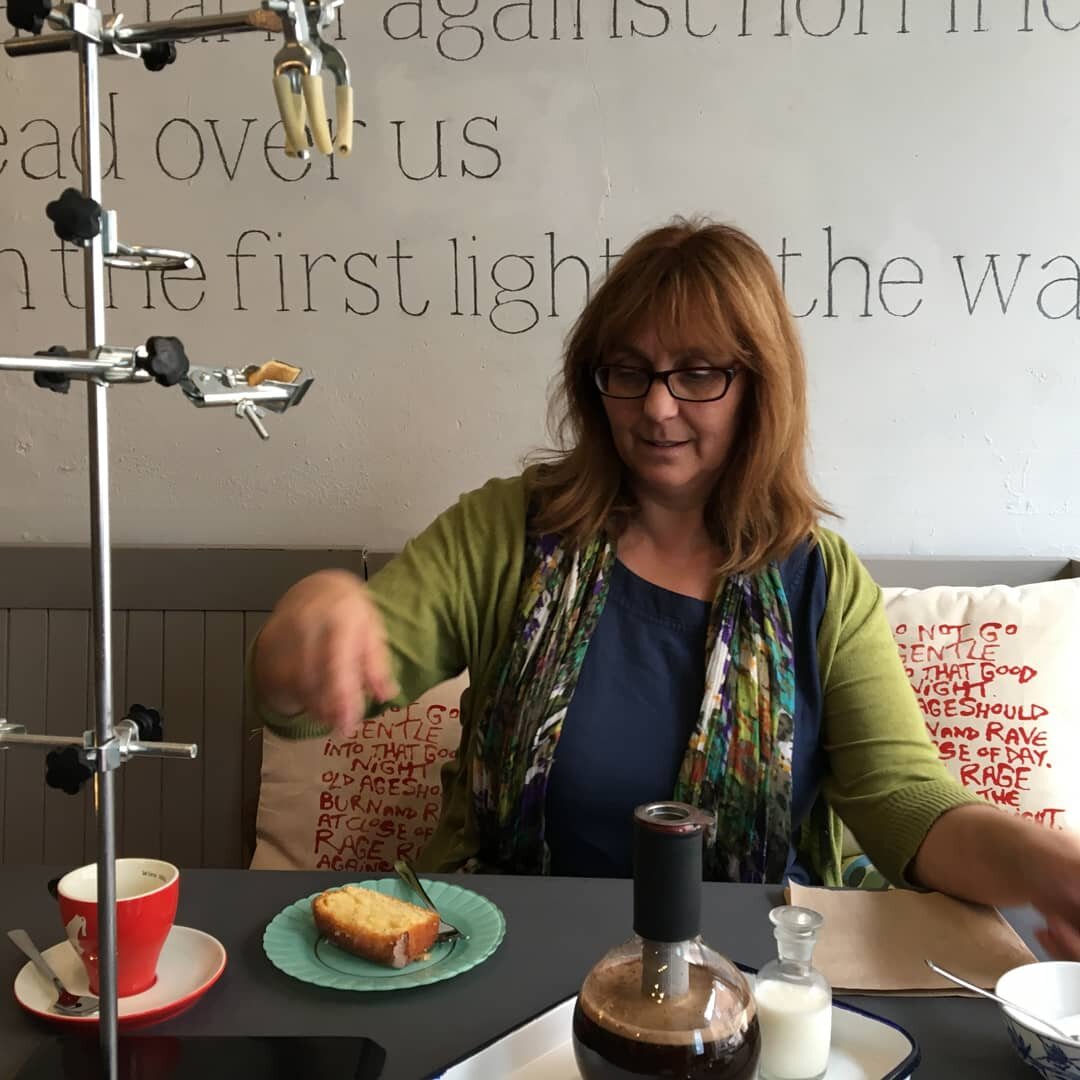
Deborah: We’ve converted a beautiful Victorian shop that had been closed for 13 years into an apothecary from which to dispense poems. It’s located in a small town on the wild west borders between England and Wales that’s full of writers and artists.
When people come into The Poetry Pharmacy, they’ll find books of poetry face up and filling the shelves. We’ve designed it so that people can browse by ailment — like ‘Matters of the Heart’, ‘Carpe Diem’, ‘Now I Become Myself’, ‘Be Alive Every Minute of Your Life’, and ‘Hope is the Thing with Feathers’ — and shop accordingly. We offer free one-on-one consultations on Friday afternoons, or people can make an appointment outside of that. We’re also happy for people to just come in and chat.
We also have a Dispensary Café which serves tisane, teas, coffee and cakes, as well as a shop that offers poems-in-pills for different needs such as a Bottle of Hope and Existential Angst Pills. Upstairs, we have The Distillery space from which we host book launches, workshops and other writing events.
We’ve kept the original architectural details like the old mahogany counter and till. We’ve allowed for as much natural light as possible (there are no neon lights). We’ve also painted the walls in muted paint colors.
There’s definitely something about the space that appeals to people in and of itself; a kind of therapy in not having technology everywhere. We’ve explicitly designed The Poetry Pharmacy for people to sit longer over coffee. There’s no pressure to move on and people are encouraged to talk to each other. It’s a place also for people to come to read and write.

Claire: Why in this moment when we’re rushing more and more of our everyday lives online and our High Streets are sadly struggling was opening a physical space important to you?
Deborah: I see the Ambulance as a physical space too; for years I operated as an ‘Emergency Poet’ from a converted vintage ambulance, prescribing poems to people at festivals, conferences, hospitals, libraries and schools around the country. But I felt like I was getting too old for all that travelling around, and it was often cold working outside in the UK. As the editor of four books and the writer of two of my own, I felt like enough people had heard of me, that if I set up a permanent location, they would already know what I was doing.
I do believe that people still want to touch something real. To be in a place that feels like it might last. The online world has a terrible power to cut connections with people in real places. The Poetry Pharmacy offers nothing like we can replicate when we are online. I also feel like if it’s there then it’s not hard for people to engage. People here are so delighted to find this place open; a place they can drift into and have a coffee and chat
I’m aware that it’s a gamble though. It’s an experiment, that comes with a certain degree of optimism and maybe even self-indulgence.
Claire: What need in the world do you think The Poetry Pharmacy responds to?
Deborah: We offer a therapy in slowness and a nostalgia for something lost: old fashioned service, friendliness, even listening.
People can come in feeling miserable and we give them a free ‘pill’ as well as the chance to talk about what they need. Then we prescribe a poem.
Claire: Why poetry? What’s the value that you see in it when applied to people’s lives?
Deborah: I realized a long time ago that most people are frightened of literature and poetry within that. And that the people who create or understand that art can be possessive. I used poetry in my work with people living with dementia. From that experience, I saw first-hand how you can change someone’s mood by taking them somewhere with a poem and that I could share the intimacy inherent in this form. This underpinned the Emergency Poet idea; I wanted to stop poetry from being intimidating and I wanted to show that it can literally be a vehicle for talking to people. That project effectively bypassed how poetry usually gets to people and how they then get to use it.
I’m aware that the Poetry Pharmacy idea is a bit mad. That putting poetry on the High Street is unusual. We keep hearing that poetry doesn’t sell, and this is a quiet town, but I’ve done it because I really do believe that poetry is a good thing. It’s beautiful. We’re putting it front and center instead of in the corner. Why not have piles of poetry books and say that has a value equivalent to other genres? With The Poetry Pharmacy we’re bringing poetry to the forefront and there’s an art in curating it — picking out the ones that speak to certain subjects, putting them with other things, and saying,“Take a look!”


Claire: And they are. People are enamored with this idea. Why do you think that’s happening?
Deborah: When I first started, it was a mad faith thing. People said, “you know why there is no other Poetry Pharmacy in the world? Because no one wants it.” But we’re finding differently; the idea of it even existing in the world seems to be a nice thing in the middle of all this darkness — BREXIT, Trump and just continuous bad news. It’s a piece of optimism and faith in something. It’s a positive thing, and light-hearted in lots of ways
It’s lovely that The Poetry Pharmacy exists in the world. It’s like a piece of fiction and reminds me of The Little Paris Bookshop by Nina George. In that novel Monsieur Perdu opens a floating bookstore on the Seine from which he prescribes books for a broken heart.
We’re only in week six and it’s been busier than I thought it would be. People get in touch across the world, we’ve had BBC News in here, the local Bishop’s Castle / Shropshire or West Midlands community is delighted, and people are seeking us out from outside of town and even from outside the UK.
We need all the elements though for it to work: the coffee shop to have a treat and a good coffee or tea that is nicely presented, like a ceremony; music that is welcoming and low-key, that makes people feel comfortable; a shop of desirable items, the consulting room and workshop space; and lots of events going on.
Claire: Would you place The Poetry Pharmacy within the world of mental wellbeing?
Deborah: I shy away from the word therapy, but I do say that it’s therapeutic. When I prescribe poetry to people, poems that I know and love, then people can make a poem their own; just reading it will take them to another place. What poetry is doing is taking you somewhere else in your head when you are busy. It’s telling you things that you may not be hearing from other people. It underlines something to yourself. Even imagining it, is a moment of benefiting from it.
At The Poetry Pharmacy we also include material for how to look after our lives in other ways beyond poetry. There’s a section ‘For days when the world is too much with us’, where we have Wordsworth next to psychotherapy and self-help books. We have another section that’s the ‘Best Medicine’ which includes gardening and nature — like counting butterflies, sitting in a patch of sunlight, and going for a walk.
Claire: When I think of The Poetry Pharmacy, I think of it as helping people with their anxieties, but I also think of it as supporting people in their loneliness. Is that fair?
Deborah: Yes, the poetry community has traditionally been good for the lonely as often people come to things on their own. People don’t have to be in a couple or with a friend to attend these events, like they might for say a dinner party or other social gatherings. It’s easy for people to come here on their own. Most of our events are on Sundays and quite a lot of people have said that Sundays are always difficult when they live on their own, but now they can come here for company. Rural isolation can also be a problem. This can be a place that people can come on their own and still feel comfortable.


Claire: Now we’ve established the life-affirming magic of the place, can we talk a little about the practical side? Like how you made it happen?
Deborah: We ran a successful Kickstarter campaign and I was amazed at the response. The crowdfunding raised money to pay for the build-out, including things like wiring the shopfront! We found that strangers turned up and said we love this idea and want to support it, because they don’t want closed-down shops on the High Street. We also received a small Arts Council grant.
We were very resourceful. As much as we could, we turned The Poetry Pharmacy into a project for both the local community and the literary/poetry one. We had many people volunteering their time and expertise.
Claire: What advice would you give to other creatives thinking of starting a bricks-and-mortar endeavor?
Deborah: It’s difficult, which I think is why so few people do it. But for me, it was huge just knowing that there’s a community of support behind me. I think it’s critical to have a few key people to support you in the first instance, and other people believing in you. The doubters are also quite useful because they test your resolve. Maybe they are right, and you don’t do it. But for me it was: ‘Bloody Hell, I’m going to prove you wrong matey.’ You’ll know in that fierce moment whether to do it or not.
Claire: How else has The Poetry Pharmacy impacted you? How does being front and center sit with the more private practice of writing poetry?
Deborah: Yes, there is that dilemma of reconciling this public project with the country mouse part of me. I do think (without overgeneralizing) that people who write who are novelists tend to be introverted, while poets tend to need to connect with other people more often. They work on a poem, then go out because they need to talk to people. For me, I crave being on my own and periods of time to write, and I’m aware that that’s not in balance at the moment. There are two sides of me; they don’t exist in the same place, but they do need to communicate, all the same. I hope that will settle down.
I do believe in The Poetry Pharmacy and it seems to be working in the way that I hoped. Also, for me too. Because I’m now so busy, I’m not online so much. What I wanted to do — and needed to do — was to have an open door and to welcome people in. To say: “Come in. Who are you?” To say. “ I’m interested in you. “
Discover more places for a happier life

Two Chairs | A Conversation about Thoughtful Therapy with Alex Maceda
Two Chairs is doing therapy differently. We spoke to its Director of Brand Strategy about why the model of delivery has been so broken but also why therapy itself isn’t.
I’ve sat in uncomfortable chairs in rooms with badly painted walls. I’ve awkwardly handed over a cheque or counted out cash at the end of a session. I’ve missed weeks of help because scheduling hadn’t worked out with the shape of my week. I’ve stumbled down stairs afterwards crying and fled to my car for solace. I’ve found people, then dropped them when it didn’t work, but made sure that I felt like I was the cause of the ending and not them. All of the above, all of it is wrong, but all of it is what can happen in our experience of therapy.
We are huge advocates of the practice of therapy and have been in and out of it (between us) for most of our adult lives. Sitting with a therapist has saved us again and again. We’re happy to spread the cause that #therapyiscool, and we’re in the business of making all our mental health tools, including talk therapy, more present in our lives.
But as we do this, we also need to acknowledge that the model of how therapy is given—not the content or the relationship parts—but all those things around it such as booking, payment, design, and fit, make it really, really hard to have a good experience at best and to get the help we need at worst. We pay more attention to how we go for a haircut, then how we go for therapy, and that makes no sense at all.
That’s why we were relieved to discover Two Chairs, a San Francisco start-up (hold the judgement) that’s making therapy all about you in all the ways that it hasn’t been so far and really needed to be. That means when you step into one of their seven therapy clinics across the Bay Area, you enter a setting that actually has your back as a person in the world.
Here the design of the spaces matters, not just in terms of beautiful furnishings with yellow (brand color) flourishes amongst the muted tones, or the LaCroix stocked in the fridge, and carefully chosen Phaidon art books on the coffee tables, but in psychologically impactful ways too. How the chairs are arranged affects how comfortable you might feel as a therapy go-er depending on your life situation. The art on the walls can subtly shift your mood. The presence of plants actually makes for a calmer environment.
Yes, therapy here is given the modern makeover it so, so badly needed, but it’s also been given one that takes into account what science is telling us about the environments and processes we need to best function as people. This is all Two Chairs Therapy’s Alex (Amac) Maceda’s domain. As the Director of Brand Strategy, Amac is responsible in her remit for interior design and client experience, working through all these details with not just operations and designers, but also clinicians and clients, who are folded into the process of what goes on before and after, as well as during a therapy session.
We had the opportunity to talk to Amac about why the model of delivery has been so broken but also why therapy in itself isn’t.


Claire: Let’s start with what Two Chairs is changing about the experience of therapy from the client’s side. Although we’re huge believers in therapy, we know that it’s really hard to just get the help that’s needed. How are you responding to this?
Amac: At Two Chairs, it’s all about access. We think of access as all the barriers that the system puts in front of you when you want to start care. The most classic example is that you are probably in crisis and you know that you want to go to therapy. You go online and Google. You maybe find 10 names. All of them are phone numbers only. Three of them call you back. Two of them don’t have availability. One of them can see you 30 minutes away at 2pm. Even when you’re opted-in, the system makes it so hard for you to get care. It’s such a disheartening experience, especially when you are engaging with it for the first time.
Claire: It’s hard to say,“I need to go to therapy,”and it’s even harder when you are trying to do this, and it’s still not coming together.
Amac: For a lot of people by the time they are asking for help, they have probably gone through quite a bit. Also, a lot of people are afraid to ask for help that first time. Whether they don’t know where to start or fear the stigma, there are so many things that you find yourself up against. Imagine that after taking so long to get to that realization, there’s still 20 barriers that they didn’t even know existed. When Two Chairs first started, that was the problem that we were trying to solve: How can we make engaging in high-quality care as easy as possible for those seeking it.
Claire: Can you talk me through how you are doing that in practice?
Amac: Some of the things we are doing are so simple, and take inspiration from different consumer brands, but are not typical in a health care setting. Things like online scheduling—it takes less than five minutes to schedule an appointment—and convenient locations—all of our clinics are located near major transit hubs. We want clients to be able to get in and out. We want clients to get on with their day and have the experience of therapy be as seamless as possible in daily routines.
Claire: You also have a unique offering in how the therapy journey starts way before clients are physically in a room with someone. Can you tell me about that intake piece?
Amac: We have a really dedicated care coordination team, and see them as a helping hand before clients even start care. They help clients think through questions like, “I don’t know if therapy is right for me, but someone recommended it,” to “how much can I expect to be covered with my insurance plan?”
What I think is really unique with Two Chairs compared to private practice or other group practices is our emphasis on matching. It’s clinically proven that the strength of the alliance between the therapist and the client is the biggest predictor of success, rather than the therapeutic approach taken by the therapist. However, the current system is not set up to match well.
Choosing a therapist can be really intimidating for anyone, and at Two Chairs, we try to make that as easy as possible. What that looks like from a client perspective is: you book an appointment online, receive a series of emails about what to expect in your appointment and then we send you a client profile to fill out.
The profile is a detailed intake form asking what some of your goals are for therapy, some demographic information, and questions that try to get at what modality might work for you, including,“How structured of a thinker are you?” from very structured to not structured, and,“How much do you want to be challenged in therapy?” from pushing back to I want a therapist who listens more. We’re not asking you to choose a modality, but rather we’re getting at some of the qualities that might move you towards one type of care or another.


Claire: That’s an interesting technology-driven part of your approach that hasn’t had a place previously in therapy. How important is the personalized data-driven piece to the Two Chairs model?
Amac: The self-reported data from the client goes into a matching algorithm that has been built in-house by our engineering team, and is founded on the latest data science. But our approach is not founded on data only. That information forms a hypothesis that a consult clinician (a position unique to Two Chairs) uses for a first consult. They prep with all the intake data, but they use their clinical expertise in that first in-person appointment to move the data around and to form a recommendation based on this human interaction. It is that person who then matches you with an ongoing clinician.
We match on so many different factors, from demographics, lived experience, and any specific preferences, like, “I can only come in at 8am in Oakland and I want to see a female who is middle aged.” We take this all into account when matching.
Claire: So, they take what they understand as you as this person on paper and you as this person in space, then put you in contact with the person who would be your therapist? If someone then goes to that therapist, and that’s not a good match, do you then rematch them? That’s one of those broken parts of classic therapy, that bad matches do happen and then someone drops out of therapy because of this even though they still need help.
Amac: Yes, that is where the consult clinician is so powerful—they become that point of contact throughout the process if anything is wrong. But we do have an over 90% success rate with the first match. Clients tend to be in therapy for quite a long time, though our goal is not to keep you in therapy forever. We’re now just over two years old, and at this stage, we’re seeing clients come back for new courses of care, and to work on new issues in more proactive ways versus more reactive ways.
Claire: I’m interested in this narrative of therapy positioned within life maintenance, like something you fit in on a regular basis. I’ve noticed that in the language of Two Chairs, that you are positioning therapy as a self-care tool rather than just as crisis management.
Amac: We have a good mix of clients who are brand new to therapy, and also those who are returning to therapy. On the new to therapy side, it’s been so powerful to see clients coming in for the first time who are telling us that they’ve been looking for a therapist, but that it had felt too intimidating, and that Two Chairs made it so easy. And on the flip side, we’ve had clients who have been in therapy for years who are coming more proactively, and treating therapy as a tool that is part of their life.
Claire: Do you approach those two needs differently in the intake process given that therapists have their own specialisms, such as trauma or situational issues, or work more generally, in a style that can be more holistic and generalized?
Amac: Yes, there’s all this self-reported data on the client side but I think what people don’t think about as much with Two Chairs is that we also have all this self-reported data on the clinician side too. Our matching tool includes their clinical expertise in session and the data we have about the clinicians about how they self-report their stylist preferences, their studies and research backgrounds.
Claire: How do you deal with the inclusivity piece? Therapy has been charged with being very narrow in its focus.
Amac: There’s a few different aspects to inclusivity, and certainly one of the hardest is financial. We’re still an Out-of-Network provider and we charge $180 for a session. That’s under market in San Francisco. But we aspire to be In-Network which we know will help a lot in terms of that financial piece. We know that the bigger we get the more power we have to be in network and then we can open access to more people.
On the other side, one of the narratives around therapy is that traditionally minority communities are less served within therapy and that gets back to our matching system. A big part of what we hear from clients is that we have a very diverse population of therapists across demographic and lived experience, qualities like gender, race, and sexual orientation. We consciously build for that. The feeling that someone understands your lived experience is very important, so we hire against that.


Claire: What happens after a therapy session? I always had this issue with therapy where I would sit in this non-descript room, see my therapist, and then come out with whatever raw feeling that I had, but then I have to go on the tube and get myself home. Can people hang out? Can they linger in the waiting room or sit with a cup of tea before heading back out into their non-therapy worlds?
Amac: I personally feel so passionately about this. Imagine that you cried during therapy and then you have to go to the bathroom to check your face and then sit in your car doing breathing exercises to collect yourself before going back to work. It doesn’t happen always, but for many of us, myself included, we’ve been there once or twice. For much of therapy, there’s no after. We think a lot about how you enter, but no one ever thinks about how you leave.
That’s something we’re addressing in all of our newest clinics and bringing that concept into the space. We’re introducing decompression areas to the extent that we can where you have separate exits and semi-private areas where you can sit and journal. We have essential oils and rocking chairs, so you can take a few moments if you need to. Each of our therapy rooms have a small mirror right before you exit so you can check how you look. These are all the little thoughtful details that we know from experience or from our clients speak to where they are at in that moment and we try to pull that into the design of the space.
Claire: Two Chairs didn’t go down the route of becoming an app but has invested in bricks and mortar and that in-person piece. Why is that aspect of just being in the room with someone so important. I know Two Chairs Founder Alex Katz has talked about Sherry Turkle’s Reclaiming Conversation: The Power of Talk in a Digital Age as a foundational text, and I wonder how this folds into your approach?
Amac: We know it’s clinically proven that in person is better. You lose so much when you are not in the room: like body language, tone, how a person is presenting, and how they seem to feel.
We also know that we are in a generation where we keep talking about how much digital is taking over our lives, and how much interaction is going through a screen. To be able to interact in person, especially around topics that are so deeply personal and that a lot of clients are talking about for the first time, allows us to bring a lot more empathy and understanding to the experience.
Claire: You have all the science backing up therapy, but you also have the science backing up the in-person piece. We’re at this moment that those two pieces are coming more and more together.
Amac: Yes, there’s so much care and attention paid understandably to the clinical setting. The hard part goes on in the therapy room. But there’s so much across the whole experience that matters—being able to be in person, to walk into a space and to feel a sense of calm, to have a cup of tea and to sit there for a moment, to take an hour out of your day in a beautifully designed setting that addresses our needs as a person.
Claire: Do you find that therapy is as stigmatized as when you started even a couple of year ago?
Amac: I certainly feel the stigma has decreased—but we have a long way to go. I find myself in a lot more open conversations about it, but know it’s a self-selecting group of people around me saying they go to therapy and that they love it. Even then, they are sharing in small conversations but not necessarily projecting it in public.
As someone who has worked in brand and marketing at different companies, I find it to be a very unique and specific reflection of where we’re at culturally with mental health. I used to work in fashion, and we had tons of user generated content on social media—people were posting pictures and tagging our brand, being advocates for our sustainability efforts, sharing our mission with friends—they wanted to be publicly associated with us. That’s not quite the same at Two Chairs—yet. We had our first tag from a client testimonial for Two Chairs only a couple of months ago, which was so powerful and exciting. Even two years ago, it would be hard to imagine someone posting about their experience with therapy on Instagram and thanking their mental health provider. It’s happening, but it’s still rare. Which makes sense—how many people do you know are going to therapy and taking a selfie and saying, “I had a great therapy session?”
There’s still a little bit of a ‘coming out’ that people do when they start to publicly associate themselves with mental health, mental illness, and therapy. Even people who are very mental health positive are not necessarily saying I’m going to therapy every week.
I was there six years ago, when I told a friend that I was in therapy and I remember feeling so scared. When they just said, “that’s great”, this relief washed over me. But even that makes such a big difference. It can be so powerful.
Everyone is on their own journey with telling their personal mental health story, but we hope that the work we’re doing at Two Chairs is making therapy a little more approachable, and creating more space so that you can talk to people about your experience with therapy when you’re ready. We want to humanize therapy more. In the past couple years there have been more and more mental health stories of famous people, often with this narrative of a grand fall from grace and then rise, which is inspiring, but not representative of most people’s experience. We’ve introduced an initiative called #TalkTherapy on our blog where we put more stories out there to show there’s a breadth of experience, that it’s positive or that it’s negative, sometimes life changing and sometimes it’s not, but we try to normalize the breadth of what happens to people in therapy.
Claire: How has Two Chairs been received on both sides, client and therapist, since launching?
Amac: We’ve seen over 2000 clients in the San Francisco Bay Area over the past two years. Last month we opened our fourth clinic in two years within San Francisco. We are one of the biggest group providers in the Bay Area at this point.
We are creating demand for therapy—we know this because a large percentage of our clients are coming to therapy for the first time, but there’s still a lot of latent demand for therapy. We’re the first consumer brand in a space that has existed for a long time and what we’re offering is a high-quality version of a something that is already there. We’re not trying to create something new that people don’t understand; we’re a better-quality version of what’s out there and we’re adding new aspects to it that make it more compelling for clients. In San Francisco there’s an emphasis on wellbeing, wellness, and self-improvement, and it’s really exciting to be in the generation that’s opening the conversation around mental health.
To learn more about Two Chairs visit their Website, Instagram, and Facebook

Shelf Help | In conversation with Toni Jones
We talk to the British journalist Toni Jones, Founder of Shelf Help about the bookclub that became a global movement and why its her mission to make self-help accessible, collaborative and cool.
When we first found out about Shelf Help, we felt like we had found our people. It’s a book club, built around self-help books, that also builds community in real-life. Isn’t that the ultimate combination?
OK, you’re hesitating, and we’re guessing it might have something to do with the genre because let’s face it, self-help can be a bit naff. You probably already have your biases, unconscious or otherwise.
Don’t worry, in the conversation that follows with Founder Toni Jones, we’ll cover that uncool factor and all the other reasons why Shelf Help is something you might need in your own life. Prepare to change your mind.

Claire: What led you to start Shelf Help?
Toni: I had just left my full-time job as a journalist to become a freelance writer, which meant suddenly spending a lot of time by myself. I was 36 and I’d never spent any time alone. It should have been the dream. I’d quit a job that I hated. I was busy and getting work. But it wasn’t that easy being by myself and getting to know myself. I realized I had spent a long time just ignoring my needs, and as soon as the job wasn’t there as a distraction, it was all back down to me.
I spent a lot of that time not unravelling but definitely in a bit of a mental health black hole. I was transitioning from this high-octane life to having a lot of time to think about whether I had done the right thing. I didn’t know how to deal with any of it. I knew I didn’t want to go back. I knew that wasn’t the right thing to do but I wasn’t sure which way to go.
I just started reading a lot of self-help. I started taking care of myself in other ways too; going to therapy for the first time (which I found really hard and amazing), doing yoga, attending retreats, and participating in a few support groups like Al Anon. I was also writing more about wellbeing because it was a trend that was coming in. In a way, in trying all these things, I was approaching my own life like I was writing a feature.
Claire: What was the first self-help book that you read?
Toni: Paul McKenna’s Change Your Life in Seven Days, which people thought was hilarious and really weird, because you don’t think of him as a self-help guru. To many people he’s that weird hypnotist on tele but he’s well-trained in positive psychology and NLP.
Because it was the first self-help book that I read, it really resonated. All these light bulbs went off. I read it slowly; I’d read a concept in that book and then I’d go away and research it. I’d go deep into the black hole of a certain author or self-help concept. Suddenly I was learning all this stuff and I literally could not get enough of it. I was devouring all these self-help books. I was fascinated by it particularly when I started reading about positive psychology and neuroscience and things like Dr Joe Dispenza (he talks about the power of your brain to change and it’s kind of the Law of Attraction but with all the science behind it).
But I was boring my actual friends with it. They were seeing a change in me—and that does spike people’s curiously—but they were like: ‘we get that you are into self-help, but it’s not our thing but good for you that it’s working.’ I started Shelf Help to find new friends who I could talk to about it. Also, as a journalist, I’m the kind of person who, when I find something good, I just want to share it.
Claire: Tell me about the first meet-up. Was it what you expected?
Toni: Shelf Help started as a local book club at a little wine-bar in west London. The first couple of meet-ups were a bit more earnest than they are now, because I started off thinking I needed to be super serious to be able to offer good support, but I’ve learned—as I’ve got better at running groups and also sharing my own story—that you can talk about the big stuff and still have fun.
Meet-ups today cover all kinds of heavy things; purpose, grief, breakups, fertility, friends, fear, careers…but we end up laughing a lot. They are actually really fun! We don’t just sit there and talk about our problems. People do bring up things that are bothering them and things that they are struggling with but there is usually someone in the room who can help them, someone who can say that happened to me and I did this. The idea is that we can all come together because everyone is fragile. We’re probably going through the same old shit and it’s nice to know other people have gone through it and that they have survived. Everyone leaves feeling positive.
Shelf Help has gone from me saying let’s talk about our problems, and that its ok to share, to a place to move forwards. Now I say we celebrate self-help. It’s about inspiring positive change. We advocate that it’s totally ok to not be ok and that people’s feelings are valid, but there’s a lot we can do to feel better, and so we focus on what’s next and how can we help each other.
Claire: As Shelf Help isn’t therapy but is to the side of therapy, how do you create an environment that is safe and purposeful?
Toni: What I do is create a space to give people tools to empower themselves. It’s self-help, so I’m never saying that I’m a therapist and that I have all the answers. At each meet-up, we use a different book but the same format. I’ll pull out 5-6 quotes or exercises from the book and every host around the world and on-line will use those questions for discussion. That gives us the framework as we’re going through the session.
For instance, let’s take a recent book Designing Your Life, which focuses on working out different versions of who you can be. I’ll say ‘The authors say… ‘ and ‘This is how they say it will work…’ Then I’ll ask, ‘Who has experience of this...’
I’m not saying that’s my advice or opinion, though I’ll share something usually based on my own experience. People understand that I’m not trying to direct anyone in any way. If you have chosen to read this book and come along to a meet-up, it’s because you are interested in the topic and meeting like-minded people. I’m pretty sure the attendees aren’t just there to see me or listen to what I have to say about something. I’m just the host: I bring people together and create an environment. But very much people are coming with their own stories to share.

Claire: It sounds like the book itself is giving you the safe container?
Toni: Yes, the expert in the room is the book. Sometimes we have the author there but not always. In a way, it is like a regular book club where you get together to chat about the different characters and chapters and everybody has a different opinion.
Also, I’m quite clear that confidentiality, kindness and no judgement are our code of conduct. That’s on our printed materials that we put out. Hosts also read out the manifesto at the beginning of each meet-up, which explains what we are and what we’re not.
We do have different levels of people at different levels of pain or need. Some people have gone to the doctor and they are going to therapy. They are using this as another tool. There are a million experts that people can google but what they are looking for with Shelf Help is a way to connect to others and a way to connect with themselves.
Claire: The self-help genre has been promoted as being so individualistic, as something you do alone. There’s this idea that you read a book alone and have all these epiphanies alone. With Shelf Help what you are saying is that actually self-help is not solitary, but rather it can be in understood as a collective experience and can be experienced in a social environment.
Toni: My mission with Shelf Help is to make self-help accessible, collaborative and cool. The idea of self-help is a bit of a misnomer. Yes, you do need to do a bit of that work on yourself, but you also need help to take that work forward. It’s much more powerful when we come together.
If you’ve got used to sitting at home by yourself, with just those stories that go around your head, often just saying something out loud to someone else can give you a different perspective. Shelf Help gives people access to different perspectives, and entirely different life experiences
When we did Susan Jeffer’s Feel the Fear and Do It Anyway at our meet-up in London, we had an Indian grandma who had the original copy from the 80s that she’d been given when she first moved to London. She was sitting next to a Gen-Z girl, 22 years old, clutching her brand-new edition of the book. Though it’s a bit of a worry that we’re still dealing with the same old stuff, it was amazing to watch them connect over the same material. They probably would never have met or talked to each other otherwise, but these are universal themes that can easily see three generations apart talking about the same eternal topics.
Claire: As an advocate for self-help books, going to therapy and going on this deep dive into personal wellness, how do you negotiate some of the cynicism that can come into play? There’s definitely an undertone that says that stuff you are doing over there, that wellbeing stuff, isn’t credible or serious.
Toni: Yes, I see that. But it started working for me, and for others, and as soon as something starts working, people want more of it.
My dream with Shelf Help is that people are not scared to read self-help, that it gets people talking about this genre and connecting, rather than thinking you must be a mess because you are reading a certain book. I believe that the audience is everyone and that’s the whole point. I want people who maybe don’t think they are self-help readers to maybe read an interesting quote or a passage on our Instagram and to go, “oh wow, that’s what’s that book is about.”
Claire: It’s interesting to see that shift, that there is a real thirst for it. That people are going towards it.
Toni: What something like Shelf Help does, and what I realize that I do for my friends and my family, is to give them permission to get curious about self-help. Yes, some people do still see it as naff and cringey, but quietly people will come along to a meet-up. They’ll have read the book and they will want to talk to me about it but maybe not in front of everyone. The interest is definitely there.
Shelf Help is all about accessibility. We make it accessible by organizing free or affordable meet-ups and events as well as via the content we share across various social media. That’s why I now call Shelf Help a platform—the book club is always going to be a big part of it—but we can share all kinds of content too. One day I hope we will be creating online courses, better digital meet-ups, and more events, like author workshops—which means you don’t have to have read any of the books to come along.
The way that people consume content now works to our favor; we don’t necessarily just have to read a book to be helped by self-help. People can also watch a Ted talk delivered by the author, listen to a podcast or follow them on social media and still connect to the strategies and ideas.

Claire: There’s a criticism that I’ll paraphrase here, that 100% of people who have read a self-help book will read another one. This means in effect that they don’t work. But really the point is not that they are buying another one because the last one didn’t work, but that they are buying another one because it is working.
What you are saying in effect with Shelf Help is that your relationship to yourself and to other people is a life-long one. That people can have a growth mindset around their own learning. That’s something positive that people can sustain in their lives. You are shifting the perception that self-help is failing if you need more to its working if you need more. It becomes a form of ongoing mental nutrition in a way instead of an ineffectual crutch.
Toni: I think the more that you learn the more you realize you have to learn. If you are looking to a book to fix you, you are missing the point because most self-help comes back to the same finding: you need to start with you. All these books and tools will help guide you but ultimately you need to know yourself, to meet yourself and then start that work.
People say to me how can you read all this self-help and not be fixed? They have this idea that if it’s so great you only need one book. But we’re always learning. That’s what we are here to do, to grow. You are never going to be complete and how boring would that be if you were? What you learn along the way is amazing and is probably the best bit.
Claire: How do you get over self-help overwhelm/ fatigue (you know that feeling where the 11 things to do to better your life feels like 1000 things to do)? How to do you go from reading self-help to actioning it?
Toni: After feedback from members we’ve slowed down the reading process, to one book of the moment (BOTM) every two months (instead of one book every month). These books require that you delve into yourself or peel off these layers. You need to do the exercises and read it at a pace that allows you to process.
Claire: You give a reading schedule?
Toni: Yes, for accountability and so people can follow along with what we’re doing. Everyone is so busy, and I have to appreciate that reading can be a luxury. We need to allocate proper time to get through these books. It’s very much about reading, processing and then acting on it. In Crazy Good, one of the books we have covered, author Steve Chandler says: “Once for information and twice for transformation.”
Claire: Do you choose all the books that you cover? How do you go about that?
Toni: Yes, I’ve done that so far. I’ve gone on books that I’ve loved and that have made a big difference to me and that I know. People seem to like the fact that they are directed to what to read. Not that I know everything about self-help, but I do get a good vibe for what most people want to know about at the moment, whether that’s happiness or habits or purpose. I also get a sense from everything that I’ve read that this particular book is one that we can dissect together. Now, it has to be available globally cause we’re a global book club and we have loads of engagement in Canada and Australia.
Claire: I saw that you are now worldwide, including Amsterdam and Los Angeles. Why did you decide to make Shelf Help a worldwide movement?
Toni: I want to make the conversation as big as possible and to get as many people as possible talking about these subjects.
I think these things affect you in San Francisco the way they affect someone here in London: Feeling lonely, and just wanting to connect. We’re so connected and so disconnected. People are just looking for things to do that bring them together. I started Shelf Help at a time that I really needed it, but I underestimated how much everyone else needed it as well.

Claire: Shelf Help fits in this cultural moment, this global phenomenon of being disconnected, and searching for something to fill the void. We’re all going through it. For me, Shelf Help covers those universal longings: how do we connect, how do we come together, how do we help ourselves?
Toni: People do want to connect online but people ultimately want to go to or even start a meet-up. We’re able to create this amazing network and that’s what technology is allowing us to do but really its feeding people’s need to connect in real life as well.
People want to catch-up or go to events with each other. Most hosts are starting to organize social events in-between book clubs where they’ll go for dinner or a yoga class or a workshop.
At the meet-up in Farnham UK, they seem to bond over their love of cake as much as the books they read. In central London, the meet-ups typically focus on purpose, career and burn out. The one in Pembrokeshire takes place at lunch-time because it is made up mostly of mums.
I want the hosts be as autonomous as possible. If you want to host a meet-up for me and for Shelf Help, then that’s brilliant. We want you on board. We want as many people as we can get, but applicants have to understand that there’s a certain level of commitment (hosts need to commit to a minimum of 6 bi-monthly meetups, and are responsible for the venue and local members, with some support from Toni/Shelf Help). To scale this movement, I know that it can’t be about me; I can’t be everywhere.
Claire: You don’t have to be the person in the room, you can create the system for it, but it doesn’t have to be you?
Toni: I absolutely don’t want it to me about me. I’m happy to be the figurehead and I’m glad that people relate to my story. I love organizing the events and managing the network of hosts, but, ultimately, I want to empower people to help themselves and build a community that helps each other.
Claire: You’re 2 years old (congratulations!). How has the idea for and realization of Shelf Help shifted from when you started to where you are now?
Toni: Two years ago, it was just a book club in Chiswick, west London. Now, I talk about Shelf Help as both a platform and community. We’re all about connecting people to ideas through both the books and other types of content that we share. We’re creating spaces on-line and off-line, with lots of events and meet-ups, and an active digital community. The community is a massive part of it
A lot of Shelf Helpers who are assisting with our second birthday party, are people who are either hosts or come to a lot of meet-ups. I didn’t know many of them a year ago. Now they’re really good friends who are all giving up their time for this celebration.
I’m finding that people want to be part of what we’re doing. They want to do what they can to help us grow. We seem to call on people who can see a huge value in focusing on their mental wellbeing and who then want to share that message.
Claire: If someone is interested in getting involved, what’s the best way for them to engage with you?
Toni: You can come to a meet-up, an event or a retreat. Or join the Facebook group, follow us on Instagram, sign up to the newsletter or even host your own local book club. There are lots of ways to get involved.
Claire: And finally, what’s the one message you take away from reading so much self-help.
Toni: At its most simple, Shelf Help is about helping people to like themselves more. Because I think that too many of us don’t like ourselves enough (maybe don’t even know how to?) and that everything in life can be made better when we improve the relationship we have with ourselves.
To find out more about Shelf Help, head to the Website, Instagram, or Facebook.


Lucky Penny Parlor & the World's Smallest Postal Service x Lea Redmond
Maria Popova, a similar collector of interesting (in ideas rather than things) encourages: “Be curious. Be constantly, consistently, indiscriminately curious.” We had that quote in mind talking to Lea and wandering through Lucky Penny Parlor.
“Lea’s storefront project is a place where matter and meaning meet through found object conversations and storytelling.”
At times of darkness, what do we reach for? What do we try to bring into our lives? Our go-to’s are probably around activism, around self-care, around community. But wonder? Curiosity? Sometimes we put them in the ‘superficial’ bucket, the one reserved for whimsy, for frivolity, for later. We leave them alone. They are coping strategies LITE.
Spending a morning with artist Lea Redmond at Lucky Penny Parlor in Oakland you realize you’ve got it all wrong. Finding wonder is deeply purposeful. To abandon it now is to abandon something of our humanity, of our possibility.
It’s ok to not feel entirely comfortable when you come into Lucky Penny Parlor. What is it really? How do you engage? Can you touch this? You’ll have these questions and others. And Lea is fine with this – she’ll lead you through it, spend time with you so you can reach for understanding, bring your experiences into hers. There’s a beauty in questioning, a kindness in the suggestion of clarity. Lea did this with my daughter and I – as we touched things on display, grasped for information as we tried to orientate ourselves, she provided the scaffolding for a connection. Over mint tea, in carefully chosen cups, we found our way in.
There’s a therapy of sorts to be found here in Tea Cup Consultations in which Lea choses a cup from her extensive collection and you bring something from your own life to discuss over tea, and the staged Tabletop Shows, dioramas that encapsulate narratives and even the universe (upcoming shows are about hummingbirds and a choose-your-own-adventure through the solar system). These intimate services provide the framework for poetic conversations, exploratory meanderings and immersive play.
Lea is interested in the material that’s in front of us of another kind though, of what’s available to us in the ordinary and every day that has a tangible quality, the concrete items that are all around us, all the time, and that we no longer see. Look through the hundreds of tiny drawers that make up Lea’s Wonder Cabinet and which contain the detritus of our everyday lives – tags, bottle tops, flea market finds, and household artifacts. Here you are taken right back into the space of seeing again, of living in the pause. Meaning here sneaks up on you, revealed by delight and humor and amusement.
Maria Popova, a similar collector of interesting (in ideas rather than things) encourages: “Be curious. Be constantly, consistently, indiscriminately curious.” We had that quote in mind talking to Lea and wandering through Lucky Penny Parlor which houses her personal collection of curios and from which she curates her own singular world.
Two doors up from Lucky Penny Parlor, is a work in process, the very soon to be first outpost of Lea’s World’s Smallest Post Service and the latest iteration of her 10-year tiny mail project. A space of serendipity – Lea happened upon the perfect-sized vintage post office front to pull it all together. From here Lea and her team will send out tiny – as in seriously tiny – packages into the world.
It’s a truly magical space that captures our love of the absurd and the cute, as well as our need for connection, our longing for the analogue. With this project, Lea is returning to something long lost – our wonder at receiving things in the mail that are not in the form of a bill or bulk entreaties. Can you imagine finding one of these tiny letters or parcels in your mailbox. Can you imagine that moment being in your day? Aren’t you smiling now just thinking about it? Or maybe you are thinking about who you can send something to?
For Lea the World’s Smallest Post Service is all about bringing not just ‘tiny mail magic’ but ‘more wonder into the world’: “We propose to create an enchanting, museum-like, open-to-the-public brick & mortar home for our World's Smallest Post Service. We want to make a place, a magical coordinate on the globe where people can count on wonder and kindness.”
Lea has constructed her world too so that we can reach for it wherever we are – with products by her design company Leafcutter Designs. Like Lively Matter a deck of prompt cards to encourage creativity and play through ‘a grand adventure of the ordinary’, and that provide a much-needed break from our screens, and the Letters to My Series, which we’ve handed to grandparents and friends, to capture the stories they may want to tell but have had no format to do so. Most recently, Lea created Everyday Offerings, which holds a way forward in our daily lives.
From the outside, all this, these storefronts and projects, Lea’s vision for crafting this magical way of living, look fun but it takes hard work, a serious and keen drive, to sustain this creative space. It looks easy because whimsy is a kind of sleight of hand, a magic of sorts that leads you out of the mundane and into belief. You don’t see the trickery (read commitment and focus) that makes it happen, that makes non-obviously functional spaces, exist in the world.
Yes, we need independent cafes and bakeries, coworking spaces and stores. But we need this other non-definable space on our high streets – of inspiration, wonder and play. Of something else. That’s a need that is not being fulfilled in our grown-up lives. We’re losing our joy, and we need to badly capture it again. We’re lucky in that we get to visit this world of Lea’s creation. For a short while. To walk within this vision of what light existing in darkness can actual be, the physical form it can take and its importance in sustaining our lives. There’s nothing superficial in that.
To find out more: website www.leafcutterdesigns.com / Instagram @lucky_penny_parlor / Facebook @LeafcutterDesigns

neve & hawk x Kris Galmarini
At a moment when we’re all being pushed to do more and more online—more apps, more sharing, more webinars—neve & hawk founder, Kris Galmarini is making the case that actual brick-and-mortar spaces matter.
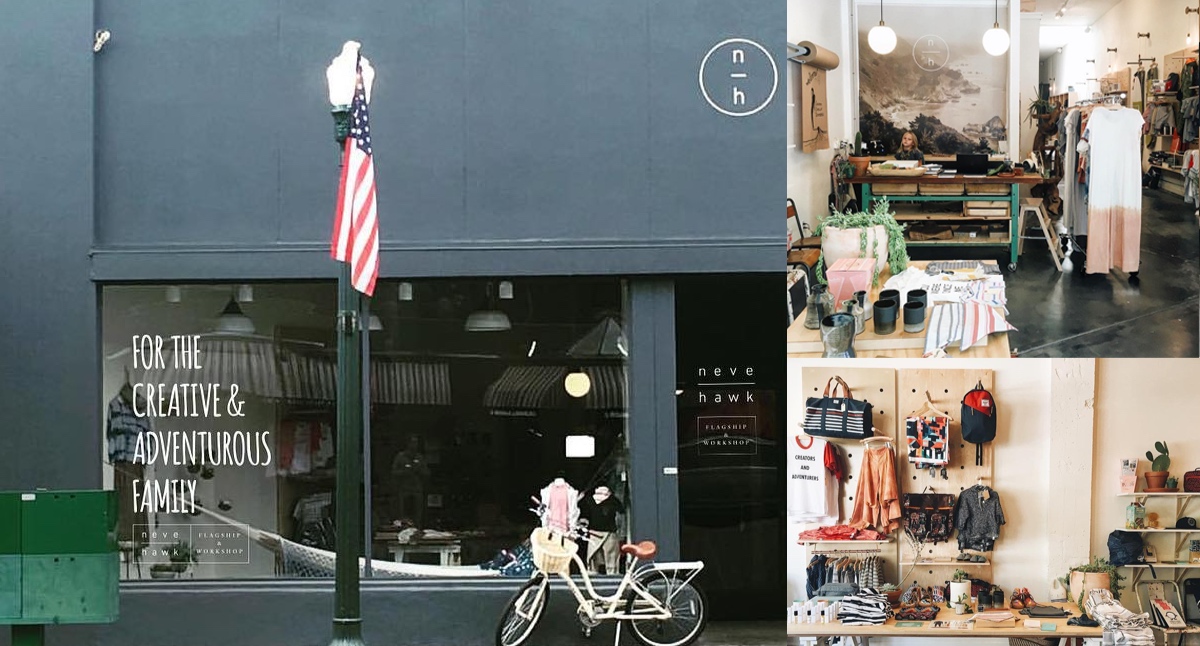
At a moment when we’re all being pushed to do more and more online—more apps, more sharing, more webinars—neve & hawk founder, Kris Galmarini is making the case that actual brick-and-mortar spaces matter. In many ways, she doesn’t need her brand’s flagship location in Marin County. Neve & hawk has a thriving online presence for its super cute California- inspired, family-loving clothing line. But Kris, herself, does need it, in a very personal way, because community matters (like really matters) to her.
Neve & hawk’s storefront goes beyond just selling something (though we totally want to buy EVERYTHING they create), to actually building something. “We want it to be a place people want to come. We want people to come into the store, and feel better than when they walked in. We want them to interact, to feel inspired, to leave the store feeling better about shit. We’re in this community and we want people to feel good.”
Kris’ mission to bring people into the space has led to a new use for the back section, a café headed by the female-backed coffee brand Lady Falcon. From mid-August, the flagship will be the site of pour-overs, crafted coffees and a reason to hang out. It’s “another way to have people in there and to bring out the community.” This builds on other offerings: a monthly workshop teaching screen printing and chain stitching where people can learn how to sew, or mend, or distress something, as well as a Quarterly Artist series, which gives creatives a start and someone who believes in their work.
This focus on human interaction and holding physical space goes hand-in-hand with who Kris is as a person. Yes, she’s an introvert who might just be hiding in her studio when you visit the store, but she also believes deeply in people, in their worth, in their authenticity, in their talents.
This starts with the design and production process around the clothes themselves: which are made and sourced (from the inks to the manufacturing process) in San Francisco, Sonoma and Marin and are given a fair market price which reflects this intentionality. At all these steps, Kris never forgets that “there are humans who are making it”, that they have value too, creatively and monetarily. “Shopping can be a thought-process”.
The sentiment extends to Kris’ sense of responsibility to her clients: “Community and loyalty go hand in hand.” Both on and offline she has actively fostered a community that people can be part of and has allowed it to grow organically.
And it absolutely extends to how Kris presents (or rather doesn’t) as a person. She doesn’t play the game we’re all being pressed into playing. At a moment, when we’re collapsing our brands with our personhood, when our sense of self is tied up with clicks, when our lives need post-production effects to make them good enough, Kris is working hard to push back. And we are so grateful for that perspective: for someone who is allowing the masks to drop, for her soul to show, and proving this idea that who we are matters much more than what we know (borrowing from two of Kris’ go to quotes).
If places can be a person, and a person can be a place, neve & hawk’s flagship would be it.
To find out more: website www.neveandhawk.com/ Instagram @neveandhawk / Facebook @neveandhawk