

Exploring Emotions, Connection, and Wellbeing Through Podcasts
Discover the best podcasts for exploring culture, emotional connection, and wellbeing. From The Hidden Brain to Noticing, explore some inspiring stories, practical tools, and cultural insights in our latest podcast playlist in our Culture Therapy series.
What makes a culture thrive? How do emotions, traditions, and shared narratives influence our collective wellbeing? Welcome to our Culture Therapy series, where we learn about the intricacies of human connection, emotional health, and the shared experiences that shape our world through podcasts, books, and more.
This month, our curated podcast playlist highlights some incredible podcasts that offer fresh perspectives on culture, emotions, and our everyday wellbeing.
Podcasts About Emotions and Connection
Podcasts like Noticing and The Hidden Brain focus on how we connect with ourselves and others. In Noticing, Maggie Ward and Urvi Patel explore the roots of disconnection, sharing practical strategies like self-compassion, thought interruption, and micro changes that foster deeper reconnection. Meanwhile, The Hidden Brain series Emotions 2.0 examines how emotions spread and intensify in group settings, from the shared joy of concert crowds to the power of communal rituals like fire walking.
Podcasts About Cultural Narratives
Exploring the stories that shape culture, Conspiracy She Wrote reveals the women-led origins of conspiracy culture, tracing the roots of Illuminati paranoia to figures like Nesta Webster. Similarly, Don’t Drink the Milk examines the legacy of witch hunts, uncovering how these historic events continue to inform modern power dynamics and societal fears.
Science-focused podcasts like The Infinite Monkey Cage also weave cultural threads into their explorations, from how stargazing has shaped civilizations to the beauty and environmental significance of trees, featuring guests like Dame Judi Dench.
Podcasts That Inspire and Entertain
Storytelling is a powerful way to connect with culture and well-being. Comedian Amy Gledhill hilariously recounts her day on What Did You Do Yesterday, reminding us of the joy in life’s small moments. In Intersections, Lauren Layfield introduces immersive soundscapes and interviews with notable Angelenos to preserve Los Angeles’ untold stories.
For those exploring relationships and personal identity, Single Ladies in Your Area follows Amy Gledhill and Harriet Kemsley navigating the modern dating scene, while Kylie Kelce’s Not Gonna Lie balances humor, holiday traditions, and personal insights from guests like Charissa Thompson.
Why Podcasts Matter for Culture Therapy
Podcasts are a treasure trove of ideas, offering tools for emotional wellbeing, cultural understanding, and even some healthy distraction. From unpacking disconnection to exploring shared narratives and communal experiences, these episodes will help you explore more of life.
As you listen, think about how these podcasts might inspire you to move toward connection with yourself, each other and the world around you.
Whether you’re drawn to emotional health, cultural history, or lighthearted storytelling, there’s something here to spark some new thoughts and bring fresh perspectives to your sense of self and the world around you.
Ready to explore how stories, art, and culture can shape your emotional well-being? Discover Culture Therapy—a new approach to finding meaning and connection in everyday life.
Explore curated recommendations and insights designed to inspire and support you. Because sometimes, the right story or even podcast can be the best remedy.

Yorkshire Sculpture Park
As we’re forced to head outside this winter, we’re looking to an open-air art museum for awe and wonder in a natural setting.
What is it: A nine-foot-high Birkin bag. An oversized teapot in which to rest. A blank snowman in the middle of a glistening pond. Yorkshire Sculpture Park is an awe-inspiring museum without walls, with over 80 modern and contemporary sculptures set across 500-acres of the historic eighteenth-century Bretton Hall estate.
What you need to know: Since it was founded over 40 years ago by Peter Murray (also the current Executive Director), a young art lecturer inspired by European sculpture parks who had the radical idea to create an outdoor art exhibit, YSP has evolved from the UK’s first sculpture park to once of the largest in Europe and one of the most world-renowned. Through its ever-changing displays and temporary exhibitions in its enclosed galleries, YSP brings new audiences to the practice of sculpture — redefining what it is and how we view it — while enabling wider access to art and opening the field for all.
Why you’ll love it: Although there’s obviously a focus on the artworks themselves — including classics by local artists Barbara Hepworth and Henry Moore — it’s so much about how those works are situated in the surrounding environment, their dialogue with the forms of nature around them, that creates the awe-inducing and reflective situations that YSP has become known for. The outdoors replaces the architecture of the museum — trees instead of white walls, grass banks instead of wooden floors, light derived from sunlight instead of overheads — to create a living context of a very different kind.
With art embedded in nature, our perception shifts according to location, light, time of day, and the seasons. No longer static, each work’s place in the landscape is sensitively considered – part of the evolution of YSP has been the transformation of the landscape that holds it to be a more fitting backdrop for its sculptures and audiences. Recently opened award-winning visitor center The Weston designed by architecture practice Fielden Fowles and built on the site of a former quarry, takes inspiration from land artists Michael Heizer and Robert Morris. And in case you need a reminder that art and nature sit closely together here, you’ll find sheep wandering amongst its sculptures and herons found by its art trails.
Why we think it's different: After a year that has seen its capacity to bring in visitors drastically reduced (80% of revenue is from audiences on-site), YSP has also recognized a silver lining, its vital role in its audience’s wellbeing, creating much-needed opportunities to bring people outdoors and to connect with art and nature. YSP has become a location for refuge and reflection, a place that can give respite in an uncertain time. This builds on the work started in pre-COVID times such as YSP’s wellbeing program. Deputy Director, Heather Featherstone, recognizing the social and personal infrastructure that YSP provides, has commented that: “Museums and cultural organisations are the hidden social care that no one really talks about.” YSP encourages a way of being and a mode of engagement that goes beyond the typical museum audience experience, with impacts beyond a visit and into our everyday lives.
In their own words: “YSP’s driving purpose for 40 years has been to ignite, nurture and sustain interest in and debate around contemporary art and sculpture, especially with those for whom art participation is not habitual or familiar. It enables open access to art, situations and ideas, and continues to re-evaluate and expand the approach to considering art’s role and relevance in society. Supporting 45,000 people each year through YSP’s learning programme, this innovative work develops ability, confidence and life aspiration in participants.”
Something to do: Art for all? Participate in new public art initiative, The Great Big Art Exhibition, hosted by Firstsite, Colchester with the support of partners such as Tate and the National Gallery. Here rainbows in windows are replaced by artworks created on a fortnightly theme, linking us to our neighbors and displaying the creativity that many of us have newly found in lockdown and beyond.

Lost at Home: Prompts for thriving while social-distancing
We’ve put together a quick guide for how to maintain your mental wellbeing while social-distancing.
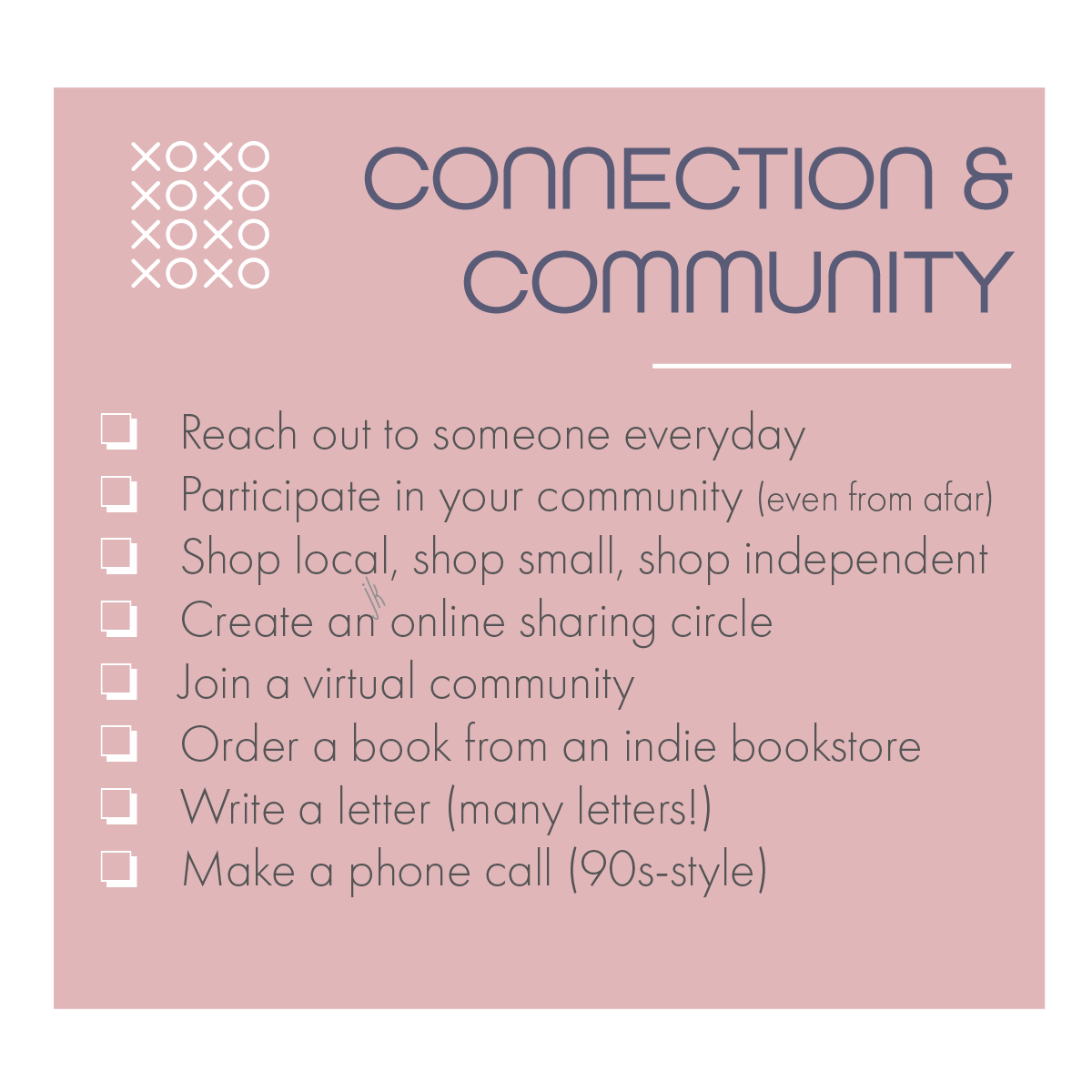
We all have the same basic needs — even when we’re stuck at home. While If Lost Start Here generally focuses on the *places* we go to meet these needs, we’re pivoting and reassessing to find ways to meet them from home. From finding community and connection to discovering your own creative potential, we’ve collected some of our ideas for thriving while social distancing. Have something to add? Feel free to share ideas in the comments below! This is in no way an exhaustive list! (And of course, please share with anyone who may need a boost of inspiration!)


Headlands Center for the Arts
A seemingly hidden away creative escape, ready to be discovered again and again.
Sometimes self-care isn’t a practice it’s a place. We’ve felt this about the Headlands Center for the Arts for a while.
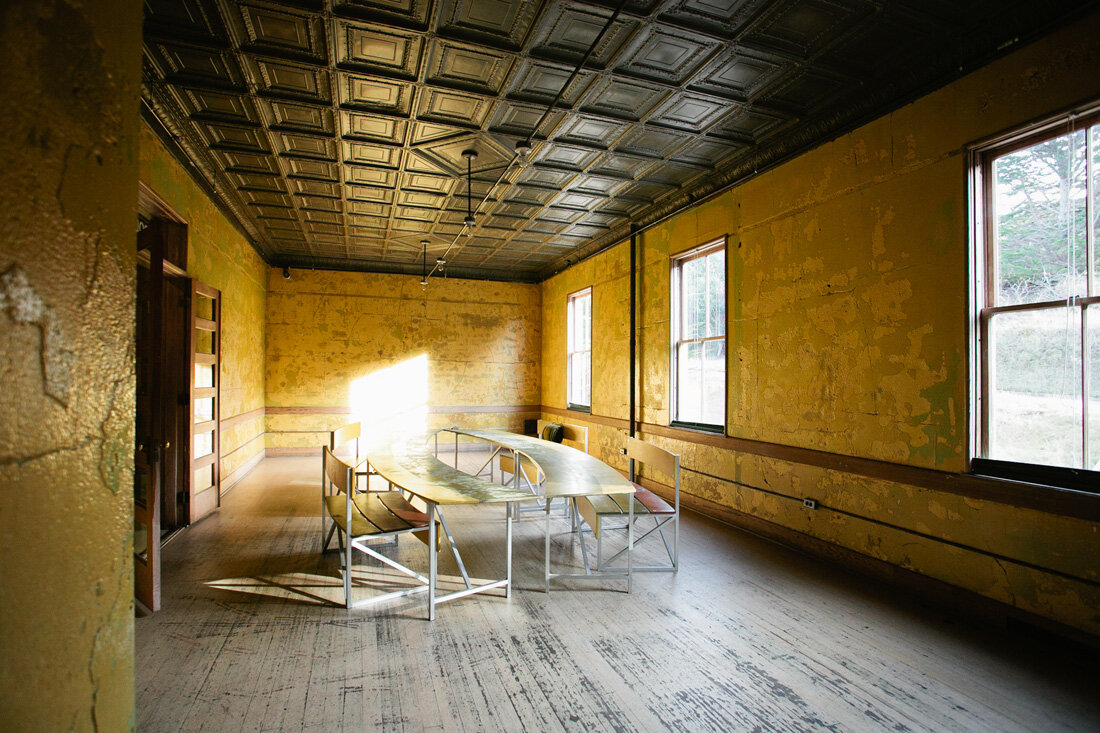
Located in what seems like the middle of nowhere, the Headlands Center is really just 30 minutes from the city of San Francisco across the Golden Gate Bridge. The tiny one-way tunnel to get there (or you can take the winding, treacherous feeling high-road), and the oftentimes bleak former military surroundings of Fort Barry, throws you off. Also, there’s sandy Rodeo beach and the vast Pacific Ocean right there when you step out of its doors. It’s not the place that you expect to find a cluster of artist-renovated buildings hosting art residencies, exhibitions and workshops. But the Headlands Center attracts an international roster of creatives seeking the time and space to make work in its renowned residency program, as well as a committed local art crowd who make the pilgrimage when it does open its doors to the public.

Time your visit carefully as the Headlands Center is something different at different times of the day/week/year. This is no static exhibition venue — rather it’s a place that shifts with its participating artists, writers, and other creatives and programmatic themes. You’ll need to pay some attention to the calendar for the things you can see and do here. On the Open Days — a handful a year — the place comes alive with a buzz of activity and many people wandering its rooms. The Project Space now offers sometimes Sunday-to-Thursday shows to visit and there’s the occasional intervention on-site, like Wall Space in the outdoor Commons area. Want a more intimate experience? Attend a dinner in the Mess Hall by Headlands chefs and invited guests or a walk, conversation, talk, performance or another public event. Whenever you visit try to grab a coffee in the Ann Hamilton designed Mess Hall.

We all have our favorite places to go to when we want to run away, maybe also when we want to run towards something. They are the ones we sink into when you get there, even if it means we don’t turn off our minds but open them instead. The Headlands Center has become that place for us. One of seeming retreat but also a restorative connection to people, to what they create and the ideas they get to explore whilst here.

Hauser & Wirth Somerset
In the unlikeliest of places — outside a small village, on a working farm — sits one of the most well-regarded galleries of contemporary art in the world.
“Hauser & Wirth Somerset is a pioneering world-class gallery and multi-purpose arts center that acts as a destination for experiencing art, architecture, and the remarkable Somerset landscape through new and innovative exhibitions of contemporary art. ”
In the unlikeliest of places — outside a small village, on a working farm — sits one of the most well-regarded galleries of contemporary art in the world. Maybe it's the giant bucket at the entrance that gives away the fact that something different is afoot in these fields.
Opened in 2014 Hauser & Wirth Somerset joins the esteemed network of galleries launched by founded Iwan & Manuela Wirth (with Ursula Hauser) in Zurich and which now includes such places as Hong Kong, New York, London, and Los Angeles. You can see why Somerset sits oddly within this company.
But the Wirths, though globally roaming, are now locals and they have cultivated the once derelict 17th-century Durslade Farm into a hugely popular arts destination in an area known more for cows than culture (though that’s all definitely changed — see also The Chapel, The Newt and favorite local brand Selfish Mother).
That they did this not just by continuing to focus on the high-end art that is the heart of their business, but by bringing in other values to make that heart beat, namely education, conservation and sustainability, is probably the most striking aspect.


Yes, here are the shining lights of the visual arts and architecture — the derelict buildings were renovated by French architecture firm Laplace into white-walled galleries (albeit in barns) and a six-bedroom Kinfolk-worthy renovated 18th-century farmhouse available to rent (note vintage furniture next to a Pipilotti Rist installation). The gardens were landscaped by Piet Oudolf of New York’s High Line, who has crafted an abundant yet tempered (though in ways you won’t expect) version of an English landscape, dotted with a changing display of outdoor sculptures, like Franz West’s incredible talking heads.
The striking pavilion by Smiljan Radić was brought in space-ship like from the Serpentine Gallery and is a liminal place of imagination and learning for grown-ups and kids alike (note — running up that ramp, also note the talks series). Even restaurant Roth Bar & Grill is art-orientated, with a site-specific bar by Björn and Oddur Roth, the son and grandson of artist Dieter Roth. And that’s all before you get into the galleries themselves, that show the kind of artists you’d find in a MoMA or Tate: you know Louise Bourgeois, Martin Creed and Phyllida Barlow.
But with Hauser & Wirth Somerset, the Wirths haven’t just plopped a little bit of the art world into the countryside. Even as it exhibits its bonafide visual arts roots, it also blazons its community, local Bruton village leaning, credentials. There’s an active education and events program that brings in schools and the local community — see ArtHaus, Open Source Salons, Family Saturdays, seasonal Pumpkin Festival and Summer Party. There’s also a permanent library and learning center built into those barns.


And if that’s not quite enough to shift the cultural landscape in this part of Somerset, in 2018 the Wirth’s opened Make Hauser & Wirth Somerset in the heart of the village, exhibiting works of contemporary makers, emerging and established, available to purchase. This storefront also offers workshops like charcoal drawing or spoon carving. And they haven’t abandoned completely the farm on which the gallery is situated; this autumn Durslade Farm Shop will open, stocking produce from it’s still working 1000+ agricultural acres.
Where we least expect it, though maybe also most need it, Hauser & Wirth Somerset proves the point that culture can go anywhere, and be for anyone. Its barn doors are open to whoever chooses to cross its threshold. Though you might want to leave your muddy boots at the entrance.


The Poetry Pharmacy | A conversation with Founder Deborah Alma about why poetry still matters
We talked to the founder of the world’s first Poetry Pharmacy about why poetry still matters.
When we first heard about The Poetry Pharmacy, we thought it was a kind of dream. A shopfront dispensing poetry for modern day ailments. It’s something from a children’s book, or a gorgeous idea of a place developed over excited conversations. But just last month, in the town of Bishop’s Castle in Shropshire, poet Deborah Alma (with her partner Dr James Sheard) opened the world’s first Poetry Pharmacy. And she readily admits its dream-like quality even as it now exists as a reality for her, and the people it serves. In the first months of opening, we were lucky to grab some time with Deborah to talk about why real-life places and poetry matter more than ever.
Claire: We’re enthralled by The Poetry Pharmacy, as I think are many people who are reaching out to you. Can you talk us through the space?
Deborah: We’ve converted a beautiful Victorian shop that had been closed for 13 years into an apothecary from which to dispense poems. It’s located in a small town on the wild west borders between England and Wales that’s full of writers and artists.
When people come into The Poetry Pharmacy, they’ll find books of poetry face up and filling the shelves. We’ve designed it so that people can browse by ailment — like ‘Matters of the Heart’, ‘Carpe Diem’, ‘Now I Become Myself’, ‘Be Alive Every Minute of Your Life’, and ‘Hope is the Thing with Feathers’ — and shop accordingly. We offer free one-on-one consultations on Friday afternoons, or people can make an appointment outside of that. We’re also happy for people to just come in and chat.
We also have a Dispensary Café which serves tisane, teas, coffee and cakes, as well as a shop that offers poems-in-pills for different needs such as a Bottle of Hope and Existential Angst Pills. Upstairs, we have The Distillery space from which we host book launches, workshops and other writing events.
We’ve kept the original architectural details like the old mahogany counter and till. We’ve allowed for as much natural light as possible (there are no neon lights). We’ve also painted the walls in muted paint colors.
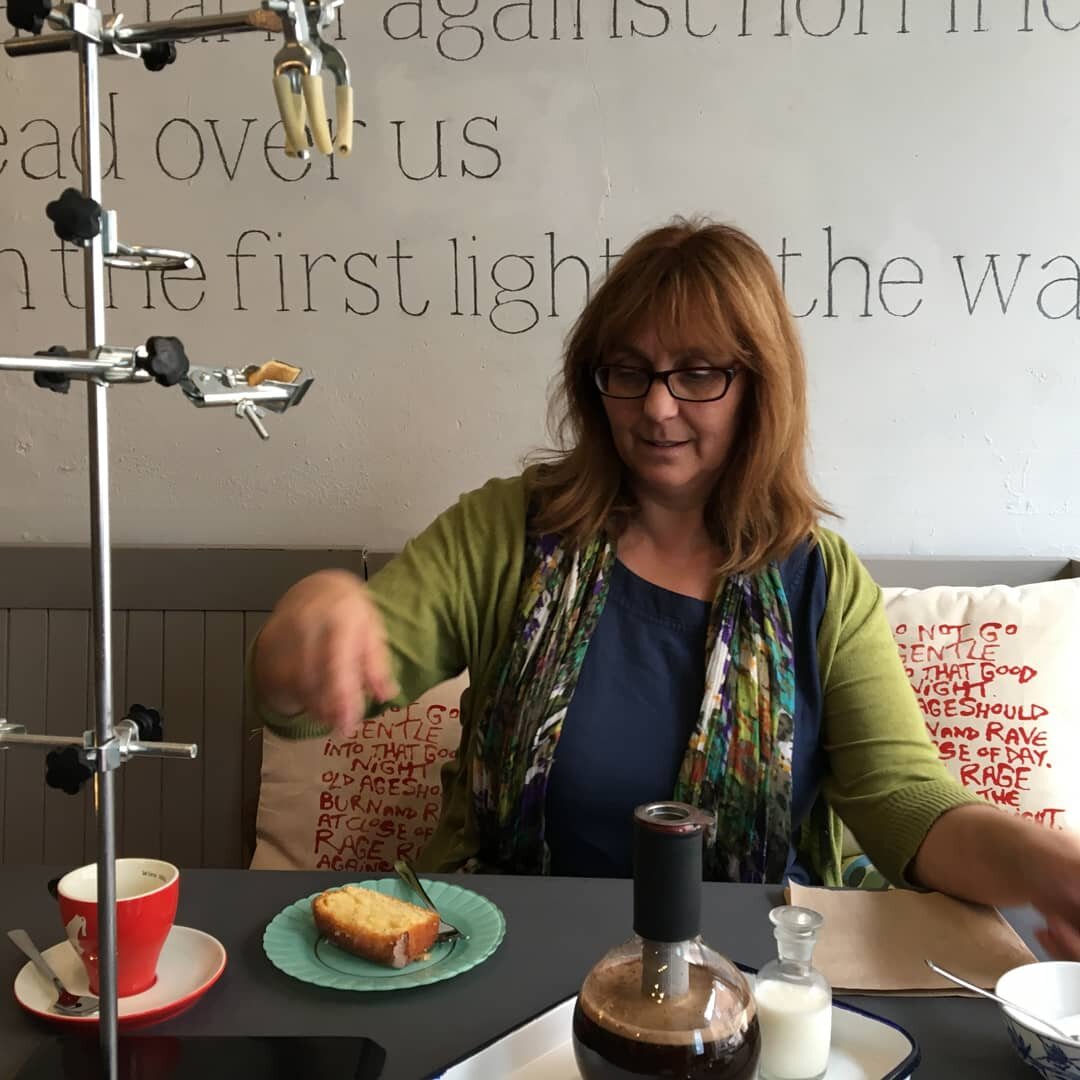
There’s definitely something about the space that appeals to people in and of itself; a kind of therapy in not having technology everywhere. We’ve explicitly designed The Poetry Pharmacy for people to sit longer over coffee. There’s no pressure to move on and people are encouraged to talk to each other. It’s a place also for people to come to read and write.

Claire: Why in this moment when we’re rushing more and more of our everyday lives online and our High Streets are sadly struggling was opening a physical space important to you?
Deborah: I see the Ambulance as a physical space too; for years I operated as an ‘Emergency Poet’ from a converted vintage ambulance, prescribing poems to people at festivals, conferences, hospitals, libraries and schools around the country. But I felt like I was getting too old for all that travelling around, and it was often cold working outside in the UK. As the editor of four books and the writer of two of my own, I felt like enough people had heard of me, that if I set up a permanent location, they would already know what I was doing.
I do believe that people still want to touch something real. To be in a place that feels like it might last. The online world has a terrible power to cut connections with people in real places. The Poetry Pharmacy offers nothing like we can replicate when we are online. I also feel like if it’s there then it’s not hard for people to engage. People here are so delighted to find this place open; a place they can drift into and have a coffee and chat
I’m aware that it’s a gamble though. It’s an experiment, that comes with a certain degree of optimism and maybe even self-indulgence.
Claire: What need in the world do you think The Poetry Pharmacy responds to?
Deborah: We offer a therapy in slowness and a nostalgia for something lost: old fashioned service, friendliness, even listening.
People can come in feeling miserable and we give them a free ‘pill’ as well as the chance to talk about what they need. Then we prescribe a poem.
Claire: Why poetry? What’s the value that you see in it when applied to people’s lives?
Deborah: I realized a long time ago that most people are frightened of literature and poetry within that. And that the people who create or understand that art can be possessive. I used poetry in my work with people living with dementia. From that experience, I saw first-hand how you can change someone’s mood by taking them somewhere with a poem and that I could share the intimacy inherent in this form. This underpinned the Emergency Poet idea; I wanted to stop poetry from being intimidating and I wanted to show that it can literally be a vehicle for talking to people. That project effectively bypassed how poetry usually gets to people and how they then get to use it.
I’m aware that the Poetry Pharmacy idea is a bit mad. That putting poetry on the High Street is unusual. We keep hearing that poetry doesn’t sell, and this is a quiet town, but I’ve done it because I really do believe that poetry is a good thing. It’s beautiful. We’re putting it front and center instead of in the corner. Why not have piles of poetry books and say that has a value equivalent to other genres? With The Poetry Pharmacy we’re bringing poetry to the forefront and there’s an art in curating it — picking out the ones that speak to certain subjects, putting them with other things, and saying,“Take a look!”


Claire: And they are. People are enamored with this idea. Why do you think that’s happening?
Deborah: When I first started, it was a mad faith thing. People said, “you know why there is no other Poetry Pharmacy in the world? Because no one wants it.” But we’re finding differently; the idea of it even existing in the world seems to be a nice thing in the middle of all this darkness — BREXIT, Trump and just continuous bad news. It’s a piece of optimism and faith in something. It’s a positive thing, and light-hearted in lots of ways
It’s lovely that The Poetry Pharmacy exists in the world. It’s like a piece of fiction and reminds me of The Little Paris Bookshop by Nina George. In that novel Monsieur Perdu opens a floating bookstore on the Seine from which he prescribes books for a broken heart.
We’re only in week six and it’s been busier than I thought it would be. People get in touch across the world, we’ve had BBC News in here, the local Bishop’s Castle / Shropshire or West Midlands community is delighted, and people are seeking us out from outside of town and even from outside the UK.
We need all the elements though for it to work: the coffee shop to have a treat and a good coffee or tea that is nicely presented, like a ceremony; music that is welcoming and low-key, that makes people feel comfortable; a shop of desirable items, the consulting room and workshop space; and lots of events going on.
Claire: Would you place The Poetry Pharmacy within the world of mental wellbeing?
Deborah: I shy away from the word therapy, but I do say that it’s therapeutic. When I prescribe poetry to people, poems that I know and love, then people can make a poem their own; just reading it will take them to another place. What poetry is doing is taking you somewhere else in your head when you are busy. It’s telling you things that you may not be hearing from other people. It underlines something to yourself. Even imagining it, is a moment of benefiting from it.
At The Poetry Pharmacy we also include material for how to look after our lives in other ways beyond poetry. There’s a section ‘For days when the world is too much with us’, where we have Wordsworth next to psychotherapy and self-help books. We have another section that’s the ‘Best Medicine’ which includes gardening and nature — like counting butterflies, sitting in a patch of sunlight, and going for a walk.
Claire: When I think of The Poetry Pharmacy, I think of it as helping people with their anxieties, but I also think of it as supporting people in their loneliness. Is that fair?
Deborah: Yes, the poetry community has traditionally been good for the lonely as often people come to things on their own. People don’t have to be in a couple or with a friend to attend these events, like they might for say a dinner party or other social gatherings. It’s easy for people to come here on their own. Most of our events are on Sundays and quite a lot of people have said that Sundays are always difficult when they live on their own, but now they can come here for company. Rural isolation can also be a problem. This can be a place that people can come on their own and still feel comfortable.


Claire: Now we’ve established the life-affirming magic of the place, can we talk a little about the practical side? Like how you made it happen?
Deborah: We ran a successful Kickstarter campaign and I was amazed at the response. The crowdfunding raised money to pay for the build-out, including things like wiring the shopfront! We found that strangers turned up and said we love this idea and want to support it, because they don’t want closed-down shops on the High Street. We also received a small Arts Council grant.
We were very resourceful. As much as we could, we turned The Poetry Pharmacy into a project for both the local community and the literary/poetry one. We had many people volunteering their time and expertise.
Claire: What advice would you give to other creatives thinking of starting a bricks-and-mortar endeavor?
Deborah: It’s difficult, which I think is why so few people do it. But for me, it was huge just knowing that there’s a community of support behind me. I think it’s critical to have a few key people to support you in the first instance, and other people believing in you. The doubters are also quite useful because they test your resolve. Maybe they are right, and you don’t do it. But for me it was: ‘Bloody Hell, I’m going to prove you wrong matey.’ You’ll know in that fierce moment whether to do it or not.
Claire: How else has The Poetry Pharmacy impacted you? How does being front and center sit with the more private practice of writing poetry?
Deborah: Yes, there is that dilemma of reconciling this public project with the country mouse part of me. I do think (without overgeneralizing) that people who write who are novelists tend to be introverted, while poets tend to need to connect with other people more often. They work on a poem, then go out because they need to talk to people. For me, I crave being on my own and periods of time to write, and I’m aware that that’s not in balance at the moment. There are two sides of me; they don’t exist in the same place, but they do need to communicate, all the same. I hope that will settle down.
I do believe in The Poetry Pharmacy and it seems to be working in the way that I hoped. Also, for me too. Because I’m now so busy, I’m not online so much. What I wanted to do — and needed to do — was to have an open door and to welcome people in. To say: “Come in. Who are you?” To say. “ I’m interested in you. “
Discover more places for a happier life

Second Home
Second Home is stretching the definition of what coworking can be and what it can look like.
“Second Home is a social business with a mission to support creativity and entrepreneurship in cities around the world.”
Coworking is no longer just about finding a place to plonk your laptop. Now it’s about so much more: finding alignment with your values, finding your tribe, finding the brightest people and the shiniest ideas, and yes, finding ways to support your mental wellbeing in ways that fold into such things as design, community and culture. That’s where Second Home steps it. It’s coworking as more than the seat you occupy; it’s coworking for a better-designed life.
We’re been in thrall to Second Home since we visited London’s Spitalfields branch with our kids, who thought it was a play space—which in a way it is. Maybe it’s the colors (that blazing brand orange), the fun textures, the transparent curvilinear walls, the sunken lounge space, the wavy ceiling. Maybe it’s the table that drops down when needed or the rooftop terrace where you can stand amongst ponds while taking in the cityscape. Maybe it’s all the green on green on green in the thousands of plants, the attempts to bring in natural light, the mix-mash of different furniture. It doesn’t feel like the kind of office space that you know, and my kids got that as they rushed through its spaces wanting to climb the chairs rather than the corporate ladder.


But it’s all been very, very intentionally designed to be this way—the playful appearance is its serious intent—to create the most positive environment for our wellbeing and productivity. The Spitalfields branch (Second Home’s earliest, opened in 2014)– and all but one of its other outposts—are the work of architect SelgasCano whose approach is deeply influenced by biophilia and evolutionary psychology.
SelgasCano also designed the recently opened, template-shifting Hollywood coworking space, which has a cacophony of yellow islands (that top tubular pods), a magic ballroom and a dense urban forest. The firm was behind the brightly colored Serpentine Pavilion purchased by Second Home and moved to La Brea Tarpits to be a pop-up/love letter/ ‘Coming Soon’ announcement to Los Angeles. At the Holland Park branch, the firm designed a space where trees grow out of the floor and a courtyard roof fills with bubbles; at Clerkenwell Green there’s a subterranean event space; in the Lisbon space an Yves Klein Blue ceiling and signature 1,000 indoor plants and trees. Only the London Fields space is designed by someone else, and then by sister company Cano Lasso, but it shares the same bold design credentials—see its impossible to miss futuristic façade – and maybe equally as radical on-site nursery and childproof café?


But beyond the outward design co-founders, Rohan Silva and Sam Aldenton had two other major principles in play: community and culture. The people who get to populate this environment are as important as the pot plants and pops of color. Second Home curates its community, aiming for a mix of start-ups, not-for-profits (it offers charity memberships), corporates, creatives, and entrepreneurs. Each inspiring, supporting, and collaborating with each other. Then there’s the culture piece, the third angle to this design-community triad; Second Home gets how ideas sustain us as much as people and place. Overlapping its space as workplace is space as creative venue, with an active cultural program that puts authors, podcasters, thought leaders, entrepreneurs, and innovators in front of its members and the public.
Collectively that greenery, the doing good piece, the feeding of curiosity and connection, are all about sustaining our wellbeing, in the same ways as the yoga sessions, running clubs, and even surf lessons on offer depending on the venue. Second Home weaves in all the multiple threads of our working lives—the design of our environment, the people we get to connect with, the culture that gets to feed us—and throws them out into as much as a real-world context as its principles allow. But there’s some fantasy at play too when you enter its doors.
(NB: There’s a special place in our heart for Second Home’s tightly curated bookstore Libreria (in Spitalfields & LA) and the poetry bookstore at the Holland Park branch. Check them out too. They probably shouldn’t be in brackets.)


Tate Exchange
Tate Exchange is answering its own question: that art does have the potential to impact our lives.
“A place for all to play, create, reflect and question what art can mean to our everyday”
Does art have the capacity to change lives? And if it does, should it? And if it should, how can it? And if it can, where, where would this even happen?
On the fifth floor of the Blavatnik building within the cultural behemoth that has become Tate Modern, you can find an initiative that is right there, at the crux of those questions, wrestling with the how’s and why’s of art’s role in society: Tate Exchange. Here, one of the most successful arts institutions in the world is creating physical space for art to be functionally in our lives and in dialogue with society more widely. It’s also staking out this territory up North, within the walls of sister-space Tate Liverpool.
We can argue for a while that art does this anyway – that art speaks to our lives. We could even argue that this is particularly the case in the vast cultural campus that has become Tate Modern (also beloved site of my first curatorial job). Yes, there’s the beauty and solemnity of the Rothko room, the drama of the Turbine Hall, the reverie of just wandering through the permanent galleries and the inspiration-making qualities of the rotating exhibitions. Yes, you have probably experienced one work of art that has affected you without that effect being branded.
But with Tate Exchange, we get to experience that question of art’s relationship to self and society more directly, to play with Impact (that elusive idea thrown around more in tech and non-profit sectors). With Tate Exchange, the organization is confronting the very idea that art has the capacity to affect our everyday lives and to answer to, and maybe also shape, society. The lines that divide life (real time and space, the big and little questions, conversation, knowledge and experience), the arts (objects, materials, storytelling, the big and little themes) and us (as the viewer, person, consumer, maker, activator) are porous. Museums are no longer perceived or positioned as separate from society, they are located, produced by and understood within it. Similarly, as we enter these white-walled spaces, we are not a blank canvas, we’re bringing biases, backgrounds, assumptions, feelings even.

Who are we? Counterpoint Arts at Tate Exchange

ArtLab at Tate Exchange
Tate Exchange is the place where the museum gets to be something different, to morph and adapt and interact in ways that push against that traditional relationship of presentation and display. To pivot on ideas of co-learning, collaboration, production, and yes that wellbeing piece. Here Tate gets to be relational, and vulnerable. To step away from its esteemed baggage. Because maybe it’s here that the museum challenges its very reason for being—not to show, and collect, and explain works of art but to examine purpose, meaning, and relevance in the realm of the arts as they hit the pressing concerns of our modern lives. To bring to the fore questions of can we do this, and does it work, along with other questions around such things as climate change, inequality, technology, the economy, and immigration.
In its four years, two of which have been headed by socially-engaged art and placemaking advocate Caro Courage, Tate Exchange has taken a deep dive in annual thematics, headliners for life each led by an artist. Tate Exchange has explored ‘Exchange’ with Tim Etchells (2016) ‘Production’ with Clare Twomey (2017), and ‘Movement’ with Tania Brugera (2018). This year, the program is roaming across ideas of ‘Power’ with Hyphen-Labs, an international female collective who explore ideas of technology.
These themes are played out within a collaborative network of over 80 world-wide associates; cultural organizations, charities, community groups, and health trusts, who draw from the fields of art, education, mental health and community (such as ActionSpace in London and dot-art Schools in Liverpool). This wide network, in turn, shapes the form that these questions take within the spaces: anything from workshops, performances, conversations, prompt cards, reading lists, curated walks, festivals, mood and pattern workshops, reskilling sessions, seed swapping, radical myology, symposia, and even podcasting lessons. It’s all here.
Tate Exchange isn’t the easiest to explain, because it does so many things; Over the years there have been myriad perspective and platform-shaping ways that its curators, artists, practitioners, students, and associates, have found to raise their voices and engage audiences. Tate Exchange is many things to many people. But it’s all linked by a single thread: it stakes territory for the importance that culture has in our very real, every day, messy lives. It acknowledges that no one checks their lives or themselves at the door when they enter a museum. As we wander its different pathways, we inevitably feel, think, and are something, someone. Tate Exchange returns to us our place to be within museums.

NOIR CITY | Dark City Wanderings
It’s like a religious revival tent meeting, but for cynics. Instead of their Sunday best, they wear their vintage 1940s finest. Rather than speaking in tongues, they wax on and on about who played what character in whatever desperately underrated classic. And Communion comes in the form of a big dose of black and white on the Castro Theatre’s massive screen.
It’s like a religious revival tent meeting, but for cynics. Instead of their Sunday best, they wear their vintage 1940s finest. Rather than speaking in tongues, they wax on and on about who played what character in whatever desperately underrated classic. And Communion comes in the form of a big dose of black and white on the Castro Theatre’s massive screen. You’ll leave sated, exhausted, but you’ll be back tomorrow night for another double feature, day-job alertness be damned. If you’re a true acolyte, you’ll see all twenty-some movies over the ten days of NOIR CITY, the annual film festival of the Film Noir Foundation.
I’ve always loved film noir. My parents apparently never thought it odd that an eleven-year-old couldn’t get enough of The Maltese Falcon; was inviting her (probably confused but at least good-humored) friends over to watch Rear Window; and once VCRs became a thing was trotting home from the movie rental shop with whatever sounded dark: Double Indemnity, Out of the Past, The Third Man. My dad had a particular soft spot for Philip Marlowe and Sam Spade, and together we tried in vain to piece together the plot of The Big Sleep, which even having read the book multiple times is incredibly hard to follow (Raymond Chandler himself allegedly said the same). But it looks superb.
Eddie Muller, founder of the Film Noir Foundation and organizer of NOIR CITY since its inception, has summarized film noir thus: “The men and women of this sinister cinematic world are driven by greed, lust, jealousy, and revenge—which leads inexorably to existential torment, soul-crushing despair, and a few last gasping breaths in a rain-soaked gutter. But damned if these lost souls don’t look sensational riding the Hades Express.”
So... Did noir make me a cynic, or did something already in Young Me gravitate toward this material, finding there something that made sense of the Evil That Men Do (or, in my case, that mean junior-high-school girls do)? My experience in the music world leads me to suspect the latter—that I was born this way, and that noir gave my imaginings form. And what a form!! Colossal glamour, pithy wit, underworld allure... Who wouldn’t want to live in a world where you could be sparklingly eloquent, successfully self-employed, adept in a fistfight, and irresistible to the ladies even if on the looks scale you’re more Fred MacMurray than Kirk Douglas?
Seeing these movies at the Castro Theatre, alongside fourteen hundred fellow travelers, takes the thing to a whole new dimension. Each evening opens with live music on the fabulous Castro Wurlitzer (recently replaced with an even more elaborate pipe/digital hybrid organ), then an acutely articulate, written-note-less introduction by the Czar of Noir (the aforementioned Mr. Muller), then the dramatic opening of the curtain to start the first feature. Each year has a theme (my personal fave so far was “international noir”), and Muller and his fellow programmers do their best to balance a few better-known titles that most people still will never have seen on the big screen, lesser-known titles that extremely few will have witnessed on the big screen, and one or two that have been saved from actual oblivion, often through a restoration directly funded by last year’s festival ticket sales. This is the goal of the nonprofit that is the foundation: to save noir films on 35mm, as they were meant to be seen. Say what you will about the viability of actual film as a medium for mass exposure to “film”—Eddie’s got a counterargument ready for you.
At this point there are numerous satellite NOIR CITY fests around the country, but San Francisco is where it all started, and where Muller grew up. He still lives here, and treats the SF iteration as the mother ship that steers the rest of the fleet. I’ve read Muller’s introduction to film noir, Dark City: The Lost World of Film Noir (1998), and have for the last couple of decades made little pencil checks next to the titles I’ve personally seen. Dark City Dames: The Wicked Women of Film Noir (2001) is the clearest manifestation of Muller’s career-long vendetta to bring the femmes of noir, fatale or otherwise, from the clichéd sidelines into the spotlight. I dutifully enrolled in Muller’s “continuing studies” course at Stanford University, “The Politics, Passions, and Personnel of Film Noir,” and I even successfully muscled my way into the gang’s inner circle, helping with the ticketing for the annual SF fest.
But at the end of the day, after you’ve completed all the reading and pondered all the theorizing and copied all the fashions and cut way too much school to watch Dialing for Dollars, the point is the theater experience. This is the “why” of the foundation: to save the films, and to show the films, at venues like the Castro. There’s got to be a really compelling reason why we keep coming back to a joint that holds 1,400 seats, puts on shows that last four or five hours, and has less than ten toilets total.
I’ve got a lot of NOIR CITY memories, but a couple stand out. The first is actually from NOIR CITY XMAS, a teaser show that happens a couple of weeks before the holidays, also at the Castro, as a kind of appetizer for the main fest coming in January. It usually features a bleak Christmas movie (I know, right?!) but this year it was Holiday Affair, a mostly-comedy with the odd bleak moment. I remember laughing so hard I was crying, right along with the crowd, fully realizing that if I’d been watching the thing at home on DVD, I would have been bored, maybe even wouldn’t have finished. I described it to Eddie the next day and he said of course that was right, that’s the power of experiencing movies in the theater. You’re physically, logistically committed, which makes you give yourself over to the larger emotive sense in the room. Sadness, injustice, intrigue, romance, glamour, and, yes, comedy are massively, massively magnified. See my religious-revival-tent metaphor that opened this piece.
This is what will be lost if the old-fashioned moviegoing experience evaporates.
Another very powerful memory of NOIR CITY is not even of being in the theater, but of reviewing the pictures taken by the photographer one year. I scrolled through crowd shot after crowd shot—hipsters, non-hipsters, old people, the occasional celeb (Chris Isaak and Jello Biafra have been noted attendees), and views of the stage showing Muller doing his thing. What stopped me in my tracks was a shot of what Eddie sees from the stage. There must be no sight on earth more satisfying than an ocean of folks who’ve paid their money and made the trek to love and support your dream, and gain something soul-satisfying that could be delivered, for us dark cynical believers, no other way.


Photographs by Rachel Walther © 2019
To find out more: website www.noircity.com / Instagram @Noir.City / Facebook @filmnoirfoundation / Twitter @noirfoundation

MARFA | Land of the Lost
The great irony of Marfa is that it isn’t really trying to be anything other than what it is: a tiny, dusty Texas town. The city of Marfa website pitches it as “more than just a place. . . . It’s a state of mind,” but my mom and I agreed that that gives the wrong idea.
“Don’t drop it!!” I yelled in mock alarm.
I’d just mentioned to the proprietor of Many Stones, the rock shop in Terlingua, Texas, that my mom and I had driven down from Marfa. Mostly in good fun, but also with a healthy dose of genuine mockery, he was holding up a work of contemporary art for our admiration and possible purchase—which was, of course, imaginary. He’d likely perfected the joke over many years: a rock shop owner, selling empty air! These rubes will believe anything!
Grizzled locals ribbing the art crowd who helicopters in, lingers just a while, and jet-sets out: Is it a cliché if that’s what they genuinely think? And who are art tourists to fling around words like “cliché,” hmm?
My mom and I spent three days in Marfa, and we saw most of what it has to offer the out-of-towners. Most tourists come to see the art—expansive installations by Donald Judd, Robert Irwin, Dan Flavin, and other confrères of 1960s minimalism, most of the works permanent and overseen by Judd’s Chinati Foundation. Almost everything is advance-ticketed in order to keep the crowds similarly minimalistic. Other tourists come to see the famous Marfa Lights, a ghostly atmospheric effect. Yet other tourists, for instance Anthony Bourdain, come for the food and continue on to Big Bend National Park, which is even deeper in, on the Mexico border. Bourdain would be dead before that episode aired. Judd died before his time, too.
The great irony of Marfa is that it isn’t really trying to be anything other than what it is: a tiny, dusty Texas town. The city of Marfa website pitches it as “more than just a place. . . . It’s a state of mind,” but my mom and I agreed that that gives the wrong idea. The folks who run the town and the art foundation really do want to keep Marfa a smallish, authentic (in the true-to-itself sense of the word, not the external-culture-police sense) place where tourism doesn’t make life insufferable for the locals. Donald Judd left New York for Marfa because he dug it as it was: small, remote, cheap. It’s the outsiders who insist on projecting onto it all sorts of loco imaginings.
My initial trip research turned up these two young ladies who sought it out as a backdrop for their fashion show:
http://livvyland.com/2017/02/02/texas-road-trip-marfa-big-bend-national-park/
Then there’s this, which makes me think “ugh”:
I have no words for this:
I mean, if you’ve spent many a summer in tiny midwestern towns, as both my mom and I have, there’s nothing . . . magical and transformative about being back in one. In fact, it’s familiar, comfortable. People wave at you when you’re out for a run. Shop owners have time to chat.
And now that we’re on the subject, I’m actually highly suspicious of art people who profess too much astonishment at experiencing a remote place. How many art hotshots in New York or L.A. or San Francisco actually grew up in the metropolis, hmm? And indeed, while waiting around for our tour of The Block, Judd’s former home/compound, I struck up a conversation with a guy, who turned out to be a Local Kid Made Good: grew up nearby, cut his teeth as a Chinati tour guide, now is employed at the Smithsonian in DC, and was back in town for the holidays to see his family. He was taking the tour as an excuse to jaw with old coworkers.
Of course now that I’ve debunked the place, it’s time to admit that I did have a transcendent moment in Marfa. As a lifelong James Dean acolyte (who even made the long, lonely drive to Cholame on one milestone death anniversary to linger at the fateful spot on the highway, at the exact time of day of the crash, with the similarly besotted), I’d known for years that his last film, the epic Giant, was filmed in Marfa. He died just days after principal photography wrapped. What I hadn’t realized was that the Hotel Paisano, where my mom and I stayed, was where the cast had lived for the month-plus of on-location filming. Massive production stills plastered the lobby, and the hallways were filled with little gems for the inquisitive guest with time on her hands, for instance a photo essay by some guy who’d visited the remains of the train station in Maryland where Elizabeth Taylor’s character was shown embarking for Texas with Rock Hudson, her new husband.
It was decrepit now, and that made him sad.
At least there was still something to see. Nothing at all remains of the Reata mansion, which was only ever a facade to begin with—time and tide, fires and looters have disappeared it all—but the spirits of those film legends, all gone now, hovered everywhere for me in Marfa.
As you leave town, for sure stop to take a photo at Elmgreen & Dragset’s Prada Marfa (I bet the rock shop guy secretly loves the idea of that place! so snarky!). But also linger a while in the desert just outside of town and commune with the ghosts of the big ones—and I’m talking about Judd and Bourdain here, too—who likewise stayed a moment or longer, and for some of whom it was more or less a last stop.

City Lights Books | behind the truth
City Lights Bookstore is a literary landmark and a magical meeting place for intellectual inquiry.
“City Lights is a landmark independent bookstore and publisher that specializes in world literature, the arts, and progressive politics.”
City Lights Bookstore is a literary landmark and a magical meeting place for intellectual inquiry. Open until midnight daily since 1953, City Lights is internationally known for its expert selection of books and for its impact on the history of free speech in America with the publication of Allen Ginsberg’s Howl and the subsequent trials. City Lights continues to publish avant-garde work, host regular events and readings, and be a beacon of inspiration for all writers and lovers of the written word.
Lawrence Ferlinghetti, the primary founder and caretaker of City Lights, turned 100 years old this year and San Francisco celebrated his incredible contribution to both this city and literary culture across the globe. Ferlinghetti is a widely read, published, and cherished poet and activist who continues to create and paint mystical worlds of the imagination.
Inspired by Ferlinghetti and City Lights, I wrote a poem to pay homage to this singular place of multi-faceted truth:
behind the truth
after ‘behind the cape’ by david larsen
behind the truth,
and growing numb,
fear floods
the misled head.
men of power
trick fear from
silence.
from
knowing
something
to
knowing
nothing.
now
the work of
untangling
knots of
misplaced, misused
lies
i start again.
To find out more about City Lights Books: Website www.citylights.com / Facebook @citylightsbooks / Instagram @citylightsbooks/ Twitter @citylightsbooks

ARoS Aarhus Kunstmuseum
ARoS refers to itself as a ‘mental fitness center’ which we just love. We’re very much on board with that approach to our museums.
“ARoS is the perfect place for social interaction. It is a place where visitors are presented with new perspectives and opportunities to broaden their outlook. In all its diverse activities, ARoS wants to radiate attractiveness, relevance, and integrity. ARoS, therefore, is an outstanding universe appealing to both the heart and the brain. Looking at art is very like standing on a trampoline. You need to be moving in order to gain something from it and, after a time, you find yourself jumping higher and seeing more of the world. This is what art is about at ARoS. It is mental fitness. ”
Usually, when an art museum decides it wants to be one of the top 10 in the world, it focuses on building a stellar collection of masterpieces. ARoS Aarhus Kunstmuseum is doing it differently by focusing on its connections with the local community and society at large. That means it’s committing to us as people not just us as an audience.
Take its latest exhibition, Tomorrow is the Question, which faces our possible futures as humans given the crises we're in and is one of the many initiatives at the museum inspired by the UN seventeen sustainable development goals (others include Hunger and Poverty). There’s the awe-inspiring rooftop work by Olafur Eliasson, Your rainbow panorama, as well as James Turrell’s wondrous expansion of the museum with the Next Level, and the ARoS Triennial, which in 2017 looked at nature and environmental issues in contexts beyond the museums walls. Plus there’s Art & Yoga, artists in residence, and an emphasis on local food and craftsmanship in its culinary offerings. It is this commitment to 'experience, insight and reflection' that is making ARoS, one of Europe’s largest museums, also maybe one of its most relevant.
In fact Director Erlend Hoyersten is explicitly making good health and well-being a goal for this contemporary arts institution:
'A good life is a life full of meaning and social relations. We humans need to commit ourselves, to know things, and to mean something to others. Joy is not about predictability, control or absence of pain. Joy is often about something we cannot be quite sure of. Art disrupts. Art asks questions. Art helps us to see what does not yet exist. Only by imagining a better world can we actually get a better world. If you can think it, you can do it.’
ARoS refers to itself as a ‘mental fitness center’ which we just love. We’re very much on board with that approach to our museums. Here we get to reach as people for whatever it is we need in our lives: curiosity, connection, awe and wonder amongst these. Giving ourselves over to new ideas, to new ways of being, to new visual languages, means we also get to give ourselves over to an expanded sense of ourselves, of our worlds and of each other.
Watch this video: it will give you shivers for how our museums can function differently. Campfires for today? Absolutely.
To find out more: Website https://en.aros.dk / Instagram @arosartmuseum / Facebook @ARoSArtMuseum / Instagram @arosartmuseum

Yerba Buena Center for the Arts
Shaping itself very much as a ‘citizen institution’ in diverse and ambitious ways, YBCA is more than an arts institution, it is a container for all our lives.
“At Yerba Buena Center for the Arts (YBCA), we are driven by the belief that art and creativity are essential to healthy lives and communities. Every day, we work with artists who are tapping into the wonder, creativity, and imagination that fuels our perception of what is possible. This sense of possibility and potential is the foundation of our well-being.”
San Francisco’s Yerba Buena Center for the Arts excels at making it’s cool taglines real. Like ‘Center for the Art of Finding Beautiful Truths Amidst Ugly Realities’. Or ‘Center for the Art of Expressing Optimism Against Unfathomable Odds’. And even ‘Center for the Art of Exposing a Needle of Insight in a Haystack of Confusion.’
These often lyrical insights are woven throughout YBCA’s mission and are activated within the diverse communities in which it consciously operates.
Yes, there’s still an active exhibitions program but one that orientates itself around social change and that promotes discussion around participation, reflection and awareness. With exhibitions by socially engaged artists such as Suzanne Lacey, Futurefarmers and Tania Brugera, YBCA goes beyond the standard solo show format to interactive installations that process our everyday realities at depth and within clear contexts.
But YBCA as a real, impactful and needed platform also manifests beyond it’s white walls and into the public realm, onto the streets, in the neighborhoods and within the urban lives surrounding it’s downtown location. YBCA’s public artworks, for instance, advocate for change. Like the partnership with the Tenderloin Healthy Corner Store Coalition, in which artists replace existing neon signs advertising liquor and cigarettes with new ones selling fresh produce. Other sited works are designed to capture our public imagination like Ana Teresa Fernández’s Dream.
With it’s moment defining YBCA 100, YBCA surveys and amplifies the people, initiatives and movements affecting social change. 2018’s wide-ranging list included the ‘me too’ movement, the students of Majory Stoneman Douglas High School, comedian Luna Malbroux, activist Naomi Klein and poet Chinaka Hodge. While YBCA’s Fellowship Program brings together creative citizens across the Bay Area to collectively interrogate a single urgent question that culminates in an inclusive day-long Public Square event, of performances, installation, workshops, and presentations.
Then there’s the partnership with Blue Shield that builds on the ‘growing evidence that art, creativity, and culture have measurable impacts on individual and community health.’ Culture Bank, co-founded by YBCA Director Deborah Cullinan, which actively invests in artists who are cultivating the hidden assets of our communities. And now YBCA has become home to the Curatorial Research Bureau, a bookstore, learning site, exhibition and public programs space that opens up who gets to learn about the discourse impacting culture.
Shaping itself very much as a ‘citizen institution’ in all these many ambitious ways, YBCA is more than an arts institution, it is a container for all our lives. It’s public service ambition is most eloquently summed up in the words of Cullinan:
“Today, as public trust in our institutions and our leaders continues to erode, there may be no role that is more important for our cultural organizations to play than to be places for people from all walks of life to come together in dialogue. In fact, I believe that the arts organizations that will survive and thrive over the next several decades will be those that embrace a radical inclusivity; set free structures that privilege certain perspectives and exclude others; encourage dialogue and debate; and, expand definitions of what art is, who makes it, and who it is for. These organizations will fuel the public imagination and catalyze collective action. These organizations will hold our democracy accountable.”
Across the cultural field, people are starting to build frameworks for engagement, transformation and participation, often through the filter of culture, and creating the structures to help negotiate our lives, from multiple perspectives. It’s a very different approach to what culture was supposed to do previously and how our institutions have been conceived and constructed. YBCA is a lead player in this field: reconfiguring what it means to be an arts institution today, the role that cultural spaces can actively take to affect our everyday lives, and what a center for doing something about it can actually look like.
Visit. Engage. Participate. Because what YBCA makes happen matters to us.
Website: www.ybca.org / Facebook @YBCA / Instagram @ybca / Twitter @YBCA

Magalleria
At a time when we’re driven more and more into the informational world of our phones, Bath’s Magalleria stakes physical/ actual space for the recent resurgence of independent magazines.
“Welcome to Magazine Heaven.”
At a time when we’re driven more and more into the informational world of our phones, Magalleria stakes physical/ actual space for the recent resurgence of independent magazines. It goes way beyond the newsagents of old with their chocolate buttons and Hello magazines, and that High Street staple W.H. Smith, that feels like it has everything but misses so much.
Since the storefront opened in 2015, owners Daniel McCabe and Susan Greenwood have refined their truly global selection of fine, independent and specialist mags that you’d probably need expensive subscriptions to even get your hands on. Plus there are mags here you’ve never heard of and want to, as well as exclusives to this store only. They’ve created one of the few places where anybody can get access to this kind of printed material:
“When we started planning Magalleria we found there wasn’t any ‘world of magazines’ the ordinary consumer could simply enter. Sure, there were seductive looking magazines draped around numerous halls and galleries across the internet that proved not to be real places but facades for vague, non-accessible or defunct commercial entities.”
Don’t worry about feeling overwhelmed when you first walk in. They will happily help you find what you are looking for. When I visited, I was looking for something specific. Any magazines that were doing interesting things in the mental health space. And they had those in piles with all the paper-based and perfectly bound perspectives that I had been searching out: Doll Hospital, frankie, Oh Comely and Flow. I also picked up Good Trouble, The Idler, The Happy Reader and Another Escape. I would have picked up more, but I had a baggage allowance to think about.
Magazines are not just to adorn your coffee table. They are for life, deeply embedded into who we are and who we might be. There’s therapeutic value in finding your publication of choice and finding yourself, your interests, your world, amongst its pages.
If you are not in the UK, you can order online but as we’re all about feet on the ground, if you are anywhere near Bath, get yourself here.
To learn more: www.magalleria.co.uk / twitter @MagalleriaBath / Facebook @Magalleria / Insta @MagalleriaBath

The School of Life
The distinct yellow pop of this life-managing brand has found infinite ways to weave itself into our lives. And this has all been done without ever really talking directly about our mental health - which is maybe the most genius thing of all.
“The School of Life is designed to help you live a calmer, wiser, more fulfilled life.”
Heads up, I have a work connection with The School of Life - I helped put on their three-day Conference at Yerba Buena Center for the Arts in San Francisco in the spring of 2018. It was kind a personal dream come true as I’d followed and obsessed over the brand for years, so this entry is going to be unabashedly in the direction of loving what they do.
I’ve known about The School of Life since they first got going over a decade ago in 2008 as a single bricks-and-mortar location in London. But now The School of Life has developed into something else: a multi-platform cultural enterprise with outlets across the world. Their initial store/classroom/therapy room now has its duplicate in multiple international locations which include Amsterdam, Berlin, Sydney and Taipei, while the distinct content developed in London now fills the twice-yearly Conferences that have so far been hosted in Los Angeles, Lisbon, Zurich and SF.
But let’s not forget the YouTube channel, the crazily popular off-site events, the gorgeous publications and products, the community app, an architectural serene retreat, even marriages and a Book of Life (which has all the thoughts on all the things). The distinct yellow pop of this life-managing brand has found infinite ways to weave itself into our lives. And this has all been done without ever really talking directly about our mental health - which is maybe the most genius thing of all.
All of this, the crazily ambitious web of physical locations and online supports, is all guided by the philosophical wisdom and cadence of writer and thinker Alain de Botton. The School of Life was, and is still, very much his own passion project, aiming to extend emotional intelligence into our everyday lives. His ambition seemingly to shape how we think about all aspects of who we are and how we interact in all the main areas of potential concern, which he’s identified as work, relationships, sociability, self-knowledge, and calm.
At the core of this mission are the roster of classes, the first step of doing something in real-space with The School of Life. These classes are approachable How-To’s for schooling us in well, umm, our lives, with subjects that we all need like How To Find Love, How to Identify Your Career Potential, and How to Fail (believe me, you need to know how to do this).
I took the class at the London school in How to be More Confident, a mixture of practical techniques and the latest research, with an undertow of stoicism (which I know is having a moment but can be sort of a downer sometimes, less grounding more annoying). Over an afternoon, we were invited to think about what confidence is, practice it by interacting with our fellow students, and learn the techniques to deploy it in our lives. All in a comfortable classroom that made it feel like learning about yourself was as natural as learning about History, or Art, or some other capital letter subject heading. That’s quite an achievement in a country that does this kind of thinking typically behind closed doors of a home kind.
The School of Life is not a bad place to start if you are looking for a very accessible journey into who you are and how you might best function. Choose a class, build a curriculum for yourself, book a bibliotherapy session, and dive deeper and deeper into the gorgeous wisdom of this brand.
To find out more: www.theschooloflife.com / Twitter @TheSchoolOfLife / Instagram @theschooloflifelondon / Facebook @theschooloflifelondon