
Collaborative Action in Self-Isolation
Share how we can come together to support community spaces and independent businesses through this unprecedented time, and help them keep the lights on.
We've been chatting about what we can do about what's happening in our world right now and our belief — shared we know with many of you — that we need to come together to take small actions to support the spaces we love.
We often feature indie stores, cafes, coworking spaces, bookshops, bakeries, unique storefronts, and cultural venues in our guide. All places that attract people and which are starting to feel the changes in attendance, balance sheets, and engagement. As we go day by day now, we're acutely aware of the need to find ways to help them keep the lights on. We have some ideas for how we might do this, whether that's just buying those much-needed groceries locally, seeing if a local restaurant has started delivery, getting books and stay at home activities from an indie store rather than the big guys, buying gift vouchers to use later. Small gestures to keep their worlds going even if we're stepping away for a while.
Here are a few quick ways to offer support. Please do share so that we can continue to offer concrete tips about how to help small businesses continue through unusual times.

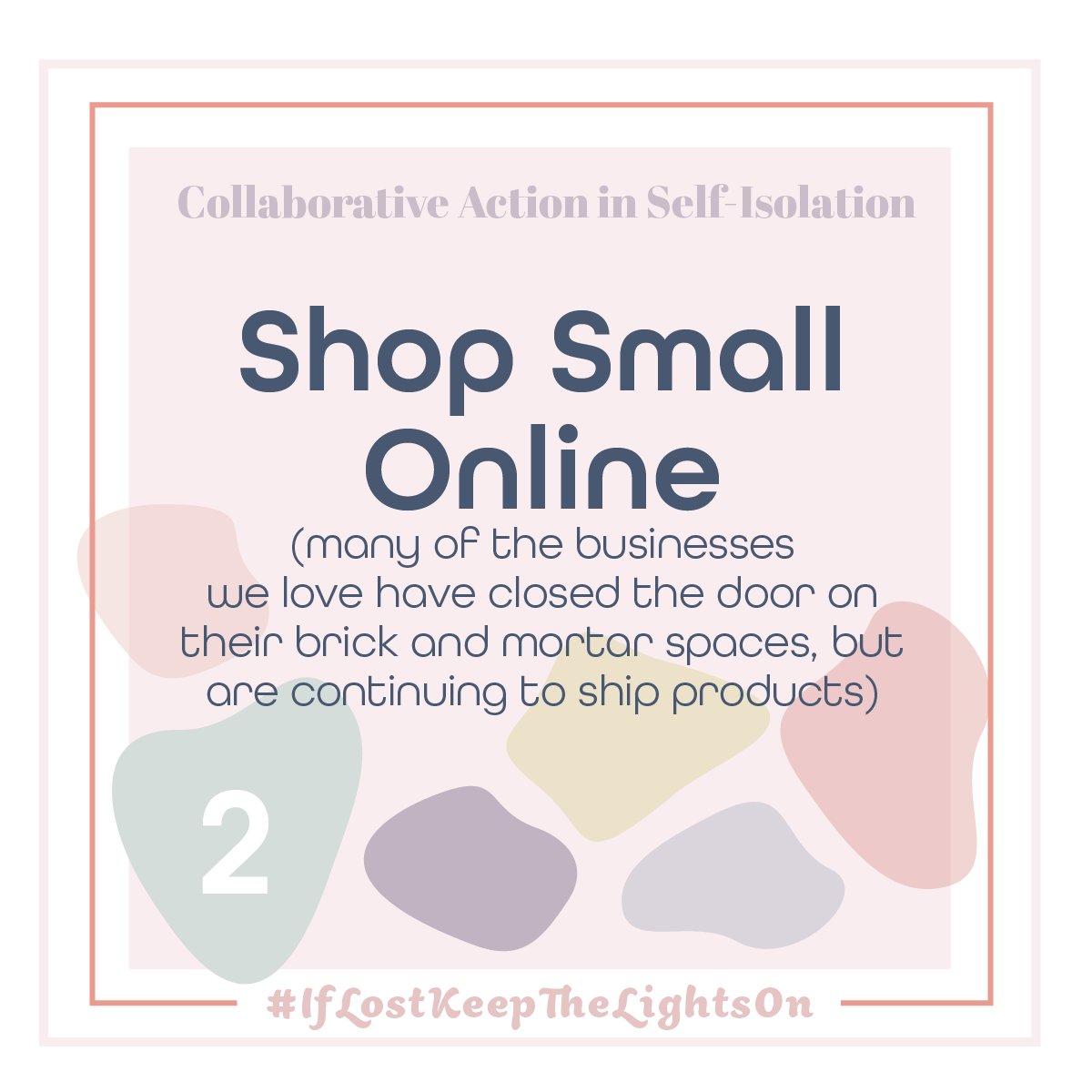
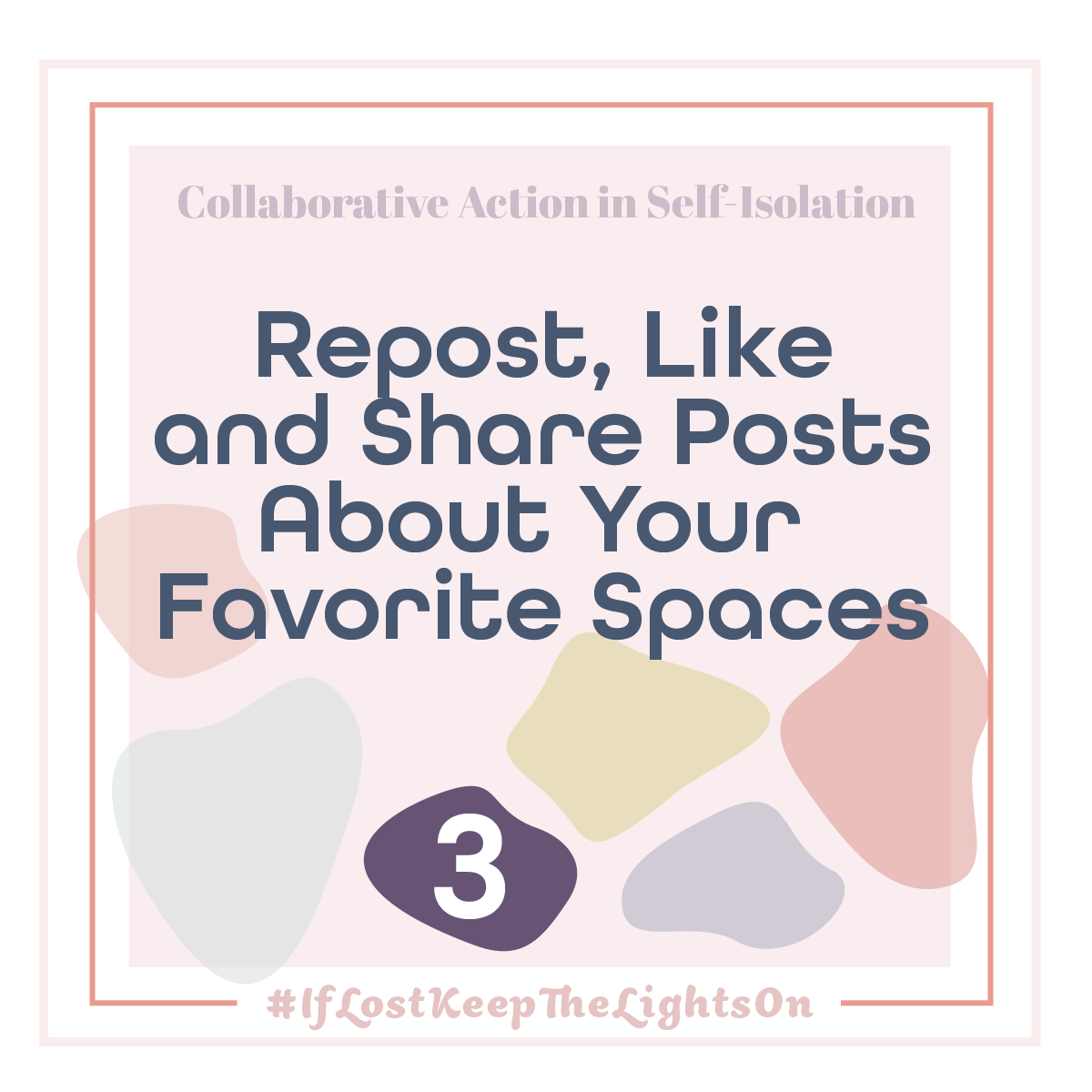


If you are a small business or if you are someone who is finding ways to engage with businesses differently, to still support them as we're social-distancing, use the hashtag #iflostkeepthelightson on social media to share advice about how people can help through these ever-evolving times.

Shifting Course // New Editorial Guidelines
We’ve reworked our editorial guidelines to help you best meet evolving mental health needs in this time of uncertainty. We’d love you to write for us, contribute an idea or support our work however you can. Collectively we’ve got this.
We wanted to let you know how we're shifting our editorial approach in this time of the Coronavirus pandemic and how we can work together to get ideas, inspiration, and tools to our readers at a time when our mental health is being greatly impacted.
Ordinarily, If Lost Start Here focuses on the places we can go to meet our needs, but that being-out-in-the-world piece is much more difficult now. So we're looking to pivot to find ways to meet the critical needs for our mental wellbeing from home. From finding community and connection to discovering our own creative potential, we're reassessing the ways we can thrive (or just cope) while social distancing and in lockdown if that happens where you are like it has happened here in California.
We're now looking to include pieces in our guide on the following subjects:
Things to do at home: This can be project-specific — from a creative project that you'd like to make available to others— or more resource-based such as a piece on the resources you are turning to sustain you at home like a great online tutorial, a meet-up platform, or a virtual pub quiz.
Nature: Many of us are turning to nature to restore balance to our days, and we're fortunate in that we can benefit from being outdoors while social-distancing. Perhaps you know a great hike, a secluded park, a hidden lake, that people can seek out in their neighborhoods (we're minimizing travel too remember). Or maybe you are an expert in forest bathing, are versed in succulent gardening, or know how to go glamping at home. We can be creative about what nature means to you.
Non-real world (the irony) places: We're looking for creative outlets, online places and innovative ways that support more of what we all need in our lives right now. Just a reminder our focus ranges across these categories (also built out on our homepage): Connection & Community, Mind/Body, Untethering, Purpose, Spirituality & Meaning, Doing Good, Mental Health, Awe & Wonder, Creativity & Culture.
Places you want us to know about so that we can support them: This one's critical, as many spaces in the world are struggling with staying open or staying afloat if they've already been forced to close their doors. Tell us about them and how we can help keep the lights on (in spirit sometimes too).
Interviews with space makers: We want to be able to share stories about how people are adapting to the current moment. Let us know how the people you know in the world who have been brave enough to make space for others, are shifting their vision, their days, their own lives.
Places you dream of visiting: We recognize that there is so much longing at the moment too. Some of us are already missing a regular cafe, a beloved family destination, a gathering that recenters you. Tell us your stories of where you imagine being (hopefully one day soon).
Culture therapy: We have a series where we look to the books (fiction, non-fiction), podcasts, TV shows, films, plays, articles, magazines and visual culture that can help support us across each of our categories. Let us know which cultural resources you turn to when you are lost, lonely, anxious or curious.
Personal narratives: Tell us about your own experience of trying to maintain your mental health in times of uncertainty. We all need to know that we are far from alone as we self-isolate or social distance. Amanda just wrote this about homeschooling which will hopefully help lots of us now attempting this.
We know that stress is high, budgets are tightening, and our plans are shifting wildly. All those things make writing for us at the moment a difficult ask. But we hope that you may have a moment to contribute so that we can build more of what we need at a moment that we need it most.
Other ways though that you can support our work: share our campaign #iflostkeepthelightson across social media, or support our fundraisers for helping spaces struggling at the moment, or share our prompts for being Lost at Home which will become a printable this week with proceeds going to struggling spaces.
Thank you for reading. Be well. Take care.
x Amanda & Claire
Co-founders, If Lost Start Here

Give Yourself a Break: A Homeschool Mom’s Guide to Loving Your Kids and Lowering Your Expectations
My friends keep asking me: “How do you homeschool ALL the time?! I am going crazy!! What’s your secret?!”
To which I keep responding:“You do realize that ‘homeschooling’ is much harder in the midst of a global pandemic when we are all panicked and locked indoors, right? Have you considered just doing a completely mediocre job??”
It should be noted, before we dive in, that there are truly unlimited ways to “homeschool” or “unschool” or “free-school”, unlimited ways to follow curiosity and to experience passion-driven, joyful education. This is just one mom’s path, in the midst of a world-altering crisis and in no way speaks to the path of any other homeschool family or system. I am posting this not to say: give up, do nothing. But rather, to say: give in, keep loving. I hope this perspective helps you to give yourself a tiny break and encourages you to find your way through, in any way that works for you and your family. You are doing a good job. You’ve got this.
In the wake of the coronavirus outbreak, rapidly intensifying shelter-in-place orders and now-mandated home-based education for many, my friends keep asking me:
“How do you homeschool ALL the time?! I am going crazy!! What’s your secret?!”
To which I keep responding:
“You do realize that ‘homeschooling’ is much harder in the midst of a global pandemic when we are all panicked and locked indoors, right? Have you considered just doing a completely mediocre job??”
This, I realize now, is not what the good parents of the world want to hear. They want the real shit. The ins-and-outs of our day. They want to know how we know that our kids are learning and well-adjusted and challenged and engaged. We do not nervously laugh-cry when we are asked this. We deliver.
So, here is everything I did today (which may be yesterday to you, or multiple days ago at this point..but does anyone even know what day of the week it is anymore? Let’s assume the construct of time will be dismantled soon.)
Ok…here we go.
It’s after 9am, but likely before 10. (Ok, it may also be after 10. I am not sure. These are trivial details now.)
We eat breakfast, pausing to be thankful that we have food and access to supermarkets (and that coffee is still allowed).
We flip through State Capital cards which happen to be strewn across the table and decide we could all really use a road trip around the continental US. (I feel like I’ve maybe never even heard of Frankfort, Kentucky before, but this must not be true?)
We make juice (convinced that ginger will save us). Kids cut fruits and veggies and craft and press their own concoctions. (This is probably science? Is “potions” a class?)
We eat chocolate because it’s delicious and this is self-care. (Also science.)
Stop everything! A package has arrived with massive blankets that look like tortillas. A photo shoot is necessitated!!
Now we’re dragging the blankets everywhere we go. (“No you can’t take it in the bathroom.” “Fine don’t let it fall in the toilet!” “No I don’t want to drag you around the house in it!” “Ok, last time! Wheeee!”)
The magic of the moment is waning.
The 11-year-old and I escape to watch Watch Harry Potter 5 (younger child reads Captain Underpants with homebound-husband then watches the movie...I’m assuming they watch other things after this as their movie is shorter but I am enraptured and intermittently sobbing so really cannot be sure.)
There are cuddles for all.
Movies are done and a “we should really do something productive” feeling surfaces. (I try to quell it but cannot.)
We Watch a 6 minute math tutorial on Khan Academy before deciding...“meh.”
We Read Harry Potter 7. It is the last book in the series and we are 81% of the way through. (I know this because my Kindle app is actively torturing me. #crucio) I’m doling out pages slowly, a seasoned addict, fully aware of the withdrawals we are all about to experience. I am sob-reading now and it’s time for a change of pace.
Still in HP-mode, we decide to watch Voldemort Make-Up Tutorials.
We do our own special effects make up. (Warning: hide your “good” make up.) (Pro tip: GO OUTSIDE)
Stop everything! Our large dog is licking our small dog and it is ADORABLE. He looks embarrassed by our laughter and we decide that he is a dog who holds himself to People Standards which is a very very complicated space to occupy. We feel for him but continue laughing. (The human experience is highly nuanced.) I think we are teaching empathy and humility but maybe we are just teaching that dogs are funny?
It’s feeling tired-y as it nears the “you’re either going to get ready for the day or you’re destined to eat an entire sleeve of Oreos at some point” threshold. (Getting ready still feels a bit too hard.)
We play charades. The kids choose things like “washing machine” and “pants”. (They are not good actors...but we do not let them in on this secret because there is still ample time to hone-in on their theatrical skills.)
We move on to play a game where you get to throw burritos at each other. (They are very good burrito throwers.)
It is lunch time. We eat at a table that some people would use for learning but that we mostly just use for eating (and burrito-related games). It used to be a nice table but is currently covered in paint...so I guess it is art now? (In a 900sf house with two dogs and two children it is very important to have functional pieces like this.)
While we’re at the table, we draw pictures of each other with our eyes closed. The 6-year-old cheats (but results suggest otherwise). The 11-year-old might be a prodigy.
We tour The Museum of Modern Art online and tell him we’ll love him even if he spends all of our (now) imaginary money on Art School. He assures us that YouTube tutorials will suffice.
We celebrate the news with a Lizzo dance party - the regular, unedited version because the Kidz Bop version is garbage (and we will not settle for anything less than “100% that bitch”.) We answer follow-up questions about “DMs” and the lure of spending time with professional football players. This is probably social studies? Maybe health, too?
Stop everything! Our snake has shed! The aftermath must be examined!! Muffin looks like a brand new man and we are all here to encourage him to be his shiniest, most noodle-y self.
It is now time for second lunch. In these strange times I’ve decided that I should not be eating food without utilizing the large bottle of buffalo wing sauce that I panic-bought at Target three weeks ago. Second Lunch is spicy and reminiscent of something you might find at an Applebees. This is self-care, now. (Unprecedented times, indeed.)
Kids disappear with boxes and scissors and tape. I am asked to cut yarn but I DO NOT ASK why because I don’t want to impede on this newfound independence. Also, I do not want to help and asking questions makes me complicit in the outcome of this project. (Plus, I need to stare at my phone.)
One child emerges from the bedroom as a dancing cardboard robot. He has painted on abs and a butt made of aluminum foil. We laugh hysterically because these are “buns of steel” and their execution is magnificent.
Child two has designed a remote control car and is operating as, I don’t know what (?) I wasn’t totally listening but something like the engine, or some sort artificial intelligence system??? Either way, she hands us the remote and it is, quite literally, the only time we’ve been in control of anything all day. Her override system is powerful, though, and she ends up going rogue. It’s ok because she is almost instantly back in the bedroom with the boxes and the scissors and her brother and all is silent for 10 glorious minutes.
Stop everything. The creativity has run out in all of us.
Everyone is lobbying for more TV (but we’re saving that for later when we’ll need to fully ignore them and get some work done.)
We lay around and listen to the Poetry Unbound podcast. (It’s possible that I am the only one listening but I mumble something about “osmosis” to myself and carry on.)
We pull out first grade spelling flash cards (despite the fact that no one here is in the first grade). We agree that English is nonsense and tentatively plan to learn Latin. The six-year-old assures us all that Spanish makes more sense and walks us through her app where she expertly clicks through pictures of corn and horses and airplanes as words the rest of us don’t understand come tumbling out of the phone.
It’s 5 now (maybe?) and we have determined that if we do not leave the house that we will literally suffocate.
We’ve heard about a project where kids go around town leaving delightful little chalk rainbows in their wake, a sign of hope and connection in otherwise unstable, disconnected times. Our neighbors are elderly so the kids make the rainbows big and extra-bright outside of their homes. We tell them that other kids may have left rainbows behind, too, and to see if they can count them on their journey around the block. They find “zero” but draw “probably 55”. The adventure is a success.
On the way home the kids find an empty basketball court and design giant chalk homes complete with rooftop decks and “more than 2 bedrooms” (an obvious slight to us, but we let it go).
Back at our tiny home, it is time for a bath.
I need to do some work, which feels pressing, but will have to wait until we’re back on dry land. For now a half-hearted mermaid impression is all I can be expected to produce.
Ok, out of the water. Kids are hungry because they didn’t eat second lunch. (Feels like their problem...but, fine, we will feed them.)
We eat dinner. It is pasta again, because we don’t understand how to save our food stores (and pasta is delicious).
We queue ANOTHER movie.
I, mostly-unapologetically, ignore them for two hours so that I can write hard hitting pieces like this. Except for the nine times I pop in to say “Sorry guys, almost done! Are you having fun? (Am I a good enough mom?) Anyway, cool cool cool, back to business! I love you!” I wish the head of the journalism program I dropped out of in college could see me now. (Except, no, not really see me as I’m still in yesterday’s PJs…which are actually PJs from TWO yesterdays ago, but who’s counting?)
We throw burritos again.
It is feeling dark enough to sleep now. We implore the children to brush their teeth (a process that spans multiple lifetimes but somehow we do not visibly age), then there are the meltdowns (whoops we missed our window), then hugs, mini-dance party, cuddles, everyone in our bed, circle back to Harry Potter and accidentally read for two hours which means we all wake up late again tomorrow.
Finally, I look around and let my eyes fall upon their little faces…faces with remnant make-up and rosy cheeks, faces that have hurled forth insults and uttered accidental poetry. Maybe it’s some mixture of gratitude that they are healthy (and silent) and the coziness of our too-small bed, or maybe it’s the realization that, holy shit, this all goes by so quickly, but, somehow, amidst the pressure to do it all right (and the fear that I’m doing it all wrong) there is really no where else I’d rather be.
Are you in search of connection and support through this time? Head to our guide for inspiration or navigate from our home page: If Lost, Start Here

Lost at Home: Prompts for thriving while social-distancing
We’ve put together a quick guide for how to maintain your mental wellbeing while social-distancing.
We all have the same basic needs — even when we’re stuck at home. While If Lost Start Here generally focuses on the *places* we go to meet these needs, we’re pivoting and reassessing to find ways to meet them from home. From finding community and connection to discovering your own creative potential, we’ve collected some of our ideas for thriving while social distancing. Have something to add? Feel free to share ideas in the comments below! This is in no way an exhaustive list! (And of course, please share with anyone who may need a boost of inspiration!)


Tilden Regional Park
At a moment when many of us are turning to nature, guest writer Kat Vellos finds her calm at Tilden Regional Park
Whenever I need a hearty serving of peace and contentment, I head to Tilden Regional Park, which sits on Ohlone land on the border of what we commonly refer to as Berkeley and Oakland, California.
As you arrive, the smell of pine and eucalyptus trees welcomes you, with their spicy and bright aroma. If you’ve chosen one of the many hiking trails or picnic areas, you might be rewarded with wide views across expanses of green that roll over hills and ravines towards Mount Diablo. Within minutes of arriving, I can feel a drop in the tension and stress that I’ve been holding. If you’re lucky, you’ll get to cross paths with a pack of shimmering, prehistoric-looking wild turkeys. And I’ve heard — but never seen — that deer and goats pass through in the summer.

If you are drawn to water like I am, wend your way over to Lake Anza. Swimming’s not usually allowed due to an algae that grows on the water. But on a clear day, you’ll find the sun glittering across its surface, as it sparkles like a sapphire set atop a tiny mountain. Just being near it deepens my breathing and allows quiet peace to wash over me. The shore of the lake even has sand near the entrance gate, so if you bring a blanket, you get to pretend that you’re laying on a very quiet, very hidden, secret beach.

Around the lake, there’s a small walking path that will take you past bigleaf maples, manzanitas, and graceful peeling eucalyptus trees that remind you to shed whatever you no longer need. At the north end of Lake Anza, a fallen eucalyptus juts from the shade into the water’s edge — a perfect perch for reflecting on the impermanence of all things.

Tilden Regional is a huge park. Admittedly, I’ve only ever explored a tiny sliver of it, having a preference for the regions surrounding Lake Anza. It has everything I need: it provides an unbroken view of the sky, the warmth of the sun, and a quiet place to walk or lay down and feel the energy of the earth rising up from deep below. If you come here, please try to maintain the tranquility that this special enclave offers. Shrill exclamations and even the volume of normal conversation carry easily across the water and will disturb the peace for everyone around you.

This special park has multiple facets and a long history that stretches back to the early 1900s.Tilden’s land originally belonged to the native Ohlone Indians. According to Wikipedia, Spanish explorers and Mexican ranchers drove the Ohlone off the land when ranchers infiltrated Wildcat Canyon. The land was turned into a park when it was purchased by the East Bay Regional Park District in 1936.
After World War II a number of attractions were added to the park, including tennis courts, a model airplane field, a miniature train, and a merry-go-round near the lake. There’s also a botanic garden and a banquet hall and event venue. If you want to stay longer, there are picnic and camping sites. Or, you can do what I do, which is simply to drop by for an hour or two whenever you need some peace and quiet and want to make the stressful rush of the city feel very, very far away.


Tomato Education
Emotional Intelligence isn’t just for us grown-ups. Agata Dela Cruz talks to the owners of Tomato, a consciously designed toddler space in London about how it’s also for our little ones.
“Our approach promotes peace and a sense of interconnection with nature, one another and our diverse world. All our services and workshops are created with the intention to strengthen a family’s ability to be happy and healthy.”
Located on a leafy high street in East Finchley, London, Tomato Education is a Montessori-based community space dedicated to enhancing the emotional wellbeing of infants and toddlers. We love it because everything about the concept — from the physical space, the curriculum and community inclusion — has been designed to make families feel connected in unique ways that support their children’s learning experience.
We had the opportunity to talk to Laura Alvarado and Beth Fordham, the founders of Tomato Education, who both believe in prioritizing emotional wellness over academic success. As seasoned educators, former students, and now parents of their own children, they shared the same adverse reactions to the lack of mental and emotional support in the traditional school system. As Laura told us: “I’ve tutored since I was 16 years old and I’m 32 now, so that’s 17 years of continuously working with children and parents. In that time, I’ve seen a decline in children’s mental health and I’ve seen the rise and stress in parents.”.
But it wasn’t until 2017 — when Laura noticed in her neighborhood of Highgate, North London, that there were numerous holistic well-being establishments for adults but nothing for children — that the concept of Tomato Education was born.


At Tomato Education everything is viewed as a learning opportunity. Laura has a deep belief that teaching is absorbed through a child’s caretakers, their environment and the wider community. Tomato Education holistically integrates all three.
For starters, the environment of the learning studio has been carefully considered for how it affects the emotional well-being and development of children. The child-sized furniture, low shelves, and easy access to supplies and activities encourage children to foster a sense of independence and self-confidence when learning new skills. The muted colors, clean and organized wall spaces, natural lighting, and the presence of plants are all there to create a calm and soothing environment that allows children to focus and learn.
The classes and group sessions that are offered encourage the participation of parents to support and observe their child as a way to immerse themselves in understanding the Montessori method. Parents and teachers are encouraged to not intervene in the classroom, but rather to allow the children self-discovery, and what Laura calls the space to enter into "flow states." This practice allows a parent to learn about their child in a whole new way. It also offers an opportunity to extend some of the mindfulness principles Tomato Education teaches to their homes and beyond.
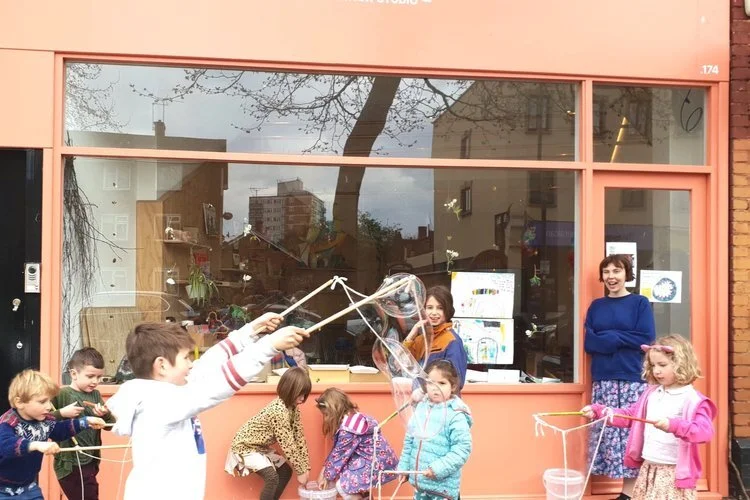

And Tomato Education is a place that welcomes a diverse range of families from all cultural and economic backgrounds. The studio space strives to be a place for parents to meet and build connections with others vested in the development of their children. Laura told us: "We arrange community bonding activities for our parents outside of all the child activities. We will try to do nights outs, going to a park or a coffee shop. Through those activities, parents become good friends and then they have birthday parties together with all their children so there's a lot of social events, which makes the community feel real."
Which benefits not just these children and their caregivers, but the community beyond. As our children learn so do we; their capacity for emotional intelligence allows us to stretch too.
To learn more about the programs and activities available at Tomato Education visit Website, Instagram and Facebook

The Natural History Museum
Illustrator Michaela Hobson revisits an old favorite, London’s Natural History Museum, and finds a place for inspiration, knowledge and respite.
“The Museum is a world-class visitor attraction and leading science research centre.
We use our unique collections and unrivalled expertise to tackle the biggest challenges facing the world today.
We care for more than 80 million specimens spanning billions of years and welcome more than five million visitors annually.”
London’s Natural History Museum exhibits a wide range of the natural world throughout time. I'm sure many of you have heard of it (and maybe you've even been there already!) but I had to share it, as it's one of my favourite places to visit. Entry to the museum is free, which makes it accessible to everyone. It also means that you can visit as many times as you like—which I've definitely taken advantage of—taking a couple of trips in the same week so that I could go at my own pace and fully enjoy the experience.
Besides the main appeal of learning all about plants and animals throughout history, I go to The Natural History Museum because it's a great place to escape the busy world outside. The building is so spacious that even when there are lots of people, you don't feel like it's overwhelming and crowded. You can stroll around the exhibits at your own speed, stop for a bite to eat in one of the cafes and spend time being fascinated by everything you see. I come out every time feeling like a child because I've learned so many new things that I want to share with everyone.

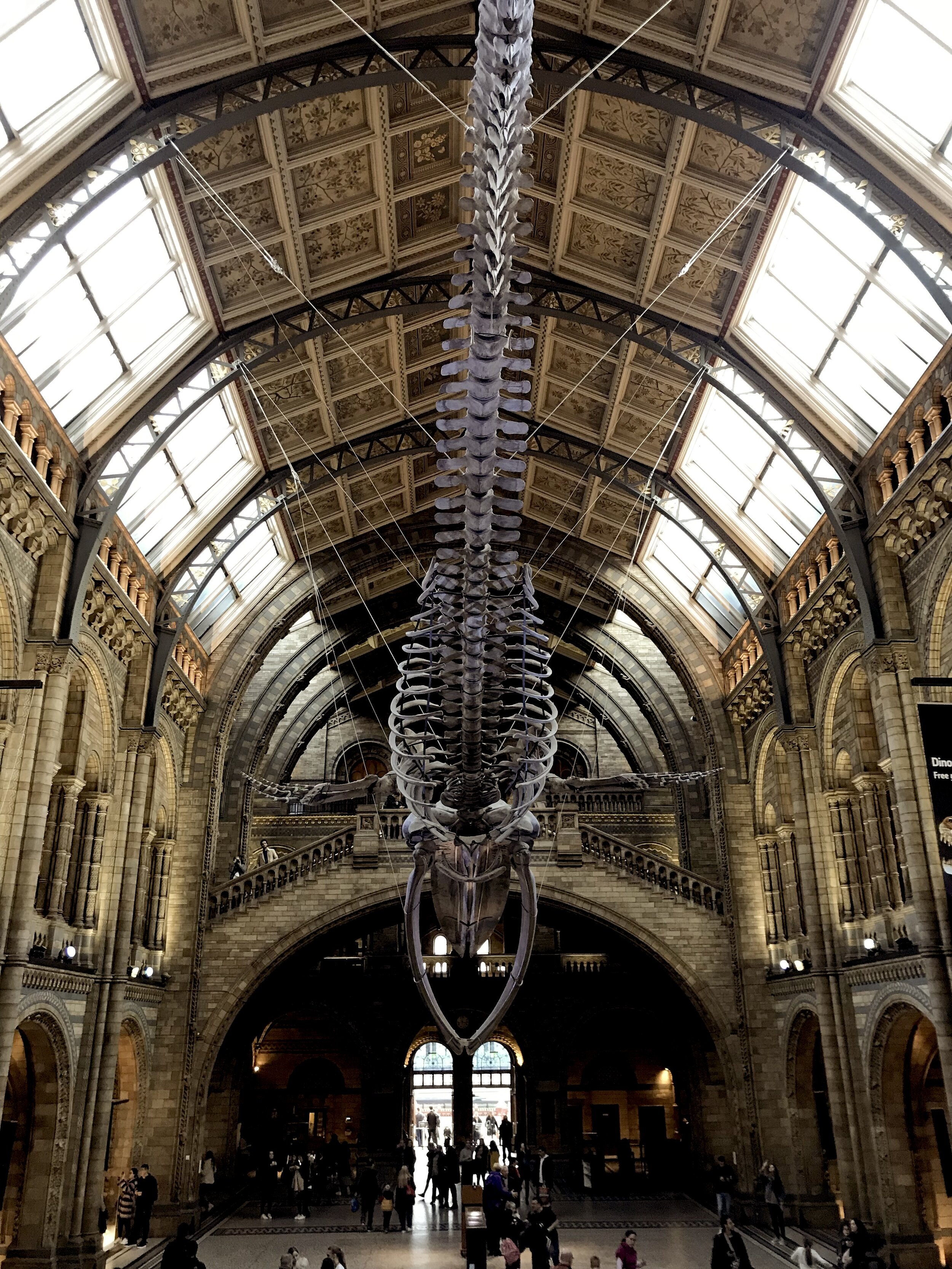

As a creative, I've also found that it's a hub of inspiration. The building itself is a work of art—with grand staircases, stained glass windows and detailed brickwork. There's an endless source of beauty around every corner, which is what I love about it the most. Stop in one of the many places to sit around the building to admire the exhibitions for as long as you need to take them in.
The Natural History Museum is a place to seek out if you're looking to relax and also be creatively refreshed. I’ve found that being in nature is one of the best ways to calm my mind, so why not learn about the history of it too.

A Space of One's Own // Part 1
This International Women’s Day, we’re celebrating female-identifying space makers. Since we launched If Lost Start Here, we’ve found again and again that many of the places that are thinking about our mental wellbeing differently have been founded by women.
This International Women’s Day, we’re celebrating female-identifying space makers. Since we launched If Lost Start Here, we’ve found again and again that many of the places that are thinking about our mental wellbeing differently have been founded by women. From initiatives that aim to balance our emotional and psychological wellbeing like Bryony Gordon’s Mental Health Mates, through to unique places of awe and wonder like Lea Redmond’s Lucky Penny Parlor, through to independent creative spaces like Alexis Joseph and Lana Porcello’s Case for Making. We’ve even covered a Poetry Pharmacy — founded by Deborah Alma. As women are raising our voices, we are also helping to shape our world in real terms.
That world is not just one that we make for ourselves. Yes, there’s a surge in interest in female-focused spaces (some of our favorites include coworking spaces like Grace Kraaijvanger’s The Hivery depicted in the main image and Molly Goodson’s The Assembly). But for the most part, these spaces created by women go beyond Virginia Woolf’s room of one’s own — a coveted space for ourselves to live an independent and creative life — but to spaces for all of us to seek out and from which we can benefit.
We’ve found that women are creating places with a purpose that can better reflect the kind of world that we thrive from inhabiting. The storefronts, initiatives, and environments that women are creating are designed to do the things we need most: build connections, contribute to healthy communities, make space for creativity, bring the relationship between our minds/ body (and sometimes souls) into focus, give us access to nature and untether us from the overwhelm of technology, and even allow for spirituality, joy, and hope.
As the world shifts, women don’t just have a voice in it, we also get to shape it, giving concrete expression to how our own needs, our own sense of space, is evolving too. Staking out physical places in the world is vitally important to what that world becomes for us and each other.
We’ve also discovered this from our conversations with women space makers; making places in the world is an act of bravery. (Take it from our friend Tiffany who just launched her women’s collective and workspace All Together Co.) It takes a huge amount of courage and commitment to actually open any physical location in the world. Think about some entry-level constraints: rising rents, a displaced consumer-driven more online, the unceasing competition for audience and platforms, and fragmented communities. Now let’s add in an almost marriage-like scenario once a space has launched: an ongoing commitment to opening and closing up, replacing milk and toilet paper, managing relationships within a business and with customers/clients/suppliers, keeping the lights on (even changing lightbulbs). And let’s just throw in the costs of build-out, inventory to get started, permits and contractors. Are you tired yet? Now do it anyway, and make it work, and thrive, and sustain yourself and others. These women are our heroes.
Over the next few months, we’ll bring you more stories from female-founded spaces, more words of wisdom about their why’s and their how’s. For now, to go into this weekend singularly celebrating women’s achievements, we’ve pulled together some of those spaces that we’re particularly excited about and some of the people behind them that we wanted to highlight. We hope you’ll find some inspiration here. We encourage you to seek out these places, as well as the others that we’ve featured in our guide, to support female-founded spaces wherever you live, and maybe even to start something of your own?


Vent Over Tea
Tatiana Backlund writes about a new active listening service in Montreal that you can seek out when you are in need of a good ole chat.
When someone tells you their problems, do you try to fix it? We tend to offer alternatives and suggestions when people share their feelings. But sometimes people don't need advice, they just need someone to listen. Just being heard by an empathetic person can help us feel validated and understood.
In Montreal, Canada, Vent Over Tea offers a free, in-person, confidential active listening service to the community. This volunteer driven service aims to promote mental wellness and connection within the comfort of a local café.
I had the opportunity to speak with the amazing folks over at Vent Over Tea to get a more in-depth understanding of this initiative.

Can you walk us through what to expect when you book a session with Vent Over Tea?
When you book a vent session through our online platform, you pick a day, time, and cafe to meet at that’s convenient for you. On the day of the vent session, you meet at the cafe, you each buy your own beverages, and then you get to talking!
When booking the session, you’ll be prompted to list any particular topics you’d like to talk about in the session, but during it you can talk about whatever you’d like. You can make chitchat and ease into whatever topic has been weighing on your mind or dive right into it. Maybe something else has come up since you booked the session that you’d rather discuss. Our active listeners are there to create a space for you to talk about what’s on your mind, so the listener doesn’t have any expectations about what, when, or how things “should” be discussed.
What value can an active listener bring?
Vent Over Tea’s active listeners bring value by helping to create a space for people to vent, explore feelings, and possibly even discover their own solutions. The idea of Vent Over Tea came about when one of our co-founders, Sarah Fennessy, had worked through her PTSD and no longer needed to see her therapist but realized she still liked having someone to talk to. Around the same time, Sarah learned about a study that found that people with low levels of depression and anxiety saw on average as much improvement in their mental health by speaking with an empathetic listener as they did speaking with a professional therapist. Our service aims to offer our venters empathy and understanding to help with their mental wellbeing.
What main goal does VOT hope to accomplish?
Vent Over Tea's main goal is to promote mental wellbeing. It’s a lofty goal for sure! There are three main ways we try to improve the mental wellness of those we interact with:
There are lots of instances where a person could benefit from talking about their issues, but they don’t need to see a professional psychologist. We understand how helpful it can be to talk through what’s bothering you with an engaged, impartial listener. We want to give people in these situations an outlet to vent to another human being face-to-face.
We want to help destigmatize help-seeking for mental health. Whether you just want to vent to one of our active listeners or you have a mental illness and want to see a psychiatrist, through our service, events, blog, and social media, we try to spread the message that it’s okay to talk about how you’re feeling; it’s okay to ask for help.
Finally, we want to help create a connection within our community. Montreal is a well-populated city, but it’s common to feel lonely and isolated here—even when you’re pressed up against strangers on the metro. Through our events in particular—but also through our service and digital presence—we try to create space for people to connect with others in a way that makes them feel more rooted in our community. We truly believe that facilitating this sense of belonging will have a positive impact on the mental health of the members of our community.
If you think you’d benefit from Vent Over Tea’s services and to find out more visit: Website, Facebook, Twitter and Instagram

Butser Ancient Farm
Writer Tiffany Francis-Baker takes us both back in time and brings us into the moment on the South Downs.
The farm sits in a small valley, just metres away from the A3 trunk road that roars its way between London and Portsmouth. You’d never guess it was so close—to drive down the dirt track is like being transported into another world, one serenaded by yellowhammers singing in the hedgerows, their golden feathers like turmeric in the morning light. This is Butser Ancient Farm in the South Downs National Park, where rosebay willowherb tumbles out of the earth like coils of pink rope, and adders sunbathe, hidden, in heaps of firewood.


At the heart of the farm is the Iron Age village that Butser has become most famous for, a cluster of six roundhouses with roofs like pointed witches’ hats against the sky. What is this place? The internet might indicate a museum or education center, but the truth is more ambiguous. It’s an archaeological research site, specialising in the construction of ancient houses using their archaeological footprints and sustainable materials. In one morning you can explore 10,000 years of British history, from the Stone Age longhouse, through to the Roman villa and Saxon mead hall—all with a cup of coffee in hand and plenty of time to greet the rare breed pigs, sheep and goats that lounge about in the sun.


To the south, at the base of a steep hill, the interior walls of the Neolithic longhouse are marked with wall paintings, streaks of umber pigment replicating a hunting scene from an archaeological dig in Turkey. On the northern edge of the farm, the Roman villa stands white and cool, complete with handcrafted mosaic, underfloor heating, and a walnut tree in the garden that is said to bring on a ‘heaviness of the head’, according to Pliny the Elder, if one sits beneath it for too long. And at the far end of the site, the Saxon mead hall glows with heat from the fireplace, a favourite roosting spot for one of the farm’s barn owls who shelters in the timber roof on dark winter nights.


Both staff and volunteers are drawn to this place through their love for an older, slower way of being. They are passionate, often eclectic, but never boring. In one day you might meet a woman weaving tapestries by the roundhouse fire, while the clink clink clink of the blacksmith echoes through the air as he forges a new sword. Elsewhere, a Roman cook drizzles honey over a batch of freshly grilled figs in the villa kitchen, as the treewright finishes hewing another timber beam in the Saxon workshop. You can smell the warmth of sleeping goats, the elderflower blossom and fire smoke, all caught in a time capsule that seems so very distant from the chaos of the modern world.

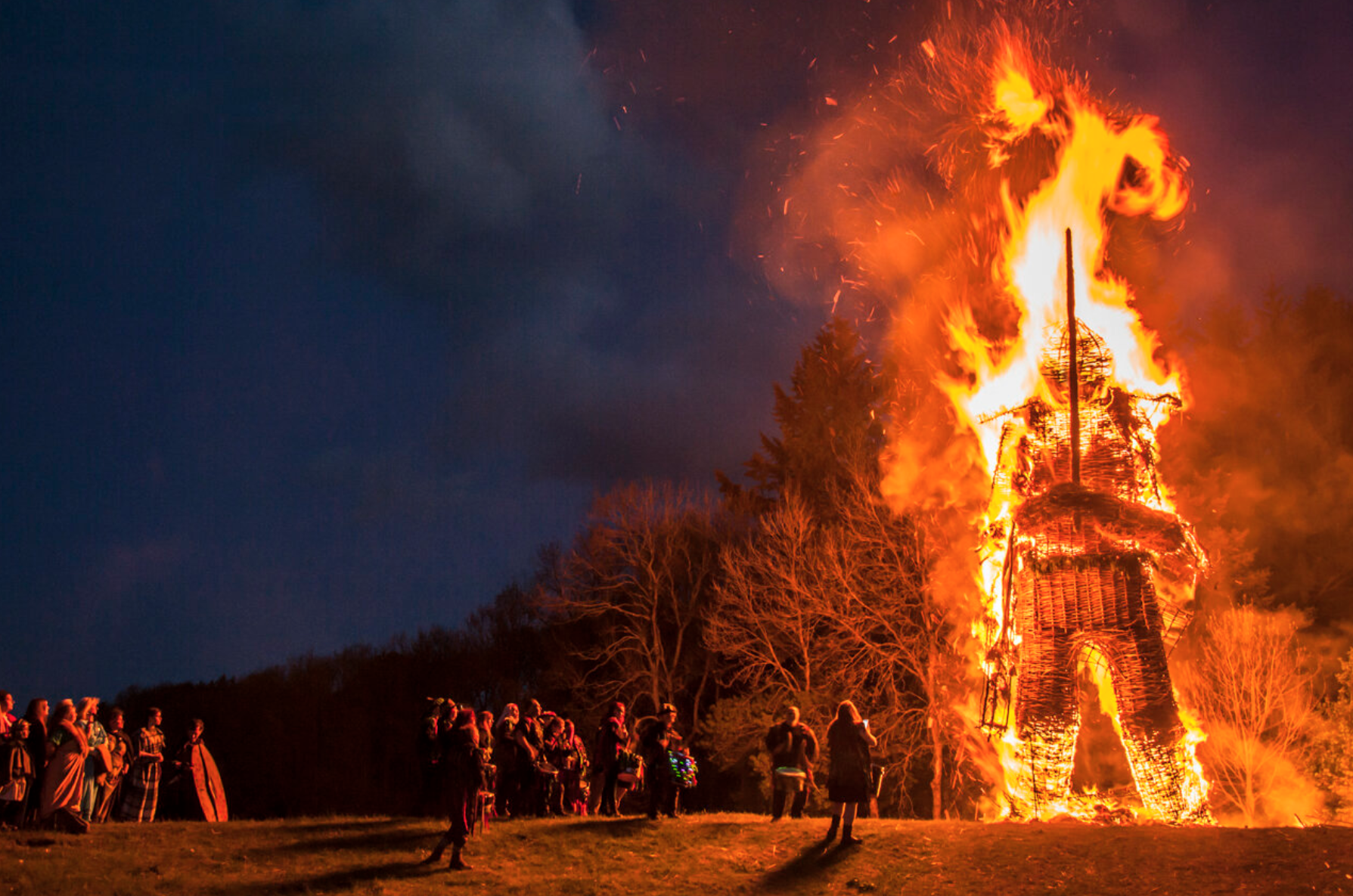
In spring, the biggest event of the Butser calendar takes place, rooted in the Celtic wheel of the year and the festival that marks the beginning of summer. Beltain (or Beltane) is held around 1st May, halfway between the spring equinox and summer solstice. At Butser, it’s a time to welcome in longer, warmer days, celebrated with live music, dancing, drumming, real ale and cider, crafts, local food, storytelling and ancient skills. As the sun sets, the festival finishes with the burning of a 30ft Wickerman, an inferno of cleansing fire and raging heat. Hundreds of people come together to bask in the Wickerman's flames, cider in hand, drummers beating their rhythm into the night, as each guest dares to escape modernity for a few short hours, hidden away in the dark wilderness of the South Downs landscape.

Mindful Doing & Creative Space
Ellie Grout finds her community of introverts at Bristol’s Creative Space and her equilibrium through Mindful Doing.
Relaxing spaces took on a major importance in my life following the second—and hopefully last—of two very unexpected breakdowns. Although I’d previously needed a little time to settle in to new surroundings, I could still be content in most places. Once my mental health had been shattered there were very few places I could go without heavy consideration. This meant that I now spent a lot of time at home; I love my house and it is definitely an anchor for me, but too much of a good thing always has its downsides.
This deterioration in health pushed me into creative experimentation, along with my sister and best friend Lottie Suki, who in a spooky coincidence had experienced a similar breakdown that closely mirrored my own. Coming from a creative family and each with creative backgrounds, it was no surprise that we found our solace in making and crafting. The first smile of excitement on my face in months came from making a teeny, tiny 25mm badge. This unofficial course of discovery proved to be our tonic: we both began to recover and rediscover our authentic selves as we lost ourselves in creation.

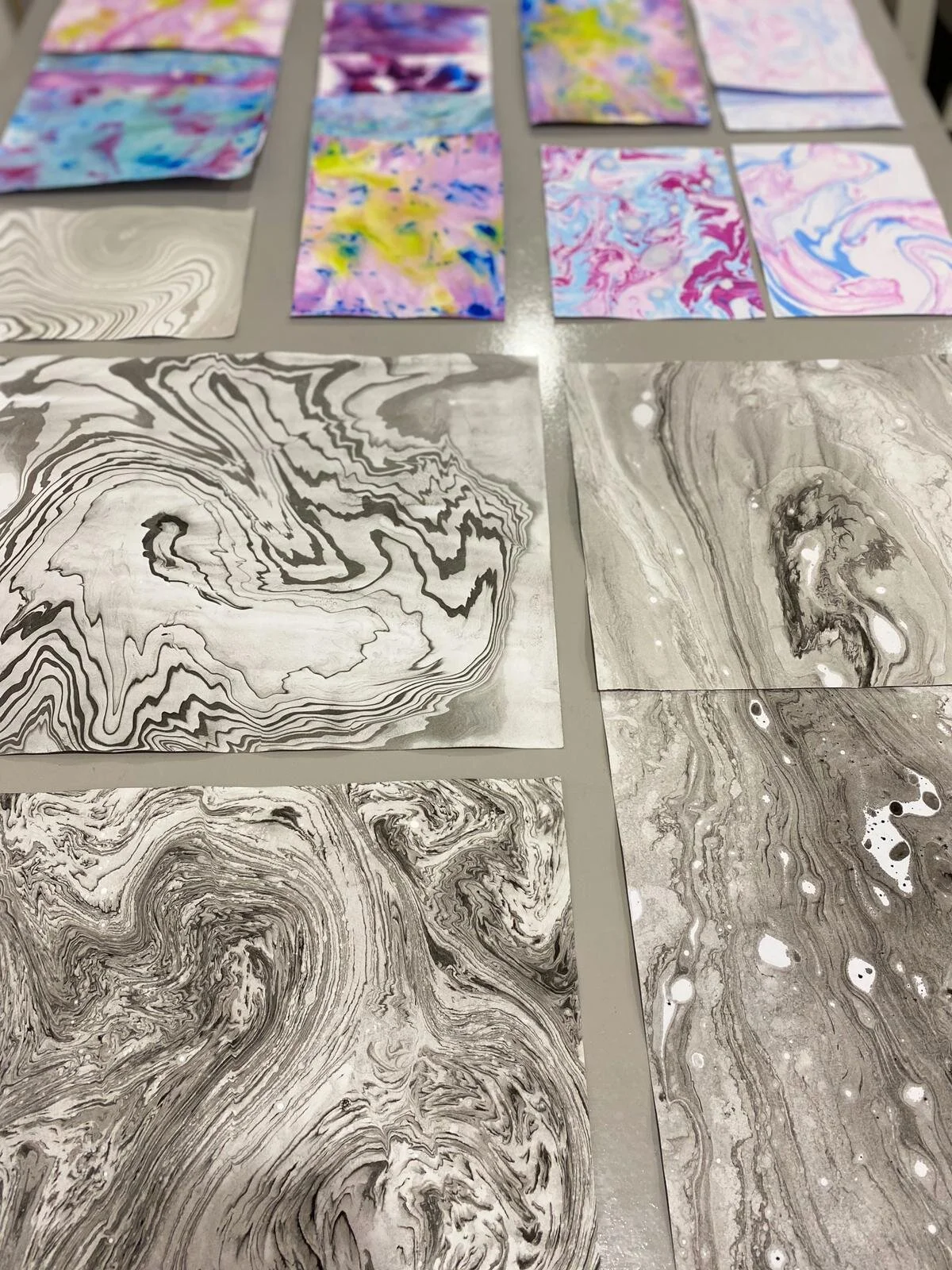

Once my sister and I had regained our confidence and joie de vivre, we began to daydream about developing a community of introverts, who, like us, would rejoice in the opportunity to calmly and quietly experiment with crafts. A weekend stroll down North Street, Bedminster, Bristol, landed us with the perfect location to make our dream a reality. I was heading to Storysmith (an idyllic independent bookshop on the same street, where you can browse what feel like dream bookshelves) and from the corner of my eye I noticed a sign calling for creative professionals who wanted to rent space to lead workshops. The coincidence was too exciting for us to ignore.
Even on first impression, Creative Space seemed heavenly. Settled amongst the pleasant hustle and bustle of North Street, the entire shop front comprises of windows which let the light flood in. Inside, the space is spacious and yet still cosy. The studio is an inspiring place to be; like a gallery, the walls are white, and the artificial lighting is bright. The windows are filled with reupholstery projects that are still in progress, along with creations from the wide variety of teachers who also run workshops in the space.


Having come such a long way in our own lives, my sister and I decided to be brave. We knew how much our wellbeing had improved through doing things mindfully, and so we made the bold step to begin our own course: ‘Mindful Doing’. Whilst we both do rather different things with our days and careers, we both discovered that the act of creating was a major contributor to our improved wellbeing and we wanted to share this with others. We devised a short course which explored some of our favourite ways of making things through writing, drawing, paper making and bookbinding and we ran it for the first time last summer. That was when we discovered our own 'Community of Introverts'.
Even though anxiety has haunted us throughout, what has been most wonderful about this little venture, is that we have both felt the healing of these sessions at least as much as the people who have come along to them. We travel to the venue filled with nerves and the overhang of daytime stressors, but by the time we leave we are filled with positivity and calm. We both feel the benefit so much from supporting others to be mindful in their ‘doing’. The community within our sessions is wonderful, the space and what it stands for within the local area closely aligns with our values, and the area is itself is a magical little nook of a vibrant city.

Beckenham Place Park
Zabby Allen, and her dog, find a world away from London as we know it, and a place to make her world just a little less isolated.
I recently moved three miles down the road. But it feels a world away. I’m used to having multiple shops and restaurants within a short walk. All that is next to us here is a station and a park. I worried when I moved that I’d feel isolated, but I’ve found that the benefits of the park far outweigh anything I had before.
The largest green space in southeast London, Beckenham Place Park was used as a golf course for over a century until 2016. Thanks to a National Lottery grant, the park has thrived since the closure of the golf course (something that understandably caused a lot of upset at the time). The Georgian swimming lake has been reinstated (I haven’t been brave enough to try it yet mind you), and the original stable blocks have been turned into a lovely cafe serving not only coffee and cake but pizza and booze! There’s a huge play area and stunning formal gardens. The centrepiece is a grand Georgian mansion—currently managed by the people behind Peckham’s Copeland Park & The Bussey Building—hosting regular markets and events, plus another cafe, basement bar, record shop, yoga studio and sewing school.


Really though, my favourite things about the park are all-natural: the bluebells starting to sprout, the maze of muddy paths, the bats that skim the lake as it gets dark, the frosty grass, the sound of the woodpeckers working away in the ancient woodland, the way the Ravensbourne River rages after a night of heavy rain and then seamlessly calms the next day and the surprising flash of bright green as the parakeets come in to roost at sunset, which I like to think of as south London’s answer to the Northern Lights.
If you like dogs, this is the place for you. My other half calls Beckenham Place Park a “dog safari”—you’ll spot every type of dog imaginable if you visit at the weekend. You might even stumble on a meetup—a grumble of pugs or a shout of schnauzers (yes those are semi-legitimate collective nouns). And yet, as busy as the park can get at the weekend, I very often find myself completely alone, listening to bird sounds and leaves crunching underfoot. How lucky I am to live this close to something so peaceful. It does my mental health wonders.


When I first visited—dog-free—I was amazed by the number of people in the park who said “good morning” to me. People interacting with strangers voluntarily in public? This wasn’t the London I knew! I need not have worried about feeling isolated. The park and the dog mean I talk to far more people in a day than I ever did before... Even if I only know their dogs’ names.
If you’re thinking of visiting, Beckenham Place Park is only half an hour from Blackfriars on the train. Alight at Beckenham Hill. Find out what events are happening at Beckenham Place Mansion here.

Eureka Hall & School of the Alternative
Illustrator Chelsea Ragan captures how past, present and future creative minds sit comfortably together at Eureka Hall.
Have you ever been to a place and felt like you have been there before? Something deep in your soul knows that the location holds more than wildlife, plants, and man-made structures. Can you sense something in the air? Maybe it’s the spirits of those who have come before, or is it the feeling that all of the stars have lined up for you to be in this moment? Time feels like it stops and you are in this place fulfilling your destiny.
This is the feeling that I experience every time I step foot onto the grand porch of Eureka Hall, formerly “Lee Hall” at YMCA Blue Ridge Assembly in Black Mountain, North Carolina.
Years ago, I was traveling with my now-husband Adam Void, passing through the Appalachian Mountains. He noted that we were just a hop and a jump away from the historic Black Mountain College Campus and we should check it out. Entering the town of Black Mountain was something special. Surrounding us were the mountains that had been inhabited by the Eastern Band of Cherokees for generations. The feeling of peace is evident and the desire to be immersed in nature immediately takes over.

Photos: Bronwyn Walls (left) and Rita Kovtun (right)

Once we made our way up the winding rhododendron filled, one-way mountain road, we saw the historic building standing high on the hilltop. This was something we had seen in pictures and dreams, but never before in the flesh. When we walked up those steps and turned around, we were awestruck by the view. The Appalachian mountains “Seven Sisters” are lined up perfectly like they were ready for a photoshoot, standing tall as they have for generations. Yes, the view is extraordinary but something else is there; something unspoken.
One explanation for this feeling of spirits is the incredible history of those who have stood countless times in exactly the same place. The many native Americans that found this oasis and treated it as gold. Fast forward thousands of years to the early 1900s when the YMCA Blue Ridge Assembly started operating as a fully functional conference center and meeting place for people all over the globe. It has since housed summer camps, yoga retreats, youth groups, and many other gatherings.
In 1933 Black Mountain College began its legacy on this porch by using these grounds to change the course of art education and to house some of the leading artists of the 20th century. On this very same porch Joseph Albers taught painting classes, faculty met to discuss the future of education, and students danced the night away. These leaders, and soon-to-be leaders, of creative thought, looked over the mountains while passing the hours, soaking up the sublime possibilities.


Even today, the porch of Eureka Hall supports budding creative minds from all across the globe. Every Summer in the month of May, School of the Alternative creates a live-in, passion-driven education experience that functions in the spirit of Black Mountain College. At SotA, anyone can take classes in the same rooms that once held Albers office and the old BMC library. On a hot summer day, you can lay in the grass in front of Eureka Hall and feel the decades fade away. This grand porch still houses late night debates of contemporary literature, plein air painting classes, DIY movie shoots, and general creative shenanigans.
I feel like I’m one of the lucky ones. I live less than five miles away from this creative hub. On days when I feel lost, insignificant, and creativity confused, I find myself drawn to those steps. A couple of months after the birth of my second child I came to sit on these steps wondering if I’ll ever make art again. “Did I lose it? Is my mojo gone?”
Sitting on those steps I reminded myself that destiny can’t be erased or lost. That no matter how treacherous the journey and the amount of times we feel lost we will always find our way to what we’re destined to do. Whatever that is. I felt the comfort of knowing that if my heart is in it, I will always have a guide. This is just one example of how this place, these steps, this view, has changed me.

Photos: Adam Void. Cover image: John Engelbrecht


The Good Life | A conversation on sustainability with founder Shelley Brown
The Good Life is one of those stores we’d love to have in our neighborhood. We chatted to its founder on why local matters more than ever.
We lured Shelley Brown away from stock-taking to talk to us about The Good Life, the waste-free mini market that she founded in northern England just a year ago. We discussed why local still matters, what led her to start the space, and how to deal with the challenges of being a store owner. This conversation restored our faith in our High Streets to do good for our communities, our planet and ourselves. We hope you feel the same!
What inspired you to start The Good Life?
The Good Life had been brewing in my subconscious for some time. It was the sudden death of my sister which spurred me to start the project with my father. It became something positive to focus on during a very dark time.
How do you bring a sense of community and connection into your space?
The Good Life is very much a community enterprise. It has been unexpected quite how much! Customers constantly tell me what the shop means to them and what it has done for the area. It’s been so rewarding. I live down the road in Heaton Moor and my daughter goes to Didsbury Rd School, a four-minute walk away. I knew that when I opened a shop like this it would be vital that I was connected to its location. The Heatons is full of independent businesses and the residents are passionate about supporting them. It is an area where people tend to stay. The shop stock has been built around the customers; if they ask for something, if I can get it I will!
Do you ever think about wellbeing, your own or others, in what you do?
Wellbeing is very much connected to The Good Life. I have always embraced life, but even more so since losing my sister. It is not unusual for customers to bring us home-baked goods, cards, and flowers. The shop has become an open space for customers to come and have a coffee or sometimes a glass of wine, to have a chat or even a cry. I feel very connected to my customer base; some have become dear friends.


Are you finding that there's an increasing interest in sustainable lifestyles? Do you think that people are starting to change their shopping habits? We've noticed more people going on plastic fasts and bringing reusable cups, for instance.
Absolutely. A change is certainly happening and people know they have to make changes. We are also seeing big corporations responding to a demand for this because of the action of individuals.
What one thing could people do to live a more sustainable life?
Refill! The household/beauty refill side of the business has grown month on month since we opened. We look for new products all the time. As well as the obvious choices like laundry liquid we now do everything from micellar water to deodorant to baby oil. It's a very easy swap for people to make and massively reduces their personal waste.
Why was a physical space important to you (rather than online)?
This business is all about relationships. The internet has, of course, contributed to the death of the High Street, but also the death of communication. Our demographic is from 0-90 and I am very aware of the isolation that older generations must feel and how important shops like this are to them.
What’s the best thing you did to achieve this dream?
I just got on with it! Failure was never an option!
What’s been the toughest moment and how did you get through it?
It's a financial juggling act. Building the stock has been hard as it's vital to buy in large bulk to compete with the supermarkets.


Who or what did you draw inspiration from?
I drew inspiration from other zero waste shops to build my base stock. An old friend Pete helped me realise my shop vision through the design process and Charly Tudor (introduced through Pete) was vital in creating the brand identity.
The shop is named after the TV programme. My sister and I watched it growing up and I re-watched it all after her death. It's not an original name, but I couldn't call it anything else!
What would be on your ideal High Street?
I love living in the Heatons because we have what a traditional High Street looks like. Independent shops offering everything from glasses to gifts to clothes. We even have an independent cinema. I hate cheap shops selling crap. Budget supermarkets who rip off suppliers and farmers. Convenience stores that sell air-freighted food all year round! We have lost the value of good, local, seasonal produce. The high cost of living has forced people to demand cheaper and cheaper foodstuffs and it's been to the detriment of the planet and of the nation’s health.
We wanted to mention how much we love the apron 'We're Naked in Here!' and your design approach overall.
All down to our designer Charly Tudor! It was certainly a talking point!

The Eden Project
What does one of the most popular visitor attractions in the UK have to do with wellbeing? A lot it would seem.
“Transformation — it’s in our nature.”
There are many visitor attractions that wear us out. The traffic at parking, overcrowded visitor buses, long walks between the ‘highlights’ and queues once we’re there, overpriced and unhealthy food options, and the inevitable sugar crashes with tantrums from all ages: collectively these make the places that should hold excitement and wonder feel fractious and underwhelming.
But this wasn’t our experience at Cornwall’s Eden Project, one of the most popular places to visit in the UK — even though one of our kids complained the entire day that they were not in a swimming pool! We managed to keep that sense of awe and wonder from the moment we arrived — and glimpsed that first truly stunning view of the biomes which are tantalizing hidden until the last moment — to when we left, of course, through the gift shop but one which played out on its shelves the same story of sustainability and impact that we’d been following all day.

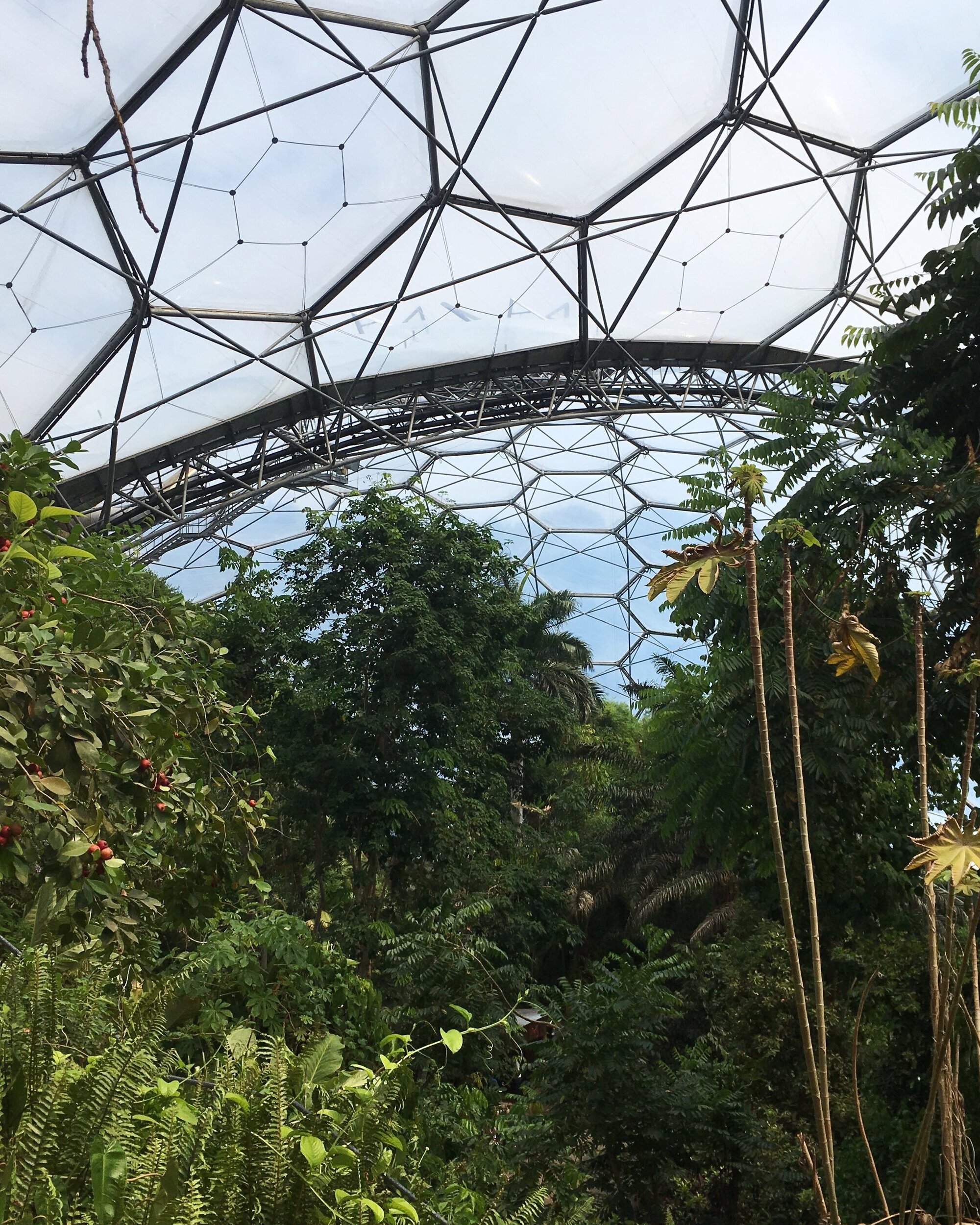
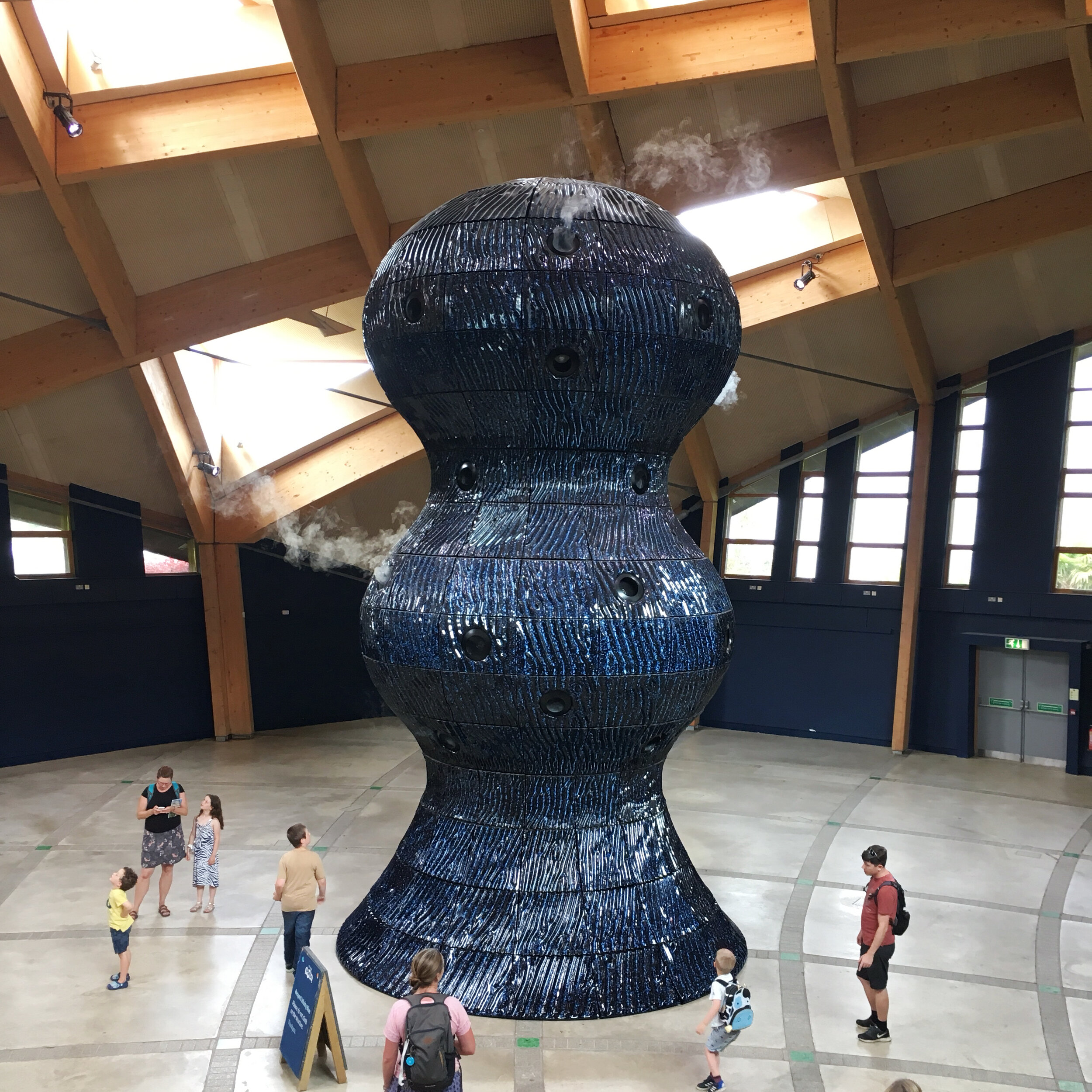
What captured our imagination most were those things you might immediately think of — the largest indoor rainforest with over 1,000 different species (and a cloud-making bridge), those other-worldly bubble domes, the zip line (!) moving its daring-doers across the valley. But there was also the wonder of the Core Building which houses permanent exhibition Invisible Worlds and includes Studio Swine’s interactive art installation Infinity Blue and Peter Randall-Page’s serene Seed sculpture which takes our understanding of the natural world right down to the Fibonacci sequence that shapes it.
There’s something else magical about the place though. Something that extends beyond the natural world on display. What’s striking is that even though it’s about plants, trees, biodiversity, what its really about is us. The story it’s telling is not just one of presentation, it’s one of impact. We’re increasingly realizing that the story of our environment is the story of the people it sustains and that we’re becoming leading characters in each’s narrative. Speak now of anything within one realm and you are speaking to the other. That’s an interconnected relationship that’s on fast forward and in conversation in ways we’d never considered before. And we need to get it, quickly.

But here’s the correlative — for the moment anyway — there’s an optimism latent in these landscapes. It’s very existence a testament of the will of people (well one person at first, co-founder Sir Tim Smit) to create something out of nothing, in this case transforming the massive hole in the ground that was a former working china clay pit into a place of possibility. There’s an optimism just in that act and it gives foundation also to the belief that each of us, working together, carries the potential to make real change happen. That’s inspiring in a different way, and as necessary as the green knowledge we’re on catch-up with.
That inherent belief in our capacity to be different, to do things differently, is taking the Eden Project ethos beyond its famous biomes. This social enterprise/education charity also hosts Nature’s Way, a social prescribing project in which GPs refer patients to initiatives within the community that might have wellbeing impacts beyond traditional pharmaceutical and medical treatments. It was the Eden Project that pioneered The Big Lunch — one weekend when neighbors across the UK are encouraged to sit down and eat lunch together (it’s taking place on 6-7 June this year and last year’s event attracted millions of participants). Then there’s Deep Roots New Shoots, which invites grandparents and their grandkids to participate in nature-based activities. The spin-off initiative Eden Project Communities promotes the idea that small acts of connection make stronger communities and happier humans.

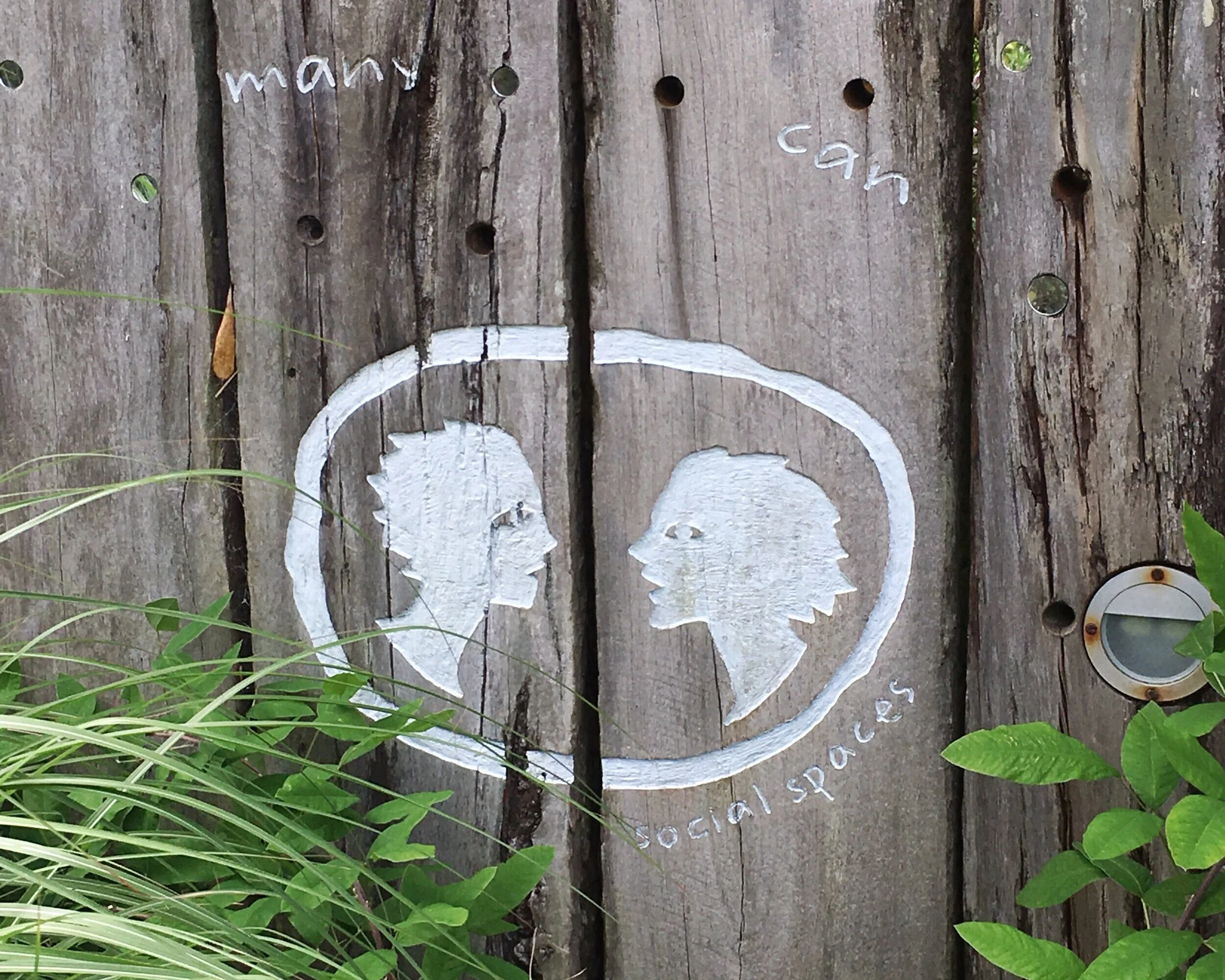
The Eden Project isn’t just an entertainment project, or an educational one either. It’s also a wellbeing endeavor — from the micro, like keeping our soil healthy, through to the macro, like keeping our communities healthy. Yes, it’s a fun place to visit (particularly for the music sessions), but we’re betting (as are they we think) that the wonder, optimism, and connectedness that you take home with you, will last longer than the honey you bought in the gift shop.
To find out more (and to keep up with new development Eden Project North): Website, Facebook, Twitter and Instagram

Headlands Center for the Arts
A seemingly hidden away creative escape, ready to be discovered again and again.
Sometimes self-care isn’t a practice it’s a place. We’ve felt this about the Headlands Center for the Arts for a while.
Located in what seems like the middle of nowhere, the Headlands Center is really just 30 minutes from the city of San Francisco across the Golden Gate Bridge. The tiny one-way tunnel to get there (or you can take the winding, treacherous feeling high-road), and the oftentimes bleak former military surroundings of Fort Barry, throws you off. Also, there’s sandy Rodeo beach and the vast Pacific Ocean right there when you step out of its doors. It’s not the place that you expect to find a cluster of artist-renovated buildings hosting art residencies, exhibitions and workshops. But the Headlands Center attracts an international roster of creatives seeking the time and space to make work in its renowned residency program, as well as a committed local art crowd who make the pilgrimage when it does open its doors to the public.

Time your visit carefully as the Headlands Center is something different at different times of the day/week/year. This is no static exhibition venue — rather it’s a place that shifts with its participating artists, writers, and other creatives and programmatic themes. You’ll need to pay some attention to the calendar for the things you can see and do here. On the Open Days — a handful a year — the place comes alive with a buzz of activity and many people wandering its rooms. The Project Space now offers sometimes Sunday-to-Thursday shows to visit and there’s the occasional intervention on-site, like Wall Space in the outdoor Commons area. Want a more intimate experience? Attend a dinner in the Mess Hall by Headlands chefs and invited guests or a walk, conversation, talk, performance or another public event. Whenever you visit try to grab a coffee in the Ann Hamilton designed Mess Hall.
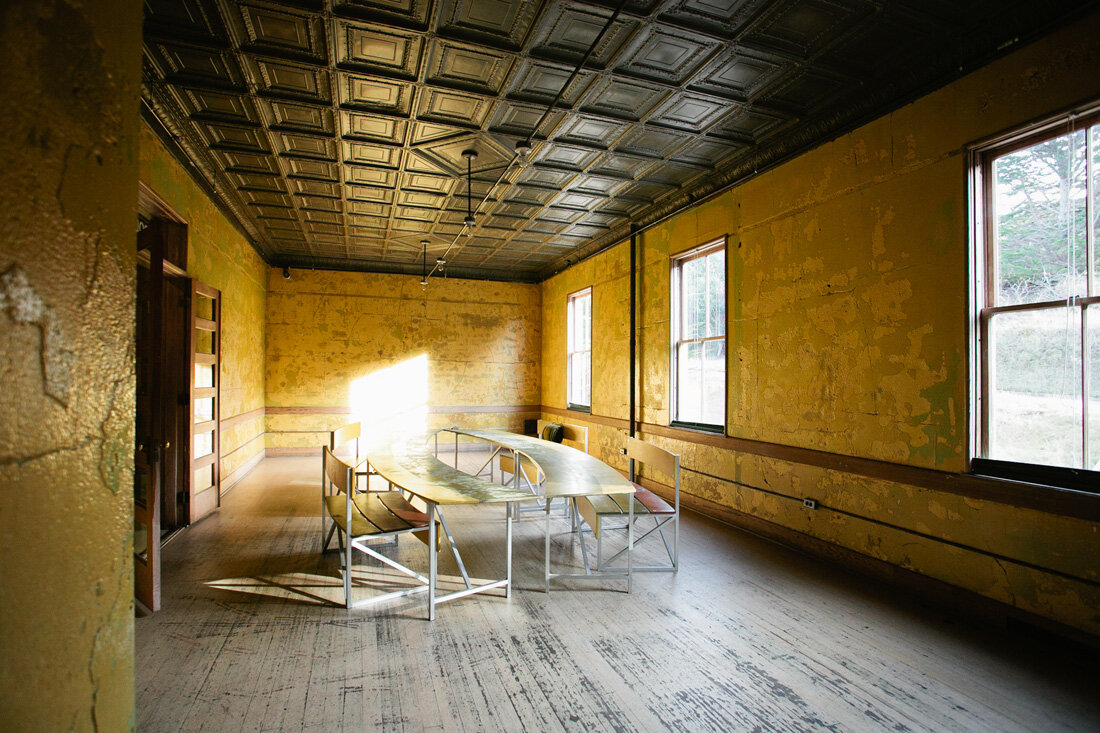

We all have our favorite places to go to when we want to run away, maybe also when we want to run towards something. They are the ones we sink into when you get there, even if it means we don’t turn off our minds but open them instead. The Headlands Center has become that place for us. One of seeming retreat but also a restorative connection to people, to what they create and the ideas they get to explore whilst here.

Ride with Me | Drawing Bike Lines Together
For Roos Stallinga riding a bike is both an art and therapy, making ourselves, and the world around us, a better place. Ride with Roos in Barcelona, Amsterdam and New York.
When I lived in New York City (between 2002-5) and studied Art Therapy at NYU, I met with a therapist as part of my training. At some point, she asked what made me most happy. I answered, “When I ride my bike around NYC!” The woman, American and in her fifties, could visibly not relate. She blinked a few times, and then kind of ignored my remark. Like, “Right, but now for something real, like work or study, something in the actual world.” At that time it was indeed really strange to bike in New York. Almost no one was doing it. But to me, I later realized, this really WAS essential — so much that I turned it into my profession.
Riding my bike in New York made me feel free, strong, alive, and right at home (maybe it helped that being Dutch I was basically brought up on a bike). I got so much inspiration and energy from riding around the city, absorbing the sights, sounds, smells, and stories. It was never boring and I got to know the city really well. The bicycle opened up new neighborhoods and parts of the city I wouldn't have come to otherwise.
At times, I would feel slightly scared, exploring new ground, not knowing anyone. Sometimes I would meet people and have a chat. Other times I would just sit in a café, writing in my diary, enjoying just being there and grateful for getting a peek into another world. Even though I was usually alone on my adventures, I somehow always felt connected, to the city, and its inhabitants. There would be eye contact with a fellow biker, laughs from a random stranger on the street. And even the occasional angry driver, who would tell me to get out of the way, or off the road. I would try to stay calm, strong, and smile. “Just smile” Another NYC cyclist once told me “You’ve got a right to be here, too”.
Now I explore cities for RIDE WITH ME, discovering the best biking routes, coffee, art, parks, hills, beaches, bars, and restaurants on the way. In 2009, I created RIDE WITH ME NYC, out of my experiences and insights, as well as conversations with fellow bikers. I wanted to share the joy, and the beautiful places and people I discovered on my way. I used my bike as my pen, to draw lines in the city. And as a key to open the city. I wanted more people to experience this, to ride these routes, and even better, to create their own adventures!
RIDE WITH ME guides are like cookbooks, with recipes for urban adventures. Some of my favorite recipes and ingredients are listed here:

AMSTERDAM is my hometown and base; I think it’s the best place in the world to bike. And so beautiful! It’s an easy place to ride, once you get beyond the chaos and amount of other people on bikes. My advice: just go with the flow, stay on the right, make eye contact, and don’t stop in the middle of the road. You will be fine!
Ride to the ‘Noord’ (North) side, taking your bike on the free ferry behind Central Station, and explore the area around the old NDSM ship wharves, with street art and artist studios, and some nice cafés, like Noorderlicht or Pllek (here’s a city beach too). Continue along the water, passing by freshly built neighborhoods, warehouses, car garages, and find another special place on a dead-end alley called De Ceuvel. Old boats lying on land are turned into creative offices, a polluted area that is slowly being cleaned by using innovative methods. There’s a nice cafe as well, and in the summer, people go swimming.

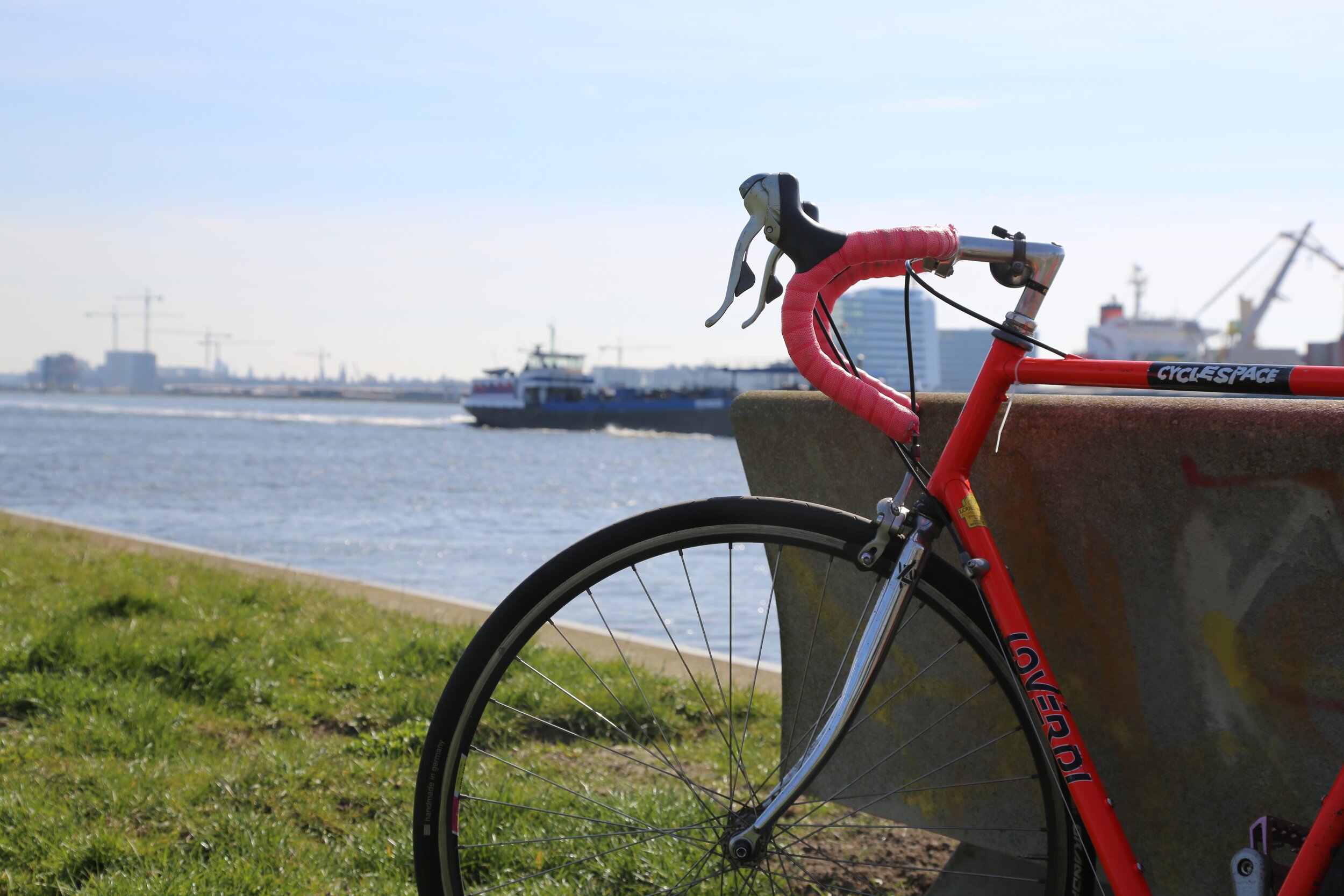
Further on, if you keep heading east, crossing the ‘Noord-Hollandsch’ canal, you will pass small workers homes, more warehouses with creative offices, a brewery called Oedipus, a local winemaker and co-working place called Chateau Amsterdam and find a couple of delicious destinations, like the Mexican taqueria called Coba, and a huge and welcoming restaurant named Hotel de Goudfazant. Ah! And if you want, you CAN also just stay and go dancing at the Skate Café. Or keep riding, all the way to Durgerdam, a quaint fishing village along the IJ lake, amongst green fields and cows.


Ride around the old city center, and its Red Light District, early in the morning, possibly on a Sunday. When most people are still asleep, you can really sense the soul of this place, rich with history, and its share of drugs, sex and rock ‘n roll.


Head West on your bike, exploring the old gas factory site called ‘Westergas’ in Westerpark, now filled with cultural happenings and culinary destinations. Through the park, you can ride even further west, towards ‘Bos en Lommer’ neighborhood — or BoLo — a diverse and upcoming area. There’s a super sweet book shop called ‘De Nieuwe Boekhandel’, and kick-ass coffee place called Friedhats Fuku Cafe founded and run by star barista Lex Wenneker and friends.

BARCELONA soothes my soul. I just love residing in this city, with its beautiful light, buildings, and nature, the people, the way of life. It always relaxes me. How wonderful being able to ride your bike to the beach, dive in, dry in the sun, and ride on. Then enjoy a long and lazy lunch, for example at Sala Beckett, which is inside a beautiful theater building, or LEKA, for deliciously local and sustainable food, both in the Poblenou neighborhood (in general a great area to explore by bike).


Barcelona is relatively easy to ride in, just go easy and accept the occasional counter-intuitive bike infra, AND the fact that as a person on a bicycle you are basically at the bottom of the mobility food chain here (after the car, the moped, the pedestrian, and maybe also the electric scooter).


Photo: Gregor van Offeren
I love riding up the Montjuic hill, a magical place filled with plants, art, culture, and sports facilities — the Olympic Games were hosted here in 1992. At the back of the mountain, there is an impressive cemetery (many famous Barcelonians were buried here) with views of the industrial port, which makes for a surreal setting. If you continue to ride up here you will pass the botanical gardens and finally get to a semi-secret ‘mirador’ (outlook post) and bar La Caseta, with beers, music, and bbq ‘en plein air’. It’s the perfect bike stop, after which you can just roll down that hill and maybe end the day at the lovely Poble Sec neighborhood.
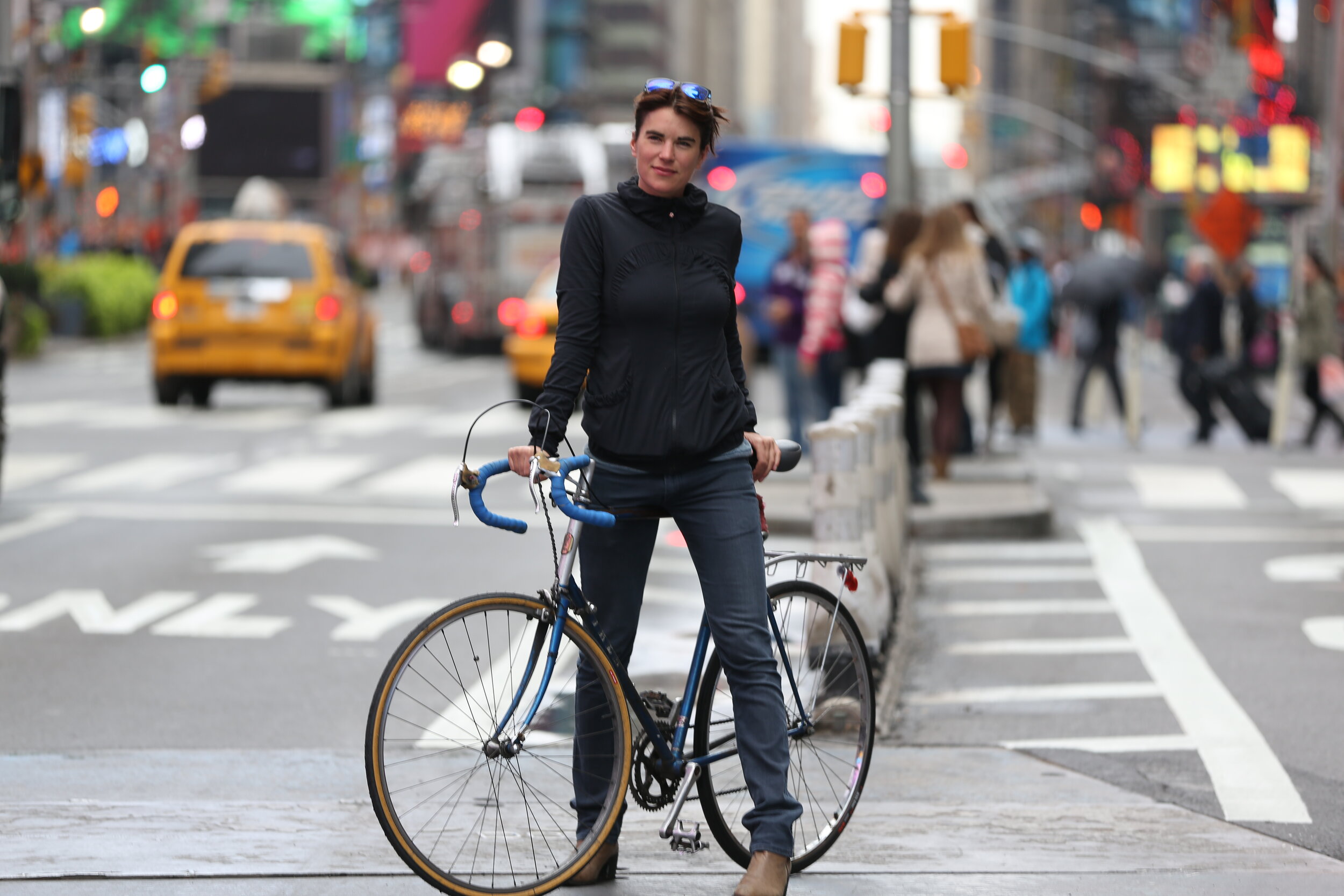
Photo: Lisa Smidt
NEW YORK CITY gives me courage and inspiration. Riding around on my bike here feels like I am surfing the waves of the city. There is so much energy! Of course, you do have to be alert at all times, focused and relaxed at the same time, kind of like a Zen monk on two wheels. Oh, and on a practical note: the blue bike-share system Citibike works great if you don’t have your own bike!
Ride to Red Hook in Brooklyn, over the Manhattan Bridge, landing in Dumbo (neighborhood Down Under the Manhattan Bridge Overpass). Along the East River, through industrial wastelands, and discover at the end of the road this old village that used to be a Dutch settlement called ‘Roode Hoek’. You’ll find you can look Lady Liberty right into the eyes, amongst red-brick warehouses, fishermen, and boats. Maybe have a Key lime pie (!) at Steve’s Key Lime Pies, or a special dinner at The Good Fork. There’s a bar called Sunny’s, straight from a Tom Waits song, rundown, smokey, with a bartender cracking jokes.
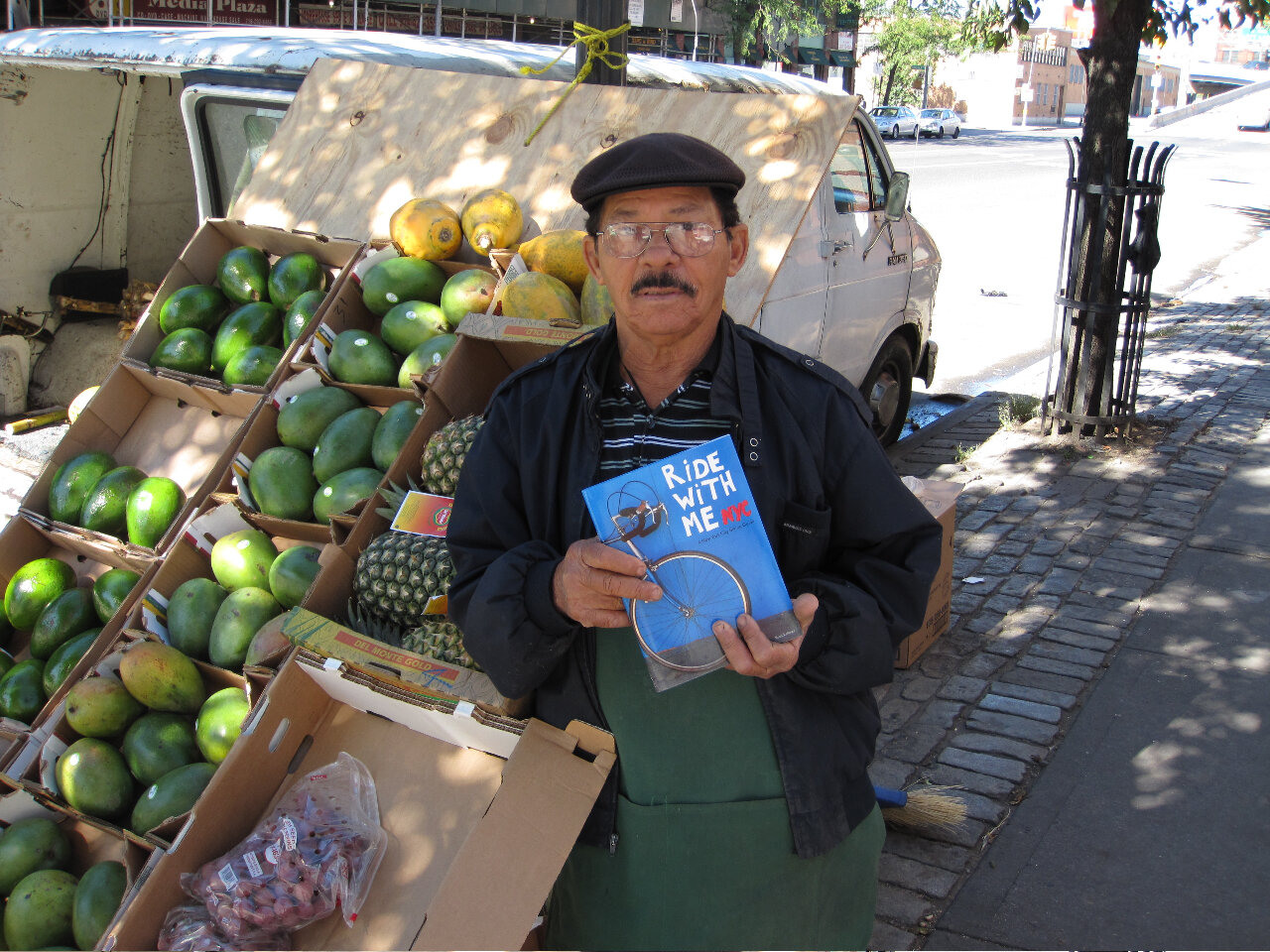

Or ride down along the Hudson River over the greenway — no cars just skaters, runners and cyclists — until you see the Statue of Liberty and Ellis Island. Maybe take a ferry to Governors Island, a historical military base transformed into a car-free, green, and arty play zone.
Ride from Dumbo all the way to Greenpoint, Brooklyn, riding through the Hasidic Jewish area, feeling like you are back in time, with the men wearing black fur hats and the women long skirts and wigs, pushing vintage strollers down the street. Hit the Brooklyn Roasting Company for a pitstop (either in Dumbo or on the way to Williamsburg). In Williamsburg and Greenpoint are tons of nice shops, cafes, and restaurants. Just riding around on your bike, watching the street life and art, is a pleasure too.
If you want more, make a detour to East Williamsburg/Bushwick, still a bit rough, with many murals, warehouses, artist spaces, and many cool bars and restaurants. A weird and wonderful place — completely hidden at the end of a tiny alley — is the Australian restaurant Carthage Must Be Destroyed. Here, they painted everything pink and serve super fresh and original dishes.


Maybe it all makes sense after all. I lived in Barcelona when I was 18, studied Psychology in Amsterdam, Art Therapy in New York City, traveled a lot, and kept a diary to write and draw in. I look at the city as a psychologist, using my bike to be free and get a grip at the same time. To get inspired, and connected to the people and places around me. Riding a bike is both an art and therapy, making ourselves, and the world around us, a better place.
Ride on!
xxxRoos

Photo of Roos: Chris Prins
Additional Photo Credits: Cover image of Roos on the Brooklyn Bridge in NYC: Theo Westenberger
All other photos/artworks/illustrations: Roos Stallinga

Hauser & Wirth Somerset
In the unlikeliest of places — outside a small village, on a working farm — sits one of the most well-regarded galleries of contemporary art in the world.
“Hauser & Wirth Somerset is a pioneering world-class gallery and multi-purpose arts center that acts as a destination for experiencing art, architecture, and the remarkable Somerset landscape through new and innovative exhibitions of contemporary art. ”
In the unlikeliest of places — outside a small village, on a working farm — sits one of the most well-regarded galleries of contemporary art in the world. Maybe it's the giant bucket at the entrance that gives away the fact that something different is afoot in these fields.
Opened in 2014 Hauser & Wirth Somerset joins the esteemed network of galleries launched by founded Iwan & Manuela Wirth (with Ursula Hauser) in Zurich and which now includes such places as Hong Kong, New York, London, and Los Angeles. You can see why Somerset sits oddly within this company.
But the Wirths, though globally roaming, are now locals and they have cultivated the once derelict 17th-century Durslade Farm into a hugely popular arts destination in an area known more for cows than culture (though that’s all definitely changed — see also The Chapel, The Newt and favorite local brand Selfish Mother).
That they did this not just by continuing to focus on the high-end art that is the heart of their business, but by bringing in other values to make that heart beat, namely education, conservation and sustainability, is probably the most striking aspect.


Yes, here are the shining lights of the visual arts and architecture — the derelict buildings were renovated by French architecture firm Laplace into white-walled galleries (albeit in barns) and a six-bedroom Kinfolk-worthy renovated 18th-century farmhouse available to rent (note vintage furniture next to a Pipilotti Rist installation). The gardens were landscaped by Piet Oudolf of New York’s High Line, who has crafted an abundant yet tempered (though in ways you won’t expect) version of an English landscape, dotted with a changing display of outdoor sculptures, like Franz West’s incredible talking heads.
The striking pavilion by Smiljan Radić was brought in space-ship like from the Serpentine Gallery and is a liminal place of imagination and learning for grown-ups and kids alike (note — running up that ramp, also note the talks series). Even restaurant Roth Bar & Grill is art-orientated, with a site-specific bar by Björn and Oddur Roth, the son and grandson of artist Dieter Roth. And that’s all before you get into the galleries themselves, that show the kind of artists you’d find in a MoMA or Tate: you know Louise Bourgeois, Martin Creed and Phyllida Barlow.
But with Hauser & Wirth Somerset, the Wirths haven’t just plopped a little bit of the art world into the countryside. Even as it exhibits its bonafide visual arts roots, it also blazons its community, local Bruton village leaning, credentials. There’s an active education and events program that brings in schools and the local community — see ArtHaus, Open Source Salons, Family Saturdays, seasonal Pumpkin Festival and Summer Party. There’s also a permanent library and learning center built into those barns.


And if that’s not quite enough to shift the cultural landscape in this part of Somerset, in 2018 the Wirth’s opened Make Hauser & Wirth Somerset in the heart of the village, exhibiting works of contemporary makers, emerging and established, available to purchase. This storefront also offers workshops like charcoal drawing or spoon carving. And they haven’t abandoned completely the farm on which the gallery is situated; this autumn Durslade Farm Shop will open, stocking produce from it’s still working 1000+ agricultural acres.
Where we least expect it, though maybe also most need it, Hauser & Wirth Somerset proves the point that culture can go anywhere, and be for anyone. Its barn doors are open to whoever chooses to cross its threshold. Though you might want to leave your muddy boots at the entrance.


Mouse-Shaped Misery or Picture-Perfect Family Fun: Disneyland Observations
Our take on whether Disneyland is really “The Happiest Place on Earth”.
I spent the last week of my life in Disneyland trying to figure out if I was a sucker for loving it so much. (I think I’ve landed on “probably yes”.) Here are my observations.
Observation 1: Everyone is better at doing make-up than I am.
Is there, like, an onsite class available somewhere? (Can I come?!) Why is everyone so luminous and poised here? I must have seen 17 thousand women, with their rose-gold Mickey ears glinting in the warm afternoon sun, their customized Etsy t-shirts clinging perfectly to their (clearly) cross-fitted bodies and their winged eyeliner looking like it was applied 6 seconds ago. Meanwhile I take one glance in the direction of Splash Mountain and I turn around in full Jafar cosplay, shocking both my group and all of the low-key Jafar fanatics.
Maybe it’s that my youth has slipped away subtly in the night, or that I don’t actually know how to use all the things the nice girls at Sephora have suggested I buy. Or maybe it’s that everyone here is Mormon and, as such, blessed with abundant, inexplicable beauty. (Having lived in Salt Lake City, I can confirm that they are, I am all but certain, God’s chosen people). But I digress. Everyone is beautiful here. (Maybe it’s the magic?) Someone please come airbrush me before I leave the house again.
Observation 2: There is an abundance of children wearing shirts with phrases like “best day ever” and “happiest vacation on earth” who are being aggressively shamed by their parents.
Hello Parents, have you ever met a child? They have small legs, need ample sleep, and are easily overwhelmed by blinking lights. They go absolutely fucking nuts when exposed to sugar and food coloring. Why, then, would we expect them to exhibit perfect behavior at 11pm on a Tuesday night while sat on the ground picking hours-old cotton candy off of their sleepy faces as Mickey Mouse shoots fireworks from his eyeballs?
Please understand that I am, in no way, exempt from the Disney-induced lapse in parenting judgement and performance. I wanted to abandon my family and drown myself in the shallow waters of It’s A Small World just as many times as the next parent, but I internalized those resentments and whisper reprimanded my children through gritted teeth (like a grown-up).
Observation 3: I am infinitely grateful for my mobility and health and I remain ever-impressed by the people who push through theirs in the name of fun.
One of the greatest things I observed on this trip were people pushing through physical setbacks, getting out there in the name of fun. There were two women (had to be 100 years old) zipping around on rascal scooters like they owned the place. (Maybe they did?) One had brace on her ankle and the other had multiple tanks of oxygen (maybe jetpacks?) affixed to her chair. They laughed and zigged and zagged through the lines of the roller coasters and the teacups and almost-never ran into small children. They didn’t have young people pulling them along, or passes that granted them access to the front of the lines. They were just there, living their best lives, for themselves.
Observation 4: Vegan food is EVERYWHERE.
From plant-based sheppard’s pie and cauliflower street tacos to vegan gumbo and oat milk mochas, I was in near-constant awe at the food selection available in the Disneyland parks. More than being impressed, I was relieved, to see the world changing in ways that feel meaningful. I understand that veganism isn’t relevant to everyone, but I think it is fair to say that adding 400 vegan menu items to the parks is indicative of a greater shift in the world, a shift that means more mindfulness in regard to the way we’re consuming food, utilizing animals and protecting our planet. Sure, Disney is primarily interested in catering to their consumers and making more money…but the implications of this shift are far greater than that. And when a massive corporation brings a once-taboo lifestyle choice into the mainstream, it opens the doors for more people to enter that space. More plant-based options = less animals harmed, and that’s an equation I can get behind.
Observation 5: There is something that happens when you spend lots of money to be happy - you’re really fucking set on being happy.
There is a lot to be said about the downfalls of the positive psychology movement (we’re very-much over the days of faking it until we make it) but there is some mystical concoction that exists at Disneyland. Something about spending an obscene amount of money, the overly-friendly staff who are there to cater to your every need, endless access to sugar/salt/fat, your belief that you should be having fun and your awe-struck children whose expectations you’ve spent MONTHS bolstering. I don’t know exactly what it is, but I actually feel happier there. Sure this could be a recipe for the letdown of the century. Unrealistically high expectations are, in our experience, almost always ill-advised. But what about when all those expectations converge in a place that is actually pretty fun? What about when Disney releases interactive apps that allow your family to play games together in line (apps that help you to start conversations about things like gratitude, favorite memories and finding magic in the everyday.) What happens when you’re really expecting to have a good time and you put all of your energy into bringing that experience to fruition? Like any person with a conscience, I struggle to look past the rampant wealth disparity in Anaheim (the home to Disneyland Park), I struggle to accept the messaging of some of their films, struggle to accept that I’ve bought into a very well-branded consumer trap that thrives on manufactured-emotions and poor impulse control…but you’d be hard-pressed to visit this place, and not fall (at least a tiny bit) into the magic of it all. Concentrated time with family, activities that are fun for all-ages and messaging that screams “YOU ARE HERE TO HAVE FUN!” are really difficult points to deny. Yes, I know I’m a sucker…my back aches and I am desperate need of a post-vacation vacation, but every night, I cuddled with my kids while watching fireworks, and I laughed and ran with my 11-year-old (whose years of wanting to connect with me are feeling more fleeting by the day) and I watched my 6-year-old hug Minnie Mouse with tears rolling down her exhausted face. Yes I know it’s all a bit contrived. I know we could have gone to Yosemite, or the Museum of Modern Art, or, like, our great aunt martha’s house(?). But sometimes it feels good to turn your brain off and sink into the magic that’s unfolding around you.

DO | The Encouragement Network
Can you be a fan of a place like you can be of a person? We’re kind of like that with everything from the DO Lectures.
“The idea is a simple one. That people who Do things, can inspire the rest of us to go and Do amazing things too.”
It’s only fitting that we should mark the transition from one decade to the next with a company that’s all about the journey, about how we can get from our ‘A’ to whatever our ‘B’ might be. For over a decade now, DO has helped with the moments that come before, during and after someone decides to navigate their own way — from how to get started, maintain momentum, face your inner critic, contend with the longing for new lives and the dread of old ones, and most of all to being confident that your ‘crazy dumb idea’ might actually be worth it.
Based in West Wales and founded by Clare and David Hieatt of Huit Denim, DO is like the generous friend who tells you how they did what they did, and how you might do the same. It’s a helping hand approach that spreads knowledge as much as encouragement.
If you are curious about different pathways or living a good life on your own terms, you’ll want to try to attend their annual Conference. The original DO Wales (others have run in Australia and the USA) is still an intimate gathering in an Old Farm (now rebranded an Ideas Farm with concepts replacing livestock as the product of choice) and offers 24 talks, dozens of workshops and six bands over three days and three nights to just 100 attendees (places are much sought after and registration is now open). Speakers — authors, academics, filmmakers, entrepreneurs, and ecologists from thematics like the environment, creativity, food, adventure, social change, and business — are given a simple invitation: to tell their story in 20 minutes.
But it’s as much about the action as the narrative arc. Those who do, share their whys and hows and offer what we — on the other side, as attendees, audience, and readers — can learn from them, so that we can do things ourselves. There’s no intimidation of the genius mind here; rather storytelling meant to inspire and initiate you through your own life, to, as they say, the Story Doing part.
With a tree trunk podium, camping as accommodation and a Cow Barn as the venue, DO Wales builds in intimacy and connection as the signposts to change. But, here’s some of the magic — those small scale moments take on a large scale reach — all those talks are available for free on the website. From last year’s conference, we recommend Running past addition, food as a way home, and love for impact. You can also listen to these talks on the podcast; there are 300 episodes now available on Spotify.
But DO is not just the Conference. During the year this ‘encouragement network’ authors standalone lectures, which share the same intention of getting people that Do in front of people who want to. Coming up, take a look at DO Story Masterclass, DO Events and DO Breakthrough.
Or, feeling the inertia, from the comfort of your couch, their publishing wing DO Books is similarly founded on the belief in life changing storytelling, namely that the right book in the right hands at the right moment can change lives, maybe even the world. Though these publications cover ideas and skills that may feel idiosyncratic in their range (childbirth, wild baking, start-up law) they tick the bases of what a modern life could look like — whether that’s leading with purpose, learning how to pause, or even how to bottle pickles.
As founder David Hiett says: “One of the things that I love is that two films idea of your life. There are two stories that you can tell. One that is safe and full of regret and one that is risky and full of pride and joy.” What will this mean to you in 2020? What will you do?