

Culture Therapy // Expanded Field of Therapy (Part 1)
In this edition of Culture Therapy, we talk about therapy itself and the podcasts, TV shows and books that are bringing this practice out of the therapy office and into our lives in very real ways.
We are huge advocates for therapy, having both been in and out of this special one-to-one relationship over our adult lives. Finding a good therapist has made the difference for us between floundering in the messiness of it all and feeling some measure of clarity and direction. We have found in therapy a language to articulate ourselves and our experiences, as well as support, care and tools for coping.
There’s still some stigma though around therapy, particularly for people with backgrounds that are anathema to talking anything out and are more about pushing it down or sucking it up.
So hopefully, for this edition of Culture Therapy, we can speak to both the therapy lovers and the therapy curious (maybe even cynics) out there both. We’ve pulled together those resources that we’ve found that help make going to therapy ok. Books, podcasts, and TV programs that make the vastly different approaches between therapists less confusing, and the process less intimating.






Parnassus Books
In Nashville author Ann Patchett gives bookstores the happy ending that they deserve.
“An Independent Bookstore for Independent People.”
At the precise moment that it felt like the end of bookstores and the victory of Amazon, author Ann Patchett jumped into the void. In 2011 when the last bookstore in Nashville closed, together with business partner Karen Hayes, Patchett somewhat counterintuitively opened a bookstore. She couldn’t quite stomach the fact that there would no longer be a place in her hometown to buy books. She was also banking on the fact that others would feel the loss and feel the same. And there was that niggling memory from long ago of wandering around Mills bookstore and finding magic within its walls. There’s a happy ending here that runs counter to the narrative that we’ve been sold; her bookstore has since thrived. The business model that we thought was broken, maybe it isn’t.
Parnassus Books is all the things you’d hope for in an independent bookstore. Shelves (perversely from closed-down Borders) of books chosen not by algorithms but by people who know, love and can recommend them, the staff who work here. Author events (a massive 250 a year) to build the connections between people who read and those who write. Storytime for children to develop a lifelong love of the printed word. Chairs to lounge in, a store dog to pet. Such was its success, that there’s a spin-off, Parnassus Books on Wheels.
Parnassus Books attests to the fact that bookstores are more than books; they go beyond words on pages to other things like getting us off screens and getting us into space with other people whether we know them or not. They allow our minds and curiosity to wander, creating safe environments to emotionally sink into. They are also community centers and empathy makers. Bookstores give us other people; books give us compassion within their pages.
The question at the heart of Parnassus Books is this: Do you want to live in a city without an independent bookstore? It’s all about choice. We have the agency to shape the towns in which we live, to share in the co-creation of the spaces that we love to spend time in. As Patchett says: “Amazon doesn’t get to make all the decisions; the people can make them, by choosing how and where they spend their money. If what a bookstore offers matters to you, then shop at a bookstore. If you feel that the experience of reading a book is valuable, then read a book. This is how we change the world: We grab hold of it. We change ourselves.”
We get to write the ending.

The Poetry Pharmacy | A conversation with Founder Deborah Alma about why poetry still matters
We talked to the founder of the world’s first Poetry Pharmacy about why poetry still matters.
When we first heard about The Poetry Pharmacy, we thought it was a kind of dream. A shopfront dispensing poetry for modern day ailments. It’s something from a children’s book, or a gorgeous idea of a place developed over excited conversations. But just last month, in the town of Bishop’s Castle in Shropshire, poet Deborah Alma (with her partner Dr James Sheard) opened the world’s first Poetry Pharmacy. And she readily admits its dream-like quality even as it now exists as a reality for her, and the people it serves. In the first months of opening, we were lucky to grab some time with Deborah to talk about why real-life places and poetry matter more than ever.
Claire: We’re enthralled by The Poetry Pharmacy, as I think are many people who are reaching out to you. Can you talk us through the space?
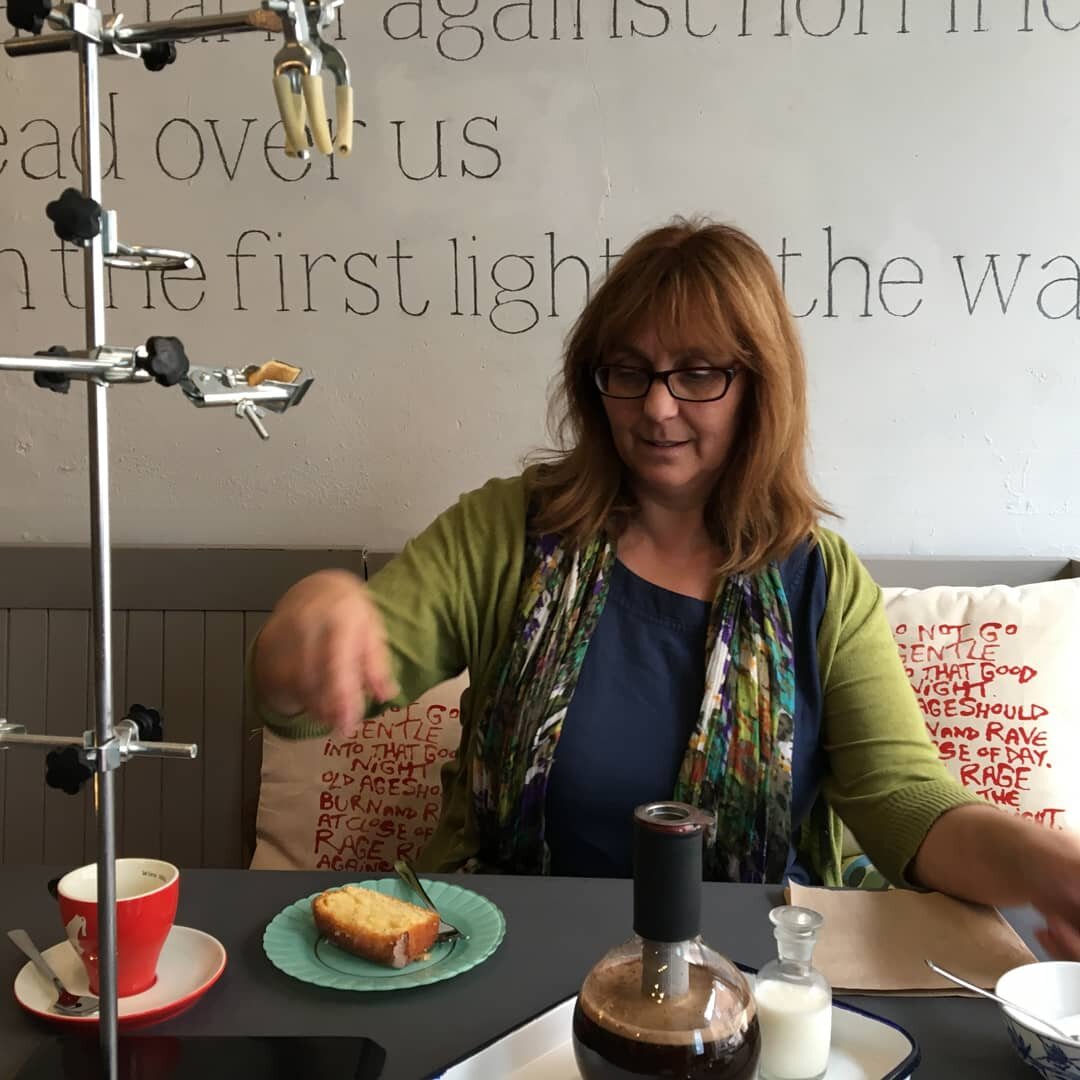
Deborah: We’ve converted a beautiful Victorian shop that had been closed for 13 years into an apothecary from which to dispense poems. It’s located in a small town on the wild west borders between England and Wales that’s full of writers and artists.
When people come into The Poetry Pharmacy, they’ll find books of poetry face up and filling the shelves. We’ve designed it so that people can browse by ailment — like ‘Matters of the Heart’, ‘Carpe Diem’, ‘Now I Become Myself’, ‘Be Alive Every Minute of Your Life’, and ‘Hope is the Thing with Feathers’ — and shop accordingly. We offer free one-on-one consultations on Friday afternoons, or people can make an appointment outside of that. We’re also happy for people to just come in and chat.
We also have a Dispensary Café which serves tisane, teas, coffee and cakes, as well as a shop that offers poems-in-pills for different needs such as a Bottle of Hope and Existential Angst Pills. Upstairs, we have The Distillery space from which we host book launches, workshops and other writing events.
We’ve kept the original architectural details like the old mahogany counter and till. We’ve allowed for as much natural light as possible (there are no neon lights). We’ve also painted the walls in muted paint colors.
There’s definitely something about the space that appeals to people in and of itself; a kind of therapy in not having technology everywhere. We’ve explicitly designed The Poetry Pharmacy for people to sit longer over coffee. There’s no pressure to move on and people are encouraged to talk to each other. It’s a place also for people to come to read and write.

Claire: Why in this moment when we’re rushing more and more of our everyday lives online and our High Streets are sadly struggling was opening a physical space important to you?
Deborah: I see the Ambulance as a physical space too; for years I operated as an ‘Emergency Poet’ from a converted vintage ambulance, prescribing poems to people at festivals, conferences, hospitals, libraries and schools around the country. But I felt like I was getting too old for all that travelling around, and it was often cold working outside in the UK. As the editor of four books and the writer of two of my own, I felt like enough people had heard of me, that if I set up a permanent location, they would already know what I was doing.
I do believe that people still want to touch something real. To be in a place that feels like it might last. The online world has a terrible power to cut connections with people in real places. The Poetry Pharmacy offers nothing like we can replicate when we are online. I also feel like if it’s there then it’s not hard for people to engage. People here are so delighted to find this place open; a place they can drift into and have a coffee and chat
I’m aware that it’s a gamble though. It’s an experiment, that comes with a certain degree of optimism and maybe even self-indulgence.
Claire: What need in the world do you think The Poetry Pharmacy responds to?
Deborah: We offer a therapy in slowness and a nostalgia for something lost: old fashioned service, friendliness, even listening.
People can come in feeling miserable and we give them a free ‘pill’ as well as the chance to talk about what they need. Then we prescribe a poem.
Claire: Why poetry? What’s the value that you see in it when applied to people’s lives?
Deborah: I realized a long time ago that most people are frightened of literature and poetry within that. And that the people who create or understand that art can be possessive. I used poetry in my work with people living with dementia. From that experience, I saw first-hand how you can change someone’s mood by taking them somewhere with a poem and that I could share the intimacy inherent in this form. This underpinned the Emergency Poet idea; I wanted to stop poetry from being intimidating and I wanted to show that it can literally be a vehicle for talking to people. That project effectively bypassed how poetry usually gets to people and how they then get to use it.
I’m aware that the Poetry Pharmacy idea is a bit mad. That putting poetry on the High Street is unusual. We keep hearing that poetry doesn’t sell, and this is a quiet town, but I’ve done it because I really do believe that poetry is a good thing. It’s beautiful. We’re putting it front and center instead of in the corner. Why not have piles of poetry books and say that has a value equivalent to other genres? With The Poetry Pharmacy we’re bringing poetry to the forefront and there’s an art in curating it — picking out the ones that speak to certain subjects, putting them with other things, and saying,“Take a look!”


Claire: And they are. People are enamored with this idea. Why do you think that’s happening?
Deborah: When I first started, it was a mad faith thing. People said, “you know why there is no other Poetry Pharmacy in the world? Because no one wants it.” But we’re finding differently; the idea of it even existing in the world seems to be a nice thing in the middle of all this darkness — BREXIT, Trump and just continuous bad news. It’s a piece of optimism and faith in something. It’s a positive thing, and light-hearted in lots of ways
It’s lovely that The Poetry Pharmacy exists in the world. It’s like a piece of fiction and reminds me of The Little Paris Bookshop by Nina George. In that novel Monsieur Perdu opens a floating bookstore on the Seine from which he prescribes books for a broken heart.
We’re only in week six and it’s been busier than I thought it would be. People get in touch across the world, we’ve had BBC News in here, the local Bishop’s Castle / Shropshire or West Midlands community is delighted, and people are seeking us out from outside of town and even from outside the UK.
We need all the elements though for it to work: the coffee shop to have a treat and a good coffee or tea that is nicely presented, like a ceremony; music that is welcoming and low-key, that makes people feel comfortable; a shop of desirable items, the consulting room and workshop space; and lots of events going on.
Claire: Would you place The Poetry Pharmacy within the world of mental wellbeing?
Deborah: I shy away from the word therapy, but I do say that it’s therapeutic. When I prescribe poetry to people, poems that I know and love, then people can make a poem their own; just reading it will take them to another place. What poetry is doing is taking you somewhere else in your head when you are busy. It’s telling you things that you may not be hearing from other people. It underlines something to yourself. Even imagining it, is a moment of benefiting from it.
At The Poetry Pharmacy we also include material for how to look after our lives in other ways beyond poetry. There’s a section ‘For days when the world is too much with us’, where we have Wordsworth next to psychotherapy and self-help books. We have another section that’s the ‘Best Medicine’ which includes gardening and nature — like counting butterflies, sitting in a patch of sunlight, and going for a walk.
Claire: When I think of The Poetry Pharmacy, I think of it as helping people with their anxieties, but I also think of it as supporting people in their loneliness. Is that fair?
Deborah: Yes, the poetry community has traditionally been good for the lonely as often people come to things on their own. People don’t have to be in a couple or with a friend to attend these events, like they might for say a dinner party or other social gatherings. It’s easy for people to come here on their own. Most of our events are on Sundays and quite a lot of people have said that Sundays are always difficult when they live on their own, but now they can come here for company. Rural isolation can also be a problem. This can be a place that people can come on their own and still feel comfortable.


Claire: Now we’ve established the life-affirming magic of the place, can we talk a little about the practical side? Like how you made it happen?
Deborah: We ran a successful Kickstarter campaign and I was amazed at the response. The crowdfunding raised money to pay for the build-out, including things like wiring the shopfront! We found that strangers turned up and said we love this idea and want to support it, because they don’t want closed-down shops on the High Street. We also received a small Arts Council grant.
We were very resourceful. As much as we could, we turned The Poetry Pharmacy into a project for both the local community and the literary/poetry one. We had many people volunteering their time and expertise.
Claire: What advice would you give to other creatives thinking of starting a bricks-and-mortar endeavor?
Deborah: It’s difficult, which I think is why so few people do it. But for me, it was huge just knowing that there’s a community of support behind me. I think it’s critical to have a few key people to support you in the first instance, and other people believing in you. The doubters are also quite useful because they test your resolve. Maybe they are right, and you don’t do it. But for me it was: ‘Bloody Hell, I’m going to prove you wrong matey.’ You’ll know in that fierce moment whether to do it or not.
Claire: How else has The Poetry Pharmacy impacted you? How does being front and center sit with the more private practice of writing poetry?
Deborah: Yes, there is that dilemma of reconciling this public project with the country mouse part of me. I do think (without overgeneralizing) that people who write who are novelists tend to be introverted, while poets tend to need to connect with other people more often. They work on a poem, then go out because they need to talk to people. For me, I crave being on my own and periods of time to write, and I’m aware that that’s not in balance at the moment. There are two sides of me; they don’t exist in the same place, but they do need to communicate, all the same. I hope that will settle down.
I do believe in The Poetry Pharmacy and it seems to be working in the way that I hoped. Also, for me too. Because I’m now so busy, I’m not online so much. What I wanted to do — and needed to do — was to have an open door and to welcome people in. To say: “Come in. Who are you?” To say. “ I’m interested in you. “
Discover more places for a happier life

How to Meditate in the Midst of Holiday Madness (and/or everyday life)
With meditation, not only are you taking a much-needed break from your thoughts, and the glorious internet, and whatever else is jockeying for attention in your life…but you’re also taking a few moments to devote yourself, fully, to your own wellness. A beautiful practice. (Your third-eye chakra is likely quivering at the mere mention of such an activity.)
Meditation is important. (Right?) It’s like, THE thing.
With meditation, not only are you taking a much-needed break from your thoughts, and the glorious internet, and whatever else is jockeying for attention in your life…but you’re also taking a few moments to devote yourself, fully, to your own wellness. A beautiful practice. (Your third-eye chakra is likely quivering at the mere mention of such an activity.)
Chances are you’ve made these promises of self-care before:
“Starting next week, I’ll work out everyday!”
“I’m finally going to do that juice cleanse. #rawtil4 #plantbasedprincess #fitfam”
“I will definitely get one of those gong things and breathe out very slowly while the peaceful reverberating sound fades amidst the shrieks of my rampaging children.”
But, let’s be real: you’re busy. Yes, meal prepping and spin class and meditation almost always leave you feeling refreshed and alive, but the pressure of having to fit them in is often enough to send you reeling with overwhelm — particularly over the holidays.
So, this got me thinking: how important is it that I do the FULL 30 minute meditation? Like would I be 50% of a good person if I only did half?? (Am I even looking to be that good?) But, no, whatever you’re thinking is probably right: listening to the whole thing is crucial. Yes. There is, of course, an arc and a story and some highly precise process that your body relies on in order to settle fully.
Truly though, I once tried to stop midway through a meditation (re: rampaging children) and found that one of my eyes just sort of drooped unceremoniously in disappointment for the remainder of the day. It was like it knew peace was soo close, but not quite attainable (a sentiment that was often echoed in my life, naturally, so a bit of a waste of 15 minutes really). And maybe it’s because the REAL peace comes at the end? That slow, deep voice gets slooowwwer and deeeeeeper and you can hardly even stay awake for the subtle ad that they weave, so seamlessly, into the end of each episode.
You’re probably thinking this is just one giant buzzkill where I tell you to give up on your dreams of ascension or betterment or anything good existing in the absence of ample-time and product-placement and greed, or whatever, BUT NO. No, friends! I am here to offer you a priceless life hack. (A hack that will be despised by 95% of the population, but a hack nonetheless!)
If you consume your meditations randomly via the podcast app, as I do (by typing in words like “meditation for sleep” or “mindfulness in the morning” or “meditations, man voice” *ow ow* #sorry) then you know that there is an option to listen to your selections at 1.5 speed.
It would, of course, be preposterous to apply this setting to a meditation that is designed to grant you time and space to center and calm yourself.
…
Absurd really.
…
Laughable.
…
Very much not something a grown-up should do.
…
Right?
…
…
Except…
…
here’s the thing you’re not considering….
meditations feature lots of slow-talking. (Like, so much.) And they have a TON of down time built in. (We are talking minute upon minute of silence!) Do we really need that much silence? Is the allotted time scientific? Or are the people recording these things just sort putting us on mute while they call their doctors or watch daytime TV or sing along to the Frozen 2 Soundtrack (#notanad … but that album is legit).
So, ok, I’m guilty. Fine. I was very busy last week. Was planning to dedicate a whole 30 minutes to myself before picking up my homeschooled (read: ever-present) children from an activity, when I got sucked into a too-long work call and my me-time plummeted from a decadent 30 minutes to a pretty-much-useless 15. There was a mediation I was dying to listen to and I had literally no time left. The hosts had specifically stated at the beginning of each episode that I was not to be operating heavy-equipment whilst listening and though I always picture myself riding on a tractor when I hear this, I knew what they meant: Don’t drive your car while you listen to this, you dumb bitch.
Fine.
I complied.
But then, as my pre-departure minutes dwindled, something happened.
In a fit of #mindfulMonday-induced FOMO, I switched on my meditation, fast-forwarded through the “obviously-an-ad” portion (No one loves protein shakes that much, Karen.) and BLAM-O started my peaceful self-care practice at 1.5 speed. (This, I realize, is blasphemy.)
Yes, there were moments where she was (apparently) speaking “normally’ and it sounded like the most frenetic parts of the Alvin and The Chipmunk’s album, but MOST of the time, she was just sort of letting words fall lazily from her mouth. At 1.5 speed things were honestly more palatable. I literally do not have time to hear all your mouth noises as you labor to articulate every word, Karen, please just make me a better person, and be quick about it. (Fun fact: the meditation I listen to is actually led by a woman named Karen! *kisses fingers in victory like a proud Italian chef*)
I know this hack is not for everyone (and maybe it should be for no one?) but in a pinch, as the rush of the holidays descends upon us, it is nice to know we have options. Yes I may have rushed through something that was specifically designed to help me relax, but I assure you, I DID relax. And sometimes just the act of checking something “good” off your to-do list is enough to bring comfort and peace.
Maybe I don’t have ample time to devote to my self-care practice, or maybe I just don’t find the time for it. But isn’t doing something better than doing nothing? Isn’t it the effort that counts? Or the practice that counts? Or the acceptance that while I may not know exactly how to become the best version of myself, that I’m definitely willing to cheat the system in order to make it look like I do that counts?? You might have answers to all of these questions, and instead of bringing a voice to them, I suggest, instead, that you take whatever feelings this has stirred within you, and apply them to your own self-care practice. That way, you’ll feel better, and I’ll continue to float through life blissfully unaware that I am doing it all wrong.
Namaste (but said really quickly).

Choose Love
This holiday season support pop-up stores Choose Love by gifting everyday items to refugees who urgently need them.
“‘The world’s first store that sells real products for refugees.’”
Holiday Fatigue. Compassion Fatigue. Everyday life fatigue.
At this time of year, as the days get darker and our schedules more frantic, many of us find ourselves exhausted, overwhelmed, maybe also panicked. We’re under pressure to consume, to shop, to scramble for all the things that we don’t need and that we probably won’t even remember in January. Some of us are starting to realize that we don’t love this Black Friday to January Sales treadmill, that it benefits someone’s bottom line but not us. We’re starting to look for ways to do the holidays differently.
Like Choose Love. No, that is not just a cute Instagrammable aphorism (though it does take a covetable merchandise form). It is an urgently needed pop-up that takes that holiday spending money and uses it for good, not seasonally appropriate greed. The Choose Love stores brought to us by Glimpse design collective—there are now 3, in London, New York, and Los Angeles—only sell things that refugees vitally need that you get to gift to them. The stores are arranged by the different stages and shifting requirements of displaced people. There’s ‘Arrival’, ‘Shelter’, and ‘Future’. A life jacket. Children’s boots. A hot shower. Safe spaces for women. A Bundle of Warmth. Think about these things for a second. Think about how and why they are needed. We defy your heart not to break just a little.
As CEO of Help Refugees (the NGO behind Choose Love), Josie Noughton sums it up: "It's easy to forget how lucky we are to have a bed, a blanket and a roof over our heads. For thousands of refugees this winter, these basic human needs are completely out of reach. This shop is all about one simple idea: that we should all Choose Love and help those in need."


Choose Love stores fill that compassion gap between the moment that we’re shocked by the news and the horrors that refugees fleeing climate change, war and persecution face, and the moment that we don’t know what to feel and what to do about it. By holding everyday items in our hands that people need, it returns essential humanity to the stories that we’ve become numb to and the headlines that we learn to forget. Simple things like baby items, clean and safe water, a bag of school supplies, restore the idea that these are real people, not just statistics, who need our help and deserve our kindness.
Though these brightly colored stores feel like a boutique gift shop, they are designed for you to leave with nothing except the knowledge that whatever it is you purchased is now finding its way to one of 120+ partners who support displaced people. You may be empty-handed, but you’ll definitely feel big-hearted. This is gift-giving as its best: we now know that doing something for someone else has a more lasting impact than doing something just for yourself. And beyond the 40,000 customers that it has to date served, Choose Love has a significant impact on the recipient too.


Since Choose Love launched in 2017, these pop-ups with a purpose have sent 1.5 million items to refugees, assisted one million displaced people in Europe, the Middle East, and the US-Mexico border, and raised 3 million pounds. Those statistics are staggering, particularly when you think that Choose Love is a relatively new concept on our High Streets. As brick-and-mortar retail is supposedly dying, they indicate a way forward for how our stores can change the world. Needs on both sides are now being met through something we’re overly familiar with, shopping and a place that has lost its own way, our High Streets.
Choosing Love matters; at a time when we’re divided across borders and beliefs, this simple mantra, and the enterprise behind it reminds us that we have options. We can choose to help people who really need it with our purchases this holiday season. And if you need any more encouragement, let’s give Banksy the last say: “For the person who has everything, buy something for someone who has nothing.’
(Also to look out for: You can also shop Choose Love for a Holiday gift – the recipient will receive a downloadable gift card with details of your item. Also, as these stores are staffed entirely by volunteers – you can gift your time.)


The Sketchbook Project at Brooklyn Art Library
At Brooklyn Art Library spend time with a living sketchbook museum.
“A crowd-funded sketchbook museum and community space.”
For the Lost: ‘A Lovely Wander NYC’ by Sara Boccaccini Meadows
For the Curious: ‘Come Travel with Me’ by Jill Macklem
For the Lonely: ‘somewhere across the sea’ by Michael Elizabeth Zimmerman
For the Anxious: ‘Anxiety Sucks’ by Suzie Deplonty
But you could equally be looking for ‘A story worth telling’, ‘Pocket-size memories’, or ‘Trivial retrospectives’. The floor to ceiling shelves of The Sketchbook Project at Brooklyn Art Library contain all those themes and more in thousands upon thousands of identical 5 x 7” sketchbooks. In fact, this Williamsburg storefront houses the largest collection of sketchbooks in the world: 45,000 in all (with 24,000 in its digital library). And most are made by amateurs: 30,000 different people in over 130 countries have so far contributed to this over a decade-old project. Anyone can submit a sketchbook irrespective of background, perspective and, here’s the key, ability. These drawn-out and doodled narratives can be made by a granny in Croatia, a mum in California, a child in England. Even you.
We’re a little in love with it.
This is how it works: you order one of their custom designed, Scout-made sketchbooks online and receive along with it a list of thematic prompts: recent calls included: ‘One last chance’, ‘Fearful faces’ and ‘Lamppost Limericks’. Choose one or discard them entirely. It’s up to you. You get to fill 36 pages with whatever you want—abstract squiggles, detailed portraits, maps and landscapes, diary entries, poems, fragments of images and memories, secrets and declarations of lost love—anything that can be contained within its pages (so no glitter or messy embellishments).


Here’s the genius part—your sketchbook has a barcode, so you’ll upload some details to an online catalog, like search terms and your bio. Then you’ll mail it back to The Sketchbook Project for the next part of its life: most likely it will be part of one of the traveling exhibitions which take place in a custom made Mobile Library (‘like a food truck, but instead of tacos you get sketchbooks’) that tours to schools, music festivals, art fairs, museums, and blue-chip companies, in such places as Melbourne, Chicago, Atlanta, Toronto, San Francisco, and even Rapid City, South Dakota. But your sketchbook will definitely find its permanent home on one of those shelves in that storefront in Brooklyn. All sketchbooks are cataloged and kept. There’s no jury, no judgment.
Founded in 2006 by Steven Peterman and Shane Zucker, The Sketchbook Project questions who gets to create, who gets to be good and whether that idea has any currency, and why creativity still matters. By giving people a blank page, it also gives them the impulse to make and the platform to share. This is art for everyone, and artist as anyone. As Peterman attests: “I wanted to create an informal outlet for anyone to create art, with a purpose. I believed and still believe in the notion that a creative community is stronger than its individual artists and that a project can be impactful in a way that is different than a traditional gallery.”
All these sketchbooks—made and mailed in from all over the world, collectively form a library of sorts. Visitors to the storefront, which has a very unlibrary feel—yes, there’s check-out cards, but there’s also music, art supplies and memorabilia on sale—can view any of these sketchbooks in its cozy space. Remember that barcode? That makes the in-store librarian’s job way easier: now visitors just search the catalog by theme, figure out what they want to view, and the librarian will pull it from the shelves. As the artist/maker/author you can get updates on how many times it been viewed—you can even get texts when your sketchbook-baby leaves its home on the shelves. The beauty in all this is that the person who made and then the person who viewed the sketchbooks are now in conversation; the sketchbooks forming physical testimonies of lives lived, documented and shared.


The Sketchbook Project gives analog form to some of our most basic needs, namely to tell stories and to connect. As we’re increasingly driven online to spill and share, it’s a real-world kickback. These shelves express myriad lives and ways of being in the world that you can flick through and digest over time and in physical space. It’s collectively made, with all the contributors expressing themselves very differently while working within exactly the same parameters. And it’s collectively understood; visitors can search for what they need amongst the pages or maybe even chance upon something unexpected. Plus it's permanent. These sketchbooks are designed to last, to be an archive of global creativity that endues longer than the time it takes to scroll through your feed.
(See also the workshops in the community space, on such things as bookmaking and journaling, and other interactive global art projects that aim to connect and dispel some fundament myths around creativity like the Pen Pal Exchange).

Second Home
Second Home is stretching the definition of what coworking can be and what it can look like.
“Second Home is a social business with a mission to support creativity and entrepreneurship in cities around the world.”
Coworking is no longer just about finding a place to plonk your laptop. Now it’s about so much more: finding alignment with your values, finding your tribe, finding the brightest people and the shiniest ideas, and yes, finding ways to support your mental wellbeing in ways that fold into such things as design, community and culture. That’s where Second Home steps it. It’s coworking as more than the seat you occupy; it’s coworking for a better-designed life.
We’re been in thrall to Second Home since we visited London’s Spitalfields branch with our kids, who thought it was a play space—which in a way it is. Maybe it’s the colors (that blazing brand orange), the fun textures, the transparent curvilinear walls, the sunken lounge space, the wavy ceiling. Maybe it’s the table that drops down when needed or the rooftop terrace where you can stand amongst ponds while taking in the cityscape. Maybe it’s all the green on green on green in the thousands of plants, the attempts to bring in natural light, the mix-mash of different furniture. It doesn’t feel like the kind of office space that you know, and my kids got that as they rushed through its spaces wanting to climb the chairs rather than the corporate ladder.


But it’s all been very, very intentionally designed to be this way—the playful appearance is its serious intent—to create the most positive environment for our wellbeing and productivity. The Spitalfields branch (Second Home’s earliest, opened in 2014)– and all but one of its other outposts—are the work of architect SelgasCano whose approach is deeply influenced by biophilia and evolutionary psychology.
SelgasCano also designed the recently opened, template-shifting Hollywood coworking space, which has a cacophony of yellow islands (that top tubular pods), a magic ballroom and a dense urban forest. The firm was behind the brightly colored Serpentine Pavilion purchased by Second Home and moved to La Brea Tarpits to be a pop-up/love letter/ ‘Coming Soon’ announcement to Los Angeles. At the Holland Park branch, the firm designed a space where trees grow out of the floor and a courtyard roof fills with bubbles; at Clerkenwell Green there’s a subterranean event space; in the Lisbon space an Yves Klein Blue ceiling and signature 1,000 indoor plants and trees. Only the London Fields space is designed by someone else, and then by sister company Cano Lasso, but it shares the same bold design credentials—see its impossible to miss futuristic façade – and maybe equally as radical on-site nursery and childproof café?


But beyond the outward design co-founders, Rohan Silva and Sam Aldenton had two other major principles in play: community and culture. The people who get to populate this environment are as important as the pot plants and pops of color. Second Home curates its community, aiming for a mix of start-ups, not-for-profits (it offers charity memberships), corporates, creatives, and entrepreneurs. Each inspiring, supporting, and collaborating with each other. Then there’s the culture piece, the third angle to this design-community triad; Second Home gets how ideas sustain us as much as people and place. Overlapping its space as workplace is space as creative venue, with an active cultural program that puts authors, podcasters, thought leaders, entrepreneurs, and innovators in front of its members and the public.
Collectively that greenery, the doing good piece, the feeding of curiosity and connection, are all about sustaining our wellbeing, in the same ways as the yoga sessions, running clubs, and even surf lessons on offer depending on the venue. Second Home weaves in all the multiple threads of our working lives—the design of our environment, the people we get to connect with, the culture that gets to feed us—and throws them out into as much as a real-world context as its principles allow. But there’s some fantasy at play too when you enter its doors.
(NB: There’s a special place in our heart for Second Home’s tightly curated bookstore Libreria (in Spitalfields & LA) and the poetry bookstore at the Holland Park branch. Check them out too. They probably shouldn’t be in brackets.)


Two Chairs | A Conversation about Thoughtful Therapy with Alex Maceda
Two Chairs is doing therapy differently. We spoke to its Director of Brand Strategy about why the model of delivery has been so broken but also why therapy itself isn’t.
I’ve sat in uncomfortable chairs in rooms with badly painted walls. I’ve awkwardly handed over a cheque or counted out cash at the end of a session. I’ve missed weeks of help because scheduling hadn’t worked out with the shape of my week. I’ve stumbled down stairs afterwards crying and fled to my car for solace. I’ve found people, then dropped them when it didn’t work, but made sure that I felt like I was the cause of the ending and not them. All of the above, all of it is wrong, but all of it is what can happen in our experience of therapy.
We are huge advocates of the practice of therapy and have been in and out of it (between us) for most of our adult lives. Sitting with a therapist has saved us again and again. We’re happy to spread the cause that #therapyiscool, and we’re in the business of making all our mental health tools, including talk therapy, more present in our lives.
But as we do this, we also need to acknowledge that the model of how therapy is given—not the content or the relationship parts—but all those things around it such as booking, payment, design, and fit, make it really, really hard to have a good experience at best and to get the help we need at worst. We pay more attention to how we go for a haircut, then how we go for therapy, and that makes no sense at all.
That’s why we were relieved to discover Two Chairs, a San Francisco start-up (hold the judgement) that’s making therapy all about you in all the ways that it hasn’t been so far and really needed to be. That means when you step into one of their seven therapy clinics across the Bay Area, you enter a setting that actually has your back as a person in the world.
Here the design of the spaces matters, not just in terms of beautiful furnishings with yellow (brand color) flourishes amongst the muted tones, or the LaCroix stocked in the fridge, and carefully chosen Phaidon art books on the coffee tables, but in psychologically impactful ways too. How the chairs are arranged affects how comfortable you might feel as a therapy go-er depending on your life situation. The art on the walls can subtly shift your mood. The presence of plants actually makes for a calmer environment.
Yes, therapy here is given the modern makeover it so, so badly needed, but it’s also been given one that takes into account what science is telling us about the environments and processes we need to best function as people. This is all Two Chairs Therapy’s Alex (Amac) Maceda’s domain. As the Director of Brand Strategy, Amac is responsible in her remit for interior design and client experience, working through all these details with not just operations and designers, but also clinicians and clients, who are folded into the process of what goes on before and after, as well as during a therapy session.
We had the opportunity to talk to Amac about why the model of delivery has been so broken but also why therapy in itself isn’t.


Claire: Let’s start with what Two Chairs is changing about the experience of therapy from the client’s side. Although we’re huge believers in therapy, we know that it’s really hard to just get the help that’s needed. How are you responding to this?
Amac: At Two Chairs, it’s all about access. We think of access as all the barriers that the system puts in front of you when you want to start care. The most classic example is that you are probably in crisis and you know that you want to go to therapy. You go online and Google. You maybe find 10 names. All of them are phone numbers only. Three of them call you back. Two of them don’t have availability. One of them can see you 30 minutes away at 2pm. Even when you’re opted-in, the system makes it so hard for you to get care. It’s such a disheartening experience, especially when you are engaging with it for the first time.
Claire: It’s hard to say,“I need to go to therapy,”and it’s even harder when you are trying to do this, and it’s still not coming together.
Amac: For a lot of people by the time they are asking for help, they have probably gone through quite a bit. Also, a lot of people are afraid to ask for help that first time. Whether they don’t know where to start or fear the stigma, there are so many things that you find yourself up against. Imagine that after taking so long to get to that realization, there’s still 20 barriers that they didn’t even know existed. When Two Chairs first started, that was the problem that we were trying to solve: How can we make engaging in high-quality care as easy as possible for those seeking it.
Claire: Can you talk me through how you are doing that in practice?
Amac: Some of the things we are doing are so simple, and take inspiration from different consumer brands, but are not typical in a health care setting. Things like online scheduling—it takes less than five minutes to schedule an appointment—and convenient locations—all of our clinics are located near major transit hubs. We want clients to be able to get in and out. We want clients to get on with their day and have the experience of therapy be as seamless as possible in daily routines.
Claire: You also have a unique offering in how the therapy journey starts way before clients are physically in a room with someone. Can you tell me about that intake piece?
Amac: We have a really dedicated care coordination team, and see them as a helping hand before clients even start care. They help clients think through questions like, “I don’t know if therapy is right for me, but someone recommended it,” to “how much can I expect to be covered with my insurance plan?”
What I think is really unique with Two Chairs compared to private practice or other group practices is our emphasis on matching. It’s clinically proven that the strength of the alliance between the therapist and the client is the biggest predictor of success, rather than the therapeutic approach taken by the therapist. However, the current system is not set up to match well.
Choosing a therapist can be really intimidating for anyone, and at Two Chairs, we try to make that as easy as possible. What that looks like from a client perspective is: you book an appointment online, receive a series of emails about what to expect in your appointment and then we send you a client profile to fill out.
The profile is a detailed intake form asking what some of your goals are for therapy, some demographic information, and questions that try to get at what modality might work for you, including,“How structured of a thinker are you?” from very structured to not structured, and,“How much do you want to be challenged in therapy?” from pushing back to I want a therapist who listens more. We’re not asking you to choose a modality, but rather we’re getting at some of the qualities that might move you towards one type of care or another.


Claire: That’s an interesting technology-driven part of your approach that hasn’t had a place previously in therapy. How important is the personalized data-driven piece to the Two Chairs model?
Amac: The self-reported data from the client goes into a matching algorithm that has been built in-house by our engineering team, and is founded on the latest data science. But our approach is not founded on data only. That information forms a hypothesis that a consult clinician (a position unique to Two Chairs) uses for a first consult. They prep with all the intake data, but they use their clinical expertise in that first in-person appointment to move the data around and to form a recommendation based on this human interaction. It is that person who then matches you with an ongoing clinician.
We match on so many different factors, from demographics, lived experience, and any specific preferences, like, “I can only come in at 8am in Oakland and I want to see a female who is middle aged.” We take this all into account when matching.
Claire: So, they take what they understand as you as this person on paper and you as this person in space, then put you in contact with the person who would be your therapist? If someone then goes to that therapist, and that’s not a good match, do you then rematch them? That’s one of those broken parts of classic therapy, that bad matches do happen and then someone drops out of therapy because of this even though they still need help.
Amac: Yes, that is where the consult clinician is so powerful—they become that point of contact throughout the process if anything is wrong. But we do have an over 90% success rate with the first match. Clients tend to be in therapy for quite a long time, though our goal is not to keep you in therapy forever. We’re now just over two years old, and at this stage, we’re seeing clients come back for new courses of care, and to work on new issues in more proactive ways versus more reactive ways.
Claire: I’m interested in this narrative of therapy positioned within life maintenance, like something you fit in on a regular basis. I’ve noticed that in the language of Two Chairs, that you are positioning therapy as a self-care tool rather than just as crisis management.
Amac: We have a good mix of clients who are brand new to therapy, and also those who are returning to therapy. On the new to therapy side, it’s been so powerful to see clients coming in for the first time who are telling us that they’ve been looking for a therapist, but that it had felt too intimidating, and that Two Chairs made it so easy. And on the flip side, we’ve had clients who have been in therapy for years who are coming more proactively, and treating therapy as a tool that is part of their life.
Claire: Do you approach those two needs differently in the intake process given that therapists have their own specialisms, such as trauma or situational issues, or work more generally, in a style that can be more holistic and generalized?
Amac: Yes, there’s all this self-reported data on the client side but I think what people don’t think about as much with Two Chairs is that we also have all this self-reported data on the clinician side too. Our matching tool includes their clinical expertise in session and the data we have about the clinicians about how they self-report their stylist preferences, their studies and research backgrounds.
Claire: How do you deal with the inclusivity piece? Therapy has been charged with being very narrow in its focus.
Amac: There’s a few different aspects to inclusivity, and certainly one of the hardest is financial. We’re still an Out-of-Network provider and we charge $180 for a session. That’s under market in San Francisco. But we aspire to be In-Network which we know will help a lot in terms of that financial piece. We know that the bigger we get the more power we have to be in network and then we can open access to more people.
On the other side, one of the narratives around therapy is that traditionally minority communities are less served within therapy and that gets back to our matching system. A big part of what we hear from clients is that we have a very diverse population of therapists across demographic and lived experience, qualities like gender, race, and sexual orientation. We consciously build for that. The feeling that someone understands your lived experience is very important, so we hire against that.


Claire: What happens after a therapy session? I always had this issue with therapy where I would sit in this non-descript room, see my therapist, and then come out with whatever raw feeling that I had, but then I have to go on the tube and get myself home. Can people hang out? Can they linger in the waiting room or sit with a cup of tea before heading back out into their non-therapy worlds?
Amac: I personally feel so passionately about this. Imagine that you cried during therapy and then you have to go to the bathroom to check your face and then sit in your car doing breathing exercises to collect yourself before going back to work. It doesn’t happen always, but for many of us, myself included, we’ve been there once or twice. For much of therapy, there’s no after. We think a lot about how you enter, but no one ever thinks about how you leave.
That’s something we’re addressing in all of our newest clinics and bringing that concept into the space. We’re introducing decompression areas to the extent that we can where you have separate exits and semi-private areas where you can sit and journal. We have essential oils and rocking chairs, so you can take a few moments if you need to. Each of our therapy rooms have a small mirror right before you exit so you can check how you look. These are all the little thoughtful details that we know from experience or from our clients speak to where they are at in that moment and we try to pull that into the design of the space.
Claire: Two Chairs didn’t go down the route of becoming an app but has invested in bricks and mortar and that in-person piece. Why is that aspect of just being in the room with someone so important. I know Two Chairs Founder Alex Katz has talked about Sherry Turkle’s Reclaiming Conversation: The Power of Talk in a Digital Age as a foundational text, and I wonder how this folds into your approach?
Amac: We know it’s clinically proven that in person is better. You lose so much when you are not in the room: like body language, tone, how a person is presenting, and how they seem to feel.
We also know that we are in a generation where we keep talking about how much digital is taking over our lives, and how much interaction is going through a screen. To be able to interact in person, especially around topics that are so deeply personal and that a lot of clients are talking about for the first time, allows us to bring a lot more empathy and understanding to the experience.
Claire: You have all the science backing up therapy, but you also have the science backing up the in-person piece. We’re at this moment that those two pieces are coming more and more together.
Amac: Yes, there’s so much care and attention paid understandably to the clinical setting. The hard part goes on in the therapy room. But there’s so much across the whole experience that matters—being able to be in person, to walk into a space and to feel a sense of calm, to have a cup of tea and to sit there for a moment, to take an hour out of your day in a beautifully designed setting that addresses our needs as a person.
Claire: Do you find that therapy is as stigmatized as when you started even a couple of year ago?
Amac: I certainly feel the stigma has decreased—but we have a long way to go. I find myself in a lot more open conversations about it, but know it’s a self-selecting group of people around me saying they go to therapy and that they love it. Even then, they are sharing in small conversations but not necessarily projecting it in public.
As someone who has worked in brand and marketing at different companies, I find it to be a very unique and specific reflection of where we’re at culturally with mental health. I used to work in fashion, and we had tons of user generated content on social media—people were posting pictures and tagging our brand, being advocates for our sustainability efforts, sharing our mission with friends—they wanted to be publicly associated with us. That’s not quite the same at Two Chairs—yet. We had our first tag from a client testimonial for Two Chairs only a couple of months ago, which was so powerful and exciting. Even two years ago, it would be hard to imagine someone posting about their experience with therapy on Instagram and thanking their mental health provider. It’s happening, but it’s still rare. Which makes sense—how many people do you know are going to therapy and taking a selfie and saying, “I had a great therapy session?”
There’s still a little bit of a ‘coming out’ that people do when they start to publicly associate themselves with mental health, mental illness, and therapy. Even people who are very mental health positive are not necessarily saying I’m going to therapy every week.
I was there six years ago, when I told a friend that I was in therapy and I remember feeling so scared. When they just said, “that’s great”, this relief washed over me. But even that makes such a big difference. It can be so powerful.
Everyone is on their own journey with telling their personal mental health story, but we hope that the work we’re doing at Two Chairs is making therapy a little more approachable, and creating more space so that you can talk to people about your experience with therapy when you’re ready. We want to humanize therapy more. In the past couple years there have been more and more mental health stories of famous people, often with this narrative of a grand fall from grace and then rise, which is inspiring, but not representative of most people’s experience. We’ve introduced an initiative called #TalkTherapy on our blog where we put more stories out there to show there’s a breadth of experience, that it’s positive or that it’s negative, sometimes life changing and sometimes it’s not, but we try to normalize the breadth of what happens to people in therapy.
Claire: How has Two Chairs been received on both sides, client and therapist, since launching?
Amac: We’ve seen over 2000 clients in the San Francisco Bay Area over the past two years. Last month we opened our fourth clinic in two years within San Francisco. We are one of the biggest group providers in the Bay Area at this point.
We are creating demand for therapy—we know this because a large percentage of our clients are coming to therapy for the first time, but there’s still a lot of latent demand for therapy. We’re the first consumer brand in a space that has existed for a long time and what we’re offering is a high-quality version of a something that is already there. We’re not trying to create something new that people don’t understand; we’re a better-quality version of what’s out there and we’re adding new aspects to it that make it more compelling for clients. In San Francisco there’s an emphasis on wellbeing, wellness, and self-improvement, and it’s really exciting to be in the generation that’s opening the conversation around mental health.
To learn more about Two Chairs visit their Website, Instagram, and Facebook

Governors Island
Rawly Bold Founder Pamela Delgado on why New York’s Governors Island is the place she turns to when she needs some balance in her life.
You know when you’ve reached that overwhelming point and you’re in dire need of an escape? It happens to all of us. For me, on those occasions when I can’t take the vacation that I would like, thankfully I can escape to a local New York City gem: Governors Island. As soon as the weather permits I’m on the first ferry there.
This little historic island (172 acres to be exact) is located off the southern tip of Manhattan and depending on where I’m standing I can see Brooklyn, Staten Island, New Jersey or the Big Apple. Once used as military installation, Governors Island is now a seasonal destination which gets around 800,000 visitors per year.
With ample park space, I often just set up my own little picnic and just be. For these escapes I don’t need to take much. I may pack a book or a magazine, but on Governors Island I get to dine, snack and support local food vendors too. Being a small business owner I’ve learned the value of support and I’m happy to do so whenever I can. Island Oyster is my favorite. I will usually indulge in oysters and a glass of champagne while watching the hustle and bustle of the city. During the hot summer days, I’ll hang out near Little Eva’s Beer Garden before frolicking over to see the Statue of Liberty. After living here for eight years New York is still surreal to me. I used to dream of living here.

Having alone time is so very rare and I take full advantage when I get it. Being here makes me feel peace. I’m a lover of the sun and water and although there is no beach, it’s close enough and gives me the fuel I need to keep on trucking. When was the last time you walked barefoot on grass? I consider that to be a luxury. The last time I did was on one of my visits here in July.
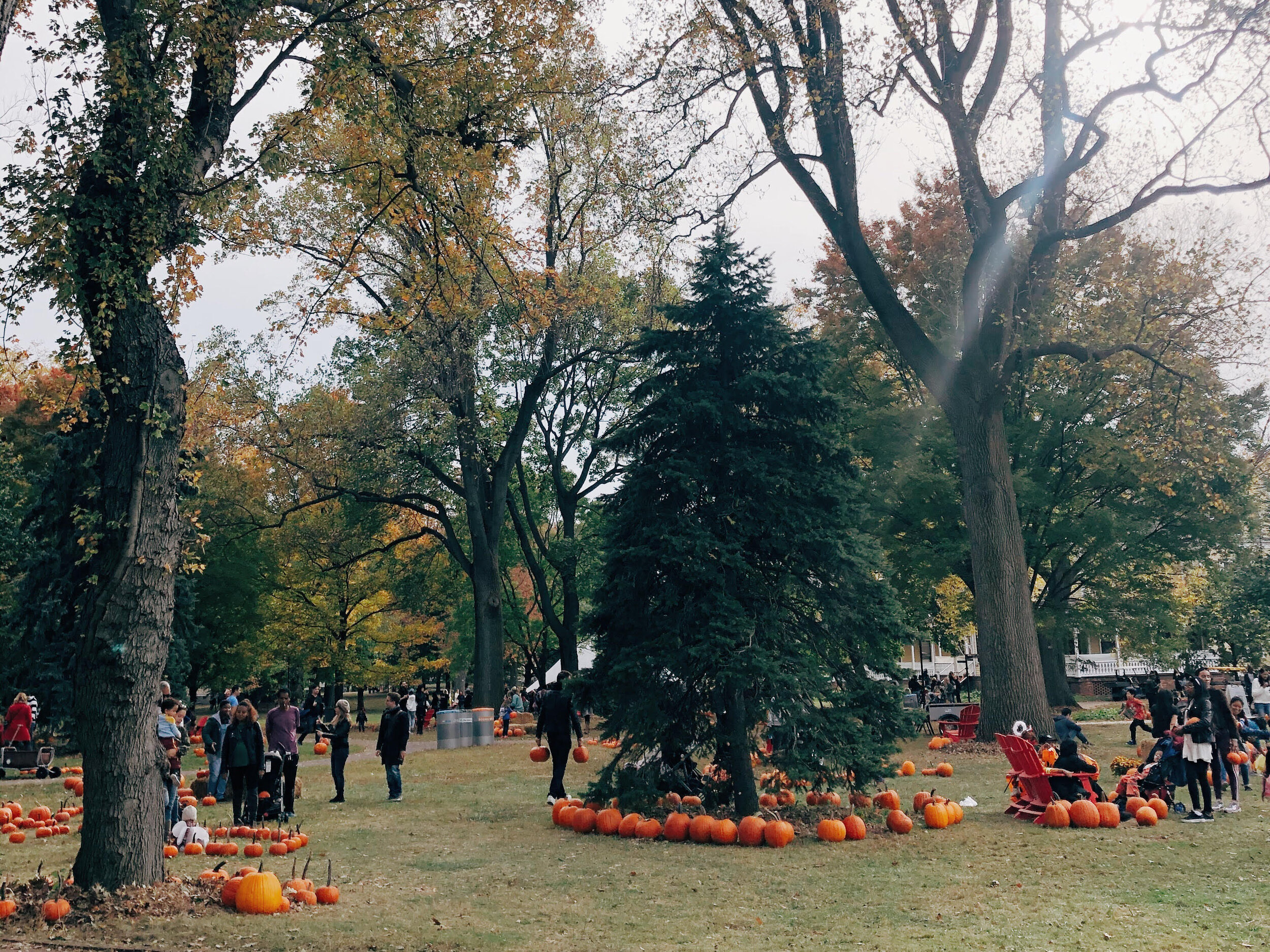
It’s now November and I’ve loved this past season! It was my first time visiting during the Fall and it won’t be my last. I felt like there was always something different or new to discover. I visited their incredible pumpkin patch: cider stations, pumpkin decorating for the kids, pumpkins for purchase, and fall foods to nosh on.


Governor’s Island gives me the opportunity to let go, of all the stress I may have experienced prior to my visit or whatever issue is coming up for me. It gives me the space to regain my clarity and prepare to face things that may require my attention or make me feel uncomfortable. Problems don’t disappear overnight, but taking a step back can help. I can be silly. I can get out of my comfort zone and meet new people if I feel like it. On occasions when I need to release pent up energy or ease my anxiousness I put my sneakers on and go for or a run. This island is the perfect track. There have been times where I turn on my yoga app and dive right into a pose with no worries in the world. It never fails to transform me. I head home feeling like a brand new person.
Living in such a fast paced city, sometimes all I need is just time to be alone with my thoughts or have a moment to meditate while the breeze from New York City harbor hits my face. As the mother of two very energetic toddler boys, I escape here to feel grounded and centered. And as someone who is multi-passionate, finding down time is required to nurture this journey of life. Governors Island has become that place for me; it will always have my heart.
To find out more, Website, Instagram, Facebook, and Twitter (Please note that Governors Island is closed for the season and will reopen in Spring 2020)

Caveat
A smart speakeasy to get your curiosity peaked while having a laugh.
“Caveat makes smart entertainment for smart people.”
With New York’s Caveat, speakeasies just got smart. A non-descript black door with a ‘c’ logo leads down a staircase and a basement space that looks like the kind of nighttime-entertainment setting you are probably familiar with: an intimate theater with chairs and round café tables facing a stage and a bar backdrop. But there are hints of something else – a library and gallery also feature within the space, and a program that includes things like this: Chaos Theory: An Off-The-Rails TED Talk On The Underlying Chaos Of Our Lives and The Nerds & The Bees: Comedy And Data — What’s Really Happening In Modern Dating.
If you like anything produced by NPR, listen to podcasts and Audible on your commute, and get excited about deep heady dives into ideas, then Caveat, a performance venue in New York’s Lower East Side, might just be your spiritual home. Here you’ll always find the kind of material that gets your brain working, unashamedly so. There is nothing even slightly uncomfortable here about knowledge, maybe because its positioned in ways that are ‘fucking funny’ by co-founders Ben Lillie (a particle physicist and co-founder of science podcast, The Story Collider) and Kate Downe (who has directed opera and Shakespeare, and led renegade museum tours). Nerdy stuff is made cool, high concepts accessible, and the esoteric absurdly wonderful.
Caveat produces its own shows, a combination of storytelling, interactive games, music, comedy and performance that range across science, philosophy, literature and academia and are hosted by university professors, anthropologists, philosophers, academics, neuroscientists and other brainy types. Live podcasts are also recorded here, authored both in-house like Nevertheless she existed and out-of-house like Monica McCarthy’s The Happier Hour. If you are finding this is your thing, you can also become a Member.
And its all with booze. Drinking kills brain cells, but here it supports the making of new ones (kind of), through smart programs designed to get your mind working and your belly laughing. Like a night of college all over again, but this time around it really is about that learning part and not just the drinking.

Tate Exchange
Tate Exchange is answering its own question: that art does have the potential to impact our lives.
“A place for all to play, create, reflect and question what art can mean to our everyday”
Does art have the capacity to change lives? And if it does, should it? And if it should, how can it? And if it can, where, where would this even happen?
On the fifth floor of the Blavatnik building within the cultural behemoth that has become Tate Modern, you can find an initiative that is right there, at the crux of those questions, wrestling with the how’s and why’s of art’s role in society: Tate Exchange. Here, one of the most successful arts institutions in the world is creating physical space for art to be functionally in our lives and in dialogue with society more widely. It’s also staking out this territory up North, within the walls of sister-space Tate Liverpool.
We can argue for a while that art does this anyway – that art speaks to our lives. We could even argue that this is particularly the case in the vast cultural campus that has become Tate Modern (also beloved site of my first curatorial job). Yes, there’s the beauty and solemnity of the Rothko room, the drama of the Turbine Hall, the reverie of just wandering through the permanent galleries and the inspiration-making qualities of the rotating exhibitions. Yes, you have probably experienced one work of art that has affected you without that effect being branded.
But with Tate Exchange, we get to experience that question of art’s relationship to self and society more directly, to play with Impact (that elusive idea thrown around more in tech and non-profit sectors). With Tate Exchange, the organization is confronting the very idea that art has the capacity to affect our everyday lives and to answer to, and maybe also shape, society. The lines that divide life (real time and space, the big and little questions, conversation, knowledge and experience), the arts (objects, materials, storytelling, the big and little themes) and us (as the viewer, person, consumer, maker, activator) are porous. Museums are no longer perceived or positioned as separate from society, they are located, produced by and understood within it. Similarly, as we enter these white-walled spaces, we are not a blank canvas, we’re bringing biases, backgrounds, assumptions, feelings even.

Who are we? Counterpoint Arts at Tate Exchange

ArtLab at Tate Exchange
Tate Exchange is the place where the museum gets to be something different, to morph and adapt and interact in ways that push against that traditional relationship of presentation and display. To pivot on ideas of co-learning, collaboration, production, and yes that wellbeing piece. Here Tate gets to be relational, and vulnerable. To step away from its esteemed baggage. Because maybe it’s here that the museum challenges its very reason for being—not to show, and collect, and explain works of art but to examine purpose, meaning, and relevance in the realm of the arts as they hit the pressing concerns of our modern lives. To bring to the fore questions of can we do this, and does it work, along with other questions around such things as climate change, inequality, technology, the economy, and immigration.
In its four years, two of which have been headed by socially-engaged art and placemaking advocate Caro Courage, Tate Exchange has taken a deep dive in annual thematics, headliners for life each led by an artist. Tate Exchange has explored ‘Exchange’ with Tim Etchells (2016) ‘Production’ with Clare Twomey (2017), and ‘Movement’ with Tania Brugera (2018). This year, the program is roaming across ideas of ‘Power’ with Hyphen-Labs, an international female collective who explore ideas of technology.
These themes are played out within a collaborative network of over 80 world-wide associates; cultural organizations, charities, community groups, and health trusts, who draw from the fields of art, education, mental health and community (such as ActionSpace in London and dot-art Schools in Liverpool). This wide network, in turn, shapes the form that these questions take within the spaces: anything from workshops, performances, conversations, prompt cards, reading lists, curated walks, festivals, mood and pattern workshops, reskilling sessions, seed swapping, radical myology, symposia, and even podcasting lessons. It’s all here.
Tate Exchange isn’t the easiest to explain, because it does so many things; Over the years there have been myriad perspective and platform-shaping ways that its curators, artists, practitioners, students, and associates, have found to raise their voices and engage audiences. Tate Exchange is many things to many people. But it’s all linked by a single thread: it stakes territory for the importance that culture has in our very real, every day, messy lives. It acknowledges that no one checks their lives or themselves at the door when they enter a museum. As we wander its different pathways, we inevitably feel, think, and are something, someone. Tate Exchange returns to us our place to be within museums.

The Makerie | In Conversation with Ali DeJohn.
We talk to Ali DeJohn, founder of the Makerie retreat, about why self-care and creativity are inextricably linked.
Starting something takes a huge amount of courage and commitment. That’s particularly the case if you are an introvert. We chatted to Ali DeJohn, founder of the Makerie—a beloved roaming creative retreat—about how she overcame her fear and realized her dream of making a nourishing space that puts the emphasis on self-care as much as technique.
Claire: Have you always been a creative person?
Ali: Yes, I have always loved creativity. Ever since I was a child, I found the most joy in making things with my hands. I went to a preschool where creativity was a major focus, and I think that sewed some creative seeds. It’s something that I carried with me all my life.
Claire: Did you continue your interest in creativity into adulthood? What were you doing before the Makerie?
Ali: I had a career in event planning. I worked for the Chicago marathon for seven and a half years and before that I worked for a small family-owned business doing all types of events. Both were great experiences.
When I had my children, I decided to stay home. I had always loved the idea of being a stay-at-home mum and I was so grateful that I was in a place where I could do that. As I really wanted to infuse creativity into our home and into our family, I started reading blogs for inspiration, which were booming at the time. There was so much rich content and so many people caring about creativity that I found my community in that world.
As much as I loved being at home with my children,I remember standing in my mom’s kitchen and bursting into tears because I felt so lost in who I was in the midst of motherhood. I had never really considered myself a driven career woman, but I realized how important it was to still maintain something of my own in this journey of being a mom.
Claire: That must have been such a powerful realization. I have a young family and I relate to that idea of losing aspects of yourself and not realizing that it’s happening until you realize that it has happened. How did you deal with that?
Ali: Though I loved to make things, it was really hard to do that in the rhythm of a life with two young babies. So, when a creative retreat popped up on some different blogs that I read, I thought well maybe I could go to that. But another part of me said, “well you’re not really an artist, you don’t really deserve to go.” This inner dialogue went back and forth, and finally, there was just this little tug at my heart, which said, “just go, you should just try this”.
So, I went to my one and only creative retreat. I was terrified but what I found was profound. What I was making, the colors I was choosing, the aesthetic I found myself creating, helped bring me back home to myself. I remembered who I was again, and it was such a joyful, powerful experience to discover that. I also really loved connecting with other people who cared deeply about creativity. I came home from that experience so incredibly filled up.


Claire: How did you go from that first taster of a creative retreat to starting the Makerie?
Ali: There was no intention at all at that time of doing my own version, but, maybe unconsciously, I knew that one day I would embark on that journey too. During the creative retreat experience, I wrote down all the things I loved and areas that would have made it feel more complete for me.
I came home and told all my friends about it, as I wanted them to share in this enormous amount of happiness and inspiration that it brought to me. I searched for a similar experience close to home and when I couldn’t find what I was looking for, somewhere that I wanted to take them to, or that I wanted to go to myself, I decided to start my own version.
Claire: What did that look like for you?
Ali: It was a really big step. I spent a year meeting with different people in our creative community to share my idea, and everyone I met with thought it was a wonderful concept, that it would be well received, and encouraged me to go for it. Everywhere I turned I was getting a green light, but I was still hesitant to move forward because it felt scary and vulnerable, on top of me being a quiet, introverted person at heart.
My husband grew tired of my waffling between doing it or not, so I had to have a heart to heart with myself. Would I rather try and fail? Or move on with my life wondering ‘what if’? At the end of the day, I realized I could live with failing if that’s what happened, but I couldn’t live with never trying and always wondering what could have happened.
Claire: How did you deal with that tension? How did you care for yourself over that time as you were making this big shift in your life?
Ali: I don’t think I did, and I still struggle with that self-care piece for myself. Honestly, I just poured my heart and soul into the first retreat. My kids were so little, and I don’t know how I did it. I just cared so much, and I still do, about creating a sacred and special space for people to practice and prioritize their creativity because it can be so hard to find in our daily rhythm and lives


Claire: You had a very clear vision for the shape of that pause that people could take out of their lives. What were the values that you were trying to bring into that first experience?
Ali: My main aim was to find a setting that was really conducive to nourishment. The space, the venue, and the environment that people walk into are crucial. For that first retreat, we chose the Colorado Chautauqua, in Boulder, which happens to be three miles from my house. It is an amazing, sacred place with community workshop spaces, cozy cabins, a dining hall, and even hiking trails out the back door.
It also has an iconic history. There was a Chautauqua movement over a hundred years ago, in which a group of people gathered together to celebrate secondary education, establishing pop-up camps where they would teach art and music and theatre. I felt like the Makerie spoke to the exact meaning of what the original Chautauqua was.
Claire: How have things changed for you since that first retreat in Colorado?
Ali: It’s been a huge organic journey that’s still continuing on its own path. The iterations have changed depending on various partnerships, the treasured teachers and artists I’ve worked with, and unique venue opportunities that have come my way. We offer varied retreat models in different locations, and have even hosted two retreats in France. I never dreamed of doing an international retreat so that was such a special opportunity.
Currently I am focused on smaller, more intimate retreats, with at the most 16 people. We feature one artist and a focused creative medium, so students are able to explore it on a deeper level. The model that we started with, allowing the participants to choose a variety of four half-day classes, was able to accommodate a large group and also involved more logistical feats. It was a playful and unique structure and maybe one day we’ll go back to that model. But for now, the smaller retreats are working well, particularly given that I now have two teenagers.
Each year we have anywhere from 3 to 7 retreats that are held across the country, and it changes every year based on different venue opportunities. Looking ahead to 2020, we have some special retreats planned in Boulder; we’re exploring a beautiful studio space in the mountains of Colorado; and planning another retreat in New Hampshire with paper flower artist Tiffanie Turner in the barn where she did an artist in residency. We’ll see what else next year brings!
Claire: Your teachers are such a vital part of your retreats. What qualities are you looking for in the artists who come to teach at The Makerie?
Ali: It’s important that the artists I choose to work with not only have teaching experience, but have a nurturing aspect to them too. Inviting adults into a creative space requires a teacher that is skilled in nourishing creativity in adults. Our teachers are crucial in making the experience feel encouraging, inviting, safe and warm.


Claire: You also attract high-caliber artists to work with (such as the retreat with Rose Pearlman in Boulder.) There can sometimes be a hierarchy between the kind of artist who has gallery shows and those who do workshops, but here you’ve managed somehow to bring the two together.
Ali: I don’t think of choosing teachers in this way. I find them through various paths and take the time to research what they’re currently doing, the types of workshops they are hosting and explore if a collaboration feels right. I’m grateful the teachers I work with trust me with their gifts and I make a special effort to make sure they feel as nourished as our participants. If they feel cared for, they are going to be able to do their best job. I’ve had so many teachers comment that when they leave our retreats, they feel inspired and filled up, instead of exhausted, and I cherish that.
Claire: How as a host do you create such a welcoming and accepting space for both your workshop leaders and your attendees?
Ali: For me, every step of the way counts and sends a message. From the second someone registers to walking through the door, I try to create a warm environment and an invitation to be part of something special. I want our participants to feel that they are loved and appreciated from the very beginning. When they arrive at the retreat, they are greeted with a hug and a genuine feeling of excitement that they are there. The teacher plays a big part in the role of creating a safe space by holding the room in a calm, capable and loving way.
There’s also the sense of entering a space that feels inspiring. When I visit a potential venue, I know within minutes if it’s going to work. There’s not a magic formula other than my intuition and it’s tied to my aesthetic preferences and senses. It’s a similar feeling when you’re looking to buy a house. You can feel the energy and whether or not it’s right.
Claire: Your approach at the Makerie feels very person-centered. You lean into ideas of imperfection, slowing down, being in conversation with the person next to you. I love how you place people right next to craft in importance for how you conceive these events. Why is this hosting/ nurturing aspect such a large piece of it for you?
Ali: Someone once described their experience at the Makerie as coming home to themself. I thought that was so beautiful and exactly what I hope people feel when they come to our retreats. It’s a magical thing to watch the transformation that happens when people take time to nurture their creativity and make beautiful things with their hands. I care deeply about each person who attends our retreats and that’s the heart of everything I do.


Claire: I have this strong belief that creativity and wellbeing are very strongly linked. My sense is that you do to. Why do you position these retreats within wellbeing and self-care rather than just as a creative workshop?
Ali: Creativity and self-care are almost the same thing. I look at creativity as one of the pillars of self-care, in addition to moving your body, making healthy food choices, taking care of your mind, and finding human connection.
There are two things at play: One is nourishment from the inside, that people have to give themselves in this process; and then there’s nourishment from the outside, which is what I work hard to create. When you combine the two, it’s a magic combination of whole-body nourishment from head to toe.
Creativity is the cornerstone of what we do and a back door into mindfulness. It’s like yoga for the mind and a way for people to drop into themselves without having to sit in a formal meditation. I love how creativity can take care of your mind and soul in a similar way.
Creativity can also be a way to connect not only with yourself but also with the person next to you. You can be making something and not even say a word, but someone can look at your aesthetic choices and gain an understanding into who you are and what you’re about. Your creativity speaks for you and you’re able to connect with people on a special level by what you’re creating with your hands.
Claire: Do you think that there’s been a shift in understanding of what creativity can do for people? I get the sense more and more that it’s a tool that’s sitting closer to wellbeing.
Ali: Absolutely. Just look at the plethora of coloring books for adults. That in and of itself shows you how everyone is craving a quiet mind. The enormous amount of information we’re all being asked to hold in this day and age is impossible to keep up with. We’re all looking for a joyful out and can’t escape it all, but there are many ways to slow down and find quiet in beautiful ways. Retreats of every kind are popping up as more and more people realize how valuable it is to step out of your everyday rhythm of life to nurture something you love.
Claire: Do you find that people coming to you are first time creatives, who had a similar sense as you that their creativity was somehow dormant and they want to find a way to reconnect with that, or are you finding its people who already have creative leanings that are very much alive who are wanting to develop that aspect of themselves more?
Ali: It’s all of the above, as very few classes require experience. All we ask is a willingness to come with an open heart.


Claire: Do you see yourself as an artist or an amateur? I ask this because often as creatives we take the role of facilitator and it can be hard to hold that space of creativity for ourselves.
Ali: I see myself as a joyful, amateur artist. I dabble in all kinds of creative endeavors - from knitting to embroidery to ceramics to drawing. I just completed 100 days of stitching, which was a fun and challenging practice. I love to try my hand at so many different things and don’t consider myself an expert in anything. I love making anything with my hands.
Claire: Finally, how has founding the Makerie impacted you? We’ve talked about how setting up something like the Makerie impacts the people who come through the door, but I wonder how it has transformed you?
Ali: It has been such an unexpected journey that continues to teach me more than I ever imagined. Here are some of the many lessons I’m learning:
The Makerie gives me rich personal growth. When someone comes to a retreat, I might not know the underlying reason they are there and I have learned to separate out what I need to hold and what someone else is carrying. I used to absorb everything, including everyone’s collective energy at a retreat, and would come away exhausted and depleted. I have learned to lovingly hold a space for other people outside myself, helping me stay nourished and healthy.
I’ve also learned that no one really knows exactly what they are doing. We’re all in the same boat of figuring it out as we go and that’s a refreshing thing to remember.
Keep doing things with a pure, heart forward intention. If I make a decision from this centered place, I know it will lead me to positive places.
Take my own advice to nourish my own creativity. It’s strange how hard it can be to carve out time for something that brings me so much joy. Making by hand nurtures my soul and will always be part of my life.
To find out more about the Makerie, check out the Website, Instagram, and Facebook


Re:Mind
Finding calm in stressed-out London with a new kind of lifestyle studio.
“Find Your Calm.
Drop-in meditation classes in the heart of London.”
Re:Mind speaks to a future where mindfulness studios are as common as your local gym. We all now understand the benefits of exercise, even as we procrastinate to get ourselves to that yoga class, or Soul Cycle session, or just out the door for a half-arsed hike. But we’re now coming to understand the benefits of being in our bodies in a different way, in ways that are slower, gentler and much less sweaty than cardio. Breathwork and meditation once meant retreats or a niche happening-over-there kind of thing. They were definitely for other people. Now we strive to bring these self-care practices into our working weeks and everyday attempts to keep it all together.
Re:Mind helps us negotiate that shift in how we see and experience mindfulness techniques. And it does so by removing some of the woo-woo that might have put us off before—incense sticks, tie-dye, those draped curtains. Founded in 2018 by entrepreneurs and wellness warriors Carla von Anhalt and Yulia Kovaleva, Re:Mind is London’s first drop-in healing studio. Bringing a lustrous charm to self-care practices, Re:Mind takes out the intimidation factor around more alternative wellness approaches.
That all starts with the space. It has been designed to hold you in your practice; to be an instant balm as you walk through the doors. The colour palette is soft, more akin to a high-end boutique. Attention has been paid to best practices for air quality, comfort and serenity. An abundance of greenery (including an air-purifying floor-to-ceiling plant wall) and cascading natural light, nature-derived materials liked the covetable buckwheat filled floor mats, and a mandala of Himalayan Salt Lamps (which are having their moment), create the setting for finding your calm. And if something looks this good, it must be good for us, right?
Actually, right. There’s now study after study to back up the techniques on offer. The intimate studio offers a wide range of equilibrium finding drop-in sessions: There’s yoga, in restorative movement class (Re:Store), mindfulness techniques (Re:Heal), and energizing breathing (Re:Breathe). But there’s also more intriguing sounding offerings such as healing sound baths (Re:Sound), rituals for connection with one another (Re:Connect) and the one we lean towards, bringing in kindness and self-care practice (Re:Caim).
In this serene urban oasis, practitioners are called ‘Calmers’, clients are invited to relax before or after a session with herbal tea, and a small library offers some context (or diversion to those of us who feel less comfortable in new environments). The on-site eco-wellness store is stocked with small businesses who are doing some of the work of sustaining us and our environment, with handmade soaps, flower remedies, chimes and the requisite crystals.
Bringing some Californian lifestyle savvy to the streets of London, this pristine boutique studio for the stressed-out gives both the space and the permission to pause. Here is a place to actually practice some of those concepts that are increasingly talked about as vital tools for navigating modern life; jumping off the pages of a lifestyle magazine or a wellness manual into our real-world. LA would be proud.

When Friendship Saves Us (Part 2) : Our Take On Modern Love
As our problems gain significance and gravity and weight, we are no longer confident that our friends can bear their burden, no longer confident that they’ll be able to see us through the wreckage of our flaws. Maybe that’s why, when we find someone who does see us and loves us still…maybe that’s why we hold so tight?
Believe me when I tell you that nothing sounds more terrifying to me than a posh British girl who has just transitioned out of her successful career as a modern art curator to focus more fully on our societal responsibility to address mental well-being. (For reference: I am insane, and 50% of the “art” in my house is from TJ Maxx.)
But a few months after our second babies were born, it was time for our firstborn children to start Kindergarten, and by some stroke of luck, or destiny (or the fact that there was actually only one school in our town) our children ended up being placed in class together.
I sometimes wonder what these days would have been like if I’d understood at that time who she was…who’d she’d be to me. If I’d have felt less lost? Less alone? If we both would have? But maybe that’s the beauty of friendship? There is simply no rush to force its unfolding, no timetable that stipulates where things ought to be; a freedom that allowed us to bumble through the initial unfolding in spit-up ridden fits and starts, baby slings flapping unceremoniously in the breeze as we realized: being together through all of this was just better than being apart.
There was a time when I thought of friendship as an immature pursuit, that all of these minor relationships were simply buying time until the real relationships began. Surely I’d outgrow the need to spill forth all of the pieces of my life in the hopes that my poor, unsuspecting friends would put them back together. Surely slumber parties and impromptu ice cream binges would lose their appeal? Surely I’d feel increasingly more inclined to hide who I was in the hopes that I’d remain protected, collected, secure. And maybe that’s true. Maybe we do start holding ourselves together more as we age. We smile and respond “I’m great!”, and we shift our conversations to inconsequential topics and we occasionally pop in to therapy when things get bad…but by and large, more often than not, we choose to suffer alone. As our problems gain significance and gravity and weight, we are no longer confident that our friends can bear their burden, no longer confident that they’ll be able to see us through the wreckage of our flaws. Maybe that’s why, when we find someone who does see us (really sees us) and loves us still…maybe that’s why we hold so tight?
Claire was the first person I opened up to fully (partially because she made me feel safe, and partially because I was breaking down before her very eyes and there was no longer a polite way to brush off her concerns).
“Yes I babysat your daughter today!” (You’re welcome!)
Yes, I also stayed at the park the whole time because I thought a murderer was hidden in my attic.“Yes, we rode our bikes to school pick-up today!” (What a fun and active mom!)
Yes, I also believe a bomb has been planted in my car and will explode at any moment in some sort of Speed-esque fashion (but minus the uniformly-sweaty-and-bronzed Keanu Reeves.)“Yes, my eyes are very puffy because I’m tired!” (#momLife amirite?)
Yes my eyes are also puffy because I’ve been crying constantly/hysterically/desperately wondering how to escape the confines of my body.
Due, in part, to a series of traumatic events and in part to a less-than-ideal genetic composition, I’d found myself locked in the jaws of anxiety and paranoia, once again — a constant gnawing that quickly escalated to a violent, thrashing attack. And when everyone else saw the smiles and the bikes and the requisite puffy-eyes…Claire saw the bite marks. When everyone else was happy to accept the ‘I’m fine!’s, happy to accept the facade I’d so expertly constructed (and who could blame them?) Claire was the type of friend who was brave enough to look beyond the poorly-bandaged wounds to the disaster that lay beyond. And when she saw me there (the real and broken me) the ‘me’ who had no jokes or quips or excuse left; when anyone would have been justified in their rapid fleeing ... She stayed.

RISE
Somerset’s RISE is both a place to come together and a modern day twist on traditional church.
“A place to relax, play, work, eat. A place to be together”
Above the entrance is a simple sign that says ‘Rise’. This sets the tone for all that goes on inside: a café, bakery and play space, an active calendar of workshops, events and activities, office space for socially-minded businesses, and a contemporary art gallery that shouts out local and national talent. Here, in a sensitively converted church, are all those components that once made this space so appealing to the congregation it previously housed: community, positivity, hope and connection.
Three years ago, Io Fox and Ed Roberts, a former teacher and nurse, bought this church, originally built in the early 1800s. It had fallen in recent years on its own hard times. The congregation of the United Reform Church had been dwindling for a while, so much so that the building was put on the market. But rather than shape this space into luxury apartments or private offices, the new owners did something remarkable. They shifted the emphasis to a wider purpose, giving a modern spin to the architecture, history and ideals this church once offered. Through their renovations, they weren’t intent on erasing what had once past, but rather building on it. Everywhere there are traces of what the building was before: etched arched windows, stone plaques, a working organ that dominates the main space. Keeping the look and feel of the place, they acknowledged its abiding history, and even embraced its former community and intent (a couple has since got married here).


They also did this, they allowed the community in which it sits in Frome, a small town in Somerset known for its creativity, a say in how this project evolved. They kept those long-time hallowed doors open to whoever needed them in maybe a different way, inviting in businesses, practitioners, parents, and charities who were seeking space to develop initiatives of their own. They welcomed everyone, with the aim of similarly nurturing people within its walls, so that Rise could truly reflect the community in which it is situated. And the local people that it served, answered the call, creating a new sense of life in this space, forming and shaping its content, giving this building new and more relevant purpose.
Three years on, Rise is now a buzzing multi-use space. The central atrium has been given over to Rye Bakery which runs a friendly café incorporating local suppliers, simple food and organic sources where possible. On Friday it hosts community building pizza nights. There’s also a play space (Alfred’s Tower) for the little ones, which has a handmade feel to it, a nice antidote to the bright plastic that usually comes with the kid’s area, and a sweet reading space. Most laudable though is the stunning woven nest space, a semi-private huddle for nursing moms and for smaller gatherings.


The mezzanine space where the congregation would once have sat, has become an increasingly well regarded contemporary art gallery, The Whittox Gallery, curated by Sara Robson. It shows local and national contemporary artists and designers in an exhibition program that roams across all media.
Sort of behind the scenes, The Old School and The Sun Room, have become spaces to hire by anyone, for private and public events. The downstairs offices and work spaces have been rented out to socially-minded organizations, like OpenStoryTellers, a charity that aims to empower people with learning disabilities and autism.
Across all these spaces are an active range of classes, workshops and events for all ages, abilities and backgrounds such as yoga classes, wellbeing sessions (like one on unleashing creative genius), exercise groups (see the popular Mojo moves and hoop dances), art and science clubs. A therapeutic choir just started in the space.
Rise is a modern-day church without really being a church at all. It works within that rich history of places where people gather, connect and believe, and gives those very fundamental human needs a thoroughly modern-day twist. In its name and its mission, Rise uplifts those who work here, engage here and play here. There’s a reason churches were once the heart of the community, and there’s a reason why Rise has become a space that local people flock to again.


When Friendship Saves Us (Part 1) : Our Take On Modern Love
Friendship offers a purity that is complicated only by the fact that there is nothing legally binding you to one another. Nothing to say, “if you leave you’ve got to give me a house or a boat or half of your grandmother’s jewelry.” Just this love that lingers in space, vulnerable, subject to the whims of men.
She’s moving back to England and I can’t come. (Obviously.)
Because the thing about friendship is: you don’t plan your life around people that you’re not having sex with. (Which honestly feels a bit barbaric, to me, but ok.)
Finding romantic love has long been considered the gold-standard of human achievement, evidence that we are worthy of a lifetime of devotion, or, at the very least, that we are tolerable enough to withstand for the better part of a lifetime. Romantic love is a precisely choreographed dance, the steps of which will never be revealed; a high-stakes game with loosely-defined rules and a massive potential for loss. On the one hand we’re expected to foster an impossible level of comfort and security. (We hurl forth our hopes and dreams, crossing our fingers that we’ve found someone who will see them and share them and keep them safe … someone who won’t be sent fleeing wildly in the opposite direction.) On the other, we’re implored to maintain a similarly-impossible level intimacy, eroticism and mystery. (If you’re not popping out from behind the dresser in a French-maid costume or developing a new mental health disorder every month, are you even trying???)
Friendship does not exist on this same playing field, or within this same town, or even within this same earthly realm. Friendship is an ever-available gift from the gods. An opportunity for connection and closeness without ever having to talk about mortgages or school districts or pills for sad penises.
Friendship is unburdened by such trite matters. Friendship does not care about flaccidity, or project-based learning or “interest rates we should really capitalize on.”
Friendship offers a purity that is complicated only by the fact that there is nothing legally binding you to one another. Nothing to say, “if you leave you’ve got to give me a house or a boat or half of your grandmother’s jewelry.” Just this love that lingers in space…vulnerable…subject to the whims of men.
When I first met Claire, she was sailing a paper boat down a stream, giggling with her young son in a fashion that suggested she was probably a nanny and almost definitely a little bit drunk. (She denies both claims.) I fell for her her all the same. Her lightness, her ease, the way she smiled and laughed, the way I could see her walls…the way I knew before she did that they’d start to fall.
We first bonded over the fact that we both had children. Not that they were similar or that we were raising them in the same way or that they even liked each other, just that they existed and that we had birthed them within the same relative time frame. (This, I’ve discovered, is as good a reason as any to develop an adult friendship.)
The unfolding was slow. I forgot her name multiple times and was forced to introduce her to some unsuspecting acquaintance who found himself lingering nearby so that she’d have to tell them her name). We had no real reason to meet so we’d just happen upon each other, at the houses of mutual friends, at the park, by a stream. (Stalker stuff.)
Years later, when it came time for us to produce our requisite second children, both of us managed to hold out for an ungodly 5 years. While the rest of the world went on to space their children perfectly, precisely, methodically, 2.6 years apart, here we were, bucking the norm, starting over after half-a-decade. (Her, because she’d had a successful career and seemingly unlimited ambition…me, because my body wasn’t very cooperative and that I was busy stock-piling mental and physical health disorders.)
The first time I saw her after having the baby, I forgot to ask the baby’s name, or when she’d had her, or if she was so tired she might die. We just sort of stood there on the sidewalk making small-talk, smiling vaguely … each of us pretending to be ok.

The Joy Cafe | A Conversation with Becky Playfair on community
We talk to the Founder of the Joy Cafe Becky Playfair on building a life-giving community cafe in one of the UK’s most deprived areas.
On an unusually hot summer morning in the little town of Boscombe, in England, I was introduced to a friend’s local cafe with a difference. As I stepped into the Joy Cafe, I lit up. In this converted shipping container, there was a hum of friendly chatter amongst families with young children and seniors sat together. The cheerful decor of sunshine yellow and dove gray gave the cafe a warm home-from-home feel. The smell of fresh coffee and sausage sandwiches wafted under my nose as I took in the delightful display of homemade brownies, cookies and cakes. As I ordered, I spotted a Suspended Drinks noticeboard whereby someone can buy an extra drink that gets ‘suspended’ on the board until someone who needs a free tea or coffee claims it. It’s a beautiful way for the locals to give or receive in their local community.
But the Joy Cafe offers so much more than free hot drinks and an insanely affordable menu of homemade food. It’s the little thoughtful details that reveal the heart and soul of this space, in initiatives that support the local neighborhood in heart-centered ways. The Joy Cafe provides positivity and connection to others through a variety of organized events and activities that bring different members of the community together in fun ways, that support mental wellness and ease loneliness.
Some of these include: Safe & Sound Ladies Craft where women can spend a couple of peaceful hours relaxing over a warm drink while crafting together. Awaken Conversations where guest speakers come and speak about personal development and life skills. Chess Club happens every week and there are regular community dinners for all ages that feature pop-ups from local cooks and food businesses. Local families who use the playground outside are supported with free breakfast mornings and art workshops during school holidays. Dotted around the Joy Cafe you can also find unstructured play opportunities for all ages with plenty of art supplies, books and board games on offer, perfect for rainy days.
The Joy Cafe was founded four years ago by Becky Playfair who had a vision to turn a rundown youth center in the park of Churchill Gardens, Boscombe (one of the most deprived areas in England), into a life-giving not-for-profit community cafe. From its first iteration as a pop-up bake sale with boxes of hula hoops, frisbees and crafting materials, the project progressed to a lease and planning permission to convert the old youth hut into a café. Key to making this happen was a JustGiving campaign to raise money in which 11 members of the Coastline Missional Community were sponsored to complete a 3 Peak Challenge, climbing the highest peaks in Scotland, England and Wales in just 24 hours!
I talked to Becky about the hard work and determination (with the huge support of the Coastline Vineyard Church and young volunteers) that helped make her dream of a very special community-centered cafe into a reality:


Sophie: How did the concept for the Joy Cafe first begin and why did you believe that it was needed?
Becky: I first had a dream to open a café when I was 18 years old. I was jogging (not very fast!) around my neighborhood in Birmingham realizing that I had little ambition but desperately wanted some! I wanted (and prayed for!) something to aim for in life. I wanted to dream big, to achieve, to make a difference, to have life goals. So, as I ran, I pondered, and prayed and pictured a café.
In the same moment I just knew that it would be more than your average British high street café. It might be a place where people had not just great food and drink but also got to encounter something more. A little bit of heaven on earth. Where people would feel safe, genuinely known, loved, appreciated and accepted. Where they would be spoken to, listened to, given hope, encouragement, a compliment, a smile, conversation or creative activity.
After studying Psychology at Exeter University, I moved to Bournemouth, then a year later to Boscombe, the most deprived area of Bournemouth. In the bottom 3% of deprived areas in the whole of the UK, the area was impacted by huge issues with drugs and alcohol, crime, poor housing, and health, etc. I moved into a house known as NO10 (the house number of where we were); we all worked part-time and gave the rest of the week to making a difference in our neighborhood. We opened our doors at NO10 and had all sorts for dinner and mentored in the local schools. Living in a truly beautiful but broken area, made me realize the need for a third space. Most of my neighbors lived in bedsits, they stood outside and smoked with only the rubbish bins to lean on. They were friendly but lonely. The communal space was the pavement. … they desperately needed a café and one that they could afford to buy coffee from!
Sophie: How did it progress from a pop-up to a proper cafe?
Becky: I started the pop-up Joy Café a year after moving to Boscombe. The two trestle tables, simple refreshments and kids’ activities were all stored in my hallway and taken in and out every day. We had an incredible first summer… local families loved us and thankfully so did the Council. They could see the transformative potential and gave us a chance. When the hut in the small park in the heart of the neighborhood became vacant, we were given the lease and allowed to renovate, making it fit-for-purpose. We’re been open as a “proper” café since February 2018.
Sophie: What were some of the challenges you found opening the Joy Cafe?
Becky: Getting the lease then planning permission for the renovations took ages and was beyond me! I would never have managed it without the support of a very wise surveyor from my church. Without his endless negotiations and skills, it wouldn’t have happened. But the toughest thing was definitely project managing the renovations. It took four months and though I had the most amazing team, largely made up of hugely generous and skilled volunteers who gave hundreds of hours to the project, I cried most days! (I was also wedding planning and later found out I had glandular fever… no wonder I was a mess!). I was consistently out of my comfort zone but somehow made it through! I’m now in my element being a barista, chatting with people, and building community.
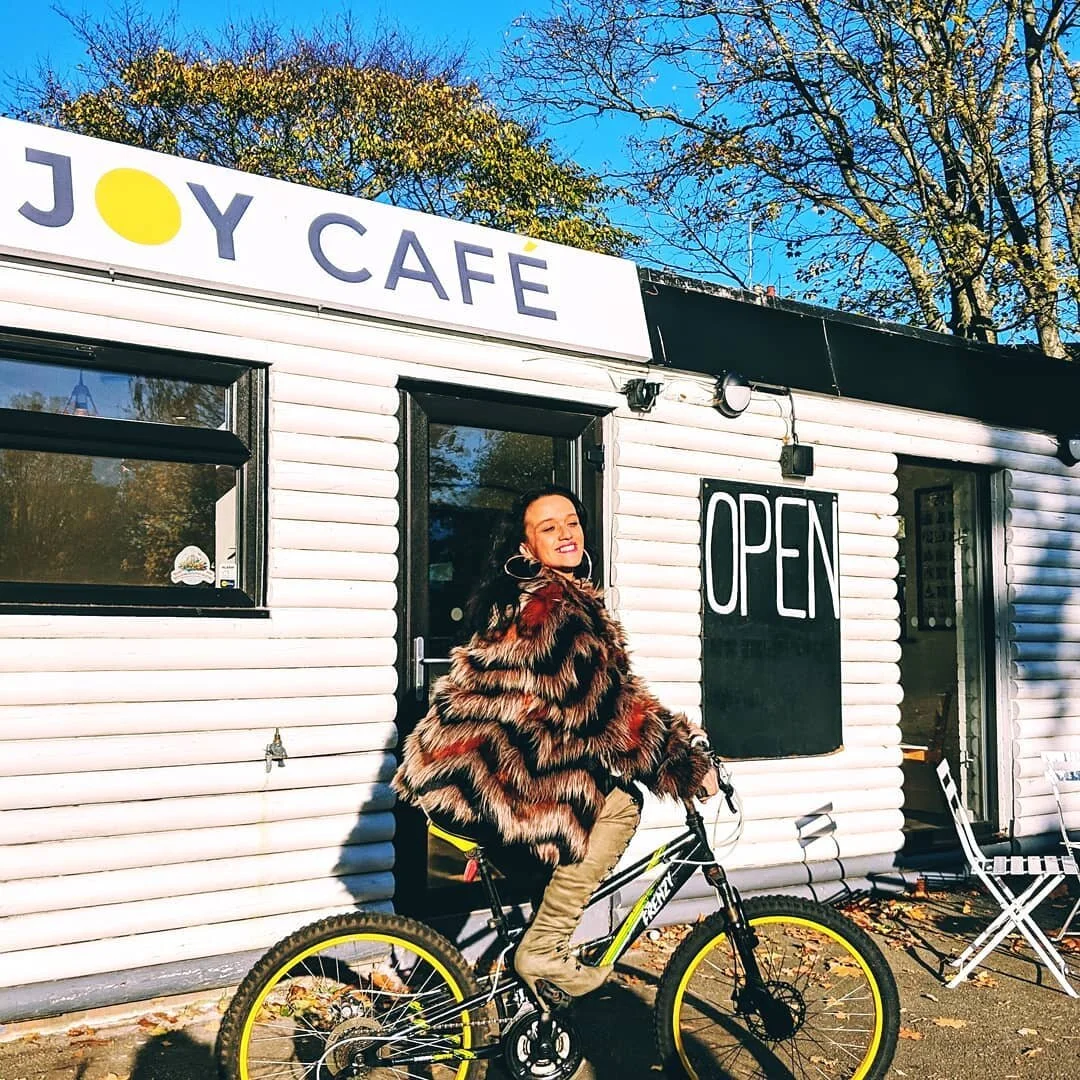

Sophie: What is the mission of the Joy Cafe and how did you want it to benefit the community?
Becky: Joy Café is a lush little café with a big heart for building life-giving community (our strapline). We want to create a safe space, a home from home. We want to be the friendliest café. We like to make people’s day. I love blessing people with the occasional free coffee or cake or go out of my way to make something off-menu that they’d love and really appreciate. We celebrate our customer’s birthdays with cards, banners and gifts. We also partner with local people, groups and organizations. We do Suspended Drinks. We love Young Volunteers and have the best and youngest baristas in Bournemouth. We want to try to listen to what our community and neighborhood needs or would like and do our best to make it happen. We have free bike repairs, chess club, creative events, eco-workshops, games groups... all sorts!
Sophie: How do you want people to feel spending time at the Joy Cafe?
Becky: Known, valued, accepted, listened to, themselves, joy, at peace, loved, part of a community.
Sophie: What are the ways that the cafe has impacted the local community, you as an owner and your staff?
Becky: So many people talk about the impact of the Joy Cafe… from local families, individuals, councilors, tradesmen, the police, people who used to live around the area and are now back… People from every area of society have commented on the dramatic and positive impact the Joy Cafe has had on the area and park. It's safer, busier, lighter, has a better atmosphere… because of the Joy Cafe. Yay!
Sophie: What are your hopes and dreams for the future of the Joy Cafe. And will there be more?
Becky: I love where we’re at and want us to continue growing. I don’t know whether there will be more Joy Cafes but if the opportunity arises then I probably wouldn’t say no!
To find out more about Joy Cafe, head to their Instagram or Facebook.


826 Valencia
826 Valencia is keeping space for our kids’ imaginations in our cities, and crafting magical spaces for our communities and for ourselves as it does so.
“826 Valencia is a non-profit organization dedicated to supporting students ages 6 to 18 with their creative and expository writing skills, and to helping teachers inspire their students to write.”
Yes, you might think you have just found yourself in a quirky pirate store or an octopus’ playground or a secret spy society, but what you’ve done is landed right at the heart of a non-profit organization that exists to support the writing skills of under-resourced kids. Maybe purpose is like medicine and you need some sugar to help it go down (not sure who does that other than Mary Poppins and her charges but it’s an association that’s stuck). For 826 Valencia and its network of storefront chapters across the US, the sugar takes the form of magic and the imagination: each of their much-needed writing centers are fronted by spaces of whimsy and curiosity.
From its start in San Francisco’s Mission District in 2002, a delightful sense of wonder has been built into how the organization has crafted itself: the first flagship that opened at 826 Valencia Street by educator Ninive Calegari and author Dave Eggers took the form of a pirate store mostly as a workaround for a local zoning issue that demanded some retail component. So of course, pirates need stores too. That model of locating the idiosyncratic in the everyday has inspired further storefront locations across the US; there’s the secret agent supply store (Chicago), a magic shop (Washington), a time travel mart (LA), a robot supply and repair shop (Michigan), a Haunting supply store (New Orleans), a Super Hero Supply Store (NYC), and maybe our favorite the Bigfoot Research Institute (Boston).
The original SF location has since been joined by two more in the city that capture this same spirit of make-believe: the wonderful Enchanted Forest and Learning Center in Mission Bay and the King Carl Emporium in the Tenderloin. In whatever shape-shifting form it takes across the US, 826 Valencia cultivates places of the imaginary and places of very real need, sitting quite naturally next to each other

Photo Interstice Architects
826 Valencia is one of the few places holding space for the imagination on our city streets and in our children’s lives. Think about its latest iteration in the Tenderloin in which a liqueur store associated with drug trafficking and anti-social behavior was converted into a playful apothecary of sorts and a light-filled writing space (also note the brightly colored, game-changing ocean-themed painted exterior). A space that might feel simply enchanting is actually a crucial vehicle for revitalizing a street corner, a community, and a child’s life.
And it also might do this. 826 Valencia might put a spell on your own. Because you get to come in, not just to purchase unicorn horn’s polish, an eye patch or Lumber Jack Repellant, but to participate, to be one of the grown-ups bringing writing to kids who need it. This is where the magic of a different kind starts to happen. Because the core belief running through all these spaces is that kids benefit greatly in confidence, pride and ability from dedicated, focused time on their writing skills—that’s in obvious ways like crafting a personal essay and helping with homework but in other more exploratory ones like working out how to express themselves in poetry and the written word.
826 Valencia is run on volunteers like you who get to tutor in their writing programs or to donate services such as illustration, design, photography and audio editing in order to create the books, magazines, and newspapers that take the students' words beyond their schools and these storefronts.
With 826 Valencia, we can have magic on our streets again and in our kids’ imaginations. We even get to have it back in our own very grown-up lives.


The Museum of Ice Cream
The Museum of Ice Cream might seem like it’s about sugary confections, and equally as sweet images, but approach it as a place of connection and then it becomes something else entirely different.
Ok, you probably have your assumptions about the Museum of Ice Cream that has been popping up in locations in San Francisco (now permanent), New York (very new and permanent), Miami, and Los Angeles. We had ours. We imagined it as an Instagram mecca, a hyperreal pink (that’s Pantone 1905C) paradise of shine and shimmer. Froth and frolics. And it was that: when we visited the SF version, we took photos with everyone else against backdrops of floating cherries and giant popsicles, made impermanent messages with pink magnets, crawled into mirrored rooms and climbed pink walls, and swam deep in the famous pit of colors. We hadn’t gone as far as some; we hadn’t coordinated our outfits and we hadn’t posed again and again for the perfect shot. But we had image-laden fun: we consumed a ton of sugar, visual and edible. We laughed and interacted and just spent a silly afternoon with our kids actually sharing in their joy and not watching from the sidelines as is sometimes the condition of modern parenting.
Though we did all this and came away feeling great (maybe slightly sick also), we have since realized we kind of missed the point. And maybe we weren’t, or aren’t, the only ones. See the Museum of Ice Cream is not really about ice cream (though there’s now a Target branded line that includes such things as Impeach-Mint so this argument might get a bit blurry). It’s also not about taking out your phone to capture the perfect image. It’s also not about screeching through oblivious of those around you as you try to craft the perfect time. What we have since learned is that that it is fundamentally about connection. That’s right, this experience, this museum, now handily rebranded by its founders as an ‘experium’, has been engineered to bring people together, to be a kind of social glue, albeit of the creamy vanilla kind.
It was this episode of Yale associated podcast The Happiness Lab by Dr. Laurie Santos that started to shift our perspective, and as we dug deeper into the motivation of co-founders Maryellis Bunn and Manish Voramotivation, we found more and more that spoke to The Museum of Ice Cream as a counterpoint to our current epidemic of disconnection and the loss of spaces in our worlds that give us the opportunities to just be people together.


Here’s the irony: The Museum of Ice Cream was intended to be so spectacular that we wouldn’t be driven into the world of image-making on our phones, but rather we would be driven away from them. We’d want to immerse ourselves more in this fantasy world, for a short time tangibly all around us, because it was more real, more compelling, than those pixels. We would want to share that experience with those following a similar journey through the joyful labyrinthine spaces, as that would heighten our own experience for us. We’d want to escape our isolation and run into a place of collective joy.
The Museum of Ice Cream has since pivoted and like all new concepts iterated on its theme. Yes, it’s a huge phenomenon that you may have visited, probably most likely have an opinion on, or are in the process of imitating (see the idiosyncratic experiential museums that it has since spawned), but it’s also still figuring itself out. Like Solo Nights (where you get in free if you turn up alone) and the phone free sessions; the Museum of Ice Cream concept is truly working when people connect within this fantasy palace, when they notice what’s actually around them and each other, and when the conversations started within the shininess go outside its walls, and sometimes that needs a phone-free helping hand.
The Museum of Ice Cream is a pop-up experience that’s meant to last more than the sugar high even as it gives you that high. It’s a careful line to tread, but we’re betting that as long as it's as much about the people it buoys up as the abundance of ice cream (or whatever the framework may become) that is consumed then this will stay a place of comfort that continues to soothe our disconnected lives.


Shelf Help | In conversation with Toni Jones
We talk to the British journalist Toni Jones, Founder of Shelf Help about the bookclub that became a global movement and why its her mission to make self-help accessible, collaborative and cool.
When we first found out about Shelf Help, we felt like we had found our people. It’s a book club, built around self-help books, that also builds community in real-life. Isn’t that the ultimate combination?
OK, you’re hesitating, and we’re guessing it might have something to do with the genre because let’s face it, self-help can be a bit naff. You probably already have your biases, unconscious or otherwise.
Don’t worry, in the conversation that follows with Founder Toni Jones, we’ll cover that uncool factor and all the other reasons why Shelf Help is something you might need in your own life. Prepare to change your mind.

Claire: What led you to start Shelf Help?
Toni: I had just left my full-time job as a journalist to become a freelance writer, which meant suddenly spending a lot of time by myself. I was 36 and I’d never spent any time alone. It should have been the dream. I’d quit a job that I hated. I was busy and getting work. But it wasn’t that easy being by myself and getting to know myself. I realized I had spent a long time just ignoring my needs, and as soon as the job wasn’t there as a distraction, it was all back down to me.
I spent a lot of that time not unravelling but definitely in a bit of a mental health black hole. I was transitioning from this high-octane life to having a lot of time to think about whether I had done the right thing. I didn’t know how to deal with any of it. I knew I didn’t want to go back. I knew that wasn’t the right thing to do but I wasn’t sure which way to go.
I just started reading a lot of self-help. I started taking care of myself in other ways too; going to therapy for the first time (which I found really hard and amazing), doing yoga, attending retreats, and participating in a few support groups like Al Anon. I was also writing more about wellbeing because it was a trend that was coming in. In a way, in trying all these things, I was approaching my own life like I was writing a feature.
Claire: What was the first self-help book that you read?
Toni: Paul McKenna’s Change Your Life in Seven Days, which people thought was hilarious and really weird, because you don’t think of him as a self-help guru. To many people he’s that weird hypnotist on tele but he’s well-trained in positive psychology and NLP.
Because it was the first self-help book that I read, it really resonated. All these light bulbs went off. I read it slowly; I’d read a concept in that book and then I’d go away and research it. I’d go deep into the black hole of a certain author or self-help concept. Suddenly I was learning all this stuff and I literally could not get enough of it. I was devouring all these self-help books. I was fascinated by it particularly when I started reading about positive psychology and neuroscience and things like Dr Joe Dispenza (he talks about the power of your brain to change and it’s kind of the Law of Attraction but with all the science behind it).
But I was boring my actual friends with it. They were seeing a change in me—and that does spike people’s curiously—but they were like: ‘we get that you are into self-help, but it’s not our thing but good for you that it’s working.’ I started Shelf Help to find new friends who I could talk to about it. Also, as a journalist, I’m the kind of person who, when I find something good, I just want to share it.
Claire: Tell me about the first meet-up. Was it what you expected?
Toni: Shelf Help started as a local book club at a little wine-bar in west London. The first couple of meet-ups were a bit more earnest than they are now, because I started off thinking I needed to be super serious to be able to offer good support, but I’ve learned—as I’ve got better at running groups and also sharing my own story—that you can talk about the big stuff and still have fun.
Meet-ups today cover all kinds of heavy things; purpose, grief, breakups, fertility, friends, fear, careers…but we end up laughing a lot. They are actually really fun! We don’t just sit there and talk about our problems. People do bring up things that are bothering them and things that they are struggling with but there is usually someone in the room who can help them, someone who can say that happened to me and I did this. The idea is that we can all come together because everyone is fragile. We’re probably going through the same old shit and it’s nice to know other people have gone through it and that they have survived. Everyone leaves feeling positive.
Shelf Help has gone from me saying let’s talk about our problems, and that its ok to share, to a place to move forwards. Now I say we celebrate self-help. It’s about inspiring positive change. We advocate that it’s totally ok to not be ok and that people’s feelings are valid, but there’s a lot we can do to feel better, and so we focus on what’s next and how can we help each other.
Claire: As Shelf Help isn’t therapy but is to the side of therapy, how do you create an environment that is safe and purposeful?
Toni: What I do is create a space to give people tools to empower themselves. It’s self-help, so I’m never saying that I’m a therapist and that I have all the answers. At each meet-up, we use a different book but the same format. I’ll pull out 5-6 quotes or exercises from the book and every host around the world and on-line will use those questions for discussion. That gives us the framework as we’re going through the session.
For instance, let’s take a recent book Designing Your Life, which focuses on working out different versions of who you can be. I’ll say ‘The authors say… ‘ and ‘This is how they say it will work…’ Then I’ll ask, ‘Who has experience of this...’
I’m not saying that’s my advice or opinion, though I’ll share something usually based on my own experience. People understand that I’m not trying to direct anyone in any way. If you have chosen to read this book and come along to a meet-up, it’s because you are interested in the topic and meeting like-minded people. I’m pretty sure the attendees aren’t just there to see me or listen to what I have to say about something. I’m just the host: I bring people together and create an environment. But very much people are coming with their own stories to share.

Claire: It sounds like the book itself is giving you the safe container?
Toni: Yes, the expert in the room is the book. Sometimes we have the author there but not always. In a way, it is like a regular book club where you get together to chat about the different characters and chapters and everybody has a different opinion.
Also, I’m quite clear that confidentiality, kindness and no judgement are our code of conduct. That’s on our printed materials that we put out. Hosts also read out the manifesto at the beginning of each meet-up, which explains what we are and what we’re not.
We do have different levels of people at different levels of pain or need. Some people have gone to the doctor and they are going to therapy. They are using this as another tool. There are a million experts that people can google but what they are looking for with Shelf Help is a way to connect to others and a way to connect with themselves.
Claire: The self-help genre has been promoted as being so individualistic, as something you do alone. There’s this idea that you read a book alone and have all these epiphanies alone. With Shelf Help what you are saying is that actually self-help is not solitary, but rather it can be in understood as a collective experience and can be experienced in a social environment.
Toni: My mission with Shelf Help is to make self-help accessible, collaborative and cool. The idea of self-help is a bit of a misnomer. Yes, you do need to do a bit of that work on yourself, but you also need help to take that work forward. It’s much more powerful when we come together.
If you’ve got used to sitting at home by yourself, with just those stories that go around your head, often just saying something out loud to someone else can give you a different perspective. Shelf Help gives people access to different perspectives, and entirely different life experiences
When we did Susan Jeffer’s Feel the Fear and Do It Anyway at our meet-up in London, we had an Indian grandma who had the original copy from the 80s that she’d been given when she first moved to London. She was sitting next to a Gen-Z girl, 22 years old, clutching her brand-new edition of the book. Though it’s a bit of a worry that we’re still dealing with the same old stuff, it was amazing to watch them connect over the same material. They probably would never have met or talked to each other otherwise, but these are universal themes that can easily see three generations apart talking about the same eternal topics.
Claire: As an advocate for self-help books, going to therapy and going on this deep dive into personal wellness, how do you negotiate some of the cynicism that can come into play? There’s definitely an undertone that says that stuff you are doing over there, that wellbeing stuff, isn’t credible or serious.
Toni: Yes, I see that. But it started working for me, and for others, and as soon as something starts working, people want more of it.
My dream with Shelf Help is that people are not scared to read self-help, that it gets people talking about this genre and connecting, rather than thinking you must be a mess because you are reading a certain book. I believe that the audience is everyone and that’s the whole point. I want people who maybe don’t think they are self-help readers to maybe read an interesting quote or a passage on our Instagram and to go, “oh wow, that’s what’s that book is about.”
Claire: It’s interesting to see that shift, that there is a real thirst for it. That people are going towards it.
Toni: What something like Shelf Help does, and what I realize that I do for my friends and my family, is to give them permission to get curious about self-help. Yes, some people do still see it as naff and cringey, but quietly people will come along to a meet-up. They’ll have read the book and they will want to talk to me about it but maybe not in front of everyone. The interest is definitely there.
Shelf Help is all about accessibility. We make it accessible by organizing free or affordable meet-ups and events as well as via the content we share across various social media. That’s why I now call Shelf Help a platform—the book club is always going to be a big part of it—but we can share all kinds of content too. One day I hope we will be creating online courses, better digital meet-ups, and more events, like author workshops—which means you don’t have to have read any of the books to come along.
The way that people consume content now works to our favor; we don’t necessarily just have to read a book to be helped by self-help. People can also watch a Ted talk delivered by the author, listen to a podcast or follow them on social media and still connect to the strategies and ideas.

Claire: There’s a criticism that I’ll paraphrase here, that 100% of people who have read a self-help book will read another one. This means in effect that they don’t work. But really the point is not that they are buying another one because the last one didn’t work, but that they are buying another one because it is working.
What you are saying in effect with Shelf Help is that your relationship to yourself and to other people is a life-long one. That people can have a growth mindset around their own learning. That’s something positive that people can sustain in their lives. You are shifting the perception that self-help is failing if you need more to its working if you need more. It becomes a form of ongoing mental nutrition in a way instead of an ineffectual crutch.
Toni: I think the more that you learn the more you realize you have to learn. If you are looking to a book to fix you, you are missing the point because most self-help comes back to the same finding: you need to start with you. All these books and tools will help guide you but ultimately you need to know yourself, to meet yourself and then start that work.
People say to me how can you read all this self-help and not be fixed? They have this idea that if it’s so great you only need one book. But we’re always learning. That’s what we are here to do, to grow. You are never going to be complete and how boring would that be if you were? What you learn along the way is amazing and is probably the best bit.
Claire: How do you get over self-help overwhelm/ fatigue (you know that feeling where the 11 things to do to better your life feels like 1000 things to do)? How to do you go from reading self-help to actioning it?
Toni: After feedback from members we’ve slowed down the reading process, to one book of the moment (BOTM) every two months (instead of one book every month). These books require that you delve into yourself or peel off these layers. You need to do the exercises and read it at a pace that allows you to process.
Claire: You give a reading schedule?
Toni: Yes, for accountability and so people can follow along with what we’re doing. Everyone is so busy, and I have to appreciate that reading can be a luxury. We need to allocate proper time to get through these books. It’s very much about reading, processing and then acting on it. In Crazy Good, one of the books we have covered, author Steve Chandler says: “Once for information and twice for transformation.”
Claire: Do you choose all the books that you cover? How do you go about that?
Toni: Yes, I’ve done that so far. I’ve gone on books that I’ve loved and that have made a big difference to me and that I know. People seem to like the fact that they are directed to what to read. Not that I know everything about self-help, but I do get a good vibe for what most people want to know about at the moment, whether that’s happiness or habits or purpose. I also get a sense from everything that I’ve read that this particular book is one that we can dissect together. Now, it has to be available globally cause we’re a global book club and we have loads of engagement in Canada and Australia.
Claire: I saw that you are now worldwide, including Amsterdam and Los Angeles. Why did you decide to make Shelf Help a worldwide movement?
Toni: I want to make the conversation as big as possible and to get as many people as possible talking about these subjects.
I think these things affect you in San Francisco the way they affect someone here in London: Feeling lonely, and just wanting to connect. We’re so connected and so disconnected. People are just looking for things to do that bring them together. I started Shelf Help at a time that I really needed it, but I underestimated how much everyone else needed it as well.

Claire: Shelf Help fits in this cultural moment, this global phenomenon of being disconnected, and searching for something to fill the void. We’re all going through it. For me, Shelf Help covers those universal longings: how do we connect, how do we come together, how do we help ourselves?
Toni: People do want to connect online but people ultimately want to go to or even start a meet-up. We’re able to create this amazing network and that’s what technology is allowing us to do but really its feeding people’s need to connect in real life as well.
People want to catch-up or go to events with each other. Most hosts are starting to organize social events in-between book clubs where they’ll go for dinner or a yoga class or a workshop.
At the meet-up in Farnham UK, they seem to bond over their love of cake as much as the books they read. In central London, the meet-ups typically focus on purpose, career and burn out. The one in Pembrokeshire takes place at lunch-time because it is made up mostly of mums.
I want the hosts be as autonomous as possible. If you want to host a meet-up for me and for Shelf Help, then that’s brilliant. We want you on board. We want as many people as we can get, but applicants have to understand that there’s a certain level of commitment (hosts need to commit to a minimum of 6 bi-monthly meetups, and are responsible for the venue and local members, with some support from Toni/Shelf Help). To scale this movement, I know that it can’t be about me; I can’t be everywhere.
Claire: You don’t have to be the person in the room, you can create the system for it, but it doesn’t have to be you?
Toni: I absolutely don’t want it to me about me. I’m happy to be the figurehead and I’m glad that people relate to my story. I love organizing the events and managing the network of hosts, but, ultimately, I want to empower people to help themselves and build a community that helps each other.
Claire: You’re 2 years old (congratulations!). How has the idea for and realization of Shelf Help shifted from when you started to where you are now?
Toni: Two years ago, it was just a book club in Chiswick, west London. Now, I talk about Shelf Help as both a platform and community. We’re all about connecting people to ideas through both the books and other types of content that we share. We’re creating spaces on-line and off-line, with lots of events and meet-ups, and an active digital community. The community is a massive part of it
A lot of Shelf Helpers who are assisting with our second birthday party, are people who are either hosts or come to a lot of meet-ups. I didn’t know many of them a year ago. Now they’re really good friends who are all giving up their time for this celebration.
I’m finding that people want to be part of what we’re doing. They want to do what they can to help us grow. We seem to call on people who can see a huge value in focusing on their mental wellbeing and who then want to share that message.
Claire: If someone is interested in getting involved, what’s the best way for them to engage with you?
Toni: You can come to a meet-up, an event or a retreat. Or join the Facebook group, follow us on Instagram, sign up to the newsletter or even host your own local book club. There are lots of ways to get involved.
Claire: And finally, what’s the one message you take away from reading so much self-help.
Toni: At its most simple, Shelf Help is about helping people to like themselves more. Because I think that too many of us don’t like ourselves enough (maybe don’t even know how to?) and that everything in life can be made better when we improve the relationship we have with ourselves.
To find out more about Shelf Help, head to the Website, Instagram, or Facebook.
