
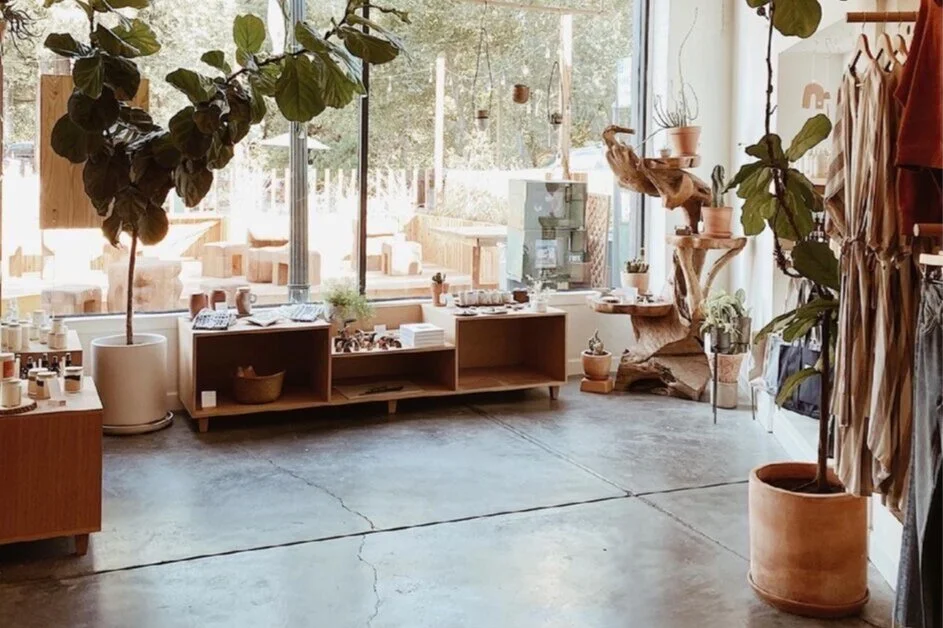
Longway California
Slow fashion meets community and connection at this California-based clothing store and cafe.
“We celebrate slow creation. The people who make things and ideas. The people who spend their lives imagining and dreaming in the same way that we do. We look to take the road with more curves, but also more thought - where a difference can be made and adventures found.”
For: anyone who values taking the backroads, those who cherish slow and thoughtful. This is the anti-thesis of fast fashion.
What is it: A California-based sustainable clothing brand and coffee shop whose dedication to building community rests at the forefront of their mission.

What you need to know: Originally opened under the name Neve and Hawk (a moniker inspired by the first and middles names of their daughter and son, respectively) Longway was, at one time, nothing more than a master bedroom turned screen printing studio. Founder Kris Galmarini and husband Bob took a passion for graphic tees and turned it into one of the most beautifully designed and highly sought-after clothing brands in California, featuring small-batch and handmade pieces that appeal to the dreamer in all of us.
How to bring this into your life: Bay Area locals can stop by their San Anselmo storefront to peruse their collection of women’s, men’s, and children’s clothing along with home goods, books, and gifts, featuring a curated selection of treasures from other artists, designers, and small businesses. While there, be sure to head to the back to find the hidden gem of Marin— an adorable cafe serving SF’s own Lady Falcon Coffee and a selection of seriously delicious treats. We cannot stress enough that this is THE BEST COFFEE IN MARIN COUNTY.
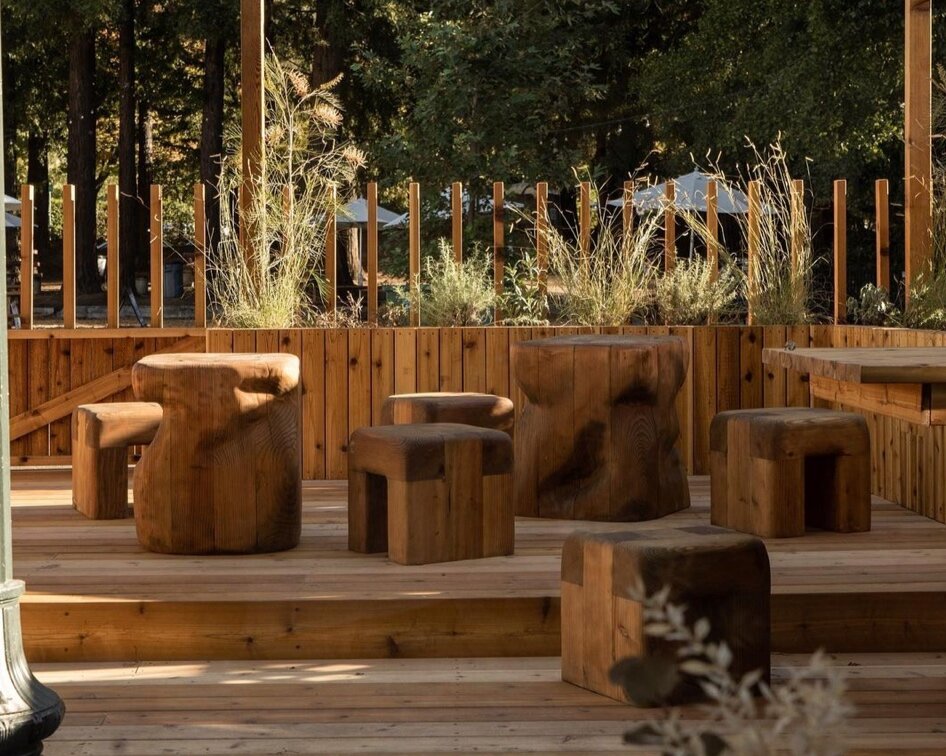
In addition to ample inside seating, which will remain closed/limited through the duration of the covid-pandemic, Longway has partnered with Orca Living to expand their dreamy vibe with the creation of a front patio that is straight out of our Pinterest dreams. Carved wooden stools and thoughtful corners designed for community, connection, and fresh air, greet visitors as they sit to sip on their coffee and give in to the feeling of slow.
For anyone who is not California-based, the Longway Instagram is a great place if you’re looking to redefine your relationship to fashion and start building towards a slower more thoughtful wardrobe, or life, in general. As a bonus, founder Kris Galmarini often graces us with her incredible dance moves and we are very much here for it! She also pops on to give followers a behind-the-scenes look at how the brand is built and the relationships she holds with the people who work so hard to bring her beautiful designs to life. From seamstresses in San Francisco and Peru to her in-store team, to her late-night stories delving into setbacks (both personal and production-related) you cannot help but feel connected to Longway. Their mission to foster community and sustainability shines through everything they do.
We can still recall when the pandemic hit and Kris jumped on Instagram to say something to the effect of. “People are struggling and it feels ridiculous to ask you to buy a new sweater right now.” There was something to her realness and understanding of privilege, that made us love Longway just a little more. At the end of the day, this is the type of brand and space we want to see existing in the world. This is the type of place we are dedicated to supporting in any way we can because it’s the type of place that pushes our world to operate at a higher standard, to value people over profit, to help us redefine consumerism.
Why we think it’s different: Longway’s storefront goes beyond just selling something (though we totally want to buy EVERYTHING they create), to actually building something. “We want it to be a place people want to come,” says founder Kris Galmarini. “We want people to come into the store, and feel better than when they walked in. We want them to interact, to feel inspired, to leave the store feeling better about shit. We’re in this community and we want people to feel good.”
In their own words: “We celebrate slow creation. The people who make things and ideas. The people who spend their lives imagining and dreaming in the same way that we do. We look to take the road with more curves, but also more thought - where a difference can be made and adventures found.”

Something to inspire: Whether fighting for racial justice or the end to family separations at the border, or the normalization of mental health struggles, or the value of slow fashion, Longway is a brand that is not afraid to speak out or to take action, raising awareness, funds and the vibrations of a community who look to them for inspiration. We appreciate Longway for their beautiful selection of goods, but we stay because we know at their heart, they are not a brand, they are a family, one that grows and changes overtime to ensure that they continue to push forward towards a kinder, more just world.
Also their Denim Sunset Jumper is literally the perfect item of clothing. (Don’t even try to change our minds.)
HausWitch
Think you know witchcraft? Think again with this space in Salem redefining Witchcraft for modern times.
Go here if: you are seeking strategies for self-care, are ready to push against some social boundaries, and want to make your home the sanctuary you need it to be.
What is it: A metaphysical lifestyle store for the modern witch, or those curious about what that even means, in Salem – yes, that Salem.
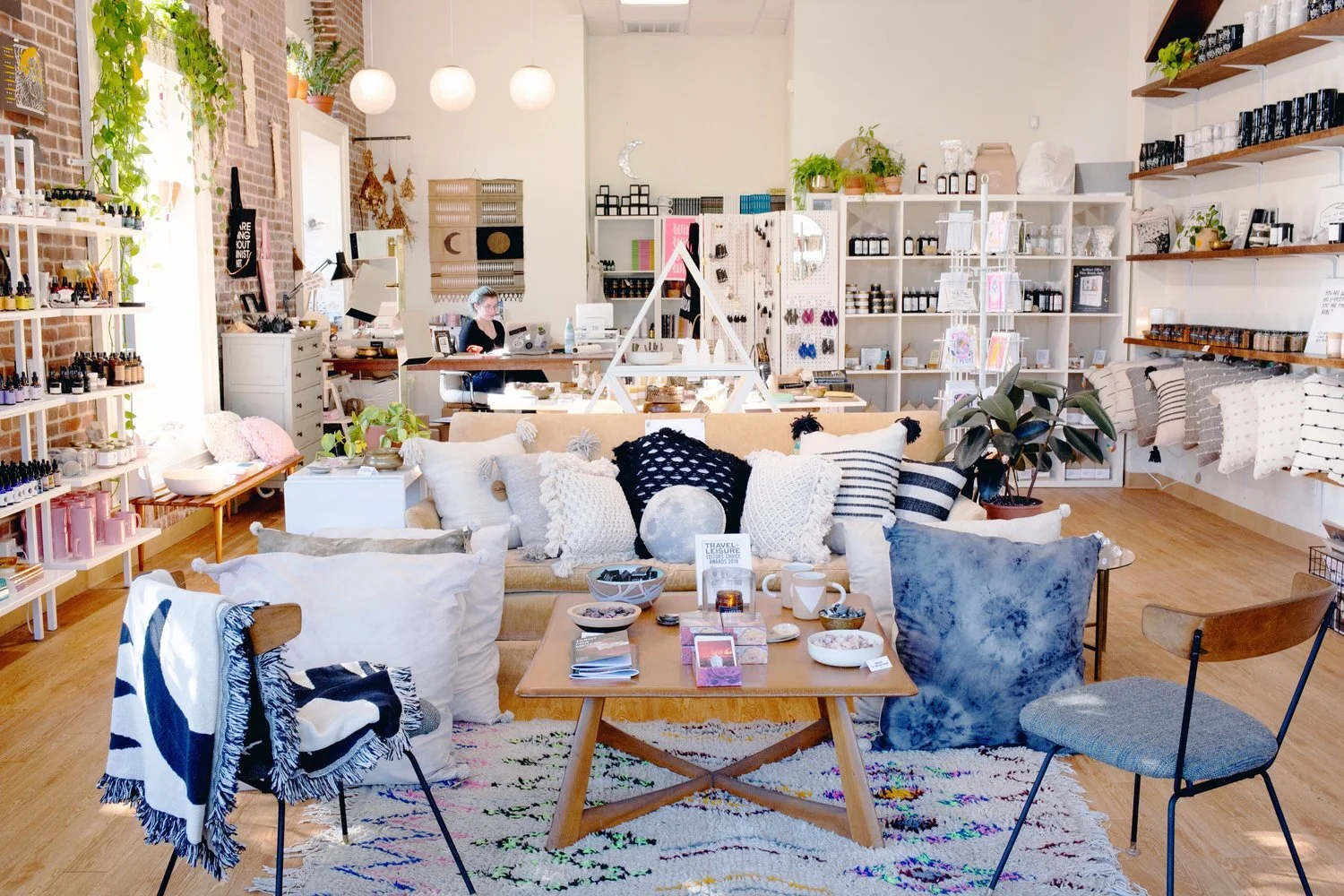
Why you’ll love it: Founder Erica Feldmann opened HausWitch in 2015 after completing her graduate studies in the sacred feminine and witchcraft at Simmons College and as a positive space to bring magic into our everyday lives and homes. This isn’t the version of witchcraft told in fairytales or Halloween stories or even those witch trials: it’s not black peaked hats, cauldrons, and evil incantations. Rather its more Scandi design and modern twists: the storefront is light-filled, combining a keen eye for interior decoration with products that reframe witchcraft for contemporary times, bringing in ideas of self-knowledge, empowerment, healing, intuition, mindfulness, and nature-inspired spirituality.
What you need to know: The Treasure Palace as Feldmann refers to the storefront holds minimally designed items for the modern witch (some serious, some playful): incense, spell kits, candles, and potions as well as throw pillows, cleaning products (from own brand LightHaus) and ceramics (‘Witches are the Future’ ). HausWitch also hosts workshops for developing intuitive skills, such as tarot reading or astrology, and that offer safe spaces for women to share, learn and support one another.
How to bring this into your life: HausWitch has just opened up again after a year of being closed due to the pandemic but you can still shop the collection from wherever you are, attend an online workshop or even bring in some magic to your home with Feldmann’s book, HausMagick.
Why we think it's different: Witchcraft is being reframed; we’re increasingly curious about what it represents, what it can provide, and how we can bring it into our lives. In a moment when we’re struggling to live within the constraints of our modern-day world, for the curious and the seekers, witchcraft offers alternative ways into healing and reflection. Its rituals can ground our days, its practices offer self-care to orientate us in spiraling lives. But witchcraft is also about empowerment, about resistance. HausWitch offers ways to slow down, tune in, recognize, but it also offers ways to push against, make space, be heard.
When you get beyond the narrative that has represented witches as outsiders, you get to one that reveals that witches are often those who have pushed against patriarchy, social norms and spiritual expression denoted narrowly. As Feldmann has said: "It's more about feeling empowered, wanting to change the world and connecting to your own intuition."
Witchcraft here sits closely with feminism, with women no longer silenced, reclaiming their powers and making space for themselves in a world that better reflects who they really are (Also shop: “A simple spell against the cis hetero white supremacist patriarchy”. ) For Feldmann, the meaning of witch is ‘Women in Total Control of Herself’ — with women here meaning all gender identities. HausWitch is an intersectional space that is consciously open to “all genders, sexualities, ethnicities, abilities, and anyone who feels like they are in need of a truly supportive and safe environment in this ever-changing world.” Feldmann’s wife Melissa Nierman teaches workshops here (currently offering Past Life and Clairvoyant Energy Readings) and runs NowAge Travel.
In their own words: “HausWitch Home + Healing is a modern metaphysical lifestyle brand and shop, providing Salem locals and visitors with a selection of witchy and handmade products from independent makers from around New England and the US! HausWitch combines the principles of earth magic, meditation, herbalism, and interior decorating to bring magic and healing into everyday spaces.”
Inspired to: We’ve all been tied to our homes this year in ways that may have made us love our spaces slightly less than usual. This spring, find a way to reconnect to where you are. In her book HausMagik, Feldmann suggests rebuilding our relationship to our own space by decluttering, being attuned to what feels good and what doesn’t, bringing in greenery and crystals, and burning sage to reset the energy of a room. Our homes are the spaces that can hold and sustain us through the less cozy outer world; this spring find a way to make it your own again, restorative and replenishing for whatever comes next.

Hoxton Street Monster Supplies
Now allowing in humans, this store has everything the monster in you needs (and a not-so-secret cause behind it all).
For: monsters of every kind struggling to find the supplies they need to get through their ghoulish days and humans of all ages looking to restore make-believe in their lives.
What is it: One to enter at your own risk, this quirky store on an ordinary-looking street in Hackney is maybe the only one in the world (that we know of) that stocks “Bespoke and Everyday Items for the Living, Dead and Undead’.
What you need to know: Escape into your imagination with a store that is really one of its kind: since its murky start by newly exiled Igor the 1st in 1818 and its tentative steps into the human world in 2010, it has been serving everyone and everything with the kind of canned and boxed delights that any self-respecting creature needs, the fang floss, breath remedies, and dragon treats on our shopping list.

How to bring this into your undead life: Wherever you are, your way into this world is definitely via witty and fantastic products like their Salt Made from the Tears Shed while Home Schooling, Mummy’s Sewing Kit and packets of powdery pink brain food. If you live locally, volunteer to help brave visitors survive the store or become a writing mentor in the Ministry of Stories.
Why we think it’s different: Beyond its license to sell ‘items including, but not limited to: Malodulous Gases, Children’s Ears, Gore, Fear (tinned only)”, behind a secret password guarded door is The Ministry of Stories , a creative and mentoring charity for mini-humans aged 8 to 18.
The not-for-profit was started by About a Boy / Fever Pitch / High Fidelity writer Nick Hornby with Lucy Macnab and Ben Payne and was modeled on Dave Egger’s 826 Valencia. The aim of the classes here is to make writing fun and accessible across all genres from gaming to screenwriting, cookbook contributions, and graphic novels, and to build the confidence that comes with creative adventures on the page experienced in a supportive community.
It’s now been widely published that there’s a curse in the store – that makes all profits go to the Ministry of Stories. As Minister of Fluency, the beloved by us and many a monster, Colin Firth declares “you know your helping to support the business of the imagination with the next generation”, so maybe this is one hex that we humans won’t venture to break.

In their own words: “We pride ourselves on being London’s, and quite possibly the world’s, only purveyor of quality goods for monsters of every kind. Many of our customers have been coming to us for centuries. Indeed, some have been coming for considerably longer. Whether you’re a Vampire, Werewolf, Sasquatch or something else entirely, we have everything you need.”
Something to inspire: Short of attempting to rebrand everything in our homes – will our kids go with water if it’s the elixir of life – look to ways to bring in the make-believe. In a year, when we’re been abruptly pulled up by reality, there are ways of escape that might be nearer than the dream destinations we’re been longing for – retreats made in our minds, and played out in worlds of our own making. Even travel bans can't go there. But monsters can.

Arium Botanicals
A plant shop in Portland that does it all just that little bit differently, from the plants they stock to how they think about the environment.
Go here if: you are a collector or seeker of botanical curiosities no matter your existing knowledge about houseplants.
What is it: As much for plant lovers as curiosity seekers, Portland’s Arium has become known for its wide variety of different species and types of plants. In a city that has an abundance of plant stores and a fervent plant community, you’ll find here special interest and rare plants that you may not be familiar with or haven’t seen before, as well as the advice and information that makes you confident about taking them home (they may be unusual but that doesn’t necessarily make them hard to care for).
Partners in business and life Anthony Sanchez and Tylor Rogers started Arium online before finding their forever home in a former Land Rover repair shop. They transformed the garage into a bright open space with white walls and a garage door that opens to let in the light, and brought in wall-to-wall foliage, with hanging displays, moss column growing plants, and greenery seemingly everywhere.
Why you’ll love it: We’re in the midst of a houseplant boom that’s been tied to social media posting millennials who understand the wellbeing benefits of bringing plants indoors: four in five 16 to 24-year-olds own at least one houseplant, with a fifth of plant owners buying them for their wellness benefits. One-third of new gardeners are millennials.
With leaves of subtle colors or unusual shapes, decorative patterns, and broad textures, Arium steps into the space that owner Tyler Rogers grew through his own wildly popular Instagram account, @Urlocalplantboy. The space celebrates ornamental horticulture and searches out truly unique specimens while making them approachable, if not coveted.
Each plant is given its botanical name, from the huge leaves of the Alocasia “Regal shield”, a sweet Ficus Altissima, and cork growing Hoya Obovata Mount. When you go there might be Begonia “Cracked Ice”, Philodendron “Pink Princess” and Alocasia “Silver Dragon”.
What you need to know: The name ‘arium’ is a play on terrarium (earth + container); here the store is given its Latin meaning: ‘a space or vessel that contains something’. It’s rather magical to think of Arium as the container of the green world owners Rogers and Sanchez have conceived to inhabit it.
How to bring this into your life: Currently Arium is open to the public with COVID-care measures in place, though workshop programs, book signings, and events are not yet back up and running. Look out for announcements on social media for when they begin again. They also ship within the US.
Why we think it's different: A vegan and queer-owned business, which the owners have declared a safe space for “all sexual orientations, gender identities, religions, and races” and that also takes its conservation standards seriously. Arium donates monthly to Conservation International and doesn’t stock plants on the IUCN Red List of Threatened Species. All their plants are ethically sourced from certified U.S. nurseries, and they use their space to educate about plants that face extinction or habitat loss, condemning the poaching of plants or wild collection. Beyond horticulture, they also support the local creative community in Portland by stocking a selection of ceramics made by local makers.
In their own words: “We initially started Arium as a means of making unusual plants that can be implemented in design and in the home. We firmly believe there is a plant for everyone and that no question is dumb or illegitimate. Like us, we all started somewhere. Making our space welcoming, a place for learning, and geek out about plants. We are proud to be a space for beginners all the way to avid collectors.”
Something to do: Our plant parenthood journey started small – as many with a single succulent. Choose a plant that you love to cultivate and bring into your home (doesn’t have to be the celebrity Fiddle Leaf Fig). Build up your gardening muscle slowly. It's ok not to have a collection of 60, start with one and see how it makes you feel. Do you like owning a plant, do you like looking after it, does it make you feel good? If it's too much pressure, feel free to abandon your houseplant journey. But if it incites something positive, bring in plant number 2.

London Terrariums
When you can’t leave the house, bring tiny worlds indoors with London Terrariums.
Go here if: space and time for gardening is limited but your interest in it isn’t
What is it: London’s first terrarium shop and studio in New Cross Gate is an entry into these magical ecosystems under glass.
What you need to know: London Terrariums was started by Emma Sibley in 2014, just before the houseplant movement really took off and potted plants went from dusty in the corner relics to central pieces in interior design. Ever since, attendees to the terrarium workshops, visitors to the brightly colored store which stocks bespoke creations and gardening tools, and clients from the V&A to The Hoxton Hotel, have become enraptured with these tiny self-sustaining worlds (the plants photosynthesize in the enclosed space, living off the condensation so there’s no need for watering). The practice of terrarium making and design stretches back to the Victorian era, and though particularly popular in the 1960s, it fell out of favor. Until now, when we’re looking for ways to reconnect with nature, to bring more of the outside into our lives, and to nurture something beyond ourselves.
What they offer (online and off): During current closed times, you can purchase a terrarium kit or attend an online workshop for at-home terrarium making. If you love subscriptions, check out their London Terrariums Plant Club for a monthly dose of greenery. LT ‘s bespoke terrariums can also be bought on the site if you are looking for a ready-made one.
Why we think it's special: As our awareness of the benefits of plants – for our mental wellbeing, productivity, and creative inspiration as well as the air quality in our homes – is increasing, making sure that everyone has access to green spaces matters more than ever. And yet the realities of urban lives often translate to no gardens, small spaces in which to live, and little time, distancing us from the natural world even more. Terrariums though striking are low maintenance taking up little space and fitting small apartments and overscheduled lives. As we’re also able to shape them ourselves, we have the added benefit of working with our hands and the pride that comes with making something. Creating terrariums gets our fingers muddy as we figure out designs with moss, orchids, and succulents within glass containers that range from huge carboys to quirky domes. As Emma has said: “ “It’s horticultural therapy. Working with the soil and the plants is meditative and calming.” They become objects of creation and reflection.
In their own words: “Terra- Meaning Earth. Arium- A suffix denoting a place. This is is the basics of what a terrarium is, we are creating a landscape protected from the outside elements, in which the plants and minerals used can interact and grow as if they are in their natural ecosystems.”
Something to inspire: Our relationship with nature doesn’t have to be monumental – like planting millennial forests – but can be realized as tiny worlds set on kitchen counters that make us smile as we pass them. House plants give us tiny ways for nature to take up space in our lives and for us to cultivate something beyond ourselves.

Prick
Beyond the best name for a store dedicated to cacti, Prick is making wider access to the greenery we all need part of its mission.
What is it: London’s first store dedicated entirely to cacti and succulents on Dalston’s Kingsland Road.
Why you’ll love it: With their geometric forms and unusual presentations, the plant life here read as nature’s aesthetic conjurings. Nominated for High Street Shop of 2020, the store feels more like a boutique than a garden center, with white walls, sculptural plinths, shelves of ceramics — “prick pots” – many of which have been commissioned by local artists and books on the subject rounding out the interior landscape. Even the wood here is sourced from the Natural History Museum’s Reading Rooms.
What you need to know: Prick was founded by Gynelle Leon, who at the age of 30 on a quest for a different story of happiness than the one she’d been sold retrained as a florist. Her love of plants had started to edge out an early career in finance and fraud prevention (her degree was in Forensic Science). A 2011 visit to Yves Saint Laurent’s Jardin Majorelle in Marrakesh led her to fall for cacti’s diverse forms and set her on a global search to become an expert taking in the epic desert plant-life of the United States. Leon now sources unusual specimens (the shop stocks over 150 types) throughout the UK and Europe, forging relationships with auctions, nurseries, and collectors to curate the store’s collection of cacti and succulents.
In the summer, Prick expanded from just the plant shop to a new space which according to Gynelle “is not a shop but our event space for workshops, talks, panel discussions lectures, book clubs, coffee mornings… I love community and have always dreamt of a space where we can celebrate and enjoy plant culture.” Due to shifting COVID rules, we suggest checking social media for updates on this new stage of Prick.
Why we think it matters: As we spend more time at home – and we can all feel differently about that – those little pops of green around us start to matter. Plants have a direct impact on our wellbeing: seeing them reduces stress, caring for them gets us out of our heads, and even the air we breathe improves. Gynelle has been open about her own experiences of depression, stress, and anxiety and how “being around nature and especially caring for my houseplants provides me with moments of calm and allows me to be in flow.”
And yet, who has access to green spaces and those green pots, indeed who can cultivate them, hasn’t been historically equal. On researching and developing Prick, Gynelle found that she was one of the few people of color in horticulture, a field dominated by middle-class white men. She has since made it part of her mission to bring plants to everyone. That’s part of the appeal of houseplants – they can be for all — there’s no need for outdoor spaces, or vast amounts of experience, or expensive tools. Hardy, needing very little attention, cacti and succulents are the perfect companions for busy city dwellers and everyone who wants to tend to them. As Leon says: “We all should have the right to a connection with nature and the ability to make a career out of it. The representation in gardening media and the large horticultural bodies must change to inspire those of all walks of life and race.”
In their own words: “Prick sees cacti and succulents as living sculptures that take years to fully develop…A succulent plant has the potential to live for many years, sometimes even outliving its owners. Investing in plants is like gaining new flatmates or family members; a break away from our modern disposable culture.”
Gift edit: The shop is now in book form, Prick, but we’re also coveting this one and this one.
Something to do: Participate in Black Pound Day, started by Swiss of So Solid Crew, and now backed by Google, which takes place on the first Saturday of the month to encourage people to support black-owned businesses.

Meticulous Ink
A tiny print studio and store that creates human-centered designs for all of us.
What is it: An independent studio and store for the printed and written word on Bath’s street of artisans Walcot Street (see other favorites Landrace Bakery and A Yarn Story).
Why you’ll love it: If you are in love with paper and pens and print, this is your place. Founded in 2010 by printmaker, illustrator, and designer Athena Cauley-Yu, Meticulous Ink is all about the precision, charm, and timelessness that go hand in hand with letterpress printing. Cauley-Yu and her team can take you through projects that matter to you (think stationery, business cards, and invitations), but you can also browse the selection of Meticulous Ink designed stationery and paper goods, and the thoughtful selection of products for modern lettering, journaling and correspondence in the tiny space out front.
What you need to know: Now into its tenth year, Meticulous Ink was recently shortlisted in the Top Five of small business campaigner Holly Tucker’s High Street Shop of the Year awards (check out the rest of the inaugural Independent Awards nominees here).
How to bring this into your life: The popular lettering and calligraphy workshops that run during normal times now take shape in Calligraphy and Handbrush Lettering Kits to practice at home (check out Cauley-Yu’s youtube videos to go along with these).
In our gift edit: This was hard to get down to just a handful of things (so basically you can’t go wrong) but we’ll go with The Stationery Pick n Mix, the cutest pencils that exist, and a custom notebook.
Why we think it's special: Those massive metal machines you see when entering the store, they work, and are the heart of all that goes on here: from the two original Heidelberg printing presses from the 1960s that started the business to the full family that now includes a Stephenson Blake proofing press, and two tabletop Model Printing presses. Each has stories of their own and are a key part of keeping the tradition of letterpress going. Cauley-Yu is enthralled by the medium and dedicated through her projects to giving it modern relevance and contemporary designs. It's all about attention to the tiniest details: making the most of paper – in all its weight, textures, colors — understanding how inks change over time, and how to make something beautiful with accuracy (from cropping to the printing itself). Printing here isn’t about mass production, but happy humans collaborating at all stages of the process.
In their own words: “We proudly create bespoke design, and stationery printed the old fashioned way - using beautiful papers, time, patience, and a deep-rooted passion for being meticulous. At the very back of the studio we usually teach our lettering and calligraphy workshops, though sadly these are on hold at the moment. The space is calm and friendly, full of creative inspiration and tactile, analogue trinkets.”
Something to do: Given our current situation, this is a store that inspires us both to retreat — to create paper-based things in which to better understand ourselves. – and to reach out — to send those things out into the world for others to enjoy. Whether that’s making a journal that best reflects who you are and spending the months indoors filling its pages, or learning calligraphy and sending a note to a loved one, try to find a way to play with materials – with paper, pens, and print – and see which direction it takes you (and to whom).
Shop Small Special: Labour and Wait
Timeless designs having a contemporary moment, London’s Labour and Wait will make you think differently about your dish brush.
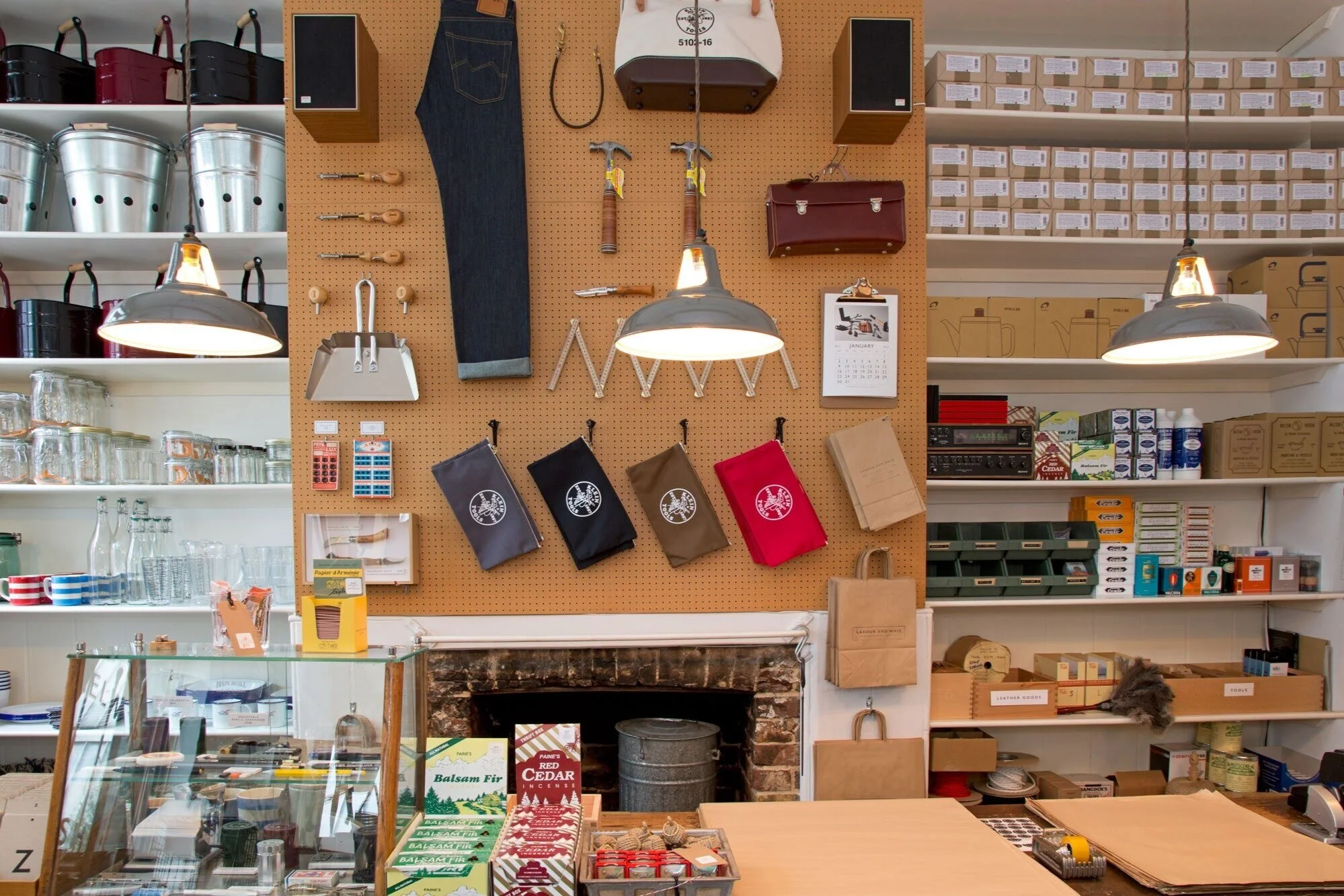
What is it: This store makes buckets look good. A corner shop that combines the hardware with the artisan in a former pub (see the distinctive green tile of Truman Brewery) in Shoreditch and offers functional products for everyday life. Also now has an outpost in Tokyo.
What you need to know: Founded in 2000 by two designers, Rachel Wythe-Moran and Simon Watkins, frustrated by the endless cycles of fashion, Labour and Wait is based on their philosophy that good design should last. Their independent store is full of products that have stood the test of time – both in terms of the legacy behind them (products include blankets produced by the last remaining woolen mill in Wales) and in terms of how long they last when we get them back home (whether that be a dish brush or bottle opener). Think functional classics like Cornishware Mugs and essential hardware needs like an indoor brush that support traditional manufacturing and resist our current throwaway culture. Though very covetable, ironically Labour and Wait takes away the pressure to consume more. Rather it’s founded on durable and functional objects having their place in everyday life.
Why we think it's special: Apart from resisting our tendency to buy plastic and buy cheap with little concern for the person behind the making – the average person in North America and Western Europe consumes 100 kilograms of plastic each year — Labour and Wait is very much an ‘in-person’ store, human interactions are key to this bricks and mortar. On Black Friday instead of leading with product discounts and special offers, Labour and Wait donated 10% of sales to Crisis at Christmas which helps homeless people in the UK.
In their own words: “We believe in a simple, honest approach to design, where quality and utility are intrinsic. From hardware to clothing we offer a selection of timeless products that celebrate functional design and which are appropriate in a traditional or contemporary environment.”
In our gift edit: Carbon neutral enamelware from Riess of Austria, a recycled coffee cup made from discarded coffee grounds, a Scottish woolen blanket made from surplus yarns (it's cold out there, sometimes emotionally), and Labour and Wait’s signature apron.
In need of more Holiday inspiration? We’re a little in love with their shops of yesterday within their own shop: like a Haberdashery, Chemist and Stationer.
Something to inspire: We get stuck on toothbrushes. Or toilet brushes. The small things around our house that we somehow forget to buy sustainably. We fall very quickly into the plastic hole with these. Try to identify something in your house that you have a kneejerk anti-environment position on (there’s something, believe us) and just focus on getting that one thing more human-friendly (whether that’s how and where it’s made, how its production affects the planet and who the person is behind the product). Small steps. Later you can commit to a plastic-free lifestyle (no, we’re not there yet either).

The Good Life | A conversation on sustainability with founder Shelley Brown
The Good Life is one of those stores we’d love to have in our neighborhood. We chatted to its founder on why local matters more than ever.
We lured Shelley Brown away from stock-taking to talk to us about The Good Life, the waste-free mini market that she founded in northern England just a year ago. We discussed why local still matters, what led her to start the space, and how to deal with the challenges of being a store owner. This conversation restored our faith in our High Streets to do good for our communities, our planet and ourselves. We hope you feel the same!
What inspired you to start The Good Life?
The Good Life had been brewing in my subconscious for some time. It was the sudden death of my sister which spurred me to start the project with my father. It became something positive to focus on during a very dark time.
How do you bring a sense of community and connection into your space?
The Good Life is very much a community enterprise. It has been unexpected quite how much! Customers constantly tell me what the shop means to them and what it has done for the area. It’s been so rewarding. I live down the road in Heaton Moor and my daughter goes to Didsbury Rd School, a four-minute walk away. I knew that when I opened a shop like this it would be vital that I was connected to its location. The Heatons is full of independent businesses and the residents are passionate about supporting them. It is an area where people tend to stay. The shop stock has been built around the customers; if they ask for something, if I can get it I will!
Do you ever think about wellbeing, your own or others, in what you do?
Wellbeing is very much connected to The Good Life. I have always embraced life, but even more so since losing my sister. It is not unusual for customers to bring us home-baked goods, cards, and flowers. The shop has become an open space for customers to come and have a coffee or sometimes a glass of wine, to have a chat or even a cry. I feel very connected to my customer base; some have become dear friends.


Are you finding that there's an increasing interest in sustainable lifestyles? Do you think that people are starting to change their shopping habits? We've noticed more people going on plastic fasts and bringing reusable cups, for instance.
Absolutely. A change is certainly happening and people know they have to make changes. We are also seeing big corporations responding to a demand for this because of the action of individuals.
What one thing could people do to live a more sustainable life?
Refill! The household/beauty refill side of the business has grown month on month since we opened. We look for new products all the time. As well as the obvious choices like laundry liquid we now do everything from micellar water to deodorant to baby oil. It's a very easy swap for people to make and massively reduces their personal waste.
Why was a physical space important to you (rather than online)?
This business is all about relationships. The internet has, of course, contributed to the death of the High Street, but also the death of communication. Our demographic is from 0-90 and I am very aware of the isolation that older generations must feel and how important shops like this are to them.
What’s the best thing you did to achieve this dream?
I just got on with it! Failure was never an option!
What’s been the toughest moment and how did you get through it?
It's a financial juggling act. Building the stock has been hard as it's vital to buy in large bulk to compete with the supermarkets.


Who or what did you draw inspiration from?
I drew inspiration from other zero waste shops to build my base stock. An old friend Pete helped me realise my shop vision through the design process and Charly Tudor (introduced through Pete) was vital in creating the brand identity.
The shop is named after the TV programme. My sister and I watched it growing up and I re-watched it all after her death. It's not an original name, but I couldn't call it anything else!
What would be on your ideal High Street?
I love living in the Heatons because we have what a traditional High Street looks like. Independent shops offering everything from glasses to gifts to clothes. We even have an independent cinema. I hate cheap shops selling crap. Budget supermarkets who rip off suppliers and farmers. Convenience stores that sell air-freighted food all year round! We have lost the value of good, local, seasonal produce. The high cost of living has forced people to demand cheaper and cheaper foodstuffs and it's been to the detriment of the planet and of the nation’s health.
We wanted to mention how much we love the apron 'We're Naked in Here!' and your design approach overall.
All down to our designer Charly Tudor! It was certainly a talking point!

The Poetry Pharmacy | A conversation with Founder Deborah Alma about why poetry still matters
We talked to the founder of the world’s first Poetry Pharmacy about why poetry still matters.
When we first heard about The Poetry Pharmacy, we thought it was a kind of dream. A shopfront dispensing poetry for modern day ailments. It’s something from a children’s book, or a gorgeous idea of a place developed over excited conversations. But just last month, in the town of Bishop’s Castle in Shropshire, poet Deborah Alma (with her partner Dr James Sheard) opened the world’s first Poetry Pharmacy. And she readily admits its dream-like quality even as it now exists as a reality for her, and the people it serves. In the first months of opening, we were lucky to grab some time with Deborah to talk about why real-life places and poetry matter more than ever.
Claire: We’re enthralled by The Poetry Pharmacy, as I think are many people who are reaching out to you. Can you talk us through the space?
Deborah: We’ve converted a beautiful Victorian shop that had been closed for 13 years into an apothecary from which to dispense poems. It’s located in a small town on the wild west borders between England and Wales that’s full of writers and artists.
When people come into The Poetry Pharmacy, they’ll find books of poetry face up and filling the shelves. We’ve designed it so that people can browse by ailment — like ‘Matters of the Heart’, ‘Carpe Diem’, ‘Now I Become Myself’, ‘Be Alive Every Minute of Your Life’, and ‘Hope is the Thing with Feathers’ — and shop accordingly. We offer free one-on-one consultations on Friday afternoons, or people can make an appointment outside of that. We’re also happy for people to just come in and chat.
We also have a Dispensary Café which serves tisane, teas, coffee and cakes, as well as a shop that offers poems-in-pills for different needs such as a Bottle of Hope and Existential Angst Pills. Upstairs, we have The Distillery space from which we host book launches, workshops and other writing events.
We’ve kept the original architectural details like the old mahogany counter and till. We’ve allowed for as much natural light as possible (there are no neon lights). We’ve also painted the walls in muted paint colors.
There’s definitely something about the space that appeals to people in and of itself; a kind of therapy in not having technology everywhere. We’ve explicitly designed The Poetry Pharmacy for people to sit longer over coffee. There’s no pressure to move on and people are encouraged to talk to each other. It’s a place also for people to come to read and write.

Claire: Why in this moment when we’re rushing more and more of our everyday lives online and our High Streets are sadly struggling was opening a physical space important to you?
Deborah: I see the Ambulance as a physical space too; for years I operated as an ‘Emergency Poet’ from a converted vintage ambulance, prescribing poems to people at festivals, conferences, hospitals, libraries and schools around the country. But I felt like I was getting too old for all that travelling around, and it was often cold working outside in the UK. As the editor of four books and the writer of two of my own, I felt like enough people had heard of me, that if I set up a permanent location, they would already know what I was doing.
I do believe that people still want to touch something real. To be in a place that feels like it might last. The online world has a terrible power to cut connections with people in real places. The Poetry Pharmacy offers nothing like we can replicate when we are online. I also feel like if it’s there then it’s not hard for people to engage. People here are so delighted to find this place open; a place they can drift into and have a coffee and chat
I’m aware that it’s a gamble though. It’s an experiment, that comes with a certain degree of optimism and maybe even self-indulgence.
Claire: What need in the world do you think The Poetry Pharmacy responds to?
Deborah: We offer a therapy in slowness and a nostalgia for something lost: old fashioned service, friendliness, even listening.
People can come in feeling miserable and we give them a free ‘pill’ as well as the chance to talk about what they need. Then we prescribe a poem.
Claire: Why poetry? What’s the value that you see in it when applied to people’s lives?
Deborah: I realized a long time ago that most people are frightened of literature and poetry within that. And that the people who create or understand that art can be possessive. I used poetry in my work with people living with dementia. From that experience, I saw first-hand how you can change someone’s mood by taking them somewhere with a poem and that I could share the intimacy inherent in this form. This underpinned the Emergency Poet idea; I wanted to stop poetry from being intimidating and I wanted to show that it can literally be a vehicle for talking to people. That project effectively bypassed how poetry usually gets to people and how they then get to use it.
I’m aware that the Poetry Pharmacy idea is a bit mad. That putting poetry on the High Street is unusual. We keep hearing that poetry doesn’t sell, and this is a quiet town, but I’ve done it because I really do believe that poetry is a good thing. It’s beautiful. We’re putting it front and center instead of in the corner. Why not have piles of poetry books and say that has a value equivalent to other genres? With The Poetry Pharmacy we’re bringing poetry to the forefront and there’s an art in curating it — picking out the ones that speak to certain subjects, putting them with other things, and saying,“Take a look!”


Claire: And they are. People are enamored with this idea. Why do you think that’s happening?
Deborah: When I first started, it was a mad faith thing. People said, “you know why there is no other Poetry Pharmacy in the world? Because no one wants it.” But we’re finding differently; the idea of it even existing in the world seems to be a nice thing in the middle of all this darkness — BREXIT, Trump and just continuous bad news. It’s a piece of optimism and faith in something. It’s a positive thing, and light-hearted in lots of ways
It’s lovely that The Poetry Pharmacy exists in the world. It’s like a piece of fiction and reminds me of The Little Paris Bookshop by Nina George. In that novel Monsieur Perdu opens a floating bookstore on the Seine from which he prescribes books for a broken heart.
We’re only in week six and it’s been busier than I thought it would be. People get in touch across the world, we’ve had BBC News in here, the local Bishop’s Castle / Shropshire or West Midlands community is delighted, and people are seeking us out from outside of town and even from outside the UK.
We need all the elements though for it to work: the coffee shop to have a treat and a good coffee or tea that is nicely presented, like a ceremony; music that is welcoming and low-key, that makes people feel comfortable; a shop of desirable items, the consulting room and workshop space; and lots of events going on.
Claire: Would you place The Poetry Pharmacy within the world of mental wellbeing?
Deborah: I shy away from the word therapy, but I do say that it’s therapeutic. When I prescribe poetry to people, poems that I know and love, then people can make a poem their own; just reading it will take them to another place. What poetry is doing is taking you somewhere else in your head when you are busy. It’s telling you things that you may not be hearing from other people. It underlines something to yourself. Even imagining it, is a moment of benefiting from it.
At The Poetry Pharmacy we also include material for how to look after our lives in other ways beyond poetry. There’s a section ‘For days when the world is too much with us’, where we have Wordsworth next to psychotherapy and self-help books. We have another section that’s the ‘Best Medicine’ which includes gardening and nature — like counting butterflies, sitting in a patch of sunlight, and going for a walk.
Claire: When I think of The Poetry Pharmacy, I think of it as helping people with their anxieties, but I also think of it as supporting people in their loneliness. Is that fair?
Deborah: Yes, the poetry community has traditionally been good for the lonely as often people come to things on their own. People don’t have to be in a couple or with a friend to attend these events, like they might for say a dinner party or other social gatherings. It’s easy for people to come here on their own. Most of our events are on Sundays and quite a lot of people have said that Sundays are always difficult when they live on their own, but now they can come here for company. Rural isolation can also be a problem. This can be a place that people can come on their own and still feel comfortable.


Claire: Now we’ve established the life-affirming magic of the place, can we talk a little about the practical side? Like how you made it happen?
Deborah: We ran a successful Kickstarter campaign and I was amazed at the response. The crowdfunding raised money to pay for the build-out, including things like wiring the shopfront! We found that strangers turned up and said we love this idea and want to support it, because they don’t want closed-down shops on the High Street. We also received a small Arts Council grant.
We were very resourceful. As much as we could, we turned The Poetry Pharmacy into a project for both the local community and the literary/poetry one. We had many people volunteering their time and expertise.
Claire: What advice would you give to other creatives thinking of starting a bricks-and-mortar endeavor?
Deborah: It’s difficult, which I think is why so few people do it. But for me, it was huge just knowing that there’s a community of support behind me. I think it’s critical to have a few key people to support you in the first instance, and other people believing in you. The doubters are also quite useful because they test your resolve. Maybe they are right, and you don’t do it. But for me it was: ‘Bloody Hell, I’m going to prove you wrong matey.’ You’ll know in that fierce moment whether to do it or not.
Claire: How else has The Poetry Pharmacy impacted you? How does being front and center sit with the more private practice of writing poetry?
Deborah: Yes, there is that dilemma of reconciling this public project with the country mouse part of me. I do think (without overgeneralizing) that people who write who are novelists tend to be introverted, while poets tend to need to connect with other people more often. They work on a poem, then go out because they need to talk to people. For me, I crave being on my own and periods of time to write, and I’m aware that that’s not in balance at the moment. There are two sides of me; they don’t exist in the same place, but they do need to communicate, all the same. I hope that will settle down.
I do believe in The Poetry Pharmacy and it seems to be working in the way that I hoped. Also, for me too. Because I’m now so busy, I’m not online so much. What I wanted to do — and needed to do — was to have an open door and to welcome people in. To say: “Come in. Who are you?” To say. “ I’m interested in you. “
Discover more places for a happier life

Choose Love
This holiday season support pop-up stores Choose Love by gifting everyday items to refugees who urgently need them.
“‘The world’s first store that sells real products for refugees.’”
Holiday Fatigue. Compassion Fatigue. Everyday life fatigue.
At this time of year, as the days get darker and our schedules more frantic, many of us find ourselves exhausted, overwhelmed, maybe also panicked. We’re under pressure to consume, to shop, to scramble for all the things that we don’t need and that we probably won’t even remember in January. Some of us are starting to realize that we don’t love this Black Friday to January Sales treadmill, that it benefits someone’s bottom line but not us. We’re starting to look for ways to do the holidays differently.
Like Choose Love. No, that is not just a cute Instagrammable aphorism (though it does take a covetable merchandise form). It is an urgently needed pop-up that takes that holiday spending money and uses it for good, not seasonally appropriate greed. The Choose Love stores brought to us by Glimpse design collective—there are now 3, in London, New York, and Los Angeles—only sell things that refugees vitally need that you get to gift to them. The stores are arranged by the different stages and shifting requirements of displaced people. There’s ‘Arrival’, ‘Shelter’, and ‘Future’. A life jacket. Children’s boots. A hot shower. Safe spaces for women. A Bundle of Warmth. Think about these things for a second. Think about how and why they are needed. We defy your heart not to break just a little.
As CEO of Help Refugees (the NGO behind Choose Love), Josie Noughton sums it up: "It's easy to forget how lucky we are to have a bed, a blanket and a roof over our heads. For thousands of refugees this winter, these basic human needs are completely out of reach. This shop is all about one simple idea: that we should all Choose Love and help those in need."


Choose Love stores fill that compassion gap between the moment that we’re shocked by the news and the horrors that refugees fleeing climate change, war and persecution face, and the moment that we don’t know what to feel and what to do about it. By holding everyday items in our hands that people need, it returns essential humanity to the stories that we’ve become numb to and the headlines that we learn to forget. Simple things like baby items, clean and safe water, a bag of school supplies, restore the idea that these are real people, not just statistics, who need our help and deserve our kindness.
Though these brightly colored stores feel like a boutique gift shop, they are designed for you to leave with nothing except the knowledge that whatever it is you purchased is now finding its way to one of 120+ partners who support displaced people. You may be empty-handed, but you’ll definitely feel big-hearted. This is gift-giving as its best: we now know that doing something for someone else has a more lasting impact than doing something just for yourself. And beyond the 40,000 customers that it has to date served, Choose Love has a significant impact on the recipient too.


Since Choose Love launched in 2017, these pop-ups with a purpose have sent 1.5 million items to refugees, assisted one million displaced people in Europe, the Middle East, and the US-Mexico border, and raised 3 million pounds. Those statistics are staggering, particularly when you think that Choose Love is a relatively new concept on our High Streets. As brick-and-mortar retail is supposedly dying, they indicate a way forward for how our stores can change the world. Needs on both sides are now being met through something we’re overly familiar with, shopping and a place that has lost its own way, our High Streets.
Choosing Love matters; at a time when we’re divided across borders and beliefs, this simple mantra, and the enterprise behind it reminds us that we have options. We can choose to help people who really need it with our purchases this holiday season. And if you need any more encouragement, let’s give Banksy the last say: “For the person who has everything, buy something for someone who has nothing.’
(Also to look out for: You can also shop Choose Love for a Holiday gift – the recipient will receive a downloadable gift card with details of your item. Also, as these stores are staffed entirely by volunteers – you can gift your time.)


The Sketchbook Project at Brooklyn Art Library
At Brooklyn Art Library spend time with a living sketchbook museum.
“A crowd-funded sketchbook museum and community space.”
For the Lost: ‘A Lovely Wander NYC’ by Sara Boccaccini Meadows
For the Curious: ‘Come Travel with Me’ by Jill Macklem
For the Lonely: ‘somewhere across the sea’ by Michael Elizabeth Zimmerman
For the Anxious: ‘Anxiety Sucks’ by Suzie Deplonty
But you could equally be looking for ‘A story worth telling’, ‘Pocket-size memories’, or ‘Trivial retrospectives’. The floor to ceiling shelves of The Sketchbook Project at Brooklyn Art Library contain all those themes and more in thousands upon thousands of identical 5 x 7” sketchbooks. In fact, this Williamsburg storefront houses the largest collection of sketchbooks in the world: 45,000 in all (with 24,000 in its digital library). And most are made by amateurs: 30,000 different people in over 130 countries have so far contributed to this over a decade-old project. Anyone can submit a sketchbook irrespective of background, perspective and, here’s the key, ability. These drawn-out and doodled narratives can be made by a granny in Croatia, a mum in California, a child in England. Even you.
We’re a little in love with it.
This is how it works: you order one of their custom designed, Scout-made sketchbooks online and receive along with it a list of thematic prompts: recent calls included: ‘One last chance’, ‘Fearful faces’ and ‘Lamppost Limericks’. Choose one or discard them entirely. It’s up to you. You get to fill 36 pages with whatever you want—abstract squiggles, detailed portraits, maps and landscapes, diary entries, poems, fragments of images and memories, secrets and declarations of lost love—anything that can be contained within its pages (so no glitter or messy embellishments).


Here’s the genius part—your sketchbook has a barcode, so you’ll upload some details to an online catalog, like search terms and your bio. Then you’ll mail it back to The Sketchbook Project for the next part of its life: most likely it will be part of one of the traveling exhibitions which take place in a custom made Mobile Library (‘like a food truck, but instead of tacos you get sketchbooks’) that tours to schools, music festivals, art fairs, museums, and blue-chip companies, in such places as Melbourne, Chicago, Atlanta, Toronto, San Francisco, and even Rapid City, South Dakota. But your sketchbook will definitely find its permanent home on one of those shelves in that storefront in Brooklyn. All sketchbooks are cataloged and kept. There’s no jury, no judgment.
Founded in 2006 by Steven Peterman and Shane Zucker, The Sketchbook Project questions who gets to create, who gets to be good and whether that idea has any currency, and why creativity still matters. By giving people a blank page, it also gives them the impulse to make and the platform to share. This is art for everyone, and artist as anyone. As Peterman attests: “I wanted to create an informal outlet for anyone to create art, with a purpose. I believed and still believe in the notion that a creative community is stronger than its individual artists and that a project can be impactful in a way that is different than a traditional gallery.”
All these sketchbooks—made and mailed in from all over the world, collectively form a library of sorts. Visitors to the storefront, which has a very unlibrary feel—yes, there’s check-out cards, but there’s also music, art supplies and memorabilia on sale—can view any of these sketchbooks in its cozy space. Remember that barcode? That makes the in-store librarian’s job way easier: now visitors just search the catalog by theme, figure out what they want to view, and the librarian will pull it from the shelves. As the artist/maker/author you can get updates on how many times it been viewed—you can even get texts when your sketchbook-baby leaves its home on the shelves. The beauty in all this is that the person who made and then the person who viewed the sketchbooks are now in conversation; the sketchbooks forming physical testimonies of lives lived, documented and shared.


The Sketchbook Project gives analog form to some of our most basic needs, namely to tell stories and to connect. As we’re increasingly driven online to spill and share, it’s a real-world kickback. These shelves express myriad lives and ways of being in the world that you can flick through and digest over time and in physical space. It’s collectively made, with all the contributors expressing themselves very differently while working within exactly the same parameters. And it’s collectively understood; visitors can search for what they need amongst the pages or maybe even chance upon something unexpected. Plus it's permanent. These sketchbooks are designed to last, to be an archive of global creativity that endues longer than the time it takes to scroll through your feed.
(See also the workshops in the community space, on such things as bookmaking and journaling, and other interactive global art projects that aim to connect and dispel some fundament myths around creativity like the Pen Pal Exchange).

826 Valencia
826 Valencia is keeping space for our kids’ imaginations in our cities, and crafting magical spaces for our communities and for ourselves as it does so.
“826 Valencia is a non-profit organization dedicated to supporting students ages 6 to 18 with their creative and expository writing skills, and to helping teachers inspire their students to write.”
Yes, you might think you have just found yourself in a quirky pirate store or an octopus’ playground or a secret spy society, but what you’ve done is landed right at the heart of a non-profit organization that exists to support the writing skills of under-resourced kids. Maybe purpose is like medicine and you need some sugar to help it go down (not sure who does that other than Mary Poppins and her charges but it’s an association that’s stuck). For 826 Valencia and its network of storefront chapters across the US, the sugar takes the form of magic and the imagination: each of their much-needed writing centers are fronted by spaces of whimsy and curiosity.
From its start in San Francisco’s Mission District in 2002, a delightful sense of wonder has been built into how the organization has crafted itself: the first flagship that opened at 826 Valencia Street by educator Ninive Calegari and author Dave Eggers took the form of a pirate store mostly as a workaround for a local zoning issue that demanded some retail component. So of course, pirates need stores too. That model of locating the idiosyncratic in the everyday has inspired further storefront locations across the US; there’s the secret agent supply store (Chicago), a magic shop (Washington), a time travel mart (LA), a robot supply and repair shop (Michigan), a Haunting supply store (New Orleans), a Super Hero Supply Store (NYC), and maybe our favorite the Bigfoot Research Institute (Boston).
The original SF location has since been joined by two more in the city that capture this same spirit of make-believe: the wonderful Enchanted Forest and Learning Center in Mission Bay and the King Carl Emporium in the Tenderloin. In whatever shape-shifting form it takes across the US, 826 Valencia cultivates places of the imaginary and places of very real need, sitting quite naturally next to each other

Photo Interstice Architects
826 Valencia is one of the few places holding space for the imagination on our city streets and in our children’s lives. Think about its latest iteration in the Tenderloin in which a liqueur store associated with drug trafficking and anti-social behavior was converted into a playful apothecary of sorts and a light-filled writing space (also note the brightly colored, game-changing ocean-themed painted exterior). A space that might feel simply enchanting is actually a crucial vehicle for revitalizing a street corner, a community, and a child’s life.
And it also might do this. 826 Valencia might put a spell on your own. Because you get to come in, not just to purchase unicorn horn’s polish, an eye patch or Lumber Jack Repellant, but to participate, to be one of the grown-ups bringing writing to kids who need it. This is where the magic of a different kind starts to happen. Because the core belief running through all these spaces is that kids benefit greatly in confidence, pride and ability from dedicated, focused time on their writing skills—that’s in obvious ways like crafting a personal essay and helping with homework but in other more exploratory ones like working out how to express themselves in poetry and the written word.
826 Valencia is run on volunteers like you who get to tutor in their writing programs or to donate services such as illustration, design, photography and audio editing in order to create the books, magazines, and newspapers that take the students' words beyond their schools and these storefronts.
With 826 Valencia, we can have magic on our streets again and in our kids’ imaginations. We even get to have it back in our own very grown-up lives.


Regional Assembly of Text
When faced with the possibility of a blank page and a typewriter, what would you say, and to whom would you write. An apology, a confession, a declaration of affection?
“A lovely little stationery shop.”
On a trip to Vancouver, I found myself in The Regional Assembly of Text thinking of sending a letter home. Established by the artists and Emily Carr graduates Brandy Fedoruk and Rebecca Ann Dolen to explore “text as a theme”, this is a store/ printing press/ design studio that offers quirky cards, tiny books, papers and printed materials. It also contains the Lowercase Reading Room, a cosy reading library of self-published books and Zines housed in a former storage closet. The Vancouver store has its duplicate in beautiful downtown Victoria, British Colombia, in a second store which has been open since March 2013.
The Regional Assembly of Text is gorgeous, with witty and heartfelt messages in abundance. It just feels good to be in it. But the reason I was really drawn to this space is that once a month they also offer The Letter Writing Club. Since September 2005, out have come the Remingtons and Coronas, with the invitation for people to type, or handwrite, letters to whomever they want, about whatever they want, whether letters to governors or girlfriends. No drafts on Word first, no time to mull over. There’s just the page and a postage stamp, old school style. The Regional Assembly of Text provides supplies, snacks and the space to compose.
As I won’t be here for their next session in a week, I chose a sheet to take away, titled “Heartfelt Letter to Follow”. The last (paper) letter I had written was to a friend when I was in High School. We were separated for the summer and pre-email, so we shared cute teenage girl letters of missing each other even though she lived a short car journey away.
This being Vancouver, I have a rainy day ahead of me, a coffee on the table, and now a pencil in hand, composing a note, but to whom? When faced with the possibility of a blank page and a typewriter, what would you say, and to whom would you write. An apology, a confession, a declaration of affection?
People talk about letter-writing as a lost art form, but perhaps the key part of that sentence is that which is lost. And maybe that’s what letters inevitably connect us back to, and why these sessions at The Regional Assembly of Text are so popular; we get to reach out again to those people, that feel like home, but aren’t where we are at the moment.
As it has rained every day the week that I was in Vancouver, we’ll end with the message on one of their greeting cards:
“Things to do:
In order to increase your level of accomplishment on a rainy day of your choice:
Answer the phone using only verbs beginning with M
Count all the books you own that have one word titles
Choose between elbows and knees
Practice drawing polar bears (mail the best one to your oldest friend, ask for one in return)
Squint every time you hear the word tomorrow
Feel accomplished.”
To find out more: www.assemblyoftext.com / Instagram @assemblyoftext

Magalleria
At a time when we’re driven more and more into the informational world of our phones, Bath’s Magalleria stakes physical/ actual space for the recent resurgence of independent magazines.
“Welcome to Magazine Heaven.”
At a time when we’re driven more and more into the informational world of our phones, Magalleria stakes physical/ actual space for the recent resurgence of independent magazines. It goes way beyond the newsagents of old with their chocolate buttons and Hello magazines, and that High Street staple W.H. Smith, that feels like it has everything but misses so much.
Since the storefront opened in 2015, owners Daniel McCabe and Susan Greenwood have refined their truly global selection of fine, independent and specialist mags that you’d probably need expensive subscriptions to even get your hands on. Plus there are mags here you’ve never heard of and want to, as well as exclusives to this store only. They’ve created one of the few places where anybody can get access to this kind of printed material:
“When we started planning Magalleria we found there wasn’t any ‘world of magazines’ the ordinary consumer could simply enter. Sure, there were seductive looking magazines draped around numerous halls and galleries across the internet that proved not to be real places but facades for vague, non-accessible or defunct commercial entities.”
Don’t worry about feeling overwhelmed when you first walk in. They will happily help you find what you are looking for. When I visited, I was looking for something specific. Any magazines that were doing interesting things in the mental health space. And they had those in piles with all the paper-based and perfectly bound perspectives that I had been searching out: Doll Hospital, frankie, Oh Comely and Flow. I also picked up Good Trouble, The Idler, The Happy Reader and Another Escape. I would have picked up more, but I had a baggage allowance to think about.
Magazines are not just to adorn your coffee table. They are for life, deeply embedded into who we are and who we might be. There’s therapeutic value in finding your publication of choice and finding yourself, your interests, your world, amongst its pages.
If you are not in the UK, you can order online but as we’re all about feet on the ground, if you are anywhere near Bath, get yourself here.
To learn more: www.magalleria.co.uk / twitter @MagalleriaBath / Facebook @Magalleria / Insta @MagalleriaBath

The School of Life
The distinct yellow pop of this life-managing brand has found infinite ways to weave itself into our lives. And this has all been done without ever really talking directly about our mental health - which is maybe the most genius thing of all.
“The School of Life is designed to help you live a calmer, wiser, more fulfilled life.”
Heads up, I have a work connection with The School of Life - I helped put on their three-day Conference at Yerba Buena Center for the Arts in San Francisco in the spring of 2018. It was kind a personal dream come true as I’d followed and obsessed over the brand for years, so this entry is going to be unabashedly in the direction of loving what they do.
I’ve known about The School of Life since they first got going over a decade ago in 2008 as a single bricks-and-mortar location in London. But now The School of Life has developed into something else: a multi-platform cultural enterprise with outlets across the world. Their initial store/classroom/therapy room now has its duplicate in multiple international locations which include Amsterdam, Berlin, Sydney and Taipei, while the distinct content developed in London now fills the twice-yearly Conferences that have so far been hosted in Los Angeles, Lisbon, Zurich and SF.
But let’s not forget the YouTube channel, the crazily popular off-site events, the gorgeous publications and products, the community app, an architectural serene retreat, even marriages and a Book of Life (which has all the thoughts on all the things). The distinct yellow pop of this life-managing brand has found infinite ways to weave itself into our lives. And this has all been done without ever really talking directly about our mental health - which is maybe the most genius thing of all.
All of this, the crazily ambitious web of physical locations and online supports, is all guided by the philosophical wisdom and cadence of writer and thinker Alain de Botton. The School of Life was, and is still, very much his own passion project, aiming to extend emotional intelligence into our everyday lives. His ambition seemingly to shape how we think about all aspects of who we are and how we interact in all the main areas of potential concern, which he’s identified as work, relationships, sociability, self-knowledge, and calm.
At the core of this mission are the roster of classes, the first step of doing something in real-space with The School of Life. These classes are approachable How-To’s for schooling us in well, umm, our lives, with subjects that we all need like How To Find Love, How to Identify Your Career Potential, and How to Fail (believe me, you need to know how to do this).
I took the class at the London school in How to be More Confident, a mixture of practical techniques and the latest research, with an undertow of stoicism (which I know is having a moment but can be sort of a downer sometimes, less grounding more annoying). Over an afternoon, we were invited to think about what confidence is, practice it by interacting with our fellow students, and learn the techniques to deploy it in our lives. All in a comfortable classroom that made it feel like learning about yourself was as natural as learning about History, or Art, or some other capital letter subject heading. That’s quite an achievement in a country that does this kind of thinking typically behind closed doors of a home kind.
The School of Life is not a bad place to start if you are looking for a very accessible journey into who you are and how you might best function. Choose a class, build a curriculum for yourself, book a bibliotherapy session, and dive deeper and deeper into the gorgeous wisdom of this brand.
To find out more: www.theschooloflife.com / Twitter @TheSchoolOfLife / Instagram @theschooloflifelondon / Facebook @theschooloflifelondon