Burnout Isn't Just About Being Busy
A few years ago, if you'd asked me what burnout looked like, I probably would have described someone who couldn't get out of bed. Someone who was exhausted. Someone who had simply done too much for too long. And while all of those things can be true, I've started to realise that burnout can be much harder to spot than that.
Sometimes it looks like carrying on. You still show up to work. You still answer the emails. You still remember the PE kit, book the dentist appointment and reply to the WhatsApp messages. From the outside, everything appears to be functioning more or less as normal. But something has shifted.
The things that used to bring you pleasure don't quite land in the same way. The book sits unopened on the bedside table. The walk you've been looking forward to all week suddenly feels like another item on the list. Someone suggests meeting for coffee and, rather than feeling excited, you find yourself wondering whether you can get out of it.
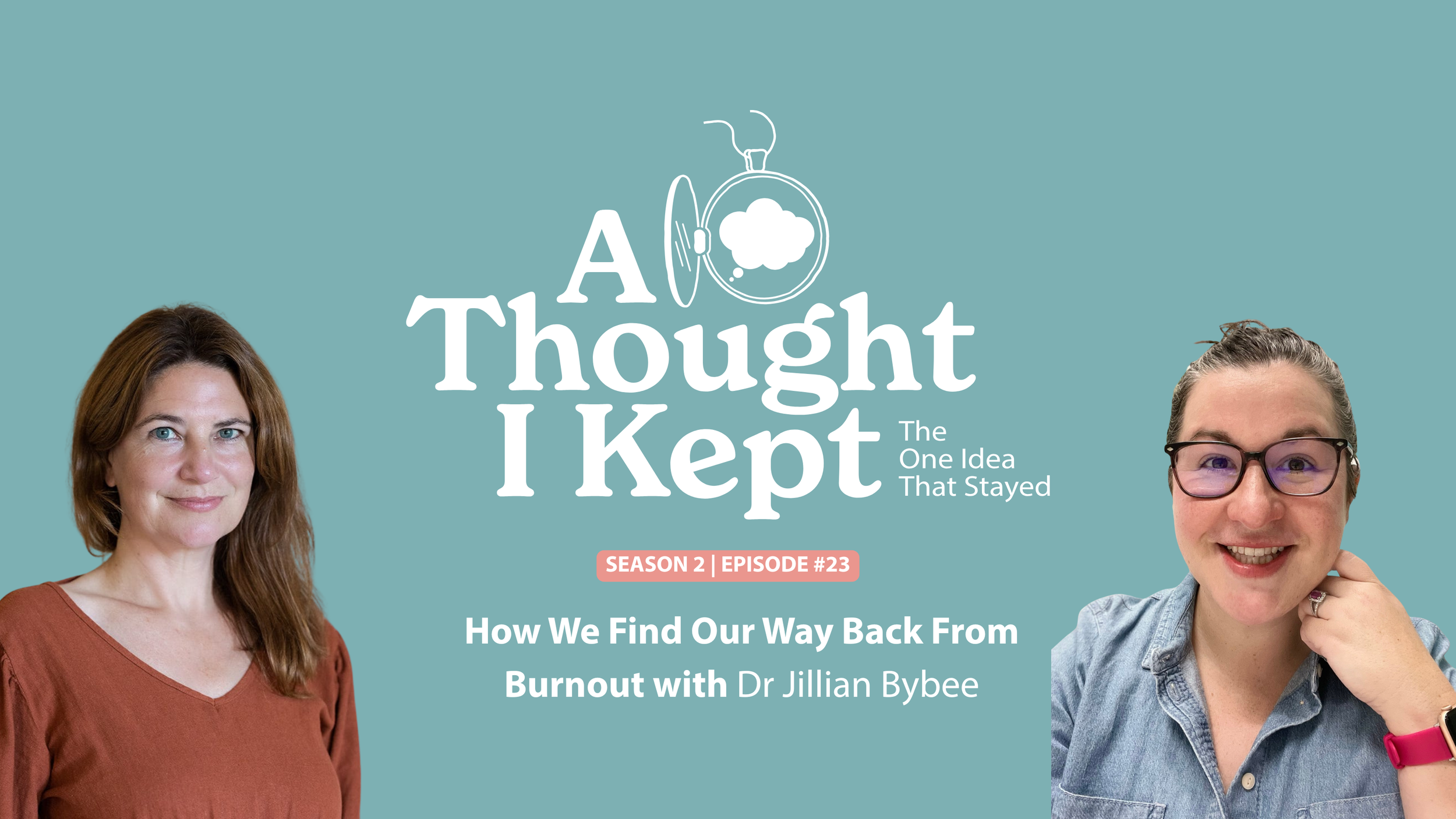
Life starts to feel flatter somehow. Not terrible or dramatic. Just a little more grey than it used to. This was something that really stood out for me from my recent conversation with Dr Jillian Bybee on A Thought I Kept.
Jillian is a paediatric intensive care physician, coach, writer and mother who has experienced burnout twice herself. During our conversation she shared a thought that changed the way she understood wellbeing:
"Wellness is not a state of being, it's a state of action."
We kept returning to that sentence as we talked because it challenges one of the most common assumptions many of us carry around wellbeing. Namely, that it's somewhere we're trying to get to.
If we're honest, many of us live as though wellbeing is waiting for us on the other side of life. It's over there somewhere, beyond the busy period at work, beyond the caring responsibilities, beyond the financial worries, beyond the endless list of things that need our attention. We imagine there will come a moment when life finally settles down and we'll have enough space to focus on ourselves.
Only life has a habit of refusing to settle down. There's always another deadline, another transition, another worry, another season of life that requires something from us. And so wellbeing remains permanently postponed.
What I loved about Jillian's perspective was the reminder that wellbeing isn't something that exists outside our lives. It has to exist within them. Not when things calm down. Now. Not perfectly. Imperfectly. Not as a destination. As a practice.
One of the moments that particularly struck me was when Jillian spoke about how she now understands burnout. Rather than defining it purely through exhaustion or workload, she shared a definition from Duke University's wellbeing research that describes burnout as an inability to feel positive emotion. Which is such a powerful reframe. Because it explains something I've seen in myself at times and in so many people I've worked with.
Burnout isn't always a collapse. Sometimes it's a disappearance. A gradual loss of access to the things that make us feel alive. Joy becomes harder to find. Wonder feels distant. Connection requires effort. Even gratitude can feel strangely out of reach.
We often think of burnout as a productivity problem. We imagine the solution lies in better time management, fewer commitments or a more efficient morning routine. But what if burnout is also an emotional experience?
What if part of what we're grieving when we're burnt out isn't simply our energy, but our relationship with life itself? That idea feels particularly important because so many of us have become very good at pushing through.
We're good at functioning. Good at coping. Good at convincing everyone, including ourselves, that we're fine.
As Jillian pointed out during our conversation, many of us have learned to suppress difficult emotions because they feel inconvenient, uncomfortable or overwhelming. The problem is that emotions don't really work like that. We can't neatly push away grief, anger, sadness and frustration while keeping joy, connection and hope fully intact. Often when we numb one part of ourselves, we numb other parts too.
Which perhaps explains why burnout can feel so lonely. Not because nobody is around us, but because we've become disconnected from ourselves.
One of the stories Jillian shared was about a coaching client who felt completely overwhelmed by the demands of her life. When they began working together, the thing she felt able to offer herself wasn't a wellness retreat or a radical lifestyle overhaul. It was five minutes. Five minutes spent reading in a room where nobody could find her.
I loved that story because it feels so different from the way wellbeing is often presented to us. There was no perfect morning routine. No expensive solution. No dramatic life change. Just five minutes and a growing recognition that she mattered too.
Sometimes I think we underestimate how powerful these small acts can be. Not because they solve everything, but because they begin to challenge the story that everyone else's needs must come before our own.
Perhaps that's why I left this conversation feeling unexpectedly hopeful. Not because burnout is simple. It isn't. Not because five minutes fixes everything. It doesn't. But because Jillian's perspective offers something many of us desperately need right now: a kinder relationship with wellbeing itself.
One that isn't rooted in perfection, optimisation or achievement. One that allows us to ask a different question. Not, "How do I become the best version of myself?" But, "What would help me feel a little more like myself again?" If burnout is the gradual loss of connection to ourselves, perhaps recovery begins there too. Not in becoming someone new. But in finding our way back to the person who has been there all along.
If this resonates, I'd encourage you to listen to my full conversation with Dr Jillian Bybee on A Thought I Kept.
And if you're feeling stuck, overwhelmed or unsure what support might help, you can also explore our Wellbeing Check-Ins and coaching sessions. Sometimes we need another idea. And sometimes we need another person.