

Isolation Inspiration: 5 Times The Internet Really Pulled Through This Week
Comedians are performing, children’s authors are reading their books, musicians are putting on concerts in their living rooms (!!) people are CONNECTING in any way that they can, all in the name of banding together to protect the most vulnerable members of our communities. (I know it’s the internet, and social media at that, but there is a real beauty here and I hope it is not lost on us.)
Ok, we know that this pandemic has been terrifying and overwhelming and inconvenient. Even under the best of conditions, we’ve been thrown from our regularly scheduled lives into some no-mans-land where no one knows what day it is or what is important or how they should be spending their time. I’m personally sticking with a 25-25-50 breakdown, toggling between (1) eating (2) trying to teach my kids literally anything and (3) re-watching every late-90s romantic movie I can remember. (While everyone else in the world is flipping out over Tiger King, I’m just over here like: Armageddon, Con Air, Titanic. Repeat). So yes, things are a bit wacky in our worlds, BUT, through all of this madness, something magical is happening, as well….
EVERYONE ELSE IS STUCK AT HOME, TOO!!
Yes, nearly everyone in the US and UK is sheltering in place at this point. Which, from one angle, might seem like a pretty bleak prospect…but with the existence of the internet, can actually be quite exciting. That’s because the people we love, the people we depend on for escape, the artists and writers and musicians, who so often feel so distant from us, now feel closer than ever. (The playing field has been leveled. All of us live in sweatpants now.)
Maybe you’ve noticed that every time you head to instagram you’re hit with a zillion notifications that people you are following are “going live”. (It is possible that I am technologically inept and need to adjust my settings, but I digress.) Under normal conditions, I wouldn’t really be apt to click on these live videos, assuming there might be some produced/commercial feel to whatever they were doing. This week, however, I started seeing new names pop up, creatives I admire, authors I live for, bands I’d never noticed on instagram…all suddenly “going live”. Hm. My interest was piqued. So I started clicking when they popped up…and you guys…hold onto your hats. (Or, your phones? Or whatever the modern day equivalent to that sentiment might be.) These people are putting on workshops and holding live readings and playing fucking concerts in their living rooms!!!
Please stop what you’re doing (YES STOP READING THIS) and go follow everyone you love on instagram! Comedians are performing, children’s authors are reading their books, people are CONNECTING in any way that they can—all in the name of banding together to protect the most vulnerable among us. (I know it’s the internet, and social media at that, but there is a real beauty here, and I hope it is not lost on us.)
I am sure you have all sorts of strange obsessions and specific tastes, but this is what we’ve loved this week, and we think you’d love it, too. (Also, we REALLY want to know how you pulled through this week and what helped you to get there? Was it a movie or a podcast or a book or a friend? Tell us about it!)
Here are a few of the things that made our life bearable this week.
5 Times The Internet Really Pulled Through

This acoustic set from Yoke Lore was like the coziest, sweetest performance ever. He was just sitting on the floor of his living room with all of his plants behind him. (We’re probably best friends now.) If you don’t know who this is, please go watch the video for his song “Beige” and fall in love. In his live performance he explains that the song is about finding a way to tell someone how you feel about them in a very specific way. (example: Let me go under your skin // Let me find the demon that drives those heavenly limbs). I’d tell you more but I’m sobbing just thinking about it. His next set will be in support of MusicCares (which provides a safety net of critical assistance for music people in times of need), so stay tuned!

We also loved Distraction Tactics with Dan Smith, lead singer of the band Bastille (who, interesting fact, would almost-definitely be my boyfriend if I weren’t married.) This new series is like a book club, but for films. (Wait, is a film club a thing?) Either way, here we come together to talk about movies from around the world. This week, we started in the UK with cult-classic Shaun of the Dead, complete with a pre-recorded interview with Simon Pegg (amazing) and a new jingle, written by Dan (equally as amazing). It was a bit like watching your best friend pull of a really great presentation at school. There’s something so sweet about the home-made authenticity in instagram live posts. (I say we get into it before the influencer destroy it.) Stay tuned for next week’s episode where we’ll head to a new country and breakdown another film! What film will it be? I can’t remember!

Glennon Doyle and Abby Wambach had an argument about “popcorn chewing volume” and cabinet doors remaining open for too long, in real time. (It was a very validating and cathartic experience for anyone who was able to catch a glimpse, I’m sure.) Glennon also stepped up as interim kindergarten teacher and read books to my six year old daughter while I lazed nearby. (This was via Instagram live…I don’t usually hang out with Glennon. I’m very busy.) She also prompted kids to ask dinnertime questions like: “How do you get your ickies out?” which is phrased so adorably that I’m maybe crying again. (She is officially raising my child now.)
**We also received our copies of Glennon’s new book Untamed! Who else is reading it?!

Lumineers singer Wesley Shultz performed a collection of original and cover songs from what looked like his kitchen? (But rich people have huge houses with tons of unnecessary rooms so it’s hard to say definitively.) In the performance he pleads with us to all take this virus seriously and do what we can to slow its spread. He also admits that some of his best lyrics were actually taken from things his wife has said to him over the years. So, you know, just typical stuff. #whoRunTheWorld?

BJ Novak read his hilarious children’s book, The Book With No Pictures and it was, again, like, do we even have to do anything? Can the internet just teach our kids?? (I, of course, am only joking. I am a homeschool mom and wrote allllll about our riveting days earlier this week.) If you watched this live reading we hope hearing BJ say “Boo Boo Butt” was the salve you needed to soothe whatever aches and pains this isolation may have conjured.
**And, as a bonus, we just wanted to mention #togetherAtHome, a virtual concert series and campaign of Global Citizen (a movement of engaged citizens who are using their collective voice to end extreme poverty) created in conjunction with the WHO. If you’ve got some time (and lets be real, you’ve got some time) scroll through the hashtag and see what’s coming up. This week, we’re excited to check out Jimmy Eat World and probably other people but we don’t know how to search upcoming events so we are simply welcoming whatever is meant to come to us, which might seem like something a highly enlightened person would say…or at least someone who possesses more crystals than we do…but for our purposes just means spending extra time on the internet, maniacally clicking on everything that pops up. 🤗
We know this time is full of so much uncertainty, but we hope you’re finding creative ways to move through and come together. Even in isolation, connection is possible. We want to hear how you’re connecting, or where you’re struggling. If you feel so inclined, please reach out.
And, if you are struggling, please consider heading to our guide to find more resources. Everyday, we’re adding and editing in the hopes that we’ll all come through this time with our mental well-being intact. To learn more about the mission of If Lost, Start Here and to stay connected, please sign up for our newsletter!
Collaborative Action in Self-Isolation
Share how we can come together to support community spaces and independent businesses through this unprecedented time, and help them keep the lights on.
We've been chatting about what we can do about what's happening in our world right now and our belief — shared we know with many of you — that we need to come together to take small actions to support the spaces we love.
We often feature indie stores, cafes, coworking spaces, bookshops, bakeries, unique storefronts, and cultural venues in our guide. All places that attract people and which are starting to feel the changes in attendance, balance sheets, and engagement. As we go day by day now, we're acutely aware of the need to find ways to help them keep the lights on. We have some ideas for how we might do this, whether that's just buying those much-needed groceries locally, seeing if a local restaurant has started delivery, getting books and stay at home activities from an indie store rather than the big guys, buying gift vouchers to use later. Small gestures to keep their worlds going even if we're stepping away for a while.
Here are a few quick ways to offer support. Please do share so that we can continue to offer concrete tips about how to help small businesses continue through unusual times.



If you are a small business or if you are someone who is finding ways to engage with businesses differently, to still support them as we're social-distancing, use the hashtag #iflostkeepthelightson on social media to share advice about how people can help through these ever-evolving times.

Shifting Course // New Editorial Guidelines
We’ve reworked our editorial guidelines to help you best meet evolving mental health needs in this time of uncertainty. We’d love you to write for us, contribute an idea or support our work however you can. Collectively we’ve got this.
We wanted to let you know how we're shifting our editorial approach in this time of the Coronavirus pandemic and how we can work together to get ideas, inspiration, and tools to our readers at a time when our mental health is being greatly impacted.
Ordinarily, If Lost Start Here focuses on the places we can go to meet our needs, but that being-out-in-the-world piece is much more difficult now. So we're looking to pivot to find ways to meet the critical needs for our mental wellbeing from home. From finding community and connection to discovering our own creative potential, we're reassessing the ways we can thrive (or just cope) while social distancing and in lockdown if that happens where you are like it has happened here in California.
We're now looking to include pieces in our guide on the following subjects:
Things to do at home: This can be project-specific — from a creative project that you'd like to make available to others— or more resource-based such as a piece on the resources you are turning to sustain you at home like a great online tutorial, a meet-up platform, or a virtual pub quiz.
Nature: Many of us are turning to nature to restore balance to our days, and we're fortunate in that we can benefit from being outdoors while social-distancing. Perhaps you know a great hike, a secluded park, a hidden lake, that people can seek out in their neighborhoods (we're minimizing travel too remember). Or maybe you are an expert in forest bathing, are versed in succulent gardening, or know how to go glamping at home. We can be creative about what nature means to you.
Non-real world (the irony) places: We're looking for creative outlets, online places and innovative ways that support more of what we all need in our lives right now. Just a reminder our focus ranges across these categories (also built out on our homepage): Connection & Community, Mind/Body, Untethering, Purpose, Spirituality & Meaning, Doing Good, Mental Health, Awe & Wonder, Creativity & Culture.
Places you want us to know about so that we can support them: This one's critical, as many spaces in the world are struggling with staying open or staying afloat if they've already been forced to close their doors. Tell us about them and how we can help keep the lights on (in spirit sometimes too).
Interviews with space makers: We want to be able to share stories about how people are adapting to the current moment. Let us know how the people you know in the world who have been brave enough to make space for others, are shifting their vision, their days, their own lives.
Places you dream of visiting: We recognize that there is so much longing at the moment too. Some of us are already missing a regular cafe, a beloved family destination, a gathering that recenters you. Tell us your stories of where you imagine being (hopefully one day soon).
Culture therapy: We have a series where we look to the books (fiction, non-fiction), podcasts, TV shows, films, plays, articles, magazines and visual culture that can help support us across each of our categories. Let us know which cultural resources you turn to when you are lost, lonely, anxious or curious.
Personal narratives: Tell us about your own experience of trying to maintain your mental health in times of uncertainty. We all need to know that we are far from alone as we self-isolate or social distance. Amanda just wrote this about homeschooling which will hopefully help lots of us now attempting this.
We know that stress is high, budgets are tightening, and our plans are shifting wildly. All those things make writing for us at the moment a difficult ask. But we hope that you may have a moment to contribute so that we can build more of what we need at a moment that we need it most.
Other ways though that you can support our work: share our campaign #iflostkeepthelightson across social media, or support our fundraisers for helping spaces struggling at the moment, or share our prompts for being Lost at Home which will become a printable this week with proceeds going to struggling spaces.
Thank you for reading. Be well. Take care.
x Amanda & Claire
Co-founders, If Lost Start Here

Give Yourself a Break: A Homeschool Mom’s Guide to Loving Your Kids and Lowering Your Expectations
My friends keep asking me: “How do you homeschool ALL the time?! I am going crazy!! What’s your secret?!”
To which I keep responding:“You do realize that ‘homeschooling’ is much harder in the midst of a global pandemic when we are all panicked and locked indoors, right? Have you considered just doing a completely mediocre job??”
It should be noted, before we dive in, that there are truly unlimited ways to “homeschool” or “unschool” or “free-school”, unlimited ways to follow curiosity and to experience passion-driven, joyful education. This is just one mom’s path, in the midst of a world-altering crisis and in no way speaks to the path of any other homeschool family or system. I am posting this not to say: give up, do nothing. But rather, to say: give in, keep loving. I hope this perspective helps you to give yourself a tiny break and encourages you to find your way through, in any way that works for you and your family. You are doing a good job. You’ve got this.
In the wake of the coronavirus outbreak, rapidly intensifying shelter-in-place orders and now-mandated home-based education for many, my friends keep asking me:
“How do you homeschool ALL the time?! I am going crazy!! What’s your secret?!”
To which I keep responding:
“You do realize that ‘homeschooling’ is much harder in the midst of a global pandemic when we are all panicked and locked indoors, right? Have you considered just doing a completely mediocre job??”
This, I realize now, is not what the good parents of the world want to hear. They want the real shit. The ins-and-outs of our day. They want to know how we know that our kids are learning and well-adjusted and challenged and engaged. We do not nervously laugh-cry when we are asked this. We deliver.
So, here is everything I did today (which may be yesterday to you, or multiple days ago at this point..but does anyone even know what day of the week it is anymore? Let’s assume the construct of time will be dismantled soon.)
Ok…here we go.
It’s after 9am, but likely before 10. (Ok, it may also be after 10. I am not sure. These are trivial details now.)
We eat breakfast, pausing to be thankful that we have food and access to supermarkets (and that coffee is still allowed).
We flip through State Capital cards which happen to be strewn across the table and decide we could all really use a road trip around the continental US. (I feel like I’ve maybe never even heard of Frankfort, Kentucky before, but this must not be true?)
We make juice (convinced that ginger will save us). Kids cut fruits and veggies and craft and press their own concoctions. (This is probably science? Is “potions” a class?)
We eat chocolate because it’s delicious and this is self-care. (Also science.)
Stop everything! A package has arrived with massive blankets that look like tortillas. A photo shoot is necessitated!!
Now we’re dragging the blankets everywhere we go. (“No you can’t take it in the bathroom.” “Fine don’t let it fall in the toilet!” “No I don’t want to drag you around the house in it!” “Ok, last time! Wheeee!”)
The magic of the moment is waning.
The 11-year-old and I escape to watch Watch Harry Potter 5 (younger child reads Captain Underpants with homebound-husband then watches the movie...I’m assuming they watch other things after this as their movie is shorter but I am enraptured and intermittently sobbing so really cannot be sure.)
There are cuddles for all.
Movies are done and a “we should really do something productive” feeling surfaces. (I try to quell it but cannot.)
We Watch a 6 minute math tutorial on Khan Academy before deciding...“meh.”
We Read Harry Potter 7. It is the last book in the series and we are 81% of the way through. (I know this because my Kindle app is actively torturing me. #crucio) I’m doling out pages slowly, a seasoned addict, fully aware of the withdrawals we are all about to experience. I am sob-reading now and it’s time for a change of pace.
Still in HP-mode, we decide to watch Voldemort Make-Up Tutorials.
We do our own special effects make up. (Warning: hide your “good” make up.) (Pro tip: GO OUTSIDE)
Stop everything! Our large dog is licking our small dog and it is ADORABLE. He looks embarrassed by our laughter and we decide that he is a dog who holds himself to People Standards which is a very very complicated space to occupy. We feel for him but continue laughing. (The human experience is highly nuanced.) I think we are teaching empathy and humility but maybe we are just teaching that dogs are funny?
It’s feeling tired-y as it nears the “you’re either going to get ready for the day or you’re destined to eat an entire sleeve of Oreos at some point” threshold. (Getting ready still feels a bit too hard.)
We play charades. The kids choose things like “washing machine” and “pants”. (They are not good actors...but we do not let them in on this secret because there is still ample time to hone-in on their theatrical skills.)
We move on to play a game where you get to throw burritos at each other. (They are very good burrito throwers.)
It is lunch time. We eat at a table that some people would use for learning but that we mostly just use for eating (and burrito-related games). It used to be a nice table but is currently covered in paint...so I guess it is art now? (In a 900sf house with two dogs and two children it is very important to have functional pieces like this.)
While we’re at the table, we draw pictures of each other with our eyes closed. The 6-year-old cheats (but results suggest otherwise). The 11-year-old might be a prodigy.
We tour The Museum of Modern Art online and tell him we’ll love him even if he spends all of our (now) imaginary money on Art School. He assures us that YouTube tutorials will suffice.
We celebrate the news with a Lizzo dance party - the regular, unedited version because the Kidz Bop version is garbage (and we will not settle for anything less than “100% that bitch”.) We answer follow-up questions about “DMs” and the lure of spending time with professional football players. This is probably social studies? Maybe health, too?
Stop everything! Our snake has shed! The aftermath must be examined!! Muffin looks like a brand new man and we are all here to encourage him to be his shiniest, most noodle-y self.
It is now time for second lunch. In these strange times I’ve decided that I should not be eating food without utilizing the large bottle of buffalo wing sauce that I panic-bought at Target three weeks ago. Second Lunch is spicy and reminiscent of something you might find at an Applebees. This is self-care, now. (Unprecedented times, indeed.)
Kids disappear with boxes and scissors and tape. I am asked to cut yarn but I DO NOT ASK why because I don’t want to impede on this newfound independence. Also, I do not want to help and asking questions makes me complicit in the outcome of this project. (Plus, I need to stare at my phone.)
One child emerges from the bedroom as a dancing cardboard robot. He has painted on abs and a butt made of aluminum foil. We laugh hysterically because these are “buns of steel” and their execution is magnificent.
Child two has designed a remote control car and is operating as, I don’t know what (?) I wasn’t totally listening but something like the engine, or some sort artificial intelligence system??? Either way, she hands us the remote and it is, quite literally, the only time we’ve been in control of anything all day. Her override system is powerful, though, and she ends up going rogue. It’s ok because she is almost instantly back in the bedroom with the boxes and the scissors and her brother and all is silent for 10 glorious minutes.
Stop everything. The creativity has run out in all of us.
Everyone is lobbying for more TV (but we’re saving that for later when we’ll need to fully ignore them and get some work done.)
We lay around and listen to the Poetry Unbound podcast. (It’s possible that I am the only one listening but I mumble something about “osmosis” to myself and carry on.)
We pull out first grade spelling flash cards (despite the fact that no one here is in the first grade). We agree that English is nonsense and tentatively plan to learn Latin. The six-year-old assures us all that Spanish makes more sense and walks us through her app where she expertly clicks through pictures of corn and horses and airplanes as words the rest of us don’t understand come tumbling out of the phone.
It’s 5 now (maybe?) and we have determined that if we do not leave the house that we will literally suffocate.
We’ve heard about a project where kids go around town leaving delightful little chalk rainbows in their wake, a sign of hope and connection in otherwise unstable, disconnected times. Our neighbors are elderly so the kids make the rainbows big and extra-bright outside of their homes. We tell them that other kids may have left rainbows behind, too, and to see if they can count them on their journey around the block. They find “zero” but draw “probably 55”. The adventure is a success.
On the way home the kids find an empty basketball court and design giant chalk homes complete with rooftop decks and “more than 2 bedrooms” (an obvious slight to us, but we let it go).
Back at our tiny home, it is time for a bath.
I need to do some work, which feels pressing, but will have to wait until we’re back on dry land. For now a half-hearted mermaid impression is all I can be expected to produce.
Ok, out of the water. Kids are hungry because they didn’t eat second lunch. (Feels like their problem...but, fine, we will feed them.)
We eat dinner. It is pasta again, because we don’t understand how to save our food stores (and pasta is delicious).
We queue ANOTHER movie.
I, mostly-unapologetically, ignore them for two hours so that I can write hard hitting pieces like this. Except for the nine times I pop in to say “Sorry guys, almost done! Are you having fun? (Am I a good enough mom?) Anyway, cool cool cool, back to business! I love you!” I wish the head of the journalism program I dropped out of in college could see me now. (Except, no, not really see me as I’m still in yesterday’s PJs…which are actually PJs from TWO yesterdays ago, but who’s counting?)
We throw burritos again.
It is feeling dark enough to sleep now. We implore the children to brush their teeth (a process that spans multiple lifetimes but somehow we do not visibly age), then there are the meltdowns (whoops we missed our window), then hugs, mini-dance party, cuddles, everyone in our bed, circle back to Harry Potter and accidentally read for two hours which means we all wake up late again tomorrow.
Finally, I look around and let my eyes fall upon their little faces…faces with remnant make-up and rosy cheeks, faces that have hurled forth insults and uttered accidental poetry. Maybe it’s some mixture of gratitude that they are healthy (and silent) and the coziness of our too-small bed, or maybe it’s the realization that, holy shit, this all goes by so quickly, but, somehow, amidst the pressure to do it all right (and the fear that I’m doing it all wrong) there is really no where else I’d rather be.
Are you in search of connection and support through this time? Head to our guide for inspiration or navigate from our home page: If Lost, Start Here

A Space of One's Own // Part 1
This International Women’s Day, we’re celebrating female-identifying space makers. Since we launched If Lost Start Here, we’ve found again and again that many of the places that are thinking about our mental wellbeing differently have been founded by women.
This International Women’s Day, we’re celebrating female-identifying space makers. Since we launched If Lost Start Here, we’ve found again and again that many of the places that are thinking about our mental wellbeing differently have been founded by women. From initiatives that aim to balance our emotional and psychological wellbeing like Bryony Gordon’s Mental Health Mates, through to unique places of awe and wonder like Lea Redmond’s Lucky Penny Parlor, through to independent creative spaces like Alexis Joseph and Lana Porcello’s Case for Making. We’ve even covered a Poetry Pharmacy — founded by Deborah Alma. As women are raising our voices, we are also helping to shape our world in real terms.
That world is not just one that we make for ourselves. Yes, there’s a surge in interest in female-focused spaces (some of our favorites include coworking spaces like Grace Kraaijvanger’s The Hivery depicted in the main image and Molly Goodson’s The Assembly). But for the most part, these spaces created by women go beyond Virginia Woolf’s room of one’s own — a coveted space for ourselves to live an independent and creative life — but to spaces for all of us to seek out and from which we can benefit.
We’ve found that women are creating places with a purpose that can better reflect the kind of world that we thrive from inhabiting. The storefronts, initiatives, and environments that women are creating are designed to do the things we need most: build connections, contribute to healthy communities, make space for creativity, bring the relationship between our minds/ body (and sometimes souls) into focus, give us access to nature and untether us from the overwhelm of technology, and even allow for spirituality, joy, and hope.
As the world shifts, women don’t just have a voice in it, we also get to shape it, giving concrete expression to how our own needs, our own sense of space, is evolving too. Staking out physical places in the world is vitally important to what that world becomes for us and each other.
We’ve also discovered this from our conversations with women space makers; making places in the world is an act of bravery. (Take it from our friend Tiffany who just launched her women’s collective and workspace All Together Co.) It takes a huge amount of courage and commitment to actually open any physical location in the world. Think about some entry-level constraints: rising rents, a displaced consumer-driven more online, the unceasing competition for audience and platforms, and fragmented communities. Now let’s add in an almost marriage-like scenario once a space has launched: an ongoing commitment to opening and closing up, replacing milk and toilet paper, managing relationships within a business and with customers/clients/suppliers, keeping the lights on (even changing lightbulbs). And let’s just throw in the costs of build-out, inventory to get started, permits and contractors. Are you tired yet? Now do it anyway, and make it work, and thrive, and sustain yourself and others. These women are our heroes.
Over the next few months, we’ll bring you more stories from female-founded spaces, more words of wisdom about their why’s and their how’s. For now, to go into this weekend singularly celebrating women’s achievements, we’ve pulled together some of those spaces that we’re particularly excited about and some of the people behind them that we wanted to highlight. We hope you’ll find some inspiration here. We encourage you to seek out these places, as well as the others that we’ve featured in our guide, to support female-founded spaces wherever you live, and maybe even to start something of your own?


Ride with Me | Drawing Bike Lines Together
For Roos Stallinga riding a bike is both an art and therapy, making ourselves, and the world around us, a better place. Ride with Roos in Barcelona, Amsterdam and New York.
When I lived in New York City (between 2002-5) and studied Art Therapy at NYU, I met with a therapist as part of my training. At some point, she asked what made me most happy. I answered, “When I ride my bike around NYC!” The woman, American and in her fifties, could visibly not relate. She blinked a few times, and then kind of ignored my remark. Like, “Right, but now for something real, like work or study, something in the actual world.” At that time it was indeed really strange to bike in New York. Almost no one was doing it. But to me, I later realized, this really WAS essential — so much that I turned it into my profession.
Riding my bike in New York made me feel free, strong, alive, and right at home (maybe it helped that being Dutch I was basically brought up on a bike). I got so much inspiration and energy from riding around the city, absorbing the sights, sounds, smells, and stories. It was never boring and I got to know the city really well. The bicycle opened up new neighborhoods and parts of the city I wouldn't have come to otherwise.
At times, I would feel slightly scared, exploring new ground, not knowing anyone. Sometimes I would meet people and have a chat. Other times I would just sit in a café, writing in my diary, enjoying just being there and grateful for getting a peek into another world. Even though I was usually alone on my adventures, I somehow always felt connected, to the city, and its inhabitants. There would be eye contact with a fellow biker, laughs from a random stranger on the street. And even the occasional angry driver, who would tell me to get out of the way, or off the road. I would try to stay calm, strong, and smile. “Just smile” Another NYC cyclist once told me “You’ve got a right to be here, too”.
Now I explore cities for RIDE WITH ME, discovering the best biking routes, coffee, art, parks, hills, beaches, bars, and restaurants on the way. In 2009, I created RIDE WITH ME NYC, out of my experiences and insights, as well as conversations with fellow bikers. I wanted to share the joy, and the beautiful places and people I discovered on my way. I used my bike as my pen, to draw lines in the city. And as a key to open the city. I wanted more people to experience this, to ride these routes, and even better, to create their own adventures!
RIDE WITH ME guides are like cookbooks, with recipes for urban adventures. Some of my favorite recipes and ingredients are listed here:

AMSTERDAM is my hometown and base; I think it’s the best place in the world to bike. And so beautiful! It’s an easy place to ride, once you get beyond the chaos and amount of other people on bikes. My advice: just go with the flow, stay on the right, make eye contact, and don’t stop in the middle of the road. You will be fine!
Ride to the ‘Noord’ (North) side, taking your bike on the free ferry behind Central Station, and explore the area around the old NDSM ship wharves, with street art and artist studios, and some nice cafés, like Noorderlicht or Pllek (here’s a city beach too). Continue along the water, passing by freshly built neighborhoods, warehouses, car garages, and find another special place on a dead-end alley called De Ceuvel. Old boats lying on land are turned into creative offices, a polluted area that is slowly being cleaned by using innovative methods. There’s a nice cafe as well, and in the summer, people go swimming.

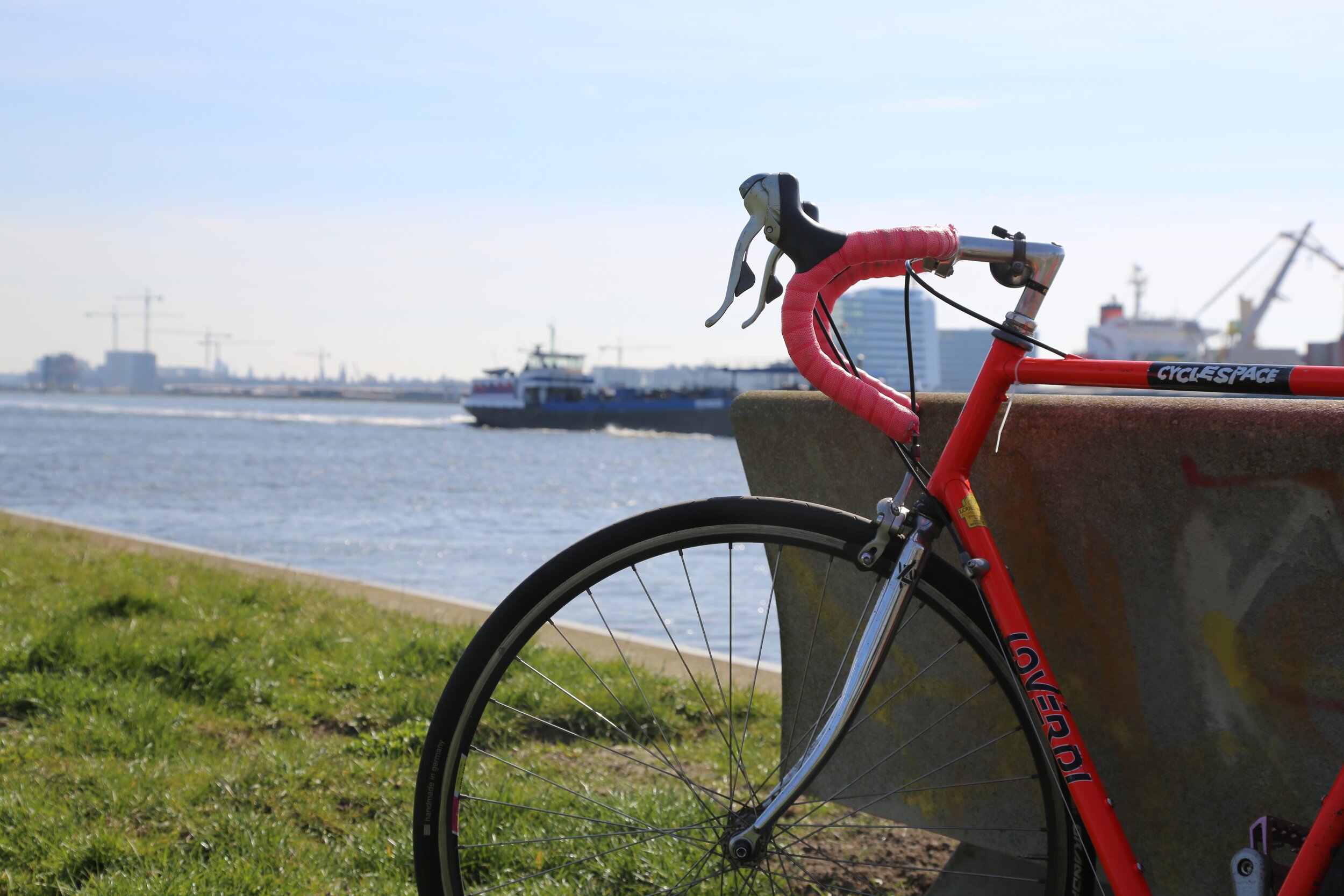
Further on, if you keep heading east, crossing the ‘Noord-Hollandsch’ canal, you will pass small workers homes, more warehouses with creative offices, a brewery called Oedipus, a local winemaker and co-working place called Chateau Amsterdam and find a couple of delicious destinations, like the Mexican taqueria called Coba, and a huge and welcoming restaurant named Hotel de Goudfazant. Ah! And if you want, you CAN also just stay and go dancing at the Skate Café. Or keep riding, all the way to Durgerdam, a quaint fishing village along the IJ lake, amongst green fields and cows.


Ride around the old city center, and its Red Light District, early in the morning, possibly on a Sunday. When most people are still asleep, you can really sense the soul of this place, rich with history, and its share of drugs, sex and rock ‘n roll.


Head West on your bike, exploring the old gas factory site called ‘Westergas’ in Westerpark, now filled with cultural happenings and culinary destinations. Through the park, you can ride even further west, towards ‘Bos en Lommer’ neighborhood — or BoLo — a diverse and upcoming area. There’s a super sweet book shop called ‘De Nieuwe Boekhandel’, and kick-ass coffee place called Friedhats Fuku Cafe founded and run by star barista Lex Wenneker and friends.

BARCELONA soothes my soul. I just love residing in this city, with its beautiful light, buildings, and nature, the people, the way of life. It always relaxes me. How wonderful being able to ride your bike to the beach, dive in, dry in the sun, and ride on. Then enjoy a long and lazy lunch, for example at Sala Beckett, which is inside a beautiful theater building, or LEKA, for deliciously local and sustainable food, both in the Poblenou neighborhood (in general a great area to explore by bike).


Barcelona is relatively easy to ride in, just go easy and accept the occasional counter-intuitive bike infra, AND the fact that as a person on a bicycle you are basically at the bottom of the mobility food chain here (after the car, the moped, the pedestrian, and maybe also the electric scooter).


Photo: Gregor van Offeren
I love riding up the Montjuic hill, a magical place filled with plants, art, culture, and sports facilities — the Olympic Games were hosted here in 1992. At the back of the mountain, there is an impressive cemetery (many famous Barcelonians were buried here) with views of the industrial port, which makes for a surreal setting. If you continue to ride up here you will pass the botanical gardens and finally get to a semi-secret ‘mirador’ (outlook post) and bar La Caseta, with beers, music, and bbq ‘en plein air’. It’s the perfect bike stop, after which you can just roll down that hill and maybe end the day at the lovely Poble Sec neighborhood.
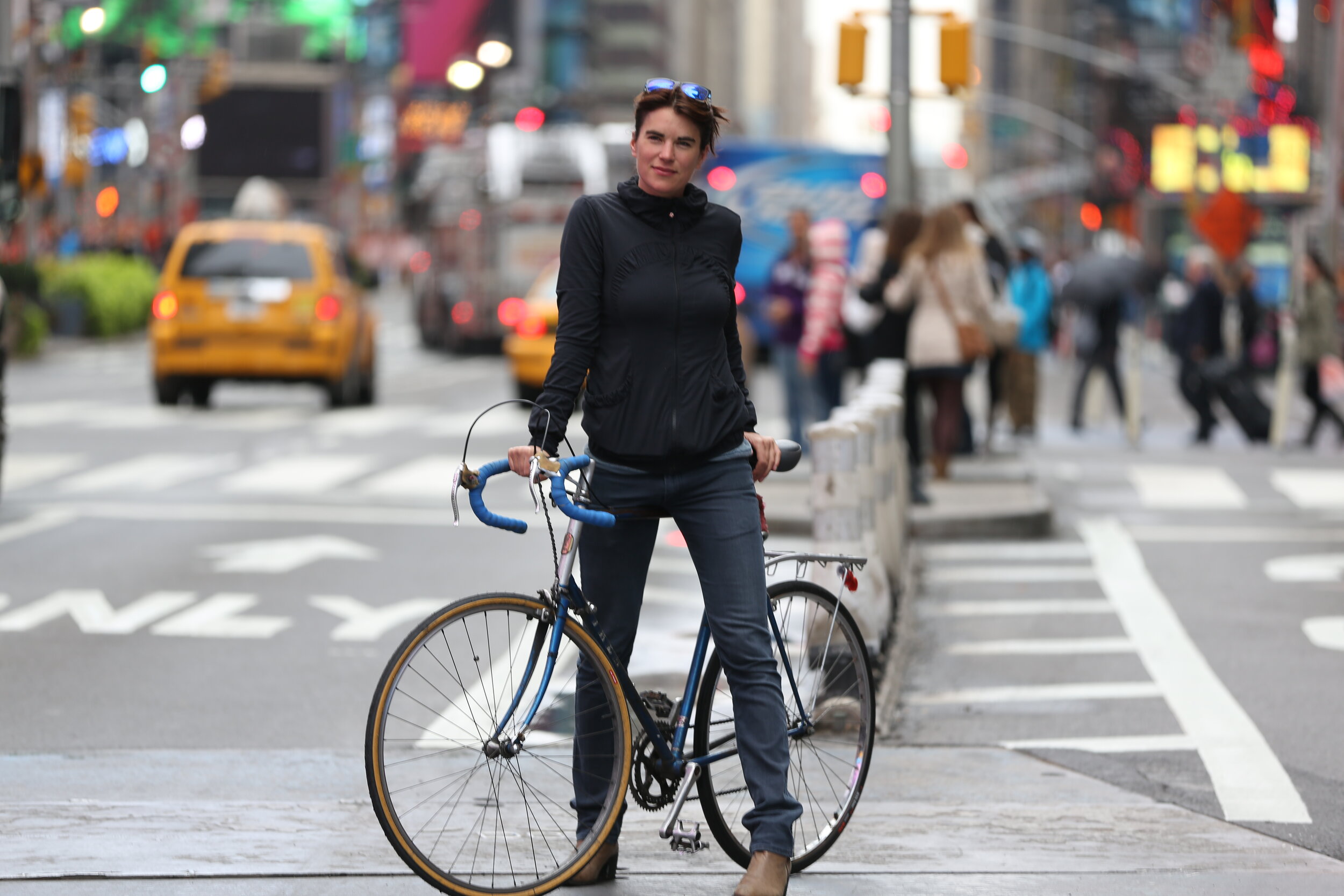
Photo: Lisa Smidt
NEW YORK CITY gives me courage and inspiration. Riding around on my bike here feels like I am surfing the waves of the city. There is so much energy! Of course, you do have to be alert at all times, focused and relaxed at the same time, kind of like a Zen monk on two wheels. Oh, and on a practical note: the blue bike-share system Citibike works great if you don’t have your own bike!
Ride to Red Hook in Brooklyn, over the Manhattan Bridge, landing in Dumbo (neighborhood Down Under the Manhattan Bridge Overpass). Along the East River, through industrial wastelands, and discover at the end of the road this old village that used to be a Dutch settlement called ‘Roode Hoek’. You’ll find you can look Lady Liberty right into the eyes, amongst red-brick warehouses, fishermen, and boats. Maybe have a Key lime pie (!) at Steve’s Key Lime Pies, or a special dinner at The Good Fork. There’s a bar called Sunny’s, straight from a Tom Waits song, rundown, smokey, with a bartender cracking jokes.
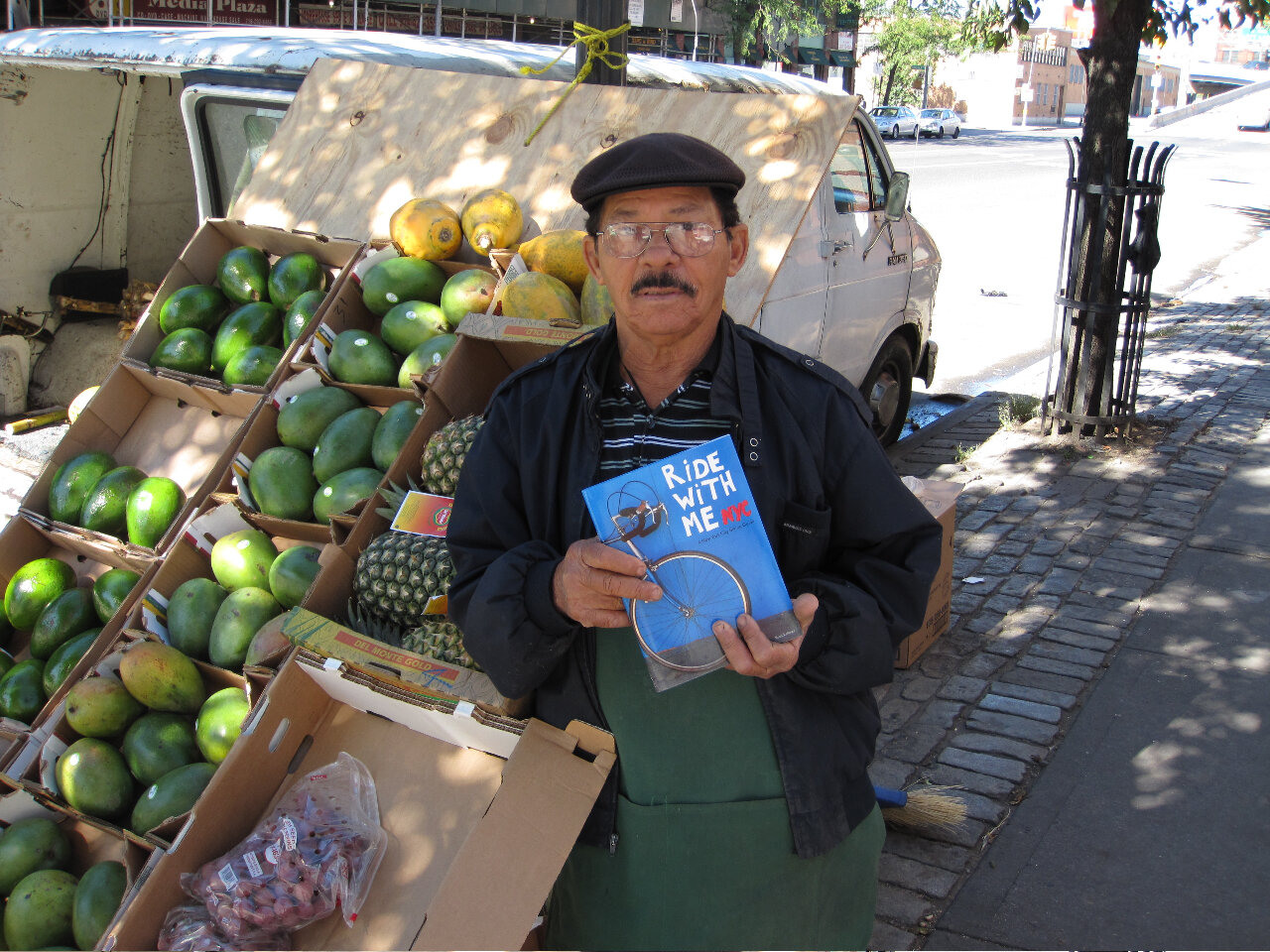

Or ride down along the Hudson River over the greenway — no cars just skaters, runners and cyclists — until you see the Statue of Liberty and Ellis Island. Maybe take a ferry to Governors Island, a historical military base transformed into a car-free, green, and arty play zone.
Ride from Dumbo all the way to Greenpoint, Brooklyn, riding through the Hasidic Jewish area, feeling like you are back in time, with the men wearing black fur hats and the women long skirts and wigs, pushing vintage strollers down the street. Hit the Brooklyn Roasting Company for a pitstop (either in Dumbo or on the way to Williamsburg). In Williamsburg and Greenpoint are tons of nice shops, cafes, and restaurants. Just riding around on your bike, watching the street life and art, is a pleasure too.
If you want more, make a detour to East Williamsburg/Bushwick, still a bit rough, with many murals, warehouses, artist spaces, and many cool bars and restaurants. A weird and wonderful place — completely hidden at the end of a tiny alley — is the Australian restaurant Carthage Must Be Destroyed. Here, they painted everything pink and serve super fresh and original dishes.


Maybe it all makes sense after all. I lived in Barcelona when I was 18, studied Psychology in Amsterdam, Art Therapy in New York City, traveled a lot, and kept a diary to write and draw in. I look at the city as a psychologist, using my bike to be free and get a grip at the same time. To get inspired, and connected to the people and places around me. Riding a bike is both an art and therapy, making ourselves, and the world around us, a better place.
Ride on!
xxxRoos

Photo of Roos: Chris Prins
Additional Photo Credits: Cover image of Roos on the Brooklyn Bridge in NYC: Theo Westenberger
All other photos/artworks/illustrations: Roos Stallinga

Shelf Help | In conversation with Toni Jones
We talk to the British journalist Toni Jones, Founder of Shelf Help about the bookclub that became a global movement and why its her mission to make self-help accessible, collaborative and cool.
When we first found out about Shelf Help, we felt like we had found our people. It’s a book club, built around self-help books, that also builds community in real-life. Isn’t that the ultimate combination?
OK, you’re hesitating, and we’re guessing it might have something to do with the genre because let’s face it, self-help can be a bit naff. You probably already have your biases, unconscious or otherwise.
Don’t worry, in the conversation that follows with Founder Toni Jones, we’ll cover that uncool factor and all the other reasons why Shelf Help is something you might need in your own life. Prepare to change your mind.

Claire: What led you to start Shelf Help?
Toni: I had just left my full-time job as a journalist to become a freelance writer, which meant suddenly spending a lot of time by myself. I was 36 and I’d never spent any time alone. It should have been the dream. I’d quit a job that I hated. I was busy and getting work. But it wasn’t that easy being by myself and getting to know myself. I realized I had spent a long time just ignoring my needs, and as soon as the job wasn’t there as a distraction, it was all back down to me.
I spent a lot of that time not unravelling but definitely in a bit of a mental health black hole. I was transitioning from this high-octane life to having a lot of time to think about whether I had done the right thing. I didn’t know how to deal with any of it. I knew I didn’t want to go back. I knew that wasn’t the right thing to do but I wasn’t sure which way to go.
I just started reading a lot of self-help. I started taking care of myself in other ways too; going to therapy for the first time (which I found really hard and amazing), doing yoga, attending retreats, and participating in a few support groups like Al Anon. I was also writing more about wellbeing because it was a trend that was coming in. In a way, in trying all these things, I was approaching my own life like I was writing a feature.
Claire: What was the first self-help book that you read?
Toni: Paul McKenna’s Change Your Life in Seven Days, which people thought was hilarious and really weird, because you don’t think of him as a self-help guru. To many people he’s that weird hypnotist on tele but he’s well-trained in positive psychology and NLP.
Because it was the first self-help book that I read, it really resonated. All these light bulbs went off. I read it slowly; I’d read a concept in that book and then I’d go away and research it. I’d go deep into the black hole of a certain author or self-help concept. Suddenly I was learning all this stuff and I literally could not get enough of it. I was devouring all these self-help books. I was fascinated by it particularly when I started reading about positive psychology and neuroscience and things like Dr Joe Dispenza (he talks about the power of your brain to change and it’s kind of the Law of Attraction but with all the science behind it).
But I was boring my actual friends with it. They were seeing a change in me—and that does spike people’s curiously—but they were like: ‘we get that you are into self-help, but it’s not our thing but good for you that it’s working.’ I started Shelf Help to find new friends who I could talk to about it. Also, as a journalist, I’m the kind of person who, when I find something good, I just want to share it.
Claire: Tell me about the first meet-up. Was it what you expected?
Toni: Shelf Help started as a local book club at a little wine-bar in west London. The first couple of meet-ups were a bit more earnest than they are now, because I started off thinking I needed to be super serious to be able to offer good support, but I’ve learned—as I’ve got better at running groups and also sharing my own story—that you can talk about the big stuff and still have fun.
Meet-ups today cover all kinds of heavy things; purpose, grief, breakups, fertility, friends, fear, careers…but we end up laughing a lot. They are actually really fun! We don’t just sit there and talk about our problems. People do bring up things that are bothering them and things that they are struggling with but there is usually someone in the room who can help them, someone who can say that happened to me and I did this. The idea is that we can all come together because everyone is fragile. We’re probably going through the same old shit and it’s nice to know other people have gone through it and that they have survived. Everyone leaves feeling positive.
Shelf Help has gone from me saying let’s talk about our problems, and that its ok to share, to a place to move forwards. Now I say we celebrate self-help. It’s about inspiring positive change. We advocate that it’s totally ok to not be ok and that people’s feelings are valid, but there’s a lot we can do to feel better, and so we focus on what’s next and how can we help each other.
Claire: As Shelf Help isn’t therapy but is to the side of therapy, how do you create an environment that is safe and purposeful?
Toni: What I do is create a space to give people tools to empower themselves. It’s self-help, so I’m never saying that I’m a therapist and that I have all the answers. At each meet-up, we use a different book but the same format. I’ll pull out 5-6 quotes or exercises from the book and every host around the world and on-line will use those questions for discussion. That gives us the framework as we’re going through the session.
For instance, let’s take a recent book Designing Your Life, which focuses on working out different versions of who you can be. I’ll say ‘The authors say… ‘ and ‘This is how they say it will work…’ Then I’ll ask, ‘Who has experience of this...’
I’m not saying that’s my advice or opinion, though I’ll share something usually based on my own experience. People understand that I’m not trying to direct anyone in any way. If you have chosen to read this book and come along to a meet-up, it’s because you are interested in the topic and meeting like-minded people. I’m pretty sure the attendees aren’t just there to see me or listen to what I have to say about something. I’m just the host: I bring people together and create an environment. But very much people are coming with their own stories to share.

Claire: It sounds like the book itself is giving you the safe container?
Toni: Yes, the expert in the room is the book. Sometimes we have the author there but not always. In a way, it is like a regular book club where you get together to chat about the different characters and chapters and everybody has a different opinion.
Also, I’m quite clear that confidentiality, kindness and no judgement are our code of conduct. That’s on our printed materials that we put out. Hosts also read out the manifesto at the beginning of each meet-up, which explains what we are and what we’re not.
We do have different levels of people at different levels of pain or need. Some people have gone to the doctor and they are going to therapy. They are using this as another tool. There are a million experts that people can google but what they are looking for with Shelf Help is a way to connect to others and a way to connect with themselves.
Claire: The self-help genre has been promoted as being so individualistic, as something you do alone. There’s this idea that you read a book alone and have all these epiphanies alone. With Shelf Help what you are saying is that actually self-help is not solitary, but rather it can be in understood as a collective experience and can be experienced in a social environment.
Toni: My mission with Shelf Help is to make self-help accessible, collaborative and cool. The idea of self-help is a bit of a misnomer. Yes, you do need to do a bit of that work on yourself, but you also need help to take that work forward. It’s much more powerful when we come together.
If you’ve got used to sitting at home by yourself, with just those stories that go around your head, often just saying something out loud to someone else can give you a different perspective. Shelf Help gives people access to different perspectives, and entirely different life experiences
When we did Susan Jeffer’s Feel the Fear and Do It Anyway at our meet-up in London, we had an Indian grandma who had the original copy from the 80s that she’d been given when she first moved to London. She was sitting next to a Gen-Z girl, 22 years old, clutching her brand-new edition of the book. Though it’s a bit of a worry that we’re still dealing with the same old stuff, it was amazing to watch them connect over the same material. They probably would never have met or talked to each other otherwise, but these are universal themes that can easily see three generations apart talking about the same eternal topics.
Claire: As an advocate for self-help books, going to therapy and going on this deep dive into personal wellness, how do you negotiate some of the cynicism that can come into play? There’s definitely an undertone that says that stuff you are doing over there, that wellbeing stuff, isn’t credible or serious.
Toni: Yes, I see that. But it started working for me, and for others, and as soon as something starts working, people want more of it.
My dream with Shelf Help is that people are not scared to read self-help, that it gets people talking about this genre and connecting, rather than thinking you must be a mess because you are reading a certain book. I believe that the audience is everyone and that’s the whole point. I want people who maybe don’t think they are self-help readers to maybe read an interesting quote or a passage on our Instagram and to go, “oh wow, that’s what’s that book is about.”
Claire: It’s interesting to see that shift, that there is a real thirst for it. That people are going towards it.
Toni: What something like Shelf Help does, and what I realize that I do for my friends and my family, is to give them permission to get curious about self-help. Yes, some people do still see it as naff and cringey, but quietly people will come along to a meet-up. They’ll have read the book and they will want to talk to me about it but maybe not in front of everyone. The interest is definitely there.
Shelf Help is all about accessibility. We make it accessible by organizing free or affordable meet-ups and events as well as via the content we share across various social media. That’s why I now call Shelf Help a platform—the book club is always going to be a big part of it—but we can share all kinds of content too. One day I hope we will be creating online courses, better digital meet-ups, and more events, like author workshops—which means you don’t have to have read any of the books to come along.
The way that people consume content now works to our favor; we don’t necessarily just have to read a book to be helped by self-help. People can also watch a Ted talk delivered by the author, listen to a podcast or follow them on social media and still connect to the strategies and ideas.

Claire: There’s a criticism that I’ll paraphrase here, that 100% of people who have read a self-help book will read another one. This means in effect that they don’t work. But really the point is not that they are buying another one because the last one didn’t work, but that they are buying another one because it is working.
What you are saying in effect with Shelf Help is that your relationship to yourself and to other people is a life-long one. That people can have a growth mindset around their own learning. That’s something positive that people can sustain in their lives. You are shifting the perception that self-help is failing if you need more to its working if you need more. It becomes a form of ongoing mental nutrition in a way instead of an ineffectual crutch.
Toni: I think the more that you learn the more you realize you have to learn. If you are looking to a book to fix you, you are missing the point because most self-help comes back to the same finding: you need to start with you. All these books and tools will help guide you but ultimately you need to know yourself, to meet yourself and then start that work.
People say to me how can you read all this self-help and not be fixed? They have this idea that if it’s so great you only need one book. But we’re always learning. That’s what we are here to do, to grow. You are never going to be complete and how boring would that be if you were? What you learn along the way is amazing and is probably the best bit.
Claire: How do you get over self-help overwhelm/ fatigue (you know that feeling where the 11 things to do to better your life feels like 1000 things to do)? How to do you go from reading self-help to actioning it?
Toni: After feedback from members we’ve slowed down the reading process, to one book of the moment (BOTM) every two months (instead of one book every month). These books require that you delve into yourself or peel off these layers. You need to do the exercises and read it at a pace that allows you to process.
Claire: You give a reading schedule?
Toni: Yes, for accountability and so people can follow along with what we’re doing. Everyone is so busy, and I have to appreciate that reading can be a luxury. We need to allocate proper time to get through these books. It’s very much about reading, processing and then acting on it. In Crazy Good, one of the books we have covered, author Steve Chandler says: “Once for information and twice for transformation.”
Claire: Do you choose all the books that you cover? How do you go about that?
Toni: Yes, I’ve done that so far. I’ve gone on books that I’ve loved and that have made a big difference to me and that I know. People seem to like the fact that they are directed to what to read. Not that I know everything about self-help, but I do get a good vibe for what most people want to know about at the moment, whether that’s happiness or habits or purpose. I also get a sense from everything that I’ve read that this particular book is one that we can dissect together. Now, it has to be available globally cause we’re a global book club and we have loads of engagement in Canada and Australia.
Claire: I saw that you are now worldwide, including Amsterdam and Los Angeles. Why did you decide to make Shelf Help a worldwide movement?
Toni: I want to make the conversation as big as possible and to get as many people as possible talking about these subjects.
I think these things affect you in San Francisco the way they affect someone here in London: Feeling lonely, and just wanting to connect. We’re so connected and so disconnected. People are just looking for things to do that bring them together. I started Shelf Help at a time that I really needed it, but I underestimated how much everyone else needed it as well.

Claire: Shelf Help fits in this cultural moment, this global phenomenon of being disconnected, and searching for something to fill the void. We’re all going through it. For me, Shelf Help covers those universal longings: how do we connect, how do we come together, how do we help ourselves?
Toni: People do want to connect online but people ultimately want to go to or even start a meet-up. We’re able to create this amazing network and that’s what technology is allowing us to do but really its feeding people’s need to connect in real life as well.
People want to catch-up or go to events with each other. Most hosts are starting to organize social events in-between book clubs where they’ll go for dinner or a yoga class or a workshop.
At the meet-up in Farnham UK, they seem to bond over their love of cake as much as the books they read. In central London, the meet-ups typically focus on purpose, career and burn out. The one in Pembrokeshire takes place at lunch-time because it is made up mostly of mums.
I want the hosts be as autonomous as possible. If you want to host a meet-up for me and for Shelf Help, then that’s brilliant. We want you on board. We want as many people as we can get, but applicants have to understand that there’s a certain level of commitment (hosts need to commit to a minimum of 6 bi-monthly meetups, and are responsible for the venue and local members, with some support from Toni/Shelf Help). To scale this movement, I know that it can’t be about me; I can’t be everywhere.
Claire: You don’t have to be the person in the room, you can create the system for it, but it doesn’t have to be you?
Toni: I absolutely don’t want it to me about me. I’m happy to be the figurehead and I’m glad that people relate to my story. I love organizing the events and managing the network of hosts, but, ultimately, I want to empower people to help themselves and build a community that helps each other.
Claire: You’re 2 years old (congratulations!). How has the idea for and realization of Shelf Help shifted from when you started to where you are now?
Toni: Two years ago, it was just a book club in Chiswick, west London. Now, I talk about Shelf Help as both a platform and community. We’re all about connecting people to ideas through both the books and other types of content that we share. We’re creating spaces on-line and off-line, with lots of events and meet-ups, and an active digital community. The community is a massive part of it
A lot of Shelf Helpers who are assisting with our second birthday party, are people who are either hosts or come to a lot of meet-ups. I didn’t know many of them a year ago. Now they’re really good friends who are all giving up their time for this celebration.
I’m finding that people want to be part of what we’re doing. They want to do what they can to help us grow. We seem to call on people who can see a huge value in focusing on their mental wellbeing and who then want to share that message.
Claire: If someone is interested in getting involved, what’s the best way for them to engage with you?
Toni: You can come to a meet-up, an event or a retreat. Or join the Facebook group, follow us on Instagram, sign up to the newsletter or even host your own local book club. There are lots of ways to get involved.
Claire: And finally, what’s the one message you take away from reading so much self-help.
Toni: At its most simple, Shelf Help is about helping people to like themselves more. Because I think that too many of us don’t like ourselves enough (maybe don’t even know how to?) and that everything in life can be made better when we improve the relationship we have with ourselves.
To find out more about Shelf Help, head to the Website, Instagram, or Facebook.


Street Wisdom
Street Wisdom is prefacing a way of being that feels critical now. It’s untethering us from devices, it’s getting us back into our heads and bodies, it's making us sit with ideas again, and it’s offering us the space, time and tools to allow new perspectives in.
“Answers are everywhere.”
OK technically this is not a place, but it is everywhere and there’s something to be said for that.
Street Wisdom was founded by David Pearl in 2013 with the mission to ‘make every street in every city a free source of inspiration for everyone, every single day.’ That reach is spreading. Their bespoke problem-solving walks are now worldwide from York to Utrecht, Paris to Wellington, and you can even take part in a World Wide Wander this coming September.
So what exactly is it and how does it work?
Volunteers lead short urban walks – each about three hours – over the course of which they set up a different kind of scenario for engaging with the world around you. Rather than casually and blindly walking familiar and even unfamiliar paths, participants like you are invited to notice everything that is around them. But this isn’t just an observation exercise, it’s also founded on inquiry because you are invited to ask these streets (aka the universe) a question - maybe around a career change, a relationship ending, or professional and personal conundrum of some other kind. But something meaty, and concrete, that needs a straight-forward enough answer. This is not metaphysical deliberation.
That means that as you wander the streets, they are going to respond to you in a metaphorical conversational way; the magic starts to happen in the form of a sign, a place name, a chance encounter, something unseen before and observed now. It’s all information, its all material to be used and processed. These guided walks are designed to help you find answers in the environment that is all around you. There’s no need to escape your life to get insight into it.
There’s some training built into these walks to do this: during the first part, before this wandering with some intent starts, participants are invited to tune into their bodies, to become aware of their instincts, their sense of self, their openness. The guides create the structure for these sessions, even if they are not the ones who are going to give you the answers. There’s also that moment of collective reflection; each session ends with participants coming together again as a group, of sharing what was discovered that might make meaning in their lives.
Sounding hokey? It’s funny, because really what Street Wisdom is doing is prefacing a way of being that feels critical now. It’s untethering us from devices, it’s getting us back into our heads and bodies, it's making us sit with ideas again, and it’s offering us the space, time and tools to allow new perspectives in. That means if you want to repress anything by wearing headphones as you walk down the street, if you want to avoid people and any chance encounters, if you want to keep your head down and your goal in mind, you can’t. You can’t do any of that. Which is pretty much our default way of negotiating our world and it probably doesn’t serve us so well. Because we no longer wander, or roam, or stroll, or kinda just be – or any of those wonderful things without a definite purpose that might get us approaching our own lives differently.
Try it. Being your body, in the streets, in your life – that’s a powerful trifecta. No avoidant behaviors here.
If you can’t get to a walk, there’s tons of material on their website to DIY one of their sessions, including an audio session, or you can read Pearl’s book Wanderful:Sat Nav for the Soul. There is wise material to be had all around us if we try to seek it.
To find out more: Website www.streetwisdom.org / Twitter @street_wisdom / Facebook @streetwisdom1 / instagram @street.wisdom

Sunday Assembly
What makes Sunday Assembly distinct, and widely compelling, is the basic belief system of ‘Live Better, Help Often, Wonder More’. Who could not find themselves getting behind that?
“Celebrating life together. Inspiring events and caring communities in 70+ cities worldwide.”
A Sunday Assembly. What are your associations with this? You probably already have some. Maybe your mind goes to Church. Maybe it goes to Religion. Maybe it’s just thrown back to some gathering, or school, or choir thing you had to attend when you were a kid. But does it go to singing Snow Patrol (‘Light Up, light up / As if you have a choice / Even if you cannot hear my voice / I’ll be right beside your dear’), or eating donuts and drinking coffee, or hearing someone’s story of how they couldn’t quite get their life to do what it needed to do that week?
Since it was launched in 2013 by two comedians Sanderson Jones and Pippa Evans, as the punch-line that didn’t have a joke, Sunday Assembly has morphed into 70 chapters in 8 countries. The most recent chapter opened in Plymouth, England in the past month. We’ve attended the monthly meet-ups in the San Francisco Bay Area. There are others, many others, in places like Cape Town, Sydney, Amsterdam, Paris, Detroit and Las Vegas. If there isn’t one near you, you get to start one with 9 of your friends, following this pathway. There’s a reason it’s the fastest growing secular community in the world.
What makes Sunday Assembly distinct, and widely compelling, is the basic belief system of ‘Live Better, Help Often, Wonder More’. Who could not find themselves getting behind that? Each Chapter is built around a Manifesto that includes things like ‘Is 100% a celebration of life. We are born from nothing and go to nothing. Let’s enjoy it together.’ And ‘Is radically inclusive. Everyone is welcome, regardless of their beliefs—this is a place of love that is open and accepting.’ And ‘We won’t tell you how to live but will try to help you do it as well as you can.’ (There are 10 points that make lots of sense, read them all here)
But this is making it all sound horribly serious. The Assemblies themselves are open and playful, and delightfully human. They speak to our needs as people – the simple ones of laughter, storytelling, friendship, singing, music, sharing food and spending time together. Things happen at them, some expected like the inspirational speakers saying wise words on themes like human aging, or happiness, or body positivity, but some things that may take you out of your comfort zone (or not, depending on how you are inclined) like err dance breaks. Bands play, spoken word artists perform, poets take the podium. Each Assembly is different though the foundation of the mission permeates even the most unique among them.
Maybe because they all speak to our more complex needs, those of wanting to be heard and needing to listen, of getting beyond ourselves and into a wider purpose, of realizing that our emotional lives can have a place in the days of our weeks, that there’s a graspable value system within our reach. Maybe the most important thing here is around belonging – at a time when we’re more and more disconnected, more lost, more lonely, Sunday Assembly opens its doors and says just ‘hi, come in.’
That’s the beautiful simplicity of the whole thing. When you walk into one of the congregations, you can feel it. That openness, that sense of welcome, that feeling of being ok. As you sing along, as you reflect, as you boogie just a little, even as you catch the eye of the person next to you in the fab recognition of it all, you get to be a person in the world, and that can feel good, even if you are out of tune or a stranger or slightly befuddled by it all. This is your chance to revel in the feeling of truly belonging, even if it’s just for a little while.
To find out more: Website www.sundayassembly.com / Instagram @sundayassemblylondon

On Cycle Class
I appreciate so many things about cycle class—the exercise, of course, but also the mental equanimity it brings. I have one of those brains that speeds, and when it’s not speeding it’s caught in a loop.
She wasn’t my first. There were others before, and there’ve been others since.
But she was my favorite. I suspect she always will be.
Circumstances kept us apart most of the time, but for a few hours a week, I was entirely hers. And when we were together, an hour went by like an instant.
She was funny, but she could also be tough. Very tough. I worked so hard, trying to make her happy. When her lips would curve into a smile of approval, it made my day.
Sometimes she would invite others to come watch us, to get new ideas.
Our song was “Sandstorm” by Darude. She could even make the song shrink or lengthen, depending on her mood. She was tiny in stature, but she was that powerful. I still think about her often, and fondly. Even though I no longer remember her name.
She was the group exercise manager at the 24 Hour Fitness at El Camino and Hwy 92, and when she led a cycle class, you could count me present and accounted for, ma’am. She often climbed off her bike and prowled around the room, never making eye contact with any one individual but letting us know she was watching, always watching, as she barked orders. “Sprint!” “Jumps!” “Hill climb!” The aforementioned others who came to watch were her fellow cycle instructors; she insisted they sample one another’s classes to keep everyone at the top of their game.
I’ve been attending cycle classes for almost twenty years now, and I’ve encountered dozens of instructors. The worst are the throwback dudes who play Aerosmith and Guns ’n’ Roses—two bands I love dearly, thank you very much—but then expect the music (not them) to lead the class, and we all plod, plod, plod away at the same BPM for an hour. Actually, no, I stand corrected, the worst is when they command us to pump away at some other BPM than the music. Would a Zumba teacher ever tell you to dance faster or slower than the music? No!
I appreciate so many things about cycle class—the exercise, of course, but also the mental equanimity it brings. I have one of those brains that speeds, and when it’s not speeding it’s caught in a loop. Cycle makes the needle jump its groove and gives me some relief. I’m not overly sporty, and I’m about as adept with choreography as I am with, say, brain surgery, but I can do jumps on fours and eights like nobody’s business. I’m competition-averse, but eagerly imagine that I’m racing the guy next to me. And likely winning, considering how easy he seems to be taking things today, the slacker.
For an hour in cycle I get to think deep thoughts about the structure of music. Even pop music has a lot of structure, and a really skilled instructor will leverage it to make us work hard and make the time streak by. I also get to muse on personality types. In the old, less trusting days, the gyms would keep the bike seats in a padlocked locker between classes, and there was that one guy who never took a seat so he’d have to stand for the whole class. Hmm.
I became a freelancer so I’d never have to attend a meeting I didn’t myself schedule, but two or possibly three thousand times over the last twenty years I’ve gotten up at the crack of dawn, or snuck out of work early, or otherwise dragged my sorry ass to the gym for cycle class at some weird hour someone else decided on. And even when Mr. Guns ’n’ Roses is at the helm, it’s always felt like time utterly well spent mentally, not just physically. I’m sure others, sweating alongside me in the dark, trouncing me in their own imaginary races, think the same.
———
And for another take on cycle class, Jimmy Fallon (thanks Lindsey for the suggestion)!

Creative Mornings
It’s a Friday morning. You have 30 minutes before work. You could be anywhere in the world. It’s time to get inspired. You are at a Creative Mornings Session.
“Breakfast lecture series for the creative community.”
It’s a Friday morning. You have 30 minutes before work. You could be anywhere in the world. It’s time to get inspired. You are at a Creative Mornings Session.
Started in 2008 in New York by Tina Roth Eisenberg, who goes by Swissmiss (who incidentally has an awesome email link pack), as an inspiring way for people in the creative community to meet, Creative Mornings has blossomed into a global phenomenon.
We’ve attended Creative Mornings in San Francisco for our blast of connection. They are sweetly hosted, with baked goods and coffee on arrival, name badges if you are ready to network at that hour, and efficient timing, you are straight into the talk because time matters when you have somewhere to be straight after.
It’s just enough time to get a perspective on a Big Picture issue. Each month, the Creative Mornings community selects a global thematic, and these have been ambitious signifiers of our times, from their first lecture subject of Art + Technology though to their 76th of Water (others have included #12 Bravery, #54 Serendipity, #67 Craft). The voices of speakers are equally as wide-ranging, from local thought-leaders to widely recognized names. These talks should give you an idea of that breadth: The Art of Gathering by Priya Parker (NYC) , From Chaos to Creativity with Danny Kim (San Diego) and Craft: The Antidote to Perfectionism with Jen Hewitt (San Francisco).
Creative Mornings give just enough thinking space and a roomful of chattering people for us freelancers to feel part of a community. That’s maybe the bit that almost matters more, that you get out of your head and off your laptop, into a room with likeminded humans who are open to knowing more and are actively willing to get out of their mental comfort zones. Just being in the room recharges. Sitting next to someone who may be chasing down the same curiosity oddly comforting.
We haven’t mentioned that these talks are free (which is incredible when you think about what people charge usually for these inspiration consumables). Which means its popular. Which means you need to sign up for your spot fast. Pre-registering is essential.
If you are not near a Creative Mornings talk, you have a couple of options: you can catch them online (all sessions are recorded and there’s an extensive - read over 6000 - archive to spend some time with) or you could even do this, start your own by applying to launch a Chapter here.
Creative Mornings has now evolved into an extensive community of support online too. Check out their recently launched Creative Guild, a global directory of creative companies, professionals and jobs.
Creative Mornings are now in 194 cities and 65 counties. Attend one and aspire to their mantra: ‘More connected. More human. More heart.’
Website: www.creativemornings.com / Instagram @creativemorning / Twitter @creativemorning / Facebook @creativemornings

The School of Life
The distinct yellow pop of this life-managing brand has found infinite ways to weave itself into our lives. And this has all been done without ever really talking directly about our mental health - which is maybe the most genius thing of all.
“The School of Life is designed to help you live a calmer, wiser, more fulfilled life.”
Heads up, I have a work connection with The School of Life - I helped put on their three-day Conference at Yerba Buena Center for the Arts in San Francisco in the spring of 2018. It was kind a personal dream come true as I’d followed and obsessed over the brand for years, so this entry is going to be unabashedly in the direction of loving what they do.
I’ve known about The School of Life since they first got going over a decade ago in 2008 as a single bricks-and-mortar location in London. But now The School of Life has developed into something else: a multi-platform cultural enterprise with outlets across the world. Their initial store/classroom/therapy room now has its duplicate in multiple international locations which include Amsterdam, Berlin, Sydney and Taipei, while the distinct content developed in London now fills the twice-yearly Conferences that have so far been hosted in Los Angeles, Lisbon, Zurich and SF.
But let’s not forget the YouTube channel, the crazily popular off-site events, the gorgeous publications and products, the community app, an architectural serene retreat, even marriages and a Book of Life (which has all the thoughts on all the things). The distinct yellow pop of this life-managing brand has found infinite ways to weave itself into our lives. And this has all been done without ever really talking directly about our mental health - which is maybe the most genius thing of all.
All of this, the crazily ambitious web of physical locations and online supports, is all guided by the philosophical wisdom and cadence of writer and thinker Alain de Botton. The School of Life was, and is still, very much his own passion project, aiming to extend emotional intelligence into our everyday lives. His ambition seemingly to shape how we think about all aspects of who we are and how we interact in all the main areas of potential concern, which he’s identified as work, relationships, sociability, self-knowledge, and calm.
At the core of this mission are the roster of classes, the first step of doing something in real-space with The School of Life. These classes are approachable How-To’s for schooling us in well, umm, our lives, with subjects that we all need like How To Find Love, How to Identify Your Career Potential, and How to Fail (believe me, you need to know how to do this).
I took the class at the London school in How to be More Confident, a mixture of practical techniques and the latest research, with an undertow of stoicism (which I know is having a moment but can be sort of a downer sometimes, less grounding more annoying). Over an afternoon, we were invited to think about what confidence is, practice it by interacting with our fellow students, and learn the techniques to deploy it in our lives. All in a comfortable classroom that made it feel like learning about yourself was as natural as learning about History, or Art, or some other capital letter subject heading. That’s quite an achievement in a country that does this kind of thinking typically behind closed doors of a home kind.
The School of Life is not a bad place to start if you are looking for a very accessible journey into who you are and how you might best function. Choose a class, build a curriculum for yourself, book a bibliotherapy session, and dive deeper and deeper into the gorgeous wisdom of this brand.
To find out more: www.theschooloflife.com / Twitter @TheSchoolOfLife / Instagram @theschooloflifelondon / Facebook @theschooloflifelondon