

The Five-Mile Holiday: How to Travel Where You Live This Summer
Not going away this summer? Discover how to turn your everyday surroundings into a five-mile holiday — with summer tips for slow adventures, creativity, and wellbeing.
So many summer guides assume one thing: you’re going somewhere.
But what if you're not?
No flight. No beach. No real time off. Just… regular life, stretched across warmer days.
Maybe the budget’s tight.
Maybe the schedule’s full.
Maybe you just don’t want the faff.
But that doesn’t mean summer is cancelled.
It might just mean it’s time for a five-mile holiday.

Why Closeness Counts
You don’t need a plane ticket to access awe.
You don’t need a passport to feel wonder.
You can begin exactly where you are.
So many of us miss what’s right in front of us because we’re trained to look for what’s further away.
We assume meaning lives elsewhere — on a coastline, in a city break, under a Tuscan sun.
But what if it’s within five miles of your front door?
We call it the five-mile holiday: an experiment in staying local, but seeing differently.
It’s travel… but turned toward the overlooked, the ordinary, the surprisingly beautiful.
How to Take a Five-Mile Holiday
Here are a few ways to begin your five-mile adventure:
1. Pretend You’re Visiting Your Town for the First Time
Visit the museum you always walk past
Take photos like a tourist
Ask someone for a recommendation
Walk a new route (even if it’s just to the shop)
Read the historical plaques you usually ignore
2. Eat Like You’re Somewhere Else
Find a food truck, bakery, or stall you’ve never tried
Try a picnic in a park you haven’t been to since last summer
Cook a dish from a country you’ve always wanted to visit
Sit and people-watch with a coffee as if you’re in a foreign square
3. Give Your Day a Theme
“Botanical day": find every green space in your area
"Creative day": visit a gallery, journal in a café, buy a new pen
"Childhood day": eat an ice lolly, watch a kids’ film, cook your favourite foods from your childhood
"Quiet day": no plans, no pressure, just wandering and noticing
4. Create Your Own Guidebook
Keep notes of where you went and what you loved
Take a disposable camera or Polaroid
Record how places made you feel, not just what you did
Invite a friend to do the same and swap guides
You Don’t Have to Go Far to Feel Far Away
The five-mile holiday isn’t about settling.
It’s about noticing what’s already here.
It reminds us that we don’t need constant stimulation to feel alive — we need presence. Curiosity. A shift in the lens.
It’s a kind of emotional travel.
A reminder that movement doesn’t always have to be physical.
Sometimes, it’s perceptual. And that’s powerful, too.
What Could Your Five-Mile Holiday Look Like?
If you were to stay local and stay open this summer — what would you find?
Try it for a day. Or a weekend.
And if you want to explore this idea more deeply, our Summer Wellcation is a lovely way to do that.
It’s your gentle invitation to explore what feels good — wherever you are.
No suitcase required.

It’s Summer… So Why Do I Still Feel Low?
Feeling flat even though the sun’s out? You’re not alone. Here’s why summertime sadness happens, what it means, and how to care for yourself through the summer blues.
You wake up to sunshine.
Your friends are away on holiday.
Your social feed is full of Aperol spritzes, sea swims, and sun-kissed skin.
But inside? You feel flat. A little off. Maybe even anxious.
And you can’t help but wonder: why doesn’t summer fix me?
Shouldn’t this be the season where everything feels lighter?
Why does it sometimes feel heavier instead?
If you’ve been feeling the pressure to be “living your best life” right now and can’t quite match that vibe — this post is for you.

We tend to associate sadness with winter — dark nights, long months, heaviness.
But there’s actually a summer-pattern Seasonal Affective Disorder:
Instead of low energy, this one shows up as
restlessness
irritability
trouble sleeping
a kind of persistent unease, even with blue skies above you
As the Mayo Clinic explains: Summer-pattern seasonal affective disorder affects about 10% of people who experience SAD. It often includes anxiety, poor sleep, and a sense of emotional disconnection.
3 Ways to Care for Yourself Through Summer Sadness
Summer-pattern SAD brings with it a unique kind of disorientation. Unlike the winter version that has us reaching for more light, this one asks us to manage too much of it. Too much brightness, heat, stimulation, and expectation.
So if you're feeling off right now, here are three expert-backed, compassion-led ways to care for yourself:
1. Cool the Light, Not Just the Room
Longer days and hotter nights can disturb our sleep — and when sleep is off, everything else follows.
Try this:
Blackout blinds or a soft sleep mask to help your body clock recalibrate
Fans, AC or whatever you need to to regulate the temperature of your room and your body.
Keep your sleep and wake times steady, even at weekends — your nervous system loves consistency
2. Say No to Overstimulation (and Over-Expectation)
Between heatwaves, social invitations, school holidays and the “go out and enjoy it!” pressure — summer can feel emotionally loud.
Instead:
Choose cooler, quieter places: libraries, art galleries, shaded walks
Hydrate. (Truly. Even slight dehydration affects your mood.)
Give yourself permission to opt out. Not every invitation is a requirement. It’s okay to not feel like BBQs and festivals. You’re allowed slower scenes.
You don’t owe the season anything.
3. Build a Gentle Structure That Holds You
One of the hidden challenges of summer is the loss of structure. Schools close. Routines dissolve. Life loosens. For some, that’s freeing. For others, it's destabilising.
Try:
Light anchors: regular mealtimes, morning stretches, a bedtime wind-down
Bookending your day with small, grounding rituals
Seeking support if the sadness sticks — therapy, especially approaches like CBT, can be a powerful guide back to steadiness
And if needed: medication and professional support are valid summer tools, too. You don't have to wait for it to pass.
That’s one layer…
Then there’s this: the emotional dissonance that comes from the pressure to feel good.
Happiness is expected in summer.
So when we don’t feel it, we add shame to the sadness.
This hedonic mismatch — the gap between what we think we should feel, and what’s really going on inside — can make us feel even more alone..
You might find yourself asking:
Is something wrong with me?
Am I wasting the season?
Why can’t I just feel better?
Even sunshine can’t override what you’re feeling.
What if we stopped treating summer like a performance?
What if instead of chasing happiness, we let ourselves be curious about what’s really here?
Your emotions don’t operate on a school calendar.
Your nervous system doesn’t care what month it is.
And while we love a good swim or iced coffee moment, they might not break familiar thoughts or feelings.
Which is where something powerful comes in: self-compassion.
According to Dr Kristen Neff, self-compassion involves treating yourself with the same kindness and care you’d offer a friend. It helps us hold pain and joy together..
Instead of asking “how do I fix this?”, ask:
What do I need more of right now?
What have I been carrying through every season?
What’s a gentle step I can take today?
A Different Kind of Summer Is Possible
When we drop the myth that summer should save us, we make space for something more nourishing:
A season of possibility, not pressure
A slower rhythm that matches our inner world
A deeper emotional honesty, rather than forced joy
You can feel more anchored in yourself this summer — not by doing more, but by being more honest about where you are.
This might be the season where you don’t reinvent yourself, glow up, or hustle through.
It might be the one where you rest, reset, and listen
That counts too. Maybe even more.
What’s summer bringing up for you this year?
Are there emotions lingering beneath the surface — even when everything looks “fine”?
If you want support to move through summer with more care, creativity, and calm — our Summer Wellcation was made just for this.
It’s a self-paced, self-supporting guide to feeling better in everyday life.
Image created with Freepik

The Anti-Bucket List: A Summer To-Don’t List for a Gentler Season
What if this summer didn’t need a glow-up, but a lie-down? Tired of the pressure to do more this summer? Discover a slow, mindful approach with our Anti-Bucket List — a gentler way to feel better, not busier
It’s that time of year when everything tells you to do more.
Summer is framed as a season of upgrades:
Get the glow. Book the trip. Make the memories. Maximise the daylight.
But what if your body, your heart, your nervous system… don’t want more?
What if what you actually crave is less?
Less planning.
Less pressure.
Less pretending.
There’s another way to do summer — and it doesn’t need a passport or a productivity plan.

The Myth of the Summer Glow-Up
Scroll any feed this time of year and you’ll find it: the subtle pressure to transform into summer mode.
We call it “hot girl summer,” or talk about seizing the season, ticking off experiences, and finally becoming that more radiant, organised, tanned and toned version of ourselves.
But what if your version of summer doesn’t look like that?
What if you’ve been quietly exhausted since April?
What if you’re healing something no one can see?
What if your greatest summer wish is… space?
This is your permission slip.
Not to do more, but to let go.
Enter: The Summer To-Don’t List.
Because wellbeing doesn’t start with optimisation.
It starts with honesty.
A Different Way to Do Summer
Instead of asking:
What can I fit in?
Where should I go?
What should I achieve?
Try asking:
What could I remove?
What would I decline?
What no longer serves me in this season?
The anti-bucket list isn’t about deprivation — it’s about freedom.
About clearing enough space that you can breathe again.
Here’s what a Summer To-Don’t List might include:
Don’t say yes to every invitation
Don’t pretend you’re fine when you’re not
Don’t feel guilty for not making memories every day
Don’t follow someone else’s summer routine
Don’t overbook your weekends
Don’t believe productivity equals worth
Don’t aim for “perfect” — aim for present
There’s no medal for squeezing the most out of your summer.
But there is relief — and reward — in choosing what matters.
A slow summer can still be a meaningful one.
You might find joy in smaller, quieter moments:
A shady bench with your book
An early bedtime
A swim without counting laps
A walk without a destination
The gentler path is still a valid one.
In fact, it might be the one that allows you to come home to yourself again.
What’s Going on Your To-Don’t List?
What are you releasing this summer?
Where are you creating more space to just be?
If your heart is craving something softer, simpler, and more spacious — our Summer Wellcation is made for you.
It’s a low-pressure, self-guided programme designed to support your wellbeing in small, creative, and caring ways. So you can create the summer that you need.

A Curiosity-Fuelled Summer Bucket List
Looking for an easier way to enjoy summer? This curiosity-fuelled bucket list offers 20 low-pressure, wellbeing-inspired ideas to help you slow down, reconnect, and find joy in the everyday.
You might love the idea of summer—the long days, the looser schedules, the promise of some sunnier days.
And yet, somewhere between school holidays, the laundry pile, and the pressure to “make the most of it,” it’s easy to feel like you’re falling behind on even the fun stuff.
Enter the summer bucket list.
What starts with good intentions—picnics, beaches, fire pits—can quickly turn into another list of things you should be doing.
For years, I made summer lists like they were contracts with joy. But by the end of July, I’d be half-ticked-off and half worn-out.
Somewhere in the middle of trying to have a good time, I forgot to notice whether I actually was.
Here’s what changed everything:
I stopped treating summer like something I had to conquer… and started following my curiosity instead.
Curiosity doesn’t ask you to rush. It doesn’t compare. It doesn’t have a checklist or a destination.
It simply asks, what if I noticed this? or what happens if I try that?
And in doing so, it gently pulls us out of overwhelm and back into presence.
Because when you feel stretched thin, curiosity doesn’t demand energy—it offers it.
It’s the gentle restart your nervous system might need when you feel like you have to be and do all the things just because “it’s summer”..
Try not to see this as a list of goals. Rather reframe it as a list glimmers—small, no-pressure invitations to help you reconnect with yourself, your surroundings, and even your sense of play.
You don’t need to do them all. Or do them “right.”
Just follow your interest. Let yourself wonder again.

The Curiosity-Fuelled Summer Bucket List
Pick one today. Come back tomorrow—or don’t. This is yours to shape.
Walk a route you’ve never taken
Lie on the grass and look at the sky for 5 minutes
Text someone just to say you’re thinking of them
Buy yourself a magazine you used to love
Eat something slowly, outside if you can
Leave your phone behind for a short walk
Watch the sunset or sunrise, on purpose
Rearrange one corner of your home
Draw something badly (no erasing allowed)
Take a 5-minute ‘holiday’—window open, feet up
Write a one-line diary entry for 3 days in a row
Make a playlist that sounds like sunshine
Sit on your front step with a cold drink
Do something with your hands (paint, knead, cut, fold)
Say no to something that doesn’t feel like a yes
Visit a local place you’ve never set foot in
Gift something to someone for no reason
Stand still in nature and count 3 things you can hear
Wear your favourite clothes for no occasion at all
Try one thing from our Summer Scavenger Hunt
This is how summer gets to feel now:
A little less effort. A little more ease. A little more *you.
When we let curiosity lead, we find joy in unexpected places: on front steps, in ordinary walks, in the sound of birds.
We don't have to make it epic—we can find some joy in the smaller, more thrown together things.
If this list gave you ideas, here are 2 ways to follow the feeling:
1. Download our free Summer Scavenger Hunt – 28 curiosity-fuelled prompts to keep you exploring all that summer can be for you
2. Join the Summer Wellcation – A self-guided, 4-week invitation to feel better in the season you love
If you’re craving a slower, more intentional season, that’s exactly what Summer Wellcation is created for.

Summer Self-Care Checklist for Overwhelmed Days
Feeling stretched thin this summer? Here’s a gentle, practical self-care checklist to help you pause, reset and feel better—without adding on any more pressure.
You love the idea of summer—the long evenings, the slower mornings, the breezy dresses and flip-flops and maybe even a road trip or two.
But here you are, somewhere between the second heatwave and the eighth load of washing, feeling low-key exhausted and wondering: Isn’t this supposed to be the relaxing season?
Summer can be a swirl of too-muchness: too much expectation, too many people to keep happy, too little time to yourself.
That’s why we created a short checklist to help on overwhelming days—not to add more, but to gently guide you back to what you need today.
Because here’s what I’ve learned (the hard way): self-care in summer doesn’t always look like bubble baths or beach escapes.
Sometimes it looks like sitting on the garden step for five minutes with your phone inside the house.
Or letting the kids watch one more episode so you can be alone in silence and remember what your own voice sounds like.
I’ve coached women through every kind of season, and summer—while beautiful—has a sneaky way of stealing our energy.
We keep trying to "make the most of it," but no one talks about how much it can take out of us, especially when we’re already carrying so much.
This checklist isn’t about self-improvement. It’s about self-preservation. And maybe even a little more joy.

Summer Self-Care Checklist for Overwhelmed Days
For when you feeling wobbly, weary or just a bit lost in the swirl of summer...
Try one or two. You don’t need to do them all.
1. Move to a cooler room—emotionally and literally.
If you’re overheating, physically or mentally, step into shade. It can be a room, a car, a headspace. Give yourself that pause.
2. Have a "bare minimum" day.
Pick 3 things: eat something, drink water, send one message. That’s enough.
3. Use your senses to re-centre.
Run your hands under cold water. Notice the texture of grass under your feet. Inhale something fresh—lavender, mint, citrus. Let your senses bring you back to the present.
4. Draw a boundary shaped like a hammock.
Say no to something, kindly. Then rest in the space it creates.
5. Write a tiny list of what’s working.
Even in the mess: the good coffee this morning, your kid’s laugh, the breeze through the window.
6. Reach for real connection.
One message to someone who sees you. Not for advice. Just for being seen.
7. Put your phone in a different room for 20 minutes.
Not forever. Just long enough to change the rhythm.
8. Move your body to move the moment.
Step outside. Stretch your arms overhead. Walk to the end of the street and back. A shift in motion can soften the stuckness.
9. Let something go half-done.
It can still be there tomorrow. And there’s something ok about that. Let it wait.
10. Ask yourself one kind question.
What would feel good right now? Then honour the first answer that comes.

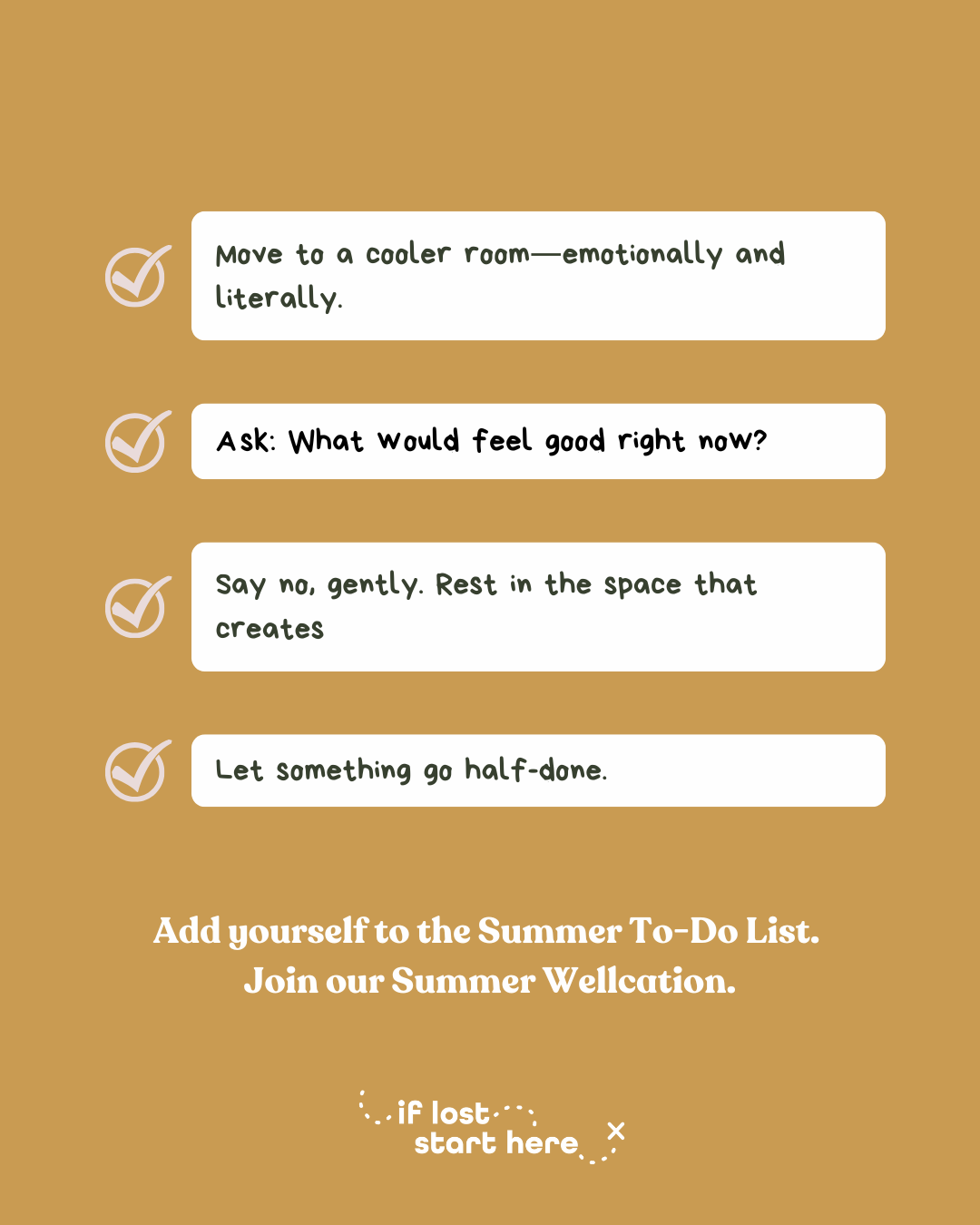
Even one of these actions can shift your day, your breath, your summer.
What’s on your personal self-care checklist right now?
Which one of these would feel best today?
If this resonated with you, here are 3 ways to go deeper:
Join our Summer Wellcation – a 4-week self-guided online reset to reclaim your season.
Subscribe to our newsletter – for more ideas, inspiration and emotional support.
Browse our guide to overwhelm — for more ways to navigate the days when it all feels too much.
Let’s create a summer that feels like yours.
Made image by Freepik

Understanding Midlife Emotions: A Toolkit for Women in Perimenopause and Menopause
Explore why midlife feels so emotional — and learn science-backed, compassionate tools for navigating perimenopause, menopause, and the mental load of midlife.
Midlife is emotional. So emotional.
Not in the dramatic, dismissive way we’re told.
But in the quietly profound, messy, layered, deeply human way no one warned us about.
For some of us, midlife emotions feel like an ambush.
For others, like a fog that won’t lift.
You cry at the school newsletter. Snap over the dishwasher. Feel nostalgic, flat, elated, invisible, and uncertain — sometimes in a single afternoon.
Here’s the thing:
You’re not going mad.
You’re not failing at life.
You’re not the only one.
The emotional shifts in midlife are real, and they are biological, cultural, social, and psychological. And once you understand what’s happening beneath the surface, it all starts to make a little more sense.

Why Midlife Feels So Emotional
Here’s what the research shows:
Hormones are real players. During perimenopause and menopause, estrogen — a key mood-regulating hormone — fluctuates wildly. This can destabilise serotonin and trigger mood swings, irritability, anxiety, and even depression.
Sleep suffers. Hot flashes and night sweats disrupt sleep, which worsens emotional resilience. It's not just tiredness — it’s emotional sensitivity fuelled by exhaustion.
Life doesn’t pause. Career shifts, aging parents, empty nests, grief, relationship changes — all pile on at once. It’s not just one thing; it’s everything, all at once.
We’ve been socially trained to ignore ourselves. We’ve been told to stay upbeat, productive, and agreeable — so when emotions hit, they feel foreign, shameful, or ‘too much’.
And the world doesn’t always see us. Many women report feeling invisible, devalued, or dismissed — especially in work and public spaces.
This is biology + life + culture colliding in one highly stressful moment.
But here’s where it also gets hopeful:
An Emotional Toolkit for Midlife Women
You don’t need to ‘get over’ your emotions.
You need tools, space, and information. Here are five small but powerful shifts you can start today:
1. Name what’s happening — without judgement
Mood swings, anxiety, flatness, brain fog… they’re not weakness. They’re signals. Naming what you’re feeling reduces shame and increases clarity.
Try: “Today I feel... because... and that’s okay.”
2. Sleep is sacred
If you’re not sleeping, you’re not thriving. Manage sleep disruptions (hot flashes, anxiety) with gentle bedtime routines, calming rituals, and support if needed.
Consider: Magnesium glycinate, low evening light, and no emotional emails after 8pm.
3. Move — gently, often
Movement isn’t just about physical health. It’s emotional regulation in disguise. A walk. A stretch. A playlist you can dance to. Move your body to move your mood.
Try: Even five minutes counts for shifting your emotional energy.
4. Talk to people who get it
Because right now you probably also need validation. Your feelings aren’t ‘too much’. You’re not broken. Talk to someone who has walked this path — or is walking it too.
To do: This is your sign to call or text that friend you’ve been thinking about.
5. Challenge the crisis narrative
What if midlife wasn’t a crisis — but a moment to reevaluate? Research shows women who see midlife as a time for growth fare better emotionally. You can rewrite the script.
Ask: What part of me might be growing right now — even if I can’t see it yet?
Something’s Coming...
This is why we created So Emotional
A retreat for your emotional life.
We’re not opening enrolment just yet, but the waitlist is open.
If you're craving real tools and real talk,
If you want to understand yourself better — and feel less alone in the process…
join the waitlist for So Emotional
Be the first to know when we open our doors.
Let’s make space for your emotions — in a way that feels good to you.

If you’re struggling with all the feelings in midlife, download our free guide for five ways to better manage your emotions right now.

Feeling Like You’re Not Coping in Midlife? You May Just Be Burnt Out
If you feel like you're losing control of your emotions in midlife, you might be experiencing emotional burnout. Here's what it looks like — and what can help.
You used to be able to handle everything. Deadlines. Family logistics. The never-ending inbox. The emotional temperature of the people around you.
But lately?
It’s taking more energy just to get through the day. You lose your temper at things that never used to bother you. You forget words mid-sentence. You wake up already tired. The tears are always closer to the surface than you’d like.
You keep thinking: “What is wrong with me?”
Here’s what we may need to acknowledge — “this isn’t just the usual stress. This could be emotional burnout.”

When You’re Doing It All — and Still Feel Like You’re Falling Apart
For many women, midlife arrives not as a calm plateau, but as a crash of emotional noise.
You’re managing more than ever — ageing parents, growing children, workplace pressures, your own changing body. All while still holding up the emotional scaffolding for others.
And somewhere in all that care and competence, your emotions started to feel less like signals and more like symptoms.
Emotional burnout doesn’t always look like falling apart. Sometimes it looks like holding it all together — until one day, you just can’t
What Emotional Burnout Looks Like (Even If You’re Still “Functioning”)
Emotional burnout in midlife often shows up as:
Feeling numb or detached from things you used to enjoy
Mood swings that feel sudden, sharp, and disproportionate
Overwhelm that hits out of nowhere
Irritability and guilt in equal measure
A loss of confidence in your emotional responses
And yes — hormonal changes can absolutely cause and intensify these experiences. Once you’ve checked this out with a medical professional and you’re still feeling burned out, years of emotional labour, invisible caregiving, and the pressure to keep being “fine”, might also be contributing.
When we’re always trying to fine, we lose contact with what’s real. And emotional steadiness starts with giving yourself the space to see what’s really going on.
There’s a Way Back to Yourself — One Feeling at a Time
Your emotions don’t need to be your enemy — even when they feel messy and out of control. They can also be information. And with the right tools, you can begin to steady them again.
That’s why we created a free resource designed just for women navigating this exact moment.

Download the Free Guide: Feel Better in the Middle of Everything..
This contains five practical tools to help you:
Understand why your emotions feel so intense right now
Reclaim your energy and focus, one moment at a time
Shift the emotional stories you’ve been carrying
Feel less alone, more steady, and more like yourself again
Sometimes you don’t need to overhaul your life — just start with a clearer understanding of what’s really going on.
Download the free guide now and start feeling more like yourself again.

How to Deal with Emotional Burnout in Midlife
Feeling emotionally burned out in midlife? Learn why you feel this way, how hormones play a role, and get practical tools to move forward with more clarity.
Have you ever caught yourself thinking, Why am I so tired, so emotional, so unlike myself lately?
You’re not just “moody.”
You’re not just “failing to cope.”
You may be experiencing emotional burnout — and if you’re a woman in midlife, you’re far from alone.
Emotional burnout happens when your emotional reserves have been stretched thin for too long. You’ve been holding space for everyone else — your kids, your partner, your parents, your workplace — and slowly, silently, your own needs have slipped off the radar.
What makes this even more intense in midlife are the hormonal shifts happening under the surface. Perimenopause and menopause bring changes in estrogen, progesterone, and testosterone, which directly impact your body and brain — affecting mood, energy, focus, and resilience.
You’re not imagining this. You’re not weak. You’re human, and your body is asking you to pay attention.

Why You’re Feeling So Emotionally Burnt Out Right Now
For years, you’ve been the glue:
Keeping the family running.
Holding the emotional weight of relationships.
Being the one everyone relies on.
But now? You’re snapping or withdrawing. You feel guilt and shame after emotional outbursts. You can’t figure out why you’re so exhausted or why small things set you off.
This is emotional burnout.
It shows up as:
Constant tiredness, even after rest.
Feeling numb, flat, or disconnected.
Increased irritability or sadness over small triggers.
A sense of “losing yourself” or wondering if you’ll ever feel balanced again.
And here’s the thing: hormonal shifts amplify all of this. Fluctuating hormones can disrupt serotonin and dopamine levels, making you more vulnerable to mood swings, anxiety, and emotional overload.
Getting the right support — including exploring options like HRT (hormone replacement therapy) where appropriate — can be part of the picture, alongside emotional tools and understanding.
How to Start Moving Through Emotional Burnout
So, how do you begin to navigate emotional burnout in midlife? Here’s what we know from emotions coaching and recent research:
Understand the narratives you hold about your emotions.
Many women have been raised to believe that anger, frustration, or sadness are “bad” or “selfish.” But these emotions are signals — not flaws. Learning to recognise, name, and work with them (rather than push them down) is the first step toward healing.
Bring the body into the process
Emotions aren’t just in the mind; they live in the body. Gentle body scans, breathing exercises, or even mindful movement can help you reconnect with what you’re feeling — and release some of the emotional tension you’ve been carrying.
Separate yourself from your emotions
You are not your anger. You are not your exhaustion. These are experiences you are having, not identities you are becoming. This small shift can help you move from drowning in feelings to navigating them with more clarity.
Get the right support
Whether it’s therapy, HRT, emotions coaching, or a guided programme, you don’t have to figure this out alone. There is nothing to be gained for pushing through solo — and finding the right help can bring immense relief.
When you start to untangle what you’re feeling, why you’re feeling it, and how your body is playing a role, you begin to see:
You are not broken.
You are not failing.
You are in a transition — one that’s asking for more understanding, more care, and better support.
With the right tools, you can move through emotional burnout toward a steadier, more resourced version of yourself.

Join the Waitlist: So Emotional — A Midlife Feelings Reset
We’ve designed this 4-week online course and community for women in midlife who want to better understand their emotions, reconnect with themselves, and gently shift how they carry their emotional weight. You’ll get to explore your emotional patterns and learn practical tools to manage overwhelm with other women going through it too and expert guidance from a Certified Emotions Coach.
Join the waitlist now to be first in line for early access, exclusive bonuses, and the support you deserve.
You don’t have to stay stuck in emotional burnout. Let’s find a way forward — together.

What If This Summer Wasn’t Just About Everyone Else?
You’re holding everything together this summer — but what about you? Here’s how to reclaim space for yourself without guilt or overwhelm.
You’re making summer work for everyone else. But what if you made space for yourself, too?
It’s that time of year again.
You’ve likely got the family calendar up, the holiday bookings in motion, the WhatsApp groups alive with BBQs and beach plans — and a low-level hum of pressure vibrating through your body.
You're trying to make it all work: childcare, work, travel, expectations.
You want this summer to feel joyful, easy, like something from a slow-living Instagram post. But if you're being honest? You're already tired. And it hasn’t even started yet.
There’s that familiar moment of wondering:
Where do I fit into this season I’m planning for everyone else?
When do I get to rest, reset, feel taken care of — not just needed?
Is it wrong to want summer to give something back to me, too?

When summer feels heavy (and not just because of the heat)
We don’t talk enough about how intense summer can be — especially for women who are the organisers, the emotional holders, the ones creating the so-called magic.
Behind the joy and brightness, there’s often:
The mental load of planning and juggling
The invisible work of keeping others happy
The loss of rhythm and routine that leaves you untethered
The pressure to make it memorable — without falling apart
Even the things we’re supposed to enjoy can become another to-do: the family holiday that’s more logistics than rest, the BBQs that drain more than connect, the daily question of how do I keep everyone occupied and happy today?
No wonder you’re staying up later and later, just for a slice of quiet.
No wonder the mornings feel harder.
No wonder you’re beginning to feel like summer is happening around you — not with you in it.
Why naming it matters
Here’s the thing we’ve found: feeling flat, resentful or emotionally absent during summer doesn’t make you ungrateful. It makes you honest.
Because beneath all the busyness, what you might really be craving is:
A moment that’s just yours
A sense of clarity about how you feel and what you need
A space that doesn’t require you to be “on”
The relief of being seen, supported, and reminded you matter too
This isn’t about doing less for others. It’s about doing something for yourself.
Because you’re a person in this season too — not just the person keeping it all going.
Three small ways to shift the shape of your summer
You don’t need to overhaul everything. You don’t need a solo yoga retreat (unless you want one!). You just need one small shift in your direction.
Here are three starting points:
1. Give yourself a headline
If your summer had a title, what would it be? Not the one about planning and packing — but the one for you. Maybe it’s “the summer I slowed down,” or “the summer I felt more present.” Naming it changes how you show up for it.
2. Create a “me list”
Not a bucket list, not another set of expectations — just a list of 5 things that make you feel more you. Tea alone in the garden. Finishing that book. A swim without company. Circle one and plan it in this week.
3. Plan one thing you don’t have to plan
Let someone else hold the structure for a change. Choose a podcast series, a gentle course, or even just a stack of journaling prompts that arrive without you doing the thinking. Let it feel easy. Let it be enough.

And this is where we can help
We created the Summer Wellcation for women like you — the ones holding it all, hoping for more, and not knowing where to find a moment that feels like theirs again.
It’s a 4-week do-anywhere experience that starts August 4.
Here’s what you’ll receive:
Daily “postcard” lessons — quick, beautiful reflections that help you ground, pause and feel
Self-coaching prompts, journaling, creative invitations and micro-adventures
4 weekly facilitated meet-ups with a small, like-minded group (gentle, supportive)
Delivered via course platform or app so you can engage wherever summer takes you
Whether you read your prompts in the park, journal in the car while waiting for summer camp to end, or just read quietly with your tea — this is your moment in the day.
Let this be the summer you don’t forget yourself.
You're already making sure everyone else has what they need.
Let this be the part of summer that gives something back to you.
We start August 4, but you can sign up now — and know you’ve got something in place just for you when you need it most.
Explore the Summer Wellcation and reserve your spot.
Early Bird Pricing: $89 until 1 July (then $129)
Because you deserve more than survival this summer.

7 Ways to Disconnect and Recharge Without Taking Time Off
Discover small and practical ways to disconnect and recharge without needing a vacation. If you can't get away right now, learn how to feel better right where you are.
Sometimes taking a vacation or retreat just isn’t possible. But that doesn’t mean you can’t find ways to disconnect and recharge right where you are. With a few small changes, you can bring moments of peace and calm into your daily life, without needing to book time off work or escape your routine.
We all need breaks, but let’s face it: taking time off can be tricky, whether it’s due to a busy schedule, financial limitations, or life’s constant demands. The good news is you don’t need a week off to feel refreshed. By incorporating these small practices into your daily routine, you can create moments of calm no matter how hectic your life feels.
Here are 7 ways to disconnect and recharge without needing a vacation:
Unplug for 15 Minutes a Day:
Whether it’s during your lunch break or just before bed, set aside a few minutes to step away from screens. Use this time to breathe, reflect, or simply sit in silence.
Create a Soothing Space at Home:
Designate a spot in your home that feels calming—a cozy chair, a corner of your bedroom, or a peaceful nook where you can retreat for a few moments.
Take a Nature Break:
If you can’t get away, bring nature to you. Sit outside for a few minutes, open a window, or tend to a plant. Nature’s calming effect is immediate, even in small doses.
Practice Mindful Breathing:
Whenever stress creeps in, pause for a moment to focus on your breath. Deep breathing can help calm your mind and reduce anxiety.
Stretch or Move Your Body:
A few minutes of stretching or light movement can help release tension and recharge your energy levels.
Gratitude Check-In:
At the end of each day, write down three things you’re grateful for. This practice shifts your focus from stress to appreciation.
Meditate or Journal:
Spend 5 minutes reflecting on your thoughts or doing a quick guided meditation to clear your mind.
By building these practices into your daily life, you’ll feel less drained and more recharged—even without taking a full vacation. And if you want a structured, supportive approach to making these habits stick, our Everyday Retreat can help.
With just a few mindful moments each day, you’ll feel more grounded, energized, and ready to take on whatever life throws at you. It’s about finding balance without stepping away from your responsibilities.
Ready to disconnect and recharge without the need for time off? Join our Everyday Retreat for daily lessons that will help you build these practices into your routine.

Reset Your Wellbeing for 2025: 8 Gentle Ways to Thrive This Year
Transform your approach to self-care with 8 simple, sustainable wellbeing principles. Start your 2025 with self-compassion, curiosity, and connection.
The start of a new year is full of promise—a fresh notebook ready to be filled with your story. Yet, the pressure of resolutions can feel overwhelming.
What if this year, instead of striving to fix yourself, you focused on nurturing your wellbeing? This New Year, step away from the hustle of perfection and explore 8 simple ways to reset your relationship with self-care and mental health.
Whether you’re feeling lost, overwhelmed, or simply curious, these principles are designed to help you reconnect with yourself in a way that feels sustainable and authentic to you.
1. Stop Trying to Fix Yourself
You are not broken. Wellbeing isn’t about becoming someone new—it’s about embracing who you already are and creating space for self-discovery.
Journal Prompt:
- What would it feel like to stop fixing myself and start exploring who I am?
2. Focus on Acceptance Over Transformation
Instead of chasing grand transformations, focus on small, compassionate changes that honor where you are now.
Journal Prompt:
- What is one thing I can accept about myself today?
3. Start with Tiny Actions
Big changes aren’t necessary. Tiny, consistent steps—like journaling for 5 minutes or stepping outside to breathe—are powerful.
Journal Prompt:
- What is the smallest action I can take today to feel better?
4. Embrace Imperfection
Wellbeing doesn’t have to be polished. Messy yoga, scribbled journal pages, or a walk in mismatched socks all count.
Journal Prompt:
- How can I let go of perfection in my wellbeing practice?
5. Tune Into Your Feelings
Feelings guide us, yet we often ignore them. Start noticing your emotions and invite them into your days for better wellbeing.
Journal Prompt:
- Which emotion have I been avoiding, and how can I make space for it?
6. Skip the Trends
Wellbeing trends can be fun, but they’re not always right for everyone. Choose practices that resonate with your values and lifestyle.
Journal Prompt:
- What trends don’t work for me, and what practices feel more authentic?
7. Accept Wellbeing’s Ebb and Flow
Your relationship with wellbeing will change over time, and that’s okay. Give yourself permission to adapt.
Journal Prompt:
- What does wellbeing mean to me right now, and how might it evolve this year?
8. Expand Your Definition of Wellbeing
Wellbeing isn’t just physical—it includes emotional, relational, and even spiritual aspects. Think of it as a whole-life approach.
Journal Prompt:
- What parts of my life—emotional, spiritual, relational—need more attention?
Your 2025 Wellbeing Reset Starts Here
What part of this manifesto speaks to you the most?
Ready to approach this year differently? Join New Year, New Approach to find a better way to well for all the days of 2025.
Let’s create a year of small, meaningful shifts that truly feel good to you.

How to Start 2025 in a Better Place: A New Approach to Wellbeing
Discover 3 alternatives to New Year’s resolutions and learn how to start 2025 in a better place. Focus on emotional wellbeing, micro-resolutions, and meaningful connections.
Are you ready to rethink how you start the New Year?
If you’re tired of setting resolutions that don’t stick, feeling the pressure to change everything about yourself, or just want a gentler way to approach 2025, this guide is for you.
Why Traditional Resolutions Don’t Work
Most people abandon their resolutions by February. Here’s why:
1. Resolutions Are Overwhelming: They demand huge changes at a time when our energy is already low (hello, January blues).
2. They Focus on Perfection: If you slip up, it feels like failure.
3. They Ignore What Really Matters: Resolutions often target surface-level changes while neglecting our emotional and relational needs.
This year, let’s start differently.
How to Start 2025 in a Better Place
Instead of aiming for a total reinvention, focus on sustainable, meaningful practices that align with your values. Here are three alternative ways to begin 2025:
1. Start Small with Micro-Resolutions
Micro-resolutions are tiny, actionable steps that feel manageable and build momentum.
Example: Replace “I’ll exercise five times a week” with “I’ll take a 10-minute walk on most days.”
Why it Works: Small actions are easier to stick to and help you build habits over time.
2. Make Emotional Resolutions
Instead of focusing on what you need to do, think about how you want to feel.
Ask yourself: “What emotions do I want to invite into my life this year?”
Examples: Replace “I need to lose weight” with “I want to feel energised.” Replace “I need to be more productive” with “I want to feel balanced.”
This approach shifts the focus from fixing yourself to creating a life that feels aligned with your values.
3. Focus on Connection-Based Goals
Wellbeing isn’t just about what you do alone—it’s about the relationships that sustain you.
Try: Scheduling a monthly catch-up with friends. Joining a community group. Setting boundaries to prioritize quality time with loved ones.
Why it Works: Strong connections improve mental health, reduce stress, and foster a sense of belonging.
A Simple Practice to Reflect and Reset
Before setting any goals for the year, take a moment to pause and reflect:
Look Back Without Judgment. What did 2024 teach you about yourself? What habits or experiences brought you joy or peace?
Reframe the New Year as a Continuation. Instead of asking, “What do I need to change?” ask, “What do I want to nurture?”
Write a Letter to Your Future Self. Imagine it’s December 2025. What would you thank yourself for? What moments would you hope to have experienced?
Rethink Wellbeing in 2025
If you’re looking for a better way to well this year, join our New Year, New Approach mini-course. This self-guided experience will help you:
Understand why resolutions fail and how to avoid the guilt cycle.
Explore 12 creative ways to approach the New Year.
Discover three flexible alternatives to resolutions that can guide you through 2025.
Why This Matters
Starting 2025 with a focus on curiosity, connection, and compassion can help you:
Reduce the overwhelm of traditional resolutions.
Feel more aligned with your values.
Build a sustainable foundation for your emotional and mental well-being.
Sign up for New Year, New Approach today and start 2025 in a better place—one that supports who you are, not who you believe you have to be.

How to Find Your Anchor This Holiday Season: A Guide to Gentle Well-Being Practices
Feeling overwhelmed as the holidays approach? Discover simple ways to anchor yourself with gentle well-being practices that can support you through this busy season.
As the year speeds toward the holiday season, life can start to feel like a relentless list of to-dos. Between work deadlines, family gatherings, and all the plans piling up, it’s easy to lose sight of yourself. If you’re craving a way to stay grounded and calm, even as the busyness builds, now is the time to explore practices that anchor you to what really matters.
Anchoring yourself is about having touchpoints – small, meaningful actions that bring you back to a sense of calm and stability. And Find Your Way, our well-being course, is designed with this exact need in mind: a gentle, supportive guide to help you build well-being practices that fit into real life. Today, we’re sharing a few foundational ideas to help you create your own anchors before the holiday season ramps up.
Why You Need an Anchor Right Now
It’s no surprise that the weeks before the holidays can be one of the most stressful times of the year. Studies show that around 64% of people feel increased stress as the holiday season approaches. The pressure to get everything just right, to do it all, and to meet everyone’s needs can make us feel like we’re in a constant whirlwind.
But what if, instead of getting swept up, you could feel calm, steady, and present? Anchoring practices give you just that. Anchors aren’t about adding more to your plate – they’re about finding small moments of stillness and grounding that help you feel centred, even on the busiest days.
Discovering the Power of Anchors
There was a time when we, too, felt lost in the shuffle, especially as the year-end drew close. We would tackle all the plans, the obligations, and the endless details but somehow feel like we were missing out on the season itself. It was only when we discovered the importance of having anchors that we were able to slow down, connect to what truly mattered, and enjoy the season in a way that felt authentic and fulfilling.
These anchors were small – a morning coffee (or egg nog latte) enjoyed without rushing, a quick (multilayered) walk outside, a few minutes to write down a thought or feeling (mostly ‘how’?) – but they helped us remember ourselves in the midst of everything else. Anchors are now an integral part of Find Your Way, created from the realisation that well-being is best built on everyday moments of connection and calm.
3 Simple Anchoring Practices to Try Before the Holidays
Here are a few simple practices that you can begin using now to help keep you grounded as the season gets busier:
1. Morning Mindfulness Moment
Take five minutes each morning to be still and present. Whether you’re sipping coffee, breathing deeply, or sitting in silence, let these minutes ground you. Studies show that even a brief daily practice can significantly reduce stress and improve focus throughout the day.
2. Daily “Gratitude Pause”
Amid all the planning, it can be easy to forget what brings us joy. Take a moment to reflect on something you’re grateful for each day, no matter how small. This practice can reset your mindset, helping you feel more positive and less overwhelmed.
3. Short Walk or Outdoor Break
If you’re feeling stressed or caught up in “holiday to-do mode,” step outside for a brief walk. Research shows that spending just 15 minutes in nature can lower stress levels and improve mood. Let the fresh air remind you that there’s more to this season than tasks and to-dos.
How Find Your Way Can Help You Feel Grounded This Season
If these practices resonate, Find Your Way is designed to be a supportive guide in your life, especially as the world gets busier. Our course explores ten pathways to well-being, including reconnecting with nature, nurturing our relationships and finding meaning in everyday moments. Each theme offers practical ways to bring well-being into your daily life without the pressure to be perfect.
Through Find Your Way, you’ll discover small, manageable ways to create an anchor point that keeps you feeling steady, no matter what the day brings. It’s all about finding a path that feels good, not one that demands more of you.
Ready to Anchor Yourself This Holiday Season and Beyond?
This November, as life picks up speed, give yourself the gift of gentle well-being practices that truly support you. Our Find Your Way course was created with real-life needs in mind – to help you feel more centred, more resilient, and more at ease in your own life.
Click here to learn more about Find Your Way and start building your well-being anchor today.
As we enter the holiday season, remember that well-being doesn’t have to be grand or time-consuming. Often, it’s the small, intentional moments that make the biggest difference. So take a breath, find your anchor, and let’s navigate this season together.

How to Create an Everyday Retreat at Home: 8 Simple Ways to Take a Break
Feeling overwhelmed? Learn 8 easy ways to create an everyday retreat at home with mindfulness, journaling, and tech-free breaks. Discover how small daily practices can bring more peace and balance into your life.
Feeling overwhelmed? The idea of escaping to a retreat sounds dreamy, but what if you don’t have the time or money to whisk yourself away for a week of relaxation?
At If Lost, we believe that you don’t need to leave your home to experience the benefits of a retreat. With a few intentional changes, you can create a retreat-like atmosphere in your own space, giving yourself daily moments of calm and connection. Today we’ll be exploring 8 simple ways to turn your home into your personal sanctuary.
Why Everyday Retreats Matter More Than Big Escapes
We all crave breaks from the daily grind, especially when life feels overwhelming. Traditional retreats offer a space to reset, but they’re not always practical. That’s why creating an everyday retreat at home can be so powerful—it fits into your routine, is accessible anytime you need it, and helps you find moments of ease in your daily routine.
Here’s how you can build small daily practices that allow you to recharge, reconnect, and retreat into a calm mindset no matter where you are.
1. Morning Mindfulness
Start your day with intention. Set aside 5–10 minutes for a simple morning ritual that grounds you before you dive into your day. It could be as simple as sitting with your favorite drink in silence, focusing on your breath, or doing a quick body scan to check in with how you’re feeling. This small practice can set the tone for the rest of the day.
2. Designate a Calm Corner
Carve out a small space in your home that feels calming—whether it’s a cozy chair by a window, a corner of your bedroom, or even just a spot on your couch. This is your “retreat corner,” a place where you can go to decompress. Make it comfy with a soft blanket, candles, or anything that brings you a sense of peace.
3. Take Mini Breaks Throughout the Day
You don’t need to wait for a big moment to relax. Build small breaks into your day—a 5-minute stretch, stepping outside for fresh air, or just closing your eyes for a moment of quiet. These tiny pauses help prevent overwhelm and keep you grounded as the day unfolds.
4. Disconnect from Technology
One of the best parts of traditional retreats is the chance to step away from the constant noise of technology. Set aside intentional tech-free moments throughout the day, whether it’s turning your phone on airplane mode during meals or setting a timer for an hour of screen-free time in the evening.
5. Connect with Nature
Even if you can’t leave your home, you can still enjoy the calming effects of nature. Open a window, tend to a houseplant, or sit outside for a few minutes. If you have the time, take a walk in a nearby park or simply sit on your porch to enjoy the fresh air. Nature has a way of grounding us, even in the smallest doses.
6. Create a Sensory Experience
Activate your senses to create a calming atmosphere. Light a candle with your favorite scent, play soft music, or enjoy a warm cup of tea. When you focus on sensory details, it helps pull your attention away from worries and back into the present moment.
7. Journaling for Reflection
End your day with a journaling practice. Take 5 minutes before bed to reflect on your thoughts and feelings from the day. Jot down three things you’re grateful for, or use this time to check in with yourself emotionally. It’s a small but powerful way to release tension and process your day.
8. Practice Self-Compassion
Perhaps the most important part of creating an everyday retreat is allowing yourself the grace to take a break, even on the busiest days. Let go of guilt or the need to be “productive” at every moment. Retreating into calm is a form of self-care, and it’s okay to prioritize your wellbeing.
The Possibility of Everyday Retreats
Creating an everyday retreat at home is all about small, mindful practices that allow you to step back, even if it’s just for a few minutes. These tiny moments of calm can have a big impact on how you navigate your day and respond to overwhelming situations.
Sign Up for the Everyday Retreat: A Live 4-Week Course for Wellbeing
If you’re ready to dive deeper into these practices and want extra support, join us for the Everyday Retreat, our live, 4-week online course. In just 10 minutes a day, you’ll learn to integrate retreat-like practices into your everyday life, alongside a community of like-minded individuals. You’ll also get access to weekly live meet-ups where we’ll share, reflect, and support one another.
Give yourself the break you deserve, right from the comfort of your home. Want to start building your Everyday Retreat? Join as a paid Substack Member and get access to this course from April 7 for free.

Embrace the magic of September’s new beginning
September Reset: How to embrace new beginnings and prioritize your wellbeing
September is here, and with it comes the promise of fresh starts, new beginnings, and that unmistakable “back-to-school” energy that fills the air. For many of us, it’s not just the kids heading back to class; it’s a time for us to rediscover our own rhythm and seize the moment to create the life we truly desire.
From Summer Chaos to September Calm
This morning, I found myself savoring my first hot coffee in what feels like weeks, the house was finally quiet after dropping my daughter off for her first day of school. The hustle and bustle of summer, with its constant activity and joyful chaos, has given way to a serene, almost sacred silence. After weeks of juggling too many things (and learning which balls were made of glass and which were just plastic), it was a moment of calm.
September always brings a whirlwind of emotions: anxiety about the unknown, the inevitable scramble to find a missing shoe, the thrill of new beginnings, and a wistful glance back at summer’s cherished memories. But amidst all these feelings, there’s a powerful sense of hope—a belief that this new school year isn’t just for the kids, but for us too. It’s a chance to start over, a blank page ready to be filled with whatever we choose.
Turning New Beginnings into Lasting Change
September’s gentle nudge feels different from January’s forceful push. There’s less pressure to be perfect, and more space to figure out what matters. It’s like the first page of a new notebook, where anything is possible. This week, as I navigated the usual back-to-school rush—ordering uniforms, helping with geography coursework, and planning for the months ahead—I also took a moment for myself. I paused to review the key areas of my life that often get overlooked but are essential to my happiness.
What I found were three areas in need of more attention: social connections, creativity, and mind-body practices. I realized that these aspects of my life are what truly nourish me, yet they’re the first to be neglected in the chaos of daily life. So, this season, I’m committing to nurturing relationships, embracing my creative writing journey, and exploring ways to move my body that support both my physical and mental well-being.
Your Path to a Joyful, Fulfilled September
So, what about you? What areas of your life are calling out for attention as we step into this new season? Maybe, like me, it’s about deepening connections, unleashing your creativity, or finding harmony between mind and body. Or perhaps your focus lies in digital wellbeing, meaningful work, or contributing to your community.
What new start might September bring for you?
Join Us in Seeking a Better Way to Well
The path to well-being isn’t linear—it’s personal, evolving, and sometimes messy. What matters is finding what works for you.
If you’re looking for a way to start, we’ve created A Better Way to Well, a free five-part email series designed to help you cut through the noise and connect with what truly matters. You’ll receive practical, research-backed prompts to help you reflect, reset, and create your own personalized approach to well-being.
Sign up here and take the first small step toward feeling better in your everyday life.

Create your path to clarity and calm by discovering your unique way to well
Discover how to create a self-guided wellbeing practice that can take you from overwhelm to calm. Where would you like to explore in your life?
Feeling overwhelmed by the demands of everyday life? Many women today are searching for ways to navigate their busy schedules with more ease and purpose. Discover how our self-guided wellbeing course can help you reclaim your well-being and move forward with confidence.
Your Journey Towards Self-Wellness
Imagine taking a moment to pause and reflect on your current state, identifying areas of your life that feel cluttered and distracting. This simple act of reflection can give you a clearer picture of where to focus your energy. This is the first step, Taking Stock, in our self-guided online course designed to help create a personalized well-being practice.
As you move through the course, you’ll learn to Embrace Change. Letting go of old habits and beliefs can be liberating, making space for new growth. You’ll begin to live more intentionally, aligning your daily actions with your core values and goals.
The concept of Frequent Resets will become your new mantra. Regular, small adjustments can keep you aligned with your aspirations and prevent you from getting stuck.
You’ll explore how to Integrate New Practices that support your well-being, such as creative pursuits and adventures in nature.
Refreshing your life in meaningful ways—whether it's reevaluating relationships or learning to have a healthier relationship with your emotions—can give you a renewed sense of energy and purpose.
Finally, by Investing in Yourself, you’ll discover the joy of dedicating time and resources to activities that enrich your life, resulting in increased happiness and fulfillment.
Create Your Own Well-Being Practice
Many women have found themselves on a similar journey, seeking ways to feel more connected and less overwhelmed. Our online self-guided course is designed to help you create a tailored well-being practice that fits seamlessly into your daily life. It’s about learning to live with intention and acceptance, making small, attainable changes that lead to a more fulfilling life.
What You’ll Learn in Our Course
Take Stock: Gain clarity on what needs your attention.
Embrace Change: Let go of what no longer serves you.
Live Consciously: Make mindful choices aligned with your values.
Reset Frequently: Keep your life dynamic and forward-moving.
Integrate New Practices: Support your health and happiness.
Refresh Your Life: Create a renewed sense of energy and purpose.
Invest in Yourself: Find joy and fulfillment in personal growth.
Join Our Course Today
Imagine waking up each day with a sense of clarity and calm, knowing that you’re investing in your well-being in ways that truly matter. Our course is your guide to creating a well-being practice that’s uniquely yours.
Start your journey today and discover how to navigate your life with more ease, purpose, and joy. Click here to enroll in our online self-guided wellbeing course now.

How to design a life that nurtures your well-being
Learn how you can create a plan for better well-being, one that supports you in exploring your life with curiosity.
You've probably tried setting relentless self-improvement goals.
Often, these goals set us up for disappointment because they're based on societal expectations, rather than our true selves.
So how can you design a life that actually supports and nurtures you?
That’s a question we consider all the time as we’re bombarded with expectations about what life should be.
We’ve found that creating a life that emphasizes self-acceptance, emotional awareness, curiosity, and creativity helps us not only face personal but also global uncertainties.
Here's how you can start building a life that truly supports you.
How to shift focus to creating a supportive environment
Begin by acknowledging your current state and the resources available to you. Instead of relentlessly pursuing self-improvement, ask yourself how you can create an environment and lifestyle that supports you as you are. This shift in focus encourages acceptance, fostering daily practices that fit within your life.
How to navigate uncertainty with curiosity
In our uncertain world, it's crucial to develop curiosity and flexibility. Focus on where you find stability internally when external conditions are volatile. Prioritize a version of self-care that helps you adapt without imposing the broken pieces of the world onto you.
How to manage unwanted emotions
Recognize that encountering feelings like fear, shame, guilt, or anxiety is normal when navigating life's complexities. Equip yourself with strategies to acknowledge, understand, and manage these emotions. This involves not letting them dictate your actions or self-worth, but rather, learning how to coexist with them as you move forward in life.
By adopting these practices, you can begin to design a life that not only supports you but also inspires others to do the same. Embracing acceptance, curiosity, and creativity in the face of uncertainties allows us to build a life centered around more of what we need and access better well-being.
Are you ready to design a life that truly supports you?
We’ve created our self-guided, online course, Find Your Way, to help people like you learn how to navigate life's uncertainties so you can feel better on your terms.
You might have tried endless self-improvement regimes. Often, these fail because they focus on changing who we are, rather than accepting and working with what we've got.
With this on-demand course you’ll get to design a life that helps you feel better and nurtures your well-being.
Here’s a 5-minute glimpse into Find Your Way:
Benefits of this course:
1. Learn to navigate life with curiosity, understanding how exploring can open the way for more possibility.
2. Gain strategies to manage unwanted emotions, turning them from obstacles into opportunities for greater self-awareness.
3. Discover the power of creating a life that meets your needs, while fostering a sense of connection with others.
When we start designing a life that truly supports us with the resources and capabilities we currently possess, our focus can shift away from constant self-improvement towards creating an environment and lifestyle that nurtures our well-being.
Enroll today to begin exploring life, and your well-being, in a whole new way.