
What to Do When Life Falls Apart and You Feel Lost
When a relationship ends, someone dies, or you lose your job, it can feel like you’ve been pushed out of the life you built. Read this guide to navigating unexpected change, uncertainty, and rebuilding self-trust without rushing to fix everything.
There are moments in life when the ground gives way without your consent.
You didn’t choose the ending. You didn’t plan the disruption. A relationship ends because someone else makes a decision. A parent dies. A health diagnosis lands. A job disappears. And suddenly you are standing outside the life you built, holding pieces that no longer fit together.
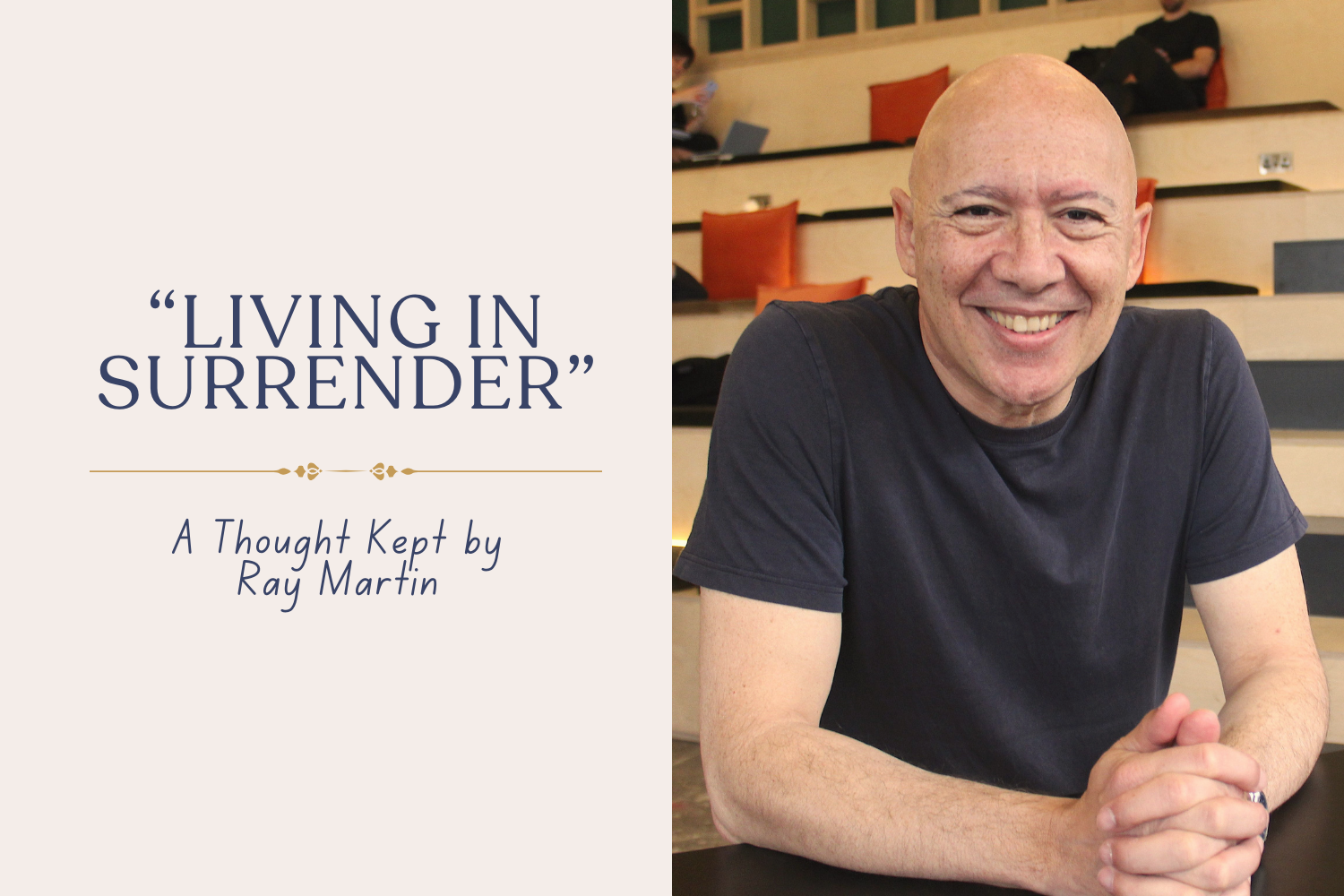
In my recent conversation with Ray Martin on A Thought I Kept, what struck me most wasn’t the romance of fourteen years of travel. It was the year that came before it. In a single stretch of time he lost his marriage, his business partnership, and his father The identity he had constructed — successful businessman, husband, son— fractured all at once.
He didn’t wake up one morning and decide to reinvent himself. Life pushed him out.
And that is often how it happens.
When something unexpected pulls the rug from under us, the first instinct is to restore what was. To fix. To replace. To rush toward a new beginning so we don’t have to sit in the in-between. Ray became fascinated by this middle space — what William Bridges calls the neutral zone The place where the old life has ended but the new one hasn’t fully formed. From the outside, nothing looks dramatic. Inside, everything is shifting.
If you are in that space, it can feel disorienting. You might not recognise yourself. The roles that once organised your days no longer apply. The confidence that came from knowing who you were can wobble. You may feel lost not because you are indecisive, but because the map you were using is no longer valid.
Ray’s core thought — the one he kept — is living in surrender
Not surrender as defeat. Not resignation. But surrender as a different way of orienting when control has already slipped from your hands.
He began to pay attention to where his energy went. After visiting an elephant sanctuary and an orphanage, he couldn’t stop thinking about them. Instead of dismissing that tug as sentimental, he followed it. That eventually led him to train for and run a marathon to raise money, something he had never imagined doing before
What I take from that is not “run a marathon.” It is this: when life has already dismantled your plans, perhaps you can afford to listen more closely to what quietly draws you.
Unexpected endings often strip us back to something more elemental. Ray speaks openly about how, earlier in life, he overrode his instincts in order to stay in character After everything fell apart, he found he could no longer ignore those nudges. He began treating life as a series of experiments rather than a fixed destination
There is something gentle in that framing. If you have been kicked out of the life you built, the pressure to “get it right” next time can be immense. An experiment carries less weight. It allows you to try, to notice, to adjust.
Another shift that came for him was around feeling. He moved from living primarily in his head to allowing himself to express emotion more freely. That matters when we are navigating grief, anxiety, or overwhelm. Emotional states are not permanent addresses. They are places we pass through. Letting yourself feel does not mean you will be swallowed by it. Often it means the feeling can move.
He also rethought the idea of “ties.” Work, relationships, community, home. The issue, he suggests, isn’t being tied to something. It’s being unconsciously tied When life tears away a tie without your permission, there can be freedom hidden inside the shock. Not the freedom you would have chosen, but the freedom to ask: what do I now choose, consciously?
Later in the conversation, Ray talks about calculating how many days he might have left — around 5,700 at this stage Not as a dramatic countdown, but as orientation. If time is finite, what is worth fighting? What can be softened? What is no longer necessary?
When the unexpected happens, we often look for certainty. For guarantees. For a clear five-step plan. What Ray’s story offers instead is steadier and perhaps more honest. You may not get certainty. But you can cultivate attention. You can notice what feels alive, even faintly. You can allow the neutral zone to do its quiet work inside you.
Being lost is not always a failure of planning. Sometimes it is the inevitable consequence of loving, committing, building — and then losing.
If you find yourself outside the life you built, perhaps the question is not immediately “What should I do next?” Perhaps it is “What is drawing me, even now?”
You can listen to the full conversation with Ray on A Thought I Kept:
And if you are in the middle of your own unexpected transition, our coaching sessions at If Lost Start Here offers a place to think, feel, and find your footing again without pressure to rush toward a new identity.
You are allowed to be in between. You are allowed to listen before you leap.
Struggling With Comparison? Rethinking Confidence and Self-Trust
Comparison and competition can quietly shape how we see ourselves. In this conversation, we explore confidence, self-trust, and the beliefs we carry through life.
This is how it might go. You’re scrolling, or reading, or listening to a podcast, and you notice a flicker of feeling when someone else shares good news. A promotion. A book deal. A confident post about work they love. You’re pleased for them — genuinely — and yet something tightens. A question forms that you don’t quite want to look at too closely.
What does this mean about me?
Moments like this don’t usually come with drama. They’re small, everyday, easy to brush past. But they can linger. And over time, they shape how we see ourselves, how we show up at work, and how much space we allow ourselves to take.
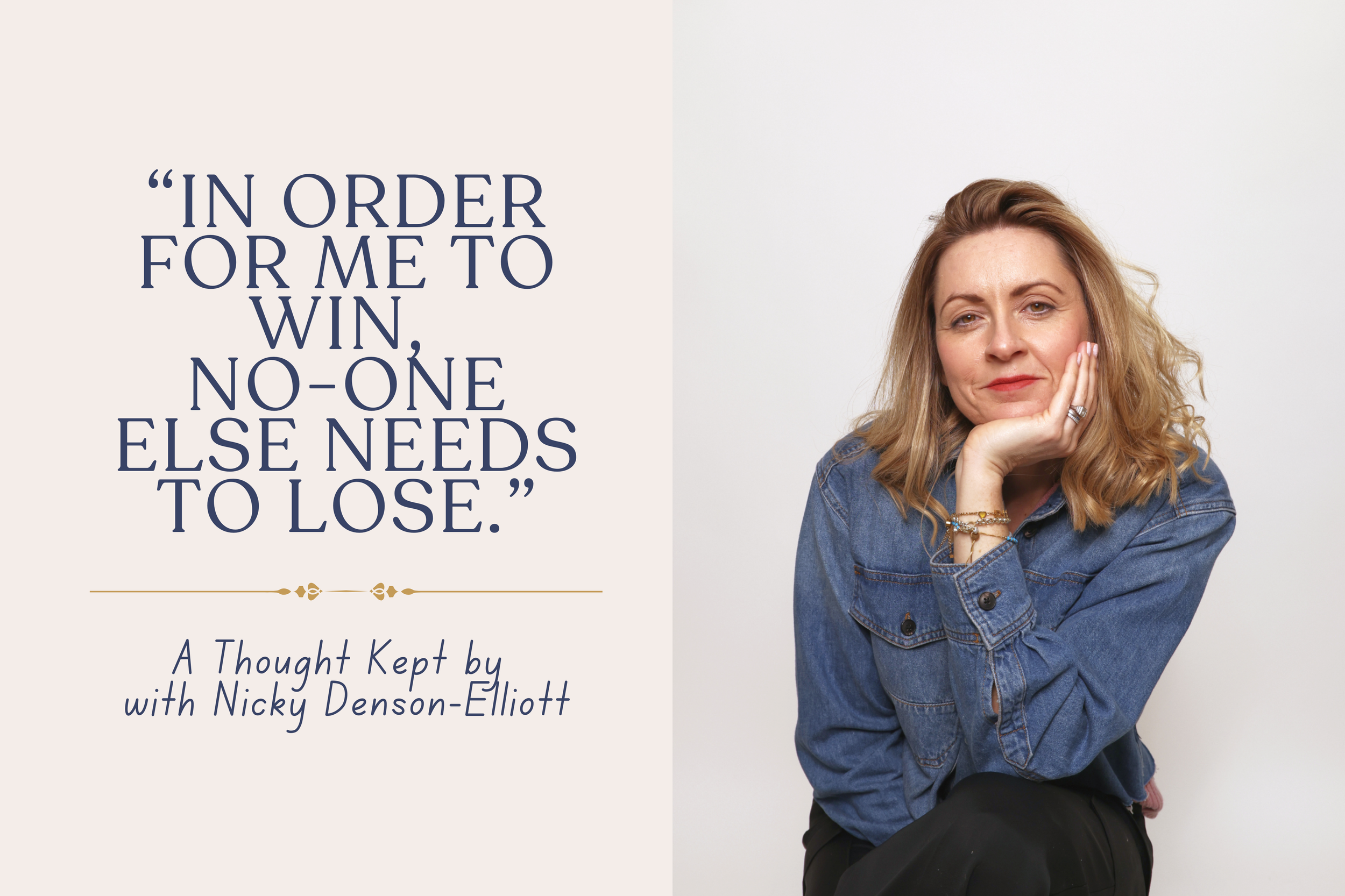
This week on A Thought I Kept, I spoke to Nicky Denson-Elliott, and she brought a thought that disrupted that familiar inner pattern:
In order for me to win, no one else has to lose.
It’s one of those ideas that seems obvious when you first hear it and then quietly radical the longer you sit with it.
Because so much of our inner landscape has been shaped by the opposite belief. That success is scarce. That confidence belongs to certain people, not others. That if someone else steps forward, there’s less room for us. These ideas don’t usually announce themselves as beliefs. They show up as feelings: comparison, jealousy, self-doubt, hesitation.
Nicky spoke about how deeply this conditioning runs, especially for women. How it can shape our relationship with money, confidence, and visibility. How it influences the way we price our work — often not based on its value, but on what feels safe. How it quietly sets women against one another, even when connection and solidarity are what we most want.
What’s important here is that none of this is a personal flaw. These are not thoughts we invented. They’re learned. Reinforced. Picked up over time in workplaces, families, schools, media, and culture. When they surface, they can feel intensely personal but they rarely originate there.
And when life already feels full or uncertain, carrying these inherited ideas can make everything heavier. You might notice it in how hard you are on yourself. In the way you second-guess decisions. In the tension you feel around confidence — wanting it, distrusting it, worrying what it might cost.
One of the most grounding parts of the conversation with Nicky was her refusal to replace one set of rules with another. There was no invitation to be bolder, louder, or more confident in a performative sense. Instead, she talked about noticing. About recognising when a familiar reaction appears and asking, with curiosity rather than judgment: Is this actually mine?
That question alone can create a shift.
Because when we start to see that some of our thoughts are inherited rather than chosen, we don’t have to wrestle with them in the same way. We don’t have to argue ourselves out of feeling jealous or small or unsure. We can simply recognise the pattern, and loosen our grip.
This matters not just for our inner world, but for how we move through everyday life. Especially work. Especially relationships with other women. Especially moments where confidence feels like something other people have access to, and we’re still figuring it out.
Letting go of the myth of competition doesn’t mean pretending everything is fair or easy. It doesn’t mean denying ambition or discomfort. But it does open up a different orientation — one where someone else’s success doesn’t automatically diminish our own, and where confidence can be something we grow into, rather than something we perform.
For many of us, this kind of rethinking doesn’t arrive as a neat turning point. It shows up gradually. In small pauses. In moments where we choose not to rush to judgment — of ourselves or others. In the realisation that uncertainty doesn’t mean we’re failing; it often means we’re paying attention.
If you’ve been questioning old ideas about success, money, confidence, or what it means to be doing “well” in life, you’re not behind. You may simply be noticing that the old maps don’t quite match the terrain anymore.
Nicky’s thought offers a steadier way of orienting. It reminds us that life isn’t a zero-sum game. That generosity — toward ourselves and others — isn’t naïve, but grounding. And that self-trust doesn’t come from fixing or perfecting ourselves, but from recognising which beliefs were never designed to support us in the first place.
You don’t need to know what comes next. You don’t need to replace every thought at once. Sometimes it’s enough to notice which ideas make life feel smaller, and to wonder — without urgency — what it might be like to set one of them down.
If this resonates, listen to the full conversation with Nicky on A Thought I Kept.
And if you need help exploring some of the feelings you have around comparison — jealousy, self-doubt, hesitation — or what confidence even means to you, explore our emotions coaching sessions.
How to Handle Your Emotions When You’re Feeling Lost or Overwhelmed
Feeling lost or overwhelmed by your feelings? Learn how to handle your emotions when you struggle to understand them.
There’s a moment many of us might recognise.
You’re trying to make a decision, move something forward, or simply get through the day — and your emotions feel louder than you’d like them to be. Anxiety edges in. Frustration bubbles up. Self-doubt has an opinion. And suddenly it feels harder to think clearly, trust yourself, or know what the next step might be.
When that happens, it’s easy to conclude that the problem is your emotions. That you’re feeling too much, or handling things badly. That if you could just calm down, be more confident, or stop overthinking, everything would be easier.
But what if the issue isn’t having emotions — it’s that most of us were never taught how to handle them well?
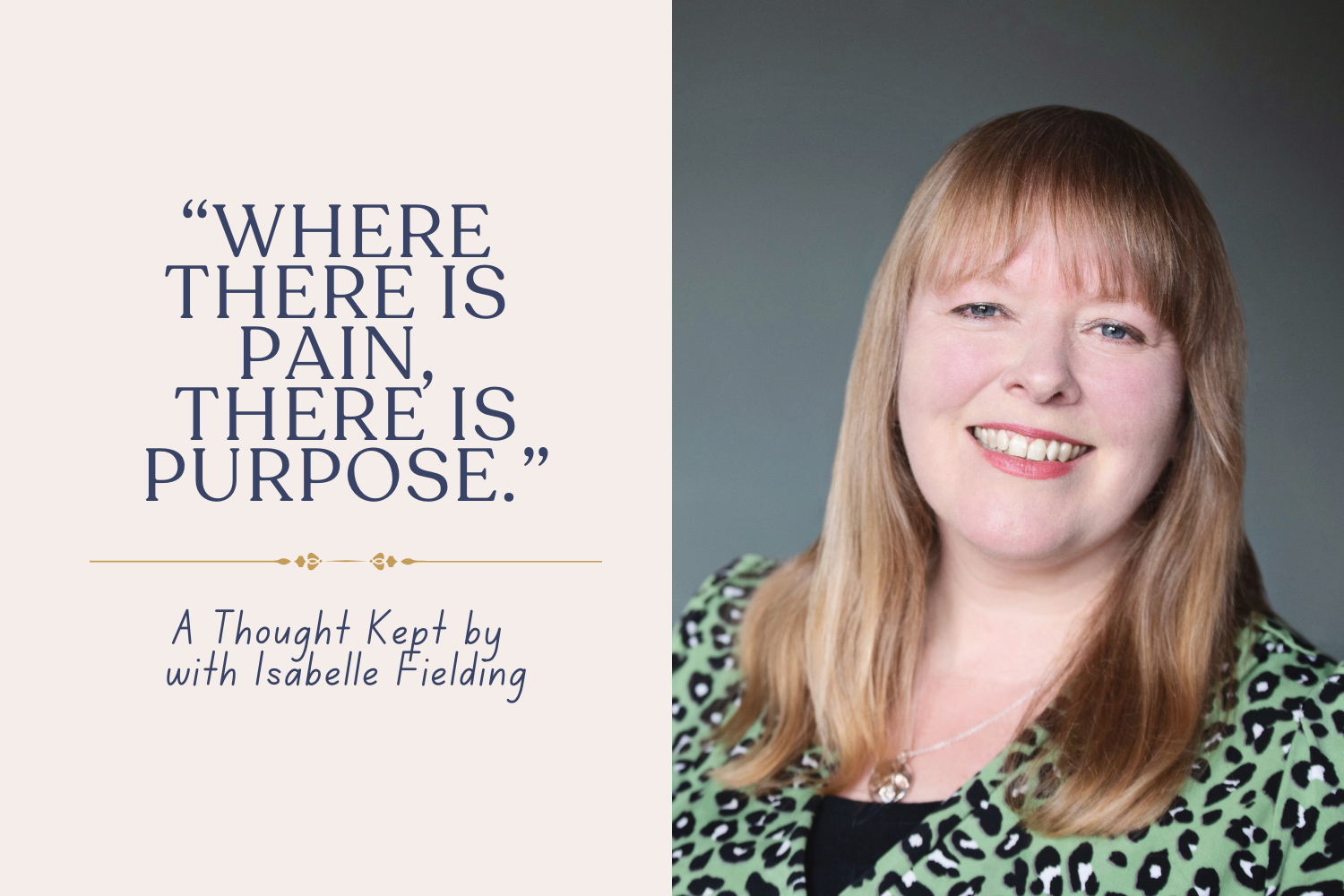
This question sat at the heart of a recent conversation on our podcast A Thought I Kept, with Isabelle Fielding. Isabelle works with individuals and organisations navigating change and uncertainty, and her work is grounded in a simple but often overlooked idea: emotions are part of being human, and learning how to relate to them is a skill — not a personality trait.
One of the key ideas Isabelle shared was this: Where there’s pain, there’s purpose. Not pain as something to glorify or push through, but pain as a signal. An indication that something matters, that a value is being touched, that attention is needed.
For many people who arrive here feeling lost, this is already a reframe. Because when emotions feel uncomfortable, our instinct is often to control them, deny them, or move away from them as quickly as possible. We tell ourselves we shouldn’t feel this way. We judge the feeling. We add a second layer — frustration, shame, self-criticism — on top of the original emotion.
Very quickly, things escalate.
Isabelle spoke about how emotions often stack like this. You feel anger, then feel ashamed of feeling angry. You feel anxious, then criticise yourself for being anxious again. Before long, it’s hard to know what you’re actually feeling — just that it’s too much.
Handling emotions better doesn’t mean stopping that first feeling from arising. It means learning how not to pile everything else on top.
In the conversation, Isabelle used an image that makes this easier to picture. Imagine being in the sea, trying to hold a beach ball underwater. It takes constant effort. Your arms ache. And eventually, no matter how determined you are, the ball bursts back to the surface — often catching you off guard. That’s what it can be like when we try to suppress or ignore our emotions. They don’t disappear; they resurface later, often louder and harder to manage.
A more sustainable approach is to let the ball float.
To allow emotions to be present without pushing them away — but also without letting them take over. Isabelle described this as learning to carry emotions lightly, rather than holding them right in front of your face. They’re there, but they don’t get to drive every decision.
This is where handling emotions becomes less about control and more about relationship.
Instead of asking, How do I get rid of this feeling? we might ask, Can I notice this without being overwhelmed by it?
Instead of assuming emotions make us unreliable, we can start to see them as information — not instructions.
Anxiety might be signalling uncertainty that needs time. Frustration might be pointing to a boundary or a mismatch. Self-doubt often appears where we care deeply about doing something well. None of these emotions tell us exactly what to do next but they can help us understand what’s going on inside us.
For people feeling lost, this can be grounding. Because it means you don’t have to wait until you feel calm, confident, or certain before you’re allowed to move forward. You don’t need to change who you are to begin handling things better.
Another important distinction Isabelle made was between experiencing an emotion and becoming it. Feeling anxious is not the same as being an anxious person. Feeling unsure doesn’t mean you can’t be trusted. Emotions are states — they come and go — even when they feel sticky or familiar.
Learning to handle emotions better often starts with noticing this difference.
It might mean pausing long enough to name what you’re feeling, without immediately reacting or analysing it. It might mean recognising when a second emotion — shame, irritation, self-judgment — has joined the first. It might mean allowing yourself to feel something without demanding that it resolve straight away.
This isn’t about emotional mastery. It’s about emotional steadiness.
At If Lost Start Here, we often talk about finding your footing rather than finding answers. About orientation rather than certainty. Learning to handle your emotions is part of how to navigate life. Not because emotions give you a perfect map, but because they help you stay connected to yourself as you move through change.
You may still feel unsure. You may still feel conflicted or overwhelmed at times. But handling emotions better doesn’t mean eliminating those experiences — it means being less knocked off course by them.
And that can make a real difference when you’re trying to move forward gently, in your own way.
If you’d like to explore this further, the full conversation with Isabelle Fielding is now available on our podcast A Thought I Kept.
And if you’re feeling lost or unsure and want support in understanding and handling your emotions, explore our coaching sessions.
The Thoughts That Stayed When the Year Felt Hard
A gentle end-of-year reflection drawn from A Thought I Kept — thoughts that helped when life felt overwhelming, uncertain or hard to navigate.
Some years are easy to summarise.
They arrive with neat headlines: “the year everything changed”, “the year it all came together”, “the year of big decisions".
And then there are the other years. The ones that feel harder to pin down.
This has been one of those years for many of us.
A year where you might not have clear answers. Where you feel more tired than triumphant. Where you’re still carrying questions about work, identity, relationships, or simply how to feel okay in the everyday.
When we started the podcast A Thought I Kept, we weren’t looking for big breakthroughs or polished wisdom. We asked a much simpler question:
What’s the thought that stayed with you — when everything else fell away?
As the year draws to a close, those are the thoughts we keep returning to. Not because they fixed everything, but because they helped us navigate life just that little bit better.
Here are some of the ideas that stayed — especially when the year felt heavy, overwhelming, or uncertain.

When Thinking Harder Wasn’t the Answer
One of the strongest threads running through this year’s conversations was the idea that clarity doesn’t always come from effort.
In our conversation with Katie Driver, we talked about how thinking clearly often begins with paying attention, not pushing for solutions. That sometimes the most helpful question isn’t “What should I do next?” but “What am I noticing right now?”
For anyone ending the year feeling mentally overloaded, this idea might help you create space for, rather than force, clarity.
That might look like fewer inputs. Quieter mornings. Walking without headphones. Letting your thoughts arrive without interrogating them.
When life feels hard, this kind of attention can be grounding — a way to feel less lost without needing a map.
Listen to the episode with Katie Driver on A Thought I Kept.
Learning to Trust Yourself Again (Slowly)
Another thought that stayed came up in conversations about self-trust.
Not the confident, decisive version of self-trust we often imagine — but a quieter kind. The kind that grows when you stop overriding yourself.
Several guests spoke about moments where they realised they had been ignoring their own signals for years: exhaustion, resentment, numbness, restlessness. And how wellbeing didn’t begin with adding more practices, but with listening.
If this year left you feeling unsure of yourself, this matters.
Self-trust isn’t rebuilt by grand declarations. It’s rebuilt in small acts:
pausing before saying yes
noticing what drains you
letting your feelings be information, not obstacles
That idea alone — my feelings are trying to tell me something — was one many of us kept.
Explore episodes on emotions, attention and self-trust wherever you listen to A Thought I Kept.
Overwhelm Isn’t a Personal Failure
Overwhelm came up again and again this year. Not as something to eliminate, but as something to understand.
In conversations about work, creativity and leadership, guests reflected on how overwhelm is often a signal that our systems — not our selves — need adjusting.
If you’re ending the year feeling overwhelmed, anxious or behind, this thought matters:
Overwhelm isn’t proof you’re failing. It’s information that’s pointing to too much noise, too many expectations, too little rest, or too little support. And noticing that is already a form of progress.
This is especially important at the end of the year, when reflection can quietly turn into self-criticism. These conversations reminded us that kindness — toward ourselves — is not a soft option. It’s a stabilising one.
You Don’t Need to Fix the Year to Learn From It
One of the most reassuring ideas to come out of the podcast this year was this:
You don’t need to tidy the year up to take something meaningful forward.
You can let it be unfinished.
Many guests spoke about learning through living, not through tidy conclusions. About carrying insights forward even when situations hadn’t resolved.
For anyone feeling lost or disconnected right now, that’s an invitation to stop forcing meaning — and trust that some understanding unfolds later.
Sometimes the thought you keep doesn’t explain everything.
It simply keeps you company.
Keeping these Thoughts Close
As we reached the end of the year, we realised something else: these ideas are easy to forget when life gets loud again.
That’s why we gathered the thoughts that stayed into a printable poster designed by Amanda — a way to live with them, not just read them once. Something to glance at on a difficult day. Something to remind you that you’re not alone in these questions.
You can shop the printable poster here — a collection of thoughts kept from the first year of A Thought I Kept.
And if any of these reflections resonated, we’d love for you to explore more.
Listen to A Thought I Kept — conversations about wellbeing, emotions, work, identity and self-trust, because when the year feels hard, sometimes the most helpful thing isn’t a plan — it’s a thought worth keeping.
Feeling Held in a World That Keeps Asking for More
Exploring overwhelm, anxiety, and what it means to feel held — especially when you’re carrying too much and don’t know how to slow down.
There’s a particular kind of overwhelm that doesn’t come from doing too much — but from holding too much.
Holding work.
Holding family life.
Holding emotions, expectations, plans, worries.
Holding it all together, often quietly.
It’s something that came up again and again in my recent conversation with Lauren Barber on the podcast A Thought I Kept. We didn’t set out to talk about overwhelm directly, but as we spoke, it became clear that this sense of being unheld — of carrying more than feels sustainable — sits beneath so many of the feelings people describe as stress, burnout, anxiety, or simply feeling lost.

What does it mean to feel held?
When we talk about being held, we often imagine something external: support from others, community, care, someone stepping in. And that matters — deeply. But Lauren spoke beautifully about another layer of holding too: the ways we hold ourselves when life keeps asking for more than we feel we have to give.
In the episode, she shared how anxiety has been a long-term companion for her — not always loud or dramatic, but often living quietly in the body. In the gut. In the mornings. In the constant background hum of hypervigilance. That feeling of being alert even when things are technically “fine”.
What struck me was how she described mistrusting good feelings. How, when you’ve spent a long time braced for difficulty, calm can feel unfamiliar — even unsafe. Ease doesn’t always land as relief; sometimes it lands as something to be suspicious of.
Many of us recognise this, especially when we’re overwhelmed. We might know what would help — rest, space, gentleness, support — and still struggle to let ourselves receive it.
Overwhelm isn’t always about doing too much
One of the ideas that stayed with me from this conversation is that overwhelm isn’t always about volume. Sometimes it’s about imbalance.
We’re holding a lot — but not being held in return.
Lauren talked about motherhood as a clear example of this. There are things in life that drain us simply because they have to be done. Meals, logistics, care, responsibility. We don’t always have the option to step away from them. And in those moments, the question isn’t “how do I escape this?” but “how do I support myself within it?”
Lauren spoke about counterbalancing — about finding small, everyday ways to bring nourishment back in. Not as a fix to the problem we can’t yet get to, but as a quiet form of care.
Putting music on while making breakfast.
Going for a walk, even when it’s inconvenient.
Wearing a favourite pair of earrings on an ordinary day.
These aren’t grand gestures. But they matter. Because they help the body feel a little safer. A little less alone. A little more held.
The quiet cost of never being held
So many people we speak to at If Lost Start Here tell us they feel disconnected — from themselves, from their energy, from what they want. Often, that disconnection isn’t because they don’t care, or don’t know. It’s because they’ve been holding so much, for so long, without anywhere to rest.
When you’re constantly in that state, your nervous system doesn’t get the message that it’s okay to soften. Even moments of rest can feel uncomfortable. Even joy can feel fragile.
Lauren shared how somatic practices — working with the body, not just the mind — have helped her rebuild a sense of safety from the inside out. Not by forcing calm, but by meeting what’s there with compassion. By learning, slowly, that feelings move. That sensations pass. That being held can be something you practise, not something you wait for.
Feeling held as a practice, not a destination
One of the most grounding ideas from this episode is that feeling held isn’t a one-time experience. It’s not something you achieve and then move on from. It’s a rhythm. A return.
It shows up in how you treat yourself when you’re tired.
In how you respond to anxiety rather than fighting it.
In whether you allow yourself small moments of care without earning them first.
This feels especially important at times of year when everything speeds up — when expectations multiply and space shrinks. When we’re told to reflect, plan, connect, celebrate, and keep going, all at once.
In those moments, being held might look less like changing everything and more like asking a quieter question: “What would help me feel supported right now?”
Work, energy, and being held
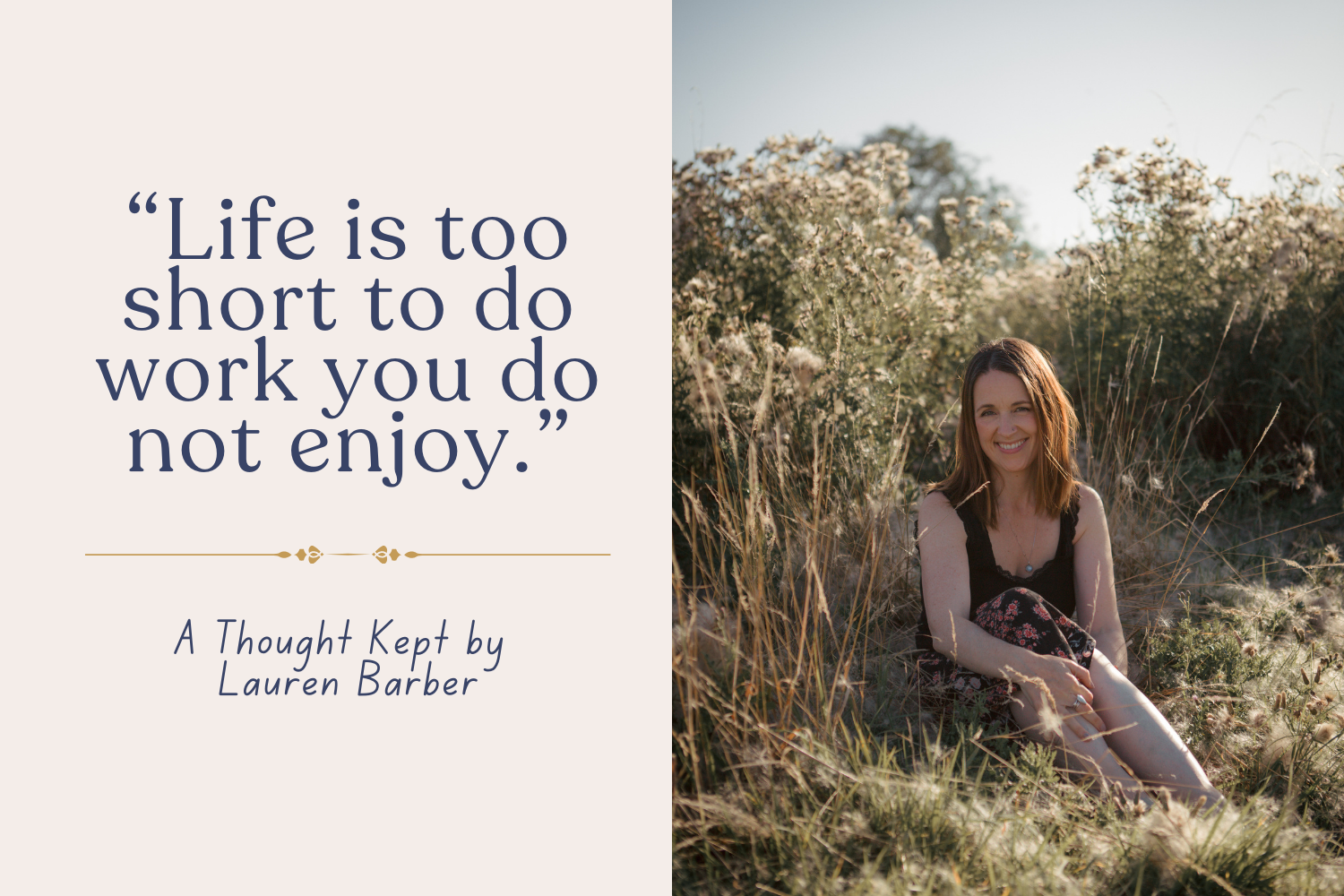
At the heart of Lauren’s story is a thought she’s carried since her early twenties: “Life is too short to do work that you do not enjoy.”
Lauren spoke about learning to notice when her work drains her energy — when she feels flat, depleted, disconnected. And how those sensations have become signals rather than something to push through.
For many people, changing work isn’t immediately possible. But even then, the episode offers a gentler invitation: to notice where energy is leaking, and where it might be replenished. To bring more of what you need into your days, even when the structure stays the same.
Feeling held, in this sense, is about staying connected to yourself — even in imperfect conditions.
A gentle invitation
If you’re feeling overwhelmed, unheld, or quietly disconnected right now, you’re not failing. You’re responding to a world that often asks for more than it gives back.
My hope is that this conversation with Lauren offers a pause. A moment of recognition. Perhaps even a small sense of being held — enough to help you take the next gentle step.
Listen to the full episode of A Thought I Kept: How We Learn to Feel Held with Lauren Barber — available on Spotify, Apple, or wherever you listen to podcasts.
And if you’d like more thoughtful reflections, tools, and ideas for everyday life, especially for those moments when you feel lost or overwhelmed, join our mailing list. You don’t have to hold everything alone.
How to End the Year with Intention (Before the New One Begins)
December doesn’t have to be a sprint to the finish line. Here's a slower, more intentional way to reflect on the year behind you and quietly begin the next one with clarity and care.
December is often framed as a finish line: A final push. A test. A moment to evaluate everything and rework yourself before the clock strikes midnight. But what if we made space for something different?
What if the end of the year wasn’t a judgment point but a waypoint?
A natural pause to notice, gather, and begin again, without rushing?
This isn't though about anticipating resolutions. It’s more about recognising what this year asked of you and how you met it. It’s about taking stock of what mattered, what’s changed, what still hurts, and what you want to carry forwards (or quietly leave behind).
So here’s an invitation to end the year on your terms, whatever that means to you.

Step 1: Reflect Without the Pressure to Perform
This time of year can stir up all kinds of emotions — joy, grief, gratitude, burnout — often tangled together. So the first thing to do is simple:
Pause and notice. Instead of listing wins or judging what you “did enough of,” try asking:
What did I learn about myself this year?
Where did I feel most like me?
What surprised me, softened me, challenged me?
These are the kinds of reflections that grow self-trust, rather than self-criticism.
You could:
Write a “reverse bucket list” — things you experienced, even if small, that mattered
Map your year by seasons or quarters and list one lesson or moment from each
List three things you coped with or made space for, even if they don’t “look impressive” on paper
Growth isn’t always visible. This is the season to witness it anyway.
Step 2: Begin Again Without Reinventing Yourself
January can come with a lot of noise. New habits. Fresh starts. Big goals. But most meaningful change is quiet and ongoing.
So instead of asking, “What do I need to fix about myself?”, try this:
What do I want to protect, grow, or honour more in the year ahead?
A few questions that can help:
What helped me feel steady this year and how can I make space for more of that?
What small boundary, rhythm or mindset actually worked?
What’s something I’m curious about right now?
And one of our favourite ideas:
Choose a word — not as a resolution, but as a companion. Something that gently anchors your direction, without pressure. Words like ease, play, curiosity, rooted, or enough can be guideposts.
Yours doesn’t need to be “clever”. It just needs to feel like a hand on your shoulder, reminding you of what matters.
Step 3: A Gentle Reflection Practice (That Won’t Overwhelm You)
If you’re unsure where to start, try this 10-minute reflection ritual:
→ Write a letter to yourself from the end of next year.
Write as if it's already happened.
What moments are you grateful for?
What did you let go of?
What surprised you in the best ways?
What would you thank yourself for doing (or not doing)?
This isn’t about setting fixed goals. It’s about listening to what your life might want to become.
You can keep the letter, hide it in a book, or revisit it this time next year.
Or Try This: Your End-of-Year Clarity Toolkit
If journaling isn’t your thing, try choosing one of the following prompts to explore this December — in a voice note, a walk, or a conversation with a friend:
What are you proud of that no one else saw?
What helped you come back to yourself this year?
What do you know now that you didn’t in January?
Where did your energy feel most alive and how can you follow that in 2025?
Sometimes clarity doesn’t come through strategy but through honesty.
When This Season Feels Tender
Not everyone loves this time of year. For some, December brings exhaustion. Loss. Isolation. Or the sense that you’re not where you “should” be.
So here’s your permission slip:
You don’t have to optimise December.
You don’t have to write a perfect wrap-up post or choose a guiding word.
You are allowed to be in progress — unfinished, unsure, still becoming.
A different year is coming. But you don’t need to earn it. You only need to arrive in it as yourself.
This year has already shaped you. You’ve likely grown in ways you didn’t expect. And the new year? It’s not a blank slate you have to earn — it’s just the next page.
Take what you need from this season. Leave the rest. You’re already enough to begin again.
Want to Step into the New Year With Support?
If you're ready to approach 2025 with more clarity, confidence, or simply a better relationship with yourself, I’m now opening up a small number of coaching spots for the new year.
This isn’t about fixing you. It’s about creating space to explore:
What you actually want next — beyond the noise
How to hold boundaries without guilt
How to reconnect with energy, meaning and emotional steadiness
And how to live your life in a way that works for you, not just around you
We’ll work at your pace, with tools and reflections tailored to you.
If that sounds like something you're curious about, you can read more here and book a free discovery call here or drop me a message with any questions.

Recognizing the Moment Change Arrives
Feeling stuck? Learn how to recognize when it's time to change, what to do next, and how to take small steps forward with clarity and confidence.
You might not notice it at first.
The pivot point of life isn’t always dramatic. It doesn’t always come as a bolt of lightning or a cinematic moment of clarity. Often, it’s quieter—a realization whispered in the stillness, a feeling that won’t let go, a sentence you catch yourself saying under your breath:
"Something has to shift."
Maybe it’s exhaustion from a situation you can’t tolerate anymore. Maybe it’s a spark of curiosity about what else could be possible. Maybe it’s simply that tiny flicker of okay—the moment you stop resisting and start allowing yourself to see a different way forward.
The question is: How do you recognize it? And what do you do when you do?
How to Know When Change is Calling for Your Attention
If you’re standing at the edge of something different but unsure if it’s time, consider these signs:
You feel restless, even when everything looks fine on the surface.
Your current life doesn’t quite fit anymore, like a sweater that has shrunk in the wash.
You keep circling the same thoughts, sensing that what worked before isn’t working now.
You find yourself drawn to new ideas, places, or people who reflect a version of yourself you haven't fully stepped into yet.
You hear yourself saying “I can’t do this anymore” or “There has to be another way.”
If any of this resonates, change might already be in motion—even if you can’t see the full picture yet.
What to Do When You Know It’s Time
Start Small:
The biggest misconception about change is that it has to be sudden or drastic. It doesn’t. Sometimes, the most profound shifts begin with one small step—a conversation, a decision, a quiet commitment to yourself.
Embrace Discomfort:
Change is rarely easy. The moment right before transformation often feels the most uncertain. But discomfort doesn’t mean you’re on the wrong path; it means you’re cultivating something new.
Get Clear on Your “Why”:
What are you moving toward? If the answer is “I don’t know yet,” that’s okay. Sometimes, all you need to know is what no longer fits. The clarity about what comes next will follow.
Reframe Setbacks:
Feeling stuck or taking a step backward doesn’t mean you’re failing. It means you’re learning. Every moment of hesitation or doubt is part of the process—it’s data, not defeat.
Surround Yourself with Support:
You don’t have to navigate change alone. The people, spaces, and resources around you influence your ability to step forward. Find those who help you move in the direction you want to go.
You Don’t Have to Have It All Figured Out—You Just Have to Begin
Here’s what we know:
The best time to change isn’t when you feel completely ready—it’s when you recognize the need for change.
Every significant transformation begins with a single decision to explore what’s next.
If you’re at that pivot point—standing at the threshold but unsure how to step through—we’re here to help.
Explore our coaching sessions.
This isn’t about forcing a transformation. It’s about clearing just a little more space—so you can finally see what might be ahead.

How to Know It’s Time for a Change: Understanding Avoidance vs. Approach Motivation
Feeling stuck in life? Learn how to recognize if you're running away from something (avoidance motivation) or moving toward something better (approach motivation) and what to do next.
Something needs to change. But what?
Maybe you’ve been circling the same thoughts for weeks, months, years even. You know something isn’t working, but the specifics feel murky. Should you quit the job? End the relationship? Finally book the trip, sign up for the course, or move to that city you can’t stop thinking about?
Or maybe it’s more subtle. A feeling of restlessness. A quiet dissatisfaction. You keep going through the motions, but a part of you knows: this isn’t it.
So how do you know when it’s time to change?
One of the most powerful ways to understand your desire for change is through the lens of “avoidance motivation” and “approach motivation”— two psychological forces that shape every decision we make.
And once you understand which one is driving you, the next step becomes clearer.
Are You Running Away or Moving Towards?
Every decision we make is guided by either avoidance motivation or approach motivation.
Avoidance Motivation is about moving away from something that feels bad—pain, stress, burnout, dissatisfaction.
Approach Motivation is about moving towards something that feels good—fulfillment, excitement, joy, purpose.
Both are valid. Both are powerful. And both can be the spark for real change. The key is knowing which one is currently guiding you and whether it’s enough to propel you forward.
Avoidance Motivation: When You Just Can’t Anymore
Avoidance motivation kicks in when you hit your limit.
It’s when:
You can’t face another Sunday night dread before Monday.
The relationship is more draining than supportive.
Your body is exhausted from stress, but you keep pushing through.
You feel trapped, uninspired, disconnected from yourself.
It’s the feeling of enough is enough.
And yet, while avoidance motivation can push us to act, it doesn’t always lead to intentional change. It can be reactive: quitting impulsively, burning bridges, retreating without a plan.
If avoidance is your main driver, pause. Ask yourself: What do I actually want instead? Not just what you want to escape, but what you want to move toward.
Because that’s where approach motivation comes in.
Approach Motivation: When You Feel Pulled Towards Something More
Approach motivation feels different.
It’s when:
You get a spark of excitement thinking about what could be.
The idea of a new path feels energizing, not just like relief.
You’re drawn towards something, even if it’s uncertain.
You start imagining a version of your life that fits better.
Approach motivation is about expansion rather than escape.
When you make a change based on what excites and compels you, rather than just what you’re running from, you’re more likely to create something lasting and meaningful.
But here’s the challenge: many of us wait until avoidance motivation is unbearable before we take action.
We wait until we’re drowning in burnout before we rethink work. Until a relationship is completely broken before we acknowledge it’s not right. Until we hit rock bottom before we start listening to ourselves.
What if we didn’t wait? What if we started paying attention the moment we felt that first pull towards something better?
Where Are You Right Now?
If you’re standing at the edge of change but feeling unsure, ask yourself:
Am I more focused on what I want to leave behind, or what I want to move towards?
Is this decision based on desperation, or is there something I’m genuinely excited to create?
If I gave myself permission to change, what would I step into?
And if the answers feel unclear, that’s okay. This is the work we do.
Your Next Step: Let’s Find Your Direction
Change doesn’t have to be something you have to struggle with alone. Whether you’re running away from something that no longer fits, or being pulled towards something you can’t quite name yet, we can help you navigate this moment.
Our coaching sessions are designed for this exact stage of life. The one where you know something needs to shift, but you’re not sure what or how.
The first step isn’t about having all the answers. It’s about deciding that you’re ready to explore what’s next.

A Better Way to Well: 5 Lessons for Everyday Well-Being
Discover five powerful lessons about well-being, from embracing your uniqueness to redefining progress. Learn how to create a personalised path to better mental health.
Well-being can feel like an elusive goal, especially when we’re bombarded with conflicting advice and expectations. Over the years, as a co-founder of If Lost, Start Here—a well-being company focused on helping people find their way—I’ve learned some surprising truths about what it really means to feel better in our everyday lives.
Here are five lessons that might help you rethink your own well-being journey.
1. Sometimes, it’s not us—it’s the situation.
How often do we blame ourselves when we don’t seem to “fit”? We’re told to adapt, to be more resilient, to “tough it out.” But what if the problem isn’t you at all—it’s the environment you’re in?
For over a decade, I worked in the art world, constantly questioning myself. Was I too quiet? Too sensitive? Too “wrong”? But when I transitioned into spaces focused on empathy, listening, and one-to-one connection—like coaching calls or well-being conversations—I thrived.
The truth is, not every situation is meant to work for every person. Trying to mould yourself to fit an environment that doesn’t align with your values or strengths only serves to stifle you. Sometimes, the bravest thing you can do is to move toward a space that lets you show up fully as yourself.
2. Mental wellness looks different for everyone.
Traditional mental wellness can feel like a one-size-fits-all solution—usually oriented towards therapy or medication. But now, we’re embracing a more nuanced approach: recognising that everyone’s well-being path is unique.
That’s why we created If Lost, Start Here as a choose-your-own-adventure well-being company. For me, mental wellness starts with awe, wonder, creativity, and connection. For my co-founder, it’s time in nature, movement, and stepping away from technology. What works for me might not work for her, and that’s okay. The key is finding what resonates with you—and knowing there are many ways to care for your mental and emotional well-being.
3. The therapeutic is everywhere.
When I realised the art world wasn’t for me, I started to retrain in psychotherapy and coaching. But over time, I’ve discovered that the therapeutic is everywhere: in the spaces we create, the communities we nurture, and the moments of connection we share
From a thoughtful prompt to a quiet moment in nature, the world is full of opportunities to support better well-being. It’s not just about what happens in a conversation one-on-one but extends to and comes from how we choose to engage with what’s around us outside that relationship too.
4. Progress doesn’t always look like progress.
Our culture tends to value action—forward momentum, measurable results, and quick fixes. But well-being doesn’t always work that way. In fact, some of the most profound progress comes when we pause.
Sometimes, progress means sitting with discomfort, taking a step back, or simply resting when everything around us screams, “Do More” Allowing yourself to stop striving is a radical act of self-care in a world that glorifies busyness.
5. It’s okay not to have it all figured out.
When we started If Lost, Start Here, I thought I needed all the answers. How could I guide others if I was still navigating my own questions? But I quickly learned that well-being isn’t about having a perfect plan—it’s about curiosity, experimentation, and a willingness to embrace the unknown.
We’re all navigating life’s uncertainties. The most important thing is to show up, stay open, and trust the process. Sometimes, it’s in the spaces between certainty and doubt that we find the answers we’re looking for.
Find Your Better Way to Well
The path to well-being isn’t linear—it’s personal, evolving, and sometimes messy. What matters is finding what works for you.
If you’re looking for a way to start, we’ve created A Better Way to Well, a free five-part email series designed to help you cut through the noise and connect with what truly matters. You’ll receive practical, research-backed prompts to help you reflect, reset, and create your own personalised approach to well-being.
Sign up here and take the first small step toward feeling better in your everyday life.