
How to Have a Better Relationship with Your Emotions (Without Trying to Fix Them)
Struggling with anxiety, overwhelm, or difficult emotions? Explore a gentler way to relate to what you feel — without fixing, avoiding, or pushing it away.
Ok we need to talk about emotions because there can be so much going on with that aspect of our lives — much of it unseen. Maybe there’s a sense that we should be handling them better. That we should feel calmer, clearer, more in control. That if anxiety shows up, or grief lingers, or something in us feels heavier than it “should,” then something has gone wrong.
So we try to manage what we feel. We minimise it, move past it, explain it away. We tell ourselves we’ll deal with it later, or that it isn’t that big a deal, or that other people have it worse. We learn, often without realising it, to close the door on parts of ourselves that feel inconvenient or uncomfortable.
And yet, for many of us, that doesn’t actually make things easier. It just makes us feel more disconnected. From ourselves, from other people, from what’s really going on.
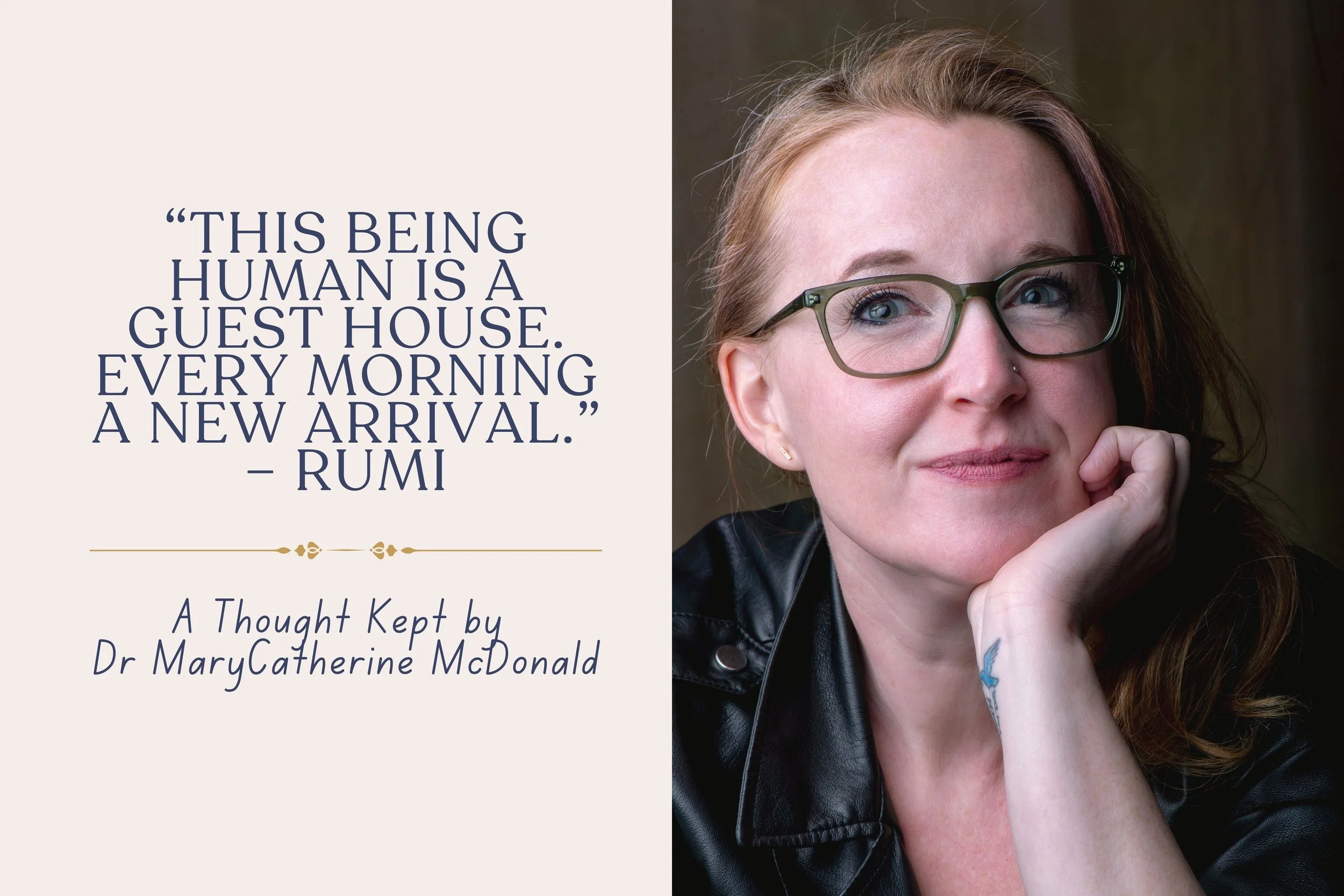
In a recent conversation on A Thought I Kept, I spoke with Dr MaryCatherine McDonald about this — and in particular, about a simple but quietly radical idea: that our emotions might not be something to fix or control, but something to relate to.
She shared a poem by Rumi that has stayed with her for years, about being human as a kind of guest house, where emotions arrive as visitors. Joy, anxiety, grief, irritation. Some welcome, some less so. All of them coming and going, whether we invite them in or not .
It’s such a different way of seeing things.
Because many of us have been taught to do the opposite. To decide which emotions are acceptable and which need to be shown the door. To believe that if something uncomfortable is present, then something must be wrong — and the goal is to get back to a more “acceptable” state as quickly as possible.
MaryCatherine described living like that for years. Feeling as though she was at war with her emotions, trying to control them, contain them, make them behave. And underneath that, a quieter belief: that if anxiety or grief were there, they would take over. That they might ruin everything.
It’s a feeling I recognise, and one I see often in my work. That fear of what might happen if we really let ourselves feel what’s there.
But what if the work isn’t to get rid of what we feel?
What if it’s to sit down with it?
To offer it a chair, rather than pushing it out of the room. To get curious, even gently, about why it’s here. Not because we want to analyse it or solve it, but because we’re willing to be in relationship with it.
That idea of relationship feels important.
Because emotions don’t arrive neatly, one at a time. They overlap. They contradict each other. We can feel anxious and hopeful, tired and grateful, grieving and still find something to laugh at. And yet, we often try to simplify that complexity into something more manageable. I am anxious. I am fine. I am coping.
But that can leave us feeling stuck. As though we’ve become the emotion, rather than someone experiencing it.
What I found grounding in this conversation was the idea that we don’t have to identify so completely with what we feel. We can be in it, without it being all of us. We can let something move through, rather than holding onto it as a fixed state.
And that matters, particularly when things feel heavy.
MaryCatherine talks about something she calls “rehearsing loss” — the way our nervous system, often shaped by past experiences, tries to protect us by anticipating what might go wrong. Imagining endings before we’ve fully lived the beginnings. Bracing ourselves, just in case.
It makes sense, when you see it like that. It’s not weakness. It’s protection.
But it can also make it harder to access the moments that are here. The small, ordinary experiences that carry something lighter in them. A conversation that lands. A moment of connection. A flicker of joy that doesn’t erase what’s hard, but sits alongside it.
This is something else she reframes beautifully — the idea that joy isn’t something we reach once everything is sorted, but something that appears in the middle of things. Not fluffy or superficial, but steady and tenacious. Something that helps us stay, rather than escape.
And maybe that’s part of what a different relationship with our emotions can offer.
Not a life where we only feel the “right” things. But a life where we feel more of what’s real, without it meaning something has gone wrong.
Where we can notice when we’re trying to push something away, and instead soften, even slightly, towards it.
Where we don’t have to be at war with ourselves.
If you’re someone who has been trying to manage or control what you feel, it might be worth asking a different question.
Not “how do I fix this?”
But “what might it be like to sit with this, just for a moment?”
There’s no perfect way to do that. No right or wrong response. Just a gradual shift, over time, from resisting what’s there to being alongside it.
And if that feels unfamiliar, you’re not alone in that either.
If you’d like to explore this idea further, you can listen to my full conversation with Dr MaryCatherine McDonald on A Thought I Kept. It’s a thoughtful, honest exploration of emotions, grief, joy, and what it means to be in relationship with what we feel.
And if you’re looking for a little more support in understanding your own emotional world, you can also explore my emotions coaching sessions — a space to gently make sense of what’s going on, at your own pace.

Understanding Midlife Emotions: A Toolkit for Women in Perimenopause and Menopause
Explore why midlife feels so emotional — and learn science-backed, compassionate tools for navigating perimenopause, menopause, and the mental load of midlife.
Midlife is emotional. So emotional.
Not in the dramatic, dismissive way we’re told.
But in the quietly profound, messy, layered, deeply human way no one warned us about.
For some of us, midlife emotions feel like an ambush.
For others, like a fog that won’t lift.
You cry at the school newsletter. Snap over the dishwasher. Feel nostalgic, flat, elated, invisible, and uncertain — sometimes in a single afternoon.
Here’s the thing:
You’re not going mad.
You’re not failing at life.
You’re not the only one.
The emotional shifts in midlife are real, and they are biological, cultural, social, and psychological. And once you understand what’s happening beneath the surface, it all starts to make a little more sense.

Why Midlife Feels So Emotional
Here’s what the research shows:
Hormones are real players. During perimenopause and menopause, estrogen — a key mood-regulating hormone — fluctuates wildly. This can destabilise serotonin and trigger mood swings, irritability, anxiety, and even depression.
Sleep suffers. Hot flashes and night sweats disrupt sleep, which worsens emotional resilience. It's not just tiredness — it’s emotional sensitivity fuelled by exhaustion.
Life doesn’t pause. Career shifts, aging parents, empty nests, grief, relationship changes — all pile on at once. It’s not just one thing; it’s everything, all at once.
We’ve been socially trained to ignore ourselves. We’ve been told to stay upbeat, productive, and agreeable — so when emotions hit, they feel foreign, shameful, or ‘too much’.
And the world doesn’t always see us. Many women report feeling invisible, devalued, or dismissed — especially in work and public spaces.
This is biology + life + culture colliding in one highly stressful moment.
But here’s where it also gets hopeful:
An Emotional Toolkit for Midlife Women
You don’t need to ‘get over’ your emotions.
You need tools, space, and information. Here are five small but powerful shifts you can start today:
1. Name what’s happening — without judgement
Mood swings, anxiety, flatness, brain fog… they’re not weakness. They’re signals. Naming what you’re feeling reduces shame and increases clarity.
Try: “Today I feel... because... and that’s okay.”
2. Sleep is sacred
If you’re not sleeping, you’re not thriving. Manage sleep disruptions (hot flashes, anxiety) with gentle bedtime routines, calming rituals, and support if needed.
Consider: Magnesium glycinate, low evening light, and no emotional emails after 8pm.
3. Move — gently, often
Movement isn’t just about physical health. It’s emotional regulation in disguise. A walk. A stretch. A playlist you can dance to. Move your body to move your mood.
Try: Even five minutes counts for shifting your emotional energy.
4. Talk to people who get it
Because right now you probably also need validation. Your feelings aren’t ‘too much’. You’re not broken. Talk to someone who has walked this path — or is walking it too.
To do: This is your sign to call or text that friend you’ve been thinking about.
5. Challenge the crisis narrative
What if midlife wasn’t a crisis — but a moment to reevaluate? Research shows women who see midlife as a time for growth fare better emotionally. You can rewrite the script.
Ask: What part of me might be growing right now — even if I can’t see it yet?
Something’s Coming...
This is why we created So Emotional
A retreat for your emotional life.
We’re not opening enrolment just yet, but the waitlist is open.
If you're craving real tools and real talk,
If you want to understand yourself better — and feel less alone in the process…
join the waitlist for So Emotional
Be the first to know when we open our doors.
Let’s make space for your emotions — in a way that feels good to you.

If you’re struggling with all the feelings in midlife, download our free guide for five ways to better manage your emotions right now.

Feeling Like You’re Not Coping in Midlife? You May Just Be Burnt Out
If you feel like you're losing control of your emotions in midlife, you might be experiencing emotional burnout. Here's what it looks like — and what can help.
You used to be able to handle everything. Deadlines. Family logistics. The never-ending inbox. The emotional temperature of the people around you.
But lately?
It’s taking more energy just to get through the day. You lose your temper at things that never used to bother you. You forget words mid-sentence. You wake up already tired. The tears are always closer to the surface than you’d like.
You keep thinking: “What is wrong with me?”
Here’s what we may need to acknowledge — “this isn’t just the usual stress. This could be emotional burnout.”

When You’re Doing It All — and Still Feel Like You’re Falling Apart
For many women, midlife arrives not as a calm plateau, but as a crash of emotional noise.
You’re managing more than ever — ageing parents, growing children, workplace pressures, your own changing body. All while still holding up the emotional scaffolding for others.
And somewhere in all that care and competence, your emotions started to feel less like signals and more like symptoms.
Emotional burnout doesn’t always look like falling apart. Sometimes it looks like holding it all together — until one day, you just can’t
What Emotional Burnout Looks Like (Even If You’re Still “Functioning”)
Emotional burnout in midlife often shows up as:
Feeling numb or detached from things you used to enjoy
Mood swings that feel sudden, sharp, and disproportionate
Overwhelm that hits out of nowhere
Irritability and guilt in equal measure
A loss of confidence in your emotional responses
And yes — hormonal changes can absolutely cause and intensify these experiences. Once you’ve checked this out with a medical professional and you’re still feeling burned out, years of emotional labour, invisible caregiving, and the pressure to keep being “fine”, might also be contributing.
When we’re always trying to fine, we lose contact with what’s real. And emotional steadiness starts with giving yourself the space to see what’s really going on.
There’s a Way Back to Yourself — One Feeling at a Time
Your emotions don’t need to be your enemy — even when they feel messy and out of control. They can also be information. And with the right tools, you can begin to steady them again.
That’s why we created a free resource designed just for women navigating this exact moment.

Download the Free Guide: Feel Better in the Middle of Everything..
This contains five practical tools to help you:
Understand why your emotions feel so intense right now
Reclaim your energy and focus, one moment at a time
Shift the emotional stories you’ve been carrying
Feel less alone, more steady, and more like yourself again
Sometimes you don’t need to overhaul your life — just start with a clearer understanding of what’s really going on.
Download the free guide now and start feeling more like yourself again.

Losing Control of Your Emotions at 48? Here's What's Really Going On (and What You Can Do About It)
Feeling like you’re losing control of your emotions at 48? Here’s why midlife hits hard emotionally, what it means, and how to steady yourself again.
You’ve always been the one who kept it together.
At home. At work. In the moments when other people fall apart, you’ve been the calm one. The capable one. The one who handles things.
But lately, something’s changed. You find yourself snapping over small things. Crying in the car. Waking up with dread or feeling foggy-headed in meetings. You’re asking yourself:
“Why can’t I control my emotions anymore?”
And maybe even, “Am I going crazy?”
You’re not. You’re in midlife — and what you’re feeling is incredibly common. But that doesn’t mean it isn’t deeply disorienting. And it definitely doesn’t mean you have to keep silently pushing through.

“I’ve Always Held It Together — Until Now”
Midlife is often described as a "second puberty" for good reason. For many women in their mid-to-late 40s, it’s the first time that emotional stability — something we’ve prided ourselves on — starts to feel elusive. You may feel like you’ve become a different person almost overnight.
The truth is, this shift isn’t just in your head — and it isn’t a sign of weakness. It’s a combination of biological, emotional, and psychological factors that hit at once:
Changing hormone levels can affect mood regulation and cognitive function.
Long-held emotional patterns (like bottling things up to stay professional or strong) begin to break down under pressure.
The stress of managing work, relationships, and caregiving responsibilities compounds everything.
It’s no wonder you feel like you’re holding on by a thread. And it’s no wonder you're asking: When will I feel like myself again?
What’s Really Going On with Your Emotions in Midlife
The good news is: there are ways to make sense of all this.
Understanding why your emotions feel so intense or unpredictable right now is the first step to feeling more steady.
You don’t need to meditate for hours or do a total life reset. You just need the right kind of support — practical, grounded, and designed for your life stage. Not one-size-fits-all advice. Not something that makes you feel broken or too much.
You need:
Language to understand what’s going on internally
Tools to respond to your emotions with clarity, not panic
Support that respects your intelligence, your capacity, and your lived experience
How to Feel Like Yourself Again (Even If You’re Not There Yet)
Imagine having a framework that explains what’s happening beneath the surface — so your emotions feel less scary and more manageable.
Imagine learning how to respond to your feelings without judging yourself, spiralling into shame, or snapping at the people you love.
Imagine feeling like yourself again — but with a deeper understanding of who that is now.
That’s exactly why I created So Emotional — a midlife course and community that helps women like you stop feeling out of control and start feeling informed, equipped, and understood.
So Emotional: A Course + Community for Women in Midlife
This is a four-week, expertly guided course to help you:
Understand why your emotions feel different in midlife
Learn tools for emotional regulation that actually make sense
Build emotional resilience without pretending nothing’s wrong
Reconnect to the steady, capable self you know is still in there
Join the waitlist now to get first access to enrolment and early bird bonuses.

How to Deal with Emotional Burnout in Midlife
Feeling emotionally burned out in midlife? Learn why you feel this way, how hormones play a role, and get practical tools to move forward with more clarity.
Have you ever caught yourself thinking, Why am I so tired, so emotional, so unlike myself lately?
You’re not just “moody.”
You’re not just “failing to cope.”
You may be experiencing emotional burnout — and if you’re a woman in midlife, you’re far from alone.
Emotional burnout happens when your emotional reserves have been stretched thin for too long. You’ve been holding space for everyone else — your kids, your partner, your parents, your workplace — and slowly, silently, your own needs have slipped off the radar.
What makes this even more intense in midlife are the hormonal shifts happening under the surface. Perimenopause and menopause bring changes in estrogen, progesterone, and testosterone, which directly impact your body and brain — affecting mood, energy, focus, and resilience.
You’re not imagining this. You’re not weak. You’re human, and your body is asking you to pay attention.

Why You’re Feeling So Emotionally Burnt Out Right Now
For years, you’ve been the glue:
Keeping the family running.
Holding the emotional weight of relationships.
Being the one everyone relies on.
But now? You’re snapping or withdrawing. You feel guilt and shame after emotional outbursts. You can’t figure out why you’re so exhausted or why small things set you off.
This is emotional burnout.
It shows up as:
Constant tiredness, even after rest.
Feeling numb, flat, or disconnected.
Increased irritability or sadness over small triggers.
A sense of “losing yourself” or wondering if you’ll ever feel balanced again.
And here’s the thing: hormonal shifts amplify all of this. Fluctuating hormones can disrupt serotonin and dopamine levels, making you more vulnerable to mood swings, anxiety, and emotional overload.
Getting the right support — including exploring options like HRT (hormone replacement therapy) where appropriate — can be part of the picture, alongside emotional tools and understanding.
How to Start Moving Through Emotional Burnout
So, how do you begin to navigate emotional burnout in midlife? Here’s what we know from emotions coaching and recent research:
Understand the narratives you hold about your emotions.
Many women have been raised to believe that anger, frustration, or sadness are “bad” or “selfish.” But these emotions are signals — not flaws. Learning to recognise, name, and work with them (rather than push them down) is the first step toward healing.
Bring the body into the process
Emotions aren’t just in the mind; they live in the body. Gentle body scans, breathing exercises, or even mindful movement can help you reconnect with what you’re feeling — and release some of the emotional tension you’ve been carrying.
Separate yourself from your emotions
You are not your anger. You are not your exhaustion. These are experiences you are having, not identities you are becoming. This small shift can help you move from drowning in feelings to navigating them with more clarity.
Get the right support
Whether it’s therapy, HRT, emotions coaching, or a guided programme, you don’t have to figure this out alone. There is nothing to be gained for pushing through solo — and finding the right help can bring immense relief.
When you start to untangle what you’re feeling, why you’re feeling it, and how your body is playing a role, you begin to see:
You are not broken.
You are not failing.
You are in a transition — one that’s asking for more understanding, more care, and better support.
With the right tools, you can move through emotional burnout toward a steadier, more resourced version of yourself.

Join the Waitlist: So Emotional — A Midlife Feelings Reset
We’ve designed this 4-week online course and community for women in midlife who want to better understand their emotions, reconnect with themselves, and gently shift how they carry their emotional weight. You’ll get to explore your emotional patterns and learn practical tools to manage overwhelm with other women going through it too and expert guidance from a Certified Emotions Coach.
Join the waitlist now to be first in line for early access, exclusive bonuses, and the support you deserve.
You don’t have to stay stuck in emotional burnout. Let’s find a way forward — together.