
When Grief Changes You But Doesn’t Define You: Finding Your Way Through Loss
Feeling lost after grief or life changes? Explore how loss can change you without defining you, and find a steadier way to navigate difficult emotions and feeling lost.
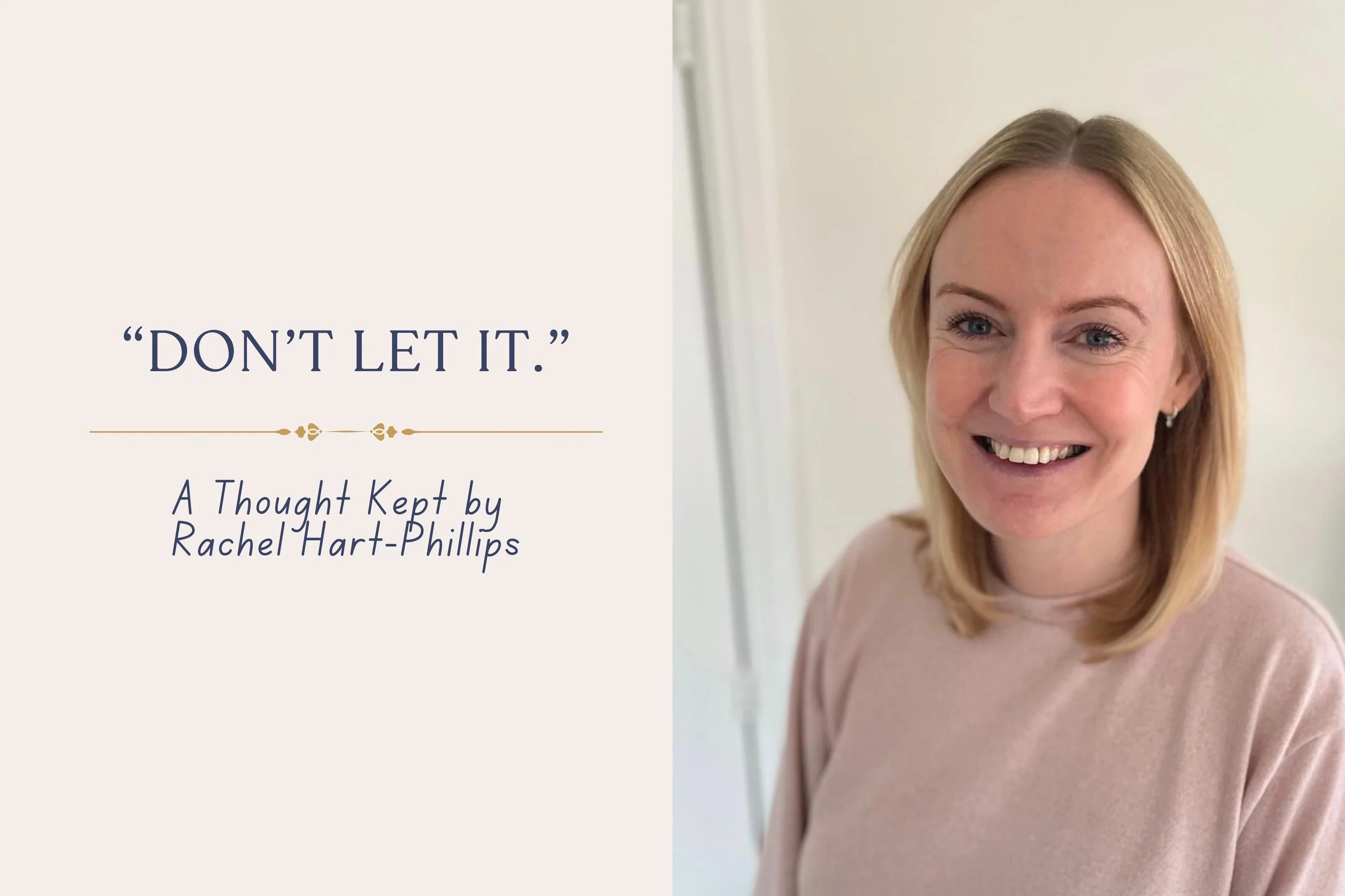
Rachel Hart-Phillips is in the car, driving away from the hospital mortuary. It is one of those days that feels almost impossible to hold — the kind where everything is too much, too raw, too real. She has just seen her husband. The future she thought she had is no longer there. And alongside the shock and the grief, there is another feeling beginning to take shape.
Fear.
Not just of what has happened, but of what it might mean. That this could be the thing that defines her. That from this moment on, she might always be “the person this happened to.” That her life might narrow around this one experience, this one loss, this one story.
She says it out loud to the friend driving her home. And he responds, simply and almost casually, “don’t let it.”
It isn’t a solution. It isn’t even something she can fully take in at the time. How could you, in the middle of something so overwhelming? But she keeps it. She carries it with her, even when it feels impossible to believe. And over time, it becomes something she can return to. Not as an instruction to be okay, but as a way of orienting herself inside something that has changed everything.
There is something in that moment that many of us will recognise, even if our circumstances are different. That quiet, often unspoken fear that the hardest thing we go through might become the thing that defines us. It might not be grief. It might be anxiety, burnout, a loss of confidence, a period of feeling lost or stuck. But the shape of the fear is often the same. That this is who I am now. That this is how it will always be.
And yet, life is rarely that singular. It is not one thing, even when one thing feels overwhelming. What Rachel’s story holds, gently and without forcing it, is the idea that we can be shaped by what happens to us without being entirely defined by it.
This is not about dismissing the impact of what we go through. Loss does change us. Grief changes us. The experiences that stop us in our tracks — the ones that make us question who we are and how we go on — they leave their mark. Rachel speaks about the many emotions that came with her grief: sadness, of course, but also anger, guilt, fear, even moments of something like joy returning in unexpected ways And perhaps one of the hardest parts is that these emotions don’t arrive neatly. They don’t follow a clear path. They can feel contradictory, confusing, and sometimes even shameful.
We are not always given space to experience that fully. There is often a subtle pressure, from the world around us and from within, to be strong, to hold it together, to find a way through as quickly as possible. Rachel described being told she was strong after earlier loss, and how that became something she felt she had to live up to — as if showing her grief might mean she was doing it wrong But over time, she came to understand that strength, in this context, looks very different. It is not about holding everything in. It is about allowing what is there to be there.
This is a different kind of orientation to the one many of us are used to. Rather than asking “how do I fix this?” or “how do I stop feeling like this?”, it becomes something more like “how do I stay with this, without losing myself inside it?” It is slower. Less certain. But also, perhaps, more human.
Rachel spoke about grief as something that lives in the body, not just the mind. Something that needs to be felt and moved through, rather than thought away And that might look like very ordinary things. A walk. A song. A moment of crying that comes out of nowhere. A small flicker of light that catches you by surprise. None of these are solutions. But they are ways of staying connected to yourself, even as everything shifts.
There was something else in our conversation that stayed with me, and it sits alongside that original thought. The idea that when something hard happens, we don’t just struggle with what we’re feeling — we also struggle with how to be around each other. The not knowing what to say. The fear of getting it wrong. The way we can sometimes back away, even when we care deeply.
Rachel has built her work around this space — around helping us find words when words feel impossible. And what she returns to, again and again, is that it doesn’t need to be perfect. Often, it is the simplest expressions that matter most. A message. A card. A “I’m here.” A “love you.” Not to fix anything, but to sit alongside it.
Because when life becomes difficult, what we are often looking for is not a solution, but a sense of not being alone in it.
And maybe this is where that original thought — don’t let it — becomes something softer, something more spacious. Not a demand to overcome or to move on. But a quiet reminder that even when something changes you, it doesn’t have to take everything with it. There can still be other parts of you. Other moments. Other possibilities that sit alongside the hard.
Rachel speaks about the metaphor of a disco ball — something made up of broken pieces that still reflects light. Not in spite of what it’s been through, but because of how those pieces come together. It feels like a more honest image of how we live. Not perfectly put back together. Not untouched by what has happened. But still capable of reflecting something back into the world.
If you are in a moment where things feel uncertain, or heavy, or difficult to name, it might not be about finding a way to change yourself. It might be about staying close to yourself, even here. Allowing what is present to be present. And trusting, even if only a little, that there is more to you than the thing that has happened.
If this feels close to home, you can listen to the full conversation with Rachel on A Thought I Kept.
And if you’re looking for a steadier way to navigate what you’re feeling, or to find your footing again, you’re always welcome to explore the coaching and resources here at If Lost Start Here.
For now, perhaps just this thought to carry gently with you:
What is the thing you’re afraid might define you?
And what might it mean, in your own time, not to let it?

The push and pull of the sea
The sea contains multitudes and it is exactly this complexity that keeps calling designer Sarah Robertson to it in moments of loss and need.
Wild and calm. Chaotic and beautiful. Bold and soft.
The sea has its contradictions. And, for as long as I can remember, I have been drawn to the push and pull of it.
From embracing the joys of wild swimming and overcoming panic while scuba diving to my rehabilitation through water therapy and evenings spent watching sunsets over the ocean, blue spaces have helped me heal and grow.
In many ways, the sea is a metaphor for our own life experiences; the ups and downs and ebbs and flows. At its most tranquil, it can relax and restore us. At its most violent, we can lose ourselves in its grip.
What I love most about water is its capacity to shift us into a more mindful state. It can lower stress, decrease anxiety and relieve depression. And as well as settling our thoughts and lifting our moods, it can bring us back to the here and now — help us feel grounded and present — and sharpen our senses.
The sea has always been a kind of therapy for me, and I have felt the emotional, mental and physical benefits first-hand. My mind can be elsewhere — ruminating over the past, worrying about the future — but as soon as my feet touch the wet sand and the waves reach my bare toes, I am right where I need to be. At these points, I feel alone in the most reassuringly positive way, and the solitude it brings allows curiosity and creativity to thrive. It is almost elevating.

Above: Luskentyre Beach at Sunset, Isle of Harris, Scotland by Nils Leonhardt | Top: Golden Hour at Luskentyre Beach, Isle of Harris, Scotland by Nils Leonhardt
In his book, Blue Mind: How Water Makes You Happier, More Connected and Better at What You Do, Wallace. J. Nichols, a marine biologist, investigates how water — literally and metaphorically — helps us move into a flow state. He coined this the "blue mind". Nichols examines why we are attracted to lakes, rivers, oceans and pools and why being near water sets our minds and bodies at ease. He illustrates the importance of our water connection — its almost magical quality — with the science behind it and the ways in which it allows our thoughts to wander freely. Is it any wonder then that some of the greatest artists, musicians and writers have been moved by the sea? Or why so many of us are called there to explore ideas or seize inspiration? If you’re looking for an a-ha moment, maybe the coast is calling you too.
Something else I cherish is that feeling of awe. The sense that we are a part of something vast, far bigger than ourselves, that connects all of us. So perhaps it is no coincidence, then, that we are also drawn to the sea to celebrate death as well as life.
My dad, who passed 30 years ago, was from Stornoway on the Isle of Lewis. Throughout my life, I had always felt this tug to travel to the Outer Hebrides, and when I first visited almost 10 years ago, it was the beginning of my love affair with the islands. We camped by beaches most nights and I don't think I've ever felt so wild and free. We were at one with the elements and upon visiting the Isle of Harris, which is connected to Lewis, I felt so at home. The coast captured my heart; I have never been anywhere else quite like it. The trip brought me a feeling of togetherness, even with someone who was no longer with me.
I believe this sense of connection is why, in the months following the loss of my son during pregnancy in June 2016, I found my visits to the sea so comforting. When we travelled that year, some days I would swim out into the ocean and edge as far out as I could go, always a little further than was comfortable, because at my most empty I could feel exactly what I needed to feel and be wholly and fully me. I could give every thought its turn to surface and release. It was painful but it was freeing, in a way. And while I couldn't bring my son back, I could somehow bring him closer to me.

Luskentyre Beach, Isle of Harris, Scotland by Nils Leonhardt
Water, in this sense, has been essential for my healing. It shifts and shapes the land, and I believe in its ability to shift and shape us too. It certainly gave me the time and space to evaluate how I live my life and do my work. And it hit the reset button on my relationship and my business and truly started the healing process. It's what encouraged me to make some radical changes.
Being by the sea makes me feel small — in the best possible way — as though I am a part of something bigger. It’s where my troubles drift away and I find connection again. This awareness draws me back to the sea most weeks. On the bad days, when my anxiety and depression have the upper hand, it brings me solace and stillness. I can sit with my emotions, filter out the noise, and bring my awareness back to what supports me. On the good days, I can cultivate more of that good stuff, which I sometimes feel inspired to share, a lot like these words.
Water has been the antidote to my messy middle. And it has brought me closer to those I love, to those I miss and, perhaps most importantly, to myself. It is why I will always return to the sea; my safe place, where I can remember and celebrate, and where I can feel at my most alive.

Salt Marches, Isle of Harris, Scotland by Nils Leonhardt