
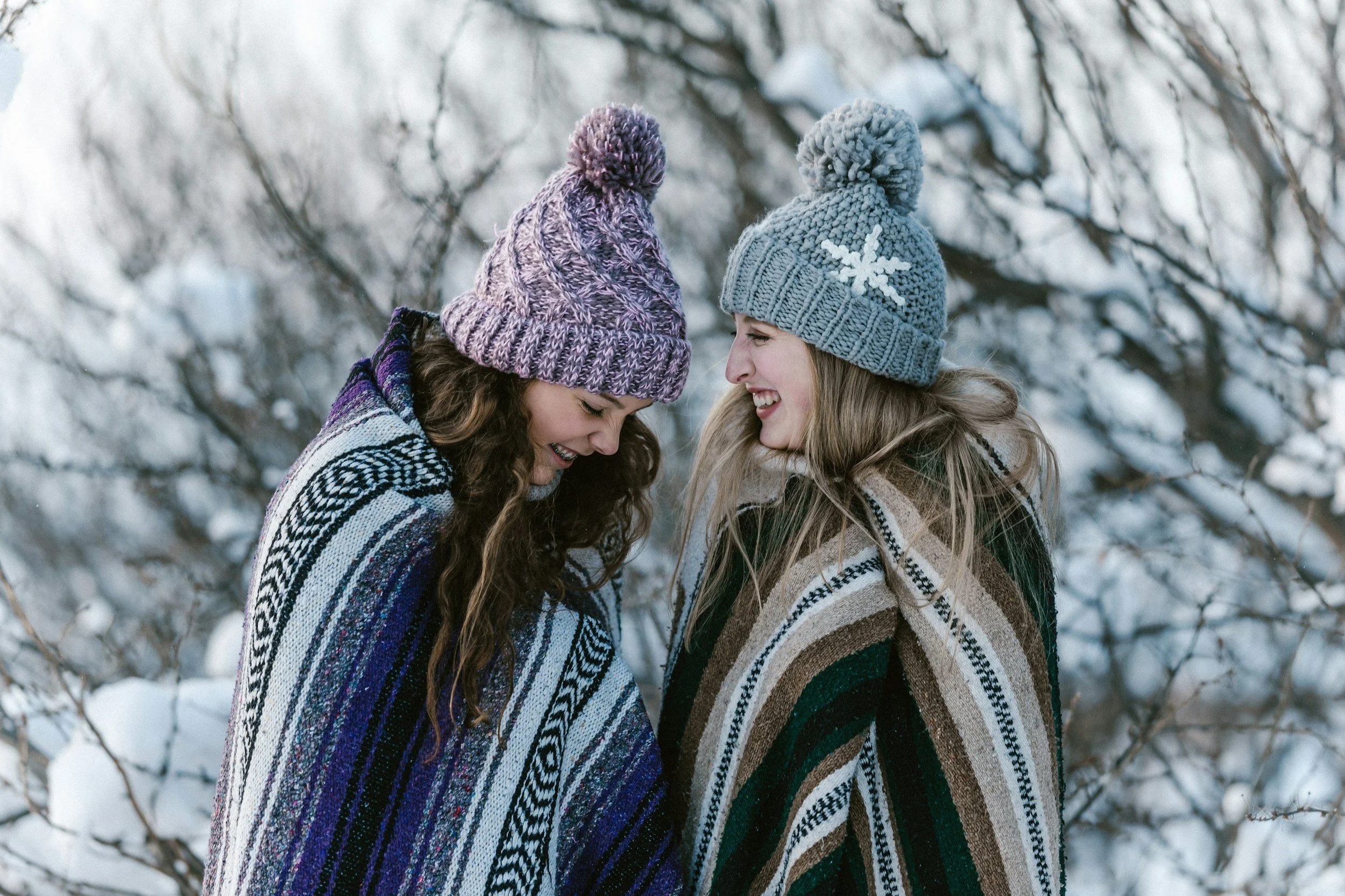
Friendship First: Celebrating Connection This Galentine's Day
Explore the joy of friendship, why it matters to your well-being, and how to nurture these bonds—especially in the isolating winter months.
Winter often brings a sense of stillness, but for many of us, it can also feel isolating. Long nights and cold days can leave us yearning for connection—those shared moments that remind us we’re not alone. This Galentine’s Day is the perfect opportunity to celebrate the friendships that light up our lives, especially during this quieter time of year.
Science tells us that friendships aren’t just nice to have; they’re essential. From boosting our mental health to supporting our longevity, these connections nurture us in ways we often overlook.
The Science of Friendship: The People That Hold Us Together
Friendship isn’t just good for the soul; it’s vital for our well-being. Research shows that meaningful relationships can reduce stress, strengthen resilience, and even improve physical health. Whether it’s a quick catch-up over coffee or a heartfelt phone call, these connections create a buffer against loneliness.
Positive psychology tells us that shared experiences strengthen our sense of belonging. Even simple rituals—like meeting a friend for a walk or laughing over a shared memory—build powerful emotional bonds.
Friendships also teach us the value of showing up for each other in small ways. Being present for someone, without trying to fix their problems, creates a space where both people feel seen and supported.
Practical Ways to Celebrate Friendship This Galentine’s Day
Friendship thrives on intention. Here are a few ideas to nurture your bonds this winter:
Host a Candlelight Dinner Tradition:
Invite a friend over for a simple meal by candlelight. Share stories, laugh, and enjoy the warmth of connection.
Create a Winter Walk Ritual:
Bundle up and explore your local park or neighbourhood together. The fresh air and movement can lift your spirits.
Swap Playlists or Books:
Share your favourite music or a novel that resonated with you. It’s a small gesture that sparks deeper conversations.
Start a Mini Friendship Project:
Whether it’s a joint craft, a collaborative journal, or planning a small adventure, working on something together strengthens bonds.
Gratitude in Action:
Write a short message to a friend sharing why you appreciate them. It doesn’t have to be long—just heartfelt.
How Friendship Changes Us
Friendships are life’s anchors, keeping us steady when we feel adrift. They remind us that life is a shared journey, full of laughter, support, and even the occasional tear.
This Galentine’s Day, celebrate your friendships in all their perfectly imperfect beauty. Honour the messy schedules, the missed calls, and the moments where you showed up for each other anyway.
And if you’re longing to deepen your connections, take the first step: reach out. Friendships don’t need grand gestures; they need small, consistent acts of care.
“Take a moment today to text or call one friend you’re grateful for. Let them know why they’re important to you. It’s a small gesture that can mean the world.”
Celebrate Friendship With Us
At If Lost, Start Here, we know how crucial connection is for emotional well-being.
Join us in celebrating the beauty of friendship. Sign up for our newsletter or explore our facilitated courses to find out more. Because life feels better when it’s shared.

The London Lonely Girls Club
Looking for connection in one of the world’s busiest cities? Holly Cooke talks to us about why she started The London Lonely Girls Club and how it can inspire you wherever you are.
“Stepping outside of your comfort zone, saying yes to every opportunity to meet others, being bold.”
We talk to Holly Cooke, founder of The London Lonely Girls Club about why she started these IRL meet-ups for women looking for connection and how this idea can inspire you wherever you are.
What is it? The London Lonely Girls Club is a community in London, created to help women in the city meet up, hang out, build friendships and make London life a little less lonely.
Why do people need it? As an adult, it can be really difficult to meet new people, make new friends or simply find others with similar interests or hobbies. And so The London Lonely Girls Club was created to meet this need and help women across one of the busiest cities in the world connect with each other!
What do you offer? We are both an online and physical community. We have an active Facebook group of over 10.5k women. Within this forum our members can post, engage and get to know each other at their own pace. Alongside this, we run meet-ups multiple times a month where our members can get to know each other IRL whilst visiting some of London’s loveliest places or doing fun activities together.
What makes it different? The London Lonely Girls Club was specifically created to help women connect, make friends and beat loneliness. It’s as simple as that, no strings attached!
What do people need to know? LLGC, as we call it, is an inclusive, supportive, fun community that any woman in London can engage with in their own way. Whether they’re just looking to find someone to go on weekend walks or theatre trips with, advice on the best place to get their hair done in a specific part of northwest London, or to build lifelong friendships, everyone is welcome!
What’s your story? Before founding The London Lonely Girls Club, I was a very lonely girl living in London. I’d moved to the city for work and to fulfill a lifelong dream of living in the best city in the world. But very quickly moving to a city where you know absolutely no one can be both isolating and terrifying. From this The London Lonely Girls Club was born, a community created to bring the women of this incredible city together under the flag of unity, connection, and friendship. With meet-ups each month that allow people to connect in person, rather than just via a screen.
How can people be inspired by your initiative wherever they are? Every day the members of LLGC teach me about bravery and courage, whether it is sharing their story in our group’s main feed and looking for others who share a similar struggle or journey, stepping outside their comfort zone by coming along alone to our monthly IRL meet-ups and connecting with others in person over a coffee, burger or glass of wine, or simply revealing themselves by joining a community with lonely in the name.
I think this is something that can inspire everyone, no matter where you live, how you identify, or what your social situation is. Stepping outside of your comfort zone, saying yes to every opportunity to meet others, being bold. Just one small decision of courage really can change your life, I should know, it did mine!
Where inspires you? The women of our community and the incredible city that we live in. They’re both so inclusive and diverse and vibrant and loud and unapologetic, but also kind and supportive and beautiful. It is inspiring to get to be just a small part of these things.
Anything we’re missing? If a woman in London is reading this, then we’d love to have you be part of our community! Whether you’ve lived here your whole life or you moved a day ago, feeling lonely is the worst. As humans, we’re built to be in community, surrounded by others who can lift us and love us and support us during both our triumphs and challenges and that is what The London Lonely Girls Club aims to do.
To find out more visit: Our website | The LLGC FB community | Our social media


Discover more places to feel connected

When Friendship Saves Us (Part 3): Our Take on Modern Love
This weekend, we’re celebrating our female friendships, the people who really help us find our way when we are lost. For our co-founder Claire, that’s Amanda, our other co-founder. Here’s some of our story.
I imagine getting comfortable before take-off on the plane back to England. Putting electronics in flight mode. Fastening my kids’ seat belts. Looking over the in-flight entertainment options with my husband. And then fleeing down the aisle. Stop, wait, don’t close the doors. Then running, running through the airport, the soundtrack kicking in, grabbing a taxi (after someone steals the one I want), to get to her. Amanda. Like the last scene in the romantic comedy, but this time I’m running to my best friend, and like a movie, I know that this is a fiction too.
Watching the end of Book Smart recently, I had a thrill of recognition. About to leave on a gap year to Africa, Amy comes back from Departures to her best friend Molly, for one last pancake, before getting on the flight late. I texted Amanda, “That’s us!!!” And although we’ve never eaten pancakes together and despite the fact that I arrive at the airport three hours in advance and couldn’t possibly be late, we thought that sounded about right.
In my final weeks in California before returning home after 13 years away, I seek out time with Amanda. She overrides my not-yet-filled bucket list. I choose her over the Golden Gate Bridge, over Napa wineries, over Stinson Beach sunsets. I choose barista-style coffee made by her 11-year-old, socially distanced in her garden, over Blue Bottle pulled by hipsters in San Francisco’s Ferry Building. I choose meeting her down by the creek in our little town over a road trip to Lake Tahoe, crossing stepping-stones over a quiet stream rather than riding jet-skis on alpine-fed horizons. In our last days together, I’m aware of making the promises a teenage girl would make to a best friend. “I will love you forever, we will grow old together, our kids will be best friends always.” But this time I mean them with the sincerity of a middle-aged woman who knows what commitment is and what true love can be.
When I met Amanda, the friendship that was designed to blossom was between our sons, both aged five and about to enter the same kindergarten class. It was a practical arrangement and it resulted in the connection we’d hope for our boys. But it was the two of us—with our new baby girls in slings and relentless nursing habits—who found a friendship neither knew we needed. For my daughter Ottilie, now aged 6, Amanda has become her second mum, though she calls her ‘Grandma,’ which befuddles us. Amanda’s daughter Willa is of course her sister-friend and they fight and love each other accordingly. Six years later our sons are like cousins, affectionate but sometimes confused by what connects them, aware only that it has something to do with family. My husband calls Amanda my real partner; she calls herself his wife’s wife.
I’d seen Amanda around town before that first blind playdate. I saw her when she toured the preschool where my son went, but she was Nikki’s friend, unattainably beautiful, and she chose not to go there, so our relationship never began. I saw her again when I was playing in the park and she was walking by, in labor, with her mum. To me, several months pregnant and puking every day, terrified of childbirth and ready to check myself into hospital weeks in advance in case something happened, she seemed a nonchalant goddess who would drop the baby and make magic happen. I felt fumbling and unsure, she looked resolute and dreamy.
In that unexpected way of life, it was Amanda that I would come to share the next years with. We would raise our girls and our boys together—navigating schools and relationships, work and shifting bodies. She taught me how to text with emojis: “It hurts my feelings when you don’t use them.” I learned that nature wasn’t terrifying and that hiking a trail alone did not mean instant murder. She showed me that kind could also mean strong, that humor didn’t need sarcasm, that the fears I had, she had too. I became vegetarian, because she’s vegan and I can get closer to that (though not quite that far). I know now that maple syrup makes everything taste better. I’ve become an unembarrassed fan of all things Disney. She sends me texts at night that I answer in the morning, because I go to bed early and she seems unoffended by that. She takes me to concerts, though live music makes me feel awkward; it’s her happy place and she wants to share it. We tell each other that “we are amazing,” without irony and with joy. Amanda was the first person I hugged post-lockdown.
In our last couple of weeks together during this odd coronavirus-threaded summer, I tread carefully in conversations about home. My husband and I had long contemplated the move back to England after too many trips home ended in tears at Heathrow. My best friend and I had known this was coming; it hung around us like a diagnosis we tried to put aside and that we often forgot. In what we thought would be our last year in San Francisco, the pandemic put paid to our plans and Amanda and I relaxed again into our time together. I realized that I could endure everything that lockdown had removed, except seeing her. That realization hit hard. Then my husband lost his job in the theater, which meant we had nothing to tie us to California. The decision to return home came quickly and forcefully. Moving back to England took on an urgency that neither of us has been prepared for and that I can’t ignore, much as I want to. We’re now down to three weeks and counting, no longer in the maybes and perhapses that chased our time together.
Together yesterday—the girls on the trampoline, the boys wondering what shared activity they could find—I try not to flinch when Amanda mentions a new friend she’s taking daily walks with. Past my house, up through the winding paths of our hill. I imagine them walking by when new people are here in my newly-sold home, saying, “I knew someone who lived there once.” I start to cultivate bruises of loss. But Amanda has taught me in our years together that love is boundless, to be shared. I allow myself to be the better person she believes me to be. “I like Hilary,” I say, “That sounds nice.”
Because I know this too. We are golden: she’s my Anne Parker, my Christina Yang, my Abby Wambach, my Rayya, my Farly, my person. Like women before me, I love my best friend. We have filled a space, begun a story, that women have navigated for centuries: Bringing up children together, finding support through our anxieties, spending hours in whispers and laughs. Making the in-between times count for more than the major moments of our lives.
Sitting on a packed suitcase in what will be my old bedroom with too many things that don’t fit and yet have nowhere to go, I hesitate. Why leave? But I know there is nothing I can do to stay here, in this moment, with her.
I have chosen: my home country that I left when I was 30. I will return there with two children whom I want to experience that home too. I’ve chosen grandparents and brothers and cousins that I’ve never quite learned to live without. I’ve chosen green fields and cozy pubs and heavy coats and clearer seasons and self-deprecating humor and supermarket shelves speak my language.
On paper, the decision makes sense. The conversations justifying our move make all the sense. The plotting—yearly plans with schools and budgets and careers and timing—makes sense too. Leaving Amanda makes no sense. And it matters nothing because I can’t get off the plane and unbuckle my children and walk down the airplane aisle with my husband to run to her and say, I love you. You are my home and I will stay with you forever. Let’s build something that will hold us and a future we can name.
When I imagine that plane ride home—now with wipes for the seats, premade snacks, stickers and coloring pads in Ziploc bags—I imagine listening as the flight attendant instructs us about what to do in an emergency. “First put on your own mask,” he’ll say. “Take care of yourself first.” But like everyone else on this plane, I know that if it came down to it, we’d put on our family’s oxygen first and save ourselves last.

When Friendship Saves Us (Part 1) : Our Take On Modern Love
Friendship offers a purity that is complicated only by the fact that there is nothing legally binding you to one another. Nothing to say, “if you leave you’ve got to give me a house or a boat or half of your grandmother’s jewelry.” Just this love that lingers in space, vulnerable, subject to the whims of men.
She’s moving back to England and I can’t come. (Obviously.)
Because the thing about friendship is: you don’t plan your life around people that you’re not having sex with. (Which honestly feels a bit barbaric, to me, but ok.)
Finding romantic love has long been considered the gold-standard of human achievement, evidence that we are worthy of a lifetime of devotion, or, at the very least, that we are tolerable enough to withstand for the better part of a lifetime. Romantic love is a precisely choreographed dance, the steps of which will never be revealed; a high-stakes game with loosely-defined rules and a massive potential for loss. On the one hand we’re expected to foster an impossible level of comfort and security. (We hurl forth our hopes and dreams, crossing our fingers that we’ve found someone who will see them and share them and keep them safe … someone who won’t be sent fleeing wildly in the opposite direction.) On the other, we’re implored to maintain a similarly-impossible level intimacy, eroticism and mystery. (If you’re not popping out from behind the dresser in a French-maid costume or developing a new mental health disorder every month, are you even trying???)
Friendship does not exist on this same playing field, or within this same town, or even within this same earthly realm. Friendship is an ever-available gift from the gods. An opportunity for connection and closeness without ever having to talk about mortgages or school districts or pills for sad penises.
Friendship is unburdened by such trite matters. Friendship does not care about flaccidity, or project-based learning or “interest rates we should really capitalize on.”
Friendship offers a purity that is complicated only by the fact that there is nothing legally binding you to one another. Nothing to say, “if you leave you’ve got to give me a house or a boat or half of your grandmother’s jewelry.” Just this love that lingers in space…vulnerable…subject to the whims of men.
When I first met Claire, she was sailing a paper boat down a stream, giggling with her young son in a fashion that suggested she was probably a nanny and almost definitely a little bit drunk. (She denies both claims.) I fell for her her all the same. Her lightness, her ease, the way she smiled and laughed, the way I could see her walls…the way I knew before she did that they’d start to fall.
We first bonded over the fact that we both had children. Not that they were similar or that we were raising them in the same way or that they even liked each other, just that they existed and that we had birthed them within the same relative time frame. (This, I’ve discovered, is as good a reason as any to develop an adult friendship.)
The unfolding was slow. I forgot her name multiple times and was forced to introduce her to some unsuspecting acquaintance who found himself lingering nearby so that she’d have to tell them her name). We had no real reason to meet so we’d just happen upon each other, at the houses of mutual friends, at the park, by a stream. (Stalker stuff.)
Years later, when it came time for us to produce our requisite second children, both of us managed to hold out for an ungodly 5 years. While the rest of the world went on to space their children perfectly, precisely, methodically, 2.6 years apart, here we were, bucking the norm, starting over after half-a-decade. (Her, because she’d had a successful career and seemingly unlimited ambition…me, because my body wasn’t very cooperative and that I was busy stock-piling mental and physical health disorders.)
The first time I saw her after having the baby, I forgot to ask the baby’s name, or when she’d had her, or if she was so tired she might die. We just sort of stood there on the sidewalk making small-talk, smiling vaguely … each of us pretending to be ok.