
Struggling With Comparison? Rethinking Confidence and Self-Trust
Comparison and competition can quietly shape how we see ourselves. In this conversation, we explore confidence, self-trust, and the beliefs we carry through life.
This is how it might go. You’re scrolling, or reading, or listening to a podcast, and you notice a flicker of feeling when someone else shares good news. A promotion. A book deal. A confident post about work they love. You’re pleased for them — genuinely — and yet something tightens. A question forms that you don’t quite want to look at too closely.
What does this mean about me?
Moments like this don’t usually come with drama. They’re small, everyday, easy to brush past. But they can linger. And over time, they shape how we see ourselves, how we show up at work, and how much space we allow ourselves to take.
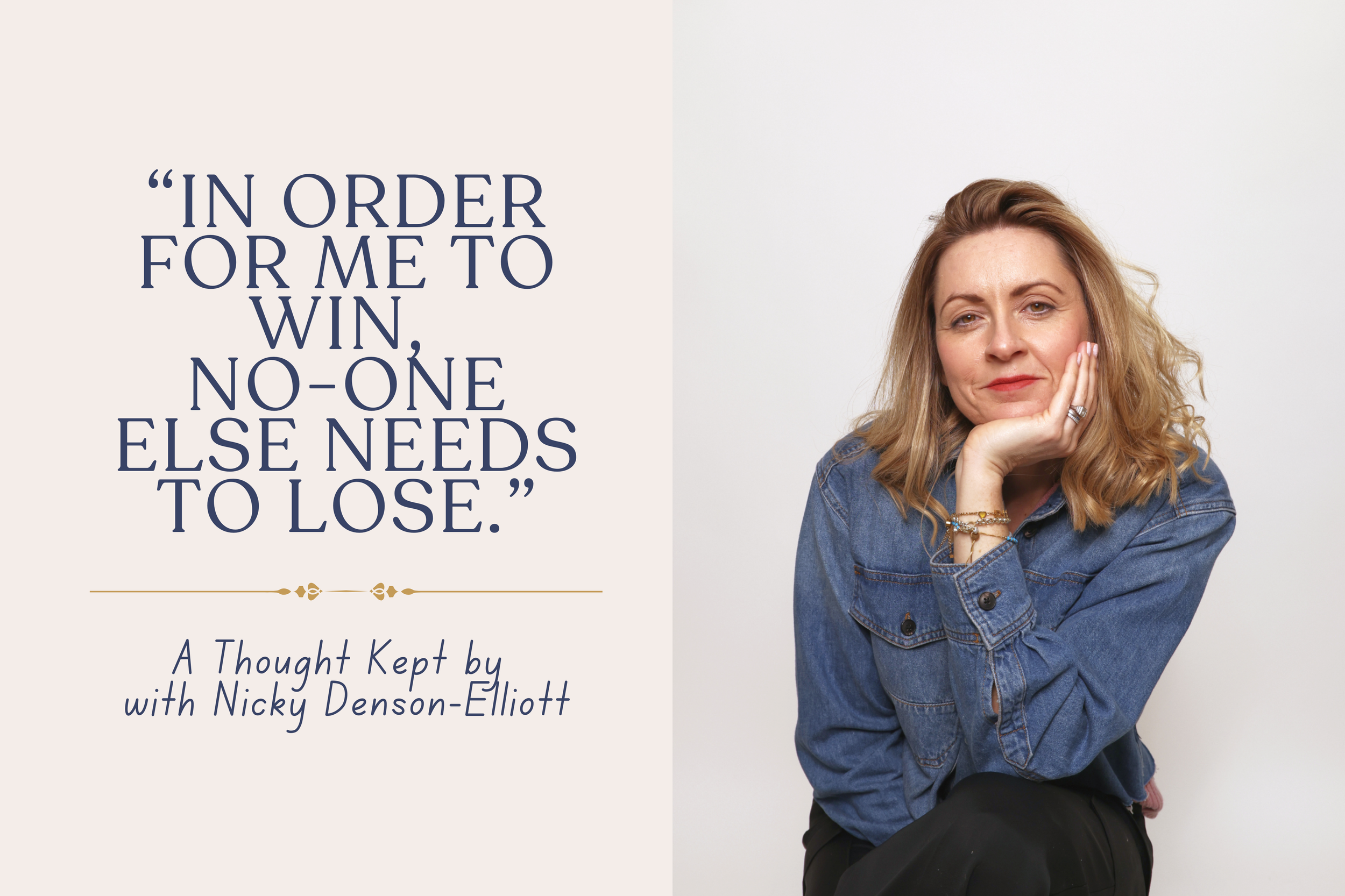
This week on A Thought I Kept, I spoke to Nicky Denson-Elliott, and she brought a thought that disrupted that familiar inner pattern:
In order for me to win, no one else has to lose.
It’s one of those ideas that seems obvious when you first hear it and then quietly radical the longer you sit with it.
Because so much of our inner landscape has been shaped by the opposite belief. That success is scarce. That confidence belongs to certain people, not others. That if someone else steps forward, there’s less room for us. These ideas don’t usually announce themselves as beliefs. They show up as feelings: comparison, jealousy, self-doubt, hesitation.
Nicky spoke about how deeply this conditioning runs, especially for women. How it can shape our relationship with money, confidence, and visibility. How it influences the way we price our work — often not based on its value, but on what feels safe. How it quietly sets women against one another, even when connection and solidarity are what we most want.
What’s important here is that none of this is a personal flaw. These are not thoughts we invented. They’re learned. Reinforced. Picked up over time in workplaces, families, schools, media, and culture. When they surface, they can feel intensely personal but they rarely originate there.
And when life already feels full or uncertain, carrying these inherited ideas can make everything heavier. You might notice it in how hard you are on yourself. In the way you second-guess decisions. In the tension you feel around confidence — wanting it, distrusting it, worrying what it might cost.
One of the most grounding parts of the conversation with Nicky was her refusal to replace one set of rules with another. There was no invitation to be bolder, louder, or more confident in a performative sense. Instead, she talked about noticing. About recognising when a familiar reaction appears and asking, with curiosity rather than judgment: Is this actually mine?
That question alone can create a shift.
Because when we start to see that some of our thoughts are inherited rather than chosen, we don’t have to wrestle with them in the same way. We don’t have to argue ourselves out of feeling jealous or small or unsure. We can simply recognise the pattern, and loosen our grip.
This matters not just for our inner world, but for how we move through everyday life. Especially work. Especially relationships with other women. Especially moments where confidence feels like something other people have access to, and we’re still figuring it out.
Letting go of the myth of competition doesn’t mean pretending everything is fair or easy. It doesn’t mean denying ambition or discomfort. But it does open up a different orientation — one where someone else’s success doesn’t automatically diminish our own, and where confidence can be something we grow into, rather than something we perform.
For many of us, this kind of rethinking doesn’t arrive as a neat turning point. It shows up gradually. In small pauses. In moments where we choose not to rush to judgment — of ourselves or others. In the realisation that uncertainty doesn’t mean we’re failing; it often means we’re paying attention.
If you’ve been questioning old ideas about success, money, confidence, or what it means to be doing “well” in life, you’re not behind. You may simply be noticing that the old maps don’t quite match the terrain anymore.
Nicky’s thought offers a steadier way of orienting. It reminds us that life isn’t a zero-sum game. That generosity — toward ourselves and others — isn’t naïve, but grounding. And that self-trust doesn’t come from fixing or perfecting ourselves, but from recognising which beliefs were never designed to support us in the first place.
You don’t need to know what comes next. You don’t need to replace every thought at once. Sometimes it’s enough to notice which ideas make life feel smaller, and to wonder — without urgency — what it might be like to set one of them down.
If this resonates, listen to the full conversation with Nicky on A Thought I Kept.
And if you need help exploring some of the feelings you have around comparison — jealousy, self-doubt, hesitation — or what confidence even means to you, explore our emotions coaching sessions.

Freedom Apothecary
A holistic wellness space and boutique for radical self-care in Philadelphia puts women at the center of all it does.
What is it: A holistic wellness boutique in the Northern Liberties neighborhood of Philadelphia that’s all about empowering women.
What you need to know: Co-founded and led by women, the inspirational Morissa Jenkins and Bonkosi Horn, Freedom Apothecary stocks female-owned brands that they trust and that share their same values around clean living, many of which are by women of color.
Why you’ll love it: Opened in the summer of 2019, Freedom Apothecary reflects Jenkins and Horn’s shared aim of a place that goes beyond just products, to one that also holds women in community, fostering connections, and sustaining relationships, with themselves and others. The light-filled corner store space with its calming arrangement of products on natural wooden shelves, dried moss wall behind the register over which the words FREEDOM are set, and the abstract mural by local artist Dora Cuenca, set a tone of welcome and openness, a space for self-care and in which to pause.
How to bring this into your life: We all need some self-care right now. During closed times when their in-person treatments and their blend bar for personalized products are on hold, you can still shop Freedom Apothecary’s selection of skincare, cosmetics, and wellness products. Favorites include the Green Tea Body Butter, Gleaux Body Balm, and Rose Face Oil – all made by Morissa – as well as brands Botnia and Noto. Or book an at-home botanical customizable facial. During open times, Freedom Apothecary offers a range of workshops in its event space that make wellness an attainable priority in our everyday lives.
Why we think it matters: Morissa and Bonkosi take the idea of “radical self-care” – in short (there’s a long history here – see below) caring for yourself first before you care for others — and gives it foundational support in holistic wellness and a physical space. Freedom Apothecary is targeted at “anyone who has skin”, with the belief that anyone can practice self-care, including black women and women of color for whom the concept of their own healing has historically (and still) been pushed aside for their healing and support of others in their family and community. Wellness here is a political act, one of resistance and empowerment.
Morissa and Bonkosi set out to consciously create a place of support and safety, to extend inclusivity in concepts of wellness and the industry that supports it (often itself whitewashed), and to provide access to clean, non-toxic products (shifting who has access to them and who gets to make them). Freedom Apothecary is ultimately about helping all women find themselves, to give space for whoever they can be, and allowing for whatever it is they need.
Freedom Apothecary contains in its name the ethos they hope to promote, both freedom from toxic products that actually harm our bodies, our selves and our planet, and freedom as it pertains to choice, to live our lives in our own way, one that allows ourselves to be nurtured and to support ourselves in ways that we need.
In their own words: “ We create space for women to empower women. We are women-founded, women-led; we provide a platform for female-founded brands; and ultimately, we foster dynamic, inclusive and brave healing spaces for all women.”
Inspired by Freedom Apothecary to: Read activist and feminist writer Audre Lorde’s A Burst of Light: “Caring for myself is not self-indulgence, it is self-preservation, and that is an act of political warfare.” Wellness means something very different from wherever it is we are standing, it's affected by race, gender, and class. Even the idea of self-care has become shaped by privilege and inflected with insta quotes and spa days. Reconnect with its activist history: How people (and particularly people of color) are able to look after ourselves is navigated within how the world allows us to do so and the importance it puts (or doesn’t put) on our own health and wellbeing.

Cafe Con Libros
A feminist bookstore making vital space for the stories of women and girls.
What is it: An intersectional feminist independent bookstore and coffee shop in Brooklyn’s Crown Heights neighborhood.
Why you’ll love it: Café Con Libros was founded by Kalima DeSuze in December 2017 when she made real the space that she wanted to see in the world, one that could hold the stories of womxn and girls – stories which have overwhelmingly been sidelined in favor of those of male voices – for those who want, need and are open to hearing them. Though intimate, the reach of the store is wide, bringing together on its physical and virtual shelves an abundance of books by female authors (99% of the selections are books by, for, or about womxn), including those beyond the continental US and by LGBTQAI+ writers.
Why we think it matters: During normal times, Café Con Libros is very much a community space for female-identifying folx; it's somewhere to hang out and be as much as it’s a bookstore. As Kalima says, the spaces that we create are political. Who holds physical space, what that space is used for, and even the stories these places are allowed to tell has meaning on a personal and collective level. Bookstores like Café Con Libros hold not just the stories within pages that we need to hear, but stories within a place that allow for all possible futures, for nurturing relationships, for community action, and for extending our learning together. As Kalima notes: “It’s time that womyn’s stories be prioritized and that a space exists explicitly for and about womyn. So many of our spaces are male-dominated; even the ones that are created solely to be for and about womyn. My womyn only spaces have served as a healing tonic and, a reminder of whose shoulders I stand on. It’s important that more of our girls and womyn have access to such warmth and mirroring.”
How to bring this into your life: As mothers of young daughters, we’re excited by the monthly subscription boxes, which include an option for baby feminist board books for the zero to fives and emerging feminist books for kids aged five to nine. There are also subscription boxes focusing on womxn of color and for the feminists among us. You can also join one of two book clubs that meet monthly (on zoom during shut-door times): either the Feminist Book Club which focuses on a book by, for, and about womxn, or The Womxn of Colour Book Club, a reading space and conversation for womxn of color. There are also virtual read-a-longs and a monthly podcast Black Feminist & Bookish, hosted by Kalima.
In their own words: “ We value: family. community. justice. art. transparency. accountability. equity. equality. authenticity. joy. solidarity. earth. the brilliance and possibility of imperfection. love.
We respect and value the contentious history womxn of color have with the word "feminist;" the tension hold us to account to live our Black Feminist and Womanist principles in real and measurable ways. We were born from and are guided by the lush cannon of Black Feminist thought producers and activists; the space endeavors to be intersectional, inclusive and welcoming of all who stand with and on behalf of the full human rights of womxn and girls. We seek to advance and uplift stories of womxn and girls around the globe who are redefining the word feminist and feminism with every day, ordinary culturally informed acts of resistance and love.
Something to inspire: Try a reading challenge: purchase, support, and read books only by womxn, or womxn of color, or by LGBTQIA+ writers for 3, 6, or 12 months. Change your knee-jerk choices in what you’d ordinarily see or consume. Extend this challenge even further to include podcasts, TV shows, films, and music that are by, for, and about womxn. This not only helps our own understanding of the ongoing pursuit for gender equality but the choices you make in where you put your attention and your money indicates to the industries behind them – the entertainment, publishing, and culture industries – what it is you really want to see.

The Vagina Museum
The world’s first museum is more than a display of gynecological anatomy. It’s dedicated to a serious discussion of women’s health, feminism, and sexuality.
What is it: The world’s first bricks-and-mortar museum dedicated to what have often been the unmentionable parts of a woman’s body.
What you need to know: Now in its starter space in Camden Market, The Vagina Museum has serious ambitions — the hope is for a permanent larger space in the next couple of years — and serious credentials — founded by science communicator Florence Schechter with sex tech entrepreneurs and gynecologists alongside global health specialists on hand to advise. Get over the titillation/gawping/shock factor (of which there is very little – this is not the vibe) and you are down to vital questions around gender and sexuality, feminism and equality, health and reproductive rights. With exhibits like Muff Busters and Periods that go straight to the taboos, The Vagina Museum takes on what we think we know about women’s bodies and what we actually need to know.
Why you’ll love it: A lot is going on down there and as women, we know there are impacts that go beyond biology (hopefully some of our menfolk know that too now). The mission statement in itself has us excited from raising awareness of gynecological health through to ‘challenging heteronormative and cisnormative behaviour.’
Why we think it’s different: Come on, it’s a museum about women’s bits, about vulvas and vaginas, and the other parts that gynecologists rather than the museum-going public are more acquainted with (though let's face it half of us have them so there’s a contradiction there).
Women’s bodies have been horrifically and frustratingly relegated. Men’s bodies have been used as the standard for modern medicine, women take medicines constructed with the male anatomy in mind, women’s pain is often minimized, we even have longer waiting times in A&E, students are only now learning about menopause along with sex education in schools, and serious mental health symptoms are often put down to gender-biased ideas of hysteria, anxiety, and emotional spirals. Also, there has been a 500% increase in vagioplasty between 2002 and 2012, period poverty still affects thousands of women and girls worldwide, and 200 million women and girls globally have undergone female genital mutilation. We could sadly go on and on.
But for now, let’s add to that list: that many of us who identify as women can point to moments when our own experience of our bodies and minds weren’t taken seriously and understood in ways that could have helped us see a way through and got us the help we needed.
Get beyond saying Vagina, and you get to some of the starkest issues facing women today.
How to bring this into your life: Severely impacted during the spring lockdown, The Vagina Museum has just completed a successful crowdfunding project to reopen in October. To continue their work and continuing operations, you can support them through the online store. Their FAQ’s also has one of the best guides as to the difference between vulvas and vaginas that we’ve read for a while (maybe even ever) if you need an anatomy refresher.
In their own words: “The aim of the Vagina Museum is to destigmatise the vagina, vulva and gynaecological anatomy. Through destigmatisation comes empowerment for all people with vulvas. …. feminism has fought very hard to have women viewed as something other than objects, as people and not just sex objects or baby vessels. Objectification of women is wrong. But for many people, their vagina is a part of their identity and directly affects their lives. It is one part of a greater whole that makes the person. By shutting down discussions about vaginas, it makes it difficult to address issues that are directly related to them like FGM and sexual violence. That must end and the first step is by acknowledging that vaginas exist and they deserve respect.”
To find out more: Website / Facebook / Instagram / Twitter
If you’ve visited The Vagina Museum or you know of other places that look at a healthy connection between women’s minds and bodies let us know about it. Things change all the time and we want to make sure we’re bringing you the most up to date information and the latest places.