

Hoxton Street Monster Supplies
Now allowing in humans, this store has everything the monster in you needs (and a not-so-secret cause behind it all).
For: monsters of every kind struggling to find the supplies they need to get through their ghoulish days and humans of all ages looking to restore make-believe in their lives.
What is it: One to enter at your own risk, this quirky store on an ordinary-looking street in Hackney is maybe the only one in the world (that we know of) that stocks “Bespoke and Everyday Items for the Living, Dead and Undead’.
What you need to know: Escape into your imagination with a store that is really one of its kind: since its murky start by newly exiled Igor the 1st in 1818 and its tentative steps into the human world in 2010, it has been serving everyone and everything with the kind of canned and boxed delights that any self-respecting creature needs, the fang floss, breath remedies, and dragon treats on our shopping list.

How to bring this into your undead life: Wherever you are, your way into this world is definitely via witty and fantastic products like their Salt Made from the Tears Shed while Home Schooling, Mummy’s Sewing Kit and packets of powdery pink brain food. If you live locally, volunteer to help brave visitors survive the store or become a writing mentor in the Ministry of Stories.
Why we think it’s different: Beyond its license to sell ‘items including, but not limited to: Malodulous Gases, Children’s Ears, Gore, Fear (tinned only)”, behind a secret password guarded door is The Ministry of Stories , a creative and mentoring charity for mini-humans aged 8 to 18.
The not-for-profit was started by About a Boy / Fever Pitch / High Fidelity writer Nick Hornby with Lucy Macnab and Ben Payne and was modeled on Dave Egger’s 826 Valencia. The aim of the classes here is to make writing fun and accessible across all genres from gaming to screenwriting, cookbook contributions, and graphic novels, and to build the confidence that comes with creative adventures on the page experienced in a supportive community.
It’s now been widely published that there’s a curse in the store – that makes all profits go to the Ministry of Stories. As Minister of Fluency, the beloved by us and many a monster, Colin Firth declares “you know your helping to support the business of the imagination with the next generation”, so maybe this is one hex that we humans won’t venture to break.

In their own words: “We pride ourselves on being London’s, and quite possibly the world’s, only purveyor of quality goods for monsters of every kind. Many of our customers have been coming to us for centuries. Indeed, some have been coming for considerably longer. Whether you’re a Vampire, Werewolf, Sasquatch or something else entirely, we have everything you need.”
Something to inspire: Short of attempting to rebrand everything in our homes – will our kids go with water if it’s the elixir of life – look to ways to bring in the make-believe. In a year, when we’re been abruptly pulled up by reality, there are ways of escape that might be nearer than the dream destinations we’re been longing for – retreats made in our minds, and played out in worlds of our own making. Even travel bans can't go there. But monsters can.

Chapter 510 and the Department of Make Believe
Need permission to dream? The Department of Make Believe gives you, and kids in Oakland, exactly that.
“I am rooted here
because this city reminds me of who I want to be
is the only place that accepts me for me
provides my tension as well as my release
lets me be all of my selves.”
What is it: A writing, bookmaking, and publishing center for Oakland’s youth fronted by a rather fantastic magical bureaucracy.
Why you’ll love it: Words matter. They give us pathways, allow for hope, shape the sense of our lives, and of ourselves. Through writing, bookmaking, and publishing workshops and camps, Chapter 510 brings words to those aged 6 to 18 living in Oakland. Here poetry is used to imagine better futures, storytelling to explore Black Joy, and songwriting to address racial injustice and the impacts of the pandemic.
Why we think it matters: By providing access to creativity, Chapter 510 also teaches confidence, joy, and courage. Through authoring essays and stories and magazines, Chapter 510 creates eager learners and leaders, future change-makers and creatives. By establishing a learning center led by teaching artists, volunteers, and educators, Chapter 510 makes a safe and supportive space for the youth in their community. It’s a place that invites all people to make-believe, whether shopping their magical products or attending one of the programs.
In their own words: “Chapter 510 is a Made in Oakland literacy project focused on developing creative and expository writing skills for students. Founded by parents, educators, writers, and youth-serving organizations, Chapter 510 shares a vision for Oakland as a place where we make our children and their perspectives visible; where teachers are honored and supported; and where we expand our community’s belief in its own possibilities.”
Something to do: If you live locally, volunteer to teach, tutor, or mentor. Or volunteer your design skills, your time, your other abilities (they are very open about who they need to support their mission - if you can help and want to help, you can apply to volunteer here). Even as classes go online during the pandemic, there are opportunities to help continue the work of Chapter 510 remotely.
How to bring this into your life wherever you are: You can now dream virtually from home with capsules of dehydrated courage and liquid procrastination.
To find out more: Website // Facebook // Twitter // Instagram
If you’ve visited Chapter 510 and the Department of Make Believe let us know about it. Things change all the time and we want to make sure we’re bringing you the most up to date information.

Tomato Education
Emotional Intelligence isn’t just for us grown-ups. Agata Dela Cruz talks to the owners of Tomato, a consciously designed toddler space in London about how it’s also for our little ones.
“Our approach promotes peace and a sense of interconnection with nature, one another and our diverse world. All our services and workshops are created with the intention to strengthen a family’s ability to be happy and healthy.”
Located on a leafy high street in East Finchley, London, Tomato Education is a Montessori-based community space dedicated to enhancing the emotional wellbeing of infants and toddlers. We love it because everything about the concept — from the physical space, the curriculum and community inclusion — has been designed to make families feel connected in unique ways that support their children’s learning experience.
We had the opportunity to talk to Laura Alvarado and Beth Fordham, the founders of Tomato Education, who both believe in prioritizing emotional wellness over academic success. As seasoned educators, former students, and now parents of their own children, they shared the same adverse reactions to the lack of mental and emotional support in the traditional school system. As Laura told us: “I’ve tutored since I was 16 years old and I’m 32 now, so that’s 17 years of continuously working with children and parents. In that time, I’ve seen a decline in children’s mental health and I’ve seen the rise and stress in parents.”.
But it wasn’t until 2017 — when Laura noticed in her neighborhood of Highgate, North London, that there were numerous holistic well-being establishments for adults but nothing for children — that the concept of Tomato Education was born.


At Tomato Education everything is viewed as a learning opportunity. Laura has a deep belief that teaching is absorbed through a child’s caretakers, their environment and the wider community. Tomato Education holistically integrates all three.
For starters, the environment of the learning studio has been carefully considered for how it affects the emotional well-being and development of children. The child-sized furniture, low shelves, and easy access to supplies and activities encourage children to foster a sense of independence and self-confidence when learning new skills. The muted colors, clean and organized wall spaces, natural lighting, and the presence of plants are all there to create a calm and soothing environment that allows children to focus and learn.
The classes and group sessions that are offered encourage the participation of parents to support and observe their child as a way to immerse themselves in understanding the Montessori method. Parents and teachers are encouraged to not intervene in the classroom, but rather to allow the children self-discovery, and what Laura calls the space to enter into "flow states." This practice allows a parent to learn about their child in a whole new way. It also offers an opportunity to extend some of the mindfulness principles Tomato Education teaches to their homes and beyond.
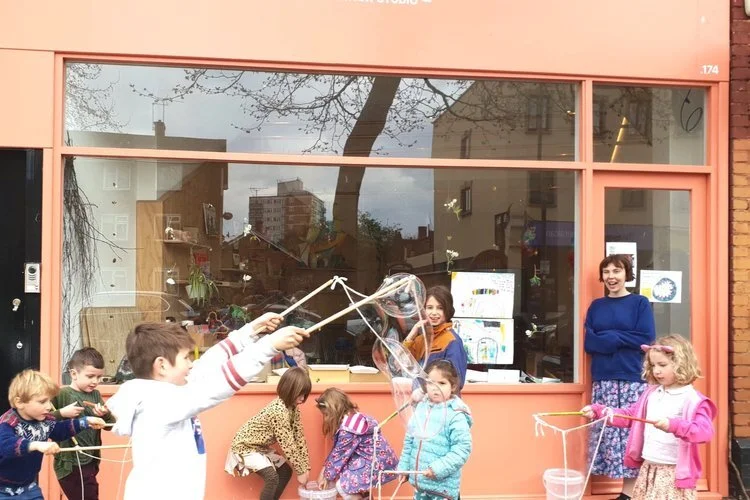

And Tomato Education is a place that welcomes a diverse range of families from all cultural and economic backgrounds. The studio space strives to be a place for parents to meet and build connections with others vested in the development of their children. Laura told us: "We arrange community bonding activities for our parents outside of all the child activities. We will try to do nights outs, going to a park or a coffee shop. Through those activities, parents become good friends and then they have birthday parties together with all their children so there's a lot of social events, which makes the community feel real."
Which benefits not just these children and their caregivers, but the community beyond. As our children learn so do we; their capacity for emotional intelligence allows us to stretch too.
To learn more about the programs and activities available at Tomato Education visit Website, Instagram and Facebook

826 Valencia
826 Valencia is keeping space for our kids’ imaginations in our cities, and crafting magical spaces for our communities and for ourselves as it does so.
“826 Valencia is a non-profit organization dedicated to supporting students ages 6 to 18 with their creative and expository writing skills, and to helping teachers inspire their students to write.”
Yes, you might think you have just found yourself in a quirky pirate store or an octopus’ playground or a secret spy society, but what you’ve done is landed right at the heart of a non-profit organization that exists to support the writing skills of under-resourced kids. Maybe purpose is like medicine and you need some sugar to help it go down (not sure who does that other than Mary Poppins and her charges but it’s an association that’s stuck). For 826 Valencia and its network of storefront chapters across the US, the sugar takes the form of magic and the imagination: each of their much-needed writing centers are fronted by spaces of whimsy and curiosity.
From its start in San Francisco’s Mission District in 2002, a delightful sense of wonder has been built into how the organization has crafted itself: the first flagship that opened at 826 Valencia Street by educator Ninive Calegari and author Dave Eggers took the form of a pirate store mostly as a workaround for a local zoning issue that demanded some retail component. So of course, pirates need stores too. That model of locating the idiosyncratic in the everyday has inspired further storefront locations across the US; there’s the secret agent supply store (Chicago), a magic shop (Washington), a time travel mart (LA), a robot supply and repair shop (Michigan), a Haunting supply store (New Orleans), a Super Hero Supply Store (NYC), and maybe our favorite the Bigfoot Research Institute (Boston).
The original SF location has since been joined by two more in the city that capture this same spirit of make-believe: the wonderful Enchanted Forest and Learning Center in Mission Bay and the King Carl Emporium in the Tenderloin. In whatever shape-shifting form it takes across the US, 826 Valencia cultivates places of the imaginary and places of very real need, sitting quite naturally next to each other

Photo Interstice Architects
826 Valencia is one of the few places holding space for the imagination on our city streets and in our children’s lives. Think about its latest iteration in the Tenderloin in which a liqueur store associated with drug trafficking and anti-social behavior was converted into a playful apothecary of sorts and a light-filled writing space (also note the brightly colored, game-changing ocean-themed painted exterior). A space that might feel simply enchanting is actually a crucial vehicle for revitalizing a street corner, a community, and a child’s life.
And it also might do this. 826 Valencia might put a spell on your own. Because you get to come in, not just to purchase unicorn horn’s polish, an eye patch or Lumber Jack Repellant, but to participate, to be one of the grown-ups bringing writing to kids who need it. This is where the magic of a different kind starts to happen. Because the core belief running through all these spaces is that kids benefit greatly in confidence, pride and ability from dedicated, focused time on their writing skills—that’s in obvious ways like crafting a personal essay and helping with homework but in other more exploratory ones like working out how to express themselves in poetry and the written word.
826 Valencia is run on volunteers like you who get to tutor in their writing programs or to donate services such as illustration, design, photography and audio editing in order to create the books, magazines, and newspapers that take the students' words beyond their schools and these storefronts.
With 826 Valencia, we can have magic on our streets again and in our kids’ imaginations. We even get to have it back in our own very grown-up lives.
