

Two Chairs | A Conversation about Thoughtful Therapy with Alex Maceda
Two Chairs is doing therapy differently. We spoke to its Director of Brand Strategy about why the model of delivery has been so broken but also why therapy itself isn’t.
I’ve sat in uncomfortable chairs in rooms with badly painted walls. I’ve awkwardly handed over a cheque or counted out cash at the end of a session. I’ve missed weeks of help because scheduling hadn’t worked out with the shape of my week. I’ve stumbled down stairs afterwards crying and fled to my car for solace. I’ve found people, then dropped them when it didn’t work, but made sure that I felt like I was the cause of the ending and not them. All of the above, all of it is wrong, but all of it is what can happen in our experience of therapy.
We are huge advocates of the practice of therapy and have been in and out of it (between us) for most of our adult lives. Sitting with a therapist has saved us again and again. We’re happy to spread the cause that #therapyiscool, and we’re in the business of making all our mental health tools, including talk therapy, more present in our lives.
But as we do this, we also need to acknowledge that the model of how therapy is given—not the content or the relationship parts—but all those things around it such as booking, payment, design, and fit, make it really, really hard to have a good experience at best and to get the help we need at worst. We pay more attention to how we go for a haircut, then how we go for therapy, and that makes no sense at all.
That’s why we were relieved to discover Two Chairs, a San Francisco start-up (hold the judgement) that’s making therapy all about you in all the ways that it hasn’t been so far and really needed to be. That means when you step into one of their seven therapy clinics across the Bay Area, you enter a setting that actually has your back as a person in the world.
Here the design of the spaces matters, not just in terms of beautiful furnishings with yellow (brand color) flourishes amongst the muted tones, or the LaCroix stocked in the fridge, and carefully chosen Phaidon art books on the coffee tables, but in psychologically impactful ways too. How the chairs are arranged affects how comfortable you might feel as a therapy go-er depending on your life situation. The art on the walls can subtly shift your mood. The presence of plants actually makes for a calmer environment.
Yes, therapy here is given the modern makeover it so, so badly needed, but it’s also been given one that takes into account what science is telling us about the environments and processes we need to best function as people. This is all Two Chairs Therapy’s Alex (Amac) Maceda’s domain. As the Director of Brand Strategy, Amac is responsible in her remit for interior design and client experience, working through all these details with not just operations and designers, but also clinicians and clients, who are folded into the process of what goes on before and after, as well as during a therapy session.
We had the opportunity to talk to Amac about why the model of delivery has been so broken but also why therapy in itself isn’t.


Claire: Let’s start with what Two Chairs is changing about the experience of therapy from the client’s side. Although we’re huge believers in therapy, we know that it’s really hard to just get the help that’s needed. How are you responding to this?
Amac: At Two Chairs, it’s all about access. We think of access as all the barriers that the system puts in front of you when you want to start care. The most classic example is that you are probably in crisis and you know that you want to go to therapy. You go online and Google. You maybe find 10 names. All of them are phone numbers only. Three of them call you back. Two of them don’t have availability. One of them can see you 30 minutes away at 2pm. Even when you’re opted-in, the system makes it so hard for you to get care. It’s such a disheartening experience, especially when you are engaging with it for the first time.
Claire: It’s hard to say,“I need to go to therapy,”and it’s even harder when you are trying to do this, and it’s still not coming together.
Amac: For a lot of people by the time they are asking for help, they have probably gone through quite a bit. Also, a lot of people are afraid to ask for help that first time. Whether they don’t know where to start or fear the stigma, there are so many things that you find yourself up against. Imagine that after taking so long to get to that realization, there’s still 20 barriers that they didn’t even know existed. When Two Chairs first started, that was the problem that we were trying to solve: How can we make engaging in high-quality care as easy as possible for those seeking it.
Claire: Can you talk me through how you are doing that in practice?
Amac: Some of the things we are doing are so simple, and take inspiration from different consumer brands, but are not typical in a health care setting. Things like online scheduling—it takes less than five minutes to schedule an appointment—and convenient locations—all of our clinics are located near major transit hubs. We want clients to be able to get in and out. We want clients to get on with their day and have the experience of therapy be as seamless as possible in daily routines.
Claire: You also have a unique offering in how the therapy journey starts way before clients are physically in a room with someone. Can you tell me about that intake piece?
Amac: We have a really dedicated care coordination team, and see them as a helping hand before clients even start care. They help clients think through questions like, “I don’t know if therapy is right for me, but someone recommended it,” to “how much can I expect to be covered with my insurance plan?”
What I think is really unique with Two Chairs compared to private practice or other group practices is our emphasis on matching. It’s clinically proven that the strength of the alliance between the therapist and the client is the biggest predictor of success, rather than the therapeutic approach taken by the therapist. However, the current system is not set up to match well.
Choosing a therapist can be really intimidating for anyone, and at Two Chairs, we try to make that as easy as possible. What that looks like from a client perspective is: you book an appointment online, receive a series of emails about what to expect in your appointment and then we send you a client profile to fill out.
The profile is a detailed intake form asking what some of your goals are for therapy, some demographic information, and questions that try to get at what modality might work for you, including,“How structured of a thinker are you?” from very structured to not structured, and,“How much do you want to be challenged in therapy?” from pushing back to I want a therapist who listens more. We’re not asking you to choose a modality, but rather we’re getting at some of the qualities that might move you towards one type of care or another.


Claire: That’s an interesting technology-driven part of your approach that hasn’t had a place previously in therapy. How important is the personalized data-driven piece to the Two Chairs model?
Amac: The self-reported data from the client goes into a matching algorithm that has been built in-house by our engineering team, and is founded on the latest data science. But our approach is not founded on data only. That information forms a hypothesis that a consult clinician (a position unique to Two Chairs) uses for a first consult. They prep with all the intake data, but they use their clinical expertise in that first in-person appointment to move the data around and to form a recommendation based on this human interaction. It is that person who then matches you with an ongoing clinician.
We match on so many different factors, from demographics, lived experience, and any specific preferences, like, “I can only come in at 8am in Oakland and I want to see a female who is middle aged.” We take this all into account when matching.
Claire: So, they take what they understand as you as this person on paper and you as this person in space, then put you in contact with the person who would be your therapist? If someone then goes to that therapist, and that’s not a good match, do you then rematch them? That’s one of those broken parts of classic therapy, that bad matches do happen and then someone drops out of therapy because of this even though they still need help.
Amac: Yes, that is where the consult clinician is so powerful—they become that point of contact throughout the process if anything is wrong. But we do have an over 90% success rate with the first match. Clients tend to be in therapy for quite a long time, though our goal is not to keep you in therapy forever. We’re now just over two years old, and at this stage, we’re seeing clients come back for new courses of care, and to work on new issues in more proactive ways versus more reactive ways.
Claire: I’m interested in this narrative of therapy positioned within life maintenance, like something you fit in on a regular basis. I’ve noticed that in the language of Two Chairs, that you are positioning therapy as a self-care tool rather than just as crisis management.
Amac: We have a good mix of clients who are brand new to therapy, and also those who are returning to therapy. On the new to therapy side, it’s been so powerful to see clients coming in for the first time who are telling us that they’ve been looking for a therapist, but that it had felt too intimidating, and that Two Chairs made it so easy. And on the flip side, we’ve had clients who have been in therapy for years who are coming more proactively, and treating therapy as a tool that is part of their life.
Claire: Do you approach those two needs differently in the intake process given that therapists have their own specialisms, such as trauma or situational issues, or work more generally, in a style that can be more holistic and generalized?
Amac: Yes, there’s all this self-reported data on the client side but I think what people don’t think about as much with Two Chairs is that we also have all this self-reported data on the clinician side too. Our matching tool includes their clinical expertise in session and the data we have about the clinicians about how they self-report their stylist preferences, their studies and research backgrounds.
Claire: How do you deal with the inclusivity piece? Therapy has been charged with being very narrow in its focus.
Amac: There’s a few different aspects to inclusivity, and certainly one of the hardest is financial. We’re still an Out-of-Network provider and we charge $180 for a session. That’s under market in San Francisco. But we aspire to be In-Network which we know will help a lot in terms of that financial piece. We know that the bigger we get the more power we have to be in network and then we can open access to more people.
On the other side, one of the narratives around therapy is that traditionally minority communities are less served within therapy and that gets back to our matching system. A big part of what we hear from clients is that we have a very diverse population of therapists across demographic and lived experience, qualities like gender, race, and sexual orientation. We consciously build for that. The feeling that someone understands your lived experience is very important, so we hire against that.


Claire: What happens after a therapy session? I always had this issue with therapy where I would sit in this non-descript room, see my therapist, and then come out with whatever raw feeling that I had, but then I have to go on the tube and get myself home. Can people hang out? Can they linger in the waiting room or sit with a cup of tea before heading back out into their non-therapy worlds?
Amac: I personally feel so passionately about this. Imagine that you cried during therapy and then you have to go to the bathroom to check your face and then sit in your car doing breathing exercises to collect yourself before going back to work. It doesn’t happen always, but for many of us, myself included, we’ve been there once or twice. For much of therapy, there’s no after. We think a lot about how you enter, but no one ever thinks about how you leave.
That’s something we’re addressing in all of our newest clinics and bringing that concept into the space. We’re introducing decompression areas to the extent that we can where you have separate exits and semi-private areas where you can sit and journal. We have essential oils and rocking chairs, so you can take a few moments if you need to. Each of our therapy rooms have a small mirror right before you exit so you can check how you look. These are all the little thoughtful details that we know from experience or from our clients speak to where they are at in that moment and we try to pull that into the design of the space.
Claire: Two Chairs didn’t go down the route of becoming an app but has invested in bricks and mortar and that in-person piece. Why is that aspect of just being in the room with someone so important. I know Two Chairs Founder Alex Katz has talked about Sherry Turkle’s Reclaiming Conversation: The Power of Talk in a Digital Age as a foundational text, and I wonder how this folds into your approach?
Amac: We know it’s clinically proven that in person is better. You lose so much when you are not in the room: like body language, tone, how a person is presenting, and how they seem to feel.
We also know that we are in a generation where we keep talking about how much digital is taking over our lives, and how much interaction is going through a screen. To be able to interact in person, especially around topics that are so deeply personal and that a lot of clients are talking about for the first time, allows us to bring a lot more empathy and understanding to the experience.
Claire: You have all the science backing up therapy, but you also have the science backing up the in-person piece. We’re at this moment that those two pieces are coming more and more together.
Amac: Yes, there’s so much care and attention paid understandably to the clinical setting. The hard part goes on in the therapy room. But there’s so much across the whole experience that matters—being able to be in person, to walk into a space and to feel a sense of calm, to have a cup of tea and to sit there for a moment, to take an hour out of your day in a beautifully designed setting that addresses our needs as a person.
Claire: Do you find that therapy is as stigmatized as when you started even a couple of year ago?
Amac: I certainly feel the stigma has decreased—but we have a long way to go. I find myself in a lot more open conversations about it, but know it’s a self-selecting group of people around me saying they go to therapy and that they love it. Even then, they are sharing in small conversations but not necessarily projecting it in public.
As someone who has worked in brand and marketing at different companies, I find it to be a very unique and specific reflection of where we’re at culturally with mental health. I used to work in fashion, and we had tons of user generated content on social media—people were posting pictures and tagging our brand, being advocates for our sustainability efforts, sharing our mission with friends—they wanted to be publicly associated with us. That’s not quite the same at Two Chairs—yet. We had our first tag from a client testimonial for Two Chairs only a couple of months ago, which was so powerful and exciting. Even two years ago, it would be hard to imagine someone posting about their experience with therapy on Instagram and thanking their mental health provider. It’s happening, but it’s still rare. Which makes sense—how many people do you know are going to therapy and taking a selfie and saying, “I had a great therapy session?”
There’s still a little bit of a ‘coming out’ that people do when they start to publicly associate themselves with mental health, mental illness, and therapy. Even people who are very mental health positive are not necessarily saying I’m going to therapy every week.
I was there six years ago, when I told a friend that I was in therapy and I remember feeling so scared. When they just said, “that’s great”, this relief washed over me. But even that makes such a big difference. It can be so powerful.
Everyone is on their own journey with telling their personal mental health story, but we hope that the work we’re doing at Two Chairs is making therapy a little more approachable, and creating more space so that you can talk to people about your experience with therapy when you’re ready. We want to humanize therapy more. In the past couple years there have been more and more mental health stories of famous people, often with this narrative of a grand fall from grace and then rise, which is inspiring, but not representative of most people’s experience. We’ve introduced an initiative called #TalkTherapy on our blog where we put more stories out there to show there’s a breadth of experience, that it’s positive or that it’s negative, sometimes life changing and sometimes it’s not, but we try to normalize the breadth of what happens to people in therapy.
Claire: How has Two Chairs been received on both sides, client and therapist, since launching?
Amac: We’ve seen over 2000 clients in the San Francisco Bay Area over the past two years. Last month we opened our fourth clinic in two years within San Francisco. We are one of the biggest group providers in the Bay Area at this point.
We are creating demand for therapy—we know this because a large percentage of our clients are coming to therapy for the first time, but there’s still a lot of latent demand for therapy. We’re the first consumer brand in a space that has existed for a long time and what we’re offering is a high-quality version of a something that is already there. We’re not trying to create something new that people don’t understand; we’re a better-quality version of what’s out there and we’re adding new aspects to it that make it more compelling for clients. In San Francisco there’s an emphasis on wellbeing, wellness, and self-improvement, and it’s really exciting to be in the generation that’s opening the conversation around mental health.
To learn more about Two Chairs visit their Website, Instagram, and Facebook

The Codfish Cowboy x Angela Skudin
What makes the beachy Codfish Cowboy unique is that it's filled with pieces made by local residents. There's a very low chance you'll be able to find the item on Amazon later.
It's not the wine country that is the North Fork, it's not the exclusive soiree scene of the Hamptons, nor is it quite the suburban sprawl that takes up much of the rest of Long Island. Long Beach, New York is a two square mile city of 30,000 people whose lives revolve around the 3.5 miles of beautiful beaches and 2.2 mile long boardwalk. Surfing, sunny days, and stiff drinks are certainly themes you’ll see thriving in the Long Beach’s West End, but scratch a little deeper and you’ll find so much more to this little community.
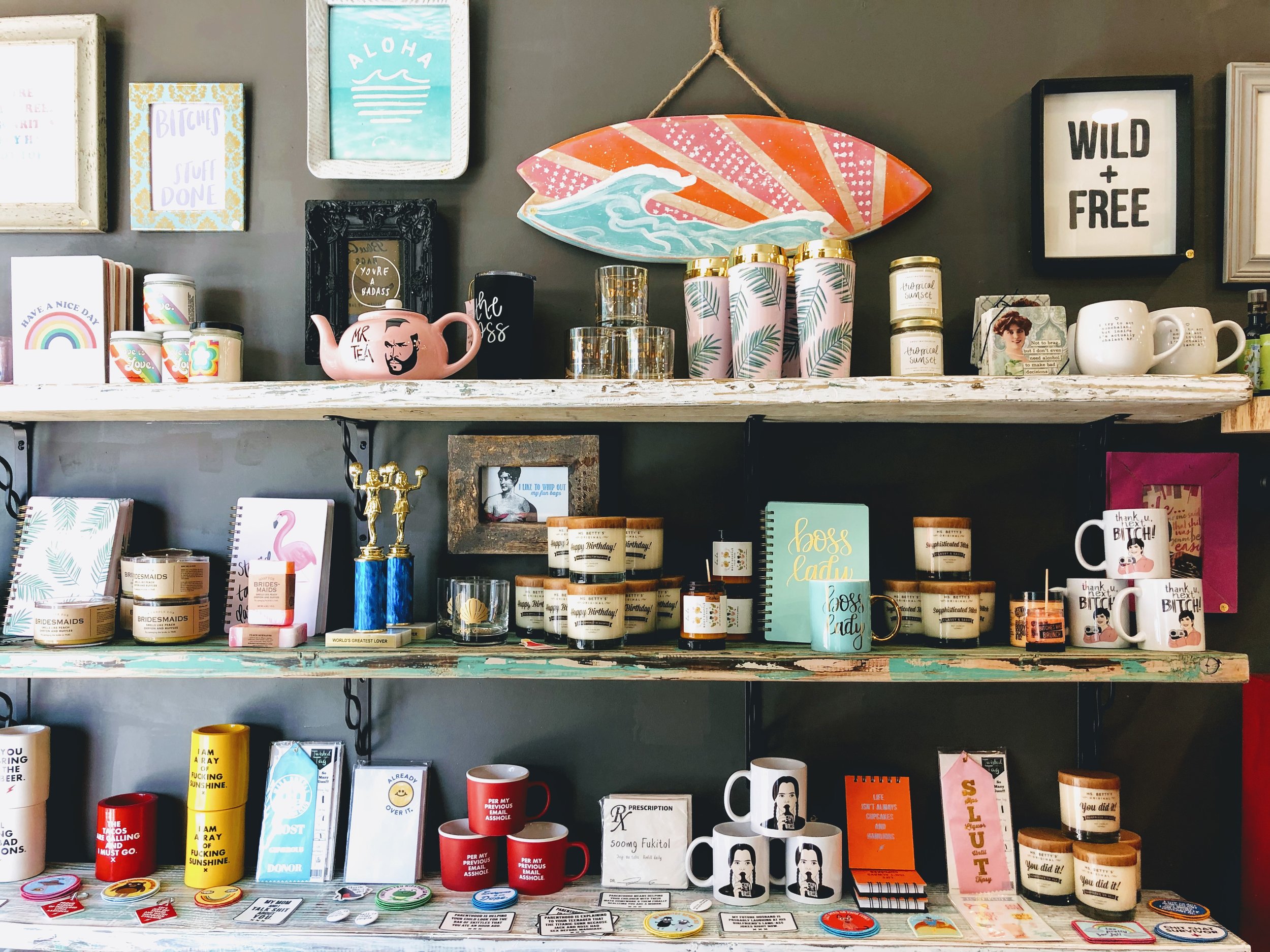
In the West End, where the bay and ocean are separated by two blocks, an impressive amount of restaurants, bars, and boutiques bring West Beech Street to life. In the midst of the action is an independent shop that draws you in with earthy smells and a friendly chalkboard whale letting you know they're open. This is The Codfish Cowboy. It’s the kind of store where you are guaranteed to find the perfect gift you went in to buy, and also sure to come out with your new favorite thing. Clever home items, a selection of clothing, unique jewelry, adorable kids stuff and more - it's all the vision of Angela Skudin, its founder and owner.
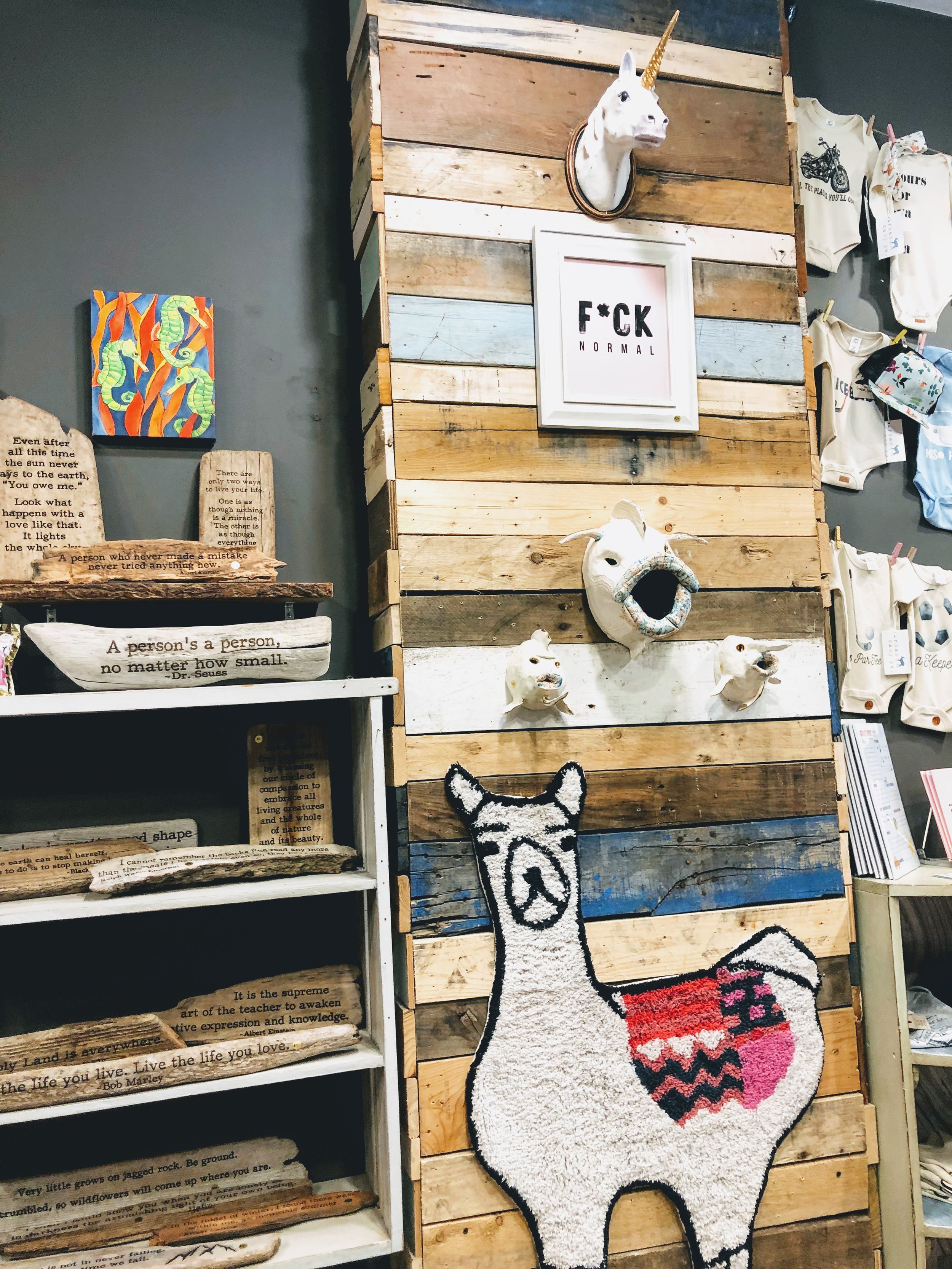
What makes the beachy Codfish Cowboy even more unique is that it's filled with pieces made by local residents. There's a very low chance you'll be able to go in and then find the item on Amazon later. Skudin prides herself on the fact that when you purchase one of her beautifully curated products, you are supporting a Long Beach maker. At the heart of her ethos is the notion of giving back; bringing something lovely into your life or home while supporting others, it's a win-win.

Here I talk to founder Angela Skudin for If Lost Start Here about what drove her to start The Codfish Cowboy:
What is The Codfish Cowboy and how did the idea for it come about?
I’m classic for my impulsive “great ideas” that fully lack any research, plan, or thought. If you put a visual perspective to it, imagine it like being a squirrel in a cage. The Codfish Cowboy was an impulsive idea that came from the desire to have a shop in my current hometown that reminded me of the shops I love visiting in my original hometown in Tulsa, Oklahoma. I’ve always been “the best gift giver” in my family. I’m told I have the ability to choose the perfect gift for anyone. At the Codfish Cowboy you can find something for a newborn baby, a bachelorette party, housewarming, 80-year-old Aunt Betty.
Why did you decide to open the store in the West End of Long Beach?
When I moved from Tulsa to Long Beach 16 years ago, I lived in the West End with my now-husband. The West End has a vibe and energy that’s undeniable. The Codfish Cowboy is now part of that vibe.
You are very supportive of various causes, from local makers to crucial environmental issues. Can you talk about how you decide whose work to display and sell and how those two passions intersect?
My mother is an immigrant from Germany. My grandfather was a maker. He owned his own furniture-making business. My family still has the original couches he made with his own two hands half a century ago. You can’t get quality like that from a factory. That business made my family who they are today. It paid for private school for all 3 of his children and allowed my family to own a home in America. It’s important to support makers. In turn, we get handcrafted quality items that have a story and help a family.
When I curate, I want to know that story. I want to pass that story on to my customers. We can spend our money anywhere we chose. It feels good to spend it on a piece of handmade art from Long Beach high school’s art teacher whose family lives 3 blocks away and rolls by in their beach wagon waving hello as they pass the store.
Growing up, my family focused on helping others and making sure my sister and I knew what paying it forward felt like. We were a middle-class average family with 2 hard-working parents. Every Thanksgiving my family adopted a family in need and brought Thanksgiving to that family. Every Christmas we adopted a family in need and brought wrapped gifts and Christmas dinner to that family. I’ll never forget those moments. When you are a kid, everyone is equal. When we dropped off the presents and food, my parents would converse with the parents and my sister and I played with those kids like they were our long-time friends. There was no Rich vs Poor, no sense of entitlement. We were all equal. I carried that feeling with me and it’s never left.
As far as environmental issues go, I have always been that person that’s picking up trash in a field, grabbing rogue plastic bags in the ocean or making sure all the soda can rings were cut so a duck doesn’t get strangled. I’m the crazy lady that washes plastic straws and reuses them. I have had the same bag from Ikea for 8 years now. To me it’s common sense….we only have one Earth and it’s our responsibility to make sure she is around for the comfort of the next generation.
What inspired you to begin your apothecary line, “tribal life alchemy”?
Karen Michel, one of my partners, was the inspiration and soul of Tribe Life. One day she said to me, “we should do our own pure essential oil product line,” and I said, “absolutely not.” Fast forward 2 months later we had Tribe Life. Karen is a basically a wizard and can do anything. I give her my ideas for graphics and she can read my crazy brain. With Tribe Life, we really wanted to ensure the quality of the products we were offering to our customers. We live in a toxic world. If I can offer pure products that have therapeutic properties to our customers, I’m going to be able to rest easier. That’s what Tribe Life Alchemy is about.
How would you say The Codfish Cowboy has evolved over the years?
I wanted to build our audience organically. No paid ads (because there simply was no budget for that). I started The Codfish Cowboy with $25,000. The build was done by myself and my awesome handy FDNY husband Casey. The materials were repurposed. I did a lot of dumpster dives to get the wood for the walls and molding. There are pieces of Long Beach homes on the walls of The Codfish Cowboy and I think that’s pretty cool. We are up to right around 3k on our Instagram followers and we are looking to launch our online sales this fall. I’m excited to see that number grow.
What has been the most surprising thing about running the store?
The perception other people have about your business. Just because you have a store does not mean you are rich and just because I’m not physically standing in the store does not mean I’m not working. When you own a brick and mortar your job never ends. There’s a ton of back end work, vendor meetings, research, buying, etc. I’m one person. I can’t be everywhere all the time, but I try.
What is your favorite way to spend a day in Long Beach, aside from being behind the counter?
Shopping local, eating local, riding my beach cruiser on the boardwalk, and soaking in the sun on our beautiful beaches.



Follow TheCodfishCowboy on Instagram and visit them at 891 W Beech Street Long Beach, NY
& visit my other West End Picks:
Blacksmith’s Breads 870 W Beech street
Dough Hut (right next door) 891 W Beech Street
Island Thyme 780 W Beech Street
Jetty Bar and Grill 832 W Beech Street
Lost at Sea 888 W Beech Street
RaKang 895W Beech Street
Shine’s Bar 55 California Street
Speakeasy 1032 W Beech Street

Lucky Penny Parlor & the World's Smallest Postal Service x Lea Redmond
Maria Popova, a similar collector of interesting (in ideas rather than things) encourages: “Be curious. Be constantly, consistently, indiscriminately curious.” We had that quote in mind talking to Lea and wandering through Lucky Penny Parlor.
“Lea’s storefront project is a place where matter and meaning meet through found object conversations and storytelling.”
At times of darkness, what do we reach for? What do we try to bring into our lives? Our go-to’s are probably around activism, around self-care, around community. But wonder? Curiosity? Sometimes we put them in the ‘superficial’ bucket, the one reserved for whimsy, for frivolity, for later. We leave them alone. They are coping strategies LITE.
Spending a morning with artist Lea Redmond at Lucky Penny Parlor in Oakland you realize you’ve got it all wrong. Finding wonder is deeply purposeful. To abandon it now is to abandon something of our humanity, of our possibility.
It’s ok to not feel entirely comfortable when you come into Lucky Penny Parlor. What is it really? How do you engage? Can you touch this? You’ll have these questions and others. And Lea is fine with this – she’ll lead you through it, spend time with you so you can reach for understanding, bring your experiences into hers. There’s a beauty in questioning, a kindness in the suggestion of clarity. Lea did this with my daughter and I – as we touched things on display, grasped for information as we tried to orientate ourselves, she provided the scaffolding for a connection. Over mint tea, in carefully chosen cups, we found our way in.
There’s a therapy of sorts to be found here in Tea Cup Consultations in which Lea choses a cup from her extensive collection and you bring something from your own life to discuss over tea, and the staged Tabletop Shows, dioramas that encapsulate narratives and even the universe (upcoming shows are about hummingbirds and a choose-your-own-adventure through the solar system). These intimate services provide the framework for poetic conversations, exploratory meanderings and immersive play.
Lea is interested in the material that’s in front of us of another kind though, of what’s available to us in the ordinary and every day that has a tangible quality, the concrete items that are all around us, all the time, and that we no longer see. Look through the hundreds of tiny drawers that make up Lea’s Wonder Cabinet and which contain the detritus of our everyday lives – tags, bottle tops, flea market finds, and household artifacts. Here you are taken right back into the space of seeing again, of living in the pause. Meaning here sneaks up on you, revealed by delight and humor and amusement.
Maria Popova, a similar collector of interesting (in ideas rather than things) encourages: “Be curious. Be constantly, consistently, indiscriminately curious.” We had that quote in mind talking to Lea and wandering through Lucky Penny Parlor which houses her personal collection of curios and from which she curates her own singular world.
Two doors up from Lucky Penny Parlor, is a work in process, the very soon to be first outpost of Lea’s World’s Smallest Post Service and the latest iteration of her 10-year tiny mail project. A space of serendipity – Lea happened upon the perfect-sized vintage post office front to pull it all together. From here Lea and her team will send out tiny – as in seriously tiny – packages into the world.
It’s a truly magical space that captures our love of the absurd and the cute, as well as our need for connection, our longing for the analogue. With this project, Lea is returning to something long lost – our wonder at receiving things in the mail that are not in the form of a bill or bulk entreaties. Can you imagine finding one of these tiny letters or parcels in your mailbox. Can you imagine that moment being in your day? Aren’t you smiling now just thinking about it? Or maybe you are thinking about who you can send something to?
For Lea the World’s Smallest Post Service is all about bringing not just ‘tiny mail magic’ but ‘more wonder into the world’: “We propose to create an enchanting, museum-like, open-to-the-public brick & mortar home for our World's Smallest Post Service. We want to make a place, a magical coordinate on the globe where people can count on wonder and kindness.”
Lea has constructed her world too so that we can reach for it wherever we are – with products by her design company Leafcutter Designs. Like Lively Matter a deck of prompt cards to encourage creativity and play through ‘a grand adventure of the ordinary’, and that provide a much-needed break from our screens, and the Letters to My Series, which we’ve handed to grandparents and friends, to capture the stories they may want to tell but have had no format to do so. Most recently, Lea created Everyday Offerings, which holds a way forward in our daily lives.
From the outside, all this, these storefronts and projects, Lea’s vision for crafting this magical way of living, look fun but it takes hard work, a serious and keen drive, to sustain this creative space. It looks easy because whimsy is a kind of sleight of hand, a magic of sorts that leads you out of the mundane and into belief. You don’t see the trickery (read commitment and focus) that makes it happen, that makes non-obviously functional spaces, exist in the world.
Yes, we need independent cafes and bakeries, coworking spaces and stores. But we need this other non-definable space on our high streets – of inspiration, wonder and play. Of something else. That’s a need that is not being fulfilled in our grown-up lives. We’re losing our joy, and we need to badly capture it again. We’re lucky in that we get to visit this world of Lea’s creation. For a short while. To walk within this vision of what light existing in darkness can actual be, the physical form it can take and its importance in sustaining our lives. There’s nothing superficial in that.
To find out more: website www.leafcutterdesigns.com / Instagram @lucky_penny_parlor / Facebook @LeafcutterDesigns