
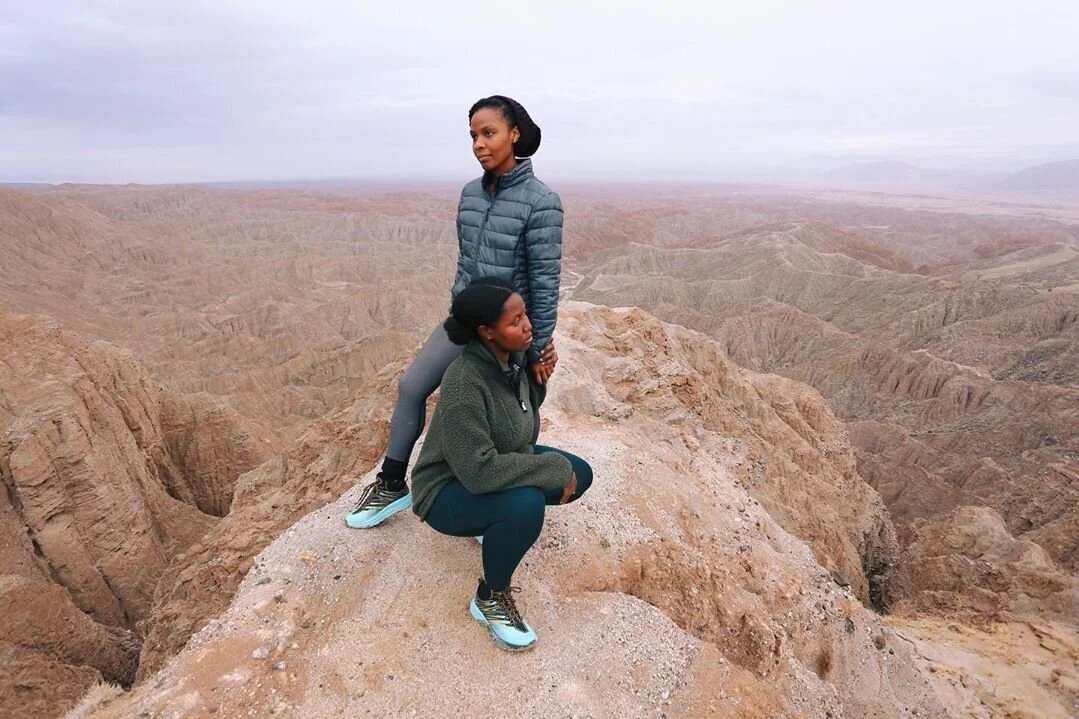
Black Girls Trekkin
How two friends in Los Angeles are working to make the outdoors more diverse.
What is it: A community and advocacy organization based in LA with a goal of making the outdoors more inclusive.
What you need to know: Friends Tiffany Tharpe and Michelle Race started the group three years ago with the goal of increasing the representation of Black women in the outdoors. Both share a love of hiking the trails around their home city of Los Angeles — a way to escape the urban hustle and a form of wellbeing in their everyday lives — which they wanted to share with other like-minded Black women and girls while shifting the narrative of who gets to even be outdoors. From inclusive group hike meet-ups to a range of outdoor activities like camping, backpacking, and nature adventures (kayaking, rock climbing, outdoor yoga) as well as education and conservation programs that focus on caring for the planet as much as understanding its history (particularly that of displaced native Americans), Black Girls Trekkin is making the outdoors safe, accessible and inclusive.
How to bring this into your life: Though it’s on pandemic pause, BGT’s group hikes around LA will hopefully be back soon. In the meantime, BGT is continuing its support of hiking for everyone in its online spaces.
Why it matters: We’ve written often of the benefits of nature for our wellbeing (there’s a whole category dedicated to the impacts of our green and blue worlds on our mental health), but we’re also conscious that access to nature is neither equitable, in how it is accessed or received. An understanding of the natural world, what it represents, who gets to connect with it and how, and its impacts on our psychological health, is deeply woven with issues of racial injustice.
Just a handful of studies that attest to this fact: A study of the 4,600 photos of people within Outside Magazine from 1991-2001, depicted just over 100 images with Black Americans. Data from the National Parks tell a story of deep racial inequality: with non-White Hispanics comprising between 88 and 95% of visitors to national lands and African Americans 1 to 1.2 percent. While another study showed that people of color were three times as likely to live in nature deprived neighborhoods.
Black Girls Trekkin works against the stereotype that Black girls and women don’t go outdoors. The co-founders' experience speaks to the biases that came with their own experience of the natural world: As a kid, Tiffany’s understanding of nature came from watching PBS, Discovery, and Animal Planet – exploring was just something that her family didn’t do. When Tiffany did start hiking in her twenties, she realized how few other Black people were on the trails, an insight shared by a Yosemite National Park Ranger. Similarly, Michelle was the only Black person to graduate in her class of marine biologists, a subject and area of interest that wasn’t “something black people do”. The narrative of who gets to explore our natural world has been primarily focused on the experiences of white people.
BGT also works against the judgment and condescension that can occur when Black women do head onto the trails, from stares to offers of help to outright hostility, advocating safety and respect for everyone who enjoys the outdoors. Alluding to a history of the natural world entangled with persecution in the minds of black people, Michelle has said this of the perceived barriers to the outdoors: “It might also come from the story we inherited, from a time when venturing out into the woods alone could end in violence and when certain spaces were literally off-limits due to racial segregation. As these well-founded words of caution have been passed down, the aversion has persisted even as the original reason has fallen out of the story we tell.” BGT is shifting this narrative, creating new stories of the Black experience of the natural world.
In their own words: “We’re here to show the world that not only do black girls and women hike, we also run, climb, swim, and have a thirst for adventure that is too often underrepresented or unacknowledged. We’re beautiful, black women who trek it out in the great outdoors!”
Something to inspire: Interested in forming a local chapter, reach out to BGT or seek out one of the other organizations listed below:
Outside the US? Let us know about other groups active in making access to nature more equitable and diverse.
To find out more about Black Girls Trekkin: Website / Instagram / Facebook

Little Free Diverse Libraries
A movement born on social media changing the narratives that make up our neighborhoods.
What is it: A movement born only six months ago on social media that is having real-world impacts, Little Free Diverse Libraries aim to amplify and share stories of Black, Indigenous, and People of Colour.
What you need to know: You may have seen Little Free Libraries in your community: those cute wooden boxes around since 2009 where you are invited to take a book and leave a book. But have you thought about the books that make-up those libraries? Do they represent the community, country, or context in which you live? Do they represent you, your voice, and your life? Do they include a breadth of voices, diverse backgrounds, and inclusive stories?
On a walk, through her home neighborhood of Arlington, Massachusetts where she was sitting out the pandemic, New York School Counsellor Sarah Kamya noticed that those in her own neighborhood didn’t do any of those things. As a daughter of a black father and a white mother, they didn’t reflect her. Neither did they speak to the Black Lives Matter Movement that was taking hold across the county.
With $150 donated from her family, Kamya brought books from black authors and began placing them in the Little Free Libraries in her neighborhood. This tiny gesture grew and grew: boxes of books by BIPOC authors began arriving at her home, as did donations from people to buy more books from diverse authors, all of which were to be distributed in other Free Libraries. Kamya bought directly from black-owned bookstores and opened her own Little Free Diverse Library.
Over 2,200 books have now been distributed to Little Free Libraries across 50 states, over 15 Little Free Diverse Libraries have been installed, $16,000 of books have purchased from Black-Owned bookstores, and the movement has inspired 20 LFDL Instagram accounts.
Why we think it matters: The stories that we are exposed to shape our understanding of the world and our place in it, not just in terms of whose lives we get to see represented but in terms of who gets to even tell those stories. Growing up, Kamya didn’t see herself in the characters or the narratives of the books she loved to read. Little Free Diverse Libraries aims to change that by widening the books that we are all exposed to so that we can increase our empathy, understanding, and kindness towards others, and think differently about issues such as social justice, systemic racism, and gender inequality.
As Kamya says: “I find books to be such an important place where one can build their self-confidence and self-worth, start conversations, and create change. I believe that Black and brown children deserve to see themselves represented in books and that if you cannot see it, you cannot be it. Some of my favorite books have been discovered in Little Free Libraries, and I am so excited for others to discover books they may have never seen, books they wish they had seen, and books that create conversations and change for years to come.”
The project has since expanded to include books about LGBT+ issues, people with disabilities, and who have different religious beliefs.
How to bring this into your life: Read widely, from diverse authors. Kamya is generous with her knowledge of books, and you can find recommendations for both adults and children on the Little Free Diverse Libraries Instagram. Among her recommendations are: Hair Love by Matthew A. Cherry, illustrated by Vashti Harrison; Of Thee I Sing by Barack Obama, illustrated by Loren Long; Talullah the Tooth Fairy CEO by Tamara Pizzoli, illustrated by Federico Fabiani; and Amazing Grace by Mary Hoffman, illustrated by Caroline Binch.
In her own words: “Having conversations regarding race with children and youth is extremely important to me. I truly believe that we have to teach about race and differences and a lot of that starts at home, and through books. I also find it important for books to represent diverse characters because if you can’t see it, you can’t be it. This project has allowed me to show Black and brown children that they deserve to have themselves represented, celebrated, and portrayed in literature. For Black authors, this project has allowed me to bring their work to the forefront. For so long Black authors have not had the recognition they deserve and this project has allowed me to highlight their work, as well as the Black-owned bookstores who have made it their mission to amplify Black voices.”
To find out more (or even start your own): Instagram