
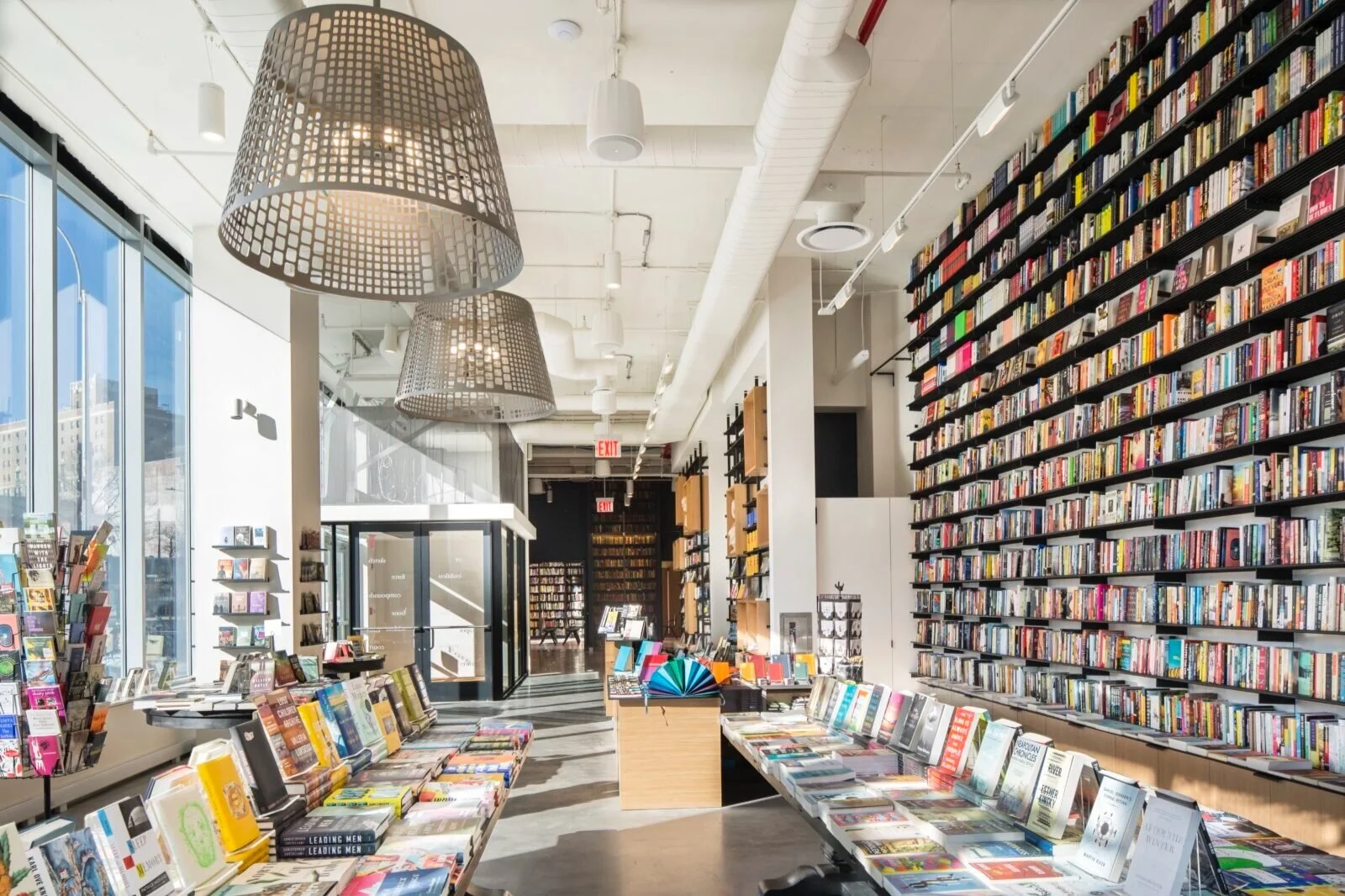
The Center for Fiction
A space dedicated to bringing fiction into the world, that supports our real lives as it does so.
What is it: For book lovers of all ages, whether those who love to read or those who love to write, The Center for Fiction celebrates fiction in all its stages, from first imaginings to beloved reads. Over 200-years after it was founded — originally as the Mercantile Library — the non-profit moved into its public-facing home in Brooklyn’s Cultural District in February 2019. Over 18,000 square feet across three floors, architects BKSK have created the conditions to make words come alive and to enter our lives in a multitude of ways.
Why you’ll love it: Browse the independent bookstore (with a focus on fiction, works in translation, and independent publishers), chat books in the café and terrace bar, attend workshops, events, writing groups, and seminars, or sit at a writing station to get down to the actual work of crafting your own story.
The Center is a living organization that grows both readers, from the youngest kids exposed to its workshops (see its Kids Read and Kids Write programs), and writers, from the earliest stages of their careers, such as the Emerging Writers Fellowship and First Novel Prize. Within its quote-strewn walls, books can be experienced at every point in their realization.
What you need to know: The Center is also home to a circulating library of over 70,000 books focused entirely on fiction, including a prominent crime fiction collection that goes back to the early twentieth century.
How to bring this into your life: Recently retired Executive Director Noreen Tomassi started a bibliotherapy program, that is still going strong, called A Novel Approach, which prescribes a year’s worth of fiction reading depending on your situation, your interests, your longings.
Why we think it matters: Though books are read alone, often they come alive when experienced together. The Center pivots on this duality. It offers a place of solace and reflection, a retreat, or maybe just a pause, from the noise and encroachments of modern living. And it sets up the connections between readers, to not just enliven narratives through discussion but to offer an antidote to our loneliness, and a comfortable excursionon for introverts. Books can take us inwards while opening up our worlds. We can hold fiction in our minds, and those stories can have a life that exists in conversation. The Center for Fiction attests to the importance of making physical space in the world that supports our imaginary one, bringing people together over words that connect.
In their own words: “The Center for Fiction, founded in 1820 as the Mercantile Library, is the only organization in the United States devoted solely to the vital art of fiction. The mission of The Center for Fiction is to encourage people to read and value fiction and to support and celebrate its creation and enjoyment.”
Something to inspire: How can you lift words off the page and live them in company, wherever you are? Seek out a writing community, a book club, an author’s talk, a book festival, an independent book store, a library. The Center is a one-stop-shop for the craft of fiction, but parse out its functions and you’ve got a version of your own making, slightly spread out but highly tailored to your world.

Emma's Torch
A beacon of light for refugees in Brooklyn is forging a way forwards through culinary education.
What is it: A not-for-profit Brooklyn restaurant and culinary school offering paid training and job placement for refugees, people granted asylum, and survivors of human trafficking.
What you need to know: Founded by Kerry Brodie in 2016 after she completely shifted her career focus from public policy — she previously worked at the Human Rights Campaign and has a Masters degree in government from John Hopkins University — to the restaurant industry, completing her studies at the Institute of Culinary Education in New York.
The impetus for this shift and the inspiration for Emma’s Torch: the possibility of food to do more than nourish, an idea that came to Brodie while she was volunteering in a Washington homeless shelter. Food can connect disparate people, bringing them together around the table, while the cultures that shape our understanding of food remain foundational no matter where people find themselves. But Brodie also saw a way to solve the difficulty that restaurants had of hiring line cooks in New York and the struggles of people newly arrived in the US to find employment.
Brodie now works with refugee resettlement agencies, homeless shelters, and social service providers to identify candidates for Emma’s Torch’s signature 10-week training program for refugees that covers everything from knife skills to job readiness. After graduation, Emma’s Torch has placed 97% of job-seeking graduates and as many as 100 trainees have secured permanent employment in the restaurant industry since it was founded.
With the COVID pandemic and the devastating impacts on the hospitality industry, Brodie has pivoted to a new partnership, becoming a Rethink Food certified organization with the aim of reducing food insecurity by donating 600 meals a week to the Nutrition Kitchen Food Pantry.
What they offer online and off: During pandemic closures, take a virtual cooking class, buy pantry provisions made by students and partners – there’s also own-brand goods such as Hawij Hot Cocoa Mix – or order pick-up and delivery. Donate to secure the future of this organization, if you are able.
Why we think it matters: Emma’s Torch has at its heart a belief that refugees can be welcomed into their new home country. Its name is taken from the poet Emma Lazurus, whose famous line is etched into the Statue of Liberty: “Give me your tired, your poor / Your huddled masses yearning to breathe free”. But this historical precedent stands in contrast with present-day experiences of xenophobia and prejudice around refugees, the difficulties displaced people have of finding employment or housing, and the fatigue and barriers that come with negotiating an ever-evolving political context that often characterizes them as a burden. But Emma’s Torch builds on the positive impacts of NYC’s large population of refugees, their contribution to the local economy, particularly in the borough of Brooklyn where it is located. As Brodie has said: "We engage in this work not simply because our students are people less advantaged than ourselves; we do this because, as Americans, we believe that when we are at our best, this is how we behave, simply because it’s the right thing to do. There is no ‘us’ and ‘them’, but if there was, I would argue that ‘they’ make ‘us’ stronger and better. What our students bring to the table has value, and we are fortunate to be able to work with them to ensure that they are welcomed by their new community."
In their own words: “We find comfort in the diversity in our classrooms and kitchens. Refugees, asylees, and survivors of human trafficking from over 35 countries have passed through our kitchen. Not only has this pushed us to be more sensitive and aware of culinary traditions from across the world, but it also reaffirms that there is so much binding us all together. Our menu reminds us of this common ground, and draws from both our students’ cultures and our team’s culinary upbringing. As we grow, we hope our menu continues to not only be a learning tool for our students, but also a unique conversation between the almost 100 students and graduates who now have a home at Emma’s Torch.”
We’re inspired to: As the hospitality industry is severely impacted by the consequences of the pandemic, support your local restaurants if you are able and you’ll be supporting the jobs that they provide. Whether that’s a burger night that your local café has pivoted to, a finish-at-home delivery box, or eating in the cold outside, find ways to support the independents so they, and the people they in turn support, can get through this time. As Emma’s Torch can attest, what you eat goes beyond food.
To find out more: Website / Instagram / Facebook
Additionally, try: Social Bite / Brigade Bar + Kitchen / Luminary Bakery

Cafe Con Libros
A feminist bookstore making vital space for the stories of women and girls.
What is it: An intersectional feminist independent bookstore and coffee shop in Brooklyn’s Crown Heights neighborhood.
Why you’ll love it: Café Con Libros was founded by Kalima DeSuze in December 2017 when she made real the space that she wanted to see in the world, one that could hold the stories of womxn and girls – stories which have overwhelmingly been sidelined in favor of those of male voices – for those who want, need and are open to hearing them. Though intimate, the reach of the store is wide, bringing together on its physical and virtual shelves an abundance of books by female authors (99% of the selections are books by, for, or about womxn), including those beyond the continental US and by LGBTQAI+ writers.
Why we think it matters: During normal times, Café Con Libros is very much a community space for female-identifying folx; it's somewhere to hang out and be as much as it’s a bookstore. As Kalima says, the spaces that we create are political. Who holds physical space, what that space is used for, and even the stories these places are allowed to tell has meaning on a personal and collective level. Bookstores like Café Con Libros hold not just the stories within pages that we need to hear, but stories within a place that allow for all possible futures, for nurturing relationships, for community action, and for extending our learning together. As Kalima notes: “It’s time that womyn’s stories be prioritized and that a space exists explicitly for and about womyn. So many of our spaces are male-dominated; even the ones that are created solely to be for and about womyn. My womyn only spaces have served as a healing tonic and, a reminder of whose shoulders I stand on. It’s important that more of our girls and womyn have access to such warmth and mirroring.”
How to bring this into your life: As mothers of young daughters, we’re excited by the monthly subscription boxes, which include an option for baby feminist board books for the zero to fives and emerging feminist books for kids aged five to nine. There are also subscription boxes focusing on womxn of color and for the feminists among us. You can also join one of two book clubs that meet monthly (on zoom during shut-door times): either the Feminist Book Club which focuses on a book by, for, and about womxn, or The Womxn of Colour Book Club, a reading space and conversation for womxn of color. There are also virtual read-a-longs and a monthly podcast Black Feminist & Bookish, hosted by Kalima.
In their own words: “ We value: family. community. justice. art. transparency. accountability. equity. equality. authenticity. joy. solidarity. earth. the brilliance and possibility of imperfection. love.
We respect and value the contentious history womxn of color have with the word "feminist;" the tension hold us to account to live our Black Feminist and Womanist principles in real and measurable ways. We were born from and are guided by the lush cannon of Black Feminist thought producers and activists; the space endeavors to be intersectional, inclusive and welcoming of all who stand with and on behalf of the full human rights of womxn and girls. We seek to advance and uplift stories of womxn and girls around the globe who are redefining the word feminist and feminism with every day, ordinary culturally informed acts of resistance and love.
Something to inspire: Try a reading challenge: purchase, support, and read books only by womxn, or womxn of color, or by LGBTQIA+ writers for 3, 6, or 12 months. Change your knee-jerk choices in what you’d ordinarily see or consume. Extend this challenge even further to include podcasts, TV shows, films, and music that are by, for, and about womxn. This not only helps our own understanding of the ongoing pursuit for gender equality but the choices you make in where you put your attention and your money indicates to the industries behind them – the entertainment, publishing, and culture industries – what it is you really want to see.

Friends Work Here
A Brooklyn coworking space that brings friendship together with purpose.
What is it: Coworking for Brooklyn creatives brought to you by Swiss Miss aka Tina Roth Eisenberg of some of our favorite endeavors: Creative Mornings, Tattly, Creative Guild, and the TeauxDeux app.
Why you’ll love it: This is not your usual coworking space. It very much embraces our lives in the round, the heart and the head, or applied to our working lives, relationships as much as purpose.
Situated on the third floor of a former factory building, it’s a 3,000 sq foot open plan space that ticks off all the design boxes: exposed brick, wooden floors, light strewing windows, as well as playful pillows, colorful magazine racks, indoor swing, and outdoor deck. There’s even occasionally live music on the fire escape. But it’s not just for hanging out, the other aspect of the space is dedicated to the needs of the professional freelancer with dedicated workstations, a conference room, phone booths, and the ubiquitous whiteboard.
Actually, scratch that, though this space is divided into the loungy and the worky, the ethos is very much that magic happens everywhere – over potluck lunches, in the kitchen making coffee, accidental conversations between meetings. Those interactions build relationships, but also create a web of inspiration and motivation in which to work.
What you need to know: Since 2015 when Friends Work Here morphed from Studio Mates, this has become a co-working community targeted at creatives — designers, illustrators, filmmakers, developers, authors, writers, photographers, and the professionally multi-hyphenated. The fact that it's situated in the same building as The Invisible Dog Art Center and the HQ of Creative Mornings, means there’s a close ecosystem of talented people to be inspired by.
Why we think it's special: Coworking that puts its people at its core. That shouldn’t be unusual but often the business model and need to scale take over, and members become another cog in the purpose-finding wheel. Friends Work Here does not take a one size fits all approach but rather prides itself on bringing together people who fit in with its values — amongst these collaboration, curiosity, kindness. The friends in its name is no accident; Members are carefully chosen to give themselves and the rest of the community the best chance of flourishing. Calling itself ‘a seriously heart-forward community’, competition and ego are not going to work well here, but that doesn’t mean you can’t be talented and invested in what you and the others around you are working on. Just that the work doesn’t get in front of being a person, even if the work is the reason you are there.
In their own words: “We welcome new members who are curious, take their side projects seriously, and who believe that collaborating is good for the soul. We love individuals who love what they do and continuously strive to grow and get better. We appreciate people who love the internet as much as we do. We want doers and kind souls.’
Something to take away from this space: Work doesn’t have to mean competition. Creativity can play nice. Both your practice and your life may better from it.

The Sketchbook Project at Brooklyn Art Library
At Brooklyn Art Library spend time with a living sketchbook museum.
“A crowd-funded sketchbook museum and community space.”
For the Lost: ‘A Lovely Wander NYC’ by Sara Boccaccini Meadows
For the Curious: ‘Come Travel with Me’ by Jill Macklem
For the Lonely: ‘somewhere across the sea’ by Michael Elizabeth Zimmerman
For the Anxious: ‘Anxiety Sucks’ by Suzie Deplonty
But you could equally be looking for ‘A story worth telling’, ‘Pocket-size memories’, or ‘Trivial retrospectives’. The floor to ceiling shelves of The Sketchbook Project at Brooklyn Art Library contain all those themes and more in thousands upon thousands of identical 5 x 7” sketchbooks. In fact, this Williamsburg storefront houses the largest collection of sketchbooks in the world: 45,000 in all (with 24,000 in its digital library). And most are made by amateurs: 30,000 different people in over 130 countries have so far contributed to this over a decade-old project. Anyone can submit a sketchbook irrespective of background, perspective and, here’s the key, ability. These drawn-out and doodled narratives can be made by a granny in Croatia, a mum in California, a child in England. Even you.
We’re a little in love with it.
This is how it works: you order one of their custom designed, Scout-made sketchbooks online and receive along with it a list of thematic prompts: recent calls included: ‘One last chance’, ‘Fearful faces’ and ‘Lamppost Limericks’. Choose one or discard them entirely. It’s up to you. You get to fill 36 pages with whatever you want—abstract squiggles, detailed portraits, maps and landscapes, diary entries, poems, fragments of images and memories, secrets and declarations of lost love—anything that can be contained within its pages (so no glitter or messy embellishments).


Here’s the genius part—your sketchbook has a barcode, so you’ll upload some details to an online catalog, like search terms and your bio. Then you’ll mail it back to The Sketchbook Project for the next part of its life: most likely it will be part of one of the traveling exhibitions which take place in a custom made Mobile Library (‘like a food truck, but instead of tacos you get sketchbooks’) that tours to schools, music festivals, art fairs, museums, and blue-chip companies, in such places as Melbourne, Chicago, Atlanta, Toronto, San Francisco, and even Rapid City, South Dakota. But your sketchbook will definitely find its permanent home on one of those shelves in that storefront in Brooklyn. All sketchbooks are cataloged and kept. There’s no jury, no judgment.
Founded in 2006 by Steven Peterman and Shane Zucker, The Sketchbook Project questions who gets to create, who gets to be good and whether that idea has any currency, and why creativity still matters. By giving people a blank page, it also gives them the impulse to make and the platform to share. This is art for everyone, and artist as anyone. As Peterman attests: “I wanted to create an informal outlet for anyone to create art, with a purpose. I believed and still believe in the notion that a creative community is stronger than its individual artists and that a project can be impactful in a way that is different than a traditional gallery.”
All these sketchbooks—made and mailed in from all over the world, collectively form a library of sorts. Visitors to the storefront, which has a very unlibrary feel—yes, there’s check-out cards, but there’s also music, art supplies and memorabilia on sale—can view any of these sketchbooks in its cozy space. Remember that barcode? That makes the in-store librarian’s job way easier: now visitors just search the catalog by theme, figure out what they want to view, and the librarian will pull it from the shelves. As the artist/maker/author you can get updates on how many times it been viewed—you can even get texts when your sketchbook-baby leaves its home on the shelves. The beauty in all this is that the person who made and then the person who viewed the sketchbooks are now in conversation; the sketchbooks forming physical testimonies of lives lived, documented and shared.


The Sketchbook Project gives analog form to some of our most basic needs, namely to tell stories and to connect. As we’re increasingly driven online to spill and share, it’s a real-world kickback. These shelves express myriad lives and ways of being in the world that you can flick through and digest over time and in physical space. It’s collectively made, with all the contributors expressing themselves very differently while working within exactly the same parameters. And it’s collectively understood; visitors can search for what they need amongst the pages or maybe even chance upon something unexpected. Plus it's permanent. These sketchbooks are designed to last, to be an archive of global creativity that endues longer than the time it takes to scroll through your feed.
(See also the workshops in the community space, on such things as bookmaking and journaling, and other interactive global art projects that aim to connect and dispel some fundament myths around creativity like the Pen Pal Exchange).