
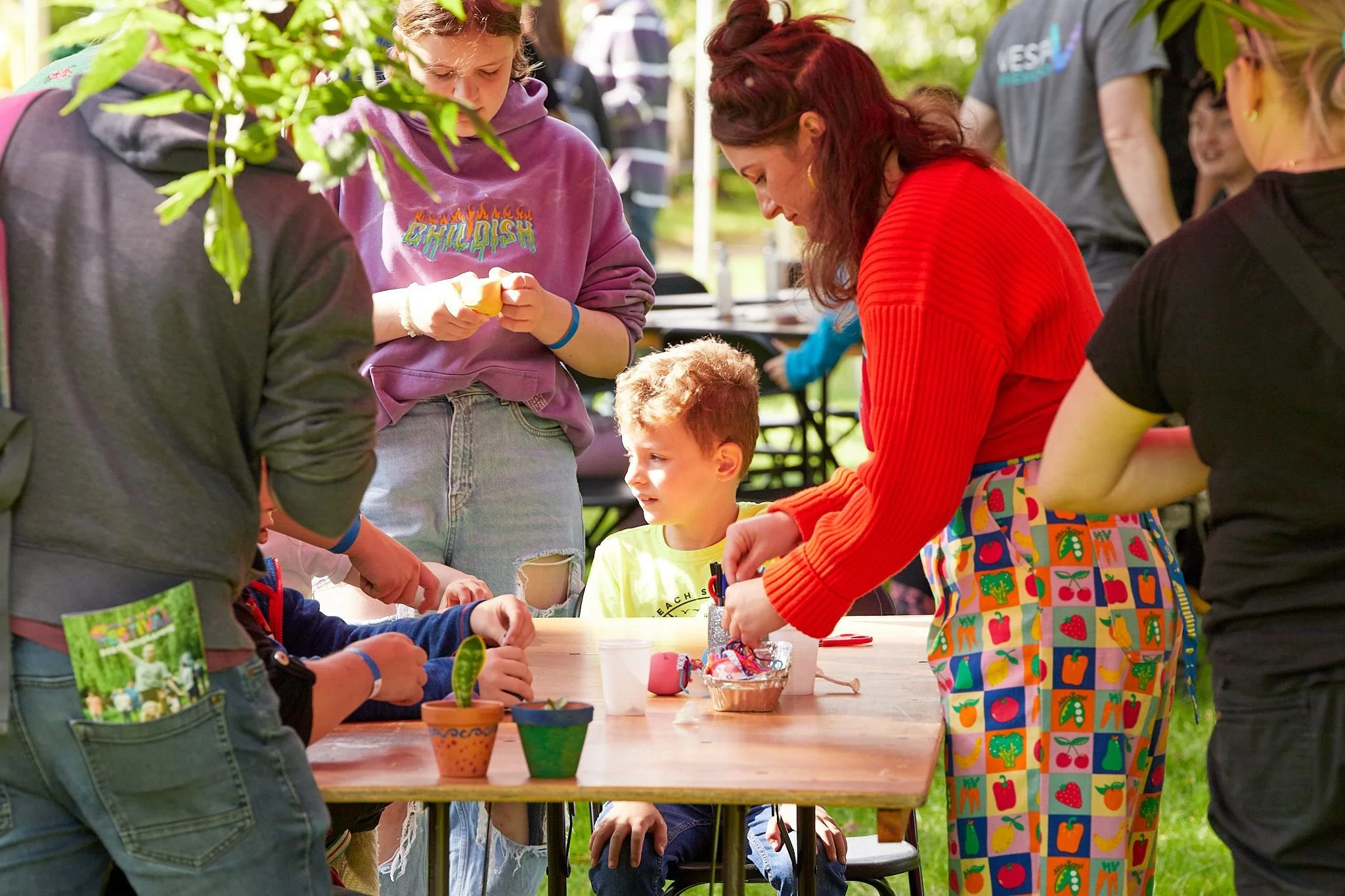
All in the Mind Festival
Discover an annual festival that uses creativity to explore mental well-being, and that’s finding ways to use performance to make happier brains.
“We use theatre to create happy brains.’”
After a couple of years that have seen our individual and collective mental health impacted and that has also forced us physically apart, the All in the Mind Festival comes at a crucial moment. Gathering people together to experience creative projects that explore our mental wellbeing, All in the Mind offers the conversations and connections we so badly need right now.
But though timely, it’s now into its 7th year. Founded in 2016 by the Fluid Motion Theatre Company, this festival has become an annual one-day event, bringing together actors, musicians, poets, comedians, and artists, for performances, workshops and interactive activities that harness the power of the arts toward better mental health for everyone. We found out more about the vision behind it and what makes it different.
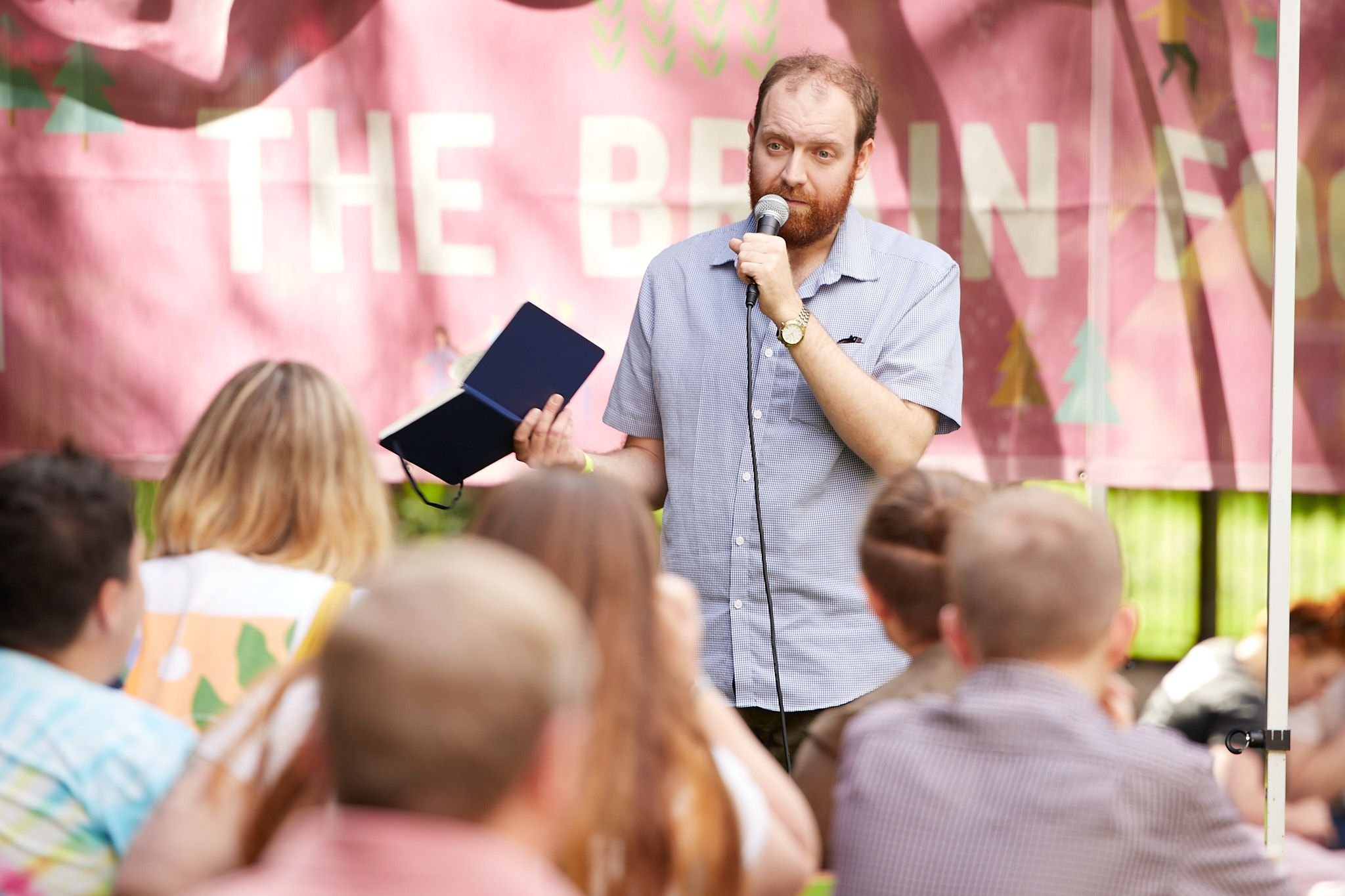
What is it? All in the Mind is the leading outdoor mental health arts festival in the UK, held in Glebe Gardens in Basingstoke’s town centre.
What do you offer? A day jam-packed with family-friendly shows and activities – from inspirational and quirky performances, to fun and interactive workshops, nature trails, a solar-powered carousel, delicious local food and drink and a community parade – there is something for everyone!
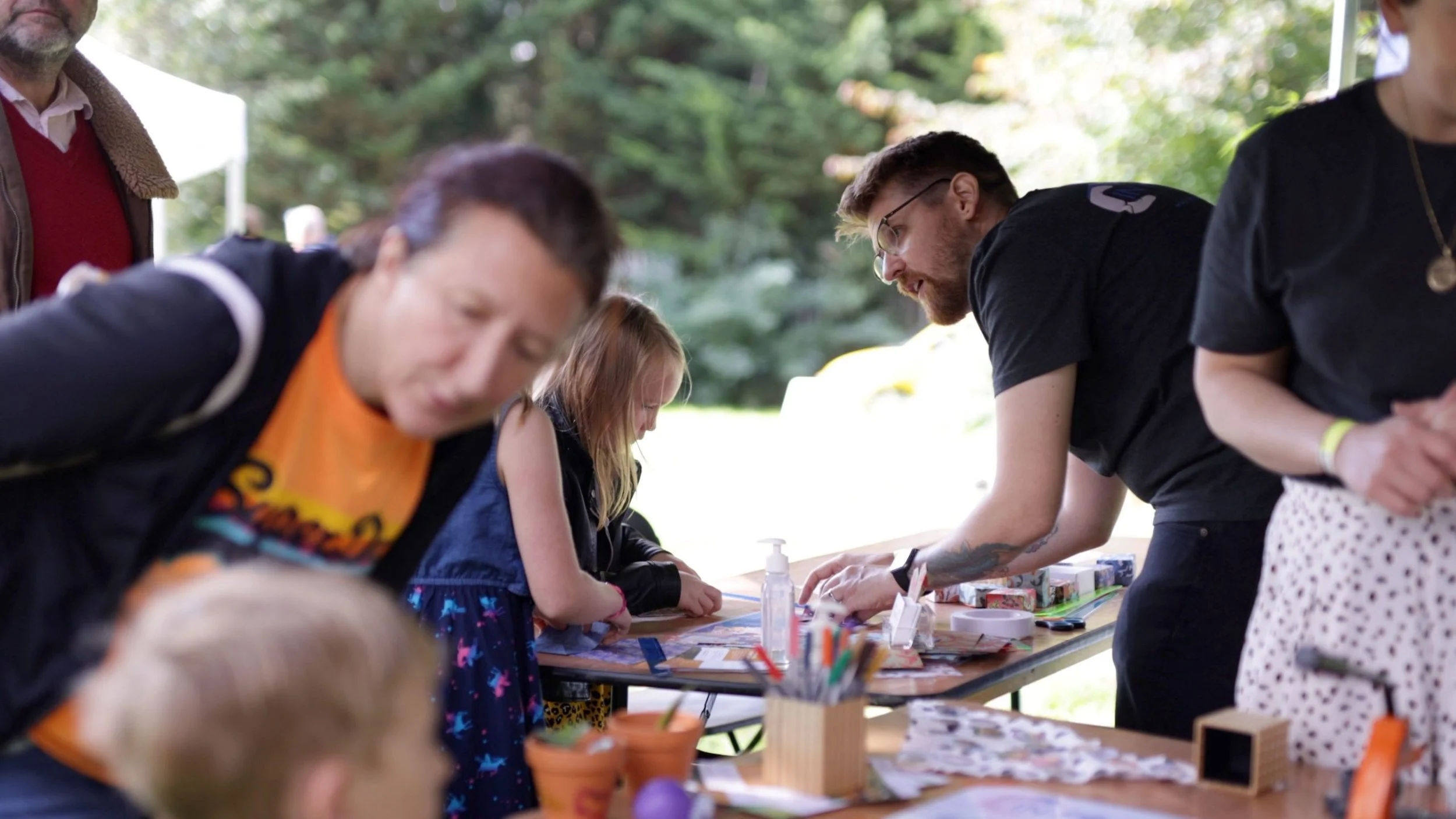
Tell us a little about your story: Our vision is to use the arts as a tool for helping open up the conversation around mental health, challenge the stigma and improve wellbeing
This year the festival will take place on Saturday 10 September 2022, is themed around nature, with tickets on sale here.
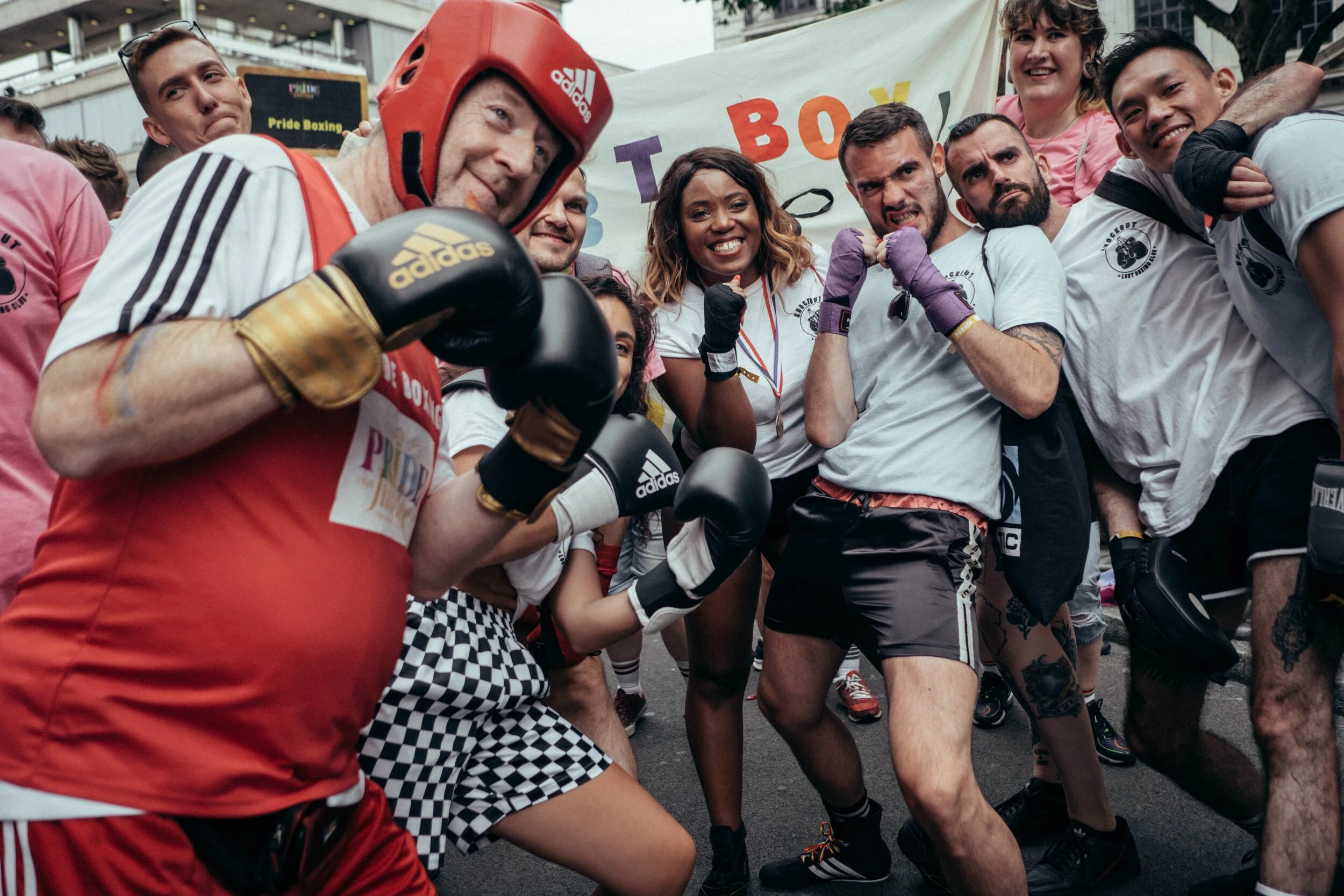
Knockout
We find out about London's Premier LGBTQ+ Boxing Club and the role that both the mind and community can play in physical wellbeing.
What is it? Knockout is a safe space for the LGBTQ+ community and their allies to gather together and pursue a healthier lifestyle through the sport of boxing. We are a fitness training group that recognises the health of the body comes through the security of the mind and community.
Why do people need it? This space was started as a secure and safe space for queer athletes who prefer non-team sports. Boxing is traditionally a sphere that is rife with difficulties for queer athletes, in regards to competitiveness and homo/transphobia. Knockout is a place where not only can these athletes find respite from these domineering structures, but also find individual and inner strength through a style of boxing not typically found in most other gyms. We focus on community and elevating the individual through the group.
What do you offer? A competitive boxing workout that challenges the body but is also tailored to the individual. We have some members who compete, but our core members are there to focus on their physical well-being.
In addition to this, we are a community that likes to deepen our bonds together by organising social events, karaoke nights, pub nights, and watching fights together.
We are also active in supporting other LGBTQ ventures, through charity drives and other forms of support. We organise 5k, 10k, and half marathon runs through our members, and help members find other sports and hobbies all with the mission statement of promoting LGBTQ+ rights and ideals.
What makes it different? Boxing is a hyper-aggressive individualistic sport that focuses on competitiveness and is typically taught in a harmful manner that isolates and can be damaging to the individual. Our trainers focus on combating these stereotypes to produce strong boxers that are developed through shared bonds and training together.
We emphasise positivity and connection, and work hard to welcome everyone to be a vital member of our community. Our training focuses on everyone who walks in the doors, leaving no one behind. For those who wish to, we encourage meeting strangers and learning something new from them. A Boxer steps into the ring alone, but we prove that the road to the ring can only be walked with friends and family.
What do people need to know? Boxing is a very intense sport and tends to attract introverted people. We are respectful of this and strive to provide a safe space for everyone, regardless of background. It is an intense workout, but highly rewarding, physically and mentally.
Currently, our trainings are held at the Sobell Center in North London, and are open to boxers of all levels. We have 2-3 coaches on hand in order to provide adequate attention to individual training, and thus are able to accommodate boxers of all skill levels.
For first-timers wishing to try out the sport, please come in comfortable trainers/running shoes, loose shorts, and a loose top. Freedom of movement is key. Please see our web page for more details.
Tell us a little about your story: Wanting to create a club run by queer people for queer people, to create a safe space and break down the barriers LGBTQ+ people feel when engaging in sport, Knockout London was born over a few drinks in the Duke of Wellington in Soho in January 2016. In the last six years, the club has expanded from a handful of people to a community of almost 200, with 2 classes available a week (and more coming soon), and supporting fighters participating in white-collar boxing events.
How can people be inspired by your space wherever they are? Our group focuses on community. We train strong individuals to become leaders but recognise that the individual is a construction of the community they are a part of. Competitive boxers are not created in gyms, but rather through the love, support and connection to the community around them. A strong Boxer gives back to their community and is active through charitable works and social events. It is not enough to carry these principles of Charity and Community only when one trains, but also throughout one’s everyday life.
Where inspires you? Any of the strong LGBTQ+ voices trying to bring positive changes to our community, whether they are activists (Munroe Bergdorf), actors (Elliot Page) or professional athletes (Jake Daniels). But also our members, all come to the club with their own stories, and our social events are a great opportunity to hear about their inspiring journeys.
Anything we're missing? We are a safe space for all members of the LGBTQ community and their allies, which means our members come first and foremost. Please be respectful of an individual’s right to privacy.

The Lost Gardens of Heligan
Seek wonder at The Lost Gardens of Heligan and discover a land once forgotten.
“Putting Heligan in aspic for posterity wasn’t what we wanted. Instead, we’d tell the story of those who worked here and re-discover their horticultural knowledge and skills.”
Go here if: you’re looking to find magic in nature, lose yourself in awe, or take a moment to pause.
What is it: Sometimes when you expect a tourist destination, what you find is a place of true wonder. From the founder of The Eden Project (and now Gillyflower Golf Course) Sir Tim Smit, The Lost Gardens of Heligan comprises 200 acres for nature lovers to explore, with breathtaking twists and turns through a lost landscape and a lost history.
Why you’ll love it: Like a story from a fairytale, a door found in the ruins of the Heligan estate led to the discovery of a garden lain long dormant. When World War I reaped its devastation, it took many of the gardeners who had once worked the estate and eventually all that they had created here: the Victorian glasshouses broke, the ferns and camellias grew over, the plant specimens brought from around the world, became hidden by time. Now Heligan has become the site of the largest garden restoration project in Europe; since the 1990s a team has worked to restore what once was, adopting the same principles of regenerative architecture, reviving the plants and species forgotten and revealing the original gardens.

Take the trail past the living sculptures embedded in the landscape (including the much-photographed Giant’s Head and reclining Mud Lady) through the jungle hidden in a valley (you can cross it by a rope bridge and it all feels like a dinosaur might emerge at any moment) up to the pineapple pit and the working gardens. But most of all just wander – the landscape shifts as you do, and the discoveries reveal themselves, sometimes slowly.
Heligan is still actively farmed with over 300 species of mostly heritage fruits, vegetables, salad, and herb plants, that are then used in the Heligan Kitchen, and heritage breeds (it was lambing season when we visited).
What you need to know: We sought out The Thunderbox, which was not what we thought it would be – once the gardener’s lavatory — but it contains the secret of past lives. The gardeners wrote their signatures on the wall beneath the statement “Don’t come here to sleep or slumber.”: the date August, 1914. In 2013, the Imperial War Museum recognized The Thunderbox as a “Living Memorial” to the gardeners of Heligan, a testament to the people who worked on the estate before World War 1 took them.

How to bring this into your life: Beyond visiting, you can attend a Lost Supper.
In their own words: “We were fired by a magnificent obsession to bring these once glorious gardens back to life in every sense and to tell, for the first time, not tales of lords and ladies but of those “ordinary” people who had made these gardens great, before departing for the Great War.”


Talk Club
Talk Club is creating the space for much-needed conversations about men’s mental health. Meet Ben Akers, its inspirational founder, who is leading the change in how men think about mental fitness and emotional strength.
There’s so much in that question. Maybe you haven’t thought to answer that for yourself. Maybe you haven’t thought to ask that of someone else. But for Ben Akers, it’s the question that can lead to everything else and the one on which his award-winning charity, Talk Club, is founded.
Talk Club provides a confidential forum for the conversations that men need to have and a safe space for men to explore their mental health and emotional wellbeing. The online and in-person meet-ups take the mental health awareness that Ben pioneered through his film Steve and turns it into mental health action: giving permission for men to look at their mental fitness and an understanding of how to get to a place of emotional strength.
We asked Ben to tell us more about his story, what motivated him to start Talk Club, and how vital it is that places like Talk Club exist. What we discovered was someone who is living his life, his own story, with the vulnerability, and courage, that he’s asking of those he’s helping.
What is it? Talk Club is a mental fitness movement for men. Founded in Bristol in 2019, the community now has over 2500 men in 64 clubs. All over the world. From Sydney to South London and all that's in between.
Why do men need it? Suicide is the biggest killer of men under 50 in the UK. A man takes his own life every 90 minutes. 76% of suicides are male. One of those men was my childhood best friend Steve Yates. He was a brother, a son, a father, a husband. A friend. My friend. So I made a film called Steve - a film for change. Here are links to both the trailer and the film.
From that film came the start of Talk Club, through which we promote Mental Fitness through the question/s "How are you? Out of 10?"
What do you offer? A safe community for men to be vulnerable. A network of talking groups as well as talk and move. If you are male and over 18 join us.
What makes it different? It's simplicity. We are about preventing mental ill-health. Promoting mental fitness through the Question/s "How are you? Out of 10?"
What do people need to know? This is TALK CLUB. Join us.
How can people be inspired by your space, wherever they are? Asking themselves or someone they care about: "How are you? Out of 10?" Start the conversation. Listen to the answer.
What inspires you? Human connection. Men who are vulnerable enough to help themselves. It has saved lives.
Talk Club
Also there for you:
Campaign Against Living Miserably | Movember | Andys Man Club | Men’s Sheds | Get The Boys A Lift | The Charlie Waller Trust and the advocacy work of Dick Moore
Main image | Photo by Donovan Grabowski on Unsplash

Mental Health Swims
We talk to Rachel Ashe about the social enterprise she founded that offers mental health peer support through cold water dips.
“We believe in empowering everyone – people of all skin colours, body shapes, ages, sexualities, genders, backgrounds and abilities to enjoy the healing power of cold water and community. Join us for a chat on the beach, a litter pick, a paddle or a swim in the shallows. We are an easy-going group that prefers short dips to long distances and puts companionship before competitive swimming.”
A cold water dip in company. A warming cup of tea (maybe some cake) after. And a safe inclusive environment in which to chat. Probably some bobble hats, definitely some laughter. Mental Health Swims is putting into practice the science that says cold water swimming can positively impact how we experience our anxiety, depression and other mental health conditions.
What started for Rachel Ashe as a January swim at her local beach in Swansea to help with a personality disorder diagnosis has become an award-winning social enterprise with a network of 80 volunteer meets across the UK and Ireland. Rachel talks to us about how Mental Health Swims is as much about the therapeutic benefits of being in community as the cold water, and how you can give it a try.

What is it? Mental Health Swims is an award-winning mental health peer support community with a huge network of groups organised by nearly 300 volunteers across the UK and beyond. We welcome anyone who is struggling with their mental health to try the healing power of cold water and community. Our motto is dips not distance and community not competition. This is in everything we do.
Why do people need it? It can be hard to get outside and meet people when you’re struggling with mental illness. Going for a dip can help you find something to talk about — the weather, how it feels when the cold water hits your body and where you got your bobble hat from. Somehow, talking about nothing very important can help make it easier to talk about how we feel.
Cold water itself is a great way to reconnect with your body and lower stress.
What do you offer? We offer in-person monthly mental health peer support groups.

What makes it different? We are very community-minded. We train all our volunteers in mental health awareness, cold water safety and volunteer well-being so you can be assured that you will be made to feel welcome and included.
What do people need to know? Check out our website to find your nearest group or if you’re interested in setting up your own mental health swim follow us on Instagram as we will be opening applications again at the end of the month.

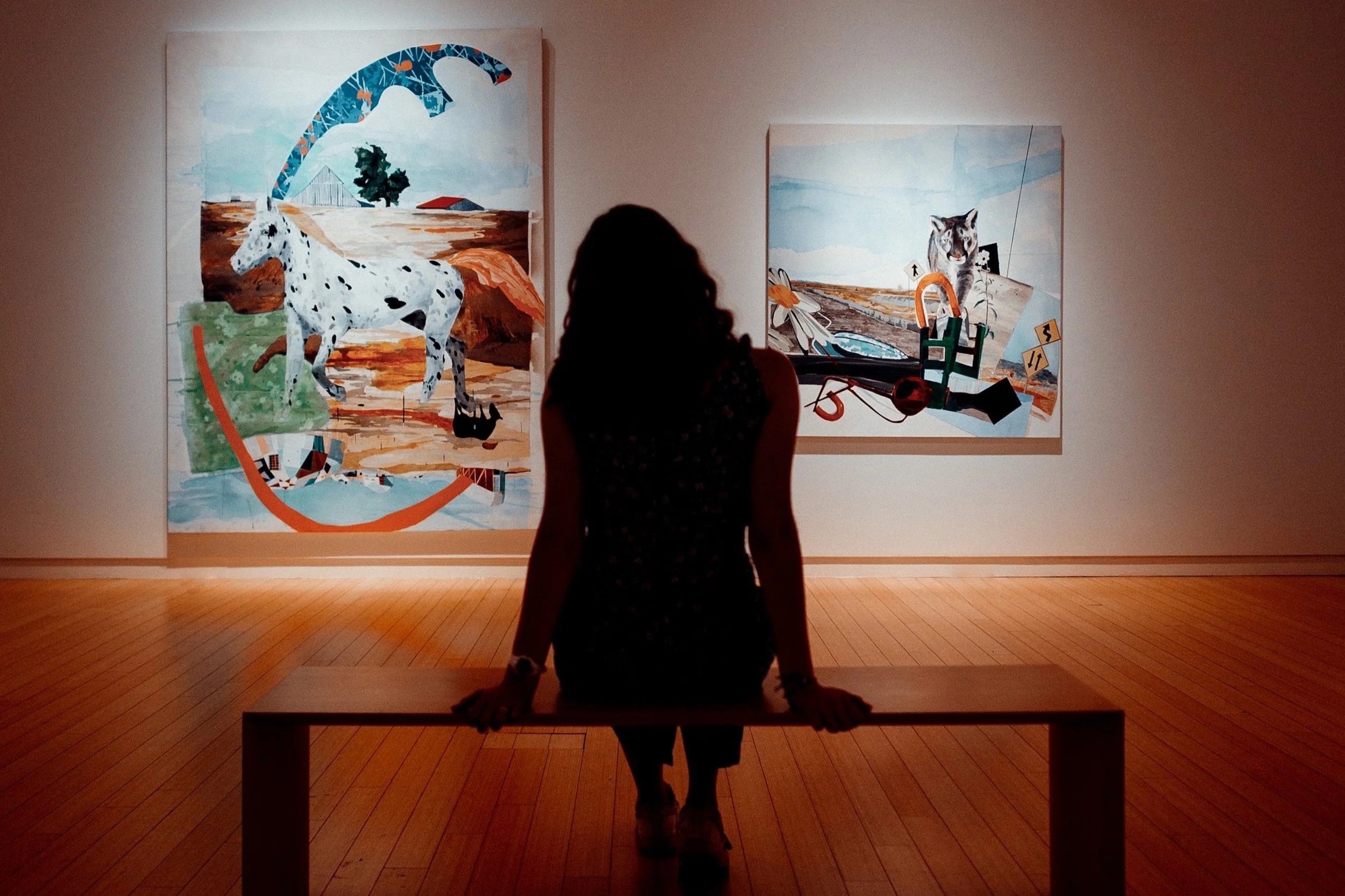
Five of our Favourite Museums for Finding Awe and Wonder
A visit to a museum can be one of those everyday adventures that helps inspire us in our daily lives, feeds our curiosity, and brings a sense of awe and wonder into our days. Here’s a round-up of five museums in London that recently offered the life pick-me-up that we needed.
Where do you go to locate awe and wonder? For us, it’s often a museum; that combination of the architecture of the space, the works in the galleries, the storytelling of the displays and exhibitions, and the people sharing the experience with us (plus the cafe and bookshop, of course).
A visit to a museum can be one of those everyday adventures that helps inspire us in our everyday lives and feeds our curiosity.
Here’s a round-up of five museums in London that we recently visited when we needed a life pick-me-up when all the things got a little too much.

Just the central atrium space on entering The Design Museum’s new home on Kensington High Street brings pause enough; but then the journey through approximately 1000 objects in Designer Maker User, the permanent collection display that contains everything from typewriters to roadsigns, is the experience we need to stimulate our (often neglected) creative minds.
For us, The Design Museum, one of the world’s leading museums on design and architecture, helps us to pay attention, to notice the details, the choices, that shape the things we use daily. The story of how we work, how we connect, and how we live our lives is told within these galleries (and sometimes it’s an odd sensation to look back on past iterations and realize that for a moment the promise they held was the future).
Look out for exhibitions that explore sensation in The World of ASMR, social and environmental issues in the work of Bethany Williams, and colour and play in the installations of Yinka Iloria.

A museum to break your heart and put it back together again: From the very first wall that reminds you that ‘Heathcliff was a foundling. Harry Potter was fostered… and Han Solo was adopted’, to the display of tokens that allowed a parent to reclaim a child, the Foundling Museum reveals the intimate stories behind the UK’s first children’s charity. Founded as a place for abandoned and neglected children by Thomas Coram, London’s first and only foundling hospital opened in 1939 (it took 17 years to raise the funds). Though the hospital has long closed, its purpose is still vital. As the current director, Caro Howell recently said, “This museum is unlike any other museum in the world, because for care-experienced young people, who have experienced such isolation and grown up without family, this museum gives them ancestry.”
But the museum also tells another story, one of artists and philanthropy; this was England’s first public art gallery (and a precursor to the Royal Academy) and artists (including William Hogarth, Charles Dickens and George Frideric Handel) created works to bring the public into its spaces. Today, The Foundling Museum celebrates the impact artists have had on children’s lives for over 270 years, from continuing to work with vulnerable young people to creating newly commissioned pieces that speak to the history of the museum itself (by artists such as Yinka Shonibare and Michael Craig-Martin).
Look out for the exhibition Superheroes, Orphans & Origins: 125 years in Comics.

We’ve often lost ourselves down the corridors of the V&A. For a time we were lucky enough to work close by and visit in our lunch hour – walking its many galleries, room by room, over years (though always finding ourselves back in the fashion galleries). The building in which the V&A is housed itself inspires awe, but it’s the vast collection spanning 5000 years of history and 1.2 million objects that inspires wonder. There’s Michelangelo’s David, Grayson Perry’s vases, Julia Margaret Cameron’s photographs, Alexander McQueen’s evening dresses and William Morris wallpaper, as well as ceramics from China, a theatre and performance collection and even a Glastonbury Festival Archive. And it’s all free to visit.
Now with a site in Dundee, a collection in Stoke on Trent, galleries in China, and future new London locations the Young V&A and the V&A East, this cultural behemoth continues to enthrall. For a taste of its magic wherever you are, watch the V&A film’s Creativity: It’s What Makes Us, or book a spot on one of their many online programs.
An exhibition to look out for Fashioning Masculinities: The Art of Menswear. An event to attend: Friday Late.

Tate Modern, always. Is there anywhere else like the Turbine Hall? Or the repurposed industrial tanks? Or the view from the iconic Lightbox on Level 6? Since it opened in May 2000, Tate Modern has dominated London’s cultural life and the South Bank. But though the building exists on a monumental scale, the artworks offer a more intimate experience: we recommended finding spaces away from the crowds (particularly in the permanent collection displays) and trying some techniques for Slow Looking.
Seek out Yayoi Kusama’s Obliteration Room and the artist’s Infinity Rooms, Lubaina Himid’s theatrical exhibition and Magdalena Abakanowicz’s woven sculptures. Participate in the Drawing Bar. And lose yourself in the wonder of modern and contemporary art (even if you don’t fully understand it).

What does home mean to you? This museum can help you reflect on that question.
Tracing how our homes have changed over a period of 400 years, this museum looks at how they are more than the spaces in which we play out our lives, but also hold emotional meanings around ideas of belonging, safety, and mental wellbeing. The Rooms Through Time Display traces a single room – the main living space – and how it evolved in middle-class households from 1630 to today offering a fascinating insight into how the way we organize our lives, our families, and our work, has changed dramatically in that period. Moving from a hall where all the household (including servants) ate together to a loft-style apartment in 1998, we get glimpses of lives once lived as well as some nostalgic moment’s along the way (like remembrances of our grandparent’s house).
Located in a row of former almshouses (whose architectural lines are traced in gold on the floor) in Hoxton, the Museum of Home reopened in 2021 (though it has existed in some form on the site since 1914) after a rebrand and refurbishment, so it’s definitely worth a visit even if you think you know it. Though on a domestic scale, there’s wonder to be hand exploring the spaces and witnessing just how much life has changed and continues to change, and how that’s impacting us – rightly or wrongly - on a daily basis.
Look out for the Museum’s Festival of Sleep and the Great Pajama Party.
Where would you add to this list? Which museums do you visit for bringing more awe and wonder to your everyday life? Let us know the places that you’d recommend we add to our guide for life.

The Generator Hub
Discover a coworking space in Exeter that has become a place where people can come and escape their own four walls, and meet other like-minded individuals (maybe even friends for life).
Located in a historic building in a stunning location on Exeter’s Quayside, the Generator Hub was the city’s first independent coworking space. Elizabeth Finnie, one of its three founders, takes us through how the Generator Hub has been helping its members shape both their businesses and their lives since 2012, and how it’s very much a coworking space with soul.
What is The Generator Hub? We are more than just bricks and mortar, we are a coworking space where people can work flexibly in a professional manner while being immersed in a diverse, interactive, and supportive community.
How did your space get started? When Neil Finnie (one of the founders) started a new business aimed at abolishing the status-quo of traditional and uninspiring internship schemes, he recognised that the participants attending his Corkscrew programs also needed to be immersed in real-time businesses to better grow their skills. At that time there were no co-working spaces in Exeter, so Neil launched not one, but two businesses simultaneously in order for them to complement each other. This is when The Generator Hub began, making Corkscrew one of its first members. Since then, The Generator has gone on to support hundreds of local businesses in many different capacities as well as the community where it is located.

How is your space different? Having grown organically we remain a very small team. Three out of four of the directors are based in the coworking space and play an active role in the community and day-to-day running of the space. We’ve also progressed approximately ten apprentices through business admin and event management roles, giving them the skills to move on to further employment. We also recognise that individuals and businesses are all unique and we will always take each situation on a case-by-case basis to give them a chance to grow and be successful.
We offer discounts for CICs, social enterprises, charities, and the NHS and adapt to people's ever-changing needs. We also like to get involved in the local community — attending local meet-up groups, supporting local networking groups by offering free space, and highlighting local events on our internal slides, newsletter and social posts.
Why is your space needed now? For many freelancers working alone, the Generator Hub has been a place where they can come and escape their own four walls, meeting other like-minded individuals and friends for life. Everyone is viewed as equal and, for many, it's a place to come and talk about issues both business-related and in their personal lives.
For small businesses, we are a great space to offer a more hybrid way of working — many companies now rotate larger teams so there is the flexibility to work from home some days and be part of the team others — again, this has really helped people’s health and wellbeing, This is particularly poignant after Covid and we feel with have maintained many people's mental well-being by just being here.

What do you offer people? We offer flexible working space options (hot desks, permanent desks, private offices), meeting rooms, registered addresses, a postal service, a reception service, and even showers on site. We organise Lunch & Learn events whereby we invite external speakers to promote their business/charity/initiatives, we hold internal talks to showcase our own members’ businesses and skills, and we arrange regular charity fundraising events. We have a meet-the-members wall and within the community, other events have grown, such as a curry club, a biscuit club, a running club, a CrossFit club, and 5-a-side football — the list is ever-growing.
How can people be inspired by your space wherever they are? We have regular social posts on Instagram and Facebook, alongside promotions of things going on in and around Exeter (on LinkedIn). We also have a monthly newsletter that highlights all the things that have been going on in the space and future things to come — as well as a community insider highlight to introduce our members to others.
What do people need to know? We are fully up and running again after Covid and we welcome any business to talk to us about their needs.
We also have a big emphasis on sustainability, people, and the planet. Having very recently started on the B-Corporation journey, we hope to make our business better for the people that work for us, the community and the environment. We are looking at trialing a 4-day work week for our employees, alongside ways to become net-zero.
Where inspires you? Nature — anything sea, river, stream, countryside.


Kelechnekoff Studio
A pole-dance studio that has diversity at its core that’s changing the shape of the wellness industry.
Nigerian-born Londoner Kelechi Okafor (recently named a Wellness Visionary to watch by Vogue) opened her pole-fitness and twerk studio space in 2016 to offer a more diverse space for women to get into their bodies and a more authentic approach to the dance styles that she teaches. Kelechnekoff Studio has since become a place of welcome to all, irrespective of body shape, ability, or background, restoring confidence to women who have been told one story of how they should look, and kindness in an industry that can seem anything but compassionate. Here the studio tells us more about their approach:
What is it? Kelechnekoff Studio is a pole dance studio in Peckham that offers classes of different levels, as well as classes in yoga, Wing Chun self defence, and handstands and flexibility.
Why do people need it? Kelechnekoff Studio is a place for all bodies to explore different types of fitness that have the power to make them feel sexy, powerful and confident. The space was started at a time when in the UK there were few fitness spaces that had inclusivity at their core and hardly any Black-owned pole dance studios.
What do you offer? The studio offers a range of pole dance classes — that include spinning pole, sexy pole, pole flow, pole dance inverts and climbs — from absolute beginners to intermediate levels. There are also sessions in Wing Chun self-defence, yoga flow, vinyasa yoga, and handstands and flexibility.
What makes it different? Our studio is based in the heart of Peckham and honours the origins of the dance styles we teach. Kindness and how people feel in their bodies are more important than appearance to us. We also strive to keep our classes as affordable as possible and create a caring community within our studio.
What do people need to know? We have classes every day of the week and even offer pole hire sessions for £5 during the week. In addition to this, you can buy a party package and have a pole dance or twerk party with us!
Tell us a little about your story: Our studio founder Kelechi Okafor is a trailblazer; she is an actress, personal trainer, pole instructor, director, author, and award-winning podcaster. Kelechi opened her studio in September 2016 to create a space for those who are often erased from mainstream fitness culture. These classes aim to nurture the relationship between mind and body and to be a safer space for people to enjoy fitness whilst exploring their sensuality with guidance and without judgment.
Kelechnekoff Studio Peckham
Sojourner Truth Centre
161 Sumner Road
London, SE15 6JL
Contact: info@kelechnekoff.com

Pages of Hackney
A bright blue beacon on Lower Clapton Road, Pages of Hackney is one of our favourite bookstores for reading advice. Founder Eleonor Lowenthal talks to us about what makes Pages of Hackney so unique and why independent bookstores matter so much to our neighborhoods.
A bright blue beacon on Lower Clapton Road, Pages of Hackney is one of our favourite bookstores for reading advice. It’s welcoming not just in how customers are greeted and the bookstore arranged (no intimidating, fusty-ness here), but also in terms of which books get to sit on its shelves and whose stories get to be told. Founder Eleonor Lowenthal talks to us about what makes Pages of Hackney so unique and why independent bookstores matter so much to our neighborhoods.
What is it? Pages of Hackney is a small award-winning bookshop on the Lower Clapton Road selling an eclectic mix of books. Our priority is to be a friendly, community bookshop that is accessible and inclusive, supporting the issues we believe in and giving a platform to marginalised voices in publishing.
Why do people need it? Everyone should have the opportunity to have books in their lives. When I started the bookshop in 2008, there hadn't been one in the local area for 30 years and we had both children and adults coming in who weren't sure what a bookshop even was. We do our best to reflect the local community in our diverse stock choices and through our Pay it Forward scheme to also make it affordable for everyone.
What do you offer? We sell books in the areas of literary fiction, politics, feminism, essays and life writing as well as philosophy, psychology, nature writing, music and children’s books. Our priority is for each customer to feel that the bookshop is for them, and we do our best to give our customers individually as much time and thought as we can. We put on lots of events, both in-person and online, addressing issues including gender, sexuality, race and current events as well as platforming novels from established and debut authors.
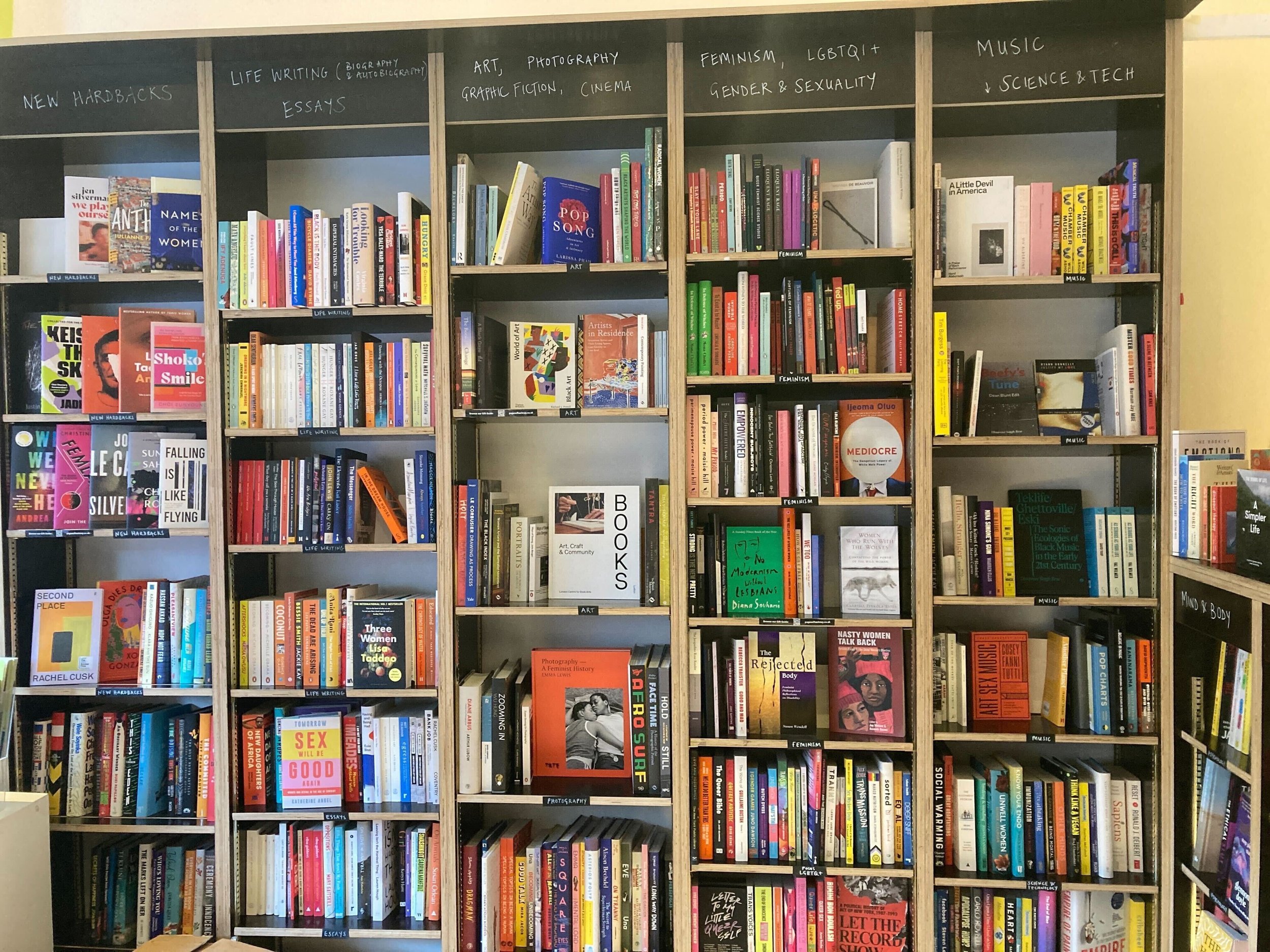
What makes it different? The space is designed to feel like a sanctuary from the busy life of the High Street. Once you step inside, you're free to browse in a quiet space, talk to us and ask for specific recommendations, or simply sit in our cosy basement. What makes us different is that we aren't simply invested in selling a book to every customer, but in making everyone feel welcome and as if the shop belongs to them and is a part of their community.
What do people need to know? We are open every day for in-person browsing, but you can also order all our books online, or request anything you don't see there. We can get most books we don't have in stock in 1-2 days and can also post books and gift wrap if required.
Tell us a little about your story: Books are an excellent way to unwind, escape into, and learn about how to cope with anything people might be struggling with. Our books reflect this and the bookshop itself is a safe space in which people can reconnect with themselves and consider what is important to them.
How can people be inspired by your space wherever they are? Simply browsing our shelves, online or in person, should be inspirational, connecting people to authors and ideas that they haven't heard of, or that they might want to explore more deeply. In addition to the usual categories, we have shelves dedicated to specific subjects that might be of interest (including the Black Britain series, both Japanese and Korean writing shelves, Afrofuturism) and authors we're currently inspired by (like Joan Didion and Toni Morrison).
Where inspires you? I get inspired by talking to new people every day in the shop and exchanging thoughts, ideas and feelings.


Typewronger Bookshop & Typewriter Repair Shop
An indie bookstore, that offers typewriters repairs, origami animals and soup on Christmas Day. Founder Tom Hodges tells us whyTypewronger is far more than just a place to buy books.
“You can’t be lonely with a book - books transport you to other worlds, other places, they make you other people. Whilst immersed in a book you can only feel what’s in the pages.”
We knew we’d discovered somewhere special on a recent trip to Edinburgh when we stumbled into Typewronger on Christmas Eve and received the warmest welcome, an origami elephant, and a recommendation to read Insomniac City (subsequently stamped with their distinctive red logo and now one of our most cherished reads). Here founder Tom Hodges tells us about what makes Typewronger so distinct:
What is it? Typewronger Books is Edinburgh's smallest indie bookshop and Scotland's only typewriter repair shop! It's home to a community of readers, writers, artists & musicians and strongly advocates the written word in our daily lives.
Why do people need it? Typewronger is far more than just a place to buy books. Regulars stop in for a chat, people have built creative connections, made friends, been inspired, switched careers, written zines & started publishing companies all as a result of hanging out in this shop.
Advice & Assistance Obtainable Immediately, and there's even a Public Typewriter for those who want to just sit down and write - and don't worry about mistakes, this is TypeWRONGer where we embrace our flaws.

What do you offer? Book signings, author events, open mic nights, a YouTube channel, we flex on the 'gram & have a 1984 electric typewriter wired directly into our Twitter (yes, it types out your Tweets!)
We send books all over the world in our characteristic wrapping with hand-typed notes of your dictation, so we're perfect if you want to send a book as a gift - just drop us an email and we'll wrangle it.
We also organise the Edinburgh Zine Fair and advise new publishers on the nitty-gritty of the trade.
What makes it different? The energy is anarchic, the books hand-picked, and we're always ready and willing to engage with you on any topic. We stamp all the books with our shop stamp and give a little origami animal with each purchase. Even though we're a tiny wee store we stay open until 9 pm, we even open on Christmas Day with soup for those with nowhere else to be, and New Years Day handing out recovery Bloody Marys.
What do people need to know? Due to Covid we have a traffic light system to limit numbers and have paused our events program. We are hoping to change both of these in the coming months as cases dwindle.

Tell us a little about your story: Typewronger started when I moved back to Edinburgh in 2017 and began selling books in the street from The Leith Walk Police Box. Every Sunday a band of friends would humph all the bookshop stuff down from my flat - books, bookcases, a carpet, an armchair - the lot! In 2018 Typewronger moved into the old gallery space beside McNaughtan's, Scotland's oldest Antiquarian bookshop. In 2019 Elsa joined the team, and the shop opened 7 days a week, and in 2021 we were joined by Viv who works the day shift on a Saturday. Since opening, we've had thousands of conversations with people from all over the world.
How can people be inspired by your space wherever they are? We send books worldwide, so you can always get a bit of Typewronger sent to your doorstep. Also, we believe in physical correspondence - if you write us a letter and include your return address we will always write back to you on one of the shop's trusty typewriters.
Where inspires you? There's a wine bar upstairs.
You can't be lonely with a book - books transport you to other worlds, other places, they make you other people. Whilst immersed in a book you can only feel what's in the pages. And the feelings can be hard, but they're cathartic, and the feelings can be good, and there's all sorts of books perfect to all sorts of moods.
Anything we're missing? It's a matter of public record that the store's founder is Tom Hanks' "hero."

Discover more places for life in our Guidebook

The Soul Spa | A conversation with founder Madeline Blackburn
How do you make time to pause? We talked to Madeline Blackburn, founder of Bath’s The Soul Spa, about how we can rethink how we treat our modern-day ailments and create better spaces to hold us on our high streets.
A center dedicated to the mind-body-soul connection, The Soul Spa was founded on a site of healing — legend has it that King Bladud was cured of leprosy from the hot springs that the building, one of the oldest in Bath, is situated on. For years people have come to this location to get well (the energy of Sulis Minerva has even been felt in its rooms).
We talk to founder Madeline Blackburn about how The Soul Spa is providing ways to treat our modern-day ailments and creating the space for people to just pause.
The Soul Spa feels like a new model for the mind/body/spiritual in our communities.
When I was thinking about how to create this space, I knew I didn’t want to be the church hall, because the environment matters so much to me. I was in a flotation tank in Colorado, and I literally sat up in the dark and the idea of “soul centers” came into my head. I went home and wrote and wrote and wrote. I noticed that there were workshops in spaces, nice retreats, and meditation and mindfulness classes. But what’s unique to The Soul Spa is that we’re in one building and have a permanent offering. Though workshops and courses might change, our practitioners and team of people are here all the time and here for you if you need them.
Often practitioners can be quite siloed but maybe, for instance, a client who comes in for psychotherapy finds it won’t work for them and that they would do better with a reiki healer. You offer a more client-led model, giving possibilities for accessing healing in different ways.
Absolutely. From a holistic physiotherapist and an astrologer to a shamanic healer and nutritionist, we try to foster a collaborative nature between us. We know what each other does. All the therapists say how refreshing it is to feel part of something, rather than just renting a room. That’s quite unique about us. Also what I understand of the human brain is where your beliefs are, if you believe in something, that’s probably going to work for you better than something that you don’t believe in. I’m here, not to make any comment or judgment about what anyone’s beliefs are, but to give them the smorgasbord of choices that will fit in with their view of the world. And then maybe even open people up to new ways that they haven’t thought of.
We don’t want to make people feel like it’s going to be work or difficult though but approach from a place of relaxation and calm, peace, and time out. We have a Quantum Field room, so people can just drop in and tune in to one of our guided meditations or bring their own.


There’s a shift in wellness now: it felt like before it was something you did over there, there was a certain audience for it and that audience looked a certain way. But with The Soul Spa and the other places we cover in this guide, we’re finding that where we locate wellness is more fluid. It’s shifting in how people are bringing it more into their everyday lives.
We’ve also noticed how people in the UK now talk about wild swimming or forest bathing, or other activities that are right there in their communities, and actively reach for something locally. It feels like people want to be doing these things and your space, and the others that we feature, give us permission to bring more of what we need into our lives.
Because you don’t do it. Most of us don’t do it at home. It’s hard to do it at your desks. Summertime yes you might sit in a park. But where is there to go in winter? I was brought up Catholic and the other week I just sat in a church for a bit, just to defrag for a few moments and calm my head down. We do need spaces that give you that permission to hang whatever is happening in life up in the cloakroom and just come and be for a bit. For The Soul Spa, I want people — whether they are shopping or a tourist or a local worker — to know there’s a space they can go for twenty minutes or half an hour where they don’t need to think about anything else.
I think we all need that space.
So many people say that they wish they had something like this in our town. Every High Street needs one.
If there was intentionality about it, the High Street would look so different, and serve us as people. What we’re really craving are these spaces that hold us differently and not on our own but together. Somehow to be around one another in positive, more human-minded ways.
I think The Soul Spa is that. I’m not a shopper but I love the energy of the High Street. That’s why it was important to be situated in a quiet place near the center of the city. I would love to think we could prove this as a model and then bring it into other places, just like how the idea of gyms developed before when they’d never existed previously.
I also like that we’d be for everyone, children and old men, fat and thin, every color and creed. Everybody. What we do here is a human thing. It’s fantastic that it appeals to people who already do yoga or meditation: they are intrinsically very interested in their health and more likely to do this, but I want other people who have never done anything like this to know it’s for then too


Why do you think wellness can be associated with being aspirational, a commodity, an appearance, and not for everybody? Is that cynicism, money, equity? Why do you think it has that weight to it?
I think it’s partly cultural because I don’t think it’s in every culture like that. There are cultures that do see it as intrinsic. But here, before the 80s, everyone was just trying to survive. My mum was born at the beginning of the war, and for her generation there was nothing. It really felt like a luxury to even consider looking after yourself. As we were growing up that was still in the mix. Then we had the 80s which just became uber materialistic and we’re still in the back end of that somehow.
It’s very natural for people to try and make themselves feel better. It’s just where you look for the thing that’s going to make you feel better that’s shifts so much. In our culture now it’s getting lots of likes, social media shaping our self-perception, and that’s not working so well.
I really think that people are going to want places like The Soul Spa more. It’s all life though. And I absolutely love life so even the bumps are kind of interesting when you can view them from that perspective.
Our model for mental wellness has been one around crisis management. For a long time, when we’ve thought about accessing therapy and medication, it’s about quickly reaching out, finding resources in the moment of high need. But what I’m seeing from you and your work at The Soul Spa is that there’s a different way of navigating our wellbeing, by developing a practice that people can build and access every day before they get to that stage. That means that when a crisis happens there’s that foundational piece, tools that people know work for them and they can use. It’s the other way around.
Most of us know now how to look after ourselves physically, and most do a bit of the right thing. We know how we should eat, and about exercise. We do all of that so that we don’t get ill and if we do, our bodies are stronger to cope with that. It’s the same thing for the mind. But I think that’s what puts so many people off, is that they think they can’t do it. Like with meditation, people often worry that they will think about what to have for tea and getting the shopping…
… they worry about getting it wrong. For many people meditation comes with the perception that their mind needs to be empty to get it right…
…and they say but my mind is too busy. But welcome to being human beings. That’s not that special, it’s not unique to them. Everybody has this experience and it’s learning that’s ok that might get someone to try it.
I come from a hypnotherapy background, and it’s all about your deep-down beliefs, where they’ve come from, and how they drive all your automatic behaviors, reactions, and thoughts. When I’m helping people relax, I’m thinking about the brain state, and about getting them into an alpha state, and potentially into the theta state because I know that in that state the rest of their body can go off the sympathetic into the parasympathetic nervous system. It can rejuvenate, it can heal. That’s the state you need to be in for your body to be well, for your mind to take a minute, to take a break.
For people who find it harder, my method is much more spoken and guided. I’ll use little hacks from hypnotherapy like a countdown or an eye-roll, or something for people to get into the alpha state a bit faster so that their neurons then fire together. The more they do that, the more they practice it, it becomes automatic, like a habit. Instead of responding when someone cuts you up on the road with adrenaline and anger, you can be more chilled out about it, understanding that maybe they are having a bad day and need a bit of love.
Just a bit of compassion
I just feel like positive things could happen if we can get more people responding like that or at least seeing or understanding why they are responding the way they do, looking at it, and being willing to shift. Instead of looking at the external world and blaming it for everything but wondering actually how can I change because I’m probably not going to change that external thing. Though in reality the more we can all change the more that can change too.


Need more mind-body connection in your life, visit our guide for more places, prompts and ideas for how and where to find it.
Let us know where you go when you are looking for more spirituality and more mind/body connection in your life.

The London Lonely Girls Club
Looking for connection in one of the world’s busiest cities? Holly Cooke talks to us about why she started The London Lonely Girls Club and how it can inspire you wherever you are.
“Stepping outside of your comfort zone, saying yes to every opportunity to meet others, being bold.”
We talk to Holly Cooke, founder of The London Lonely Girls Club about why she started these IRL meet-ups for women looking for connection and how this idea can inspire you wherever you are.
What is it? The London Lonely Girls Club is a community in London, created to help women in the city meet up, hang out, build friendships and make London life a little less lonely.
Why do people need it? As an adult, it can be really difficult to meet new people, make new friends or simply find others with similar interests or hobbies. And so The London Lonely Girls Club was created to meet this need and help women across one of the busiest cities in the world connect with each other!
What do you offer? We are both an online and physical community. We have an active Facebook group of over 10.5k women. Within this forum our members can post, engage and get to know each other at their own pace. Alongside this, we run meet-ups multiple times a month where our members can get to know each other IRL whilst visiting some of London’s loveliest places or doing fun activities together.
What makes it different? The London Lonely Girls Club was specifically created to help women connect, make friends and beat loneliness. It’s as simple as that, no strings attached!
What do people need to know? LLGC, as we call it, is an inclusive, supportive, fun community that any woman in London can engage with in their own way. Whether they’re just looking to find someone to go on weekend walks or theatre trips with, advice on the best place to get their hair done in a specific part of northwest London, or to build lifelong friendships, everyone is welcome!
What’s your story? Before founding The London Lonely Girls Club, I was a very lonely girl living in London. I’d moved to the city for work and to fulfill a lifelong dream of living in the best city in the world. But very quickly moving to a city where you know absolutely no one can be both isolating and terrifying. From this The London Lonely Girls Club was born, a community created to bring the women of this incredible city together under the flag of unity, connection, and friendship. With meet-ups each month that allow people to connect in person, rather than just via a screen.
How can people be inspired by your initiative wherever they are? Every day the members of LLGC teach me about bravery and courage, whether it is sharing their story in our group’s main feed and looking for others who share a similar struggle or journey, stepping outside their comfort zone by coming along alone to our monthly IRL meet-ups and connecting with others in person over a coffee, burger or glass of wine, or simply revealing themselves by joining a community with lonely in the name.
I think this is something that can inspire everyone, no matter where you live, how you identify, or what your social situation is. Stepping outside of your comfort zone, saying yes to every opportunity to meet others, being bold. Just one small decision of courage really can change your life, I should know, it did mine!
Where inspires you? The women of our community and the incredible city that we live in. They’re both so inclusive and diverse and vibrant and loud and unapologetic, but also kind and supportive and beautiful. It is inspiring to get to be just a small part of these things.
Anything we’re missing? If a woman in London is reading this, then we’d love to have you be part of our community! Whether you’ve lived here your whole life or you moved a day ago, feeling lonely is the worst. As humans, we’re built to be in community, surrounded by others who can lift us and love us and support us during both our triumphs and challenges and that is what The London Lonely Girls Club aims to do.
To find out more visit: Our website | The LLGC FB community | Our social media


Discover more places to feel connected

FOLDE: A Conversation with Co-founder Karen Brazier
We spoke with Karen Brazier about how Dorset’s FOLDE is connecting more people with nature and how this contributes to their, as well her own, wellbeing.
Let’s start with, what FOLDE is. It feels like a bookstore that goes beyond just books. One for curiosity seekers and nature lovers.
That’s a pretty good description. FOLDE doesn’t really fit neatly into your typical shop categories, e.g. bookstore or gallery. Our starting point is our theme - the nature and landscape of our home county of Dorset - and everything else tends to follow from that. In addition to our core collection of nature-writing books, we sell art and traditional craft from local artists and makers that in some way celebrate our county’s nature, lore or landscape. That could be through subject matter or the use of locally sourced materials. We also sell a carefully curated range of items that enhance your experience of being outdoors, from field kettles for making a fresh cup of tea when you’re out on a walk, to quick-dry towels for use after wild swimming.
What led you to start FOLDE and create a space in your community?
We jokingly call FOLDE our pandemic-induced midlife crisis but its origins began long before the first lockdown. We met over the garden fence (quite literally, our gardens back onto each other) and, as our friendship developed, we discovered that we had both reached a point in our corporate careers where we wanted to make a change. It wasn’t just work-life balance; our jobs were taking us away from Shaftesbury, our beautiful hilltop town, physically and mentally, just as we were waking up to the fact that regularly spending time outdoors in the Dorset countryside was vital to our wellbeing. We wanted to find a way of rooting ourselves in the heart of the place that had given us so much, of celebrating it and protecting it, whilst also giving ourselves more time just to be here.
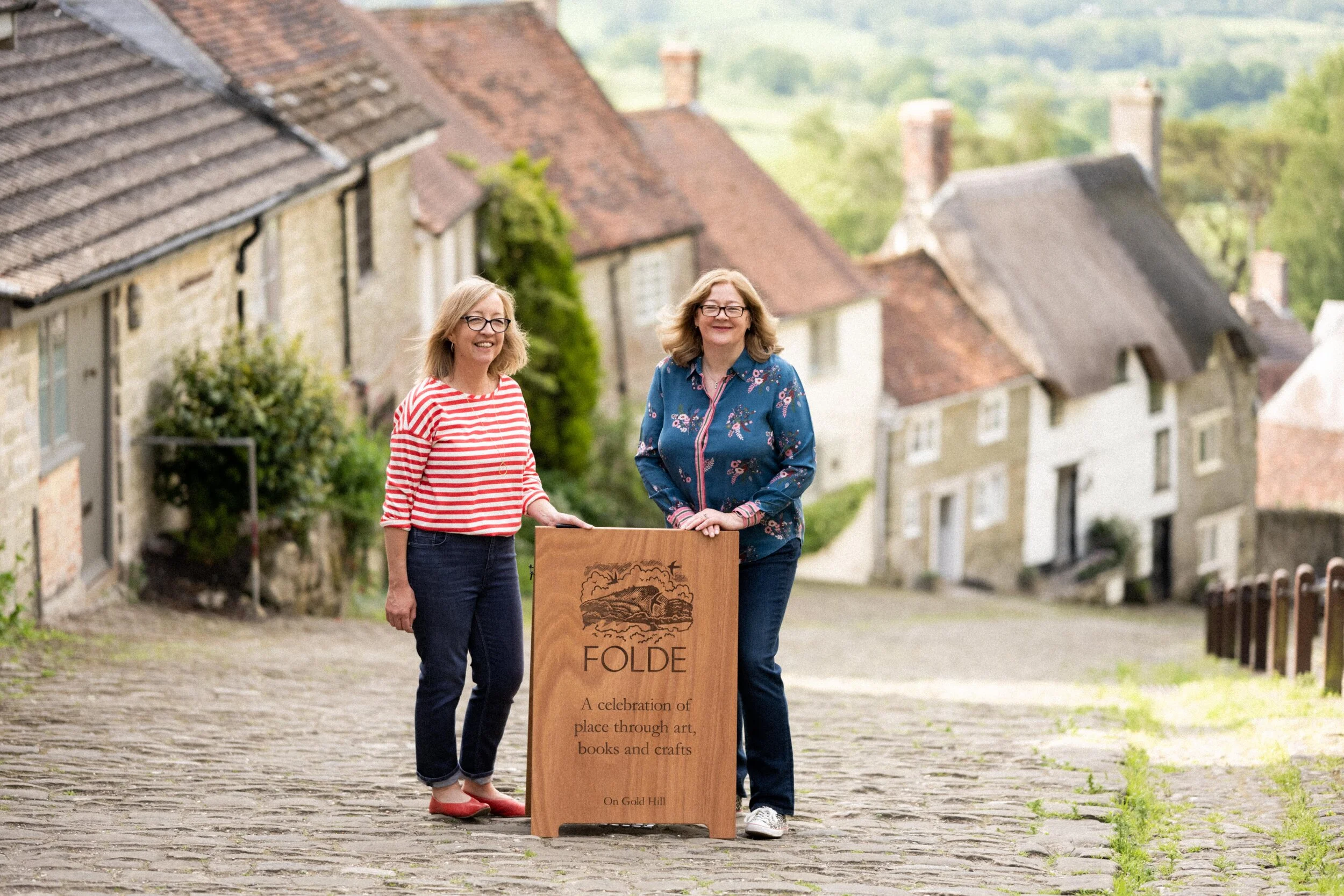
All Photos: Matt Austin
Tell us about your three themes: Land. Sea. Self.
Quite simply, these are the things that make us tick, from swimming in salty waters to striding across the Dorset hills. The products we sell are broadly grouped around the ‘land’ and ‘sea’ themes, while ‘self’ addresses our central aim of helping more people to discover how a greater connection with nature can contribute significantly to their own wellbeing.
What has been your own experience of the therapeutic value of nature?
It’s fair to say that we had both experienced a degree of burnout in our previous careers, which had taken its toll on our mental and physical health. For me (Karen), it took some years to discover that there was a sanctuary to be found in getting outside; in my twenties and early thirties, I used to think the answers I sought were waiting in a shopping mall. My partner has always been an outdoorsy sort of person and when I was at my lowest ebb, he knew that it would help me to get outside, even on those days when all I wanted was to stay under the duvet. His persistence paid off and gradually, over a period of years, I grew to truly love walking, on the Dorset coast in particular, and I became better at managing my stress levels. I found that being outside gave me the tools I needed to recalibrate as well as a deeper connection with nature that helped me to make sense of my place in the world. Regular walks are now essential to my wellbeing, supplemented by year-round sea-swimming, and I border on the evangelical about the therapeutic benefits of both.
As for Amber, she had spent her childhood growing up in various small villages in West Dorset, and found that the sense of community, nature and belonging had become something of a beacon to her through her adult years. Travel was a big part of her previous working life and, while she enjoyed the experiences, she found she always yearned for the green hills and vales of Dorset. It keeps her grounded and connected to the earth, and it’s home to the footpaths she treads when she needs time to think. It also helps her to appreciate the seasons, and the changes that come with them.

During the pandemic many of us turned to nature for our mental wellbeing? Were you surprised by that? Do you think this is sustainable as something in people’s lives now?
No, we weren’t entirely surprised. Over the past decade or two, we had both found great comfort in noticing the rhythms of nature. No matter what else is going on, the sun always rises and sets, the seasons come and go; these rhythms are a constant among the more chaotic aspects of life. But in order to notice these things, you have to allow yourself to experience nature, and this can sometimes push people out of their comfort zones.
In recent generations, so many of us have come to live and work in a context that is entirely separate from nature. It doesn’t help that until relatively recently, the outdoor recreation industry was heavily geared towards white men dressed in Gore-Tex and if you didn’t look like that, it was easy to think, ‘well, that’s not for me.’ However, when our options for entertainment, exercise and socialising were suddenly and so dramatically curtailed by lockdown, it was not surprising that the simple act of taking a daily walk outside brought nature into closer focus for so many of us and, in so doing, allowed us to discover our fundamental human need to connect with it.
Whether it is sustainable is a good question. We like to think it is, and if the burgeoning number of nature-writing titles being published is anything to go by, we don’t think people’s interest in the subject shows any signs of waning, whether that’s wild swimming or planting a bee-friendly garden. That said, we are acutely aware that it is largely dependent on people’s access to green space, and the pandemic highlighted that there are significant societal inequalities in this regard.
On returning to the UK after 14 years away, we’ve been struck by how outdoorsy it’s become here, from wild swimming and camping to coastal hikes and paddleboarding. What do you think has accounted for this shift and where do you see it going next?
There’s definitely a much greater awareness in the UK of the physical and mental health benefits of outdoor pursuits and, to a certain extent, social media has glamorised the appeal of these activities: we can’t be the only ones to have looked at a photo of a dreamy coastal clifftop at sunset and thought ‘I want to be there’. Instagram in particular has effectively become a wanderlust travel brochure in terms of its ability to present aspirational images of beautiful outdoor experiences, and it is often said that Millennials prefer to collect experiences rather than tangible goods. It’s more than that, though. We think it also has much to do with the speed and relentless distractions of the digital age; spending time actively engaged with the outdoors is a brilliant antidote to that.
In terms of where it’s going, we hope that there will be a greater focus on diversity and inclusivity, as well as sustainability, although the sector still has some way to go in these areas.

What’s been your experience of starting a space in your community? What have been your joys and challenges? Anything unexpected?
It has been almost entirely a complete and utter joy. Shaftesbury is a close-knit town of largely independent businesses, which are greatly valued by the people who live here, particularly since the pandemic when they pivoted overnight to provide for the community at a time of great uncertainty. Support for local businesses has never been greater, and recognising this helped us to take the leap of faith and open FOLDE. We had tested the proposition online first and, when a space became available right here on the iconic Gold Hill, we took it as a sign that we should go for it. True to Shaftesbury form, we were met with a very warm reception by our community and, although we are in a good spot for tourists, it is our local customers who keep us going.
There are so many joys to doing what we do, from building relationships with the many talented artists and makers right here on our doorstep to having a presence at the heart of the town we love. The biggest joy, undoubtedly, has been growing our FOLDE community, both online and in-person, i.e. the people who share our love for this beautiful part of the world and want to swap stories about the places they’ve been and the outdoor experiences they’ve had. We’re aware that we don’t look like your typical outdoor action women and we think that this might sometimes help our customers to try something they haven’t done before, such as cold water swimming; very much a case of ‘if they can do it, so can I.’
As far as the challenges are concerned, sometimes it can be hard to find certain products that fit with our ethos without compromising on our sustainability standards. And given that it’s just the two of us, we’ve had to learn quickly about many different aspects of running a clicks-and-mortar business, from till systems to packaging to payroll. Perhaps the biggest challenge is knowing when to leave it alone; we’re having a lot of fun and we’re brimming with ideas about where we can take FOLDE but we have to remind ourselves that we don’t have to do everything in year one. Luckily, our other halves are good at reining us in.

We have a series called Culture Therapy, where we list the podcasts, books, TV shows, films, etc. that people can seek out in our different pathways. Which books probably (though if you have other media that relate let us know) would you recommend for people wanting to bring more nature into their lives?
Almost every book we sell helps people to find a closer connection with nature in one way or another but the ones we would specifically recommend are:
The Salt Path and its follow-up The Wild Silence by Raynor Winn. These are obviously very well-known titles but we recommend them because they speak volumes for the power of nature to heal and restore, and they remain among our bestselling books.
The Forager’s Calendar by John Wright. There’s no shortage of interest in foraging among our customers but John Wright’s often humorous book is by far our most popular title on the subject. Foraging is a great way to reconnect with the natural world: it makes you slow down, notice and engage with everything that’s going on in the hedgerows, all year round.
Grounded: How Connection with Nature Can Improve Our Mental and Physical Wellbeing by Ruth Allen. We are both avid followers of outdoor psychotherapist Ruth Allen’s Instagram account (@whitepeak_ruth) and were delighted when she published her first book. She is wise beyond measure, and the book is a visually appealing, soul-nourishing mix of practical exercises and mindful activities interspersed with personal stories and thought-provoking questions. You will often find yourself nodding in agreement.
In music, we are huge fans of British folk singer and conservationist Sam Lee. His most recent album, Old Wow, is a spellbinding love letter to nature but one that contains stark warnings about all that we stand to lose. Earlier this year, we took part in Sam’s ‘Singing With Nightingales’, an unforgettable, immersive and profoundly moving experience that highlights through music the threat to the nightingale and other endangered species.
We would also recommend Lost in the Cedar Wood, a collaborative, lockdown project between folk singer Johnny Flynn and nature writer Robert Macfarlane that brilliantly melds myth, poetry, landscape and music. The opening track, Ten Degrees of Strange, is a rambunctious song about trying to outrun anxiety by seeking joy and strength in landscape and movement.

What are your favorite places to reconnect with nature?
We both love to explore Dorset’s Jurassic Coast, which offers an embarrassment of riches for anyone who likes walking or swimming against some breathtaking backdrops. There’s something about walking through fields to a clifftop or beach that can make you feel as if you’re the first person to discover it. While the honeypot attractions such as Durdle Door and Old Harry Rocks can be unbearably busy in high season, there are still plenty of other lesser known places, particularly if you’re prepared to walk a little, or go earlier or later in the day.
For our daily fix, we are fortunate that our commute to the shop takes us along a wooded path known as Pine Walk, which is lined with soaring beech and pine trees, punctuated with views across to Melbury Beacon. This is the hill that features in the wood engraving that we commissioned from Dorset printmaker Robin Mackenzie to use as our logo.
How can people engage with FOLDE from wherever they are?
Our website offers an edited selection of our products for purchase online as well as journal articles about our favourite artists, books, walks and outdoor experiences. On Instagram, we share the daily goings-on in the shop as well as many of our outdoor adventures when we’re not behind the counter.
Anything we’ve missed? Anything that you’re excited to share?
FOLDE will be appearing as a pop-up at Planted Cities at King’s Cross from 23 to 26 September, which is an event that aims to bring people and spaces closer to nature. We’re also working on a series of readings and workshops with some of our authors and makers, such as basket-making with local willow weaver Yanina Stockings. In spring 2022, we plan to launch FOLDE Out, a series of walking retreats for people who are looking to explore Dorset whilst widening their outdoor experiences as part of a small and supportive group.

Ready to bring more nature into your life, wherever you are?


The push and pull of the sea
The sea contains multitudes and it is exactly this complexity that keeps calling designer Sarah Robertson to it in moments of loss and need.
Wild and calm. Chaotic and beautiful. Bold and soft.
The sea has its contradictions. And, for as long as I can remember, I have been drawn to the push and pull of it.
From embracing the joys of wild swimming and overcoming panic while scuba diving to my rehabilitation through water therapy and evenings spent watching sunsets over the ocean, blue spaces have helped me heal and grow.
In many ways, the sea is a metaphor for our own life experiences; the ups and downs and ebbs and flows. At its most tranquil, it can relax and restore us. At its most violent, we can lose ourselves in its grip.
What I love most about water is its capacity to shift us into a more mindful state. It can lower stress, decrease anxiety and relieve depression. And as well as settling our thoughts and lifting our moods, it can bring us back to the here and now — help us feel grounded and present — and sharpen our senses.
The sea has always been a kind of therapy for me, and I have felt the emotional, mental and physical benefits first-hand. My mind can be elsewhere — ruminating over the past, worrying about the future — but as soon as my feet touch the wet sand and the waves reach my bare toes, I am right where I need to be. At these points, I feel alone in the most reassuringly positive way, and the solitude it brings allows curiosity and creativity to thrive. It is almost elevating.

Above: Luskentyre Beach at Sunset, Isle of Harris, Scotland by Nils Leonhardt | Top: Golden Hour at Luskentyre Beach, Isle of Harris, Scotland by Nils Leonhardt
In his book, Blue Mind: How Water Makes You Happier, More Connected and Better at What You Do, Wallace. J. Nichols, a marine biologist, investigates how water — literally and metaphorically — helps us move into a flow state. He coined this the "blue mind". Nichols examines why we are attracted to lakes, rivers, oceans and pools and why being near water sets our minds and bodies at ease. He illustrates the importance of our water connection — its almost magical quality — with the science behind it and the ways in which it allows our thoughts to wander freely. Is it any wonder then that some of the greatest artists, musicians and writers have been moved by the sea? Or why so many of us are called there to explore ideas or seize inspiration? If you’re looking for an a-ha moment, maybe the coast is calling you too.
Something else I cherish is that feeling of awe. The sense that we are a part of something vast, far bigger than ourselves, that connects all of us. So perhaps it is no coincidence, then, that we are also drawn to the sea to celebrate death as well as life.
My dad, who passed 30 years ago, was from Stornoway on the Isle of Lewis. Throughout my life, I had always felt this tug to travel to the Outer Hebrides, and when I first visited almost 10 years ago, it was the beginning of my love affair with the islands. We camped by beaches most nights and I don't think I've ever felt so wild and free. We were at one with the elements and upon visiting the Isle of Harris, which is connected to Lewis, I felt so at home. The coast captured my heart; I have never been anywhere else quite like it. The trip brought me a feeling of togetherness, even with someone who was no longer with me.
I believe this sense of connection is why, in the months following the loss of my son during pregnancy in June 2016, I found my visits to the sea so comforting. When we travelled that year, some days I would swim out into the ocean and edge as far out as I could go, always a little further than was comfortable, because at my most empty I could feel exactly what I needed to feel and be wholly and fully me. I could give every thought its turn to surface and release. It was painful but it was freeing, in a way. And while I couldn't bring my son back, I could somehow bring him closer to me.

Luskentyre Beach, Isle of Harris, Scotland by Nils Leonhardt
Water, in this sense, has been essential for my healing. It shifts and shapes the land, and I believe in its ability to shift and shape us too. It certainly gave me the time and space to evaluate how I live my life and do my work. And it hit the reset button on my relationship and my business and truly started the healing process. It's what encouraged me to make some radical changes.
Being by the sea makes me feel small — in the best possible way — as though I am a part of something bigger. It’s where my troubles drift away and I find connection again. This awareness draws me back to the sea most weeks. On the bad days, when my anxiety and depression have the upper hand, it brings me solace and stillness. I can sit with my emotions, filter out the noise, and bring my awareness back to what supports me. On the good days, I can cultivate more of that good stuff, which I sometimes feel inspired to share, a lot like these words.
Water has been the antidote to my messy middle. And it has brought me closer to those I love, to those I miss and, perhaps most importantly, to myself. It is why I will always return to the sea; my safe place, where I can remember and celebrate, and where I can feel at my most alive.

Salt Marches, Isle of Harris, Scotland by Nils Leonhardt

A Prescription for Everyday Life: Bath (Part 1)
In the first of a new series, we’ve brought together our favourite places in Bath to seek out for bringing more creativity, purpose, nature, awe, doing good and mental wellbeing into your life.
We’re starting a new series with local prescriptions for everyday life. Each month — maybe more often if we can get it together and the world keeps opening — we’ll focus on one location and tell you about the independents, the social spaces, the nature spots, the creative outlets, and the communities — that can help you have more good days.
First up, Bath, Claire’s new home town. We’ve been discovering this Georgian city beyond the tourist places and the Bridgerton version we’ve come to love. Within its crescent streets and hilly avenues, Bath holds many possibilities for helping us live more thoughtful lives. Here are some of our newly discovered places for finding more of what we need.
For Purpose: Cassia

A recent addition to Bath’s creative life, Cassia Coworking and Café opened on the riverside this spring and has already attracted those of us seeking to get out of our houses and back into a beautifully designed working environment that doesn’t have dirty clothes on the floor, the same four walls around us, or Netflix tempting us.
You can choose to work out of the café, or you can book a space in the study — in which case you get access to the Snug for private phone calls, tea, coffee and water brought to you regularly throughout the day and a supportive group of people around you making things happen too.
A lockdown-born dream founded by Anna Sabine and Tom Graham who wanted to combine the benefits of a café, coworking and bar in one place, Cassia proves the antidote to our languishing moments. And with a set of values that matches many of the companies and individuals who choose to work out of here, it's becoming our go-to place for reconnecting with a world we’ve long been locked out of.
For Nature: Botanica Studios

What started as a market stall is now a densely packed house-plant pop-up (and consultancy business) founded by plant stylist Alice Dobie.
There’s a warm welcome for both the faint-hearted and the more adept, for those willing but maybe not yet able to cultivate greenery in their own homes and those with a collection they adore and are hoping to build upon. Many plants here are chosen for their tolerance like Ceropegia woodii (string of hearts) and golden pathos, others for the touches that they might add to a space.
Here the aesthetic appeal of plants sits closely with their calming benefits and ties to our emotional health, with plants as companions in our days, particularly the stay-at-home ones.
For Doing Good: Share and Repair:

Many a time we’ve had a toaster or printer that we couldn’t fix (in spite of Youtube videos) and that ultimately ended up at the tip, when they might have been revived and returned to life in our homes.
Step in Share and Repair founded by local Lorna Montgomery which fixes just this problem by providing the space, the volunteers and the know-how to get things working again. Just having celebrated its fourth birthday, this community group and charity also offers How-to Sessions to learn repair techniques yourself.
And if you’re trying to reduce the amount that you consume, you can also rent popular appliances, tools, house and garden items, and even camping equipment, so there’s no use once and throwaway culture going on but rather an investment in a shared community cupboard (their Library of Things) from which we can all borrow.
For Mental Wellbeing: Urban Garden
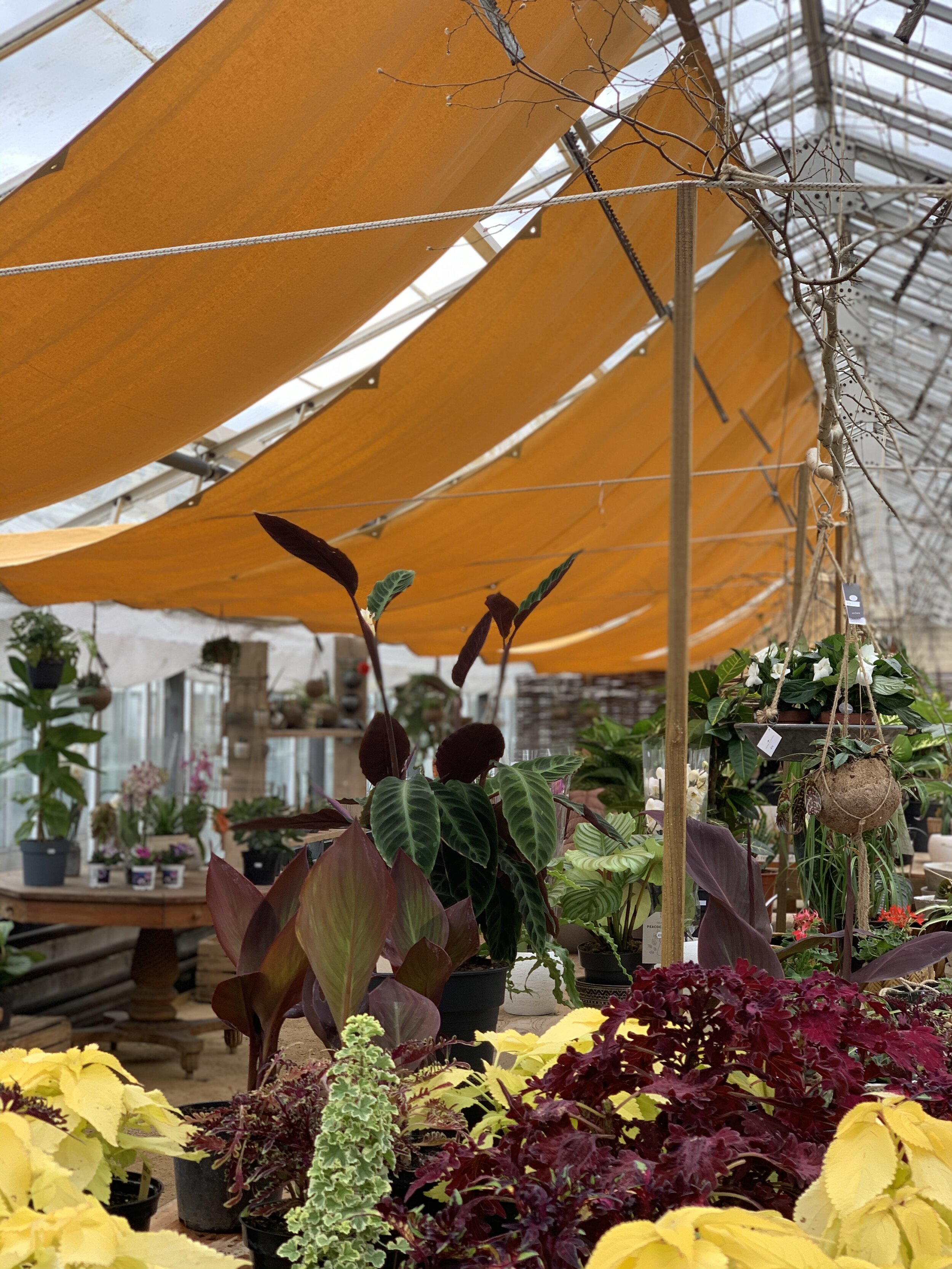
Many years in the making, this social enterprise and garden center in Royal Victoria Park recently opened after three failed attempts due to the shifting COVID situation.
As much about people as plants, the Urban Garden is run by Grow Yourself a Community Interest Company (CIC) that helps young people get back into work and partners with the charity Grow for Life which offers horticultural therapy programs. The range of plants (cacti, terrariums, edibles, shrubs, perennials) stocked in its light-filled glasshouses include many that are grown on-site in partnership with BANES council and volunteers.
But Urban Garden is not just committed to supporting our mental wellbeing but also to helping the environment too, with initiatives to reduce single-use plastics that include offering refillable (non-peat-based) compost bags and making use of posipots for taking new plants home.
Urban Garden is still in its early stages. There are also plans for public workshops and a café on site.
If you’re curious about how gardening, particularly in a community, can help you feel better, check this one out.
For Awe and Wonder: Persephone Books
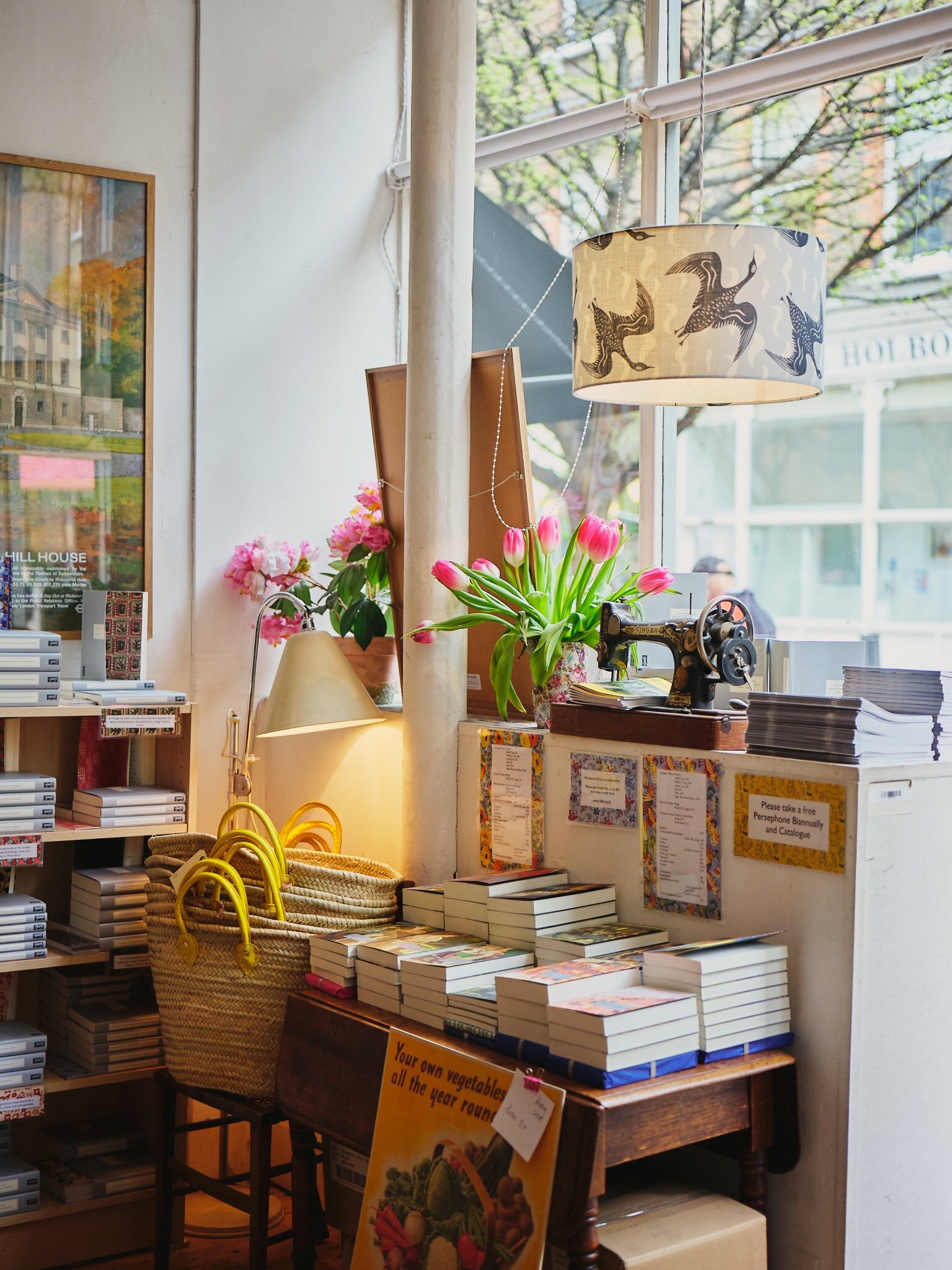
New to Bath, the charming Persephone Books brings some of its former home base of Bloomsbury to the city. This intimate bookstore showcases the independent Persephone publishing house founded in 1999 by Nicola Beauman – which The Observer has referred to as “The nearest thing British publishing has to a cult”.
Displayed across its shelves are each of Persephone’s 139 signature grey-jacked books by twentieth-century female writers, many from the mid-century and long-neglected. New to these writers, we found our way through with the helpful descriptors, some written by contemporary female cultural figures. Just choosing is a process of discovery, with short stories, memories, diaries, poems and cookbooks from writers you may already be acquainted with such as Virginia Woolf (A Room of One’s Own, no. 134) and Frances Hodgson Burnett (The Making of a Marchioness, no. 29), to many that may be new to you such as D.E. Stevenson (Miss Bundle’s Book, no.81) and Oriel Malet (Marjory Fleming, no. 17). A popular favourite is Miss Pettigrew Lives for a Day (book no. 21) by Winifred Watson.
Seek out the table of books they wished they had published: including recent BBC hit The Pursuit of Love. With the office right there at the back of the store, you can absorb the magic of book-making, while in the space upstairs there are plans for programs to support local writers.
There’s a palpable sense of reclaiming at Persephone – of the books that were almost lost, of lives often rushed through and here slowed down, of a love of reading often pushed aside by aimless scrolling. It marks a coming home for writers, the lives they trace, and for women’s creativity itself. Also for ourselves as we’re inspired to sit with a good book over a mug of tea.
Additionally, try: Mr. B’s Emporium of Reading Delights | Topping and Company | Magalleria
For Creativity and Culture: A Yarn Story

A University of Kentucky report recently claimed that our emotional well-being and self-esteem can be boosted by just one craft session. Inspired, we headed to A Yarn Story, on Bath’s artisan Walcot Street, which has been making space for the craft of knitting and crocheting since 2015.
Founded by west coaster Carmen Schmidt (from Oregon by way of Germany and Ireland), the store offers thoughtfully sourced patterns, tools and yarns, with many natural, hand-dyed, and even organic (Garthenor) on offer. It's designed for both the novice and the seasoned maker in mind with workshops and events to bring like-minded people together and refine skills (when times don’t allow for in-person there are virtual knit-nights).
Its fan base regularly celebrates this store as one of the best yarn shops in the country. We love it for its friendly service, with staff enthusiastically sharing ideas for projects and excitement over textures and colours.
On a recent visit, we were guided to the kits of Toft as a good starter project. We also discovered Nordic Knit Life magazine Laine and 52 Weeks of Shawls while there. One to seek out if you’re looking to bring more creativity into your life. In the words of Maya Angelou — once quoted on the store’s windows — ‘You can’t use up creativity…the more you use, the more you have.
Additionally, try: Meticulous Ink
Local to Bath? Let us know where we’ve missed? Where would you add to this Prescription for Everyday Life? Tell us the thoughtful places in Bath that help you find your way in the world.
In Part 2, we’ll cover our favourite places in Bath for Spirituality & Meaning, for Mind & Body Connection, for Untethering, and for Connection & Community. Have ideas for where we should feature in these categories? Reach out to us here.
And if you’re interested in writing about your city, complete this form and tell us where you seek out.

Get The Boys A Lift
A group of lads in Wales is making conversations about men’s mental health more acceptable at their cafe headquarters and beyond.
Go here if: you are looking for a supportive space to talk.
What is it: A not-for-profit coffee shop, community hub and drop-in counseling space in Haverford West run by a group of local lads who are vocal advocates for better mental health in Pembrokeshire.
Why you’ll love it: For its origin story and ongoing mission: when founder Gareth Owens returned from a year in New Zealand in 2016, he felt isolated. Remembering a couple of students at his school who had taken their own lives, Owens embarked on a walk around Wales to raise funds for mental health awareness and suicide prevention. Part of his strategy was printing branded T-shirts to raise additional funds.
The idea quickly caught the attention of others, and he was joined by more friends — including fellow GTBAL founders Jake Hicks, Steven Cristofaro and Mike Slack — for his next fundraiser, a hike to every UK capital. This morphed into further sponsored walks over the next few years, with the hugely popular campaigns and accompanying merchandise culminating in a donation of £12,000 to local and national mental health organizations.
But it also led them to start their own place — this place — that does the work that they realized needed to be done in their own community to raise mental health up the agenda, and make it ok to talk about what people, particularly men, are really going through in a safe, supportive space.
What you need to know: The coffee is good, like destination good (GTBAL was featured in The Independent Coffee Guide), there are board games and brownies to be had and a warm friendly welcome when you come through its doors. Beyond the coffee, there is free counseling on-site by trained practitioners which is significant when you realise the cost and access barriers that typically accompany therapy.
GTBAL are active campaigners for better mental health with recent campaigns including their Get Out and Get Active campaign, a recent climb in collaboration with a local gym, or Pints4Prevention, where you can donate the cost of a pint each month to support free counseling.
How to bring this into your life wherever you are: The merchandise supports the work of the social enterprise so ‘buy merch, fund counseling’. Or raise funds for the vital work that they do like one person’s recent shiver-inducing ’30 Days, 30 Swims’. Their founding ethos, you don’t need to know someone to give them a lift very much applies here.
Why we think it’s different: Get The Boys A Lift shifted from handing over the money raised to non-profits to launching a model of support that worked in its own community, a unique drop-in free counseling spot open to everyone. As more people need therapy, and waiting lists get longer, GTBAL is making it easier for people to access the help they need when they need it. If only there was one of these on every high street. Since the café started in April of 2019, it has funded mental health support for over 220 people in the community.
GTBAL is also stepping into the space of men’s mental health, crucial when two-thirds of suicides were carried out by men and one of the most vulnerable populations for suicide are males aged 45-49, but surprising when so much of the wellness and therapeutic fields continue to be associated with women. The stigma of needing and asking for help is still gendered, though thankfully this is starting to shift (see the advocacy work too of Jonny Benjamin for this and Prince Harry’s recent vocal testimonies to his own struggles with mental health.)
In their own words: “We’re a Community Interest Company based in the heart and soul of West Wales that pride ourselves on doing right by our community to help improve mental health within our own community as well as those further afield.”
Something to do: Allow the men in your life and your community to be open about their mental health. Hold back on any gendered assumptions about how someone should or shouldn’t be coping. Bring empathy, compassion and support to conversations with those who are open about their struggles. Make it ok for everyone to talk about their mental health, whatever that looks like for them and whoever they are.

Bath City Farm
How a suburban farm in Bath is raising our spirits along with the animals.
What is it: A working farm in a residential area of Bath.
What you need to know: The southwestern city of Bath is known for its hills and skyline views, but one of the most unexpected viewpoints is at Bath City Farm. Overlooking the west end of the city, Twerton and Bath Football Club ground, the farm is virtually hidden in the residential Whiteway neighbourhood. Sprawling across grassy hillsides, its 37 acres include pens for Gloucester Old Spot pigs, sheep fields, Shetland ponies, Dexter cattle, Pygmy goats, and chickens and ducks.
What they offer (online and off): Bath City Farm helps hundreds of people every year by running nearly a dozen social and educational projects, including Roots to Health, which supports adults with complex health and social needs. For local families, it’s a great spot to visit with young children and get to know more about farm animals. There’s also a café and a farm shop selling produce, jam and meat.
Why we think it matters: In a time when many of us live in cities, being around farmyard environments, seeing animals and experiencing the daily and seasonal rhythms of farms, can be hugely grounding for many different communities. Bath City Farm isn’t just a plucky working farm, it provides vital therapeutic activities and emotional and social support to hundreds of families and individuals in an under-resourced area of Bath.
In their own words: “When I was signed off work 18 years ago, the mental health team tried to get me into quite a lot of different things. Bath City Farm is the only place that got my interest. It’s made me much better coming here. I’ve learnt how to clip goats’ hooves, mend fencing and do lots of mucking out! It gives me something to look forward to every week. I love what I am doing here. It suits me down to the ground.” — volunteer, Bath City Farm
One piece of advice for where you are: Stop by to see the animals and pick up some fresh groceries, drop in for a cup of tea and a flapjack, or (if you’re looking for a community to join) sign up to be a volunteer. If you’re not based within reach of Bath, keep an eye on their Facebook page for news—recent updates include the arrival of a rare Large Black pig and new kids for a momma goat named Biscuit.

The Little Retreat & The Big Retreat Festival | A Conversation with founder Amber Rich
We speak to Amber Rich, founder of The Little Retreat and The Big Retreat Festival about how she arrived at these projects, how wellness is now something that we all reach for, and her role as a curator of discovery and awe.
To call The Little Retreat in Pembrokeshire glamping is like calling Glennon Doyle a blogger. Staying in one of the wood-furnace heated domes (with furniture you’d find in a boutique hotel), warming up in your own Scandi hot tub, or roasting smores by a private fire pit after a day at the beach or walking in the Preseli Hills, you’ll sink into what life could be if we stopped for a while to notice its possibilities.
The Little Retreat was founded by Amber Rich, who also curates The Big Retreat “feel-good festival” that takes place on these grounds (2022 tickets are already on sale), and from which it takes its cue. Where the festival has a Darwin den, campfire stage, cold water swims in The Cleddau, a talk tent curated by Shelf Help director Toni Jones, and creative workshops, its weekend away counterpart has sustainability woven through its design, foraging workshops about to start, stargazing tents with views of dark skies, and curated programs focusing on such practices as breathwork, yoga, arts and craft. The festival and retreat overlap, exchange ideas, and share their approach, with both offering a slowed-down lifestyle and collective experiences that get you closer to a vision of how you might shape your own life when you return back to it.
After a few days at The Little Retreat, we had the chance to speak with Amber about how she arrived at this place, how closely the festival and the retreat are connected, and how wellness is now something that we all reach for:
Let’s start with the connection between The Big Retreat and The Little Retreat. Why did you start them and how do they connect? If the core value of the festival is one of ‘discovery’, how would you describe the retreat?
I used to own my own gym and ran fitness and wellbeing classes to improve mental and physical health. After the birth of my daughter Bea (who is now 7) I decided that I wanted to utilise the family land to create a sanctuary where people could come to escape their busy lives, pause and reconnect. This was the start of the original "Little Retreats".
I found that these retreats were having such a profound effect on people’s lives and making a real difference: One lady who attended had not been able to sleep for years. After our retreat, she learnt how to pause and use those skills to have her first good night’s sleep in 7 years! It was feedback like this that spurred me on to create The Big Retreat Festival.
I wanted to create a space where people could come and discover breath work, fire walking, gong baths, yoga, wild swimming, forest bathing — literally anything and everything that allowed people to "find their feel good". It also included festival favourites such as gin workshops and music to enhance people’s experience and wellbeing.
I realised that giving people time and space in a beautiful setting to discover all of these wonderful life-enhancing experiences could really make a positive change in people’s lives.
Discovery and "finding your feel good" still remains the core value to this day.
What do you think people are looking for who stay with you or attend one of your events?
I think people are looking for time to reflect on themselves, to unplug from daily life and to find out what makes them feel good. We are perfectly poised in the heart of the Pembrokeshire National Park on the banks of the "Secret Waterway". The stunning location inspires awe and wonder every time and we think the unique setting coupled with a sanctuary and safe space to discover is the catalyst for change.

What do you hope people experience with the projects that you create? What do you hope they take away and bring into their everyday lives?
I hope that people’s appreciation for nature and the outdoors grows and they are able to reconnect and utilise outdoor space to improve their wellbeing. I think it’s important with the complexity of modern living that people are reminded that sometimes it’s the simple things that bring us the most happiness.
If you attend one of our Feel Good Retreats you will learn skills that you can take away with you and implement straight away in your everyday life. The goal is to inspire people to reset and to really connect with themselves and the great outdoors.
I see my role as a curator of discovery and awe, allowing people the opportunity to reset, rethink and equip themselves with a host of skills and experiences — a toolkit that they can take home and continue to use to ultimately change their path and enhance their lives.
How do you think the idea of wellness has shifted since you started The Little and Big Retreats?
When I first began The Little Retreat the words wellbeing and wellness were quite niche and only appealed to a select few. Today looking after your mental and physical health is much more mainstream and in the public psyche. With the Covid pandemic more and more people are realising just how important nature and mental as well as physical health are to enhance our lives. That is one positive we can take away from the Covid pandemic.

What motivates you to create these spaces in the world? What kept you going during recent challenges?
My key motivation is to provide a sanctuary that allows people to discover not only nature but how to unwind and reconnect for their physical and mental health. A safe space where people are free to discover and pause.
The design of the space at The Little Retreat was about focusing on ways for people to connect with the outdoors without necessarily having to "rough it" to experience the joys of being close to nature. A key focus was also to have a minimal impact on the surrounding ecology and landscape.
The pandemic has actually given me the time and space to take ecology and planning into focus and look at ways for nature to thrive. We noticed during the pandemic the return of otters on the river banks and native oysters that had previously been wiped out due to human impact. This rewinding of our natural space showed me just how important it is to tread lightly on the site and in everything we do. We have worked to encourage nature in the planning — from bat boxes, swallow bricks, hedgehog runs, planting native species and harvesting the rainwater. We are really hoping to reduce our carbon footprint at both The Little Retreat and The Big Retreat Festival.
Over the pandemic, I realised that conserving the area was so important for nature and our own wellbeing that I set up the nonprofit arm "The Big Retreat Community". This is geared at enhancing and protecting nature as well as giving welsh artists a platform at our next festival.
In our guide for life, we roam across ten different pathways in the places that we feature and I’m curious about where you’d position your projects and why?
After looking through your Ten Pathways it is extremely difficult to choose one. All of them are intertwined intrinsically in everything we do from untethering upon arrival, to reconnecting mind and spirit right through to purpose and doing good. All of your pathways align exactly with our mission and how we conduct our projects.

How do you bring the values of the places you create into your own life?
I am constantly trying new things and discovering not only the latest external wellbeing practices but rediscovering the landscape. I make sure I set aside time every day to do this. Whether it’s a cooling wild swim in the Cleddau or a mindful walk through the woodland set around our site. I make sure that at least once a day I allow time for myself to reconnect and discover. I think it is so important to schedule this time into your diary in the same way you would an appointment at the doctor’s.
As we emerge from the lockdowns and are maybe feeling more hopeful about our worlds, is there anything that you’re particularly excited about going forwards?
There is so much going on at The Little Retreats this year it’s actually really really exciting. We have the addition of wild food workshops offering a foraging course and a 12-course dinner, the release of our Find Your Feel Good In Pembrokeshire guide, wild swimming sessions, forest bathing, and breathwork. We are currently building the space for the new stargazer tents with outdoor hot baths — a perfect opportunity to make the most of our stunning location in an official UK Dark Sky reserve. There are so many things that are organically falling into place.
We want both The Little and The Big Retreat to be a sanctuary and a beacon for anyone and everyone who wants to set aside time to find out just what it is that makes them tick and "find their feel good".
While there: we recommend pastries and bread from the micro bakery in the village Hugtasty, the award-winning beach shack Café Mor at Freshwater West (also the site of Dobby’s resting place), the stunning beaches, hikes, and paddle-boarding at Stackpole, and cafe with a mission Get the Boys a Lift.

Unplugged
Exhausted by the tech in your life? Unplugged offers you a way to get some space from your phone.
Go here if: you’d had it with Zoom calls, social media, and emails, you’ve become not tethered but entrapped by your online life, or you’re never two steps away from your smartphone, ever.
What is it: A 3-day digital detox retreat in the form of a cabin in the countryside just an hour outside of London.
Why you’ll love it: Rather than rustic chic, the cabin looks like something a tech start-up would design (somewhat aptly the founders met at a tech-startup), clean lines, matt black, and a large screen in the form of a window to look through rather than an interface to scroll down.
What you need to know: Write. Play board games. Read. Go for a non-lockdown-induced walk. Talk to one another. There are lots of options to spend time and connect and be in this place, but screens are not one of them. They will literally be locked away. No photos, no just checking, no looking over at notifications during mealtimes. Founders Hector Hughes and Ben Elliott will help you get through it though. On arrival, you’ll get a welcome pack, a polaroid camera, a map of the area, a compass, and a torch, as well as postcards to send out into the world. The cabin also has books and activities (and a cassette player!) to occupy your time
What they offer (online and off): Only offline this one.
Why we think it's different: Founders Hector and Ben started Unplugged in response to their own needs. Hector had realized the extent to which he was tethered to technology when he went on a two-week silent retreat to the Himalayas. Ben could get in up to 14 hours of screen time a day. Looking for a solution that didn’t involve vast amounts of time and a plane flight, they opened their first cabin to reconnect with ourselves by turning off our devices. That they did so last July, after the first lockdown, was particularly timely.
During the first few months of the pandemic, many of us forgot where we ended and our devices began. Any tech boundaries we had dissolved in work from home, zoom pub quizzes, and Netflix binges. We digitized our days, whether as a numbing distraction or for essential professional needs, our devices became the way we interacted with a world we couldn’t physically get to. But as that real-life world opens up, now is the moment to shift that co-dependency, to find ways to reclaim analog space and our non-tech-centered lives.
In their own words: “Humans have always escaped to nature as an antidote to hectic city life. The issue is that now so many of us just wouldn’t know where to start. We’re glued to our phones, inundated with push notifications & respond to emails at all times of the day. We’re on a mission to help you unplug from your devices so that you can recharge.”
Something to do: Wherever you are you can set boundaries around technology. Start with turning off notifications, taking your smartphone out of your bedroom, leaving it behind occasionally when you pop out, using apps to mediate social media time or gaming, keep your phone literally out of sight which will translate to out of mind, buy a watch and an alarm clock, and let people know that you can’t be reached sometimes. In those moments when a phone demands your attention, really think about whether that moment of interruption in your day was worth it. If it wasn’t find ways to block those demands on your time like deleting apps, and even turning off your phone for short, then longer, periods.

The Magazine Stores We're Escaping To
Looking for some inspiration for where to shop for those indie magazines you love? Here are just a handful of our favorites. Let us know yours.
Over the pandemic, some of us have turned to magazines for connection when we couldn’t turn to people. With glimpses of other lives and different times, with stories of inspiration and creative possibilities, with images of places we can’t get to and people we aren’t allowed to meet, independent magazines to some of us have become the escape that we needed. But today, instead of featuring our favorite reads (head over to our Culture Therapy section for some ideas), we’re going to travel to our favorite places to find those reads. Hopefully, in one of these stores, you will find the magazine for whatever you need, wherever you are.

Shop. Journal. Podcast. Events. Consultancy. A magazine loving empire created by graphic designer and veteran of the magazine industry Jeremy Leslie: he worked on City Limits, Time Out and Blitz, titles by companies like Waitrose and Virgin Atlantic, and in 2018 was awarded the Mark Boxer Award for his contribution to magazines by the British Society of Magazine Editors.
The Clerkenwell flagship store opened in 2015, suitably in an old Squires Newsagents and in a neighborhood closely associated with the printed word — just up the road are both the first place where the word ‘magazine’ was used ( in 1731 referring to The Gentleman’s Magazine) and the University of London’s Journalism school. The space – described by Creative Review as ‘The spiritual home of independent publishing’ — has been designed to showcase the magazines themselves and to allow people to feel comfortable browsing the 500 or so titles sourced from around the world. You are encouraged to linger over the finely curated selections that are “based on gut instinct” and the right mix of great design, imagery, and content. You’ll find stalwarts like Interview and Zoetrope and newcomers like Baggage – travel for solo parents – and The World Needs Magic – transforming workplaces. A visit will have you falling down analog rabbit holes of the kind we’d like more of in our everyday lives.
If Lost recommends: Disquiet focusing on men’s perspective on their mental health, Friends on the Shelf, a conversation within its covers, and The Delicate Rebellion, inspiration for those going it alone as creatives, makers, and entrepreneurs.

In a town just outside of Manchester now undergoing a one billion pound regeneration (and where I went to school), locals Holly Carter (a designer and maker) and Martin Wilson (a graduate of Manchester School of Art) opened Rare Mags after a successful Kickstarter campaign. The bright blue storefront heralds an interior that holds a carefully edited selection of independent magazines and a true passion for the printed page, all in a definite northern tone. Stocking hard to find and international titles – and going deep on personal interests like indie titles for cyclists (Carter is an avid fan of the sport) and art & photography — this is a place to seek out if you want to find new and much-loved titles. There are magazines we’ve never come across. Like did you know there was an indie Scottish soccer periodical called Nutmeg, a wine magazine like no other called Noble Rot and a food history magazine named Eaten? There are also books, stationery and coffee (by local Hard Lines Coffee). Wish this one had been around when I’d been going to school just up the road. Would have made journeys on the A6 way more interesting.
If Lost recommends: Standart, Courier, Grimoire Silvanus, bilingual les others, this issue on Period, thematic ‘Lost’, and the most beautifully titled Where the Leaves Fall. In need of even more inspiration, choose one of Rare Mags Subscriptions.

Between a Card Factory and a Holland & Barrett in outdoor shopping center Rushden Lakes, you’ll find not WHSmith but Magazine Heaven. Why the name? It’s the size and breadth of titles on offer. Amongst its 3000 titles — the largest selection of magazines under one roof — you’ll find High Street staples like the Vogues and Tatlers of the world, newcomers like bathing magazine Hamam, niche culture magazines like Mayday and Soffa and even self-published magazines, Wonk, Scorchin and Explorations. Founder Bill Palmer has said the store embraces “a wide range of hobbies, passions, and interests within an environment that will encourage exploration and browsing’, its aim to “become a destination for magazine lovers.” With locally sourced coffee and blended teas at Artisan café, this is one place to linger – maybe for hours rather than minutes. Magazine Heaven also functions as a community hub, hosting Yoga, Jazz and Tapas Evenings, Games Nights, Book Clubs, and Art Events, amongst other programs.
If Lost Recommends: Bloom, Positive News, The Homeworker and Womankind. Magazine Heaven also stocks books such as Kazuo Ishiguro’s highly anticipated new novel Klara and the Sun.
Additionally try, previously featured If Lost places:
Let us know where you go to source indie magazines. Tell us about the stores that you love that feature a range of indie titles, the shopfronts that do for magazines what bookstores do for books. You can email us or fill in this form so that we can include them in our guide for life and bring more awe and wonder into our worlds.
