

Refettorio Felix
The magic that can happen when a Michelin-starred chef takes on food insecurity, food waste and social isolation.
What is it: The community magic that can happen when a three-star Michelin chef solves for issues of food waste, food insecurity, and social isolation through great food, compassionate design, and human dignity. Refettorio Felix takes London’s food surplus and turns it into meals for the vulnerable prepared by local chefs, bringing people together in community over a shared meal served in comfortable surroundings.
What you need to know: In 2017, renowned chef Massimo Bottura – his Moderna restaurant Osteria Francescana was named the world’s best – brought his innovative non-profit Food for Soul to St Cuthberts Centre, a 30-year old charity serving those experiencing mental health issues and homelessness, aging populations and the vulnerable in the community. Building on the impacts of Refettorio Paris and Refettorio Gastromotiva in Rio de Janeiro, in London Bottura teamed up with The Felix Project, a charity that saves food that can’t be sold — in date, good quality ingredients from national supermarkets — and delivers it to those in need.
As with his other projects, Bottura realized that the context mattered too. For Refettorio Felix he commissioned Ilse Crawford, a designer sensitive to the wellbeing impacts of the environments that she creates, to transform St Cuthbert’s space. Her brief: “to make it beautiful, a universal pleasure that is often missing from social projects”. The resulting dining area facilitates connection and closeness, with reading areas, low hanging light fixtures, and darker toned walls. Swiss furniture company Vitra donated the chairs.
How to bring this into your life: Refettorio Felix is very much active through the pandemic, serving meals and hot drinks. If you are local you can volunteer to support their ongoing work.
Why we think it matters: There are an estimated 8.4 million (12%) adults living in households with insufficient access to food. And yet, in the UK annually 10,000 tonnes of food is wasted (that figure is closer to 1.6 billion tons worldwide). These figures are pre-covid and have only gotten worse. Before the virus, the project served 75-80 people a day, in the early days of the pandemic that went up to 300 meals.
Refettorio Felix steps right into the gap between food insecurity and food waste, but it does so in ways that treat people with care and dignity. The conversations made over meals, the feeling of support of a safe environment, become as important as the social inequalities it hopes to alleviate. After a meal, people can stay – for therapeutic counseling, creative workshops, and even laundry services.
In their own words: “We sustain and support vulnerable people with positive and warm therapeutic services to accomplish our charity’s objectives of relieving poverty, hardship, sickness and distress. Our impact is grounded in the power of a shared meal of outstanding quality made with 100% surplus food.”
Something to do: If you are able, start to help alleviate food insecurity from your home – from reducing the meat you consume and the food you waste to supporting your local food bank and supporting school meal programs.
Additionally, support: Emma’s Torch | Social Bite | Brigade Bar + Kitchen | Luminary Bakery

Book-ish
For curiosity seekers, book lovers, and those looking for an escape into ideas, Crickhowell’s Book-ish makes a community out of reading.
“Reading gives us somewhere to go, when we have to stay where we are.”
What is it: An award-winning bookstore – Independent Bookshop of the Year Award 2020 — situated in an award-winning town — Crickhowell officially has one of Britain’s best High Streets, Book-ish was founded by an award-winning local high street hero Emma Corfield-Walters in 2010. Likes all good bookstores there’s a person behind it who believes in its capacity to be the heart of a community.
What you need to know: When the pandemic closed the store, Corfield-Walters (aka Mrs. Bookish) quickly got together with the female-founders of three other leading independent bookstores — Helen Stanton from Forum Books, Carrie Morris from Booka Bookshop, and Sue Porter from Linghams Booksellers — to start 4Indies, an online space that hosts author events for at home times.
How to bring this into your life: Book-ish has one of the widest range of book clubs that we’ve seen, including The Throw Away Your Television Society that delves into ever-changing themes, and The Underground for teen readers. You can sign up for a subscription service, with a book pick — non-fiction, fiction, poetry, picture book — sent out each month. (One option includes a monthly candle). Book-ish still runs an active online events calendar for when in-person is on hold.
Why we think it matters: Our favorite bookstores are those that go beyond books into the lives of our communities, enriching not only our minds and imaginations but also the relationships that bind us together. During non-pandemic times, the bookshop, with its bar, café, and events space, is a critical place to come together, to chat, to make space for ourselves. But its work goes outwards too. Corfield-Walters is a local advocate, bringing books into schools, hosting pop-ups at local festivals such as Green Man and HowTheLightsGetIn (when they are running), and serving as the co-director of the Crickhowell Literary Festival. She’s also an active supporter of community-building campaigns like Totally Locally, Fair Tax Town, and the community Corn Exchange Program. Book-ish makes space for books, but it also makes space for the people who love them too.
What next: If your pandemic fatigue now comes with reading fatigue, seek out Corfield-Walters’ recommendation to get you back to books: My Sister The Serial Killer by Oyinkan Braithwaite for “its short chapters and wickedly dark characters”.
To find out more: Website / Instagram / Facebook / Twitter
Additionally, try: Mr. B’s Emporium of Reading Delights / Pages of Hackney

Grow2Know
A London based not-for-profit bringing the therapeutic benefits of gardening to young people and changing who gets to garden one project at a time.
What is it: “The healing power of nature in the community”. Grow 2Know is a not-for-profit based in the community of North Kensington aiming to make horticulture more inclusive, by inspiring, supporting, and educating young diverse gardeners through greening disused spaces across London.
What you need to know: In the aftermath of the devastating Grenfell Tower fire in 2017, local semi-professional footballer Tayshan Hayden-Smith who had lost friends in the fire turned to nature for healing, greening the spaces in the surrounding community as a form of therapy. With other community members in North Kensington, he founded the Grenfell Garden of Peace, a sanctuary and a symbol of resilience. Now with Danny Clarke aka The Black Gardener (and the first black gardener to be given a TV show, The Instant Gardener in 2015) and Ali Yellop a local agriculturalist, all of whom have Jamaican heritage, Hayden Smith has started Grow2Know. Through designing, building and collaborating on community gardens, Grow2Know aims to shift the narrative of who gets to garden and who gets access to green spaces.
Projects have included taking over a discussed green space at Morley College, transforming it into a place of tranquility with the help of members, staff and students. This year, Grow2Know will participate in the RHS Chelsea Flower Show creating a garden centered on the Caribbean community, and inspired by the now closed North Kensington Caribbean restaurant The Mangrove which in the 1970s was frequently the target of police. Future projects also include a Calisthenics exercise garden to reinforce the physical benefits of green spaces and a collaboration with Steel Warriors, who use salvaged steel from melted down confiscated knives to build outdoor exercise gyms.
Why we think it matters: This pandemic has made overt the connection between nature and our mental wellbeing, but persistent social inequalities mean that not everyone has access to those benefits. As Grow2know has noted “if you live on the 20th floor of a tower block what reason do you have to currently get involved in gardening?”. Gardening pulls together disparate threads all impacted by racial justice, from environmentalism — the quality of the air we breathe and who feels most the consequences of climate change — through to food insecurity (having access to fruit and vegetables through urban farming initiatives). Grow2Know aims to shape the conversation around gardening by mitigating some of these issues. Their approach takes a broad view, diversifying who has access to green spaces while showing young people the mental health benefits of gardening, and the connections between nutrition and growing food. The benefits of gardening here are far-reaching, experienced personally as therapy and support, and more widely, making communities more conducive to mental wellbeing and connection.
In their own words: “Grow2Know aims to heal, inspire, empower & educate using horticulture – planting seeds in the minds of young people & giving them the necessary tools to make a positive impact in their communities. We aim to change the narrative & break the mould on the stereotypes of what it is like to be a gardener & what a gardener may look like, & in turn, create a more inclusive industry. We feel that gardening is a pretty cool thing to do & it is our mission to exhibit just how cool it is.”
Something to do: Follow one of Mind’s tips for getting into nature wherever you are, such as bringing nature inside, helping the environment, and growing your own food.
Discover more ways to enhance your well-being through the natural world

The Goodlife Centre
If like many of us you’ve lost contact with basic DIY skills, London’s The Goodlife Centre gets those power tools back in your hands.
What is it: An independent DIY learning space in London’s Bankside.
Why you’ll love it: Classes are open to everyone (well over 10), so whether you are homeschooling, retraining for work, or exploring new skills for pleasure, there’s something to learn. With subjects as broad as Carpentry, Furniture Making, and Home Maintenance, that workshop could cover making a plant pot holder or simple bookbinding, learning modern upholstery or woodcarving, or delving into Log Cabin quilting or cold process soap making. You’ll come away with practical knowledge, more confidence in how to use those power tools, do things for yourself, and make whatever you need to happen in your home.
What you need to know: Inspired by her first “Tools for the Terrified” course in 2009, founder Alison Winfield-Chislett — formally a product designer at Asprey and Tiffany and author of The Girls Guide to DIY — developed the idea for The Goodlife Centre. From its first bright studio workspace in 2011 to its current permanent home in a renovated cardboard box making factory, The Goodlife Centre’s central location has given weary Londoners an escape into making.
What they offer online and off: During closed times, classes head online and are on-demand, with current offers including Basic Tiling, DIY drills, and Basic Practical Electrics. The Goodlife Centre can even send you a Practice Box, so you’re DIY endeavors are more played with than permanent.
Why we think it's special: If you’ve never learned how to ‘do things’, and you often turn to Youtube for how to rewire a plug or paint a wall, The Goodlife Centre’s experts offer the foundations and confidence to tackle repairs, restore unloved items, and make things from scratch. Becoming self-reliant is empowering, learning to take care of our homes and not outsourcing our own skills a way of reconnecting to our environments. Working with our hands again also gives us access to the analog world, getting us off our devices and into a learning experience that is all about the moment, the physical, the tangible. But these skills are impactful beyond the satisfaction of reupholstering a chair. Our throwaway culture is having serious consequences for our environment. By relearning basic object survival skills, we can reduce the amount that is wasted when something is deemed unbroken or unfixable.
In their own words: “The Goodlife Centre provides interesting practical ‘hands-on’ workshops where everyone can gain new skills and enjoy expanding their confidence and abilities. All classes are open to men and women and are intended to teach skills to beginners and are not intended as trade training courses. We do not test or evaluate – so you can relax while you learn.”
Something to do: Hesitate before you bin something you believe to be broken. Possibly it’s not and there’s a simple fix. Try to repair something (with safety cautions in mind) before you decide to replace it. Take Do Nation’s Pledge to Fix It.
To find out more: Website / Instagram / Facebook / Twitter
Photo: Vic Philips

Something Good
A Newcastle store making it easier to live the zero-waste lifestyle.
What is it: A sustainable living store with a plastic-free pantry and a refillery, Something Good is bringing the zero-waste lifestyle to Newcastle (and possibly beyond if its popular online service is extended).
Why you’ll love it: Founder Lauren Wedderburn, an architect by training, has applied an ethos of great design to create a minimalist, light-filled space that makes supporting a more ethical lifestyle much easier for all of us. Confused by the implications of the choices that you make in a regular supermarket run, Lauren has chosen a selection of products that not only fit the store’s carefully curated aesthetic but also the rigorous set of values (biodegradable, plastic-free, and not tested on animals) on which it is founded.
What you need to know: Here you’ll find the everyday items that you use in your life and in your home – the porridge you make for breakfast, the coffee that wakes you, the oat milk you’ve now switched to, the body wash you apply in the shower — but without the environmental devastation. Gone are single-use plastics and none-reusable packaging: Dried goods, like cereals and spices, nuts and pasta, are dispensed into compostable bags or long-use containers; bath, kitchen, and cleaning products distributed in refillable bottles so you buy only what you need.
Where possible Lauren sources locally, supporting the independents in her community similarly striving for a better way of living, like handmade chocolate from Tynemouth, natural deodorant produced a walk away, and coffee beans ground and roasted in North Shields.
Purchases also support one of the shop’s two charity partners: tree planting with the Tree Sisters — whereby money for a tree is donated with each delivery or each birthday of loyalty club members, and The Hygiene Bank, alleviating hygiene poverty through a buy one / donate one scheme.
How to bring this into your life: The pandemic has driven more of us online for our food shopping. Replace an Ocado order if you can with click and collect from a zero-waste store. Something Good even offers local delivery by electric cargo bikes or a zero transmission van.
Why we think it matters: When we read that microplastics have now entered our water supply and that traces have been found in our bodies, there’s no hiding the devastating impact of our consumer choices anymore. From killing seabirds and marine life to accelerating climate change, that throwaway water bottle lasts longer than the thirst you had when you bought it. Similarly, we’re overbuying when we shop, with an estimated 33 to 50% of all food grown globally never eaten. By buying less and buying what you need, you can reduce the amount of food that goes moldy in your fridge or is forgotten at the back of a cupboard. Stores like Something Good present an alternative way of purchasing our food and products for our home in a way that not only feels good but does our planet good too.
In their own words: "Our little shop brings together all of the products we use ourselves to make our everyday routine a little less wasteful, and a little more sustainable! Everything we sell is tried, tested, tasted and loved by us, so we can make it simple and affordable for you to make some small changes, too.
We make sure each product is thoughtfully designed, well crafted, and sourced from only the best growers, makers and creators. And we make sure to champion local small businesses at every opportunity."
Something to do: Many more of us are turning to plant-based eating as a form of environmental protection, but many of our cosmetic products also use animal derivatives in their ingredients. If you are making the switch to vegan, look on your bathroom shelf as much as your kitchen fridge. Lauren recommends Pamoja skincare, as a planet-friendly go-to.
To find out more: Website / Instagram / Facebook
Additionally, try The Good Life for more on pursuing a zero-waste lifestyle.

Yorkshire Sculpture Park
As we’re forced to head outside this winter, we’re looking to an open-air art museum for awe and wonder in a natural setting.
What is it: A nine-foot-high Birkin bag. An oversized teapot in which to rest. A blank snowman in the middle of a glistening pond. Yorkshire Sculpture Park is an awe-inspiring museum without walls, with over 80 modern and contemporary sculptures set across 500-acres of the historic eighteenth-century Bretton Hall estate.
What you need to know: Since it was founded over 40 years ago by Peter Murray (also the current Executive Director), a young art lecturer inspired by European sculpture parks who had the radical idea to create an outdoor art exhibit, YSP has evolved from the UK’s first sculpture park to once of the largest in Europe and one of the most world-renowned. Through its ever-changing displays and temporary exhibitions in its enclosed galleries, YSP brings new audiences to the practice of sculpture — redefining what it is and how we view it — while enabling wider access to art and opening the field for all.
Why you’ll love it: Although there’s obviously a focus on the artworks themselves — including classics by local artists Barbara Hepworth and Henry Moore — it’s so much about how those works are situated in the surrounding environment, their dialogue with the forms of nature around them, that creates the awe-inducing and reflective situations that YSP has become known for. The outdoors replaces the architecture of the museum — trees instead of white walls, grass banks instead of wooden floors, light derived from sunlight instead of overheads — to create a living context of a very different kind.
With art embedded in nature, our perception shifts according to location, light, time of day, and the seasons. No longer static, each work’s place in the landscape is sensitively considered – part of the evolution of YSP has been the transformation of the landscape that holds it to be a more fitting backdrop for its sculptures and audiences. Recently opened award-winning visitor center The Weston designed by architecture practice Fielden Fowles and built on the site of a former quarry, takes inspiration from land artists Michael Heizer and Robert Morris. And in case you need a reminder that art and nature sit closely together here, you’ll find sheep wandering amongst its sculptures and herons found by its art trails.
Why we think it's different: After a year that has seen its capacity to bring in visitors drastically reduced (80% of revenue is from audiences on-site), YSP has also recognized a silver lining, its vital role in its audience’s wellbeing, creating much-needed opportunities to bring people outdoors and to connect with art and nature. YSP has become a location for refuge and reflection, a place that can give respite in an uncertain time. This builds on the work started in pre-COVID times such as YSP’s wellbeing program. Deputy Director, Heather Featherstone, recognizing the social and personal infrastructure that YSP provides, has commented that: “Museums and cultural organisations are the hidden social care that no one really talks about.” YSP encourages a way of being and a mode of engagement that goes beyond the typical museum audience experience, with impacts beyond a visit and into our everyday lives.
In their own words: “YSP’s driving purpose for 40 years has been to ignite, nurture and sustain interest in and debate around contemporary art and sculpture, especially with those for whom art participation is not habitual or familiar. It enables open access to art, situations and ideas, and continues to re-evaluate and expand the approach to considering art’s role and relevance in society. Supporting 45,000 people each year through YSP’s learning programme, this innovative work develops ability, confidence and life aspiration in participants.”
Something to do: Art for all? Participate in new public art initiative, The Great Big Art Exhibition, hosted by Firstsite, Colchester with the support of partners such as Tate and the National Gallery. Here rainbows in windows are replaced by artworks created on a fortnightly theme, linking us to our neighbors and displaying the creativity that many of us have newly found in lockdown and beyond.

Social Bite
A cafe with a cause in Edinburgh that became a movement to end homelessness.
What is it: A sandwich shop in Edinburgh that became a movement to end homelessness in Scotland (and has also captured the attention of Meghan Markle, George Clooney, and Helen Mirren)
What you need to know: The first café was opened in 2012 on Edinburgh’s Rose Street – amongst the Subways and Prets — by co-founders Josh Littlejohn MBE and Alice Thompson (who recently left to join motivational speaker agency Speaker Buzz). From the outset, Social Bite donated its profits to homeless causes and a pay-it-forward jar sat on the counter so that customers could donate a meal to people experiencing homelessness. Now Social Bite has grown into an award-winning social enterprise with five of its mission-driven cafes across three cities (now including Glasgow and Aberdeen), and one central kitchen.
But there’s also now this – a housing development Social Bite Village, the now international Sleep Out campaign, and an annual fundraising campaign to provide Christmas meals to the homeless (the cafés in Glasgow and Edinburgh this year opened to homeless people in Edinburgh and Glasgow and served 155,000 meals).
How to bring this into your life: One small ask: Buy a box of brownies. Each ethically sourced and handmade brownie box helps to fund jobs, housing, and support for people experiencing homelessness. Need more ideas? Social Bite has a ton of them for wherever you are, like using Amazon Smile, Sustainably, and Give as You Live.
Why we think it matters: At a moment when homelessness and food insecurity are becoming dire consequences of the Coronavirus epidemic, Social Bite's mission of tackling homelessness with compassion, support, and love is needed more than ever. One-third of the cafes’ workforce are people who have struggled with homelessness. Their high-end restaurant Vesta Bar + Kitchen sets aside Monday afternoons to feed people experiencing homelessness for free and with humanity – with a two-course menu of dishes typically offered to paying patrons during the week. And the business did a very quick pivot when the COVID crisis hit. They shifted their operations to feeding the hungry — still including the homeless, but also now those experiencing food poverty and vulnerable children and adults — with a weekly target of providing 5000 emergency food packs to partners in communities in Scotland, and 160 free meals distributed each day in the cafes in Edinburgh and Glasgow.
In their own words: “We believe that now more than ever, there is a need to put aside our differences and come together to ensure that everyone has a safe space to call home.”
Inspired to: Volunteer to help the homeless and feed the hungry in your community. Pack food parcels at your local food bank (and donate items), support campaigns for free school lunches, and share food going to waste on the Olio app.
To find out more: Website / Instagram / Facebook / Twitter
Try also: London’s Luminary Bakery and Brigade Bar + Kitchen

Golden Hare Books
Edinburgh’s Golden Hare Books keeps the city’s literary tradition alive with its thoughtful curation.
What is it: An award-winning (Bookshop of the Year 2019 UK & Ireland) indie bookstore to warm your heart (and hands by its wood-burning stove) in Edinburgh’s village within the city, Stockbridge.
What you need to know: Founded in 2012 by Sir Mark Jones – previously the Director of the Victoria & Albert Museum and the National Museums of Scotland – this is a bookstore as curated space in both how it looks and what gets to be included. Covers face out and draw attention to great design, creating an immediate visual hook for potential readers and making objects of the books themselves.
The range of its small careful selection of books changes constantly –‘the idea is that you never visit the same bookshop twice.’ Golden Hare is known for bringing in a wide range of choices, including works in translation, books by women, and diverse children’s authors
How to bring this into your life: It’s all about the reading subscription, Postbooks, which sends a beautifully packaged fiction or non-fiction book(s) each month specially chosen for you, often around a theme, like Green Transformation, and with its own reading guide. The key difference though is that Golden Hare supports indie presses and small publishers in its choices such as Charco Press, Tilted Axis, or & Other Stories, widening your reading from the usual suspects and making sure more writers get attention from readers.
Golden Hare is also a bookstore where you can become a Member, and during usual times there is an active book club and Sunday Stories reading club for kids. Golden Hare has pivoted to the ways we now shop: click and collect, and Saturday bike deliveries.
Why it caught our attention: This is a bookstore that works hard. It does a lot. Not just in its active support of indie publishers but its reach within the local community and that of the city of Edinburgh. In 2019, Golden Hare hosted its first book festival with local partners and it co-hosts the Edinburgh Book Fringe with Lighthouse Books. Books are embedded in the cultural life of Edinburgh – a UNESCO City of Literature. It was famously here that J.K. Rowling wrote some of her Harry Potter series and Arthur Conan Doyle, Sherlock Holmes. Golden Hare keeps the tradition alive of supporting local voices and creating a place for the writing community.
In their own words: “We are a knowledgeable team of self-confessed reading addicts who have been selling beautiful and important books since 2012.
Our charming independent bookshop is situated in Edinburgh's Stockbridge, where you can find an ever-changing collection of fiction and non-fiction for readers of all ages. We hold close to 2000 titles covering all genres of writing from cookery to travel, from flower arranging to science fiction - and many more topics in between.”
Lost at home: It's winter where we are. Maybe there too. Cozy down with a book. Choose one of Golden Hare’s winter picks: Once Upon a River by Diana Settenfield, The Snow Child by Eowyn Ivey, and The Changeling by Victor LaValle. While purchasing, make a resolution not to buy from internet giants (take this resolve into the rest of 2021).
While here: Seek out Golden Hare collaborators café Lovecrumbs and Smith & Gertrude, as well as If Lost favorites the Royal Botanic Gardens and Lifestory.

Mr. B’s Emporium of Reading Delights
This month, we’re finding awe and wonder in our independent bookstores. First up for booklovers and the curious, Mr B’s Emporium.
This week, in the middle of winter and at the start of a New Year that’s feeling decidedly same-y, we’re seeking wonder in the everyday. We need an antidote to All This (gestures to COVID, politics, BREXIT, homeschool, laundry, Tuesdays in January).
For us, one of the easiest ways to access awe is through bookstores. As holders of the imaginary, of knowledge and curiosity, these special places out in the world give us access to lives that we might otherwise not know and avenues in our own worlds that we currently may be unable to tread. Even during the harshest of lockdowns (hello, UK), the doors of independent bookstores may be closed, but what they contain can still be made available to us.
Over the next week, we’re going to focus on a handful of independent bookstores that help us find our way in uncertain times. Like a great café or bakery, a local dive bar or a music venue, we’re aware that we each have our go-to independent bookstores, so let us know what yours are, so we can bring them into our guide and into other people’s lives.
Mr. B’s Emporium of Reading Delights
“Book lovers — welcome to your spiritual home.”
What is it: How bookstores look in movies, Bath’s Mr. B’s Emporium has all the delight, whimsy, and charm of a highly idiosyncratic world created especially for bibliophiles. A dream conceived on a honeymoon by newly married lawyers Nic and Juliette Bottomley, since it opened in 2006 Mr. B’s Emporium has twice been named best UK Independent bookstore and The Guardian has named it as one of the top ten bookstores in the world.
Why you’ll love it: For us, it’s the friendly staff who have an exhaustive knowledge of books and aren’t afraid to share it — every time we’re there we eavesdrop on excited conversations about much-loved recommendations — while also kinda apologizing when it feels like they may be upselling us as they get enthused about something. It’s also the magical kid’s section, with its fairytale tree and park bench corner. It’s The Imaginarium, an in-store spot for visiting writers-in-residence. It’s the fine touches: the wall of comic book pages, the winding staircase, the fireplace, and claw foot bath (book filled, of course). It's maybe also the fact that Mr. B’s Emporium is set off the main street, down an alleyway, so it feels like a find, though other book lovers have been lured this way before.
What you need to know: It’s so much about reading here: about opinions on books and chatter on authors, about bringing into your world books you may not have previously considered. The staff will gently guide you through but also leave you alone if you are more of a private browser.
How to bring this into your life wherever you are: For At-Home Times, go with their specially tailored to you Reading Subscriptions, which are like a through-your-letterbox monthly bibliotherapy session. One to save for Later (which we are), the Reading Spas – meaning a cozy tea and cake moment in the bibliotherapy room with a pile of books chosen especially for you. During All Times, watch storytime on the YouTube channel or listen to their podcast with more recommendations and meandering chats, Talking to Book People.
Why we think it matters: Books are personal but sometimes the way they are sold feels nothing of the sort. Book buying becomes transactional, with stores that pile it high, discount massively, and rotate them fast. Reading lists become bestseller lists. At Mr. B’s Emporium book-finding feels more person to person, one world brought into another, a love shared and passed on. Here books are restored as the wonders that we, and they, believe them to be.
In their own words: “Mr. B's is a beautiful, energetic and innovative bookshop on John Street in the heart of Bath. It's a bright labyrinthine space where book-related chatter and advice seems ever-present and you never know what you might encounter next, from claw-foot bath book displays to toilets illustrated by Chris Riddell.”
Something to do when this is all done: Take a bookshop tour of wherever you are (you could even attempt this virtually). See Louise Boland’s Bookshop Tours of Britain for inspiration.
While local: We recommend Landrace Bakery and Colonna Coffee, and If Lost featured places: Meticulous Ink and Magalleria.

Prick
Beyond the best name for a store dedicated to cacti, Prick is making wider access to the greenery we all need part of its mission.
What is it: London’s first store dedicated entirely to cacti and succulents on Dalston’s Kingsland Road.
Why you’ll love it: With their geometric forms and unusual presentations, the plant life here read as nature’s aesthetic conjurings. Nominated for High Street Shop of 2020, the store feels more like a boutique than a garden center, with white walls, sculptural plinths, shelves of ceramics — “prick pots” – many of which have been commissioned by local artists and books on the subject rounding out the interior landscape. Even the wood here is sourced from the Natural History Museum’s Reading Rooms.
What you need to know: Prick was founded by Gynelle Leon, who at the age of 30 on a quest for a different story of happiness than the one she’d been sold retrained as a florist. Her love of plants had started to edge out an early career in finance and fraud prevention (her degree was in Forensic Science). A 2011 visit to Yves Saint Laurent’s Jardin Majorelle in Marrakesh led her to fall for cacti’s diverse forms and set her on a global search to become an expert taking in the epic desert plant-life of the United States. Leon now sources unusual specimens (the shop stocks over 150 types) throughout the UK and Europe, forging relationships with auctions, nurseries, and collectors to curate the store’s collection of cacti and succulents.
In the summer, Prick expanded from just the plant shop to a new space which according to Gynelle “is not a shop but our event space for workshops, talks, panel discussions lectures, book clubs, coffee mornings… I love community and have always dreamt of a space where we can celebrate and enjoy plant culture.” Due to shifting COVID rules, we suggest checking social media for updates on this new stage of Prick.
Why we think it matters: As we spend more time at home – and we can all feel differently about that – those little pops of green around us start to matter. Plants have a direct impact on our wellbeing: seeing them reduces stress, caring for them gets us out of our heads, and even the air we breathe improves. Gynelle has been open about her own experiences of depression, stress, and anxiety and how “being around nature and especially caring for my houseplants provides me with moments of calm and allows me to be in flow.”
And yet, who has access to green spaces and those green pots, indeed who can cultivate them, hasn’t been historically equal. On researching and developing Prick, Gynelle found that she was one of the few people of color in horticulture, a field dominated by middle-class white men. She has since made it part of her mission to bring plants to everyone. That’s part of the appeal of houseplants – they can be for all — there’s no need for outdoor spaces, or vast amounts of experience, or expensive tools. Hardy, needing very little attention, cacti and succulents are the perfect companions for busy city dwellers and everyone who wants to tend to them. As Leon says: “We all should have the right to a connection with nature and the ability to make a career out of it. The representation in gardening media and the large horticultural bodies must change to inspire those of all walks of life and race.”
In their own words: “Prick sees cacti and succulents as living sculptures that take years to fully develop…A succulent plant has the potential to live for many years, sometimes even outliving its owners. Investing in plants is like gaining new flatmates or family members; a break away from our modern disposable culture.”
Gift edit: The shop is now in book form, Prick, but we’re also coveting this one and this one.
Something to do: Participate in Black Pound Day, started by Swiss of So Solid Crew, and now backed by Google, which takes place on the first Saturday of the month to encourage people to support black-owned businesses.

Meticulous Ink
A tiny print studio and store that creates human-centered designs for all of us.
What is it: An independent studio and store for the printed and written word on Bath’s street of artisans Walcot Street (see other favorites Landrace Bakery and A Yarn Story).
Why you’ll love it: If you are in love with paper and pens and print, this is your place. Founded in 2010 by printmaker, illustrator, and designer Athena Cauley-Yu, Meticulous Ink is all about the precision, charm, and timelessness that go hand in hand with letterpress printing. Cauley-Yu and her team can take you through projects that matter to you (think stationery, business cards, and invitations), but you can also browse the selection of Meticulous Ink designed stationery and paper goods, and the thoughtful selection of products for modern lettering, journaling and correspondence in the tiny space out front.
What you need to know: Now into its tenth year, Meticulous Ink was recently shortlisted in the Top Five of small business campaigner Holly Tucker’s High Street Shop of the Year awards (check out the rest of the inaugural Independent Awards nominees here).
How to bring this into your life: The popular lettering and calligraphy workshops that run during normal times now take shape in Calligraphy and Handbrush Lettering Kits to practice at home (check out Cauley-Yu’s youtube videos to go along with these).
In our gift edit: This was hard to get down to just a handful of things (so basically you can’t go wrong) but we’ll go with The Stationery Pick n Mix, the cutest pencils that exist, and a custom notebook.
Why we think it's special: Those massive metal machines you see when entering the store, they work, and are the heart of all that goes on here: from the two original Heidelberg printing presses from the 1960s that started the business to the full family that now includes a Stephenson Blake proofing press, and two tabletop Model Printing presses. Each has stories of their own and are a key part of keeping the tradition of letterpress going. Cauley-Yu is enthralled by the medium and dedicated through her projects to giving it modern relevance and contemporary designs. It's all about attention to the tiniest details: making the most of paper – in all its weight, textures, colors — understanding how inks change over time, and how to make something beautiful with accuracy (from cropping to the printing itself). Printing here isn’t about mass production, but happy humans collaborating at all stages of the process.
In their own words: “We proudly create bespoke design, and stationery printed the old fashioned way - using beautiful papers, time, patience, and a deep-rooted passion for being meticulous. At the very back of the studio we usually teach our lettering and calligraphy workshops, though sadly these are on hold at the moment. The space is calm and friendly, full of creative inspiration and tactile, analogue trinkets.”
Something to do: Given our current situation, this is a store that inspires us both to retreat — to create paper-based things in which to better understand ourselves. – and to reach out — to send those things out into the world for others to enjoy. Whether that’s making a journal that best reflects who you are and spending the months indoors filling its pages, or learning calligraphy and sending a note to a loved one, try to find a way to play with materials – with paper, pens, and print – and see which direction it takes you (and to whom).
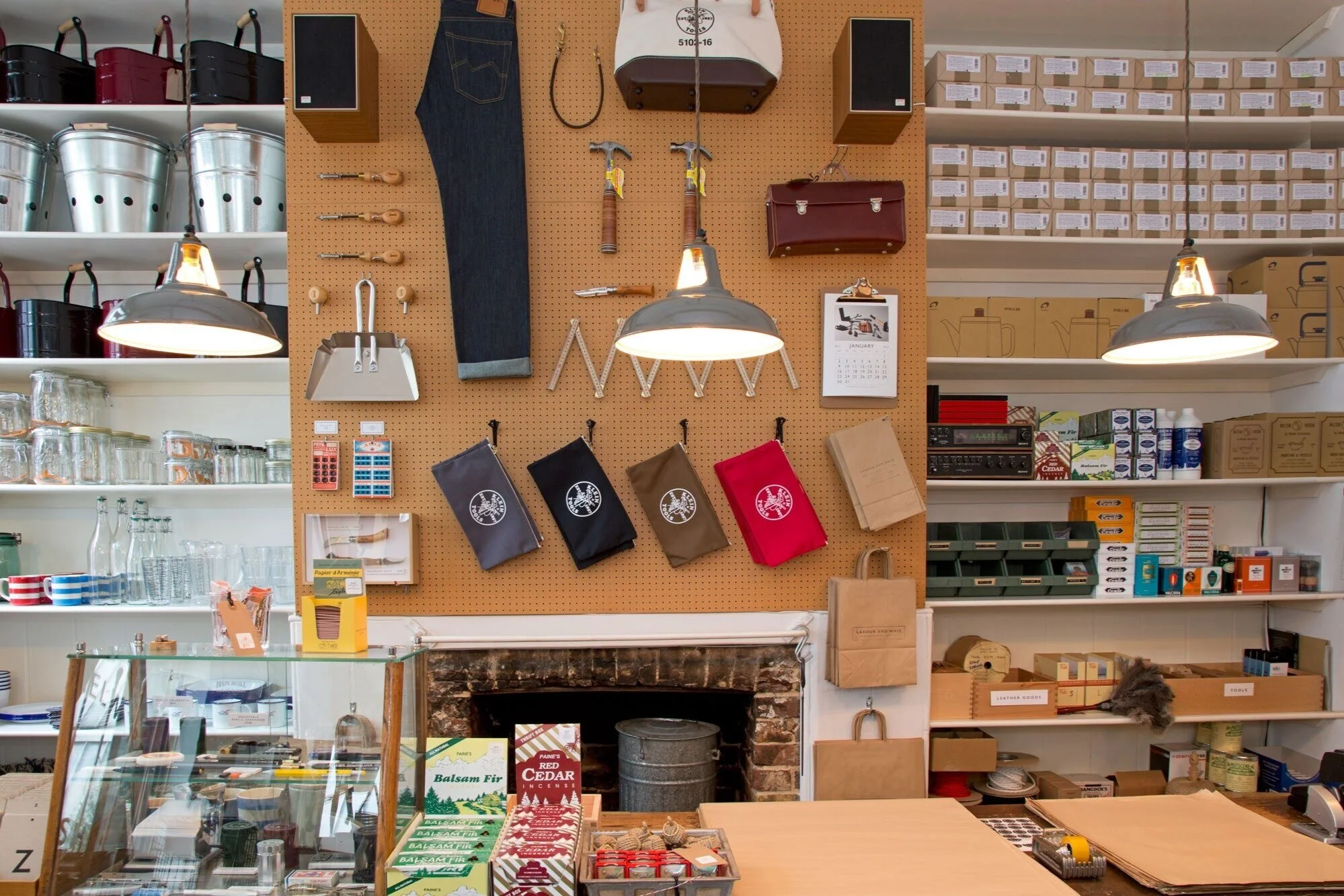
Shop Small Special: Labour and Wait
Timeless designs having a contemporary moment, London’s Labour and Wait will make you think differently about your dish brush.
What is it: This store makes buckets look good. A corner shop that combines the hardware with the artisan in a former pub (see the distinctive green tile of Truman Brewery) in Shoreditch and offers functional products for everyday life. Also now has an outpost in Tokyo.
What you need to know: Founded in 2000 by two designers, Rachel Wythe-Moran and Simon Watkins, frustrated by the endless cycles of fashion, Labour and Wait is based on their philosophy that good design should last. Their independent store is full of products that have stood the test of time – both in terms of the legacy behind them (products include blankets produced by the last remaining woolen mill in Wales) and in terms of how long they last when we get them back home (whether that be a dish brush or bottle opener). Think functional classics like Cornishware Mugs and essential hardware needs like an indoor brush that support traditional manufacturing and resist our current throwaway culture. Though very covetable, ironically Labour and Wait takes away the pressure to consume more. Rather it’s founded on durable and functional objects having their place in everyday life.
Why we think it's special: Apart from resisting our tendency to buy plastic and buy cheap with little concern for the person behind the making – the average person in North America and Western Europe consumes 100 kilograms of plastic each year — Labour and Wait is very much an ‘in-person’ store, human interactions are key to this bricks and mortar. On Black Friday instead of leading with product discounts and special offers, Labour and Wait donated 10% of sales to Crisis at Christmas which helps homeless people in the UK.
In their own words: “We believe in a simple, honest approach to design, where quality and utility are intrinsic. From hardware to clothing we offer a selection of timeless products that celebrate functional design and which are appropriate in a traditional or contemporary environment.”
In our gift edit: Carbon neutral enamelware from Riess of Austria, a recycled coffee cup made from discarded coffee grounds, a Scottish woolen blanket made from surplus yarns (it's cold out there, sometimes emotionally), and Labour and Wait’s signature apron.
In need of more Holiday inspiration? We’re a little in love with their shops of yesterday within their own shop: like a Haberdashery, Chemist and Stationer.
Something to inspire: We get stuck on toothbrushes. Or toilet brushes. The small things around our house that we somehow forget to buy sustainably. We fall very quickly into the plastic hole with these. Try to identify something in your house that you have a kneejerk anti-environment position on (there’s something, believe us) and just focus on getting that one thing more human-friendly (whether that’s how and where it’s made, how its production affects the planet and who the person is behind the product). Small steps. Later you can commit to a plastic-free lifestyle (no, we’re not there yet either).

Shop Small Special | Lifestory
Meander slowly online or off this Holiday Season with Scandi inspired concept store Lifestory.
What is it: A slow Scandi-oriented lifestyle store in Edinburgh.
What you need to know: Lifestory was founded in 2014 by Susan Doherty (who also started the city’s Hula Juice Bars) as Edinburgh’s first concept store — bringing together coffee and design — after being inspired by similar stores on her travels in places like Melbourne and Copenhagen. An airy, warm space, Lifestory offers a thoughtful edit of the Scandinavian-based (like House Doctor, ferm LIVING and Hay) and the Scandinavian-inspired (like Woolf & Moon and Kinshipped) with some Japanese simplicity added in there. During "normal times”, there’s coffee and cake for browsing the latest issue of Cereal.
Why we’ve included it here: Each independent store makes a circle of support: within the local community in which it’s located (with Lifestory located amongst the indies of Broughton Street) and the wider community of makers that it gives a platform to (in this case candle makers, jewelry designers, potters, graphic designers, furniture crafters). We often overlook the human in how we shop, the people behind stores, behind products and, behind our neighborhoods, so its good to be reminded of this by Susan: “Ultimately, the unique quality of Lifestory, as with all shops of this kind, lies with the owner’s relationship with the products, with the space itself and with their customers". A living wage employer, Lifestory also supports the people who work there.
In their own words: “Independently-owned and constantly evolving, Lifestory is a destination for lovers of Scandinavian design and lifestyle, considered products that share the traits of beauty and function.”
Our Christmas gift edit: We’re coveting many of the wall-based pieces such as Soo Burnell’s prints and the We Haven’t Located Us Yet print.
Something to do: Browse your neighborhood, even if virtually. Many independents have had to scramble to put their wares online in the last few months, extending their business ethos of bricks and mortar into digital platforms. That’s a huge transition and a very different way of working for many people who started shopfronts for the community aspect. This season if you’re not allowed, or able, to go out, take a virtual shopping journey through a local town, and shop like you would if you were able to meander with carols in the background and snow falling (yes, we’re romanticizing as we huddle inside). For inspiration, read this piece about how our neighborhood stores are coming together online.
To find out more: Website / Instagram / Twitter

Shop Small Special | Alice in Scandiland
We’re starting our Shop Small Holiday Special with Alice’s adventures in Scandiland.
When indie doors close at the most important time of the year (many shops make the bulk of their earnings in the run-up to the Holidays), our makers, shop owners, small-batch producers, and our communities struggle. In the weeks before Christmas, we’re focusing on independent stores that are anchor points in their neighborhoods, who support small themselves, and who make our worlds just that little bit better by existing.
In a moment when we can easily slip into the mass-produced at the expense of the environment, our makers, and ourselves — what do 80p black dresses really do for us and all those amazon deliveries we’re now relying on — we feel that shops that curate the handmade, that add to our high streets, and that give us places to go matter more than ever. If you can (we understand the competing pressures financially that many of us have this year), give independent stores in your community the gift of your support.
What is it: Scandinavian design comes to Cornwall courtesy of award-winning style blogger Alice Collyer.
Why you’ll love it: As with many independent stores, Alice in Scandiland started as a labor of love two years ago, when Alice decided to transform the inspiration for her blog and the vintage finds that she sold in her backyard She-Shed, into a bricks and mortar shop. Literally built out by Alice and her dad, Alice in Scandiland is very much an extension of her own home and life philosophy.
Why we think it matters: Hygge. Lagom. Fitka. Scandanavian concepts in living that have caught our attention, and which have themselves spun mini industries. But take away the quickly produced books and listicles that cash in on cool new words, pare all the trend styling back and they represent enduring healthy approaches to life. Alice got there before most of us, embracing the cult around all things Scandinavian (yes, we know they are better at everything than us now) when she started to makeover her own home by taking the things away she didn’t need and immediately felt the benefits of living with less.
Favoring a natural color palette and materials, integrating form with function, and bringing in light and nature where possible, Scandinavian design is all about creating a sense of stillness that is soothing in its calm. Its warm minimalism helps our environment too – items are made to last and owning less is foundational. If we’re fortunate to be able to work from home (and still not resent it), how we create our home environments will make even more of a difference to how we function. Alice may have been having adventures in Scandiland for a while, but they are adventures we can now share in worlds of our own making.
In conversation with 91 Magazine Alice says: “I love to champion independent makers, they are keeping amazing skills and crafts alive, putting their heart and soul into their creations. I firmly believe that it is these carefully considered pieces that add the meaningful finishing touches to a home and that’s not something you can buy for £3 in Primark. I am a strong advocate of buying less, but buying better.
It really doesn’t have to mean spending much more either, if you average it out over a year. It’s important that we all become more conscious consumers and support our local creatives. Add this with vintage, thrifted finds and it’s a total winner.”
In our gift guide: we recommend Sofia Lind’s white flower print, Laura Lane’s Cornish Textured Mug and for those thank you cards, Gemma Koomen’s note set.
How to bring this into your life: Want to recreate the pared-down look at home – think woven baskets, cozy textures, and handmade ceramics. Alice’s blog gives tons of tips. During usual times, Alice also acts as a small business mentor and hosts workshops including one on building as successful an Instagram platform as her own.

The Compassionate Frome Project a.k.a. Health Connections Mendip
How a small town in England is teaching us the value of community.
“Across the country, and across the world, people of good heart and goodwill are quietly working on imaginative projects to improve the quality of their own lives, the lives of those around them, and the world in which they live. Many such initiatives happen in relatively obscure places through the actions of ordinary people outside the usual centres of power who are motivated by that active concern for others which is the hallmark of compassion. Beyond the immediate benefits accruing from their work, those small committed groups may, consciously or unconsciously, be preparing the ground for radical change in the way society as a whole conducts its affairs. They are, in a real sense, encouraging us all to be more fully human.”
What is it: A different way of responding to the modern life ailments that present themselves at the doctor’s office, this experiment in connection as a remedy in the rural town of Frome has lessons for us all and has now been captured in the book The Compassionate Project: A Case for Hope & Humankindness from the Town that Beat Loneliness by Dr. Julian Abel and Lindsay Clarke.
What you need to know: People show up at their GP for reasons that go beyond the realm of medicine —social isolation amongst the elderly, loss of motivation due to developing an illness, fear stemming from changes in environment or lifestyle, a loss of self-esteem following a career or relationship shift — but they are often looking for an antidote that lies more in the realm of compassion.
Led by Dr. Helen Kingston, a GP in Frome’s Medical Practice, and Jenny Hartnoll, a local community development worker, the Compassionate Frome Project makes connections between people who need something to help their situation and the existing community resources that might respond to that need. Where gaps in initiatives exist, Health Connections Mendip develops new ones with the local community. The project has also established supportive infrastructure (such as arranging lifts and even accompanying clients shy of going alone) where there were issues of access.
Between 2013 and 2017, the Compassionate Frome Project led to a reduction in the rate of ER emergencies across the town by 15% at a moment when the county of Somerset in which Frome is located registered an increase of 30%.
Why you’ll love it: Those ten minutes you get with your doctor start to look very different within this model. Rather than prescribing a cure for loneliness, sadness, anxiety, or loss in the form of pills, another avenue is opened up that leads into the community, into interest groups, into motivations and connections of a different sort.
Why we think it's different: What we put into our lives — just as with food — has impacts on how we are able to live those lives. We now know that the quality of our social connections affects our health. Chronic loneliness increases by 20% the risk of early death. Good social relationships have been found to have more positive impacts on hypertension than medication, reduce inflammation, and minimize the risk of death more effectively than “losing weight, improving diet, and stopping smoking or drinking.” As authors Abel & Cole note in their book: “Though we identify ourselves as individuals, we actually live in the plural. We are interdependent beings cared for by the people around us who form those networks of relationship that provide us with support, companionship, and the basic necessities of life.”
The Compassionate Project has become a model for how we can improve our own situations by reaching out to the community around us and how we can attempt to resolve some of the modern conditions that are on the rise such as our sense of isolation, a growing lack of purpose, and a pervasive unease at our uncertain world, together. This idea is gaining ground: A Compassionate City Charter is being developed by the Welsh government and has been adopted by the towns of Plymouth and Inverclyde in the UK.
Something to do inspired by this project: Care for relationships in your life. Often we skim over the people in our lives, and invest our time elsewhere, like our careers or Netflix. Spend 15 minutes each day talking to someone you care about (from one of our favorite thinkers Dr. Vivek Murthy); write a letter, text, or WhatsApp message to someone you may have neglected; say hello to someone on your walk; put the phone away in the queue when you collect take-out or coffee, be aware of those around you. Even causal interactions impact how we feel and can lighten our days.

Magazine Brighton
Lost at home? Bring the world in with Magazine Brighton.
What is it: A renowned independent magazine store founded by long-term (since the age of 6) print-lover Martin Skelton.
Why you’ll love it: It’s a store with just thoughtfully selected indie magazine titles. Hundreds of them. Stacked on the floors, arranged on tables, front-facing on wall-shelves. Since it opened in 2014, the choice of titles has grown three-fold, which reflects both the stores growing audience and the growing indie publishing sector.
What you need to know: After years of traveling internationally and finding this very kind of store abroad, Skelton bet it all by bringing the concept to his adopted home town of Brighton. Keep in mind the context: people were more used to WH Smith for their magazines and London as the kind of place to position such an idea.
What they offer if you can’t get to Brighton (which is all of us at the moment): The online site now aims to replicate the density of the store, with lessons learned from the first and now second lockdowns on how to make things easily browsable (maybe too easily as we deposited way too many magazines in our cart while writing this). Magazine Brighton also posts the latest arrivals to their Instagram if you need inspiration and some new discoveries. Like Oh Mag and Openhouse.
Why we think it matters: Magazines were almost (almost) made for this moment. The push against the digital, the celebration of creativity in print, and the small-batch focus, all speak to our collective longing for less digital interfacing, less homogenized products, and less corporate gain. But for us, the reason we think magazines matter as much as they do, particularly now, is that they bring other voices into our homes and different stories into our lives. They are all about engagement.
When our worlds shrink to just four walls and that same world insists that we pay attention to its diversity, magazines hold space for lives lived differently, experiences outside of our comfort zones, and ideas previously unconsidered. This is particularly crucial when you realize that there is no algorithm in this bookstore, or within the pages themselves, shifting what you get to see. There is no dominant narrative. There is no ‘them’ and ‘us’ in curating these titles. Collectively this amalgamation of stories, images, and design, lends something of the normal again in how we’re able to converse and interact and be with one another.
Somewhere like Magazine Brighton is putting you back in control again of the content you get to consume and giving you an entry to connect with the world no matter what state it's in.
In their own words: “Al, my son-in-law, described our shop as ‘Like vinyl, but print’ and it’s a great phrase. Without trying to sound like one of those old intelligence tests, indy magazines are to conventional magazines as vinyl is to digital, artisan bread is to Wonderloaf, microbreweries are to the big brewers, farm-made cheese is to factory-made cheese, and so on. There’s nothing wrong with any of those things in their place but I think there’s enough people out there who want a balance as well.’ – Skelton talking to Mag Culture
Something to read: For a guide that’s all about getting to ok, we’d recommend these wellbeing focused magazines: Rising Issue – 01 // Mental Health Matters; What Do People Do? – Issue 2; Anxiety Empire – Issue 1, Positive Wellbeing — A Zine for Mums, Seed, and perennial favorite Flow.

FForest
As many of us have realized how vital nature is to how we function in our worlds, places like Fforest have been holding that idea for a while for us.
What is it: Oh that’s a tough one. We hesitate to put it in any of the buckets — glamping, nature retreat, lifestyle brand, eco camp, staycation — so we’ll go with this. Fforest is what happens when someone dreams something and makes it happen for all of us. Sorry, that’s not so helpful. Let’s jump to here:
What you need to know: Conceived by two London creatives, Sian Tucker and James Lynch, graduates of the Royal College and St Martins who had found a way to live the good life in Shoreditch and New Zealand, before taking some of that to Fforest. On 500 acres in Wales, they have created a magical place to pursue the simple life with their family of four boys and many, many others. Fforest takes form across specially designed places to stay — geodesic domes, hill and garden shacs, crog lofts, a stone farmhouse, and Kata Cabins. Each is furnished in that way that hand made can feel luxurious: with craft furniture, Welsh woolen blankets, and small touches like wildflowers in enamel jugs on arrival. What is in essence a thoughtfully designed situation makes the best of life, of our natural world, and the things right there in front of us (no, not washing up, your mobile phone, or screaming in-box). Rather they have built a spirit of slow, of play, of untethering,
While there: Book a pizza night in town at their tented restaurant in Cardigan or supper in the woods at Hydref (where you order ahead to reduce food waste, also note the repurposed 24 classroom doors), seek out ‘the bwythn’, a tiny pub that serves their own IPA, or if a sauna is more your style, head to the wooden cedar barrel. Getting out into the natural surroundings is encouraged, in fact, part of the religion here: walk the coastal path, find the National Trust beach Penbryn, or take a canoe along Teifi gorge. And if it all sounds very grown-up, that’s not true. Kids are very much welcome to run free — there’s even a family summer camp of sorts in the form of Gather 2021.
How to bring this into your life: All the wisdom for living the Fforest lifestyle at home is captured in Sian’s book: ”Fforest: Being, Doing, and Making in Nature.” Create a tiny bit of the magic, with star walks, wild swims, and den building.
Why it caught our attention now: In a year that has taught us the pleasure in the simple, in each other, and in nature (amongst many, many other hard-won lessons), Fforest has been ahead of us, speaking this language for a while. All the components of a good life – defined here as one lived slowly, locally and with meaning are woven into the ethos of this place: food is served to be collectively enjoyed, ingredients are sourced from the farm gardens, architecture from repurposed materials encourage a feeling of sanctuary. Think low environmental footprint, high human value. It’s all designed to linger: over sunsets and views, firepits and new friendships, in wildflower meadows and outdoor terraces. Life is lived in the details; how we spend time with each other and how we exist in place is not the stuff of life’s periphery but its core.
Favorite thing said about this place: “How to describe Fforest? Labelling it a campsite would be like calling El Bulli a café. Instead, picture a hip hybrid of Welsh farm and Japanese forest retreat, where you can get up close and personal with nature.”
In their own words: “The dream would be about celebrating how good ‘simple’ could look, feel and taste. The dream was to combine the life-enhancing feeling of living outdoors with the simplest of things all wrapped up in the luxury of a magical setting, underpinned by all the design and creative skills that Sian & I had learned over the years.” – James (@fforestchief)
One piece of advice we take from Fforest: As the cold sets in here, we’re taking Fforest’s advice to ‘Do Winter Well: Embrace winter with candles, fires, beautifully crafted food, long cozy lie-ins & woodland walks.” Add a thick blanket and cute PJs and we’re preparing to face this winter, maybe more alone than we like, but ready to get together when the weather turns again.

Another Place
In a moment when time is stretching out, Anthony Gormley’s “Iron Men” captures the wonder of shifting lives.
What is it: An extraordinary public artwork by British sculpture Sir Antony Gormley permanently installed on Crosby Beach in the North of England. One hundred cast-iron figures stand facing the horizon across a 2-mile radius of the beach. These naked figures were cast from the artist’s own body, though are rendered in different states of serenity. Since 2005, over 650,000 people have born witness to these “Iron Men”, while Turner Contemporary in Margate now has its own companion work Another Time XXI.
Why you’ll love it: In a moment when we’re being forced to live in the details of our lives, to notice changing colors on daily walks or even the differentiations in the wallpaper of our homes, Another Place is similarly about the passage of time. The subtle and major shifts that happen with these figures within a very demarcated area, feels like those that happen within our own individual – and now collective – experiences.
Sometimes the tide obscures the figures, sometimes it reveals them. Sometimes the shifting sands submerge them, before allowing them to emerge again. Barnacles grow along their limbs, rust disrupts the surfaces. The tides, the weather, the industrial backdrop, alter what this sculpture can be at different times of the day, in different seasons, in different years. Though it looks static, these weighty presences (weighing just under a ton each), when subject to nature are not permanently the same.
What you need to know: Oddly peripatetic themselves, the sculptures were previously exhibited on coastlines in Germany, Norway, and Belgium — and never found their way to their next destination, New York. In their own movements, and now final place, Gormley brings up the complex emotions associated with emigration, the anxiety around movement, the hope that such movement might bring, and the resoluteness when we find our place.
Why we think it matters: This is art not confined to the white-walled gallery. At the mercy of nature, open to anyone, Gormley recognizes the possibility of his work to capture the imagination of everyone from art pilgrims to dog walkers, beach lovers to sandcastle-building kids. Awe and wonder are held in these forms, the spaces between them and the spaces between those on the beach with them. Of Another Place Gormley has said:
“I want to see whether it’s possible for art to be everyone’s, in the same way that the sky is and it still seems to me, that that is the most exciting challenge in art. Can you make the conditions that surround us all the time, into an arena for a kind of awareness that wouldn’t exist before, and I guess Another Place is a good example of this, where we have a beach, we have tide, we have changing conditions of weather and night and day and into that you insert these works, but adequately spaced, to allow for people to walk between them and in fact it’s the space between that is critical always in the work.”
Or in their own words — well writer Jeanette Winterson’s: “Standing modestly at their posts, the Gormley bodies are guides. They have something of ancient Earth about them — these metal men, as though they have erupted out of the iron core of the world, uncertain of human form, not smoothed by millennia of natural selection, but only now cooled from molten. They could be an older life-form pushed up, tectonically, by a shift in the Earth’s plates, or returned from a past too old to imagine, through some yawn in time.”
How to bring this into your life: Take a masterclass with the artist: choose between Zabludowicz Collection talk, BBC’s quarantine drawing class or National Saturday Club’s body sculpting exercise.
To find out more: Website
Discover more places for life

The Good Life Experience
Is it too soon to start planning for a different year? The Good Life Experience is one festival that might get you back to enjoying everything that life has to offer.
What is it: Billed as a festival like no other, The Good Life Experience takes place over a long autumn weekend on a castle estate in North Wales and has all the things that you’d hope to have in your regular life — great music, creative expression, inspirational books, time in the great outdoors, incredible food — to give you a taster of The Good Life. Founded by Cerys Matthews, Steve Abbot, and Charlie and Caroline Gladstone in 2014 to be ‘more than just’, from its starting point of “powerful, memorable and — most importantly — FUN experiences.”, it has since expanded to include Summer Camps, a dog-diving competition, and a range of activities for our grown-up inner children like fairground rides, ax throwing, and blacksmithing!
Why you’ll love it: Sometimes we think of The Good Life like our guide made in festival format: it has all the components that we try to weave together in the way that we approach the world: connection, nature, wellness, untethering, purpose, meaning, awe, creativity and doing good. All that is needed for our wellbeing.
Or see it like a favorite lifestyle magazine that makes all the things recommended and talked about happen in the real world rather than just on the page, so there’s the latest authors talking about their writings, top chefs cooking their recipes with us, sustainably produced fashion and small independent makers to shop, and travel spreads on glamping that you get to inhabit for a few nights. It's all there for real-world engagement.
Or consider it like how kids feel when they get to a theme park and want to do all the things and they have that squeaky voice and excitement inside, but here it’s us grown-ups (though many of us with our kids) wanting to do all the things too. On our list are floristry and weaving, dancing to new bands then star gazing, faery card reading, and campfire cooking sessions.
In short, The Good Life Experience is a playground of the thoughtfully curated and frankly just fun for the curious and the seekers among us.
What you need to know: Are we allowed to plan ahead yet? If so, booking a slot at The Good Life Experience is high on our list of things to do for making 2021 nothing like 2020. (Tickets are already available for next year’s festival taking place from 29 April to 2 May and the waitlist for them has already started — which we’re now also on, sigh).
How to bring this into your life: The Good Life Experience is not just a festival anymore, it’s becoming a way of life to access year-round. And when lockdown happened (and is happening again) the team behind it got active: see a community shop in a pub, new podcasts and daily posters, Some Good Ideas, and a whole array of Good Life Experiences to do at home. At the time of writing, you can participate in the new project Lockdown Radio and an All Day Communion, a partnership with writer Mark Shayler. Out of festival hours, there are also weekend camps at sister project Glen Dye in Scotland and open through all the times their farm shop on Hawarden Estates.
Why we think it’s different: There was a moment not that long ago when making anything other than toast for breakfast was seen as the norm and self-care extended to a long bath. Maybe we learned knitting from our nans, or we tried Jamie Oliver when we needed to cook, or we got into the National Trust to go outdoors. But then something shifted, hugely. With the constant demands of our working and online lives, a planet on a horribly destructive path, and daily life that’s getting harder on our minds and souls, many of us are now seeking out the different and the good and the life-affirming. We’re looking for ways to connect with something slower, more meaningful, and dare we say it more human.
Such pastimes as wild swimming, crafting, and poetry, have become newly popular and widely sought out. Just think about those sourdough starters and new crocheted wall pieces that you started in Lockdown. We turn to other things when the world turns inside out, and often these are simple pleasures, the people around us, and the natural world.
Where once The Good Life Experience was a singular way of being, now more of us are open to experiences that help us find new ways of navigating our lives and having better, more joyful, and sustainable days as we do so. If The Good Life Experience becomes just an interruption in the year from all the things that make modern life what it is than that’s great, but taking new discoveries beyond the weekend has the capacity to help year-round.
In their own words: “At its core, this movement can best be defined, perhaps, as The Search for The Good Life; a life that’s fulfilled and considered, yes, but is also fun and values the things that matter... family, friends, a real connection with The Great Outdoors, proper food and drink, discovery, music that comes from the soul, great books, craft. All the things that don’t cost a great deal but that make life richer, more rewarding, and better fun.”
To find out more: Website / Instagram / Twitter / Facebook
Additionally try: The Big Retreat

Pilea Plant Shop
Head to Pilea to choose a houseplant that won’t just brighten your room but also brighten your day.
What is it: A gorgeous shop devoted to houseplants situated at the top of Frome’s hill of independents.
Why you’ll love it: With names like Monstera deliciosa cheese plants, Calathea lancifolia rattlesnakes, and Sedum burritos you might be confused about what you are choosing, and how to care for it. But at Pilea, it's all about bringing you together with a plant that you love and that you feel able to care for.
What you need to know: With everyday and exotic selections, the people who work here are happy to consult with you about which plant will thrive in your home. They’ll even send you on your way with a short guide to making your plant happy (ie keeping it alive).
How to bring this into your life: When the store closes, the carefully chosen plants head online. Workshops aren’t running at the moment, but when they are we recommend you check them out for some creative plant inspiration.
Why we think it matters: Bringing greenery into our home is an act of conscious self-care. Having houseplants around us has been connected to a better sense of calm and well-being, reduced anxiety, and a happier mood. They have even been connected to better concentration and improved memory, as well as physiological benefits like higher pain tolerance, lower blood pressure, and reduced headaches, fatigue, and cortisol levels. Add to this that some houseplants have been shown to improve air quality – NASA even has a list of which ones to buy for your homes. That Ficus plant that you may be coveting for your lounge looks good but it also supports human health.
In their own words: “Pilea plant shop provides beautiful and more unusual houseplants. It's really important that our customers feel confident taking a plant home to nurture. These days there are so many varieties of houseplants available. We love getting excited with people about the varieties that can be sourced, helping them understand how to look after them in their homes, replicating the tropical climates that the plants often originate from.”